Cambridge IGCSE English - Literature 0486 — 2017 Oct/Nov Paper 4 · Variant 3
0486/43/O/N/17 · 25 marks · ≈28 min
The question paper and its mark scheme, free to read here and free to download. This is Cambridge’s own paper, exactly as it was sat.
Question paper8 pages
Mark scheme3 pages
Answers below. Sit the paper first if you are practising.
Paper as text
Question paper, page 1
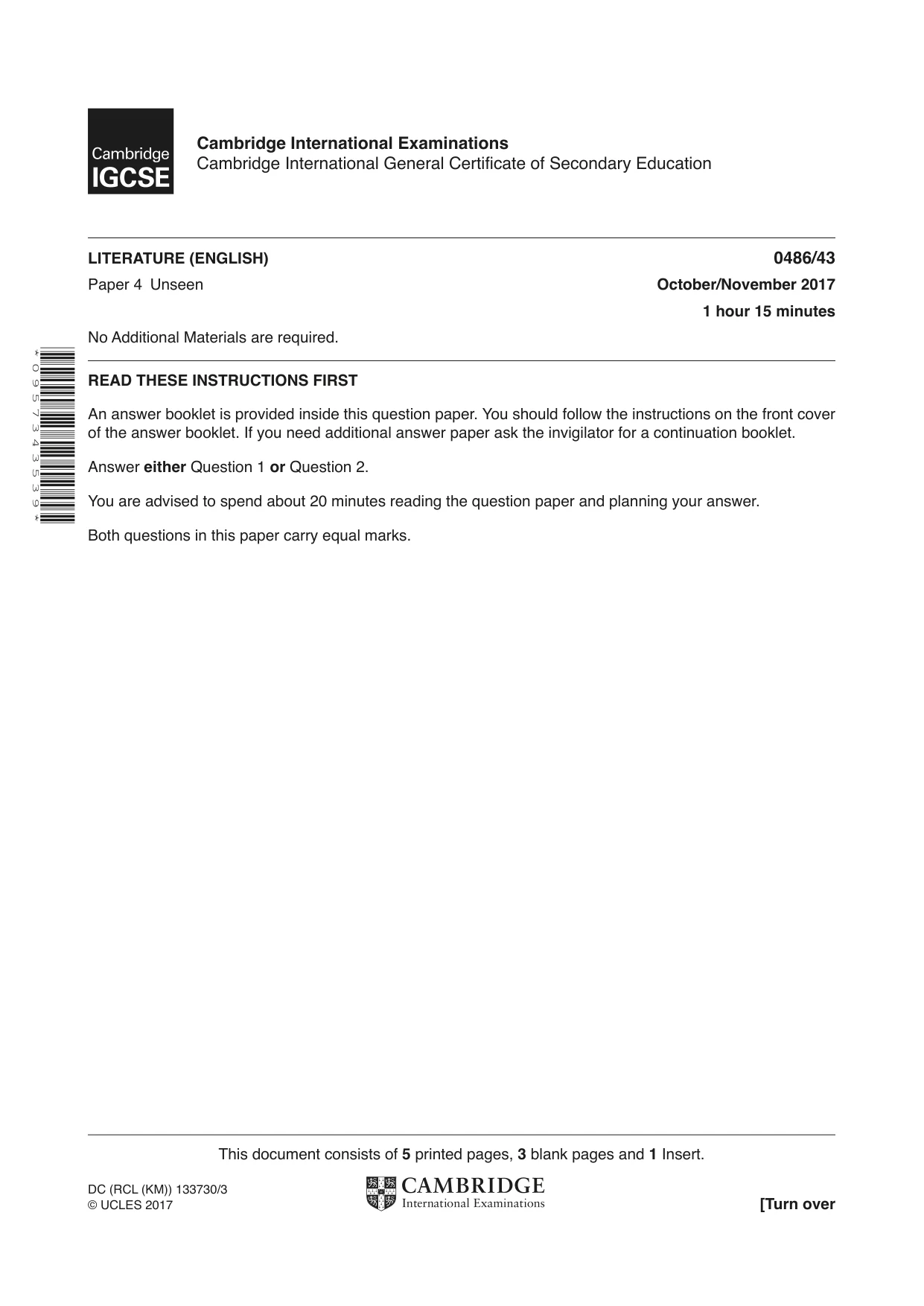
This document consists of 5 printed pages, 3 blank pages and 1 Insert. DC (RCL (KM)) 133730/3 © UCLES 2017 [Turn over Cambridge International Examinations Cambridge International General Certificate of Secondary Education * 0 9 5 7 3 4 3 5 3 9 * LITERATURE (ENGLISH) 0486/43 Paper 4 Unseen October/November 2017 1 hour 15 minutes No Additional Materials are required. READ THESE INSTRUCTIONS FIRST An answer booklet is provided inside this question paper. You should follow the instructions on the front cover of the answer booklet. If you need additional answer paper ask the invigilator for a continuation booklet. Answer either Question 1 or Question 2. You are advised to spend about 20 minutes reading the question paper and planning your answer. Both questions in this paper carry equal marks.
Question paper, page 2
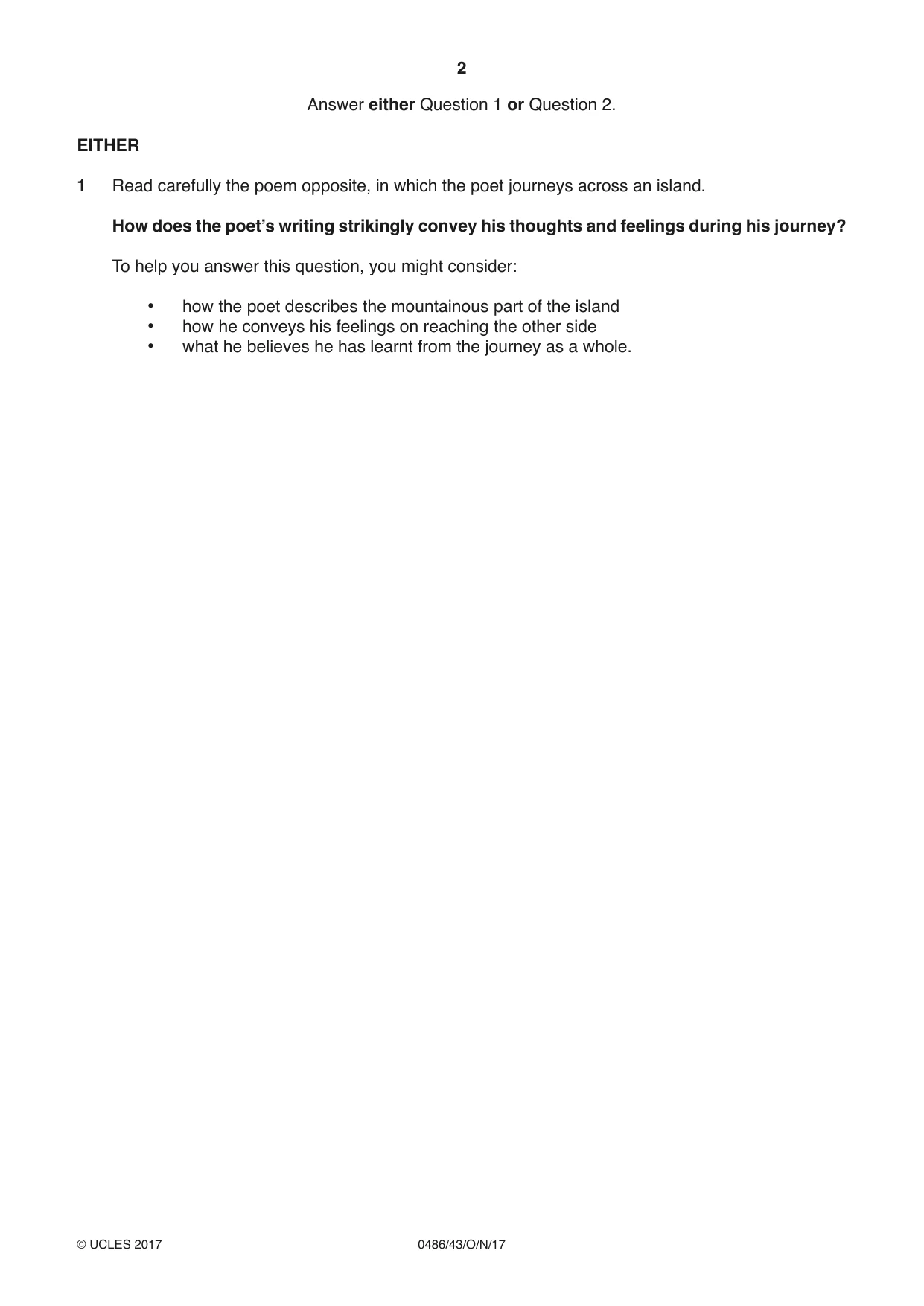
2 0486/43/O/N/17 © UCLES 2017 Answer either Question 1 or Question 2. EITHER 1 Read carefully the poem opposite, in which the poet journeys across an island. How does the poet’s writing strikingly convey his thoughts and feelings during his journey? To help you answer this question, you might consider: • how the poet describes the mountainous part of the island • how he conveys his feelings on reaching the other side • what he believes he has learnt from the journey as a whole.
Question paper, page 3
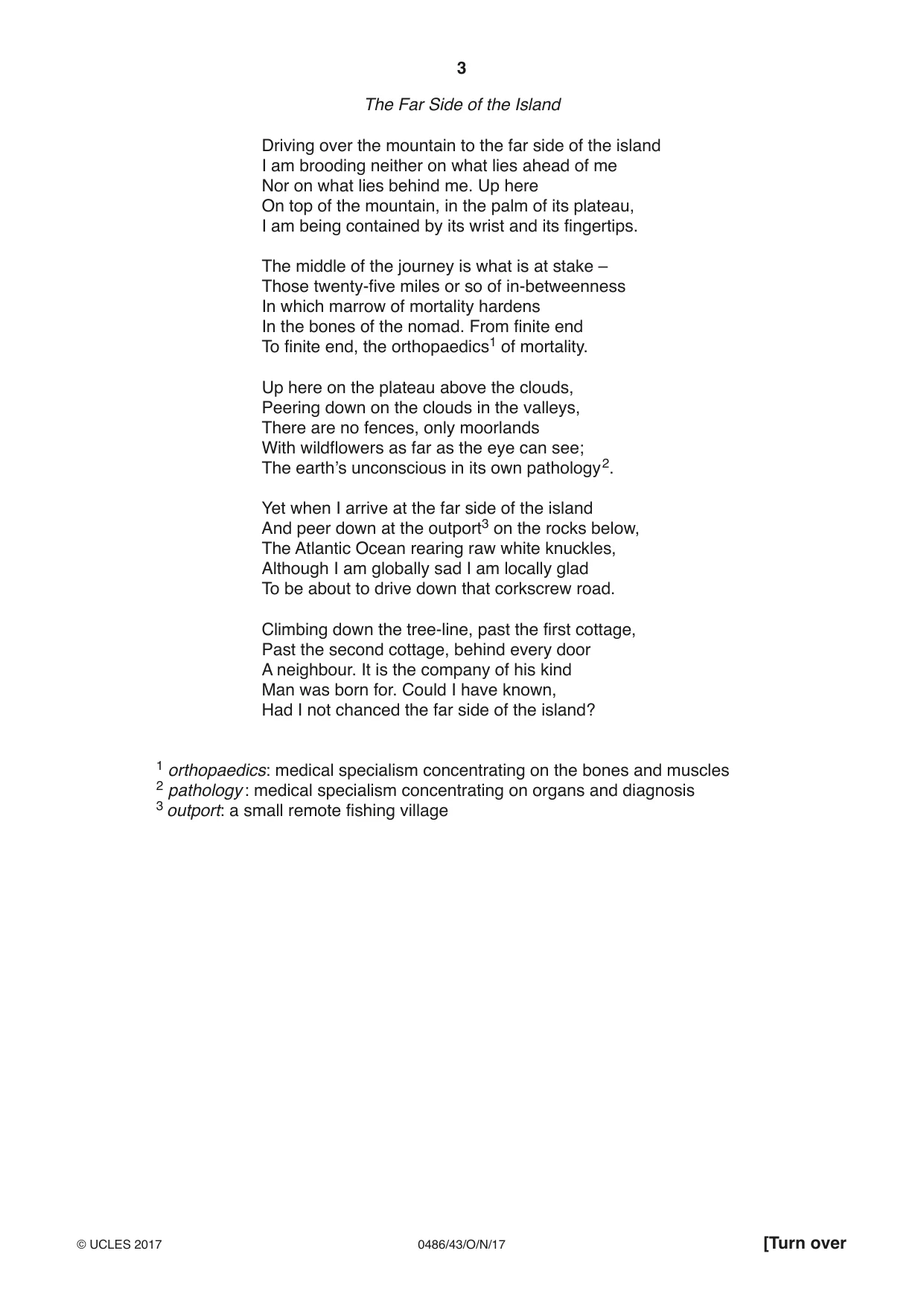
3 0486/43/O/N/17 © UCLES 2017 [Turn over The Far Side of the Island Driving over the mountain to the far side of the island I am brooding neither on what lies ahead of me Nor on what lies behind me. Up here On top of the mountain, in the palm of its plateau, I am being contained by its wrist and its fingertips. The middle of the journey is what is at stake – Those twenty-five miles or so of in-betweenness In which marrow of mortality hardens In the bones of the nomad. From finite end To finite end, the orthopaedics1 of mortality. Up here on the plateau above the clouds, Peering down on the clouds in the valleys, There are no fences, only moorlands With wildflowers as far as the eye can see; The earth’s unconscious in its own pathology 2. Yet when I arrive at the far side of the island And peer down at the outport3 on the rocks below, The Atlantic Ocean rearing raw white knuckles, Although I am globally sad I am locally glad To be about to drive down that corkscrew road. Climbing down the tree-line, past the first cottage, Past the second cottage, behind every door A neighbour. It is the company of his kind Man was born for. Could I have known, Had I not chanced the far side of the island? 1 orthopaedics: medical specialism concentrating on the bones and muscles 2 pathology : medical specialism concentrating on organs and diagnosis 3 outport: a small remote fishing village
Question paper, page 4
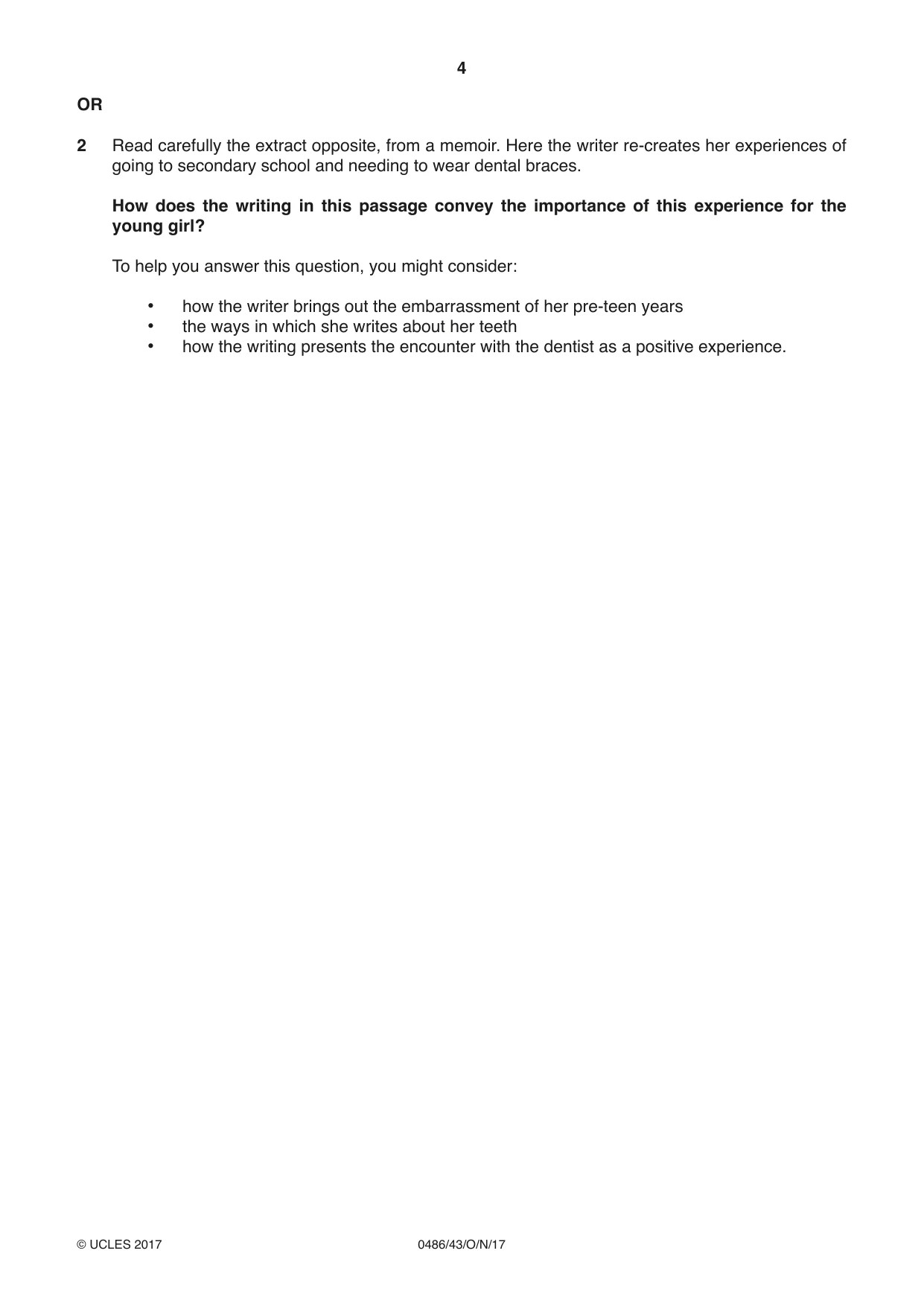
4 0486/43/O/N/17 © UCLES 2017 OR 2 Read carefully the extract opposite, from a memoir. Here the writer re-creates her experiences of going to secondary school and needing to wear dental braces. How does the writing in this passage convey the importance of this experience for the young girl? To help you answer this question, you might consider: • how the writer brings out the embarrassment of her pre-teen years • the ways in which she writes about her teeth • how the writing presents the encounter with the dentist as a positive experience.
Question paper, page 5
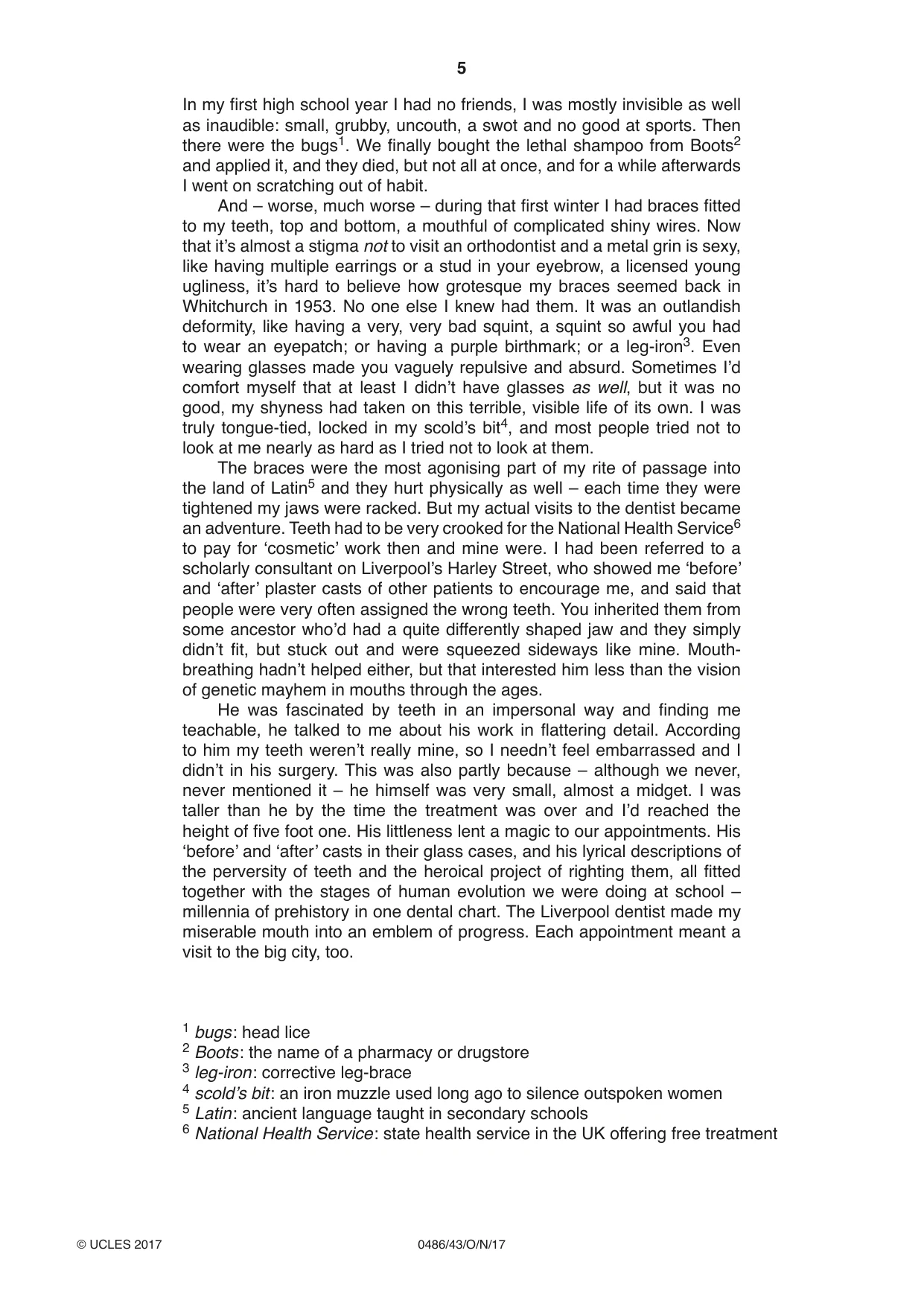
5 0486/43/O/N/17 © UCLES 2017 In my first high school year I had no friends, I was mostly invisible as well as inaudible: small, grubby, uncouth, a swot and no good at sports. Then there were the bugs1. We finally bought the lethal shampoo from Boots2 and applied it, and they died, but not all at once, and for a while afterwards I went on scratching out of habit. And – worse, much worse – during that first winter I had braces fitted to my teeth, top and bottom, a mouthful of complicated shiny wires. Now that it’s almost a stigma not to visit an orthodontist and a metal grin is sexy, like having multiple earrings or a stud in your eyebrow, a licensed young ugliness, it’s hard to believe how grotesque my braces seemed back in Whitchurch in 1953. No one else I knew had them. It was an outlandish deformity, like having a very, very bad squint, a squint so awful you had to wear an eyepatch; or having a purple birthmark; or a leg-iron3. Even wearing glasses made you vaguely repulsive and absurd. Sometimes I’d comfort myself that at least I didn’t have glasses as well, but it was no good, my shyness had taken on this terrible, visible life of its own. I was truly tongue-tied, locked in my scold’s bit4, and most people tried not to look at me nearly as hard as I tried not to look at them. The braces were the most agonising part of my rite of passage into the land of Latin5 and they hurt physically as well – each time they were tightened my jaws were racked. But my actual visits to the dentist became an adventure. Teeth had to be very crooked for the National Health Service6 to pay for ‘cosmetic’ work then and mine were. I had been referred to a scholarly consultant on Liverpool’s Harley Street, who showed me ‘before’ and ‘after’ plaster casts of other patients to encourage me, and said that people were very often assigned the wrong teeth. You inherited them from some ancestor who’d had a quite differently shaped jaw and they simply didn’t fit, but stuck out and were squeezed sideways like mine. Mouth- breathing hadn’t helped either, but that interested him less than the vision of genetic mayhem in mouths through the ages. He was fascinated by teeth in an impersonal way and finding me teachable, he talked to me about his work in flattering detail. According to him my teeth weren’t really mine, so I needn’t feel embarrassed and I didn’t in his surgery. This was also partly because – although we never, never mentioned it – he himself was very small, almost a midget. I was taller than he by the time the treatment was over and I’d reached the height of five foot one. His littleness lent a magic to our appointments. His ‘before’ and ‘after’ casts in their glass cases, and his lyrical descriptions of the perversity of teeth and the heroical project of righting them, all fitted together with the stages of human evolution we were doing at school – millennia of prehistory in one dental chart. The Liverpool dentist made my miserable mouth into an emblem of progress. Each appointment meant a visit to the big city, too. 1 bugs : head lice 2 Boots : the name of a pharmacy or drugstore 3 leg-iron : corrective leg-brace 4 scold’s bit : an iron muzzle used long ago to silence outspoken women 5 Latin : ancient language taught in secondary schools 6 National Health Service : state health service in the UK offering free treatment
Question paper, page 6
6 0486/43/O/N/17 © UCLES 2017 BLANK PAGE
Question paper, page 7
7 0486/43/O/N/17 © UCLES 2017 BLANK PAGE
Question paper, page 8
8 0486/43/O/N/17 © UCLES 2017 BLANK PAGE Permission to reproduce items where third-party owned material protected by copyright is included has been sought and cleared where possible. Every reasonable effort has been made by the publisher (UCLES) to trace copyright holders, but if any items requiring clearance have unwittingly been included, the publisher will be pleased to make amends at the earliest possible opportunity. To avoid the issue of disclosure of answer-related information to candidates, all copyright acknowledgements are reproduced online in the Cambridge International Examinations Copyright Acknowledgements Booklet. This is produced for each series of examinations and is freely available to download at www.cie.org.uk after the live examination series. Cambridge International Examinations is part of the Cambridge Assessment Group. Cambridge Assessment is the brand name of University of Cambridge Local Examinations Syndicate (UCLES), which is itself a department of the University of Cambridge.
Mark scheme, page 1
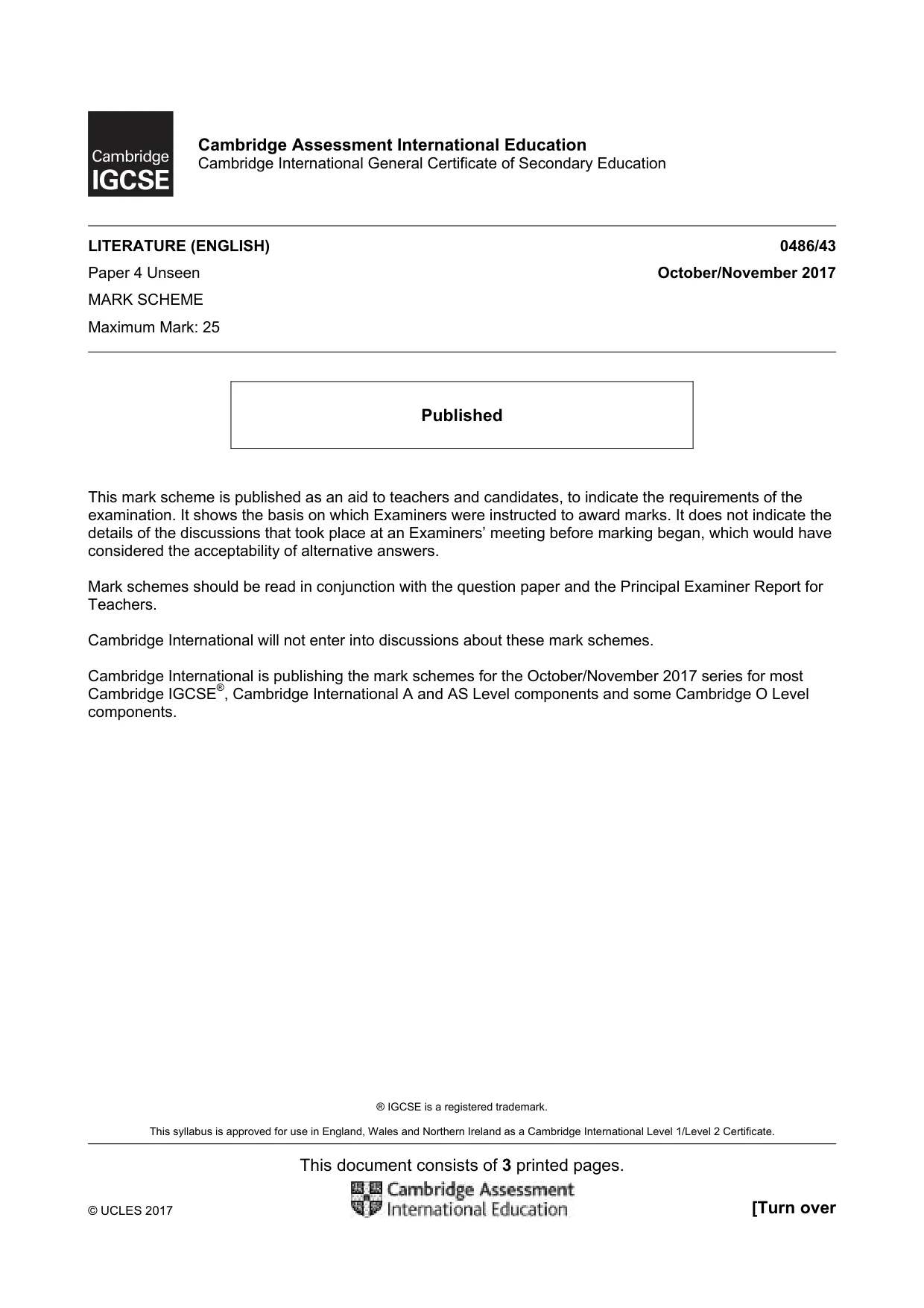
® IGCSE is a registered trademark. This syllabus is approved for use in England, Wales and Northern Ireland as a Cambridge International Level 1/Level 2 Certificate. This document consists of 3 printed pages. © UCLES 2017 [Turn over Cambridge Assessment International Education Cambridge International General Certificate of Secondary Education LITERATURE (ENGLISH) 0486/43 Paper 4 Unseen October/November 2017 MARK SCHEME Maximum Mark: 25 Published This mark scheme is published as an aid to teachers and candidates, to indicate the requirements of the examination. It shows the basis on which Examiners were instructed to award marks. It does not indicate the details of the discussions that took place at an Examiners’ meeting before marking began, which would have considered the acceptability of alternative answers. Mark schemes should be read in conjunction with the question paper and the Principal Examiner Report for Teachers. Cambridge International will not enter into discussions about these mark schemes. Cambridge International is publishing the mark schemes for the October/November 2017 series for most Cambridge IGCSE®, Cambridge International A and AS Level components and some Cambridge O Level components.
Mark scheme, page 2
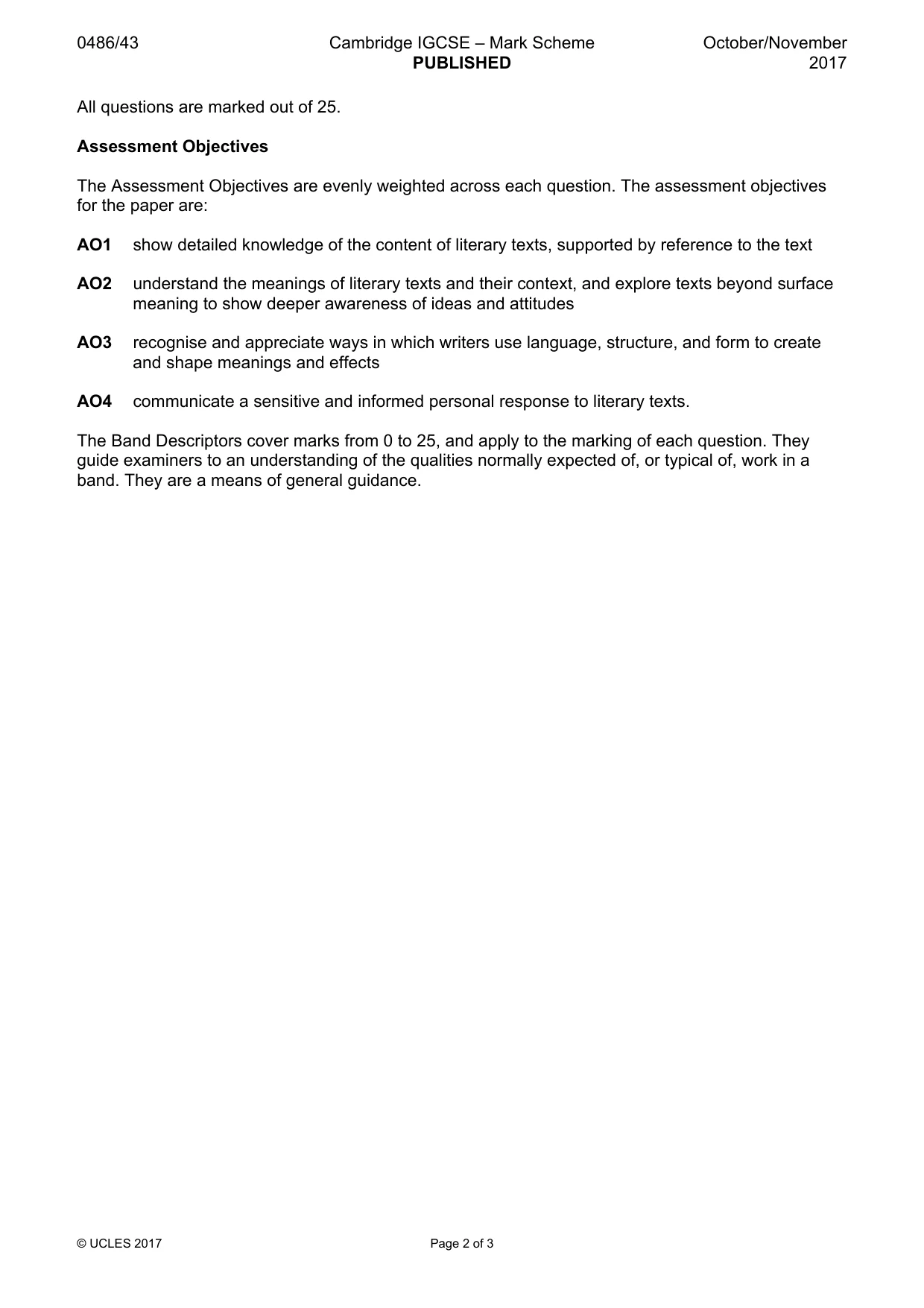
0486/43 Cambridge IGCSE – Mark Scheme PUBLISHED October/November 2017 © UCLES 2017 Page 2 of 3 All questions are marked out of 25. Assessment Objectives The Assessment Objectives are evenly weighted across each question. The assessment objectives for the paper are: AO1 show detailed knowledge of the content of literary texts, supported by reference to the text AO2 understand the meanings of literary texts and their context, and explore texts beyond surface meaning to show deeper awareness of ideas and attitudes AO3 recognise and appreciate ways in which writers use language, structure, and form to create and shape meanings and effects AO4 communicate a sensitive and informed personal response to literary texts. The Band Descriptors cover marks from 0 to 25, and apply to the marking of each question. They guide examiners to an understanding of the qualities normally expected of, or typical of, work in a band. They are a means of general guidance.
Mark scheme, page 3
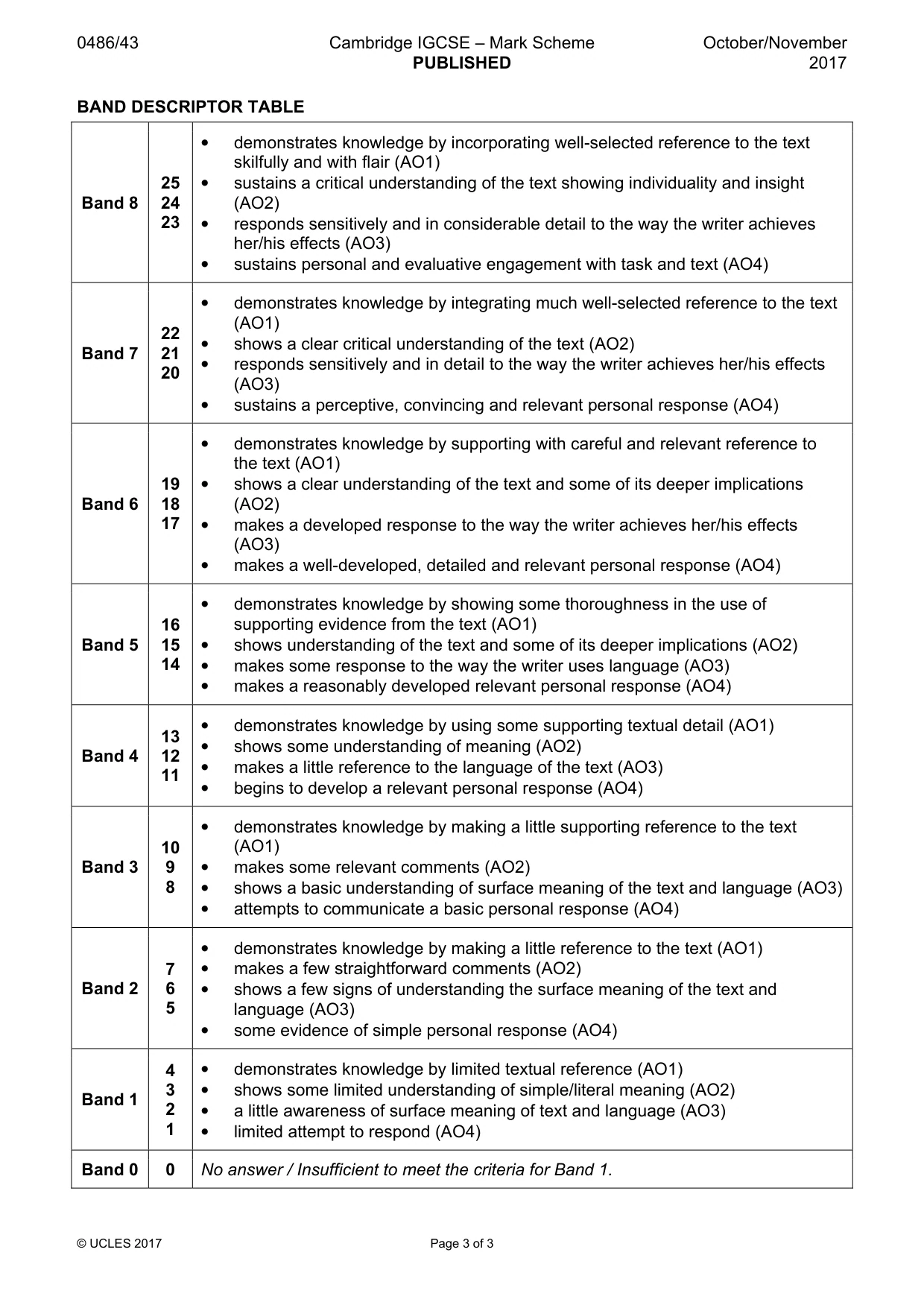
0486/43 Cambridge IGCSE – Mark Scheme PUBLISHED October/November 2017 © UCLES 2017 Page 3 of 3 BAND DESCRIPTOR TABLE Band 8 25 24 23 • demonstrates knowledge by incorporating well-selected reference to the text skilfully and with flair (AO1) • sustains a critical understanding of the text showing individuality and insight (AO2) • responds sensitively and in considerable detail to the way the writer achieves her/his effects (AO3) • sustains personal and evaluative engagement with task and text (AO4) Band 7 22 21 20 • demonstrates knowledge by integrating much well-selected reference to the text (AO1) • shows a clear critical understanding of the text (AO2) • responds sensitively and in detail to the way the writer achieves her/his effects (AO3) • sustains a perceptive, convincing and relevant personal response (AO4) Band 6 19 18 17 • demonstrates knowledge by supporting with careful and relevant reference to the text (AO1) • shows a clear understanding of the text and some of its deeper implications (AO2) • makes a developed response to the way the writer achieves her/his effects (AO3) • makes a well-developed, detailed and relevant personal response (AO4) Band 5 16 15 14 • demonstrates knowledge by showing some thoroughness in the use of supporting evidence from the text (AO1) • shows understanding of the text and some of its deeper implications (AO2) • makes some response to the way the writer uses language (AO3) • makes a reasonably developed relevant personal response (AO4) Band 4 13 12 11 • demonstrates knowledge by using some supporting textual detail (AO1) • shows some understanding of meaning (AO2) • makes a little reference to the language of the text (AO3) • begins to develop a relevant personal response (AO4) Band 3 10 9 8 • demonstrates knowledge by making a little supporting reference to the text (AO1) • makes some relevant comments (AO2) • shows a basic understanding of surface meaning of the text and language (AO3) • attempts to communicate a basic personal response (AO4) Band 2 7 6 5 • demonstrates knowledge by making a little reference to the text (AO1) • makes a few straightforward comments (AO2) • shows a few signs of understanding the surface meaning of the text and language (AO3) • some evidence of simple personal response (AO4) Band 1 4 3 2 1 • demonstrates knowledge by limited textual reference (AO1) • shows some limited understanding of simple/literal meaning (AO2) • a little awareness of surface meaning of text and language (AO3) • limited attempt to respond (AO4) Band 0 0 No answer / Insufficient to meet the criteria for Band 1.
What you needed in this session
Cambridge’s own grade thresholds for 2017 Oct/Nov, Paper 4 · Variant 3. A higher threshold means an easier paper — the bar moves with how the cohort did.