Cambridge IGCSE English - Literature 0486 — 2016 May/June Paper 4 · Variant 3
0486/43/M/J/16 · 25 marks · ≈28 min
The question paper and its mark scheme, free to read here and free to download. This is Cambridge’s own paper, exactly as it was sat.
Question paper8 pages


Mark scheme3 pages
Answers below. Sit the paper first if you are practising.
Paper as text
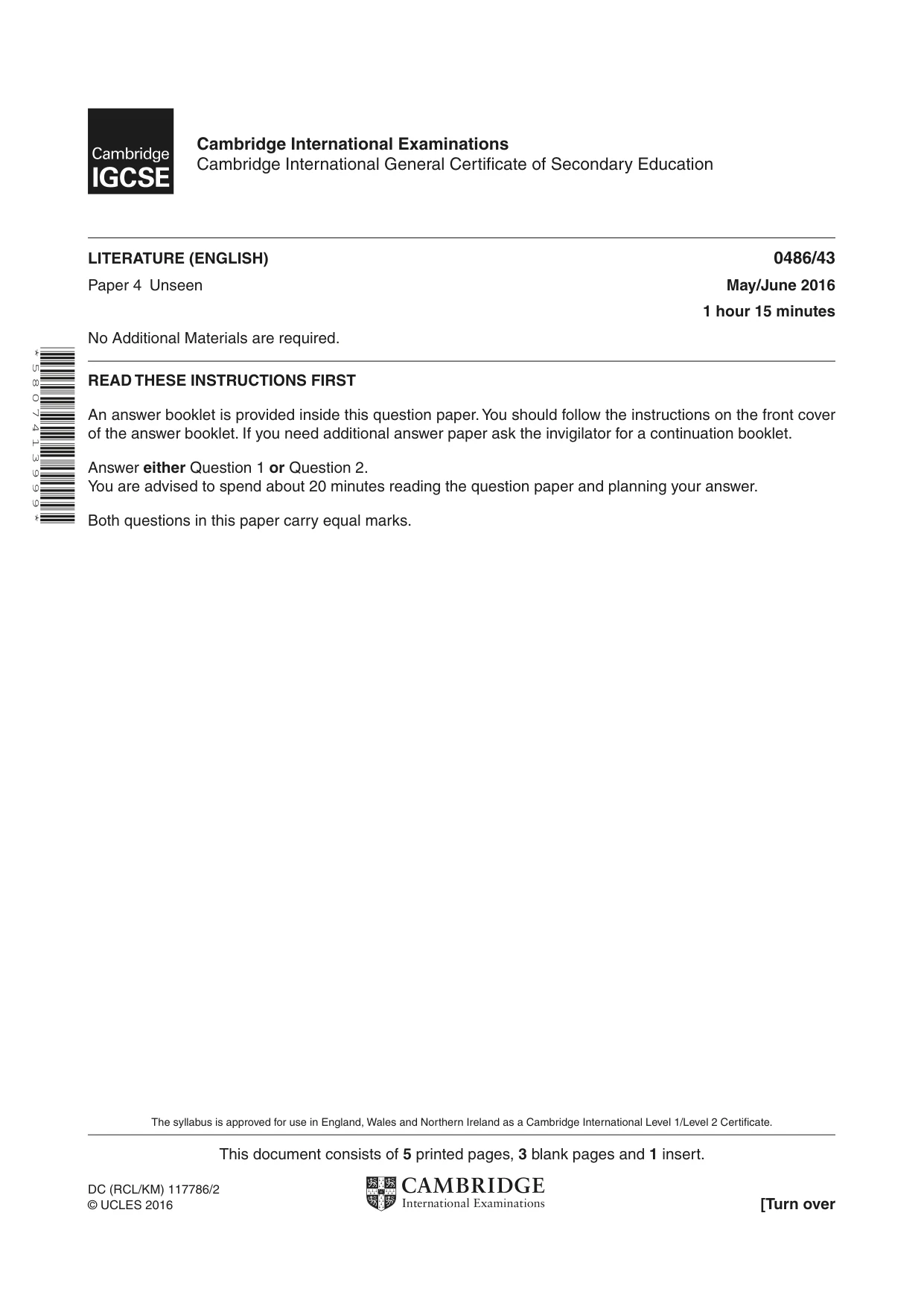
Question paper, page 1
This document consists of 5 printed pages, 3 blank pages and 1 insert. DC (RCL/KM) 117786/2 © UCLES 2016 [Turn over * 5 8 0 7 4 1 3 9 9 9 * LITERATURE (ENGLISH) 0486/43 Paper 4 Unseen May/June 2016 1 hour 15 minutes No Additional Materials are required. READ THESE INSTRUCTIONS FIRST An answer booklet is provided inside this question paper. You should follow the instructions on the front cover of the answer booklet. If you need additional answer paper ask the invigilator for a continuation booklet. Answer either Question 1 or Question 2. You are advised to spend about 20 minutes reading the question paper and planning your answer. Both questions in this paper carry equal marks. The syllabus is approved for use in England, Wales and Northern Ireland as a Cambridge International Level 1/Level 2 Certificate. Cambridge International Examinations Cambridge International General Certificate of Secondary Education
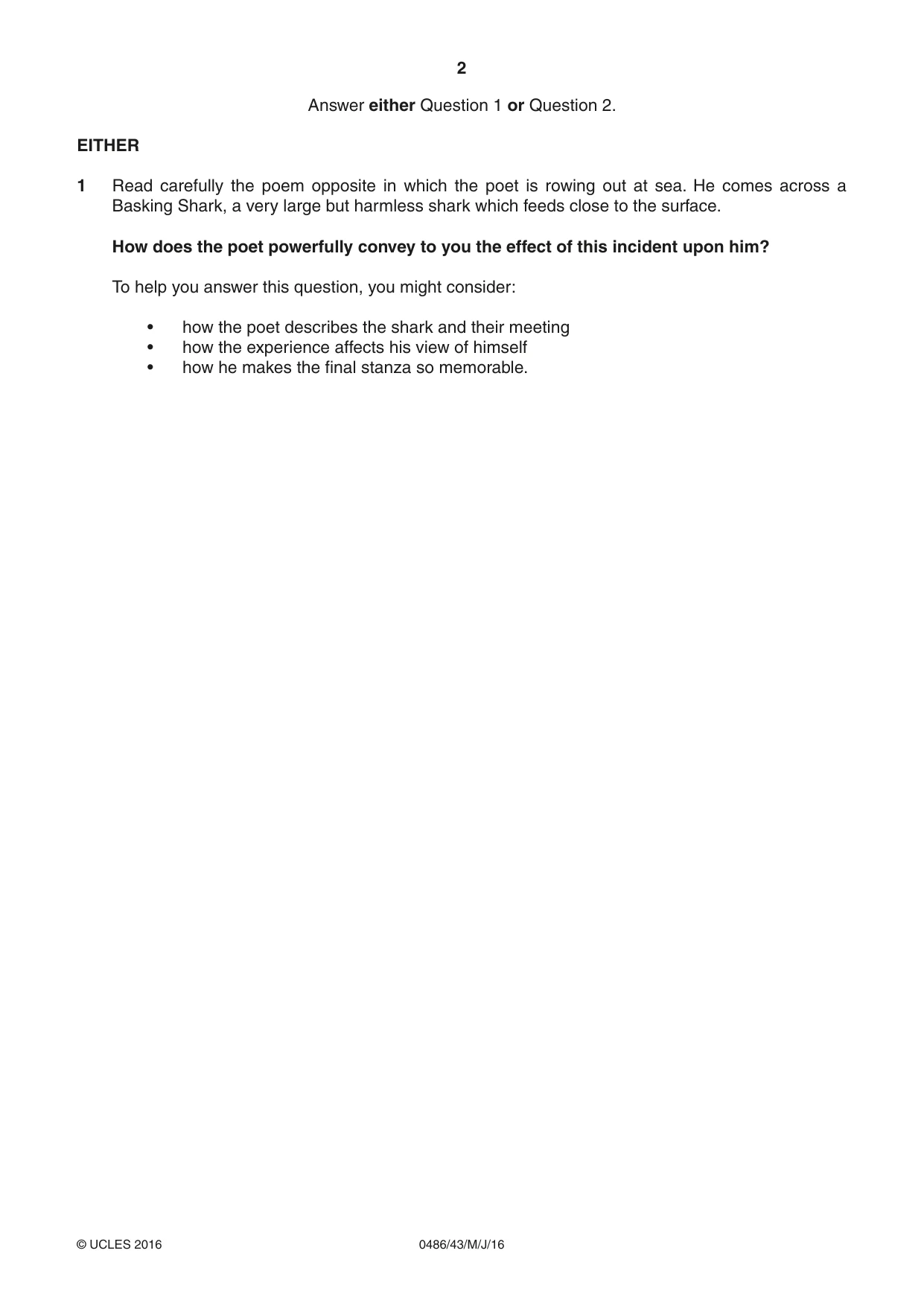
Question paper, page 2
2 0486/43/M/J/16 © UCLES 2016 Answer either Question 1 or Question 2. EITHER 1 Read carefully the poem opposite in which the poet is rowing out at sea. He comes across a Basking Shark, a very large but harmless shark which feeds close to the surface. How does the poet powerfully convey to you the effect of this incident upon him? To help you answer this question, you might consider: • how the poet describes the shark and their meeting • how the experience affects his view of himself • how he makes the final stanza so memorable.
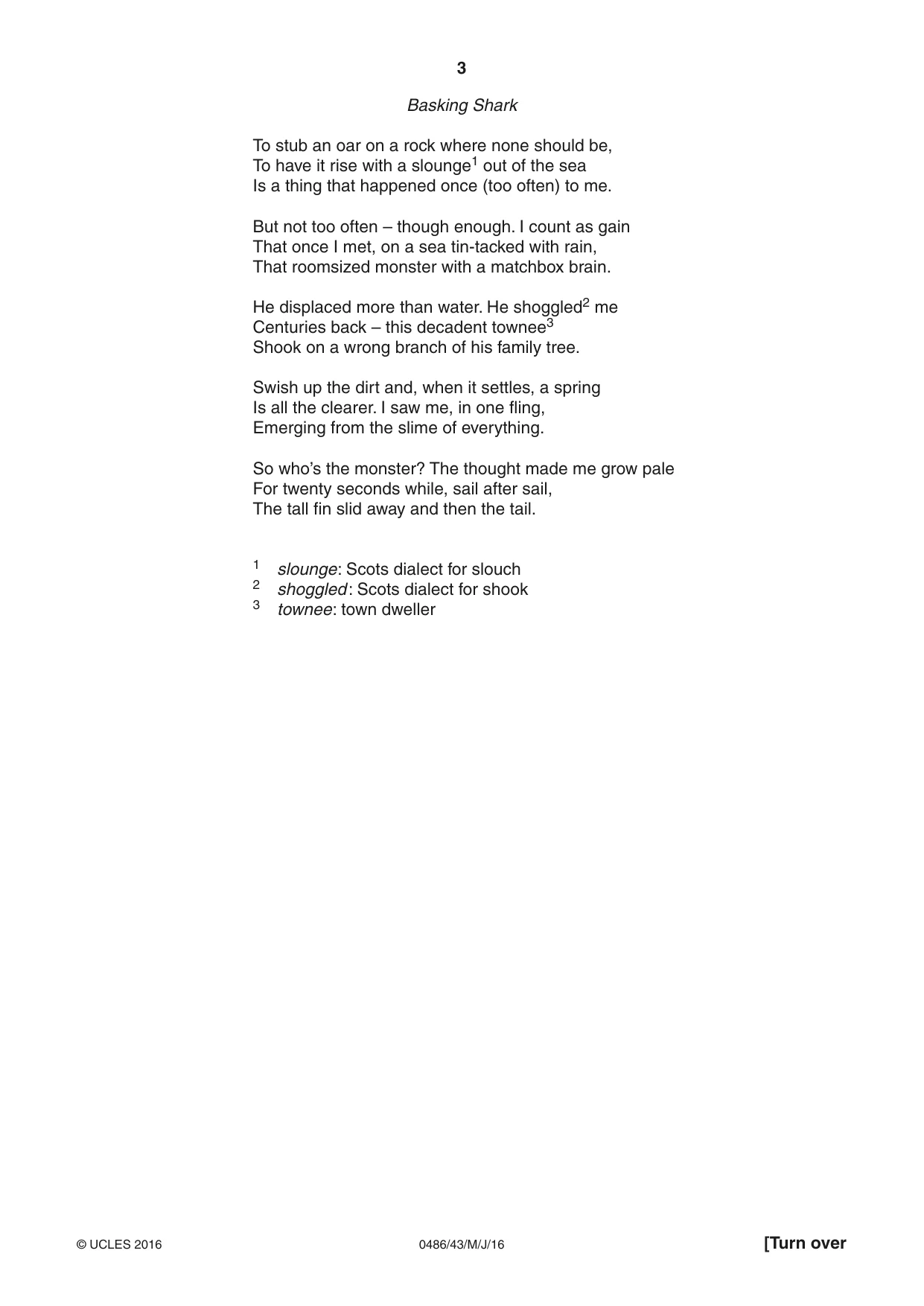
Question paper, page 3
3 0486/43/M/J/16 © UCLES 2016 [Turn over Basking Shark To stub an oar on a rock where none should be, To have it rise with a slounge1 out of the sea Is a thing that happened once (too often) to me. But not too often – though enough. I count as gain That once I met, on a sea tin-tacked with rain, That roomsized monster with a matchbox brain. He displaced more than water. He shoggled2 me Centuries back – this decadent townee3 Shook on a wrong branch of his family tree. Swish up the dirt and, when it settles, a spring Is all the clearer. I saw me, in one fling, Emerging from the slime of everything. So who’s the monster? The thought made me grow pale For twenty seconds while, sail after sail, The tall fin slid away and then the tail. 1 slounge : Scots dialect for slouch 2 shoggled : Scots dialect for shook 3 townee : town dweller
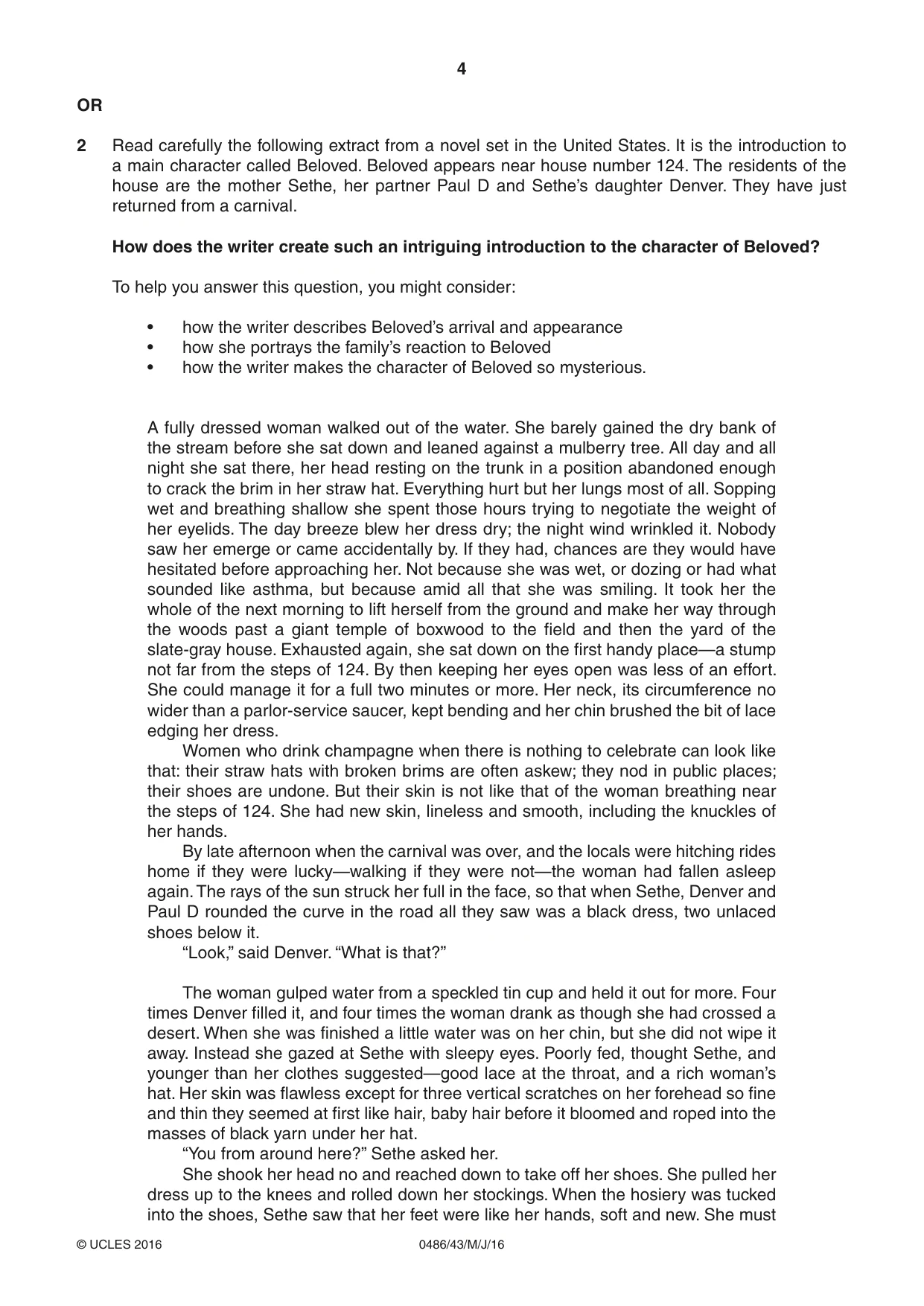
Question paper, page 4
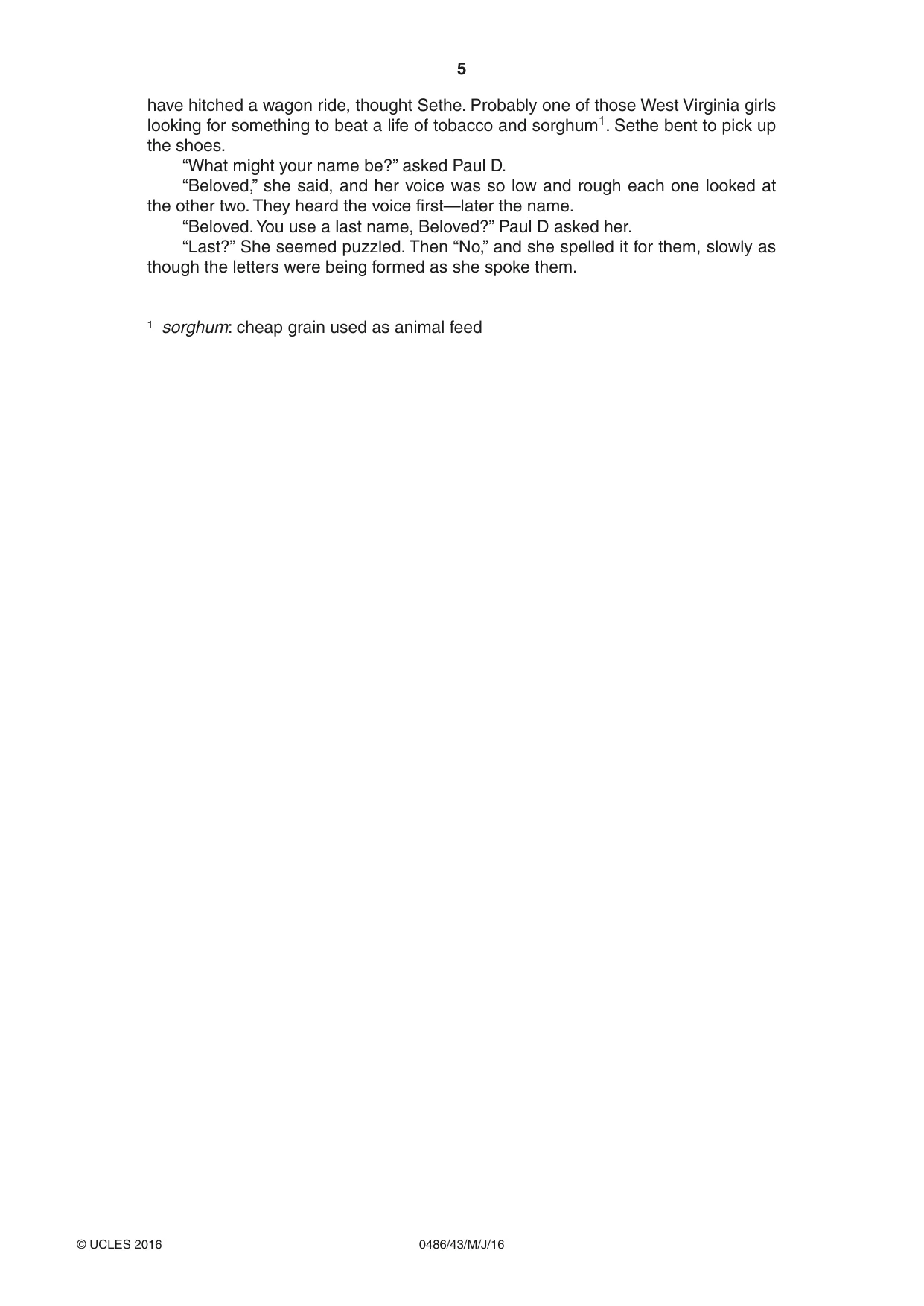
4 0486/43/M/J/16 © UCLES 2016 OR 2 Read carefully the following extract from a novel set in the United States. It is the introduction to a main character called Beloved. Beloved appears near house number 124. The residents of the house are the mother Sethe, her partner Paul D and Sethe’s daughter Denver. They have just returned from a carnival. How does the writer create such an intriguing introduction to the character of Beloved? To help you answer this question, you might consider: • how the writer describes Beloved’s arrival and appearance • how she portrays the family’s reaction to Beloved • how the writer makes the character of Beloved so mysterious. A fully dressed woman walked out of the water. She barely gained the dry bank of the stream before she sat down and leaned against a mulberry tree. All day and all night she sat there, her head resting on the trunk in a position abandoned enough to crack the brim in her straw hat. Everything hurt but her lungs most of all. Sopping wet and breathing shallow she spent those hours trying to negotiate the weight of her eyelids. The day breeze blew her dress dry; the night wind wrinkled it. Nobody saw her emerge or came accidentally by. If they had, chances are they would have hesitated before approaching her. Not because she was wet, or dozing or had what sounded like asthma, but because amid all that she was smiling. It took her the whole of the next morning to lift herself from the ground and make her way through the woods past a giant temple of boxwood to the field and then the yard of the slate-gray house. Exhausted again, she sat down on the first handy place—a stump not far from the steps of 124. By then keeping her eyes open was less of an effort. She could manage it for a full two minutes or more. Her neck, its circumference no wider than a parlor-service saucer, kept bending and her chin brushed the bit of lace edging her dress. Women who drink champagne when there is nothing to celebrate can look like that: their straw hats with broken brims are often askew; they nod in public places; their shoes are undone. But their skin is not like that of the woman breathing near the steps of 124. She had new skin, lineless and smooth, including the knuckles of her hands. By late afternoon when the carnival was over, and the locals were hitching rides home if they were lucky—walking if they were not—the woman had fallen asleep again. The rays of the sun struck her full in the face, so that when Sethe, Denver and Paul D rounded the curve in the road all they saw was a black dress, two unlaced shoes below it. “Look,” said Denver. “What is that?” The woman gulped water from a speckled tin cup and held it out for more. Four times Denver filled it, and four times the woman drank as though she had crossed a desert. When she was finished a little water was on her chin, but she did not wipe it away. Instead she gazed at Sethe with sleepy eyes. Poorly fed, thought Sethe, and younger than her clothes suggested—good lace at the throat, and a rich woman’s hat. Her skin was flawless except for three vertical scratches on her forehead so fine and thin they seemed at first like hair, baby hair before it bloomed and roped into the masses of black yarn under her hat. “You from around here?” Sethe asked her. She shook her head no and reached down to take off her shoes. She pulled her dress up to the knees and rolled down her stockings. When the hosiery was tucked into the shoes, Sethe saw that her feet were like her hands, soft and new. She must
Question paper, page 5
5 0486/43/M/J/16 © UCLES 2016 have hitched a wagon ride, thought Sethe. Probably one of those West Virginia girls looking for something to beat a life of tobacco and sorghum1. Sethe bent to pick up the shoes. “What might your name be?” asked Paul D. “Beloved,” she said, and her voice was so low and rough each one looked at the other two. They heard the voice first—later the name. “Beloved. You use a last name, Beloved?” Paul D asked her. “Last?” She seemed puzzled. Then “No,” and she spelled it for them, slowly as though the letters were being formed as she spoke them. ¹ sorghum: cheap grain used as animal feed
Question paper, page 6
6 0486/43/M/J/16 © UCLES 2016 BLANK PAGE
Question paper, page 7
7 0486/43/M/J/16 © UCLES 2016 BLANK PAGE
Question paper, page 8
8 0486/43/M/J/16 © UCLES 2016 BLANK PAGE Permission to reproduce items where third-party owned material protected by copyright is included has been sought and cleared where possible. Every reasonable effort has been made by the publisher (UCLES) to trace copyright holders, but if any items requiring clearance have unwittingly been included, the publisher will be pleased to make amends at the earliest possible opportunity. To avoid the issue of disclosure of answer-related information to candidates, all copyright acknowledgements are reproduced online in the Cambridge International Examinations Copyright Acknowledgements Booklet. This is produced for each series of examinations and is freely available to download at www.cie.org.uk after the live examination series. Cambridge International Examinations is part of the Cambridge Assessment Group. Cambridge Assessment is the brand name of University of Cambridge Local Examinations Syndicate (UCLES), which is itself a department of the University of Cambridge.
Mark scheme, page 1
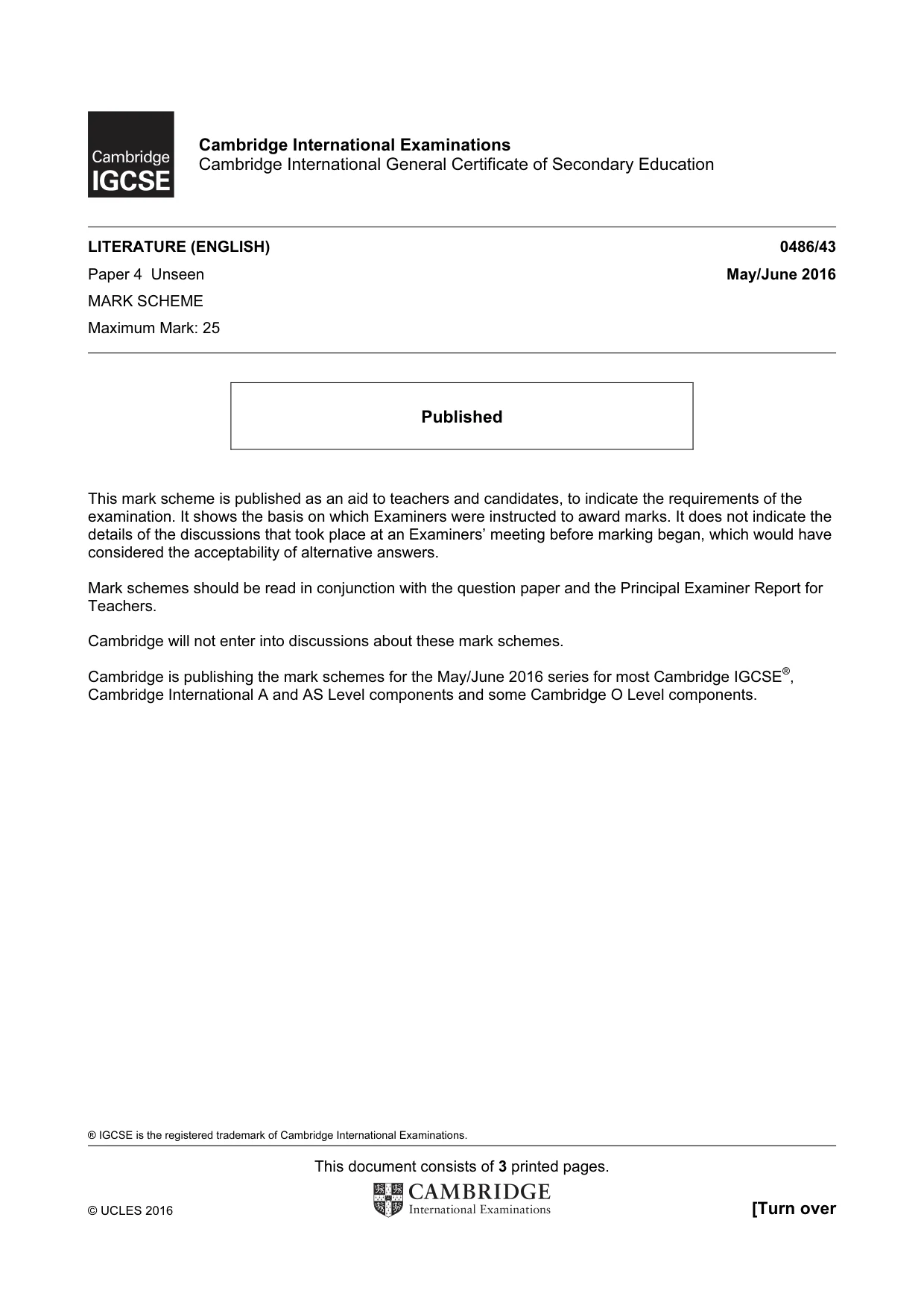
® IGCSE is the registered trademark of Cambridge International Examinations. This document consists of 3 printed pages. © UCLES 2016 [Turn over Cambridge International Examinations Cambridge International General Certificate of Secondary Education LITERATURE (ENGLISH) 0486/43 Paper 4 Unseen May/June 2016 MARK SCHEME Maximum Mark: 25 Published This mark scheme is published as an aid to teachers and candidates, to indicate the requirements of the examination. It shows the basis on which Examiners were instructed to award marks. It does not indicate the details of the discussions that took place at an Examiners’ meeting before marking began, which would have considered the acceptability of alternative answers. Mark schemes should be read in conjunction with the question paper and the Principal Examiner Report for Teachers. Cambridge will not enter into discussions about these mark schemes. Cambridge is publishing the mark schemes for the May/June 2016 series for most Cambridge IGCSE®, Cambridge International A and AS Level components and some Cambridge O Level components.
Mark scheme, page 2
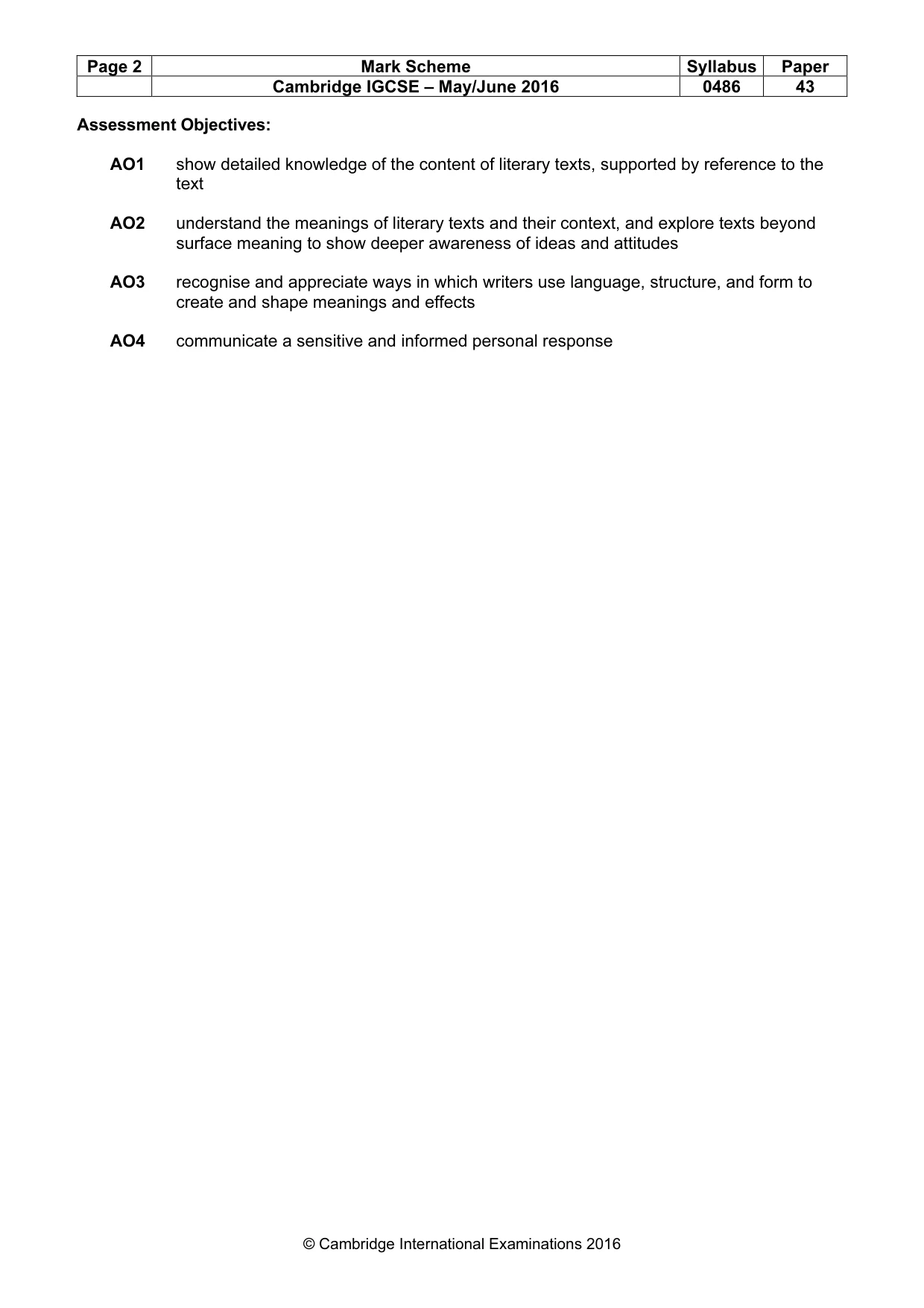
Page 2 Mark Scheme Syllabus Paper Cambridge IGCSE – May/June 2016 0486 43 © Cambridge International Examinations 2016 Assessment Objectives: AO1 show detailed knowledge of the content of literary texts, supported by reference to the text AO2 understand the meanings of literary texts and their context, and explore texts beyond surface meaning to show deeper awareness of ideas and attitudes AO3 recognise and appreciate ways in which writers use language, structure, and form to create and shape meanings and effects AO4 communicate a sensitive and informed personal response
Mark scheme, page 3
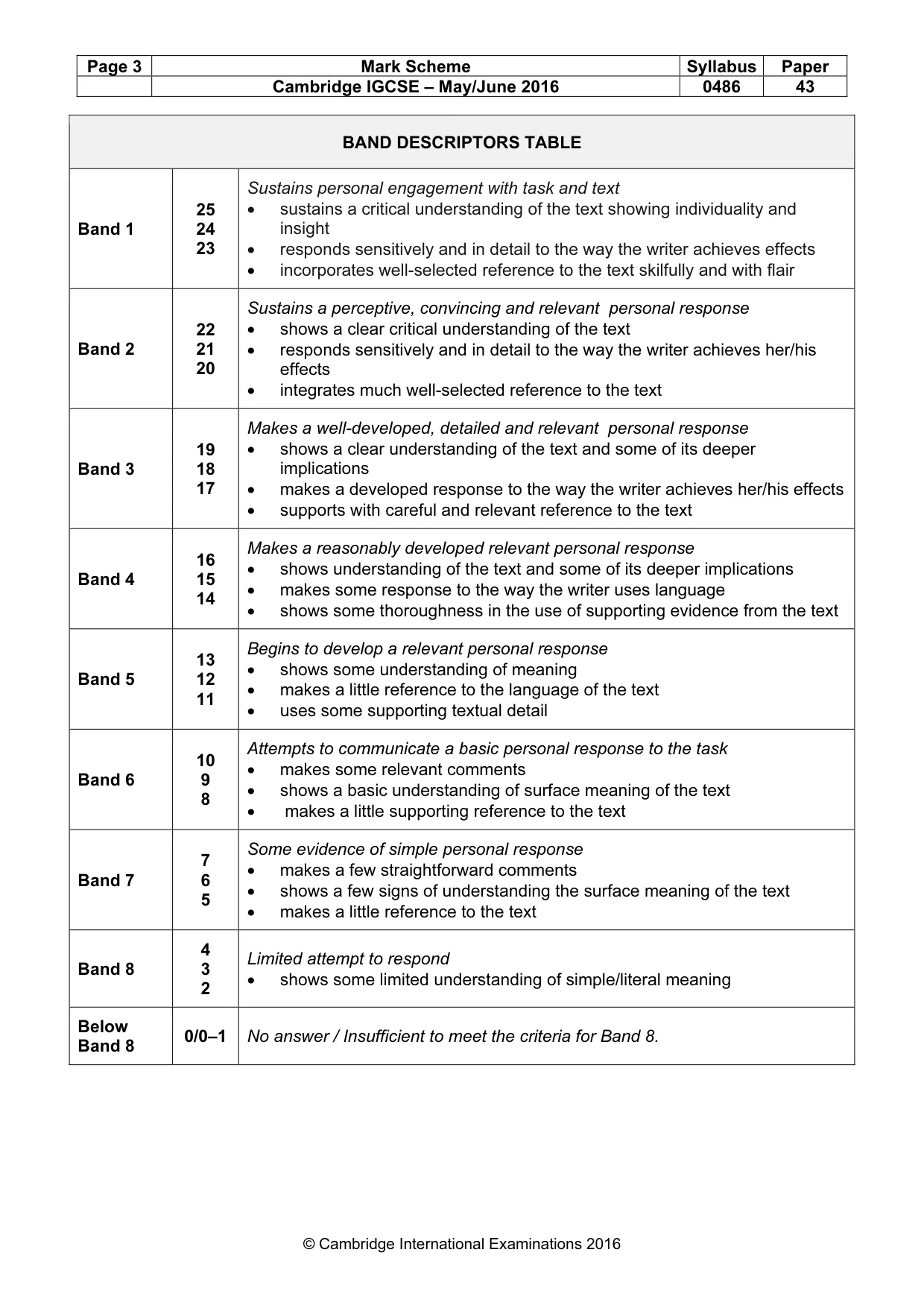
Page 3 Mark Scheme Syllabus Paper Cambridge IGCSE – May/June 2016 0486 43 © Cambridge International Examinations 2016 BAND DESCRIPTORS TABLE Band 1 25 24 23 Sustains personal engagement with task and text • sustains a critical understanding of the text showing individuality and insight • responds sensitively and in detail to the way the writer achieves effects • incorporates well-selected reference to the text skilfully and with flair Band 2 22 21 20 Sustains a perceptive, convincing and relevant personal response • shows a clear critical understanding of the text • responds sensitively and in detail to the way the writer achieves her/his effects • integrates much well-selected reference to the text Band 3 19 18 17 Makes a well-developed, detailed and relevant personal response • shows a clear understanding of the text and some of its deeper implications • makes a developed response to the way the writer achieves her/his effects • supports with careful and relevant reference to the text Band 4 16 15 14 Makes a reasonably developed relevant personal response • shows understanding of the text and some of its deeper implications • makes some response to the way the writer uses language • shows some thoroughness in the use of supporting evidence from the text Band 5 13 12 11 Begins to develop a relevant personal response • shows some understanding of meaning • makes a little reference to the language of the text • uses some supporting textual detail Band 6 10 9 8 Attempts to communicate a basic personal response to the task • makes some relevant comments • shows a basic understanding of surface meaning of the text • makes a little supporting reference to the text Band 7 7 6 5 Some evidence of simple personal response • makes a few straightforward comments • shows a few signs of understanding the surface meaning of the text • makes a little reference to the text Band 8 4 3 2 Limited attempt to respond • shows some limited understanding of simple/literal meaning Below Band 8 0/0–1 No answer / Insufficient to meet the criteria for Band 8.
What you needed in this session
Cambridge’s own grade thresholds for 2016 May/June, Paper 4 · Variant 3. A higher threshold means an easier paper — the bar moves with how the cohort did.