Cambridge IGCSE English - Literature 0486 — 2018 Oct/Nov Paper 4 · Variant 2
0486/42/O/N/18 · 25 marks · ≈28 min
The question paper and its mark scheme, free to read here and free to download. This is Cambridge’s own paper, exactly as it was sat.
Question paper8 pages



Mark scheme4 pages
Answers below. Sit the paper first if you are practising.
Paper as text
Question paper, page 1
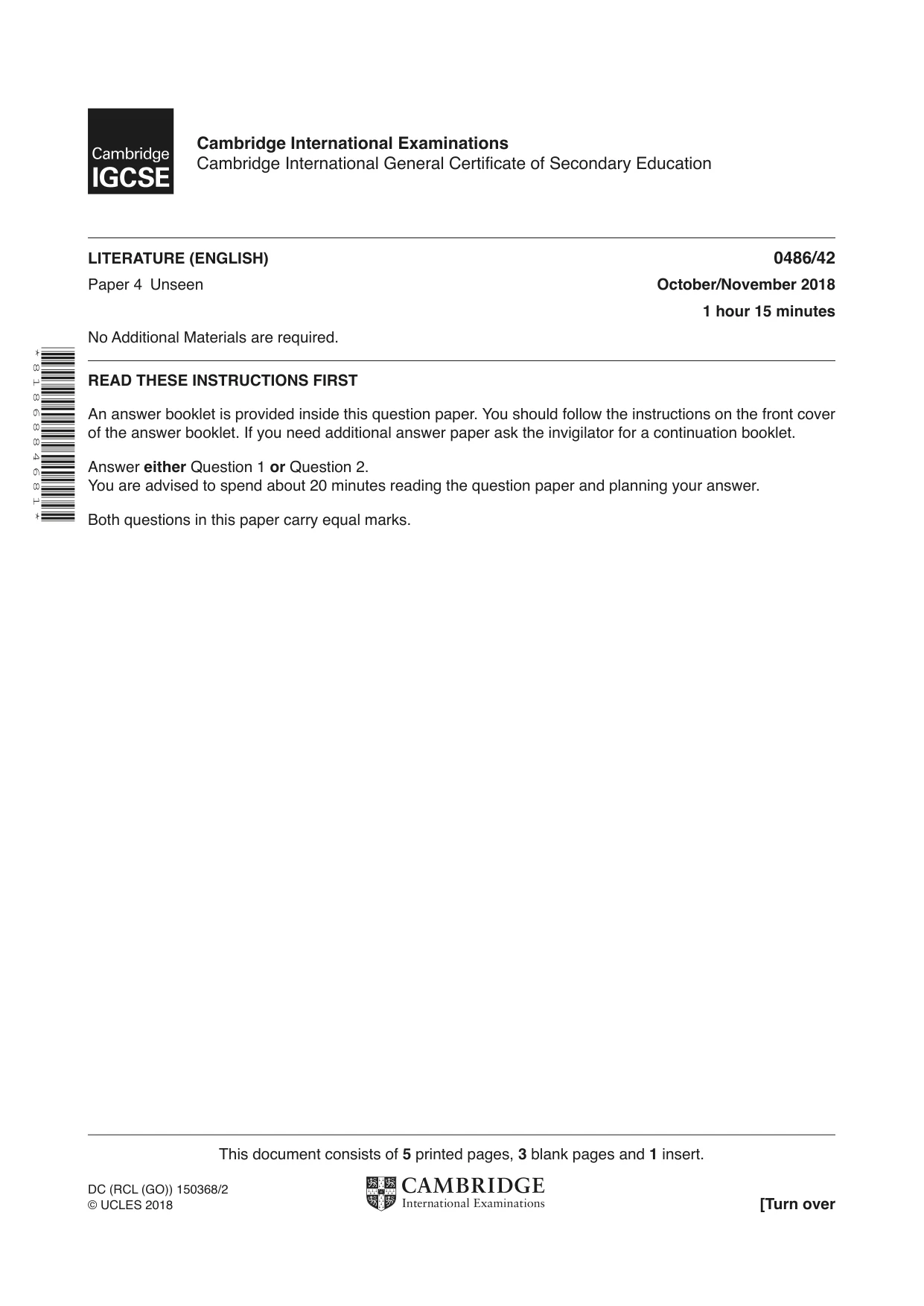
This document consists of 5 printed pages, 3 blank pages and 1 insert. DC (RCL (GO)) 150368/2 © UCLES 2018 [Turn over Cambridge International Examinations Cambridge International General Certificate of Secondary Education * 8 1 8 6 8 8 4 6 8 1 * LITERATURE (ENGLISH) 0486/42 Paper 4 Unseen October/November 2018 1 hour 15 minutes No Additional Materials are required. READ THESE INSTRUCTIONS FIRST An answer booklet is provided inside this question paper. You should follow the instructions on the front cover of the answer booklet. If you need additional answer paper ask the invigilator for a continuation booklet. Answer either Question 1 or Question 2. You are advised to spend about 20 minutes reading the question paper and planning your answer. Both questions in this paper carry equal marks.
Question paper, page 2
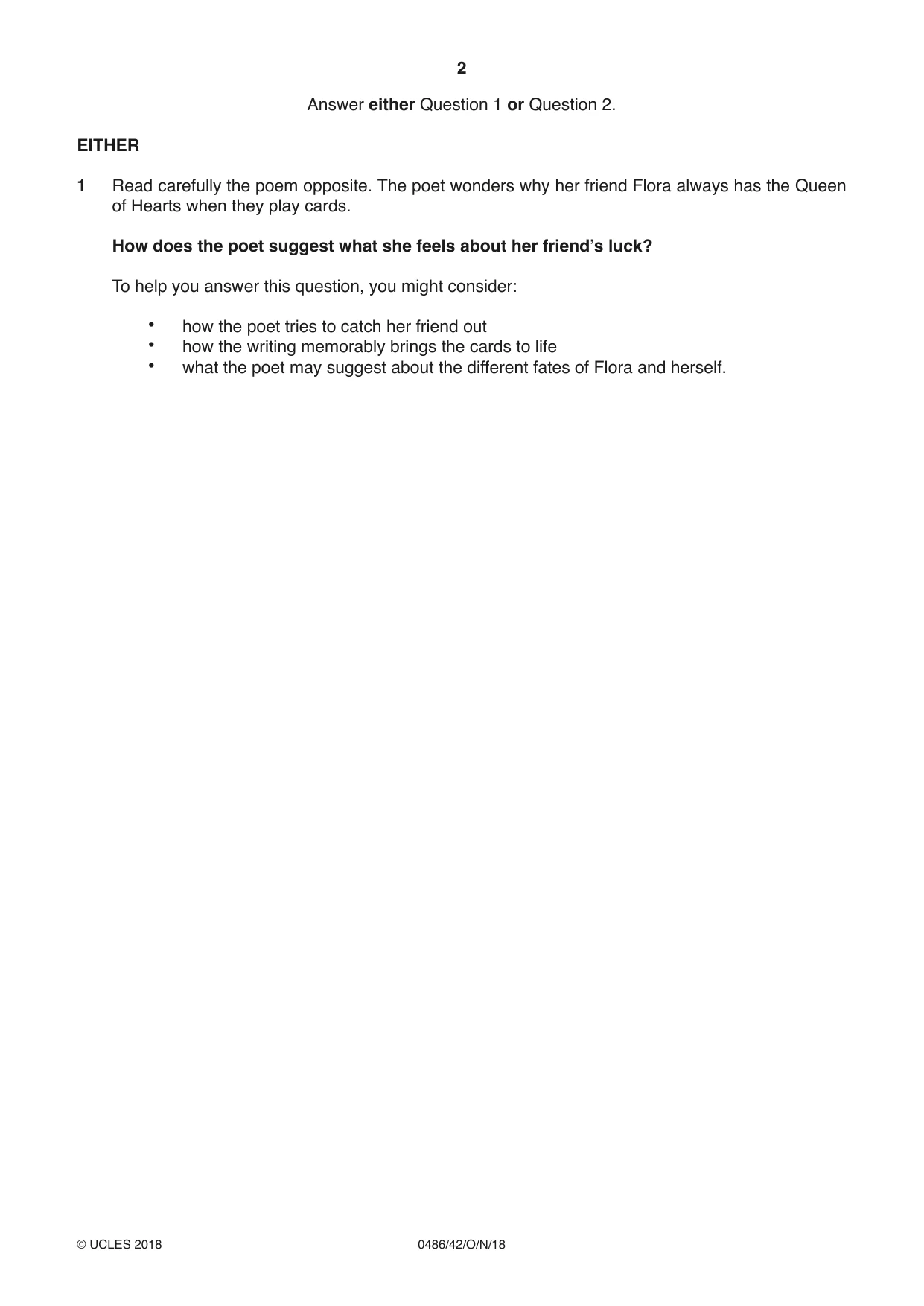
2 0486/42/O/N/18 © UCLES 2018 Answer either Question 1 or Question 2. EITHER 1 Read carefully the poem opposite. The poet wonders why her friend Flora always has the Queen of Hearts when they play cards. How does the poet suggest what she feels about her friend’s luck? To help you answer this question, you might consider: • how the poet tries to catch her friend out • how the writing memorably brings the cards to life • what the poet may suggest about the different fates of Flora and herself.
Question paper, page 3
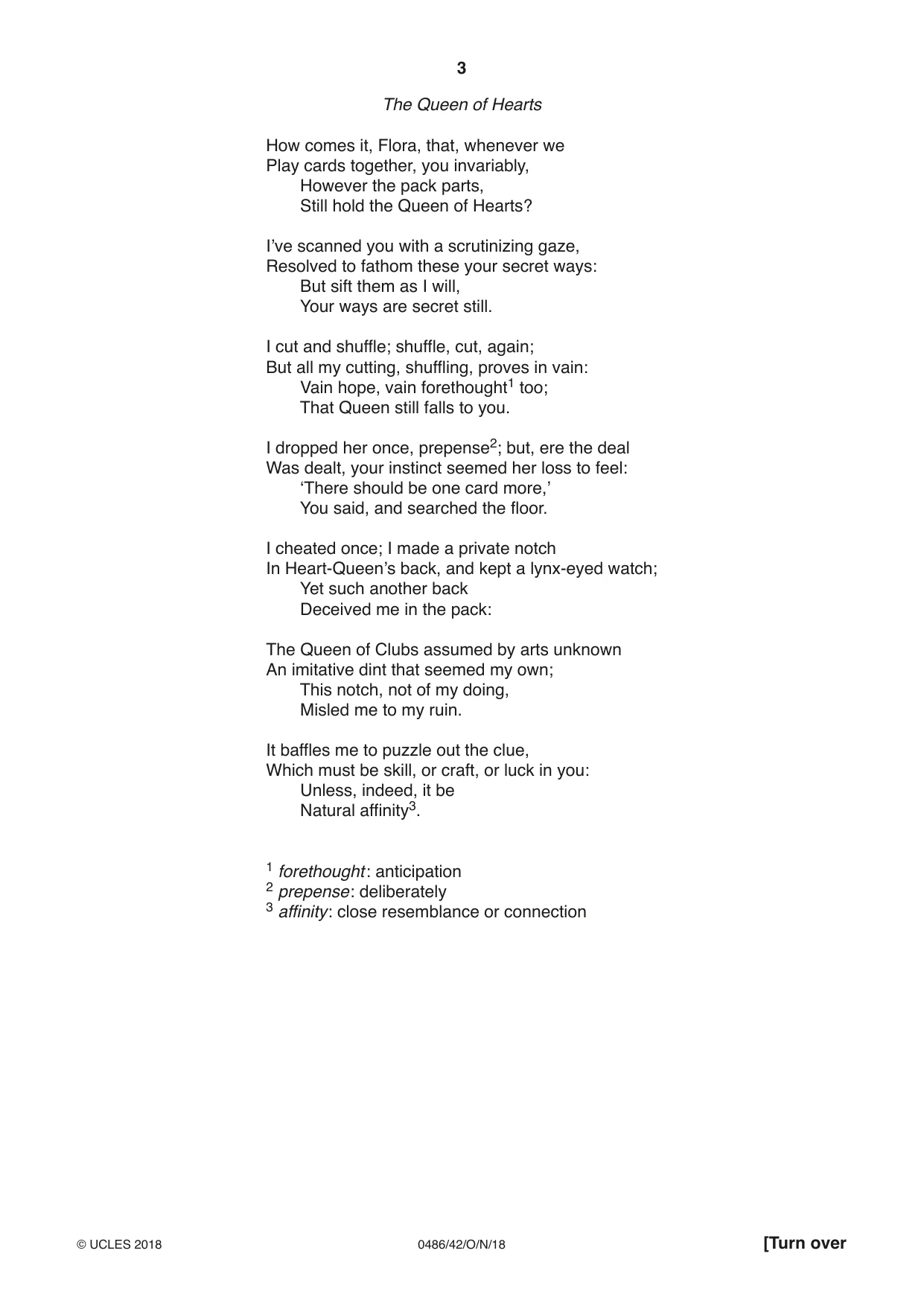
3 0486/42/O/N/18 © UCLES 2018 [Turn over The Queen of Hearts How comes it, Flora, that, whenever we Play cards together, you invariably, However the pack parts, Still hold the Queen of Hearts? I’ve scanned you with a scrutinizing gaze, Resolved to fathom these your secret ways: But sift them as I will, Your ways are secret still. I cut and shuffle; shuffle, cut, again; But all my cutting, shuffling, proves in vain: Vain hope, vain forethought1 too; That Queen still falls to you. I dropped her once, prepense2; but, ere the deal Was dealt, your instinct seemed her loss to feel: ‘There should be one card more,’ You said, and searched the floor. I cheated once; I made a private notch In Heart-Queen’s back, and kept a lynx-eyed watch; Yet such another back Deceived me in the pack: The Queen of Clubs assumed by arts unknown An imitative dint that seemed my own; This notch, not of my doing, Misled me to my ruin. It baffles me to puzzle out the clue, Which must be skill, or craft, or luck in you: Unless, indeed, it be Natural affinity3. 1 forethought: anticipation 2 prepense: deliberately 3 affinity: close resemblance or connection
Question paper, page 4
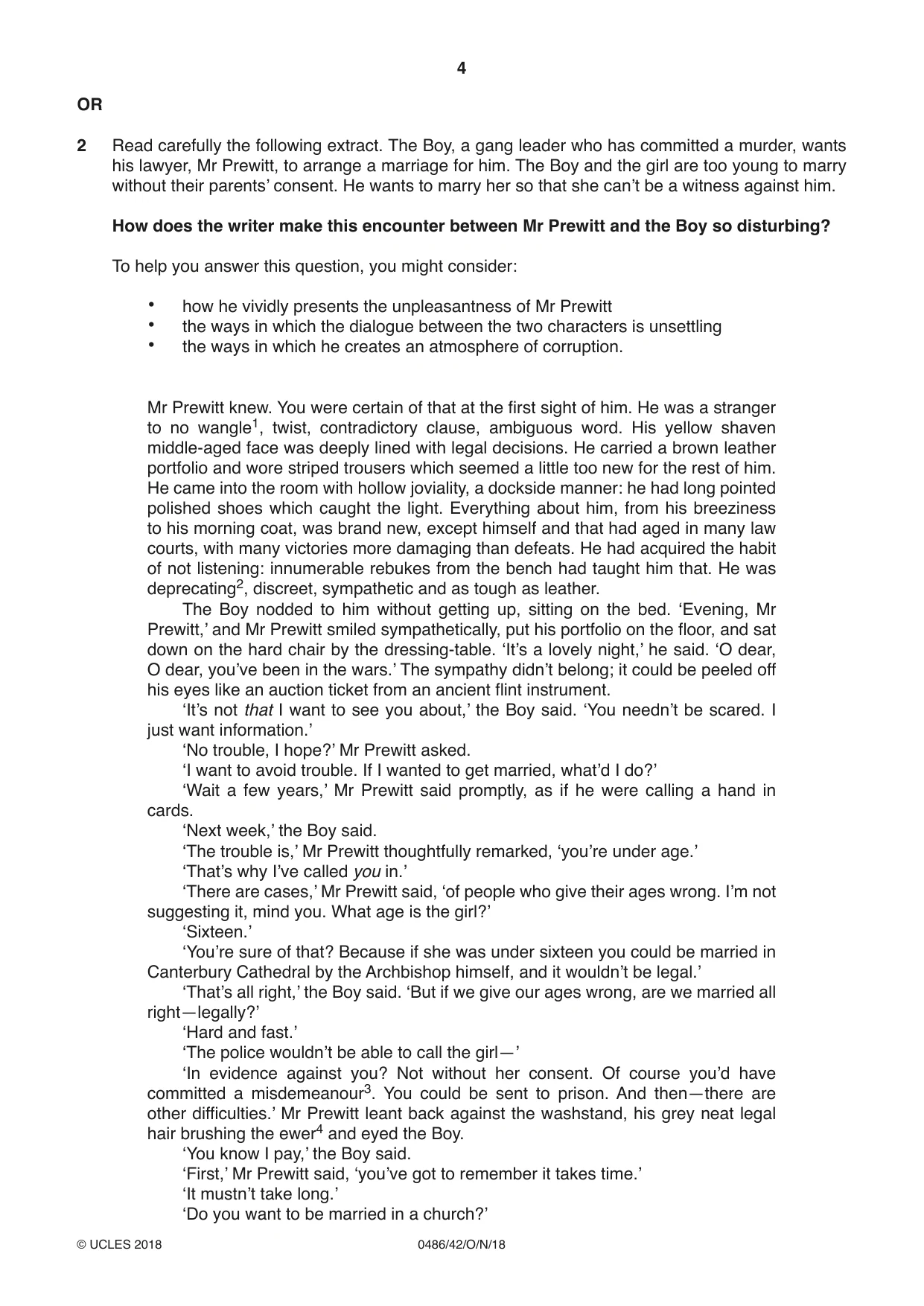
4 0486/42/O/N/18 © UCLES 2018 OR 2 Read carefully the following extract. The Boy, a gang leader who has committed a murder, wants his lawyer, Mr Prewitt, to arrange a marriage for him. The Boy and the girl are too young to marry without their parents’ consent. He wants to marry her so that she can’t be a witness against him. How does the writer make this encounter between Mr Prewitt and the Boy so disturbing? To help you answer this question, you might consider: • how he vividly presents the unpleasantness of Mr Prewitt • the ways in which the dialogue between the two characters is unsettling • the ways in which he creates an atmosphere of corruption. Mr Prewitt knew. You were certain of that at the first sight of him. He was a stranger to no wangle1, twist, contradictory clause, ambiguous word. His yellow shaven middle-aged face was deeply lined with legal decisions. He carried a brown leather portfolio and wore striped trousers which seemed a little too new for the rest of him. He came into the room with hollow joviality, a dockside manner: he had long pointed polished shoes which caught the light. Everything about him, from his breeziness to his morning coat, was brand new, except himself and that had aged in many law courts, with many victories more damaging than defeats. He had acquired the habit of not listening: innumerable rebukes from the bench had taught him that. He was deprecating2, discreet, sympathetic and as tough as leather. The Boy nodded to him without getting up, sitting on the bed. ‘Evening, Mr Prewitt,’ and Mr Prewitt smiled sympathetically, put his portfolio on the floor, and sat down on the hard chair by the dressing-table. ‘It’s a lovely night,’ he said. ‘O dear, O dear, you’ve been in the wars.’ The sympathy didn’t belong; it could be peeled off his eyes like an auction ticket from an ancient flint instrument. ‘It’s not that I want to see you about,’ the Boy said. ‘You needn’t be scared. I just want information.’ ‘No trouble, I hope?’ Mr Prewitt asked. ‘I want to avoid trouble. If I wanted to get married, what’d I do?’ ‘Wait a few years,’ Mr Prewitt said promptly, as if he were calling a hand in cards. ‘Next week,’ the Boy said. ‘The trouble is,’ Mr Prewitt thoughtfully remarked, ‘you’re under age.’ ‘That’s why I’ve called you in.’ ‘There are cases,’ Mr Prewitt said, ‘of people who give their ages wrong. I’m not suggesting it, mind you. What age is the girl?’ ‘Sixteen.’ ‘You’re sure of that? Because if she was under sixteen you could be married in Canterbury Cathedral by the Archbishop himself, and it wouldn’t be legal.’ ‘That’s all right,’ the Boy said. ‘But if we give our ages wrong, are we married all right—legally?’ ‘Hard and fast.’ ‘The police wouldn’t be able to call the girl—’ ‘In evidence against you? Not without her consent. Of course you’d have committed a misdemeanour3. You could be sent to prison. And then—there are other difficulties.’ Mr Prewitt leant back against the washstand, his grey neat legal hair brushing the ewer4 and eyed the Boy. ‘You know I pay,’ the Boy said. ‘First,’ Mr Prewitt said, ‘you’ve got to remember it takes time.’ ‘It mustn’t take long.’ ‘Do you want to be married in a church?’
Question paper, page 5
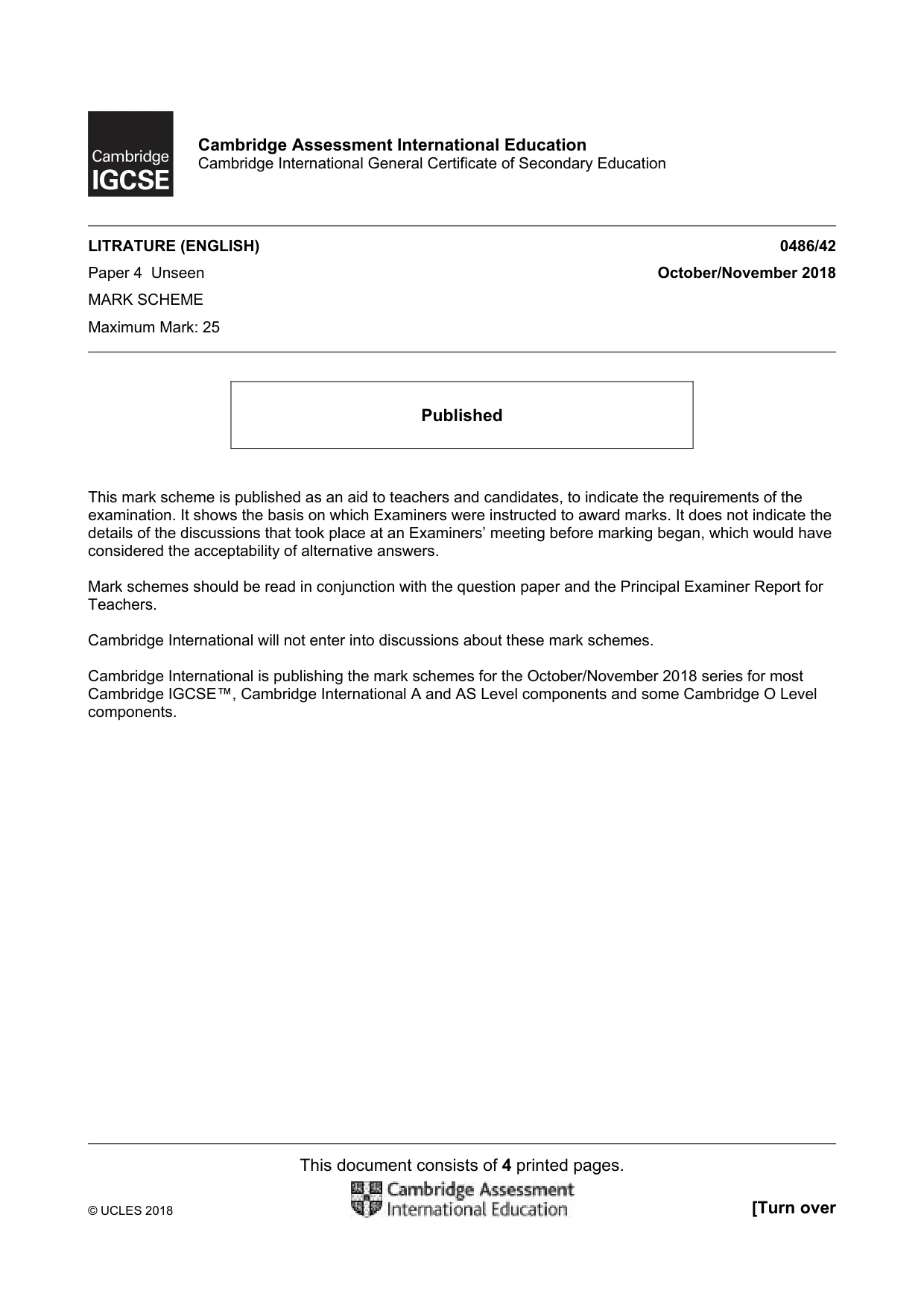
5 0486/42/O/N/18 © UCLES 2018 ‘Of course I don’t,’ the Boy said. ‘This won’t be a real marriage.’ ‘Real enough.’ ‘Not real like when the priest says it.’ ‘Your religious feelings do you credit,’ Mr Prewitt said. ‘This I take it then will be a civil marriage. You could get a licence—fifteen days’ residence—you qualify for that—and one day’s notice. As far as that’s concerned you could be married the day after tomorrow—in your own district. Then comes the next difficulty. A marriage of a minor’s not easy.’ ‘Go on. I’ll pay.’ ‘It’s no good just saying you’re twenty-one. No one would believe you. But if you said you were eighteen you could be married provided you had your parents’ or your guardian’s consent. Are your parents alive?’ ‘No.’ ‘Who’s your guardian?’ ‘I don’t know what you mean.’ Mr Prewitt said thoughtfully, ‘We might arrange a guardian. It’s risky though. It might be better if you’d lost touch. He’d gone to South Africa and left you. We might make quite a good thing out of that,’ Mr Prewitt added softly. ‘Flung on the world at an early age you’ve bravely made your own way.’ His eyes shifted from bedball to bedball5. ‘We’d ask for the discretion of the registrar.’ ‘I never knew it was all that difficult,’ the Boy said. ‘Maybe I can manage some other way.’ ‘Given time,’ Mr Prewitt said, ‘anything can be managed.’ He showed his tartar- coated teeth in a fatherly smile. ‘Give the word, my boy, and I’ll see you married.’ 1 wangle (slang): trick 2 deprecating: disapproving 3 misdemeanour: minor criminal offence 4 ewer: water jug 5 bedball: top of bedpost
Question paper, page 6
6 0486/42/O/N/18 © UCLES 2018 BLANK PAGE
Question paper, page 7
7 0486/42/O/N/18 © UCLES 2018 BLANK PAGE
Question paper, page 8
8 0486/42/O/N/18 © UCLES 2018 BLANK PAGE Permission to reproduce items where third-party owned material protected by copyright is included has been sought and cleared where possible. Every reasonable effort has been made by the publisher (UCLES) to trace copyright holders, but if any items requiring clearance have unwittingly been included, the publisher will be pleased to make amends at the earliest possible opportunity. To avoid the issue of disclosure of answer-related information to candidates, all copyright acknowledgements are reproduced online in the Cambridge International Examinations Copyright Acknowledgements Booklet. This is produced for each series of examinations and is freely available to download at www.cie.org.uk after the live examination series. Cambridge International Examinations is part of the Cambridge Assessment Group. Cambridge Assessment is the brand name of University of Cambridge Local Examinations Syndicate (UCLES), which is itself a department of the University of Cambridge.
Mark scheme, page 1
This document consists of 4 printed pages. © UCLES 2018 [Turn over Cambridge Assessment International Education Cambridge International General Certificate of Secondary Education LITRATURE (ENGLISH) 0486/42 Paper 4 Unseen October/November 2018 MARK SCHEME Maximum Mark: 25 Published This mark scheme is published as an aid to teachers and candidates, to indicate the requirements of the examination. It shows the basis on which Examiners were instructed to award marks. It does not indicate the details of the discussions that took place at an Examiners’ meeting before marking began, which would have considered the acceptability of alternative answers. Mark schemes should be read in conjunction with the question paper and the Principal Examiner Report for Teachers. Cambridge International will not enter into discussions about these mark schemes. Cambridge International is publishing the mark schemes for the October/November 2018 series for most Cambridge IGCSE™, Cambridge International A and AS Level components and some Cambridge O Level components.
Mark scheme, page 2
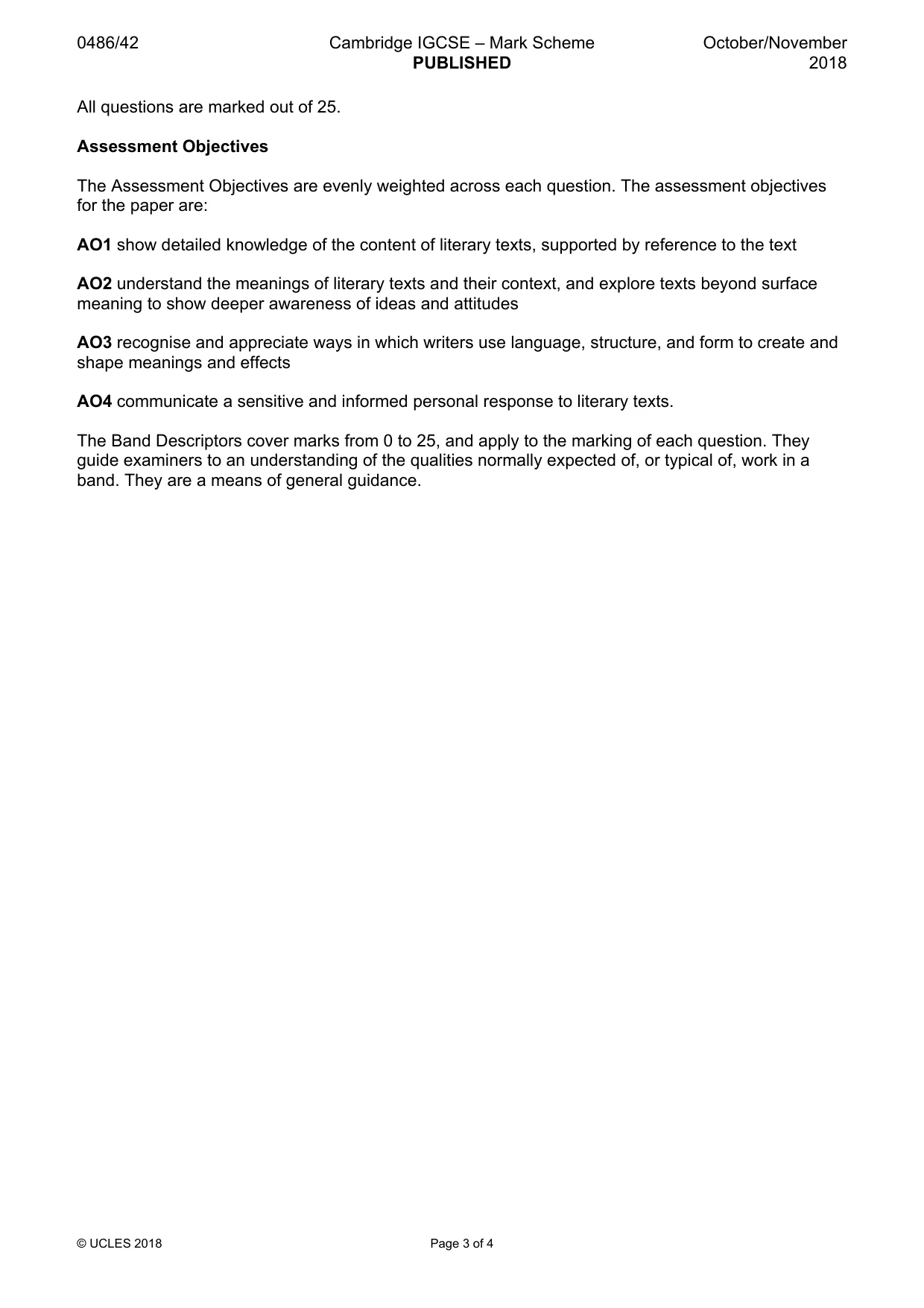
0486/42 Cambridge IGCSE – Mark Scheme PUBLISHED October/November 2018 © UCLES 2018 Page 2 of 4 Generic Marking Principles These general marking principles must be applied by all examiners when marking candidate answers. They should be applied alongside the specific content of the mark scheme or generic level descriptors for a question. Each question paper and mark scheme will also comply with these marking principles. GENERIC MARKING PRINCIPLE 1: Marks must be awarded in line with: • the specific content of the mark scheme or the generic level descriptors for the question • the specific skills defined in the mark scheme or in the generic level descriptors for the question • the standard of response required by a candidate as exemplified by the standardisation scripts. GENERIC MARKING PRINCIPLE 2: Marks awarded are always whole marks (not half marks, or other fractions). GENERIC MARKING PRINCIPLE 3: Marks must be awarded positively: • marks are awarded for correct/valid answers, as defined in the mark scheme. However, credit is given for valid answers which go beyond the scope of the syllabus and mark scheme, referring to your Team Leader as appropriate • marks are awarded when candidates clearly demonstrate what they know and can do • marks are not deducted for errors • marks are not deducted for omissions • answers should only be judged on the quality of spelling, punctuation and grammar when these features are specifically assessed by the question as indicated by the mark scheme. The meaning, however, should be unambiguous. GENERIC MARKING PRINCIPLE 4: Rules must be applied consistently e.g. in situations where candidates have not followed instructions or in the application of generic level descriptors. GENERIC MARKING PRINCIPLE 5: Marks should be awarded using the full range of marks defined in the mark scheme for the question (however; the use of the full mark range may be limited according to the quality of the candidate responses seen). GENERIC MARKING PRINCIPLE 6: Marks awarded are based solely on the requirements as defined in the mark scheme. Marks should not be awarded with grade thresholds or grade descriptors in mind.
Mark scheme, page 3
0486/42 Cambridge IGCSE – Mark Scheme PUBLISHED October/November 2018 © UCLES 2018 Page 3 of 4 All questions are marked out of 25. Assessment Objectives The Assessment Objectives are evenly weighted across each question. The assessment objectives for the paper are: AO1 show detailed knowledge of the content of literary texts, supported by reference to the text AO2 understand the meanings of literary texts and their context, and explore texts beyond surface meaning to show deeper awareness of ideas and attitudes AO3 recognise and appreciate ways in which writers use language, structure, and form to create and shape meanings and effects AO4 communicate a sensitive and informed personal response to literary texts. The Band Descriptors cover marks from 0 to 25, and apply to the marking of each question. They guide examiners to an understanding of the qualities normally expected of, or typical of, work in a band. They are a means of general guidance.
Mark scheme, page 4
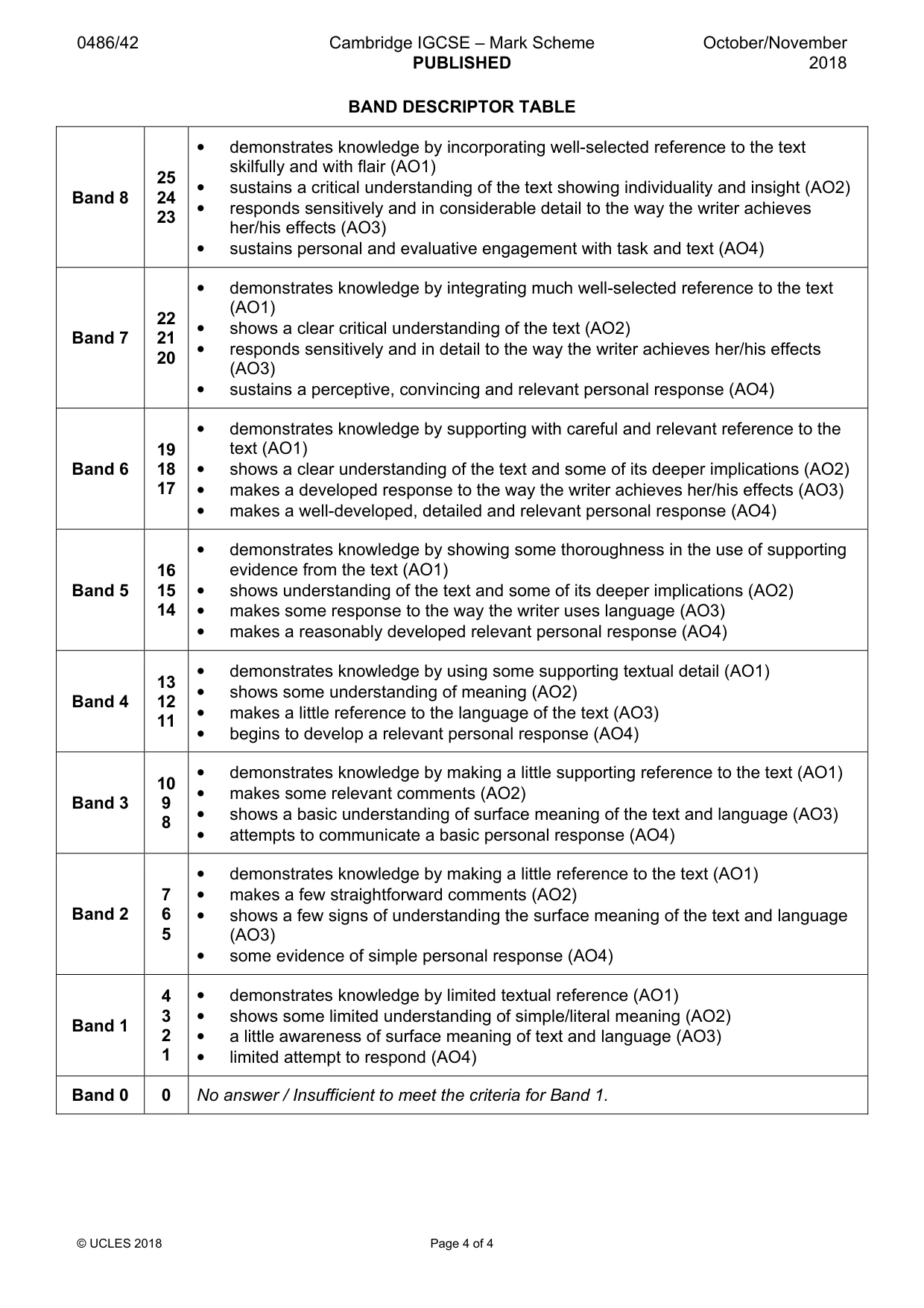
0486/42 Cambridge IGCSE – Mark Scheme PUBLISHED October/November 2018 © UCLES 2018 Page 4 of 4 BAND DESCRIPTOR TABLE Band 8 25 24 23 • demonstrates knowledge by incorporating well-selected reference to the text skilfully and with flair (AO1) • sustains a critical understanding of the text showing individuality and insight (AO2) • responds sensitively and in considerable detail to the way the writer achieves her/his effects (AO3) • sustains personal and evaluative engagement with task and text (AO4) Band 7 22 21 20 • demonstrates knowledge by integrating much well-selected reference to the text (AO1) • shows a clear critical understanding of the text (AO2) • responds sensitively and in detail to the way the writer achieves her/his effects (AO3) • sustains a perceptive, convincing and relevant personal response (AO4) Band 6 19 18 17 • demonstrates knowledge by supporting with careful and relevant reference to the text (AO1) • shows a clear understanding of the text and some of its deeper implications (AO2) • makes a developed response to the way the writer achieves her/his effects (AO3) • makes a well-developed, detailed and relevant personal response (AO4) Band 5 16 15 14 • demonstrates knowledge by showing some thoroughness in the use of supporting evidence from the text (AO1) • shows understanding of the text and some of its deeper implications (AO2) • makes some response to the way the writer uses language (AO3) • makes a reasonably developed relevant personal response (AO4) Band 4 13 12 11 • demonstrates knowledge by using some supporting textual detail (AO1) • shows some understanding of meaning (AO2) • makes a little reference to the language of the text (AO3) • begins to develop a relevant personal response (AO4) Band 3 10 9 8 • demonstrates knowledge by making a little supporting reference to the text (AO1) • makes some relevant comments (AO2) • shows a basic understanding of surface meaning of the text and language (AO3) • attempts to communicate a basic personal response (AO4) Band 2 7 6 5 • demonstrates knowledge by making a little reference to the text (AO1) • makes a few straightforward comments (AO2) • shows a few signs of understanding the surface meaning of the text and language (AO3) • some evidence of simple personal response (AO4) Band 1 4 3 2 1 • demonstrates knowledge by limited textual reference (AO1) • shows some limited understanding of simple/literal meaning (AO2) • a little awareness of surface meaning of text and language (AO3) • limited attempt to respond (AO4) Band 0 0 No answer / Insufficient to meet the criteria for Band 1.
What you needed in this session
Cambridge’s own grade thresholds for 2018 Oct/Nov, Paper 4 · Variant 2. A higher threshold means an easier paper — the bar moves with how the cohort did.