Cambridge IGCSE English - Literature 0486 — 2018 Oct/Nov Paper 4 · Variant 1
0486/41/O/N/18 · 25 marks · ≈28 min
The question paper and its mark scheme, free to read here and free to download. This is Cambridge’s own paper, exactly as it was sat.
Question paper8 pages



Mark scheme4 pages
Answers below. Sit the paper first if you are practising.
Paper as text
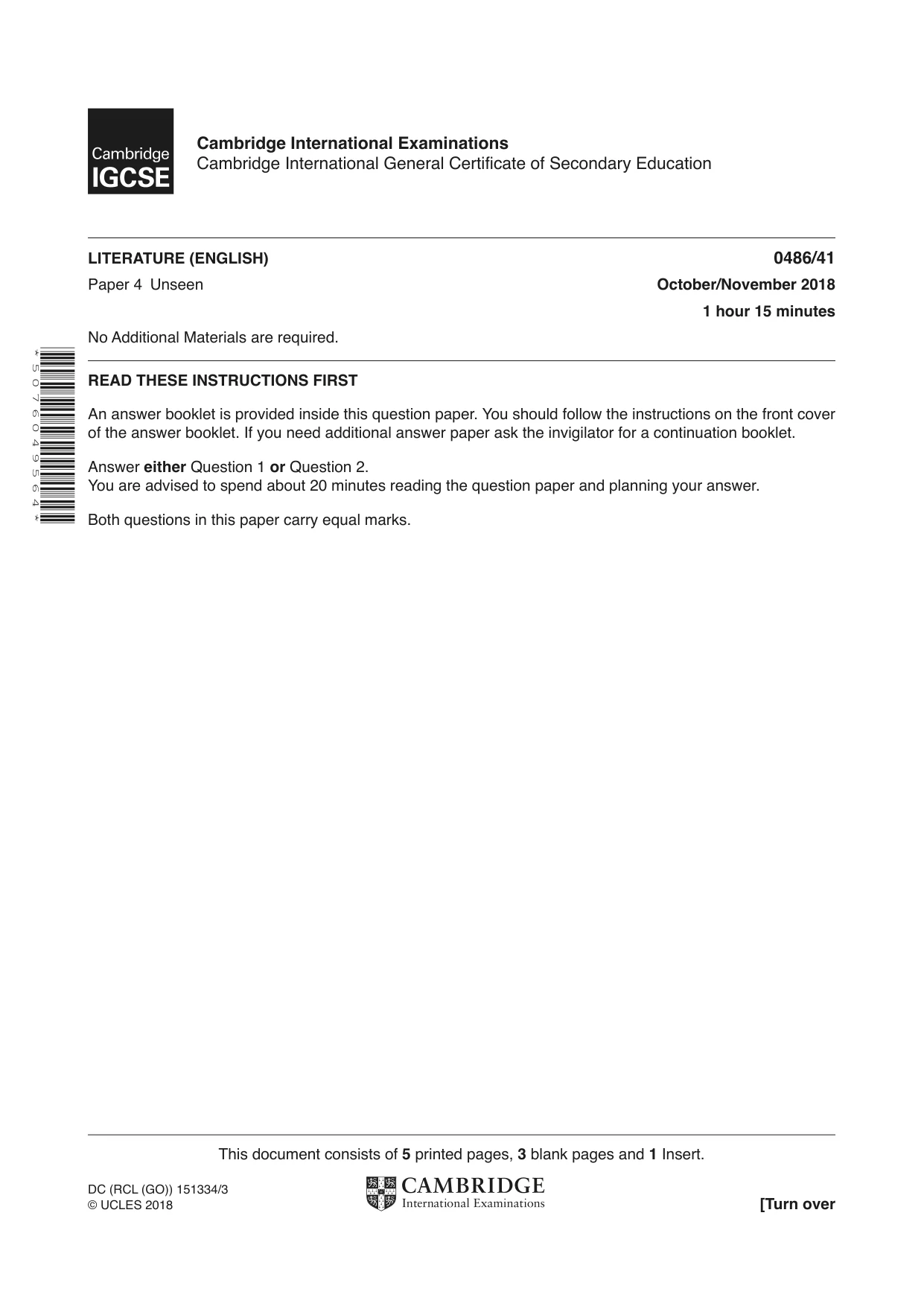
Question paper, page 1
This document consists of 5 printed pages, 3 blank pages and 1 Insert. DC (RCL (GO)) 151334/3 © UCLES 2018 [Turn over Cambridge International Examinations Cambridge International General Certificate of Secondary Education * 5 0 7 6 0 4 9 5 6 4 * LITERATURE (ENGLISH) 0486/41 Paper 4 Unseen October/November 2018 1 hour 15 minutes No Additional Materials are required. READ THESE INSTRUCTIONS FIRST An answer booklet is provided inside this question paper. You should follow the instructions on the front cover of the answer booklet. If you need additional answer paper ask the invigilator for a continuation booklet. Answer either Question 1 or Question 2. You are advised to spend about 20 minutes reading the question paper and planning your answer. Both questions in this paper carry equal marks.
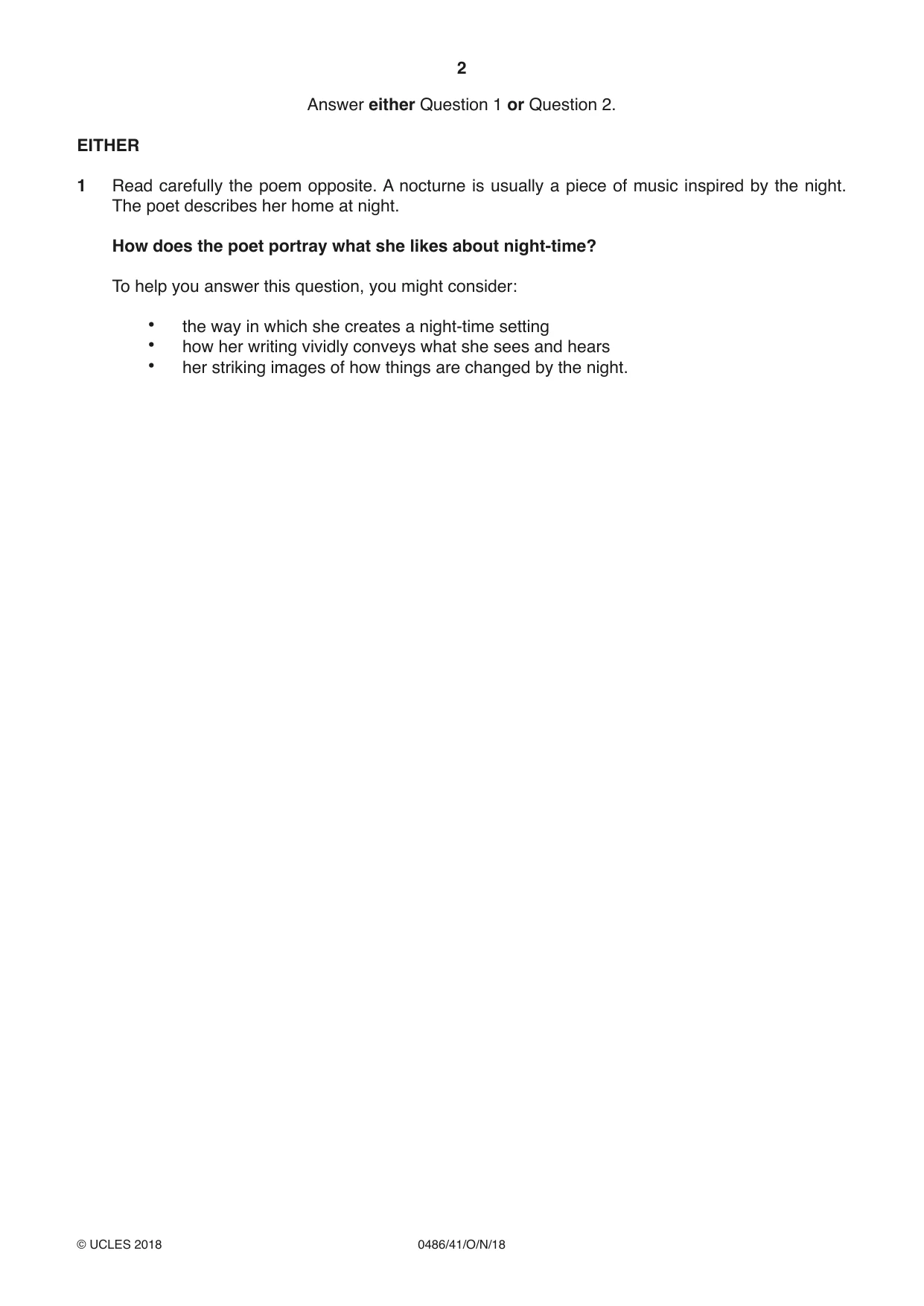
Question paper, page 2
2 0486/41/O/N/18 © UCLES 2018 Answer either Question 1 or Question 2. EITHER 1 Read carefully the poem opposite. A nocturne is usually a piece of music inspired by the night. The poet describes her home at night. How does the poet portray what she likes about night-time? To help you answer this question, you might consider: • the way in which she creates a night-time setting • how her writing vividly conveys what she sees and hears • her striking images of how things are changed by the night.
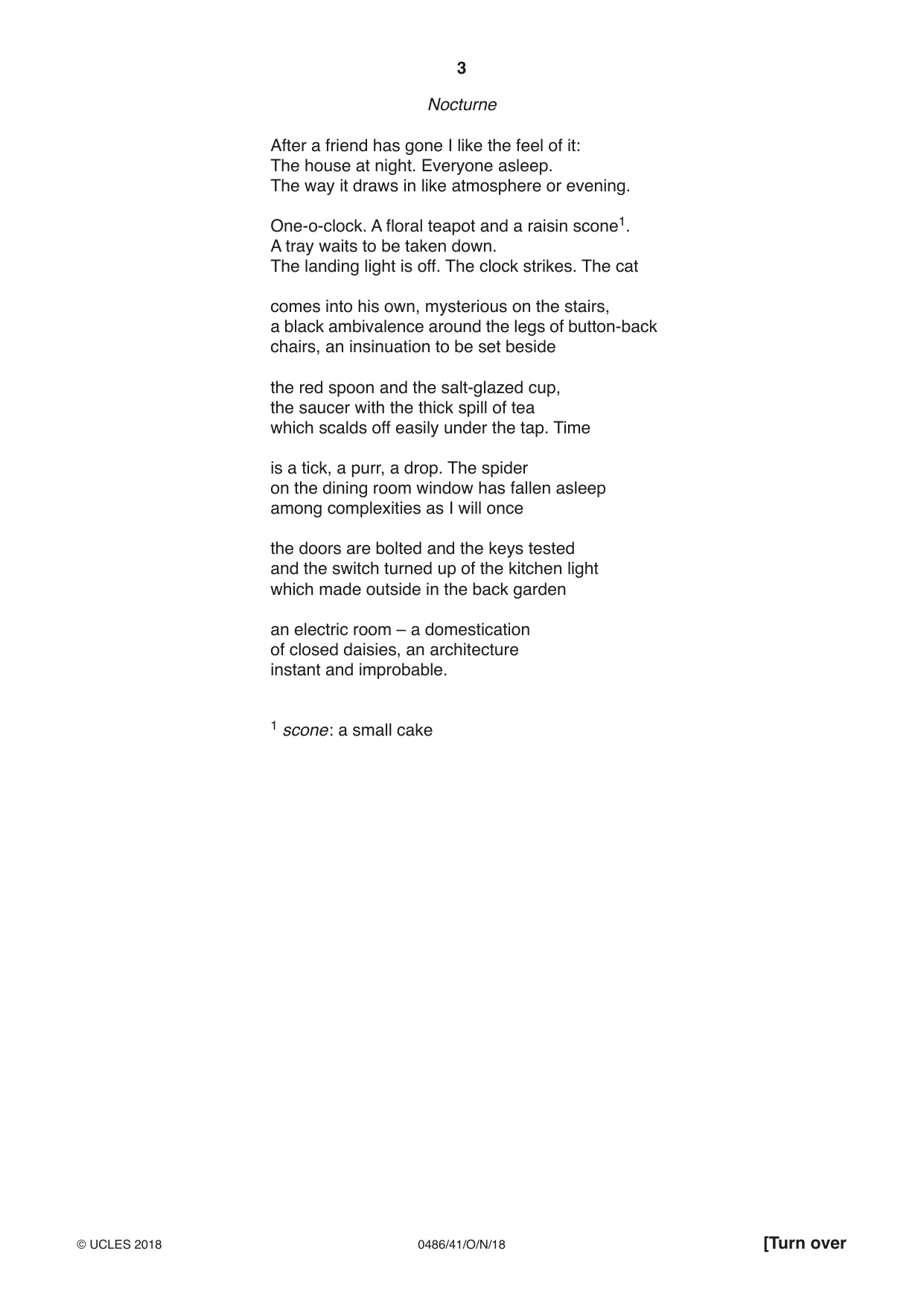
Question paper, page 3
3 0486/41/O/N/18 © UCLES 2018 [Turn over Nocturne After a friend has gone I like the feel of it: The house at night. Everyone asleep. The way it draws in like atmosphere or evening. One-o-clock. A floral teapot and a raisin scone1. A tray waits to be taken down. The landing light is off. The clock strikes. The cat comes into his own, mysterious on the stairs, a black ambivalence around the legs of button-back chairs, an insinuation to be set beside the red spoon and the salt-glazed cup, the saucer with the thick spill of tea which scalds off easily under the tap. Time is a tick, a purr, a drop. The spider on the dining room window has fallen asleep among complexities as I will once the doors are bolted and the keys tested and the switch turned up of the kitchen light which made outside in the back garden an electric room – a domestication of closed daisies, an architecture instant and improbable. 1 scone: a small cake
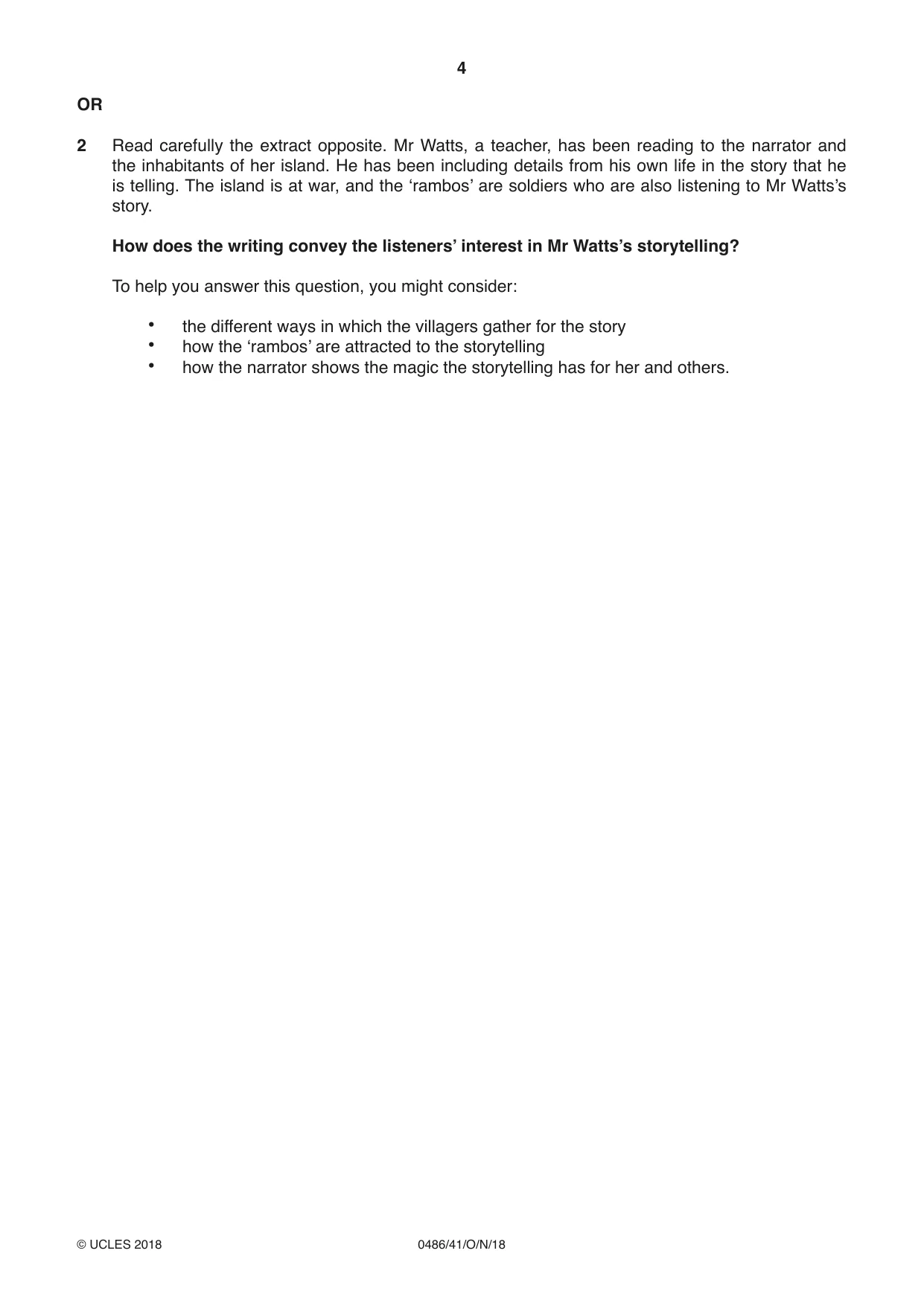
Question paper, page 4
4 0486/41/O/N/18 © UCLES 2018 OR 2 Read carefully the extract opposite. Mr Watts, a teacher, has been reading to the narrator and the inhabitants of her island. He has been including details from his own life in the story that he is telling. The island is at war, and the ‘rambos’ are soldiers who are also listening to Mr Watts’s story. How does the writing convey the listeners’ interest in Mr Watts’s storytelling? To help you answer this question, you might consider: • the different ways in which the villagers gather for the story • how the ‘rambos’ are attracted to the storytelling • how the narrator shows the magic the storytelling has for her and others.
Question paper, page 5
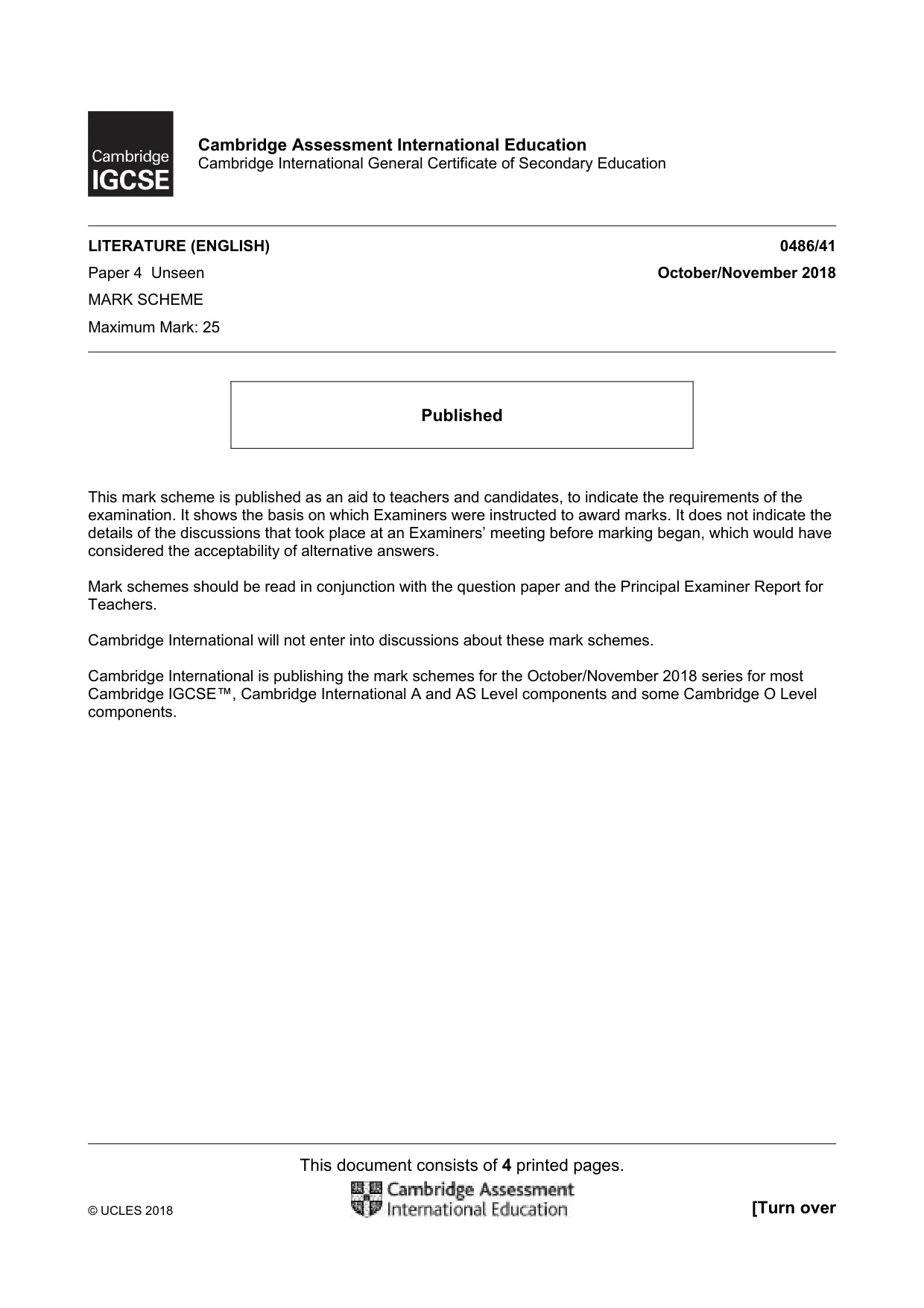
5 0486/41/O/N/18 © UCLES 2018 Each night we assembled, some of us sitting cross-legged on the ground, some lying with hands under heads to count the stars as they came out, one after another, like shy fish emerging from their holes in the reef. Some stood as if they might not stay (but they always did). My mum was always the last to arrive. It was a point of pride with her. She liked to pretend she had her hands full with other, more important things. That was the impression she hoped to give to anyone who might pay her the respect of noticing. She would wait until the last straggler had joined the audience. Only then did she allow herself the luxury of changing her mind, thinking she might have time to hear Mr Watts speak after all, especially now he had shown a capacity to surprise. If you watched closely you saw Mr Watts sink into himself. You saw his eyes close, as if reaching for faraway words, faint as distant stars. He never raised his voice. He didn’t have to. The only other noises came from the fire, the sea murmuring, and the nightlife in the trees waking from their daytime slumber. But on hearing Mr Watts’ voice the creatures shut up as well. Even the trees listened. And the old women too, and with the respect they once reserved for prayer back when there was a roof to sit under and a white German pastor to stare at. And the rambos1 were as enthralled as the rest of us. Three years in the jungle setting death traps for the redskins2 had made them dangerous, but when I saw the soft focus of their eyes by the fire, I saw faces that missed the classroom. They were practically kids themselves. The one with the sleepy eye would not have been more than twenty. The rest were in their teens. Nowadays I’ve come to think of them as no more than children in torn clothes bearing weapons from another war. But they had power. They had the power to ask the question that no one else thought to ask. The question was simple enough. Who are you? So in the first instance they were after information. In the second, they found themselves seduced by Mr Watts’ story. By the third night, it was settled. Mr Watts was Pip3 and they—like the rest of us—were the audience. Mr Watts spoke with care so as not to leave anyone behind. Whenever he mentioned Grace’s4 name we wriggled in to get closer to the story of one of our own in the white world. When Mr Watts’ voice started to falter we would know that the night’s storytelling was coming to an end. His voice would stall in the middle of a sentence, at which point some of us would join him in staring up at the black night. This was a trick of his because when we looked down again we saw him disappear into the night, back to his house. 1 rambos: (slang) soldiers 2 redskins: (slang) foreign invaders 3 Pip: name of the main character in Mr Watts’s story 4 Grace: name of Mr Watts’s dead wife
Question paper, page 6
6 0486/41/O/N/18 © UCLES 2018 BLANK PAGE
Question paper, page 7
7 0486/41/O/N/18 © UCLES 2018 BLANK PAGE
Question paper, page 8
8 0486/41/O/N/18 © UCLES 2018 BLANK PAGE Permission to reproduce items where third-party owned material protected by copyright is included has been sought and cleared where possible. Every reasonable effort has been made by the publisher (UCLES) to trace copyright holders, but if any items requiring clearance have unwittingly been included, the publisher will be pleased to make amends at the earliest possible opportunity. To avoid the issue of disclosure of answer-related information to candidates, all copyright acknowledgements are reproduced online in the Cambridge International Examinations Copyright Acknowledgements Booklet. This is produced for each series of examinations and is freely available to download at www.cie.org.uk after the live examination series. Cambridge International Examinations is part of the Cambridge Assessment Group. Cambridge Assessment is the brand name of University of Cambridge Local Examinations Syndicate (UCLES), which is itself a department of the University of Cambridge.
Mark scheme, page 1
This document consists of 4 printed pages. © UCLES 2018 [Turn over Cambridge Assessment International Education Cambridge International General Certificate of Secondary Education LITERATURE (ENGLISH) 0486/41 Paper 4 Unseen October/November 2018 MARK SCHEME Maximum Mark: 25 Published This mark scheme is published as an aid to teachers and candidates, to indicate the requirements of the examination. It shows the basis on which Examiners were instructed to award marks. It does not indicate the details of the discussions that took place at an Examiners’ meeting before marking began, which would have considered the acceptability of alternative answers. Mark schemes should be read in conjunction with the question paper and the Principal Examiner Report for Teachers. Cambridge International will not enter into discussions about these mark schemes. Cambridge International is publishing the mark schemes for the October/November 2018 series for most Cambridge IGCSE™, Cambridge International A and AS Level components and some Cambridge O Level components.
Mark scheme, page 2
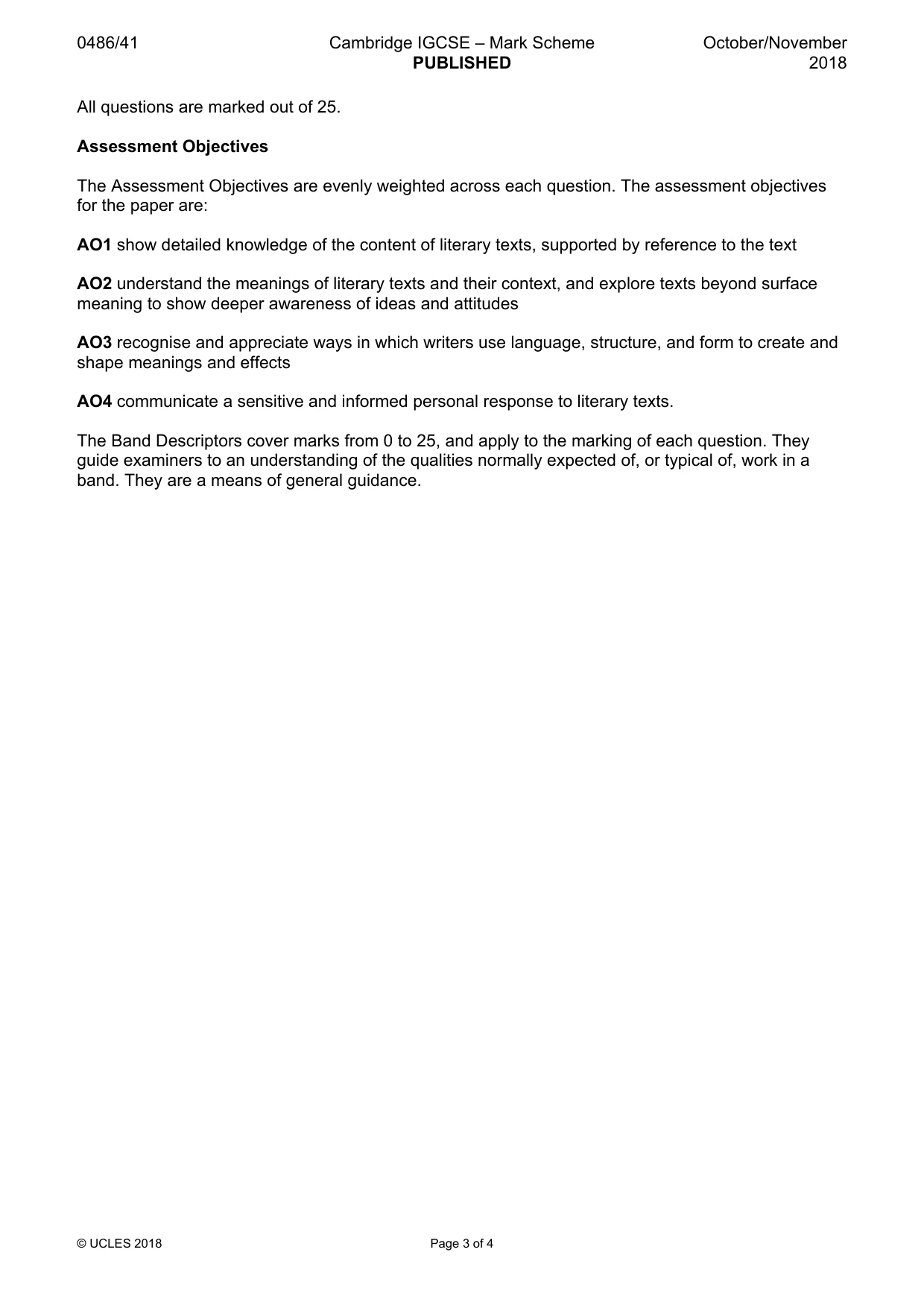
0486/41 Cambridge IGCSE – Mark Scheme PUBLISHED October/November 2018 © UCLES 2018 Page 2 of 4 Generic Marking Principles These general marking principles must be applied by all examiners when marking candidate answers. They should be applied alongside the specific content of the mark scheme or generic level descriptors for a question. Each question paper and mark scheme will also comply with these marking principles. GENERIC MARKING PRINCIPLE 1: Marks must be awarded in line with: • the specific content of the mark scheme or the generic level descriptors for the question • the specific skills defined in the mark scheme or in the generic level descriptors for the question • the standard of response required by a candidate as exemplified by the standardisation scripts. GENERIC MARKING PRINCIPLE 2: Marks awarded are always whole marks (not half marks, or other fractions). GENERIC MARKING PRINCIPLE 3: Marks must be awarded positively: • marks are awarded for correct/valid answers, as defined in the mark scheme. However, credit is given for valid answers which go beyond the scope of the syllabus and mark scheme, referring to your Team Leader as appropriate • marks are awarded when candidates clearly demonstrate what they know and can do • marks are not deducted for errors • marks are not deducted for omissions • answers should only be judged on the quality of spelling, punctuation and grammar when these features are specifically assessed by the question as indicated by the mark scheme. The meaning, however, should be unambiguous. GENERIC MARKING PRINCIPLE 4: Rules must be applied consistently e.g. in situations where candidates have not followed instructions or in the application of generic level descriptors. GENERIC MARKING PRINCIPLE 5: Marks should be awarded using the full range of marks defined in the mark scheme for the question (however; the use of the full mark range may be limited according to the quality of the candidate responses seen). GENERIC MARKING PRINCIPLE 6: Marks awarded are based solely on the requirements as defined in the mark scheme. Marks should not be awarded with grade thresholds or grade descriptors in mind.
Mark scheme, page 3
0486/41 Cambridge IGCSE – Mark Scheme PUBLISHED October/November 2018 © UCLES 2018 Page 3 of 4 All questions are marked out of 25. Assessment Objectives The Assessment Objectives are evenly weighted across each question. The assessment objectives for the paper are: AO1 show detailed knowledge of the content of literary texts, supported by reference to the text AO2 understand the meanings of literary texts and their context, and explore texts beyond surface meaning to show deeper awareness of ideas and attitudes AO3 recognise and appreciate ways in which writers use language, structure, and form to create and shape meanings and effects AO4 communicate a sensitive and informed personal response to literary texts. The Band Descriptors cover marks from 0 to 25, and apply to the marking of each question. They guide examiners to an understanding of the qualities normally expected of, or typical of, work in a band. They are a means of general guidance.
Mark scheme, page 4
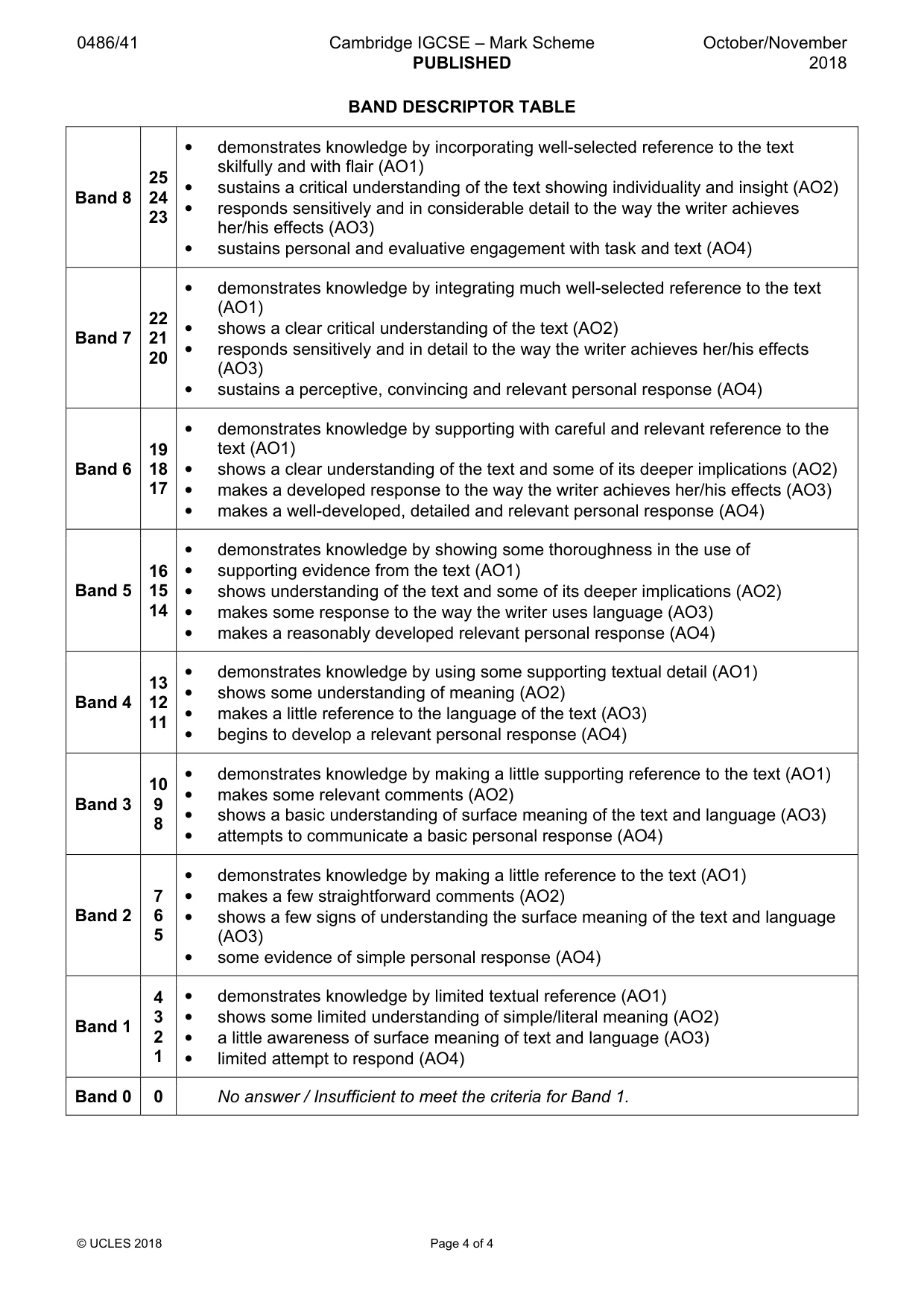
0486/41 Cambridge IGCSE – Mark Scheme PUBLISHED October/November 2018 © UCLES 2018 Page 4 of 4 BAND DESCRIPTOR TABLE Band 8 25 24 23 • demonstrates knowledge by incorporating well-selected reference to the text skilfully and with flair (AO1) • sustains a critical understanding of the text showing individuality and insight (AO2) • responds sensitively and in considerable detail to the way the writer achieves her/his effects (AO3) • sustains personal and evaluative engagement with task and text (AO4) Band 7 22 21 20 • demonstrates knowledge by integrating much well-selected reference to the text (AO1) • shows a clear critical understanding of the text (AO2) • responds sensitively and in detail to the way the writer achieves her/his effects (AO3) • sustains a perceptive, convincing and relevant personal response (AO4) Band 6 19 18 17 • demonstrates knowledge by supporting with careful and relevant reference to the text (AO1) • shows a clear understanding of the text and some of its deeper implications (AO2) • makes a developed response to the way the writer achieves her/his effects (AO3) • makes a well-developed, detailed and relevant personal response (AO4) Band 5 16 15 14 • demonstrates knowledge by showing some thoroughness in the use of • supporting evidence from the text (AO1) • shows understanding of the text and some of its deeper implications (AO2) • makes some response to the way the writer uses language (AO3) • makes a reasonably developed relevant personal response (AO4) Band 4 13 12 11 • demonstrates knowledge by using some supporting textual detail (AO1) • shows some understanding of meaning (AO2) • makes a little reference to the language of the text (AO3) • begins to develop a relevant personal response (AO4) Band 3 10 9 8 • demonstrates knowledge by making a little supporting reference to the text (AO1) • makes some relevant comments (AO2) • shows a basic understanding of surface meaning of the text and language (AO3) • attempts to communicate a basic personal response (AO4) Band 2 7 6 5 • demonstrates knowledge by making a little reference to the text (AO1) • makes a few straightforward comments (AO2) • shows a few signs of understanding the surface meaning of the text and language (AO3) • some evidence of simple personal response (AO4) Band 1 4 3 2 1 • demonstrates knowledge by limited textual reference (AO1) • shows some limited understanding of simple/literal meaning (AO2) • a little awareness of surface meaning of text and language (AO3) • limited attempt to respond (AO4) Band 0 0 No answer / Insufficient to meet the criteria for Band 1.
What you needed in this session
Cambridge’s own grade thresholds for 2018 Oct/Nov, Paper 4 · Variant 1. A higher threshold means an easier paper — the bar moves with how the cohort did.