Cambridge IGCSE English - Literature 0486 — 2017 May/June Paper 4 · Variant 3
0486/43/M/J/17 · 25 marks · ≈28 min
The question paper and its mark scheme, free to read here and free to download. This is Cambridge’s own paper, exactly as it was sat.
Question paper8 pages


Mark scheme3 pages
Answers below. Sit the paper first if you are practising.
Paper as text
Question paper, page 1
This document consists of 5 printed pages, 3 blank pages and 1 Insert. DC (RCL (JDA)) 133594/3 © UCLES 2017 [Turn over Cambridge International Examinations Cambridge International General Certificate of Secondary Education * 9 7 5 8 1 8 4 9 4 1 * LITERATURE (ENGLISH) 0486/43 Paper 4 Unseen May/June 2017 1 hour 15 minutes No Additional Materials are required. READ THESE INSTRUCTIONS FIRST An answer booklet is provided inside this question paper. You should follow the instructions on the front cover of the answer booklet. If you need additional answer paper ask the invigilator for a continuation booklet. Answer either Question 1 or Question 2. You are advised to spend about 20 minutes reading the question paper and planning your answer. Both questions in this paper carry equal marks.
Question paper, page 2
2 0486/43/M/J/17 © UCLES 2017 Answer either Question 1 or Question 2. EITHER 1 Read carefully the poem opposite. How does the poet vividly portray the woman and the impression she made on him? To help you answer this question, you might consider: • how he describes her life and surroundings • how he describes the woman and her attitudes • how he conveys the impact of meeting her ‘face to face’.
Question paper, page 3
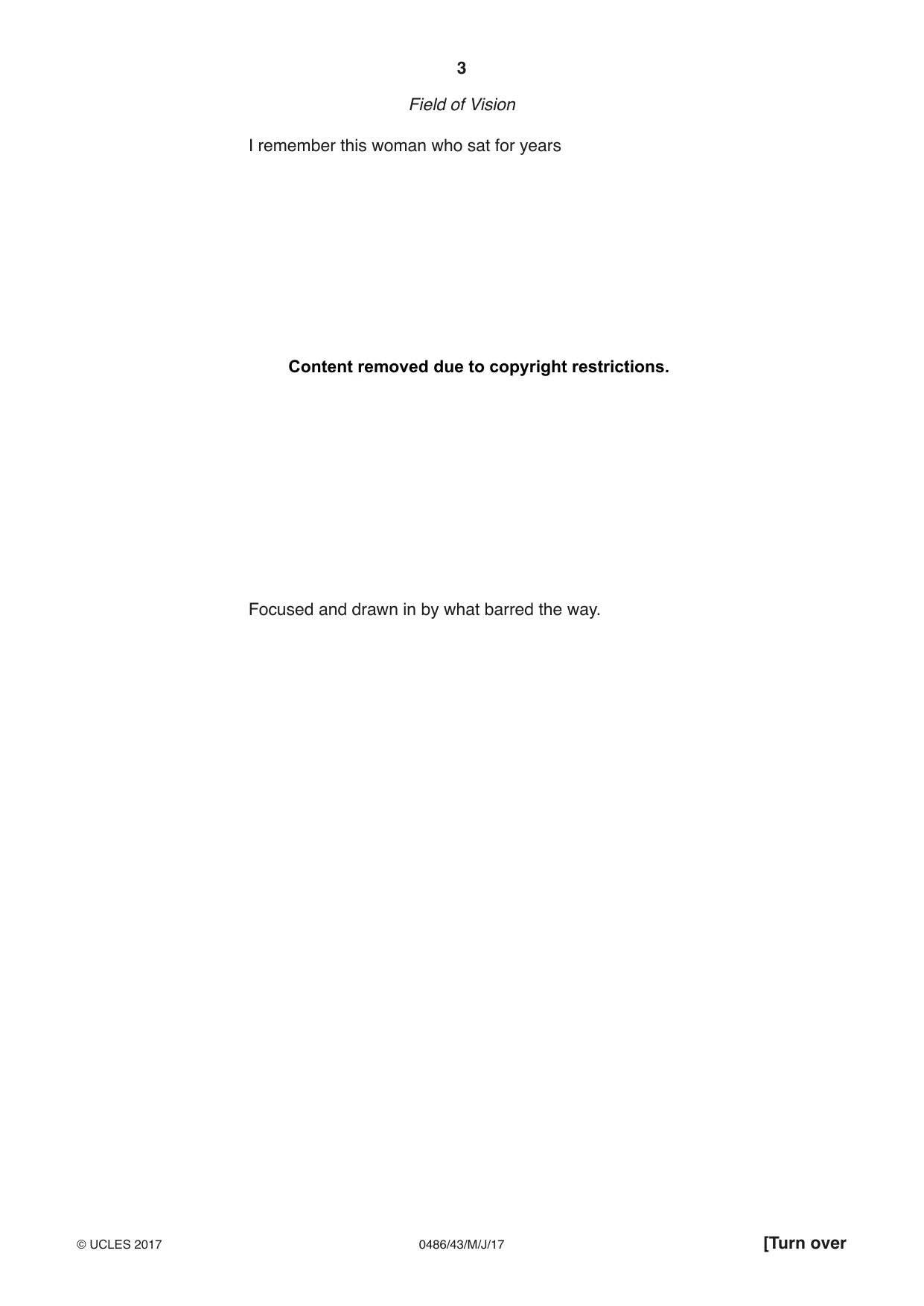
3 0486/43/M/J/17 © UCLES 2017 [Turn over Field of Vision I remember this woman who sat for years Focused and drawn in by what barred the way. Content removed due to copyright restrictions.
Question paper, page 4
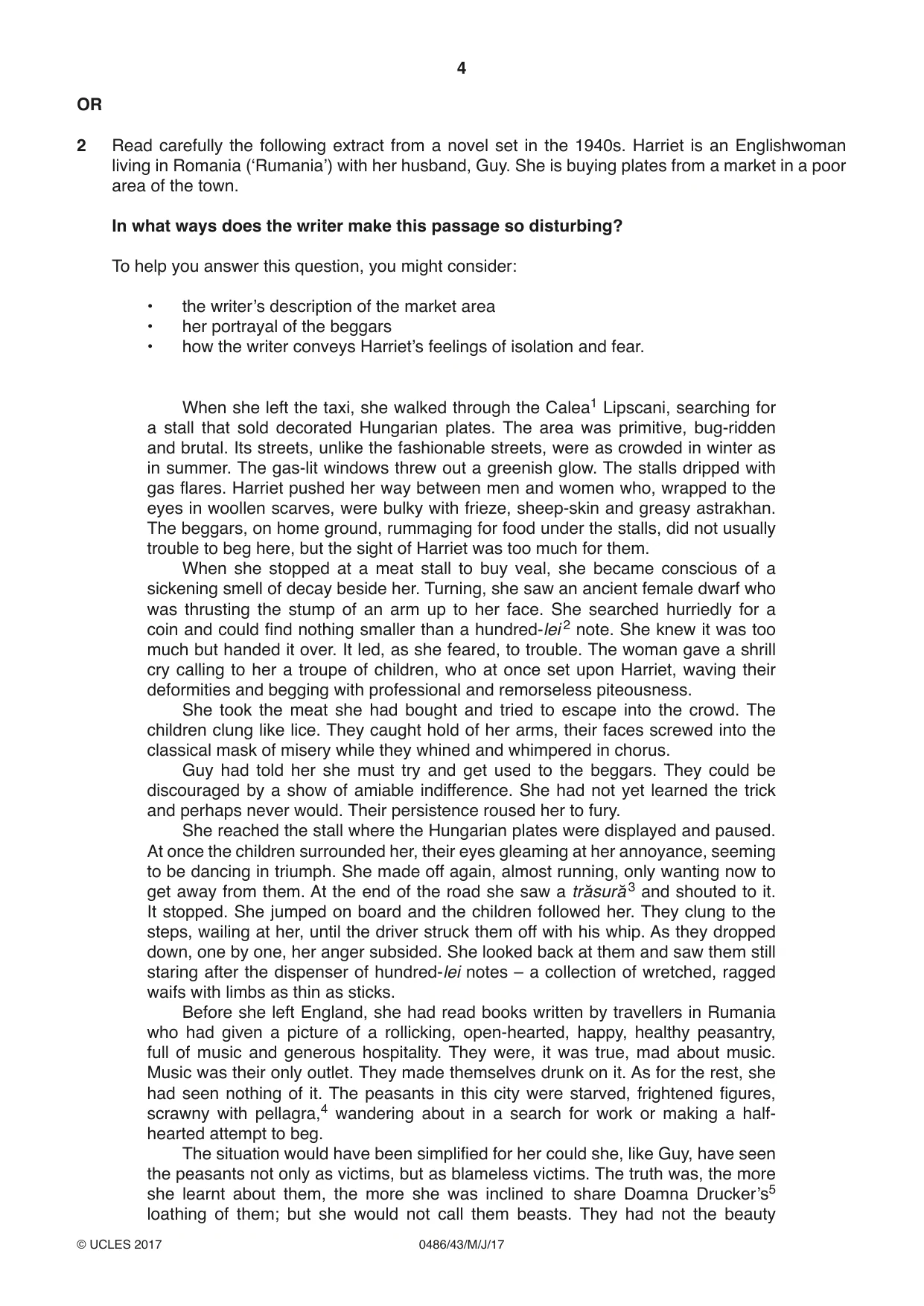
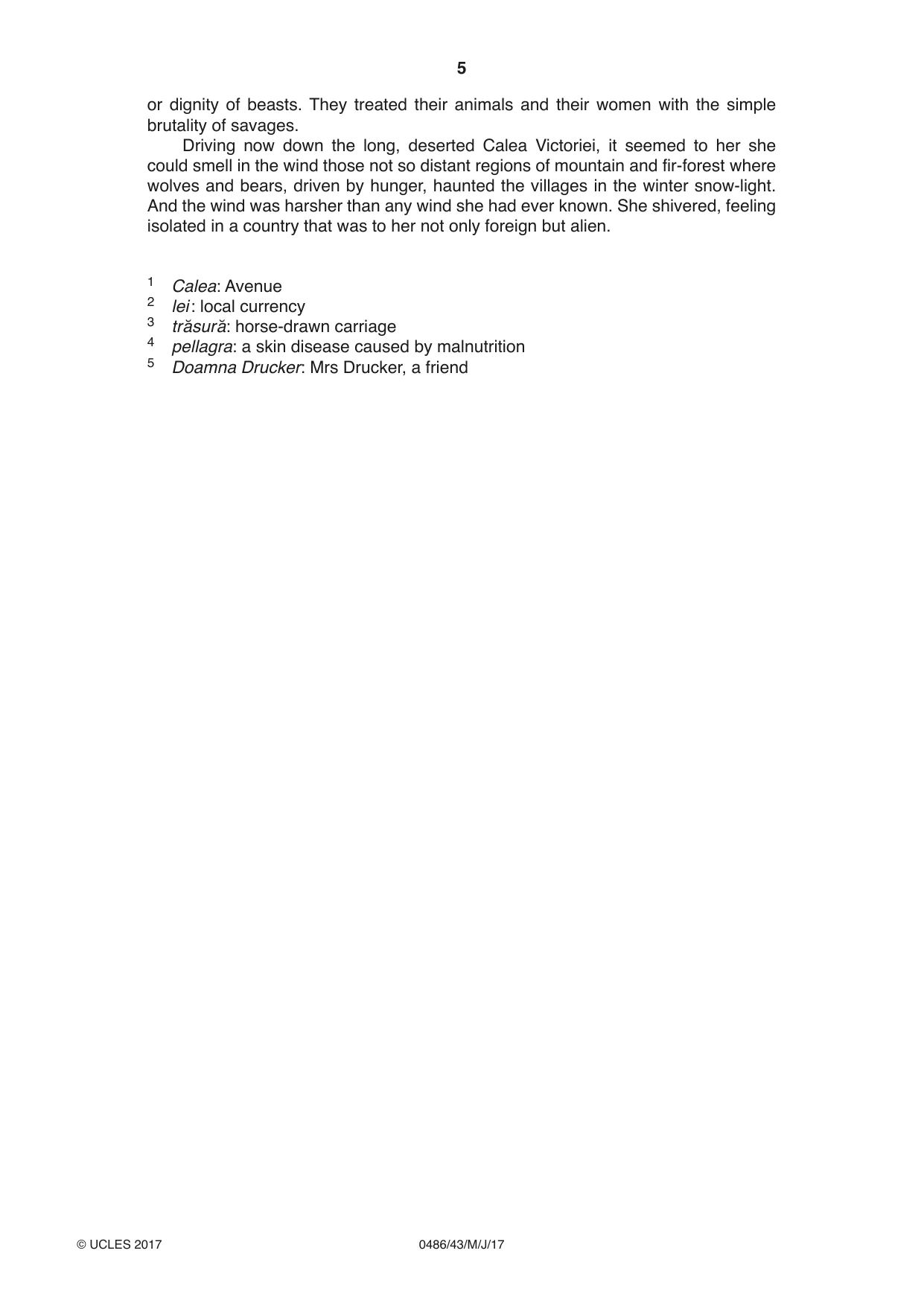
4 0486/43/M/J/17 © UCLES 2017 OR 2 Read carefully the following extract from a novel set in the 1940s. Harriet is an Englishwoman living in Romania (‘Rumania’) with her husband, Guy. She is buying plates from a market in a poor area of the town. In what ways does the writer make this passage so disturbing? To help you answer this question, you might consider: • the writer’s description of the market area • her portrayal of the beggars • how the writer conveys Harriet’s feelings of isolation and fear. When she left the taxi, she walked through the Calea1 Lipscani, searching for a stall that sold decorated Hungarian plates. The area was primitive, bug-ridden and brutal. Its streets, unlike the fashionable streets, were as crowded in winter as in summer. The gas-lit windows threw out a greenish glow. The stalls dripped with gas flares. Harriet pushed her way between men and women who, wrapped to the eyes in woollen scarves, were bulky with frieze, sheep-skin and greasy astrakhan. The beggars, on home ground, rummaging for food under the stalls, did not usually trouble to beg here, but the sight of Harriet was too much for them. When she stopped at a meat stall to buy veal, she became conscious of a sickening smell of decay beside her. Turning, she saw an ancient female dwarf who was thrusting the stump of an arm up to her face. She searched hurriedly for a coin and could find nothing smaller than a hundred-lei 2 note. She knew it was too much but handed it over. It led, as she feared, to trouble. The woman gave a shrill cry calling to her a troupe of children, who at once set upon Harriet, waving their deformities and begging with professional and remorseless piteousness. She took the meat she had bought and tried to escape into the crowd. The children clung like lice. They caught hold of her arms, their faces screwed into the classical mask of misery while they whined and whimpered in chorus. Guy had told her she must try and get used to the beggars. They could be discouraged by a show of amiable indifference. She had not yet learned the trick and perhaps never would. Their persistence roused her to fury. She reached the stall where the Hungarian plates were displayed and paused. At once the children surrounded her, their eyes gleaming at her annoyance, seeming to be dancing in triumph. She made off again, almost running, only wanting now to get away from them. At the end of the road she saw a tr˘asur˘a 3 and shouted to it. It stopped. She jumped on board and the children followed her. They clung to the steps, wailing at her, until the driver struck them off with his whip. As they dropped down, one by one, her anger subsided. She looked back at them and saw them still staring after the dispenser of hundred-lei notes – a collection of wretched, ragged waifs with limbs as thin as sticks. Before she left England, she had read books written by travellers in Rumania who had given a picture of a rollicking, open-hearted, happy, healthy peasantry, full of music and generous hospitality. They were, it was true, mad about music. Music was their only outlet. They made themselves drunk on it. As for the rest, she had seen nothing of it. The peasants in this city were starved, frightened figures, scrawny with pellagra,4 wandering about in a search for work or making a half- hearted attempt to beg. The situation would have been simplified for her could she, like Guy, have seen the peasants not only as victims, but as blameless victims. The truth was, the more she learnt about them, the more she was inclined to share Doamna Drucker’s5 loathing of them; but she would not call them beasts. They had not the beauty
Question paper, page 5
5 0486/43/M/J/17 © UCLES 2017 or dignity of beasts. They treated their animals and their women with the simple brutality of savages. Driving now down the long, deserted Calea Victoriei, it seemed to her she could smell in the wind those not so distant regions of mountain and fir-forest where wolves and bears, driven by hunger, haunted the villages in the winter snow-light. And the wind was harsher than any wind she had ever known. She shivered, feeling isolated in a country that was to her not only foreign but alien. 1 Calea: Avenue 2 lei : local currency 3 tr˘asur˘a: horse-drawn carriage 4 pellagra: a skin disease caused by malnutrition 5 Doamna Drucker: Mrs Drucker, a friend
Question paper, page 6
6 0486/43/M/J/17 © UCLES 2017 BLANK PAGE
Question paper, page 7
7 0486/43/M/J/17 © UCLES 2017 BLANK PAGE
Question paper, page 8
8 0486/43/M/J/17 © UCLES 2017 BLANK PAGE Permission to reproduce items where third-party owned material protected by copyright is included has been sought and cleared where possible. Every reasonable effort has been made by the publisher (UCLES) to trace copyright holders, but if any items requiring clearance have unwittingly been included, the publisher will be pleased to make amends at the earliest possible opportunity. To avoid the issue of disclosure of answer-related information to candidates, all copyright acknowledgements are reproduced online in the Cambridge International Examinations Copyright Acknowledgements Booklet. This is produced for each series of examinations and is freely available to download at www.cie.org.uk after the live examination series. Cambridge International Examinations is part of the Cambridge Assessment Group. Cambridge Assessment is the brand name of University of Cambridge Local Examinations Syndicate (UCLES), which is itself a department of the University of Cambridge.
Mark scheme, page 1
® IGCSE is a registered trademark. This document consists of 3 printed pages. © UCLES 2017 [Turn over Cambridge International Examinations Cambridge International General Certificate of Secondary Education LITERATURE (ENGLISH) 0486/43 Paper 4 Unseen May/June 2017 MARK SCHEME Maximum Mark: 25 Published This mark scheme is published as an aid to teachers and candidates, to indicate the requirements of the examination. It shows the basis on which Examiners were instructed to award marks. It does not indicate the details of the discussions that took place at an Examiners’ meeting before marking began, which would have considered the acceptability of alternative answers. Mark schemes should be read in conjunction with the question paper and the Principal Examiner Report for Teachers. Cambridge will not enter into discussions about these mark schemes. Cambridge is publishing the mark schemes for the May/June 2017 series for most Cambridge IGCSE®, Cambridge International A and AS Level and Cambridge Pre-U components, and some Cambridge O Level components.
Mark scheme, page 2
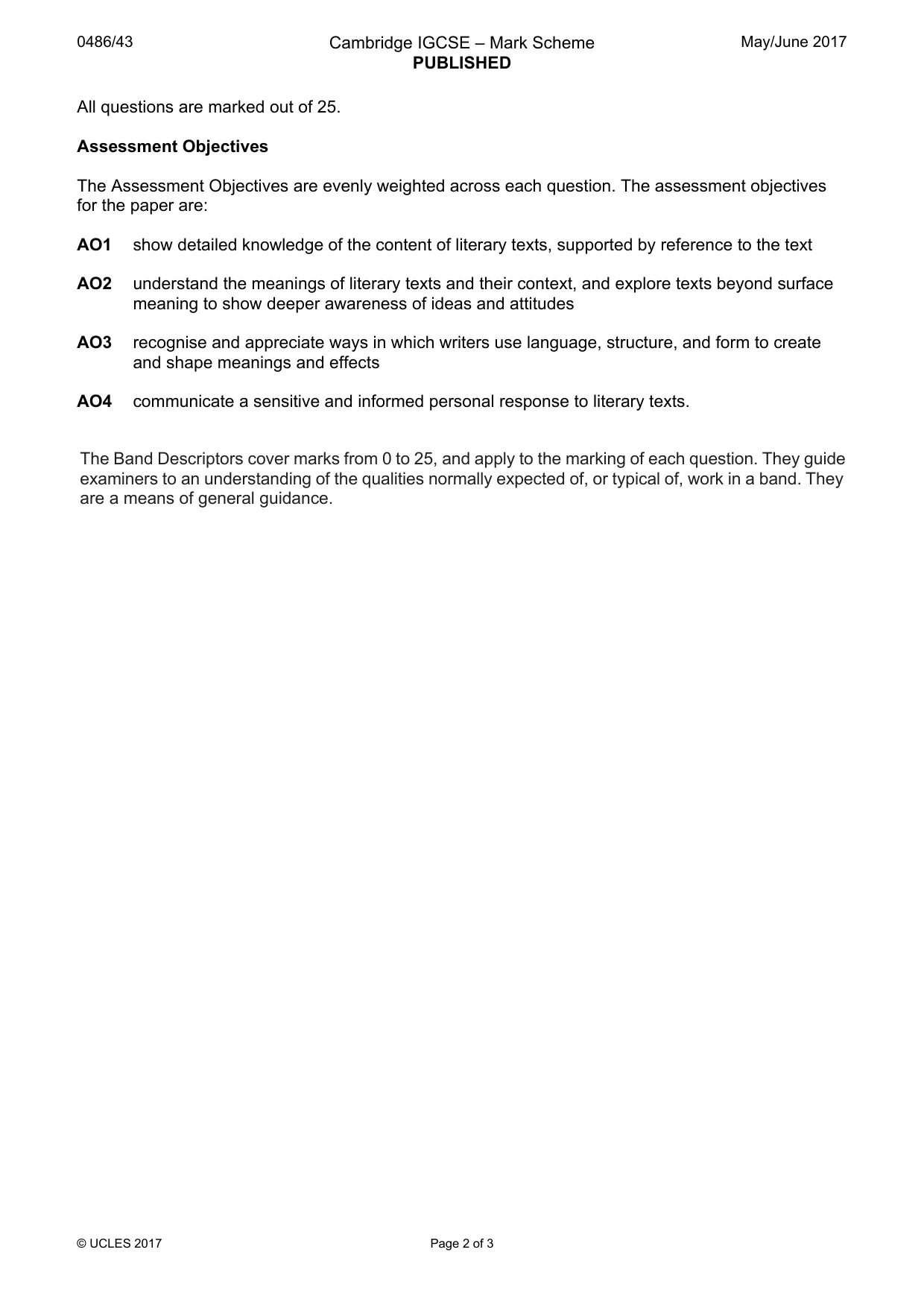
0486/43 Cambridge IGCSE – Mark Scheme PUBLISHED May/June 2017 © UCLES 2017 Page 2 of 3 All questions are marked out of 25. Assessment Objectives The Assessment Objectives are evenly weighted across each question. The assessment objectives for the paper are: AO1 show detailed knowledge of the content of literary texts, supported by reference to the text AO2 understand the meanings of literary texts and their context, and explore texts beyond surface meaning to show deeper awareness of ideas and attitudes AO3 recognise and appreciate ways in which writers use language, structure, and form to create and shape meanings and effects AO4 communicate a sensitive and informed personal response to literary texts. The Band Descriptors cover marks from 0 to 25, and apply to the marking of each question. They guide examiners to an understanding of the qualities normally expected of, or typical of, work in a band. They are a means of general guidance.
Mark scheme, page 3
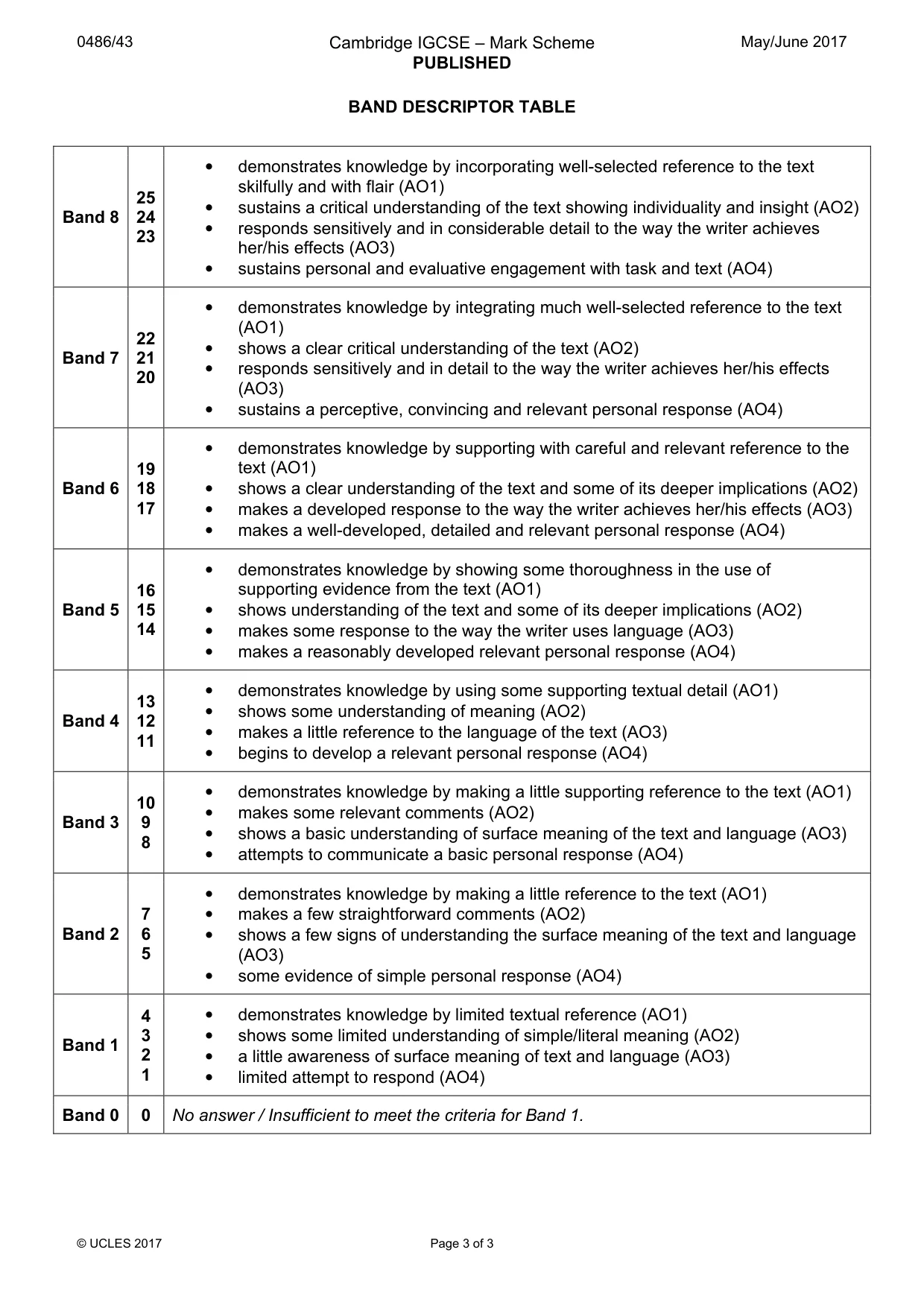
0486/43 Cambridge IGCSE – Mark Scheme PUBLISHED May/June 2017 © UCLES 2017 Page 3 of 3 BAND DESCRIPTOR TABLE Band 8 25 24 23 • demonstrates knowledge by incorporating well-selected reference to the text skilfully and with flair (AO1) • sustains a critical understanding of the text showing individuality and insight (AO2) • responds sensitively and in considerable detail to the way the writer achieves her/his effects (AO3) • sustains personal and evaluative engagement with task and text (AO4) Band 7 22 21 20 • demonstrates knowledge by integrating much well-selected reference to the text (AO1) • shows a clear critical understanding of the text (AO2) • responds sensitively and in detail to the way the writer achieves her/his effects (AO3) • sustains a perceptive, convincing and relevant personal response (AO4) Band 6 19 18 17 • demonstrates knowledge by supporting with careful and relevant reference to the text (AO1) • shows a clear understanding of the text and some of its deeper implications (AO2) • makes a developed response to the way the writer achieves her/his effects (AO3) • makes a well-developed, detailed and relevant personal response (AO4) Band 5 16 15 14 • demonstrates knowledge by showing some thoroughness in the use of supporting evidence from the text (AO1) • shows understanding of the text and some of its deeper implications (AO2) • makes some response to the way the writer uses language (AO3) • makes a reasonably developed relevant personal response (AO4) Band 4 13 12 11 • demonstrates knowledge by using some supporting textual detail (AO1) • shows some understanding of meaning (AO2) • makes a little reference to the language of the text (AO3) • begins to develop a relevant personal response (AO4) Band 3 10 9 8 • demonstrates knowledge by making a little supporting reference to the text (AO1) • makes some relevant comments (AO2) • shows a basic understanding of surface meaning of the text and language (AO3) • attempts to communicate a basic personal response (AO4) Band 2 7 6 5 • demonstrates knowledge by making a little reference to the text (AO1) • makes a few straightforward comments (AO2) • shows a few signs of understanding the surface meaning of the text and language (AO3) • some evidence of simple personal response (AO4) Band 1 4 3 2 1 • demonstrates knowledge by limited textual reference (AO1) • shows some limited understanding of simple/literal meaning (AO2) • a little awareness of surface meaning of text and language (AO3) • limited attempt to respond (AO4) Band 0 0 No answer / Insufficient to meet the criteria for Band 1.
What you needed in this session
Cambridge’s own grade thresholds for 2017 May/June, Paper 4 · Variant 3. A higher threshold means an easier paper — the bar moves with how the cohort did.