Cambridge IGCSE English - Literature 0486 — 2018 May/June Paper 4 · Variant 1
0486/41/M/J/18 · 25 marks · ≈28 min
The question paper and its mark scheme, free to read here and free to download. This is Cambridge’s own paper, exactly as it was sat.
Question paper8 pages


Mark scheme4 pages
Answers below. Sit the paper first if you are practising.
Paper as text
Question paper, page 1
This document consists of 5 printed pages, 3 blank pages and 1 Insert. DC (RCL (GO)) 149023/2 © UCLES 2018 [Turn over Cambridge International Examinations Cambridge International General Certificate of Secondary Education * 7 6 1 8 3 0 2 7 0 8 * LITERATURE (ENGLISH) 0486/41 Paper 4 Unseen May/June 2018 1 hour 15 minutes No Additional Materials are required. READ THESE INSTRUCTIONS FIRST An answer booklet is provided inside this question paper. You should follow the instructions on the front cover of the answer booklet. If you need additional answer paper ask the invigilator for a continuation booklet. Answer either Question 1 or Question 2. You are advised to spend about 20 minutes reading the question paper and planning your answer. Both questions in this paper carry equal marks.
Question paper, page 2
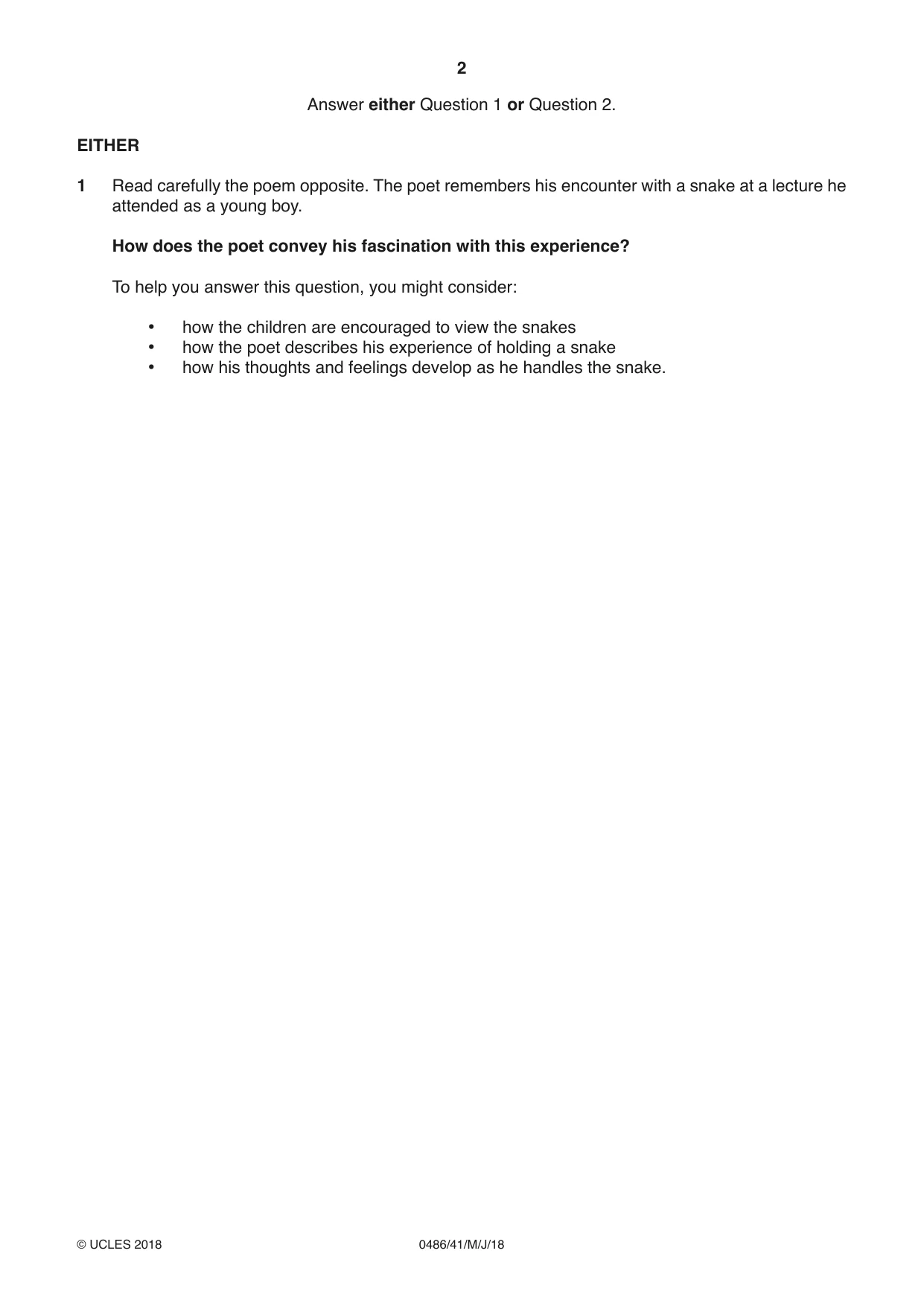
2 0486/41/M/J/18 © UCLES 2018 Answer either Question 1 or Question 2. EITHER 1 Read carefully the poem opposite. The poet remembers his encounter with a snake at a lecture he attended as a young boy. How does the poet convey his fascination with this experience? To help you answer this question, you might consider: • how the children are encouraged to view the snakes • how the poet describes his experience of holding a snake • how his thoughts and feelings develop as he handles the snake.
Question paper, page 3
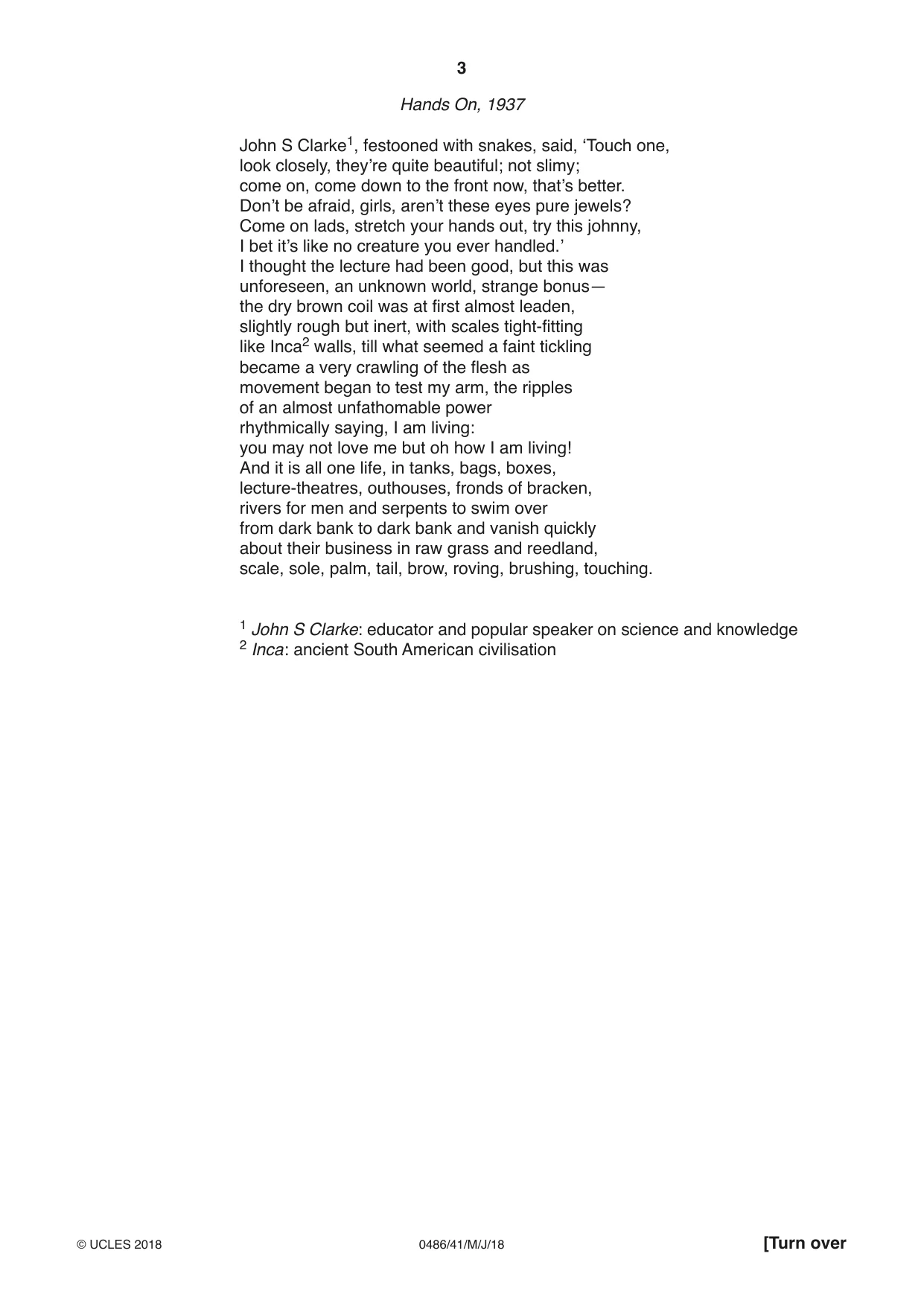
3 0486/41/M/J/18 © UCLES 2018 [Turn over Hands On, 1937 John S Clarke1, festooned with snakes, said, ‘Touch one, look closely, they’re quite beautiful; not slimy; come on, come down to the front now, that’s better. Don’t be afraid, girls, aren’t these eyes pure jewels? Come on lads, stretch your hands out, try this johnny, I bet it’s like no creature you ever handled.’ I thought the lecture had been good, but this was unforeseen, an unknown world, strange bonus— the dry brown coil was at first almost leaden, slightly rough but inert, with scales tight-fitting like Inca2 walls, till what seemed a faint tickling became a very crawling of the flesh as movement began to test my arm, the ripples of an almost unfathomable power rhythmically saying, I am living: you may not love me but oh how I am living! And it is all one life, in tanks, bags, boxes, lecture-theatres, outhouses, fronds of bracken, rivers for men and serpents to swim over from dark bank to dark bank and vanish quickly about their business in raw grass and reedland, scale, sole, palm, tail, brow, roving, brushing, touching. 1 John S Clarke: educator and popular speaker on science and knowledge 2 Inca: ancient South American civilisation
Question paper, page 4
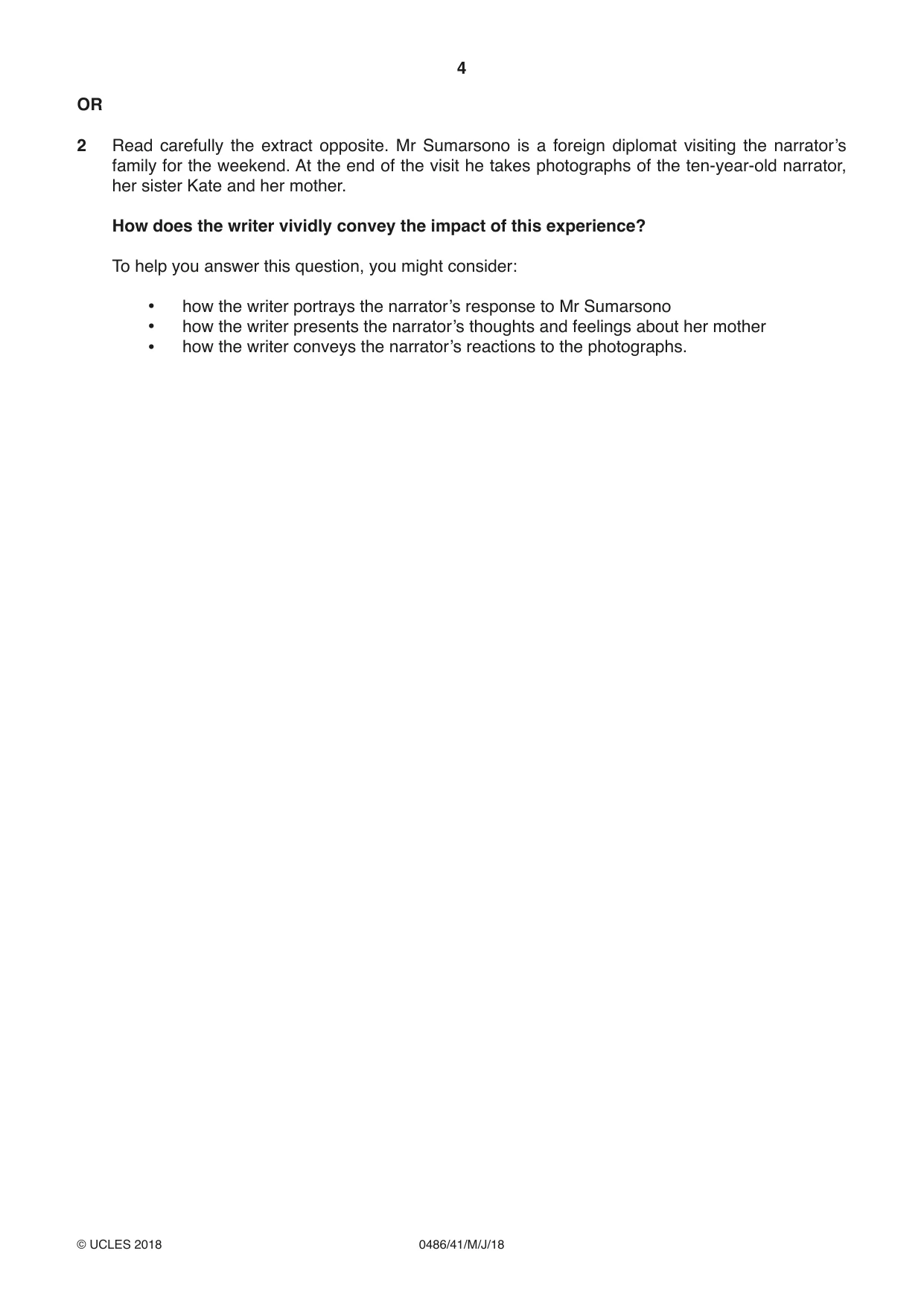
4 0486/41/M/J/18 © UCLES 2018 OR 2 Read carefully the extract opposite. Mr Sumarsono is a foreign diplomat visiting the narrator’s family for the weekend. At the end of the visit he takes photographs of the ten-year-old narrator, her sister Kate and her mother. How does the writer vividly convey the impact of this experience? To help you answer this question, you might consider: • how the writer portrays the narrator’s response to Mr Sumarsono • how the writer presents the narrator’s thoughts and feelings about her mother • how the writer conveys the narrator’s reactions to the photographs.
Question paper, page 5
5 0486/41/M/J/18 © UCLES 2018 Mr Sumarsono stooped over us, his courtesy exquisite and unyielding. ‘Please,’ he said, ‘now photograph.’ He held up the camera. It covered his face entirely, a strange mechanical mask. ‘My photograph,’ he said in a decisive tone. He aimed the camera first at me. I produced a taut and artificial smile, and at once he reappeared from behind the camera. ‘No smile,’ he said firmly, shaking his head. ‘No smile.’ He himself produced a hideous smile, then shook his head and turned grave. ‘Ah!’ he said, nodding, and pointed to me. Chastened, I sat solemn and rigid while he disappeared behind the camera again. I didn’t move even when he had finished, after the flash and the clicks of lenses and winding sprockets. Mr Sumarsono turned to Kate, who had learned from me and offered up a smooth and serious face. Mr Sumarsono nodded, but stepped toward her. ‘Hand!’ he said, motioning toward it, and he made the gesture that he wanted. Kate stared but obediently did as he asked. When Mr Sumarsono turned to my mother, I worried again that she would stage a last-ditch attempt to take over, that she would insist on mortifying us all. ‘Now!’ said Mr Sumarsono, bowing peremptorily at her. ‘Please.’ I looked at her, and to my amazement, relief and delight, my mother did exactly the right thing. She smiled at Mr Sumarsono in a normal and relaxed way, as though they were old friends. She leaned easily back in her chair, graceful – I could suddenly see – and poised. She smoothed her hair back from her forehead. In Mr Sumarsono’s pictures, the images of us that he produced, this is how we look. I am staring solemnly at the camera, dead serious, head-on. I look mystified, as though I am trying to understand something inexplicable; what the people around me mean when they speak, perhaps. I look as though I am in a foreign country where I do not speak the language. Kate looks both radiant and ethereal; her eyes are alight. Her mouth is puckered into a mirthful V; she is trying to suppress a smile. The V of her mouth is echoed above her face by her two forked fingers, poised airily behind her head. But it is the picture of my mother that surprised me the most. Mr Sumarsono’s portrait was of someone entirely different from the person I knew, though the face was the same. Looking at it gave me the same feeling that the stopped escalator did; a sense of dislocation, a sudden uncertainty about my own beliefs. In the photograph my mother leans back against her chair like a queen, all her power evident, and at rest. Her face is turned slightly away; she is guarding her privacy. Her nose, her cheeks, her eyes, are bright with wine and excitement, but she is calm and amused. A mother cannot be beautiful, because she is so much more a mother than a woman, but in this picture it struck me, my mother looked, in an odd way, beautiful. I could see for the first time that other people might think she actually was beautiful. Mr Sumarsono’s view of my mother was of a glowing, self-assured, generous woman. And Mr Sumarsono himself was a real person, despite his meekness. I knew that; I had seen him take control. His view meant something; I could not ignore it. And I began to wonder. We still have the pictures. Mr Sumarsono brought them with him the next time he came out for the weekend.
Question paper, page 6
6 0486/41/M/J/18 © UCLES 2018 BLANK PAGE
Question paper, page 7
7 0486/41/M/J/18 © UCLES 2018 BLANK PAGE
Question paper, page 8
8 0486/41/M/J/18 © UCLES 2018 BLANK PAGE Permission to reproduce items where third-party owned material protected by copyright is included has been sought and cleared where possible. Every reasonable effort has been made by the publisher (UCLES) to trace copyright holders, but if any items requiring clearance have unwittingly been included, the publisher will be pleased to make amends at the earliest possible opportunity. To avoid the issue of disclosure of answer-related information to candidates, all copyright acknowledgements are reproduced online in the Cambridge International Examinations Copyright Acknowledgements Booklet. This is produced for each series of examinations and is freely available to download at www.cie.org.uk after the live examination series. Cambridge International Examinations is part of the Cambridge Assessment Group. Cambridge Assessment is the brand name of University of Cambridge Local Examinations Syndicate (UCLES), which is itself a department of the University of Cambridge.
Mark scheme, page 1
IGCSE™ is a registered trademark. This document consists of 4 printed pages. © UCLES 2018 [Turn over Cambridge Assessment International Education Cambridge International General Certificate of Secondary Education LITERATURE (ENGLISH) 0486/41 Paper 4 Unseen May/June 2018 MARK SCHEME Maximum Mark: 25 Published This mark scheme is published as an aid to teachers and candidates, to indicate the requirements of the examination. It shows the basis on which Examiners were instructed to award marks. It does not indicate the details of the discussions that took place at an Examiners’ meeting before marking began, which would have considered the acceptability of alternative answers. Mark schemes should be read in conjunction with the question paper and the Principal Examiner Report for Teachers. Cambridge International will not enter into discussions about these mark schemes. Cambridge International is publishing the mark schemes for the May/June 2018 series for most Cambridge IGCSE™, Cambridge International A and AS Level and Cambridge Pre-U components, and some Cambridge O Level components.
Mark scheme, page 2
0486/41 Cambridge IGCSE – Mark Scheme PUBLISHED May/June 2018 © UCLES 2018 Page 2 of 4 Generic Marking Principles These general marking principles must be applied by all examiners when marking candidate answers. They should be applied alongside the specific content of the mark scheme or generic level descriptors for a question. Each question paper and mark scheme will also comply with these marking principles. GENERIC MARKING PRINCIPLE 1: Marks must be awarded in line with: • the specific content of the mark scheme or the generic level descriptors for the question • the specific skills defined in the mark scheme or in the generic level descriptors for the question • the standard of response required by a candidate as exemplified by the standardisation scripts. GENERIC MARKING PRINCIPLE 2: Marks awarded are always whole marks (not half marks, or other fractions). GENERIC MARKING PRINCIPLE 3: Marks must be awarded positively: • marks are awarded for correct/valid answers, as defined in the mark scheme. However, credit is given for valid answers which go beyond the scope of the syllabus and mark scheme, referring to your Team Leader as appropriate • marks are awarded when candidates clearly demonstrate what they know and can do • marks are not deducted for errors • marks are not deducted for omissions • answers should only be judged on the quality of spelling, punctuation and grammar when these features are specifically assessed by the question as indicated by the mark scheme. The meaning, however, should be unambiguous. GENERIC MARKING PRINCIPLE 4: Rules must be applied consistently e.g. in situations where candidates have not followed instructions or in the application of generic level descriptors. GENERIC MARKING PRINCIPLE 5: Marks should be awarded using the full range of marks defined in the mark scheme for the question (however; the use of the full mark range may be limited according to the quality of the candidate responses seen). GENERIC MARKING PRINCIPLE 6: Marks awarded are based solely on the requirements as defined in the mark scheme. Marks should not be awarded with grade thresholds or grade descriptors in mind.
Mark scheme, page 3
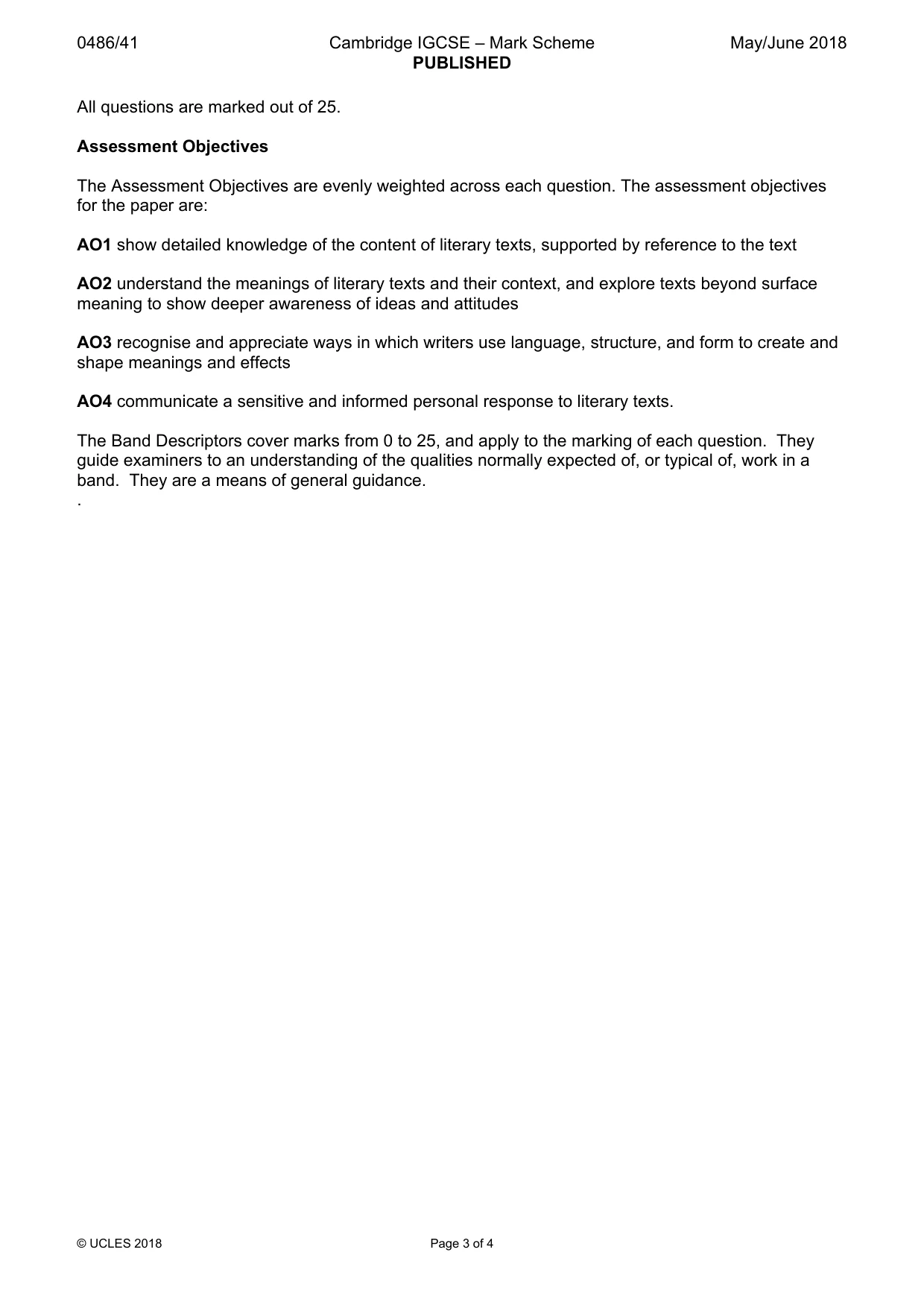
0486/41 Cambridge IGCSE – Mark Scheme PUBLISHED May/June 2018 © UCLES 2018 Page 3 of 4 All questions are marked out of 25. Assessment Objectives The Assessment Objectives are evenly weighted across each question. The assessment objectives for the paper are: AO1 show detailed knowledge of the content of literary texts, supported by reference to the text AO2 understand the meanings of literary texts and their context, and explore texts beyond surface meaning to show deeper awareness of ideas and attitudes AO3 recognise and appreciate ways in which writers use language, structure, and form to create and shape meanings and effects AO4 communicate a sensitive and informed personal response to literary texts. The Band Descriptors cover marks from 0 to 25, and apply to the marking of each question. They guide examiners to an understanding of the qualities normally expected of, or typical of, work in a band. They are a means of general guidance. .
Mark scheme, page 4
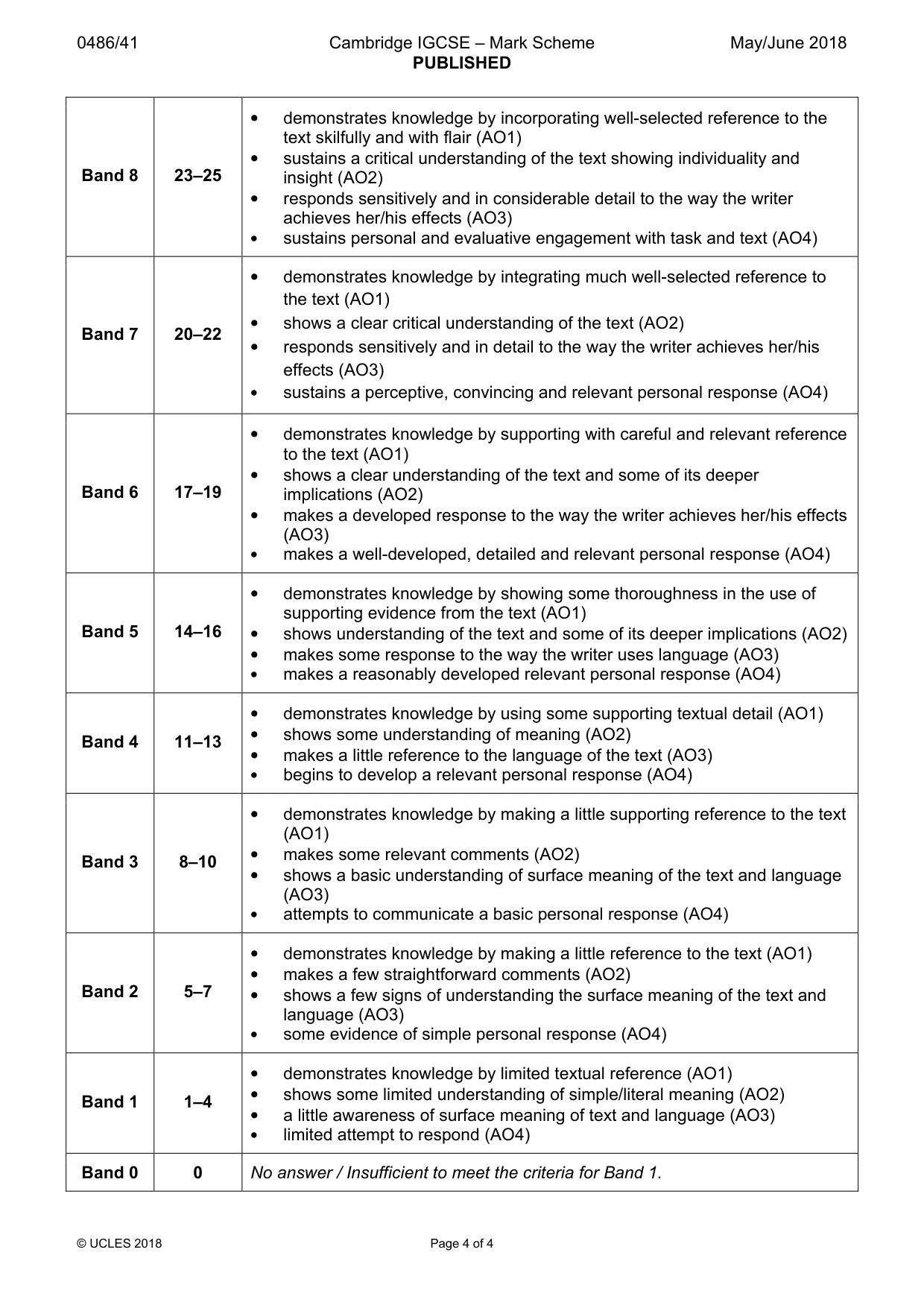
0486/41 Cambridge IGCSE – Mark Scheme PUBLISHED May/June 2018 © UCLES 2018 Page 4 of 4 Band 8 23–25 • demonstrates knowledge by incorporating well-selected reference to the text skilfully and with flair (AO1) • sustains a critical understanding of the text showing individuality and insight (AO2) • responds sensitively and in considerable detail to the way the writer achieves her/his effects (AO3) • sustains personal and evaluative engagement with task and text (AO4) Band 7 20–22 • demonstrates knowledge by integrating much well-selected reference to the text (AO1) • shows a clear critical understanding of the text (AO2) • responds sensitively and in detail to the way the writer achieves her/his effects (AO3) • sustains a perceptive, convincing and relevant personal response (AO4) Band 6 17–19 • demonstrates knowledge by supporting with careful and relevant reference to the text (AO1) • shows a clear understanding of the text and some of its deeper implications (AO2) • makes a developed response to the way the writer achieves her/his effects (AO3) • makes a well-developed, detailed and relevant personal response (AO4) Band 5 14–16 • demonstrates knowledge by showing some thoroughness in the use of supporting evidence from the text (AO1) • shows understanding of the text and some of its deeper implications (AO2) • makes some response to the way the writer uses language (AO3) • makes a reasonably developed relevant personal response (AO4) Band 4 11–13 • demonstrates knowledge by using some supporting textual detail (AO1) • shows some understanding of meaning (AO2) • makes a little reference to the language of the text (AO3) • begins to develop a relevant personal response (AO4) Band 3 8–10 • demonstrates knowledge by making a little supporting reference to the text (AO1) • makes some relevant comments (AO2) • shows a basic understanding of surface meaning of the text and language (AO3) • attempts to communicate a basic personal response (AO4) Band 2 5–7 • demonstrates knowledge by making a little reference to the text (AO1) • makes a few straightforward comments (AO2) • shows a few signs of understanding the surface meaning of the text and language (AO3) • some evidence of simple personal response (AO4) Band 1 1–4 • demonstrates knowledge by limited textual reference (AO1) • shows some limited understanding of simple/literal meaning (AO2) • a little awareness of surface meaning of text and language (AO3) • limited attempt to respond (AO4) Band 0 0 No answer / Insufficient to meet the criteria for Band 1.
What you needed in this session
Cambridge’s own grade thresholds for 2018 May/June, Paper 4 · Variant 1. A higher threshold means an easier paper — the bar moves with how the cohort did.