Cambridge IGCSE English - Literature 0486 — 2018 May/June Paper 4 · Variant 2
0486/42/M/J/18 · 25 marks · ≈28 min
The question paper and its mark scheme, free to read here and free to download. This is Cambridge’s own paper, exactly as it was sat.
Question paper8 pages



Mark scheme4 pages
Answers below. Sit the paper first if you are practising.
Paper as text
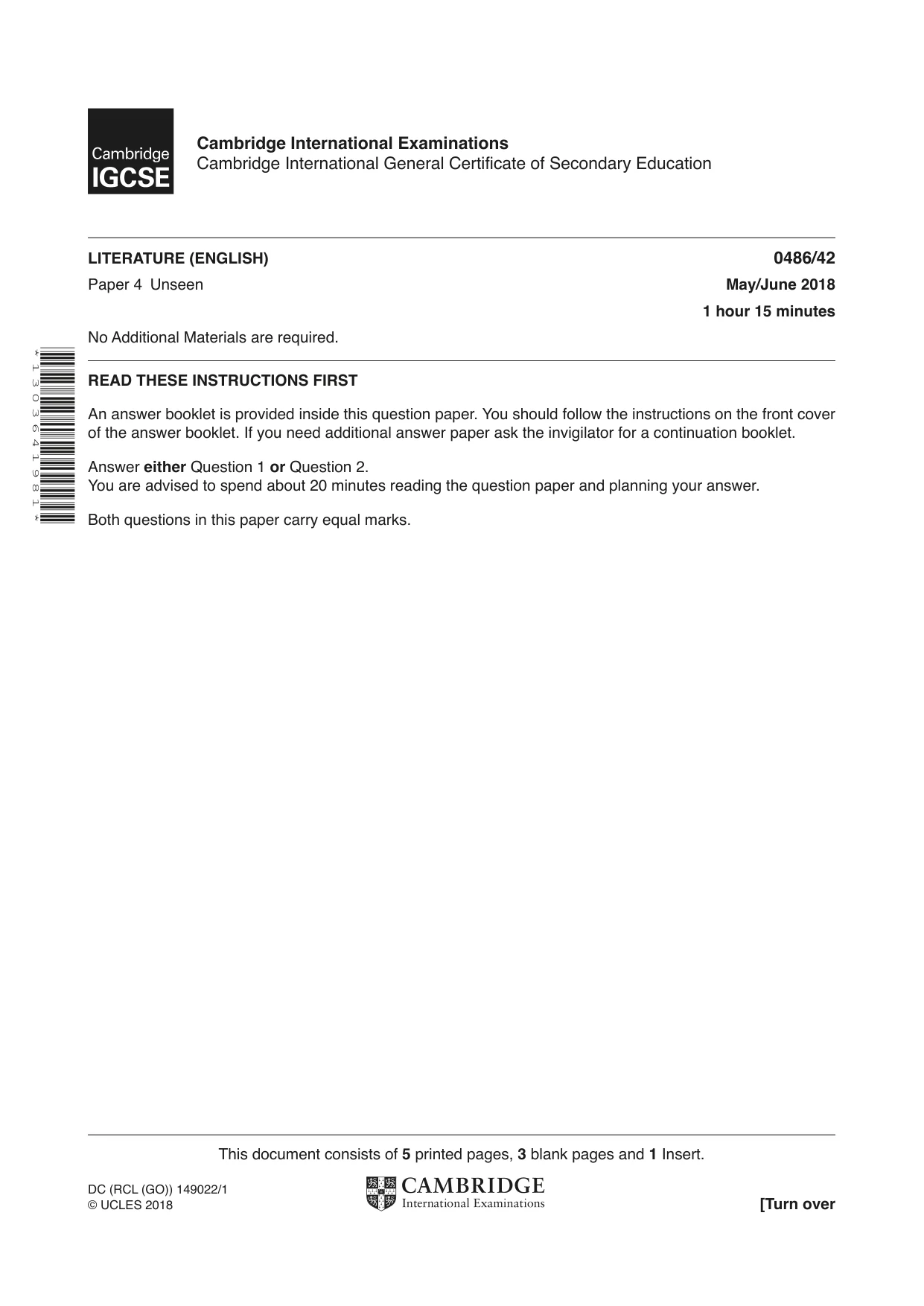
Question paper, page 1
This document consists of 5 printed pages, 3 blank pages and 1 Insert. DC (RCL (GO)) 149022/1 © UCLES 2018 [Turn over Cambridge International Examinations Cambridge International General Certificate of Secondary Education * 1 3 0 3 6 4 1 9 8 1 * LITERATURE (ENGLISH) 0486/42 Paper 4 Unseen May/June 2018 1 hour 15 minutes No Additional Materials are required. READ THESE INSTRUCTIONS FIRST An answer booklet is provided inside this question paper. You should follow the instructions on the front cover of the answer booklet. If you need additional answer paper ask the invigilator for a continuation booklet. Answer either Question 1 or Question 2. You are advised to spend about 20 minutes reading the question paper and planning your answer. Both questions in this paper carry equal marks.
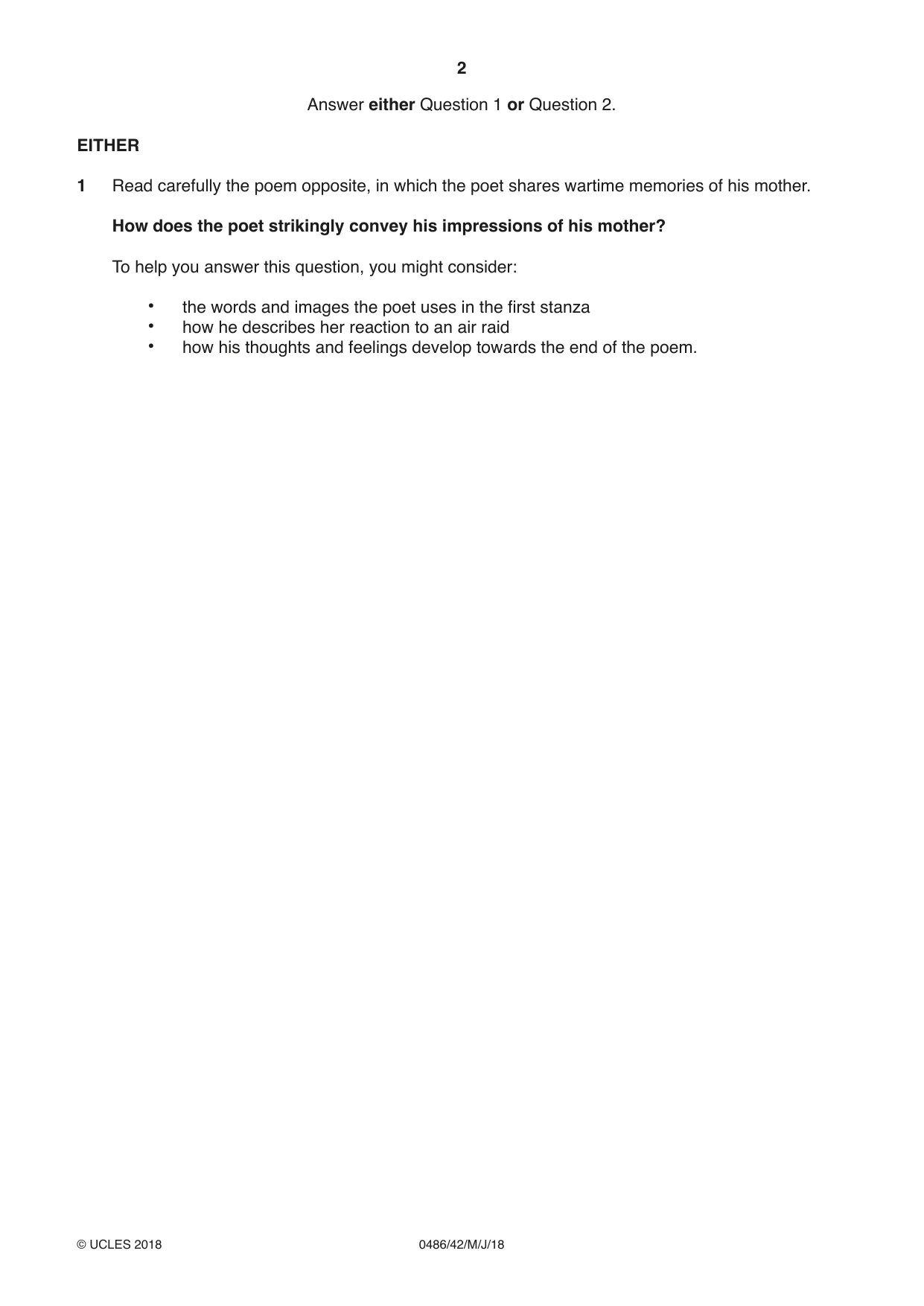
Question paper, page 2
2 0486/42/M/J/18 © UCLES 2018 Answer either Question 1 or Question 2. EITHER 1 Read carefully the poem opposite, in which the poet shares wartime memories of his mother. How does the poet strikingly convey his impressions of his mother? To help you answer this question, you might consider: • the words and images the poet uses in the first stanza • how he describes her reaction to an air raid • how his thoughts and feelings develop towards the end of the poem.
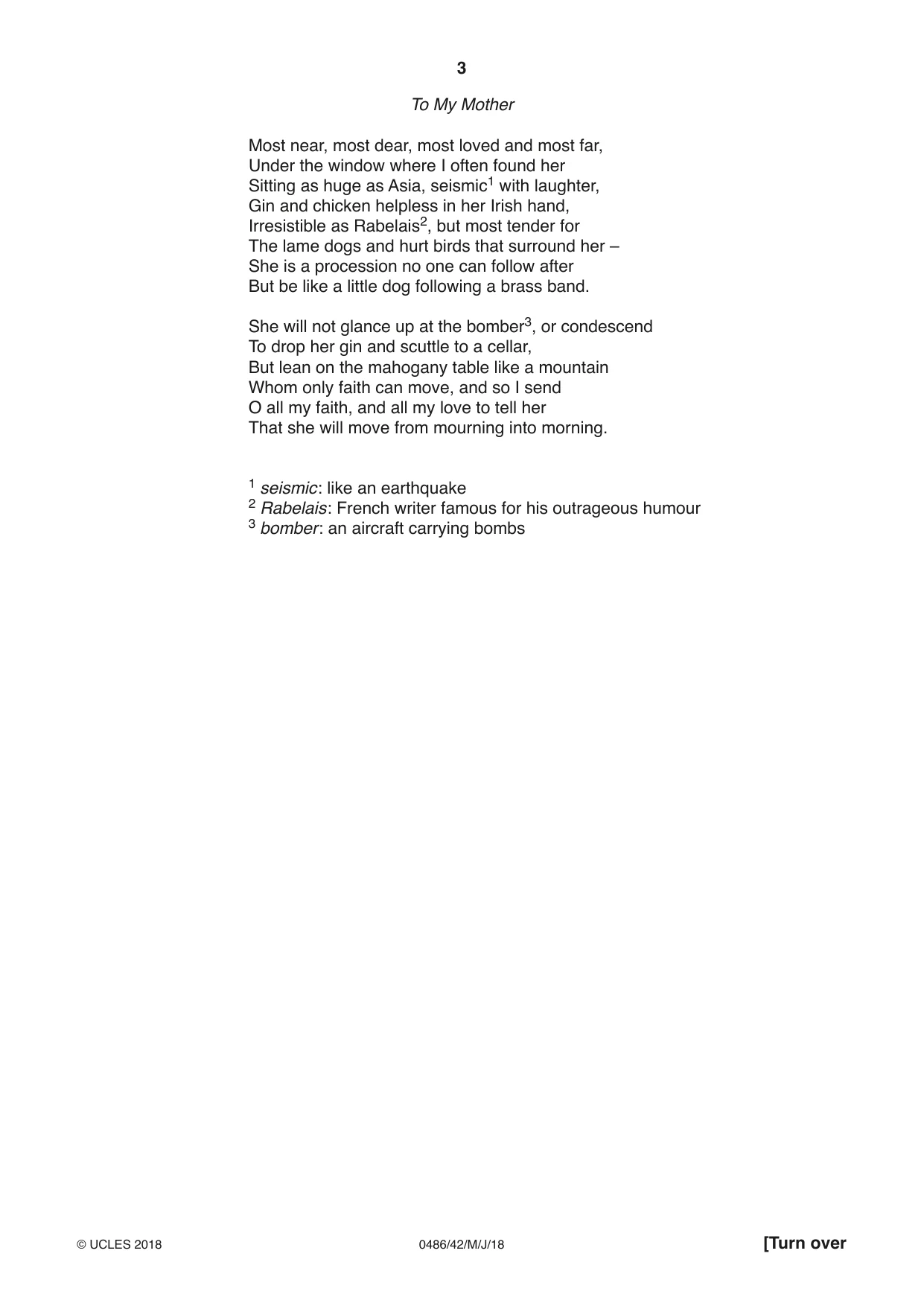
Question paper, page 3
3 0486/42/M/J/18 © UCLES 2018 [Turn over To My Mother Most near, most dear, most loved and most far, Under the window where I often found her Sitting as huge as Asia, seismic1 with laughter, Gin and chicken helpless in her Irish hand, Irresistible as Rabelais2, but most tender for The lame dogs and hurt birds that surround her – She is a procession no one can follow after But be like a little dog following a brass band. She will not glance up at the bomber3, or condescend To drop her gin and scuttle to a cellar, But lean on the mahogany table like a mountain Whom only faith can move, and so I send O all my faith, and all my love to tell her That she will move from mourning into morning. 1 seismic: like an earthquake 2 Rabelais: French writer famous for his outrageous humour 3 bomber: an aircraft carrying bombs
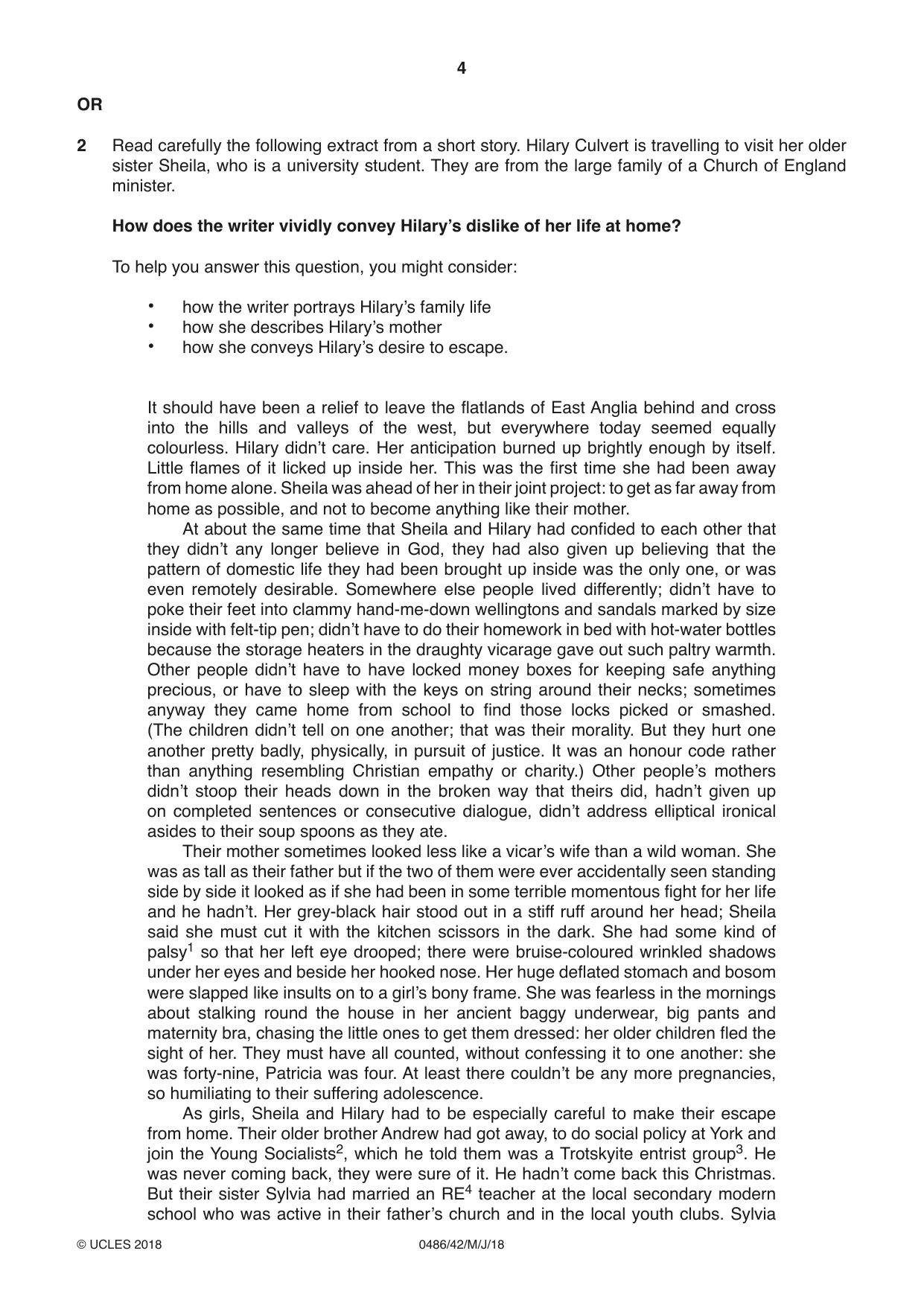
Question paper, page 4
4 0486/42/M/J/18 © UCLES 2018 OR 2 Read carefully the following extract from a short story. Hilary Culvert is travelling to visit her older sister Sheila, who is a university student. They are from the large family of a Church of England minister. How does the writer vividly convey Hilary’s dislike of her life at home? To help you answer this question, you might consider: • how the writer portrays Hilary’s family life • how she describes Hilary’s mother • how she conveys Hilary’s desire to escape. It should have been a relief to leave the flatlands of East Anglia behind and cross into the hills and valleys of the west, but everywhere today seemed equally colourless. Hilary didn’t care. Her anticipation burned up brightly enough by itself. Little flames of it licked up inside her. This was the first time she had been away from home alone. Sheila was ahead of her in their joint project: to get as far away from home as possible, and not to become anything like their mother. At about the same time that Sheila and Hilary had confided to each other that they didn’t any longer believe in God, they had also given up believing that the pattern of domestic life they had been brought up inside was the only one, or was even remotely desirable. Somewhere else people lived differently; didn’t have to poke their feet into clammy hand-me-down wellingtons and sandals marked by size inside with felt-tip pen; didn’t have to do their homework in bed with hot-water bottles because the storage heaters in the draughty vicarage gave out such paltry warmth. Other people didn’t have to have locked money boxes for keeping safe anything precious, or have to sleep with the keys on string around their necks; sometimes anyway they came home from school to find those locks picked or smashed. (The children didn’t tell on one another; that was their morality. But they hurt one another pretty badly, physically, in pursuit of justice. It was an honour code rather than anything resembling Christian empathy or charity.) Other people’s mothers didn’t stoop their heads down in the broken way that theirs did, hadn’t given up on completed sentences or consecutive dialogue, didn’t address elliptical ironical asides to their soup spoons as they ate. Their mother sometimes looked less like a vicar’s wife than a wild woman. She was as tall as their father but if the two of them were ever accidentally seen standing side by side it looked as if she had been in some terrible momentous fight for her life and he hadn’t. Her grey-black hair stood out in a stiff ruff around her head; Sheila said she must cut it with the kitchen scissors in the dark. She had some kind of palsy1 so that her left eye drooped; there were bruise-coloured wrinkled shadows under her eyes and beside her hooked nose. Her huge deflated stomach and bosom were slapped like insults on to a girl’s bony frame. She was fearless in the mornings about stalking round the house in her ancient baggy underwear, big pants and maternity bra, chasing the little ones to get them dressed: her older children fled the sight of her. They must have all counted, without confessing it to one another: she was forty-nine, Patricia was four. At least there couldn’t be any more pregnancies, so humiliating to their suffering adolescence. As girls, Sheila and Hilary had to be especially careful to make their escape from home. Their older brother Andrew had got away, to do social policy at York and join the Young Socialists2, which he told them was a Trotskyite entrist group3. He was never coming back, they were sure of it. He hadn’t come back this Christmas. But their sister Sylvia had married an RE4 teacher at the local secondary modern school who was active in their father’s church and in the local youth clubs. Sylvia
Question paper, page 5
5 0486/42/M/J/18 © UCLES 2018 already had two babies, and Sheila and Hilary had heard her muttering things to herself. They remembered that she used to be a jolly sprightly girl even if they hadn’t liked her much: competitive at beach rounders when they went on day trips to the coast, sentimentally devoted to the doomed stray dogs she tried to smuggle into their bedroom. Now, when they visited her rented flat in Haverhill, her twin-tub washing machine was always pulled out from the wall, filling the kitchen with urine- pungent steam. Sylvia would be standing uncommunicatively, heaving masses of boiling nappies with wooden tongs out of the washer into the spin tub, while the babies bawled in the battered wooden playpen that had been handed on from the vicarage. 1 Palsy: loss of muscle control 2 Young Socialists: a political organisation 3 Trotskyite entrist group: a radical political group 4 RE: Religious Education
Question paper, page 6
6 0486/42/M/J/18 © UCLES 2018 BLANK PAGE
Question paper, page 7
7 0486/42/M/J/18 © UCLES 2018 BLANK PAGE
Question paper, page 8
8 0486/42/M/J/18 © UCLES 2018 BLANK PAGE Permission to reproduce items where third-party owned material protected by copyright is included has been sought and cleared where possible. Every reasonable effort has been made by the publisher (UCLES) to trace copyright holders, but if any items requiring clearance have unwittingly been included, the publisher will be pleased to make amends at the earliest possible opportunity. To avoid the issue of disclosure of answer-related information to candidates, all copyright acknowledgements are reproduced online in the Cambridge International Examinations Copyright Acknowledgements Booklet. This is produced for each series of examinations and is freely available to download at www.cie.org.uk after the live examination series. Cambridge International Examinations is part of the Cambridge Assessment Group. Cambridge Assessment is the brand name of University of Cambridge Local Examinations Syndicate (UCLES), which is itself a department of the University of Cambridge.
Mark scheme, page 1
IGCSE™ is a registered trademark. This document consists of 4 printed pages. © UCLES 2018 [Turn over Cambridge Assessment International Education Cambridge International General Certificate of Secondary Education LITERATURE 0486/42 Paper 4 Unseen May/June 2018 MARK SCHEME Maximum Mark: 25 Published This mark scheme is published as an aid to teachers and candidates, to indicate the requirements of the examination. It shows the basis on which Examiners were instructed to award marks. It does not indicate the details of the discussions that took place at an Examiners’ meeting before marking began, which would have considered the acceptability of alternative answers. Mark schemes should be read in conjunction with the question paper and the Principal Examiner Report for Teachers. Cambridge International will not enter into discussions about these mark schemes. Cambridge International is publishing the mark schemes for the May/June 2018 series for most Cambridge IGCSE™, Cambridge International A and AS Level and Cambridge Pre-U components, and some Cambridge O Level components.
Mark scheme, page 2
0486/42 Cambridge IGCSE – Mark Scheme PUBLISHED May/June 2018 © UCLES 2018 Page 2 of 4 Generic Marking Principles These general marking principles must be applied by all examiners when marking candidate answers. They should be applied alongside the specific content of the mark scheme or generic level descriptors for a question. Each question paper and mark scheme will also comply with these marking principles. GENERIC MARKING PRINCIPLE 1: Marks must be awarded in line with: • the specific content of the mark scheme or the generic level descriptors for the question • the specific skills defined in the mark scheme or in the generic level descriptors for the question • the standard of response required by a candidate as exemplified by the standardisation scripts. GENERIC MARKING PRINCIPLE 2: Marks awarded are always whole marks (not half marks, or other fractions). GENERIC MARKING PRINCIPLE 3: Marks must be awarded positively: • marks are awarded for correct/valid answers, as defined in the mark scheme. However, credit is given for valid answers which go beyond the scope of the syllabus and mark scheme, referring to your Team Leader as appropriate • marks are awarded when candidates clearly demonstrate what they know and can do • marks are not deducted for errors • marks are not deducted for omissions • answers should only be judged on the quality of spelling, punctuation and grammar when these features are specifically assessed by the question as indicated by the mark scheme. The meaning, however, should be unambiguous. GENERIC MARKING PRINCIPLE 4: Rules must be applied consistently e.g. in situations where candidates have not followed instructions or in the application of generic level descriptors. GENERIC MARKING PRINCIPLE 5: Marks should be awarded using the full range of marks defined in the mark scheme for the question (however; the use of the full mark range may be limited according to the quality of the candidate responses seen). GENERIC MARKING PRINCIPLE 6: Marks awarded are based solely on the requirements as defined in the mark scheme. Marks should not be awarded with grade thresholds or grade descriptors in mind.
Mark scheme, page 3
0486/42 Cambridge IGCSE – Mark Scheme PUBLISHED May/June 2018 © UCLES 2018 Page 3 of 4 All questions are marked out of 25. Assessment Objectives The Assessment Objectives are evenly weighted across each question. The assessment objectives for the paper are: AO1 show detailed knowledge of the content of literary texts, supported by reference to the text AO2 understand the meanings of literary texts and their contexts, and explore texts beyond surface meaning to show deeper awareness of ideas and attitudes AO3 recognise and appreciate ways in which writers use language, structure, and form to create and shape meanings and effects AO4 communicate a sensitive and informed personal response to literary texts. The Band Descriptors cover marks from 0 to 25, and apply to the marking of each question. They guide examiners to an understanding of the qualities normally expected of, or typical of, work in a band. They are a means of general guidance. .
Mark scheme, page 4
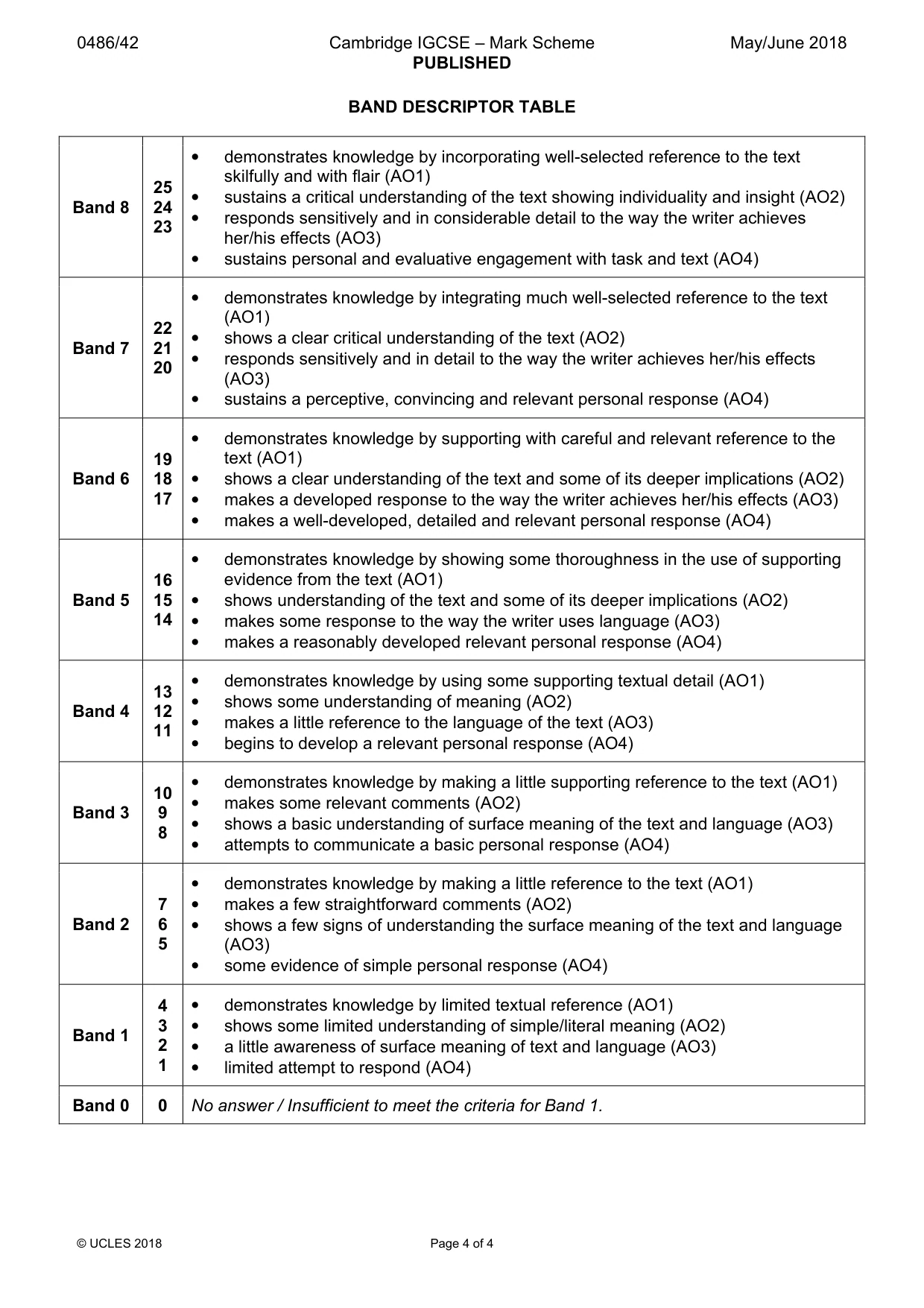
0486/42 Cambridge IGCSE – Mark Scheme PUBLISHED May/June 2018 © UCLES 2018 Page 4 of 4 BAND DESCRIPTOR TABLE Band 8 25 24 23 • demonstrates knowledge by incorporating well-selected reference to the text skilfully and with flair (AO1) • sustains a critical understanding of the text showing individuality and insight (AO2) • responds sensitively and in considerable detail to the way the writer achieves her/his effects (AO3) • sustains personal and evaluative engagement with task and text (AO4) Band 7 22 21 20 • demonstrates knowledge by integrating much well-selected reference to the text (AO1) • shows a clear critical understanding of the text (AO2) • responds sensitively and in detail to the way the writer achieves her/his effects (AO3) • sustains a perceptive, convincing and relevant personal response (AO4) Band 6 19 18 17 • demonstrates knowledge by supporting with careful and relevant reference to the text (AO1) • shows a clear understanding of the text and some of its deeper implications (AO2) • makes a developed response to the way the writer achieves her/his effects (AO3) • makes a well-developed, detailed and relevant personal response (AO4) Band 5 16 15 14 • demonstrates knowledge by showing some thoroughness in the use of supporting evidence from the text (AO1) • shows understanding of the text and some of its deeper implications (AO2) • makes some response to the way the writer uses language (AO3) • makes a reasonably developed relevant personal response (AO4) Band 4 13 12 11 • demonstrates knowledge by using some supporting textual detail (AO1) • shows some understanding of meaning (AO2) • makes a little reference to the language of the text (AO3) • begins to develop a relevant personal response (AO4) Band 3 10 9 8 • demonstrates knowledge by making a little supporting reference to the text (AO1) • makes some relevant comments (AO2) • shows a basic understanding of surface meaning of the text and language (AO3) • attempts to communicate a basic personal response (AO4) Band 2 7 6 5 • demonstrates knowledge by making a little reference to the text (AO1) • makes a few straightforward comments (AO2) • shows a few signs of understanding the surface meaning of the text and language (AO3) • some evidence of simple personal response (AO4) Band 1 4 3 2 1 • demonstrates knowledge by limited textual reference (AO1) • shows some limited understanding of simple/literal meaning (AO2) • a little awareness of surface meaning of text and language (AO3) • limited attempt to respond (AO4) Band 0 0 No answer / Insufficient to meet the criteria for Band 1.
What you needed in this session
Cambridge’s own grade thresholds for 2018 May/June, Paper 4 · Variant 2. A higher threshold means an easier paper — the bar moves with how the cohort did.