Cambridge IGCSE English - Literature 0486 — 2017 Oct/Nov Paper 4 · Variant 2
0486/42/O/N/17 · 25 marks · ≈28 min
The question paper and its mark scheme, free to read here and free to download. This is Cambridge’s own paper, exactly as it was sat.
Question paper4 pages
Mark scheme3 pages
Answers below. Sit the paper first if you are practising.
Paper as text
Question paper, page 1
This document consists of 3 printed pages, 1 blank page and 1 Insert. DC (RCL (JDA)) 133731/2 © UCLES 2017 [Turn over Cambridge International Examinations Cambridge International General Certificate of Secondary Education * 6 9 8 1 2 2 0 8 0 2 * LITERATURE (ENGLISH) 0486/42 Paper 4 Unseen October/November 2017 1 hour 15 minutes No Additional Materials are required. READ THESE INSTRUCTIONS FIRST An answer booklet is provided inside this question paper. You should follow the instructions on the front cover of the answer booklet. If you need additional answer paper ask the invigilator for a continuation booklet. Answer either Question 1 or Question 2. You are advised to spend about 20 minutes reading the question paper and planning your answer. Both questions in this paper carry equal marks.
Question paper, page 2
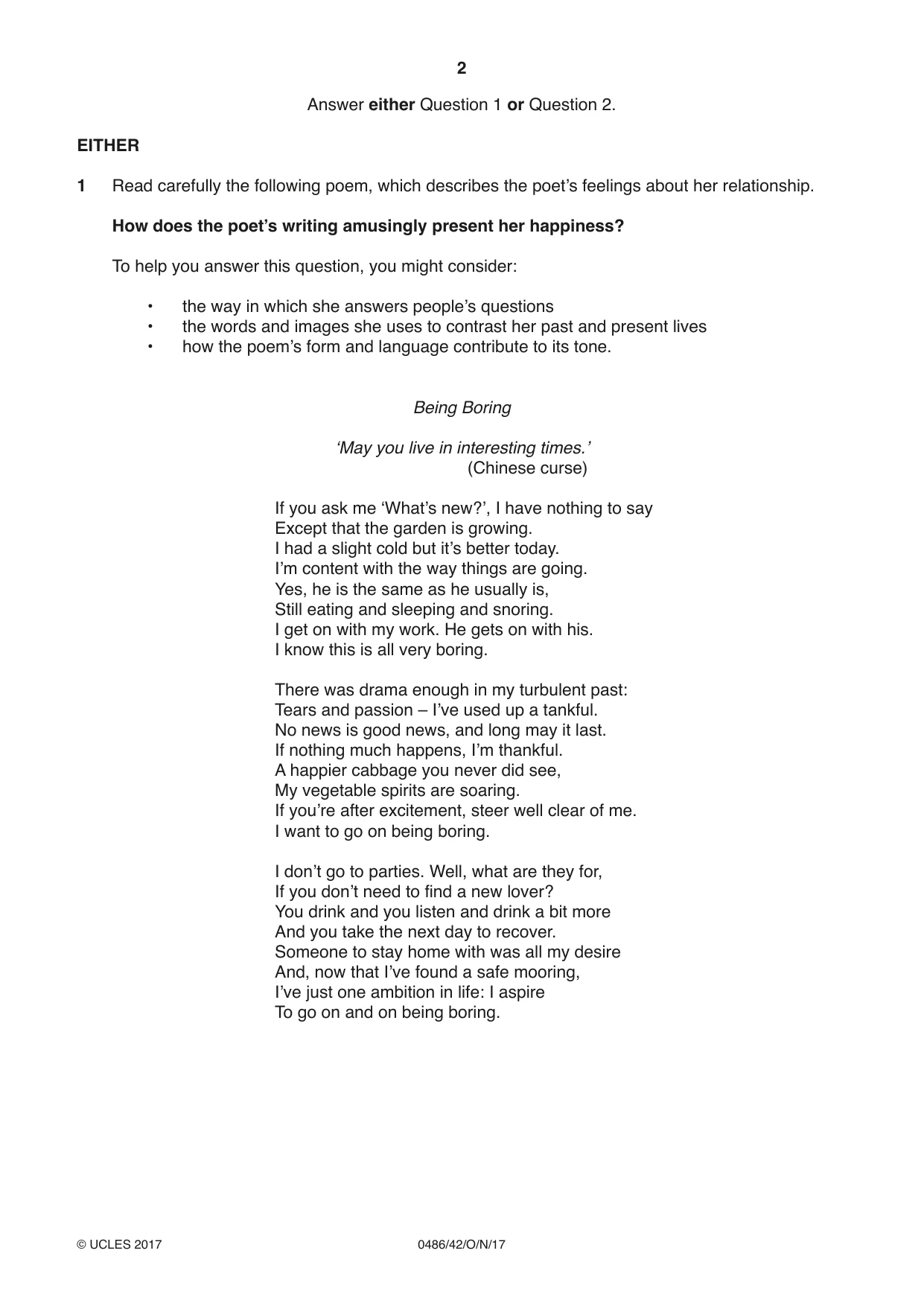
2 0486/42/O/N/17 © UCLES 2017 Answer either Question 1 or Question 2. EITHER 1 Read carefully the following poem, which describes the poet’s feelings about her relationship. How does the poet’s writing amusingly present her happiness? To help you answer this question, you might consider: • the way in which she answers people’s questions • the words and images she uses to contrast her past and present lives • how the poem’s form and language contribute to its tone. Being Boring ‘May you live in interesting times.’ (Chinese curse) If you ask me ‘What’s new?’, I have nothing to say Except that the garden is growing. I had a slight cold but it’s better today. I’m content with the way things are going. Yes, he is the same as he usually is, Still eating and sleeping and snoring. I get on with my work. He gets on with his. I know this is all very boring. There was drama enough in my turbulent past: Tears and passion – I’ve used up a tankful. No news is good news, and long may it last. If nothing much happens, I’m thankful. A happier cabbage you never did see, My vegetable spirits are soaring. If you’re after excitement, steer well clear of me. I want to go on being boring. I don’t go to parties. Well, what are they for, If you don’t need to find a new lover? You drink and you listen and drink a bit more And you take the next day to recover. Someone to stay home with was all my desire And, now that I’ve found a safe mooring, I’ve just one ambition in life: I aspire To go on and on being boring.
Question paper, page 3
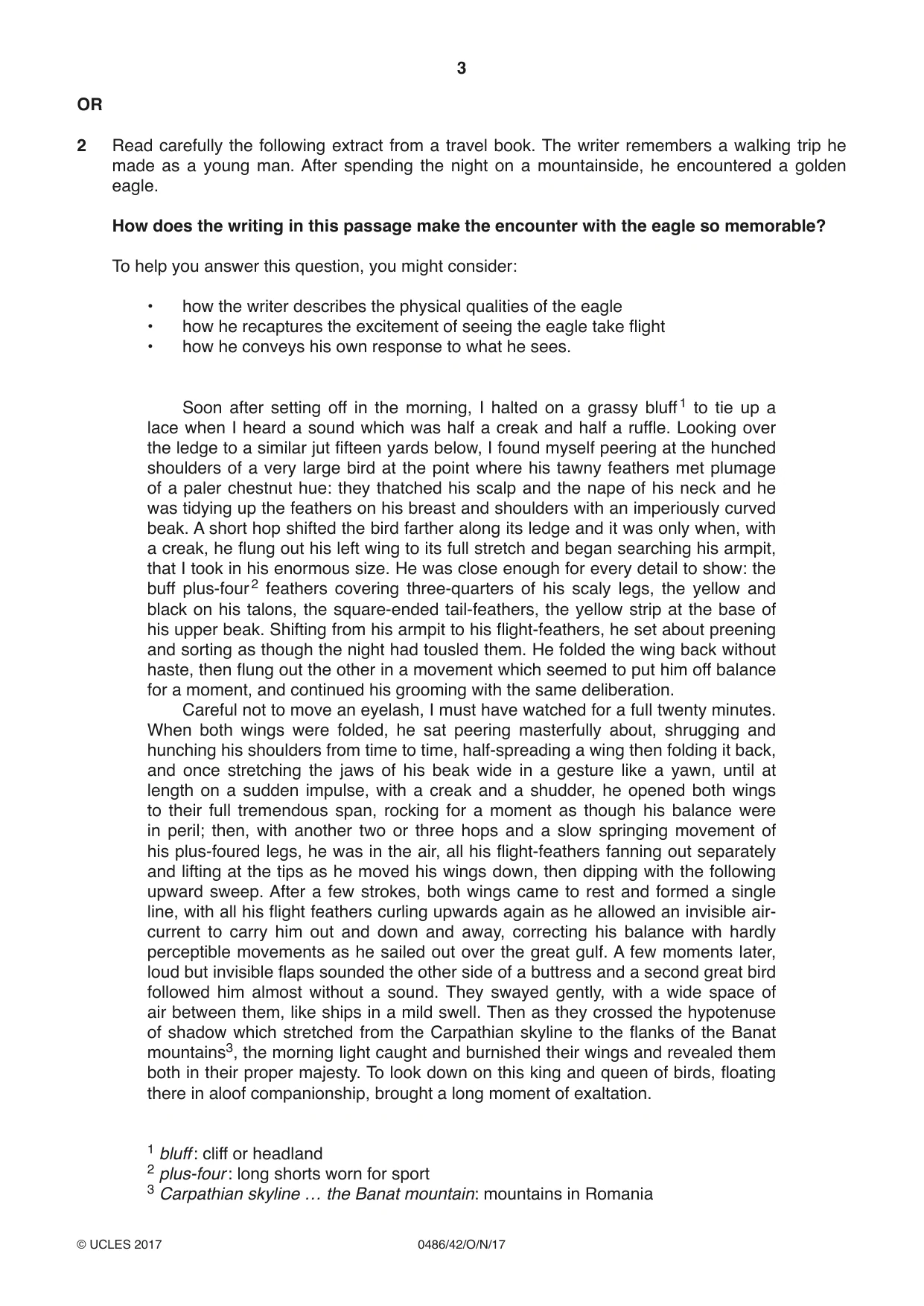
3 0486/42/O/N/17 © UCLES 2017 OR 2 Read carefully the following extract from a travel book. The writer remembers a walking trip he made as a young man. After spending the night on a mountainside, he encountered a golden eagle. How does the writing in this passage make the encounter with the eagle so memorable? To help you answer this question, you might consider: • how the writer describes the physical qualities of the eagle • how he recaptures the excitement of seeing the eagle take flight • how he conveys his own response to what he sees. Soon after setting off in the morning, I halted on a grassy bluff 1 to tie up a lace when I heard a sound which was half a creak and half a ruffle. Looking over the ledge to a similar jut fifteen yards below, I found myself peering at the hunched shoulders of a very large bird at the point where his tawny feathers met plumage of a paler chestnut hue: they thatched his scalp and the nape of his neck and he was tidying up the feathers on his breast and shoulders with an imperiously curved beak. A short hop shifted the bird farther along its ledge and it was only when, with a creak, he flung out his left wing to its full stretch and began searching his armpit, that I took in his enormous size. He was close enough for every detail to show: the buff plus-four 2 feathers covering three-quarters of his scaly legs, the yellow and black on his talons, the square-ended tail-feathers, the yellow strip at the base of his upper beak. Shifting from his armpit to his flight-feathers, he set about preening and sorting as though the night had tousled them. He folded the wing back without haste, then flung out the other in a movement which seemed to put him off balance for a moment, and continued his grooming with the same deliberation. Careful not to move an eyelash, I must have watched for a full twenty minutes. When both wings were folded, he sat peering masterfully about, shrugging and hunching his shoulders from time to time, half-spreading a wing then folding it back, and once stretching the jaws of his beak wide in a gesture like a yawn, until at length on a sudden impulse, with a creak and a shudder, he opened both wings to their full tremendous span, rocking for a moment as though his balance were in peril; then, with another two or three hops and a slow springing movement of his plus-foured legs, he was in the air, all his flight-feathers fanning out separately and lifting at the tips as he moved his wings down, then dipping with the following upward sweep. After a few strokes, both wings came to rest and formed a single line, with all his flight feathers curling upwards again as he allowed an invisible air- current to carry him out and down and away, correcting his balance with hardly perceptible movements as he sailed out over the great gulf. A few moments later, loud but invisible flaps sounded the other side of a buttress and a second great bird followed him almost without a sound. They swayed gently, with a wide space of air between them, like ships in a mild swell. Then as they crossed the hypotenuse of shadow which stretched from the Carpathian skyline to the flanks of the Banat mountains3, the morning light caught and burnished their wings and revealed them both in their proper majesty. To look down on this king and queen of birds, floating there in aloof companionship, brought a long moment of exaltation. 1 bluff : cliff or headland 2 plus-four : long shorts worn for sport 3 Carpathian skyline … the Banat mountain: mountains in Romania
Question paper, page 4
4 0486/42/O/N/17 © UCLES 2017 BLANK PAGE Permission to reproduce items where third-party owned material protected by copyright is included has been sought and cleared where possible. Every reasonable effort has been made by the publisher (UCLES) to trace copyright holders, but if any items requiring clearance have unwittingly been included, the publisher will be pleased to make amends at the earliest possible opportunity. To avoid the issue of disclosure of answer-related information to candidates, all copyright acknowledgements are reproduced online in the Cambridge International Examinations Copyright Acknowledgements Booklet. This is produced for each series of examinations and is freely available to download at www.cie.org.uk after the live examination series. Cambridge International Examinations is part of the Cambridge Assessment Group. Cambridge Assessment is the brand name of University of Cambridge Local Examinations Syndicate (UCLES), which is itself a department of the University of Cambridge.
Mark scheme, page 1
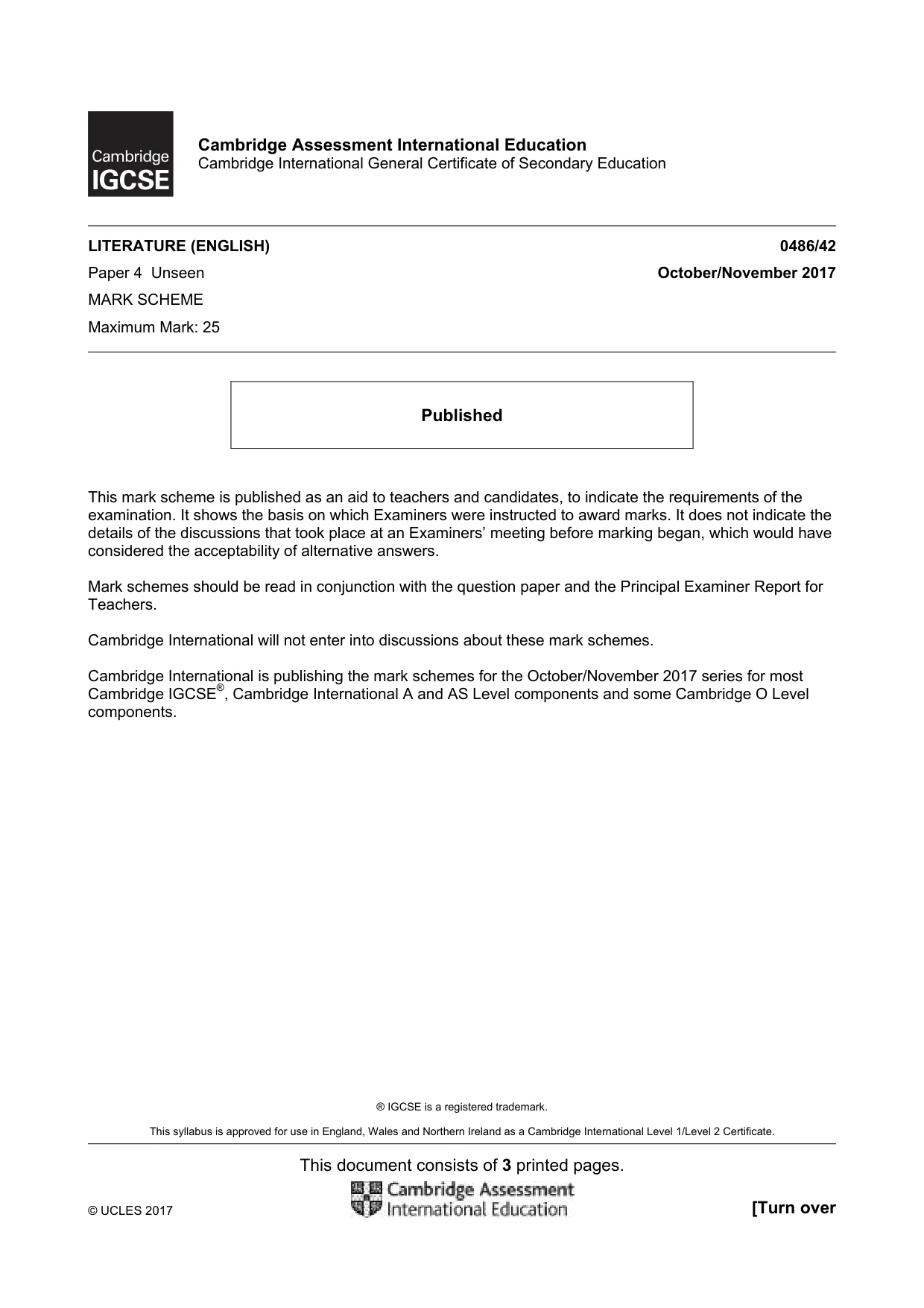
® IGCSE is a registered trademark. This syllabus is approved for use in England, Wales and Northern Ireland as a Cambridge International Level 1/Level 2 Certificate. This document consists of 3 printed pages. © UCLES 2017 [Turn over Cambridge Assessment International Education Cambridge International General Certificate of Secondary Education LITERATURE (ENGLISH) 0486/42 Paper 4 Unseen October/November 2017 MARK SCHEME Maximum Mark: 25 Published This mark scheme is published as an aid to teachers and candidates, to indicate the requirements of the examination. It shows the basis on which Examiners were instructed to award marks. It does not indicate the details of the discussions that took place at an Examiners’ meeting before marking began, which would have considered the acceptability of alternative answers. Mark schemes should be read in conjunction with the question paper and the Principal Examiner Report for Teachers. Cambridge International will not enter into discussions about these mark schemes. Cambridge International is publishing the mark schemes for the October/November 2017 series for most Cambridge IGCSE®, Cambridge International A and AS Level components and some Cambridge O Level components.
Mark scheme, page 2
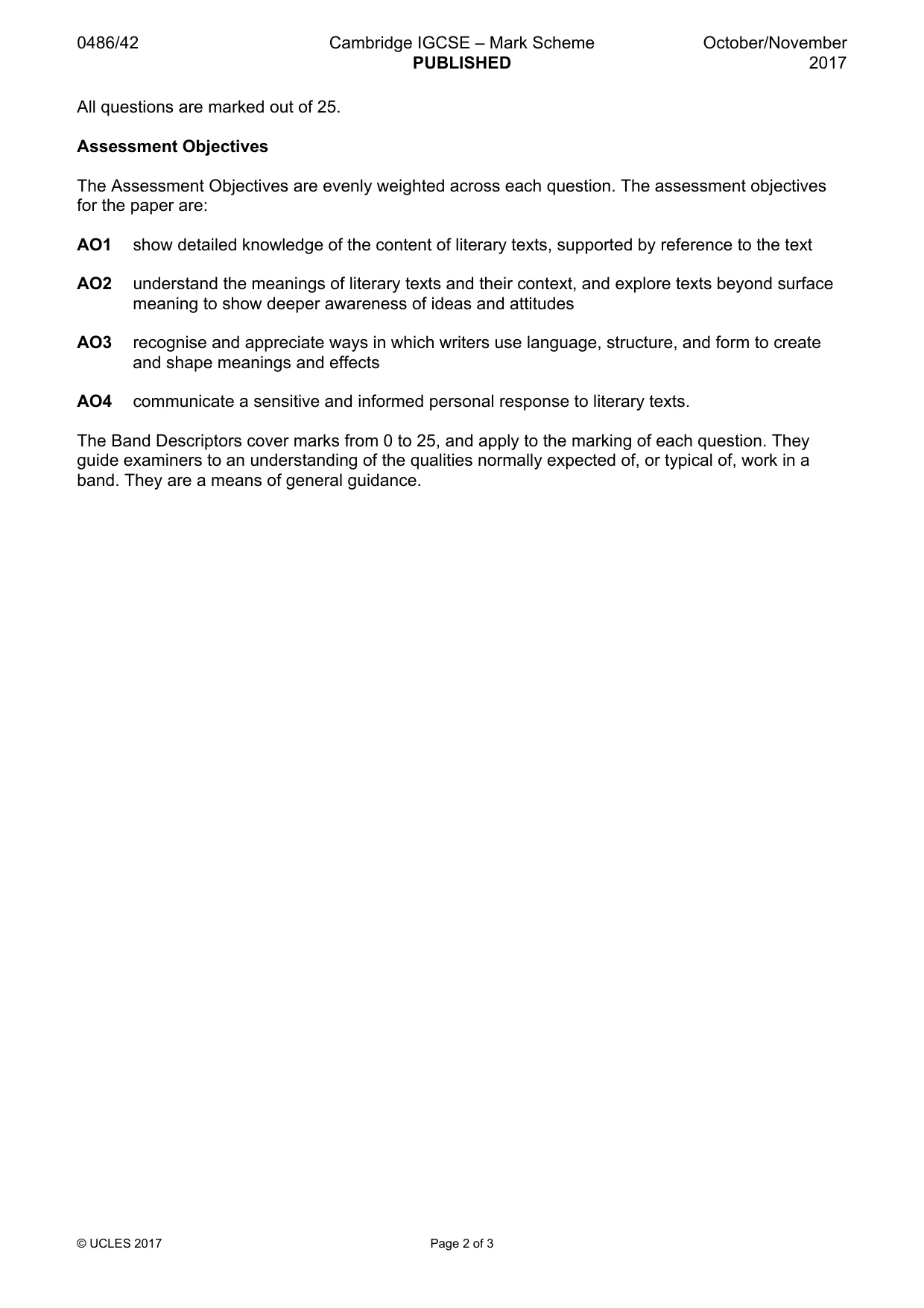
0486/42 Cambridge IGCSE – Mark Scheme PUBLISHED October/November 2017 © UCLES 2017 Page 2 of 3 All questions are marked out of 25. Assessment Objectives The Assessment Objectives are evenly weighted across each question. The assessment objectives for the paper are: AO1 show detailed knowledge of the content of literary texts, supported by reference to the text AO2 understand the meanings of literary texts and their context, and explore texts beyond surface meaning to show deeper awareness of ideas and attitudes AO3 recognise and appreciate ways in which writers use language, structure, and form to create and shape meanings and effects AO4 communicate a sensitive and informed personal response to literary texts. The Band Descriptors cover marks from 0 to 25, and apply to the marking of each question. They guide examiners to an understanding of the qualities normally expected of, or typical of, work in a band. They are a means of general guidance.
Mark scheme, page 3
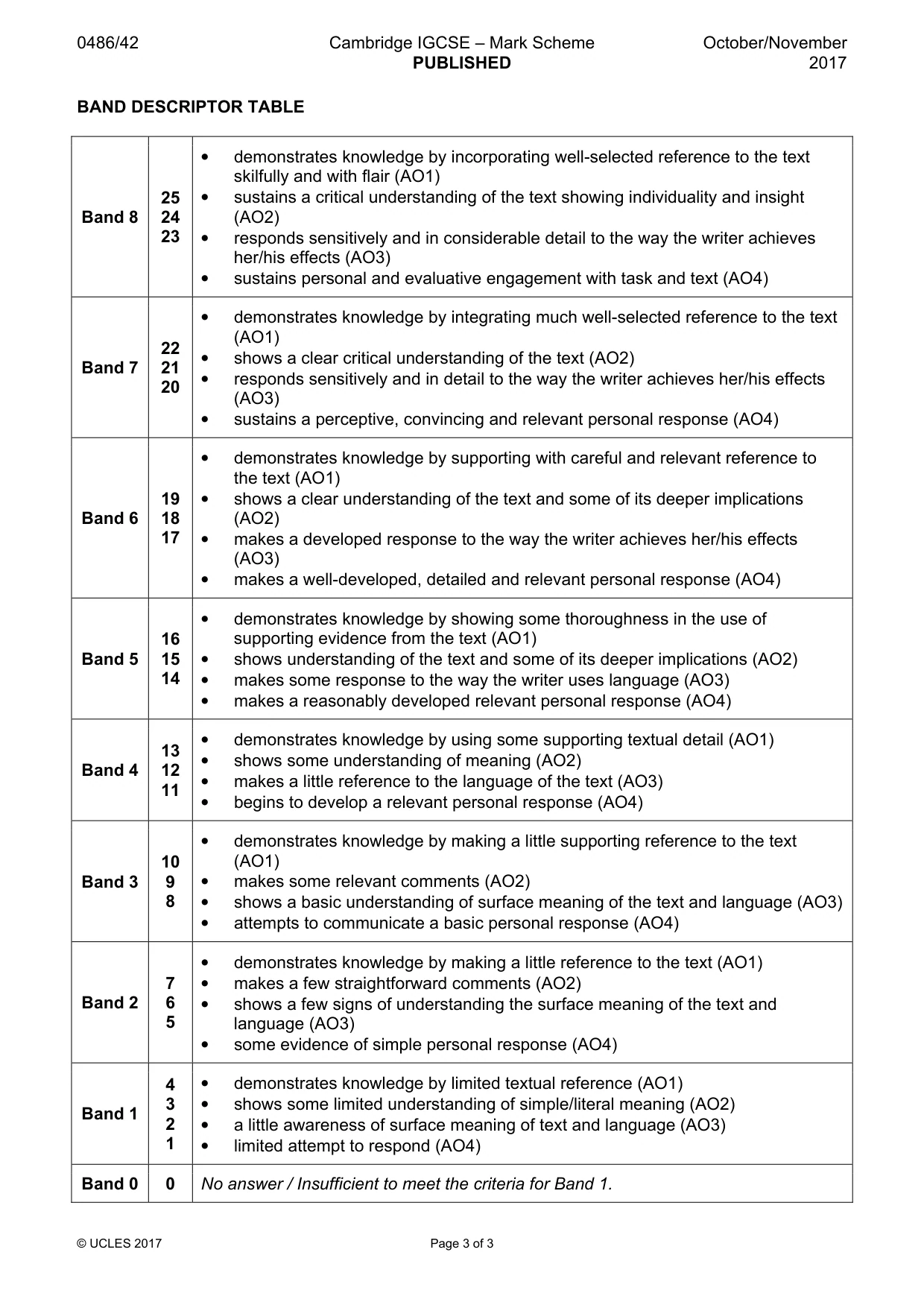
0486/42 Cambridge IGCSE – Mark Scheme PUBLISHED October/November 2017 © UCLES 2017 Page 3 of 3 BAND DESCRIPTOR TABLE Band 8 25 24 23 • demonstrates knowledge by incorporating well-selected reference to the text skilfully and with flair (AO1) • sustains a critical understanding of the text showing individuality and insight (AO2) • responds sensitively and in considerable detail to the way the writer achieves her/his effects (AO3) • sustains personal and evaluative engagement with task and text (AO4) Band 7 22 21 20 • demonstrates knowledge by integrating much well-selected reference to the text (AO1) • shows a clear critical understanding of the text (AO2) • responds sensitively and in detail to the way the writer achieves her/his effects (AO3) • sustains a perceptive, convincing and relevant personal response (AO4) Band 6 19 18 17 • demonstrates knowledge by supporting with careful and relevant reference to the text (AO1) • shows a clear understanding of the text and some of its deeper implications (AO2) • makes a developed response to the way the writer achieves her/his effects (AO3) • makes a well-developed, detailed and relevant personal response (AO4) Band 5 16 15 14 • demonstrates knowledge by showing some thoroughness in the use of supporting evidence from the text (AO1) • shows understanding of the text and some of its deeper implications (AO2) • makes some response to the way the writer uses language (AO3) • makes a reasonably developed relevant personal response (AO4) Band 4 13 12 11 • demonstrates knowledge by using some supporting textual detail (AO1) • shows some understanding of meaning (AO2) • makes a little reference to the language of the text (AO3) • begins to develop a relevant personal response (AO4) Band 3 10 9 8 • demonstrates knowledge by making a little supporting reference to the text (AO1) • makes some relevant comments (AO2) • shows a basic understanding of surface meaning of the text and language (AO3) • attempts to communicate a basic personal response (AO4) Band 2 7 6 5 • demonstrates knowledge by making a little reference to the text (AO1) • makes a few straightforward comments (AO2) • shows a few signs of understanding the surface meaning of the text and language (AO3) • some evidence of simple personal response (AO4) Band 1 4 3 2 1 • demonstrates knowledge by limited textual reference (AO1) • shows some limited understanding of simple/literal meaning (AO2) • a little awareness of surface meaning of text and language (AO3) • limited attempt to respond (AO4) Band 0 0 No answer / Insufficient to meet the criteria for Band 1.
What you needed in this session
Cambridge’s own grade thresholds for 2017 Oct/Nov, Paper 4 · Variant 2. A higher threshold means an easier paper — the bar moves with how the cohort did.