Cambridge IGCSE English - Literature 0486 — 2017 Oct/Nov Paper 4 · Variant 1
0486/41/O/N/17 · 25 marks · ≈28 min
The question paper and its mark scheme, free to read here and free to download. This is Cambridge’s own paper, exactly as it was sat.
Question paper8 pages


Mark scheme3 pages
Answers below. Sit the paper first if you are practising.
Paper as text
Question paper, page 1
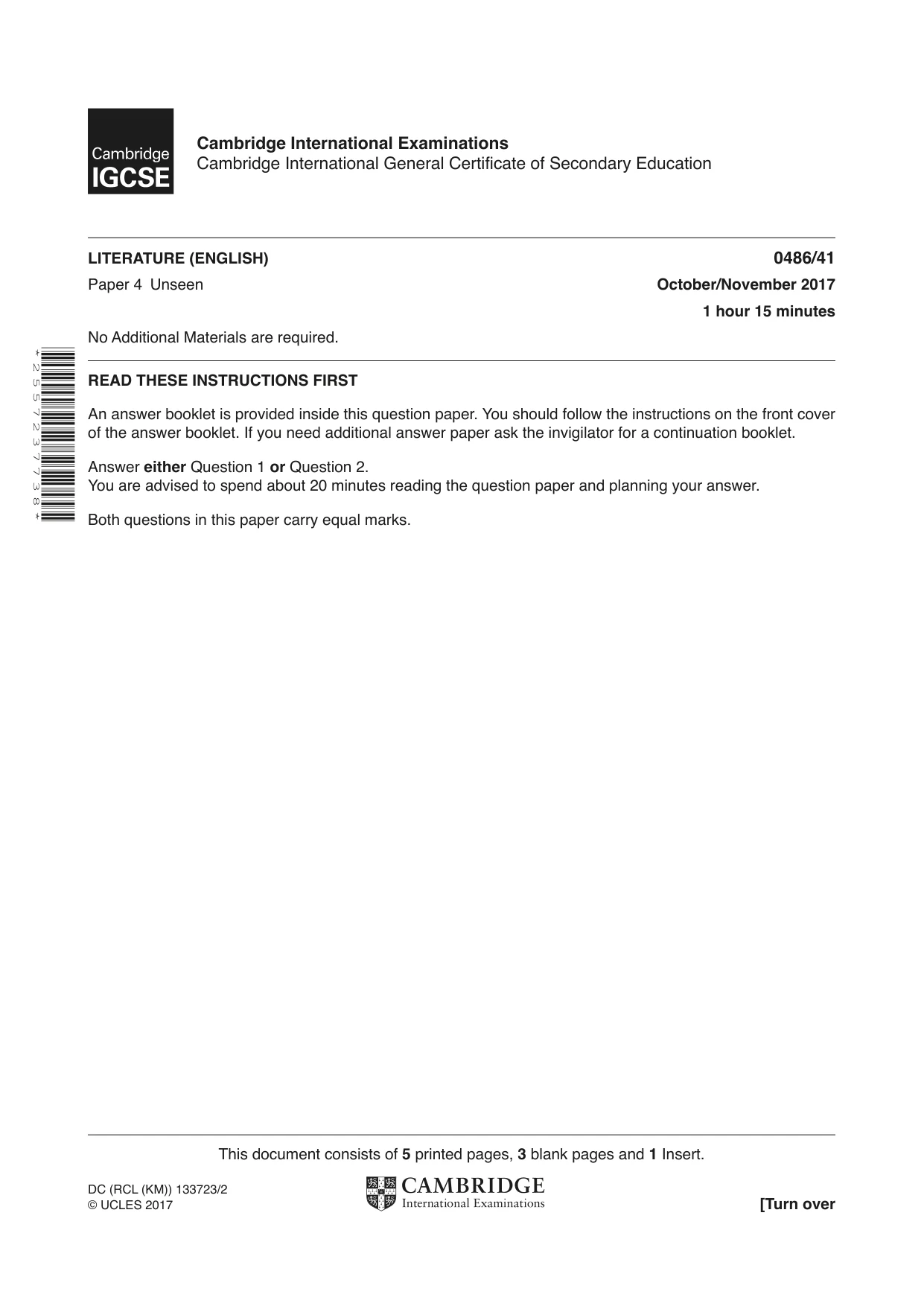
This document consists of 5 printed pages, 3 blank pages and 1 Insert. DC (RCL (KM)) 133723/2 © UCLES 2017 [Turn over Cambridge International Examinations Cambridge International General Certificate of Secondary Education * 2 5 5 7 2 3 7 7 3 8 * LITERATURE (ENGLISH) 0486/41 Paper 4 Unseen October/November 2017 1 hour 15 minutes No Additional Materials are required. READ THESE INSTRUCTIONS FIRST An answer booklet is provided inside this question paper. You should follow the instructions on the front cover of the answer booklet. If you need additional answer paper ask the invigilator for a continuation booklet. Answer either Question 1 or Question 2. You are advised to spend about 20 minutes reading the question paper and planning your answer. Both questions in this paper carry equal marks.
Question paper, page 2
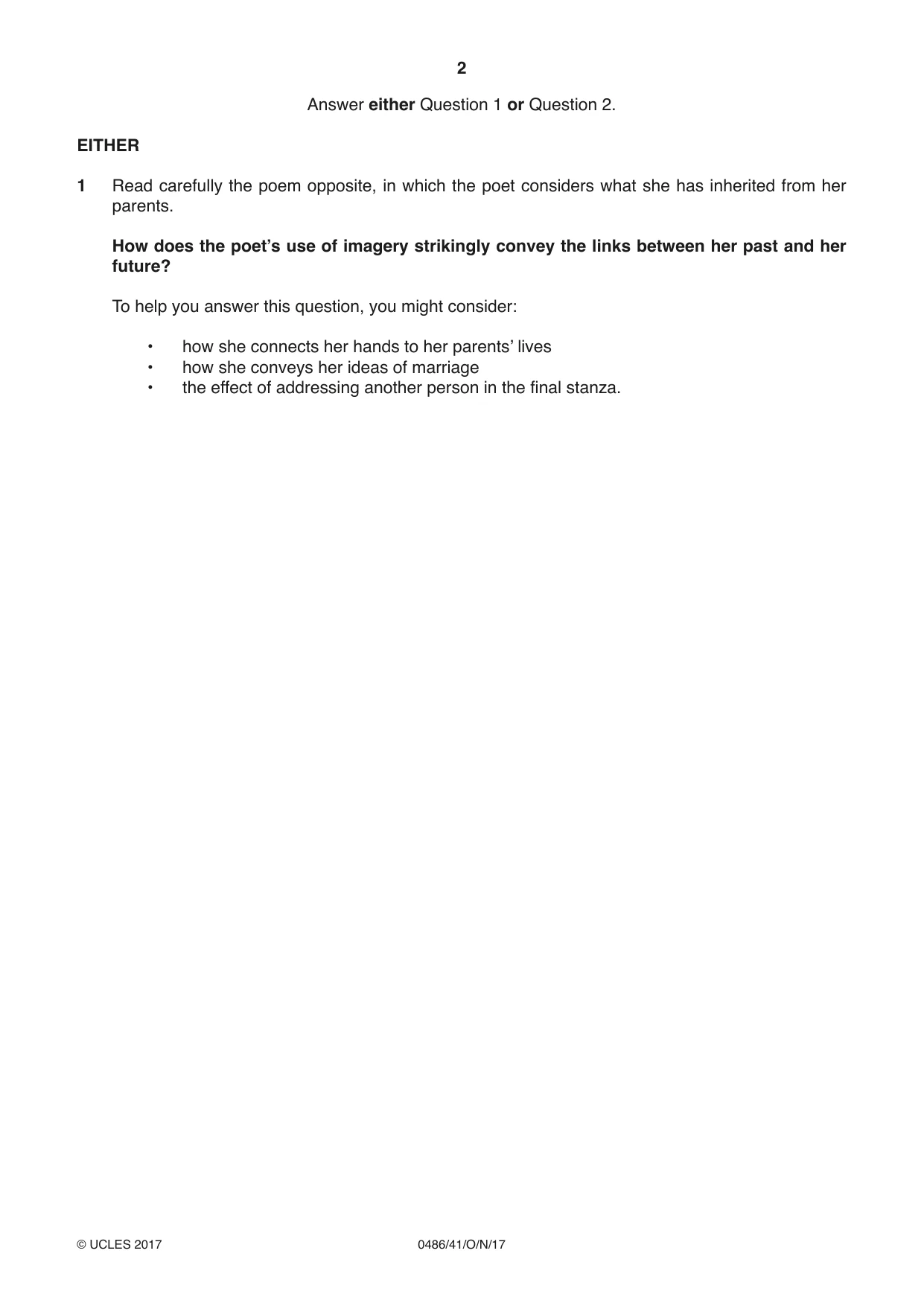
2 0486/41/O/N/17 © UCLES 2017 Answer either Question 1 or Question 2. EITHER 1 Read carefully the poem opposite, in which the poet considers what she has inherited from her parents. How does the poet’s use of imagery strikingly convey the links between her past and her future? To help you answer this question, you might consider: • how she connects her hands to her parents’ lives • how she conveys her ideas of marriage • the effect of addressing another person in the final stanza.
Question paper, page 3
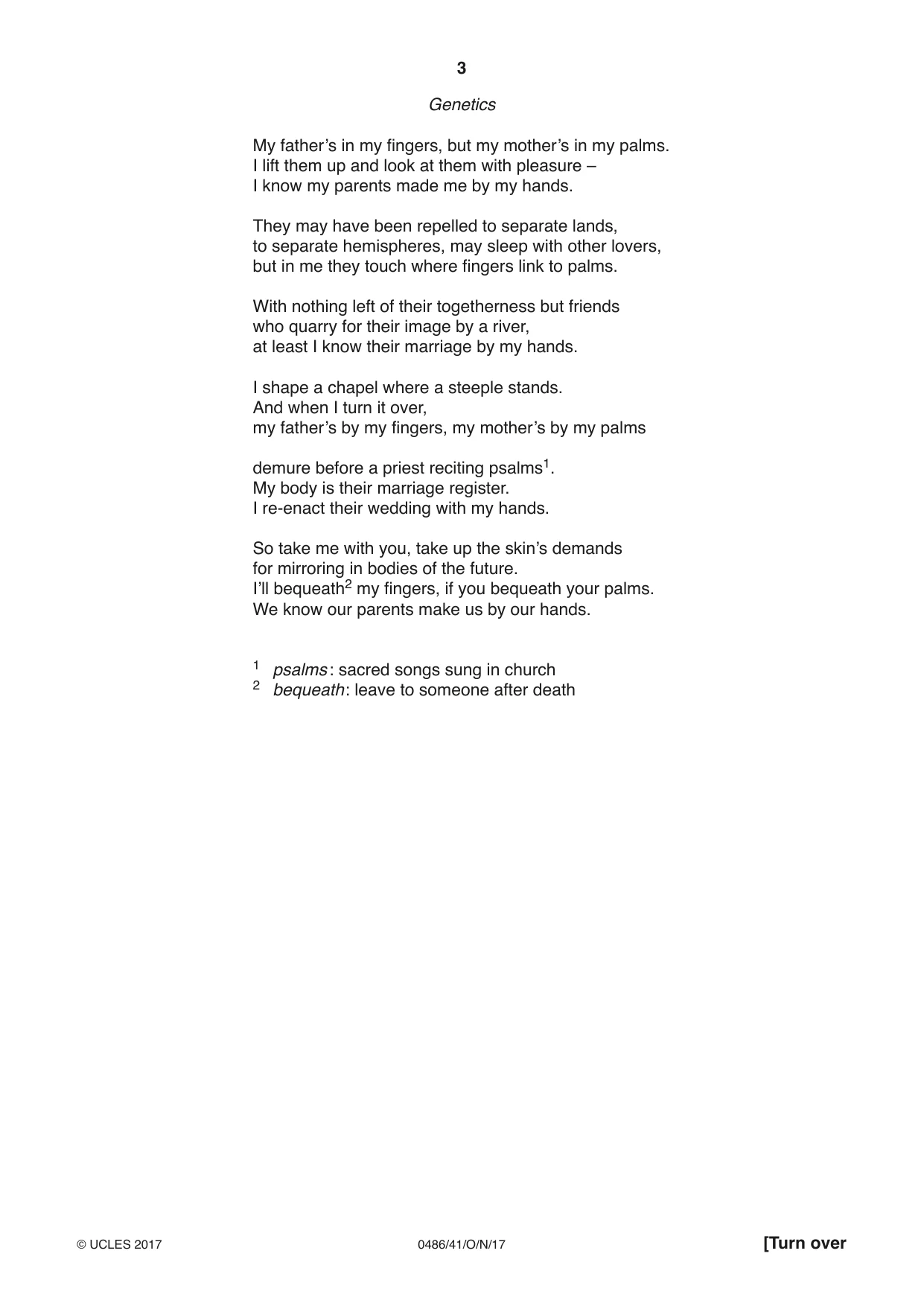
3 0486/41/O/N/17 © UCLES 2017 [Turn over Genetics My father’s in my fingers, but my mother’s in my palms. I lift them up and look at them with pleasure – I know my parents made me by my hands. They may have been repelled to separate lands, to separate hemispheres, may sleep with other lovers, but in me they touch where fingers link to palms. With nothing left of their togetherness but friends who quarry for their image by a river, at least I know their marriage by my hands. I shape a chapel where a steeple stands. And when I turn it over, my father’s by my fingers, my mother’s by my palms demure before a priest reciting psalms1. My body is their marriage register. I re-enact their wedding with my hands. So take me with you, take up the skin’s demands for mirroring in bodies of the future. I’ll bequeath2 my fingers, if you bequeath your palms. We know our parents make us by our hands. 1 psalms : sacred songs sung in church 2 bequeath : leave to someone after death
Question paper, page 4
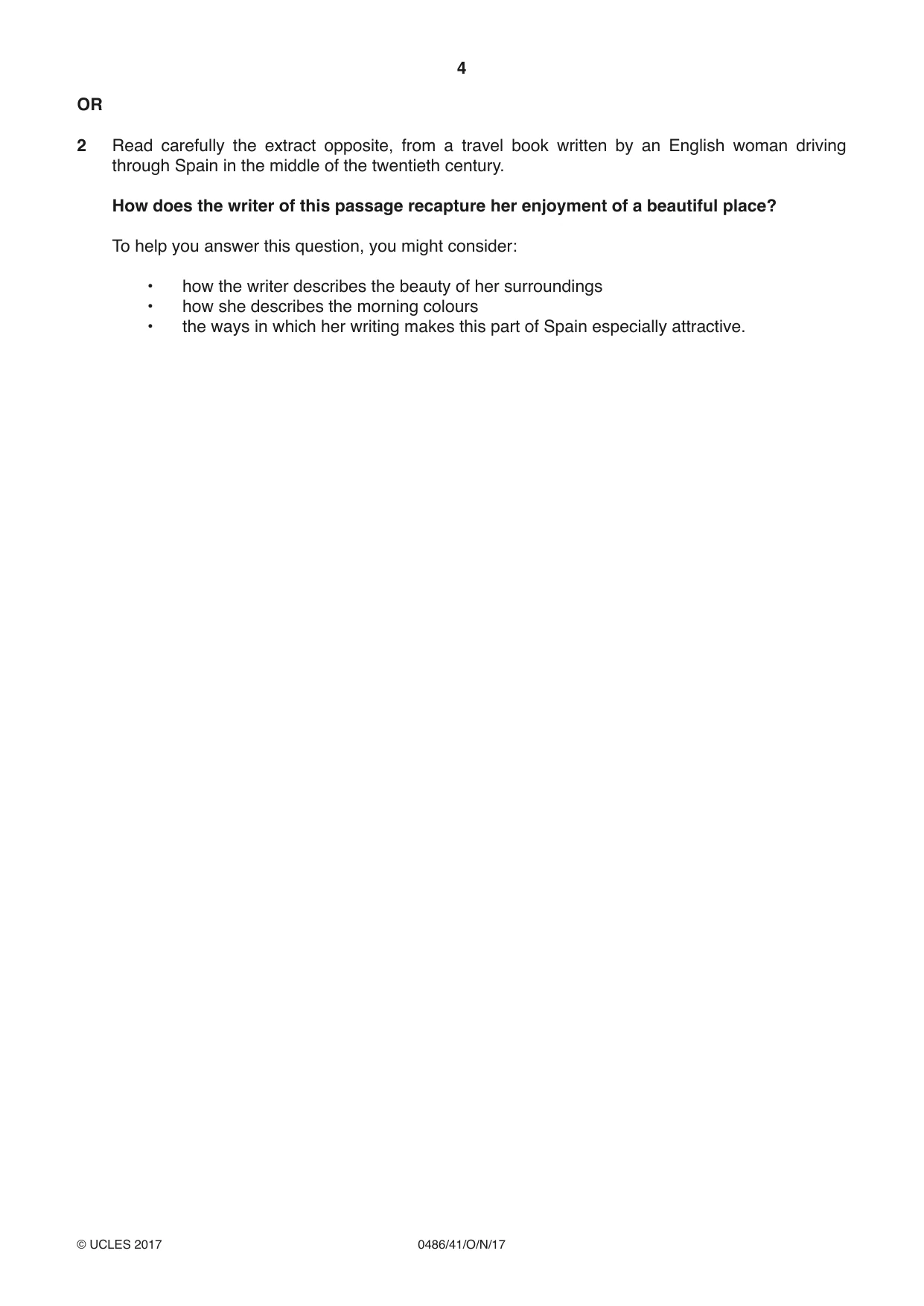
4 0486/41/O/N/17 © UCLES 2017 OR 2 Read carefully the extract opposite, from a travel book written by an English woman driving through Spain in the middle of the twentieth century. How does the writer of this passage recapture her enjoyment of a beautiful place? To help you answer this question, you might consider: • how the writer describes the beauty of her surroundings • how she describes the morning colours • the ways in which her writing makes this part of Spain especially attractive.
Question paper, page 5
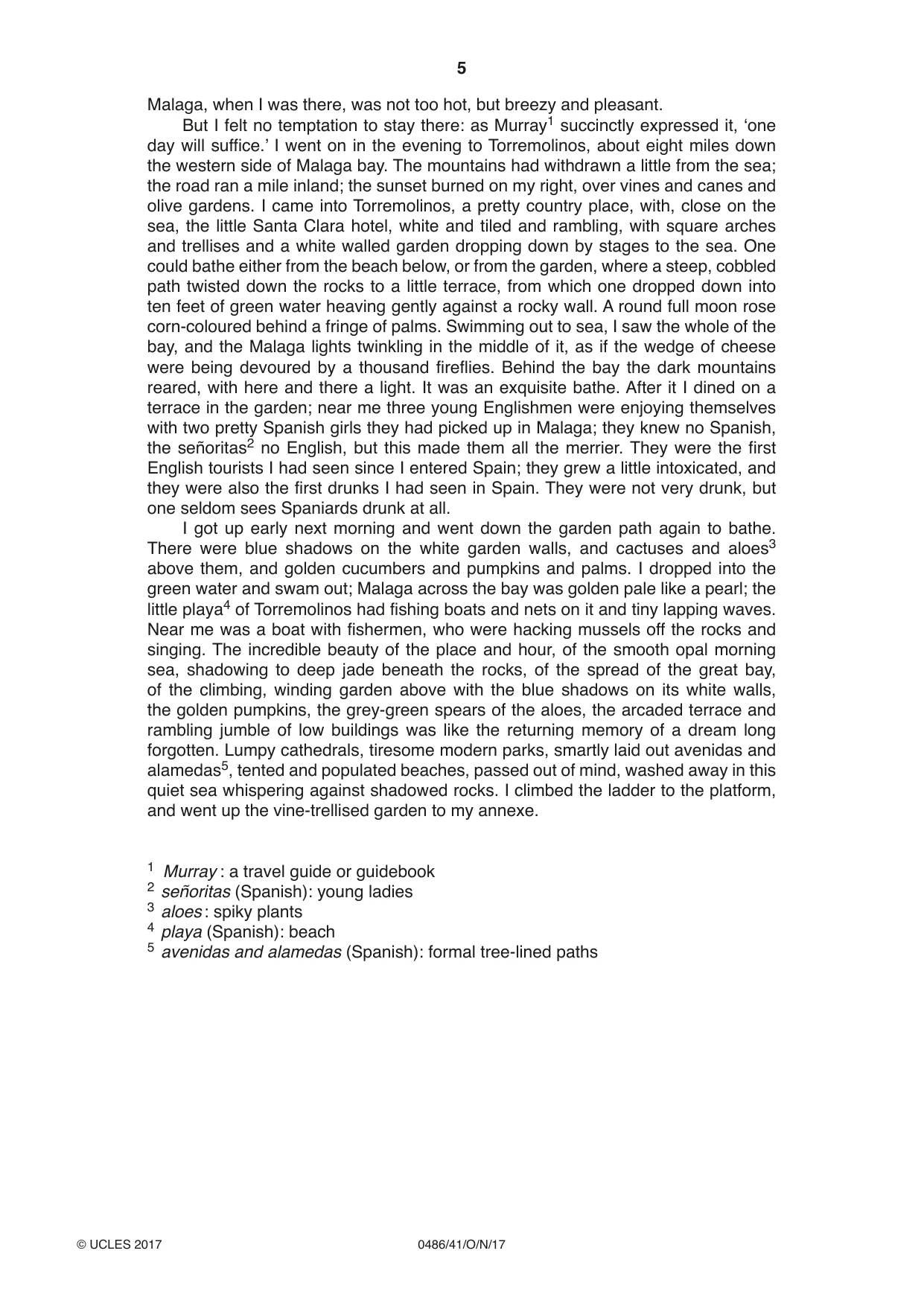
5 0486/41/O/N/17 © UCLES 2017 Malaga, when I was there, was not too hot, but breezy and pleasant. But I felt no temptation to stay there: as Murray1 succinctly expressed it, ‘one day will suffice.’ I went on in the evening to Torremolinos, about eight miles down the western side of Malaga bay. The mountains had withdrawn a little from the sea; the road ran a mile inland; the sunset burned on my right, over vines and canes and olive gardens. I came into Torremolinos, a pretty country place, with, close on the sea, the little Santa Clara hotel, white and tiled and rambling, with square arches and trellises and a white walled garden dropping down by stages to the sea. One could bathe either from the beach below, or from the garden, where a steep, cobbled path twisted down the rocks to a little terrace, from which one dropped down into ten feet of green water heaving gently against a rocky wall. A round full moon rose corn-coloured behind a fringe of palms. Swimming out to sea, I saw the whole of the bay, and the Malaga lights twinkling in the middle of it, as if the wedge of cheese were being devoured by a thousand fireflies. Behind the bay the dark mountains reared, with here and there a light. It was an exquisite bathe. After it I dined on a terrace in the garden; near me three young Englishmen were enjoying themselves with two pretty Spanish girls they had picked up in Malaga; they knew no Spanish, the señoritas2 no English, but this made them all the merrier. They were the first English tourists I had seen since I entered Spain; they grew a little intoxicated, and they were also the first drunks I had seen in Spain. They were not very drunk, but one seldom sees Spaniards drunk at all. I got up early next morning and went down the garden path again to bathe. There were blue shadows on the white garden walls, and cactuses and aloes3 above them, and golden cucumbers and pumpkins and palms. I dropped into the green water and swam out; Malaga across the bay was golden pale like a pearl; the little playa4 of Torremolinos had fishing boats and nets on it and tiny lapping waves. Near me was a boat with fishermen, who were hacking mussels off the rocks and singing. The incredible beauty of the place and hour, of the smooth opal morning sea, shadowing to deep jade beneath the rocks, of the spread of the great bay, of the climbing, winding garden above with the blue shadows on its white walls, the golden pumpkins, the grey-green spears of the aloes, the arcaded terrace and rambling jumble of low buildings was like the returning memory of a dream long forgotten. Lumpy cathedrals, tiresome modern parks, smartly laid out avenidas and alamedas5, tented and populated beaches, passed out of mind, washed away in this quiet sea whispering against shadowed rocks. I climbed the ladder to the platform, and went up the vine-trellised garden to my annexe. 1 Murray : a travel guide or guidebook 2 señoritas (Spanish): young ladies 3 aloes : spiky plants 4 playa (Spanish): beach 5 avenidas and alamedas (Spanish): formal tree-lined paths
Question paper, page 6
6 0486/41/O/N/17 © UCLES 2017 BLANK PAGE
Question paper, page 7
7 0486/41/O/N/17 © UCLES 2017 BLANK PAGE
Question paper, page 8
8 0486/41/O/N/17 © UCLES 2017 BLANK PAGE Permission to reproduce items where third-party owned material protected by copyright is included has been sought and cleared where possible. Every reasonable effort has been made by the publisher (UCLES) to trace copyright holders, but if any items requiring clearance have unwittingly been included, the publisher will be pleased to make amends at the earliest possible opportunity. To avoid the issue of disclosure of answer-related information to candidates, all copyright acknowledgements are reproduced online in the Cambridge International Examinations Copyright Acknowledgements Booklet. This is produced for each series of examinations and is freely available to download at www.cie.org.uk after the live examination series. Cambridge International Examinations is part of the Cambridge Assessment Group. Cambridge Assessment is the brand name of University of Cambridge Local Examinations Syndicate (UCLES), which is itself a department of the University of Cambridge.
Mark scheme, page 1
® IGCSE is a registered trademark. This syllabus is approved for use in England, Wales and Northern Ireland as a Cambridge International Level 1/Level 2 Certificate. This document consists of 3 printed pages. © UCLES 2017 [Turn over Cambridge Assessment International Education Cambridge International General Certificate of Secondary Education LITERATURE (ENGLISH) 0486/41 Paper 4 Unseen October/November 2017 MARK SCHEME Maximum Mark: 25 Published This mark scheme is published as an aid to teachers and candidates, to indicate the requirements of the examination. It shows the basis on which Examiners were instructed to award marks. It does not indicate the details of the discussions that took place at an Examiners’ meeting before marking began, which would have considered the acceptability of alternative answers. Mark schemes should be read in conjunction with the question paper and the Principal Examiner Report for Teachers. Cambridge International will not enter into discussions about these mark schemes. Cambridge International is publishing the mark schemes for the October/November 2017 series for most Cambridge IGCSE®, Cambridge International A and AS Level components and some Cambridge O Level components.
Mark scheme, page 2
0486/41 Cambridge IGCSE – Mark Scheme PUBLISHED October/November 2017 © UCLES 2017 Page 2 of 3 All questions are marked out of 25. Assessment Objectives The Assessment Objectives are evenly weighted across each question. The assessment objectives for the paper are: AO1 show detailed knowledge of the content of literary texts, supported by reference to the text AO2 understand the meanings of literary texts and their context, and explore texts beyond surface meaning to show deeper awareness of ideas and attitudes AO3 recognise and appreciate ways in which writers use language, structure, and form to create and shape meanings and effects AO4 communicate a sensitive and informed personal response to literary texts. The Band Descriptors cover marks from 0 to 25, and apply to the marking of each question. They guide examiners to an understanding of the qualities normally expected of, or typical of, work in a band. They are a means of general guidance.
Mark scheme, page 3
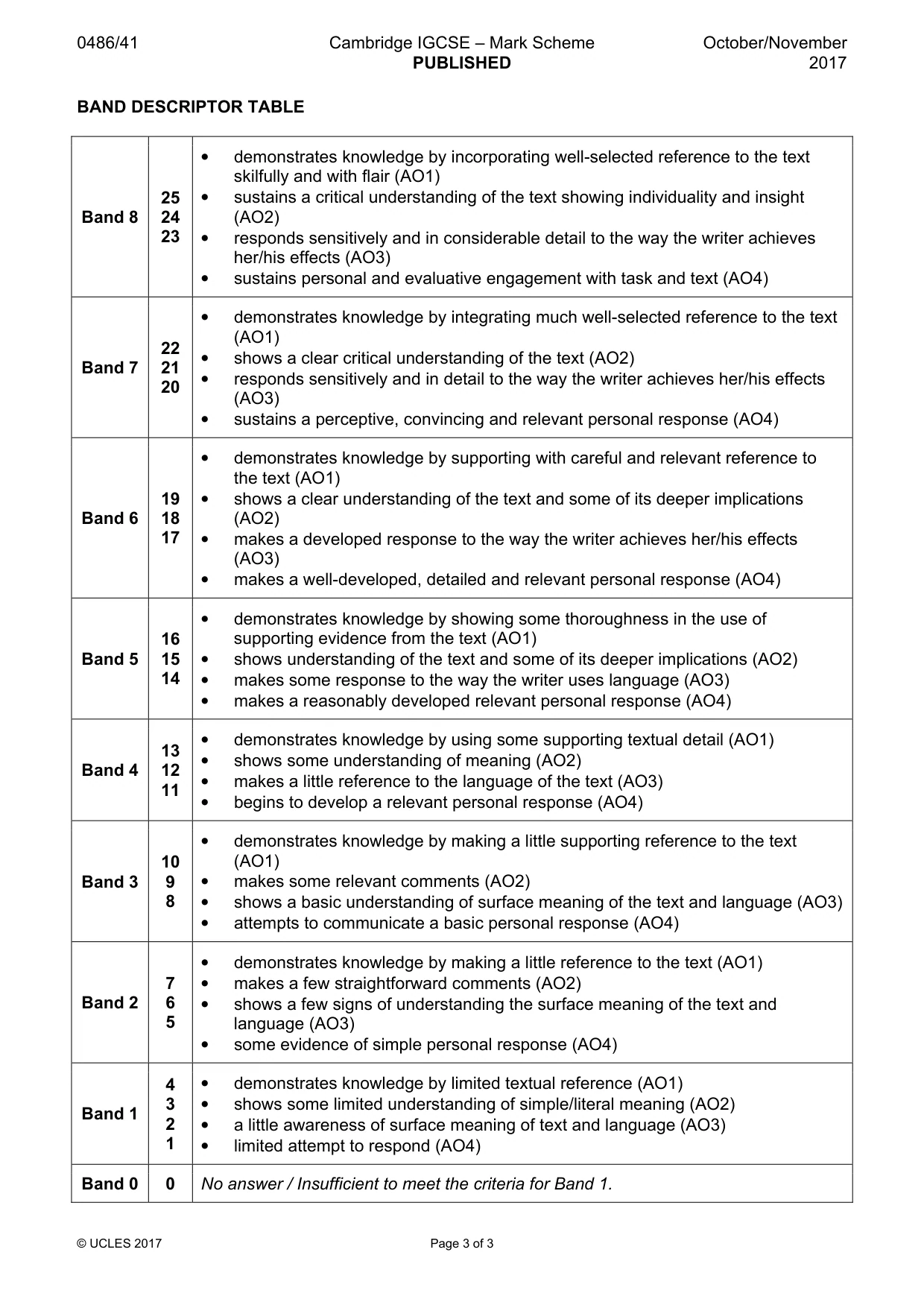
0486/41 Cambridge IGCSE – Mark Scheme PUBLISHED October/November 2017 © UCLES 2017 Page 3 of 3 BAND DESCRIPTOR TABLE Band 8 25 24 23 • demonstrates knowledge by incorporating well-selected reference to the text skilfully and with flair (AO1) • sustains a critical understanding of the text showing individuality and insight (AO2) • responds sensitively and in considerable detail to the way the writer achieves her/his effects (AO3) • sustains personal and evaluative engagement with task and text (AO4) Band 7 22 21 20 • demonstrates knowledge by integrating much well-selected reference to the text (AO1) • shows a clear critical understanding of the text (AO2) • responds sensitively and in detail to the way the writer achieves her/his effects (AO3) • sustains a perceptive, convincing and relevant personal response (AO4) Band 6 19 18 17 • demonstrates knowledge by supporting with careful and relevant reference to the text (AO1) • shows a clear understanding of the text and some of its deeper implications (AO2) • makes a developed response to the way the writer achieves her/his effects (AO3) • makes a well-developed, detailed and relevant personal response (AO4) Band 5 16 15 14 • demonstrates knowledge by showing some thoroughness in the use of supporting evidence from the text (AO1) • shows understanding of the text and some of its deeper implications (AO2) • makes some response to the way the writer uses language (AO3) • makes a reasonably developed relevant personal response (AO4) Band 4 13 12 11 • demonstrates knowledge by using some supporting textual detail (AO1) • shows some understanding of meaning (AO2) • makes a little reference to the language of the text (AO3) • begins to develop a relevant personal response (AO4) Band 3 10 9 8 • demonstrates knowledge by making a little supporting reference to the text (AO1) • makes some relevant comments (AO2) • shows a basic understanding of surface meaning of the text and language (AO3) • attempts to communicate a basic personal response (AO4) Band 2 7 6 5 • demonstrates knowledge by making a little reference to the text (AO1) • makes a few straightforward comments (AO2) • shows a few signs of understanding the surface meaning of the text and language (AO3) • some evidence of simple personal response (AO4) Band 1 4 3 2 1 • demonstrates knowledge by limited textual reference (AO1) • shows some limited understanding of simple/literal meaning (AO2) • a little awareness of surface meaning of text and language (AO3) • limited attempt to respond (AO4) Band 0 0 No answer / Insufficient to meet the criteria for Band 1.
What you needed in this session
Cambridge’s own grade thresholds for 2017 Oct/Nov, Paper 4 · Variant 1. A higher threshold means an easier paper — the bar moves with how the cohort did.