Cambridge IGCSE English - Literature 0486 — 2017 May/June Paper 4 · Variant 1
0486/41/M/J/17 · 25 marks · ≈28 min
The question paper and its mark scheme, free to read here and free to download. This is Cambridge’s own paper, exactly as it was sat.
Question paper8 pages
Mark scheme3 pages
Answers below. Sit the paper first if you are practising.
Paper as text
Question paper, page 1
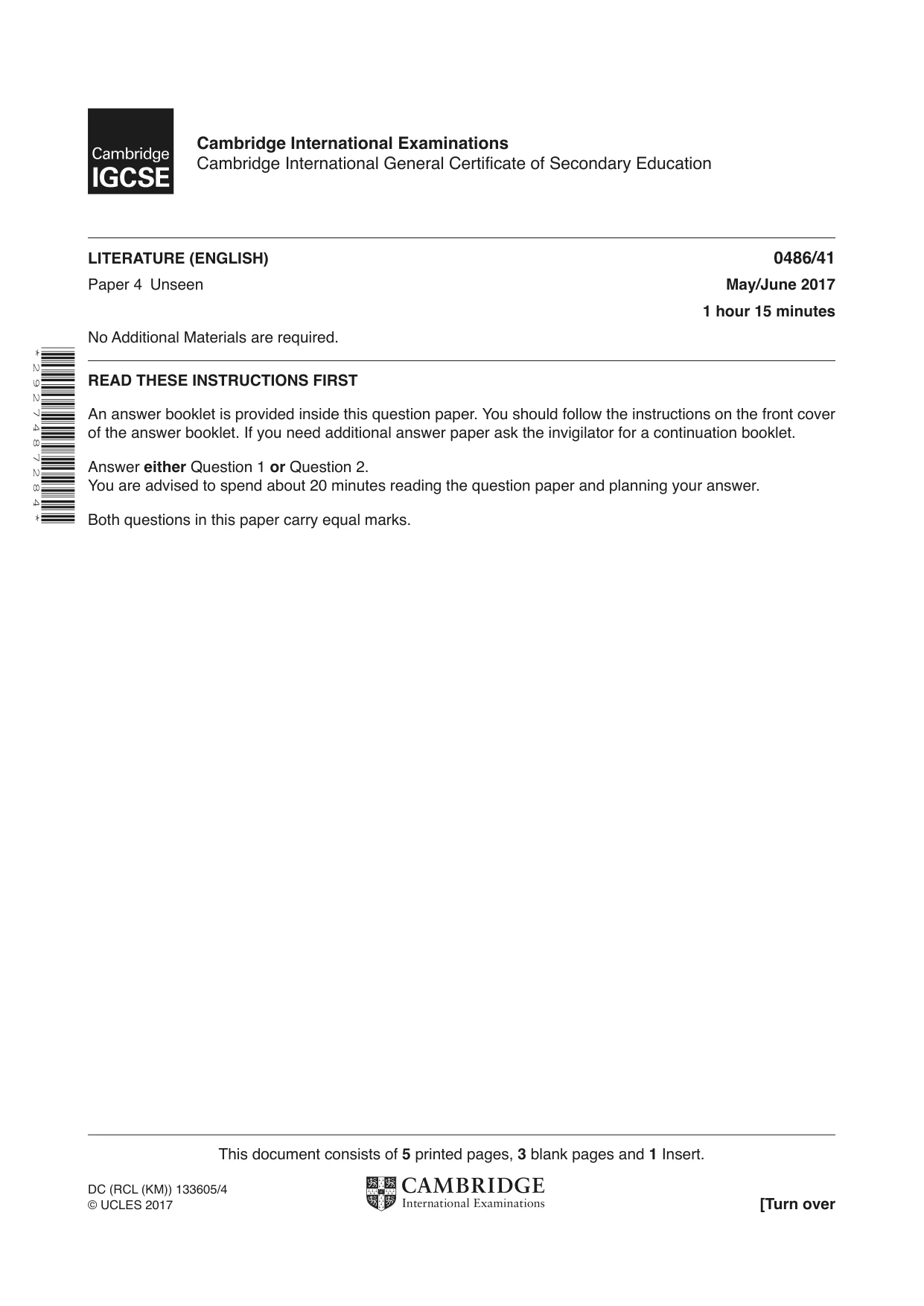
This document consists of 5 printed pages, 3 blank pages and 1 Insert. DC (RCL (KM)) 133605/4 © UCLES 2017 [Turn over Cambridge International Examinations Cambridge International General Certificate of Secondary Education * 2 9 2 7 4 8 7 2 8 4 * LITERATURE (ENGLISH) 0486/41 Paper 4 Unseen May/June 2017 1 hour 15 minutes No Additional Materials are required. READ THESE INSTRUCTIONS FIRST An answer booklet is provided inside this question paper. You should follow the instructions on the front cover of the answer booklet. If you need additional answer paper ask the invigilator for a continuation booklet. Answer either Question 1 or Question 2. You are advised to spend about 20 minutes reading the question paper and planning your answer. Both questions in this paper carry equal marks.
Question paper, page 2
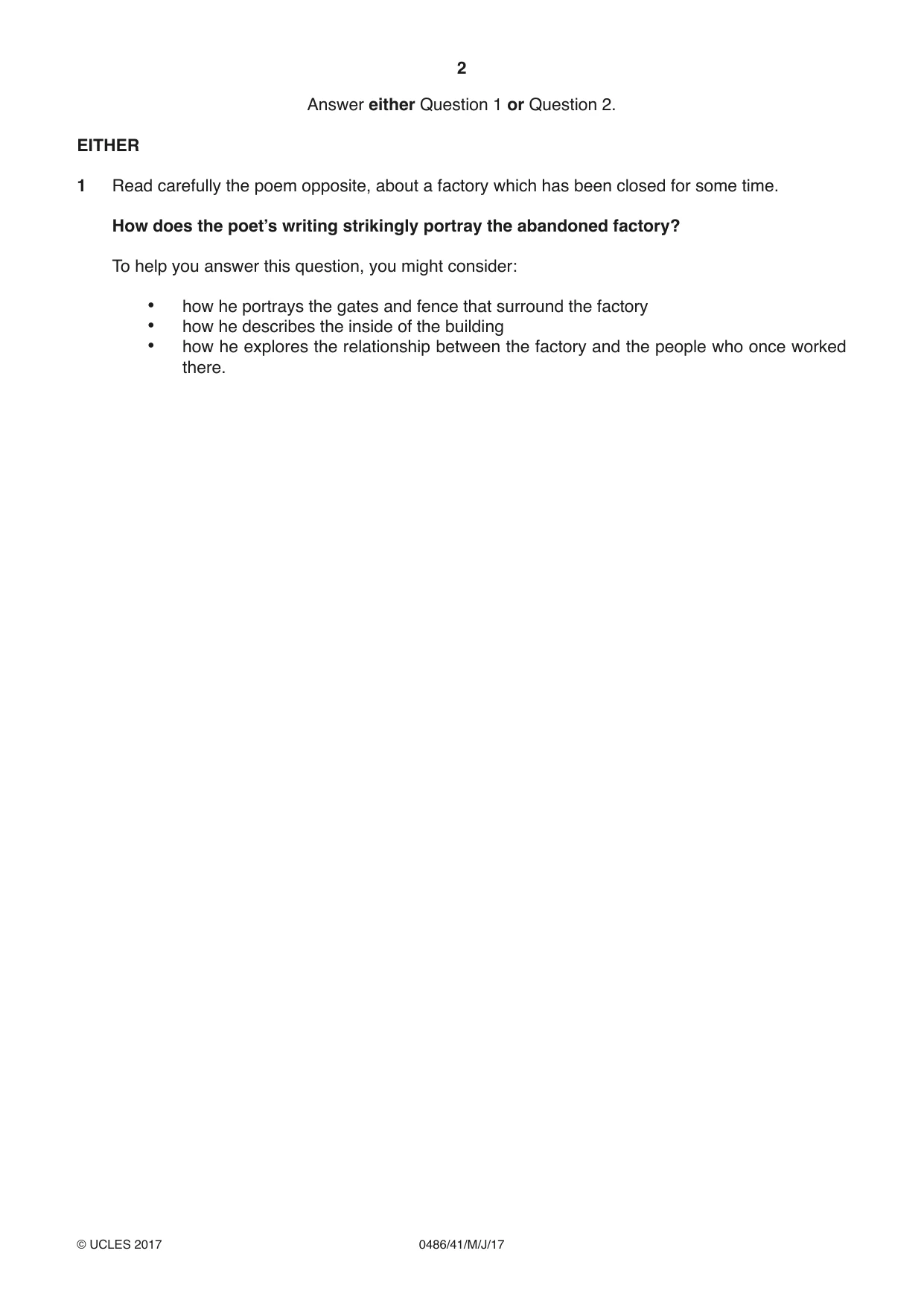
2 0486/41/M/J/17 © UCLES 2017 Answer either Question 1 or Question 2. EITHER 1 Read carefully the poem opposite, about a factory which has been closed for some time. How does the poet’s writing strikingly portray the abandoned factory? To help you answer this question, you might consider: • how he portrays the gates and fence that surround the factory • how he describes the inside of the building • how he explores the relationship between the factory and the people who once worked there.
Question paper, page 3
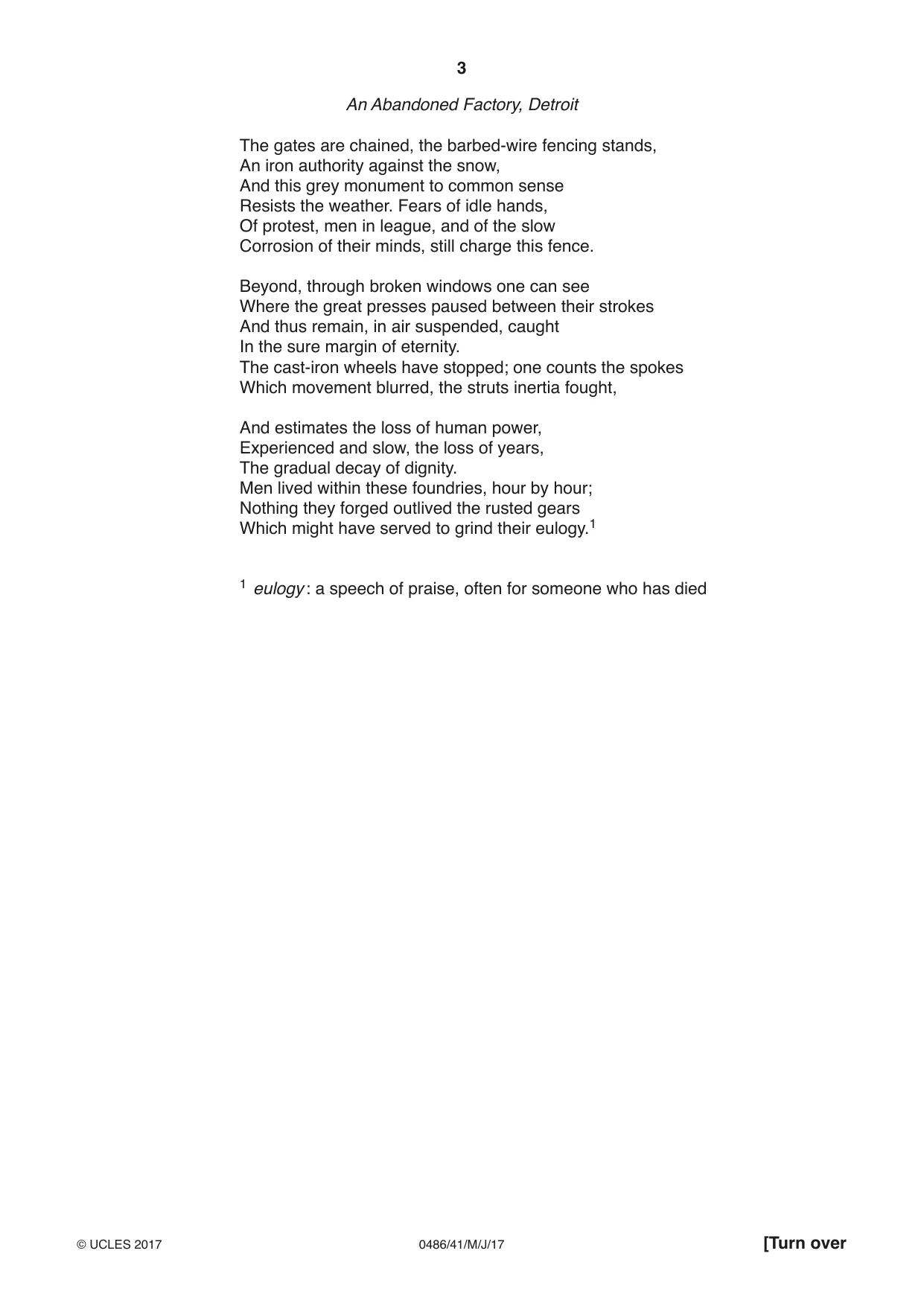
3 0486/41/M/J/17 © UCLES 2017 [Turn over An Abandoned Factory, Detroit The gates are chained, the barbed-wire fencing stands, An iron authority against the snow, And this grey monument to common sense Resists the weather. Fears of idle hands, Of protest, men in league, and of the slow Corrosion of their minds, still charge this fence. Beyond, through broken windows one can see Where the great presses paused between their strokes And thus remain, in air suspended, caught In the sure margin of eternity. The cast-iron wheels have stopped; one counts the spokes Which movement blurred, the struts inertia fought, And estimates the loss of human power, Experienced and slow, the loss of years, The gradual decay of dignity. Men lived within these foundries, hour by hour; Nothing they forged outlived the rusted gears Which might have served to grind their eulogy.1 1 eulogy : a speech of praise, often for someone who has died
Question paper, page 4
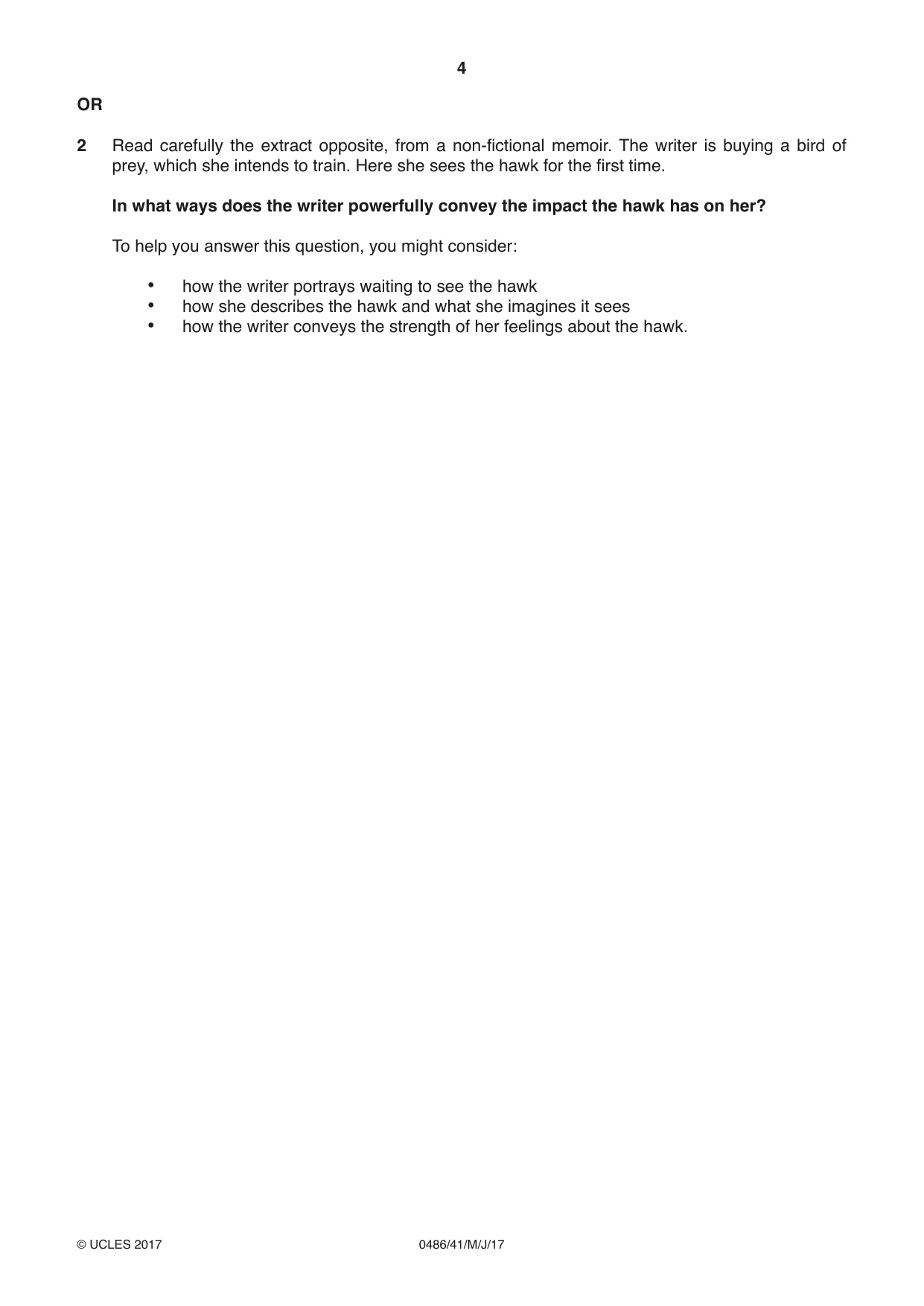
4 0486/41/M/J/17 © UCLES 2017 OR 2 Read carefully the extract opposite, from a non-fictional memoir. The writer is buying a bird of prey, which she intends to train. Here she sees the hawk for the first time. In what ways does the writer powerfully convey the impact the hawk has on her? To help you answer this question, you might consider: • how the writer portrays waiting to see the hawk • how she describes the hawk and what she imagines it sees • how the writer conveys the strength of her feelings about the hawk.
Question paper, page 5
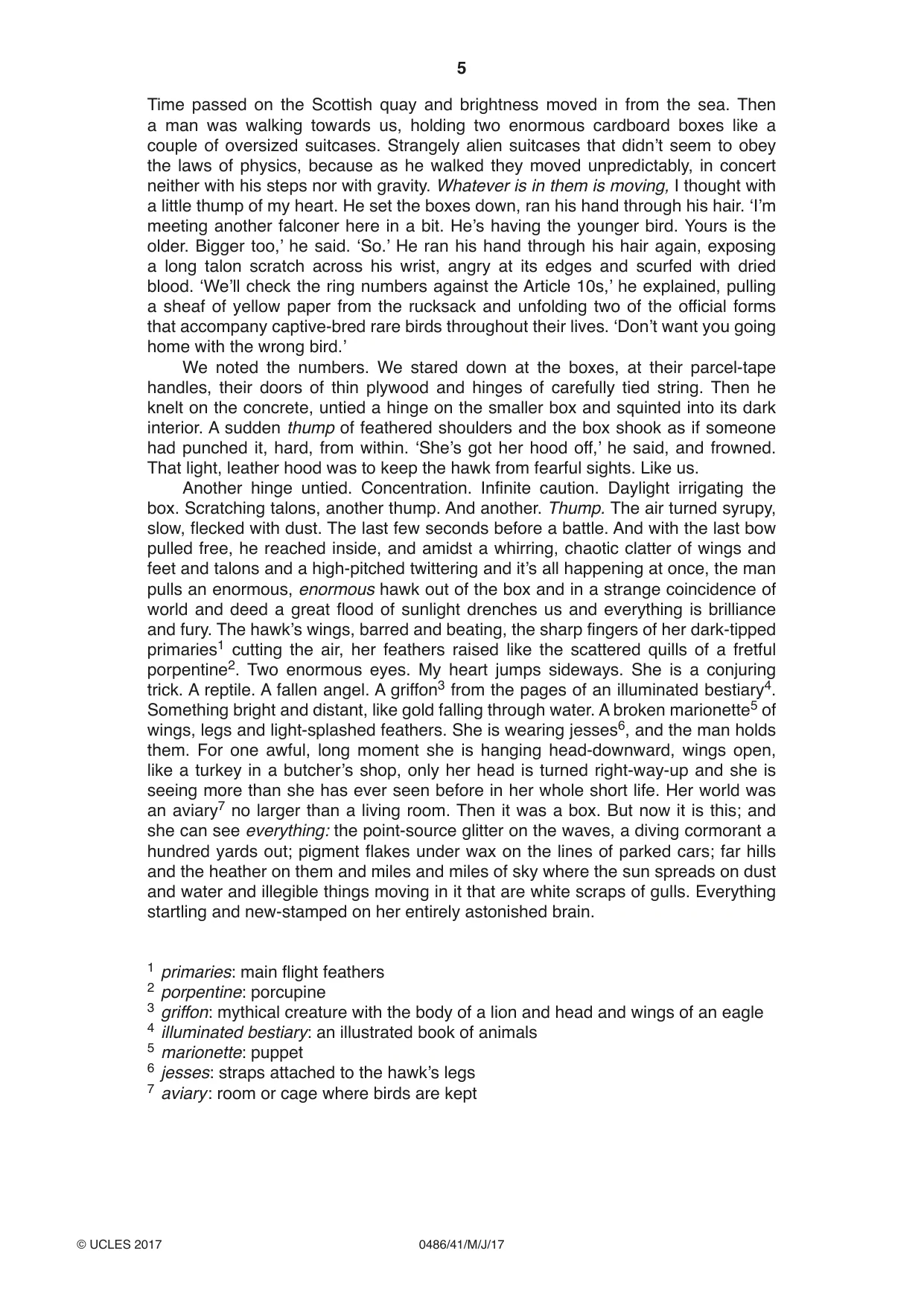
5 0486/41/M/J/17 © UCLES 2017 Time passed on the Scottish quay and brightness moved in from the sea. Then a man was walking towards us, holding two enormous cardboard boxes like a couple of oversized suitcases. Strangely alien suitcases that didn’t seem to obey the laws of physics, because as he walked they moved unpredictably, in concert neither with his steps nor with gravity. Whatever is in them is moving, I thought with a little thump of my heart. He set the boxes down, ran his hand through his hair. ‘I’m meeting another falconer here in a bit. He’s having the younger bird. Yours is the older. Bigger too,’ he said. ‘So.’ He ran his hand through his hair again, exposing a long talon scratch across his wrist, angry at its edges and scurfed with dried blood. ‘We’ll check the ring numbers against the Article 10s,’ he explained, pulling a sheaf of yellow paper from the rucksack and unfolding two of the official forms that accompany captive-bred rare birds throughout their lives. ‘Don’t want you going home with the wrong bird.’ We noted the numbers. We stared down at the boxes, at their parcel-tape handles, their doors of thin plywood and hinges of carefully tied string. Then he knelt on the concrete, untied a hinge on the smaller box and squinted into its dark interior. A sudden thump of feathered shoulders and the box shook as if someone had punched it, hard, from within. ‘She’s got her hood off,’ he said, and frowned. That light, leather hood was to keep the hawk from fearful sights. Like us. Another hinge untied. Concentration. Infinite caution. Daylight irrigating the box. Scratching talons, another thump. And another. Thump. The air turned syrupy, slow, flecked with dust. The last few seconds before a battle. And with the last bow pulled free, he reached inside, and amidst a whirring, chaotic clatter of wings and feet and talons and a high-pitched twittering and it’s all happening at once, the man pulls an enormous, enormous hawk out of the box and in a strange coincidence of world and deed a great flood of sunlight drenches us and everything is brilliance and fury. The hawk’s wings, barred and beating, the sharp fingers of her dark-tipped primaries1 cutting the air, her feathers raised like the scattered quills of a fretful porpentine2. Two enormous eyes. My heart jumps sideways. She is a conjuring trick. A reptile. A fallen angel. A griffon3 from the pages of an illuminated bestiary4. Something bright and distant, like gold falling through water. A broken marionette5 of wings, legs and light-splashed feathers. She is wearing jesses6, and the man holds them. For one awful, long moment she is hanging head-downward, wings open, like a turkey in a butcher’s shop, only her head is turned right-way-up and she is seeing more than she has ever seen before in her whole short life. Her world was an aviary7 no larger than a living room. Then it was a box. But now it is this; and she can see everything: the point-source glitter on the waves, a diving cormorant a hundred yards out; pigment flakes under wax on the lines of parked cars; far hills and the heather on them and miles and miles of sky where the sun spreads on dust and water and illegible things moving in it that are white scraps of gulls. Everything startling and new-stamped on her entirely astonished brain. 1 primaries: main flight feathers 2 porpentine: porcupine 3 griffon: mythical creature with the body of a lion and head and wings of an eagle 4 illuminated bestiary: an illustrated book of animals 5 marionette: puppet 6 jesses: straps attached to the hawk’s legs 7 aviary: room or cage where birds are kept
Question paper, page 6
6 0486/41/M/J/17 © UCLES 2017 BLANK PAGE
Question paper, page 7
7 0486/41/M/J/17 © UCLES 2017 BLANK PAGE
Question paper, page 8
8 0486/41/M/J/17 © UCLES 2017 BLANK PAGE Permission to reproduce items where third-party owned material protected by copyright is included has been sought and cleared where possible. Every reasonable effort has been made by the publisher (UCLES) to trace copyright holders, but if any items requiring clearance have unwittingly been included, the publisher will be pleased to make amends at the earliest possible opportunity. To avoid the issue of disclosure of answer-related information to candidates, all copyright acknowledgements are reproduced online in the Cambridge International Examinations Copyright Acknowledgements Booklet. This is produced for each series of examinations and is freely available to download at www.cie.org.uk after the live examination series. Cambridge International Examinations is part of the Cambridge Assessment Group. Cambridge Assessment is the brand name of University of Cambridge Local Examinations Syndicate (UCLES), which is itself a department of the University of Cambridge.
Mark scheme, page 1
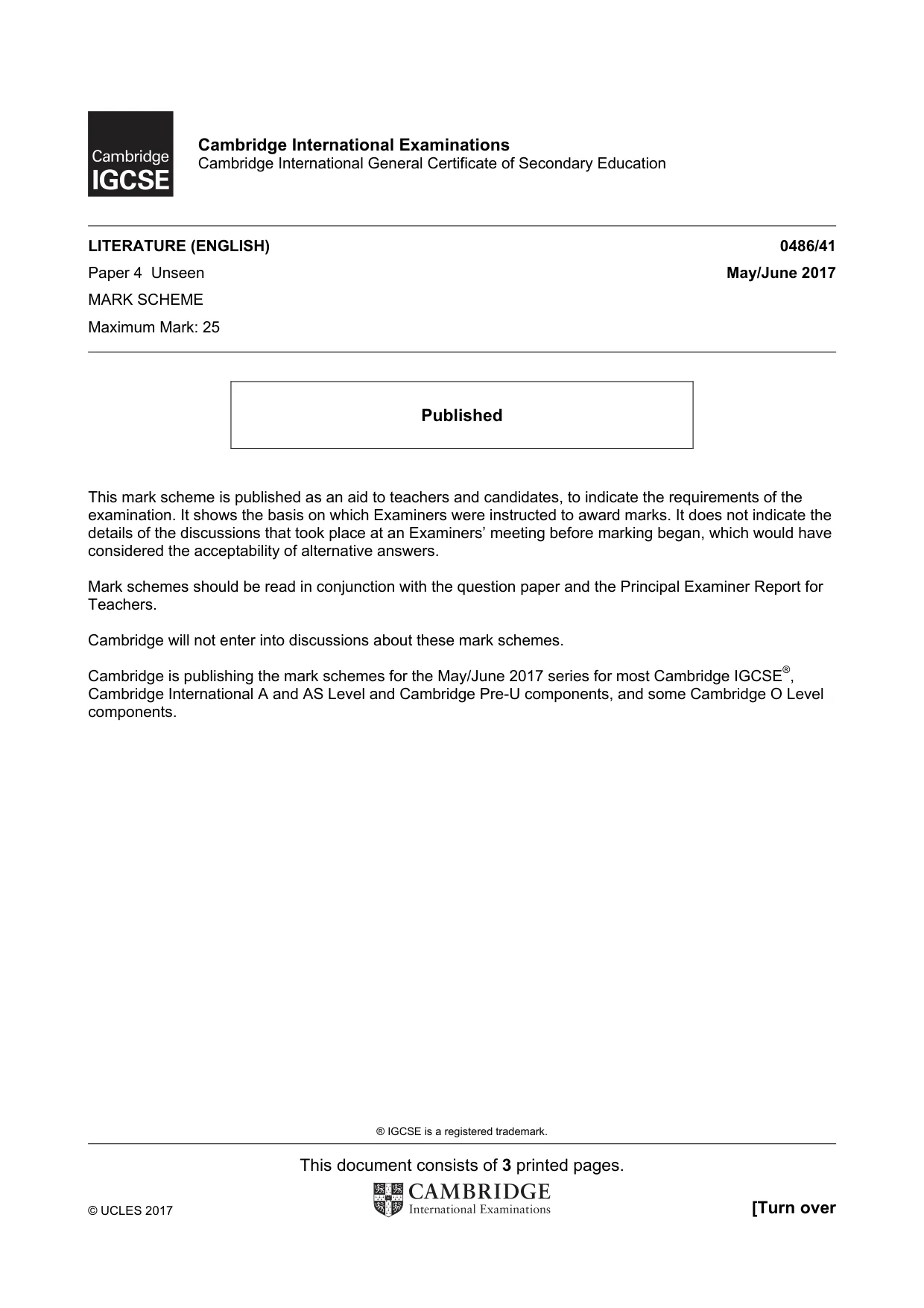
® IGCSE is a registered trademark. This document consists of 3 printed pages. © UCLES 2017 [Turn over Cambridge International Examinations Cambridge International General Certificate of Secondary Education LITERATURE (ENGLISH) 0486/41 Paper 4 Unseen May/June 2017 MARK SCHEME Maximum Mark: 25 Published This mark scheme is published as an aid to teachers and candidates, to indicate the requirements of the examination. It shows the basis on which Examiners were instructed to award marks. It does not indicate the details of the discussions that took place at an Examiners’ meeting before marking began, which would have considered the acceptability of alternative answers. Mark schemes should be read in conjunction with the question paper and the Principal Examiner Report for Teachers. Cambridge will not enter into discussions about these mark schemes. Cambridge is publishing the mark schemes for the May/June 2017 series for most Cambridge IGCSE®, Cambridge International A and AS Level and Cambridge Pre-U components, and some Cambridge O Level components.
Mark scheme, page 2
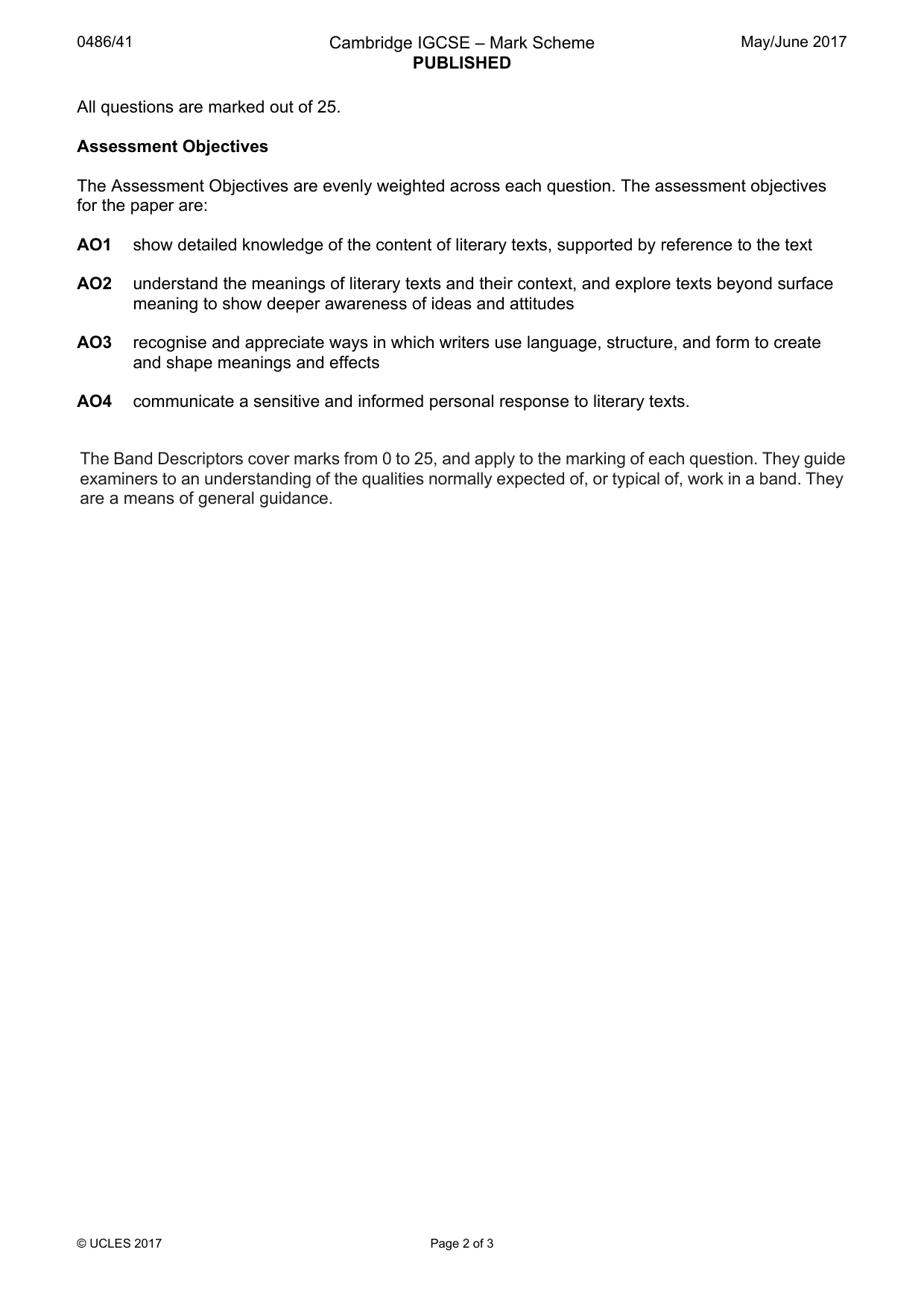
0486/41 Cambridge IGCSE – Mark Scheme PUBLISHED May/June 2017 © UCLES 2017 Page 2 of 3 All questions are marked out of 25. Assessment Objectives The Assessment Objectives are evenly weighted across each question. The assessment objectives for the paper are: AO1 show detailed knowledge of the content of literary texts, supported by reference to the text AO2 understand the meanings of literary texts and their context, and explore texts beyond surface meaning to show deeper awareness of ideas and attitudes AO3 recognise and appreciate ways in which writers use language, structure, and form to create and shape meanings and effects AO4 communicate a sensitive and informed personal response to literary texts. The Band Descriptors cover marks from 0 to 25, and apply to the marking of each question. They guide examiners to an understanding of the qualities normally expected of, or typical of, work in a band. They are a means of general guidance.
Mark scheme, page 3
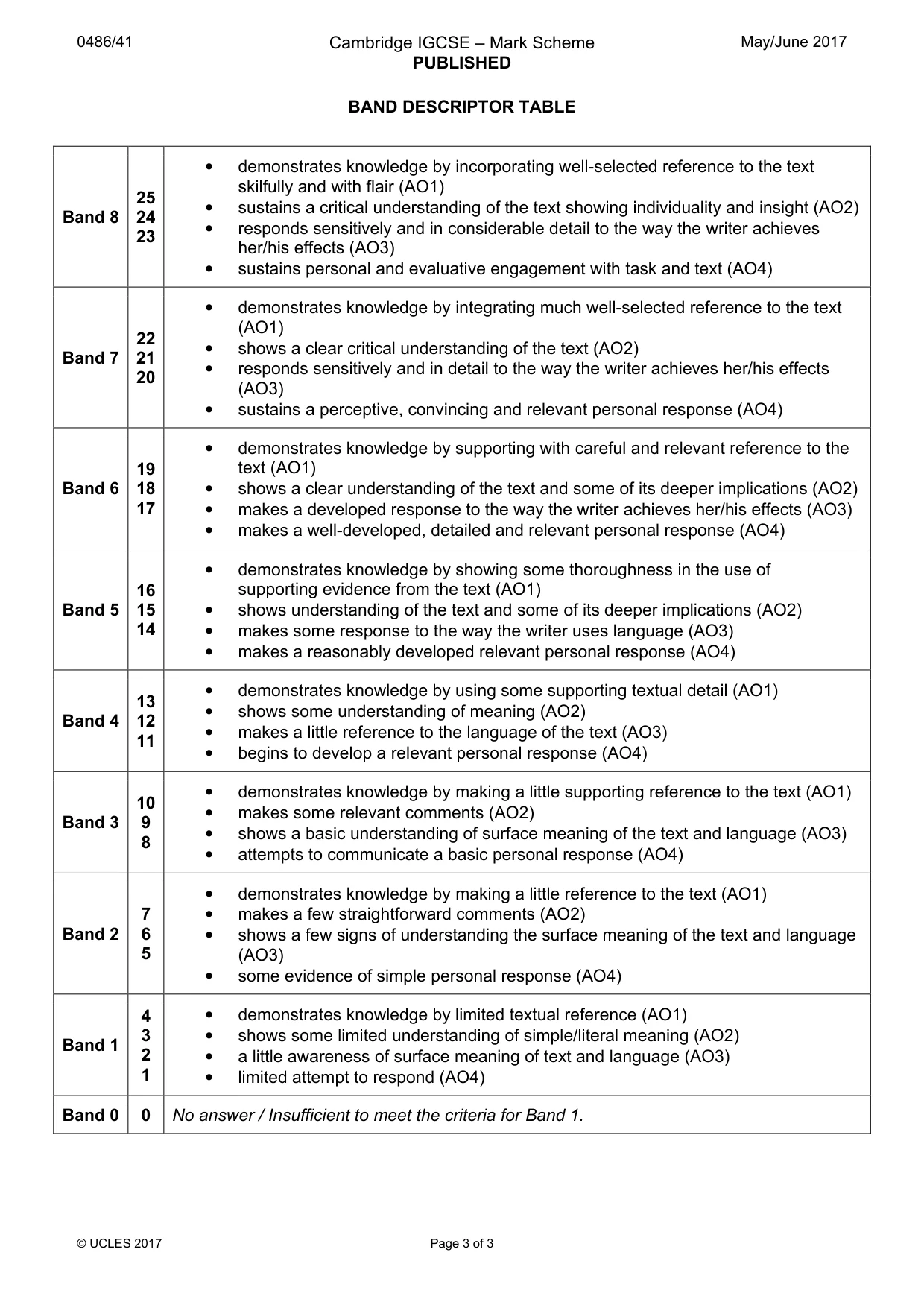
0486/41 Cambridge IGCSE – Mark Scheme PUBLISHED May/June 2017 © UCLES 2017 Page 3 of 3 BAND DESCRIPTOR TABLE Band 8 25 24 23 • demonstrates knowledge by incorporating well-selected reference to the text skilfully and with flair (AO1) • sustains a critical understanding of the text showing individuality and insight (AO2) • responds sensitively and in considerable detail to the way the writer achieves her/his effects (AO3) • sustains personal and evaluative engagement with task and text (AO4) Band 7 22 21 20 • demonstrates knowledge by integrating much well-selected reference to the text (AO1) • shows a clear critical understanding of the text (AO2) • responds sensitively and in detail to the way the writer achieves her/his effects (AO3) • sustains a perceptive, convincing and relevant personal response (AO4) Band 6 19 18 17 • demonstrates knowledge by supporting with careful and relevant reference to the text (AO1) • shows a clear understanding of the text and some of its deeper implications (AO2) • makes a developed response to the way the writer achieves her/his effects (AO3) • makes a well-developed, detailed and relevant personal response (AO4) Band 5 16 15 14 • demonstrates knowledge by showing some thoroughness in the use of supporting evidence from the text (AO1) • shows understanding of the text and some of its deeper implications (AO2) • makes some response to the way the writer uses language (AO3) • makes a reasonably developed relevant personal response (AO4) Band 4 13 12 11 • demonstrates knowledge by using some supporting textual detail (AO1) • shows some understanding of meaning (AO2) • makes a little reference to the language of the text (AO3) • begins to develop a relevant personal response (AO4) Band 3 10 9 8 • demonstrates knowledge by making a little supporting reference to the text (AO1) • makes some relevant comments (AO2) • shows a basic understanding of surface meaning of the text and language (AO3) • attempts to communicate a basic personal response (AO4) Band 2 7 6 5 • demonstrates knowledge by making a little reference to the text (AO1) • makes a few straightforward comments (AO2) • shows a few signs of understanding the surface meaning of the text and language (AO3) • some evidence of simple personal response (AO4) Band 1 4 3 2 1 • demonstrates knowledge by limited textual reference (AO1) • shows some limited understanding of simple/literal meaning (AO2) • a little awareness of surface meaning of text and language (AO3) • limited attempt to respond (AO4) Band 0 0 No answer / Insufficient to meet the criteria for Band 1.
What you needed in this session
Cambridge’s own grade thresholds for 2017 May/June, Paper 4 · Variant 1. A higher threshold means an easier paper — the bar moves with how the cohort did.