Cambridge IGCSE English - Literature 0486 — 2017 May/June Paper 4 · Variant 2
0486/42/M/J/17 · 25 marks · ≈28 min
The question paper and its mark scheme, free to read here and free to download. This is Cambridge’s own paper, exactly as it was sat.
Question paper8 pages


Mark scheme3 pages
Answers below. Sit the paper first if you are practising.
Paper as text
Question paper, page 1
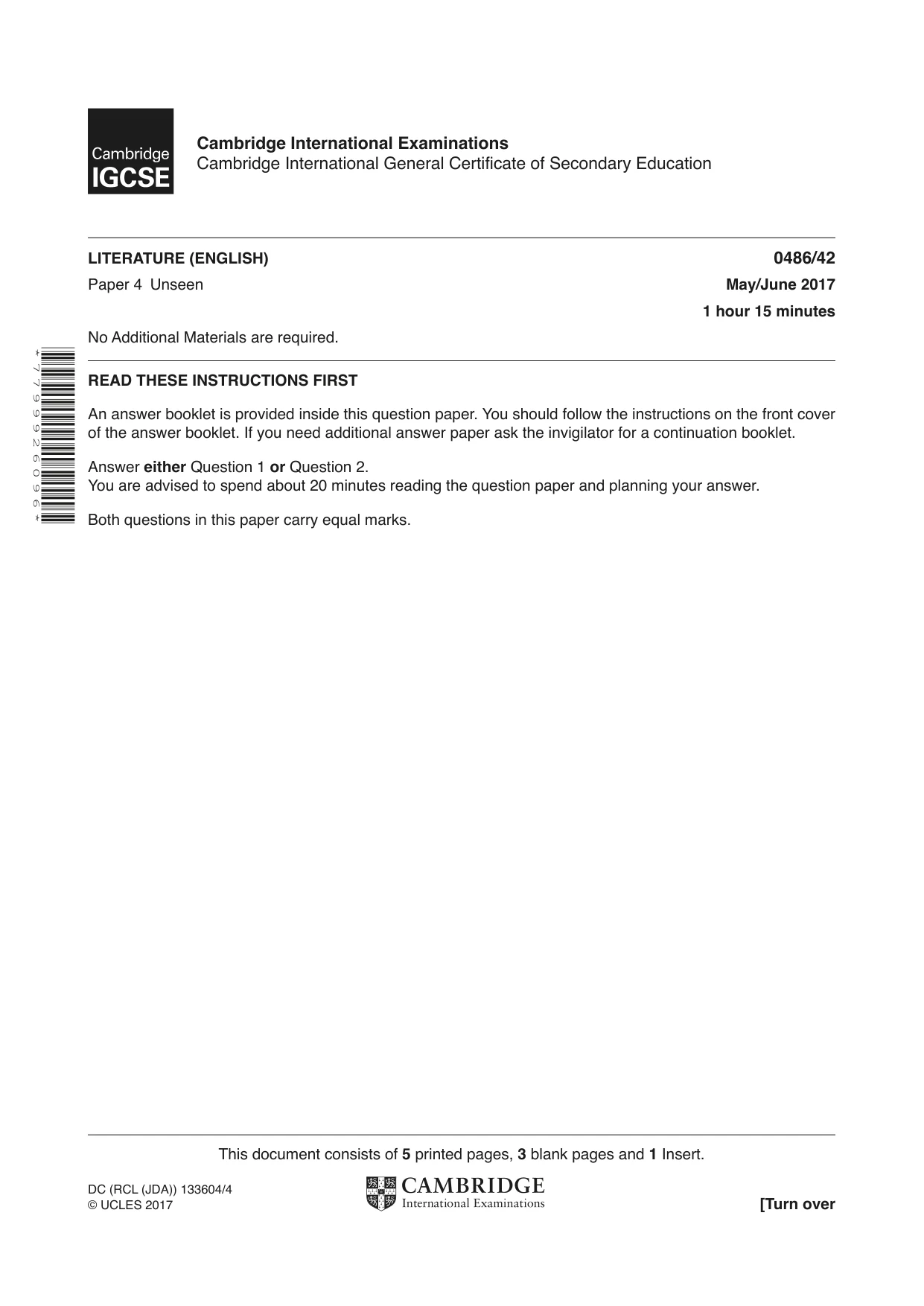
This document consists of 5 printed pages, 3 blank pages and 1 Insert. DC (RCL (JDA)) 133604/4 © UCLES 2017 [Turn over Cambridge International Examinations Cambridge International General Certificate of Secondary Education * 7 7 9 9 9 2 6 0 9 6 * LITERATURE (ENGLISH) 0486/42 Paper 4 Unseen May/June 2017 1 hour 15 minutes No Additional Materials are required. READ THESE INSTRUCTIONS FIRST An answer booklet is provided inside this question paper. You should follow the instructions on the front cover of the answer booklet. If you need additional answer paper ask the invigilator for a continuation booklet. Answer either Question 1 or Question 2. You are advised to spend about 20 minutes reading the question paper and planning your answer. Both questions in this paper carry equal marks.
Question paper, page 2
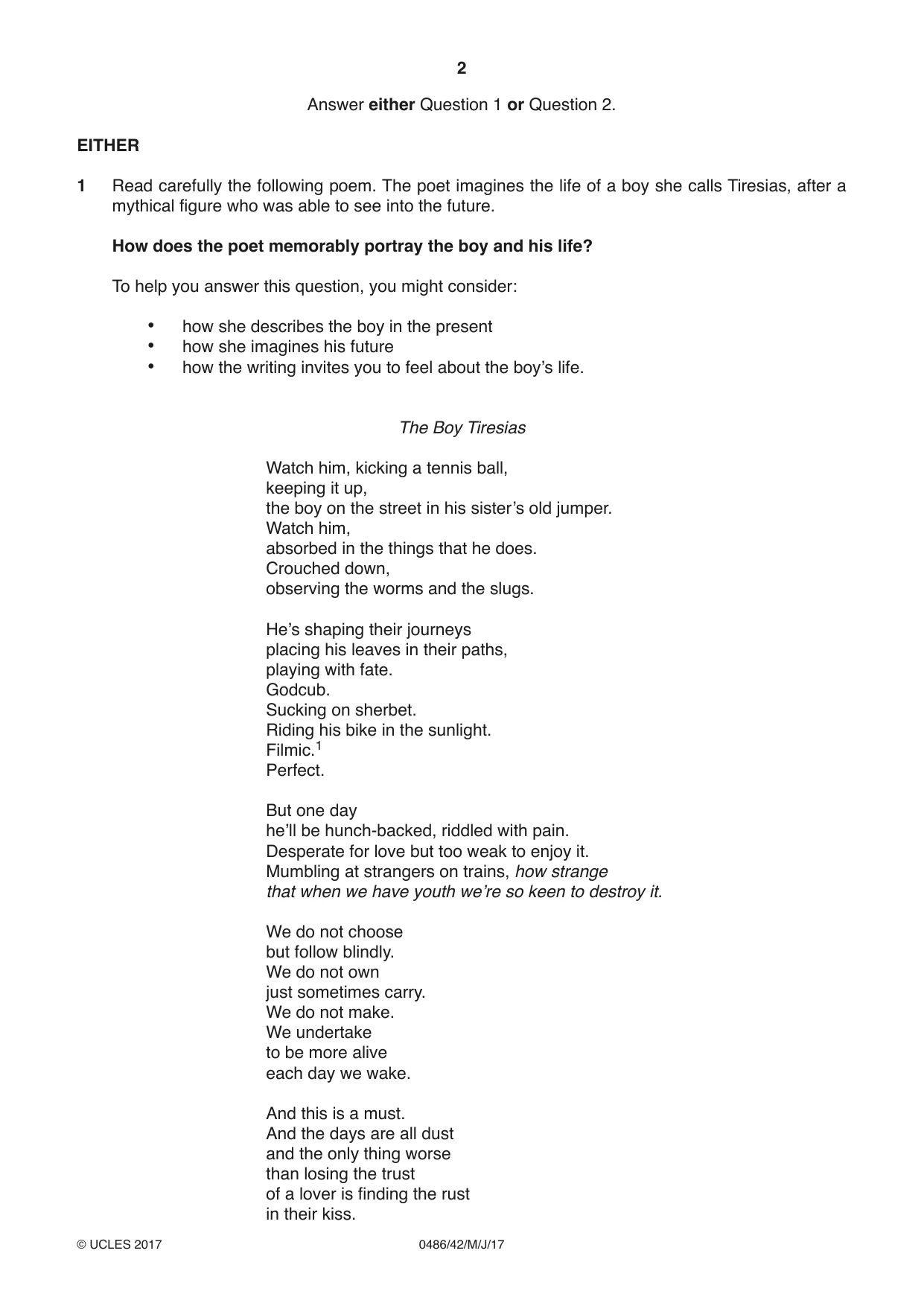
2 0486/42/M/J/17 © UCLES 2017 Answer either Question 1 or Question 2. EITHER 1 Read carefully the following poem. The poet imagines the life of a boy she calls Tiresias, after a mythical figure who was able to see into the future. How does the poet memorably portray the boy and his life? To help you answer this question, you might consider: • how she describes the boy in the present • how she imagines his future • how the writing invites you to feel about the boy’s life. The Boy Tiresias Watch him, kicking a tennis ball, keeping it up, the boy on the street in his sister’s old jumper. Watch him, absorbed in the things that he does. Crouched down, observing the worms and the slugs. He’s shaping their journeys placing his leaves in their paths, playing with fate. Godcub. Sucking on sherbet. Riding his bike in the sunlight. Filmic.1 Perfect. But one day he’ll be hunch-backed, riddled with pain. Desperate for love but too weak to enjoy it. Mumbling at strangers on trains, how strange that when we have youth we’re so keen to destroy it. We do not choose but follow blindly. We do not own just sometimes carry. We do not make. We undertake to be more alive each day we wake. And this is a must. And the days are all dust and the only thing worse than losing the trust of a lover is finding the rust in their kiss.
Question paper, page 3
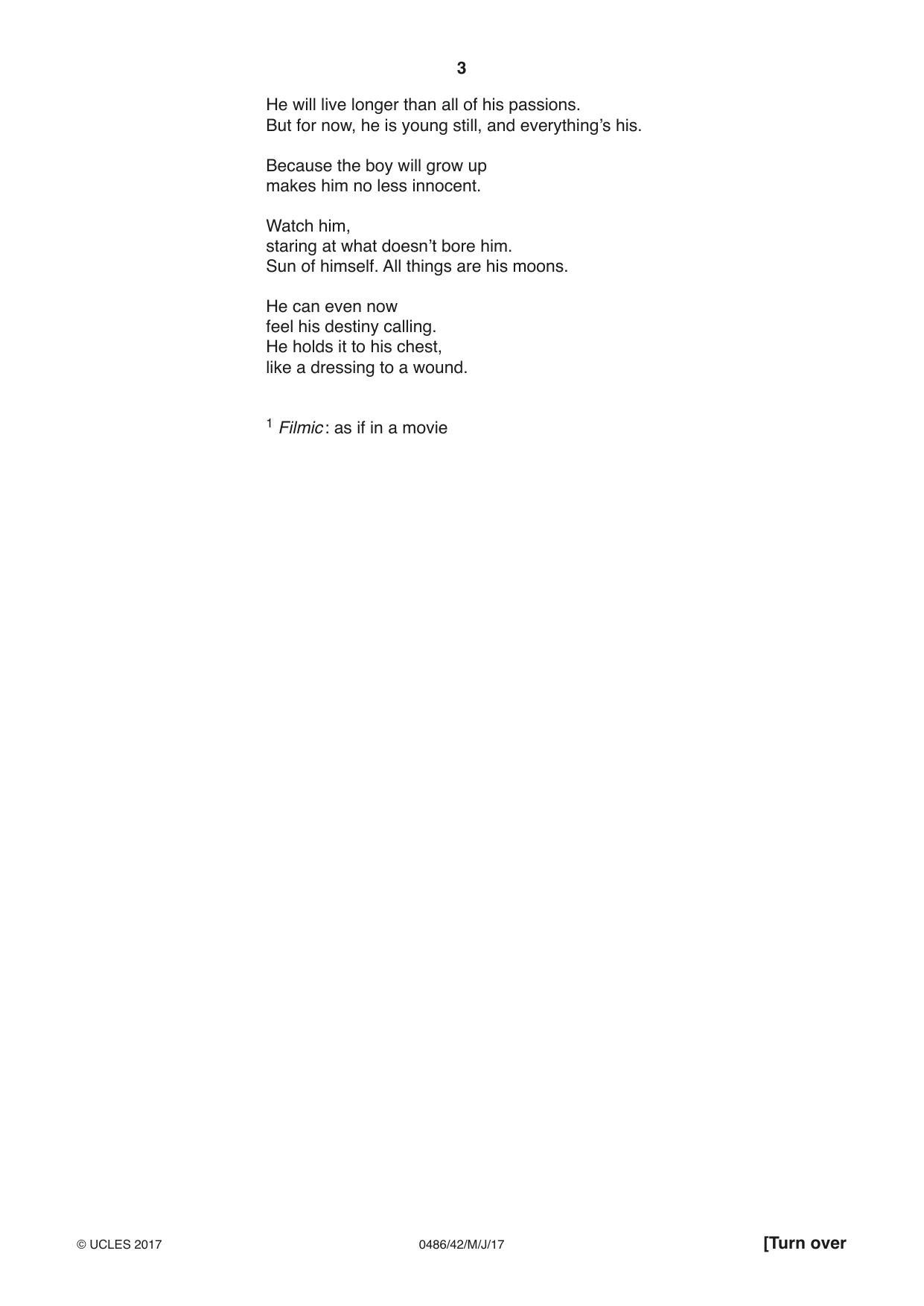
3 0486/42/M/J/17 © UCLES 2017 [Turn over He will live longer than all of his passions. But for now, he is young still, and everything’s his. Because the boy will grow up makes him no less innocent. Watch him, staring at what doesn’t bore him. Sun of himself. All things are his moons. He can even now feel his destiny calling. He holds it to his chest, like a dressing to a wound. 1 Filmic : as if in a movie
Question paper, page 4
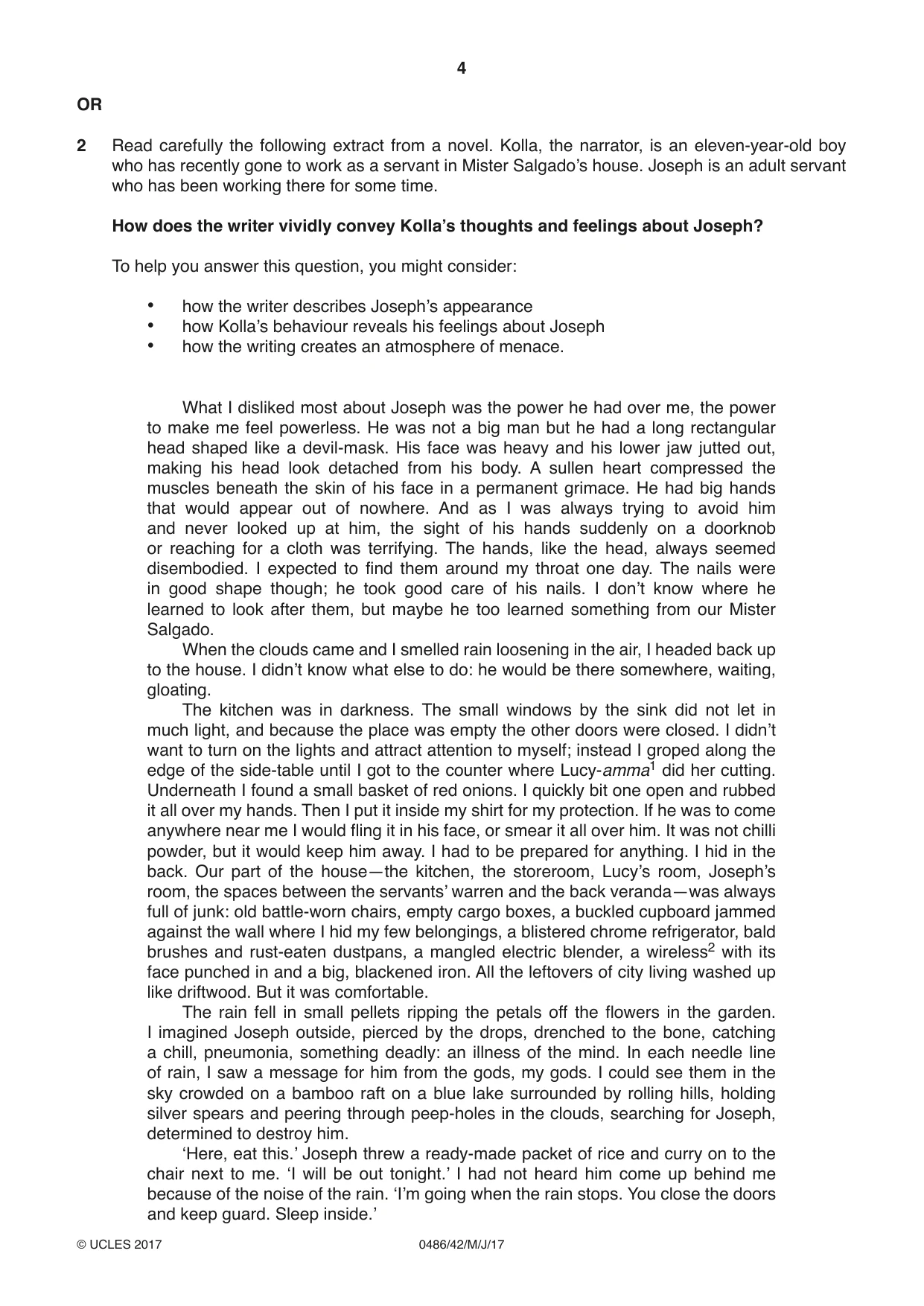
4 0486/42/M/J/17 © UCLES 2017 OR 2 Read carefully the following extract from a novel. Kolla, the narrator, is an eleven-year-old boy who has recently gone to work as a servant in Mister Salgado’s house. Joseph is an adult servant who has been working there for some time. How does the writer vividly convey Kolla’s thoughts and feelings about Joseph? To help you answer this question, you might consider: • how the writer describes Joseph’s appearance • how Kolla’s behaviour reveals his feelings about Joseph • how the writing creates an atmosphere of menace. What I disliked most about Joseph was the power he had over me, the power to make me feel powerless. He was not a big man but he had a long rectangular head shaped like a devil-mask. His face was heavy and his lower jaw jutted out, making his head look detached from his body. A sullen heart compressed the muscles beneath the skin of his face in a permanent grimace. He had big hands that would appear out of nowhere. And as I was always trying to avoid him and never looked up at him, the sight of his hands suddenly on a doorknob or reaching for a cloth was terrifying. The hands, like the head, always seemed disembodied. I expected to find them around my throat one day. The nails were in good shape though; he took good care of his nails. I don’t know where he learned to look after them, but maybe he too learned something from our Mister Salgado. When the clouds came and I smelled rain loosening in the air, I headed back up to the house. I didn’t know what else to do: he would be there somewhere, waiting, gloating. The kitchen was in darkness. The small windows by the sink did not let in much light, and because the place was empty the other doors were closed. I didn’t want to turn on the lights and attract attention to myself; instead I groped along the edge of the side-table until I got to the counter where Lucy-amma1 did her cutting. Underneath I found a small basket of red onions. I quickly bit one open and rubbed it all over my hands. Then I put it inside my shirt for my protection. If he was to come anywhere near me I would fling it in his face, or smear it all over him. It was not chilli powder, but it would keep him away. I had to be prepared for anything. I hid in the back. Our part of the house—the kitchen, the storeroom, Lucy’s room, Joseph’s room, the spaces between the servants’ warren and the back veranda—was always full of junk: old battle-worn chairs, empty cargo boxes, a buckled cupboard jammed against the wall where I hid my few belongings, a blistered chrome refrigerator, bald brushes and rust-eaten dustpans, a mangled electric blender, a wireless2 with its face punched in and a big, blackened iron. All the leftovers of city living washed up like driftwood. But it was comfortable. The rain fell in small pellets ripping the petals off the flowers in the garden. I imagined Joseph outside, pierced by the drops, drenched to the bone, catching a chill, pneumonia, something deadly: an illness of the mind. In each needle line of rain, I saw a message for him from the gods, my gods. I could see them in the sky crowded on a bamboo raft on a blue lake surrounded by rolling hills, holding silver spears and peering through peep-holes in the clouds, searching for Joseph, determined to destroy him. ‘Here, eat this.’ Joseph threw a ready-made packet of rice and curry on to the chair next to me. ‘I will be out tonight.’ I had not heard him come up behind me because of the noise of the rain. ‘I’m going when the rain stops. You close the doors and keep guard. Sleep inside.’
Question paper, page 5
5 0486/42/M/J/17 © UCLES 2017 Where he had to go I could not imagine, but I was overjoyed. I wished the rain would stop immediately: instead it poured down even harder. The sound rose to a crescendo. Water drilling into the ground. The gutters were spilling over and waves seemed to wash down the sides of the veranda; the drain had turned into a river. Joseph disappeared into his room, and I reversed my prayers; I tried to will the rain to stop. ‘Give us a break: let him go, leave the house, then come down as hard as hard can so he will never ever return. Let him drown as he walks slurping in the rain with that spoony jaw of his.’ 1 Lucy-amma: the household cook 2 wireless: a radio set
Question paper, page 6
6 0486/42/M/J/17 © UCLES 2017 BLANK PAGE
Question paper, page 7
7 0486/42/M/J/17 © UCLES 2017 BLANK PAGE
Question paper, page 8
8 0486/42/M/J/17 © UCLES 2017 BLANK PAGE Permission to reproduce items where third-party owned material protected by copyright is included has been sought and cleared where possible. Every reasonable effort has been made by the publisher (UCLES) to trace copyright holders, but if any items requiring clearance have unwittingly been included, the publisher will be pleased to make amends at the earliest possible opportunity. To avoid the issue of disclosure of answer-related information to candidates, all copyright acknowledgements are reproduced online in the Cambridge International Examinations Copyright Acknowledgements Booklet. This is produced for each series of examinations and is freely available to download at www.cie.org.uk after the live examination series. Cambridge International Examinations is part of the Cambridge Assessment Group. Cambridge Assessment is the brand name of University of Cambridge Local Examinations Syndicate (UCLES), which is itself a department of the University of Cambridge.
Mark scheme, page 1
® IGCSE is a registered trademark. This document consists of 3 printed pages. © UCLES 2017 [Turn over Cambridge International Examinations Cambridge International General Certificate of Secondary Education LITERATURE (ENGLISH) 0486/42 Paper 4 Unseen May/June 2017 MARK SCHEME Maximum Mark: 25 Published This mark scheme is published as an aid to teachers and candidates, to indicate the requirements of the examination. It shows the basis on which Examiners were instructed to award marks. It does not indicate the details of the discussions that took place at an Examiners’ meeting before marking began, which would have considered the acceptability of alternative answers. Mark schemes should be read in conjunction with the question paper and the Principal Examiner Report for Teachers. Cambridge will not enter into discussions about these mark schemes. Cambridge is publishing the mark schemes for the May/June 2017 series for most Cambridge IGCSE®, Cambridge International A and AS Level and Cambridge Pre-U components, and some Cambridge O Level components.
Mark scheme, page 2
0486/42 Cambridge IGCSE – Mark Scheme PUBLISHED May/June 2017 © UCLES 2017 Page 2 of 3 All questions are marked out of 25. Assessment Objectives The Assessment Objectives are evenly weighted across each question. The assessment objectives for the paper are: AO1 show detailed knowledge of the content of literary texts, supported by reference to the text AO2 understand the meanings of literary texts and their context, and explore texts beyond surface meaning to show deeper awareness of ideas and attitudes AO3 recognise and appreciate ways in which writers use language, structure, and form to create and shape meanings and effects AO4 communicate a sensitive and informed personal response to literary texts. The Band Descriptors cover marks from 0 to 25, and apply to the marking of each question. They guide examiners to an understanding of the qualities normally expected of, or typical of, work in a band. They are a means of general guidance.
Mark scheme, page 3
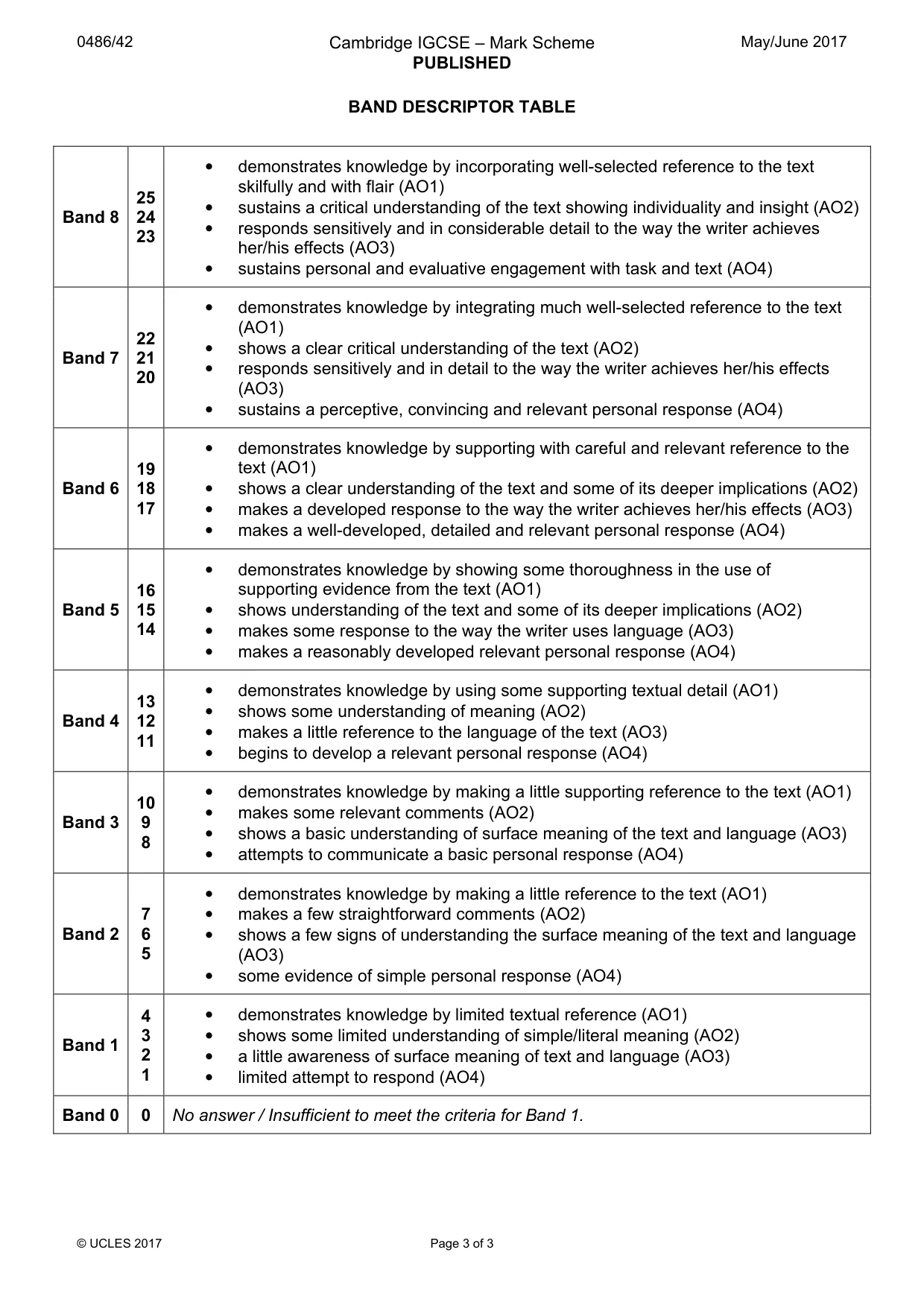
0486/42 Cambridge IGCSE – Mark Scheme PUBLISHED May/June 2017 © UCLES 2017 Page 3 of 3 BAND DESCRIPTOR TABLE Band 8 25 24 23 • demonstrates knowledge by incorporating well-selected reference to the text skilfully and with flair (AO1) • sustains a critical understanding of the text showing individuality and insight (AO2) • responds sensitively and in considerable detail to the way the writer achieves her/his effects (AO3) • sustains personal and evaluative engagement with task and text (AO4) Band 7 22 21 20 • demonstrates knowledge by integrating much well-selected reference to the text (AO1) • shows a clear critical understanding of the text (AO2) • responds sensitively and in detail to the way the writer achieves her/his effects (AO3) • sustains a perceptive, convincing and relevant personal response (AO4) Band 6 19 18 17 • demonstrates knowledge by supporting with careful and relevant reference to the text (AO1) • shows a clear understanding of the text and some of its deeper implications (AO2) • makes a developed response to the way the writer achieves her/his effects (AO3) • makes a well-developed, detailed and relevant personal response (AO4) Band 5 16 15 14 • demonstrates knowledge by showing some thoroughness in the use of supporting evidence from the text (AO1) • shows understanding of the text and some of its deeper implications (AO2) • makes some response to the way the writer uses language (AO3) • makes a reasonably developed relevant personal response (AO4) Band 4 13 12 11 • demonstrates knowledge by using some supporting textual detail (AO1) • shows some understanding of meaning (AO2) • makes a little reference to the language of the text (AO3) • begins to develop a relevant personal response (AO4) Band 3 10 9 8 • demonstrates knowledge by making a little supporting reference to the text (AO1) • makes some relevant comments (AO2) • shows a basic understanding of surface meaning of the text and language (AO3) • attempts to communicate a basic personal response (AO4) Band 2 7 6 5 • demonstrates knowledge by making a little reference to the text (AO1) • makes a few straightforward comments (AO2) • shows a few signs of understanding the surface meaning of the text and language (AO3) • some evidence of simple personal response (AO4) Band 1 4 3 2 1 • demonstrates knowledge by limited textual reference (AO1) • shows some limited understanding of simple/literal meaning (AO2) • a little awareness of surface meaning of text and language (AO3) • limited attempt to respond (AO4) Band 0 0 No answer / Insufficient to meet the criteria for Band 1.
What you needed in this session
Cambridge’s own grade thresholds for 2017 May/June, Paper 4 · Variant 2. A higher threshold means an easier paper — the bar moves with how the cohort did.