Cambridge IGCSE English - Literature 0486 — 2016 Oct/Nov Paper 4 · Variant 3
0486/43/O/N/16 · 25 marks · ≈28 min
The question paper and its mark scheme, free to read here and free to download. This is Cambridge’s own paper, exactly as it was sat.
Question paper8 pages


Mark scheme3 pages
Answers below. Sit the paper first if you are practising.
Paper as text
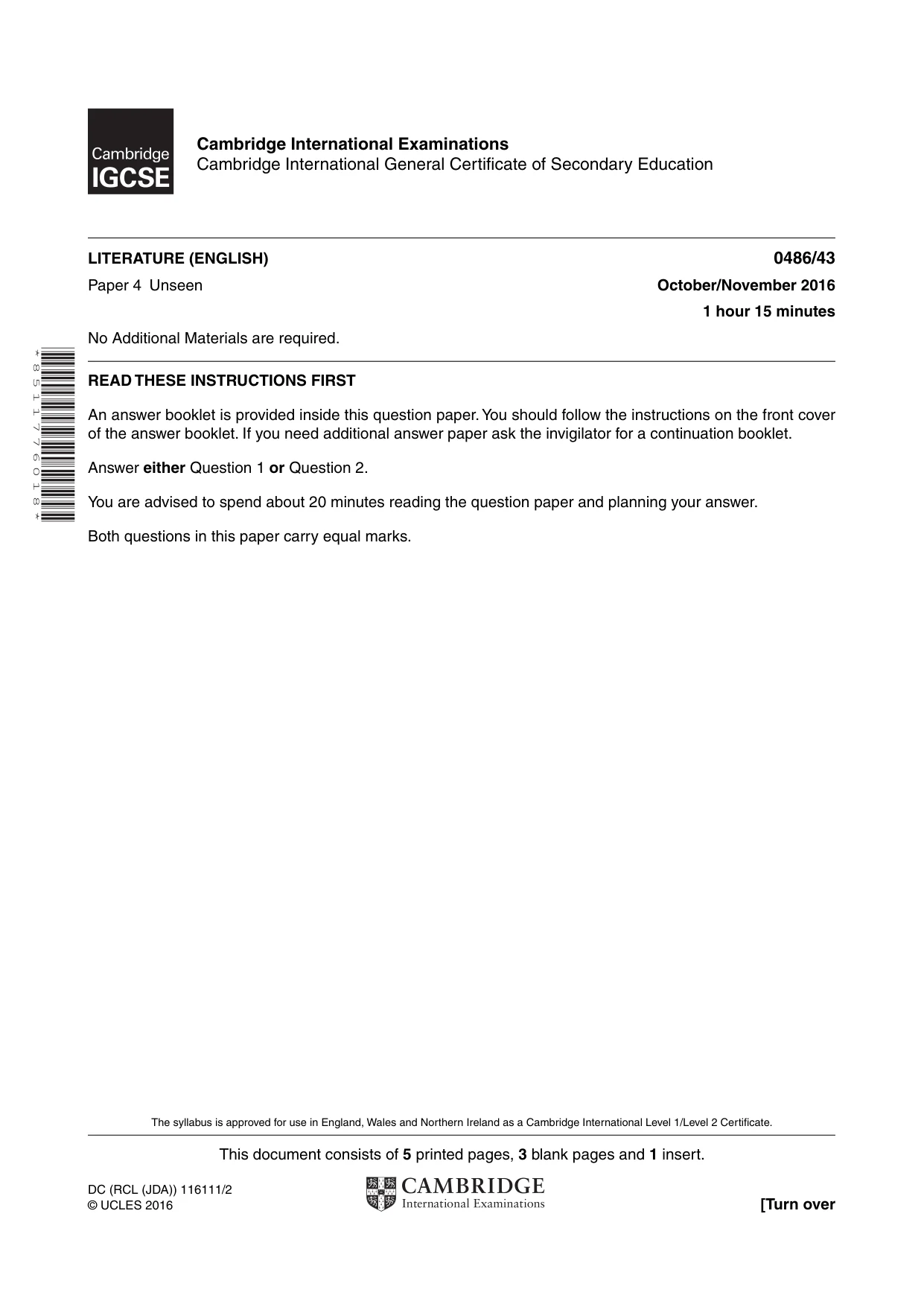
Question paper, page 1
This document consists of 5 printed pages, 3 blank pages and 1 insert. DC (RCL (JDA)) 116111/2 © UCLES 2016 [Turn over Cambridge International Examinations Cambridge International General Certificate of Secondary Education * 8 5 1 1 7 7 6 0 1 8 * LITERATURE (ENGLISH) 0486/43 Paper 4 Unseen October/November 2016 1 hour 15 minutes No Additional Materials are required. READ THESE INSTRUCTIONS FIRST An answer booklet is provided inside this question paper. You should follow the instructions on the front cover of the answer booklet. If you need additional answer paper ask the invigilator for a continuation booklet. Answer either Question 1 or Question 2. You are advised to spend about 20 minutes reading the question paper and planning your answer. Both questions in this paper carry equal marks. The syllabus is approved for use in England, Wales and Northern Ireland as a Cambridge International Level 1/Level 2 Certificate.
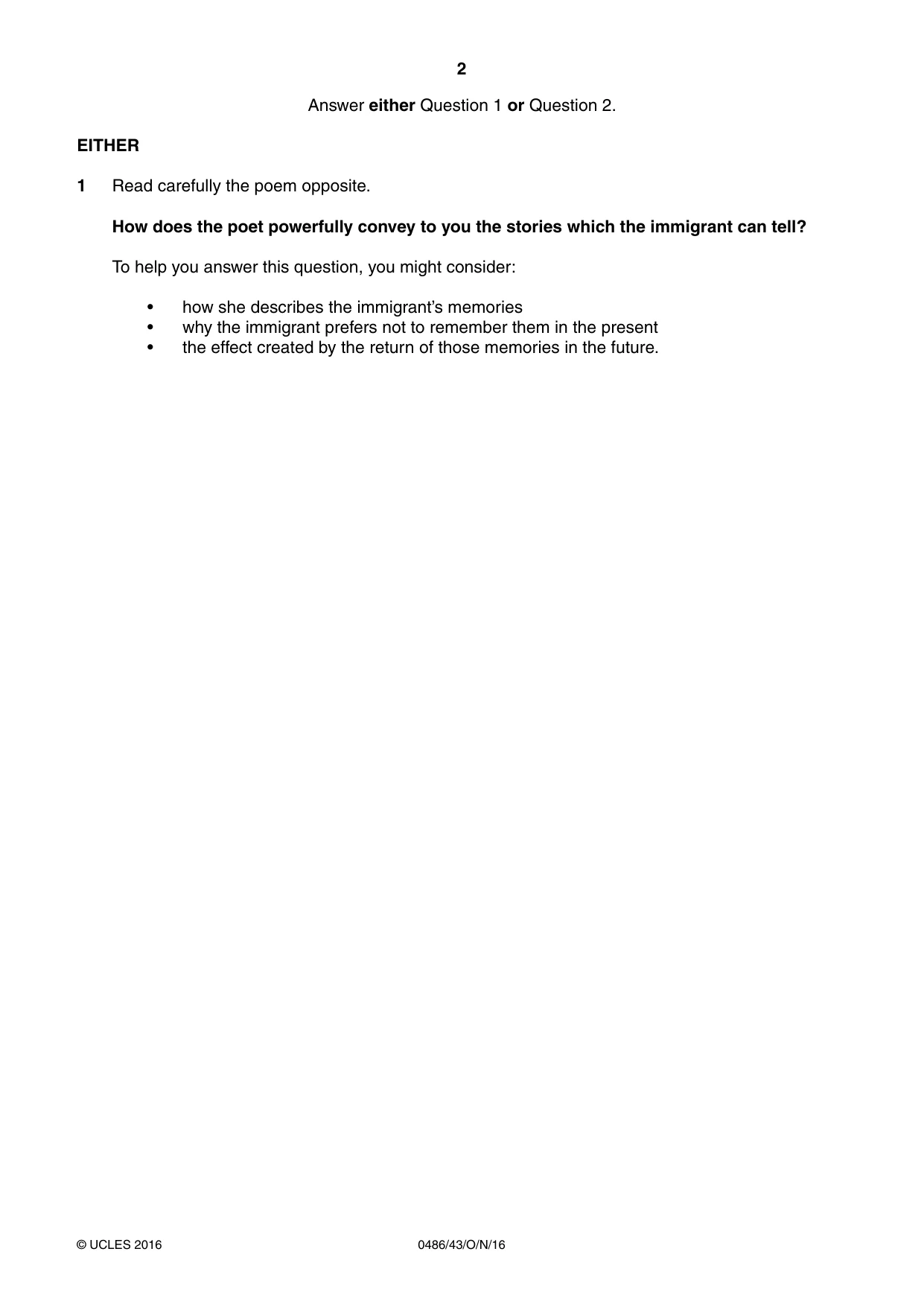
Question paper, page 2
2 0486/43/O/N/16 © UCLES 2016 Answer either Question 1 or Question 2. EITHER 1 Read carefully the poem opposite. How does the poet powerfully convey to you the stories which the immigrant can tell? To help you answer this question, you might consider: • how she describes the immigrant’s memories • why the immigrant prefers not to remember them in the present • the effect created by the return of those memories in the future.
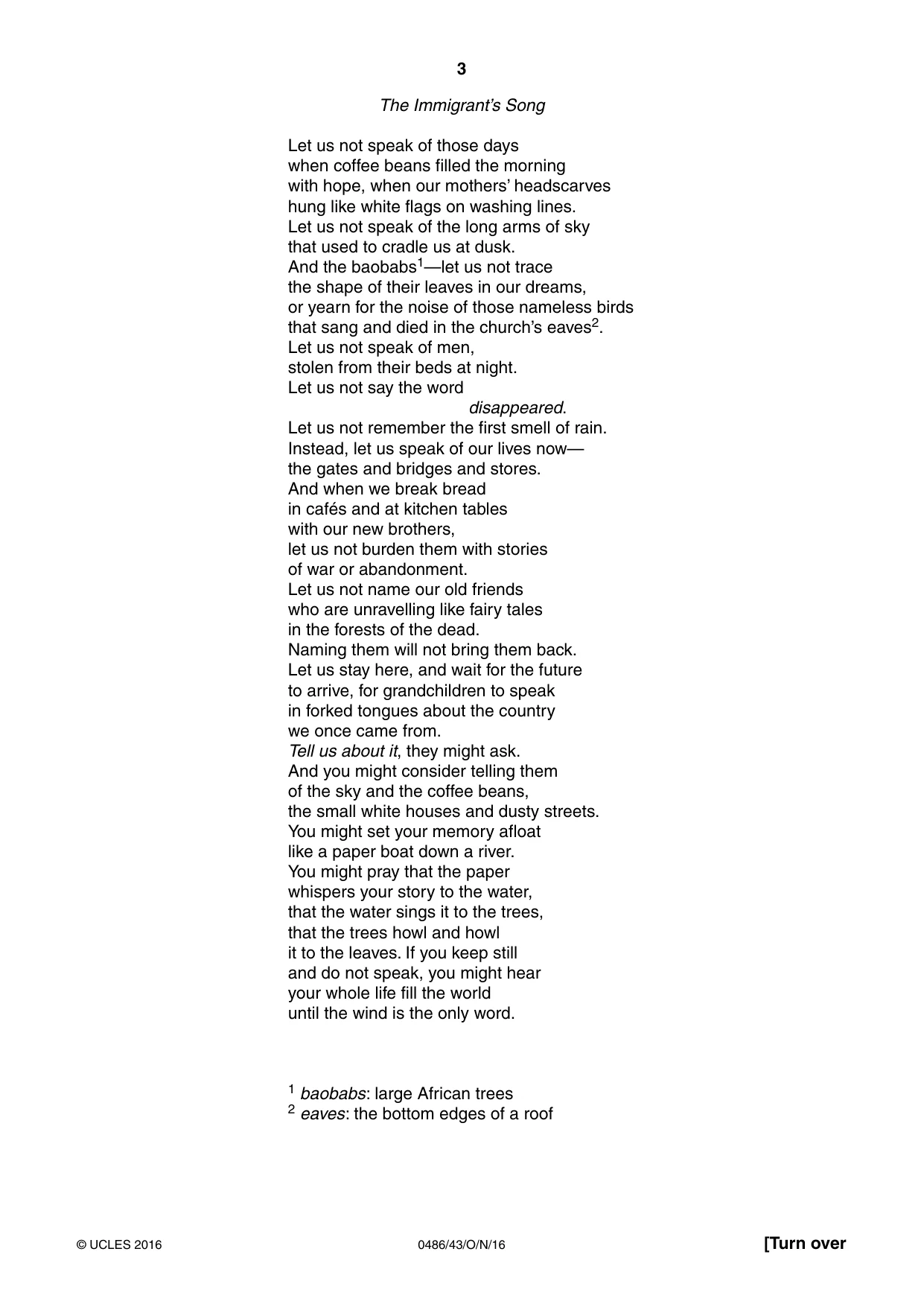
Question paper, page 3
3 0486/43/O/N/16 © UCLES 2016 [Turn over The Immigrant’s Song Let us not speak of those days when coffee beans filled the morning with hope, when our mothers’ headscarves hung like white flags on washing lines. Let us not speak of the long arms of sky that used to cradle us at dusk. And the baobabs1—let us not trace the shape of their leaves in our dreams, or yearn for the noise of those nameless birds that sang and died in the church’s eaves2. Let us not speak of men, stolen from their beds at night. Let us not say the word disappeared. Let us not remember the first smell of rain. Instead, let us speak of our lives now— the gates and bridges and stores. And when we break bread in cafés and at kitchen tables with our new brothers, let us not burden them with stories of war or abandonment. Let us not name our old friends who are unravelling like fairy tales in the forests of the dead. Naming them will not bring them back. Let us stay here, and wait for the future to arrive, for grandchildren to speak in forked tongues about the country we once came from. Tell us about it, they might ask. And you might consider telling them of the sky and the coffee beans, the small white houses and dusty streets. You might set your memory afloat like a paper boat down a river. You might pray that the paper whispers your story to the water, that the water sings it to the trees, that the trees howl and howl it to the leaves. If you keep still and do not speak, you might hear your whole life fill the world until the wind is the only word. 1 baobabs : large African trees 2 eaves : the bottom edges of a roof
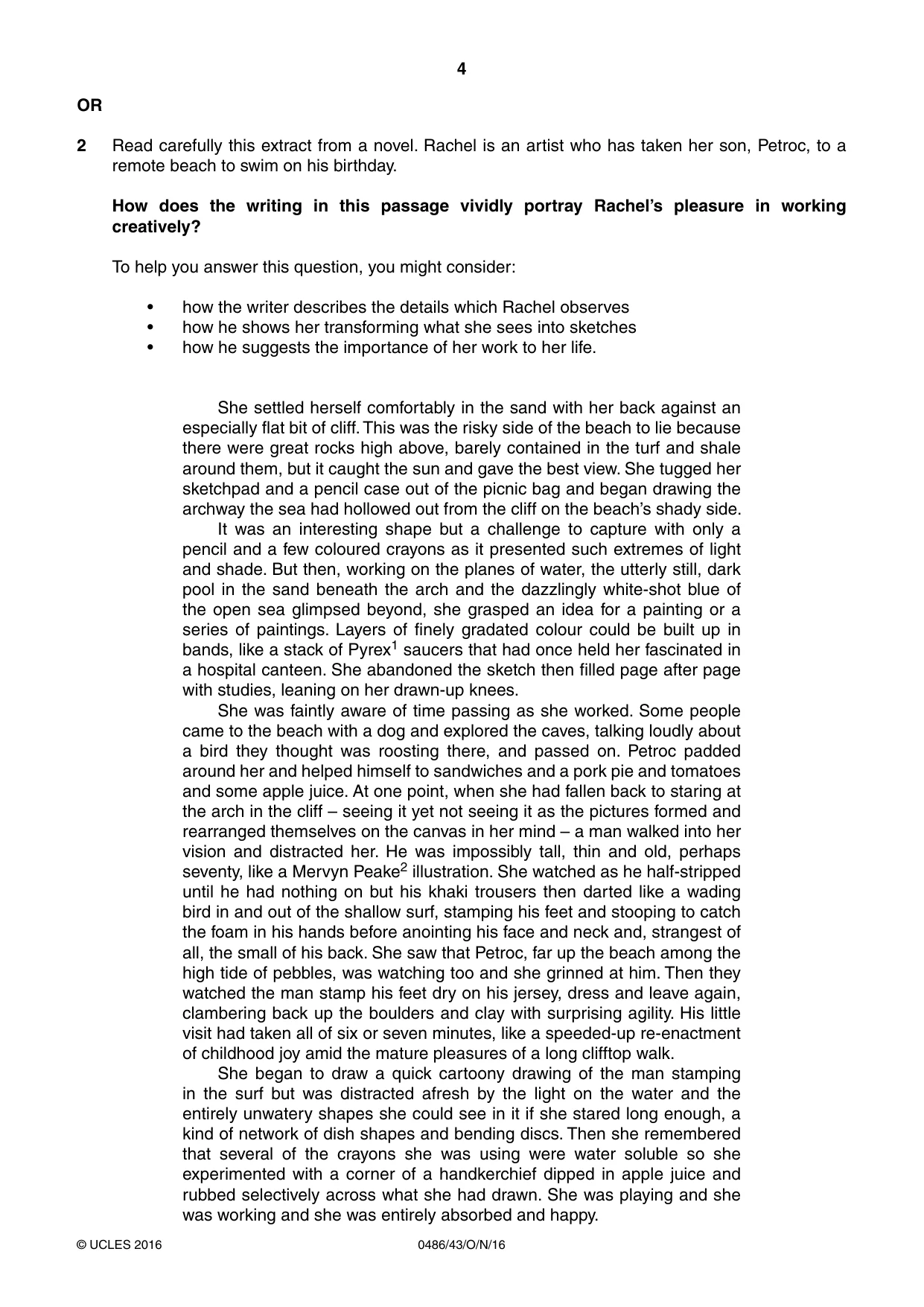
Question paper, page 4
4 0486/43/O/N/16 © UCLES 2016 OR 2 Read carefully this extract from a novel. Rachel is an artist who has taken her son, Petroc, to a remote beach to swim on his birthday. How does the writing in this passage vividly portray Rachel’s pleasure in working creatively? To help you answer this question, you might consider: • how the writer describes the details which Rachel observes • how he shows her transforming what she sees into sketches • how he suggests the importance of her work to her life. She settled herself comfortably in the sand with her back against an especially flat bit of cliff. This was the risky side of the beach to lie because there were great rocks high above, barely contained in the turf and shale around them, but it caught the sun and gave the best view. She tugged her sketchpad and a pencil case out of the picnic bag and began drawing the archway the sea had hollowed out from the cliff on the beach’s shady side. It was an interesting shape but a challenge to capture with only a pencil and a few coloured crayons as it presented such extremes of light and shade. But then, working on the planes of water, the utterly still, dark pool in the sand beneath the arch and the dazzlingly white-shot blue of the open sea glimpsed beyond, she grasped an idea for a painting or a series of paintings. Layers of finely gradated colour could be built up in bands, like a stack of Pyrex1 saucers that had once held her fascinated in a hospital canteen. She abandoned the sketch then filled page after page with studies, leaning on her drawn-up knees. She was faintly aware of time passing as she worked. Some people came to the beach with a dog and explored the caves, talking loudly about a bird they thought was roosting there, and passed on. Petroc padded around her and helped himself to sandwiches and a pork pie and tomatoes and some apple juice. At one point, when she had fallen back to staring at the arch in the cliff – seeing it yet not seeing it as the pictures formed and rearranged themselves on the canvas in her mind – a man walked into her vision and distracted her. He was impossibly tall, thin and old, perhaps seventy, like a Mervyn Peake2 illustration. She watched as he half-stripped until he had nothing on but his khaki trousers then darted like a wading bird in and out of the shallow surf, stamping his feet and stooping to catch the foam in his hands before anointing his face and neck and, strangest of all, the small of his back. She saw that Petroc, far up the beach among the high tide of pebbles, was watching too and she grinned at him. Then they watched the man stamp his feet dry on his jersey, dress and leave again, clambering back up the boulders and clay with surprising agility. His little visit had taken all of six or seven minutes, like a speeded-up re-enactment of childhood joy amid the mature pleasures of a long clifftop walk. She began to draw a quick cartoony drawing of the man stamping in the surf but was distracted afresh by the light on the water and the entirely unwatery shapes she could see in it if she stared long enough, a kind of network of dish shapes and bending discs. Then she remembered that several of the crayons she was using were water soluble so she experimented with a corner of a handkerchief dipped in apple juice and rubbed selectively across what she had drawn. She was playing and she was working and she was entirely absorbed and happy.
Question paper, page 5
5 0486/43/O/N/16 © UCLES 2016 Finally she broke off, when her inability to take the ideas further without paint and brushes was becoming a kind of pain, and remembered with a spasm of guilt that it was Petroc’s birthday and that was why they were there together with no one else. 1 Pyrex : brand of glass cookware 2 Mervyn Peake : a writer and artist well-known for his unusual illustrations
Question paper, page 6
6 0486/43/O/N/16 © UCLES 2016 BLANK PAGE
Question paper, page 7
7 0486/43/O/N/16 © UCLES 2016 BLANK PAGE
Question paper, page 8
8 0486/43/O/N/16 © UCLES 2016 BLANK PAGE Permission to reproduce items where third-party owned material protected by copyright is included has been sought and cleared where possible. Every reasonable effort has been made by the publisher (UCLES) to trace copyright holders, but if any items requiring clearance have unwittingly been included, the publisher will be pleased to make amends at the earliest possible opportunity. To avoid the issue of disclosure of answer-related information to candidates, all copyright acknowledgements are reproduced online in the Cambridge International Examinations Copyright Acknowledgements Booklet. This is produced for each series of examinations and is freely available to download at www.cie.org.uk after the live examination series. Cambridge International Examinations is part of the Cambridge Assessment Group. Cambridge Assessment is the brand name of University of Cambridge Local Examinations Syndicate (UCLES), which is itself a department of the University of Cambridge.
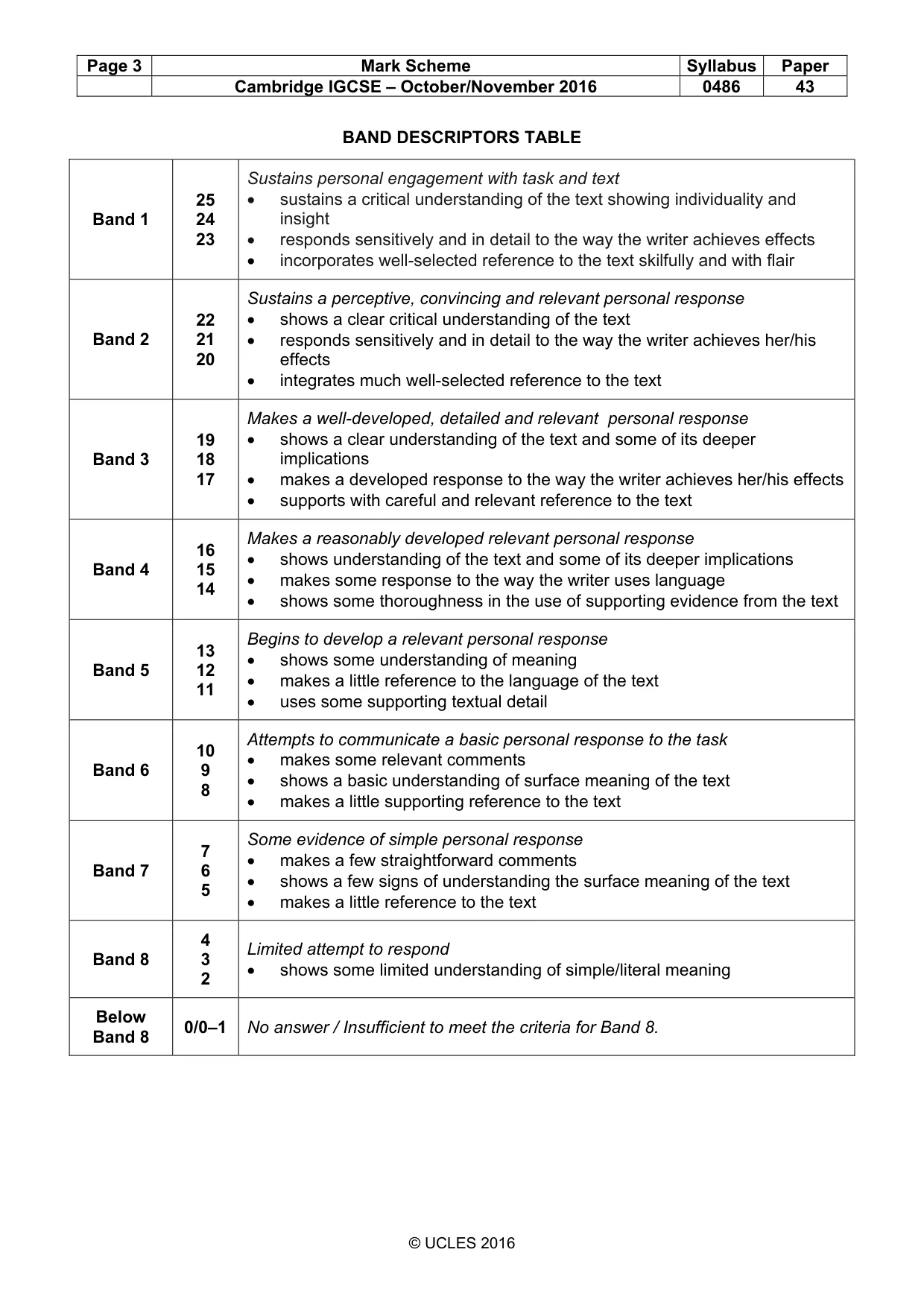
Mark scheme, page 1
® IGCSE is the registered trademark of Cambridge International Examinations. This syllabus is approved for use in England, Wales and Northern Ireland as a Cambridge International Level 1/Level 2 Certificate. This document consists of 3 printed pages. © UCLES 2016 [Turn over Cambridge International Examinations Cambridge International General Certificate of Secondary Education LITERATURE (ENGLISH) 0486/43 Paper 4 Unseen October/November 2016 MARK SCHEME Maximum Mark: 25 Published This mark scheme is published as an aid to teachers and candidates, to indicate the requirements of the examination. It shows the basis on which Examiners were instructed to award marks. It does not indicate the details of the discussions that took place at an Examiners’ meeting before marking began, which would have considered the acceptability of alternative answers. Mark schemes should be read in conjunction with the question paper and the Principal Examiner Report for Teachers. Cambridge will not enter into discussions about these mark schemes. Cambridge is publishing the mark schemes for the October/November 2016 series for most Cambridge IGCSE®, Cambridge International A and AS Level components and some Cambridge O Level components.
Mark scheme, page 2
Page 2 Mark Scheme Syllabus Paper Cambridge IGCSE – October/November 2016 0486 43 © UCLES 2016 Assessment Objectives: AO1 show detailed knowledge of the content of literary texts, supported by reference to the text AO2 understand the meanings of literary texts and their context, and explore texts beyond surface meaning to show deeper awareness of ideas and attitudes AO3 recognise and appreciate ways in which writers use language, structure, and form to create and shape meanings and effects AO4 communicate a sensitive and informed personal response
Mark scheme, page 3
Page 3 Mark Scheme Syllabus Paper Cambridge IGCSE – October/November 2016 0486 43 © UCLES 2016 BAND DESCRIPTORS TABLE Band 1 25 24 23 Sustains personal engagement with task and text • sustains a critical understanding of the text showing individuality and insight • responds sensitively and in detail to the way the writer achieves effects • incorporates well-selected reference to the text skilfully and with flair Band 2 22 21 20 Sustains a perceptive, convincing and relevant personal response • shows a clear critical understanding of the text • responds sensitively and in detail to the way the writer achieves her/his effects • integrates much well-selected reference to the text Band 3 19 18 17 Makes a well-developed, detailed and relevant personal response • shows a clear understanding of the text and some of its deeper implications • makes a developed response to the way the writer achieves her/his effects • supports with careful and relevant reference to the text Band 4 16 15 14 Makes a reasonably developed relevant personal response • shows understanding of the text and some of its deeper implications • makes some response to the way the writer uses language • shows some thoroughness in the use of supporting evidence from the text Band 5 13 12 11 Begins to develop a relevant personal response • shows some understanding of meaning • makes a little reference to the language of the text • uses some supporting textual detail Band 6 10 9 8 Attempts to communicate a basic personal response to the task • makes some relevant comments • shows a basic understanding of surface meaning of the text • makes a little supporting reference to the text Band 7 7 6 5 Some evidence of simple personal response • makes a few straightforward comments • shows a few signs of understanding the surface meaning of the text • makes a little reference to the text Band 8 4 3 2 Limited attempt to respond • shows some limited understanding of simple/literal meaning Below Band 8 0/0–1 No answer / Insufficient to meet the criteria for Band 8.
What you needed in this session
Cambridge’s own grade thresholds for 2016 Oct/Nov, Paper 4 · Variant 3. A higher threshold means an easier paper — the bar moves with how the cohort did.