Cambridge IGCSE English - Literature 0486 — 2016 Oct/Nov Paper 4 · Variant 2
0486/42/O/N/16 · 25 marks · ≈28 min
The question paper and its mark scheme, free to read here and free to download. This is Cambridge’s own paper, exactly as it was sat.
Question paper8 pages
Mark scheme3 pages
Answers below. Sit the paper first if you are practising.
Paper as text
Question paper, page 1
This document consists of 5 printed pages, 3 blank pages and 1 insert. DC (RCL (KM)) 115908/4 © UCLES 2016 [Turn over Cambridge International Examinations Cambridge International General Certificate of Secondary Education * 1 1 4 7 5 7 5 2 4 1 * LITERATURE (ENGLISH) 0486/42 Paper 4 Unseen October/November 2016 1 hour 15 minutes No Additional Materials are required. READ THESE INSTRUCTIONS FIRST An answer booklet is provided inside this question paper. You should follow the instructions on the front cover of the answer booklet. If you need additional answer paper ask the invigilator for a continuation booklet. Answer either Question 1 or Question 2. You are advised to spend about 20 minutes reading the question paper and planning your answer. Both questions in this paper carry equal marks. The syllabus is approved for use in England, Wales and Northern Ireland as a Cambridge International Level 1/Level 2 Certificate.
Question paper, page 2
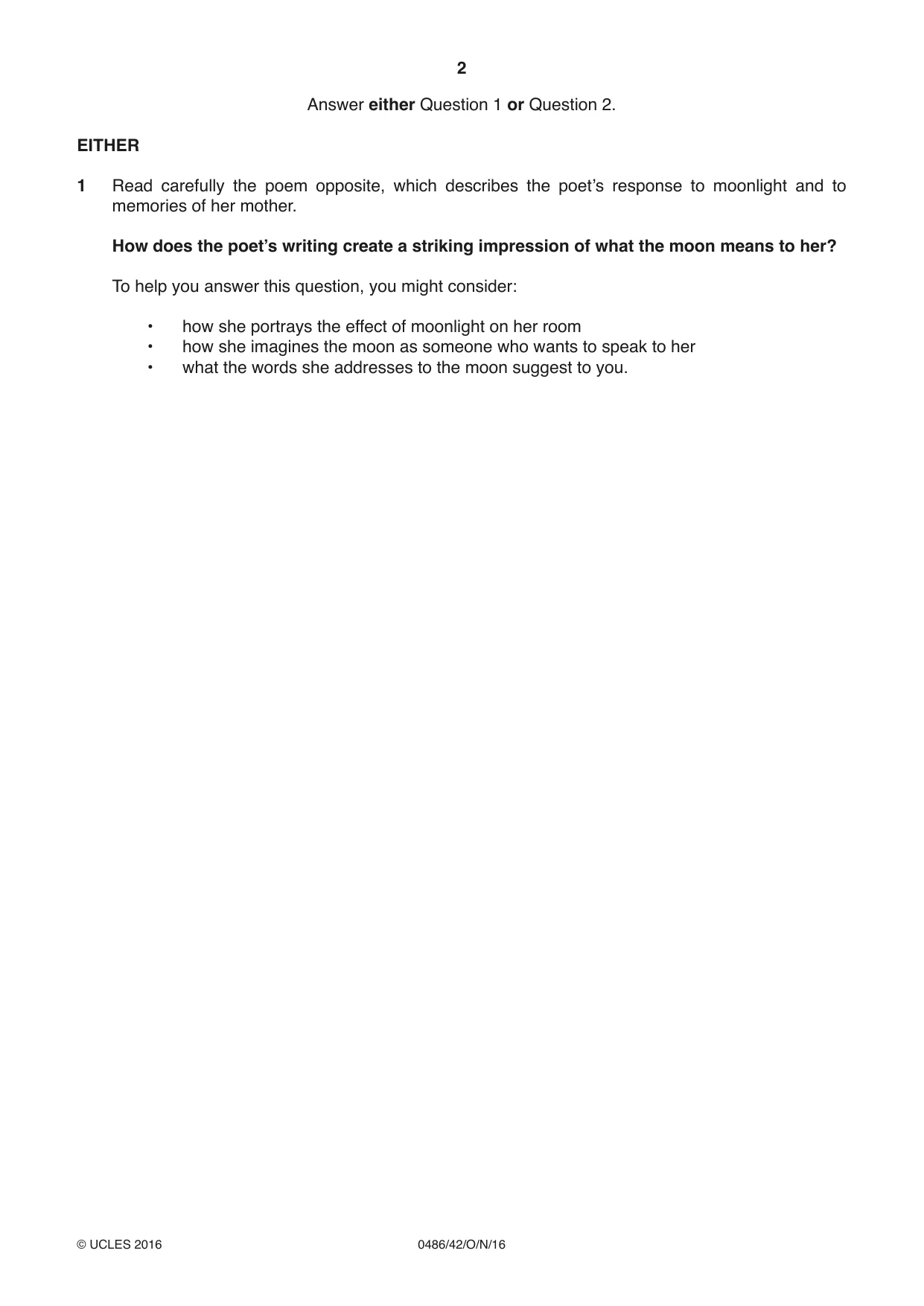
2 0486/42/O/N/16 © UCLES 2016 Answer either Question 1 or Question 2. EITHER 1 Read carefully the poem opposite, which describes the poet’s response to moonlight and to memories of her mother. How does the poet’s writing create a striking impression of what the moon means to her? To help you answer this question, you might consider: • how she portrays the effect of moonlight on her room • how she imagines the moon as someone who wants to speak to her • what the words she addresses to the moon suggest to you.
Question paper, page 3
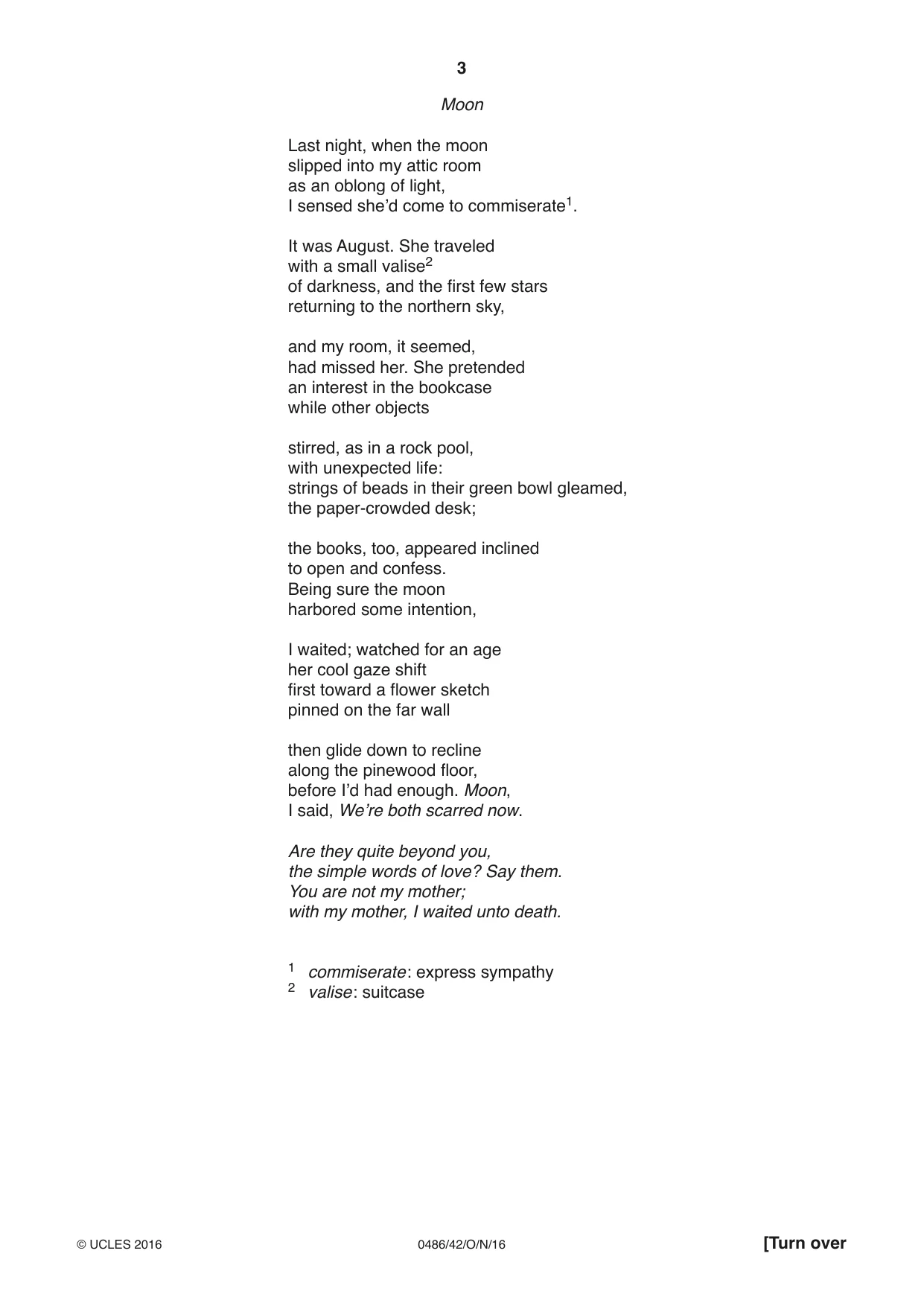
3 0486/42/O/N/16 © UCLES 2016 [Turn over Moon Last night, when the moon slipped into my attic room as an oblong of light, I sensed she’d come to commiserate1. It was August. She traveled with a small valise2 of darkness, and the first few stars returning to the northern sky, and my room, it seemed, had missed her. She pretended an interest in the bookcase while other objects stirred, as in a rock pool, with unexpected life: strings of beads in their green bowl gleamed, the paper-crowded desk; the books, too, appeared inclined to open and confess. Being sure the moon harbored some intention, I waited; watched for an age her cool gaze shift first toward a flower sketch pinned on the far wall then glide down to recline along the pinewood floor, before I’d had enough. Moon, I said, We’re both scarred now. Are they quite beyond you, the simple words of love? Say them. You are not my mother; with my mother, I waited unto death. 1 commiserate : express sympathy 2 valise : suitcase
Question paper, page 4
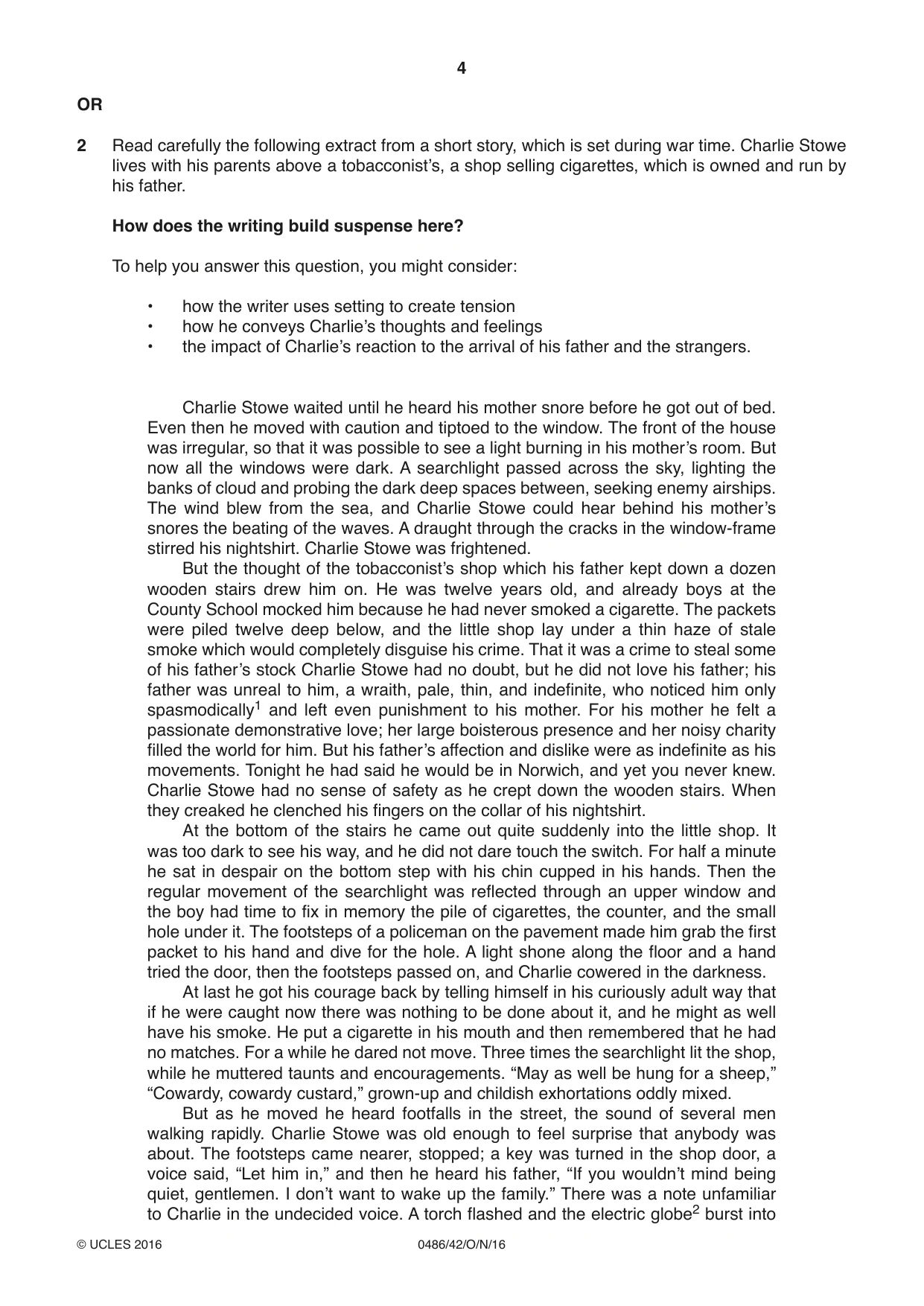
4 0486/42/O/N/16 © UCLES 2016 OR 2 Read carefully the following extract from a short story, which is set during war time. Charlie Stowe lives with his parents above a tobacconist’s, a shop selling cigarettes, which is owned and run by his father. How does the writing build suspense here? To help you answer this question, you might consider: • how the writer uses setting to create tension • how he conveys Charlie’s thoughts and feelings • the impact of Charlie’s reaction to the arrival of his father and the strangers. Charlie Stowe waited until he heard his mother snore before he got out of bed. Even then he moved with caution and tiptoed to the window. The front of the house was irregular, so that it was possible to see a light burning in his mother’s room. But now all the windows were dark. A searchlight passed across the sky, lighting the banks of cloud and probing the dark deep spaces between, seeking enemy airships. The wind blew from the sea, and Charlie Stowe could hear behind his mother’s snores the beating of the waves. A draught through the cracks in the window-frame stirred his nightshirt. Charlie Stowe was frightened. But the thought of the tobacconist’s shop which his father kept down a dozen wooden stairs drew him on. He was twelve years old, and already boys at the County School mocked him because he had never smoked a cigarette. The packets were piled twelve deep below, and the little shop lay under a thin haze of stale smoke which would completely disguise his crime. That it was a crime to steal some of his father’s stock Charlie Stowe had no doubt, but he did not love his father; his father was unreal to him, a wraith, pale, thin, and indefinite, who noticed him only spasmodically1 and left even punishment to his mother. For his mother he felt a passionate demonstrative love; her large boisterous presence and her noisy charity filled the world for him. But his father’s affection and dislike were as indefinite as his movements. Tonight he had said he would be in Norwich, and yet you never knew. Charlie Stowe had no sense of safety as he crept down the wooden stairs. When they creaked he clenched his fingers on the collar of his nightshirt. At the bottom of the stairs he came out quite suddenly into the little shop. It was too dark to see his way, and he did not dare touch the switch. For half a minute he sat in despair on the bottom step with his chin cupped in his hands. Then the regular movement of the searchlight was reflected through an upper window and the boy had time to fix in memory the pile of cigarettes, the counter, and the small hole under it. The footsteps of a policeman on the pavement made him grab the first packet to his hand and dive for the hole. A light shone along the floor and a hand tried the door, then the footsteps passed on, and Charlie cowered in the darkness. At last he got his courage back by telling himself in his curiously adult way that if he were caught now there was nothing to be done about it, and he might as well have his smoke. He put a cigarette in his mouth and then remembered that he had no matches. For a while he dared not move. Three times the searchlight lit the shop, while he muttered taunts and encouragements. “May as well be hung for a sheep,” “Cowardy, cowardy custard,” grown-up and childish exhortations oddly mixed. But as he moved he heard footfalls in the street, the sound of several men walking rapidly. Charlie Stowe was old enough to feel surprise that anybody was about. The footsteps came nearer, stopped; a key was turned in the shop door, a voice said, “Let him in,” and then he heard his father, “If you wouldn’t mind being quiet, gentlemen. I don’t want to wake up the family.” There was a note unfamiliar to Charlie in the undecided voice. A torch flashed and the electric globe2 burst into
Question paper, page 5
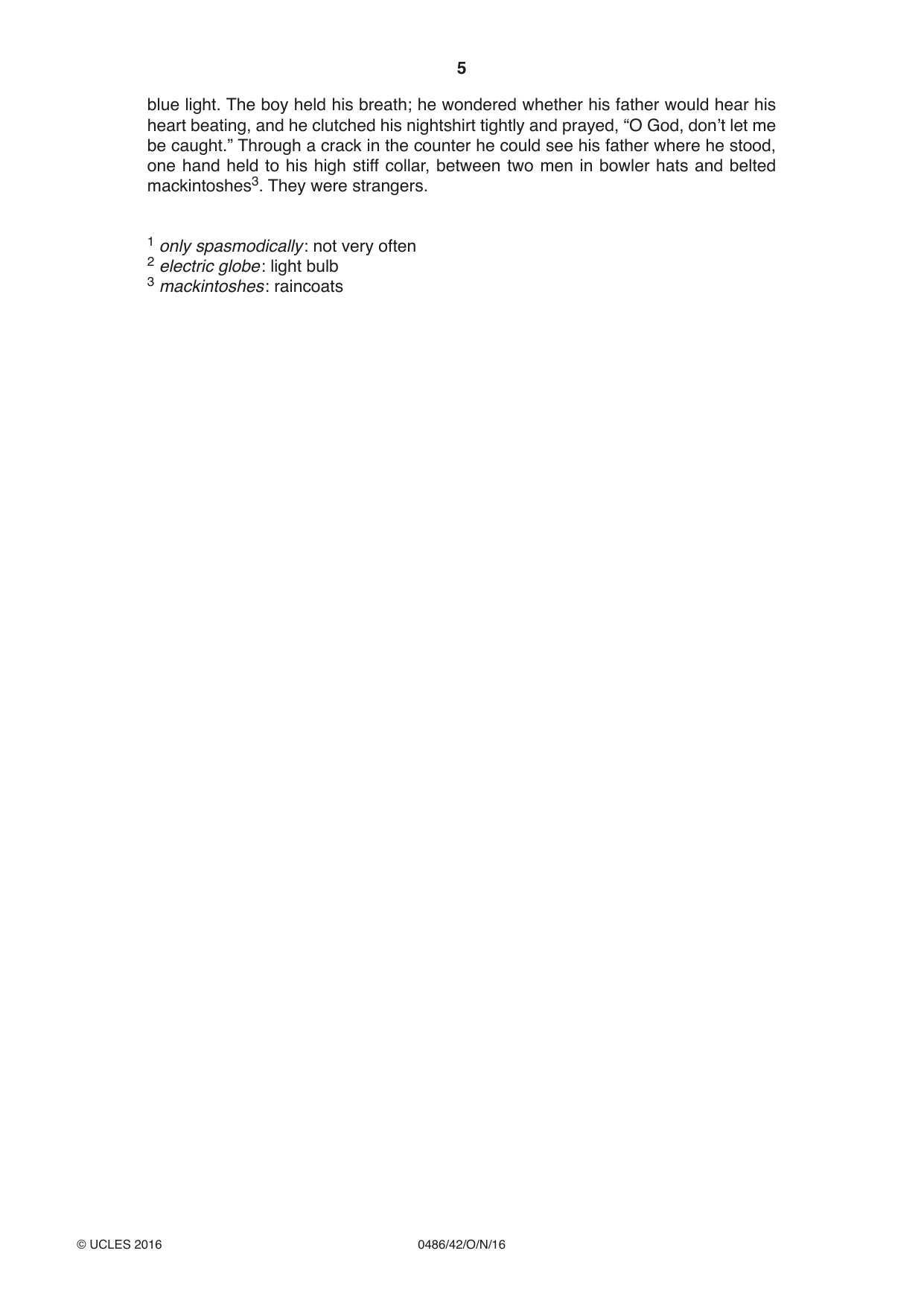
5 0486/42/O/N/16 © UCLES 2016 blue light. The boy held his breath; he wondered whether his father would hear his heart beating, and he clutched his nightshirt tightly and prayed, “O God, don’t let me be caught.” Through a crack in the counter he could see his father where he stood, one hand held to his high stiff collar, between two men in bowler hats and belted mackintoshes3. They were strangers. 1 only spasmodically : not very often 2 electric globe : light bulb 3 mackintoshes : raincoats
Question paper, page 6
6 0486/42/O/N/16 © UCLES 2016 BLANK PAGE
Question paper, page 7
7 0486/42/O/N/16 © UCLES 2016 BLANK PAGE
Question paper, page 8
8 0486/42/O/N/16 © UCLES 2016 BLANK PAGE Permission to reproduce items where third-party owned material protected by copyright is included has been sought and cleared where possible. Every reasonable effort has been made by the publisher (UCLES) to trace copyright holders, but if any items requiring clearance have unwittingly been included, the publisher will be pleased to make amends at the earliest possible opportunity. To avoid the issue of disclosure of answer-related information to candidates, all copyright acknowledgements are reproduced online in the Cambridge International Examinations Copyright Acknowledgements Booklet. This is produced for each series of examinations and is freely available to download at www.cie.org.uk after the live examination series. Cambridge International Examinations is part of the Cambridge Assessment Group. Cambridge Assessment is the brand name of University of Cambridge Local Examinations Syndicate (UCLES), which is itself a department of the University of Cambridge.
Mark scheme, page 1
® IGCSE is the registered trademark of Cambridge International Examinations. This syllabus is approved for use in England, Wales and Northern Ireland as a Cambridge International Level 1/Level 2 Certificate. This document consists of 3 printed pages. © UCLES 2016 [Turn over Cambridge International Examinations Cambridge International General Certificate of Secondary Education LITERATURE (ENGLISH) 0486/42 Paper 4 Unseen October/November 2016 MARK SCHEME Maximum Mark: 25 Published This mark scheme is published as an aid to teachers and candidates, to indicate the requirements of the examination. It shows the basis on which Examiners were instructed to award marks. It does not indicate the details of the discussions that took place at an Examiners’ meeting before marking began, which would have considered the acceptability of alternative answers. Mark schemes should be read in conjunction with the question paper and the Principal Examiner Report for Teachers. Cambridge will not enter into discussions about these mark schemes. Cambridge is publishing the mark schemes for the October/November 2016 series for most Cambridge IGCSE®, Cambridge International A and AS Level components and some Cambridge O Level components.
Mark scheme, page 2
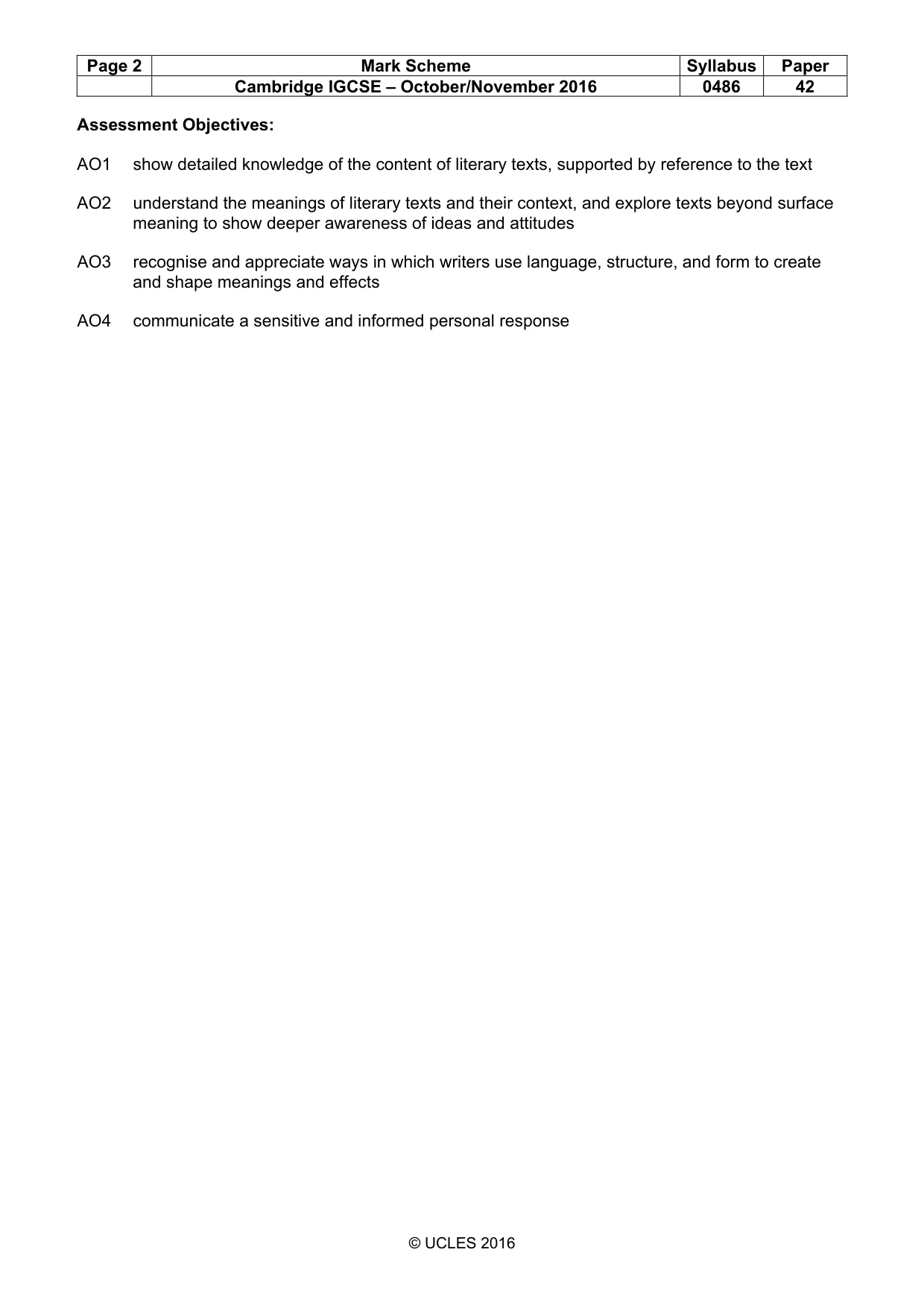
Page 2 Mark Scheme Syllabus Paper Cambridge IGCSE – October/November 2016 0486 42 © UCLES 2016 Assessment Objectives: AO1 show detailed knowledge of the content of literary texts, supported by reference to the text AO2 understand the meanings of literary texts and their context, and explore texts beyond surface meaning to show deeper awareness of ideas and attitudes AO3 recognise and appreciate ways in which writers use language, structure, and form to create and shape meanings and effects AO4 communicate a sensitive and informed personal response
Mark scheme, page 3
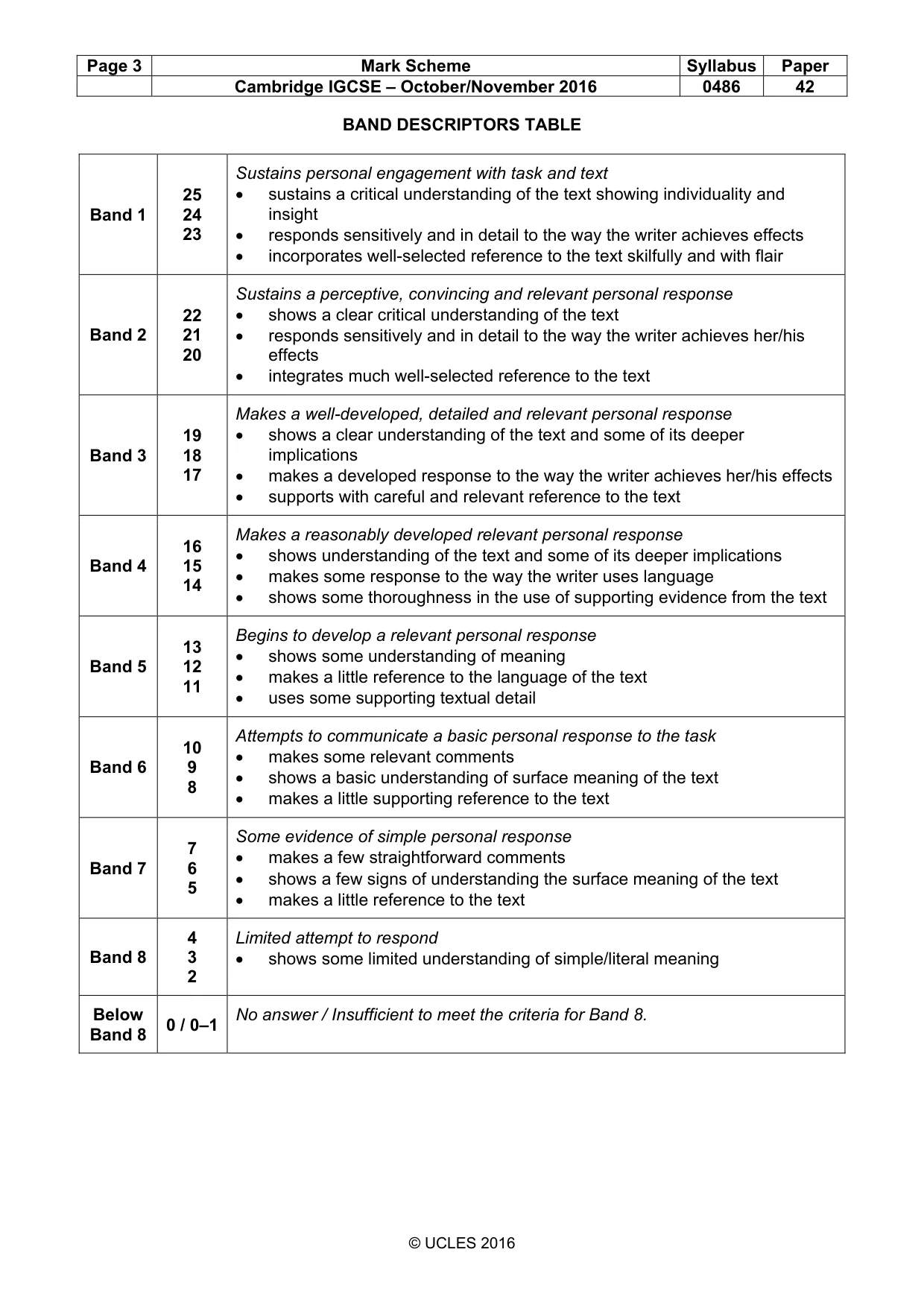
Page 3 Mark Scheme Syllabus Paper Cambridge IGCSE – October/November 2016 0486 42 © UCLES 2016 BAND DESCRIPTORS TABLE Band 1 25 24 23 Sustains personal engagement with task and text • sustains a critical understanding of the text showing individuality and insight • responds sensitively and in detail to the way the writer achieves effects • incorporates well-selected reference to the text skilfully and with flair Band 2 22 21 20 Sustains a perceptive, convincing and relevant personal response • shows a clear critical understanding of the text • responds sensitively and in detail to the way the writer achieves her/his effects • integrates much well-selected reference to the text Band 3 19 18 17 Makes a well-developed, detailed and relevant personal response • shows a clear understanding of the text and some of its deeper implications • makes a developed response to the way the writer achieves her/his effects • supports with careful and relevant reference to the text Band 4 16 15 14 Makes a reasonably developed relevant personal response • shows understanding of the text and some of its deeper implications • makes some response to the way the writer uses language • shows some thoroughness in the use of supporting evidence from the text Band 5 13 12 11 Begins to develop a relevant personal response • shows some understanding of meaning • makes a little reference to the language of the text • uses some supporting textual detail Band 6 10 9 8 Attempts to communicate a basic personal response to the task • makes some relevant comments • shows a basic understanding of surface meaning of the text • makes a little supporting reference to the text Band 7 7 6 5 Some evidence of simple personal response • makes a few straightforward comments • shows a few signs of understanding the surface meaning of the text • makes a little reference to the text Band 8 4 3 2 Limited attempt to respond • shows some limited understanding of simple/literal meaning Below Band 8 0 / 0–1 No answer / Insufficient to meet the criteria for Band 8.
What you needed in this session
Cambridge’s own grade thresholds for 2016 Oct/Nov, Paper 4 · Variant 2. A higher threshold means an easier paper — the bar moves with how the cohort did.