Cambridge IGCSE English - Literature 0486 — 2016 Oct/Nov Paper 4 · Variant 1
0486/41/O/N/16 · 25 marks · ≈28 min
The question paper and its mark scheme, free to read here and free to download. This is Cambridge’s own paper, exactly as it was sat.
Question paper8 pages


Mark scheme3 pages
Answers below. Sit the paper first if you are practising.
Paper as text
Question paper, page 1
This document consists of 5 printed pages, 3 blank pages and 1 insert. DC RCL (KM) 115912/2 © UCLES 2016 [Turn over Cambridge International Examinations Cambridge International General Certificate of Secondary Education * 7 2 0 9 7 2 2 2 1 8 * LITERATURE (ENGLISH) 0486/41 Paper 4 Unseen October/November 2016 1 hour 15 minutes No Additional Materials are required. READ THESE INSTRUCTIONS FIRST An answer booklet is provided inside this question paper. You should follow the instructions on the front cover of the answer booklet. If you need additional answer paper ask the invigilator for a continuation booklet. Answer either Question 1 or Question 2. You are advised to spend about 20 minutes reading the question paper and planning your answer. Both questions in this paper carry equal marks. The syllabus is approved for use in England, Wales and Northern Ireland as a Cambridge International Level 1/Level 2 Certificate.
Question paper, page 2
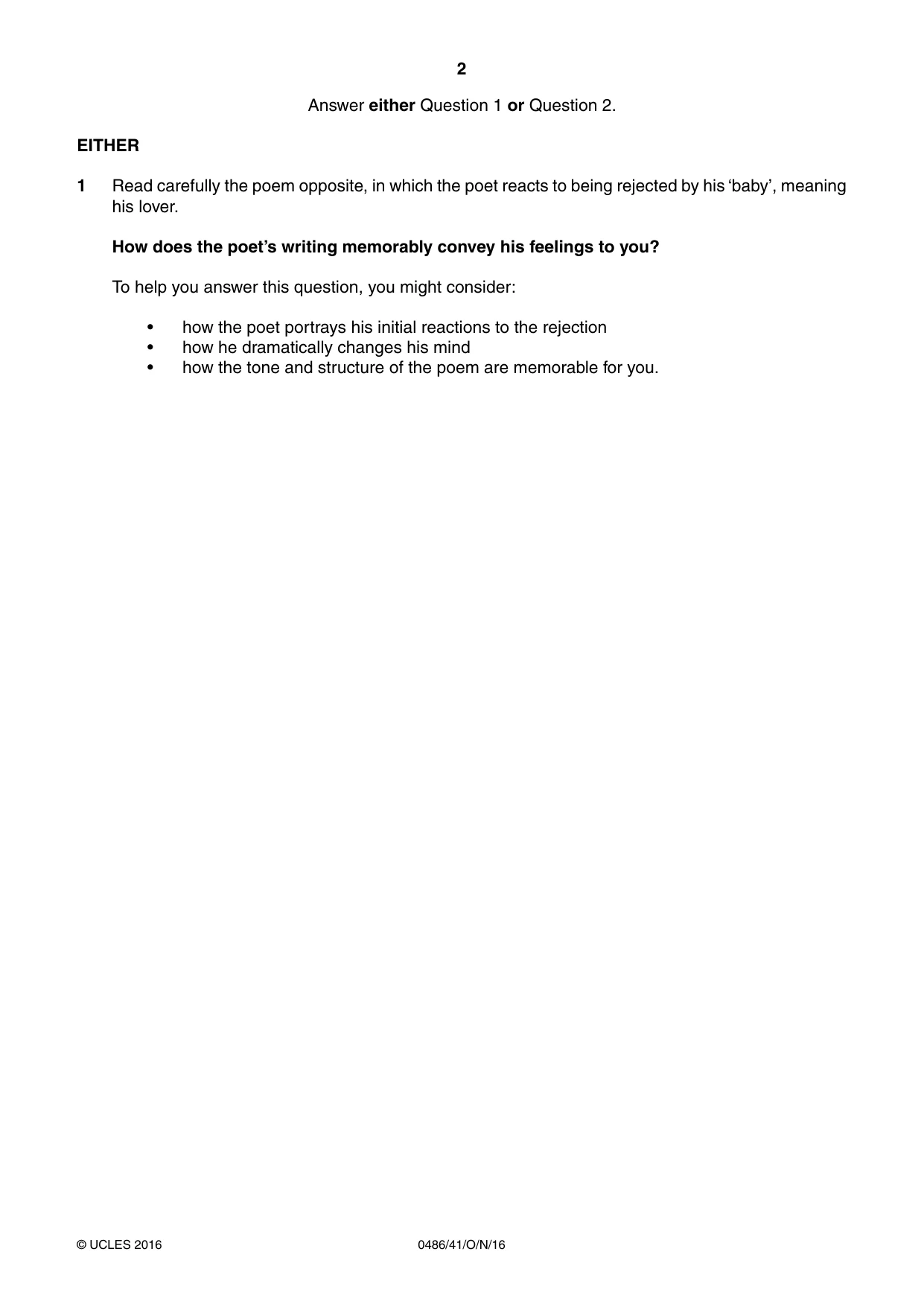
2 0486/41/O/N/16 © UCLES 2016 Answer either Question 1 or Question 2. EITHER 1 Read carefully the poem opposite, in which the poet reacts to being rejected by his ‘baby’, meaning his lover. How does the poet’s writing memorably convey his feelings to you? To help you answer this question, you might consider: • how the poet portrays his initial reactions to the rejection • how he dramatically changes his mind • how the tone and structure of the poem are memorable for you.
Question paper, page 3
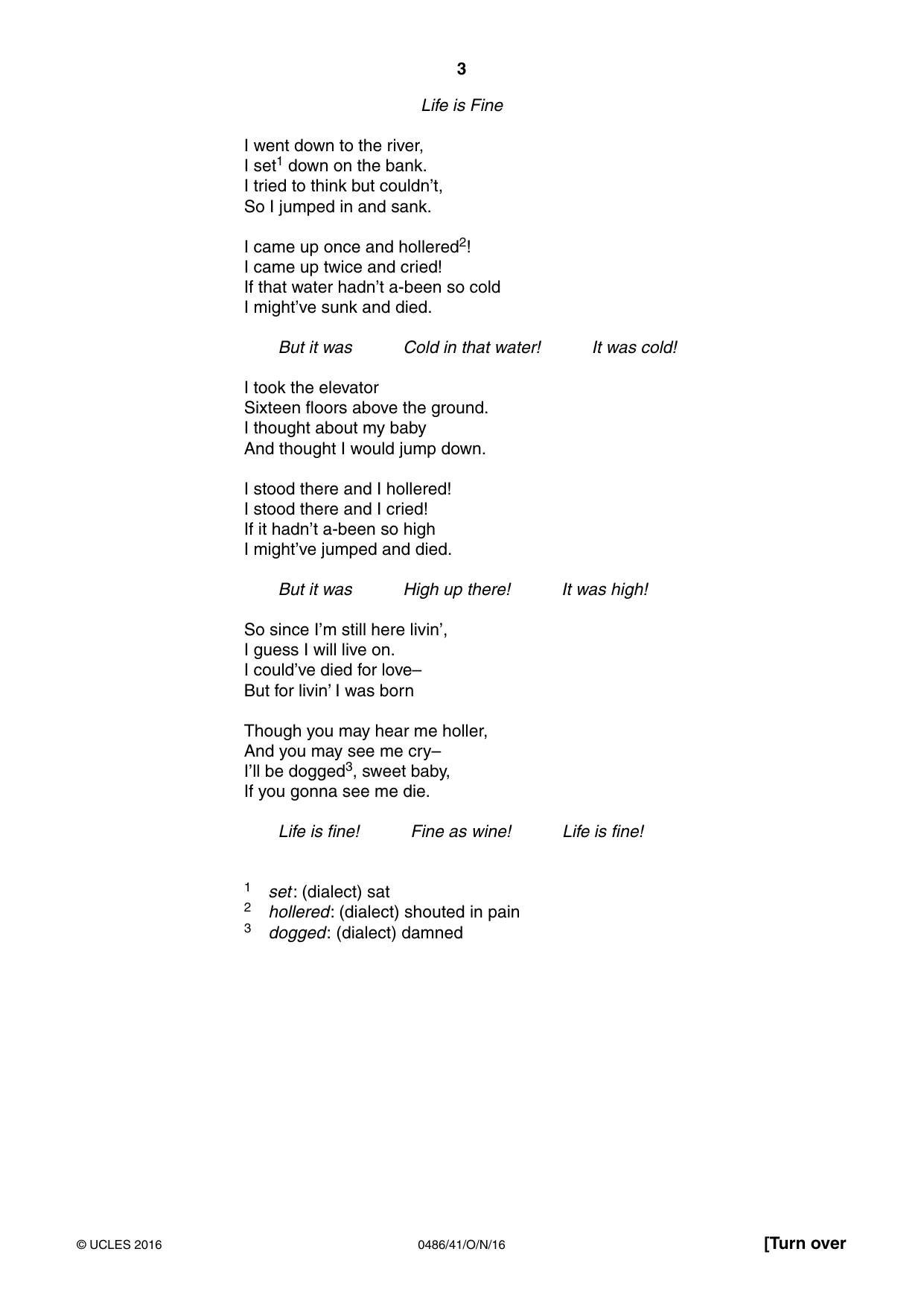
3 0486/41/O/N/16 © UCLES 2016 [Turn over Life is Fine I went down to the river, I set1 down on the bank. I tried to think but couldn’t, So I jumped in and sank. I came up once and hollered2! I came up twice and cried! If that water hadn’t a-been so cold I might’ve sunk and died. But it was Cold in that water! It was cold! I took the elevator Sixteen floors above the ground. I thought about my baby And thought I would jump down. I stood there and I hollered! I stood there and I cried! If it hadn’t a-been so high I might’ve jumped and died. But it was High up there! It was high! So since I’m still here livin’, I guess I will live on. I could’ve died for love– But for livin’ I was born Though you may hear me holler, And you may see me cry– I’ll be dogged3, sweet baby, If you gonna see me die. Life is fine! Fine as wine! Life is fine! 1 set : (dialect) sat 2 hollered : (dialect) shouted in pain 3 dogged : (dialect) damned
Question paper, page 4
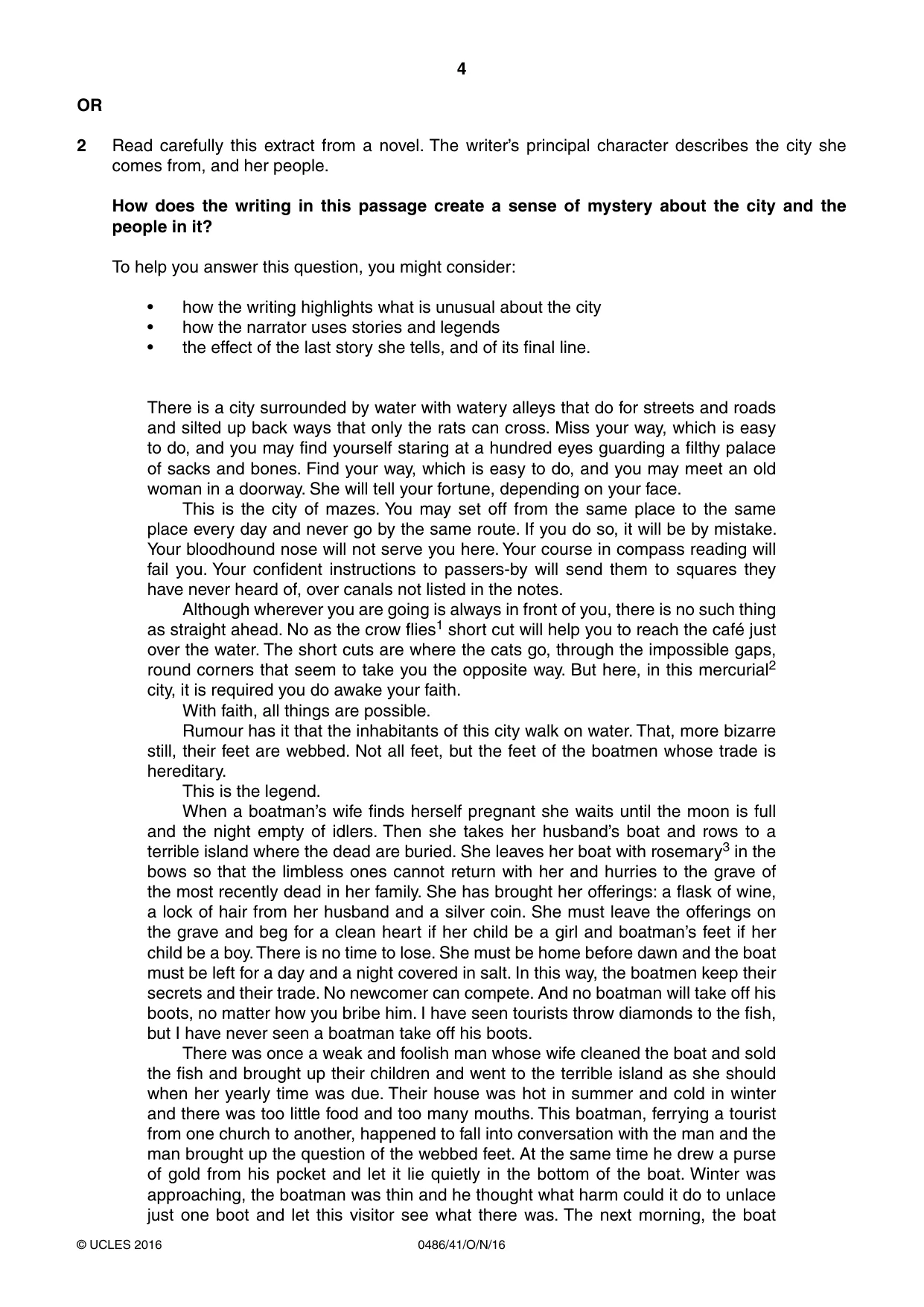
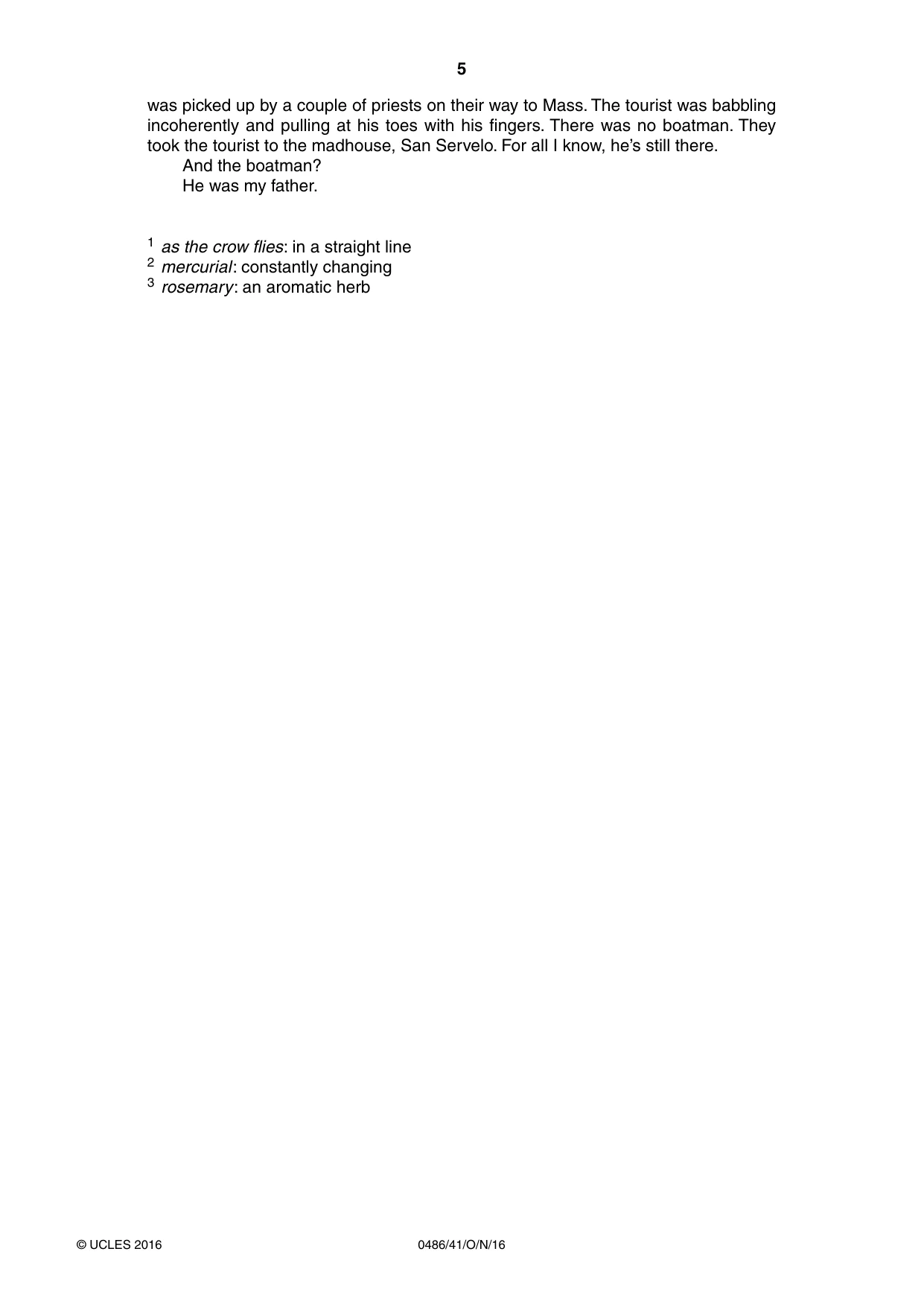
4 0486/41/O/N/16 © UCLES 2016 OR 2 Read carefully this extract from a novel. The writer’s principal character describes the city she comes from, and her people. How does the writing in this passage create a sense of mystery about the city and the people in it? To help you answer this question, you might consider: • how the writing highlights what is unusual about the city • how the narrator uses stories and legends • the effect of the last story she tells, and of its final line. There is a city surrounded by water with watery alleys that do for streets and roads and silted up back ways that only the rats can cross. Miss your way, which is easy to do, and you may find yourself staring at a hundred eyes guarding a filthy palace of sacks and bones. Find your way, which is easy to do, and you may meet an old woman in a doorway. She will tell your fortune, depending on your face. This is the city of mazes. You may set off from the same place to the same place every day and never go by the same route. If you do so, it will be by mistake. Your bloodhound nose will not serve you here. Your course in compass reading will fail you. Your confident instructions to passers-by will send them to squares they have never heard of, over canals not listed in the notes. Although wherever you are going is always in front of you, there is no such thing as straight ahead. No as the crow flies1 short cut will help you to reach the café just over the water. The short cuts are where the cats go, through the impossible gaps, round corners that seem to take you the opposite way. But here, in this mercurial2 city, it is required you do awake your faith. With faith, all things are possible. Rumour has it that the inhabitants of this city walk on water. That, more bizarre still, their feet are webbed. Not all feet, but the feet of the boatmen whose trade is hereditary. This is the legend. When a boatman’s wife finds herself pregnant she waits until the moon is full and the night empty of idlers. Then she takes her husband’s boat and rows to a terrible island where the dead are buried. She leaves her boat with rosemary3 in the bows so that the limbless ones cannot return with her and hurries to the grave of the most recently dead in her family. She has brought her offerings: a flask of wine, a lock of hair from her husband and a silver coin. She must leave the offerings on the grave and beg for a clean heart if her child be a girl and boatman’s feet if her child be a boy. There is no time to lose. She must be home before dawn and the boat must be left for a day and a night covered in salt. In this way, the boatmen keep their secrets and their trade. No newcomer can compete. And no boatman will take off his boots, no matter how you bribe him. I have seen tourists throw diamonds to the fish, but I have never seen a boatman take off his boots. There was once a weak and foolish man whose wife cleaned the boat and sold the fish and brought up their children and went to the terrible island as she should when her yearly time was due. Their house was hot in summer and cold in winter and there was too little food and too many mouths. This boatman, ferrying a tourist from one church to another, happened to fall into conversation with the man and the man brought up the question of the webbed feet. At the same time he drew a purse of gold from his pocket and let it lie quietly in the bottom of the boat. Winter was approaching, the boatman was thin and he thought what harm could it do to unlace just one boot and let this visitor see what there was. The next morning, the boat
Question paper, page 5
5 0486/41/O/N/16 © UCLES 2016 was picked up by a couple of priests on their way to Mass. The tourist was babbling incoherently and pulling at his toes with his fingers. There was no boatman. They took the tourist to the madhouse, San Servelo. For all I know, he’s still there. And the boatman? He was my father. 1 as the crow flies : in a straight line 2 mercurial : constantly changing 3 rosemary : an aromatic herb
Question paper, page 6
6 0486/41/O/N/16 © UCLES 2016 BLANK PAGE
Question paper, page 7
7 0486/41/O/N/16 © UCLES 2016 BLANK PAGE
Question paper, page 8
8 0486/41/O/N/16 © UCLES 2016 BLANK PAGE Permission to reproduce items where third-party owned material protected by copyright is included has been sought and cleared where possible. Every reasonable effort has been made by the publisher (UCLES) to trace copyright holders, but if any items requiring clearance have unwittingly been included, the publisher will be pleased to make amends at the earliest possible opportunity. To avoid the issue of disclosure of answer-related information to candidates, all copyright acknowledgements are reproduced online in the Cambridge International Examinations Copyright Acknowledgements Booklet. This is produced for each series of examinations and is freely available to download at www.cie.org.uk after the live examination series. Cambridge International Examinations is part of the Cambridge Assessment Group. Cambridge Assessment is the brand name of University of Cambridge Local Examinations Syndicate (UCLES), which is itself a department of the University of Cambridge.
Mark scheme, page 1
® IGCSE is the registered trademark of Cambridge International Examinations. This document consists of 3 printed pages. © UCLES 2016 [Turn over Cambridge International Examinations Cambridge International General Certificate of Secondary Education LITERATURE (ENGLISH) 0486/41 Paper 4 Unseen October/November 2016 MARK SCHEME Maximum Mark: 25 Published This mark scheme is published as an aid to teachers and candidates, to indicate the requirements of the examination. It shows the basis on which Examiners were instructed to award marks. It does not indicate the details of the discussions that took place at an Examiners’ meeting before marking began, which would have considered the acceptability of alternative answers. Mark schemes should be read in conjunction with the question paper and the Principal Examiner Report for Teachers. Cambridge will not enter into discussions about these mark schemes. Cambridge is publishing the mark schemes for the October/November 2016 series for most Cambridge IGCSE®, Cambridge International A and AS Level components and some Cambridge O Level components.
Mark scheme, page 2
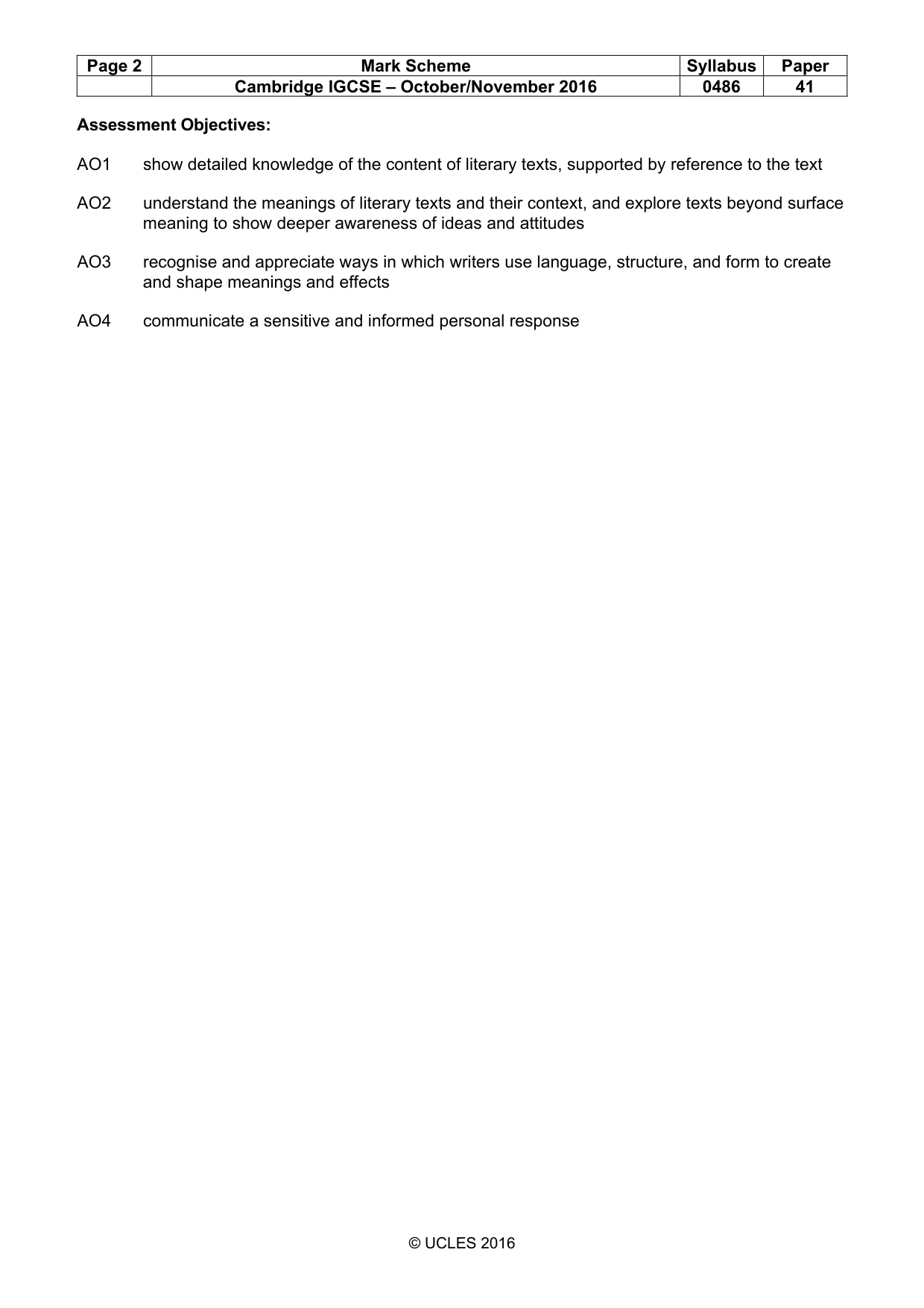
Page 2 Mark Scheme Syllabus Paper Cambridge IGCSE – October/November 2016 0486 41 © UCLES 2016 Assessment Objectives: AO1 show detailed knowledge of the content of literary texts, supported by reference to the text AO2 understand the meanings of literary texts and their context, and explore texts beyond surface meaning to show deeper awareness of ideas and attitudes AO3 recognise and appreciate ways in which writers use language, structure, and form to create and shape meanings and effects AO4 communicate a sensitive and informed personal response
Mark scheme, page 3
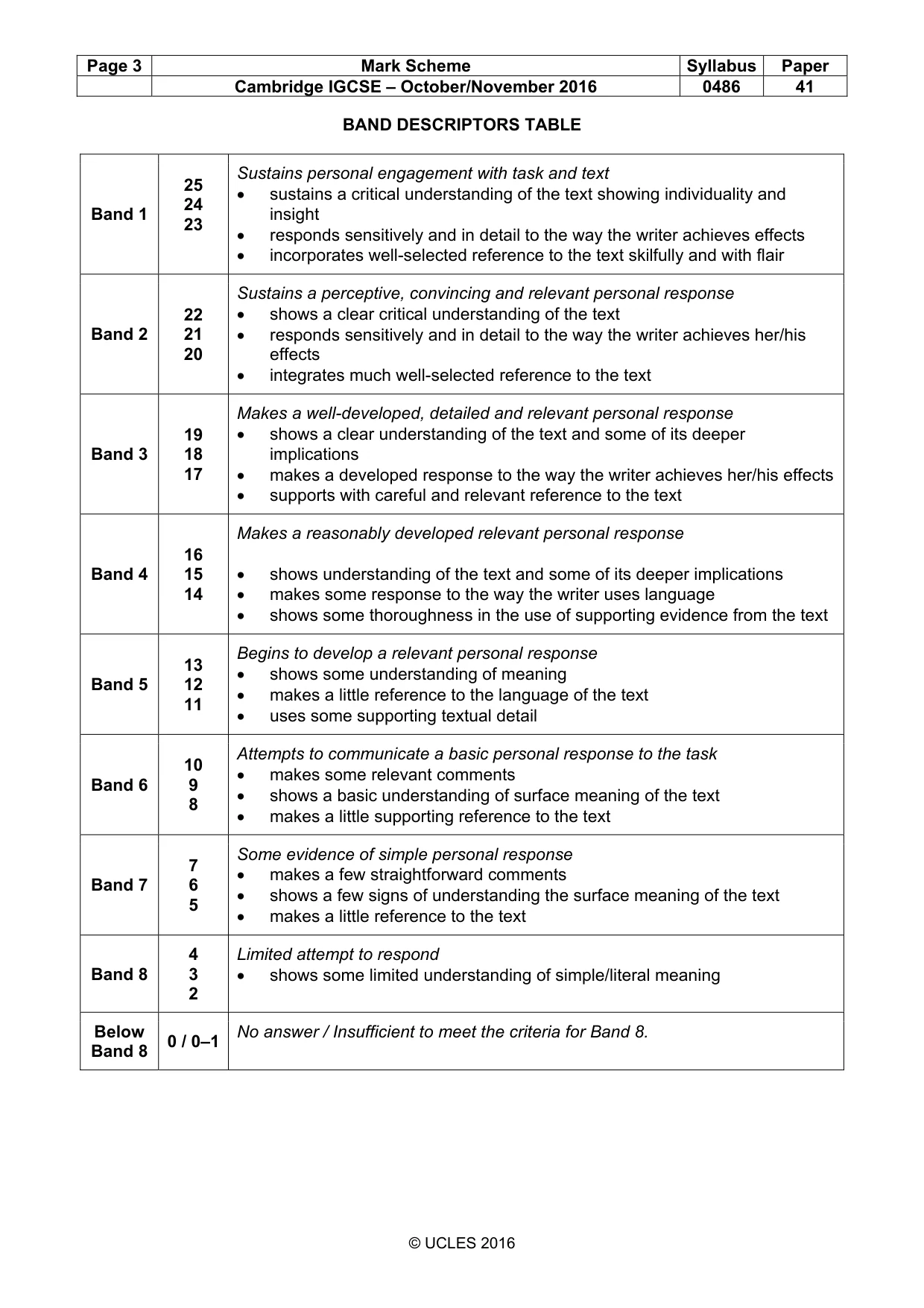
Page 3 Mark Scheme Syllabus Paper Cambridge IGCSE – October/November 2016 0486 41 © UCLES 2016 BAND DESCRIPTORS TABLE Band 1 25 24 23 Sustains personal engagement with task and text • sustains a critical understanding of the text showing individuality and insight • responds sensitively and in detail to the way the writer achieves effects • incorporates well-selected reference to the text skilfully and with flair Band 2 22 21 20 Sustains a perceptive, convincing and relevant personal response • shows a clear critical understanding of the text • responds sensitively and in detail to the way the writer achieves her/his effects • integrates much well-selected reference to the text Band 3 19 18 17 Makes a well-developed, detailed and relevant personal response • shows a clear understanding of the text and some of its deeper implications • makes a developed response to the way the writer achieves her/his effects • supports with careful and relevant reference to the text Band 4 16 15 14 Makes a reasonably developed relevant personal response • shows understanding of the text and some of its deeper implications • makes some response to the way the writer uses language • shows some thoroughness in the use of supporting evidence from the text Band 5 13 12 11 Begins to develop a relevant personal response • shows some understanding of meaning • makes a little reference to the language of the text • uses some supporting textual detail Band 6 10 9 8 Attempts to communicate a basic personal response to the task • makes some relevant comments • shows a basic understanding of surface meaning of the text • makes a little supporting reference to the text Band 7 7 6 5 Some evidence of simple personal response • makes a few straightforward comments • shows a few signs of understanding the surface meaning of the text • makes a little reference to the text Band 8 4 3 2 Limited attempt to respond • shows some limited understanding of simple/literal meaning Below Band 8 0 / 0–1 No answer / Insufficient to meet the criteria for Band 8.
What you needed in this session
Cambridge’s own grade thresholds for 2016 Oct/Nov, Paper 4 · Variant 1. A higher threshold means an easier paper — the bar moves with how the cohort did.