Cambridge IGCSE English - Literature 0486 — 2015 May/June Paper 4 · Variant 3
0486/43/M/J/15 · 25 marks · ≈28 min
The question paper and its mark scheme, free to read here and free to download. This is Cambridge’s own paper, exactly as it was sat.
Question paper8 pages


Mark scheme3 pages
Answers below. Sit the paper first if you are practising.
Paper as text
Question paper, page 1
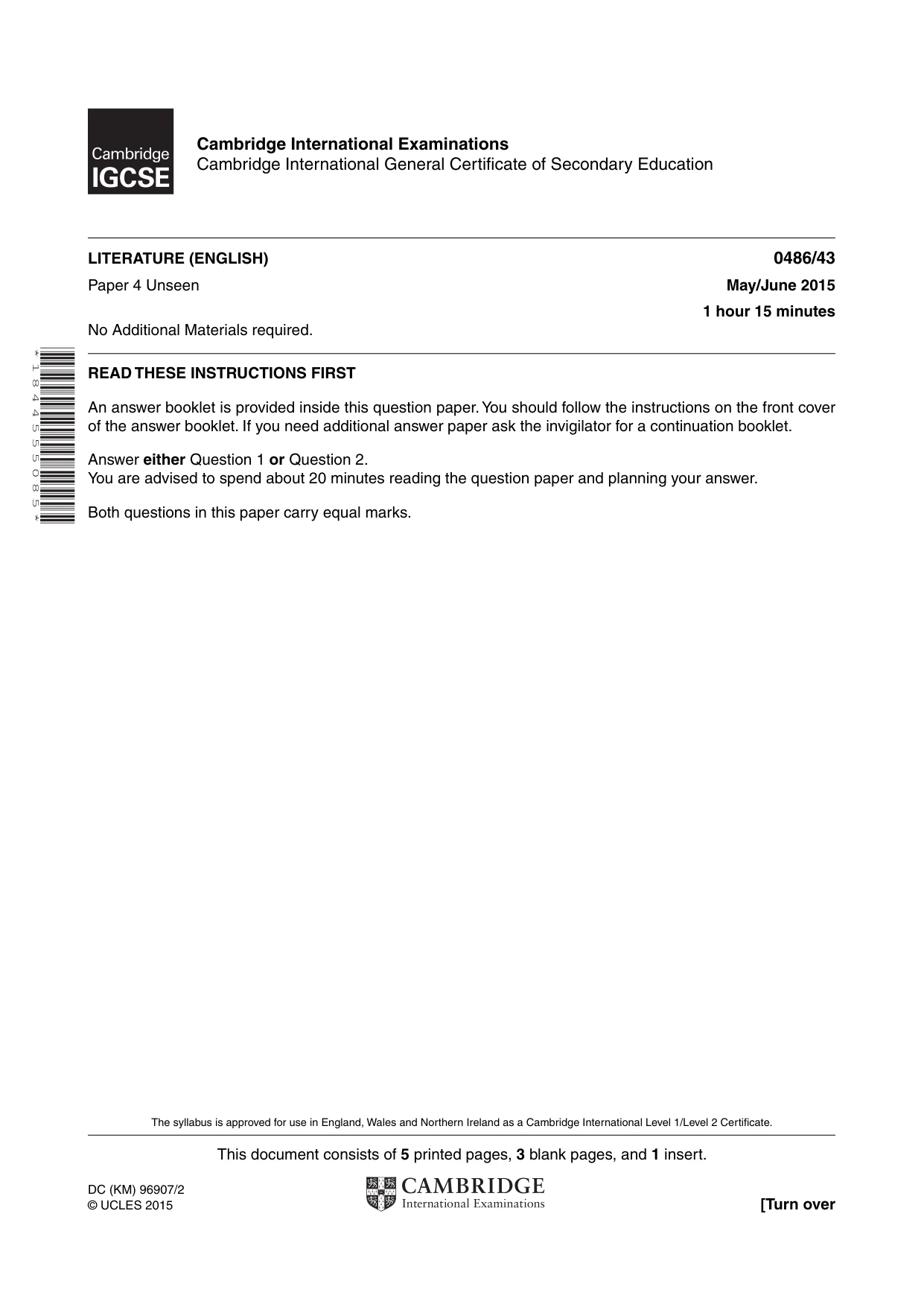
This document consists of 5 printed pages, 3 blank pages, and 1 insert. DC (KM) 96907/2 © UCLES 2015 [Turn over Cambridge International Examinations Cambridge International General Certificate of Secondary Education * 1 8 4 4 5 5 5 0 8 5 * LITERATURE (ENGLISH) 0486/43 Paper 4 Unseen May/June 2015 1 hour 15 minutes No Additional Materials required. READ THESE INSTRUCTIONS FIRST An answer booklet is provided inside this question paper. You should follow the instructions on the front cover of the answer booklet. If you need additional answer paper ask the invigilator for a continuation booklet. Answer either Question 1 or Question 2. You are advised to spend about 20 minutes reading the question paper and planning your answer. Both questions in this paper carry equal marks. The syllabus is approved for use in England, Wales and Northern Ireland as a Cambridge International Level 1/Level 2 Certificate.
Question paper, page 2
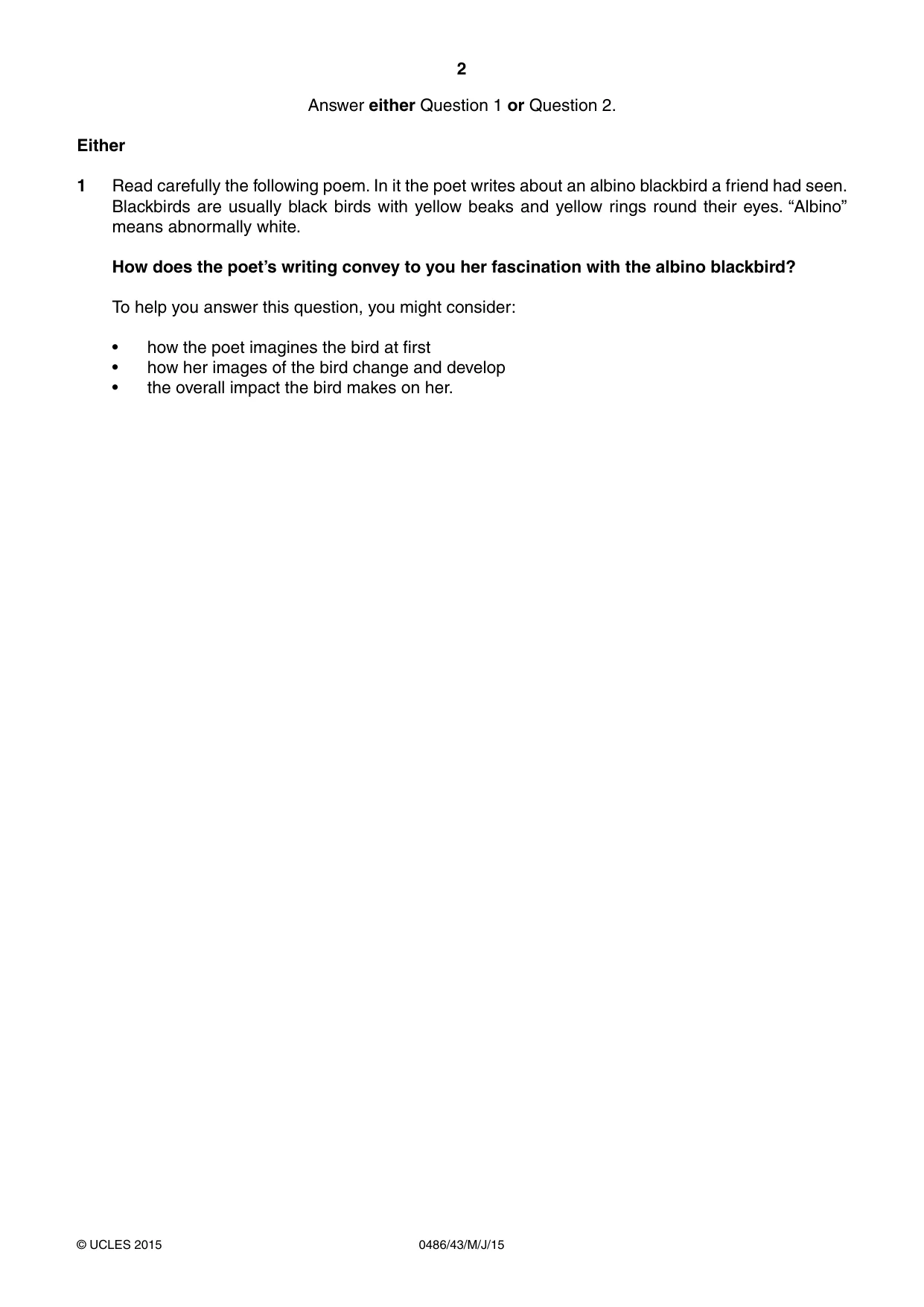
2 0486/43/M/J/15 © UCLES 2015 Answer either Question 1 or Question 2. Either 1 Read carefully the following poem. In it the poet writes about an albino blackbird a friend had seen. Blackbirds are usually black birds with yellow beaks and yellow rings round their eyes. “Albino” means abnormally white. How does the poet’s writing convey to you her fascination with the albino blackbird? To help you answer this question, you might consider: • how the poet imagines the bird at first • how her images of the bird change and develop • the overall impact the bird makes on her.
Question paper, page 3
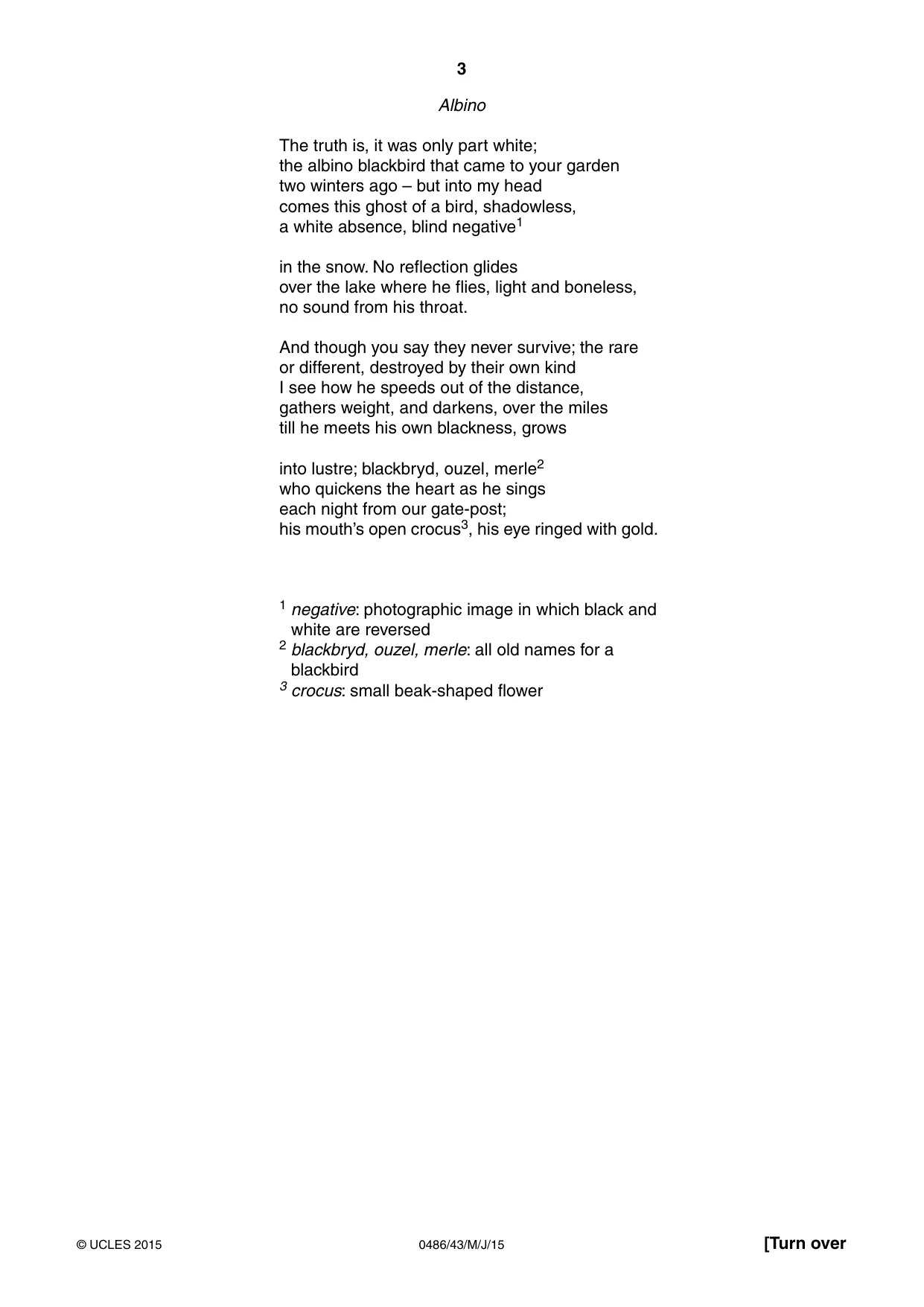
3 0486/43/M/J/15 © UCLES 2015 [Turn over Albino The truth is, it was only part white; the albino blackbird that came to your garden two winters ago – but into my head comes this ghost of a bird, shadowless, a white absence, blind negative1 in the snow. No reflection glides over the lake where he flies, light and boneless, no sound from his throat. And though you say they never survive; the rare or different, destroyed by their own kind I see how he speeds out of the distance, gathers weight, and darkens, over the miles till he meets his own blackness, grows into lustre; blackbryd, ouzel, merle2 who quickens the heart as he sings each night from our gate-post; his mouth’s open crocus3, his eye ringed with gold. 1 negative: photographic image in which black and white are reversed 2 blackbryd, ouzel, merle: all old names for a blackbird 3 crocus: small beak-shaped flower
Question paper, page 4
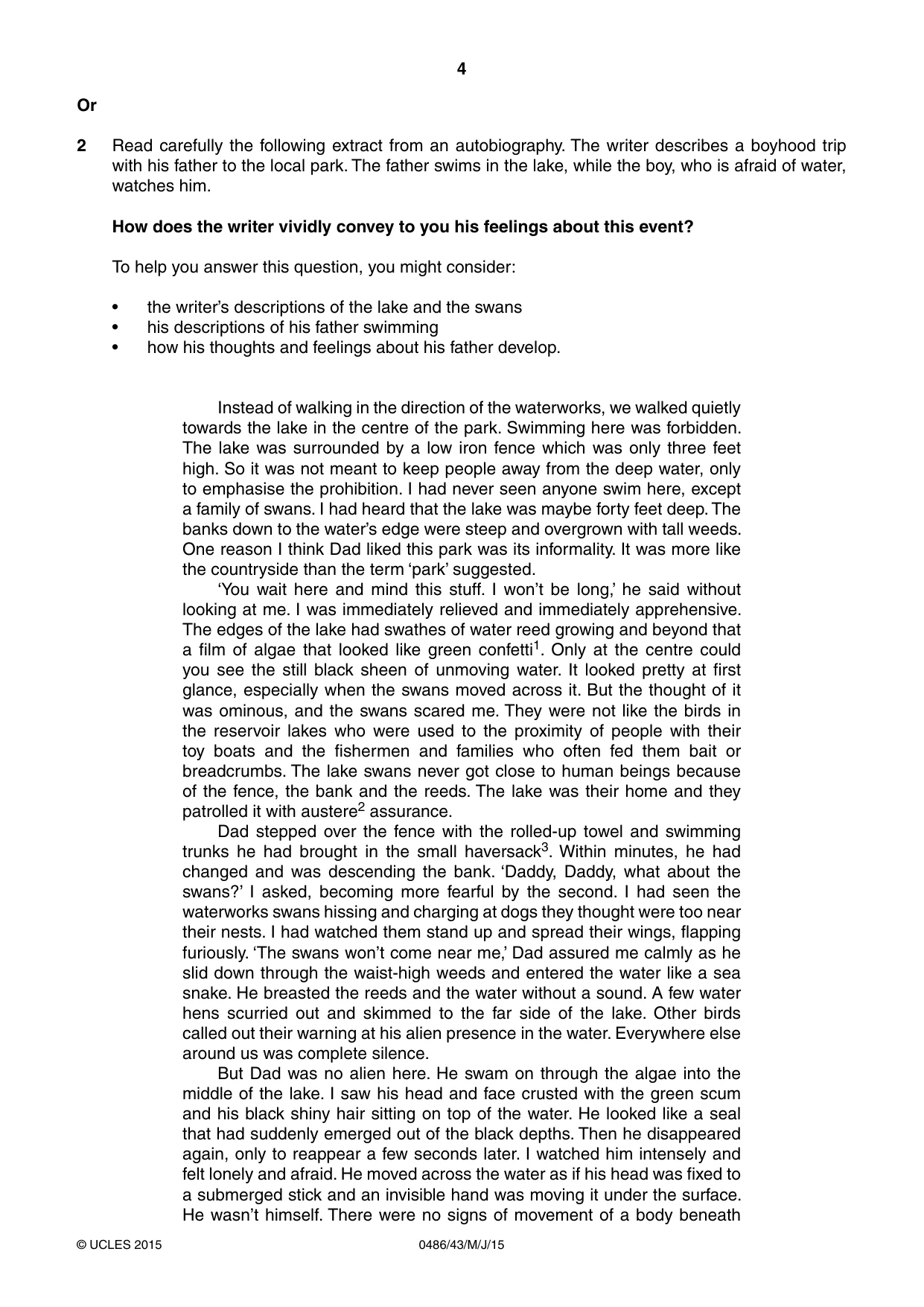
4 0486/43/M/J/15 © UCLES 2015 Or 2 Read carefully the following extract from an autobiography. The writer describes a boyhood trip with his father to the local park. The father swims in the lake, while the boy, who is afraid of water, watches him. How does the writer vividly convey to you his feelings about this event? To help you answer this question, you might consider: • the writer’s descriptions of the lake and the swans • his descriptions of his father swimming • how his thoughts and feelings about his father develop. Instead of walking in the direction of the waterworks, we walked quietly towards the lake in the centre of the park. Swimming here was forbidden. The lake was surrounded by a low iron fence which was only three feet high. So it was not meant to keep people away from the deep water, only to emphasise the prohibition. I had never seen anyone swim here, except a family of swans. I had heard that the lake was maybe forty feet deep. The banks down to the water’s edge were steep and overgrown with tall weeds. One reason I think Dad liked this park was its informality. It was more like the countryside than the term ‘park’ suggested. ‘You wait here and mind this stuff. I won’t be long,’ he said without looking at me. I was immediately relieved and immediately apprehensive. The edges of the lake had swathes of water reed growing and beyond that a film of algae that looked like green confetti1. Only at the centre could you see the still black sheen of unmoving water. It looked pretty at first glance, especially when the swans moved across it. But the thought of it was ominous, and the swans scared me. They were not like the birds in the reservoir lakes who were used to the proximity of people with their toy boats and the fishermen and families who often fed them bait or breadcrumbs. The lake swans never got close to human beings because of the fence, the bank and the reeds. The lake was their home and they patrolled it with austere2 assurance. Dad stepped over the fence with the rolled-up towel and swimming trunks he had brought in the small haversack3. Within minutes, he had changed and was descending the bank. ‘Daddy, Daddy, what about the swans?’ I asked, becoming more fearful by the second. I had seen the waterworks swans hissing and charging at dogs they thought were too near their nests. I had watched them stand up and spread their wings, flapping furiously. ‘The swans won’t come near me,’ Dad assured me calmly as he slid down through the waist-high weeds and entered the water like a sea snake. He breasted the reeds and the water without a sound. A few water hens scurried out and skimmed to the far side of the lake. Other birds called out their warning at his alien presence in the water. Everywhere else around us was complete silence. But Dad was no alien here. He swam on through the algae into the middle of the lake. I saw his head and face crusted with the green scum and his black shiny hair sitting on top of the water. He looked like a seal that had suddenly emerged out of the black depths. Then he disappeared again, only to reappear a few seconds later. I watched him intensely and felt lonely and afraid. He moved across the water as if his head was fixed to a submerged stick and an invisible hand was moving it under the surface. He wasn’t himself. There were no signs of movement of a body beneath
Question paper, page 5
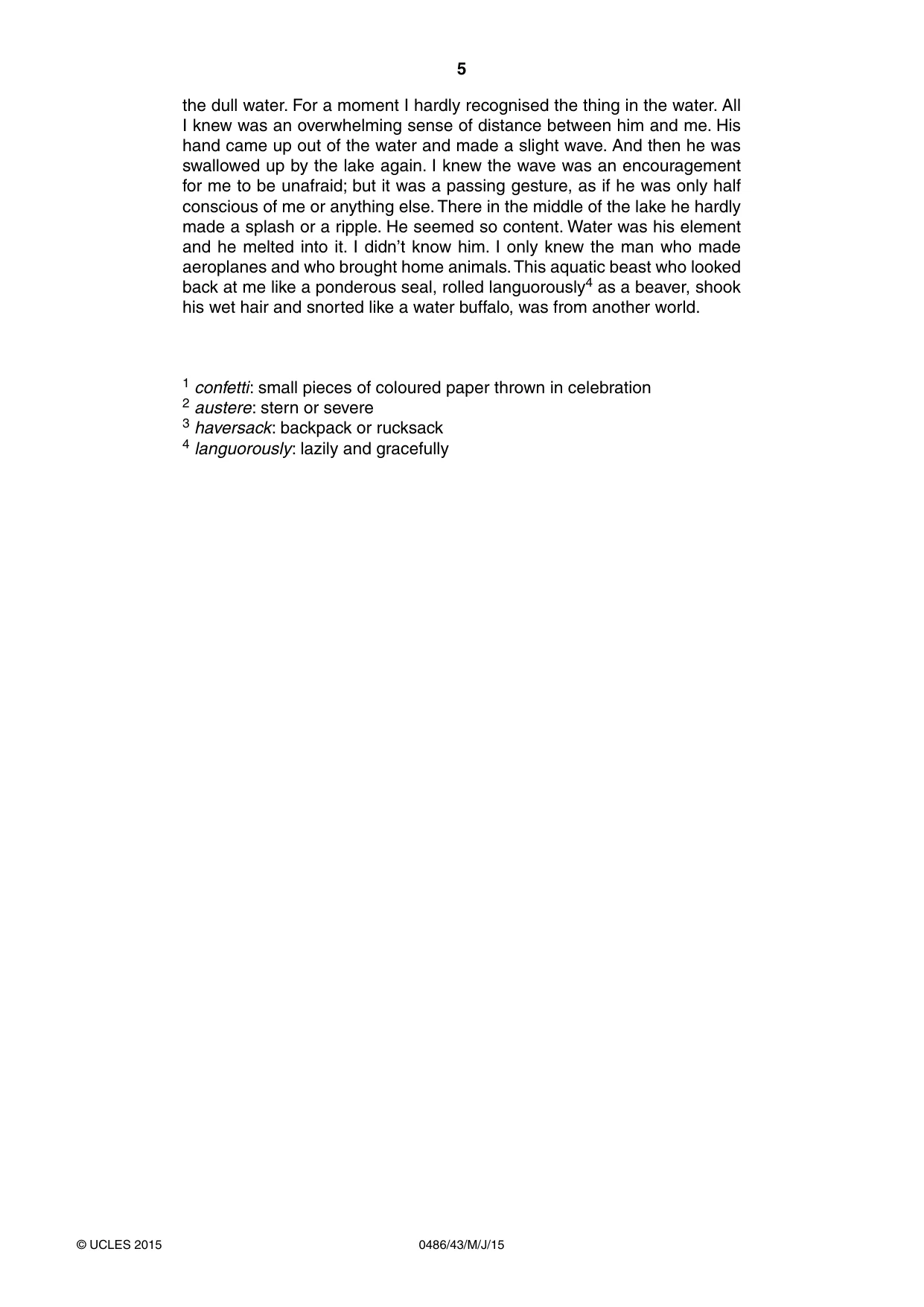
5 0486/43/M/J/15 © UCLES 2015 the dull water. For a moment I hardly recognised the thing in the water. All I knew was an overwhelming sense of distance between him and me. His hand came up out of the water and made a slight wave. And then he was swallowed up by the lake again. I knew the wave was an encouragement for me to be unafraid; but it was a passing gesture, as if he was only half conscious of me or anything else. There in the middle of the lake he hardly made a splash or a ripple. He seemed so content. Water was his element and he melted into it. I didn’t know him. I only knew the man who made aeroplanes and who brought home animals. This aquatic beast who looked back at me like a ponderous seal, rolled languorously4 as a beaver, shook his wet hair and snorted like a water buffalo, was from another world. 1 confetti : small pieces of coloured paper thrown in celebration 2 austere : stern or severe 3 haversack : backpack or rucksack 4 languorously : lazily and gracefully
Question paper, page 6
6 0486/43/M/J/15 © UCLES 2015 BLANK PAGE
Question paper, page 7
7 0486/43/M/J/15 © UCLES 2015 BLANK PAGE
Question paper, page 8
8 0486/43/M/J/15 © UCLES 2015 BLANK PAGE Permission to reproduce items where third-party owned material protected by copyright is included has been sought and cleared where possible. Every reasonable effort has been made by the publisher (UCLES) to trace copyright holders, but if any items requiring clearance have unwittingly been included, the publisher will be pleased to make amends at the earliest possible opportunity. To avoid the issue of disclosure of answer-related information to candidates, all copyright acknowledgements are reproduced online in the Cambridge International Examinations Copyright Acknowledgements Booklet. This is produced for each series of examinations and is freely available to download at www.cie.org.uk after the live examination series. Cambridge International Examinations is part of the Cambridge Assessment Group. Cambridge Assessment is the brand name of University of Cambridge Local Examinations Syndicate (UCLES), which is itself a department of the University of Cambridge.
Mark scheme, page 1
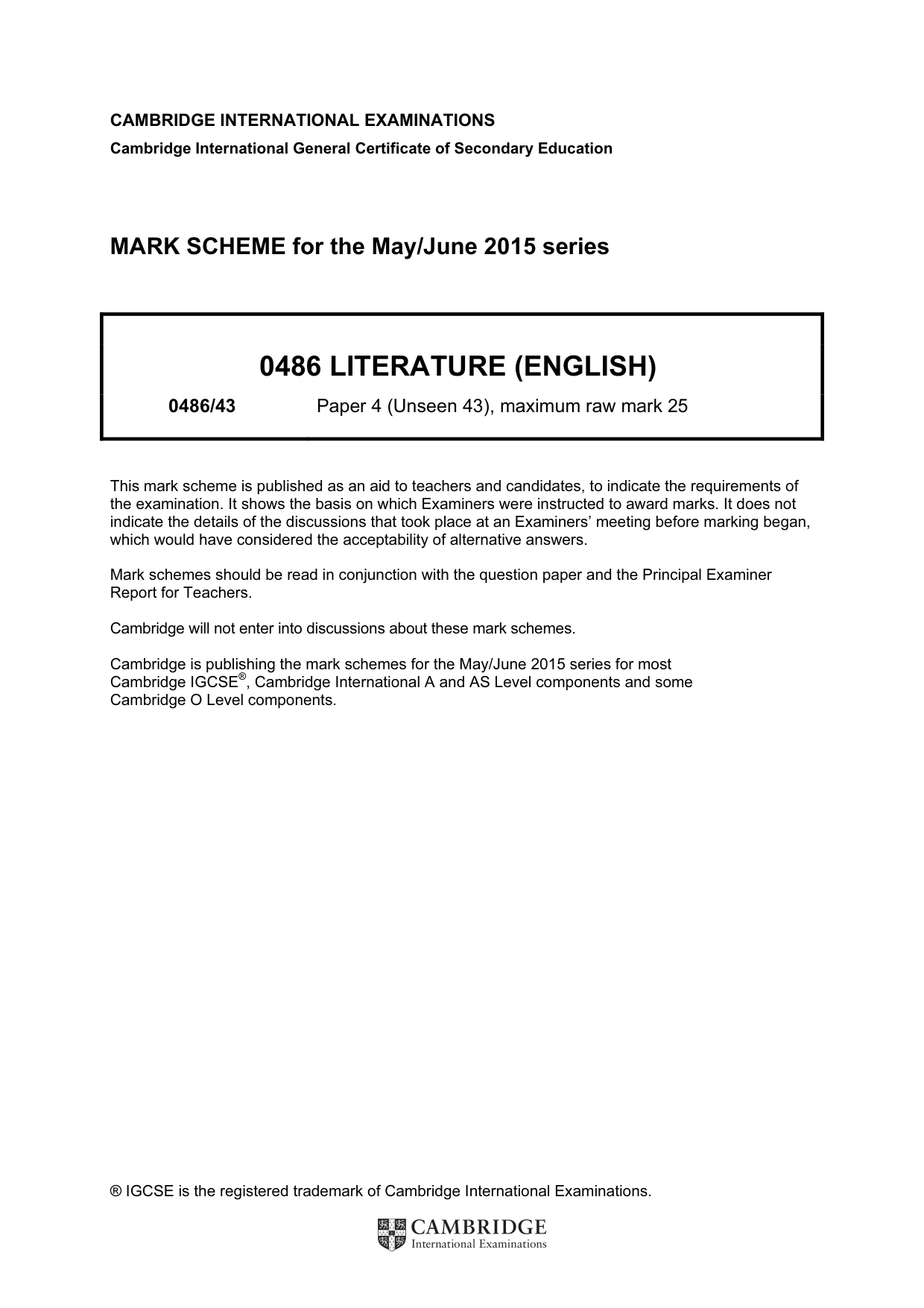
® IGCSE is the registered trademark of Cambridge International Examinations. CAMBRIDGE INTERNATIONAL EXAMINATIONS Cambridge International General Certificate of Secondary Education MARK SCHEME for the May/June 2015 series 0486 LITERATURE (ENGLISH) 0486/43 Paper 4 (Unseen 43), maximum raw mark 25 This mark scheme is published as an aid to teachers and candidates, to indicate the requirements of the examination. It shows the basis on which Examiners were instructed to award marks. It does not indicate the details of the discussions that took place at an Examiners’ meeting before marking began, which would have considered the acceptability of alternative answers. Mark schemes should be read in conjunction with the question paper and the Principal Examiner Report for Teachers. Cambridge will not enter into discussions about these mark schemes. Cambridge is publishing the mark schemes for the May/June 2015 series for most Cambridge IGCSE®, Cambridge International A and AS Level components and some Cambridge O Level components.
Mark scheme, page 2
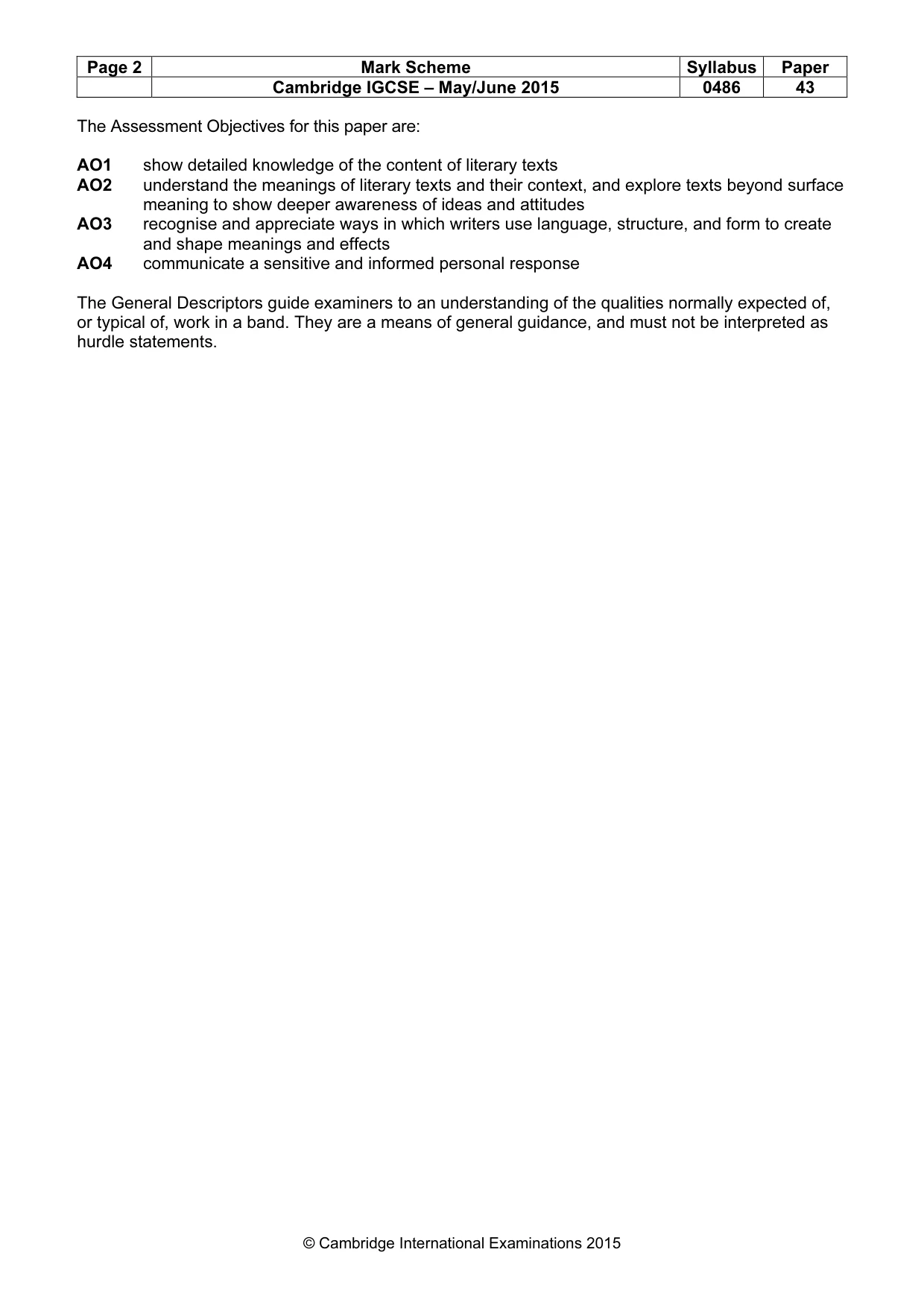
Page 2 Mark Scheme Syllabus Paper Cambridge IGCSE – May/June 2015 0486 43 © Cambridge International Examinations 2015 The Assessment Objectives for this paper are: AO1 show detailed knowledge of the content of literary texts AO2 understand the meanings of literary texts and their context, and explore texts beyond surface meaning to show deeper awareness of ideas and attitudes AO3 recognise and appreciate ways in which writers use language, structure, and form to create and shape meanings and effects AO4 communicate a sensitive and informed personal response The General Descriptors guide examiners to an understanding of the qualities normally expected of, or typical of, work in a band. They are a means of general guidance, and must not be interpreted as hurdle statements.
Mark scheme, page 3
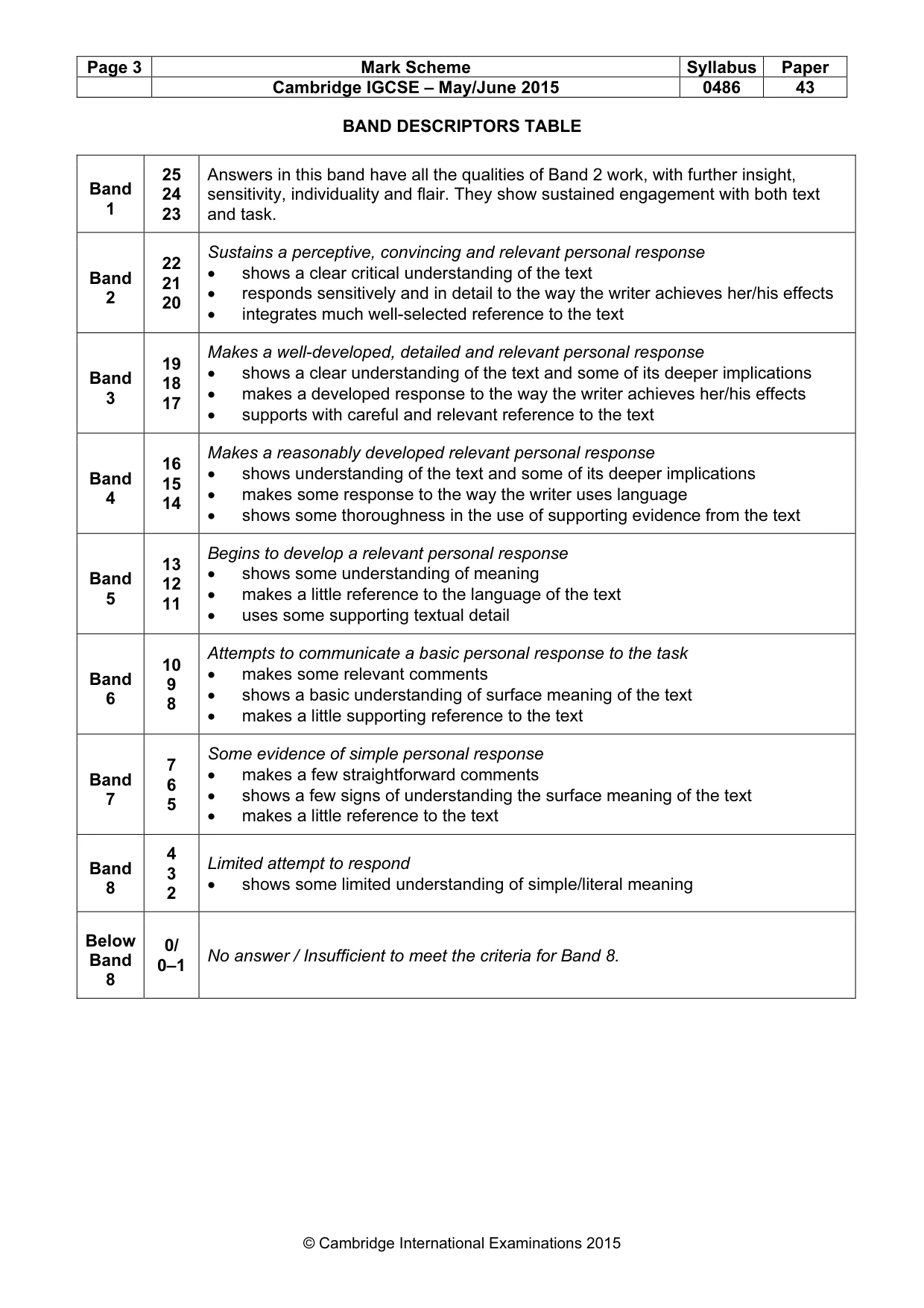
Page 3 Mark Scheme Syllabus Paper Cambridge IGCSE – May/June 2015 0486 43 © Cambridge International Examinations 2015 BAND DESCRIPTORS TABLE Band 1 25 24 23 Answers in this band have all the qualities of Band 2 work, with further insight, sensitivity, individuality and flair. They show sustained engagement with both text and task. Band 2 22 21 20 Sustains a perceptive, convincing and relevant personal response • shows a clear critical understanding of the text • responds sensitively and in detail to the way the writer achieves her/his effects • integrates much well-selected reference to the text Band 3 19 18 17 Makes a well-developed, detailed and relevant personal response • shows a clear understanding of the text and some of its deeper implications • makes a developed response to the way the writer achieves her/his effects • supports with careful and relevant reference to the text Band 4 16 15 14 Makes a reasonably developed relevant personal response • shows understanding of the text and some of its deeper implications • makes some response to the way the writer uses language • shows some thoroughness in the use of supporting evidence from the text Band 5 13 12 11 Begins to develop a relevant personal response • shows some understanding of meaning • makes a little reference to the language of the text • uses some supporting textual detail Band 6 10 9 8 Attempts to communicate a basic personal response to the task • makes some relevant comments • shows a basic understanding of surface meaning of the text • makes a little supporting reference to the text Band 7 7 6 5 Some evidence of simple personal response • makes a few straightforward comments • shows a few signs of understanding the surface meaning of the text • makes a little reference to the text Band 8 4 3 2 Limited attempt to respond • shows some limited understanding of simple/literal meaning Below Band 8 0/ 0–1 No answer / Insufficient to meet the criteria for Band 8.
What you needed in this session
Cambridge’s own grade thresholds for 2015 May/June, Paper 4 · Variant 3. A higher threshold means an easier paper — the bar moves with how the cohort did.