Cambridge IGCSE English - Literature 0486 — 2015 May/June Paper 4 · Variant 2
0486/42/M/J/15 · 25 marks · ≈28 min
The question paper and its mark scheme, free to read here and free to download. This is Cambridge’s own paper, exactly as it was sat.
Question paper8 pages



Mark scheme3 pages
Answers below. Sit the paper first if you are practising.
Paper as text
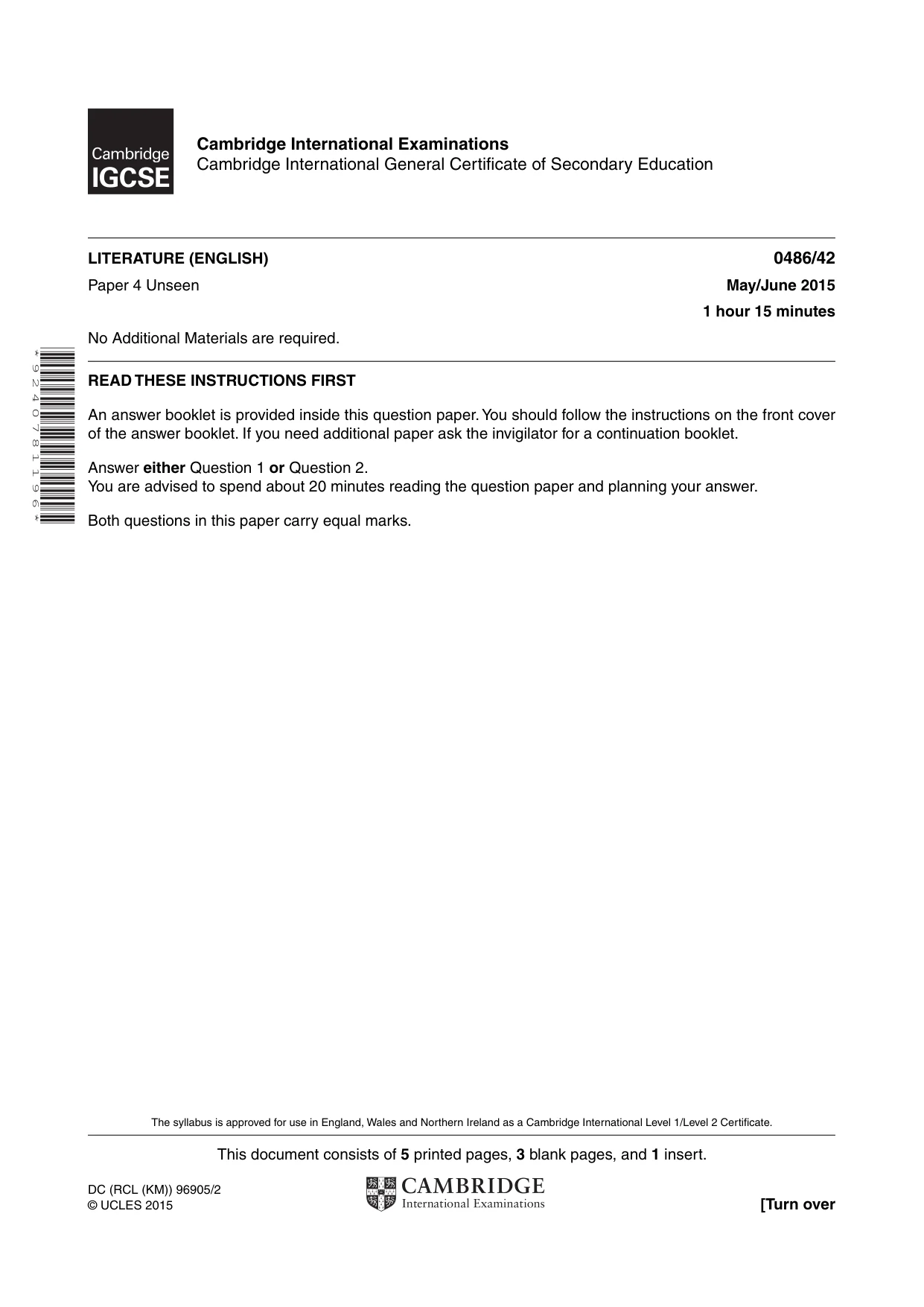
Question paper, page 1
This document consists of 5 printed pages, 3 blank pages, and 1 insert. DC (RCL (KM)) 96905/2 © UCLES 2015 [Turn over Cambridge International Examinations Cambridge International General Certificate of Secondary Education * 9 2 4 0 7 8 1 1 9 6 * LITERATURE (ENGLISH) 0486/42 Paper 4 Unseen May/June 2015 1 hour 15 minutes No Additional Materials are required. READ THESE INSTRUCTIONS FIRST An answer booklet is provided inside this question paper. You should follow the instructions on the front cover of the answer booklet. If you need additional paper ask the invigilator for a continuation booklet. Answer either Question 1 or Question 2. You are advised to spend about 20 minutes reading the question paper and planning your answer. Both questions in this paper carry equal marks. The syllabus is approved for use in England, Wales and Northern Ireland as a Cambridge International Level 1/Level 2 Certificate.
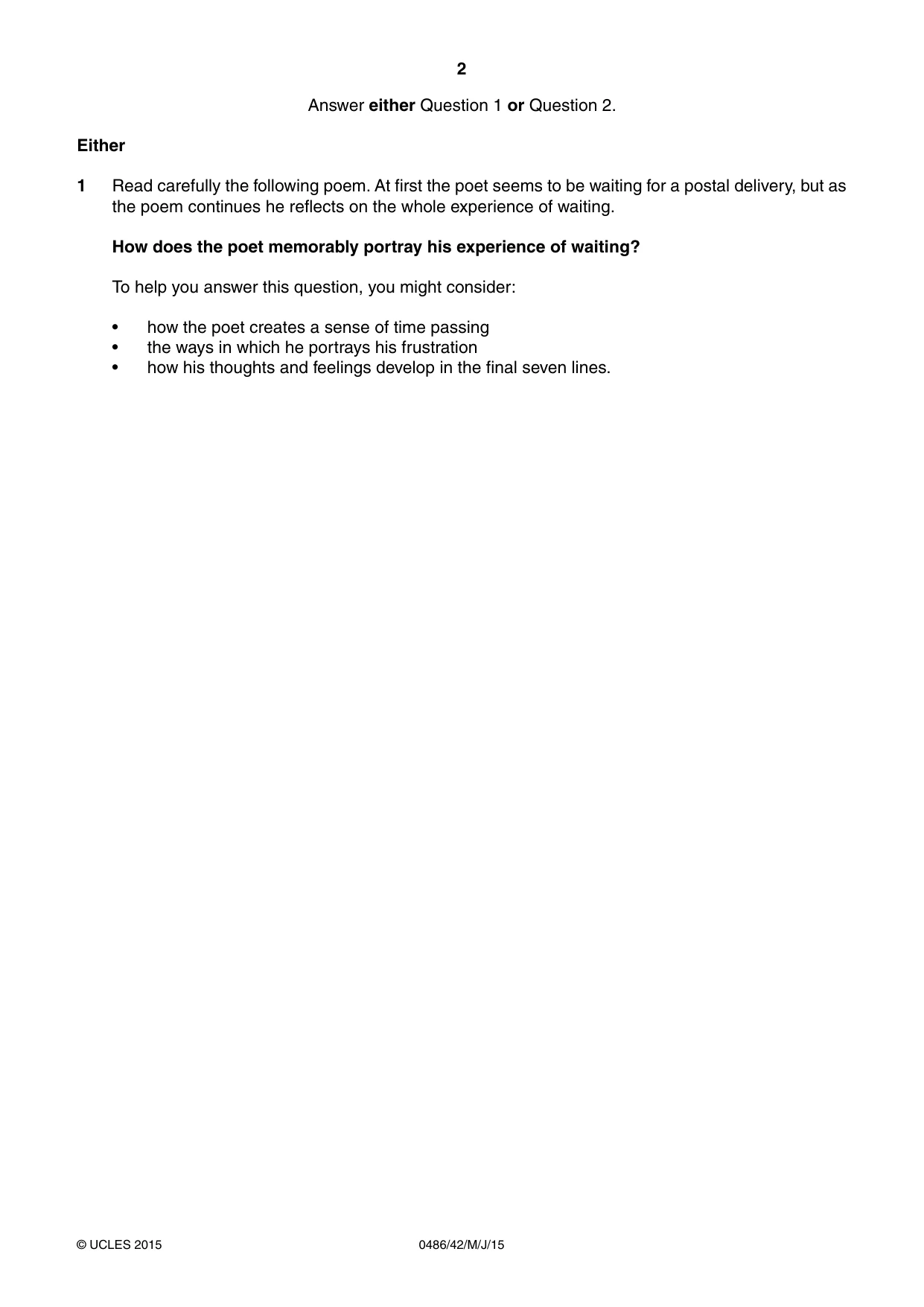
Question paper, page 2
2 0486/42/M/J/15 © UCLES 2015 Answer either Question 1 or Question 2. Either 1 Read carefully the following poem. At first the poet seems to be waiting for a postal delivery, but as the poem continues he reflects on the whole experience of waiting. How does the poet memorably portray his experience of waiting? To help you answer this question, you might consider: • how the poet creates a sense of time passing • the ways in which he portrays his frustration • how his thoughts and feelings develop in the final seven lines.
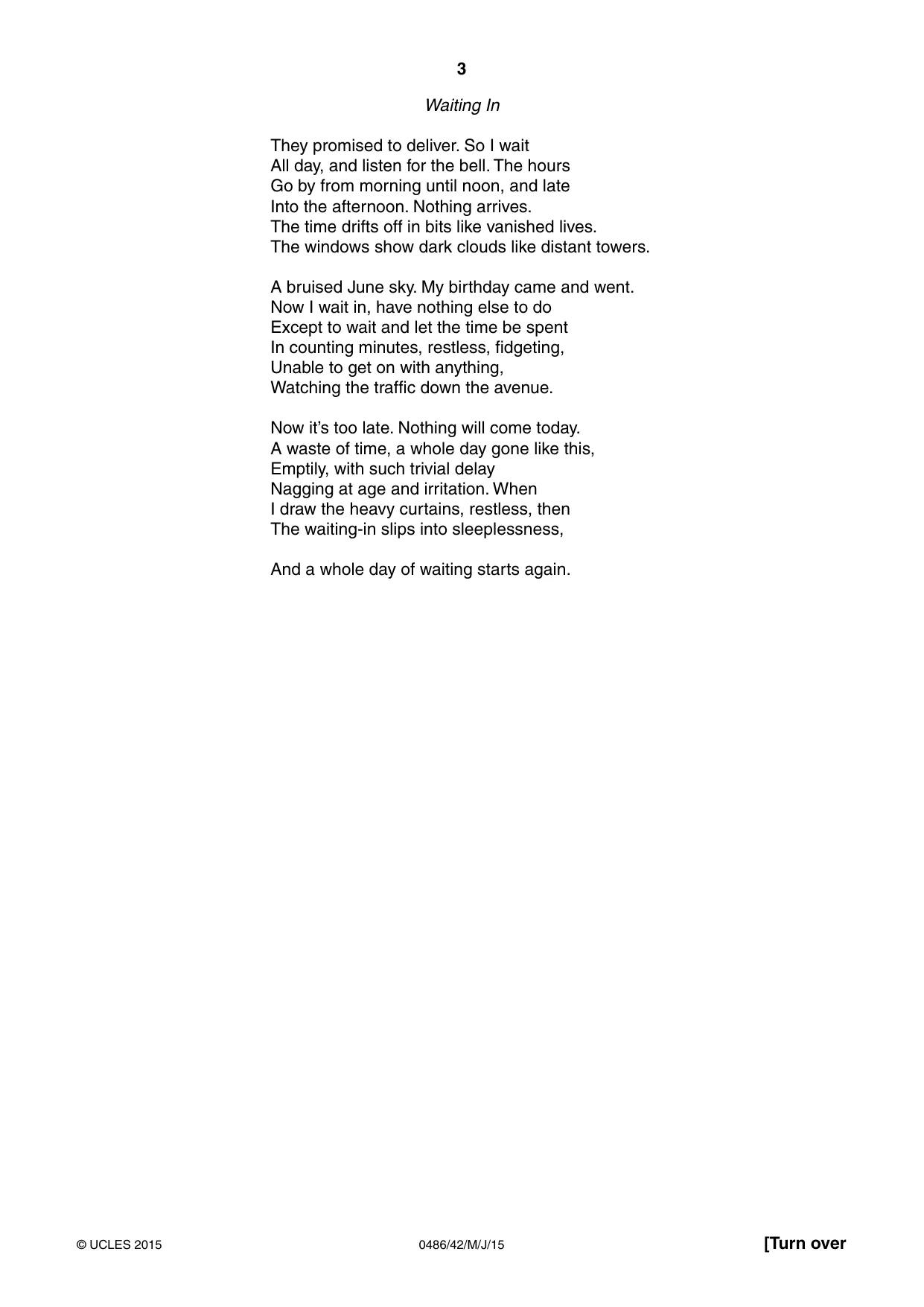
Question paper, page 3
3 0486/42/M/J/15 © UCLES 2015 [Turn over Waiting In They promised to deliver. So I wait All day, and listen for the bell. The hours Go by from morning until noon, and late Into the afternoon. Nothing arrives. The time drifts off in bits like vanished lives. The windows show dark clouds like distant towers. A bruised June sky. My birthday came and went. Now I wait in, have nothing else to do Except to wait and let the time be spent In counting minutes, restless, fidgeting, Unable to get on with anything, Watching the traffic down the avenue. Now it’s too late. Nothing will come today. A waste of time, a whole day gone like this, Emptily, with such trivial delay Nagging at age and irritation. When I draw the heavy curtains, restless, then The waiting-in slips into sleeplessness, And a whole day of waiting starts again.
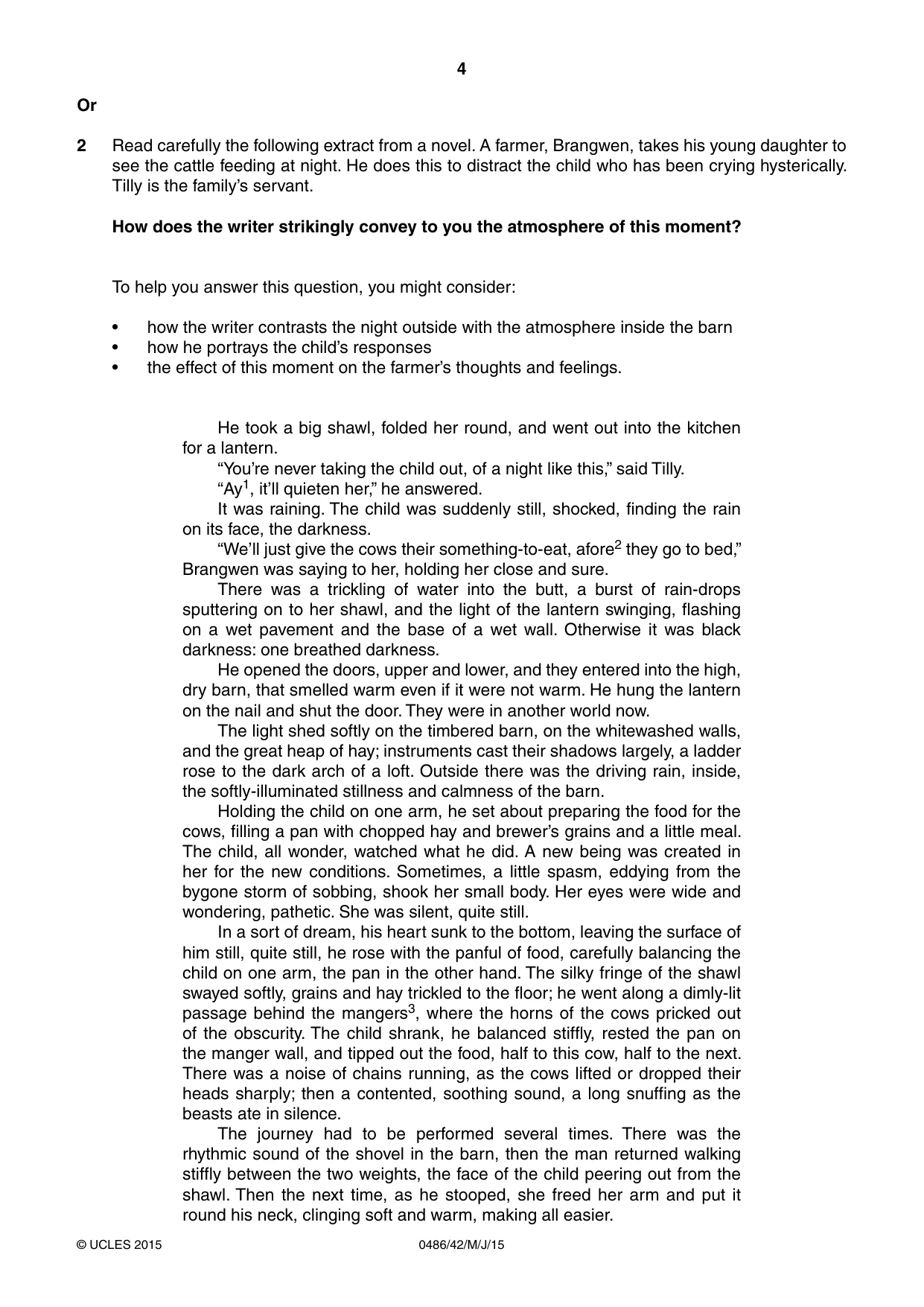
Question paper, page 4
4 0486/42/M/J/15 © UCLES 2015 Or 2 Read carefully the following extract from a novel. A farmer, Brangwen, takes his young daughter to see the cattle feeding at night. He does this to distract the child who has been crying hysterically. Tilly is the family’s servant. How does the writer strikingly convey to you the atmosphere of this moment? To help you answer this question, you might consider: • how the writer contrasts the night outside with the atmosphere inside the barn • how he portrays the child’s responses • the effect of this moment on the farmer’s thoughts and feelings. He took a big shawl, folded her round, and went out into the kitchen for a lantern. “You’re never taking the child out, of a night like this,” said Tilly. “Ay1, it’ll quieten her,” he answered. It was raining. The child was suddenly still, shocked, finding the rain on its face, the darkness. “We’ll just give the cows their something-to-eat, afore2 they go to bed,” Brangwen was saying to her, holding her close and sure. There was a trickling of water into the butt, a burst of rain-drops sputtering on to her shawl, and the light of the lantern swinging, flashing on a wet pavement and the base of a wet wall. Otherwise it was black darkness: one breathed darkness. He opened the doors, upper and lower, and they entered into the high, dry barn, that smelled warm even if it were not warm. He hung the lantern on the nail and shut the door. They were in another world now. The light shed softly on the timbered barn, on the whitewashed walls, and the great heap of hay; instruments cast their shadows largely, a ladder rose to the dark arch of a loft. Outside there was the driving rain, inside, the softly-illuminated stillness and calmness of the barn. Holding the child on one arm, he set about preparing the food for the cows, filling a pan with chopped hay and brewer’s grains and a little meal. The child, all wonder, watched what he did. A new being was created in her for the new conditions. Sometimes, a little spasm, eddying from the bygone storm of sobbing, shook her small body. Her eyes were wide and wondering, pathetic. She was silent, quite still. In a sort of dream, his heart sunk to the bottom, leaving the surface of him still, quite still, he rose with the panful of food, carefully balancing the child on one arm, the pan in the other hand. The silky fringe of the shawl swayed softly, grains and hay trickled to the floor; he went along a dimly-lit passage behind the mangers3, where the horns of the cows pricked out of the obscurity. The child shrank, he balanced stiffly, rested the pan on the manger wall, and tipped out the food, half to this cow, half to the next. There was a noise of chains running, as the cows lifted or dropped their heads sharply; then a contented, soothing sound, a long snuffing as the beasts ate in silence. The journey had to be performed several times. There was the rhythmic sound of the shovel in the barn, then the man returned walking stiffly between the two weights, the face of the child peering out from the shawl. Then the next time, as he stooped, she freed her arm and put it round his neck, clinging soft and warm, making all easier.
Question paper, page 5
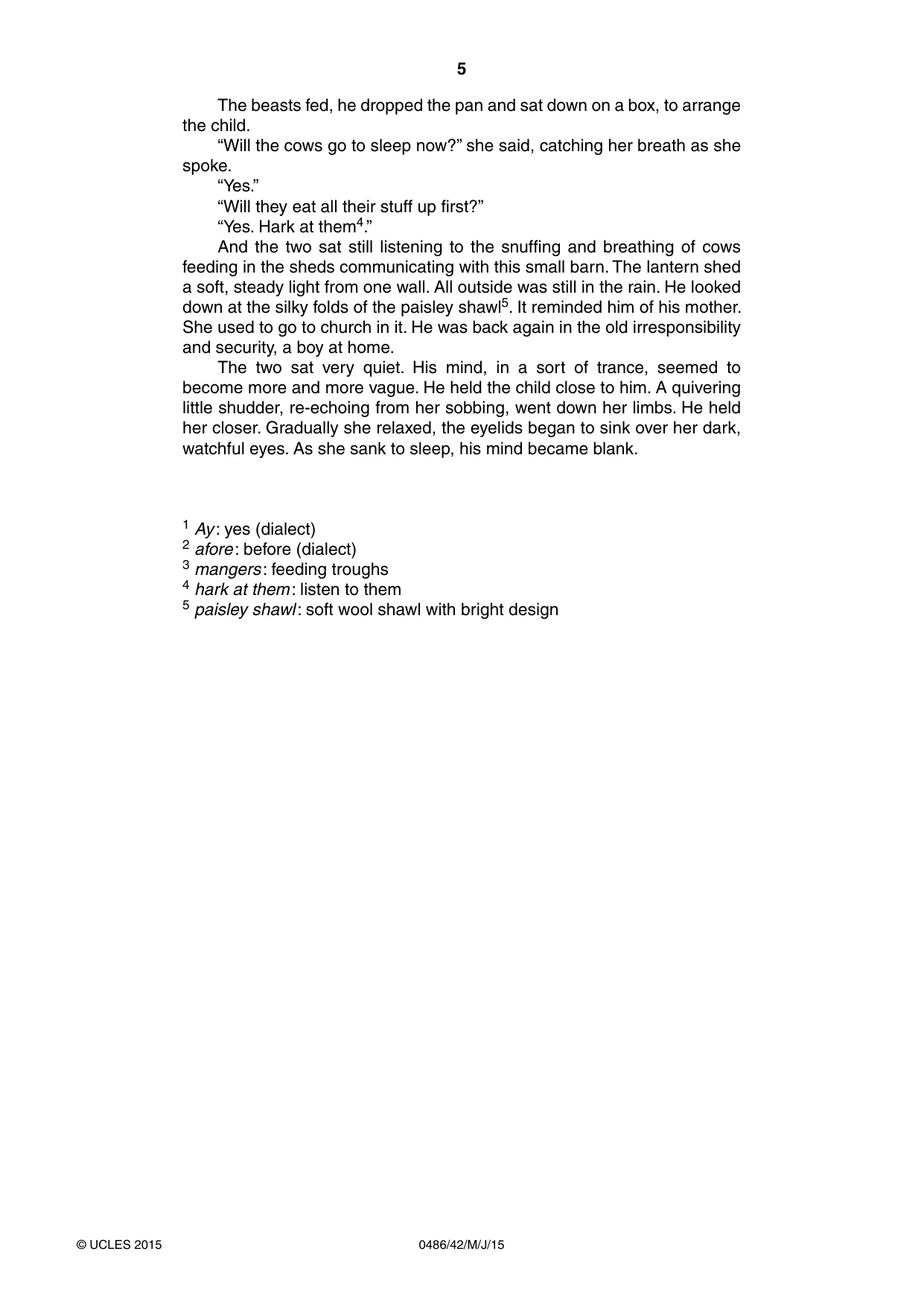
5 0486/42/M/J/15 © UCLES 2015 The beasts fed, he dropped the pan and sat down on a box, to arrange the child. “Will the cows go to sleep now?” she said, catching her breath as she spoke. “Yes.” “Will they eat all their stuff up first?” “Yes. Hark at them4.” And the two sat still listening to the snuffing and breathing of cows feeding in the sheds communicating with this small barn. The lantern shed a soft, steady light from one wall. All outside was still in the rain. He looked down at the silky folds of the paisley shawl5. It reminded him of his mother. She used to go to church in it. He was back again in the old irresponsibility and security, a boy at home. The two sat very quiet. His mind, in a sort of trance, seemed to become more and more vague. He held the child close to him. A quivering little shudder, re-echoing from her sobbing, went down her limbs. He held her closer. Gradually she relaxed, the eyelids began to sink over her dark, watchful eyes. As she sank to sleep, his mind became blank. 1 Ay : yes (dialect) 2 afore : before (dialect) 3 mangers : feeding troughs 4 hark at them : listen to them 5 paisley shawl : soft wool shawl with bright design
Question paper, page 6
6 0486/42/M/J/15 © UCLES 2015 BLANK PAGE
Question paper, page 7
7 0486/42/M/J/15 © UCLES 2015 BLANK PAGE
Question paper, page 8
8 0486/42/M/J/15 © UCLES 2015 BLANK PAGE Permission to reproduce items where third-party owned material protected by copyright is included has been sought and cleared where possible. Every reasonable effort has been made by the publisher (UCLES) to trace copyright holders, but if any items requiring clearance have unwittingly been included, the publisher will be pleased to make amends at the earliest possible opportunity. To avoid the issue of disclosure of answer-related information to candidates, all copyright acknowledgements are reproduced online in the Cambridge International Examinations Copyright Acknowledgements Booklet. This is produced for each series of examinations and is freely available to download at www.cie.org.uk after the live examination series. Cambridge International Examinations is part of the Cambridge Assessment Group. Cambridge Assessment is the brand name of University of Cambridge Local Examinations Syndicate (UCLES), which is itself a department of the University of Cambridge.
Mark scheme, page 1
® IGCSE is the registered trademark of Cambridge International Examinations. CAMBRIDGE INTERNATIONAL EXAMINATIONS Cambridge International General Certificate of Secondary Education MARK SCHEME for the May/June 2015 series 0486 LITERATURE (ENGLISH) 0486/42 Paper 4 (Unseen 42), maximum raw mark 25 This mark scheme is published as an aid to teachers and candidates, to indicate the requirements of the examination. It shows the basis on which Examiners were instructed to award marks. It does not indicate the details of the discussions that took place at an Examiners’ meeting before marking began, which would have considered the acceptability of alternative answers. Mark schemes should be read in conjunction with the question paper and the Principal Examiner Report for Teachers. Cambridge will not enter into discussions about these mark schemes. Cambridge is publishing the mark schemes for the May/June 2015 series for most Cambridge IGCSE®, Cambridge International A and AS Level components and some Cambridge O Level components.
Mark scheme, page 2
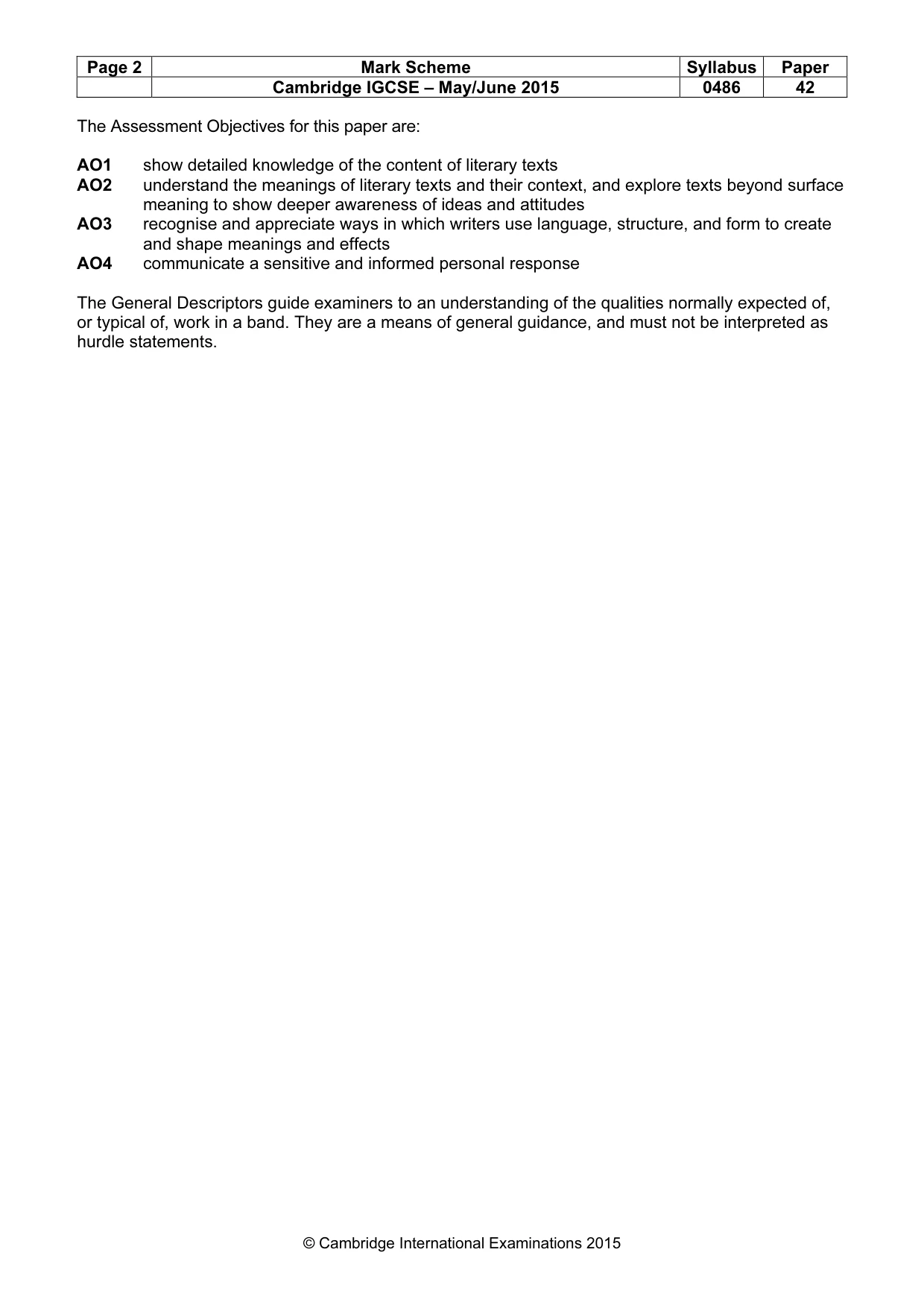
Page 2 Mark Scheme Syllabus Paper Cambridge IGCSE – May/June 2015 0486 42 © Cambridge International Examinations 2015 The Assessment Objectives for this paper are: AO1 show detailed knowledge of the content of literary texts AO2 understand the meanings of literary texts and their context, and explore texts beyond surface meaning to show deeper awareness of ideas and attitudes AO3 recognise and appreciate ways in which writers use language, structure, and form to create and shape meanings and effects AO4 communicate a sensitive and informed personal response The General Descriptors guide examiners to an understanding of the qualities normally expected of, or typical of, work in a band. They are a means of general guidance, and must not be interpreted as hurdle statements.
Mark scheme, page 3
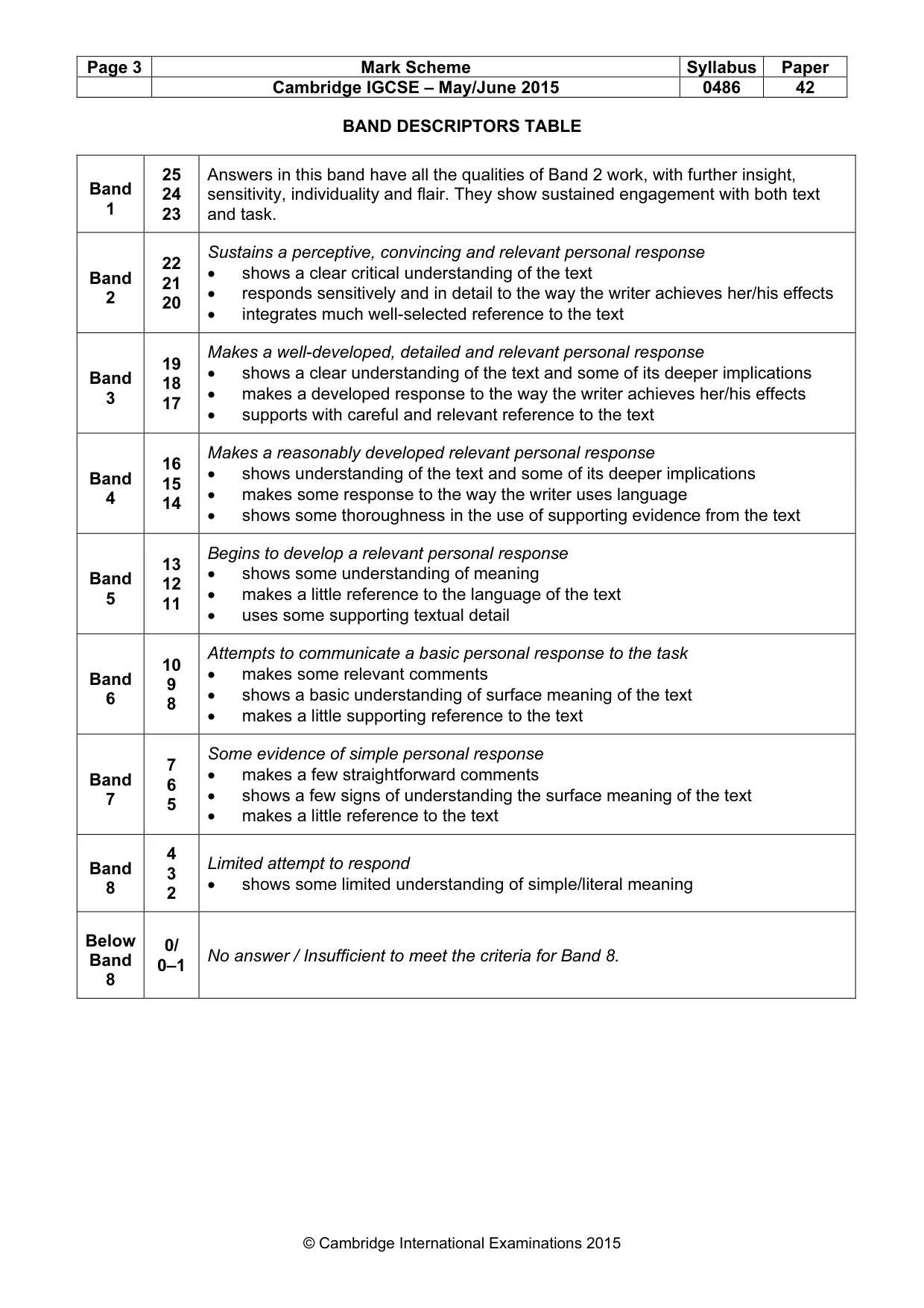
Page 3 Mark Scheme Syllabus Paper Cambridge IGCSE – May/June 2015 0486 42 © Cambridge International Examinations 2015 BAND DESCRIPTORS TABLE Band 1 25 24 23 Answers in this band have all the qualities of Band 2 work, with further insight, sensitivity, individuality and flair. They show sustained engagement with both text and task. Band 2 22 21 20 Sustains a perceptive, convincing and relevant personal response • shows a clear critical understanding of the text • responds sensitively and in detail to the way the writer achieves her/his effects • integrates much well-selected reference to the text Band 3 19 18 17 Makes a well-developed, detailed and relevant personal response • shows a clear understanding of the text and some of its deeper implications • makes a developed response to the way the writer achieves her/his effects • supports with careful and relevant reference to the text Band 4 16 15 14 Makes a reasonably developed relevant personal response • shows understanding of the text and some of its deeper implications • makes some response to the way the writer uses language • shows some thoroughness in the use of supporting evidence from the text Band 5 13 12 11 Begins to develop a relevant personal response • shows some understanding of meaning • makes a little reference to the language of the text • uses some supporting textual detail Band 6 10 9 8 Attempts to communicate a basic personal response to the task • makes some relevant comments • shows a basic understanding of surface meaning of the text • makes a little supporting reference to the text Band 7 7 6 5 Some evidence of simple personal response • makes a few straightforward comments • shows a few signs of understanding the surface meaning of the text • makes a little reference to the text Band 8 4 3 2 Limited attempt to respond • shows some limited understanding of simple/literal meaning Below Band 8 0/ 0–1 No answer / Insufficient to meet the criteria for Band 8.
What you needed in this session
Cambridge’s own grade thresholds for 2015 May/June, Paper 4 · Variant 2. A higher threshold means an easier paper — the bar moves with how the cohort did.