Cambridge IGCSE English - Literature 0486 — 2015 May/June Paper 4 · Variant 1
0486/41/M/J/15 · 25 marks · ≈28 min
The question paper and its mark scheme, free to read here and free to download. This is Cambridge’s own paper, exactly as it was sat.
Question paper8 pages


Mark scheme3 pages
Answers below. Sit the paper first if you are practising.
Paper as text
Question paper, page 1
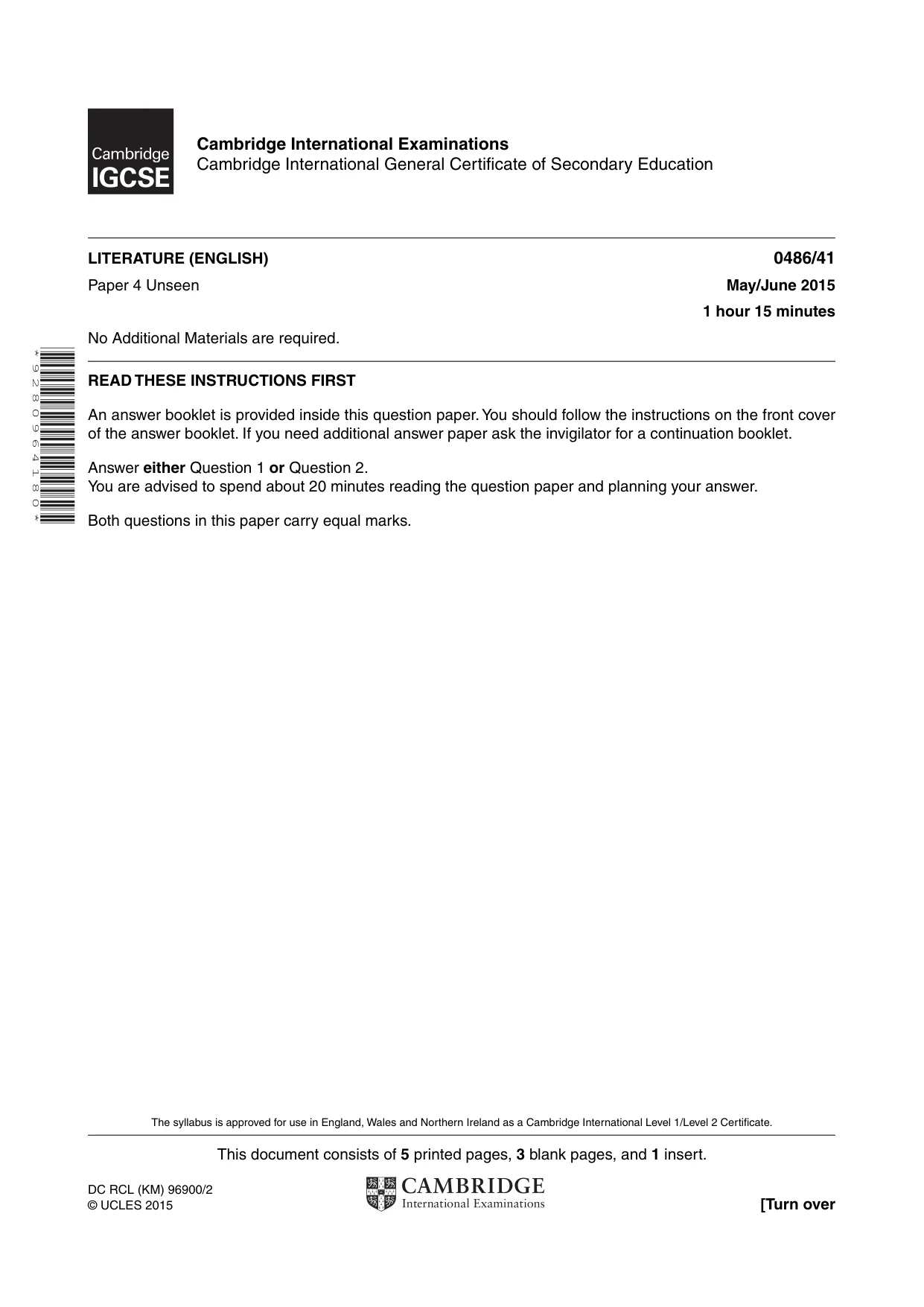
This document consists of 5 printed pages, 3 blank pages, and 1 insert. DC RCL (KM) 96900/2 © UCLES 2015 [Turn over Cambridge International Examinations Cambridge International General Certificate of Secondary Education * 9 2 8 0 9 6 4 1 8 0 * LITERATURE (ENGLISH) 0486/41 Paper 4 Unseen May/June 2015 1 hour 15 minutes No Additional Materials are required. READ THESE INSTRUCTIONS FIRST An answer booklet is provided inside this question paper. You should follow the instructions on the front cover of the answer booklet. If you need additional answer paper ask the invigilator for a continuation booklet. Answer either Question 1 or Question 2. You are advised to spend about 20 minutes reading the question paper and planning your answer. Both questions in this paper carry equal marks. The syllabus is approved for use in England, Wales and Northern Ireland as a Cambridge International Level 1/Level 2 Certificate.
Question paper, page 2
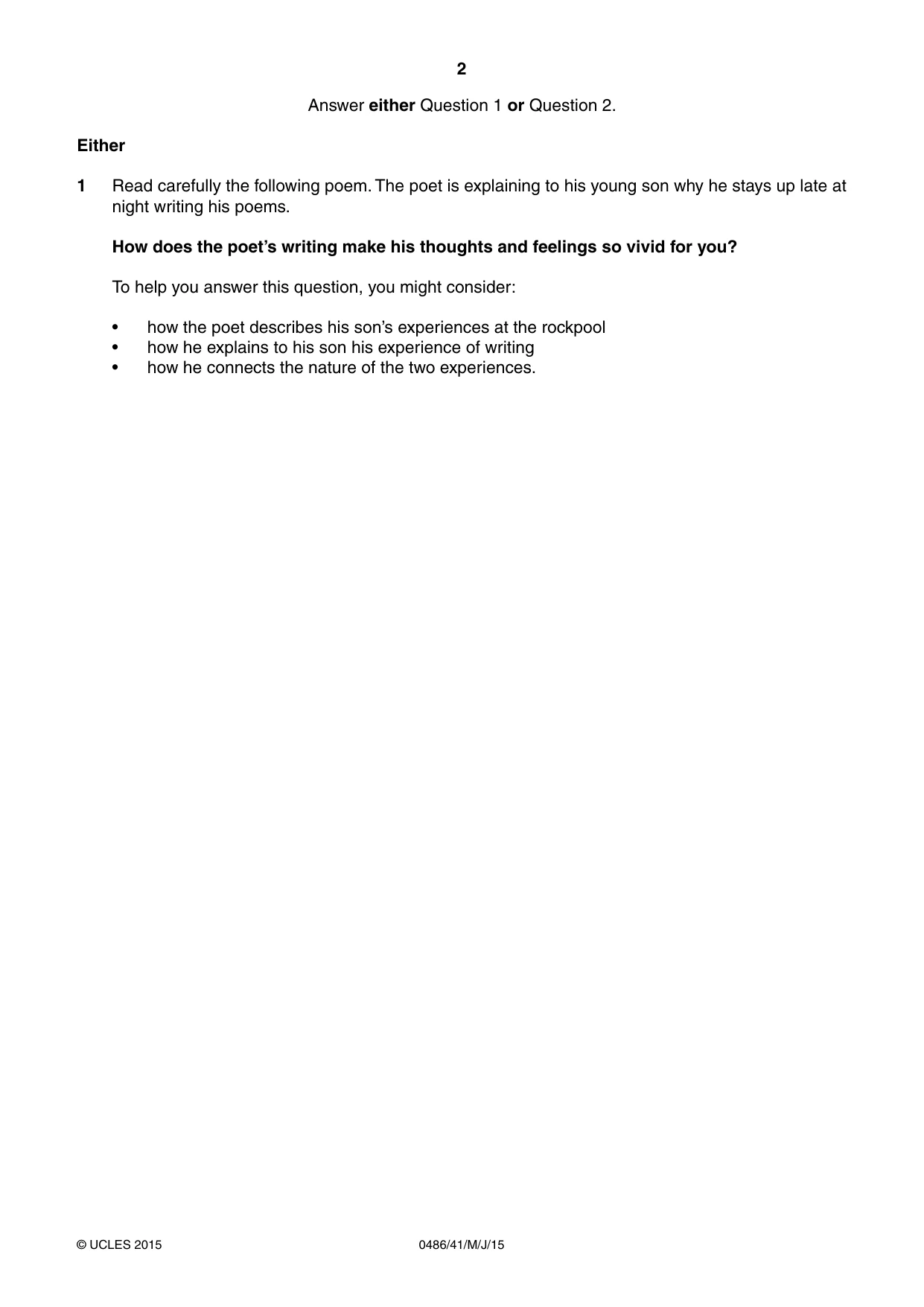
2 0486/41/M/J/15 © UCLES 2015 Answer either Question 1 or Question 2. Either 1 Read carefully the following poem. The poet is explaining to his young son why he stays up late at night writing his poems. How does the poet’s writing make his thoughts and feelings so vivid for you? To help you answer this question, you might consider: • how the poet describes his son’s experiences at the rockpool • how he explains to his son his experience of writing • how he connects the nature of the two experiences.
Question paper, page 3
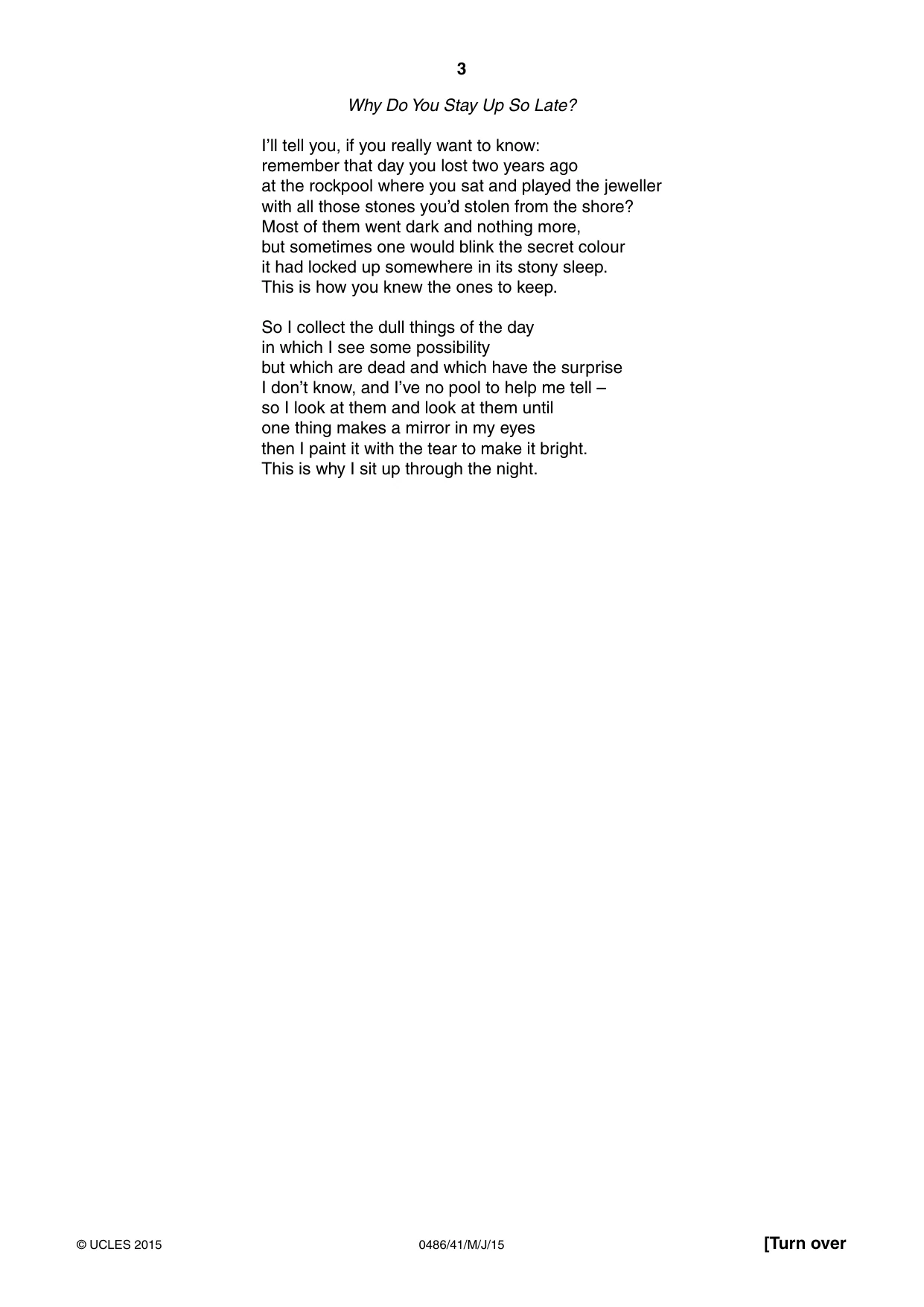
3 0486/41/M/J/15 © UCLES 2015 [Turn over Why Do You Stay Up So Late? I’ll tell you, if you really want to know: remember that day you lost two years ago at the rockpool where you sat and played the jeweller with all those stones you’d stolen from the shore? Most of them went dark and nothing more, but sometimes one would blink the secret colour it had locked up somewhere in its stony sleep. This is how you knew the ones to keep. So I collect the dull things of the day in which I see some possibility but which are dead and which have the surprise I don’t know, and I’ve no pool to help me tell – so I look at them and look at them until one thing makes a mirror in my eyes then I paint it with the tear to make it bright. This is why I sit up through the night.
Question paper, page 4
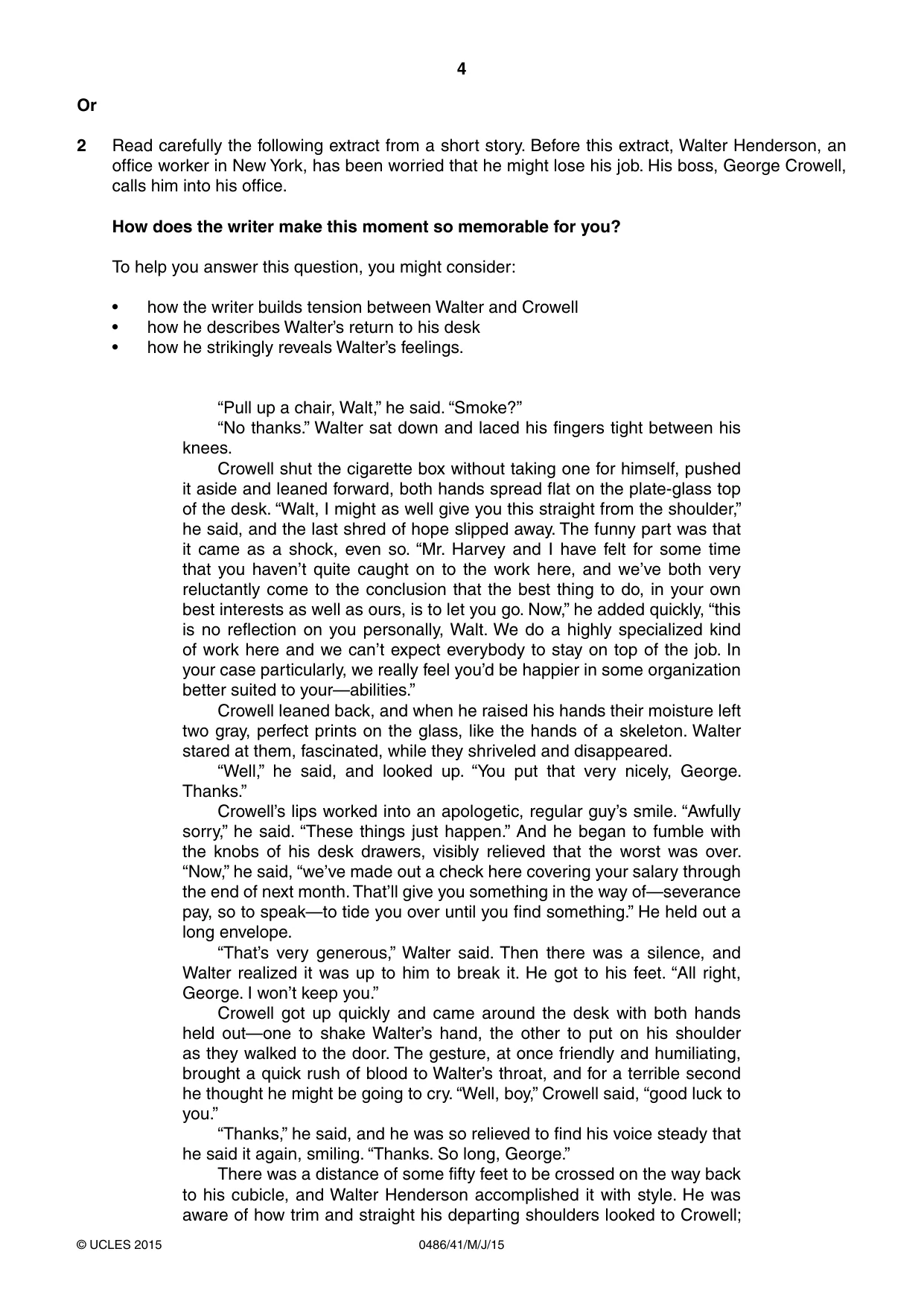
4 0486/41/M/J/15 © UCLES 2015 Or 2 Read carefully the following extract from a short story. Before this extract, Walter Henderson, an office worker in New York, has been worried that he might lose his job. His boss, George Crowell, calls him into his office. How does the writer make this moment so memorable for you? To help you answer this question, you might consider: • how the writer builds tension between Walter and Crowell • how he describes Walter’s return to his desk • how he strikingly reveals Walter’s feelings. “Pull up a chair, Walt,” he said. “Smoke?” “No thanks.” Walter sat down and laced his fingers tight between his knees. Crowell shut the cigarette box without taking one for himself, pushed it aside and leaned forward, both hands spread flat on the plate-glass top of the desk. “Walt, I might as well give you this straight from the shoulder,” he said, and the last shred of hope slipped away. The funny part was that it came as a shock, even so. “Mr. Harvey and I have felt for some time that you haven’t quite caught on to the work here, and we’ve both very reluctantly come to the conclusion that the best thing to do, in your own best interests as well as ours, is to let you go. Now,” he added quickly, “this is no reflection on you personally, Walt. We do a highly specialized kind of work here and we can’t expect everybody to stay on top of the job. In your case particularly, we really feel you’d be happier in some organization better suited to your—abilities.” Crowell leaned back, and when he raised his hands their moisture left two gray, perfect prints on the glass, like the hands of a skeleton. Walter stared at them, fascinated, while they shriveled and disappeared. “Well,” he said, and looked up. “You put that very nicely, George. Thanks.” Crowell’s lips worked into an apologetic, regular guy’s smile. “Awfully sorry,” he said. “These things just happen.” And he began to fumble with the knobs of his desk drawers, visibly relieved that the worst was over. “Now,” he said, “we’ve made out a check here covering your salary through the end of next month. That’ll give you something in the way of—severance pay, so to speak—to tide you over until you find something.” He held out a long envelope. “That’s very generous,” Walter said. Then there was a silence, and Walter realized it was up to him to break it. He got to his feet. “All right, George. I won’t keep you.” Crowell got up quickly and came around the desk with both hands held out—one to shake Walter’s hand, the other to put on his shoulder as they walked to the door. The gesture, at once friendly and humiliating, brought a quick rush of blood to Walter’s throat, and for a terrible second he thought he might be going to cry. “Well, boy,” Crowell said, “good luck to you.” “Thanks,” he said, and he was so relieved to find his voice steady that he said it again, smiling. “Thanks. So long, George.” There was a distance of some fifty feet to be crossed on the way back to his cubicle, and Walter Henderson accomplished it with style. He was aware of how trim and straight his departing shoulders looked to Crowell;
Question paper, page 5
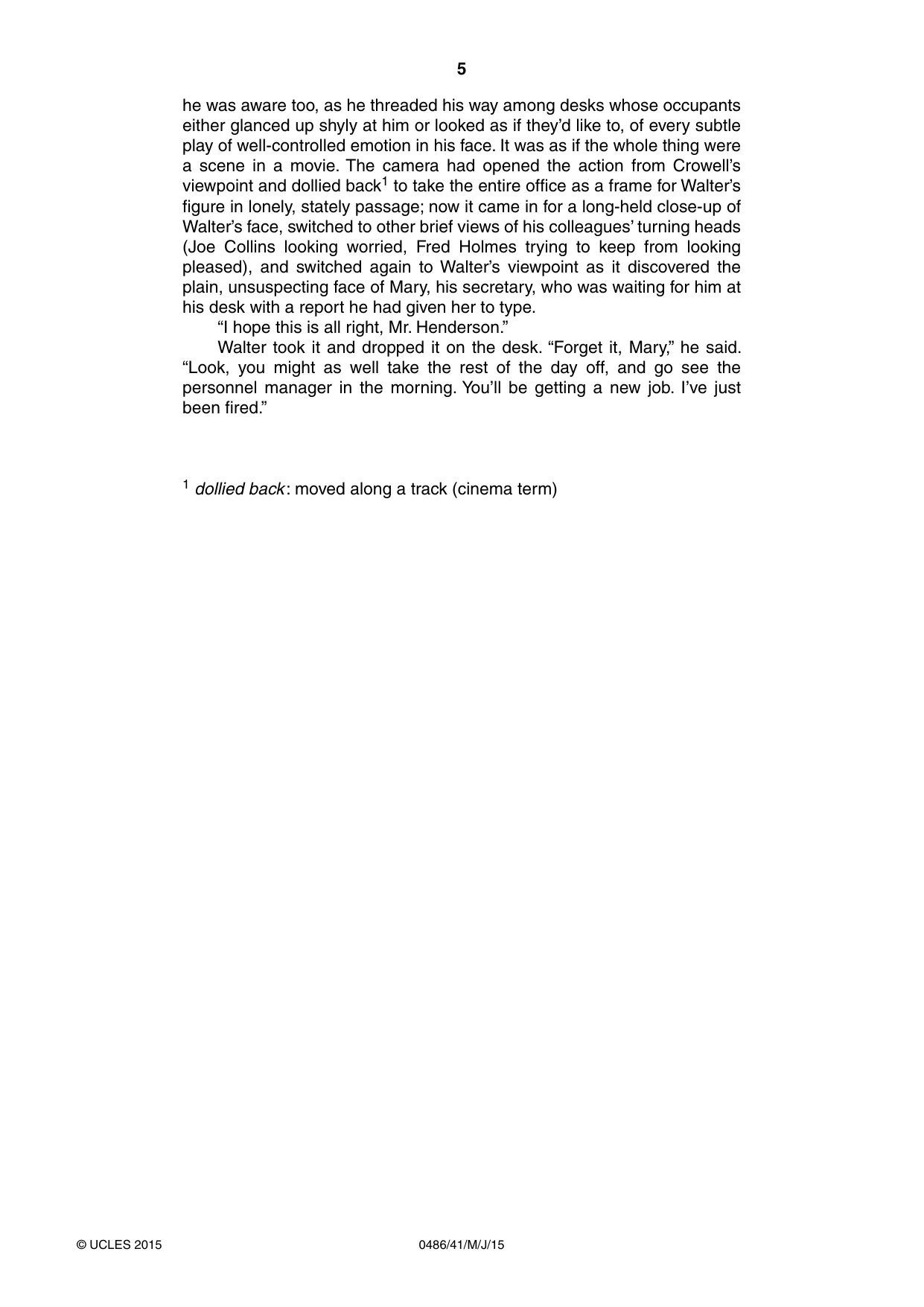
5 0486/41/M/J/15 © UCLES 2015 he was aware too, as he threaded his way among desks whose occupants either glanced up shyly at him or looked as if they’d like to, of every subtle play of well-controlled emotion in his face. It was as if the whole thing were a scene in a movie. The camera had opened the action from Crowell’s viewpoint and dollied back1 to take the entire office as a frame for Walter’s figure in lonely, stately passage; now it came in for a long-held close-up of Walter’s face, switched to other brief views of his colleagues’ turning heads (Joe Collins looking worried, Fred Holmes trying to keep from looking pleased), and switched again to Walter’s viewpoint as it discovered the plain, unsuspecting face of Mary, his secretary, who was waiting for him at his desk with a report he had given her to type. “I hope this is all right, Mr. Henderson.” Walter took it and dropped it on the desk. “Forget it, Mary,” he said. “Look, you might as well take the rest of the day off, and go see the personnel manager in the morning. You’ll be getting a new job. I’ve just been fired.” 1 dollied back : moved along a track (cinema term)
Question paper, page 6
6 0486/41/M/J/15 © UCLES 2015 BLANK PAGE
Question paper, page 7
7 0486/41/M/J/15 © UCLES 2015 BLANK PAGE
Question paper, page 8
8 0486/41/M/J/15 © UCLES 2015 Permission to reproduce items where third-party owned material protected by copyright is included has been sought and cleared where possible. Every reasonable effort has been made by the publisher (UCLES) to trace copyright holders, but if any items requiring clearance have unwittingly been included, the publisher will be pleased to make amends at the earliest possible opportunity. To avoid the issue of disclosure of answer-related information to candidates, all copyright acknowledgements are reproduced online in the Cambridge International Examinations Copyright Acknowledgements Booklet. This is produced for each series of examinations and is freely available to download at www.cie.org.uk after the live examination series. Cambridge International Examinations is part of the Cambridge Assessment Group. Cambridge Assessment is the brand name of University of Cambridge Local Examinations Syndicate (UCLES), which is itself a department of the University of Cambridge. BLANK PAGE
Mark scheme, page 1
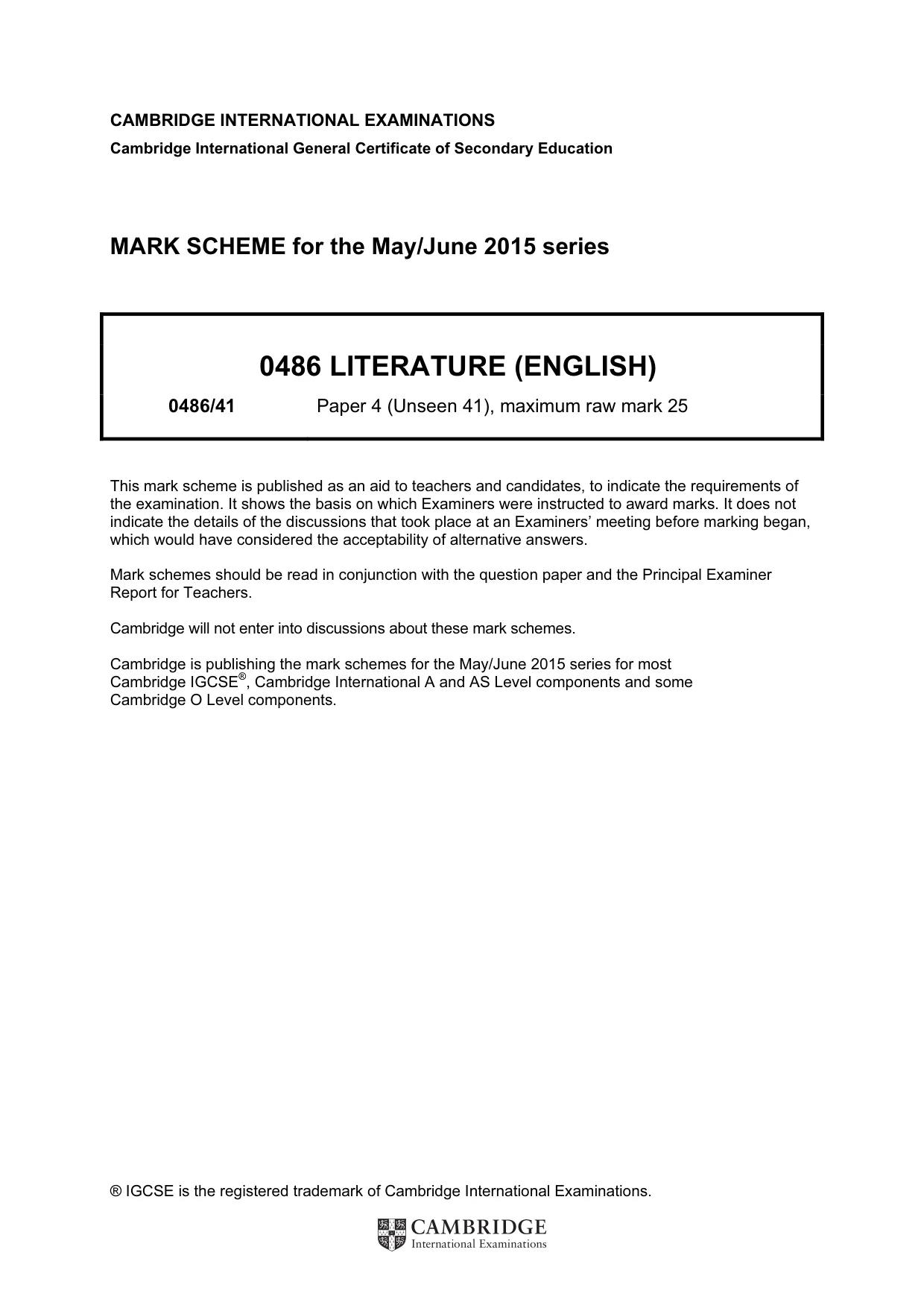
® IGCSE is the registered trademark of Cambridge International Examinations. CAMBRIDGE INTERNATIONAL EXAMINATIONS Cambridge International General Certificate of Secondary Education MARK SCHEME for the May/June 2015 series 0486 LITERATURE (ENGLISH) 0486/41 Paper 4 (Unseen 41), maximum raw mark 25 This mark scheme is published as an aid to teachers and candidates, to indicate the requirements of the examination. It shows the basis on which Examiners were instructed to award marks. It does not indicate the details of the discussions that took place at an Examiners’ meeting before marking began, which would have considered the acceptability of alternative answers. Mark schemes should be read in conjunction with the question paper and the Principal Examiner Report for Teachers. Cambridge will not enter into discussions about these mark schemes. Cambridge is publishing the mark schemes for the May/June 2015 series for most Cambridge IGCSE®, Cambridge International A and AS Level components and some Cambridge O Level components.
Mark scheme, page 2
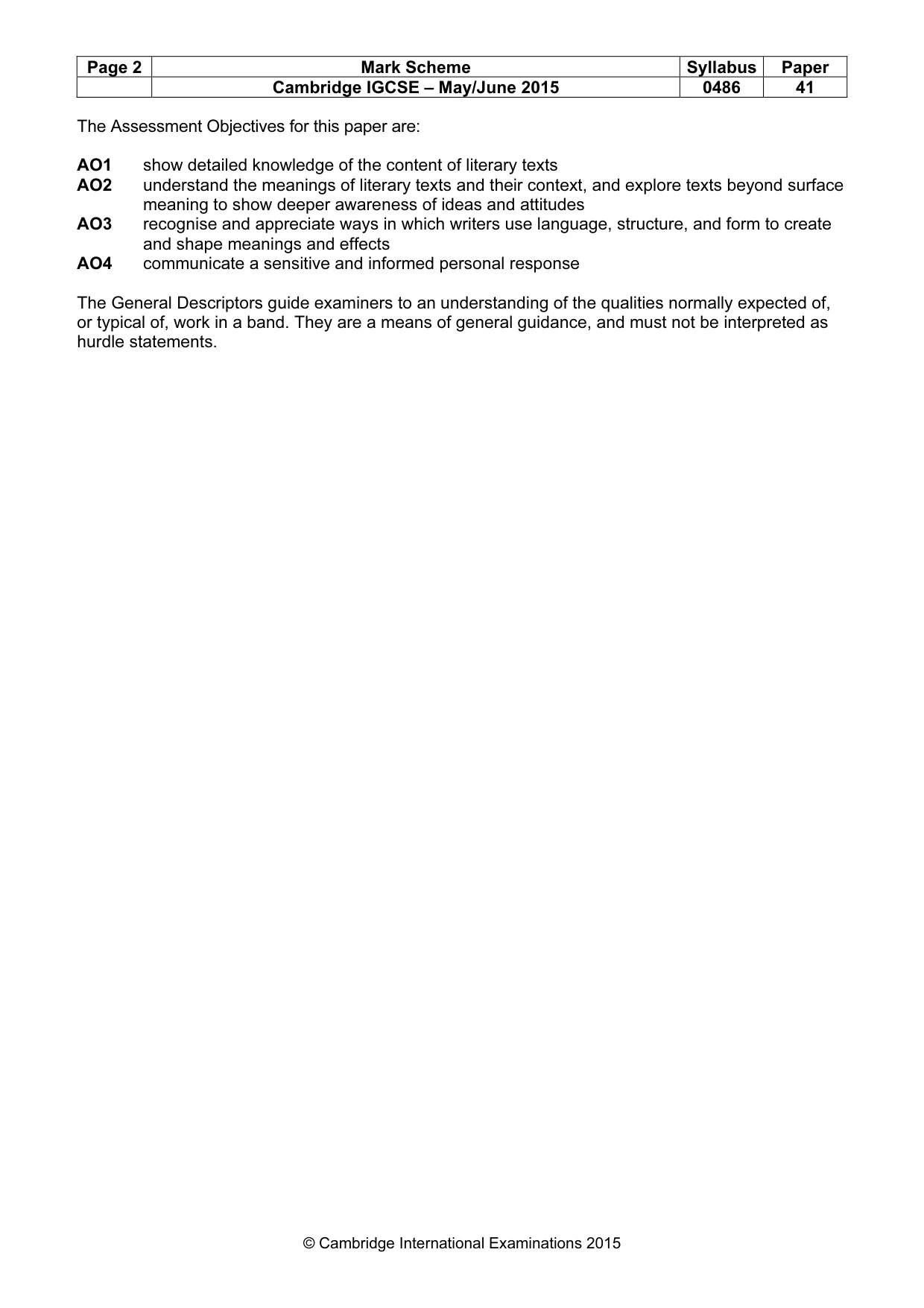
Page 2 Mark Scheme Syllabus Paper Cambridge IGCSE – May/June 2015 0486 41 © Cambridge International Examinations 2015 The Assessment Objectives for this paper are: AO1 show detailed knowledge of the content of literary texts AO2 understand the meanings of literary texts and their context, and explore texts beyond surface meaning to show deeper awareness of ideas and attitudes AO3 recognise and appreciate ways in which writers use language, structure, and form to create and shape meanings and effects AO4 communicate a sensitive and informed personal response The General Descriptors guide examiners to an understanding of the qualities normally expected of, or typical of, work in a band. They are a means of general guidance, and must not be interpreted as hurdle statements.
Mark scheme, page 3
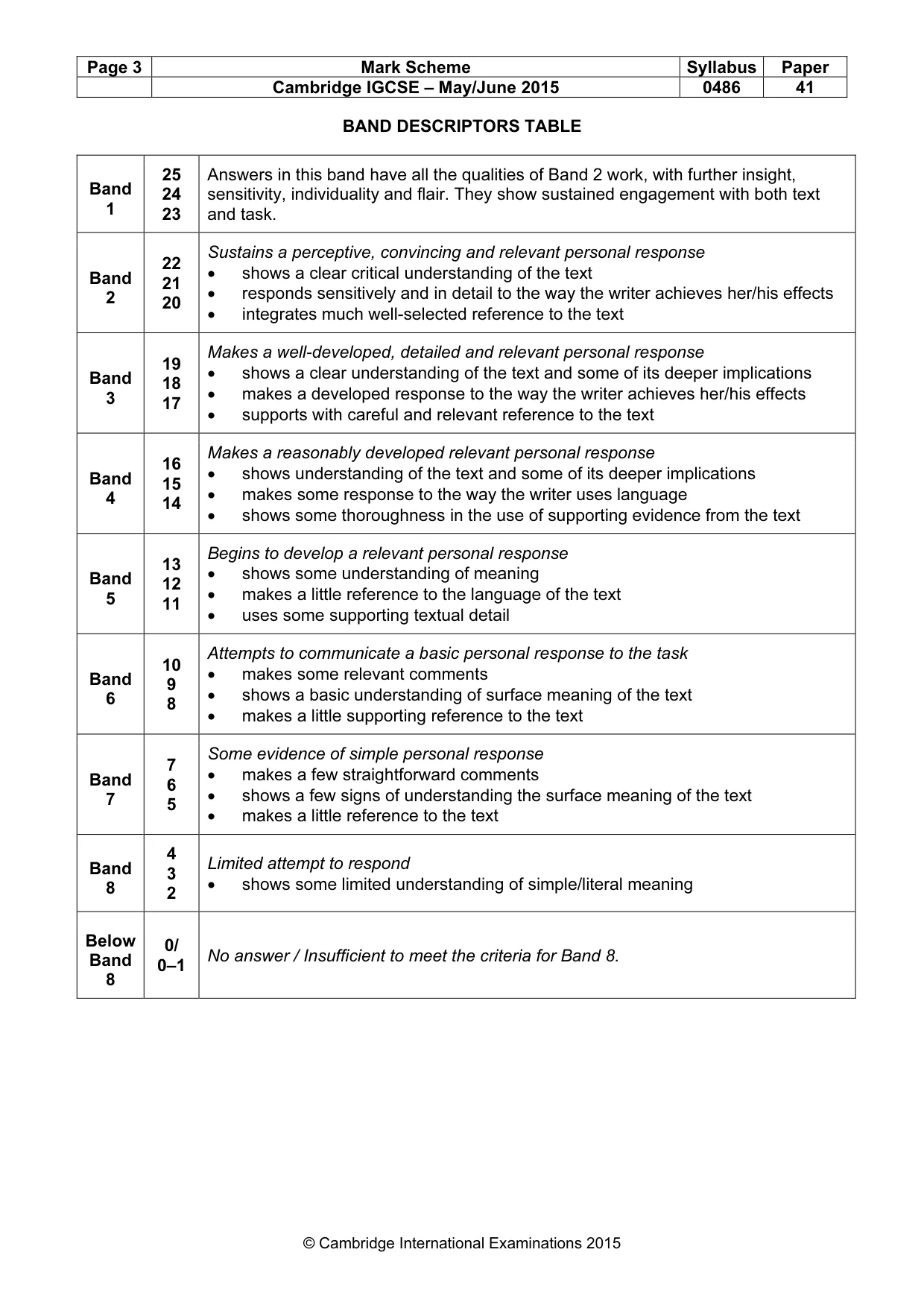
Page 3 Mark Scheme Syllabus Paper Cambridge IGCSE – May/June 2015 0486 41 © Cambridge International Examinations 2015 BAND DESCRIPTORS TABLE Band 1 25 24 23 Answers in this band have all the qualities of Band 2 work, with further insight, sensitivity, individuality and flair. They show sustained engagement with both text and task. Band 2 22 21 20 Sustains a perceptive, convincing and relevant personal response • shows a clear critical understanding of the text • responds sensitively and in detail to the way the writer achieves her/his effects • integrates much well-selected reference to the text Band 3 19 18 17 Makes a well-developed, detailed and relevant personal response • shows a clear understanding of the text and some of its deeper implications • makes a developed response to the way the writer achieves her/his effects • supports with careful and relevant reference to the text Band 4 16 15 14 Makes a reasonably developed relevant personal response • shows understanding of the text and some of its deeper implications • makes some response to the way the writer uses language • shows some thoroughness in the use of supporting evidence from the text Band 5 13 12 11 Begins to develop a relevant personal response • shows some understanding of meaning • makes a little reference to the language of the text • uses some supporting textual detail Band 6 10 9 8 Attempts to communicate a basic personal response to the task • makes some relevant comments • shows a basic understanding of surface meaning of the text • makes a little supporting reference to the text Band 7 7 6 5 Some evidence of simple personal response • makes a few straightforward comments • shows a few signs of understanding the surface meaning of the text • makes a little reference to the text Band 8 4 3 2 Limited attempt to respond • shows some limited understanding of simple/literal meaning Below Band 8 0/ 0–1 No answer / Insufficient to meet the criteria for Band 8.
What you needed in this session
Cambridge’s own grade thresholds for 2015 May/June, Paper 4 · Variant 1. A higher threshold means an easier paper — the bar moves with how the cohort did.