Questions as text
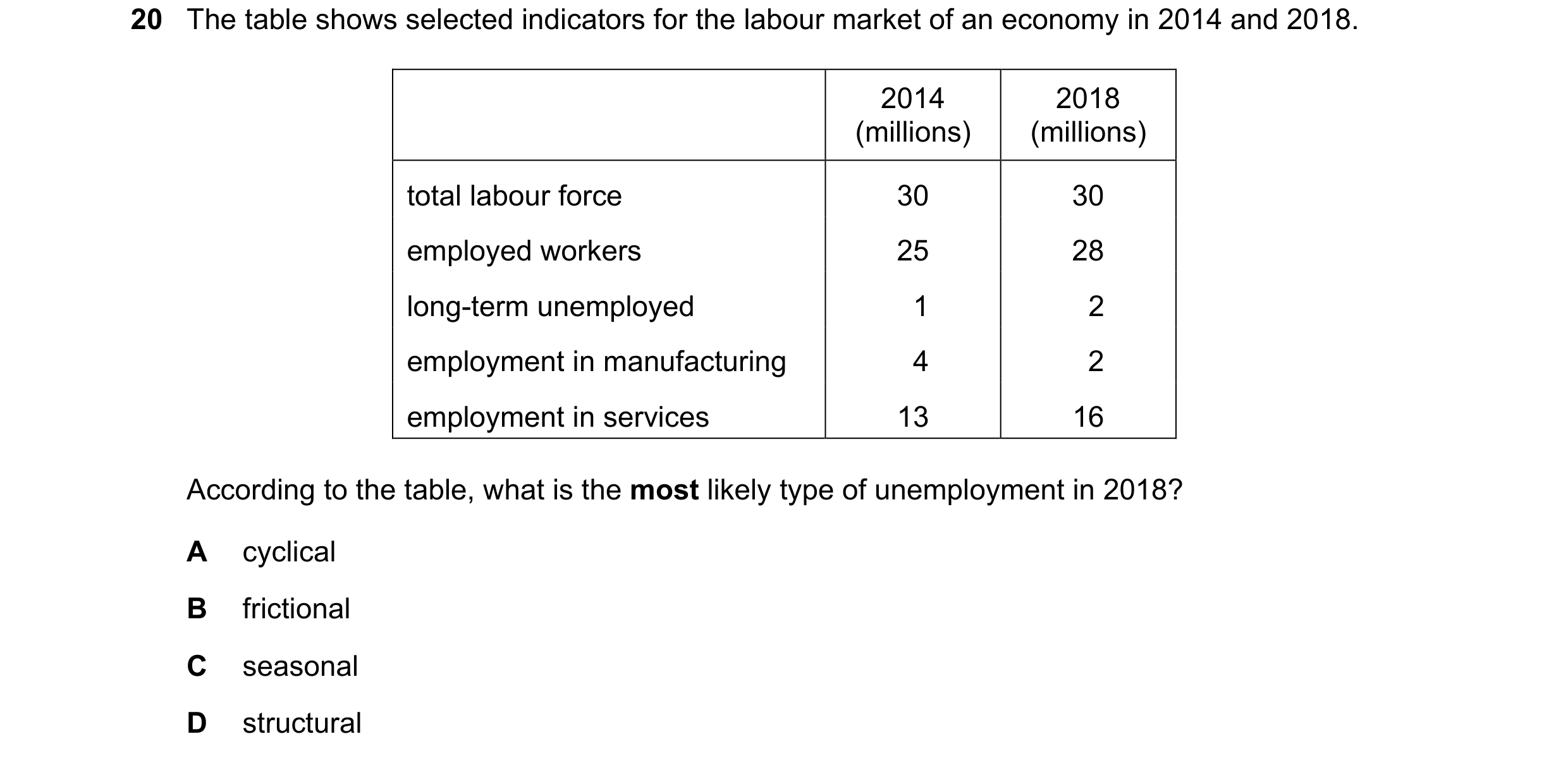
Q1 · The table shows selected indicators for the labour market of an economy in 2014 and 2018 0987/11 May/June 2020
20 The table shows selected indicators for the labour market of an economy in 2014 and 2018. 2014 2018 (millions) (millions) total labour force 30 30 employed workers 25 28 long-term unemployed 1 2 employment in manufacturing 4 2 employment in services 13 16 According to the table, what is the most likely type of unemployment in 2018? A cyclical B frictional C seasonal D structural
1 marks
Answer: D
This question in 0987/11 May/June 2020
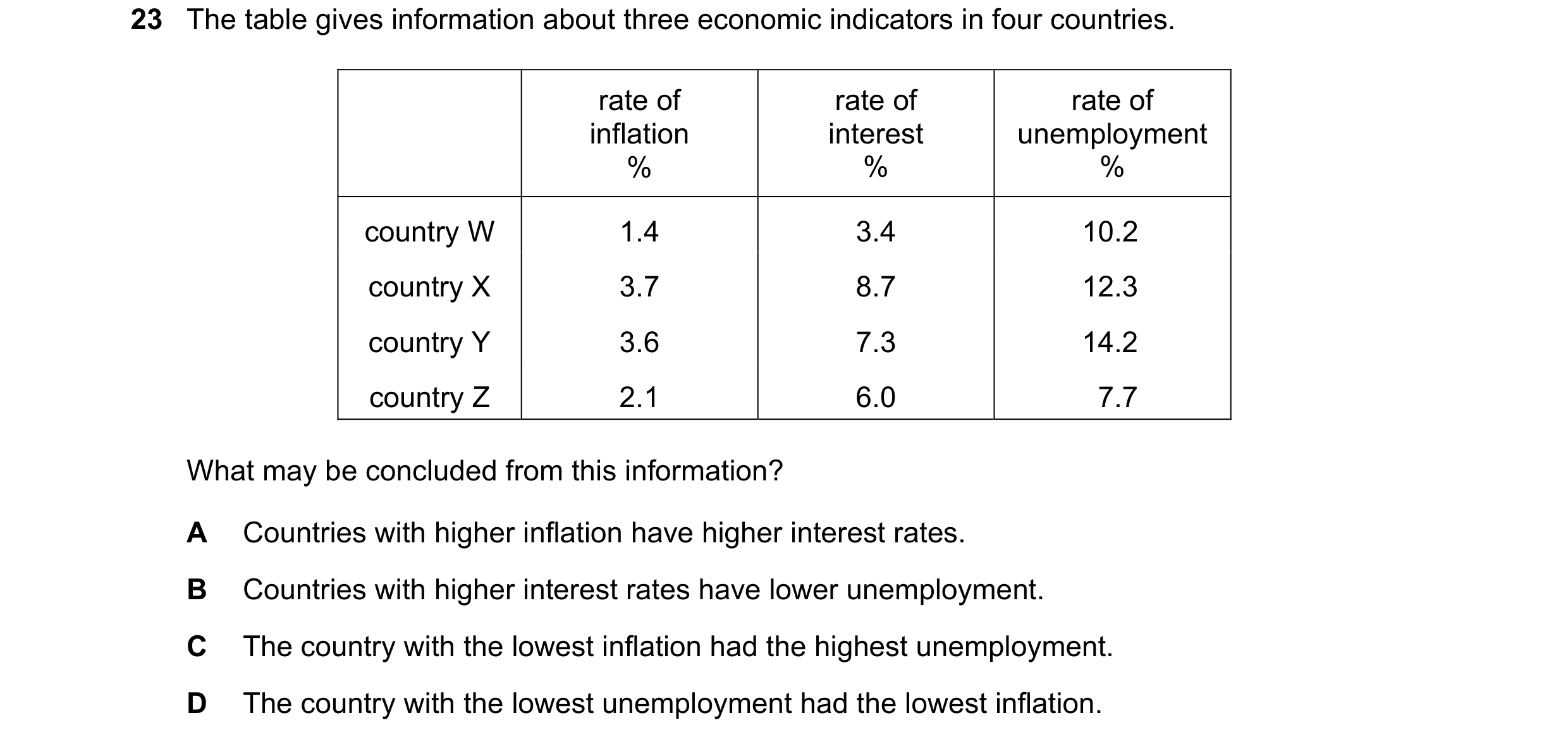
Q2 · The table gives information about three economic indicators in four countries 0987/11 May/June 2020
23 The table gives information about three economic indicators in four countries. rate of rate of rate of inflation interest unemployment % % % country W 1.4 3.4 10.2 country X 3.7 8.7 12.3 country Y 3.6 7.3 14.2 country Z 2.1 6.0 7.7 What may be concluded from this information? A Countries with higher inflation have higher interest rates. B Countries with higher interest rates have lower unemployment. C The country with the lowest inflation had the highest unemployment. D The country with the lowest unemployment had the lowest inflation.
1 marks
Answer: A
This question in 0987/11 May/June 2020
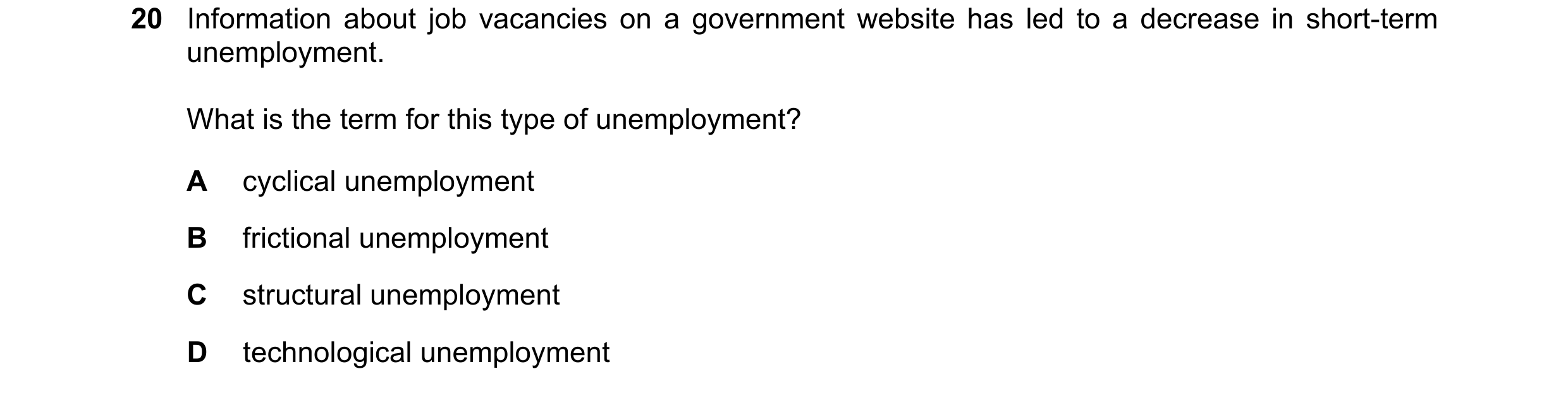
Q3 · Information about job vacancies on a government website has led to a decrease in… 0987/12 May/June 2020
20 Information about job vacancies on a government website has led to a decrease in short-term unemployment. What is the term for this type of unemployment? A cyclical unemployment B frictional unemployment C structural unemployment D technological unemployment
1 marks
Answer: B
This question in 0987/12 May/June 2020
Q4 · Which group should not be included in the measurement of unemployment? 0987/12 Oct/Nov 2020
20 Which group should not be included in the measurement of unemployment? A redundant unskilled workers seeking alternative work B seasonal agricultural workers in out-of-season periods C students over 18 years continuing with full-time education D those who have left school and cannot get a job
1 marks
Answer: C
This question in 0987/12 Oct/Nov 2020
Q5 · Which supply-side policy measure would help to match the skills of workers to job… 0987/12 Oct/Nov 2021
20 Which supply-side policy measure would help to match the skills of workers to job vacancies? A encouraging the modernisation of factories B offering retraining to unemployed workers C reducing taxes to provide incentives to work D replacing government enterprises with private enterprises
1 marks
Answer: B
This question in 0987/12 Oct/Nov 2021
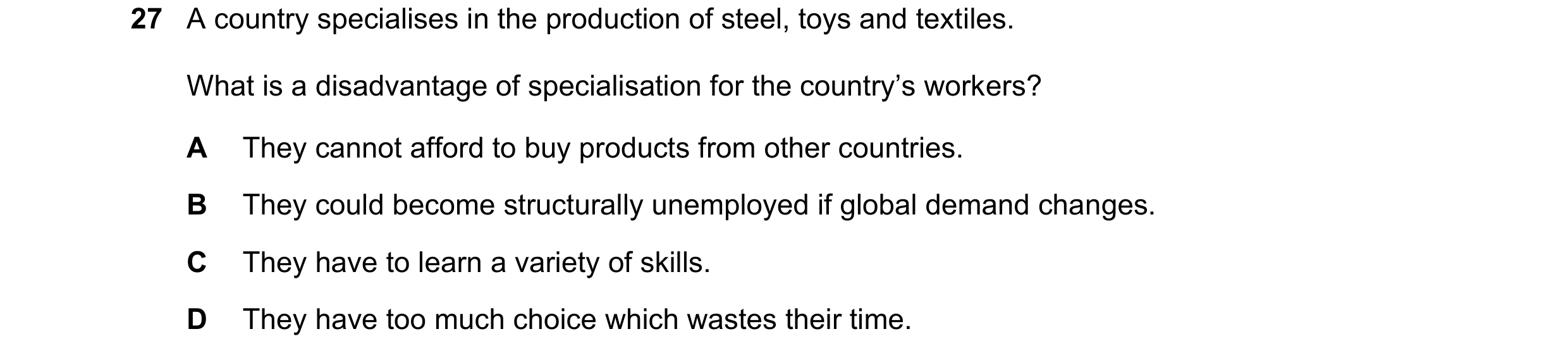
Q6 · A country specialises in the production of steel, toys and textiles 0987/12 Oct/Nov 2021
27 A country specialises in the production of steel, toys and textiles. What is a disadvantage of specialisation for the country’s workers? A They cannot afford to buy products from other countries. B They could become structurally unemployed if global demand changes. C They have to learn a variety of skills. D They have too much choice which wastes their time.
1 marks
Answer: B
This question in 0987/12 Oct/Nov 2021
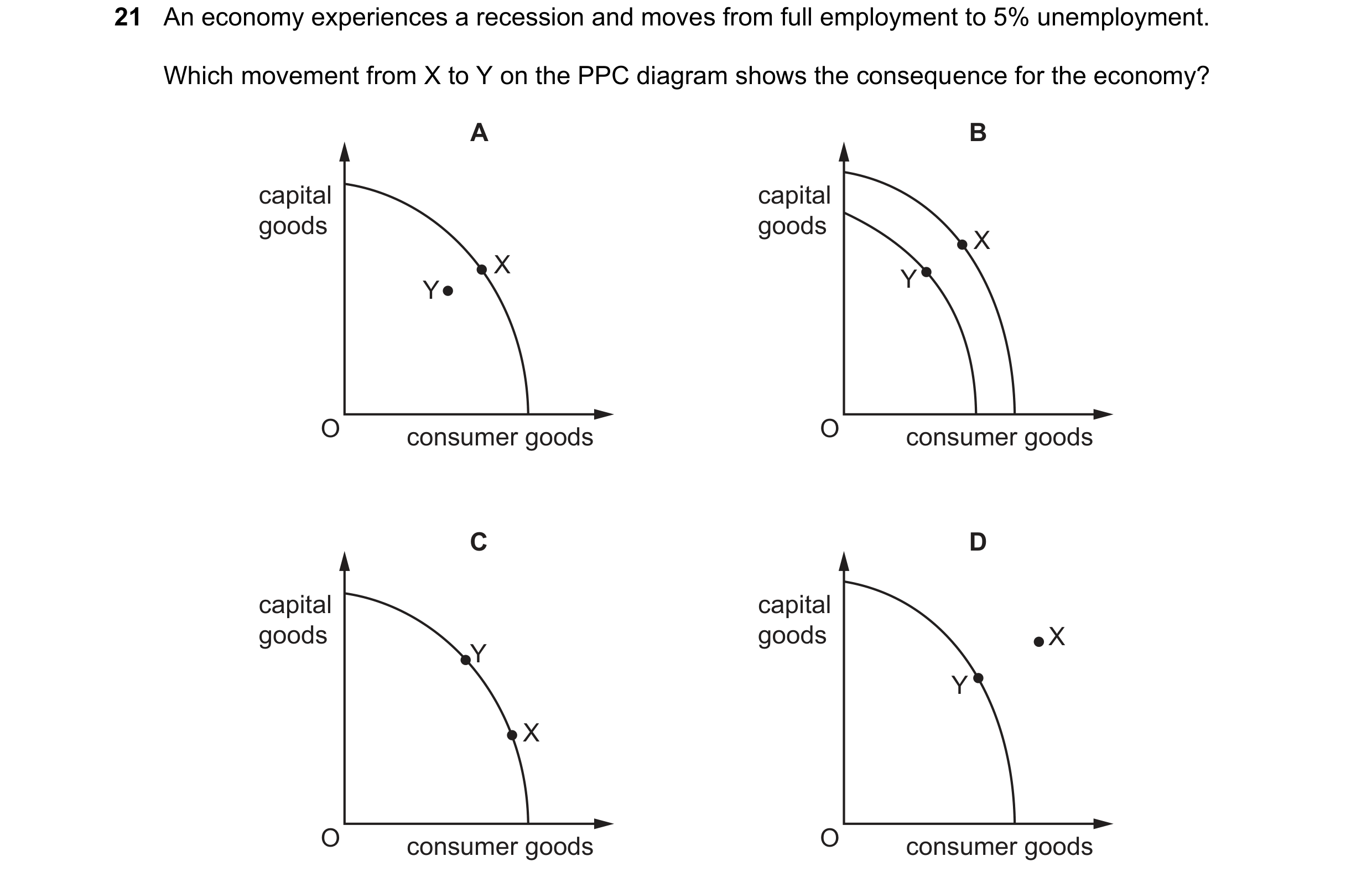
Q7 · An economy experiences a recession and moves from full employment to 5% unemployment 0987/11 May/June 2022
21 An economy experiences a recession and moves from full employment to 5% unemployment. Which movement from X to Y on the PPC diagram shows the consequence for the economy? A B capital capital goods goods X X Y Y O consumer goods O consumer goods C D capital capital goods goods X Y Y X O consumer goods O consumer goods
1 marks
Answer: A
This question in 0987/11 May/June 2022
Q8 · The retail trade in a country has unemployed workers in one region and job vacancies in… 0987/12 May/June 2022
21 The retail trade in a country has unemployed workers in one region and job vacancies in another region. What could explain this? A Costs of employing workers are lower when there is unemployment. B It is more expensive to live in the area where the retail jobs are available. C Retailing demands the same skills everywhere. D The geographical mobility of labour has increased.
1 marks
Answer: B
This question in 0987/12 May/June 2022
Q9 · What is the definition of the unemployment rate? 0987/12 Oct/Nov 2022
21 What is the definition of the unemployment rate? A the benefits and allowances paid by the government to people without a job B the number of people without a job but seeking a job as a percentage of the labour force C the rate of change in the number of people who have not worked over the last year D the total number of people not working when the data was calculated
1 marks
Answer: B
This question in 0987/12 Oct/Nov 2022
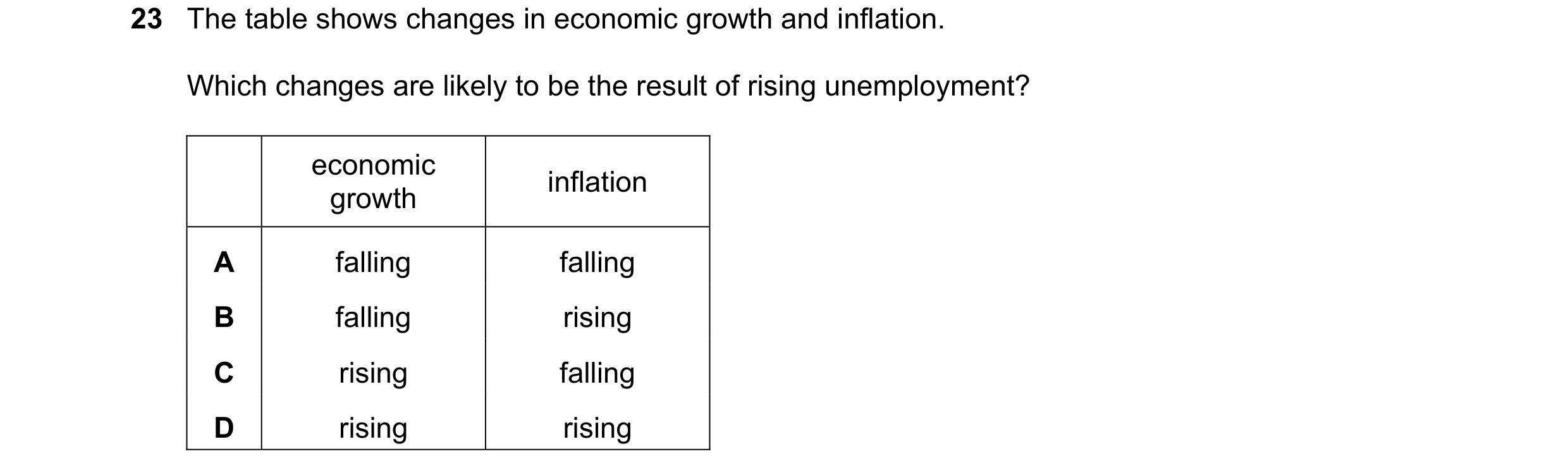
Q10 · The table shows changes in economic growth and inflation 0987/12 Oct/Nov 2022
23 The table shows changes in economic growth and inflation. Which changes are likely to be the result of rising unemployment? economic inflation growth A falling falling B falling rising C rising falling D rising rising
1 marks
Answer: A
This question in 0987/12 Oct/Nov 2022
Q11 · Government policy measures can affect economic activity in a country 0987/11 May/June 2023
18 Government policy measures can affect economic activity in a country. Which pair of monetary policy measures would be likely to increase employment? A depreciate foreign exchange rates and increase education spending B increase money supply and reduce interest rates C provide subsidies and grants and lower sales tax D reduce income tax and improve infrastructure
1 marks
Answer: B
This question in 0987/11 May/June 2023
Q12 · What is most likely to lead to an increase in structural unemployment in a country? 0987/11 May/June 2023
22 What is most likely to lead to an increase in structural unemployment in a country? A The country is experiencing a period of negative economic growth. B The country is experiencing a period of positive economic growth. C The country is moving from producing primary sector goods to secondary sector goods. D The country is moving towards more flexible labour markets.
1 marks
Answer: C
This question in 0987/11 May/June 2023
Q13 · What is a likely consequence of a falling level of unemployment? 0987/12 May/June 2023
22 What is a likely consequence of a falling level of unemployment? A downward pressure on wage rates B increase in welfare benefit payments C rise in absolute poverty D rise in income tax revenue
1 marks
Answer: D
This question in 0987/12 May/June 2023
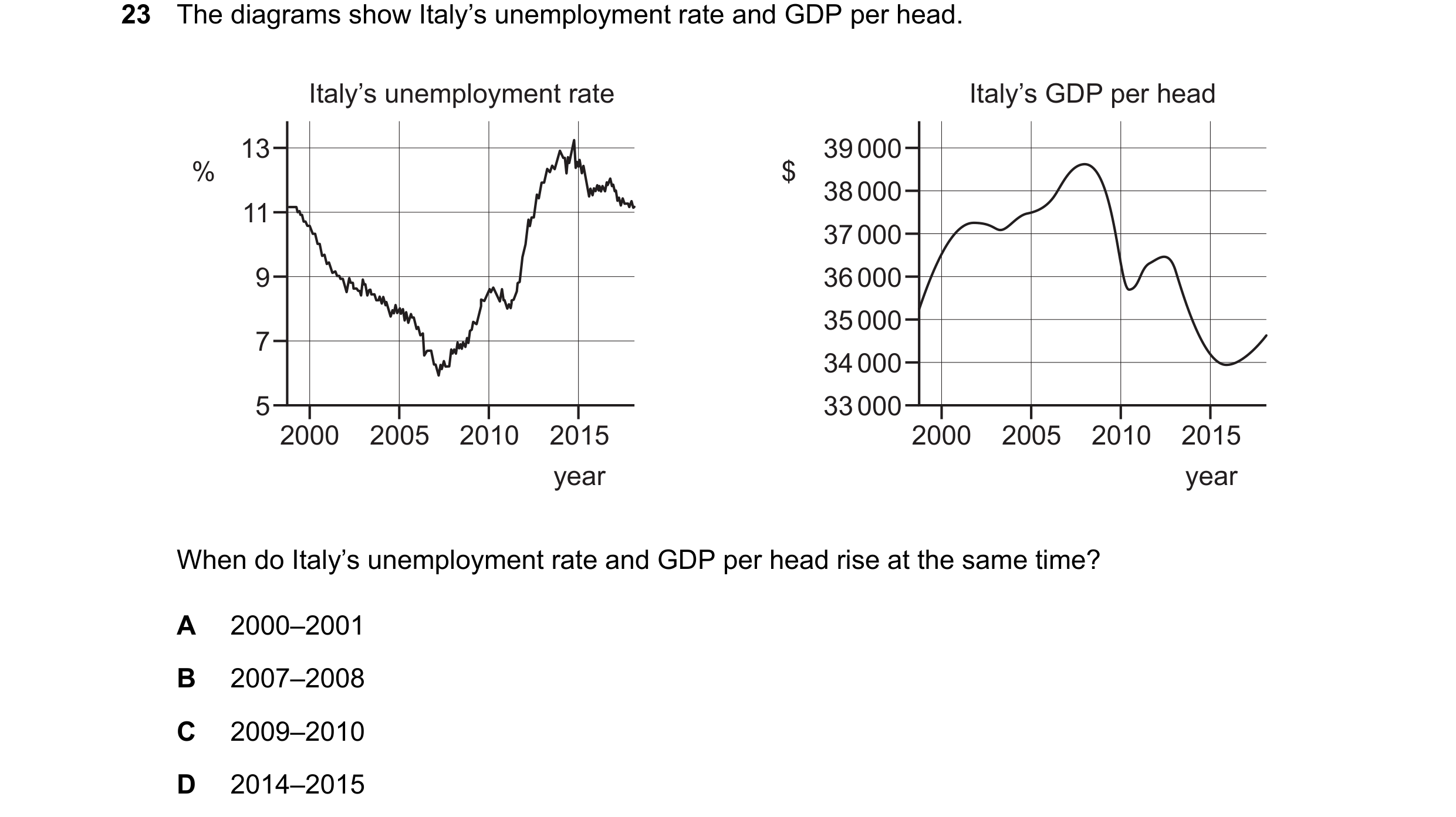
Q14 · The diagrams show Italy’s unemployment rate and GDP per head 0987/12 May/June 2023
23 The diagrams show Italy’s unemployment rate and GDP per head. Italy’s unemployment rate Italy’s GDP per head 13 39 000 % $ 38 000 11 37 000 9 36 000 35 000 7 34 000 5 33 000 2000 2005 2010 2015 2000 2005 2010 2015 year year When do Italy’s unemployment rate and GDP per head rise at the same time? A 2000–2001 B 2007–2008 C 2009–2010 D 2014–2015
1 marks
Answer: B
This question in 0987/12 May/June 2023
Q15 · Why would devaluing the international value of an economy’s currency help reduce… 0987/12 Oct/Nov 2023
18 Why would devaluing the international value of an economy’s currency help reduce unemployment? A Devaluing the currency would increase the cost of production. B Devaluing the currency would increase the confidence of investors. C Devaluing the currency would increase the foreign demand for domestic products. D Devaluing the currency would increase the demand for imports.
1 marks
Answer: C
This question in 0987/12 Oct/Nov 2023
Q16 · Which change to fiscal policy is most likely to reduce cyclical unemployment in an… 0987/12 Oct/Nov 2023
22 Which change to fiscal policy is most likely to reduce cyclical unemployment in an economy? A increasing direct taxation B increasing the budget deficit C increasing the budget surplus D increasing the money supply
1 marks
Answer: B
This question in 0987/12 Oct/Nov 2023
Q17 · What causes cyclical unemployment in a recession? 0987/12 Oct/Nov 2024
21 What causes cyclical unemployment in a recession? A a permanent decrease in the demand for labour B a permanent decrease in the supply of labour C a temporary decrease in the demand for labour D a temporary decrease in the supply of labour
1 marks
Answer: C
This question in 0987/12 Oct/Nov 2024
Q18 · Which supply-side policy measure is most likely to enable a government to achieve its aim… 0987/11 May/June 2025
20 Which supply-side policy measure is most likely to enable a government to achieve its aim of full employment? A decreasing government spending on school buildings B decreasing the number of teachers in schools C increasing taxation on private school fees D increasing the provision of enterprise skills in schools
1 marks
Answer: D
This question in 0987/11 May/June 2025
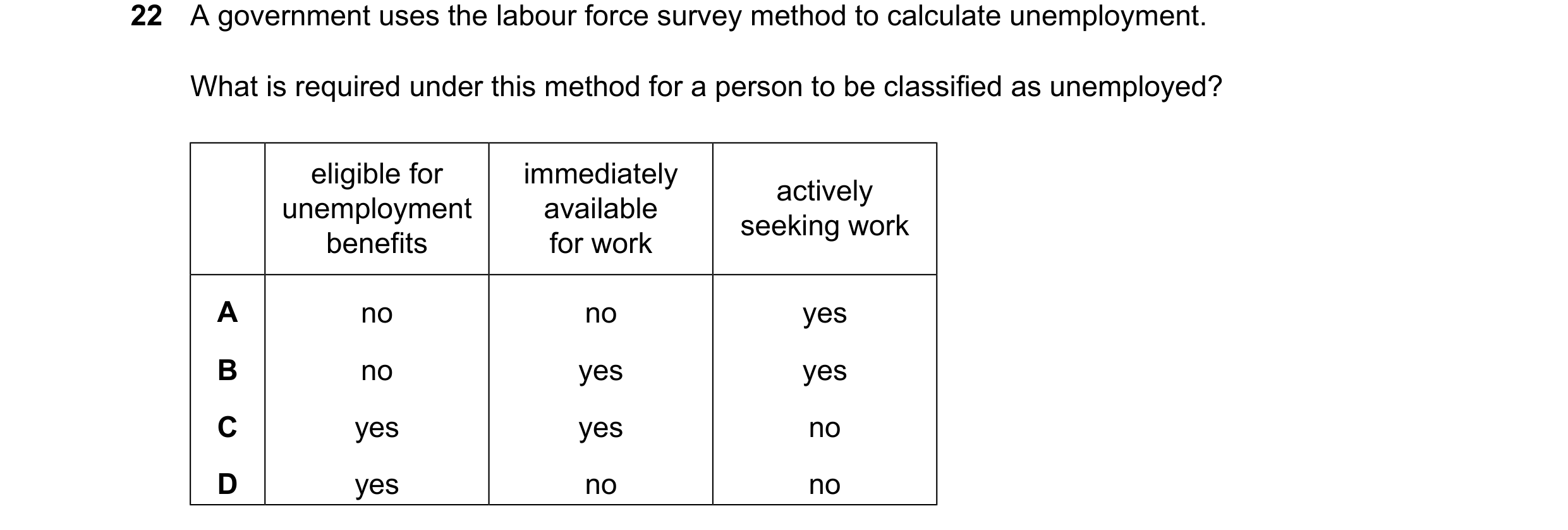
Q19 · A government uses the labour force survey method to calculate unemployment 0987/11 May/June 2025
22 A government uses the labour force survey method to calculate unemployment. What is required under this method for a person to be classified as unemployed? eligible for immediately actively unemployment available seeking work benefits for work A no no yes B no yes yes C yes yes no D yes no no
1 marks
Answer: B
This question in 0987/11 May/June 2025
Q20 · What is most likely to rise when the level of employment falls in a high-income economy? 0987/11 May/June 2025
23 What is most likely to rise when the level of employment falls in a high-income economy? A consumer confidence B government expenditure on state benefits C government revenue from income tax D the rate of growth of real output
1 marks
Answer: B
This question in 0987/11 May/June 2025
Q21 · Sanjay, a coal miner, became unemployed when the only local mine closed 0987/12 May/June 2025
2 Sanjay, a coal miner, became unemployed when the only local mine closed. He lives in a village near family and friends and would like to stay in the same village. What is the cause of Sanjay’s occupational immobility? A a desire to live near family and friends B no relevant skills C the cost of travelling for work D unaffordable housing
1 marks
Answer: B
This question in 0987/12 May/June 2025
Q22 · A government conducted a labour force survey 0987/12 May/June 2025
22 A government conducted a labour force survey. It only included people of working age in the survey. The results are shown in the table. number of people of working age 10000000 employed 7000000 unemployed 1000000 not seeking work 2000000 Which percentage of working-age people are in the labour force? A 30% B 70% C 80% D 90%
1 marks
Answer: C
This question in 0987/12 May/June 2025
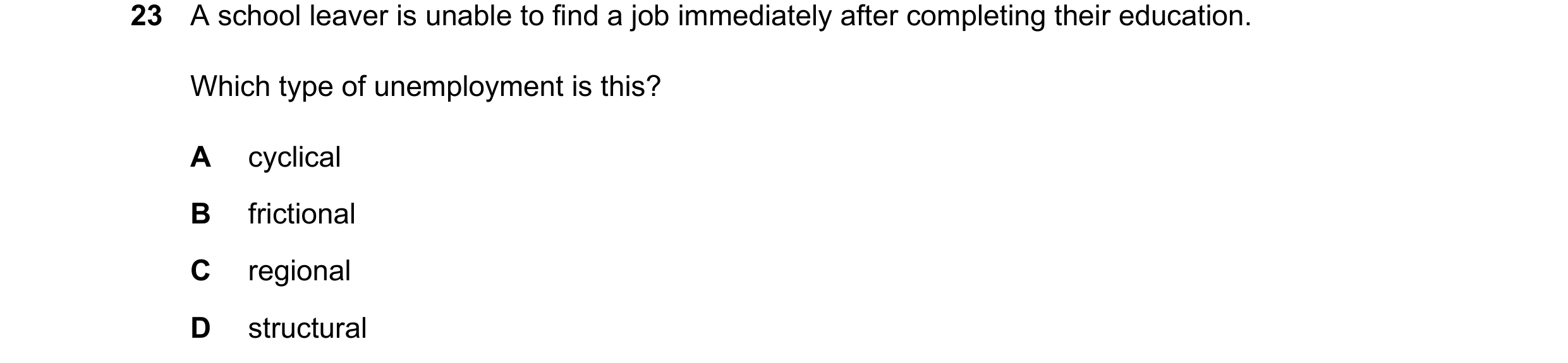
Q23 · A school leaver is unable to find a job immediately after completing their education 0987/12 May/June 2025
23 A school leaver is unable to find a job immediately after completing their education. Which type of unemployment is this? A cyclical B frictional C regional D structural
1 marks
Answer: B
This question in 0987/12 May/June 2025
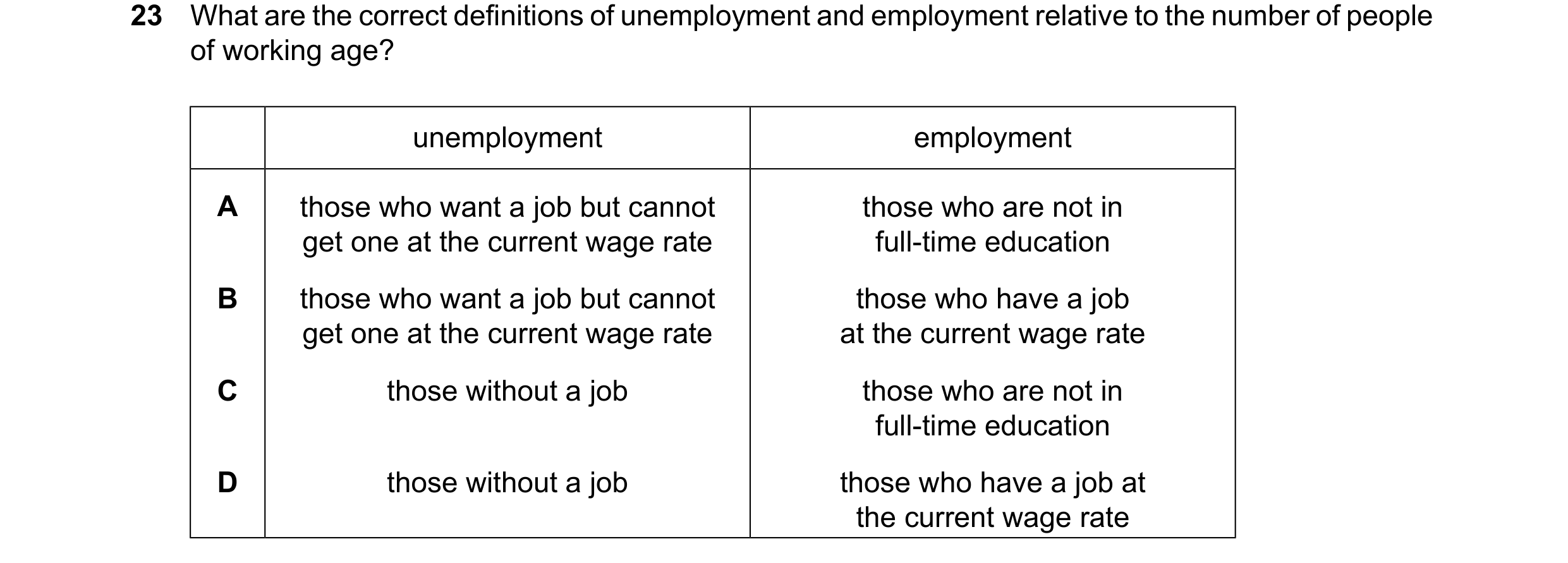
Q24 · What are the correct definitions of unemployment and employment relative to the number of… 0987/12 Oct/Nov 2025
23 What are the correct definitions of unemployment and employment relative to the number of people of working age? unemployment employment A those who want a job but cannot those who are not in get one at the current wage rate full-time education B those who want a job but cannot those who have a job get one at the current wage rate at the current wage rate C those without a job those who are not in full-time education D those without a job those who have a job at the current wage rate
1 marks
Answer: B
This question in 0987/12 Oct/Nov 2025
 1 / 6
1 / 6

 2 / 6
2 / 6

 3 / 6
3 / 6

 4 / 6
4 / 6

 5 / 6
5 / 6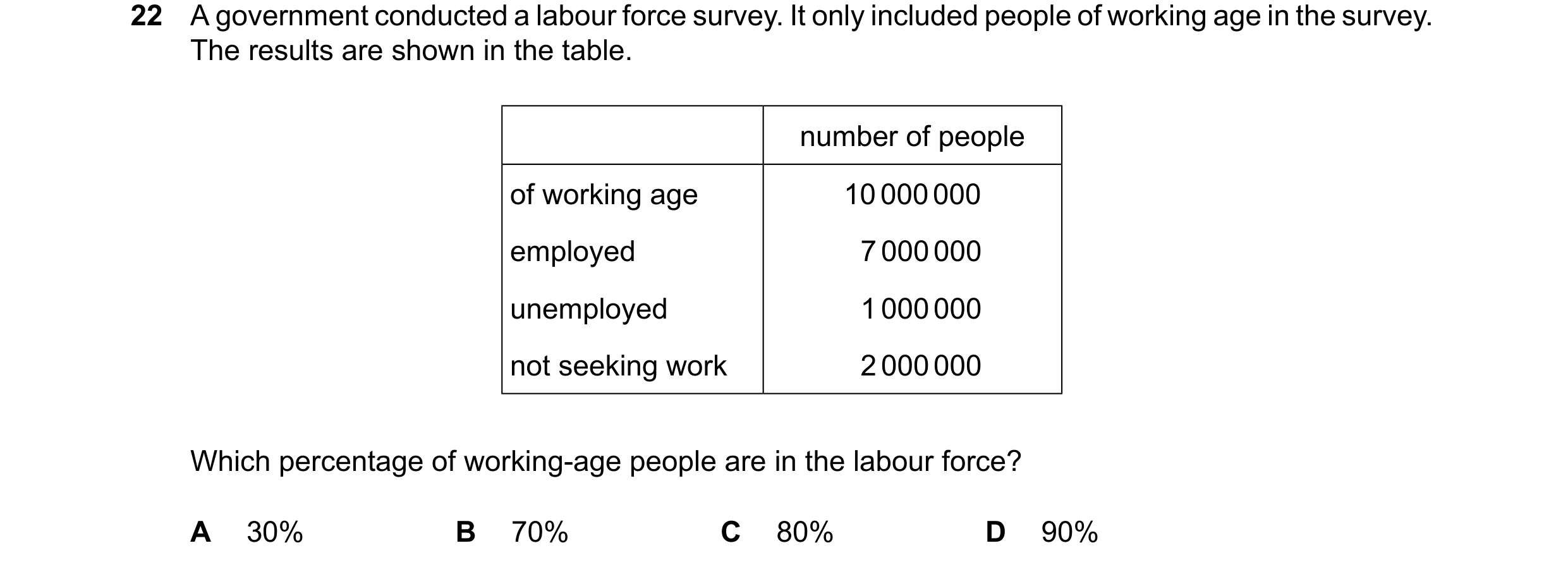
 6 / 6
6 / 6