Cambridge IGCSE Economics (9-1) 0987 — 2020 May/June Paper 1 · Variant 1
0987/11/M/J/20 · 30 questions · 30 marks · ≈34 min
The question paper and its mark scheme, free to read here and free to download. This is Cambridge’s own paper, exactly as it was sat.
Question paper12 pages

Mark scheme3 pages
Answers below. Sit the paper first if you are practising.
Questions as text
Q1 · What is an example of the purchase of a consumer good?
1 What is an example of the purchase of a consumer good? A A farm owner buys a television. B A farm owner buys additional land. C A farm owner buys fertiliser for their crops. D A farm owner buys some farming equipment.
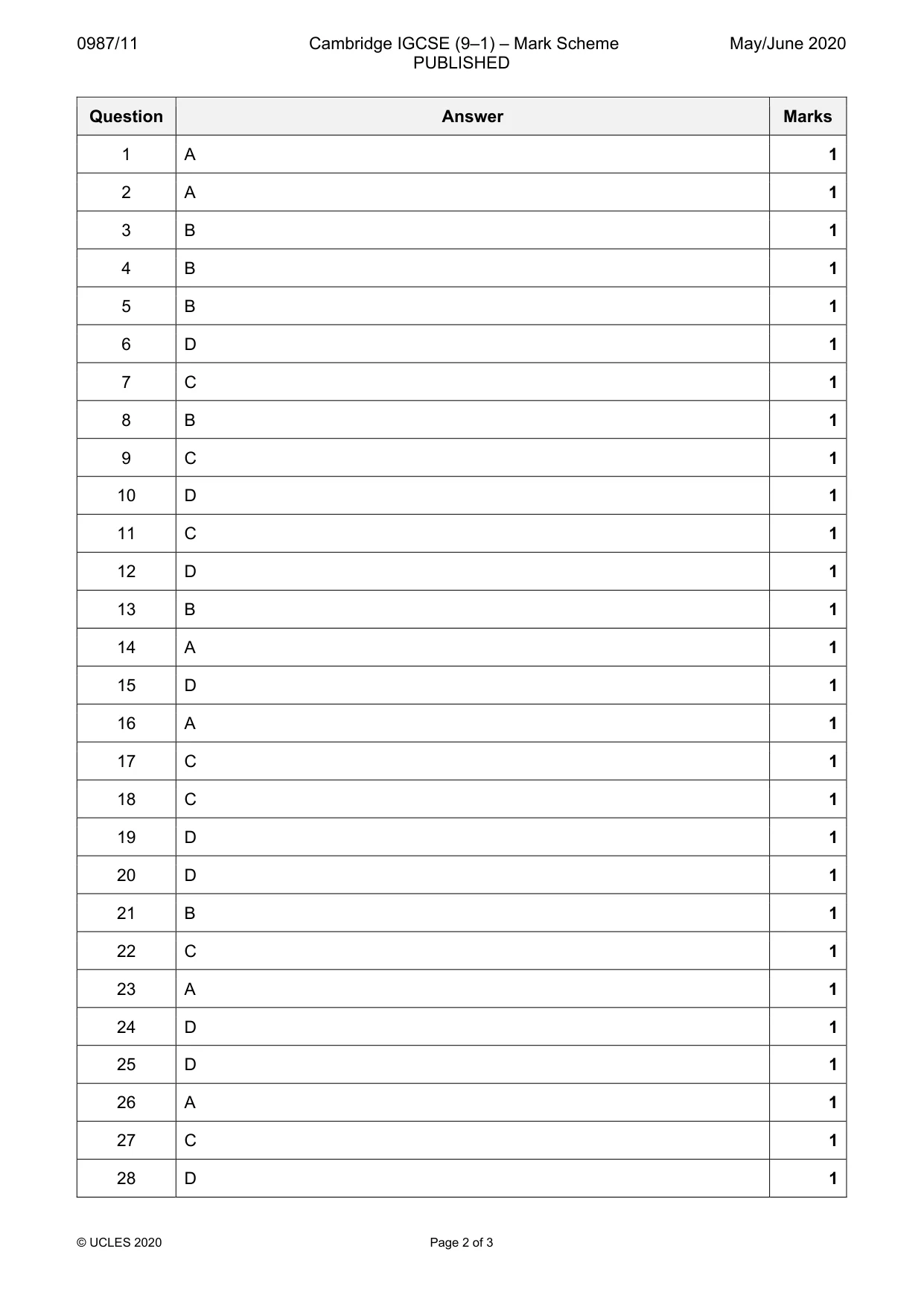
Mark scheme: A
Q2 · What is the function of the factors of production in an economy?
2 What is the function of the factors of production in an economy? A to make goods and services to fulfil wants and needs B to provide an even distribution of income C to provide tax income for the government D to reduce the existence of external costs
Mark scheme: A
Q3 · The diagram shows a production possibility curve (PPC) for an economy that can produce…
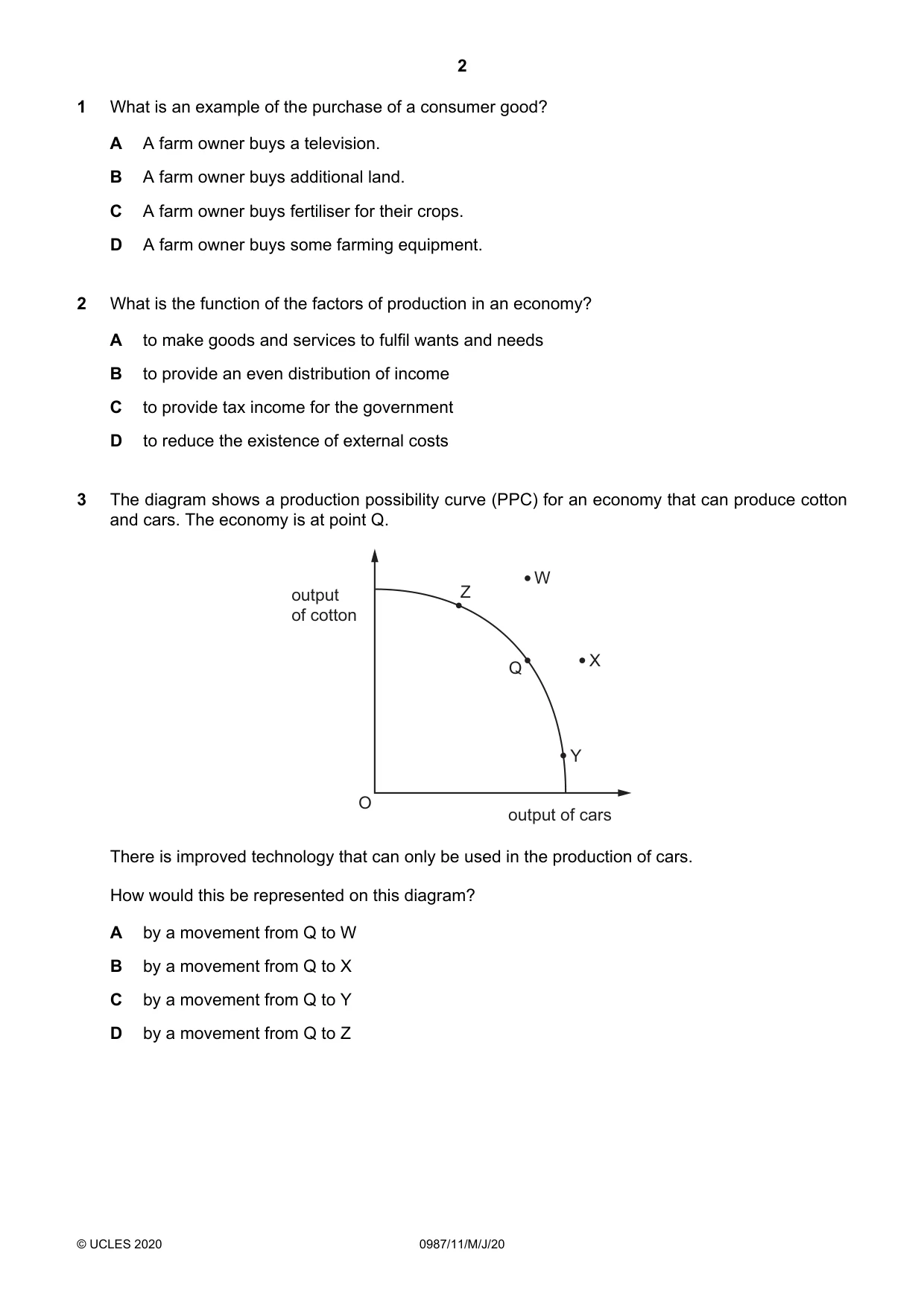
3 The diagram shows a production possibility curve (PPC) for an economy that can produce cotton and cars. The economy is at point Q. W output Z of cotton Q X Y O output of cars There is improved technology that can only be used in the production of cars. How would this be represented on this diagram? A by a movement from Q to W B by a movement from Q to X C by a movement from Q to Y D by a movement from Q to Z
Mark scheme: B
More questions on Production possibility curve (PPC) diagrams
Q4 · Which topic is included in microeconomics?
4 Which topic is included in microeconomics? A economic growth B elasticity of demand C inflation D the balance of payments
Mark scheme: B
Q5 · What aspect of demerit goods means they are overproduced?
5 What aspect of demerit goods means they are overproduced? A clear product information B high external costs C high product taxes D low customer demand
Mark scheme: B
Q6 · The diagram shows market demand and supply curves
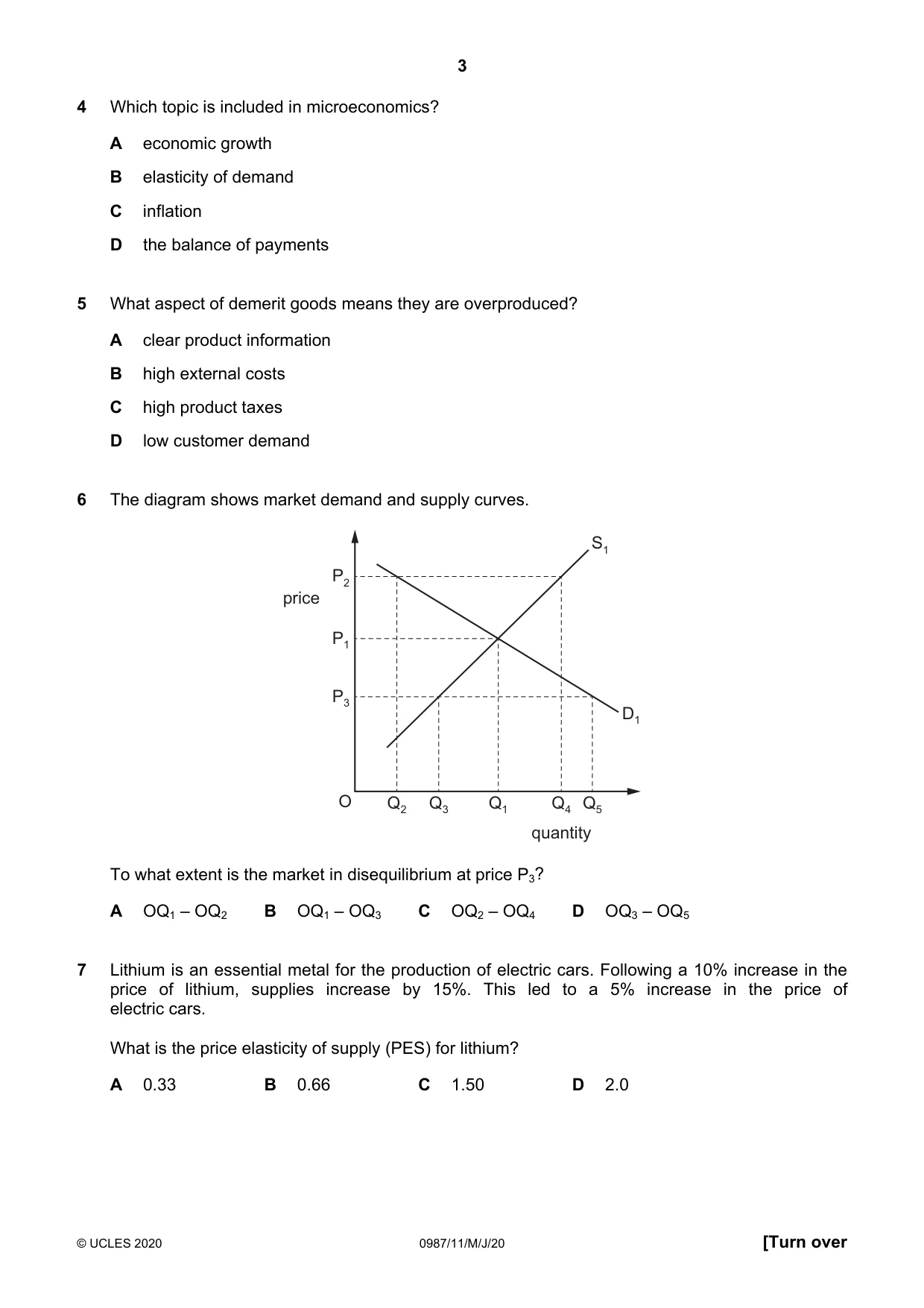
6 The diagram shows market demand and supply curves. S1 P2 price P1 P3 D1 O Q2 Q3 Q1 Q4 Q5 quantity To what extent is the market in disequilibrium at price P3? A OQ1 – OQ2 B OQ1 – OQ3 C OQ2 – OQ4 D OQ3 – OQ5
Mark scheme: D
Q7 · Lithium is an essential metal for the production of electric cars
7 Lithium is an essential metal for the production of electric cars. Following a 10% increase in the price of lithium, supplies increase by 15%. This led to a 5% increase in the price of electric cars. What is the price elasticity of supply (PES) for lithium? A 0.33 B 0.66 C 1.50 D 2.0
Mark scheme: C
Q8 · The wage of labour in a firm increases
8 The wage of labour in a firm increases. What is the most likely effect on the production process? A Capital replaces labour immediately. B Capital replaces labour in the long run. C Labour replaces capital immediately. D Labour replaces capital in the long run.
Mark scheme: B
Q9 · Which combination of influences would increase the level of borrowing by a household?
9 Which combination of influences would increase the level of borrowing by a household? influence 1 influence 2 A becoming pensioners higher rate of inflation B greater wealth lower consumer confidence C higher consumer confidence lower rate of interest D higher rate of interest greater availability of credit
Mark scheme: C
Q10 · The graph shows women’s wages as a percentage of men’s wages in year 1 and year 2
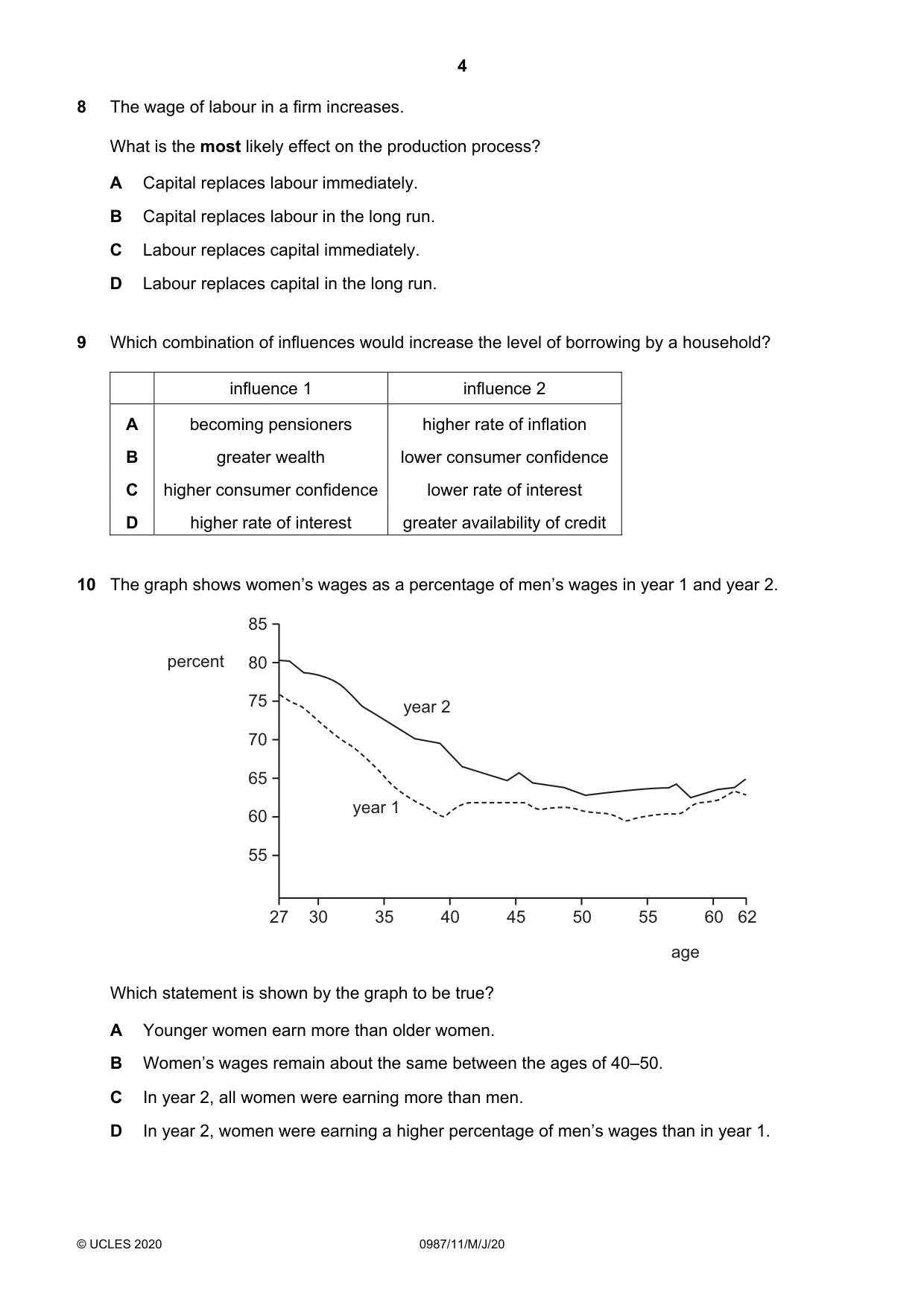
10 The graph shows women’s wages as a percentage of men’s wages in year 1 and year 2. 85 percent 80 75 year 2 70 65 year 1 60 55 27 30 35 40 45 50 55 60 62 age Which statement is shown by the graph to be true? A Younger women earn more than older women. B Women’s wages remain about the same between the ages of 40–50. C In year 2, all women were earning more than men. D In year 2, women were earning a higher percentage of men’s wages than in year 1.
Mark scheme: D
Question 11
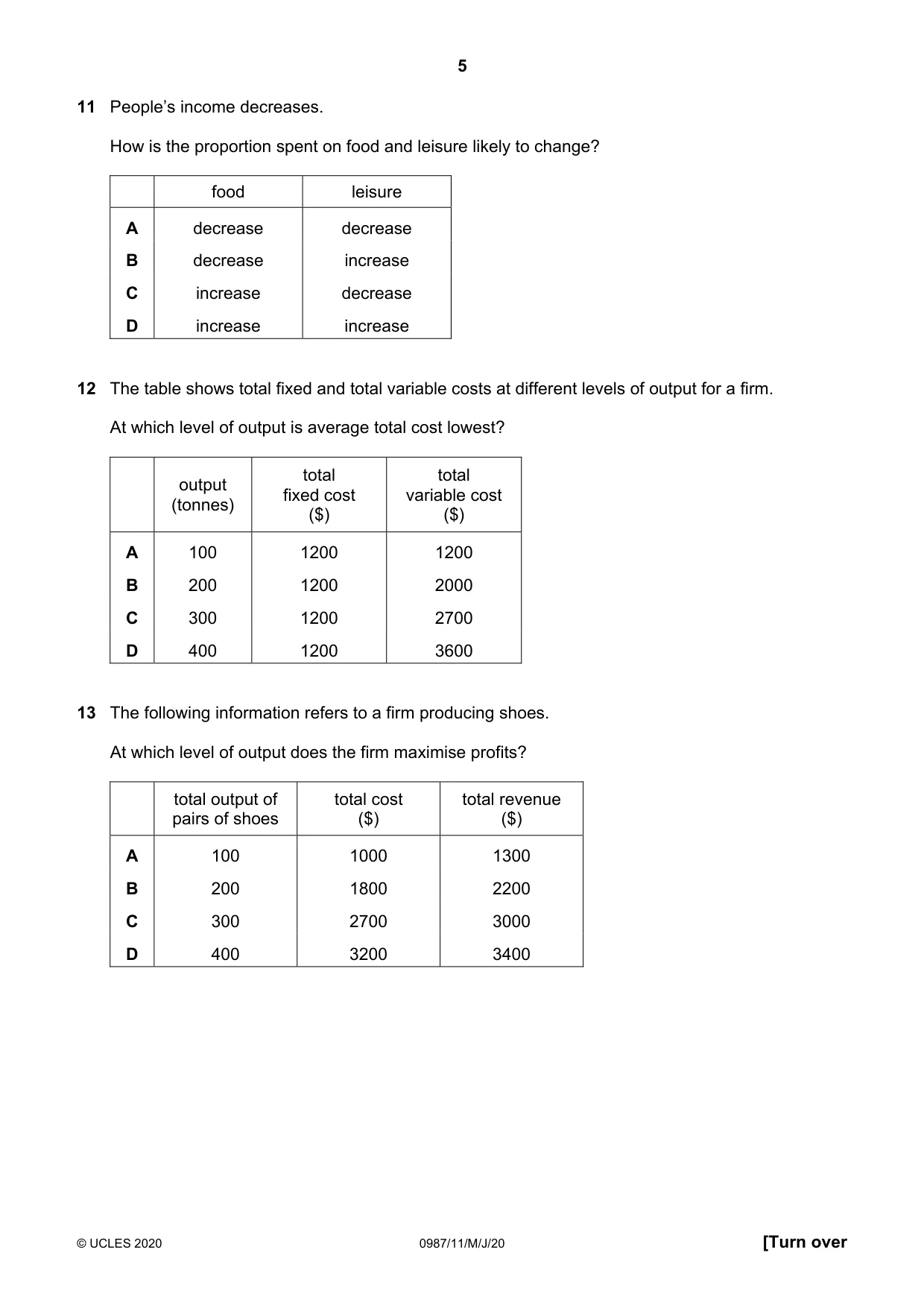
11 People’s income decreases. How is the proportion spent on food and leisure likely to change? food leisure A decrease decrease B decrease increase C increase decrease D increase increase
Mark scheme: C
Q12 · The table shows total fixed and total variable costs at different levels of output for a…
12 The table shows total fixed and total variable costs at different levels of output for a firm. At which level of output is average total cost lowest? total total output fixed cost variable cost (tonnes) ($) ($) A 100 1200 1200 B 200 1200 2000 C 300 1200 2700 D 400 1200 3600
Mark scheme: D
Q13 · The following information refers to a firm producing shoes
13 The following information refers to a firm producing shoes. At which level of output does the firm maximise profits? total output of total cost total revenue pairs of shoes ($) ($) A 100 1000 1300 B 200 1800 2200 C 300 2700 3000 D 400 3200 3400
Mark scheme: B
Q14 · What is most likely to lead to an improvement in labour productivity in an industry?
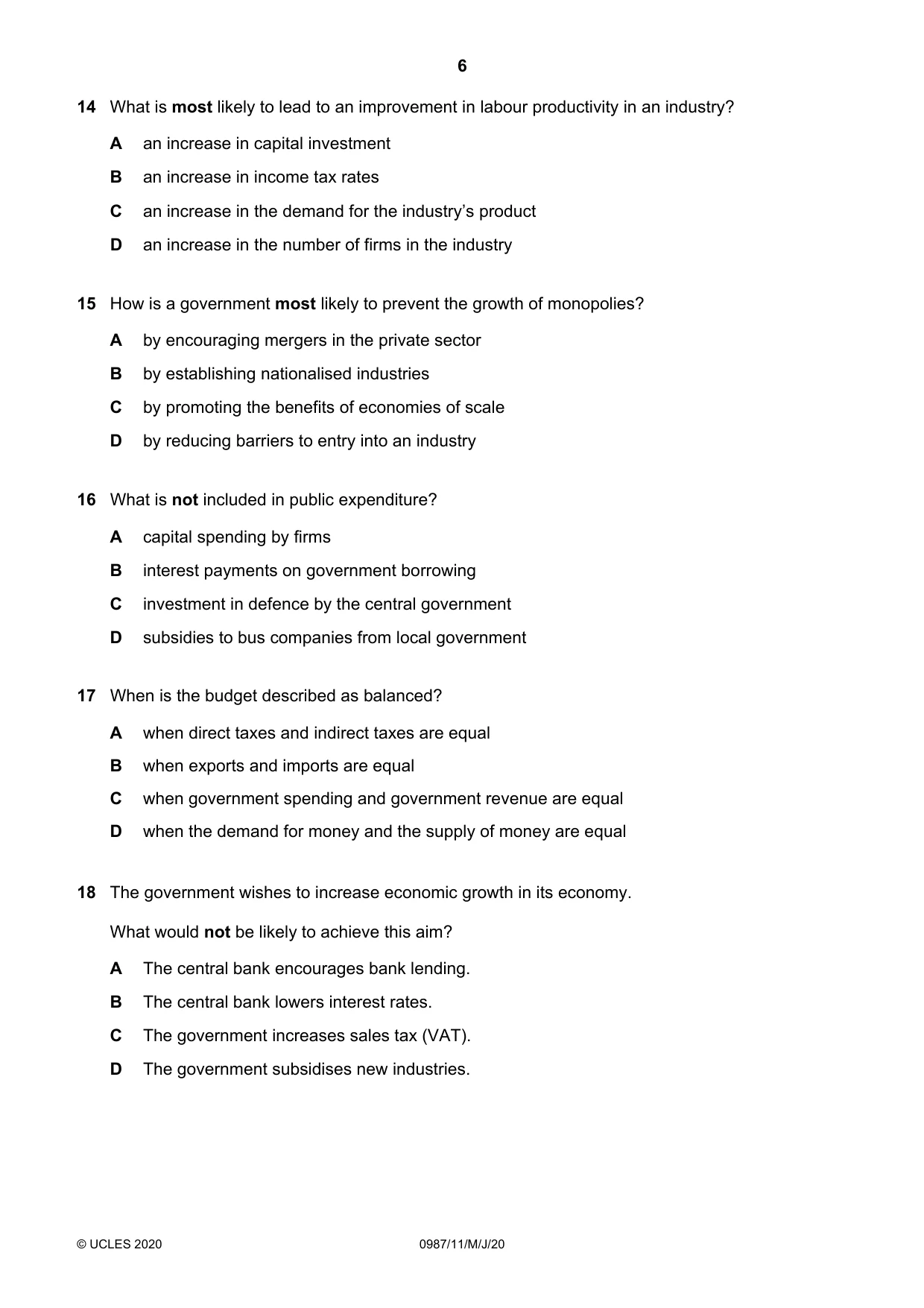
14 What is most likely to lead to an improvement in labour productivity in an industry? A an increase in capital investment B an increase in income tax rates C an increase in the demand for the industry’s product D an increase in the number of firms in the industry
Mark scheme: A
Q15 · How is a government most likely to prevent the growth of monopolies?
15 How is a government most likely to prevent the growth of monopolies? A by encouraging mergers in the private sector B by establishing nationalised industries C by promoting the benefits of economies of scale D by reducing barriers to entry into an industry
Mark scheme: D
Q16 · What is not included in public expenditure?
16 What is not included in public expenditure? A capital spending by firms B interest payments on government borrowing C investment in defence by the central government D subsidies to bus companies from local government
Mark scheme: A
Q17 · When is the budget described as balanced?
17 When is the budget described as balanced? A when direct taxes and indirect taxes are equal B when exports and imports are equal C when government spending and government revenue are equal D when the demand for money and the supply of money are equal
Mark scheme: C
Q18 · The government wishes to increase economic growth in its economy
18 The government wishes to increase economic growth in its economy. What would not be likely to achieve this aim? A The central bank encourages bank lending. B The central bank lowers interest rates. C The government increases sales tax (VAT). D The government subsidises new industries.
Mark scheme: C
Q19 · The government redistributes income more evenly
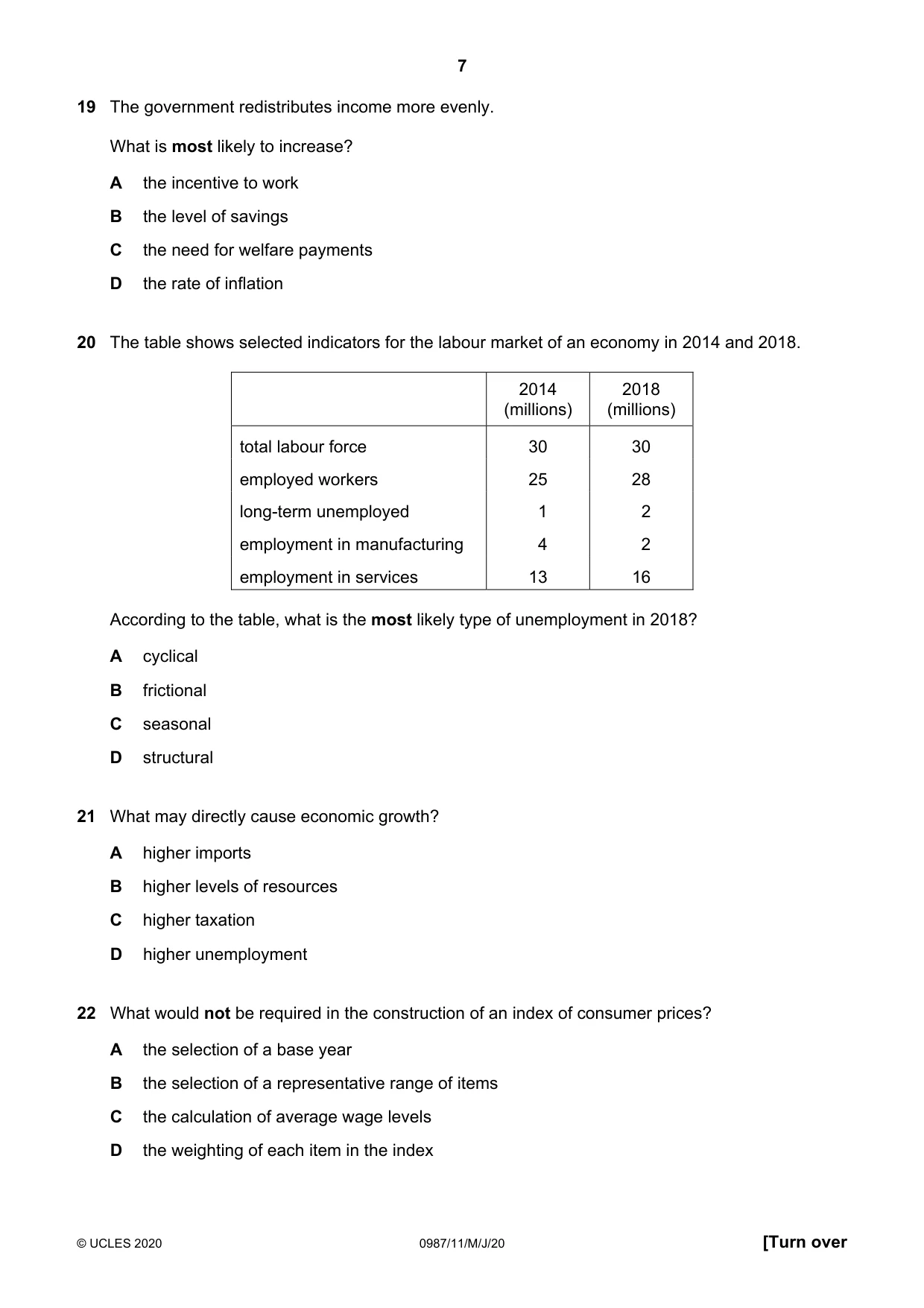
19 The government redistributes income more evenly. What is most likely to increase? A the incentive to work B the level of savings C the need for welfare payments D the rate of inflation
Mark scheme: D
Q20 · The table shows selected indicators for the labour market of an economy in 2014 and 2018
20 The table shows selected indicators for the labour market of an economy in 2014 and 2018. 2014 2018 (millions) (millions) total labour force 30 30 employed workers 25 28 long-term unemployed 1 2 employment in manufacturing 4 2 employment in services 13 16 According to the table, what is the most likely type of unemployment in 2018? A cyclical B frictional C seasonal D structural
Mark scheme: D
Q21 · What may directly cause economic growth?
21 What may directly cause economic growth? A higher imports B higher levels of resources C higher taxation D higher unemployment
Mark scheme: B
Q22 · What would not be required in the construction of an index of consumer prices?
22 What would not be required in the construction of an index of consumer prices? A the selection of a base year B the selection of a representative range of items C the calculation of average wage levels D the weighting of each item in the index
Mark scheme: C
Q23 · The table gives information about three economic indicators in four countries
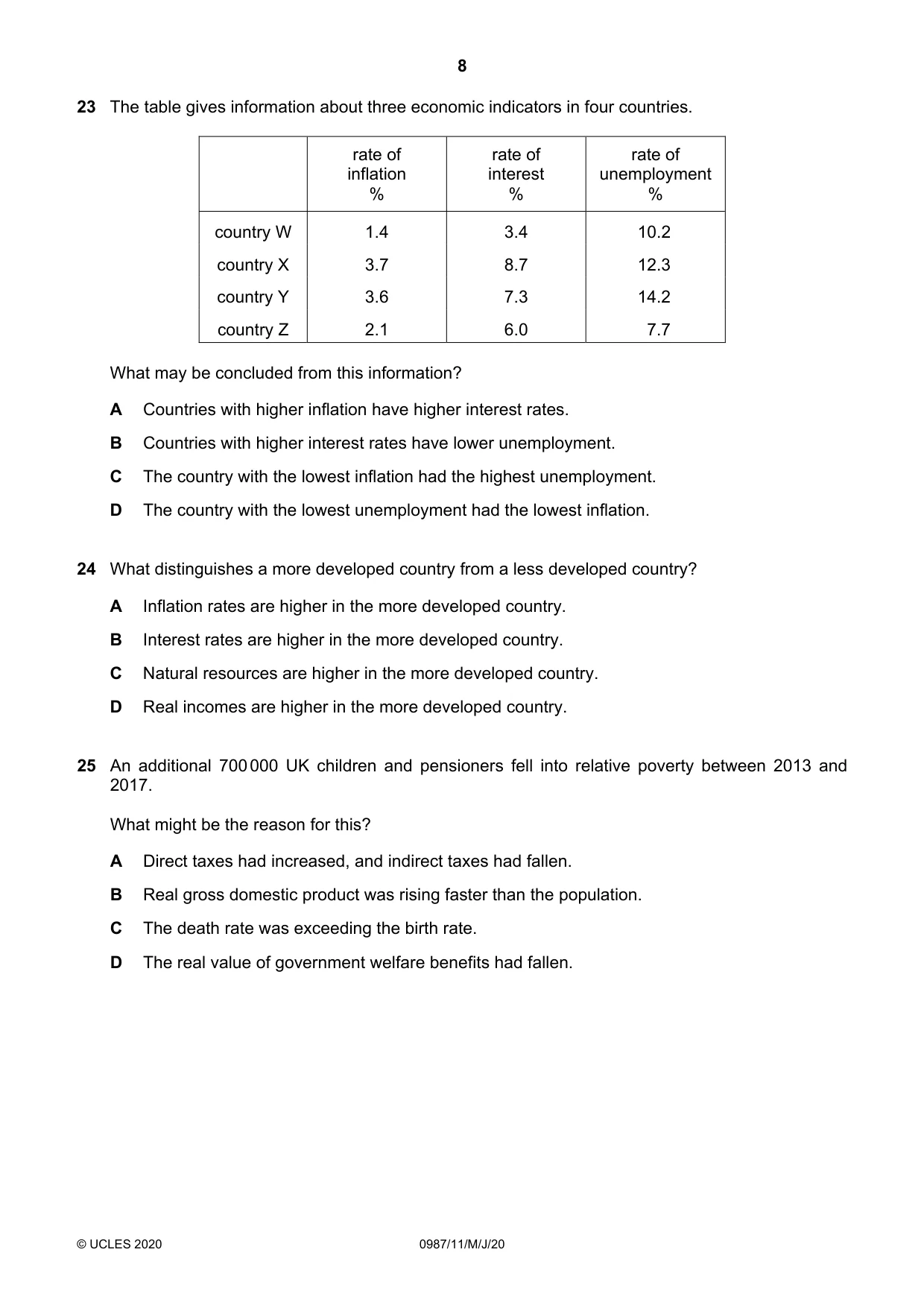
23 The table gives information about three economic indicators in four countries. rate of rate of rate of inflation interest unemployment % % % country W 1.4 3.4 10.2 country X 3.7 8.7 12.3 country Y 3.6 7.3 14.2 country Z 2.1 6.0 7.7 What may be concluded from this information? A Countries with higher inflation have higher interest rates. B Countries with higher interest rates have lower unemployment. C The country with the lowest inflation had the highest unemployment. D The country with the lowest unemployment had the lowest inflation.
Mark scheme: A
Q24 · What distinguishes a more developed country from a less developed country?
24 What distinguishes a more developed country from a less developed country? A Inflation rates are higher in the more developed country. B Interest rates are higher in the more developed country. C Natural resources are higher in the more developed country. D Real incomes are higher in the more developed country.
Mark scheme: D
More questions on Differences in economic development between countries
Q25 · An additional 700 000 UK children and pensioners fell into relative poverty between 2013…
25 An additional 700 000 UK children and pensioners fell into relative poverty between 2013 and 2017. What might be the reason for this? A Direct taxes had increased, and indirect taxes had fallen. B Real gross domestic product was rising faster than the population. C The death rate was exceeding the birth rate. D The real value of government welfare benefits had fallen.
Mark scheme: D
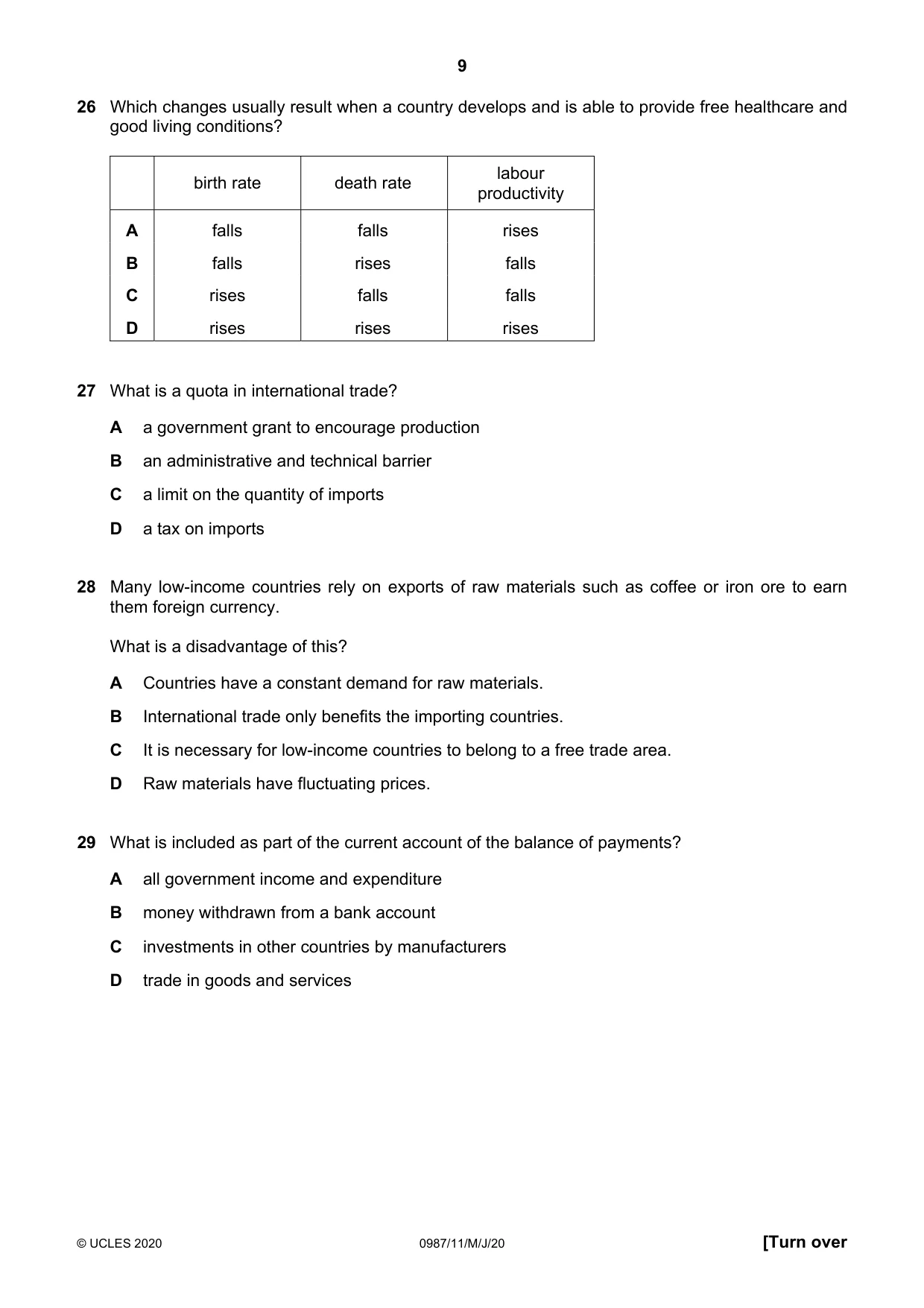
Q26 · Which changes usually result when a country develops and is able to provide free…
26 Which changes usually result when a country develops and is able to provide free healthcare and good living conditions? labour birth rate death rate productivity A falls falls rises B falls rises falls C rises falls falls D rises rises rises
Mark scheme: A
Q27 · What is a quota in international trade?
27 What is a quota in international trade? A a government grant to encourage production B an administrative and technical barrier C a limit on the quantity of imports D a tax on imports
Mark scheme: C
Q28 · Many low-income countries rely on exports of raw materials such as coffee or iron ore to…
28 Many low-income countries rely on exports of raw materials such as coffee or iron ore to earn them foreign currency. What is a disadvantage of this? A Countries have a constant demand for raw materials. B International trade only benefits the importing countries. C It is necessary for low-income countries to belong to a free trade area. D Raw materials have fluctuating prices.
Mark scheme: D
Q29 · What is included as part of the current account of the balance of payments?
29 What is included as part of the current account of the balance of payments? A all government income and expenditure B money withdrawn from a bank account C investments in other countries by manufacturers D trade in goods and services
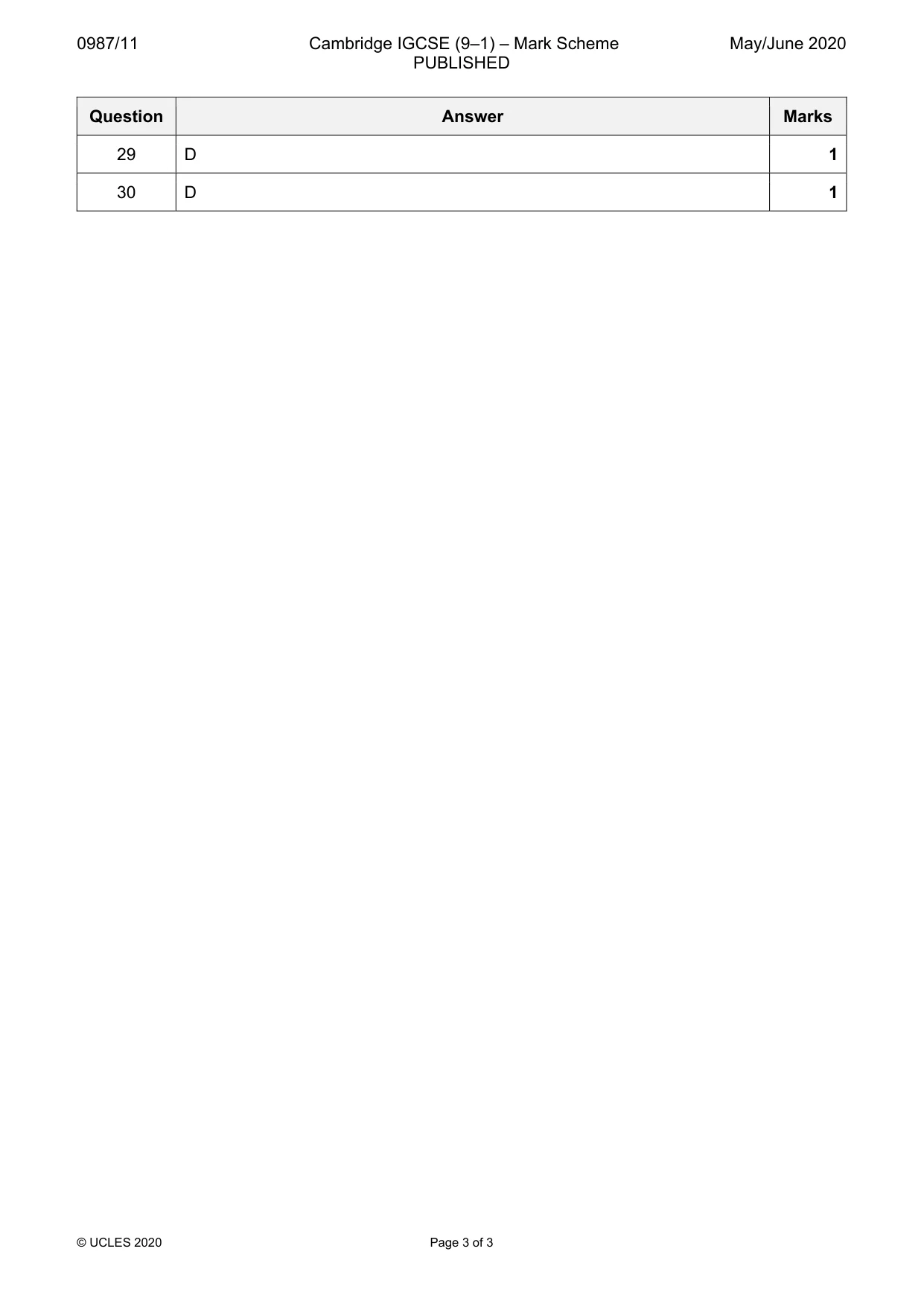
Mark scheme: D
More questions on Current account of the balance of payments
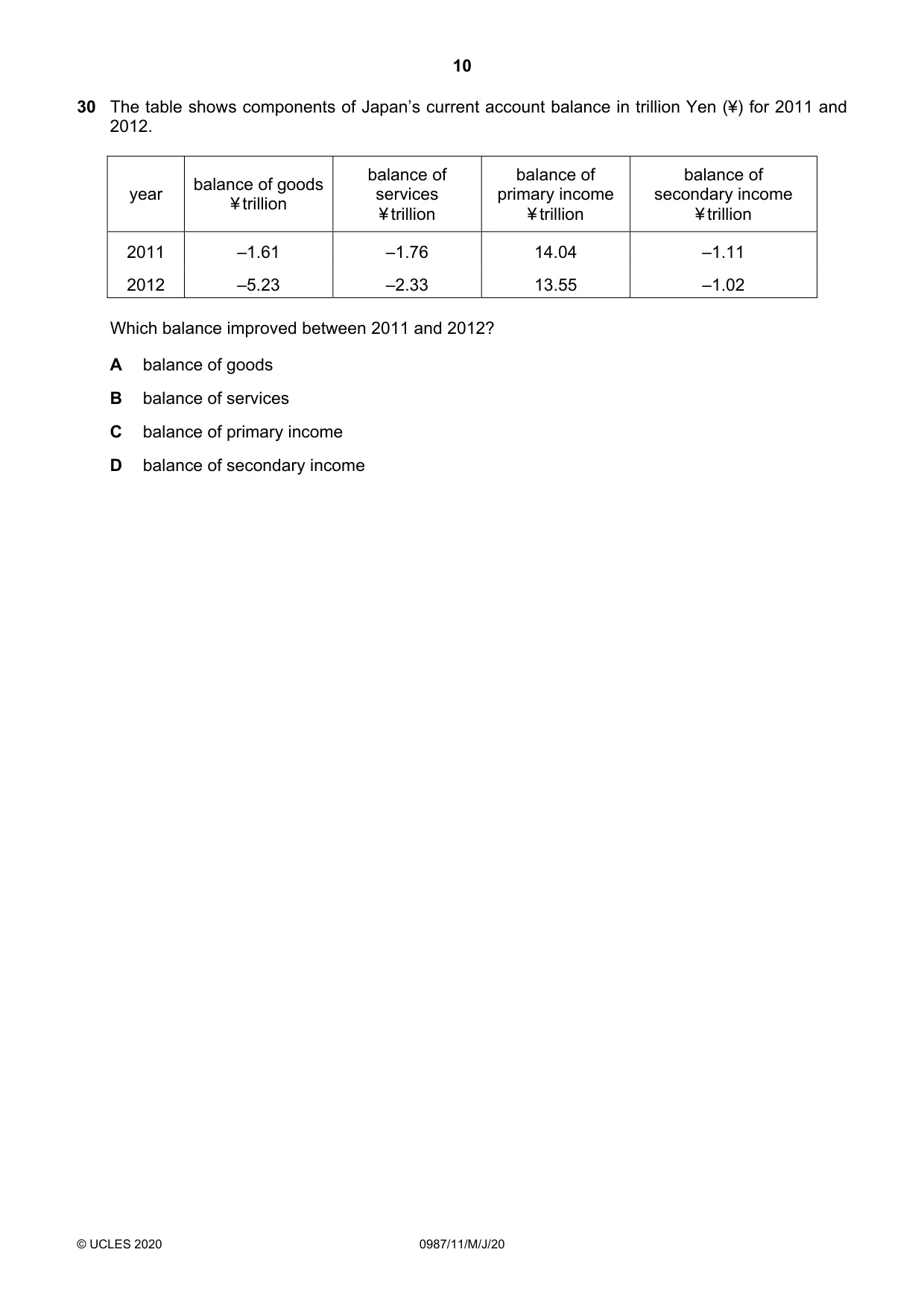
Q30 · The table shows components of Japan’s current account balance in trillion Yen (¥) for…
30 The table shows components of Japan’s current account balance in trillion Yen (¥) for 2011 and 2012. balance of balance of balance of balance of goods year services primary income secondary income ¥ trillion ¥ trillion ¥ trillion ¥ trillion 2011 –1.61 –1.76 14.04 –1.11 2012 –5.23 –2.33 13.55 –1.02 Which balance improved between 2011 and 2012? A balance of goods B balance of services C balance of primary income D balance of secondary income
Mark scheme: D
More questions on Current account of the balance of payments
What was in this paper
The subtopics covered by these 30 questions, and how many questions each got. Open one in a new tab to see every Cambridge question on it.
3Current account of the balance of payments2Firms’ costs, revenue and objectives2Households2Inflation2Workers2Differences in economic development between countries1Economic growth1Employment and unemployment1Factors of production1Firms and production1Globalisation and trade restrictions1Government macroeconomic intervention1Market failure1Monetary policy1Population1Poverty1Price determination1Price elasticity of demand (PED)1Price elasticity of supply (PES)1Production possibility curve (PPC) diagrams1Specialisation and free trade1The nature of the basic economic problem1