Cambridge IGCSE Economics (9-1) 0987 — 2022 May/June Paper 1 · Variant 2
0987/12/M/J/22 · 30 questions · 30 marks · ≈34 min
The question paper and its mark scheme, free to read here and free to download. This is Cambridge’s own paper, exactly as it was sat.
Question paper12 pages

Mark scheme3 pages
Answers below. Sit the paper first if you are practising.
Questions as text
Q1 · What is an example of a free good?
1 What is an example of a free good? A defence B education C health services D sunshine
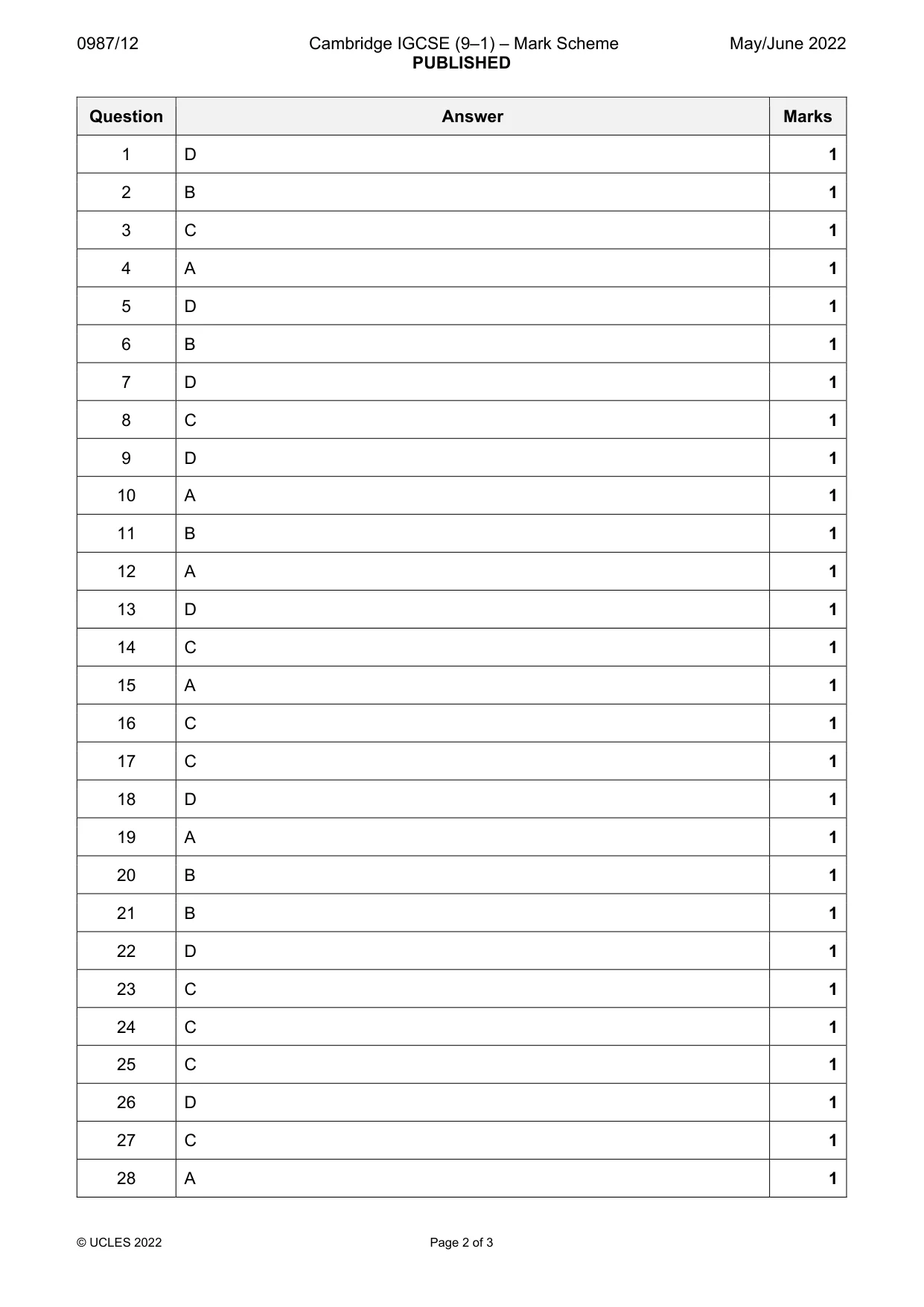
Mark scheme: D
Q2 · A student has nothing to do on a Friday evening
2 A student has nothing to do on a Friday evening. She withdraws $5 from the $100 she has in a savings account and buys a present to take to a party, to which admission is free. What does this involve? A an opportunity cost equal to $95 B an opportunity cost equal to other goods she could have bought for $5 C no opportunity cost, as entrance to the party is free D no opportunity cost, as she had no better way of using the time
Mark scheme: B
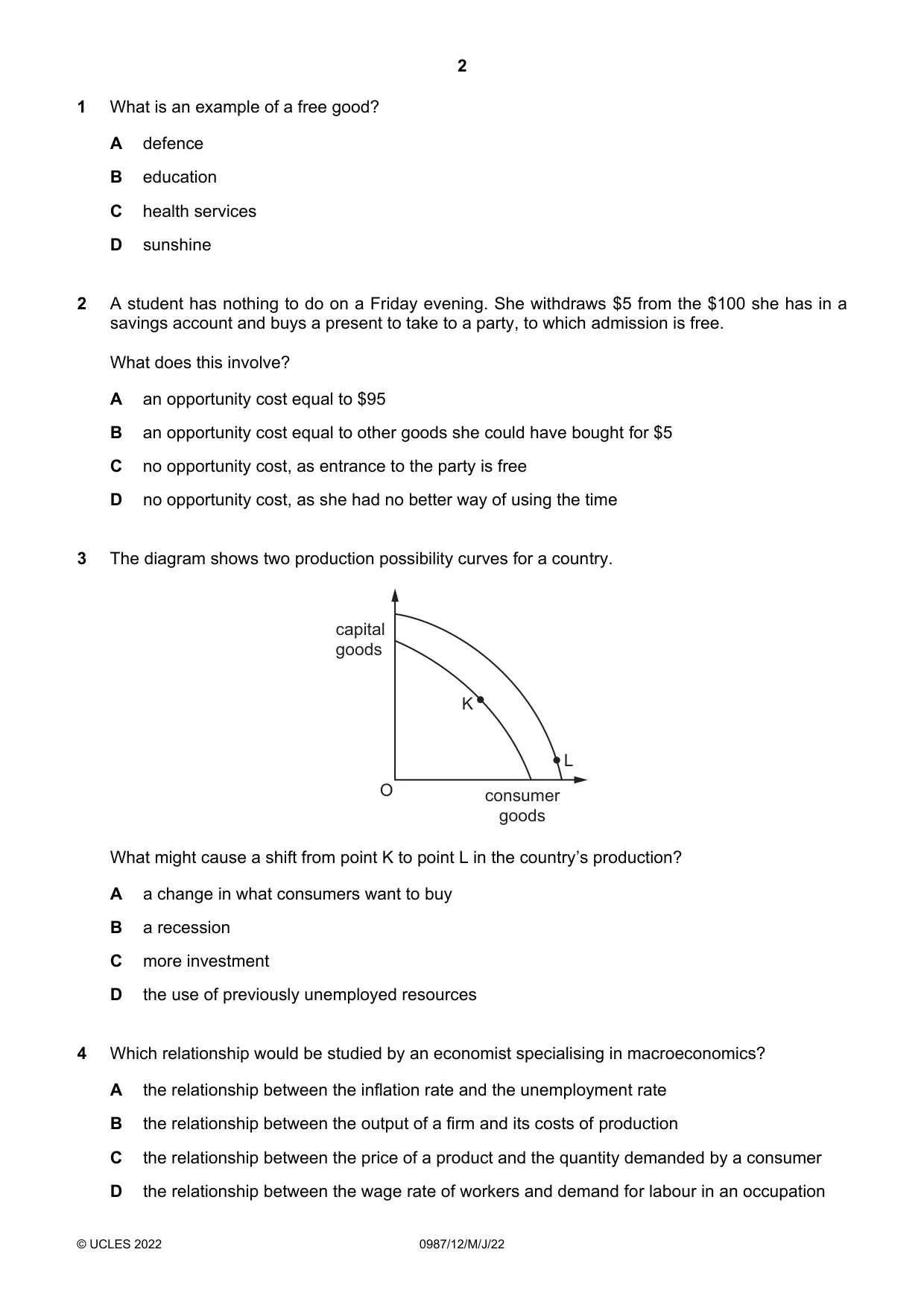
Q3 · The diagram shows two production possibility curves for a country
3 The diagram shows two production possibility curves for a country. capital goods K L O consumer goods What might cause a shift from point K to point L in the country’s production? A a change in what consumers want to buy B a recession C more investment D the use of previously unemployed resources
Mark scheme: C
More questions on Production possibility curve (PPC) diagrams
Q4 · Which relationship would be studied by an economist specialising in macroeconomics?
4 Which relationship would be studied by an economist specialising in macroeconomics? A the relationship between the inflation rate and the unemployment rate B the relationship between the output of a firm and its costs of production C the relationship between the price of a product and the quantity demanded by a consumer D the relationship between the wage rate of workers and demand for labour in an occupation
Mark scheme: A
Q5 · In recent years, a government has started to make more use of the free market system
5 In recent years, a government has started to make more use of the free market system. However, they are doing it very slowly to avoid the disadvantages that a free market system might bring. What is a possible disadvantage of the free market system? A decreased incentive to work B decreased levels of pollution C increased efficiency D increased inequality of income
Mark scheme: D
Q6 · What will cause the demand curve for a good to shift to the right?
6 What will cause the demand curve for a good to shift to the right? A a decrease in the disposable income of consumers B a decrease in the price of a complement good C a decrease in the price of a substitute good D a decrease in the price of the good
Mark scheme: B
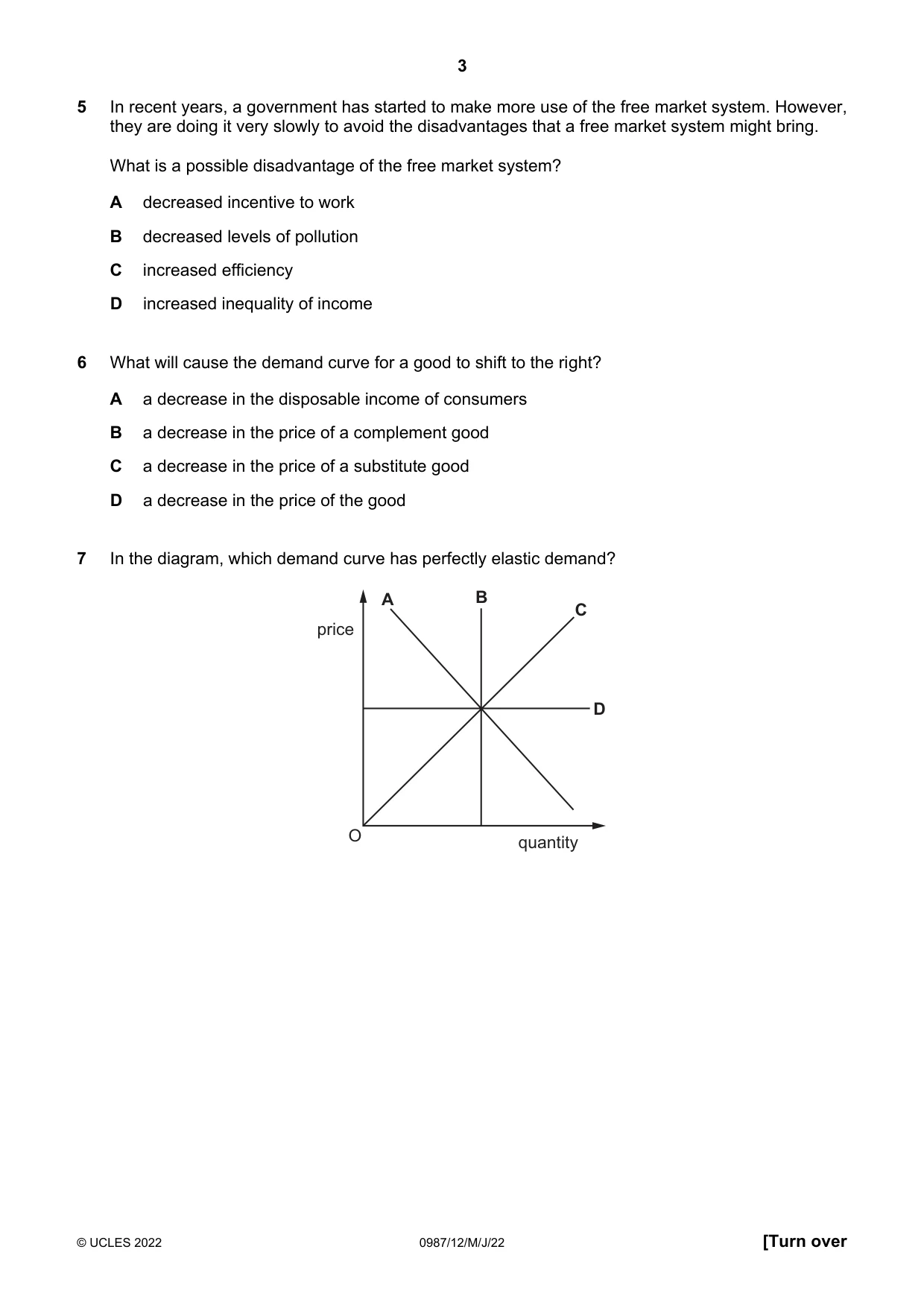
Q7 · In the diagram, which demand curve has perfectly elastic demand?
7 In the diagram, which demand curve has perfectly elastic demand? A B C price D O quantity
Mark scheme: D
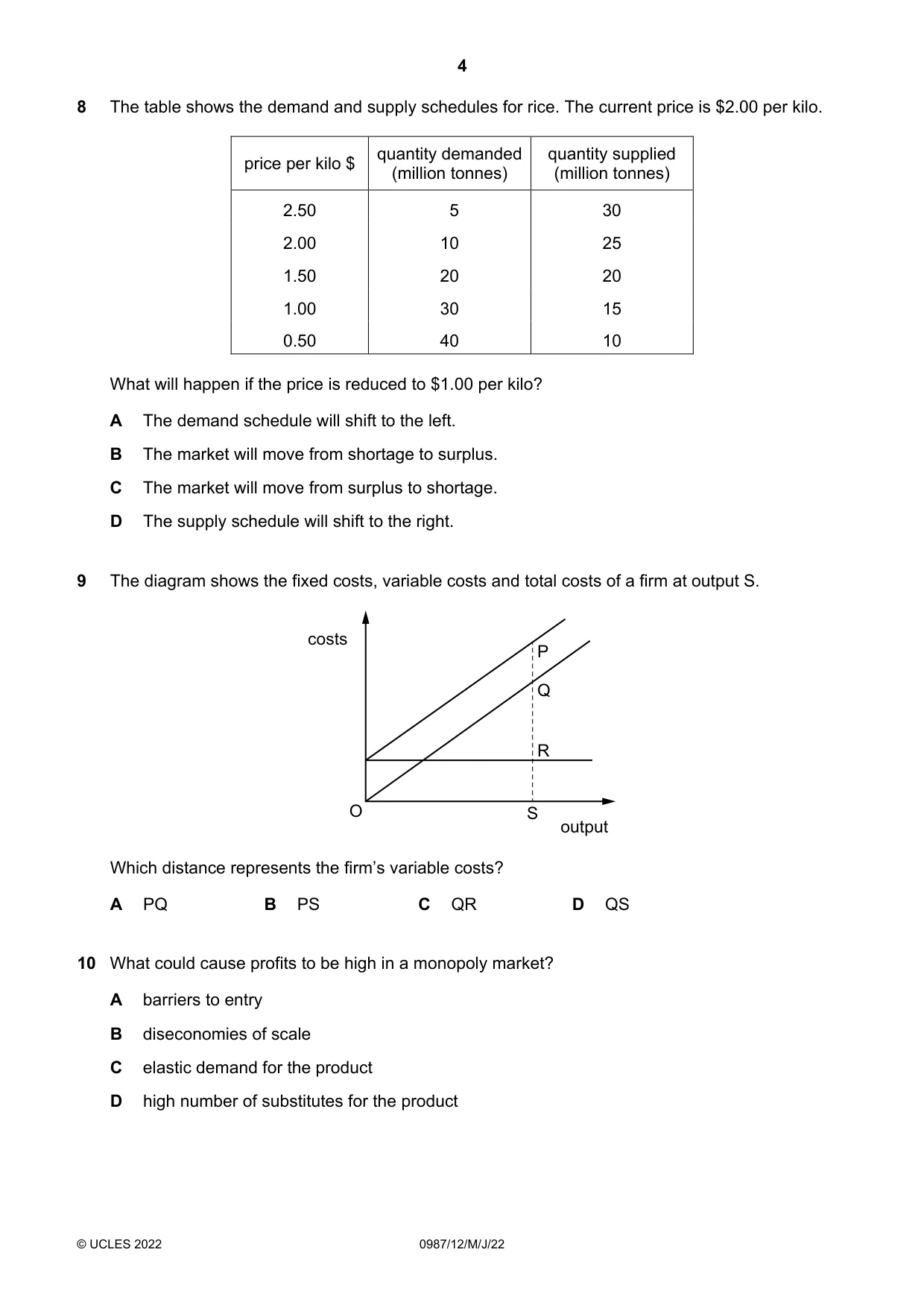
Q8 · The table shows the demand and supply schedules for rice
8 The table shows the demand and supply schedules for rice. The current price is $2.00 per kilo. quantity demanded quantity supplied price per kilo $ (million tonnes) (million tonnes) 2.50 5 30 2.00 10 25 1.50 20 20 1.00 30 15 0.50 40 10 What will happen if the price is reduced to $1.00 per kilo? A The demand schedule will shift to the left. B The market will move from shortage to surplus. C The market will move from surplus to shortage. D The supply schedule will shift to the right.
Mark scheme: C
Q9 · The diagram shows the fixed costs, variable costs and total costs of a firm at output S
9 The diagram shows the fixed costs, variable costs and total costs of a firm at output S. costs P Q R O S output Which distance represents the firm’s variable costs? A PQ B PS C QR D QS
Mark scheme: D
Q10 · What could cause profits to be high in a monopoly market?
10 What could cause profits to be high in a monopoly market? A barriers to entry B diseconomies of scale C elastic demand for the product D high number of substitutes for the product
Mark scheme: A
Q11 · Which firm is most likely to be classified as a small firm in the tertiary sector?
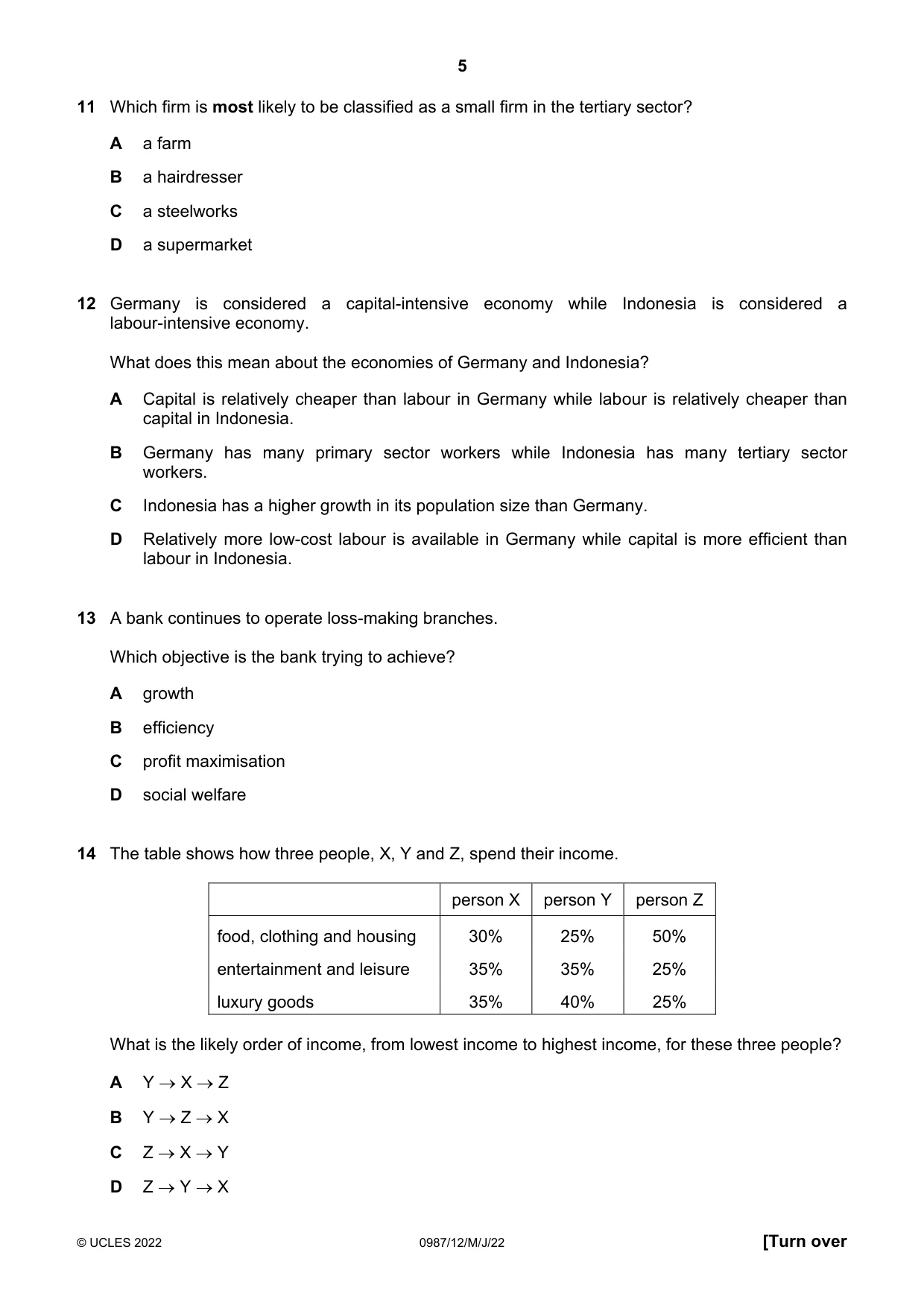
11 Which firm is most likely to be classified as a small firm in the tertiary sector? A a farm B a hairdresser C a steelworks D a supermarket
Mark scheme: B
Q12 · Germany is considered a capital-intensive economy while Indonesia is considered a…
12 Germany is considered a capital-intensive economy while Indonesia is considered a labour-intensive economy. What does this mean about the economies of Germany and Indonesia? A Capital is relatively cheaper than labour in Germany while labour is relatively cheaper than capital in Indonesia. B Germany has many primary sector workers while Indonesia has many tertiary sector workers. C Indonesia has a higher growth in its population size than Germany. D Relatively more low-cost labour is available in Germany while capital is more efficient than labour in Indonesia.
Mark scheme: A
Q13 · A bank continues to operate loss-making branches
13 A bank continues to operate loss-making branches. Which objective is the bank trying to achieve? A growth B efficiency C profit maximisation D social welfare
Mark scheme: D
Q14 · The table shows how three people, X, Y and Z, spend their income
14 The table shows how three people, X, Y and Z, spend their income. person X person Y person Z food, clothing and housing 30% 25% 50% entertainment and leisure 35% 35% 25% luxury goods 35% 40% 25% What is the likely order of income, from lowest income to highest income, for these three people? A Y X Z B Y Z X C Z X Y D Z Y X
Mark scheme: C
Q15 · Which activity is correctly linked to the organisation that provides it?
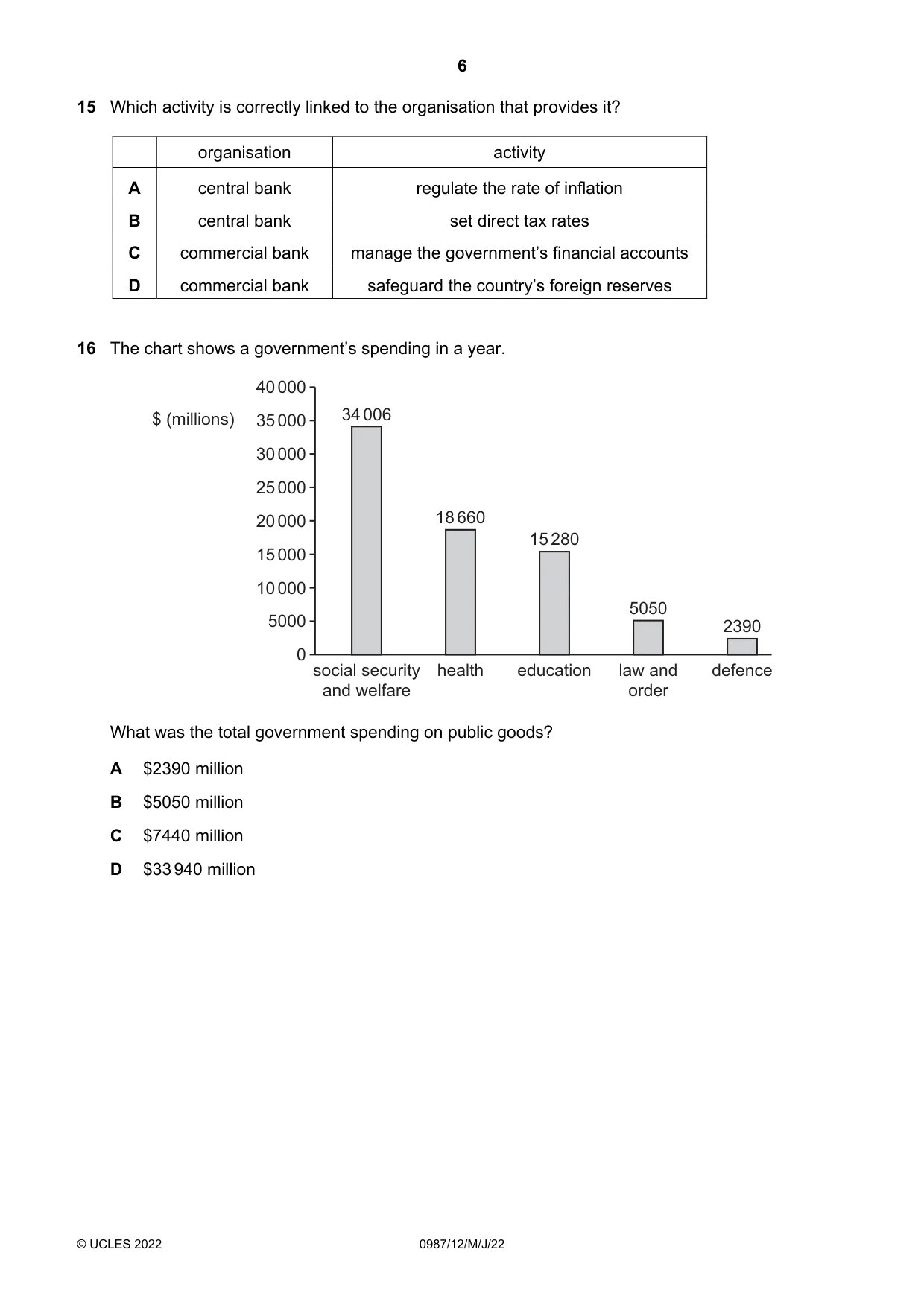
15 Which activity is correctly linked to the organisation that provides it? organisation activity A central bank regulate the rate of inflation B central bank set direct tax rates C commercial bank manage the government’s financial accounts D commercial bank safeguard the country’s foreign reserves
Mark scheme: A
Q16 · The chart shows a government’s spending in a year
16 The chart shows a government’s spending in a year. 40 000 $ (millions) 35 000 34 006 30 000 25 000 20 000 18 660 15 280 15 000 10 000 5050 5000 2390 0 social security health education law and defence and welfare order What was the total government spending on public goods? A $2390 million B $5050 million C $7440 million D $33 940 million
Mark scheme: C
Q17 · A government levies a specific tax on the supply of cigarettes
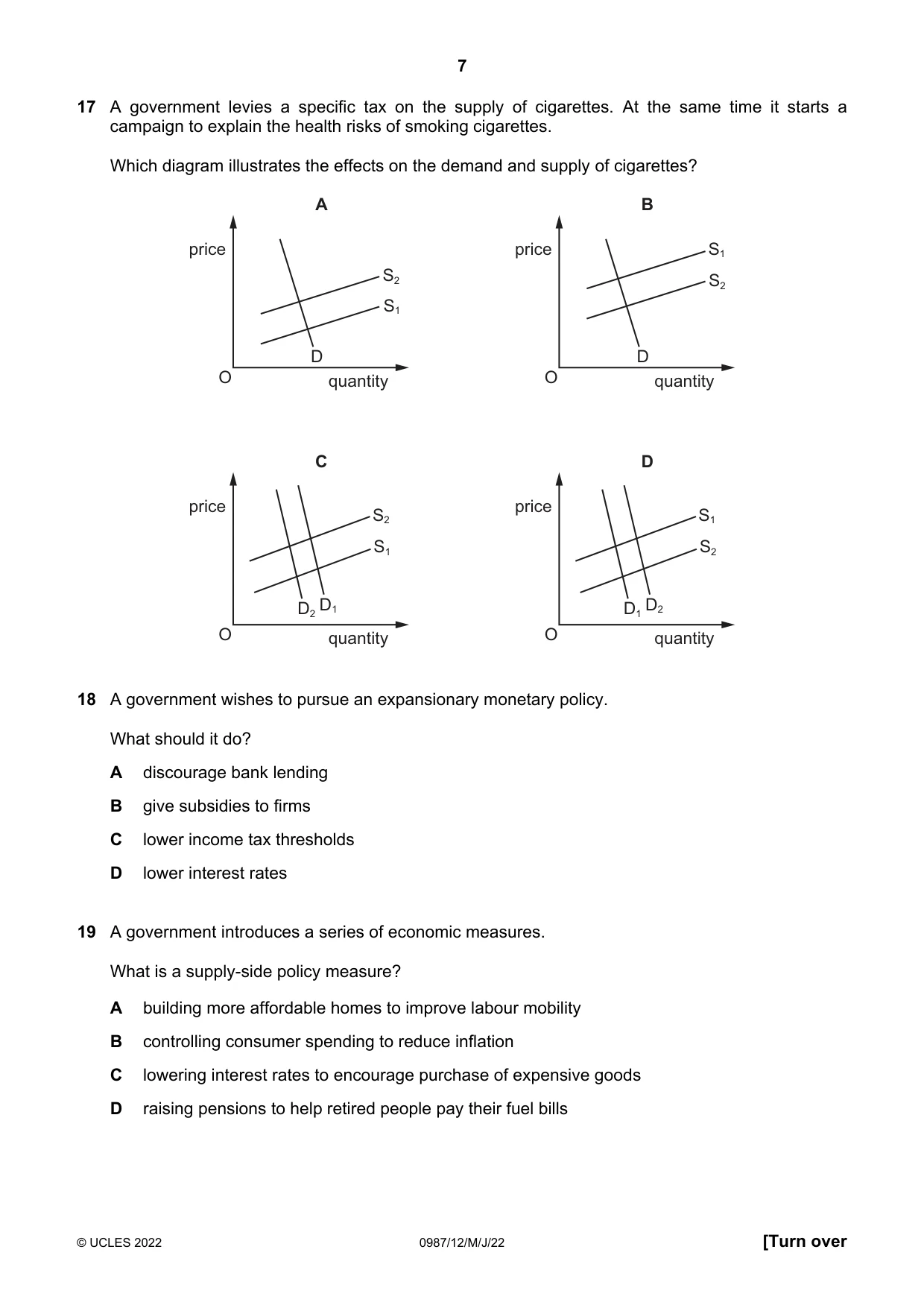
17 A government levies a specific tax on the supply of cigarettes. At the same time it starts a campaign to explain the health risks of smoking cigarettes. Which diagram illustrates the effects on the demand and supply of cigarettes? A B price price S1 S2 S2 S1 D D O quantity O quantity C D price price S2 S1 S1 S2 D2 D1 D1 D2 O quantity O quantity
Mark scheme: C
Q18 · A government wishes to pursue an expansionary monetary policy
18 A government wishes to pursue an expansionary monetary policy. What should it do? A discourage bank lending B give subsidies to firms C lower income tax thresholds D lower interest rates
Mark scheme: D
Q19 · A government introduces a series of economic measures
19 A government introduces a series of economic measures. What is a supply-side policy measure? A building more affordable homes to improve labour mobility B controlling consumer spending to reduce inflation C lowering interest rates to encourage purchase of expensive goods D raising pensions to help retired people pay their fuel bills
Mark scheme: A
Q20 · What is identified as economic growth?
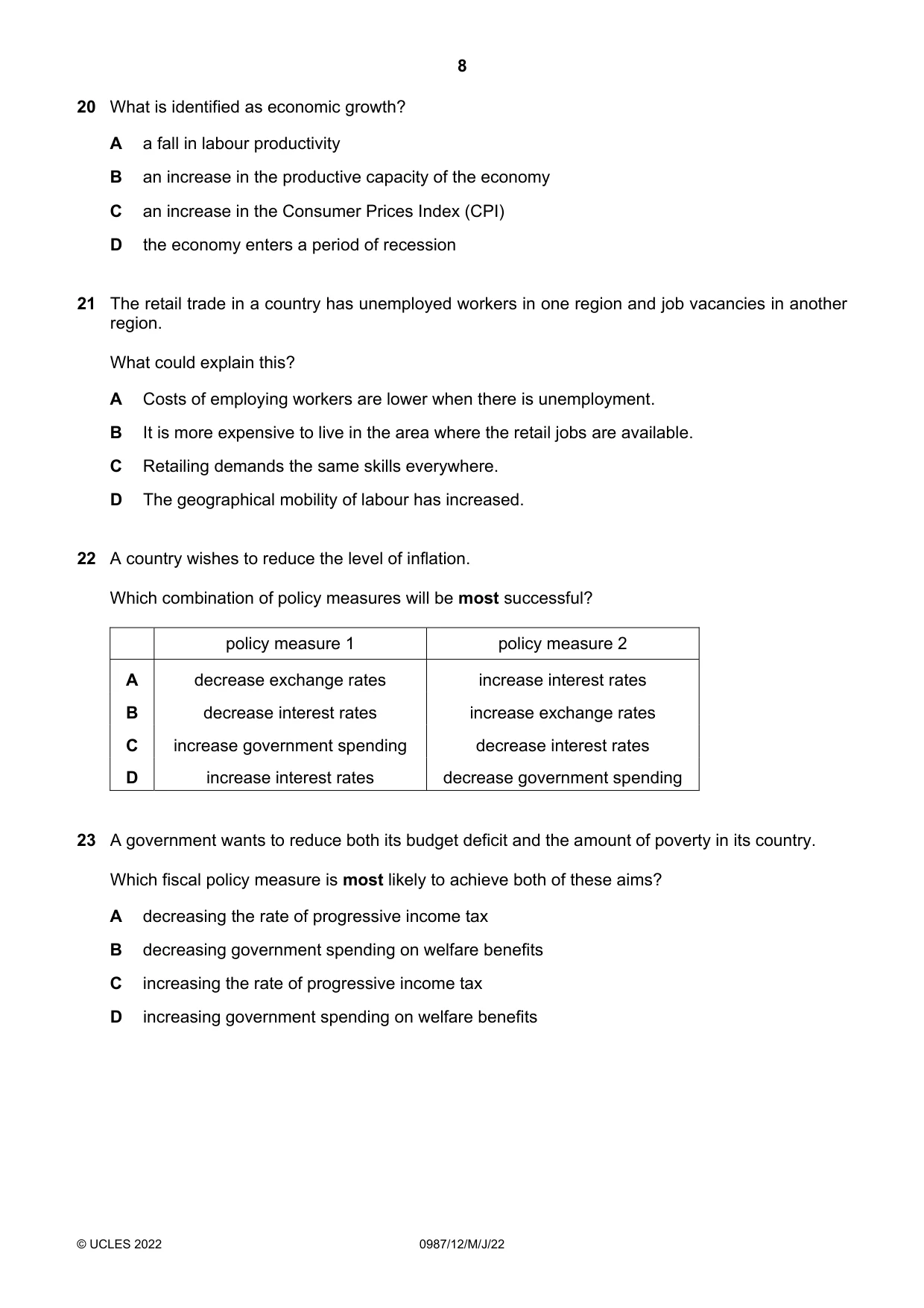
20 What is identified as economic growth? A a fall in labour productivity B an increase in the productive capacity of the economy C an increase in the Consumer Prices Index (CPI) D the economy enters a period of recession
Mark scheme: B
Q21 · The retail trade in a country has unemployed workers in one region and job vacancies in…
21 The retail trade in a country has unemployed workers in one region and job vacancies in another region. What could explain this? A Costs of employing workers are lower when there is unemployment. B It is more expensive to live in the area where the retail jobs are available. C Retailing demands the same skills everywhere. D The geographical mobility of labour has increased.
Mark scheme: B
Q22 · A country wishes to reduce the level of inflation
22 A country wishes to reduce the level of inflation. Which combination of policy measures will be most successful? policy measure 1 policy measure 2 A decrease exchange rates increase interest rates B decrease interest rates increase exchange rates C increase government spending decrease interest rates D increase interest rates decrease government spending
Mark scheme: D
Q23 · A government wants to reduce both its budget deficit and the amount of poverty in its…
23 A government wants to reduce both its budget deficit and the amount of poverty in its country. Which fiscal policy measure is most likely to achieve both of these aims? A decreasing the rate of progressive income tax B decreasing government spending on welfare benefits C increasing the rate of progressive income tax D increasing government spending on welfare benefits
Mark scheme: C
Q24 · Which components, in addition to Gross Domestic Product (GDP) per head, are included in…
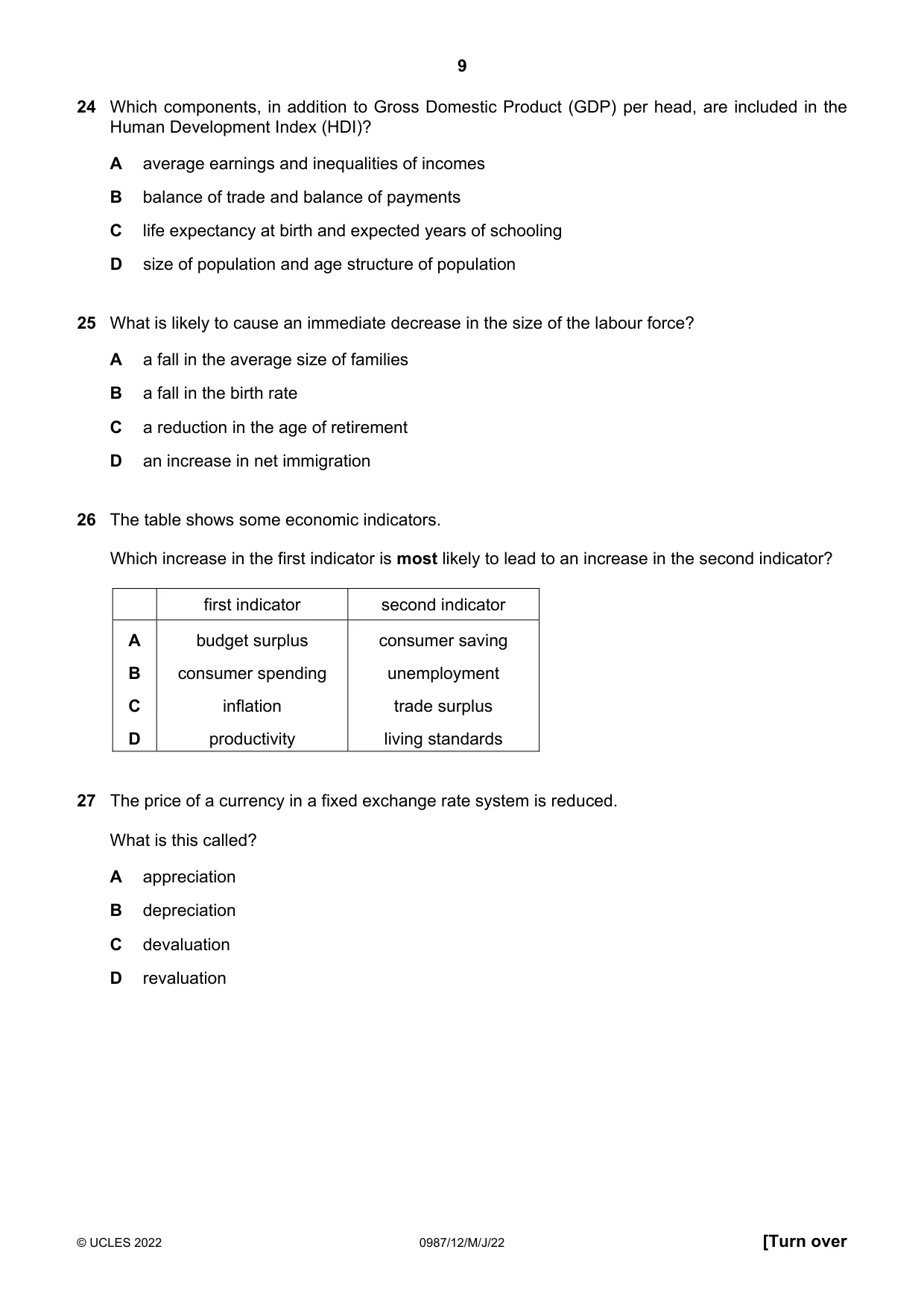
24 Which components, in addition to Gross Domestic Product (GDP) per head, are included in the Human Development Index (HDI)? A average earnings and inequalities of incomes B balance of trade and balance of payments C life expectancy at birth and expected years of schooling D size of population and age structure of population
Mark scheme: C
Q25 · What is likely to cause an immediate decrease in the size of the labour force?
25 What is likely to cause an immediate decrease in the size of the labour force? A a fall in the average size of families B a fall in the birth rate C a reduction in the age of retirement D an increase in net immigration
Mark scheme: C
Q26 · The table shows some economic indicators
26 The table shows some economic indicators. Which increase in the first indicator is most likely to lead to an increase in the second indicator? first indicator second indicator A budget surplus consumer saving B consumer spending unemployment C inflation trade surplus D productivity living standards
Mark scheme: D
Q27 · The price of a currency in a fixed exchange rate system is reduced
27 The price of a currency in a fixed exchange rate system is reduced. What is this called? A appreciation B depreciation C devaluation D revaluation
Mark scheme: C
Q28 · A government removed the quota on goods imported into the country
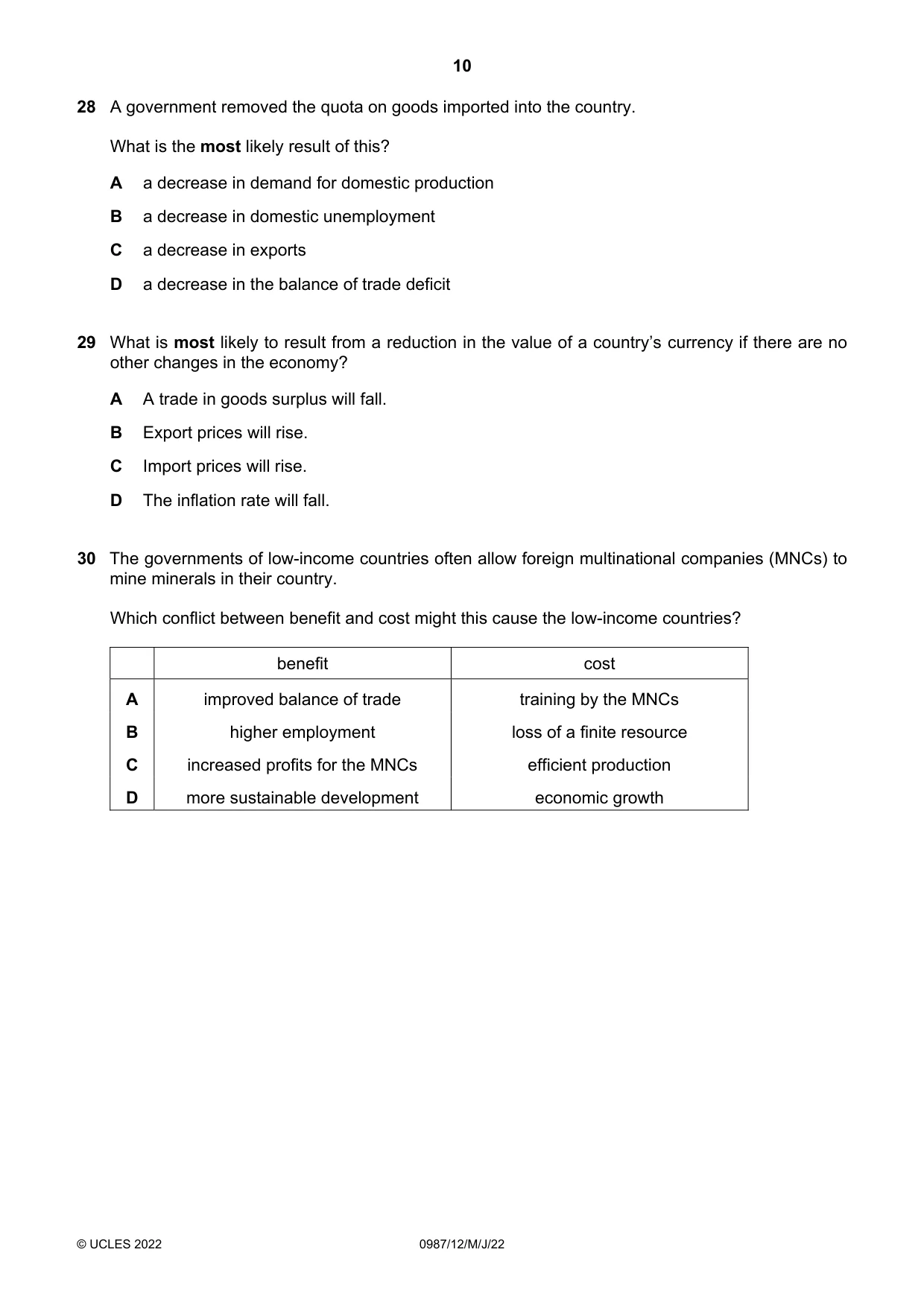
28 A government removed the quota on goods imported into the country. What is the most likely result of this? A a decrease in demand for domestic production B a decrease in domestic unemployment C a decrease in exports D a decrease in the balance of trade deficit
Mark scheme: A
Q29 · What is most likely to result from a reduction in the value of a country’s currency if…
29 What is most likely to result from a reduction in the value of a country’s currency if there are no other changes in the economy? A A trade in goods surplus will fall. B Export prices will rise. C Import prices will rise. D The inflation rate will fall.
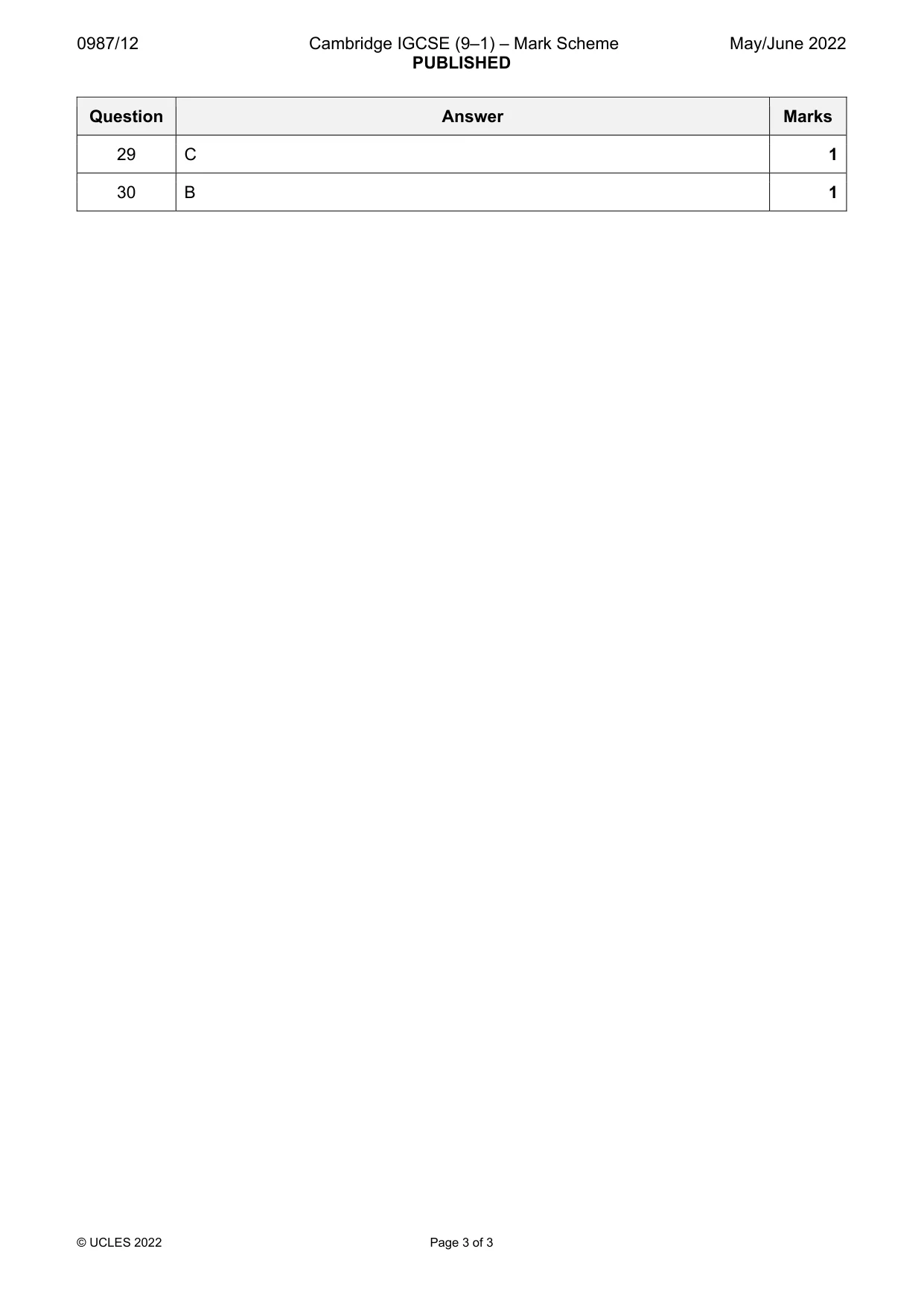
Mark scheme: C
Q30 · The governments of low-income countries often allow foreign multinational companies…
30 The governments of low-income countries often allow foreign multinational companies (MNCs) to mine minerals in their country. Which conflict between benefit and cost might this cause the low-income countries? benefit cost A improved balance of trade training by the MNCs B higher employment loss of a finite resource C increased profits for the MNCs efficient production D more sustainable development economic growth
Mark scheme: B
More questions on Differences in economic development between countries
What was in this paper
The subtopics covered by these 30 questions, and how many questions each got. Open one in a new tab to see every Cambridge question on it.
3Firms’ costs, revenue and objectives2Foreign exchange rates2Market failure2Demand1Differences in economic development between countries1Economic growth1Employment and unemployment1Factors of production1Firms1Fiscal policy1Globalisation and trade restrictions1Government macroeconomic intervention1Inflation1Monetary policy1Money and banking1Opportunity cost1Price changes1Price determination1Price elasticity of demand (PED)1Production possibility curve (PPC) diagrams1Supply-side policy1The nature of the basic economic problem1Types of markets1Workers1What you needed in this session
Cambridge’s own grade thresholds for 2022 May/June, Paper 1 · Variant 2. A higher threshold means an easier paper — the bar moves with how the cohort did.