Cambridge IGCSE Economics (9-1) 0987 — 2021 Oct/Nov Paper 1 · Variant 2
0987/12/O/N/21 · 29 questions · 30 marks · ≈34 min
The question paper and its mark scheme, free to read here and free to download. This is Cambridge’s own paper, exactly as it was sat.
Question paper12 pages
Mark scheme3 pages
Answers below. Sit the paper first if you are practising.

Questions as text
Q1 · To help reduce the price of oil, new supplies are needed
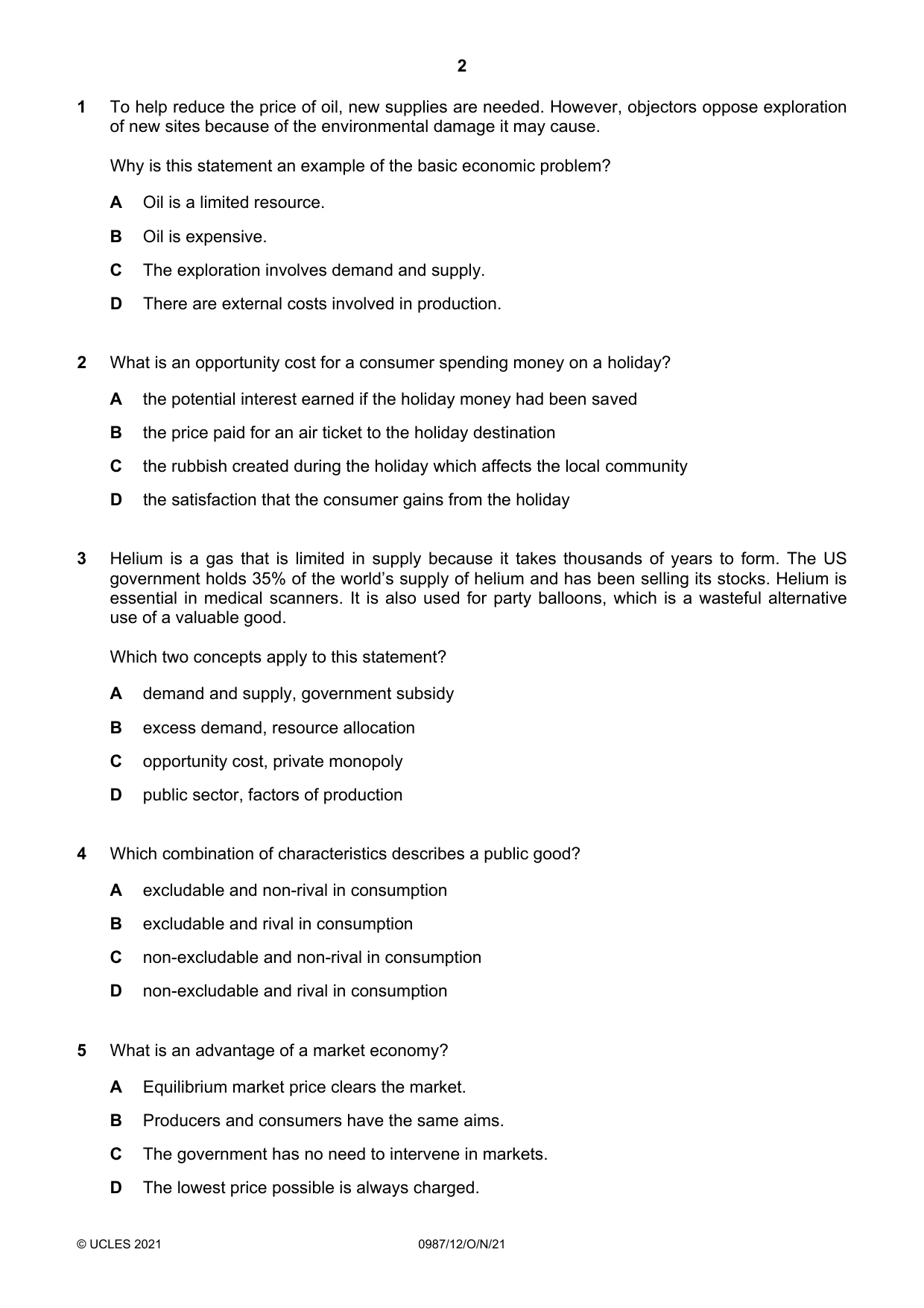
1 To help reduce the price of oil, new supplies are needed. However, objectors oppose exploration of new sites because of the environmental damage it may cause. Why is this statement an example of the basic economic problem? A Oil is a limited resource. B Oil is expensive. C The exploration involves demand and supply. D There are external costs involved in production.
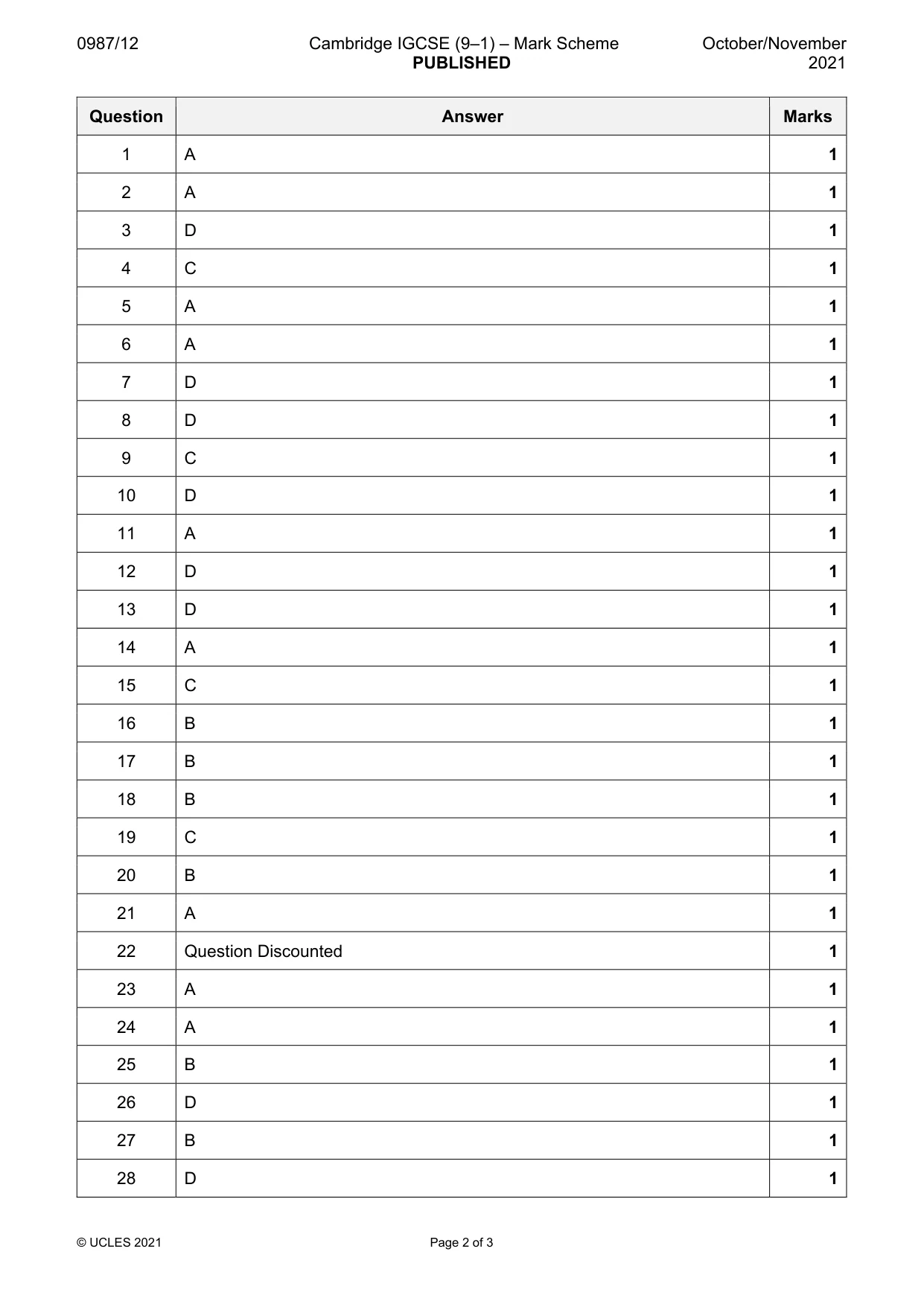
Mark scheme: A
Q2 · What is an opportunity cost for a consumer spending money on a holiday?
2 What is an opportunity cost for a consumer spending money on a holiday? A the potential interest earned if the holiday money had been saved B the price paid for an air ticket to the holiday destination C the rubbish created during the holiday which affects the local community D the satisfaction that the consumer gains from the holiday
Mark scheme: A
Q3 · Helium is a gas that is limited in supply because it takes thousands of years to form
3 Helium is a gas that is limited in supply because it takes thousands of years to form. The US government holds 35% of the world’s supply of helium and has been selling its stocks. Helium is essential in medical scanners. It is also used for party balloons, which is a wasteful alternative use of a valuable good. Which two concepts apply to this statement? A demand and supply, government subsidy B excess demand, resource allocation C opportunity cost, private monopoly D public sector, factors of production
Mark scheme: D
Q4 · Which combination of characteristics describes a public good?
4 Which combination of characteristics describes a public good? A excludable and non-rival in consumption B excludable and rival in consumption C non-excludable and non-rival in consumption D non-excludable and rival in consumption
Mark scheme: C
Q5 · What is an advantage of a market economy?
5 What is an advantage of a market economy? A Equilibrium market price clears the market. B Producers and consumers have the same aims. C The government has no need to intervene in markets. D The lowest price possible is always charged.
Mark scheme: A
Q6 · What is a macroeconomic aim of a government?
6 What is a macroeconomic aim of a government? A balance of payments stability B deflation C income inequality D unemployment
Mark scheme: A
Q7 · An economy relies on potash to make fertiliser
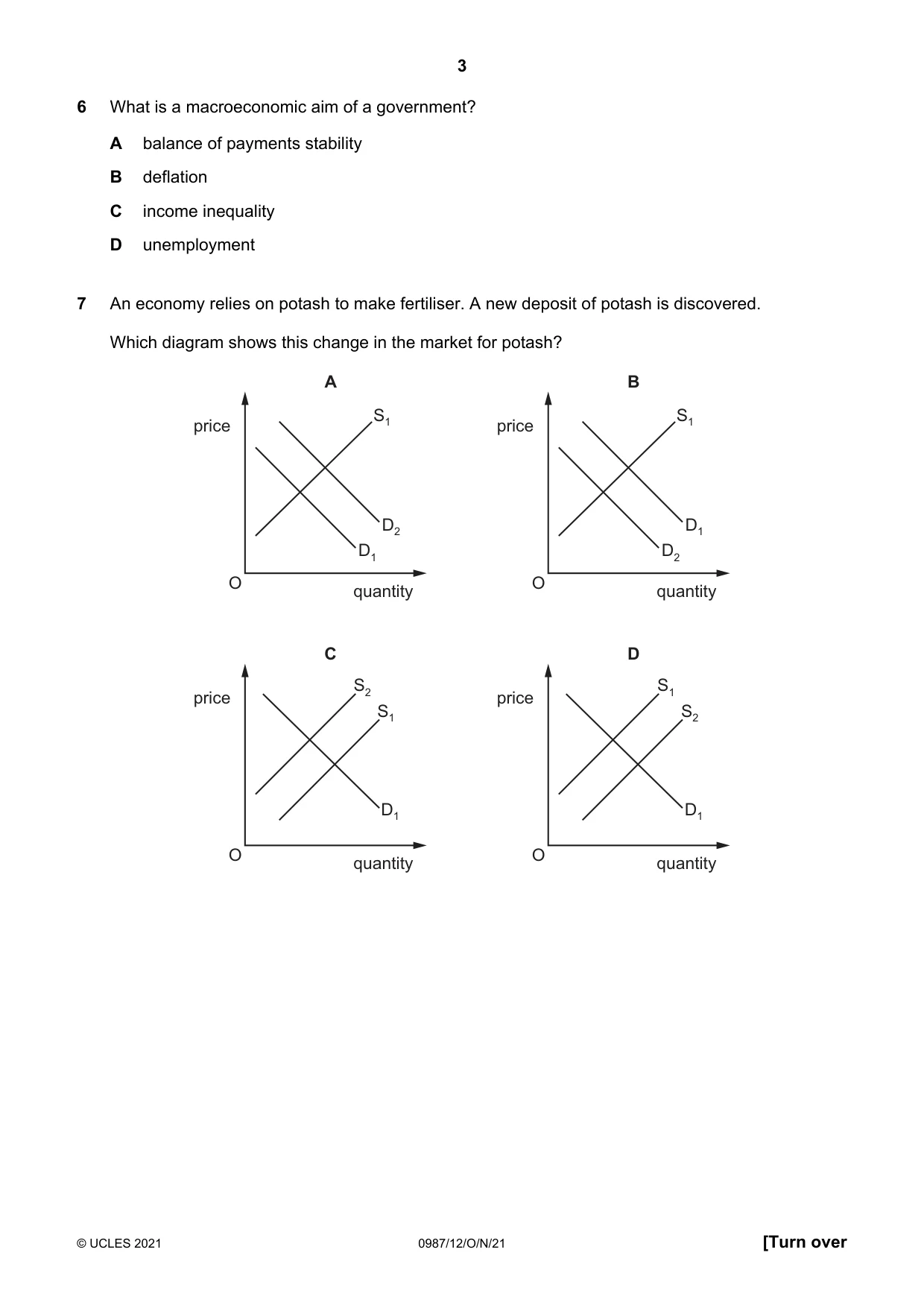
7 An economy relies on potash to make fertiliser. A new deposit of potash is discovered. Which diagram shows this change in the market for potash? A B S1 S1 price price D2 D1 D1 D2 O O quantity quantity C D S2 S1 price price S1 S2 D1 D1 O O quantity quantity
Mark scheme: D
Q8 · The table shows the quantity demanded at different prices
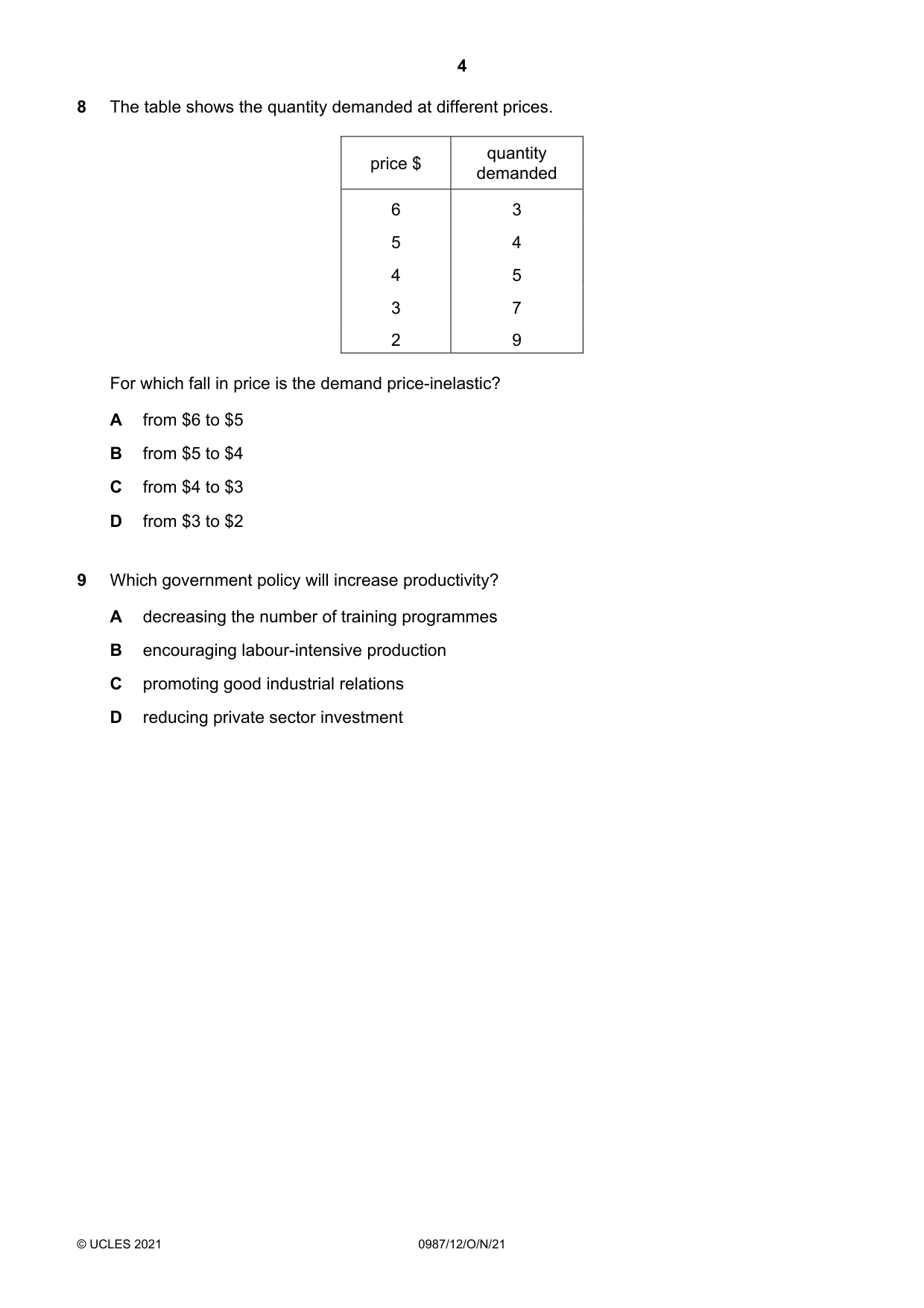
8 The table shows the quantity demanded at different prices. quantity price $ demanded 6 3 5 4 4 5 3 7 2 9 For which fall in price is the demand price-inelastic? A from $6 to $5 B from $5 to $4 C from $4 to $3 D from $3 to $2
Mark scheme: D
Q9 · Which government policy will increase productivity?
9 Which government policy will increase productivity? A decreasing the number of training programmes B encouraging labour-intensive production C promoting good industrial relations D reducing private sector investment
Mark scheme: C
Q10 · The diagrams show the wage rates of cleaners (OWc) and nurses (OWn)
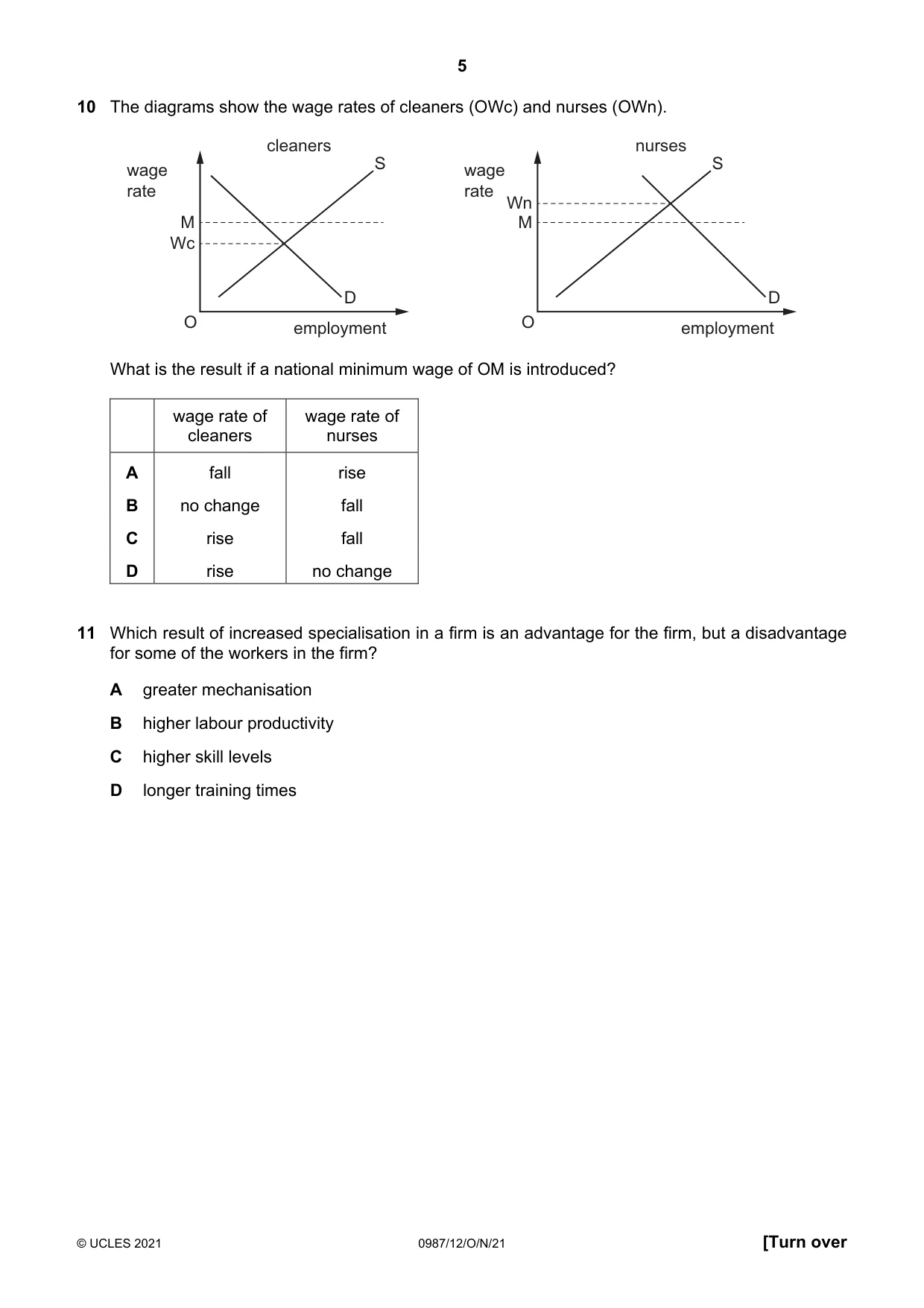
10 The diagrams show the wage rates of cleaners (OWc) and nurses (OWn). cleaners nurses wage S wage S rate rate Wn M M Wc D D O employment O employment What is the result if a national minimum wage of OM is introduced? wage rate of wage rate of cleaners nurses A fall rise B no change fall C rise fall D rise no change
Mark scheme: D
Q11 · Which result of increased specialisation in a firm is an advantage for the firm, but a…
11 Which result of increased specialisation in a firm is an advantage for the firm, but a disadvantage for some of the workers in the firm? A greater mechanisation B higher labour productivity C higher skill levels D longer training times
Mark scheme: A
Q12 · The diagram shows the imposition of a subsidy on a product supplied by a firm
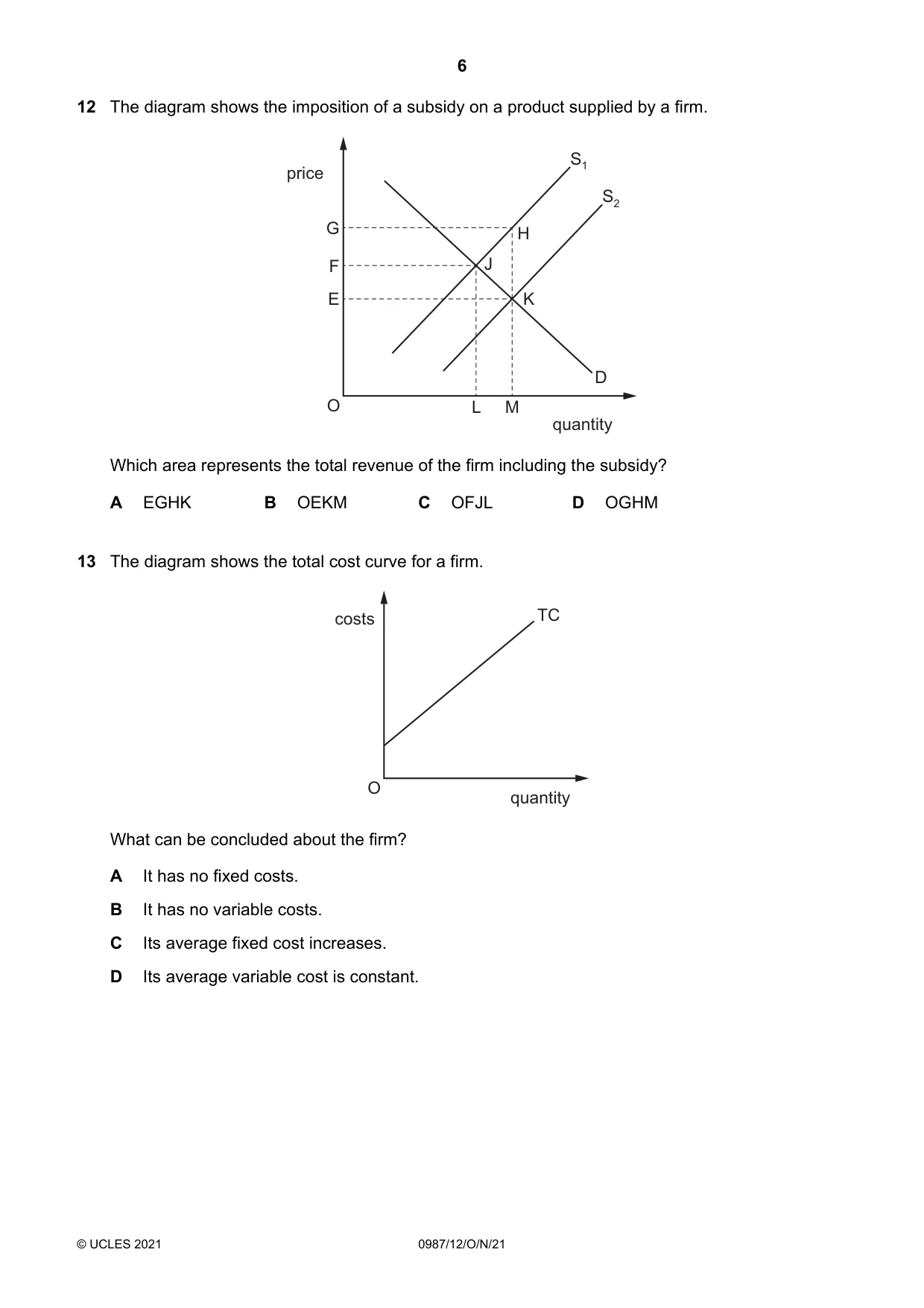
12 The diagram shows the imposition of a subsidy on a product supplied by a firm. S1 price S2 G H F J E K D O L M quantity Which area represents the total revenue of the firm including the subsidy? A EGHK B OEKM C OFJL D OGHM
Mark scheme: D
Q13 · The diagram shows the total cost curve for a firm
13 The diagram shows the total cost curve for a firm. costs TC O quantity What can be concluded about the firm? A It has no fixed costs. B It has no variable costs. C Its average fixed cost increases. D Its average variable cost is constant.
Mark scheme: D
Q14 · The table shows the average total cost of a firm over a range of output
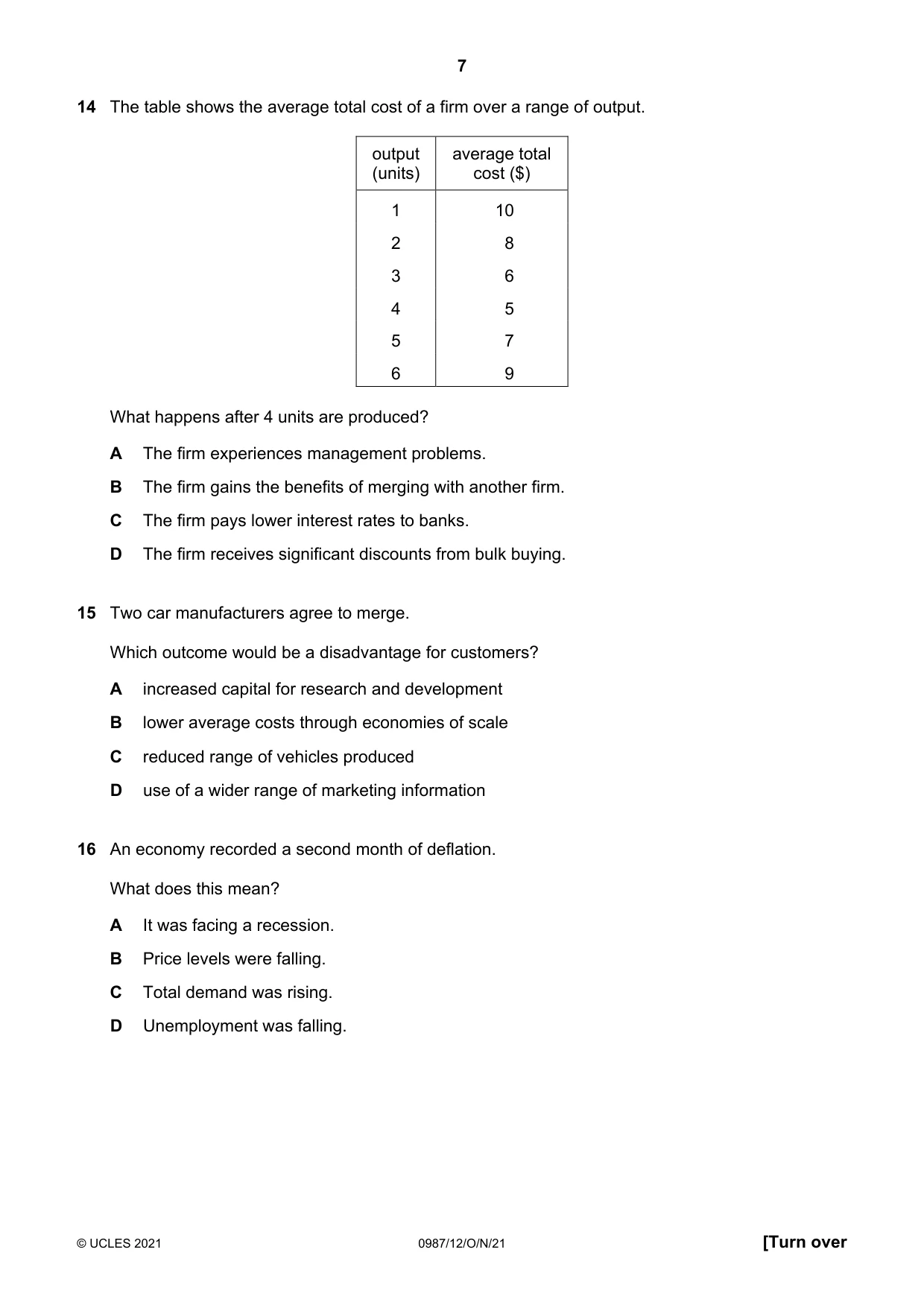
14 The table shows the average total cost of a firm over a range of output. output average total (units) cost ($) 1 10 2 8 3 6 4 5 5 7 6 9 What happens after 4 units are produced? A The firm experiences management problems. B The firm gains the benefits of merging with another firm. C The firm pays lower interest rates to banks. D The firm receives significant discounts from bulk buying.
Mark scheme: A
Q15 · Two car manufacturers agree to merge
15 Two car manufacturers agree to merge. Which outcome would be a disadvantage for customers? A increased capital for research and development B lower average costs through economies of scale C reduced range of vehicles produced D use of a wider range of marketing information
Mark scheme: C
Q16 · An economy recorded a second month of deflation
16 An economy recorded a second month of deflation. What does this mean? A It was facing a recession. B Price levels were falling. C Total demand was rising. D Unemployment was falling.
Mark scheme: B
Q17 · What is a cause of demand-pull inflation?
17 What is a cause of demand-pull inflation? A a surplus of skilled labour B higher government expenditure C higher tax rates D lower net exports
Mark scheme: B
Q18 · What is the consequence of economic growth for individuals and for the economy?
18 What is the consequence of economic growth for individuals and for the economy? individuals the economy A increase in absolute poverty increase in inflation B increase in average incomes increase in government tax revenue C increase in the variety of goods and services reduction in exports D increase in unemployment reduction in the standard of living
Mark scheme: B
Q19 · The table shows a government’s receipts from taxation
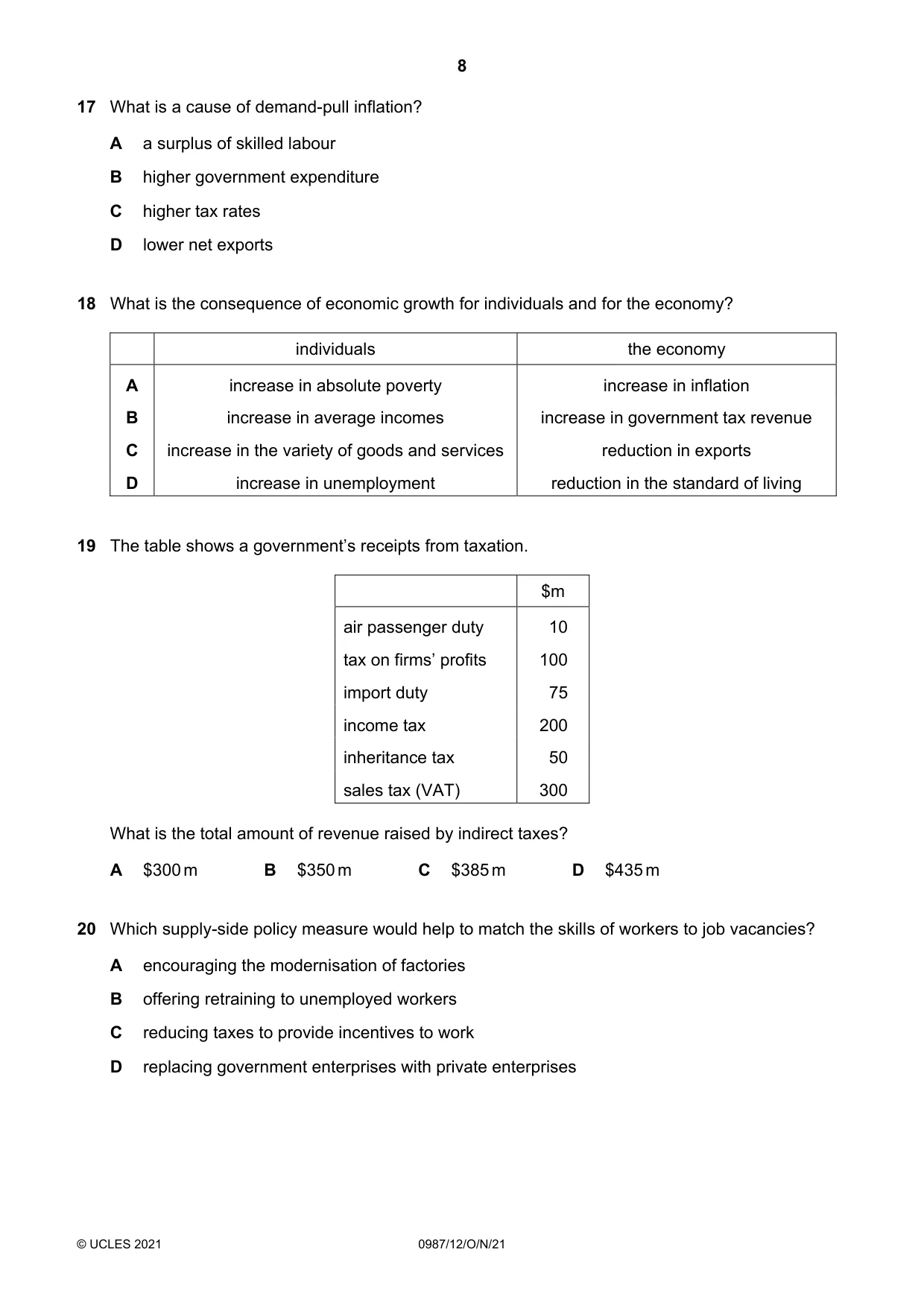
19 The table shows a government’s receipts from taxation. $m air passenger duty 10 tax on firms’ profits 100 import duty 75 income tax 200 inheritance tax 50 sales tax (VAT) 300 What is the total amount of revenue raised by indirect taxes? A $300 m B $350 m C $385 m D $435 m
Mark scheme: C
Q20 · Which supply-side policy measure would help to match the skills of workers to job…
20 Which supply-side policy measure would help to match the skills of workers to job vacancies? A encouraging the modernisation of factories B offering retraining to unemployed workers C reducing taxes to provide incentives to work D replacing government enterprises with private enterprises
Mark scheme: B
Q21 · How is the rate of inflation measured?
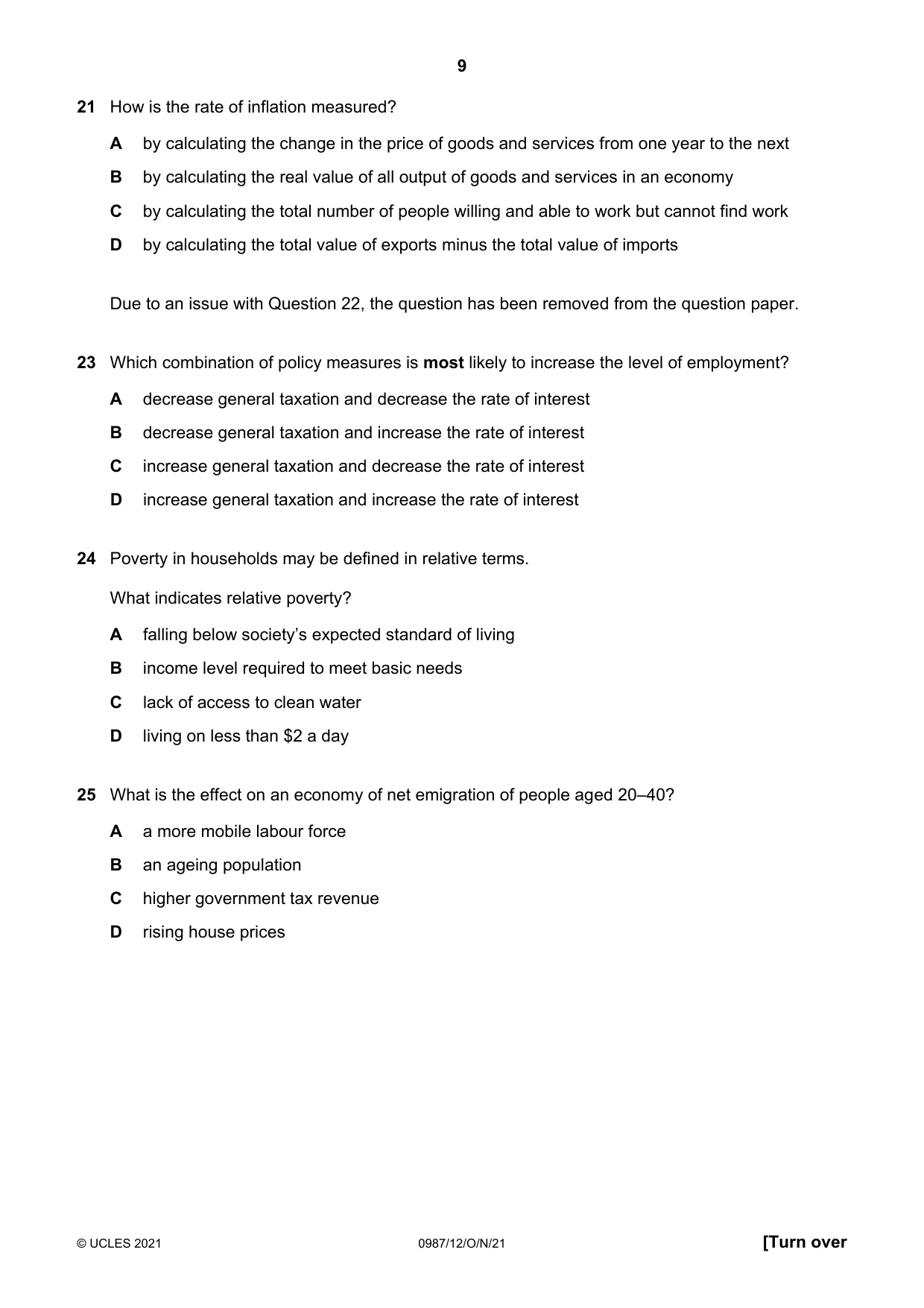
21 How is the rate of inflation measured? A by calculating the change in the price of goods and services from one year to the next B by calculating the real value of all output of goods and services in an economy C by calculating the total number of people willing and able to work but cannot find work D by calculating the total value of exports minus the total value of imports Due to an issue with Question 22, the question has been removed from the question paper.
Mark scheme: A
Q23 · Which combination of policy measures is most likely to increase the level of employment?
23 Which combination of policy measures is most likely to increase the level of employment? A decrease general taxation and decrease the rate of interest B decrease general taxation and increase the rate of interest C increase general taxation and decrease the rate of interest D increase general taxation and increase the rate of interest
Mark scheme: A
Q24 · Poverty in households may be defined in relative terms
24 Poverty in households may be defined in relative terms. What indicates relative poverty? A falling below society’s expected standard of living B income level required to meet basic needs C lack of access to clean water D living on less than $2 a day
Mark scheme: A
Q25 · What is the effect on an economy of net emigration of people aged 20–40?
25 What is the effect on an economy of net emigration of people aged 20–40? A a more mobile labour force B an ageing population C higher government tax revenue D rising house prices
Mark scheme: B
Q26 · The table shows statistics for four countries, A–D
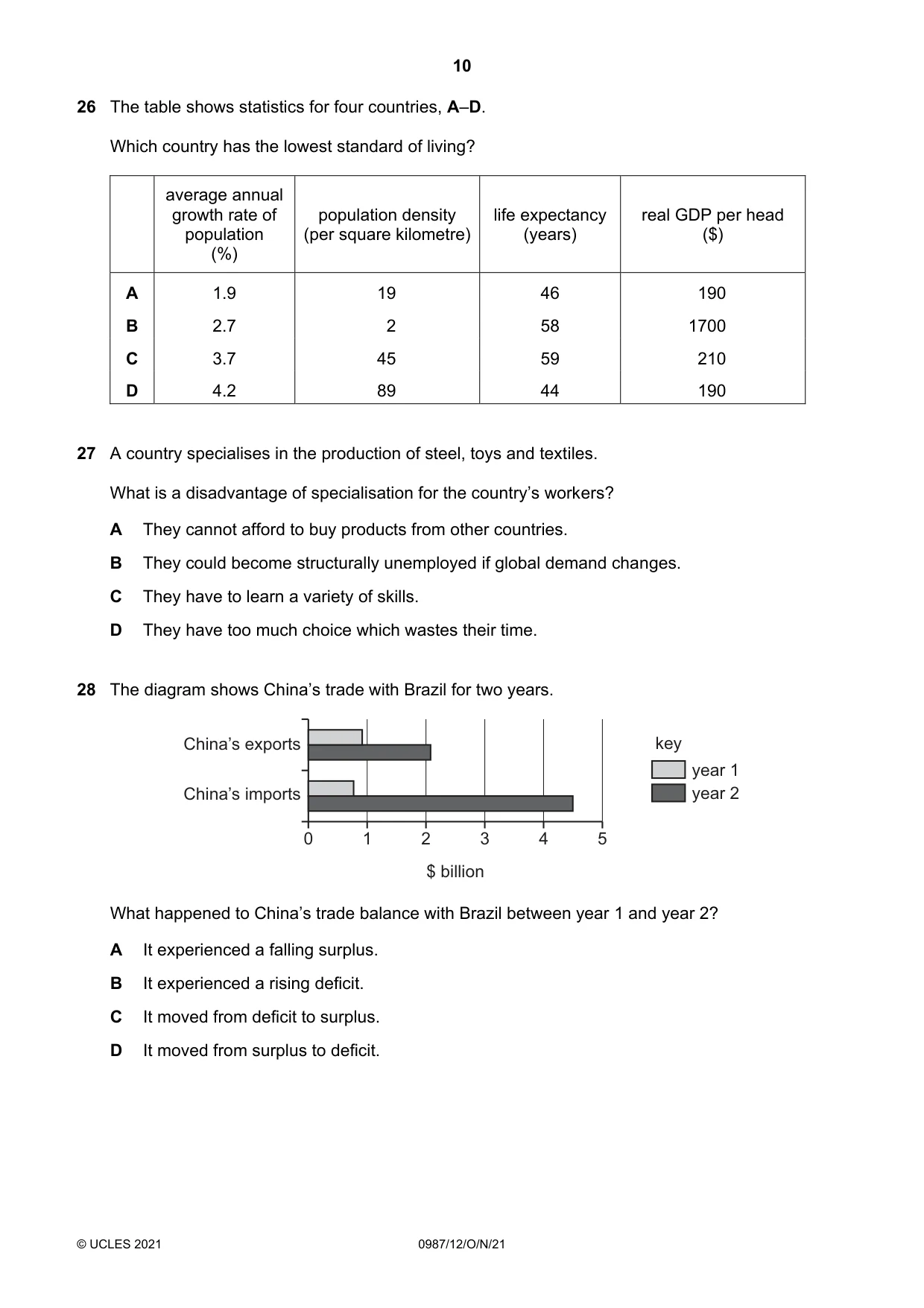
26 The table shows statistics for four countries, A–D. Which country has the lowest standard of living? average annual growth rate of population density life expectancy real GDP per head population (per square kilometre) (years) ($) (%) A 1.9 19 46 190 B 2.7 2 58 1700 C 3.7 45 59 210 D 4.2 89 44 190
Mark scheme: D
Q27 · A country specialises in the production of steel, toys and textiles
27 A country specialises in the production of steel, toys and textiles. What is a disadvantage of specialisation for the country’s workers? A They cannot afford to buy products from other countries. B They could become structurally unemployed if global demand changes. C They have to learn a variety of skills. D They have too much choice which wastes their time.
Mark scheme: B
Q28 · The diagram shows China’s trade with Brazil for two years
28 The diagram shows China’s trade with Brazil for two years. China’s exports key year 1 China’s imports year 2 0 1 2 3 4 5 $ billion What happened to China’s trade balance with Brazil between year 1 and year 2? A It experienced a falling surplus. B It experienced a rising deficit. C It moved from deficit to surplus. D It moved from surplus to deficit.
Mark scheme: D
More questions on Current account of the balance of payments
Q29 · The US imposed tariffs on cars and motorcycles from Germany
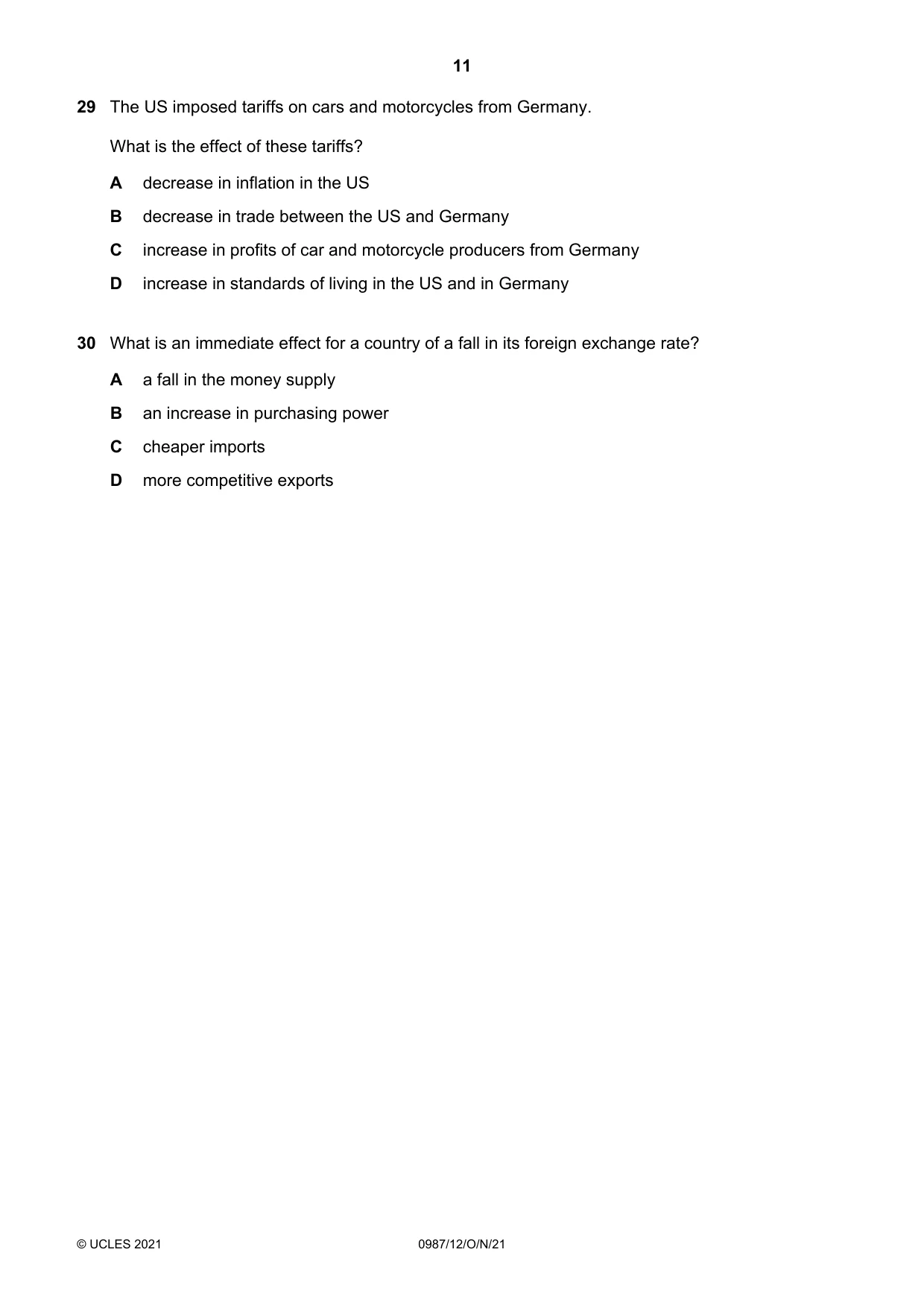
29 The US imposed tariffs on cars and motorcycles from Germany. What is the effect of these tariffs? A decrease in inflation in the US B decrease in trade between the US and Germany C increase in profits of car and motorcycle producers from Germany D increase in standards of living in the US and in Germany
Mark scheme: B
Q30 · What is an immediate effect for a country of a fall in its foreign exchange rate?
30 What is an immediate effect for a country of a fall in its foreign exchange rate? A a fall in the money supply B an increase in purchasing power C cheaper imports D more competitive exports
Mark scheme: D
What was in this paper
The subtopics covered by these 29 questions, and how many questions each got. Open one in a new tab to see every Cambridge question on it.
3Firms’ costs, revenue and objectives2Fiscal policy2Government macroeconomic intervention2Opportunity cost2Specialisation and free trade2Supply-side policy2Current account of the balance of payments1Economic growth1Foreign exchange rates1Globalisation and trade restrictions1Living standards1Market economic system1Market failure1Population1Poverty1Price determination1Price elasticity of demand (PED)1Supply1The nature of the basic economic problem1Types of markets1What you needed in this session
Cambridge’s own grade thresholds for 2021 Oct/Nov, Paper 1 · Variant 2. A higher threshold means an easier paper — the bar moves with how the cohort did.