Cambridge IGCSE Economics (9-1) 0987 — 2025 Oct/Nov Paper 1 · Variant 2
0987/12/O/N/25 · 30 questions · 30 marks · ≈34 min
The question paper and its mark scheme, free to read here and free to download. This is Cambridge’s own paper, exactly as it was sat.
Question paper12 pages
Mark scheme3 pages
Answers below. Sit the paper first if you are practising.
Questions as text
Q1 · A government wants to build a new hospital
1 A government wants to build a new hospital. What is most likely to prevent the government from doing this? A People in the country cannot afford healthcare. B People in the country would go abroad for healthcare. C The government cannot agree how big the hospital should be. D The government does not have enough money.
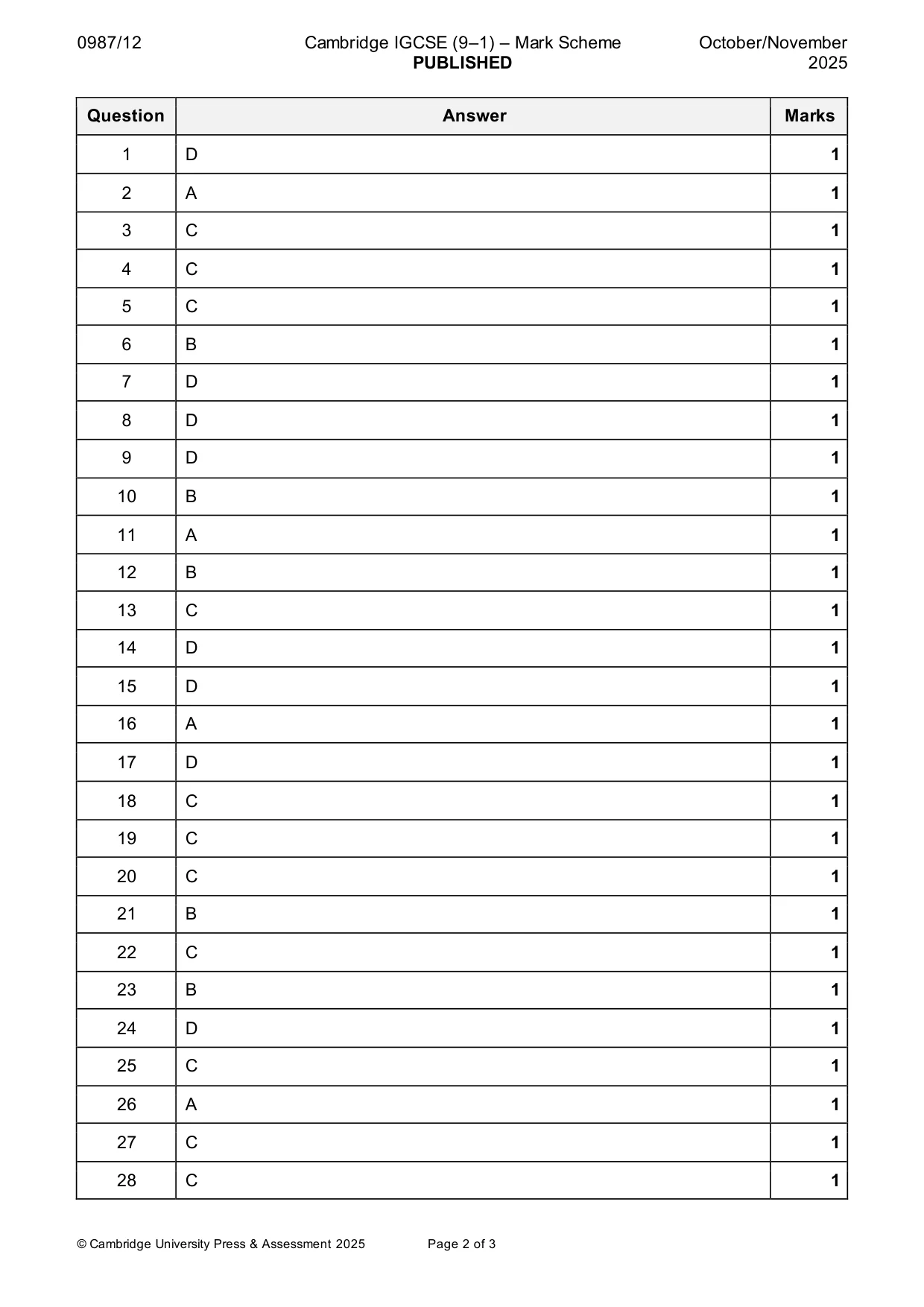
Mark scheme: D
Q2 · Which term describes the loss of potential benefit to a consumer when making a choice…
2 Which term describes the loss of potential benefit to a consumer when making a choice between alternatives? A opportunity cost B scarcity C shortage D the economic problem
Mark scheme: A
Q3 · A country is producing at point X on its production possibility curve (PPC) which shows…
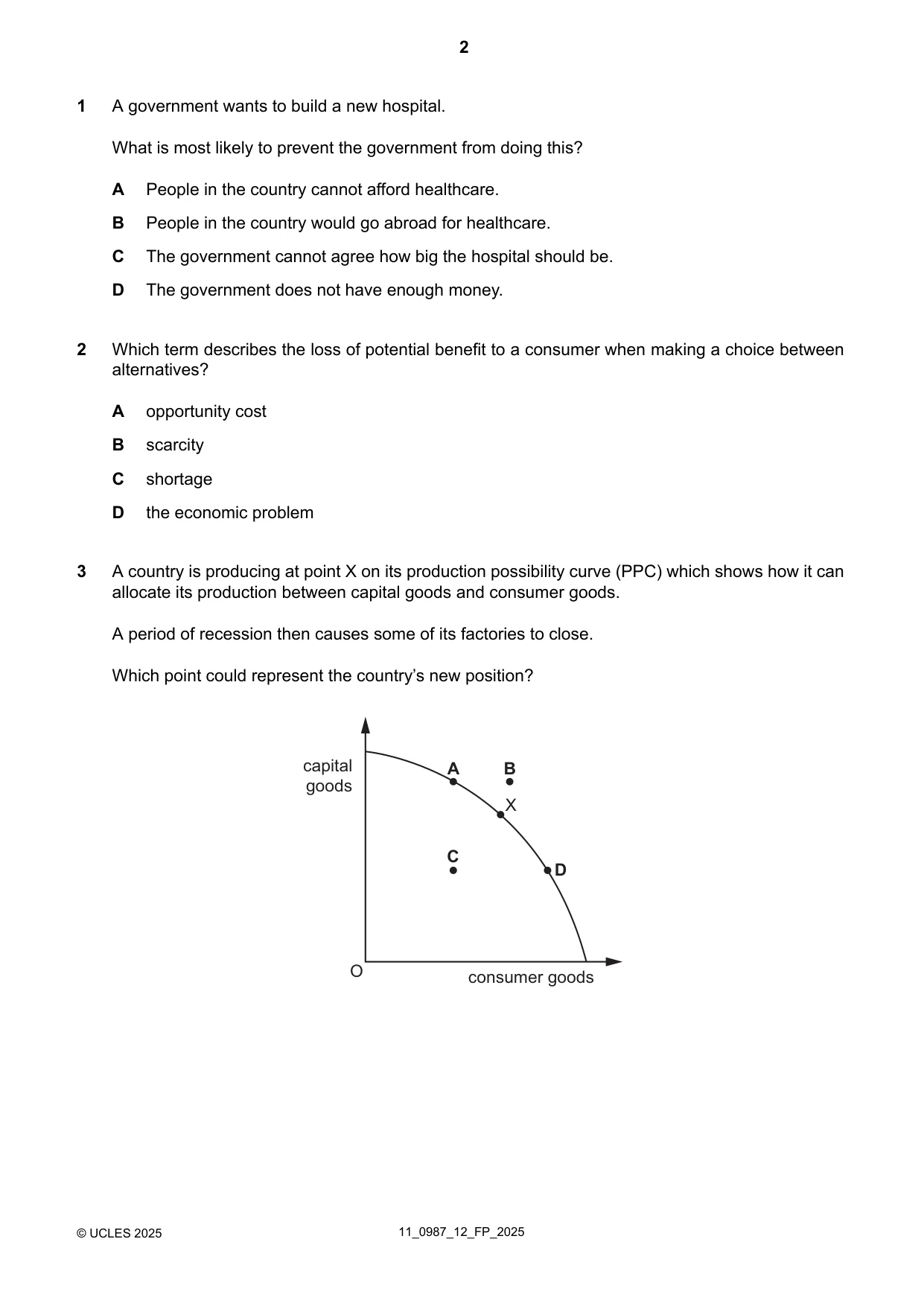
3 A country is producing at point X on its production possibility curve (PPC) which shows how it can allocate its production between capital goods and consumer goods. A period of recession then causes some of its factories to close. Which point could represent the country’s new position? capital A B goods X C D O consumer goods
Mark scheme: C
More questions on Production possibility curve (PPC) diagrams
Q4 · Which combination gives correct examples of macroeconomics and microeconomics?
4 Which combination gives correct examples of macroeconomics and microeconomics? macroeconomics microeconomics A study of demand for a product study of price of a product B study of behaviour of firms study of individual behaviour C study of the economy as a whole study of specific markets D study of the international economy study of the national economy
Mark scheme: C
More questions on The role of markets in allocating resources
Q5 · The diagram shows the supply and demand curves for a good
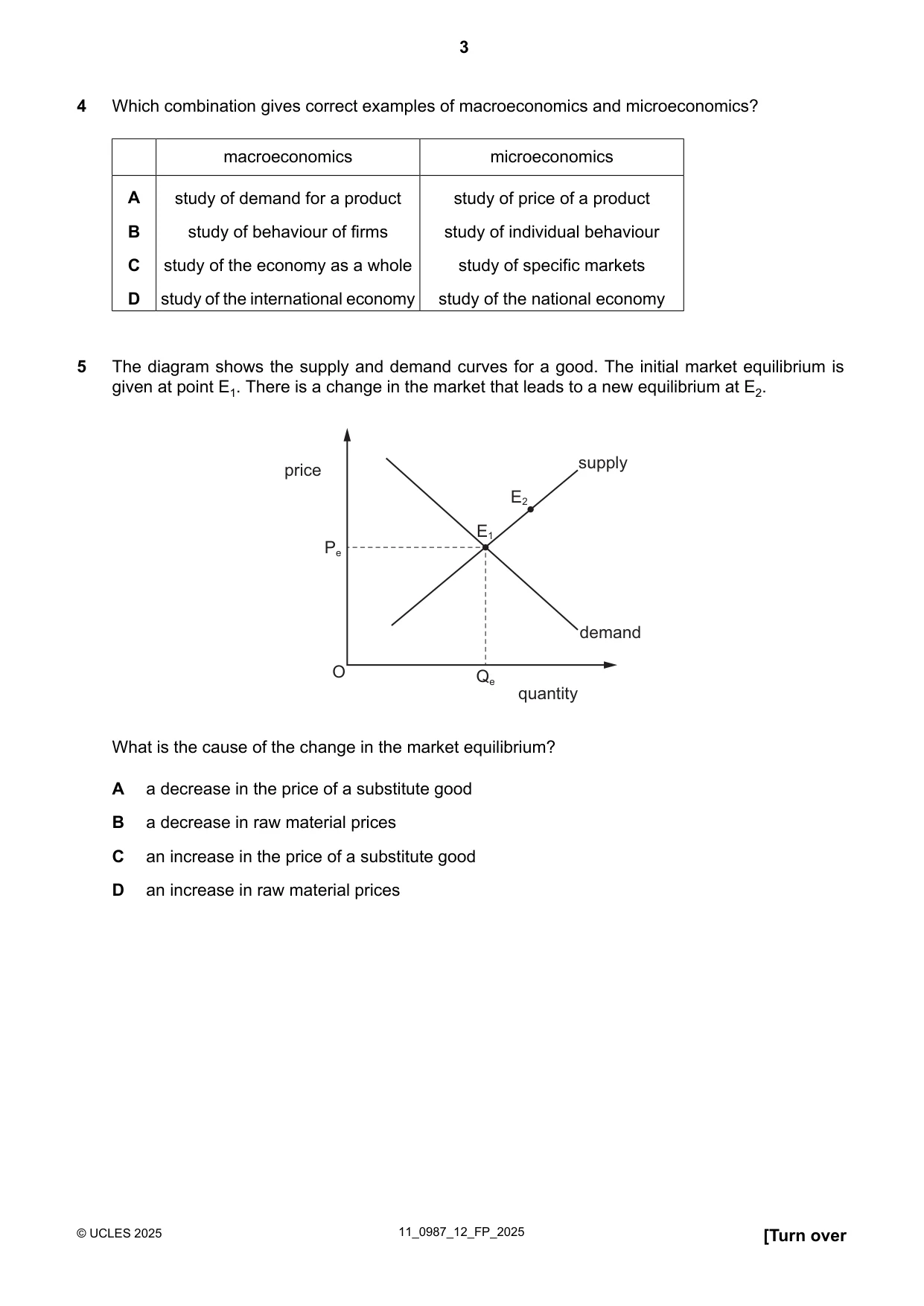
5 The diagram shows the supply and demand curves for a good. The initial market equilibrium is given at point E1. There is a change in the market that leads to a new equilibrium at E2. price supply E2 E1 Pe demand O Qe quantity What is the cause of the change in the market equilibrium? A a decrease in the price of a substitute good B a decrease in raw material prices C an increase in the price of a substitute good D an increase in raw material prices
Mark scheme: C
Q6 · The diagram shows the demand curve for a good
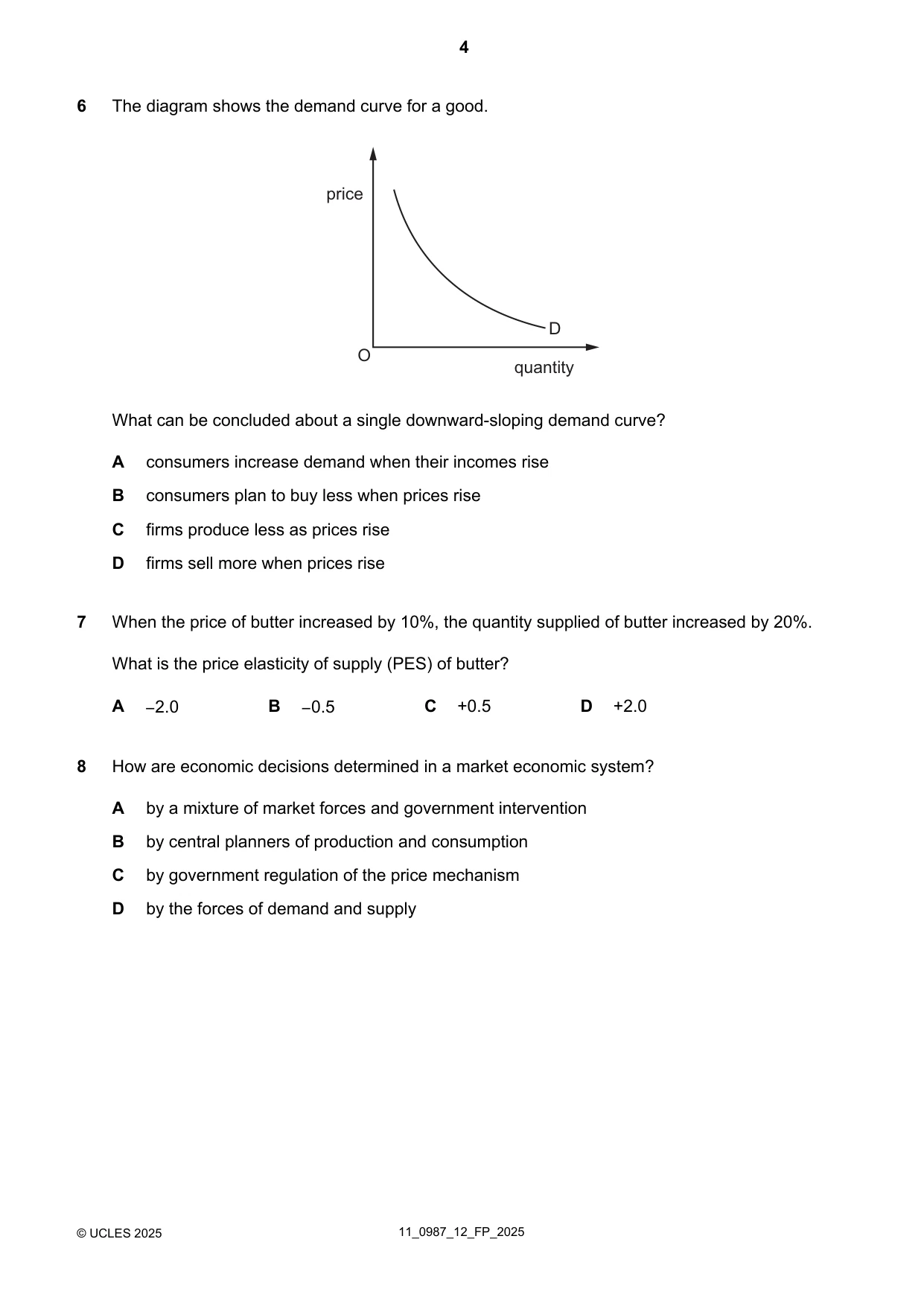
6 The diagram shows the demand curve for a good. price D O quantity What can be concluded about a single downward-sloping demand curve? A consumers increase demand when their incomes rise B consumers plan to buy less when prices rise C firms produce less as prices rise D firms sell more when prices rise
Mark scheme: B
Q7 · When the price of butter increased by 10%, the quantity supplied of butter increased by…
7 When the price of butter increased by 10%, the quantity supplied of butter increased by 20%. What is the price elasticity of supply (PES) of butter? A −2.0 B −0.5 C +0.5 D +2.0
Mark scheme: D
Q8 · How are economic decisions determined in a market economic system?
8 How are economic decisions determined in a market economic system? A by a mixture of market forces and government intervention B by central planners of production and consumption C by government regulation of the price mechanism D by the forces of demand and supply
Mark scheme: D
Q9 · A bridge is built over a river which enables journey times to be reduced
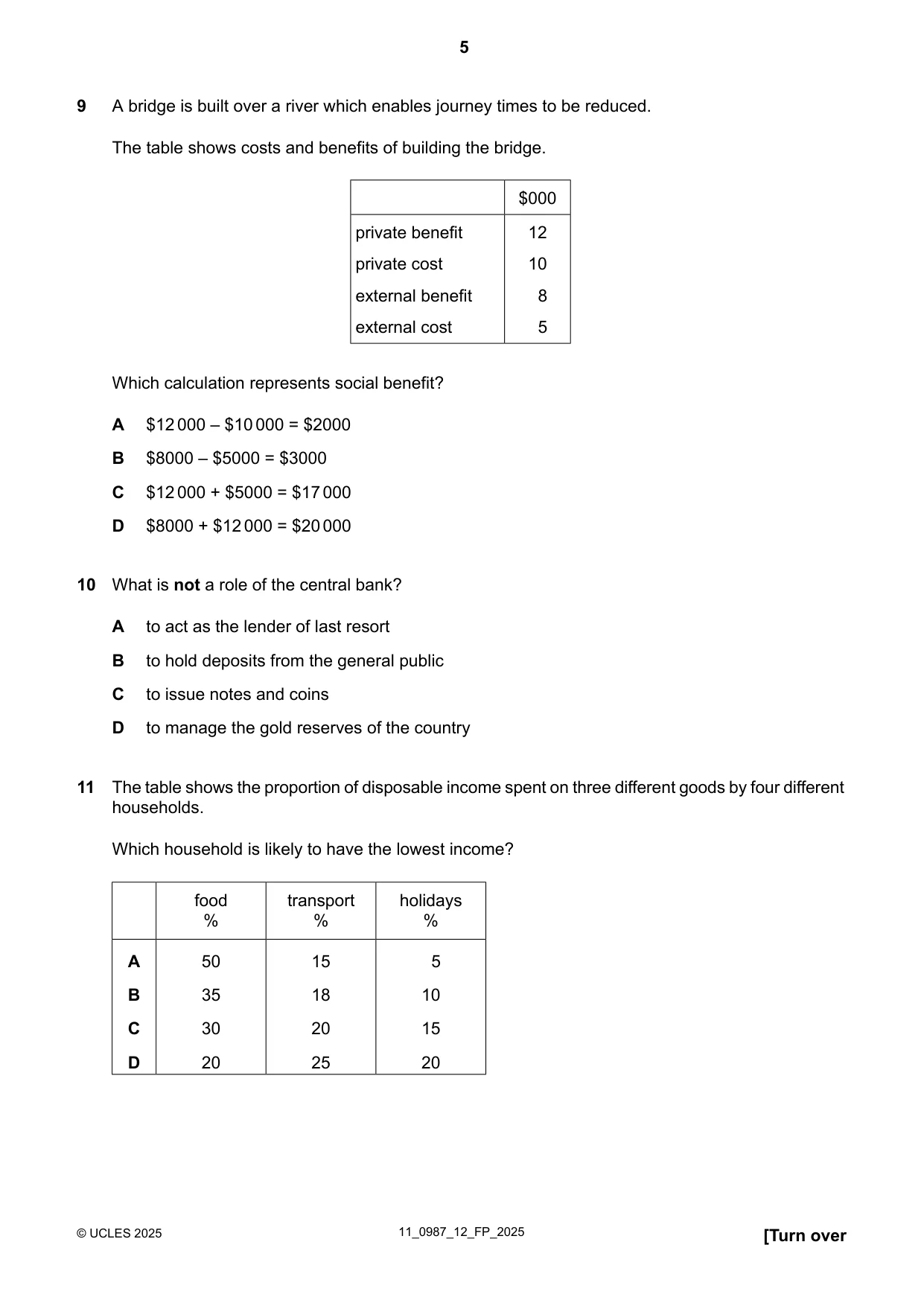
9 A bridge is built over a river which enables journey times to be reduced. The table shows costs and benefits of building the bridge. $000 private benefit 12 private cost 10 external benefit 8 external cost 5 Which calculation represents social benefit? A $12000 – $10000 = $2000 B $8000 – $5000 = $3000 C $12000 + $5000 = $17000 D $8000 + $12000 = $20000
Mark scheme: D
Q10 · What is not a role of the central bank?
10 What is not a role of the central bank? A to act as the lender of last resort B to hold deposits from the general public C to issue notes and coins D to manage the gold reserves of the country
Mark scheme: B
Q11 · The table shows the proportion of disposable income spent on three different goods by…
11 The table shows the proportion of disposable income spent on three different goods by four different households. Which household is likely to have the lowest income? food transport holidays % % % A 50 15 5 B 35 18 10 C 30 20 15 D 20 25 20
Mark scheme: A
Q12 · In which occupations do wages tend to be lowest?
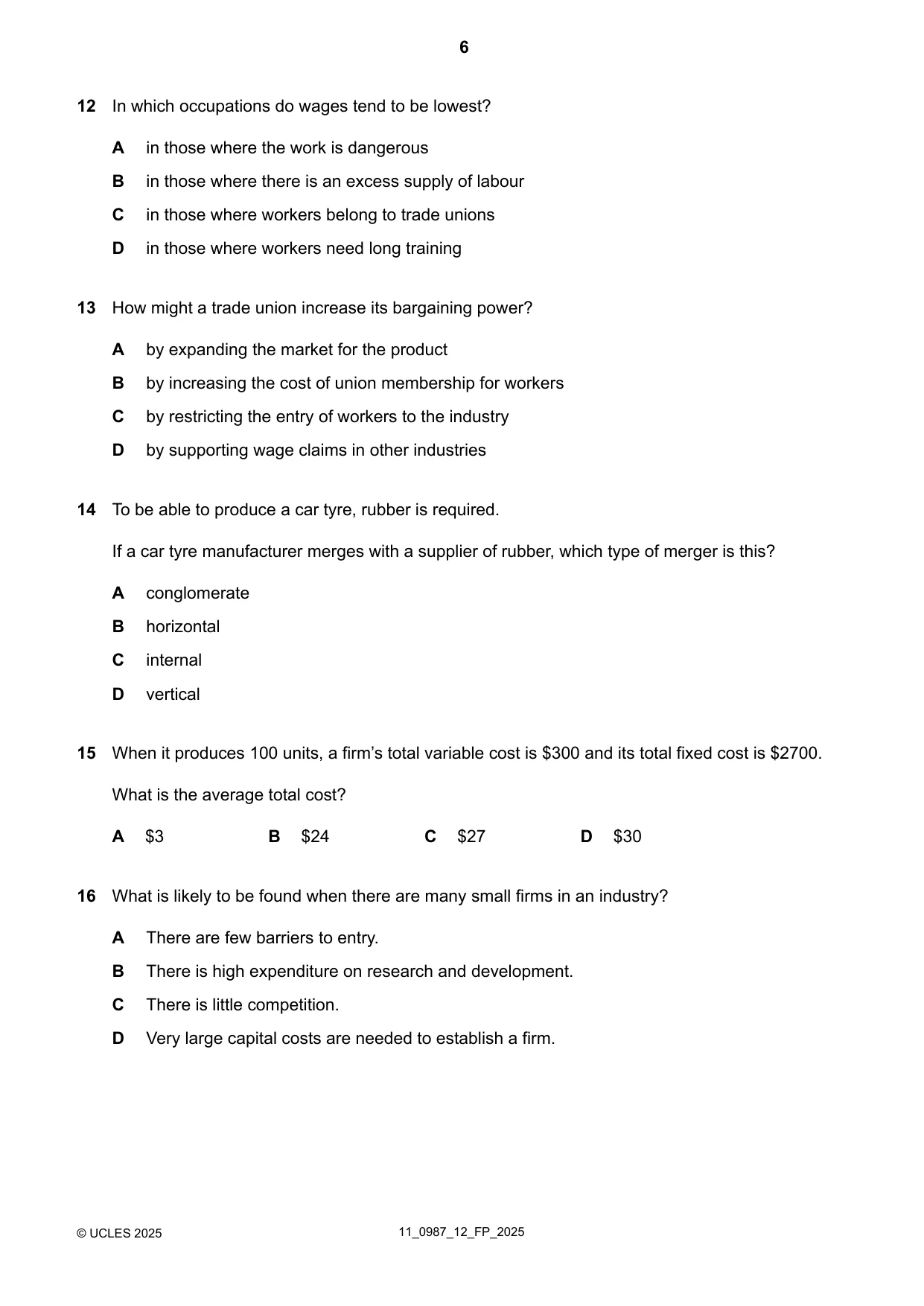
12 In which occupations do wages tend to be lowest? A in those where the work is dangerous B in those where there is an excess supply of labour C in those where workers belong to trade unions D in those where workers need long training
Mark scheme: B
Q13 · How might a trade union increase its bargaining power?
13 How might a trade union increase its bargaining power? A by expanding the market for the product B by increasing the cost of union membership for workers C by restricting the entry of workers to the industry D by supporting wage claims in other industries
Mark scheme: C
Q14 · To be able to produce a car tyre, rubber is required
14 To be able to produce a car tyre, rubber is required. If a car tyre manufacturer merges with a supplier of rubber, which type of merger is this? A conglomerate B horizontal C internal D vertical
Mark scheme: D
Q15 · When it produces 100 units, a firm’s total variable cost is $300 and its total fixed cost…
15 When it produces 100 units, a firm’s total variable cost is $300 and its total fixed cost is $2700. What is the average total cost? A $3 B $24 C $27 D $30
Mark scheme: D
Q16 · What is likely to be found when there are many small firms in an industry?
16 What is likely to be found when there are many small firms in an industry? A There are few barriers to entry. B There is high expenditure on research and development. C There is little competition. D Very large capital costs are needed to establish a firm.
Mark scheme: A
Q17 · A government imposes tariffs on imported goods
17 A government imposes tariffs on imported goods. What is not a likely reason for this? A to boost domestic output B to influence the country’s balance of payments C to protect domestic employment D to reduce the exports from the country
Mark scheme: D
Q18 · A government collects the following revenue in a year
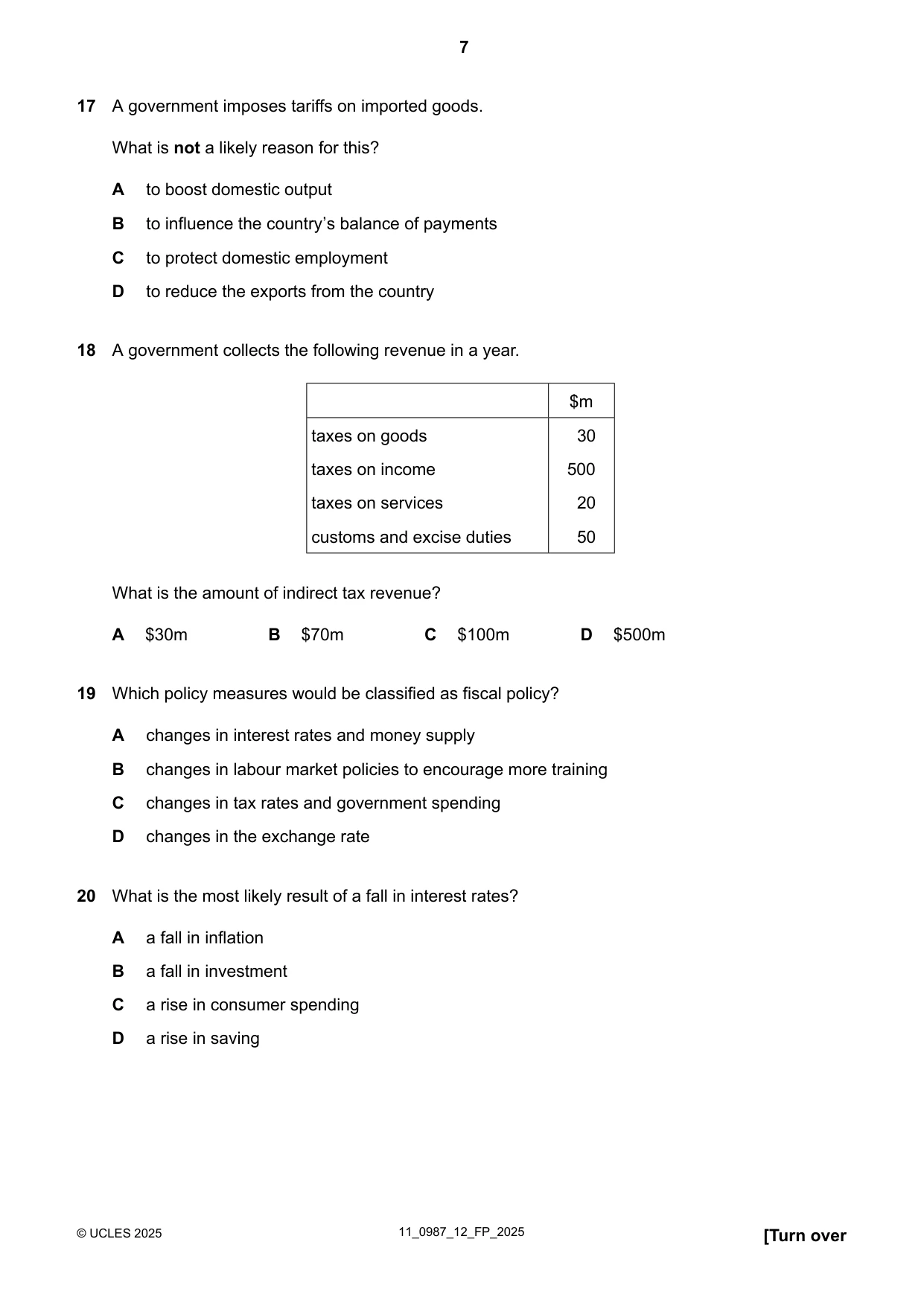
18 A government collects the following revenue in a year. $m taxes on goods 30 taxes on income 500 taxes on services 20 customs and excise duties 50 What is the amount of indirect tax revenue? A $30m B $70m C $100m D $500m
Mark scheme: C
Q19 · Which policy measures would be classified as fiscal policy?
19 Which policy measures would be classified as fiscal policy? A changes in interest rates and money supply B changes in labour market policies to encourage more training C changes in tax rates and government spending D changes in the exchange rate
Mark scheme: C
Q20 · What is the most likely result of a fall in interest rates?
20 What is the most likely result of a fall in interest rates? A a fall in inflation B a fall in investment C a rise in consumer spending D a rise in saving
Mark scheme: C
Q21 · What does a successful supply-side policy increase in an economy?
21 What does a successful supply-side policy increase in an economy? A the level of unemployment B the production possibilities C the rate of inflation D the rate of interest
Mark scheme: B
Q22 · In one particular year, South Sudan’s population growth was 1.3% while its GDP growth was…
22 In one particular year, South Sudan’s population growth was 1.3% while its GDP growth was 2%. What is the most likely consequence of this? A GDP per capita will decrease B the rate of inflation will decrease C the standard of living will increase D unemployment will increase
Mark scheme: C
Q23 · What are the correct definitions of unemployment and employment relative to the number of…
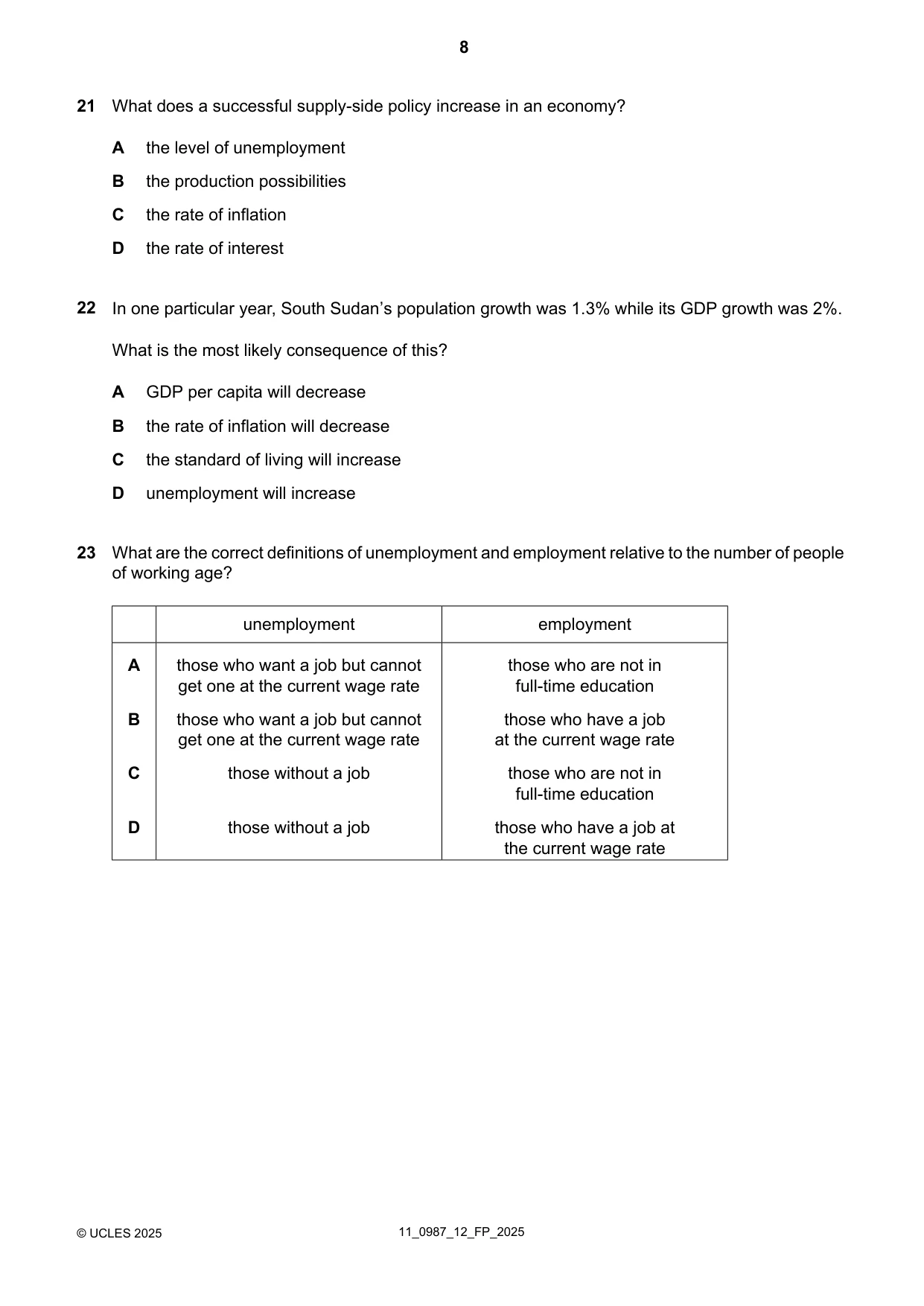
23 What are the correct definitions of unemployment and employment relative to the number of people of working age? unemployment employment A those who want a job but cannot those who are not in get one at the current wage rate full-time education B those who want a job but cannot those who have a job get one at the current wage rate at the current wage rate C those without a job those who are not in full-time education D those without a job those who have a job at the current wage rate
Mark scheme: B
Q24 · The graph shows changes in the average price level
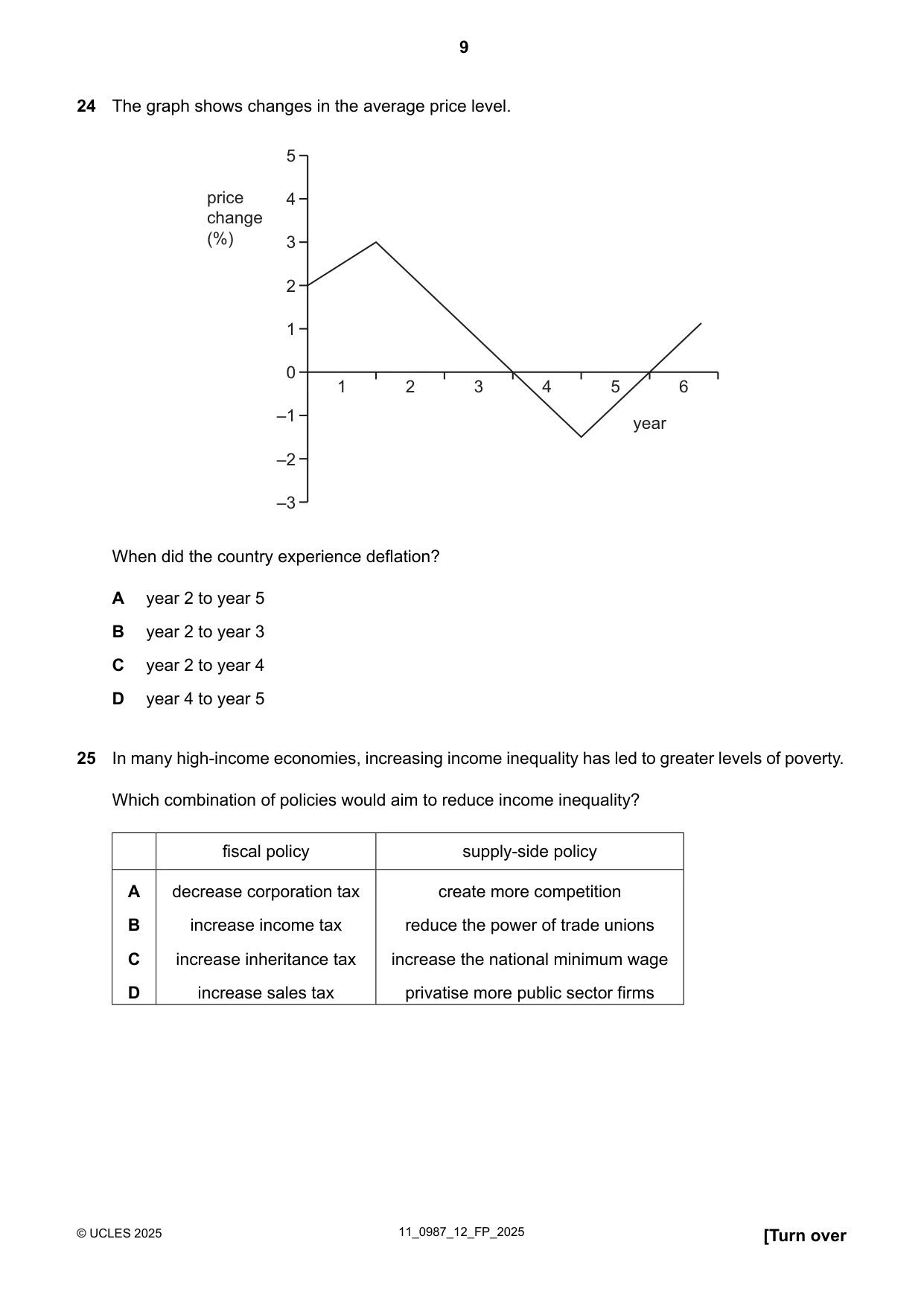
24 The graph shows changes in the average price level. 5 price 4 change (%) 3 2 1 0 1 2 3 4 5 6 –1 year –2 –3 When did the country experience deflation? A year 2 to year 5 B year 2 to year 3 C year 2 to year 4 D year 4 to year 5
Mark scheme: D
Q25 · In many high-income economies, increasing income inequality has led to greater levels of…
25 In many high-income economies, increasing income inequality has led to greater levels of poverty. Which combination of policies would aim to reduce income inequality? fiscal policy supply-side policy A decrease corporation tax create more competition B increase income tax reduce the power of trade unions C increase inheritance tax increase the national minimum wage D increase sales tax privatise more public sector firms
Mark scheme: C
Q26 · A country has a falling birth rate and a rising death rate, while an increasing number of…
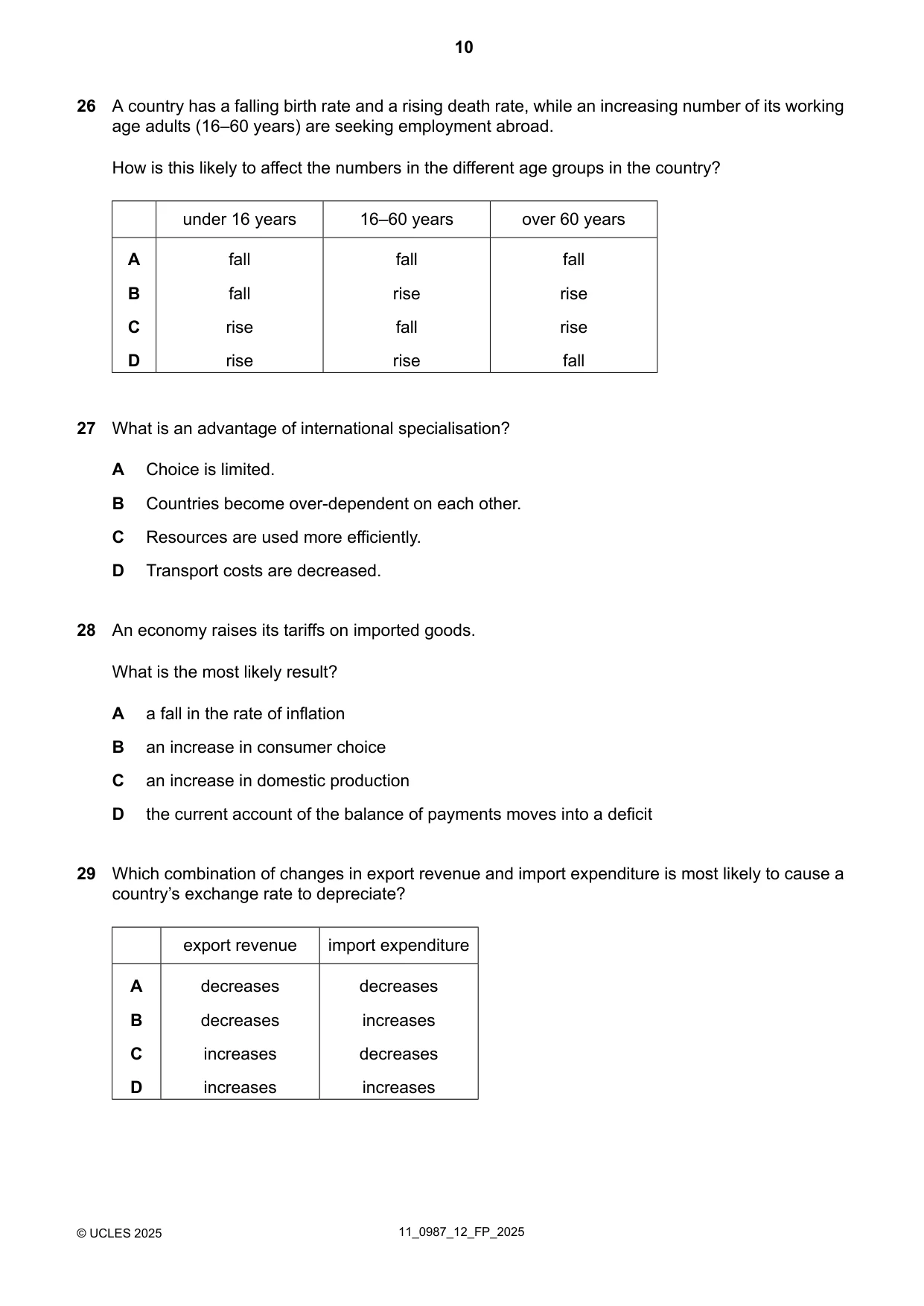
26 A country has a falling birth rate and a rising death rate, while an increasing number of its working age adults (16–60 years) are seeking employment abroad. How is this likely to affect the numbers in the different age groups in the country? under 16 years 16–60 years over 60 years A fall fall fall B fall rise rise C rise fall rise D rise rise fall
Mark scheme: A
Q27 · What is an advantage of international specialisation?
27 What is an advantage of international specialisation? A Choice is limited. B Countries become over-dependent on each other. C Resources are used more efficiently. D Transport costs are decreased.
Mark scheme: C
Q28 · An economy raises its tariffs on imported goods
28 An economy raises its tariffs on imported goods. What is the most likely result? A a fall in the rate of inflation B an increase in consumer choice C an increase in domestic production D the current account of the balance of payments moves into a deficit
Mark scheme: C
Q29 · Which combination of changes in export revenue and import expenditure is most likely to…
29 Which combination of changes in export revenue and import expenditure is most likely to cause a country’s exchange rate to depreciate? export revenue import expenditure A decreases decreases B decreases increases C increases decreases D increases increases
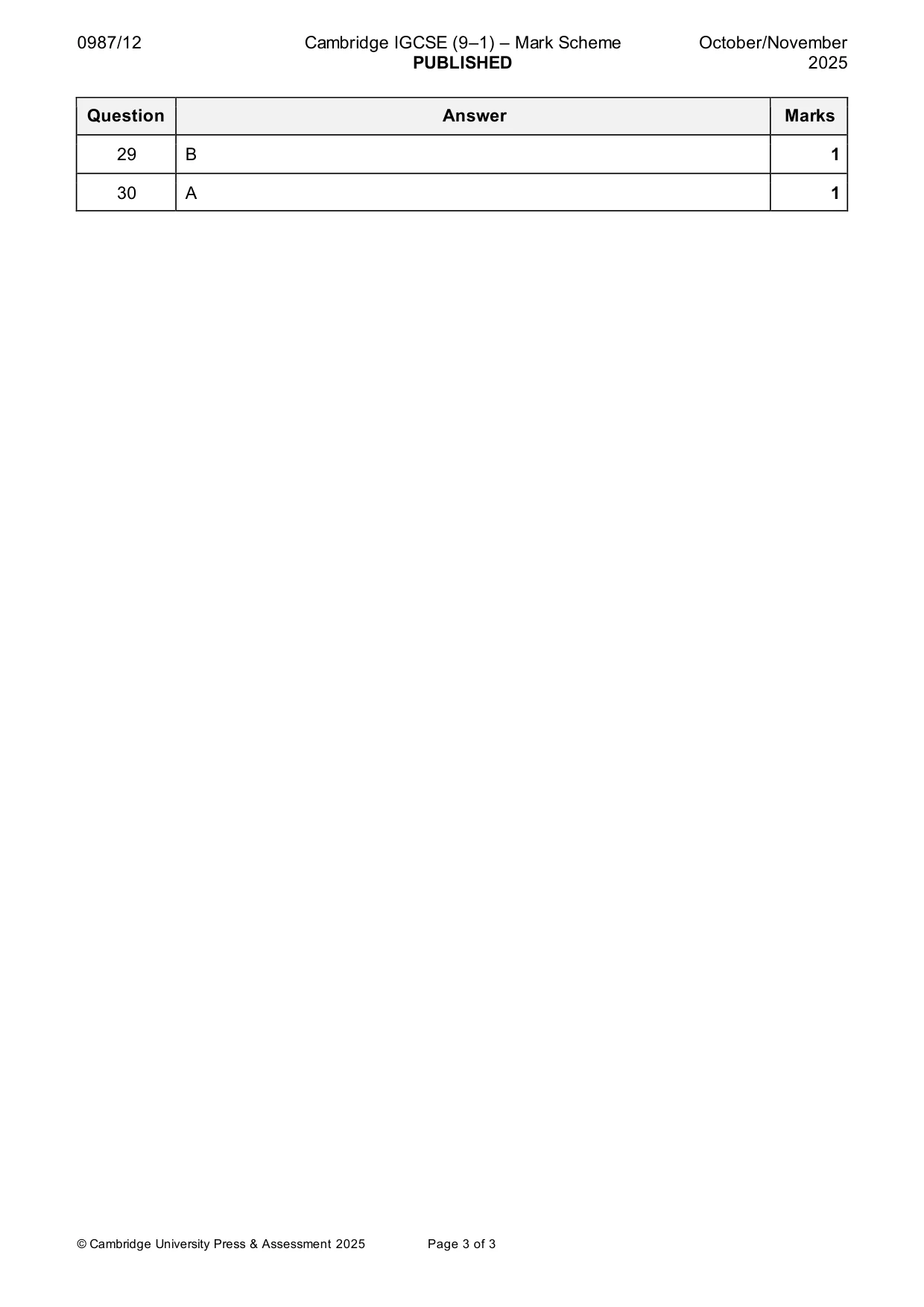
Mark scheme: B
Q30 · A government wishes to reduce the deficit on the current account of its balance of…
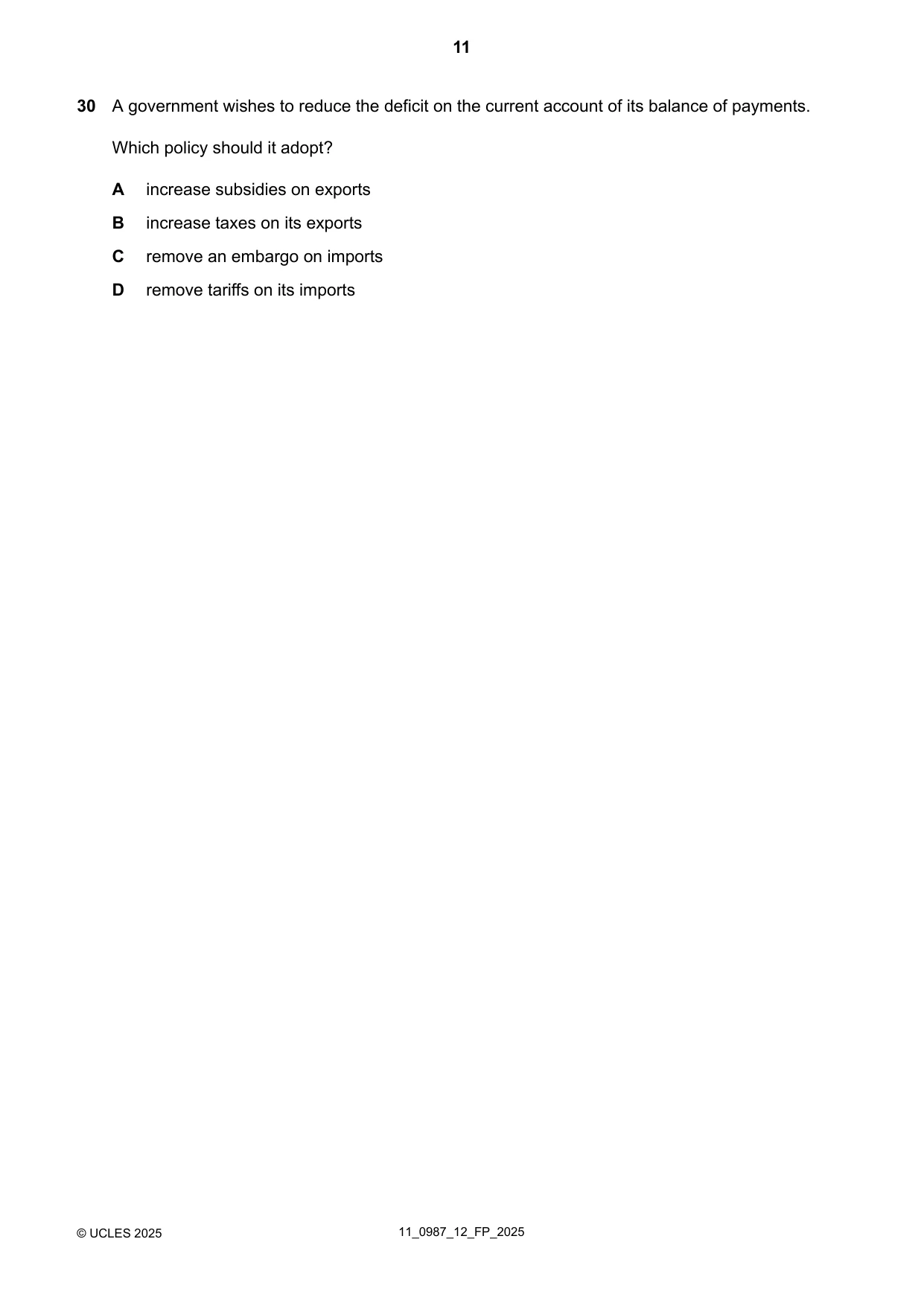
30 A government wishes to reduce the deficit on the current account of its balance of payments. Which policy should it adopt? A increase subsidies on exports B increase taxes on its exports C remove an embargo on imports D remove tariffs on its imports
Mark scheme: A
What was in this paper
The subtopics covered by these 30 questions, and how many questions each got. Open one in a new tab to see every Cambridge question on it.
3Fiscal policy2Poverty2Workers2Demand1Employment and unemployment1Firms1Firms’ costs, revenue and objectives1Foreign exchange rates1Inflation1Living standards1Market economic system1Market failure1Monetary policy1Money and banking1Opportunity cost1Population1Price changes1Price elasticity of supply (PES)1Production possibility curve (PPC) diagrams1Specialisation and free trade1Supply-side policy1The nature of the basic economic problem1The role of markets in allocating resources1Types of markets1What you needed in this session
Cambridge’s own grade thresholds for 2025 Oct/Nov, Paper 1 · Variant 2. A higher threshold means an easier paper — the bar moves with how the cohort did.