Questions as text
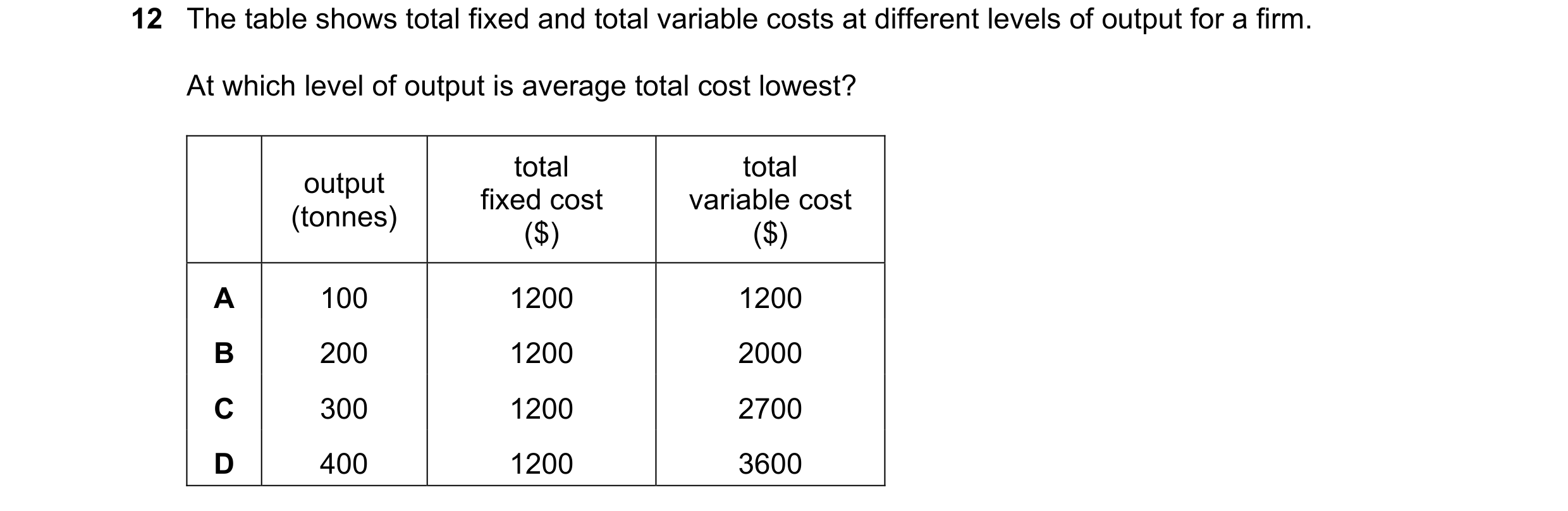
Q1 · The table shows total fixed and total variable costs at different levels of output for a… 0987/11 May/June 2020
12 The table shows total fixed and total variable costs at different levels of output for a firm. At which level of output is average total cost lowest? total total output fixed cost variable cost (tonnes) ($) ($) A 100 1200 1200 B 200 1200 2000 C 300 1200 2700 D 400 1200 3600
1 marks
Answer: D
This question in 0987/11 May/June 2020
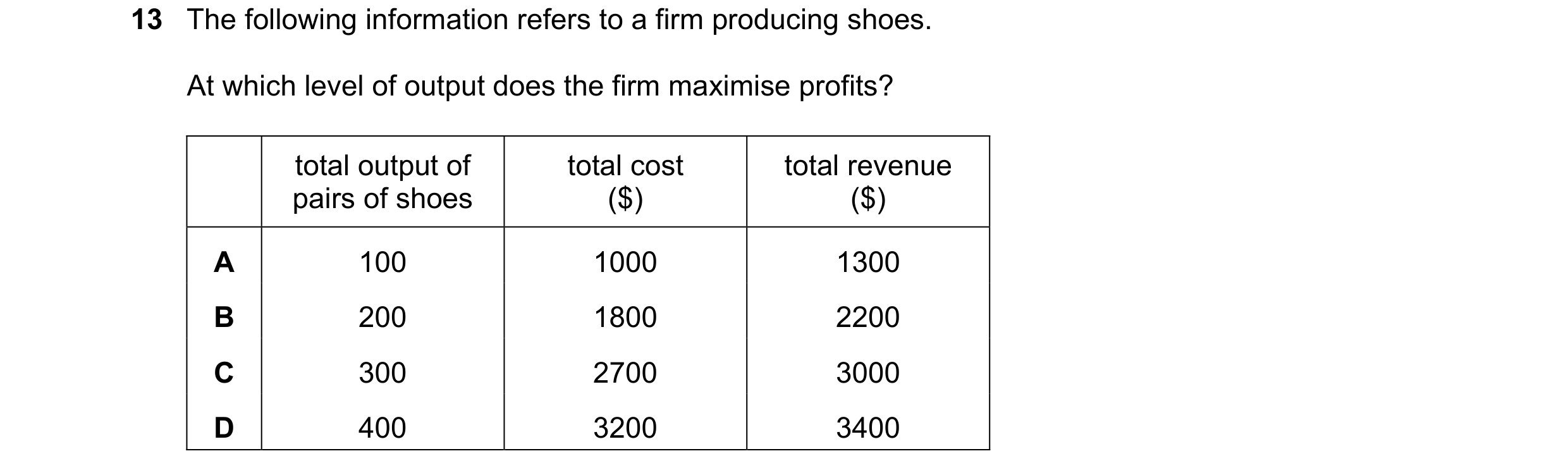
Q2 · The following information refers to a firm producing shoes 0987/11 May/June 2020
13 The following information refers to a firm producing shoes. At which level of output does the firm maximise profits? total output of total cost total revenue pairs of shoes ($) ($) A 100 1000 1300 B 200 1800 2200 C 300 2700 3000 D 400 3200 3400
1 marks
Answer: B
This question in 0987/11 May/June 2020
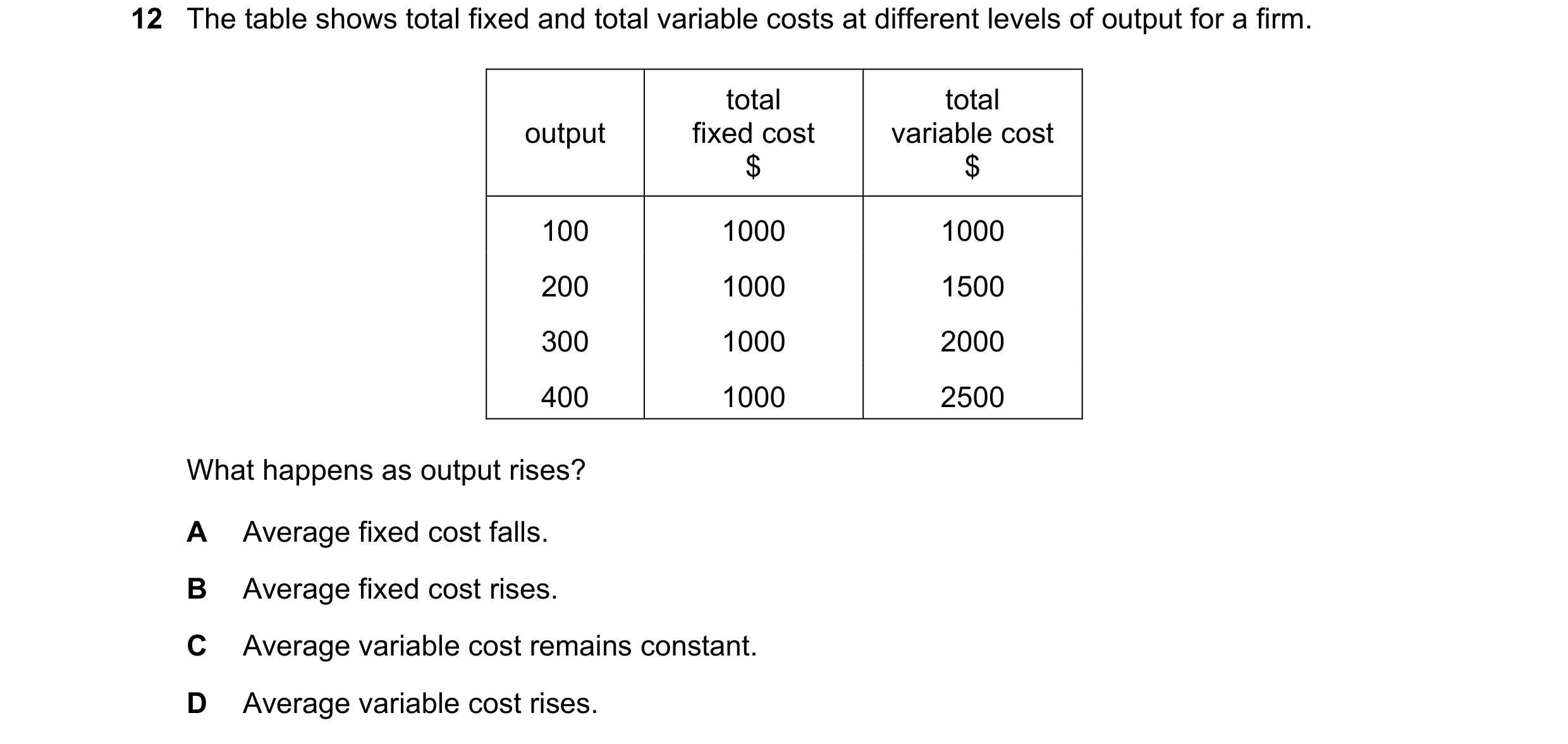
Q3 · The table shows total fixed and total variable costs at different levels of output for a… 0987/12 May/June 2020
12 The table shows total fixed and total variable costs at different levels of output for a firm. total total output fixed cost variable cost $ $ 100 1000 1000 200 1000 1500 300 1000 2000 400 1000 2500 What happens as output rises? A Average fixed cost falls. B Average fixed cost rises. C Average variable cost remains constant. D Average variable cost rises.
1 marks
Answer: A
This question in 0987/12 May/June 2020
Q4 · The following information refers to a firm producing shoes 0987/12 May/June 2020
13 The following information refers to a firm producing shoes. At which level of output does the firm maximise profits? total output of total cost total revenue pairs of shoes ($) ($) A 100 1000 1300 B 200 1800 2200 C 300 2700 3000 D 400 3200 3400
1 marks
Answer: B
This question in 0987/12 May/June 2020
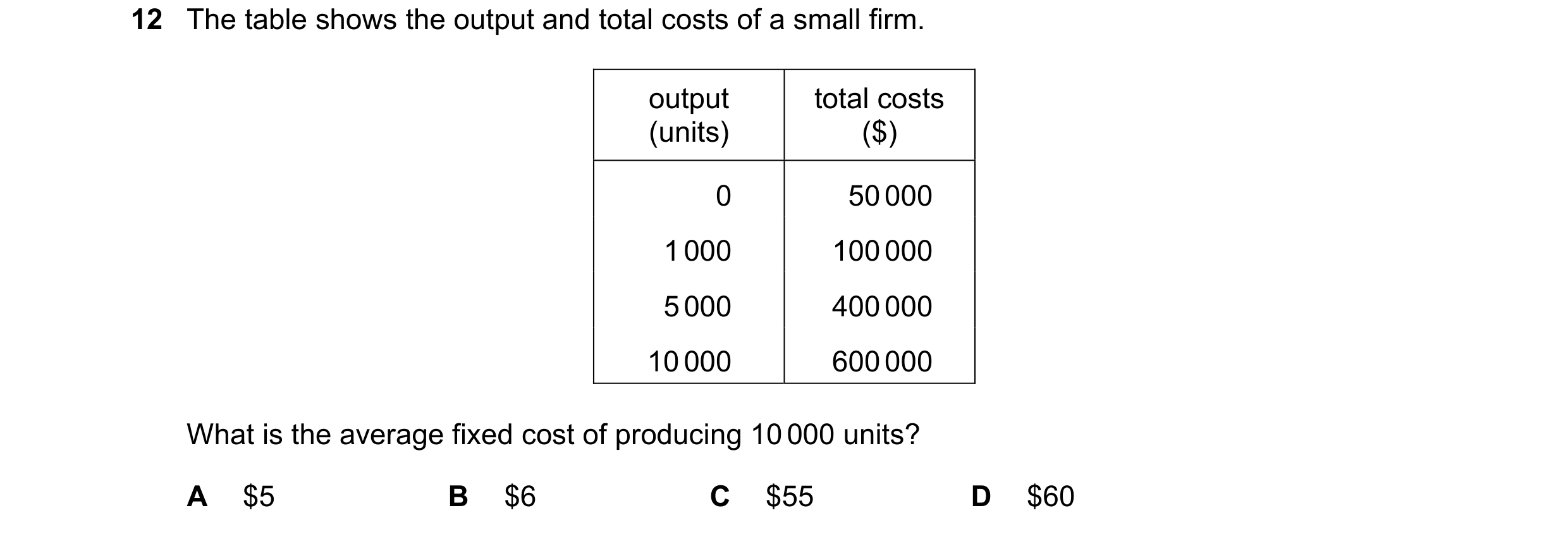
Q5 · The table shows the output and total costs of a small firm 0987/12 Oct/Nov 2020
12 The table shows the output and total costs of a small firm. output total costs (units) ($) 0 50 000 1 000 100 000 5 000 400 000 10 000 600 000 What is the average fixed cost of producing 10 000 units? A $5 B $6 C $55 D $60
1 marks
Answer: A
This question in 0987/12 Oct/Nov 2020
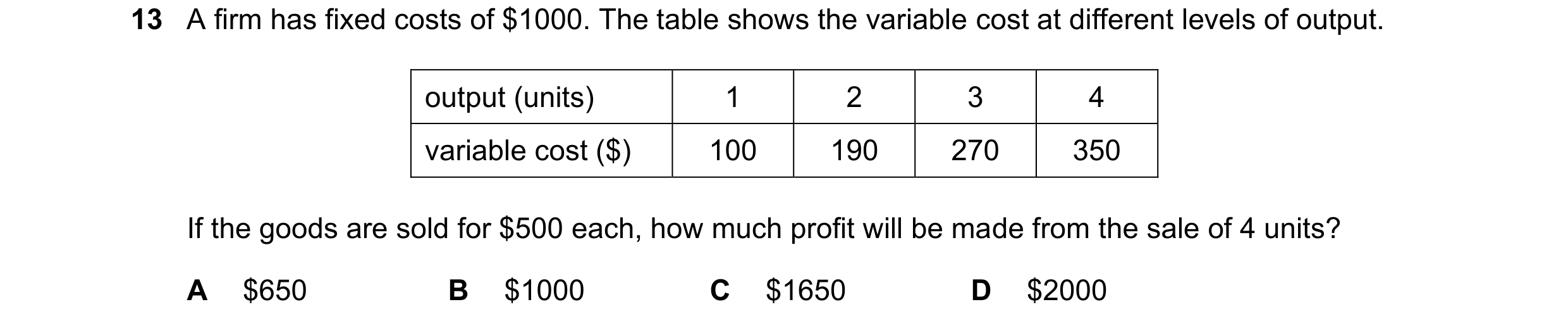
Q6 · A firm has fixed costs of $1000 0987/12 Oct/Nov 2020
13 A firm has fixed costs of $1000. The table shows the variable cost at different levels of output. output (units) 1 2 3 4 variable cost ($) 100 190 270 350 If the goods are sold for $500 each, how much profit will be made from the sale of 4 units? A $650 B $1000 C $1650 D $2000
1 marks
Answer: A
This question in 0987/12 Oct/Nov 2020
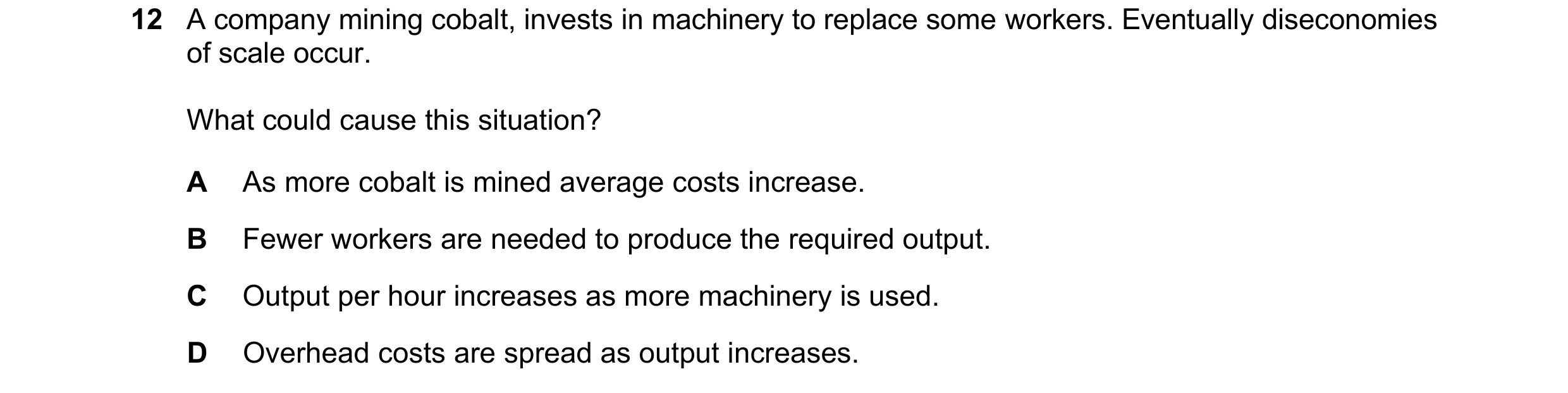
Q7 · A company mining cobalt, invests in machinery to replace some workers 0987/11 May/June 2021
12 A company mining cobalt, invests in machinery to replace some workers. Eventually diseconomies of scale occur. What could cause this situation? A As more cobalt is mined average costs increase. B Fewer workers are needed to produce the required output. C Output per hour increases as more machinery is used. D Overhead costs are spread as output increases.
1 marks
Answer: A
This question in 0987/11 May/June 2021
Q8 · Dimitry owns a firm that produces and sells bottles of lemonade 0987/11 May/June 2021
14 Dimitry owns a firm that produces and sells bottles of lemonade. He only sells one size of bottle. How would Dimitry calculate the total revenue of the firm? A multiply the quantity sold by the cost per bottle B multiply the quantity sold by the price per bottle C multiply the quantity sold by the profit per bottle D multiply the quantity sold by the tax per bottle
1 marks
Answer: B
This question in 0987/11 May/June 2021
Q9 · Which cost of production falls continuously as output increases? 0987/12 May/June 2021
12 Which cost of production falls continuously as output increases? A average fixed cost B average total cost C average variable cost D total variable cost
1 marks
Answer: A
This question in 0987/12 May/June 2021
Q10 · What is calculated when price is multiplied by the quantity demanded of a product? 0987/12 May/June 2021
14 What is calculated when price is multiplied by the quantity demanded of a product? A average revenue B profit C total cost D total revenue
1 marks
Answer: D
This question in 0987/12 May/June 2021
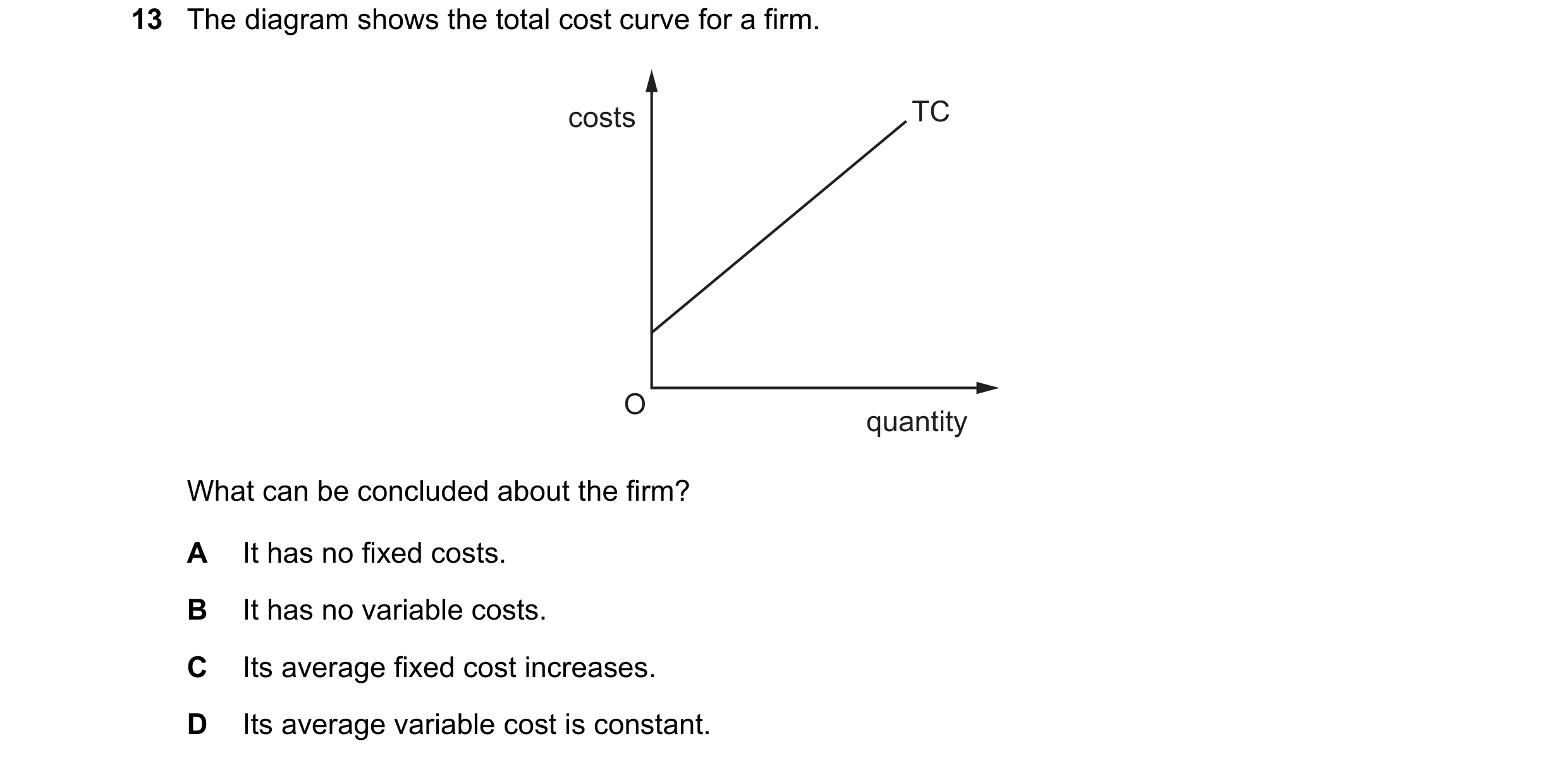
Q11 · The diagram shows the total cost curve for a firm 0987/12 Oct/Nov 2021
13 The diagram shows the total cost curve for a firm. costs TC O quantity What can be concluded about the firm? A It has no fixed costs. B It has no variable costs. C Its average fixed cost increases. D Its average variable cost is constant.
1 marks
Answer: D
This question in 0987/12 Oct/Nov 2021
Q12 · The table shows the average total cost of a firm over a range of output 0987/12 Oct/Nov 2021
14 The table shows the average total cost of a firm over a range of output. output average total (units) cost ($) 1 10 2 8 3 6 4 5 5 7 6 9 What happens after 4 units are produced? A The firm experiences management problems. B The firm gains the benefits of merging with another firm. C The firm pays lower interest rates to banks. D The firm receives significant discounts from bulk buying.
1 marks
Answer: A
This question in 0987/12 Oct/Nov 2021
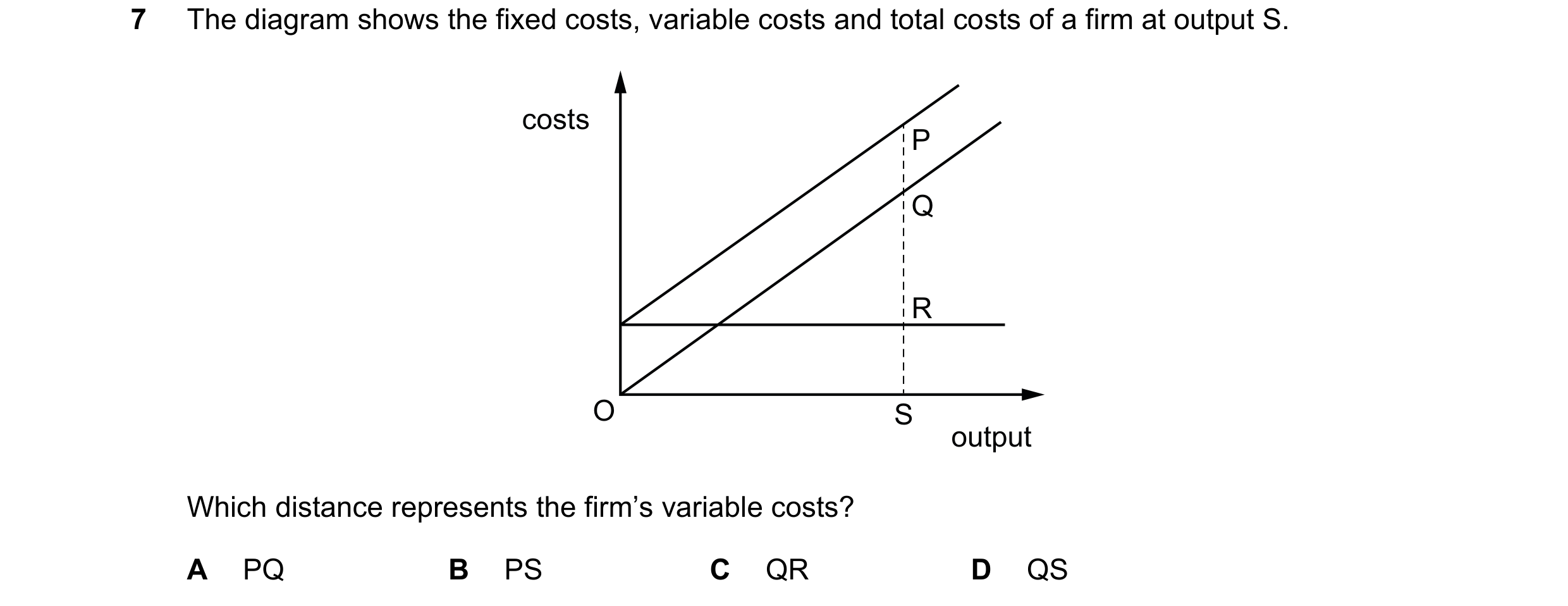
Q13 · The diagram shows the fixed costs, variable costs and total costs of a firm at output S 0987/11 May/June 2022
7 The diagram shows the fixed costs, variable costs and total costs of a firm at output S. costs P Q R O S output Which distance represents the firm’s variable costs? A PQ B PS C QR D QS
1 marks
Answer: D
This question in 0987/11 May/June 2022
Q14 · A manufacturer of medical supplies benefits from improved road links to its main markets 0987/11 May/June 2022
10 A manufacturer of medical supplies benefits from improved road links to its main markets. What benefit definitely occurs as a result? A increased average revenue B increased external economies of scale C increased internal economies of scale D increased market share
1 marks
Answer: B
This question in 0987/11 May/June 2022
Q15 · The diagram shows the fixed costs, variable costs and total costs of a firm at output S 0987/12 May/June 2022
9 The diagram shows the fixed costs, variable costs and total costs of a firm at output S. costs P Q R O S output Which distance represents the firm’s variable costs? A PQ B PS C QR D QS
1 marks
Answer: D
This question in 0987/12 May/June 2022
Q16 · A bank continues to operate loss-making branches 0987/12 May/June 2022
13 A bank continues to operate loss-making branches. Which objective is the bank trying to achieve? A growth B efficiency C profit maximisation D social welfare
1 marks
Answer: D
This question in 0987/12 May/June 2022
Q17 · Which statement is correct when comparing small firms with large firms? 0987/12 Oct/Nov 2022
15 Which statement is correct when comparing small firms with large firms? A Small firms are more able to adapt to changes in market conditions. B Small firms are more able to reduce competition through barriers to entry. C Small firms benefit from lower cost per unit from economies of scale. D Small firms have higher total fixed costs and lower average fixed costs.
1 marks
Answer: A
This question in 0987/12 Oct/Nov 2022
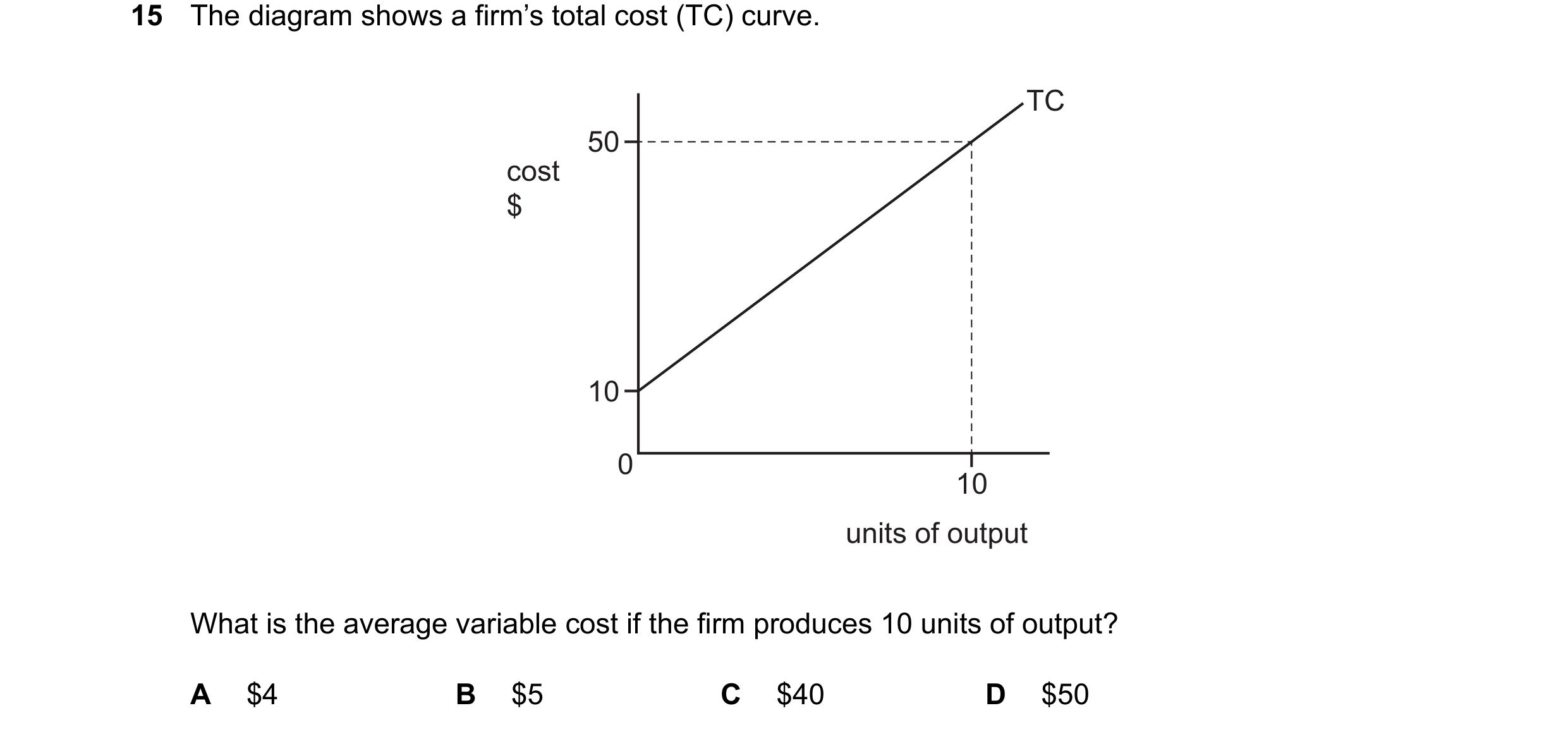
Q18 · The diagram shows a firm’s total cost (TC) curve 0987/11 May/June 2023
15 The diagram shows a firm’s total cost (TC) curve. TC 50 cost $ 10 0 10 units of output What is the average variable cost if the firm produces 10 units of output? A $4 B $5 C $40 D $50
1 marks
Answer: A
This question in 0987/11 May/June 2023
Q19 · Which price elasticity of demand (PED) would cause an increase in total revenue if the… 0987/12 May/June 2023
6 Which price elasticity of demand (PED) would cause an increase in total revenue if the price of the good increased? A perfectly elastic B relatively elastic C relatively inelastic D unitary elastic
1 marks
Answer: C
This question in 0987/12 May/June 2023
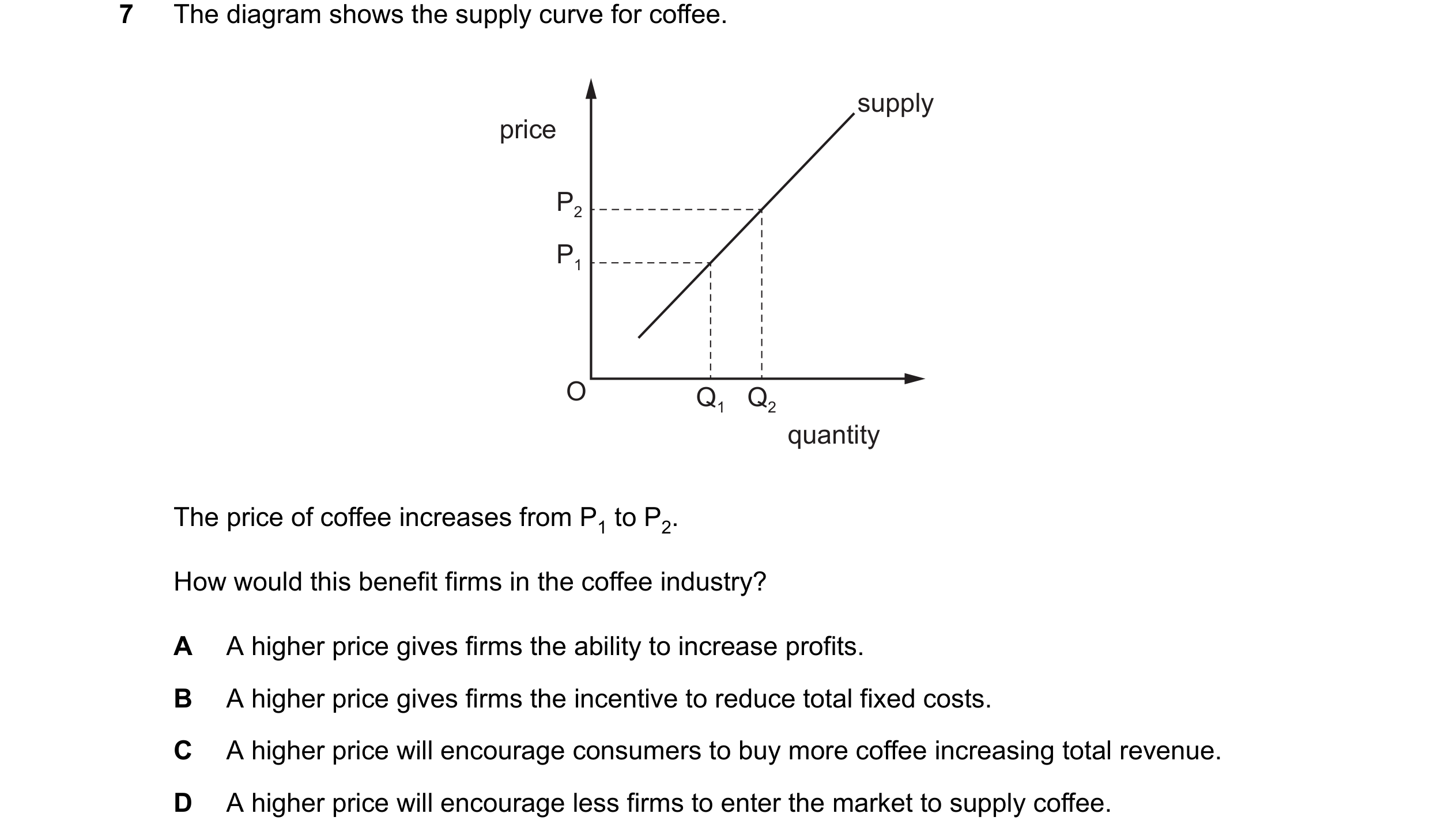
Q20 · The diagram shows the supply curve for coffee 0987/12 May/June 2023
7 The diagram shows the supply curve for coffee. supply price P2 P1 O Q1 Q2 quantity The price of coffee increases from P1 to P2. How would this benefit firms in the coffee industry? A A higher price gives firms the ability to increase profits. B A higher price gives firms the incentive to reduce total fixed costs. C A higher price will encourage consumers to buy more coffee increasing total revenue. D A higher price will encourage less firms to enter the market to supply coffee.
1 marks
Answer: A
This question in 0987/12 May/June 2023
Q21 · What is not a variable cost of production? 0987/12 May/June 2023
14 What is not a variable cost of production? A cost of fuel B cost of raw materials C extra pay for working additional hours D rent of offices
1 marks
Answer: D
This question in 0987/12 May/June 2023
Q22 · What is a definition of a firm’s revenue? 0987/12 May/June 2023
15 What is a definition of a firm’s revenue? A money received from sales B sales volume C surplus over costs D tax payments
1 marks
Answer: A
This question in 0987/12 May/June 2023
Q23 · A firm produces five units of output at an average cost of $20 per unit 0987/12 Oct/Nov 2023
16 A firm produces five units of output at an average cost of $20 per unit. The cost of the sixth unit is $26. What is the average cost of six units? A $4.33 B $6 C $8.33 D $21
1 marks
Answer: D
This question in 0987/12 Oct/Nov 2023
Q24 · What is a variable cost for a firm? 0987/12 May/June 2024
13 What is a variable cost for a firm? A the cost of raw materials B the interest payment on existing loans C the rent on the factory D the insurance on the factory buildings
1 marks
Answer: A
This question in 0987/12 May/June 2024
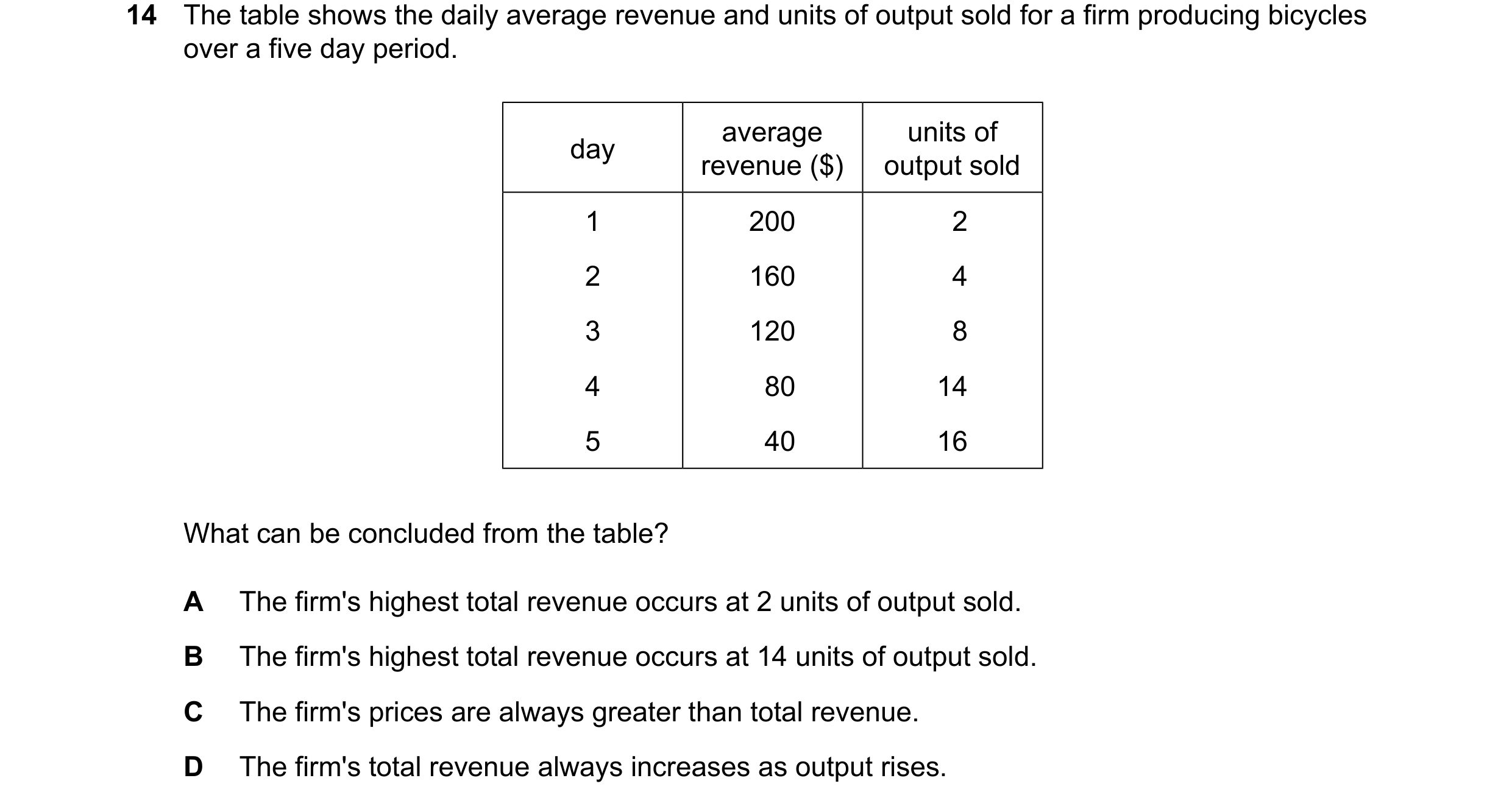
Q25 · The table shows the daily average revenue and units of output sold for a firm producing… 0987/12 May/June 2024
14 The table shows the daily average revenue and units of output sold for a firm producing bicycles over a five day period. average units of day revenue ($) output sold 1 200 2 2 160 4 3 120 8 4 80 14 5 40 16 What can be concluded from the table? A The firm's highest total revenue occurs at 2 units of output sold. B The firm's highest total revenue occurs at 14 units of output sold. C The firm's prices are always greater than total revenue. D The firm's total revenue always increases as output rises.
1 marks
Answer: B
This question in 0987/12 May/June 2024
Q26 · The diagram shows the average total cost (ATC) for a firm, in the long run 0987/12 Oct/Nov 2024
13 The diagram shows the average total cost (ATC) for a firm, in the long run. costs ATC1 ATC2 O output What would cause the shift from ATC1 to ATC2? A difficulties in controlling the firm B external economies of scale C managerial economies of scale D technical economies of scale
1 marks
Answer: B
This question in 0987/12 Oct/Nov 2024
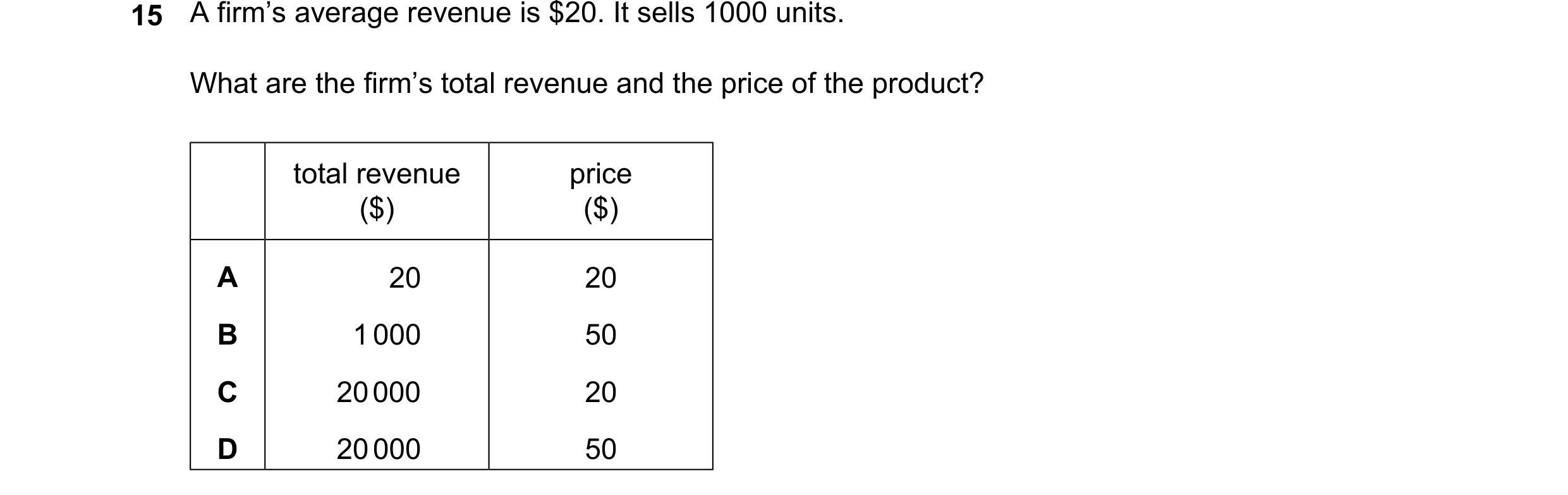
Q27 · What are the firm’s total revenue and the price of the product? 0987/12 Oct/Nov 2024
15 What are the firm’s total revenue and the price of the product? total revenue price ($) ($) A 20 20 B 1 000 50 C 20 000 20 D 20 000 50
1 marks
Answer: C
This question in 0987/12 Oct/Nov 2024
Q28 · The diagram shows the average total costs (ATC) and average fixed costs (AFC) for a firm 0987/11 May/June 2025
16 The diagram shows the average total costs (ATC) and average fixed costs (AFC) for a firm. ATC 14 cost $ 10 6 AFC 2 0 W X Y Z output Which statement is correct? A At output X, average variable costs are lower than average fixed costs. B At output Y, total variable costs are greater than total fixed costs. C Between outputs W and Z, total fixed costs are falling. D Between outputs W and Y, average variable costs have not changed.
1 marks
Answer: A
This question in 0987/11 May/June 2025
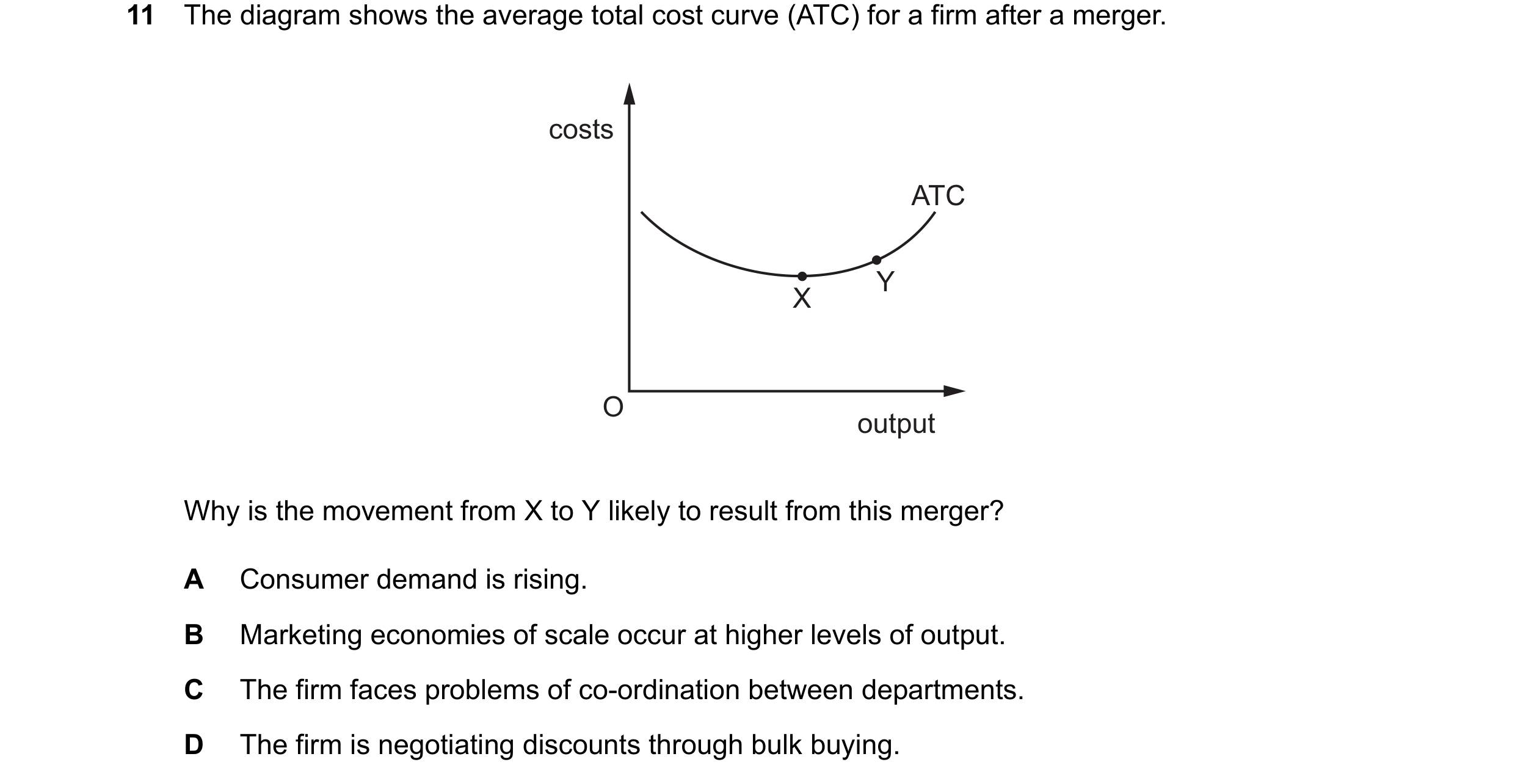
Q29 · The diagram shows the average total cost curve (ATC) for a firm after a merger 0987/12 May/June 2025
11 The diagram shows the average total cost curve (ATC) for a firm after a merger. costs ATC Y X O output Why is the movement from X to Y likely to result from this merger? A Consumer demand is rising. B Marketing economies of scale occur at higher levels of output. C The firm faces problems of co-ordination between departments. D The firm is negotiating discounts through bulk buying.
1 marks
Answer: C
This question in 0987/12 May/June 2025
Q30 · What are fixed costs? 0987/12 May/June 2025
13 What are fixed costs? A costs that are divided by the amount produced B costs that are present when output is zero C costs that change according to the level of output D costs that decrease when output increases
1 marks
Answer: B
This question in 0987/12 May/June 2025
Q31 · The table shows the daily output and costs of four firms making chairs 0987/12 May/June 2025
14 The table shows the daily output and costs of four firms making chairs. Which firm has the highest average cost of production? fixed costs variable costs output (units) ($) ($) A 6 100 140 B 9 30 150 C 12 200 160 D 15 120 330
1 marks
Answer: A
This question in 0987/12 May/June 2025
Q32 · The only information known about a firm is the price it charges for its product and the… 0987/12 May/June 2025
15 The only information known about a firm is the price it charges for its product and the quantity it sells. What else can be concluded from this? A its average cost and profit B its average cost and total revenue C its average revenue and profit D its average revenue and total revenue
1 marks
Answer: D
This question in 0987/12 May/June 2025
Q33 · When it produces 100 units, a firm’s total variable cost is $300 and its total fixed cost… 0987/12 Oct/Nov 2025
15 When it produces 100 units, a firm’s total variable cost is $300 and its total fixed cost is $2700. What is the average total cost? A $3 B $24 C $27 D $30
1 marks
Answer: D
This question in 0987/12 Oct/Nov 2025
 1 / 10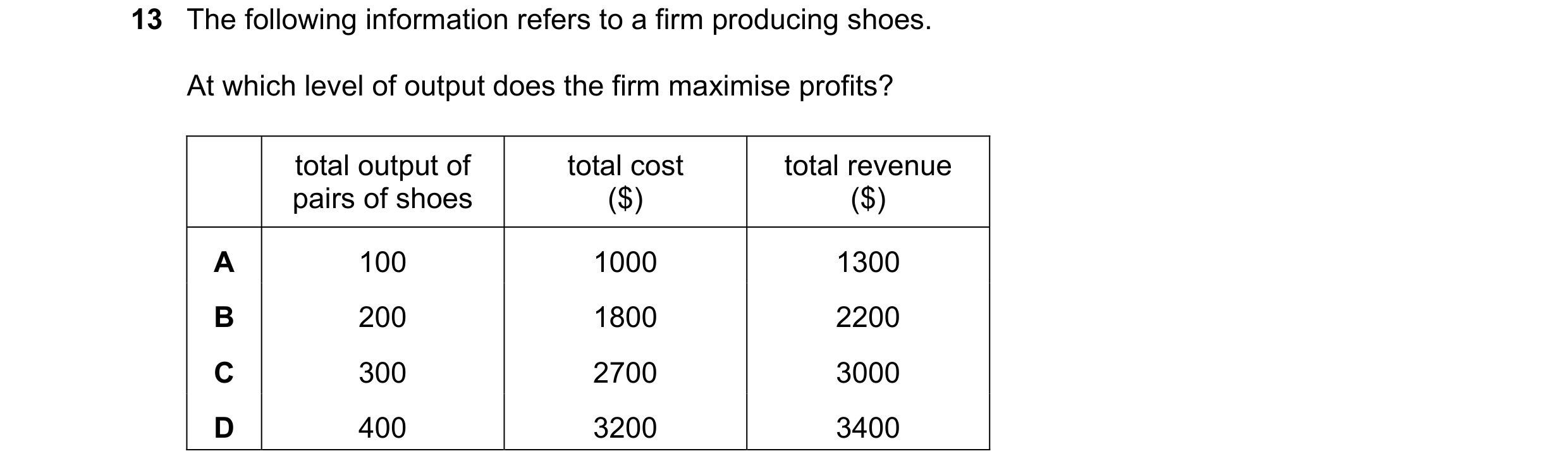
 2 / 10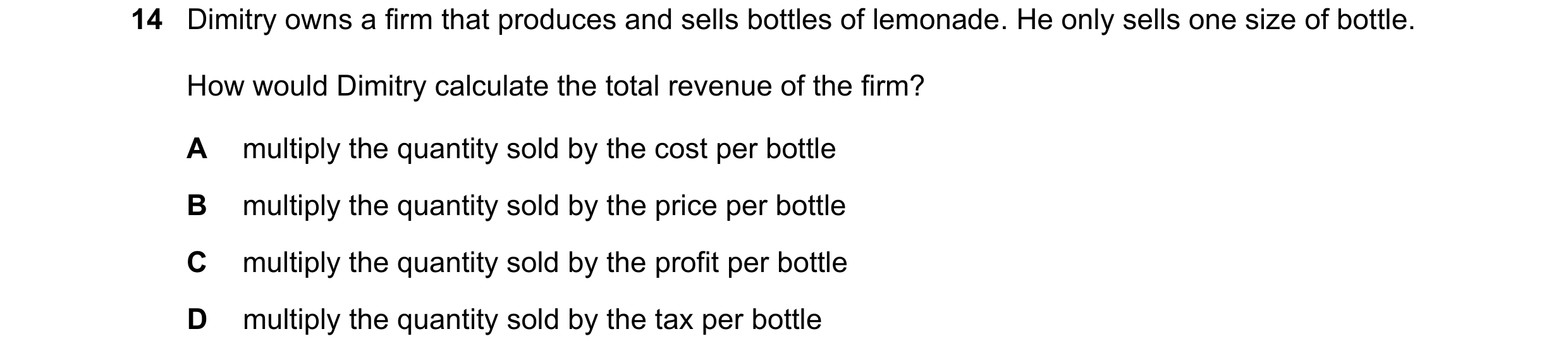


 3 / 10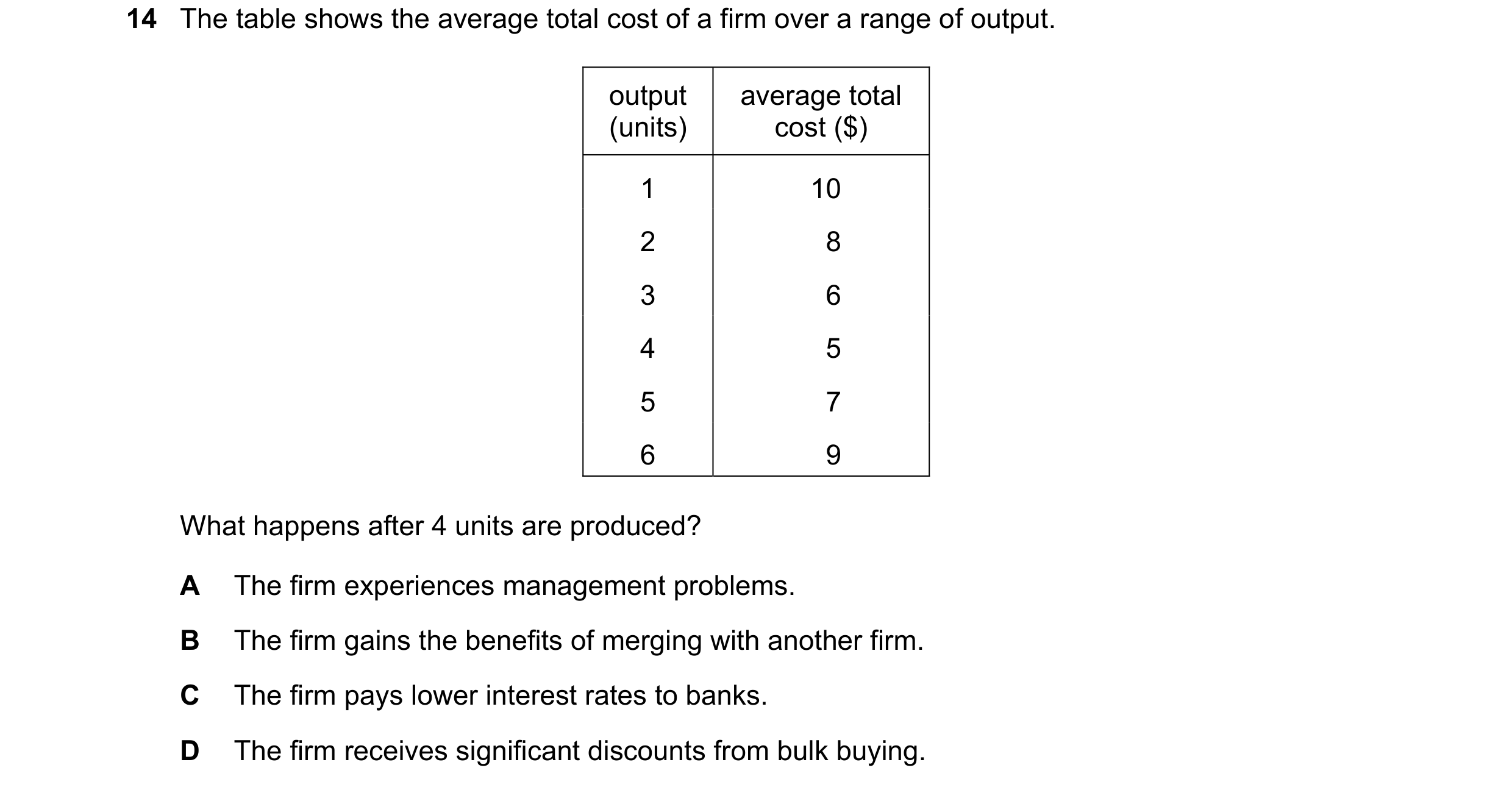
 4 / 10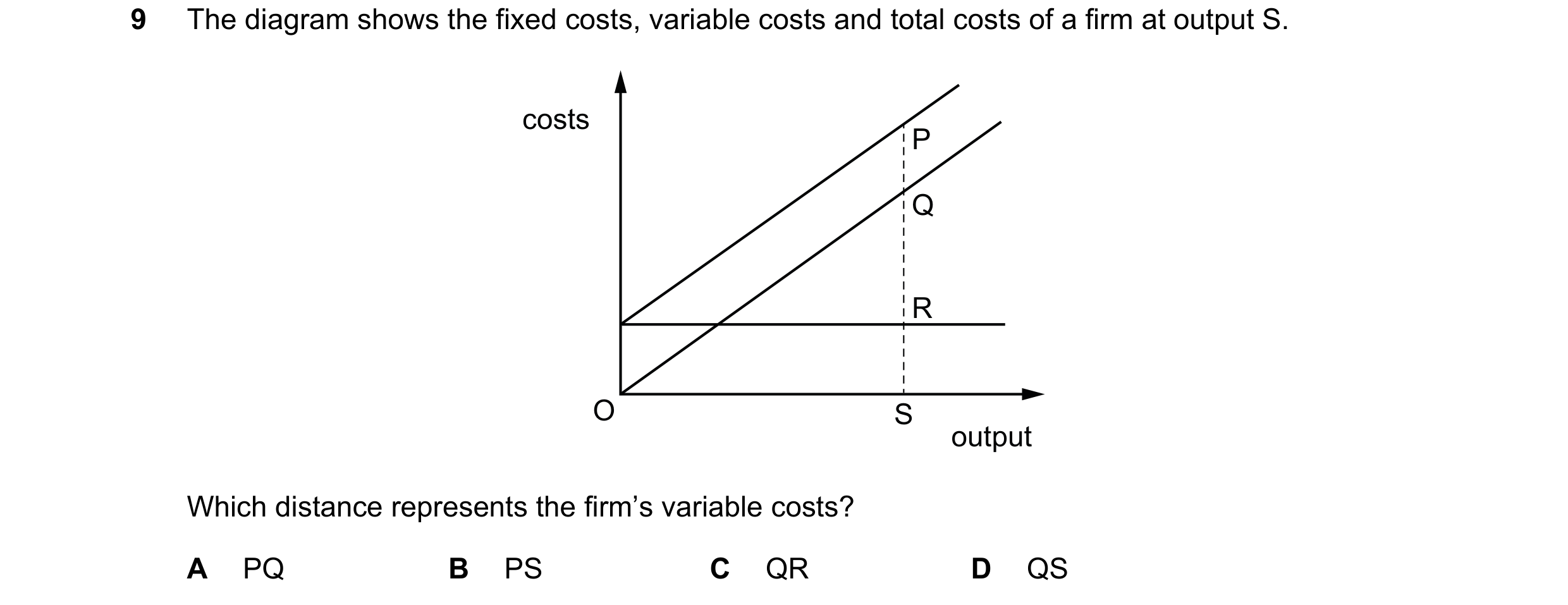

 5 / 10

 6 / 10

 7 / 10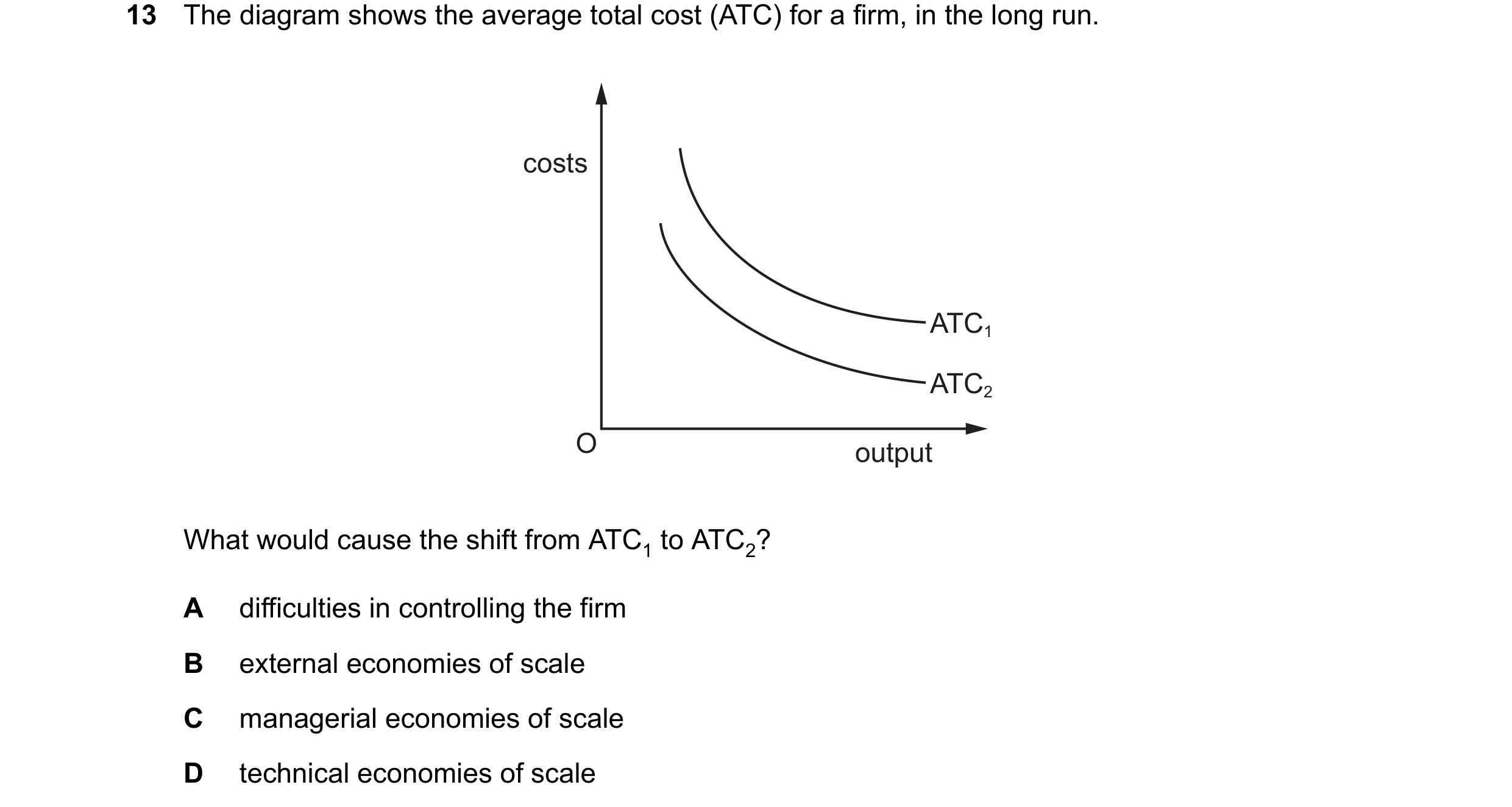
 8 / 10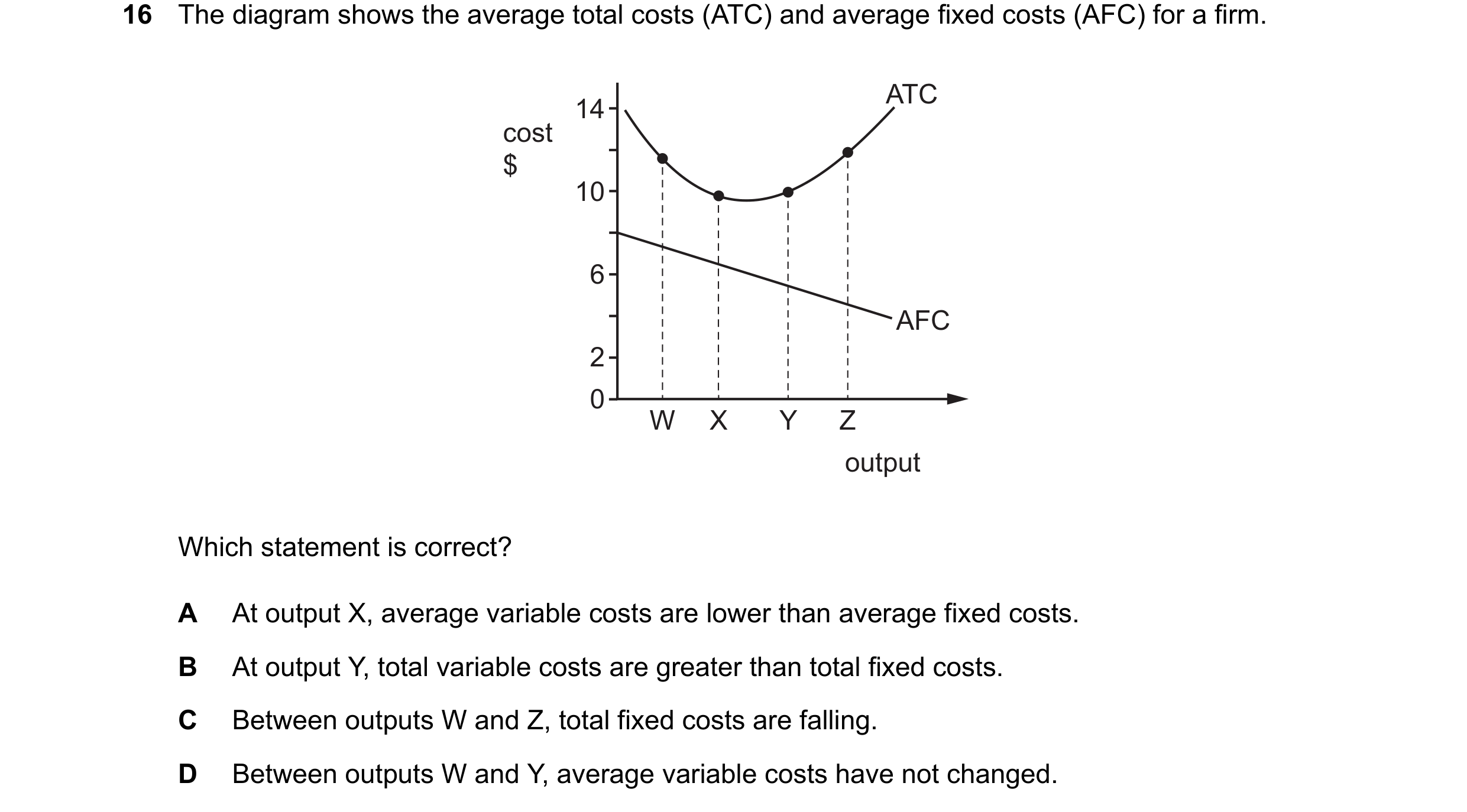
 9 / 10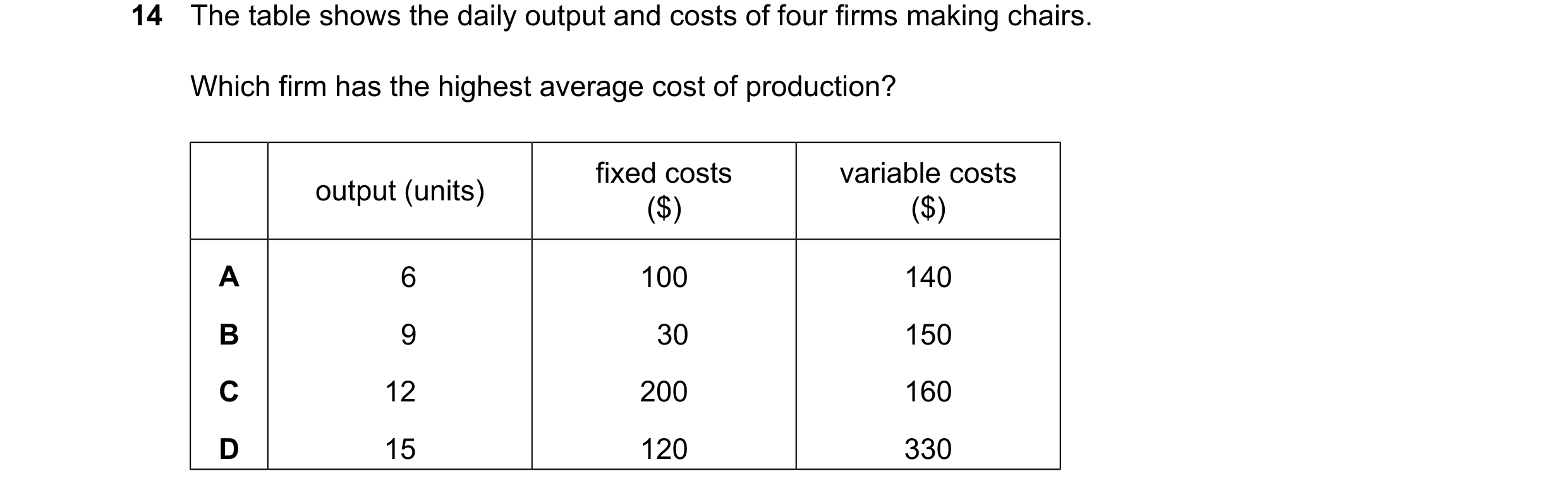
 10 / 10