Cambridge IGCSE Economics 0455 — 2020 May/June Paper 2 · Variant 3
0455/23/M/J/20 · 5 questions · 110 marks · ≈124 min
The question paper and its mark scheme, free to read here and free to download. This is Cambridge’s own paper, exactly as it was sat.
Question paper8 pages





Mark scheme14 pages
Answers below. Sit the paper first if you are practising.




Questions as text
Q1 · Calculate the total number of people over 60 years old in Greece in 2015
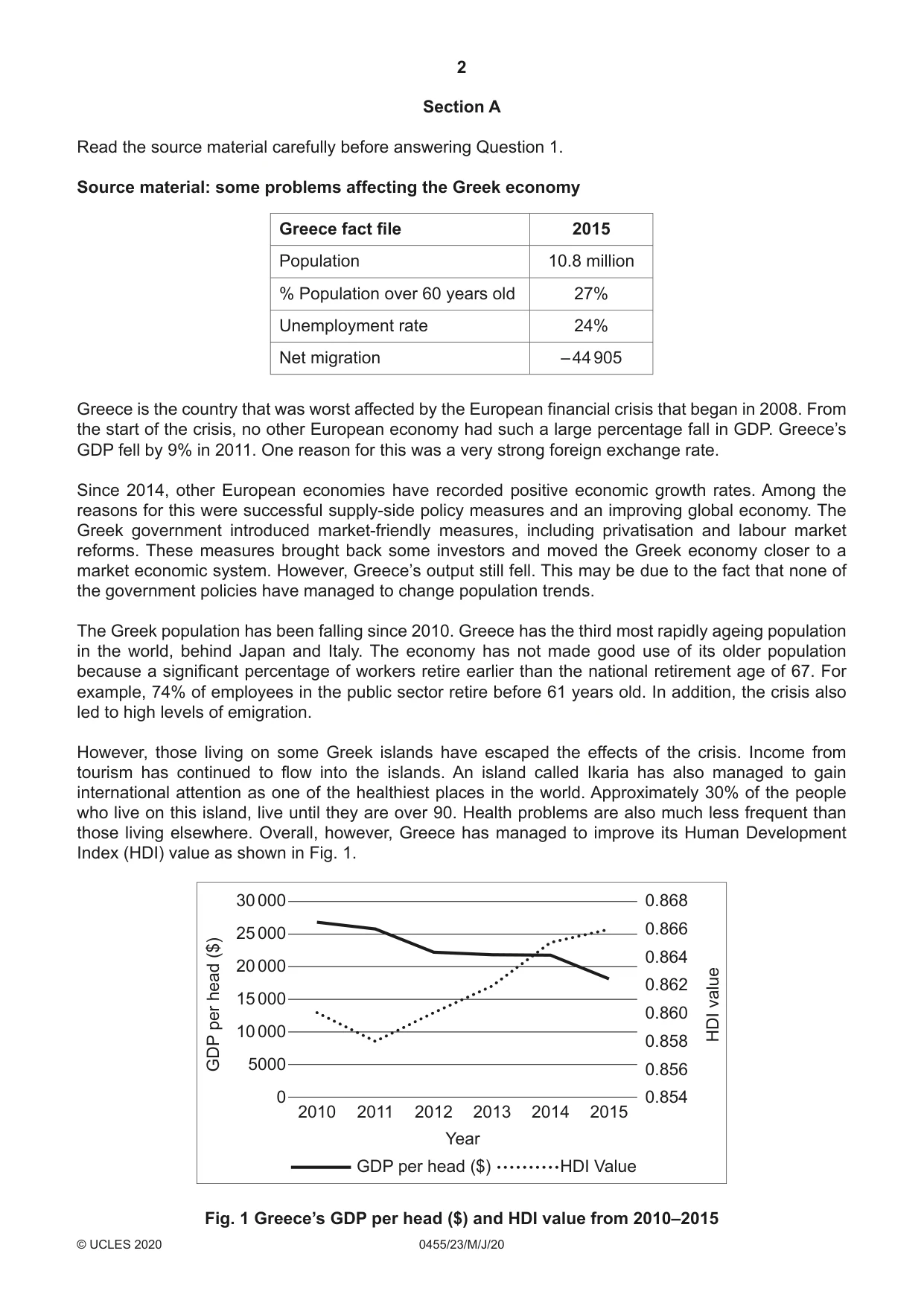
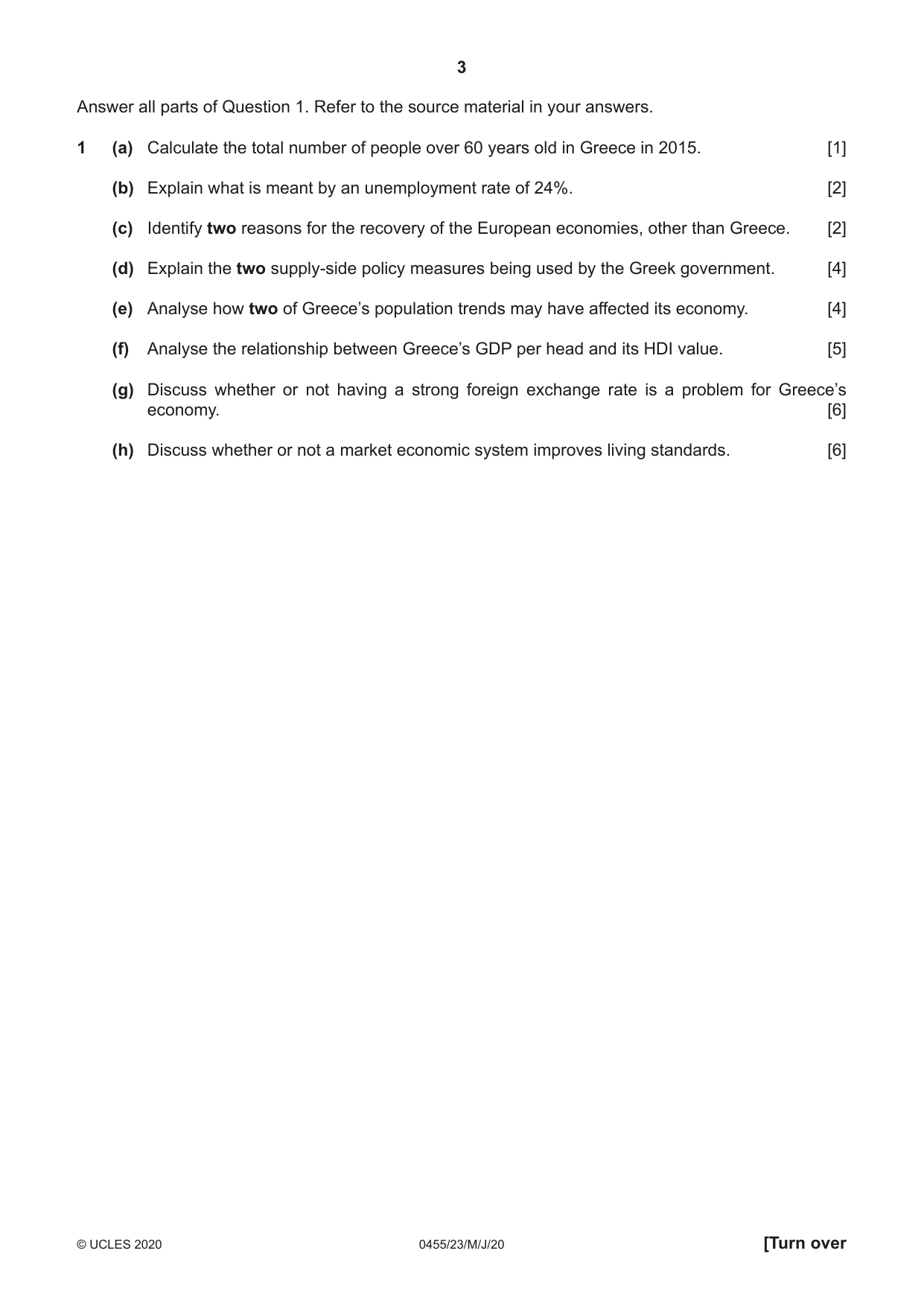
1 (a) Calculate the total number of people over 60 years old in Greece in 2015. [1] (b) Explain what is meant by an unemployment rate of 24%. [2] (c) Identify two reasons for the recovery of the European economies, other than Greece. [2] (d) Explain the two supply-side policy measures being used by the Greek government. [4] (e) Analyse how two of Greece’s population trends may have affected its economy. [4] (f) Analyse the relationship between Greece’s GDP per head and its HDI value. [5] (g) Discuss whether or not having a strong foreign exchange rate is a problem for Greece’s economy. [6] (h) Discuss whether or not a market economic system improves living standards. [6]
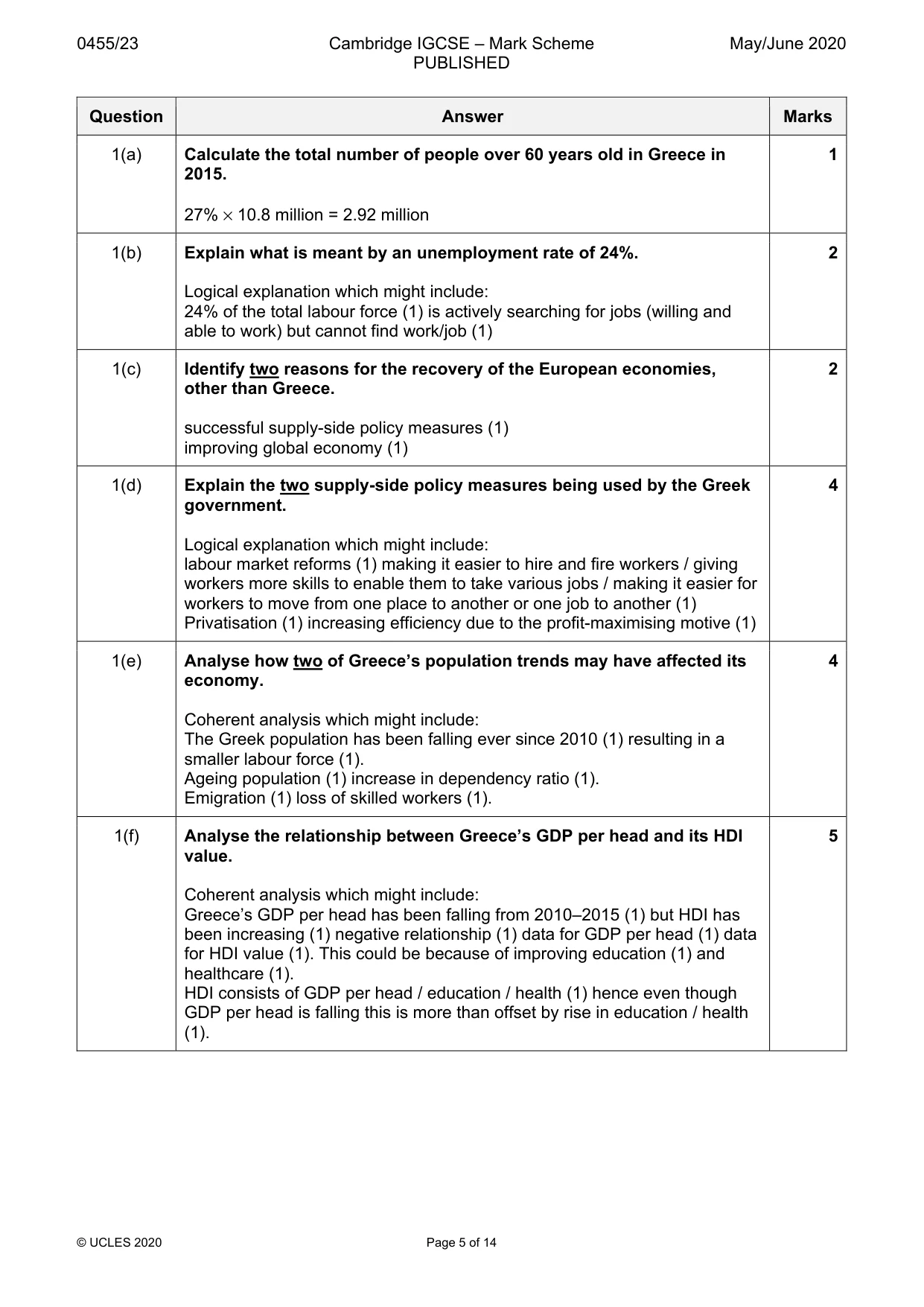
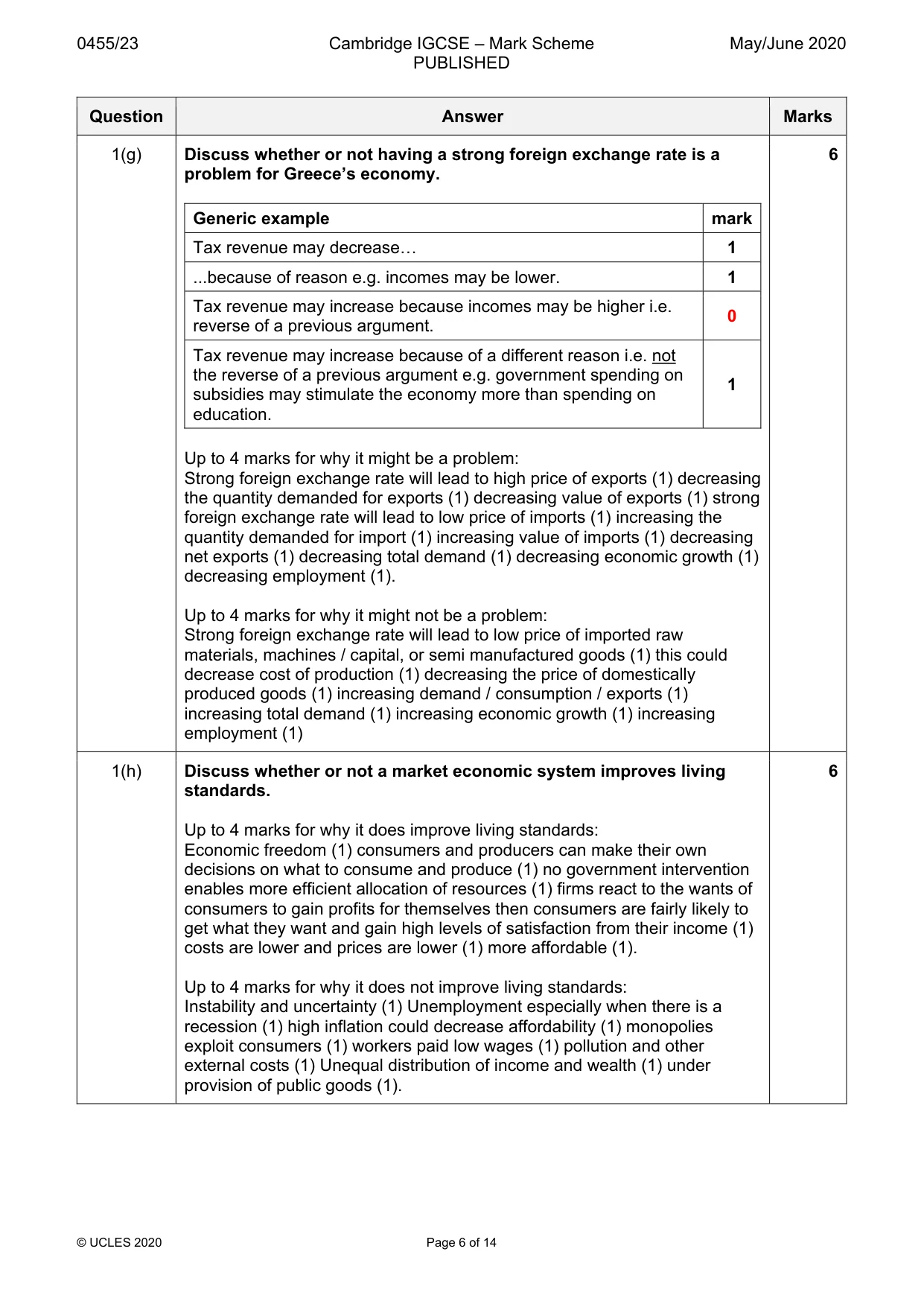
Mark scheme: Question Answer Marks 1(a) Calculate the total number of people over 60 years old in Greece in 1 2015. 27% × 10.8 million = 2.92 million 1(b) Explain what is meant by an unemployment rate of 24%. 2 Logical explanation which might include: 24% of the total labour force (1) is actively searching for jobs (willing and able to work) but cannot find work/job (1) 1(c) Identify two reasons for the recovery of the European economies, 2 other than Greece. successful supply-side policy measures (1) improving global economy (1) 1(d) Explain the two supply-side policy measures being used by the Greek 4 government. Logical explanation which might include: labour market reforms (1) making it easier to hire and fire workers / giving workers more skills to enable them to take various jobs / making it easier for workers to move from one place to another or one job to another (1) Privatisation (1) increasing efficiency due to the profit-maximising motive (1) 1(e) Analyse how two of Greece’s population trends may have affected its 4 economy. Coherent analysis which might include: The Greek population has been falling ever since 2010 (1) resulting in a smaller labour force (1). Ageing population (1) increase in dependency ratio (1). Emigration (1) loss of skilled workers (1). 1(f) Analyse the relationship between Greece’s GDP per head and its HDI 5 value. Coherent analysis which might include: Greece’s GDP per head has been falling from 2010–2015 (1) but HDI has been increasing (1) negative relationship (1) data for GDP per head (1) data for HDI value (1). This could be because of improving education (1) and healthcare (1). HDI consists of GDP per head / education / health (1) hence even though GDP per head is falling this is more than offset by rise in education / health (1). 1(g) Discuss whether or not having a strong foreign exchange rate is a 6 problem for Greece’s economy. Generic example mark Tax revenue may decrease… 1 ...because of reason e.g. incomes may be lower. 1 Tax revenue may increase because incomes may be higher i.e. 0 reverse of a previous argument. Tax revenue may increase because of a different reason i.e. not the reverse of a previous argument e.g. government spending on 1 subsidies may stimulate the economy more than spending on education. Up to 4 marks for why it might be a problem: Strong foreign exchange rate will lead to high price of exports (1) decreasing the quantity demanded for exports (1) decreasing value of exports (1) strong foreign exchange rate will lead to low price of imports (1) increasing the quantity demanded for import (1) increasing value of imports (1) decreasing net exports (1) decreasing total demand (1) decreasing economic growth (1) decreasing employment (1). Up to 4 marks for why it might not be a problem: Strong foreign exchange rate will lead to low price of imported raw materials, machines / capital, or semi manufactured goods (1) this could decrease cost of production (1) decreasing the price of domestically produced goods (1) increasing demand / consumption / exports (1) increasing total demand (1) increasing economic growth (1) increasing employment (1) 1(h) Discuss whether or not a market economic system improves living 6 standards. Up to 4 marks for why it does improve living standards: Economic freedom (1) consumers and producers can make their own decisions on what to consume and produce (1) no government intervention enables more efficient allocation of resources (1) firms react to the wants of consumers to gain profits for themselves then consumers are fairly likely to get what they want and gain high levels of satisfaction from their income (1) costs are lower and prices are lower (1) more affordable (1). Up to 4 marks for why it does not improve living standards: Instability and uncertainty (1) Unemployment especially when there is a recession (1) high inflation could decrease affordability (1) monopolies exploit consumers (1) workers paid low wages (1) pollution and other external costs (1) Unequal distribution of income and wealth (1) under provision of public goods (1).
Q2 · In Nagicho, a small town in Japan, a woman on average has 2.8 children in her lifetime
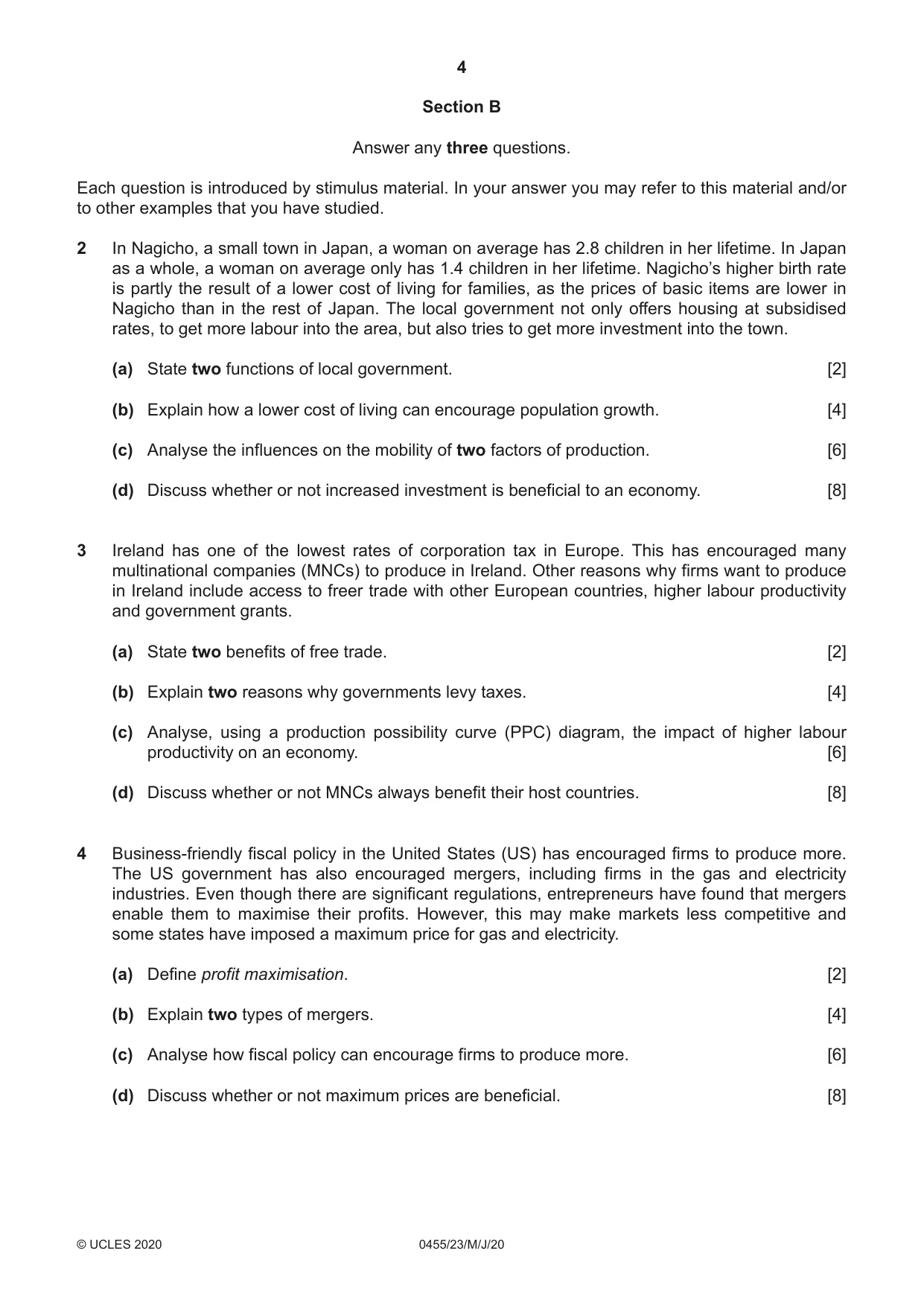
2 In Nagicho, a small town in Japan, a woman on average has 2.8 children in her lifetime. In Japan as a whole, a woman on average only has 1.4 children in her lifetime. Nagicho’s higher birth rate is partly the result of a lower cost of living for families, as the prices of basic items are lower in Nagicho than in the rest of Japan. The local government not only offers housing at subsidised rates, to get more labour into the area, but also tries to get more investment into the town. (a) State two functions of local government. [2] (b) Explain how a lower cost of living can encourage population growth. [4] (c) Analyse the influences on the mobility of two factors of production. [6] (d) Discuss whether or not increased investment is beneficial to an economy. [8]
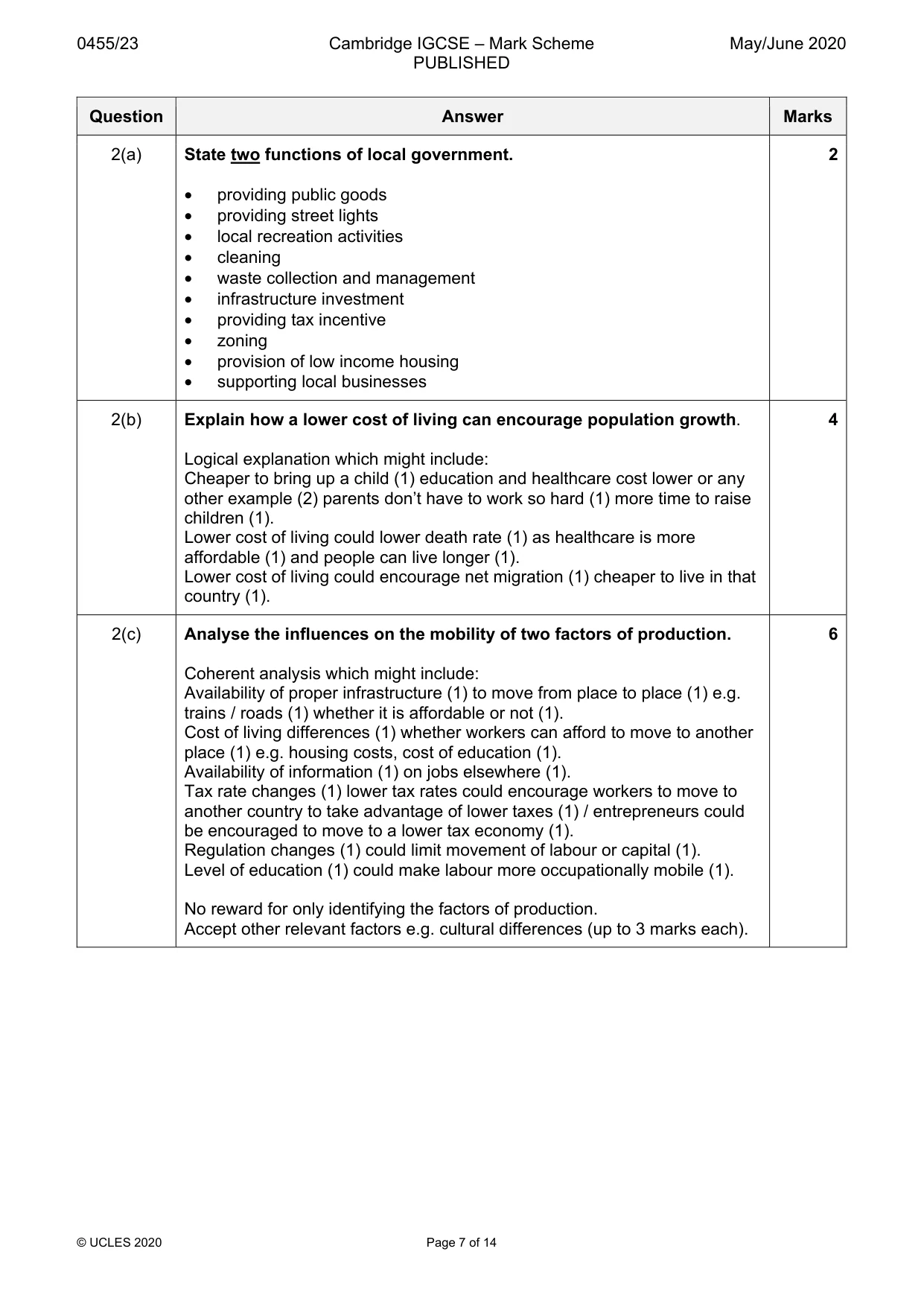
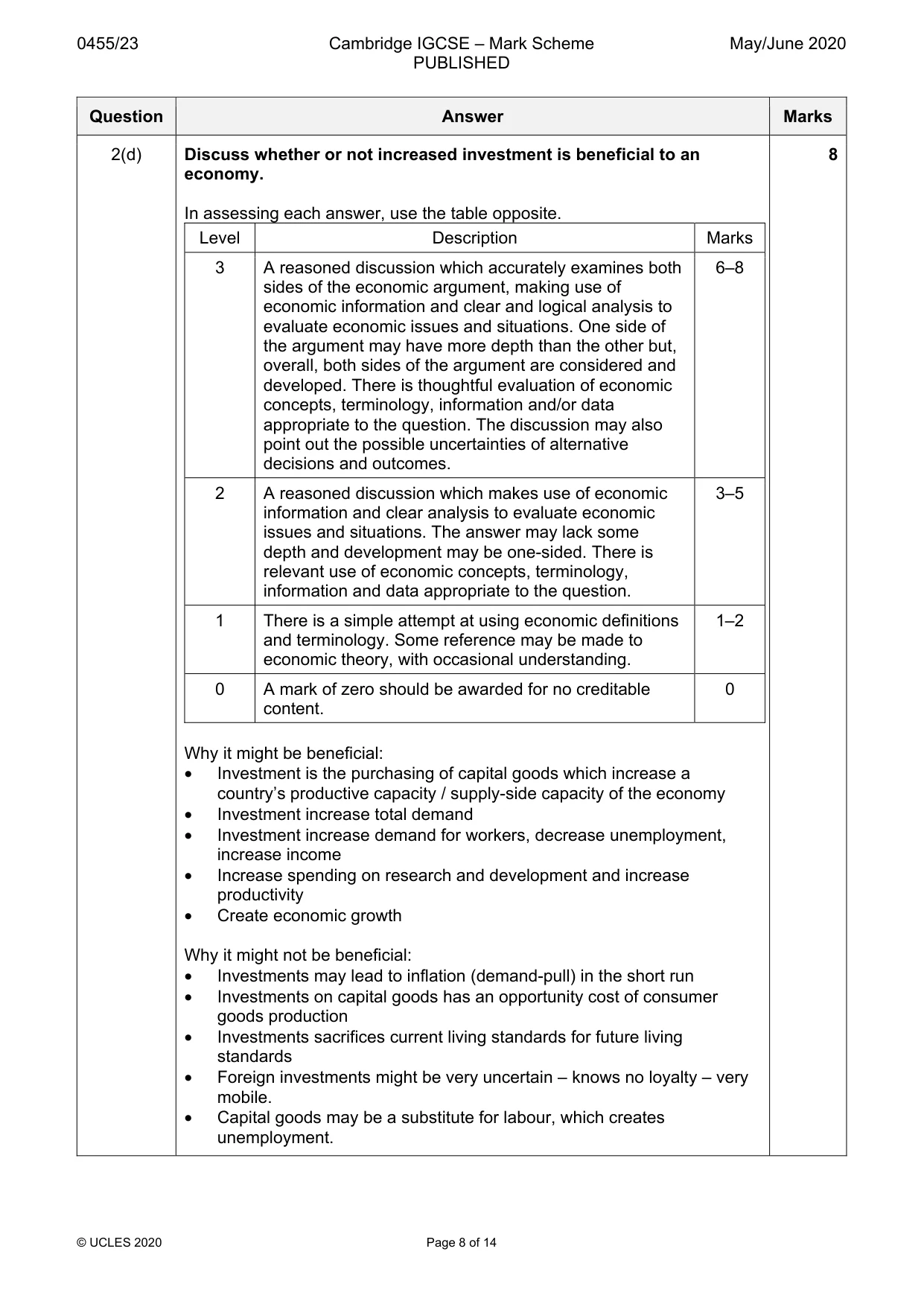
Mark scheme: 2(a) State two functions of local government. 2 • providing public goods • providing street lights • local recreation activities • cleaning • waste collection and management • infrastructure investment • providing tax incentive • zoning • provision of low income housing • supporting local businesses 2(b) Explain how a lower cost of living can encourage population growth. 4 Logical explanation which might include: Cheaper to bring up a child (1) education and healthcare cost lower or any other example (2) parents don’t have to work so hard (1) more time to raise children (1). Lower cost of living could lower death rate (1) as healthcare is more affordable (1) and people can live longer (1). Lower cost of living could encourage net migration (1) cheaper to live in that country (1). 2(c) Analyse the influences on the mobility of two factors of production. 6 Coherent analysis which might include: Availability of proper infrastructure (1) to move from place to place (1) e.g. trains / roads (1) whether it is affordable or not (1). Cost of living differences (1) whether workers can afford to move to another place (1) e.g. housing costs, cost of education (1). Availability of information (1) on jobs elsewhere (1). Tax rate changes (1) lower tax rates could encourage workers to move to another country to take advantage of lower taxes (1) / entrepreneurs could be encouraged to move to a lower tax economy (1). Regulation changes (1) could limit movement of labour or capital (1). Level of education (1) could make labour more occupationally mobile (1). No reward for only identifying the factors of production. Accept other relevant factors e.g. cultural differences (up to 3 marks each). 2(d) Discuss whether or not increased investment is beneficial to an 8 economy. In assessing each answer, use the table opposite. Level Description Marks 3 A reasoned discussion which accurately examines both 6–8 sides of the economic argument, making use of economic information and clear and logical analysis to evaluate economic issues and situations. One side of the argument may have more depth than the other but, overall, both sides of the argument are considered and developed. There is thoughtful evaluation of economic concepts, terminology, information and/or data appropriate to the question. The discussion may also point out the possible uncertainties of alternative decisions and outcomes. 2 A reasoned discussion which makes use of economic 3–5 information and clear analysis to evaluate economic issues and situations. The answer may lack some depth and development may be one-sided. There is relevant use of economic concepts, terminology, information and data appropriate to the question. 1 There is a simple attempt at using economic definitions 1–2 and terminology. Some reference may be made to economic theory, with occasional understanding. 0 A mark of zero should be awarded for no creditable 0 content. Why it might be beneficial: • Investment is the purchasing of capital goods which increase a country’s productive capacity / supply-side capacity of the economy • Investment increase total demand • Investment increase demand for workers, decrease unemployment, increase income • Increase spending on research and development and increase productivity • Create economic growth Why it might not be beneficial: • Investments may lead to inflation (demand-pull) in the short run • Investments on capital goods has an opportunity cost of consumer goods production • Investments sacrifices current living standards for future living standards • Foreign investments might be very uncertain – knows no loyalty – very mobile. • Capital goods may be a substitute for labour, which creates unemployment.
Q3 · Ireland has one of the lowest rates of corporation tax in Europe
3 Ireland has one of the lowest rates of corporation tax in Europe. This has encouraged many multinational companies (MNCs) to produce in Ireland. Other reasons why firms want to produce in Ireland include access to freer trade with other European countries, higher labour productivity and government grants. (a) State two benefits of free trade. [2] (b) Explain two reasons why governments levy taxes. [4] (c) Analyse, using a production possibility curve (PPC) diagram, the impact of higher labour productivity on an economy. [6] (d) Discuss whether or not MNCs always benefit their host countries. [8]
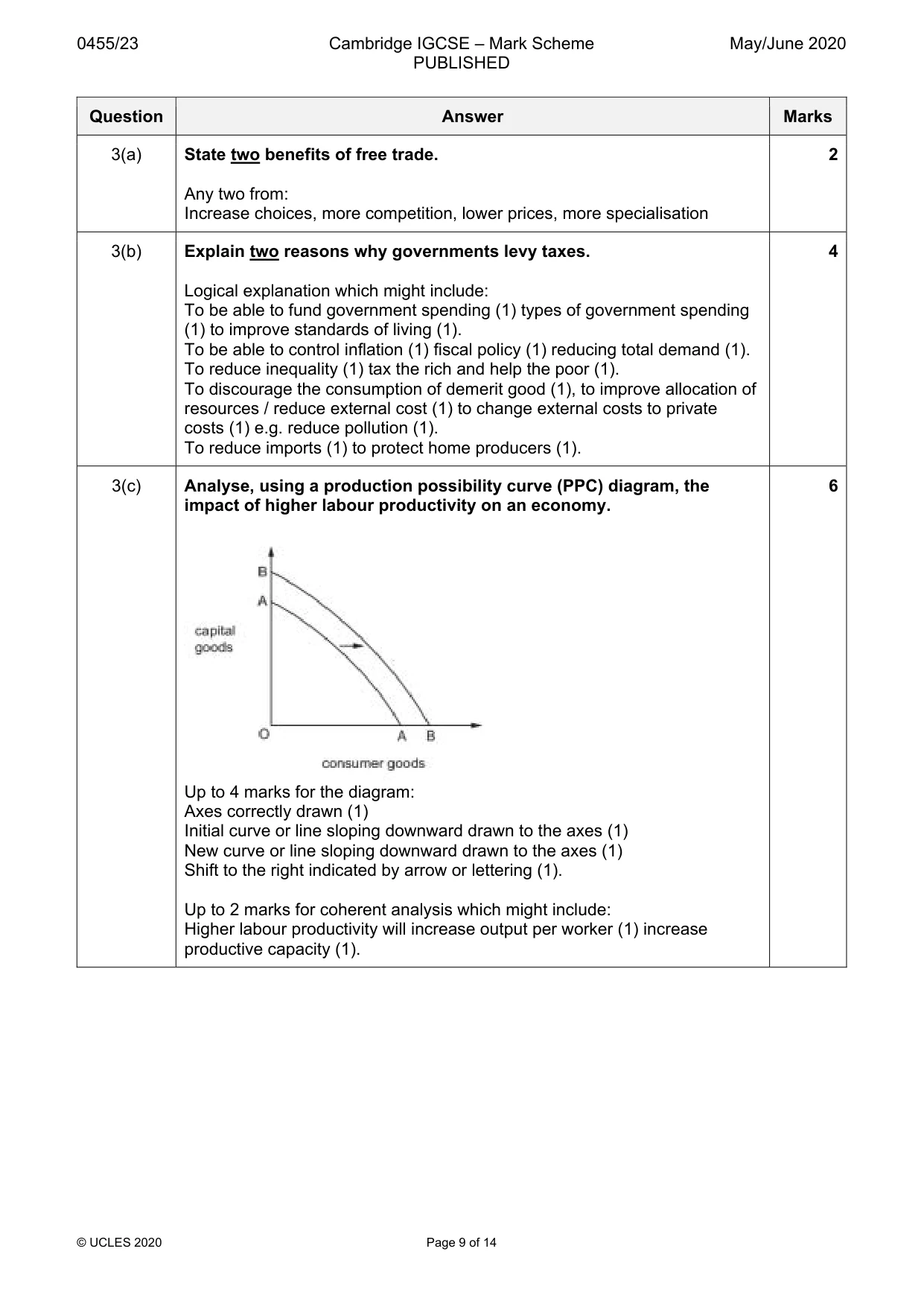
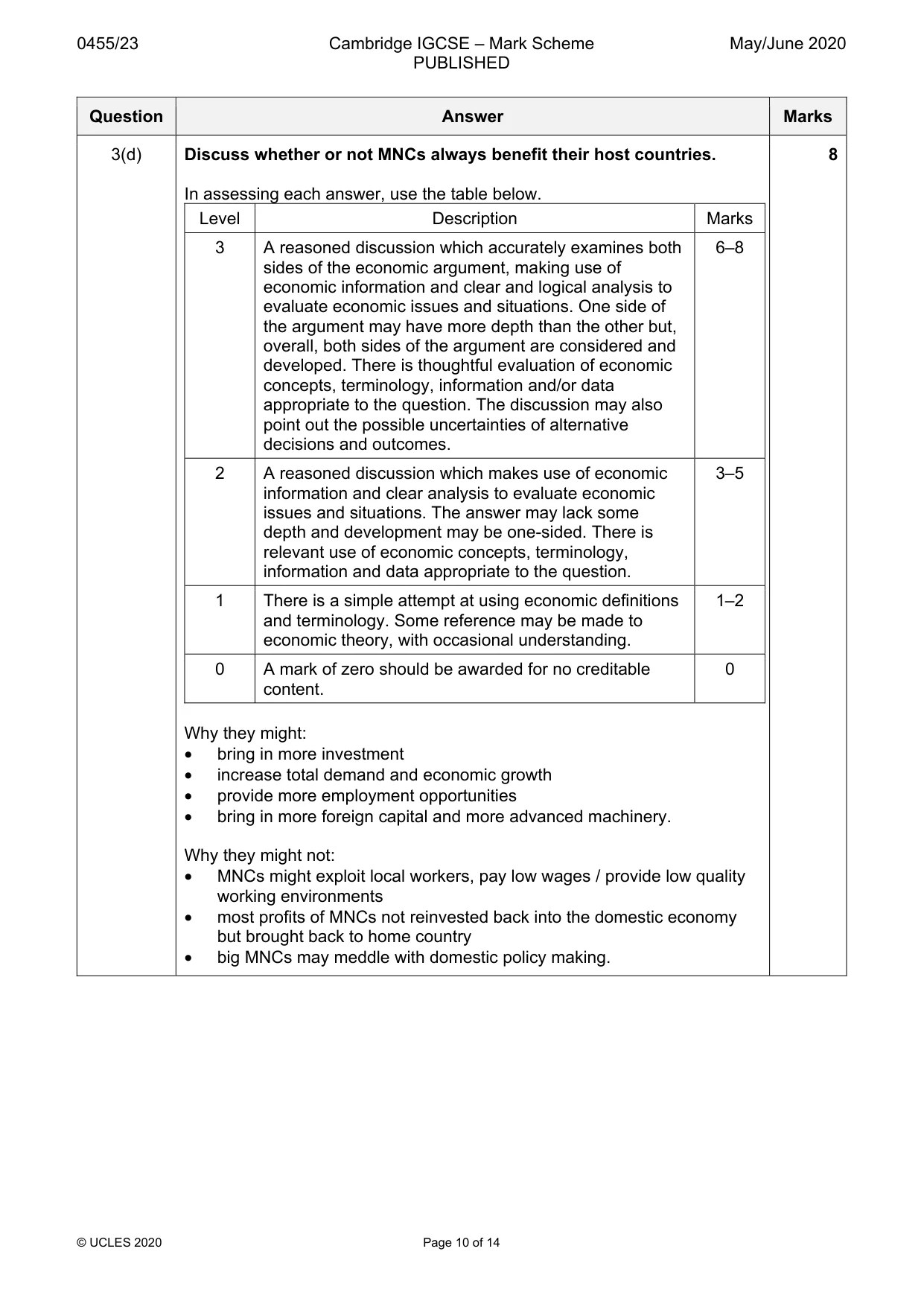
Mark scheme: 3(a) State two benefits of free trade. 2 Any two from: Increase choices, more competition, lower prices, more specialisation 3(b) Explain two reasons why governments levy taxes. 4 Logical explanation which might include: To be able to fund government spending (1) types of government spending (1) to improve standards of living (1). To be able to control inflation (1) fiscal policy (1) reducing total demand (1). To reduce inequality (1) tax the rich and help the poor (1). To discourage the consumption of demerit good (1), to improve allocation of resources / reduce external cost (1) to change external costs to private costs (1) e.g. reduce pollution (1). To reduce imports (1) to protect home producers (1). 3(c) Analyse, using a production possibility curve (PPC) diagram, the 6 impact of higher labour productivity on an economy. Up to 4 marks for the diagram: Axes correctly drawn (1) Initial curve or line sloping downward drawn to the axes (1) New curve or line sloping downward drawn to the axes (1) Shift to the right indicated by arrow or lettering (1). Up to 2 marks for coherent analysis which might include: Higher labour productivity will increase output per worker (1) increase productive capacity (1). 3(d) Discuss whether or not MNCs always benefit their host countries. 8 In assessing each answer, use the table below. Level Description Marks 3 A reasoned discussion which accurately examines both 6–8 sides of the economic argument, making use of economic information and clear and logical analysis to evaluate economic issues and situations. One side of the argument may have more depth than the other but, overall, both sides of the argument are considered and developed. There is thoughtful evaluation of economic concepts, terminology, information and/or data appropriate to the question. The discussion may also point out the possible uncertainties of alternative decisions and outcomes. 2 A reasoned discussion which makes use of economic 3–5 information and clear analysis to evaluate economic issues and situations. The answer may lack some depth and development may be one-sided. There is relevant use of economic concepts, terminology, information and data appropriate to the question. 1 There is a simple attempt at using economic definitions 1–2 and terminology. Some reference may be made to economic theory, with occasional understanding. 0 A mark of zero should be awarded for no creditable 0 content. Why they might: • bring in more investment • increase total demand and economic growth • provide more employment opportunities • bring in more foreign capital and more advanced machinery. Why they might not: • MNCs might exploit local workers, pay low wages / provide low quality working environments • most profits of MNCs not reinvested back into the domestic economy but brought back to home country • big MNCs may meddle with domestic policy making.
Q4 · Business-friendly fiscal policy in the United States (US) has encouraged firms to produce…
4 Business-friendly fiscal policy in the United States (US) has encouraged firms to produce more. The US government has also encouraged mergers, including firms in the gas and electricity industries. Even though there are significant regulations, entrepreneurs have found that mergers enable them to maximise their profits. However, this may make markets less competitive and some states have imposed a maximum price for gas and electricity. (a) Define profit maximisation. [2] (b) Explain two types of mergers. [4] (c) Analyse how fiscal policy can encourage firms to produce more. [6] (d) Discuss whether or not maximum prices are beneficial. [8]
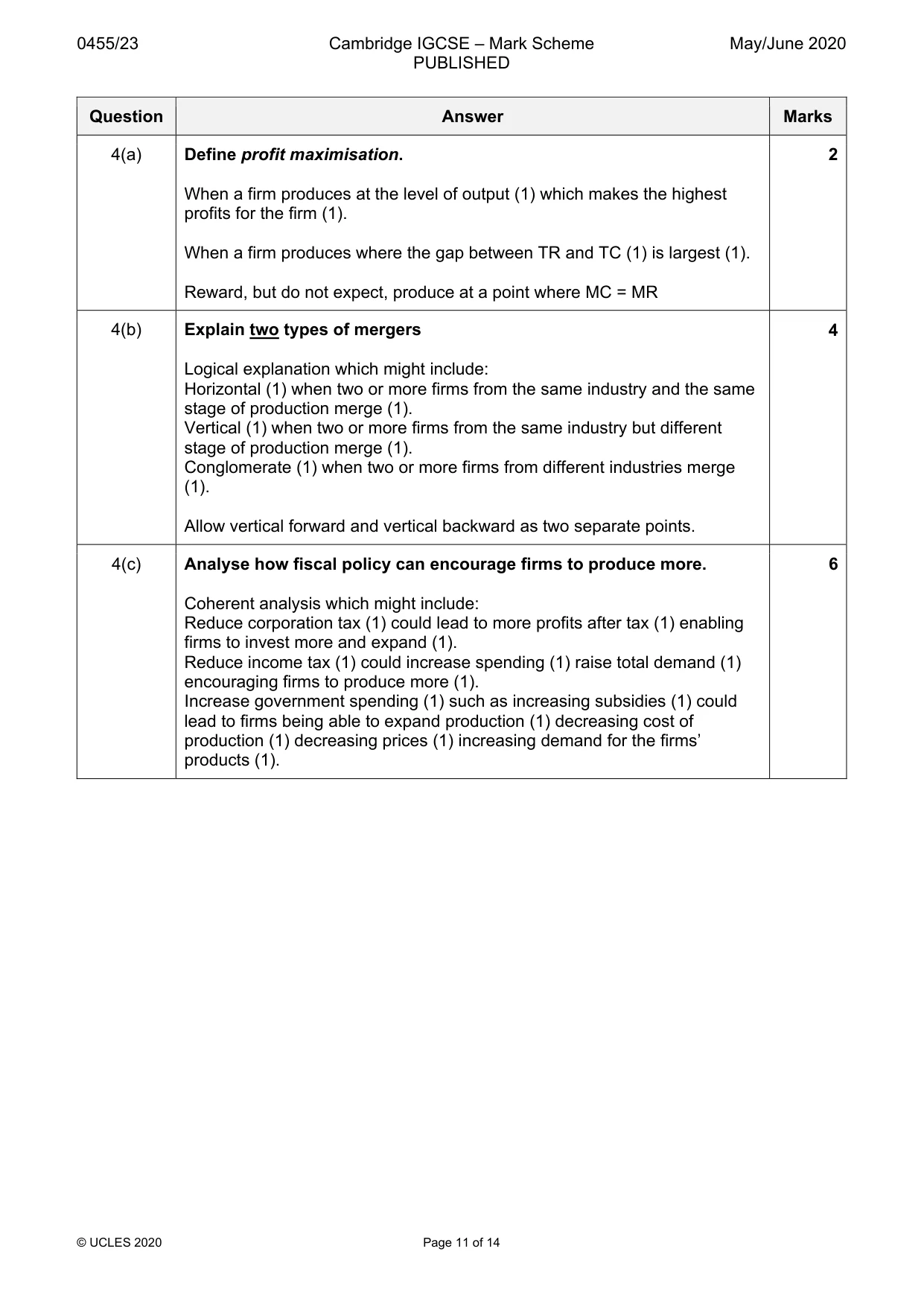
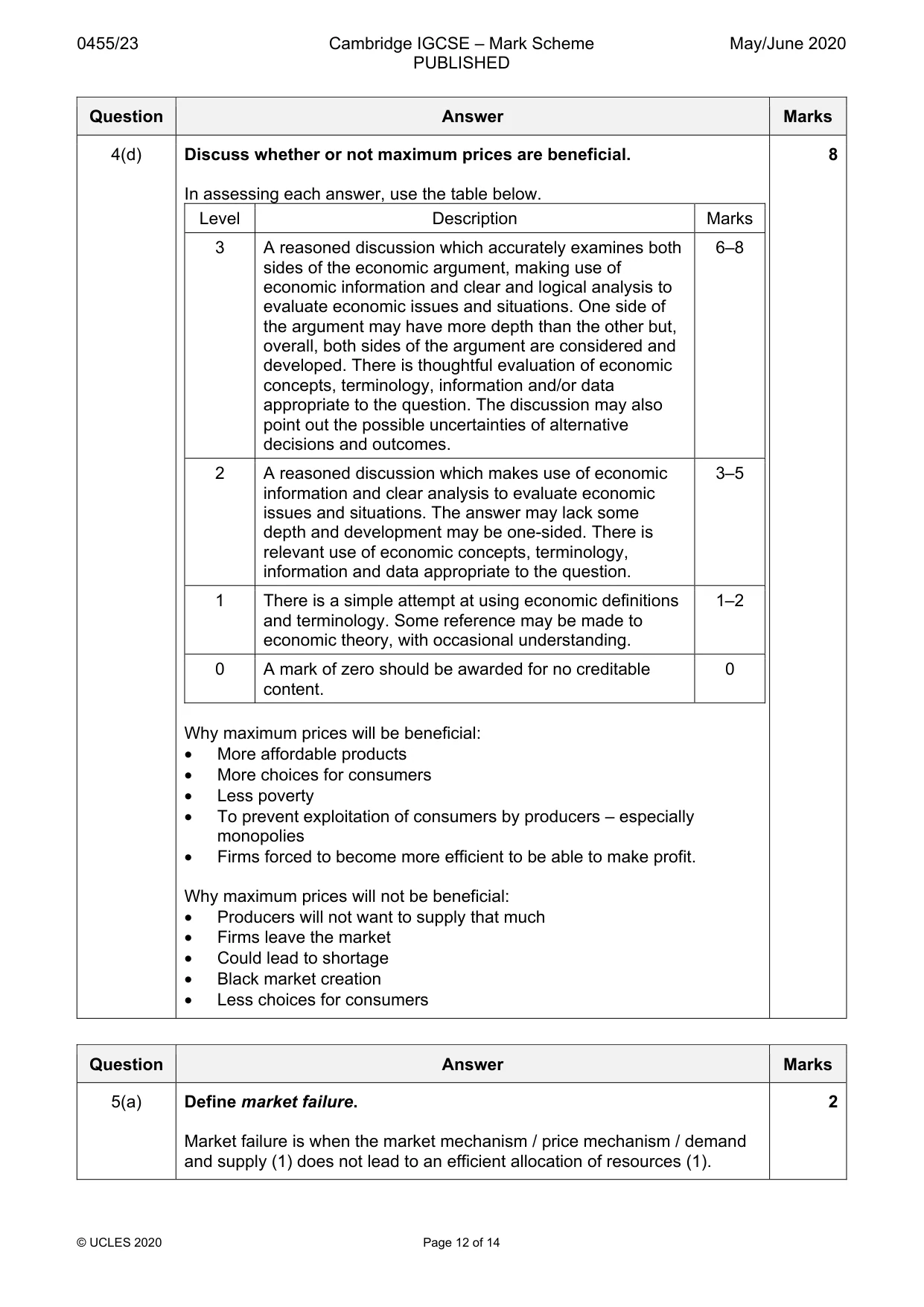
Mark scheme: 4(a) Define profit maximisation. 2 When a firm produces at the level of output (1) which makes the highest profits for the firm (1). When a firm produces where the gap between TR and TC (1) is largest (1). Reward, but do not expect, produce at a point where MC = MR 4(b) Explain two types of mergers 4 Logical explanation which might include: Horizontal (1) when two or more firms from the same industry and the same stage of production merge (1). Vertical (1) when two or more firms from the same industry but different stage of production merge (1). Conglomerate (1) when two or more firms from different industries merge (1). Allow vertical forward and vertical backward as two separate points. 4(c) Analyse how fiscal policy can encourage firms to produce more. 6 Coherent analysis which might include: Reduce corporation tax (1) could lead to more profits after tax (1) enabling firms to invest more and expand (1). Reduce income tax (1) could increase spending (1) raise total demand (1) encouraging firms to produce more (1). Increase government spending (1) such as increasing subsidies (1) could lead to firms being able to expand production (1) decreasing cost of production (1) decreasing prices (1) increasing demand for the firms’ products (1). 4(d) Discuss whether or not maximum prices are beneficial. 8 In assessing each answer, use the table below. Level Description Marks 3 A reasoned discussion which accurately examines both 6–8 sides of the economic argument, making use of economic information and clear and logical analysis to evaluate economic issues and situations. One side of the argument may have more depth than the other but, overall, both sides of the argument are considered and developed. There is thoughtful evaluation of economic concepts, terminology, information and/or data appropriate to the question. The discussion may also point out the possible uncertainties of alternative decisions and outcomes. 2 A reasoned discussion which makes use of economic 3–5 information and clear analysis to evaluate economic issues and situations. The answer may lack some depth and development may be one-sided. There is relevant use of economic concepts, terminology, information and data appropriate to the question. 1 There is a simple attempt at using economic definitions 1–2 and terminology. Some reference may be made to economic theory, with occasional understanding. 0 A mark of zero should be awarded for no creditable 0 content. Why maximum prices will be beneficial: • More affordable products • More choices for consumers • Less poverty • To prevent exploitation of consumers by producers – especially monopolies • Firms forced to become more efficient to be able to make profit. Why maximum prices will not be beneficial: • Producers will not want to supply that much • Firms leave the market • Could lead to shortage • Black market creation • Less choices for consumers
Q5 · There is a high level of division of labour in the United Kingdom (UK) energy industry
5 There is a high level of division of labour in the United Kingdom (UK) energy industry. Cold weather in early 2018 caused very high demand for energy and a change in its price. This led to a temporary shortage of energy for firms and households in the UK. Part of the change in price may have been the result of UK energy firms abusing their monopoly power. This would be an example of market failure. (a) Define market failure. [2] (b) Explain two influences, other than weather, that could affect the demand for a product. [4] (c) Analyse the possible effects of a shortage of a product such as energy on an economy. [6] (d) Discuss whether or not workers benefit from division of labour. [8]
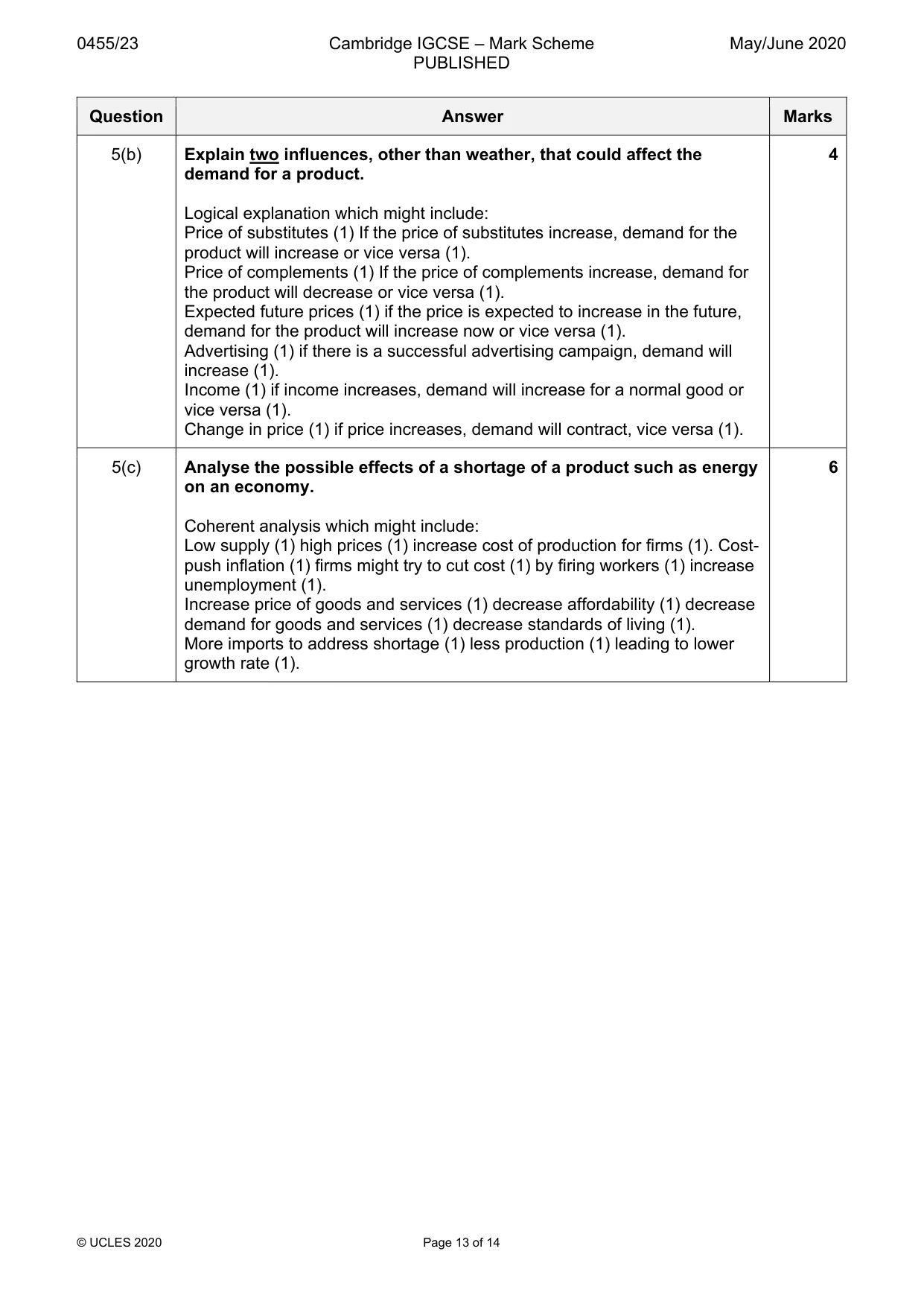
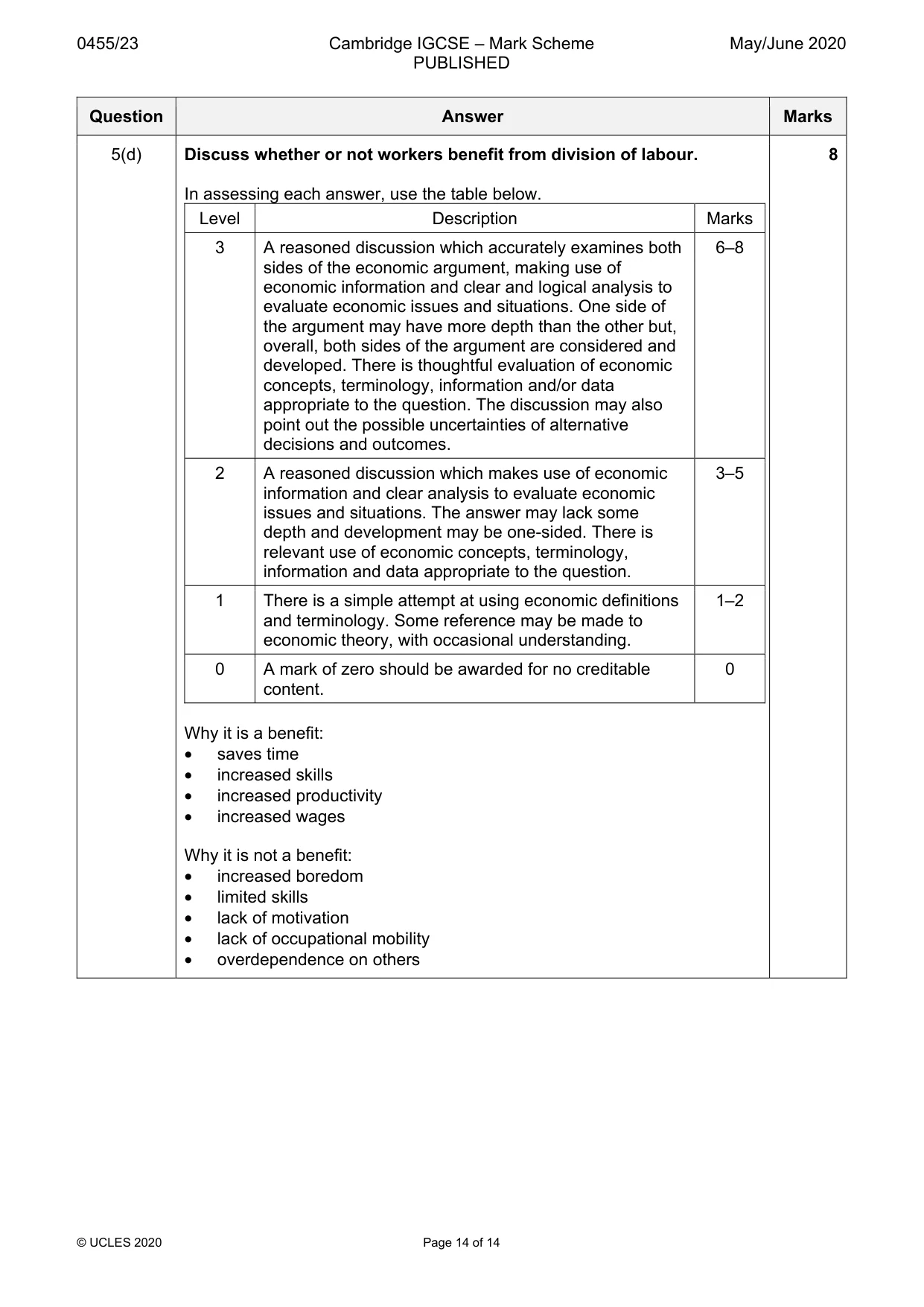
Mark scheme: 5(a) Define market failure. 2 Market failure is when the market mechanism / price mechanism / demand and supply (1) does not lead to an efficient allocation of resources (1). 5(b) Explain two influences, other than weather, that could affect the 4 demand for a product. Logical explanation which might include: Price of substitutes (1) If the price of substitutes increase, demand for the product will increase or vice versa (1). Price of complements (1) If the price of complements increase, demand for the product will decrease or vice versa (1). Expected future prices (1) if the price is expected to increase in the future, demand for the product will increase now or vice versa (1). Advertising (1) if there is a successful advertising campaign, demand will increase (1). Income (1) if income increases, demand will increase for a normal good or vice versa (1). Change in price (1) if price increases, demand will contract, vice versa (1). 5(c) Analyse the possible effects of a shortage of a product such as energy 6 on an economy. Coherent analysis which might include: Low supply (1) high prices (1) increase cost of production for firms (1). Cost- push inflation (1) firms might try to cut cost (1) by firing workers (1) increase unemployment (1). Increase price of goods and services (1) decrease affordability (1) decrease demand for goods and services (1) decrease standards of living (1). More imports to address shortage (1) less production (1) leading to lower growth rate (1). 5(d) Discuss whether or not workers benefit from division of labour. 8 In assessing each answer, use the table below. Level Description Marks 3 A reasoned discussion which accurately examines both 6–8 sides of the economic argument, making use of economic information and clear and logical analysis to evaluate economic issues and situations. One side of the argument may have more depth than the other but, overall, both sides of the argument are considered and developed. There is thoughtful evaluation of economic concepts, terminology, information and/or data appropriate to the question. The discussion may also point out the possible uncertainties of alternative decisions and outcomes. 2 A reasoned discussion which makes use of economic 3–5 information and clear analysis to evaluate economic issues and situations. The answer may lack some depth and development may be one-sided. There is relevant use of economic concepts, terminology, information and data appropriate to the question. 1 There is a simple attempt at using economic definitions 1–2 and terminology. Some reference may be made to economic theory, with occasional understanding. 0 A mark of zero should be awarded for no creditable 0 content. Why it is a benefit: • saves time • increased skills • increased productivity • increased wages Why it is not a benefit: • increased boredom • limited skills • lack of motivation • lack of occupational mobility • overdependence on others
What was in this paper
The subtopics covered by these 5 questions, and how many questions each got. Open one in a new tab to see every Cambridge question on it.