Cambridge IGCSE Economics 0455 — 2020 Oct/Nov Paper 2 · Variant 3
0455/23/O/N/20 · 5 questions · 90 marks · ≈101 min
The question paper and its mark scheme, free to read here and free to download. This is Cambridge’s own paper, exactly as it was sat.
Question paper8 pages
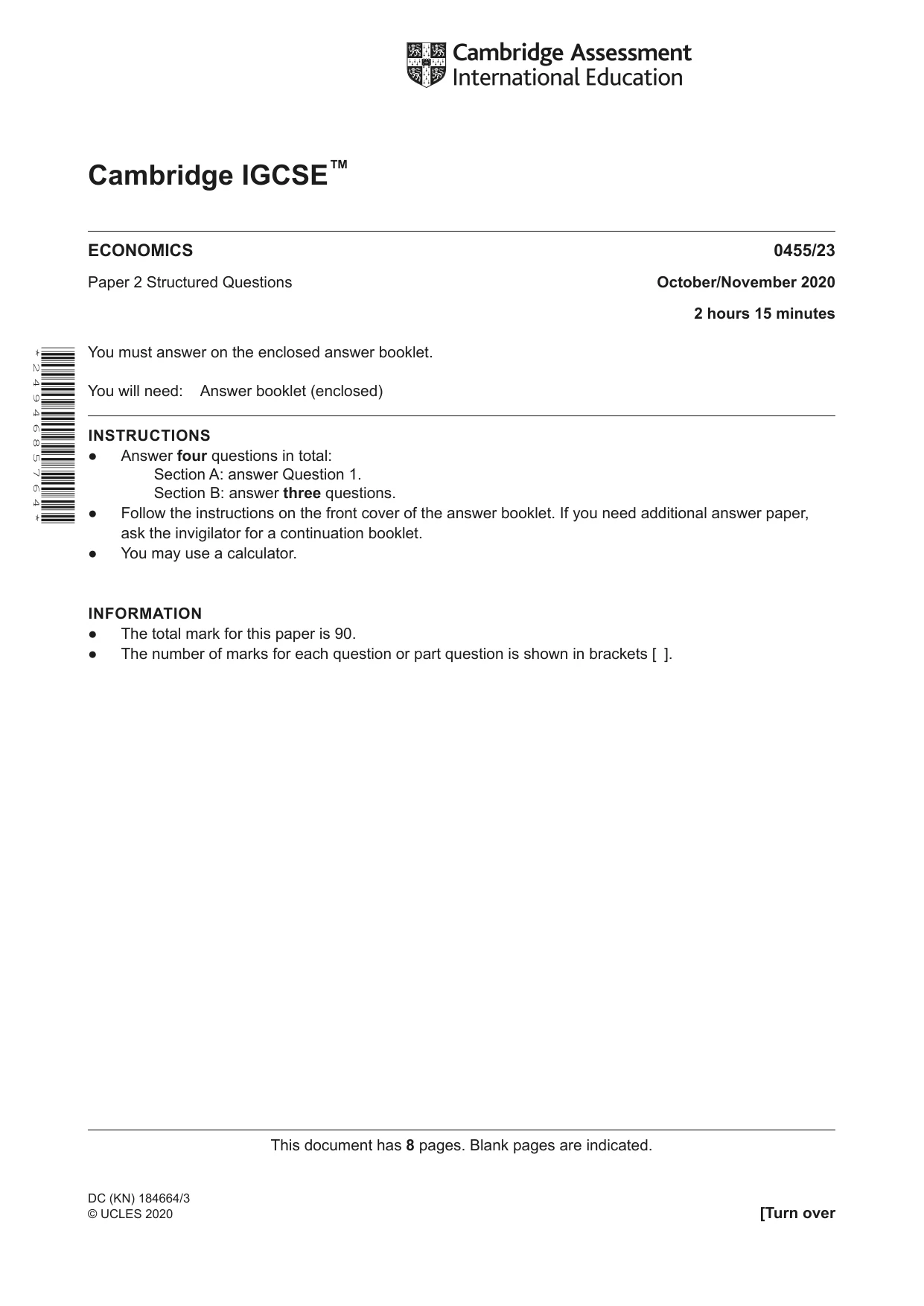




Mark scheme21 pages
Answers below. Sit the paper first if you are practising.
Questions as text
Q1 · Calculate the external cost per kilometre of driving a car in Manila in 2017
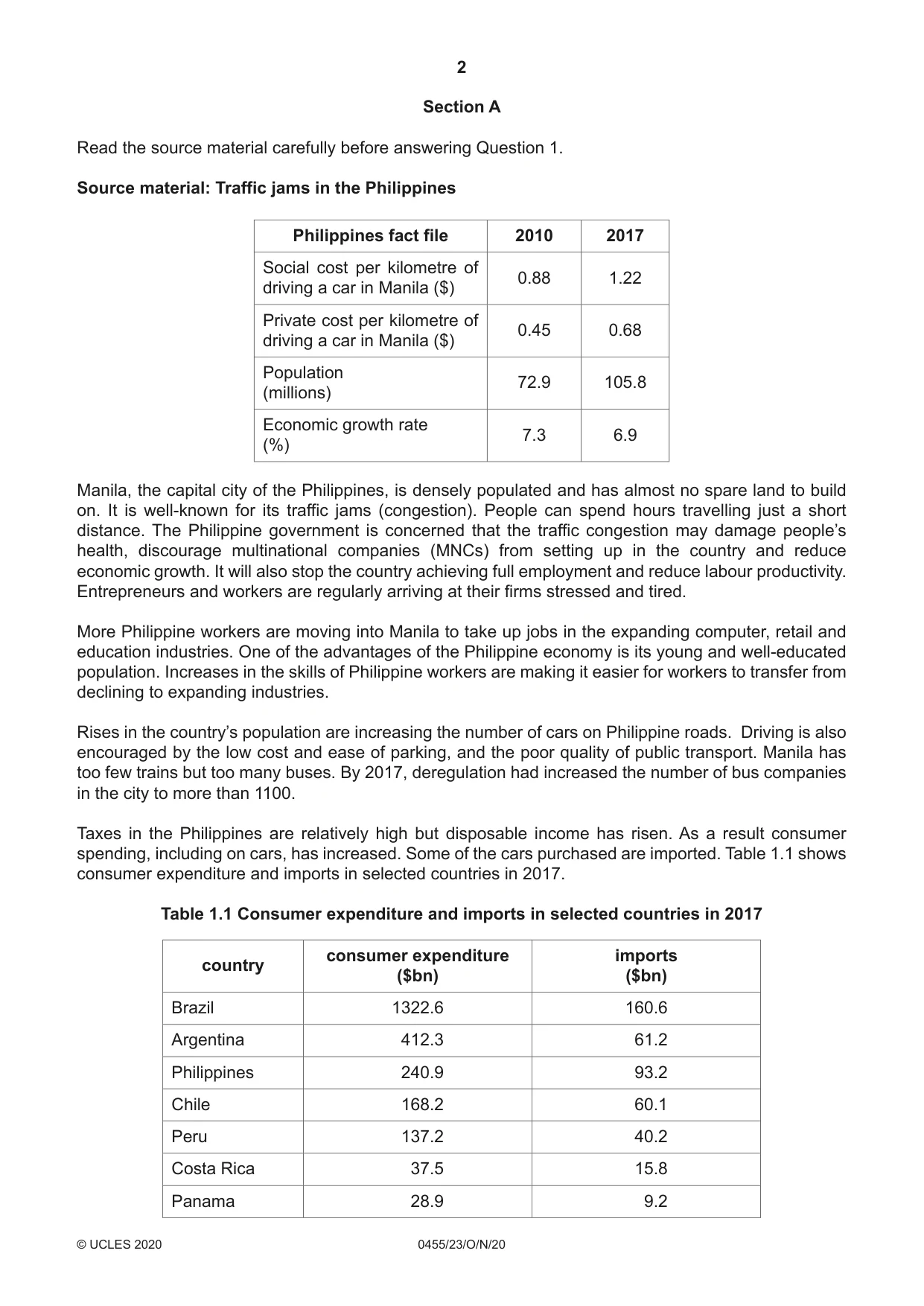
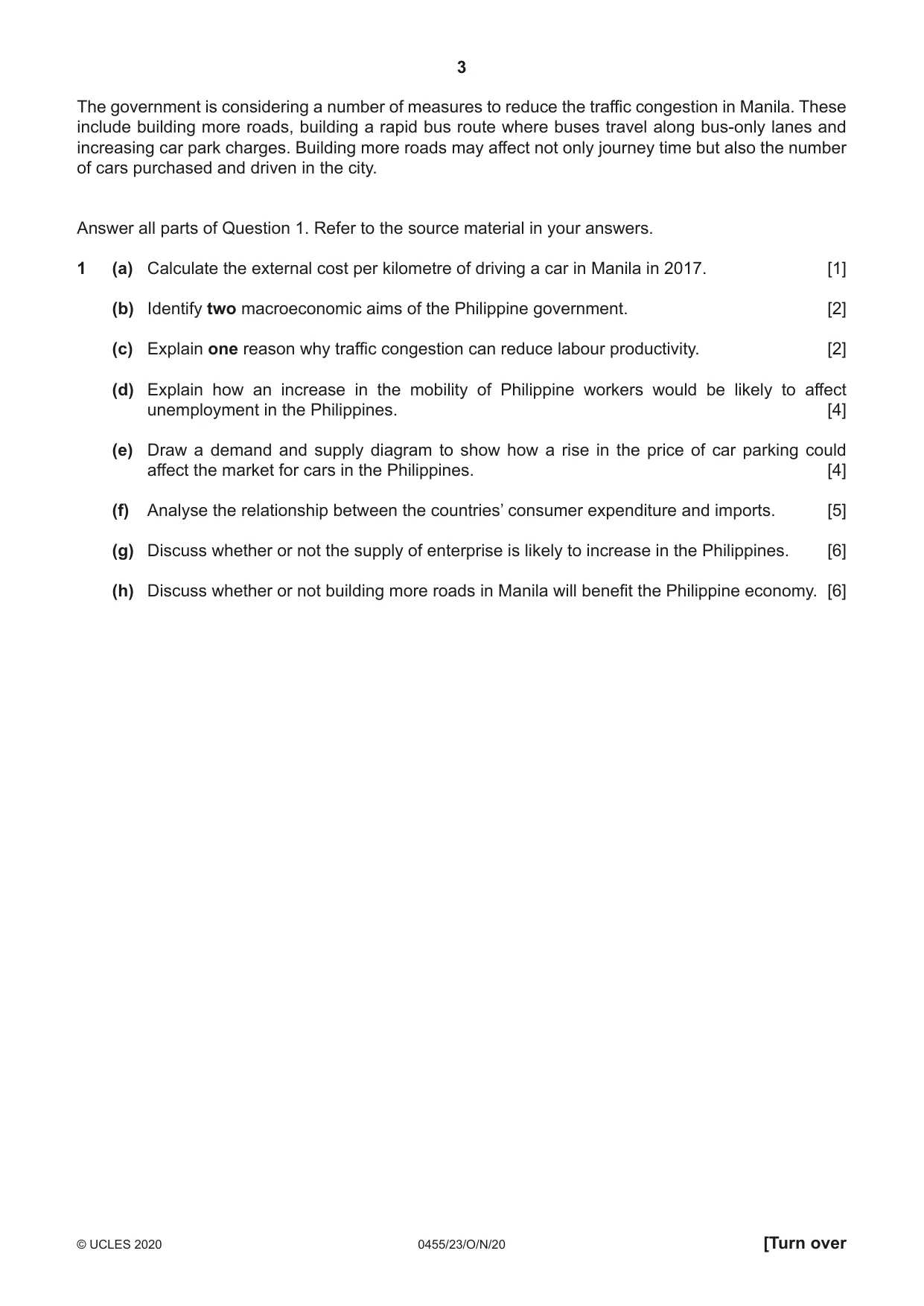
1 (a) Calculate the external cost per kilometre of driving a car in Manila in 2017. [1] (b) Identify two macroeconomic aims of the Philippine government. [2] (c) Explain one reason why traffic congestion can reduce labour productivity. [2] (d) Explain how an increase in the mobility of Philippine workers would be likely to affect unemployment in the Philippines. [4] (e) Draw a demand and supply diagram to show how a rise in the price of car parking could affect the market for cars in the Philippines. [4] (f) Analyse the relationship between the countries’ consumer expenditure and imports. [5] (g) Discuss whether or not the supply of enterprise is likely to increase in the Philippines. [6] (h) Discuss whether or not building more roads in Manila will benefit the Philippine economy. [6]
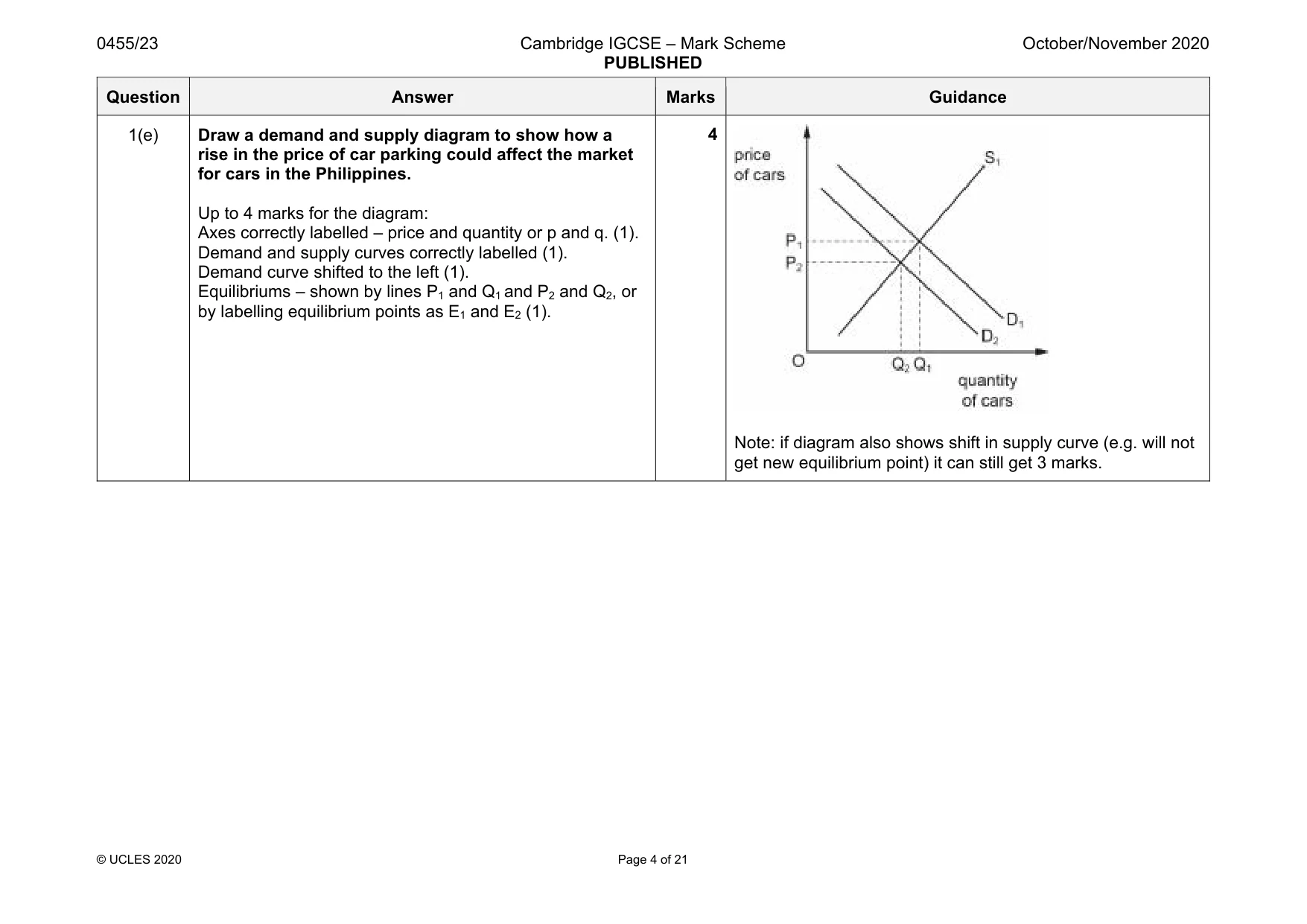
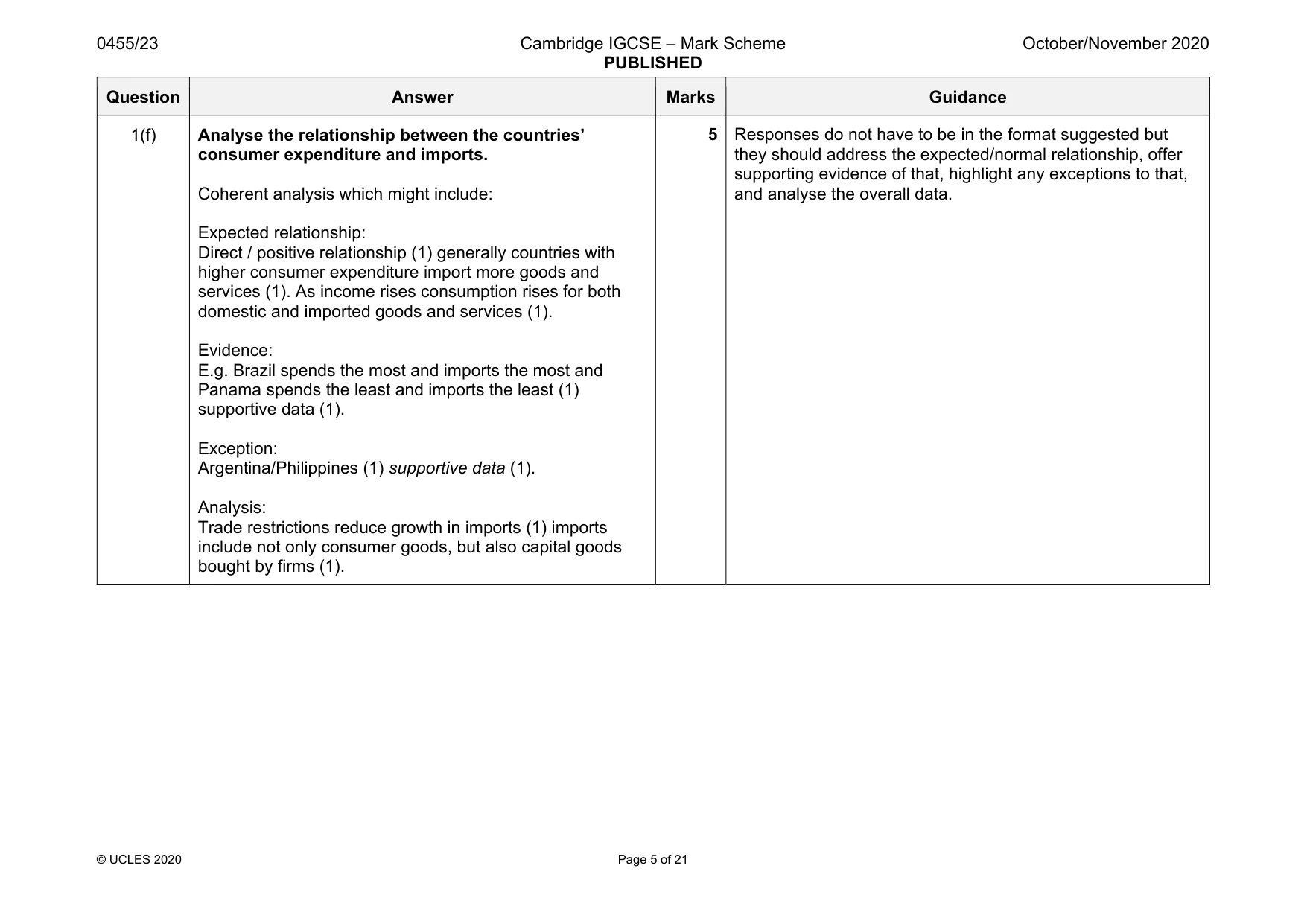
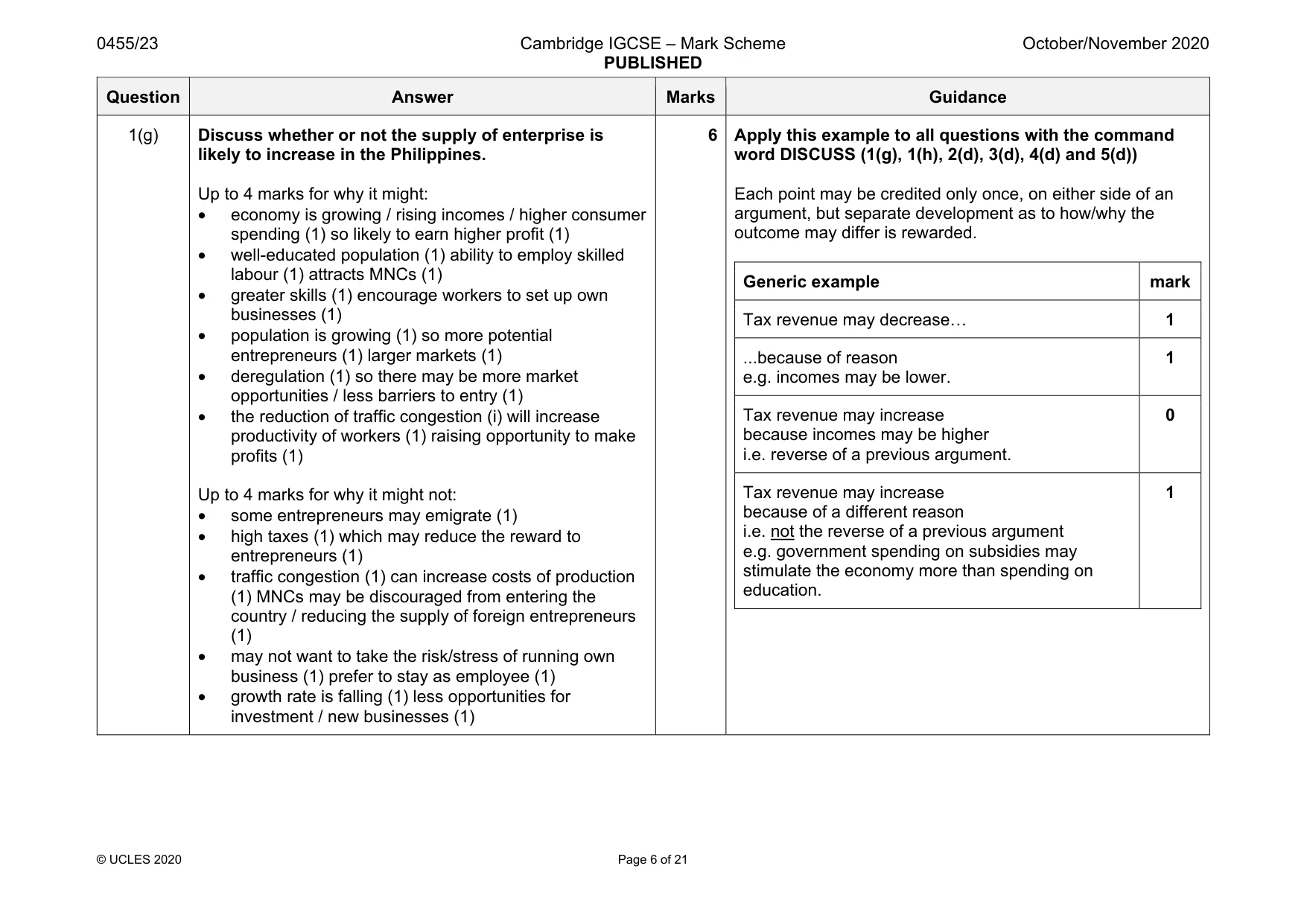
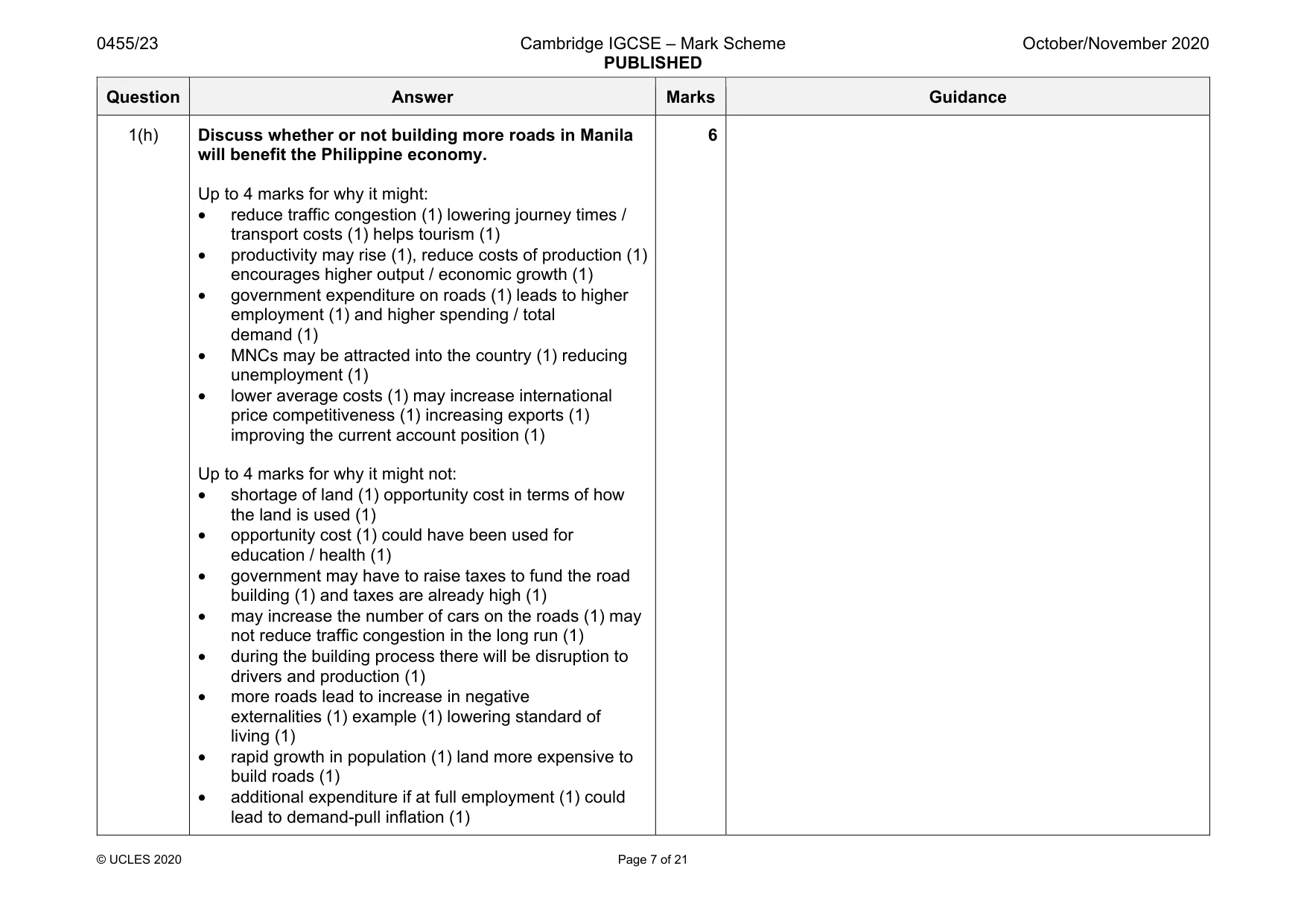
Mark scheme: 1(a) Calculate the external cost per kilometre of driving a car in Manila in 2017. $0.54 (1). 1 $ not necessary for 1 mark. 1(b) Identify two macroeconomic aims of the Philippine government. Economic growth (1) full employment (1). 2 Also accept raised labour productivity and low unemployment. If more than two are given, consider the first two only. 1(c) Explain one reason why traffic congestion can reduce labour productivity. Logical explanation which might include: Reduce health of workers / workers arriving tired / stressed (1) this is likely to lead to more days of absence from work / reduce their output per hour (1). Late arrival to work (1) output per day declines / less working time (1). 2 1(d) Explain how an increase in the mobility of Philippine workers would be likely to affect unemployment in the Philippines. Logical explanation which might include: Greater geographical mobility (1) enables moving from areas of unemployment to areas where there are job vacancies / expanding industries such as computer, retail, and education (1) will affect frictional unemployment (1) take jobs overseas (1). Greater occupational mobility (1) through education/training enables moving into jobs requiring different skills/qualifications (1) will reduce structural unemployment (1). 4 Question Answer Marks Guidance 1(e) Draw a demand and supply diagram to show how a rise in the price of car parking could affect the market for cars in the Philippines. Up to 4 marks for the diagram: Axes correctly labelled – price and quantity or p and q. (1). Demand and supply curves correctly labelled (1). Demand curve shifted to the left (1). Equilibriums – shown by lines P1 and Q1 and P2 and Q2, or by labelling equilibrium points as E1 and E2 (1). 4 Note: if diagram also shows shift in supply curve (e.g. will not get new equilibrium point) it can still get 3 marks. Question Answer Marks Guidance 1(f) Analyse the relationship between the countries’ consumer expenditure and imports. Coherent analysis which might include: Expected relationship: Direct / positive relationship (1) generally countries with higher consumer expenditure import more goods and services (1). As income rises consumption rises for both domestic and imported goods and services (1). Evidence: E.g. Brazil spends the most and imports the most and Panama spends the least and imports the least (1) supportive data (1). Exception: Argentina/Philippines (1) supportive data (1). Analysis: Trade restrictions reduce growth in imports (1) imports include not only consumer goods, but also capital goods bought by firms (1). 5 Responses do not have to be in the format suggested but they should address the expected/normal relationship, offer supporting evidence of that, highlight any exceptions to that, and analyse the overall data. Question Answer Marks Guidance 1(g) Discuss whether or not the supply of enterprise is likely to increase in the Philippines. Up to 4 marks for why it might: • economy is growing / rising incomes / higher consumer spending (1) so likely to earn higher profit (1) • well-educated population (1) ability to employ skilled labour (1) attracts MNCs (1) • greater skills (1) encourage workers to set up own businesses (1) • population is growing (1) so more potential entrepreneurs (1) larger markets (1) • deregulation (1) so there may be more market opportunities / less barriers to entry (1) • the reduction of traffic congestion (i) will increase productivity of workers (1) raising opportunity to make profits (1) Up to 4 marks for why it might not: • some entrepreneurs may emigrate (1) • high taxes (1) which may reduce the reward to entrepreneurs (1) • traffic congestion (1) can increase costs of production (1) MNCs may be discouraged from entering the country / reducing the supply of foreign entrepreneurs (1) • may not want to take the risk/stress of running own business (1) prefer to stay as employee (1) • growth rate is falling (1) less opportunities for investment / new businesses (1) 6 Apply this example to all questions with the command word DISCUSS (1(g), 1(h), 2(d), 3(d), 4(d) and 5(d)) Each point may be credited only once, on either side of an argument, but separate development as to how/why the outcome may differ is rewarded. Generic example mark Tax revenue may decrease… 1 ...because of reason e.g. incomes may be lower. 1 Tax revenue may increase because incomes may be higher i.e. reverse of a previous argument. 0 Tax revenue may increase because of a different reason i.e. not the reverse of a previous argument e.g. government spending on subsidies may stimulate the economy more than spending on education. 1 Question Answer Marks Guidance 1(h) Discuss whether or not building more roads in Manila will benefit the Philippine economy. Up to 4 marks for why it might: • reduce traffic congestion (1) lowering journey times / transport costs (1) helps tourism (1) • productivity may rise (1), reduce costs of production (1) encourages higher output / economic growth (1) • government expenditure on roads (1) leads to higher employment (1) and higher spending / total demand (1) • MNCs may be attracted into the country (1) reducing unemployment (1) • lower average costs (1) may increase international price competitiveness (1) increasing exports (1) improving the current account position (1) Up to 4 marks for why it might not: • shortage of land (1) opportunity cost in terms of how the land is used (1) • opportunity cost (1) could have been used for education / health (1) • government may have to raise taxes to fund the road building (1) and taxes are already high (1) • may increase the number of cars on the roads (1) may not reduce traffic congestion in the long run (1) • during the building process there will be disruption to drivers and production (1) • more roads lead to increase in negative externalities (1) example (1) lowering standard of living (1) • rapid growth in population (1) land more expensive to build roads (1) • additional expenditure if at full employment (1) could lead to demand-pull inflation (1) 6
Q2 · Changes in tobacco production and consumption can have both microeconomic and…
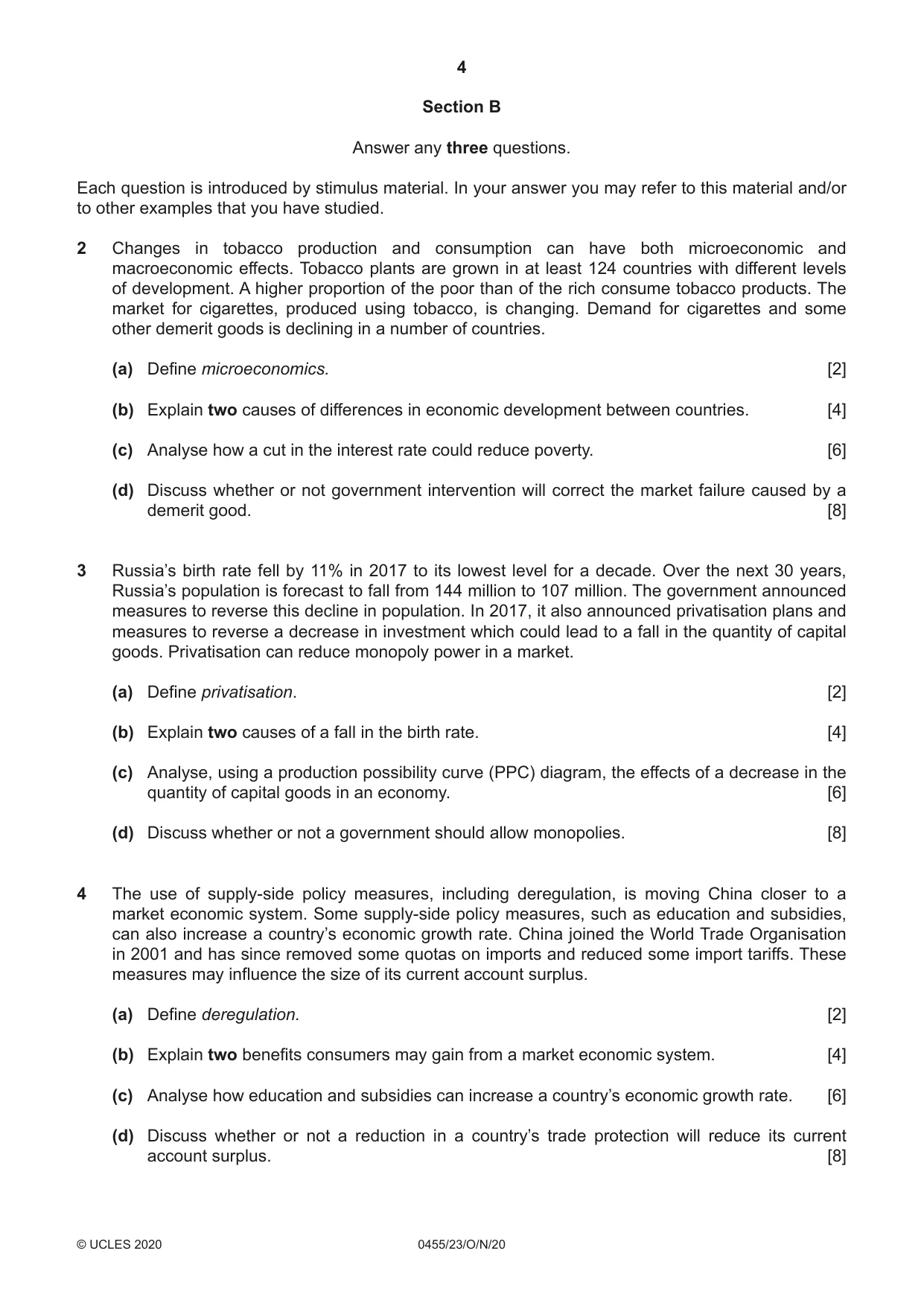
2 Changes in tobacco production and consumption can have both microeconomic and macroeconomic effects. Tobacco plants are grown in at least 124 countries with different levels of development. A higher proportion of the poor than of the rich consume tobacco products. The market for cigarettes, produced using tobacco, is changing. Demand for cigarettes and some other demerit goods is declining in a number of countries. (a) Define microeconomics. [2] (b) Explain two causes of differences in economic development between countries. [4] (c) Analyse how a cut in the interest rate could reduce poverty. [6] (d) Discuss whether or not government intervention will correct the market failure caused by a demerit good. [8]
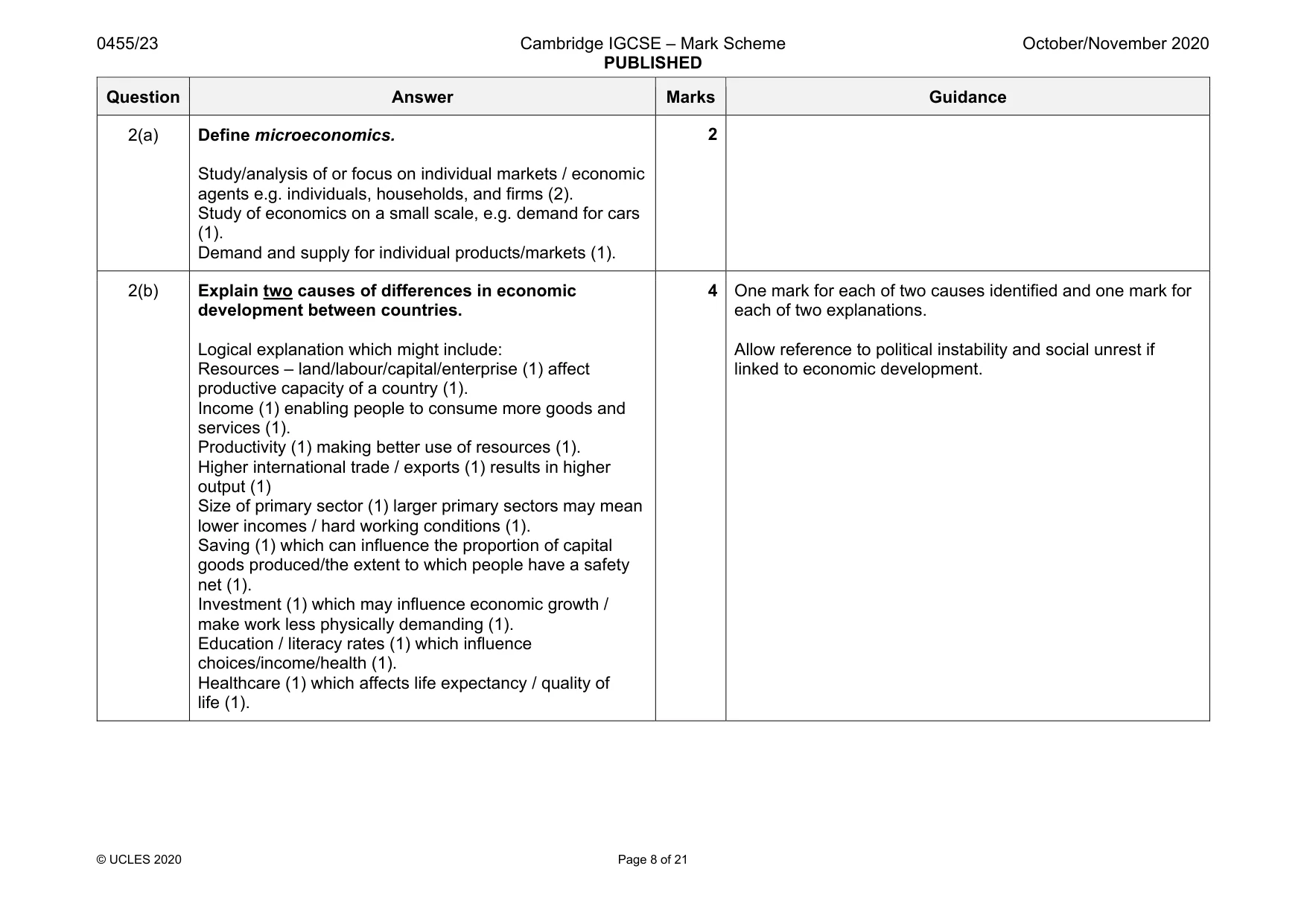
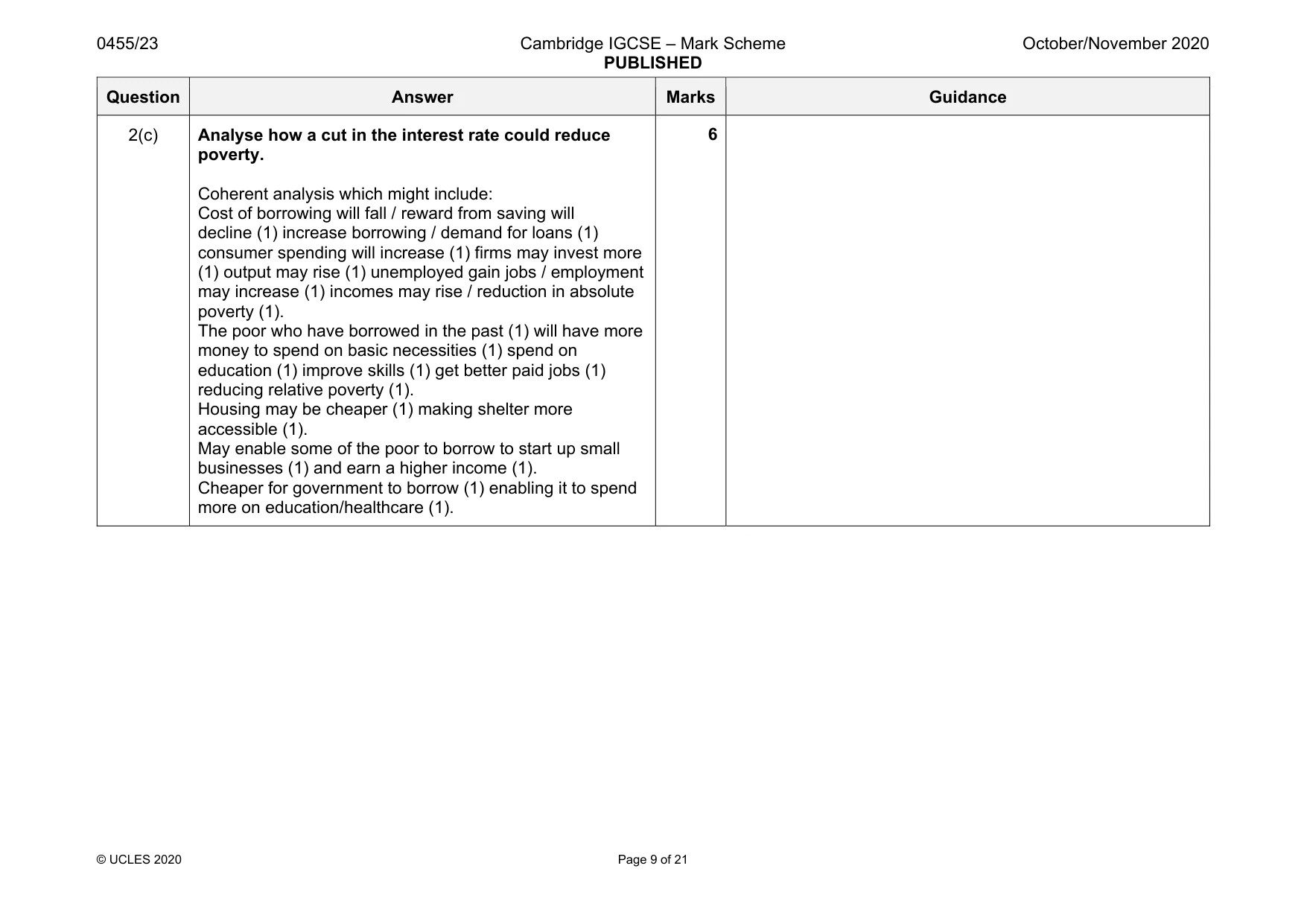
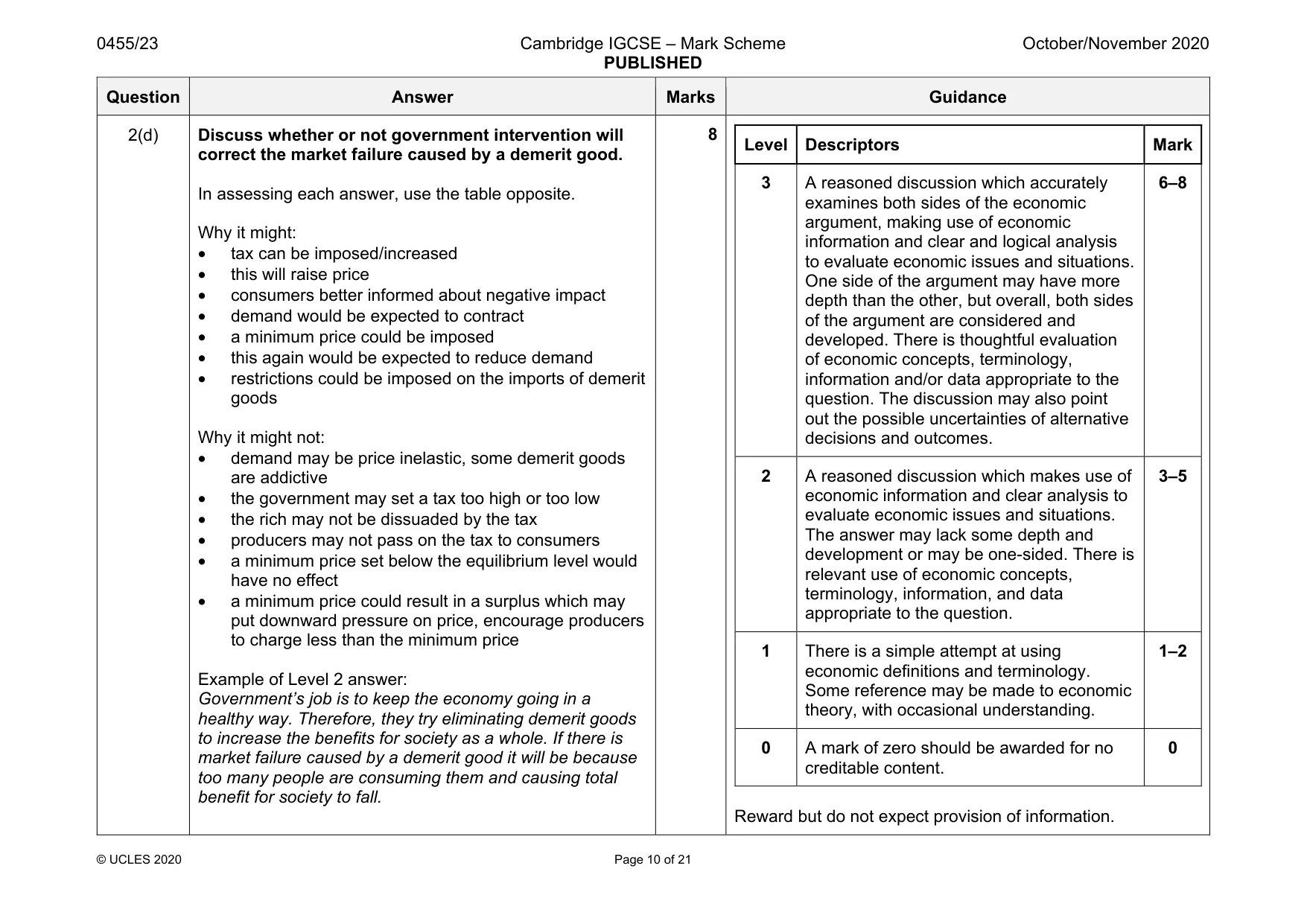
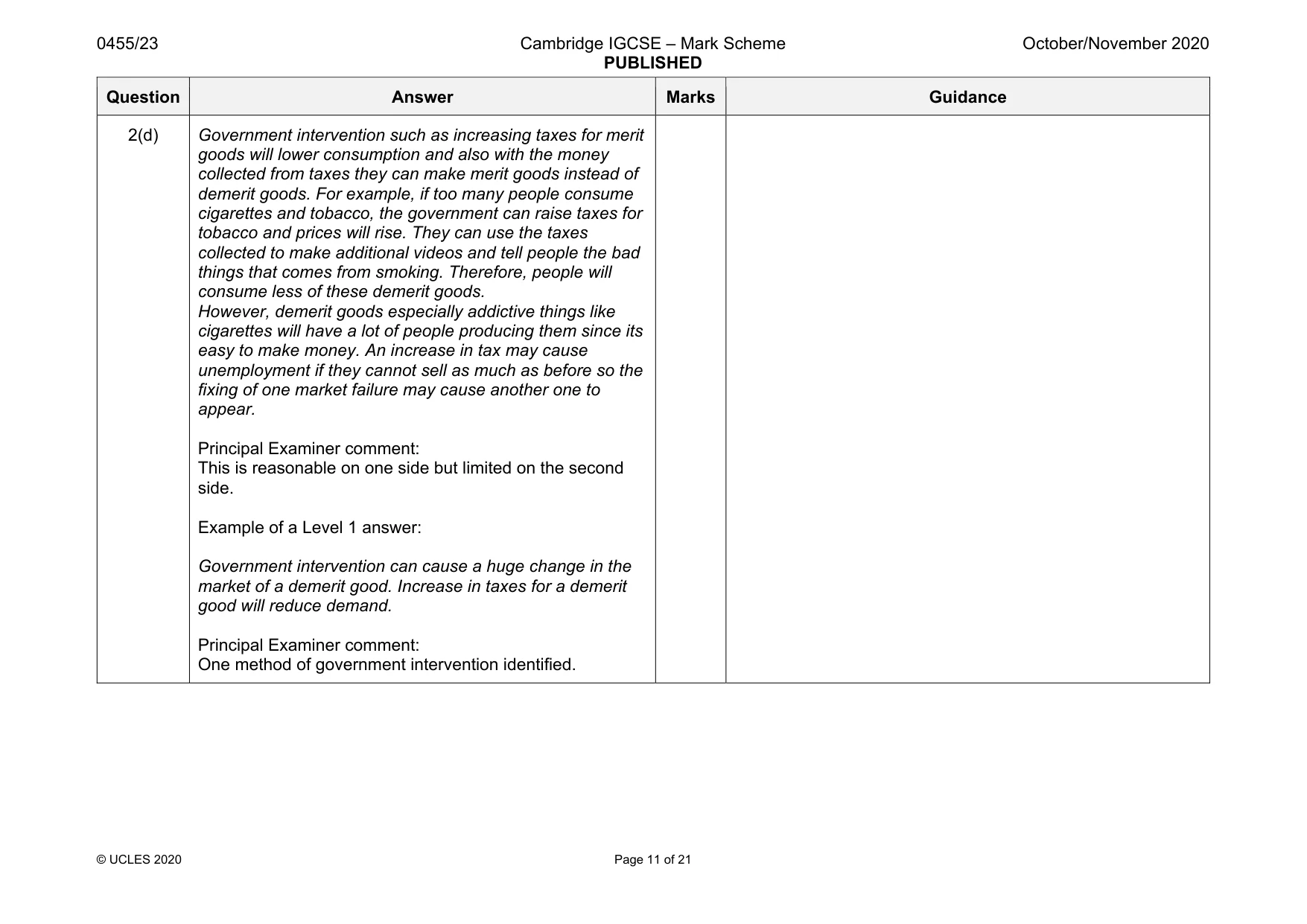
Mark scheme: 2(a) Define microeconomics. Study/analysis of or focus on individual markets / economic agents e.g. individuals, households, and firms (2). Study of economics on a small scale, e.g. demand for cars (1). Demand and supply for individual products/markets (1). 2(b) Explain two causes of differences in economic development between countries. Logical explanation which might include: Resources – land/labour/capital/enterprise (1) affect productive capacity of a country (1). Income (1) enabling people to consume more goods and services (1). Productivity (1) making better use of resources (1). Higher international trade / exports (1) results in higher output (1) Size of primary sector (1) larger primary sectors may mean lower incomes / hard working conditions (1). Saving (1) which can influence the proportion of capital goods produced/the extent to which people have a safety net (1). Investment (1) which may influence economic growth / make work less physically demanding (1). Education / literacy rates (1) which influence choices/income/health (1). Healthcare (1) which affects life expectancy / quality of life (1). 4 One mark for each of two causes identified and one mark for each of two explanations. Allow reference to political instability and social unrest if linked to economic development. Question Answer Marks Guidance 2(c) Analyse how a cut in the interest rate could reduce poverty. Coherent analysis which might include: Cost of borrowing will fall / reward from saving will decline (1) increase borrowing / demand for loans (1) consumer spending will increase (1) firms may invest more (1) output may rise (1) unemployed gain jobs / employment may increase (1) incomes may rise / reduction in absolute poverty (1). The poor who have borrowed in the past (1) will have more money to spend on basic necessities (1) spend on education (1) improve skills (1) get better paid jobs (1) reducing relative poverty (1). Housing may be cheaper (1) making shelter more accessible (1). May enable some of the poor to borrow to start up small businesses (1) and earn a higher income (1). Cheaper for government to borrow (1) enabling it to spend more on education/healthcare (1). 6 Question Answer Marks Guidance 2(d) Discuss whether or not government intervention will correct the market failure caused by a demerit good. In assessing each answer, use the table opposite. Why it might: • tax can be imposed/increased • this will raise price • consumers better informed about negative impact • demand would be expected to contract • a minimum price could be imposed • this again would be expected to reduce demand • restrictions could be imposed on the imports of demerit goods Why it might not: • demand may be price inelastic, some demerit goods are addictive • the government may set a tax too high or too low • the rich may not be dissuaded by the tax • producers may not pass on the tax to consumers • a minimum price set below the equilibrium level would have no effect • a minimum price could result in a surplus which may put downward pressure on price, encourage producers to charge less than the minimum price Example of Level 2 answer: Government’s job is to keep the economy going in a healthy way. Therefore, they try eliminating demerit goods to increase the benefits for society as a whole. If there is market failure caused by a demerit good it will be because too many people are consuming them and causing total benefit for society to fall. 8 Level Descriptors Mark 3 A reasoned discussion which accurately examines both sides of the economic argument, making use of economic information and clear and logical analysis to evaluate economic issues and situations. One side of the argument may have more depth than the other, but overall, both sides of the argument are considered and developed. There is thoughtful evaluation of economic concepts, terminology, information and/or data appropriate to the question. The discussion may also point out the possible uncertainties of alternative decisions and outcomes. 6–8 2 A reasoned discussion which makes use of economic information and clear analysis to evaluate economic issues and situations. The answer may lack some depth and development or may be one-sided. There is relevant use of economic concepts, terminology, information, and data appropriate to the question. 3–5 1 There is a simple attempt at using economic definitions and terminology. Some reference may be made to economic theory, with occasional understanding. 1–2 0 A mark of zero should be awarded for no creditable content. 0 Reward but do not expect provision of information. Question Answer Marks Guidance 2(d) Government intervention such as increasing taxes for merit goods will lower consumption and also with the money collected from taxes they can make merit goods instead of demerit goods. For example, if too many people consume cigarettes and tobacco, the government can raise taxes for tobacco and prices will rise. They can use the taxes collected to make additional videos and tell people the bad things that comes from smoking. Therefore, people will consume less of these demerit goods. However, demerit goods especially addictive things like cigarettes will have a lot of people producing them since its easy to make money. An increase in tax may cause unemployment if they cannot sell as much as before so the fixing of one market failure may cause another one to appear. Principal Examiner comment: This is reasonable on one side but limited on the second side. Example of a Level 1 answer: Government intervention can cause a huge change in the market of a demerit good. Increase in taxes for a demerit good will reduce demand. Principal Examiner comment: One method of government intervention identified.
Q3 · Russia’s birth rate fell by 11% in 2017 to its lowest level for a decade
3 Russia’s birth rate fell by 11% in 2017 to its lowest level for a decade. Over the next 30 years, Russia’s population is forecast to fall from 144 million to 107 million. The government announced measures to reverse this decline in population. In 2017, it also announced privatisation plans and measures to reverse a decrease in investment which could lead to a fall in the quantity of capital goods. Privatisation can reduce monopoly power in a market. (a) Define privatisation. [2] (b) Explain two causes of a fall in the birth rate. [4] (c) Analyse, using a production possibility curve (PPC) diagram, the effects of a decrease in the quantity of capital goods in an economy. [6] (d) Discuss whether or not a government should allow monopolies. [8]
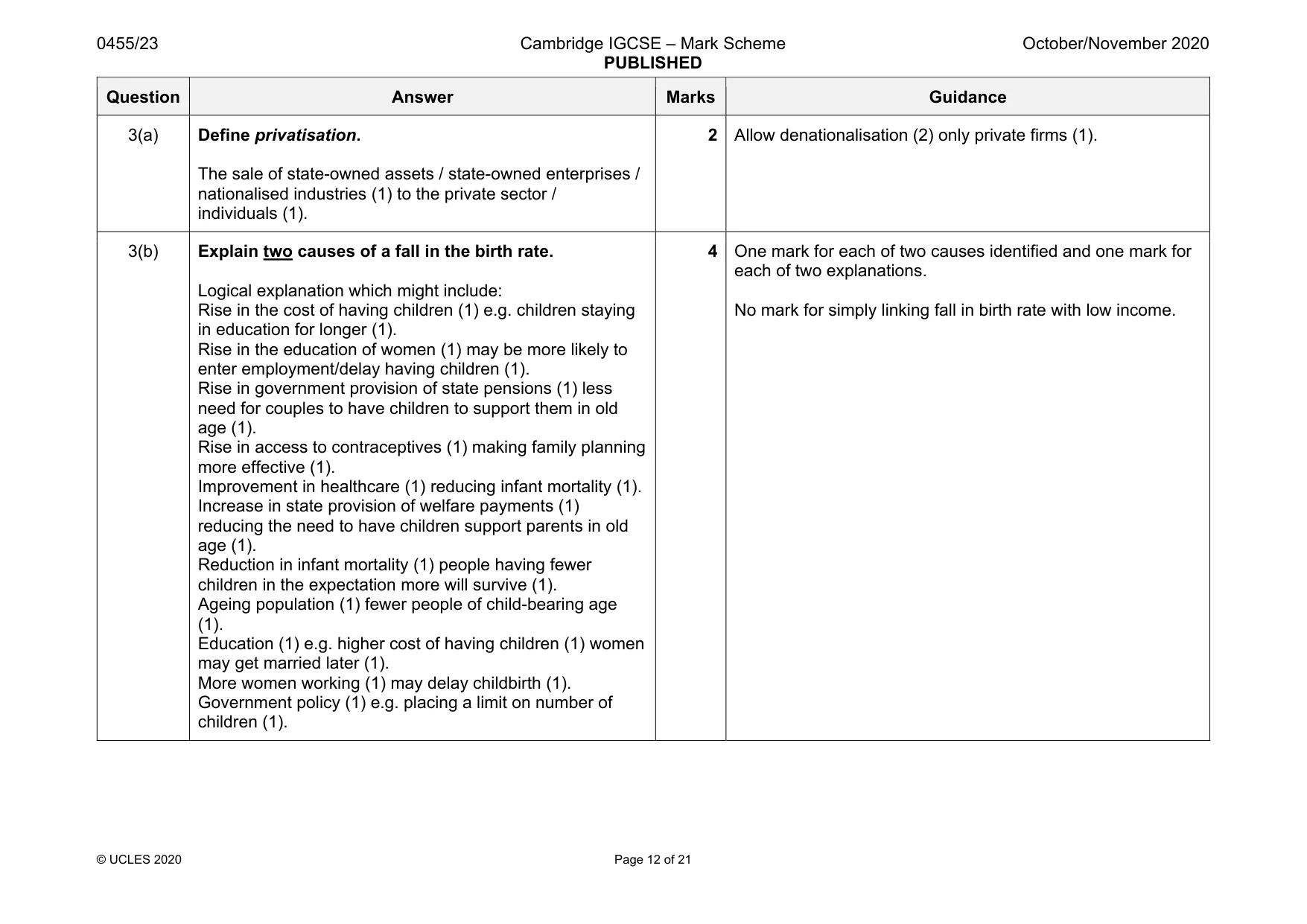
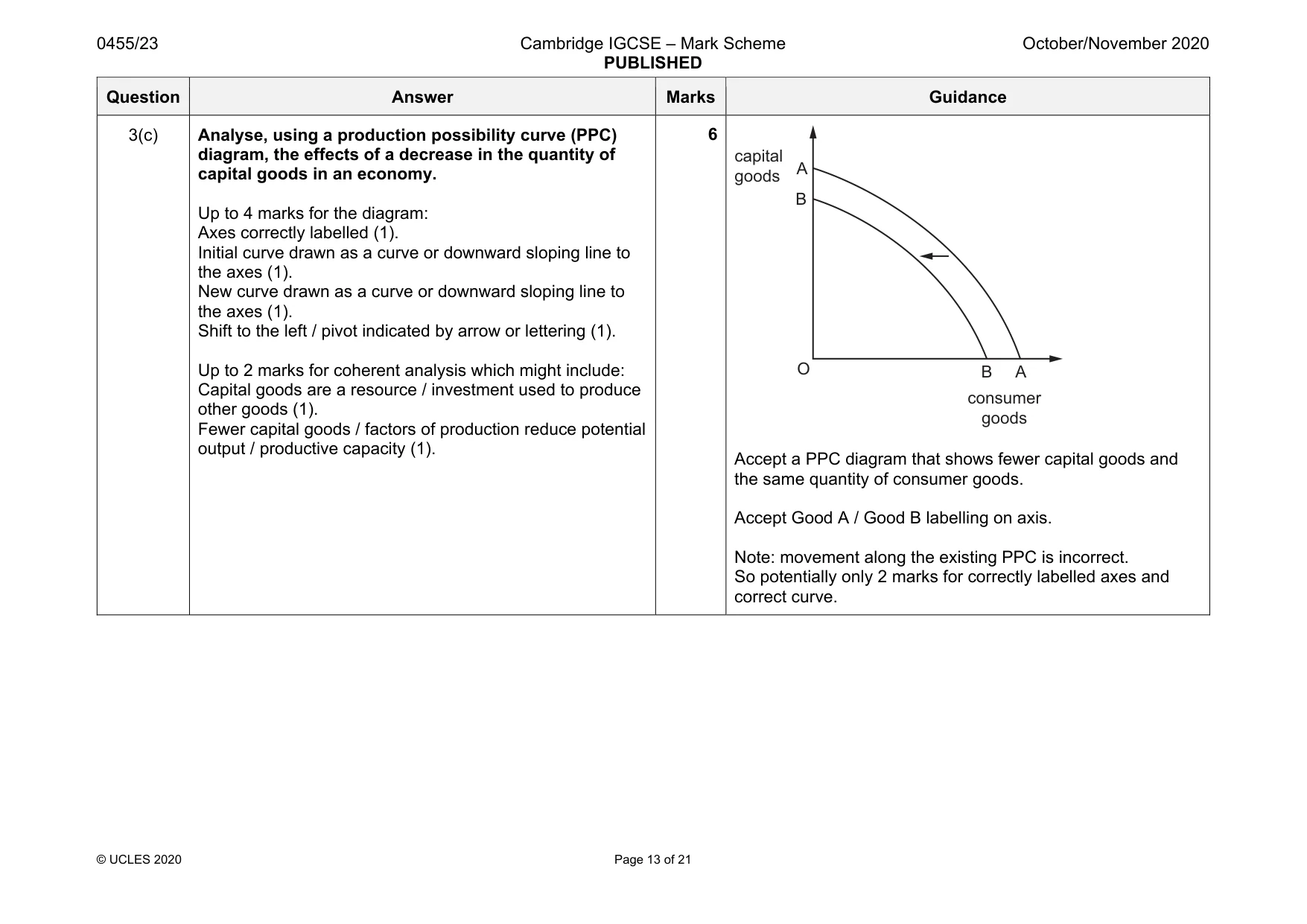
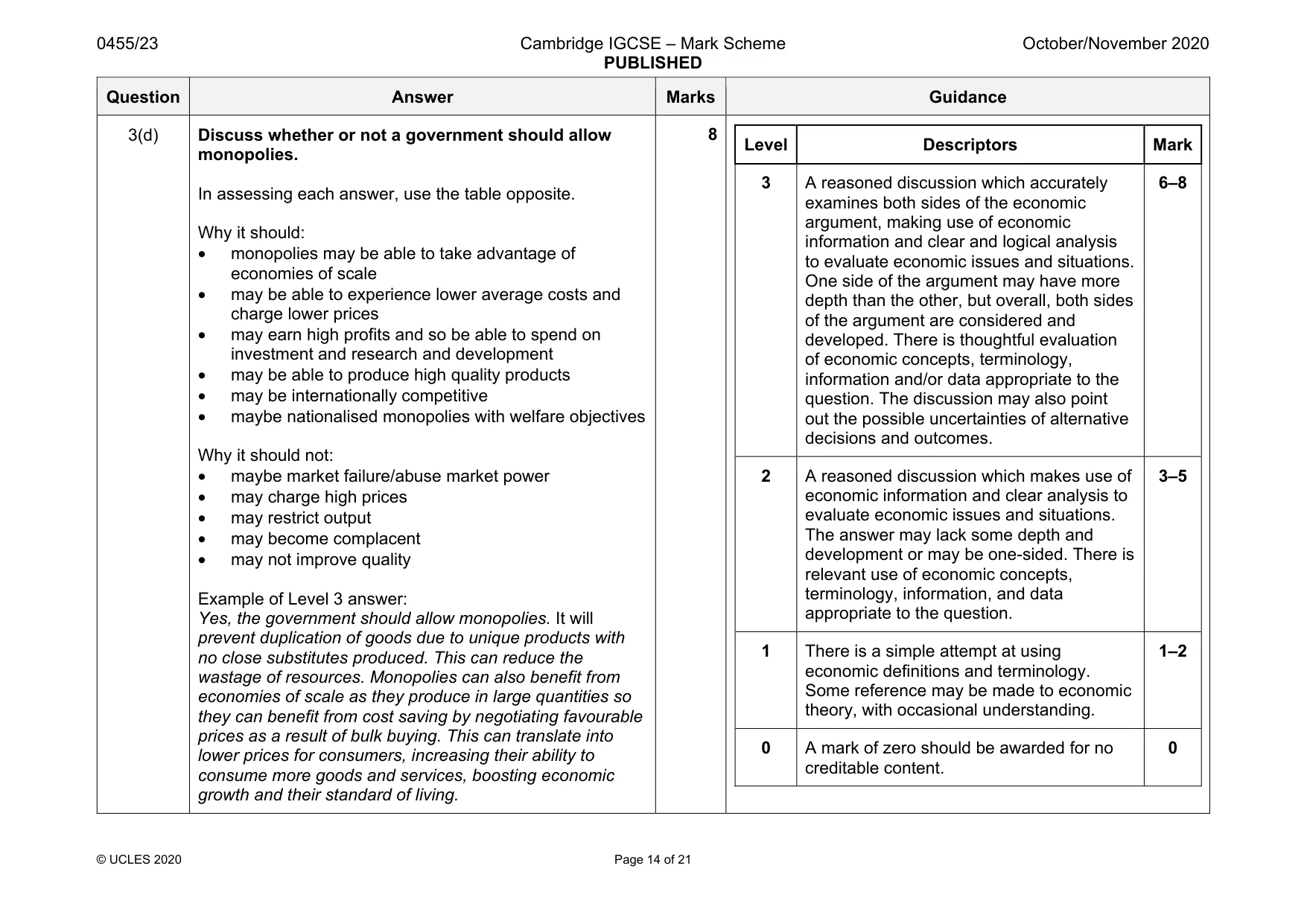
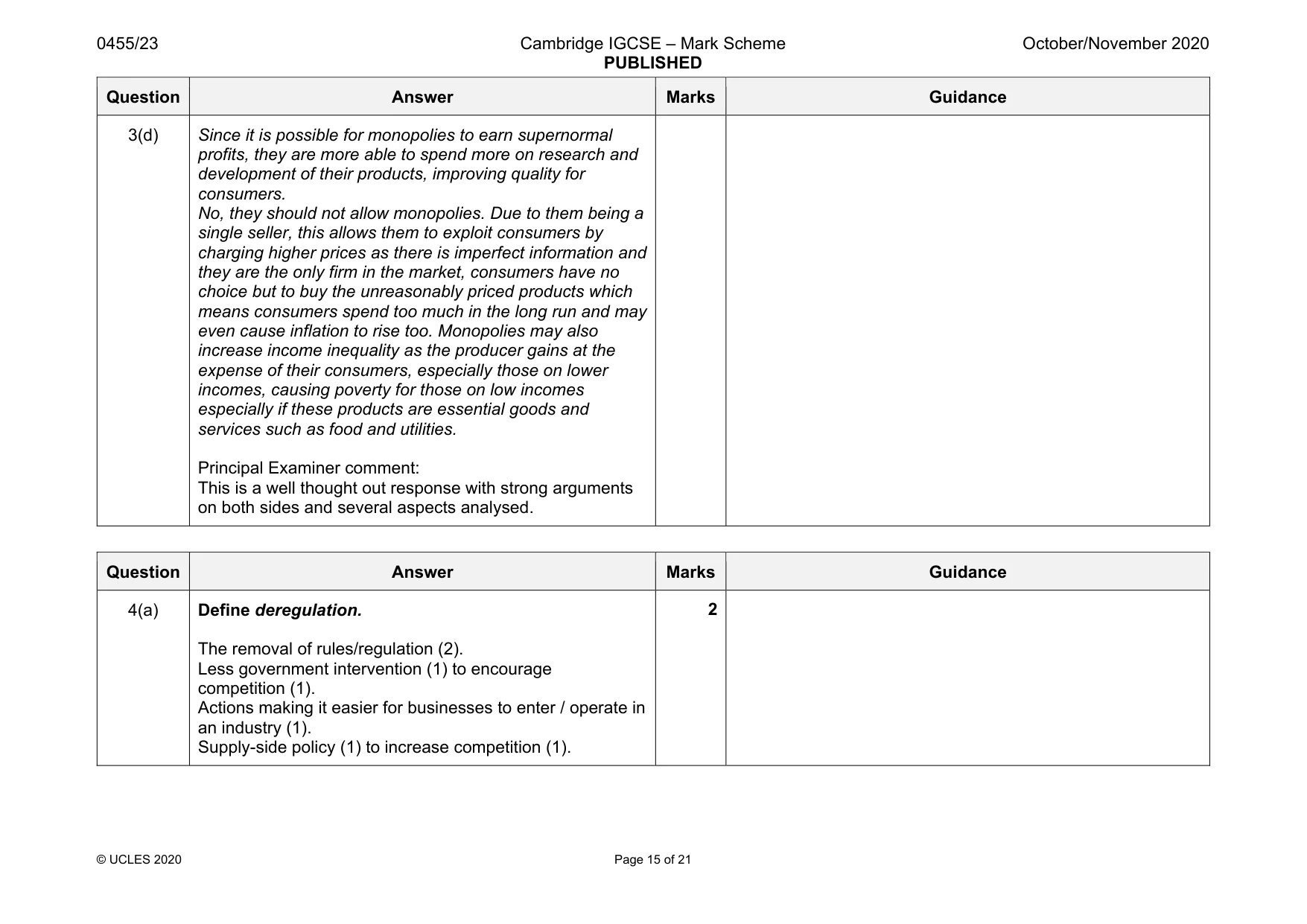
Mark scheme: 3(a) Define privatisation. The sale of state-owned assets / state-owned enterprises / nationalised industries (1) to the private sector / individuals (1). 2 Allow denationalisation (2) only private firms (1). 3(b) Explain two causes of a fall in the birth rate. Logical explanation which might include: Rise in the cost of having children (1) e.g. children staying in education for longer (1). Rise in the education of women (1) may be more likely to enter employment/delay having children (1). Rise in government provision of state pensions (1) less need for couples to have children to support them in old age (1). Rise in access to contraceptives (1) making family planning more effective (1). Improvement in healthcare (1) reducing infant mortality (1). Increase in state provision of welfare payments (1) reducing the need to have children support parents in old age (1). Reduction in infant mortality (1) people having fewer children in the expectation more will survive (1). Ageing population (1) fewer people of child-bearing age (1). Education (1) e.g. higher cost of having children (1) women may get married later (1). More women working (1) may delay childbirth (1). Government policy (1) e.g. placing a limit on number of children (1). 4 One mark for each of two causes identified and one mark for each of two explanations. No mark for simply linking fall in birth rate with low income. Question Answer Marks Guidance 3(c) Analyse, using a production possibility curve (PPC) diagram, the effects of a decrease in the quantity of capital goods in an economy. Up to 4 marks for the diagram: Axes correctly labelled (1). Initial curve drawn as a curve or downward sloping line to the axes (1). New curve drawn as a curve or downward sloping line to the axes (1). Shift to the left / pivot indicated by arrow or lettering (1). Up to 2 marks for coherent analysis which might include: Capital goods are a resource / investment used to produce other goods (1). Fewer capital goods / factors of production reduce potential output / productive capacity (1). 6 Accept a PPC diagram that shows fewer capital goods and the same quantity of consumer goods. Accept Good A / Good B labelling on axis. Note: movement along the existing PPC is incorrect. So potentially only 2 marks for correctly labelled axes and correct curve. A B capital goods O B A consumer goods Question Answer Marks Guidance 3(d) Discuss whether or not a government should allow monopolies. In assessing each answer, use the table opposite. Why it should: • monopolies may be able to take advantage of economies of scale • may be able to experience lower average costs and charge lower prices • may earn high profits and so be able to spend on investment and research and development • may be able to produce high quality products • may be internationally competitive • maybe nationalised monopolies with welfare objectives Why it should not: • maybe market failure/abuse market power • may charge high prices • may restrict output • may become complacent • may not improve quality Example of Level 3 answer: Yes, the government should allow monopolies. It will prevent duplication of goods due to unique products with no close substitutes produced. This can reduce the wastage of resources. Monopolies can also benefit from economies of scale as they produce in large quantities so they can benefit from cost saving by negotiating favourable prices as a result of bulk buying. This can translate into lower prices for consumers, increasing their ability to consume more goods and services, boosting economic growth and their standard of living. 8 Level Descriptors Mark 3 A reasoned discussion which accurately examines both sides of the economic argument, making use of economic information and clear and logical analysis to evaluate economic issues and situations. One side of the argument may have more depth than the other, but overall, both sides of the argument are considered and developed. There is thoughtful evaluation of economic concepts, terminology, information and/or data appropriate to the question. The discussion may also point out the possible uncertainties of alternative decisions and outcomes. 6–8 2 A reasoned discussion which makes use of economic information and clear analysis to evaluate economic issues and situations. The answer may lack some depth and development or may be one-sided. There is relevant use of economic concepts, terminology, information, and data appropriate to the question. 3–5 1 There is a simple attempt at using economic definitions and terminology. Some reference may be made to economic theory, with occasional understanding. 1–2 0 A mark of zero should be awarded for no creditable content. 0 Question Answer Marks Guidance 3(d) Since it is possible for monopolies to earn supernormal profits, they are more able to spend more on research and development of their products, improving quality for consumers. No, they should not allow monopolies. Due to them being a single seller, this allows them to exploit consumers by charging higher prices as there is imperfect information and they are the only firm in the market, consumers have no choice but to buy the unreasonably priced products which means consumers spend too much in the long run and may even cause inflation to rise too. Monopolies may also increase income inequality as the producer gains at the expense of their consumers, especially those on lower incomes, causing poverty for those on low incomes especially if these products are essential goods and services such as food and utilities. Principal Examiner comment: This is a well thought out response with strong arguments on both sides and several aspects analysed.
Q4 · The use of supply-side policy measures, including deregulation, is moving China closer to…
4 The use of supply-side policy measures, including deregulation, is moving China closer to a market economic system. Some supply-side policy measures, such as education and subsidies, can also increase a country’s economic growth rate. China joined the World Trade Organisation in 2001 and has since removed some quotas on imports and reduced some import tariffs. These measures may influence the size of its current account surplus. (a) Define deregulation. [2] (b) Explain two benefits consumers may gain from a market economic system. [4] (c) Analyse how education and subsidies can increase a country’s economic growth rate. [6] (d) Discuss whether or not a reduction in a country’s trade protection will reduce its current account surplus. [8]
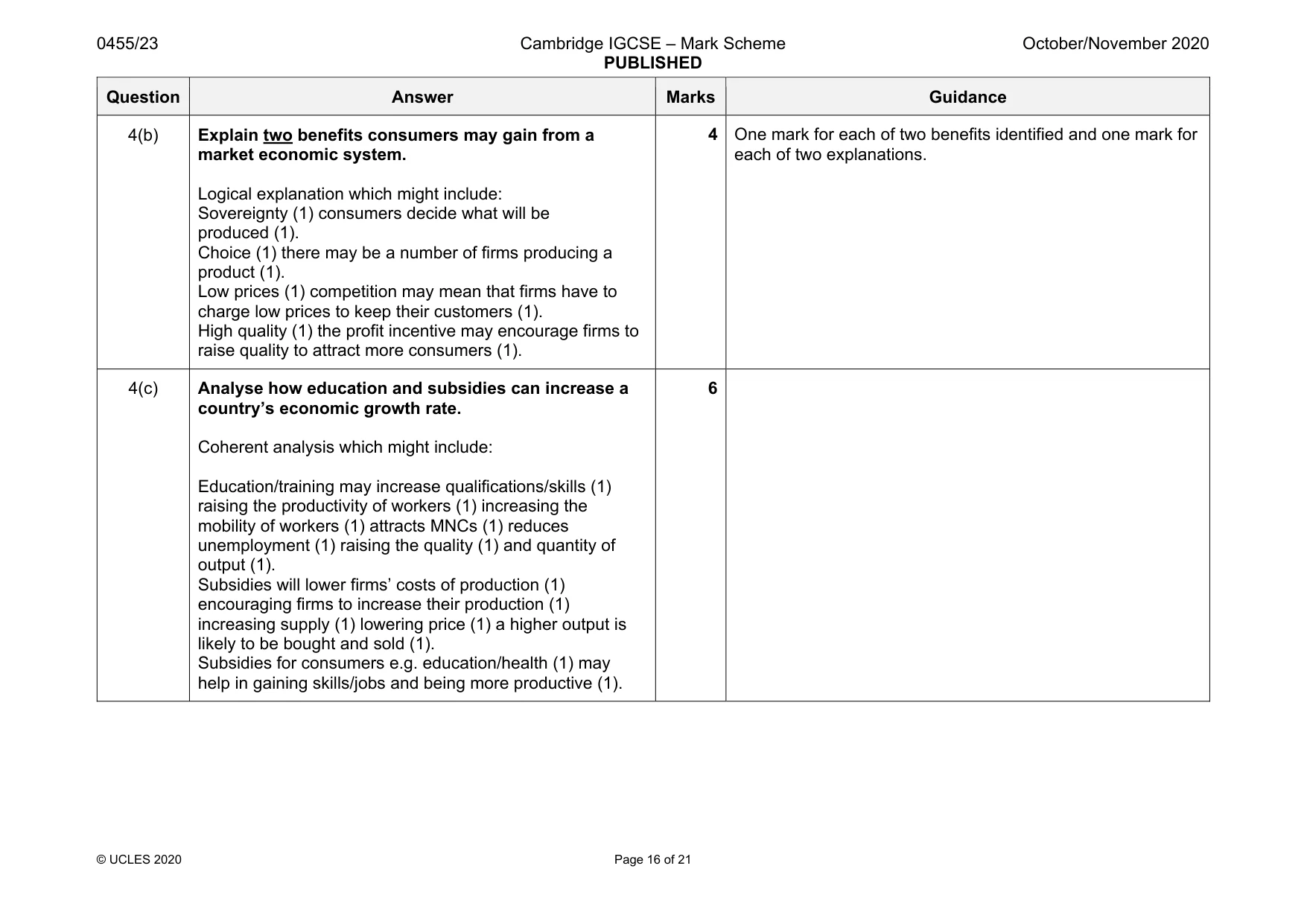
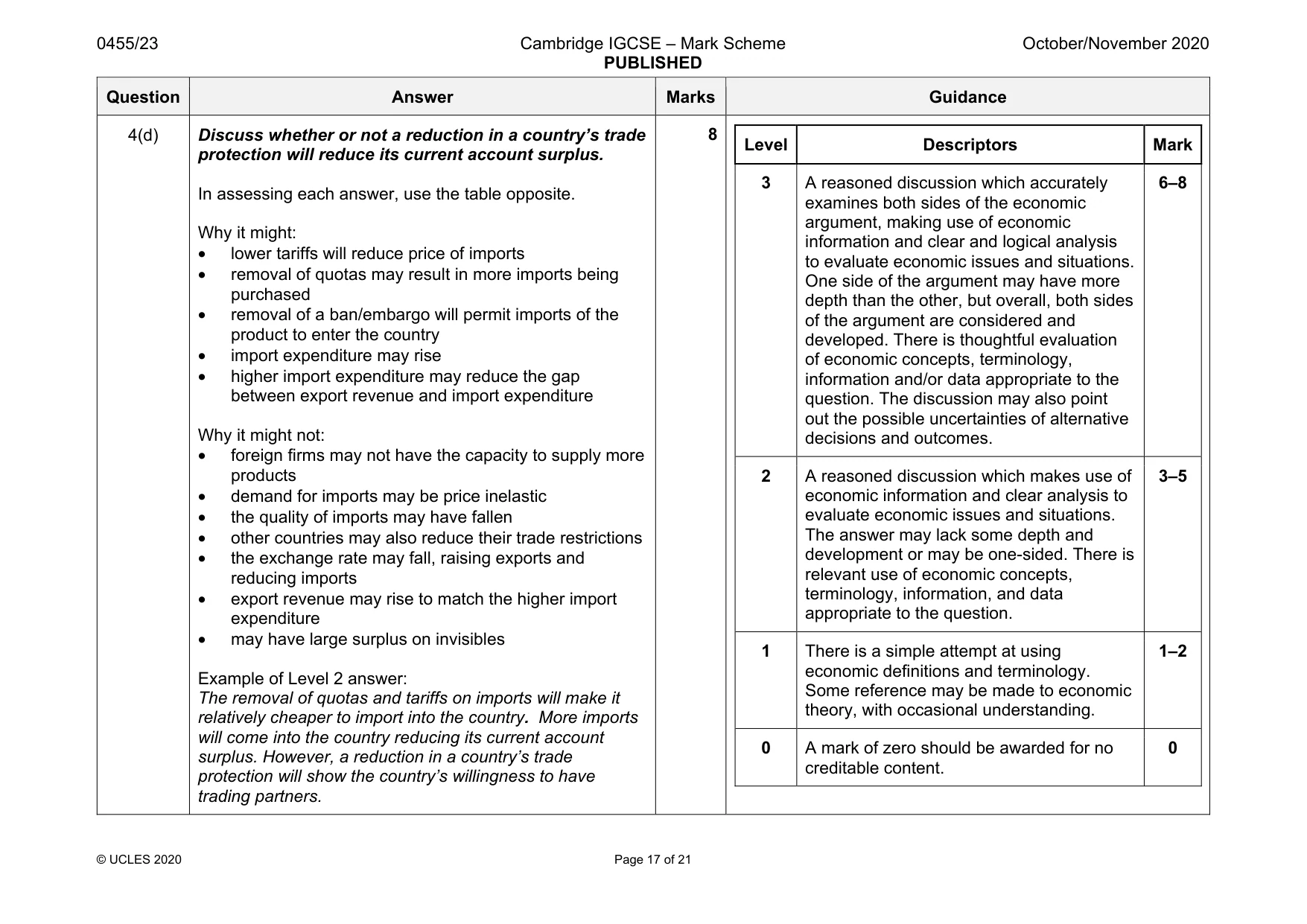
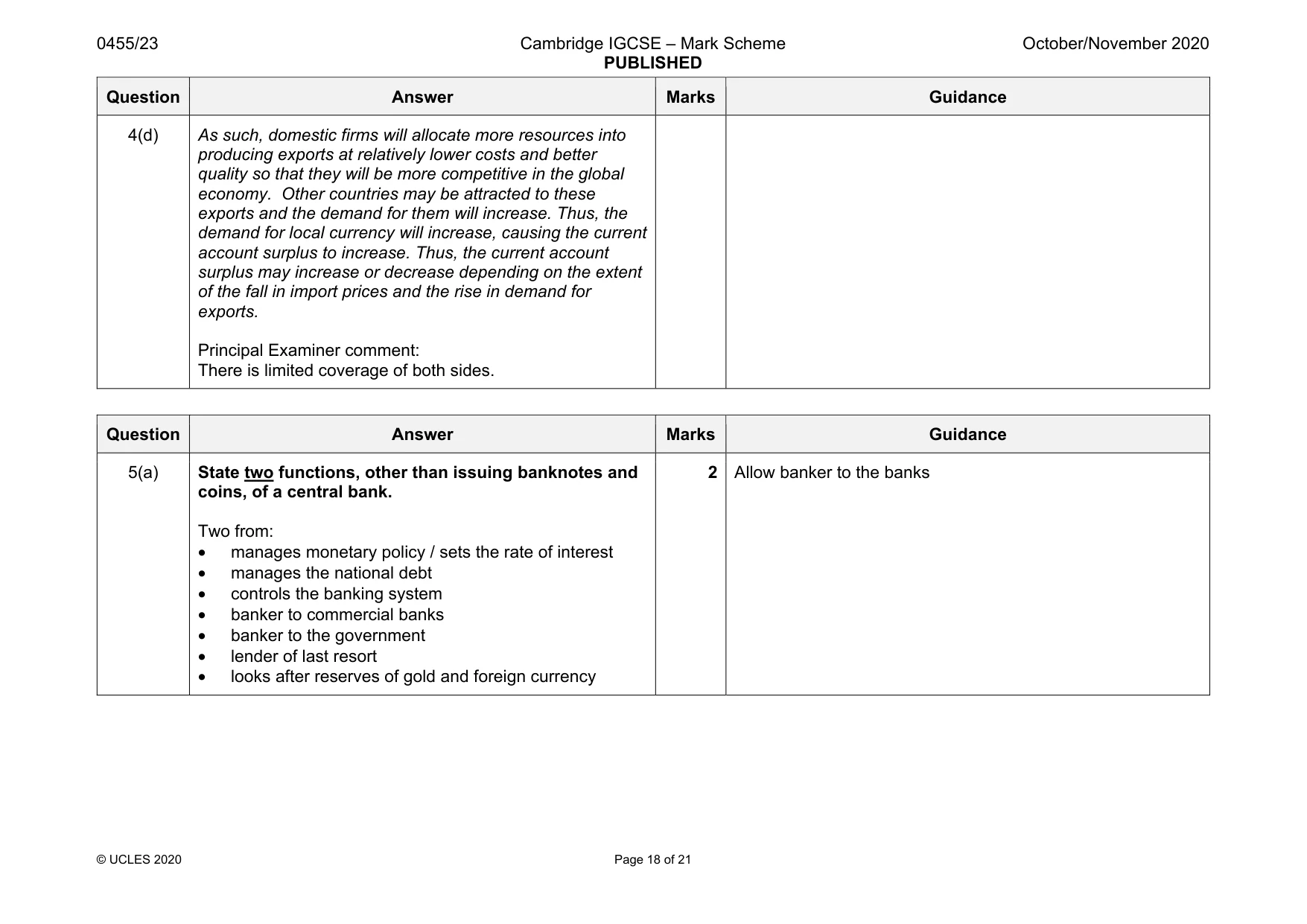
Mark scheme: 4(a) Define deregulation. The removal of rules/regulation (2). Less government intervention (1) to encourage competition (1). Actions making it easier for businesses to enter / operate in an industry (1). Supply-side policy (1) to increase competition (1). Question Answer Marks Guidance 4(b) Explain two benefits consumers may gain from a market economic system. Logical explanation which might include: Sovereignty (1) consumers decide what will be produced (1). Choice (1) there may be a number of firms producing a product (1). Low prices (1) competition may mean that firms have to charge low prices to keep their customers (1). High quality (1) the profit incentive may encourage firms to raise quality to attract more consumers (1). 4 One mark for each of two benefits identified and one mark for each of two explanations. 4(c) Analyse how education and subsidies can increase a country’s economic growth rate. Coherent analysis which might include: Education/training may increase qualifications/skills (1) raising the productivity of workers (1) increasing the mobility of workers (1) attracts MNCs (1) reduces unemployment (1) raising the quality (1) and quantity of output (1). Subsidies will lower firms’ costs of production (1) encouraging firms to increase their production (1) increasing supply (1) lowering price (1) a higher output is likely to be bought and sold (1). Subsidies for consumers e.g. education/health (1) may help in gaining skills/jobs and being more productive (1). 6 Question Answer Marks Guidance 4(d) Discuss whether or not a reduction in a country’s trade protection will reduce its current account surplus. In assessing each answer, use the table opposite. Why it might: • lower tariffs will reduce price of imports • removal of quotas may result in more imports being purchased • removal of a ban/embargo will permit imports of the product to enter the country • import expenditure may rise • higher import expenditure may reduce the gap between export revenue and import expenditure Why it might not: • foreign firms may not have the capacity to supply more products • demand for imports may be price inelastic • the quality of imports may have fallen • other countries may also reduce their trade restrictions • the exchange rate may fall, raising exports and reducing imports • export revenue may rise to match the higher import expenditure • may have large surplus on invisibles Example of Level 2 answer: The removal of quotas and tariffs on imports will make it relatively cheaper to import into the country. More imports will come into the country reducing its current account surplus. However, a reduction in a country’s trade protection will show the country’s willingness to have trading partners. 8 Level Descriptors Mark 3 A reasoned discussion which accurately examines both sides of the economic argument, making use of economic information and clear and logical analysis to evaluate economic issues and situations. One side of the argument may have more depth than the other, but overall, both sides of the argument are considered and developed. There is thoughtful evaluation of economic concepts, terminology, information and/or data appropriate to the question. The discussion may also point out the possible uncertainties of alternative decisions and outcomes. 6–8 2 A reasoned discussion which makes use of economic information and clear analysis to evaluate economic issues and situations. The answer may lack some depth and development or may be one-sided. There is relevant use of economic concepts, terminology, information, and data appropriate to the question. 3–5 1 There is a simple attempt at using economic definitions and terminology. Some reference may be made to economic theory, with occasional understanding. 1–2 0 A mark of zero should be awarded for no creditable content. 0 Question Answer Marks Guidance 4(d) As such, domestic firms will allocate more resources into producing exports at relatively lower costs and better quality so that they will be more competitive in the global economy. Other countries may be attracted to these exports and the demand for them will increase. Thus, the demand for local currency will increase, causing the current account surplus to increase. Thus, the current account surplus may increase or decrease depending on the extent of the fall in import prices and the rise in demand for exports. Principal Examiner comment: There is limited coverage of both sides.
Q5 · It was announced in November 2016 that 500 and 1000 rupee banknotes could no longer be…
5 It was announced in November 2016 that 500 and 1000 rupee banknotes could no longer be used in shops in India. These were replaced by the central bank, an institution that makes extensive use of division of labour. In India, cash is still an important form of money used in economic transactions. The replacement of banknotes put pressure on banking staff and other workers in the tertiary sector, and affected the general price level. (a) State two functions, other than issuing banknotes and coins, of a central bank. [2] (b) Explain two reasons why workers in the tertiary sector may be paid more than workers in the primary sector. [4] (c) Analyse the advantages for firms of using division of labour. [6] (d) Discuss whether or not deflation will benefit an economy. [8]
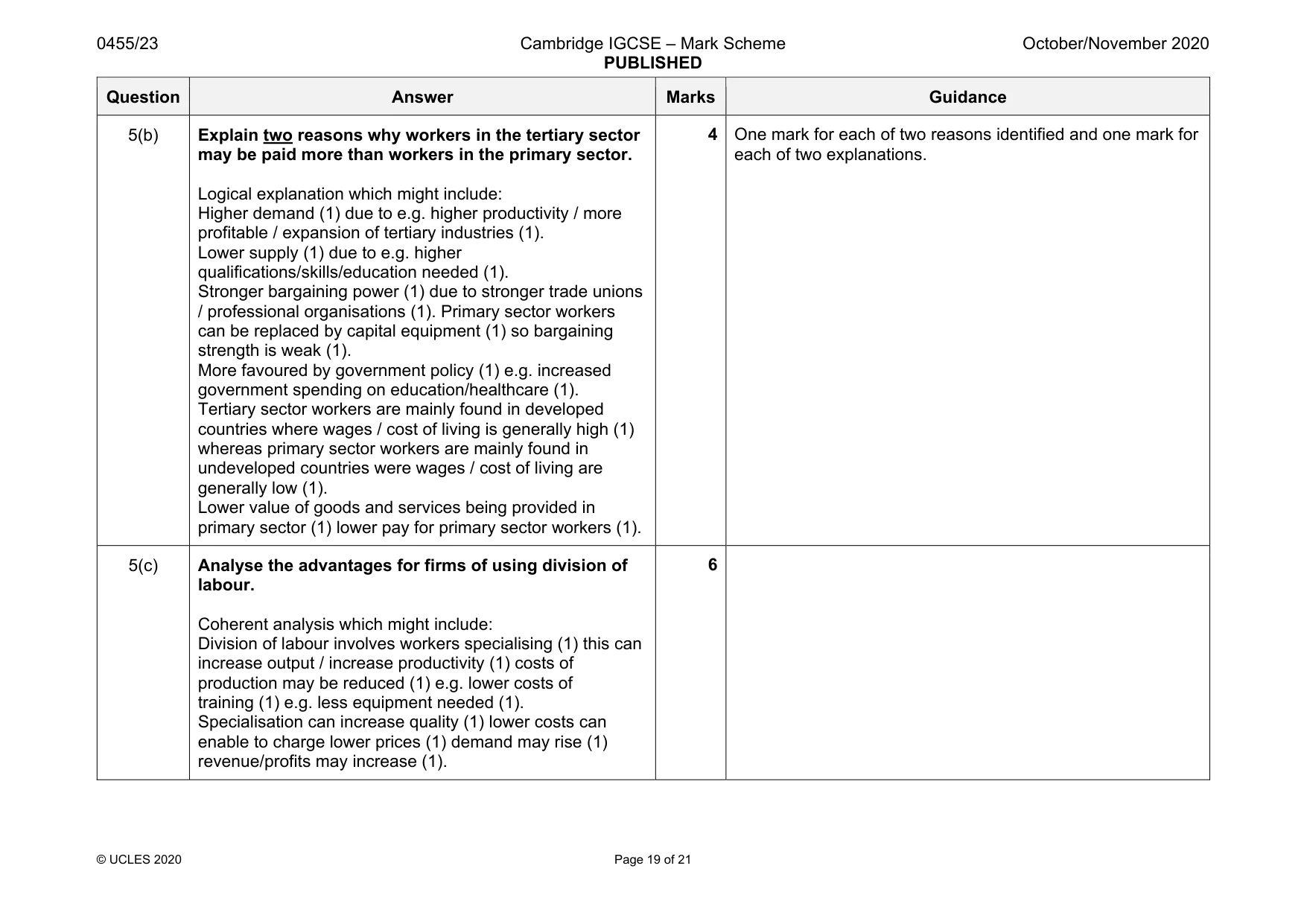
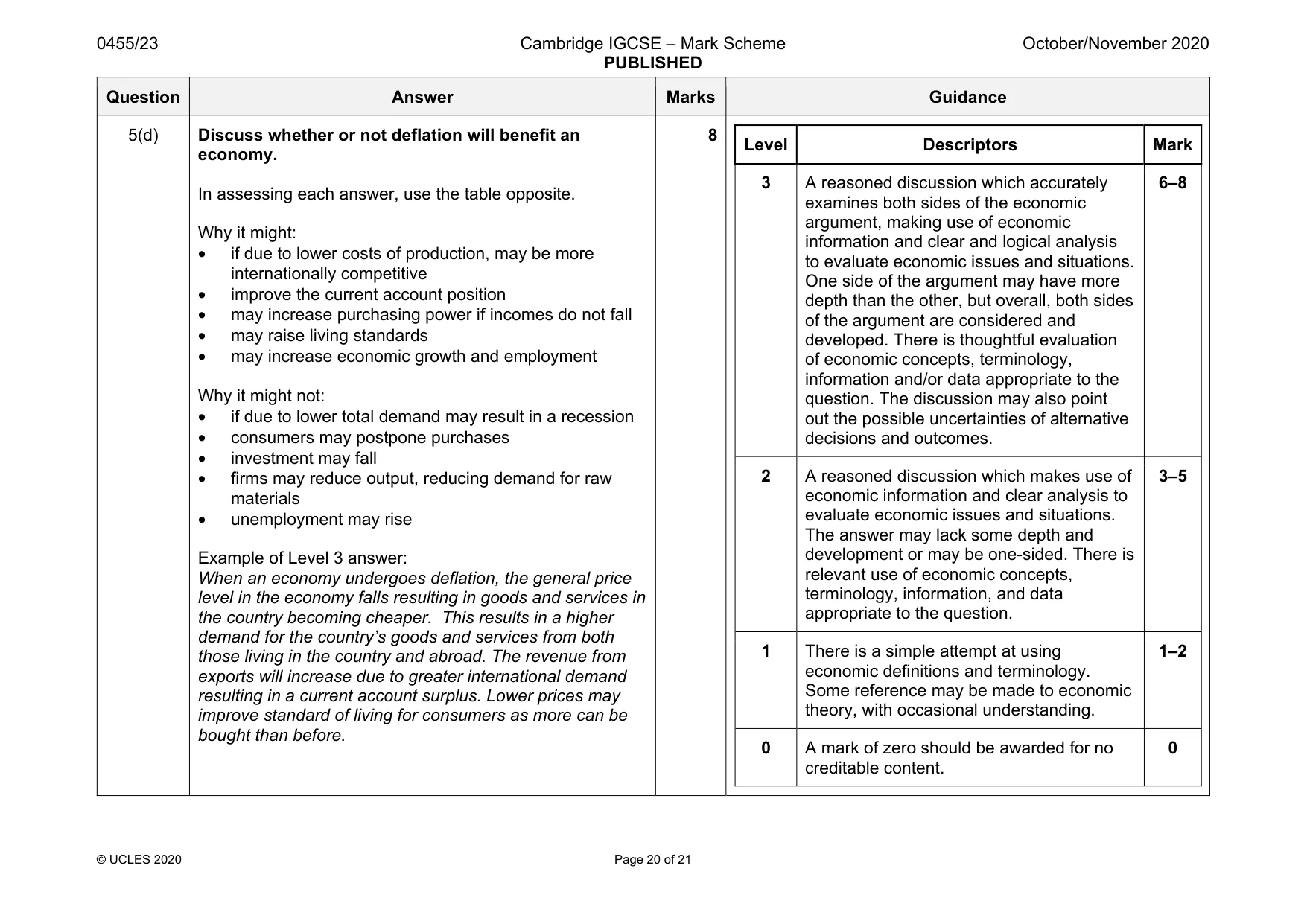
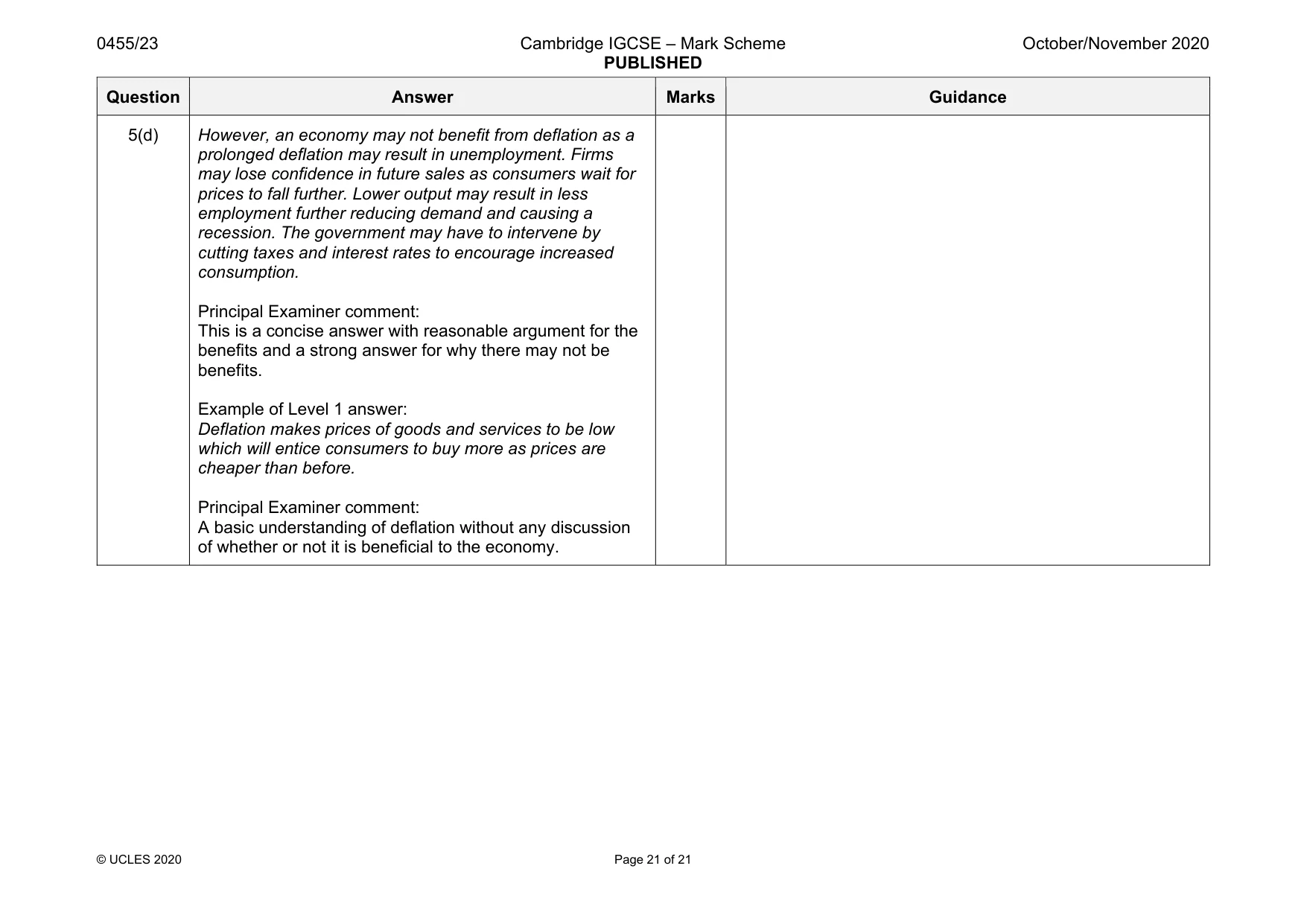
Mark scheme: 5(a) State two functions, other than issuing banknotes and coins, of a central bank. Two from: • manages monetary policy / sets the rate of interest • manages the national debt • controls the banking system • banker to commercial banks • banker to the government • lender of last resort • looks after reserves of gold and foreign currency 2 Allow banker to the banks Question Answer Marks Guidance 5(b) Explain two reasons why workers in the tertiary sector may be paid more than workers in the primary sector. Logical explanation which might include: Higher demand (1) due to e.g. higher productivity / more profitable / expansion of tertiary industries (1). Lower supply (1) due to e.g. higher qualifications/skills/education needed (1). Stronger bargaining power (1) due to stronger trade unions / professional organisations (1). Primary sector workers can be replaced by capital equipment (1) so bargaining strength is weak (1). More favoured by government policy (1) e.g. increased government spending on education/healthcare (1). Tertiary sector workers are mainly found in developed countries where wages / cost of living is generally high (1) whereas primary sector workers are mainly found in undeveloped countries were wages / cost of living are generally low (1). Lower value of goods and services being provided in primary sector (1) lower pay for primary sector workers (1). 4 One mark for each of two reasons identified and one mark for each of two explanations. 5(c) Analyse the advantages for firms of using division of labour. Coherent analysis which might include: Division of labour involves workers specialising (1) this can increase output / increase productivity (1) costs of production may be reduced (1) e.g. lower costs of training (1) e.g. less equipment needed (1). Specialisation can increase quality (1) lower costs can enable to charge lower prices (1) demand may rise (1) revenue/profits may increase (1). 6 Question Answer Marks Guidance 5(d) Discuss whether or not deflation will benefit an economy. In assessing each answer, use the table opposite. Why it might: • if due to lower costs of production, may be more internationally competitive • improve the current account position • may increase purchasing power if incomes do not fall • may raise living standards • may increase economic growth and employment Why it might not: • if due to lower total demand may result in a recession • consumers may postpone purchases • investment may fall • firms may reduce output, reducing demand for raw materials • unemployment may rise Example of Level 3 answer: When an economy undergoes deflation, the general price level in the economy falls resulting in goods and services in the country becoming cheaper. This results in a higher demand for the country’s goods and services from both those living in the country and abroad. The revenue from exports will increase due to greater international demand resulting in a current account surplus. Lower prices may improve standard of living for consumers as more can be bought than before. 8 Level Descriptors Mark 3 A reasoned discussion which accurately examines both sides of the economic argument, making use of economic information and clear and logical analysis to evaluate economic issues and situations. One side of the argument may have more depth than the other, but overall, both sides of the argument are considered and developed. There is thoughtful evaluation of economic concepts, terminology, information and/or data appropriate to the question. The discussion may also point out the possible uncertainties of alternative decisions and outcomes. 6–8 2 A reasoned discussion which makes use of economic information and clear analysis to evaluate economic issues and situations. The answer may lack some depth and development or may be one-sided. There is relevant use of economic concepts, terminology, information, and data appropriate to the question. 3–5 1 There is a simple attempt at using economic definitions and terminology. Some reference may be made to economic theory, with occasional understanding. 1–2 0 A mark of zero should be awarded for no creditable content. 0 Question Answer Marks Guidance 5(d) However, an economy may not benefit from deflation as a prolonged deflation may result in unemployment. Firms may lose confidence in future sales as consumers wait for prices to fall further. Lower output may result in less employment further reducing demand and causing a recession. The government may have to intervene by cutting taxes and interest rates to encourage increased consumption. Principal Examiner comment: This is a concise answer with reasonable argument for the benefits and a strong answer for why there may not be benefits. Example of Level 1 answer: Deflation makes prices of goods and services to be low which will entice consumers to buy more as prices are cheaper than before. Principal Examiner comment: A basic understanding of deflation without any discussion of whether or not it is beneficial to the economy.
What was in this paper
The subtopics covered by these 5 questions, and how many questions each got. Open one in a new tab to see every Cambridge question on it.
What you needed in this session
Cambridge’s own grade thresholds for 2020 Oct/Nov, Paper 2 · Variant 3. A higher threshold means an easier paper — the bar moves with how the cohort did.