Cambridge IGCSE Economics 0455 — 2019 May/June Paper 2 · Variant 3
0455/23/M/J/19 · 7 questions · 90 marks · ≈101 min
The question paper and its mark scheme, free to read here and free to download. This is Cambridge’s own paper, exactly as it was sat.
Question paper8 pages
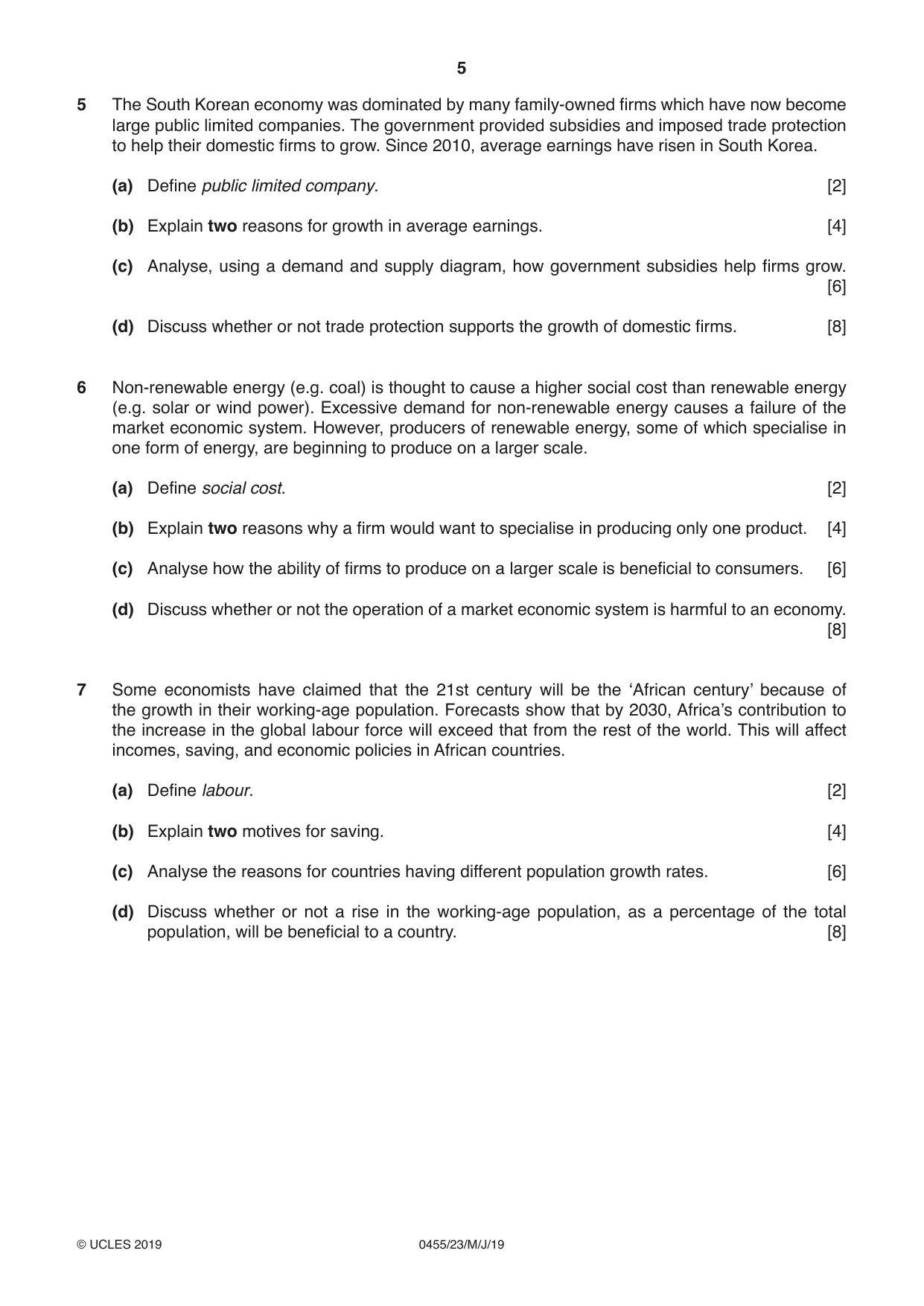



Mark scheme17 pages
Answers below. Sit the paper first if you are practising.
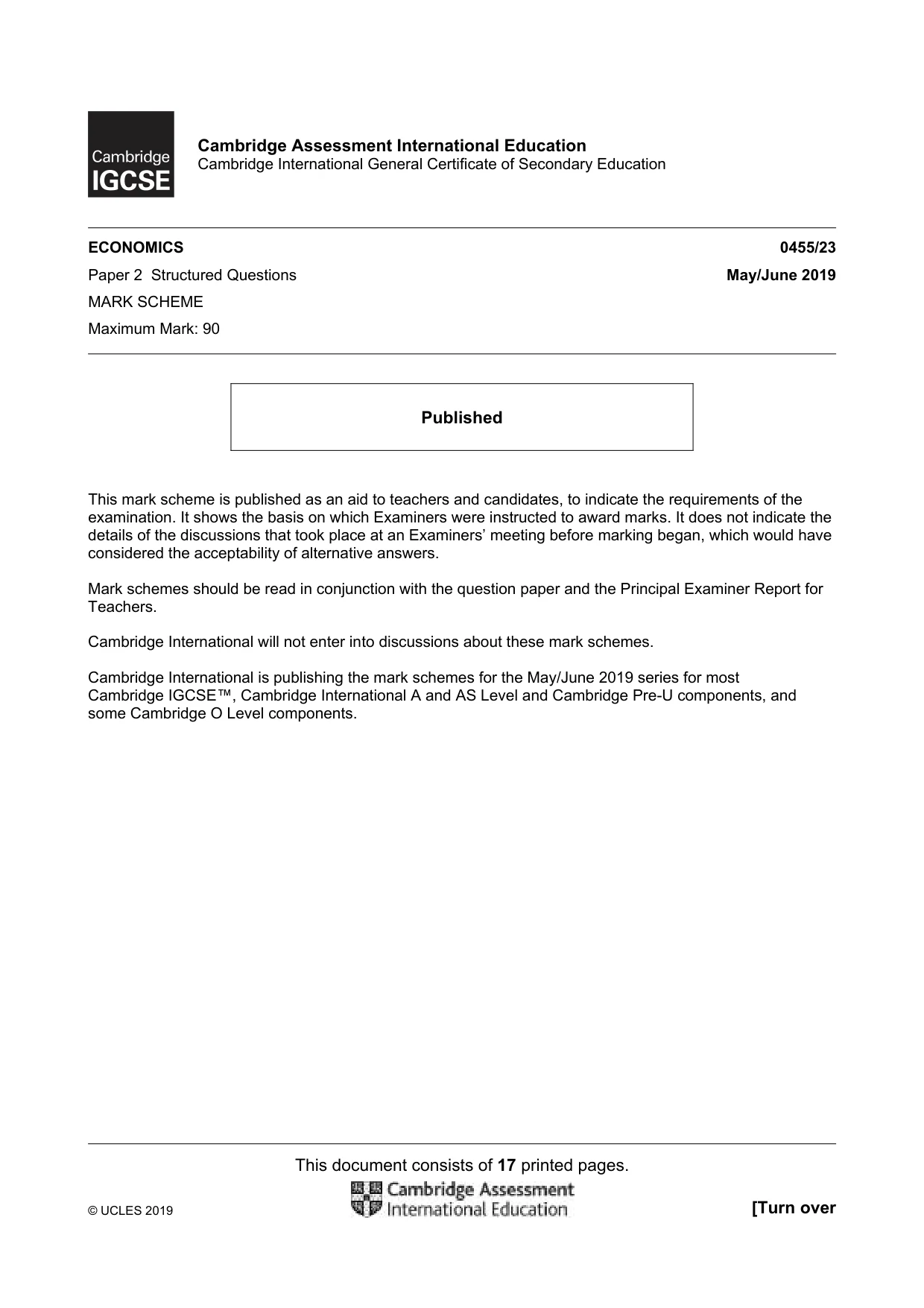
Questions as text
Q1 · Iceland’s Economic Structure The people of Iceland once depended on farming and fishing…
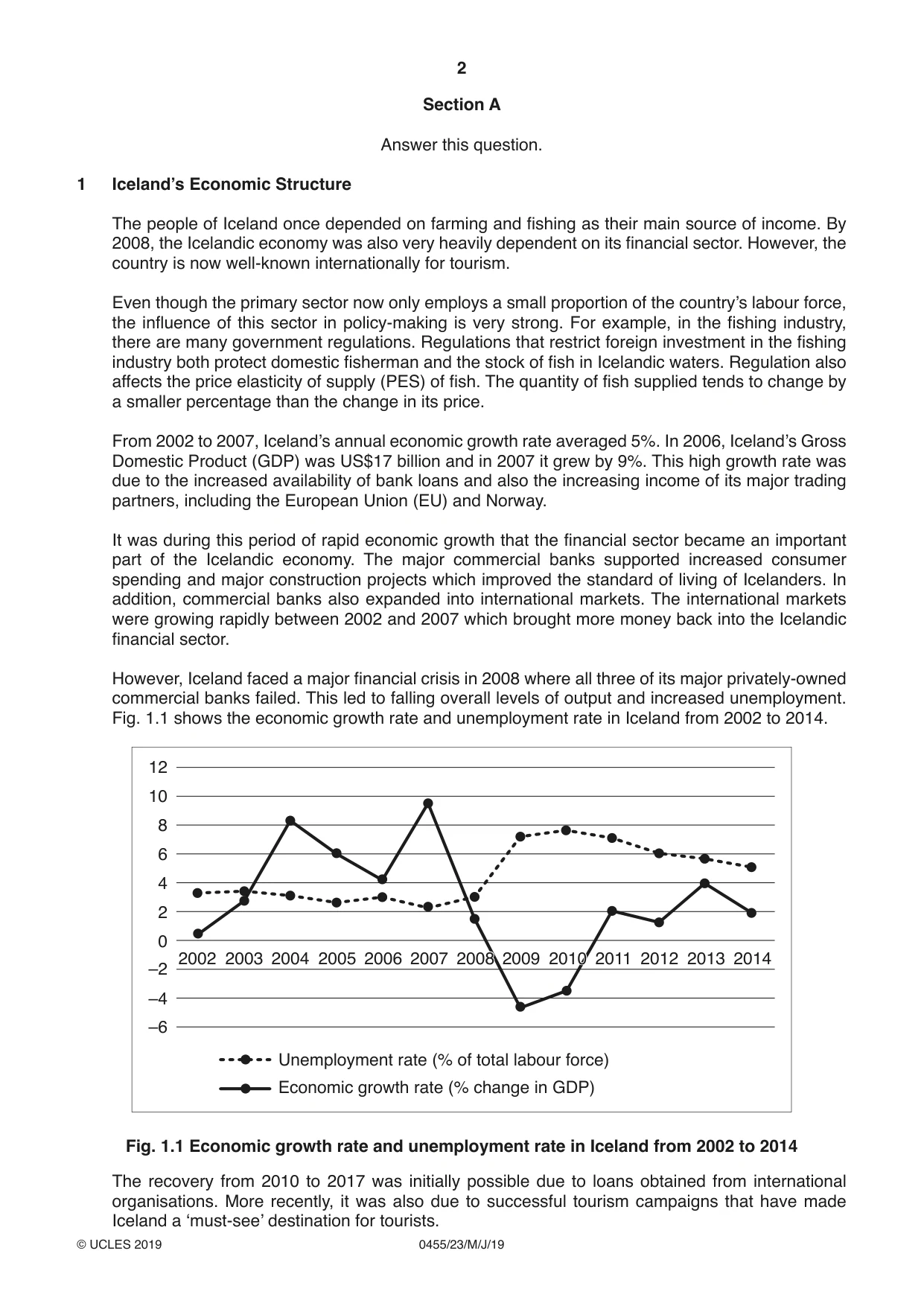
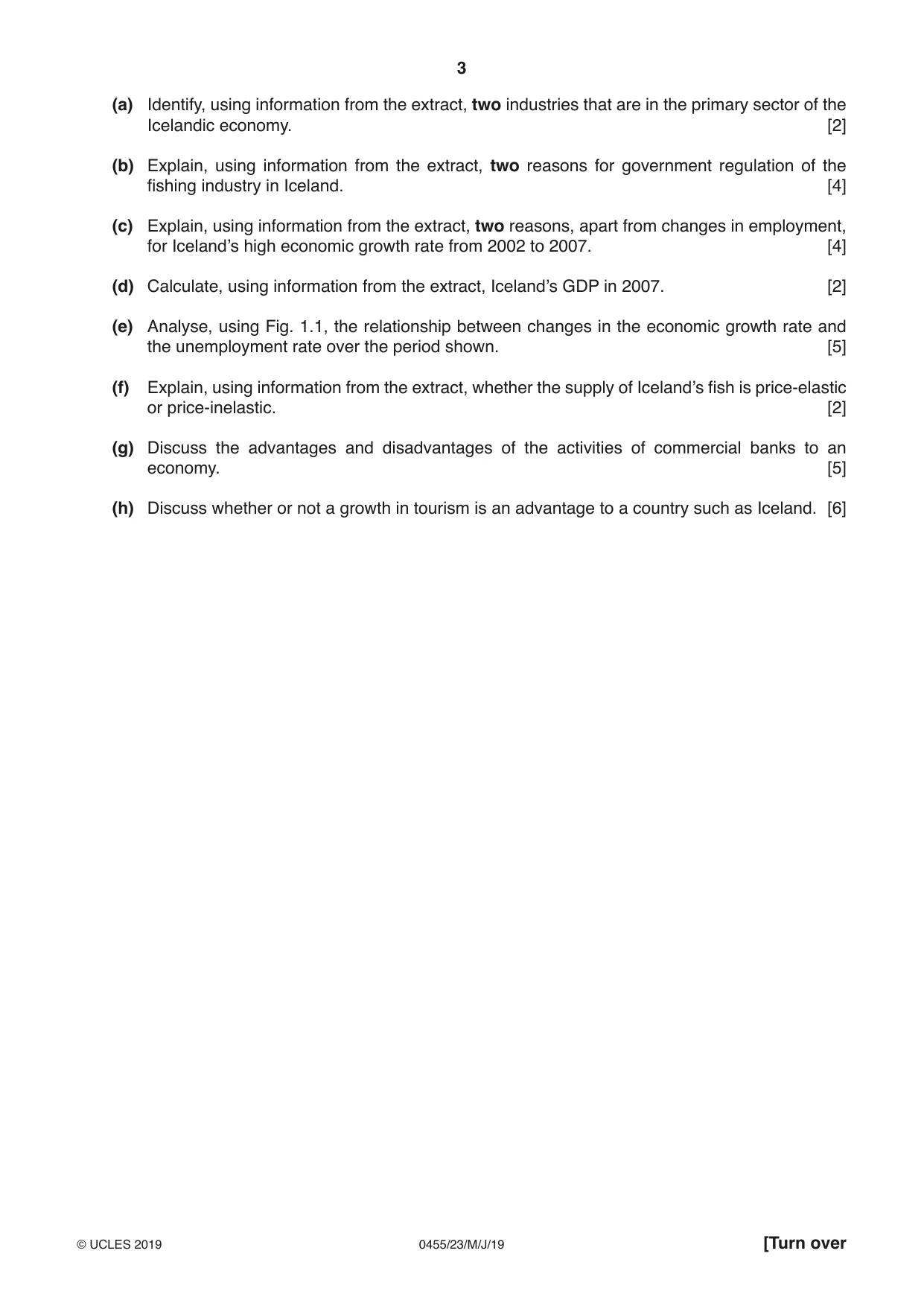
1 Iceland’s Economic Structure The people of Iceland once depended on farming and fishing as their main source of income. By 2008, the Icelandic economy was also very heavily dependent on its financial sector. However, the country is now well-known internationally for tourism. Even though the primary sector now only employs a small proportion of the country’s labour force, the influence of this sector in policy-making is very strong. For example, in the fishing industry, there are many government regulations. Regulations that restrict foreign investment in the fishing industry both protect domestic fisherman and the stock of fish in Icelandic waters. Regulation also affects the price elasticity of supply (PES) of fish. The quantity of fish supplied tends to change by a smaller percentage than the change in its price. From 2002 to 2007, Iceland’s annual economic growth rate averaged 5%. In 2006, Iceland’s Gross Domestic Product (GDP) was US$17 billion and in 2007 it grew by 9%. This high growth rate was due to the increased availability of bank loans and also the increasing income of its major trading partners, including the European Union (EU) and Norway. It was during this period of rapid economic growth that the financial sector became an important part of the Icelandic economy. The major commercial banks supported increased consumer spending and major construction projects which improved the standard of living of Icelanders. In addition, commercial banks also expanded into international markets. The international markets were growing rapidly between 2002 and 2007 which brought more money back into the Icelandic financial sector. However, Iceland faced a major financial crisis in 2008 where all three of its major privately-owned commercial banks failed. This led to falling overall levels of output and increased unemployment. Fig. 1.1 shows the economic growth rate and unemployment rate in Iceland from 2002 to 2014. 12 10 8 6 4 2 0 2002 2003 2004 2005 2006 2007 20082008 2009 20102010 2011 2012 2013 2014 –2 –4 –6 Unemployment rate (% of total labour force) Economic growth rate (% change in GDP) Fig. 1.1 Economic growth rate and unemployment rate in Iceland from 2002 to 2014 The recovery from 2010 to 2017 was initially possible due to loans obtained from international organisations. More recently, it was also due to successful tourism campaigns that have made Iceland a ‘must-see’ destination for tourists. (a) Identify, using information from the extract, two industries that are in the primary sector of the Icelandic economy. [2] (b) Explain, using information from the extract, two reasons for government regulation of the fishing industry in Iceland. [4] (c) Explain, using information from the extract, two reasons, apart from changes in employment, for Iceland’s high economic growth rate from 2002 to 2007. [4] (d) Calculate, using information from the extract, Iceland’s GDP in 2007. [2] (e) Analyse, using Fig. 1.1, the relationship between changes in the economic growth rate and the unemployment rate over the period shown. [5] (f) Explain, using information from the extract, whether the supply of Iceland’s fish is price-elastic or price-inelastic. [2] (g) Discuss the advantages and disadvantages of the activities of commercial banks to an economy. [5] (h) Discuss whether or not a growth in tourism is an advantage to a country such as Iceland. [6]
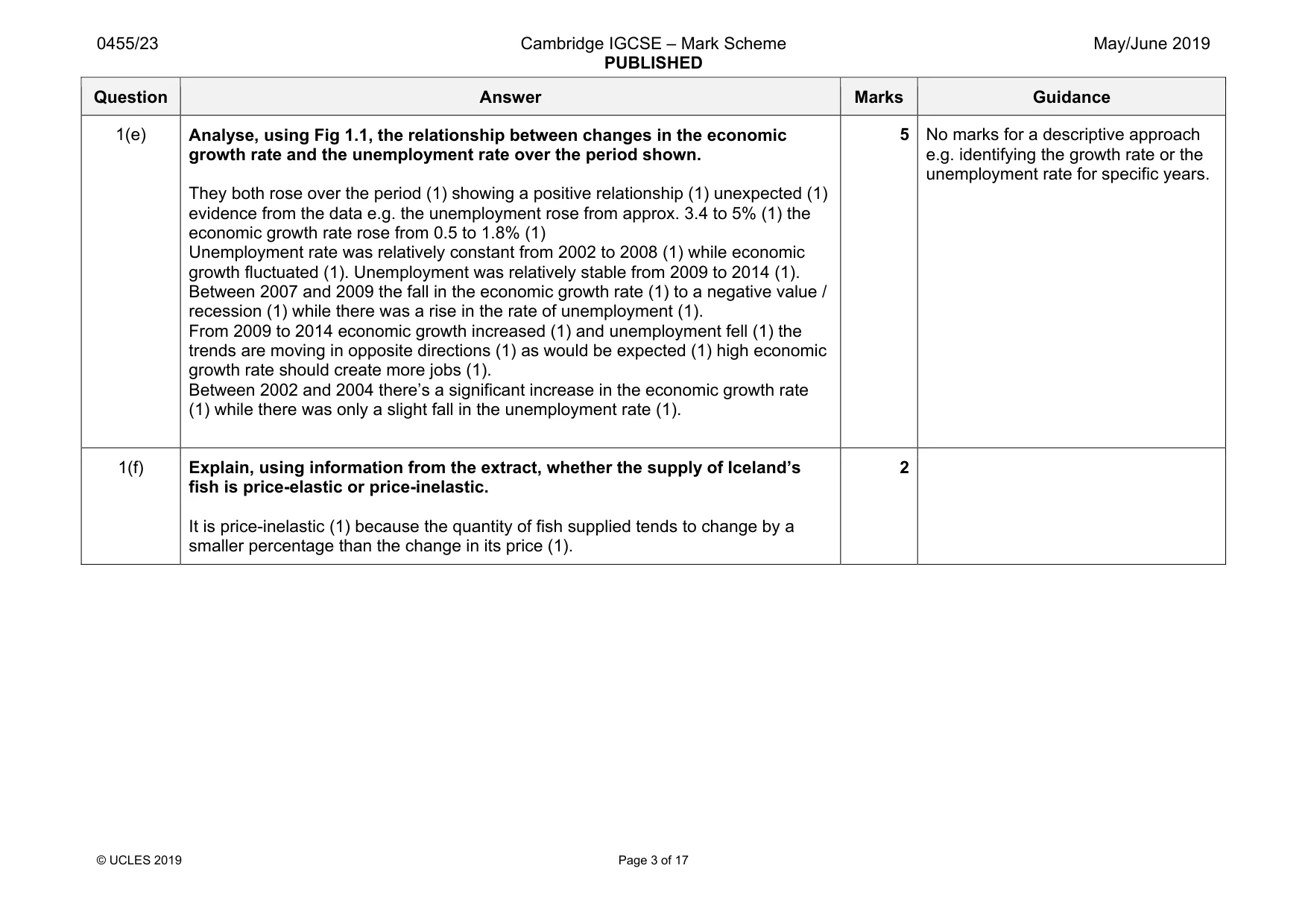
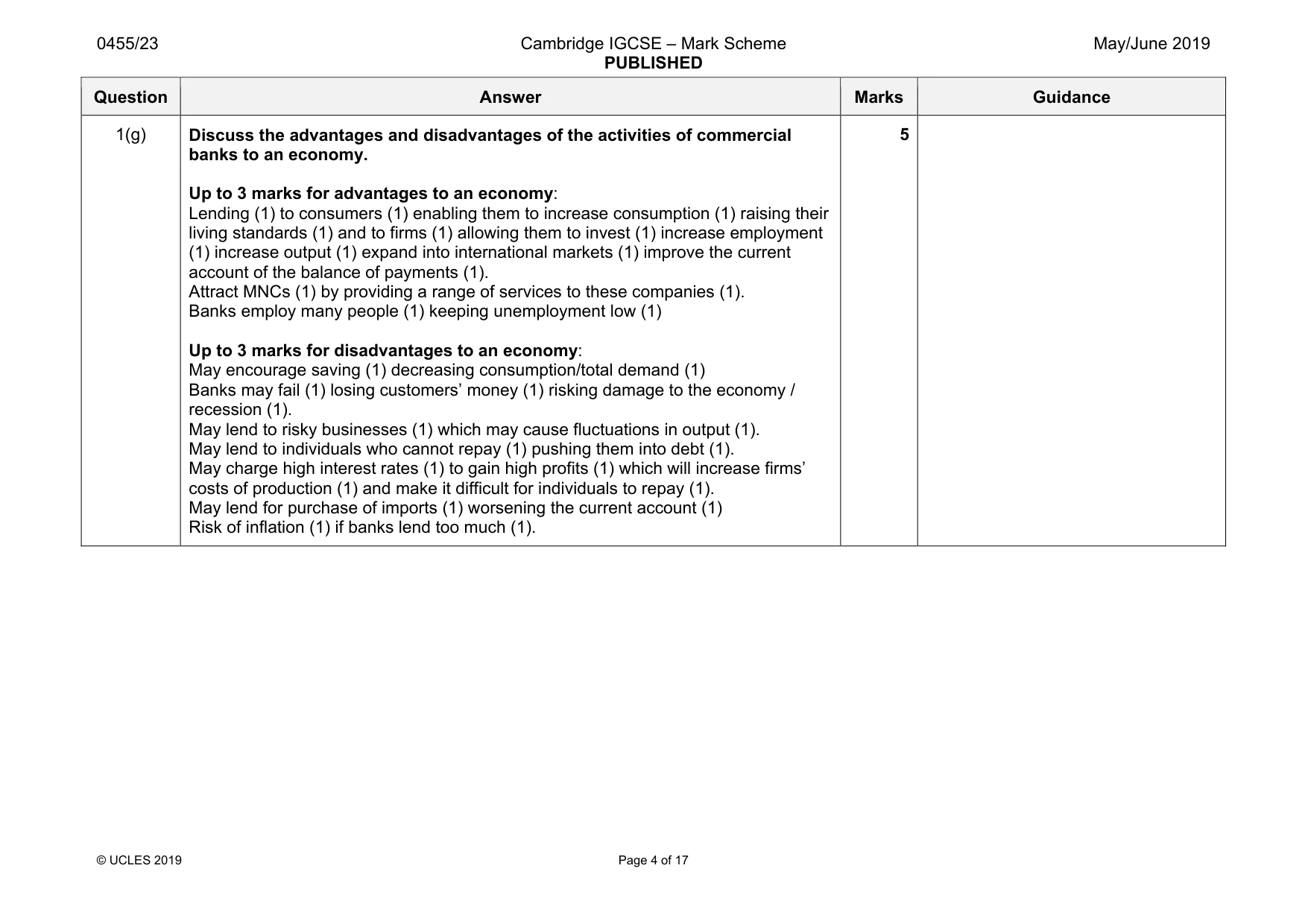
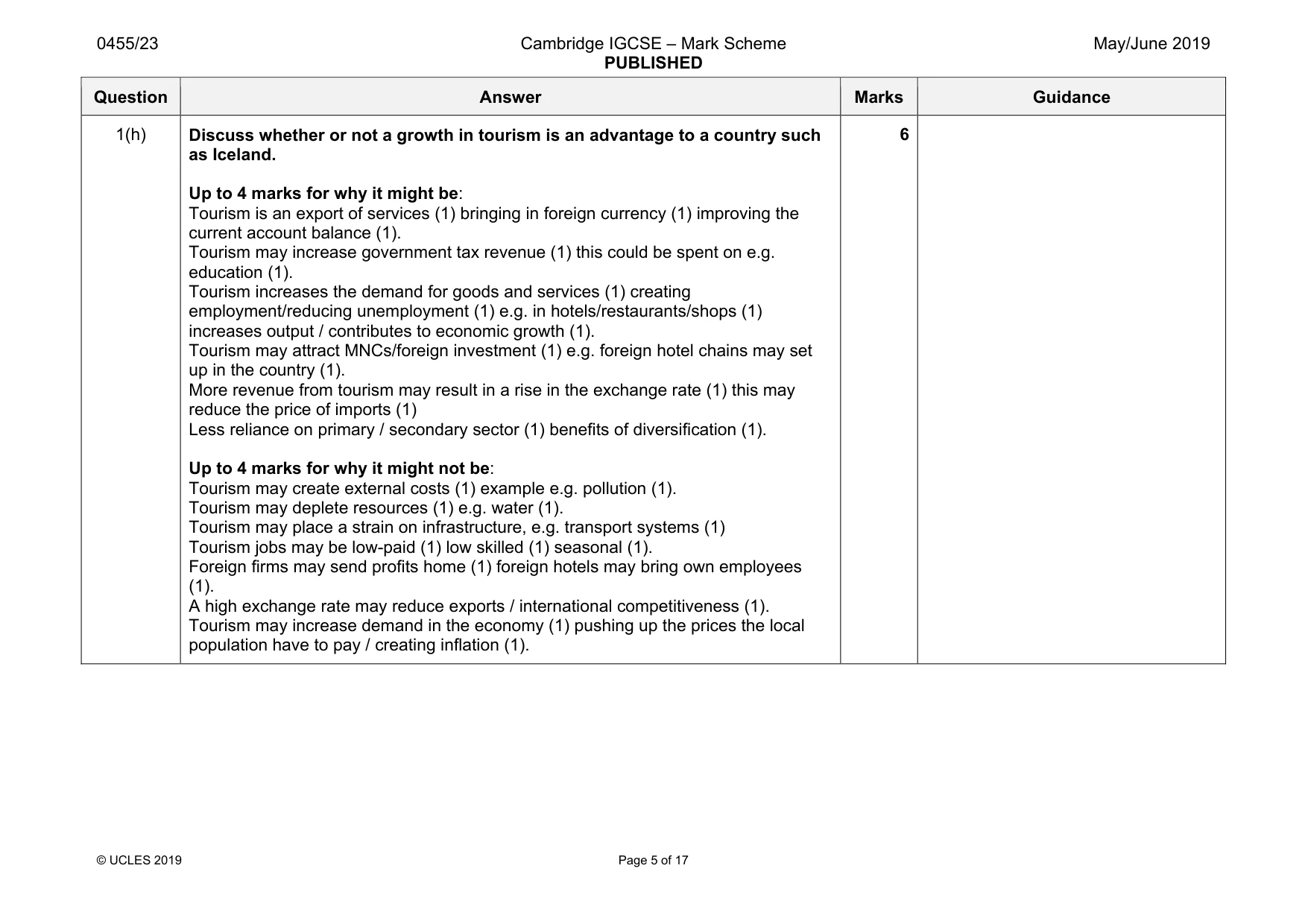
Mark scheme: 1(a) Identify, using information from the extract, two industries that are in the primary sector of the Icelandic economy. • farming • fishing 2 1(b) Explain, using information from the extract, two reasons for government regulation of the fishing industry in Iceland. Protect domestic fishermen (1) to ensure they have a stable income (1) to ensure that jobs are preserved (1) can compete with foreign fishermen (1). Protect the stock of fish (1) to ensure sustainability of fish stocks (1) for future generations (1). 4 1(c) Explain, using information from the extract, two reasons, apart from changes in employment, for Iceland’s high growth rate from 2002–2007. • increased availability of bank loans (1) more borrowing (1) to fund consumption (1) and to fund investments (1). • increasing income of its major trading partners, including the European Union and Norway (1) Iceland can now export more to their trading partners (1) increase net exports / external demand / aggregate demand (1) 4 1(d) Calculate, using information from the extract, Iceland’s GDP in 2007. $18.53 billion (2) 18.53 or working e.g. $17bn × 0.09 = $1.53bn (1) 2 Question Answer Marks Guidance 1(e) Analyse, using Fig 1.1, the relationship between changes in the economic growth rate and the unemployment rate over the period shown. They both rose over the period (1) showing a positive relationship (1) unexpected (1) evidence from the data e.g. the unemployment rose from approx. 3.4 to 5% (1) the economic growth rate rose from 0.5 to 1.8% (1) Unemployment rate was relatively constant from 2002 to 2008 (1) while economic growth fluctuated (1). Unemployment was relatively stable from 2009 to 2014 (1). Between 2007 and 2009 the fall in the economic growth rate (1) to a negative value / recession (1) while there was a rise in the rate of unemployment (1). From 2009 to 2014 economic growth increased (1) and unemployment fell (1) the trends are moving in opposite directions (1) as would be expected (1) high economic growth rate should create more jobs (1). Between 2002 and 2004 there’s a significant increase in the economic growth rate (1) while there was only a slight fall in the unemployment rate (1). 5 No marks for a descriptive approach e.g. identifying the growth rate or the unemployment rate for specific years. 1(f) Explain, using information from the extract, whether the supply of Iceland’s fish is price-elastic or price-inelastic. It is price-inelastic (1) because the quantity of fish supplied tends to change by a smaller percentage than the change in its price (1). 2 Question Answer Marks Guidance 1(g) Discuss the advantages and disadvantages of the activities of commercial banks to an economy. Up to 3 marks for advantages to an economy: Lending (1) to consumers (1) enabling them to increase consumption (1) raising their living standards (1) and to firms (1) allowing them to invest (1) increase employment (1) increase output (1) expand into international markets (1) improve the current account of the balance of payments (1). Attract MNCs (1) by providing a range of services to these companies (1). Banks employ many people (1) keeping unemployment low (1) Up to 3 marks for disadvantages to an economy: May encourage saving (1) decreasing consumption/total demand (1) Banks may fail (1) losing customers’ money (1) risking damage to the economy / recession (1). May lend to risky businesses (1) which may cause fluctuations in output (1). May lend to individuals who cannot repay (1) pushing them into debt (1). May charge high interest rates (1) to gain high profits (1) which will increase firms’ costs of production (1) and make it difficult for individuals to repay (1). May lend for purchase of imports (1) worsening the current account (1) Risk of inflation (1) if banks lend too much (1). 5 Question Answer Marks Guidance 1(h) Discuss whether or not a growth in tourism is an advantage to a country such as Iceland. Up to 4 marks for why it might be: Tourism is an export of services (1) bringing in foreign currency (1) improving the current account balance (1). Tourism may increase government tax revenue (1) this could be spent on e.g. education (1). Tourism increases the demand for goods and services (1) creating employment/reducing unemployment (1) e.g. in hotels/restaurants/shops (1) increases output / contributes to economic growth (1). Tourism may attract MNCs/foreign investment (1) e.g. foreign hotel chains may set up in the country (1). More revenue from tourism may result in a rise in the exchange rate (1) this may reduce the price of imports (1) Less reliance on primary / secondary sector (1) benefits of diversification (1). Up to 4 marks for why it might not be: Tourism may create external costs (1) example e.g. pollution (1). Tourism may deplete resources (1) e.g. water (1). Tourism may place a strain on infrastructure, e.g. transport systems (1) Tourism jobs may be low-paid (1) low skilled (1) seasonal (1). Foreign firms may send profits home (1) foreign hotels may bring own employees (1). A high exchange rate may reduce exports / international competitiveness (1). Tourism may increase demand in the economy (1) pushing up the prices the local population have to pay / creating inflation (1). 6
Q2 · Germany’s economy is one of the best performing economies in the European Union (EU)
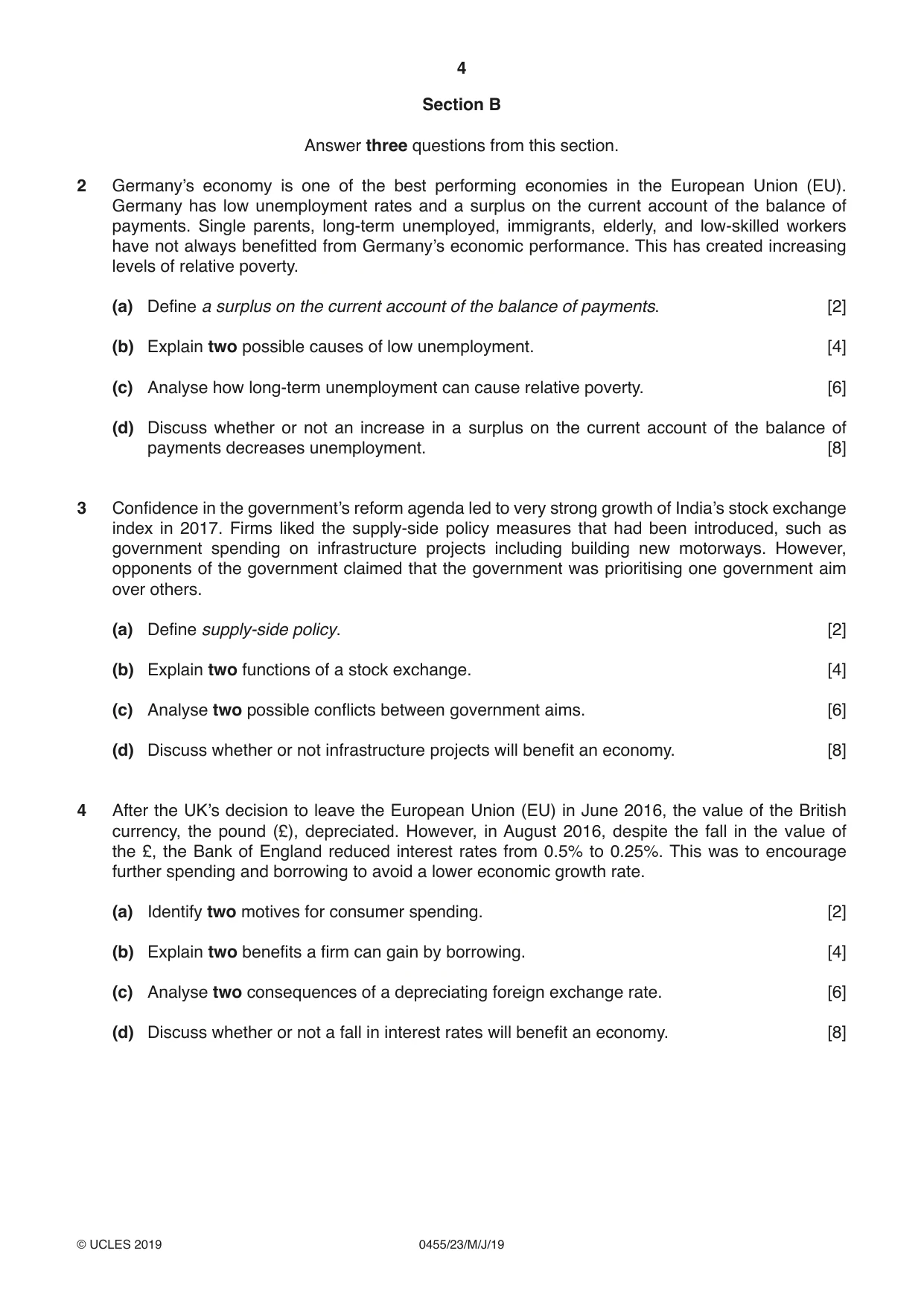
2 Germany’s economy is one of the best performing economies in the European Union (EU). Germany has low unemployment rates and a surplus on the current account of the balance of payments. Single parents, long-term unemployed, immigrants, elderly, and low-skilled workers have not always benefitted from Germany’s economic performance. This has created increasing levels of relative poverty. (a) Define a surplus on the current account of the balance of payments. [2] (b) Explain two possible causes of low unemployment. [4] (c) Analyse how long-term unemployment can cause relative poverty. [6] (d) Discuss whether or not an increase in a surplus on the current account of the balance of payments decreases unemployment. [8]
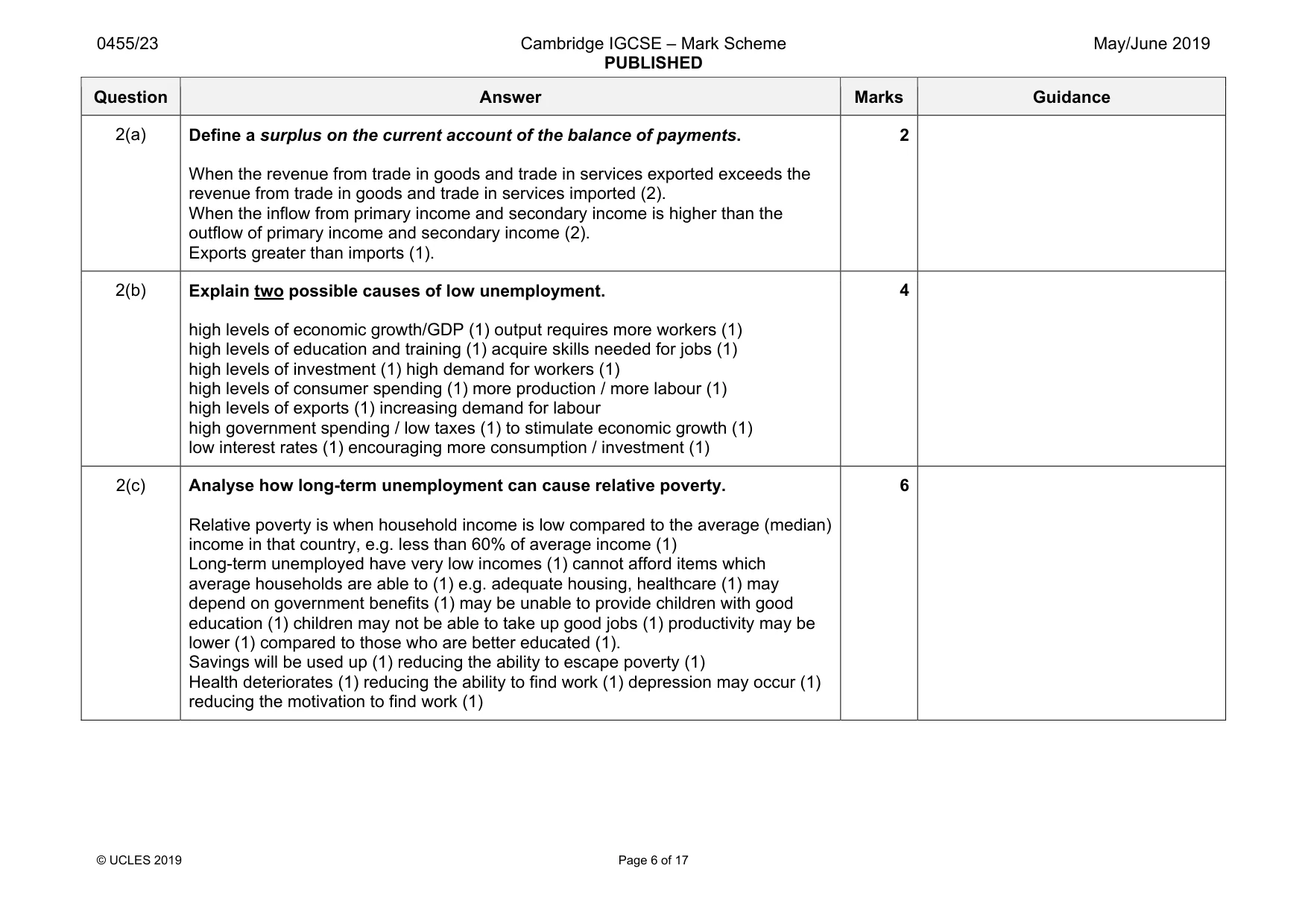
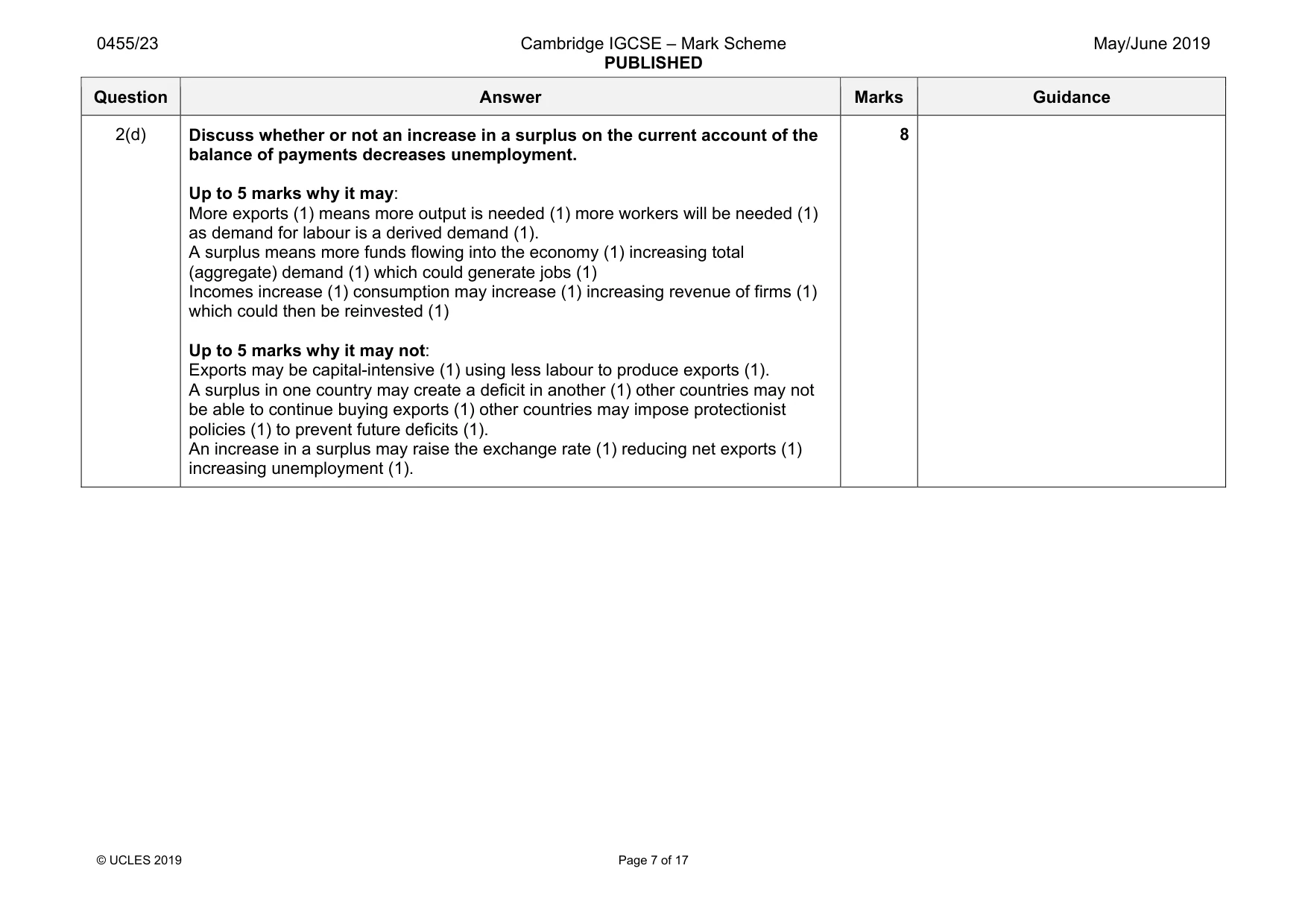
Mark scheme: 2(a) Define a surplus on the current account of the balance of payments. When the revenue from trade in goods and trade in services exported exceeds the revenue from trade in goods and trade in services imported (2). When the inflow from primary income and secondary income is higher than the outflow of primary income and secondary income (2). Exports greater than imports (1). 2 2(b) Explain two possible causes of low unemployment. high levels of economic growth/GDP (1) output requires more workers (1) high levels of education and training (1) acquire skills needed for jobs (1) high levels of investment (1) high demand for workers (1) high levels of consumer spending (1) more production / more labour (1) high levels of exports (1) increasing demand for labour high government spending / low taxes (1) to stimulate economic growth (1) low interest rates (1) encouraging more consumption / investment (1) 4 2(c) Analyse how long-term unemployment can cause relative poverty. Relative poverty is when household income is low compared to the average (median) income in that country, e.g. less than 60% of average income (1) Long-term unemployed have very low incomes (1) cannot afford items which average households are able to (1) e.g. adequate housing, healthcare (1) may depend on government benefits (1) may be unable to provide children with good education (1) children may not be able to take up good jobs (1) productivity may be lower (1) compared to those who are better educated (1). Savings will be used up (1) reducing the ability to escape poverty (1) Health deteriorates (1) reducing the ability to find work (1) depression may occur (1) reducing the motivation to find work (1) 6 Question Answer Marks Guidance 2(d) Discuss whether or not an increase in a surplus on the current account of the balance of payments decreases unemployment. Up to 5 marks why it may: More exports (1) means more output is needed (1) more workers will be needed (1) as demand for labour is a derived demand (1). A surplus means more funds flowing into the economy (1) increasing total (aggregate) demand (1) which could generate jobs (1) Incomes increase (1) consumption may increase (1) increasing revenue of firms (1) which could then be reinvested (1) Up to 5 marks why it may not: Exports may be capital-intensive (1) using less labour to produce exports (1). A surplus in one country may create a deficit in another (1) other countries may not be able to continue buying exports (1) other countries may impose protectionist policies (1) to prevent future deficits (1). An increase in a surplus may raise the exchange rate (1) reducing net exports (1) increasing unemployment (1). 8
Q3 · Confidence in the government’s reform agenda led to very strong growth of India’s stock…
3 Confidence in the government’s reform agenda led to very strong growth of India’s stock exchange index in 2017. Firms liked the supply-side policy measures that had been introduced, such as government spending on infrastructure projects including building new motorways. However, opponents of the government claimed that the government was prioritising one government aim over others. (a) Define supply-side policy. [2] (b) Explain two functions of a stock exchange. [4] (c) Analyse two possible conflicts between government aims. [6] (d) Discuss whether or not infrastructure projects will benefit an economy. [8]
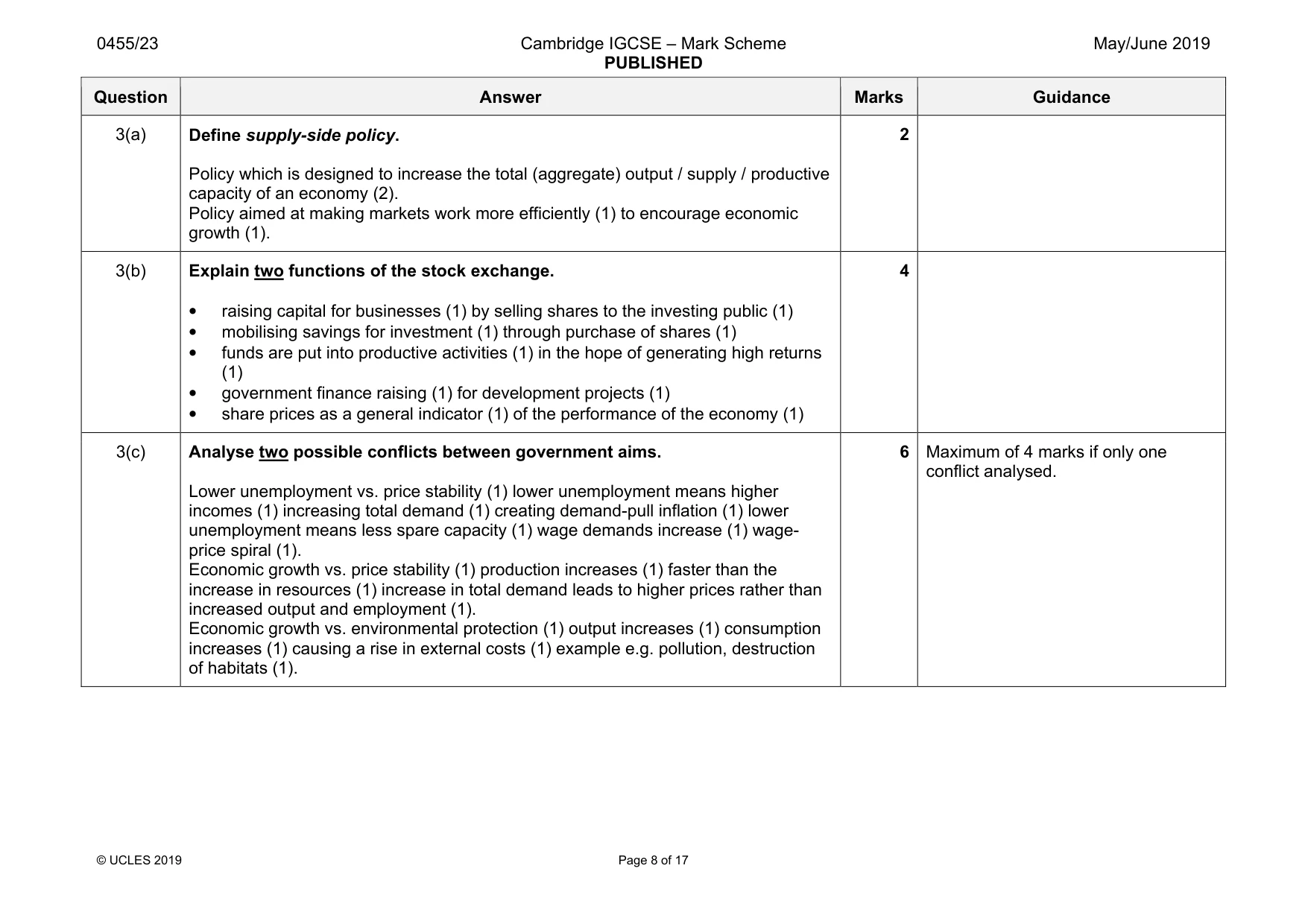
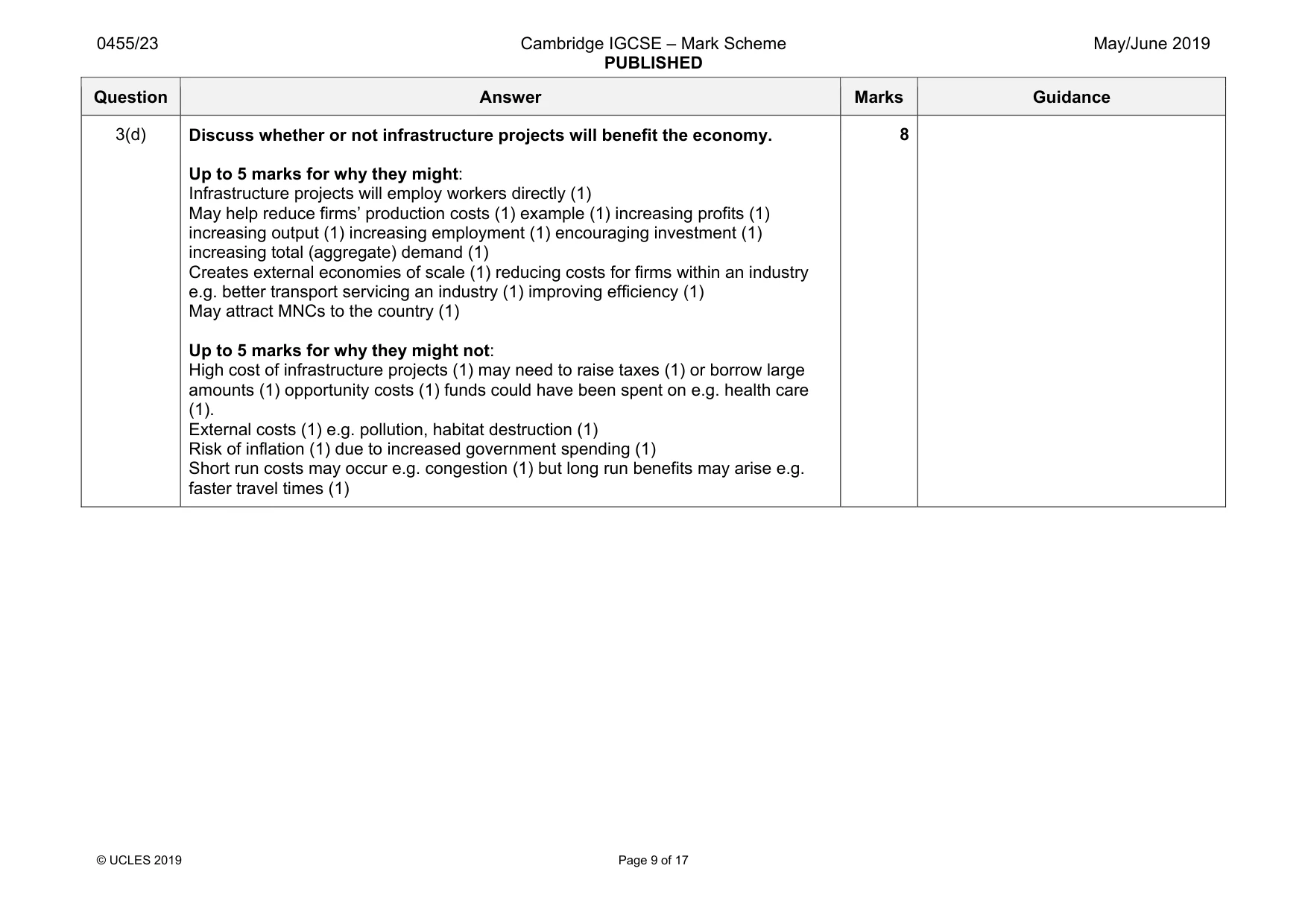
Mark scheme: 3(a) Define supply-side policy. Policy which is designed to increase the total (aggregate) output / supply / productive capacity of an economy (2). Policy aimed at making markets work more efficiently (1) to encourage economic growth (1). 2 3(b) Explain two functions of the stock exchange. • raising capital for businesses (1) by selling shares to the investing public (1) • mobilising savings for investment (1) through purchase of shares (1) • funds are put into productive activities (1) in the hope of generating high returns (1) • government finance raising (1) for development projects (1) • share prices as a general indicator (1) of the performance of the economy (1) 4 3(c) Analyse two possible conflicts between government aims. Lower unemployment vs. price stability (1) lower unemployment means higher incomes (1) increasing total demand (1) creating demand-pull inflation (1) lower unemployment means less spare capacity (1) wage demands increase (1) wage- price spiral (1). Economic growth vs. price stability (1) production increases (1) faster than the increase in resources (1) increase in total demand leads to higher prices rather than increased output and employment (1). Economic growth vs. environmental protection (1) output increases (1) consumption increases (1) causing a rise in external costs (1) example e.g. pollution, destruction of habitats (1). 6 Maximum of 4 marks if only one conflict analysed. Question Answer Marks Guidance 3(d) Discuss whether or not infrastructure projects will benefit the economy. Up to 5 marks for why they might: Infrastructure projects will employ workers directly (1) May help reduce firms’ production costs (1) example (1) increasing profits (1) increasing output (1) increasing employment (1) encouraging investment (1) increasing total (aggregate) demand (1) Creates external economies of scale (1) reducing costs for firms within an industry e.g. better transport servicing an industry (1) improving efficiency (1) May attract MNCs to the country (1) Up to 5 marks for why they might not: High cost of infrastructure projects (1) may need to raise taxes (1) or borrow large amounts (1) opportunity costs (1) funds could have been spent on e.g. health care (1). External costs (1) e.g. pollution, habitat destruction (1) Risk of inflation (1) due to increased government spending (1) Short run costs may occur e.g. congestion (1) but long run benefits may arise e.g. faster travel times (1) 8
Q4 · After the UK’s decision to leave the European Union (EU) in June 2016, the value of the…
4 After the UK’s decision to leave the European Union (EU) in June 2016, the value of the British currency, the pound (£), depreciated. However, in August 2016, despite the fall in the value of the £, the Bank of England reduced interest rates from 0.5% to 0.25%. This was to encourage further spending and borrowing to avoid a lower economic growth rate. (a) Identify two motives for consumer spending. [2] (b) Explain two benefits a firm can gain by borrowing. [4] (c) Analyse two consequences of a depreciating foreign exchange rate. [6] (d) Discuss whether or not a fall in interest rates will benefit an economy. [8]
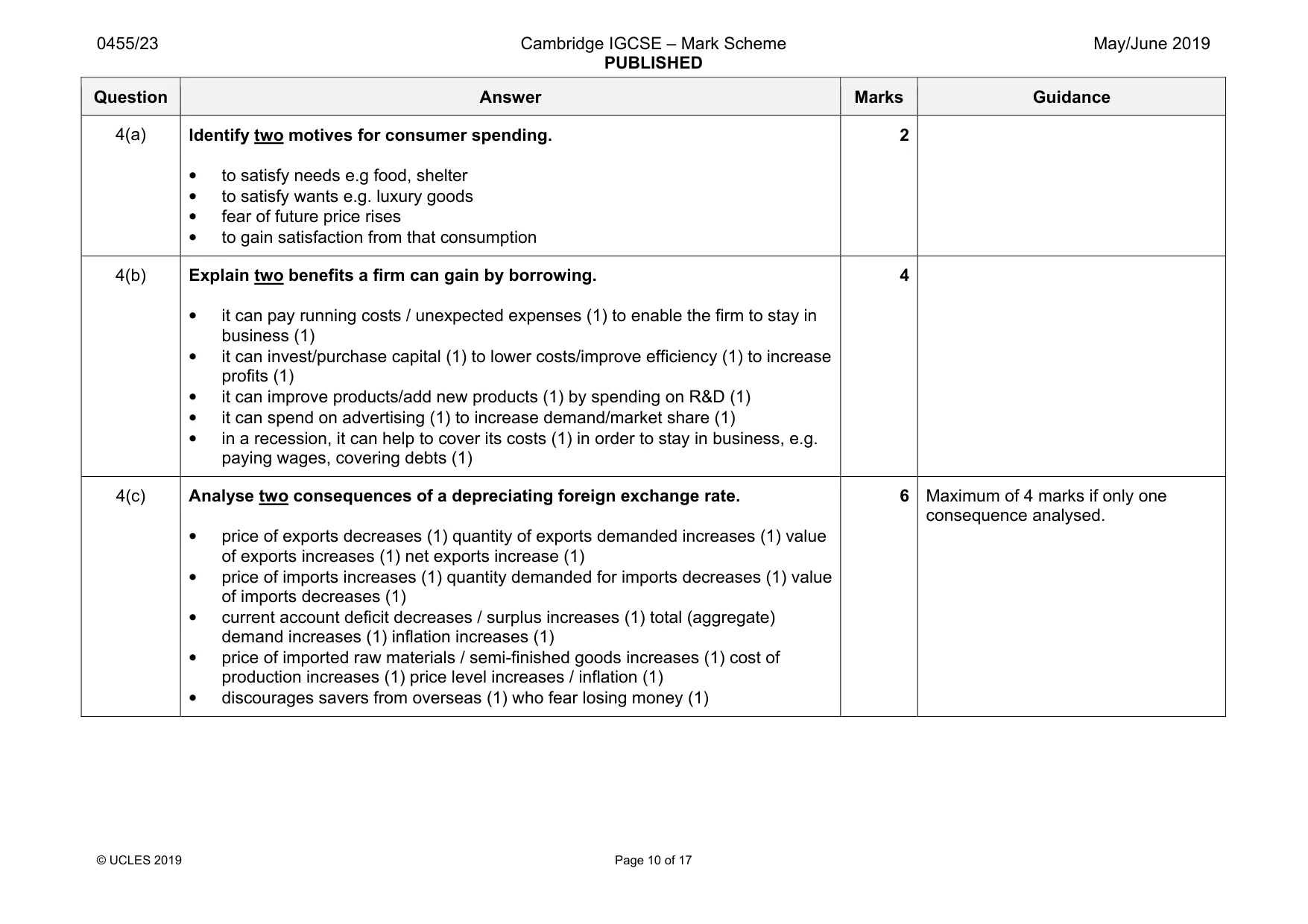
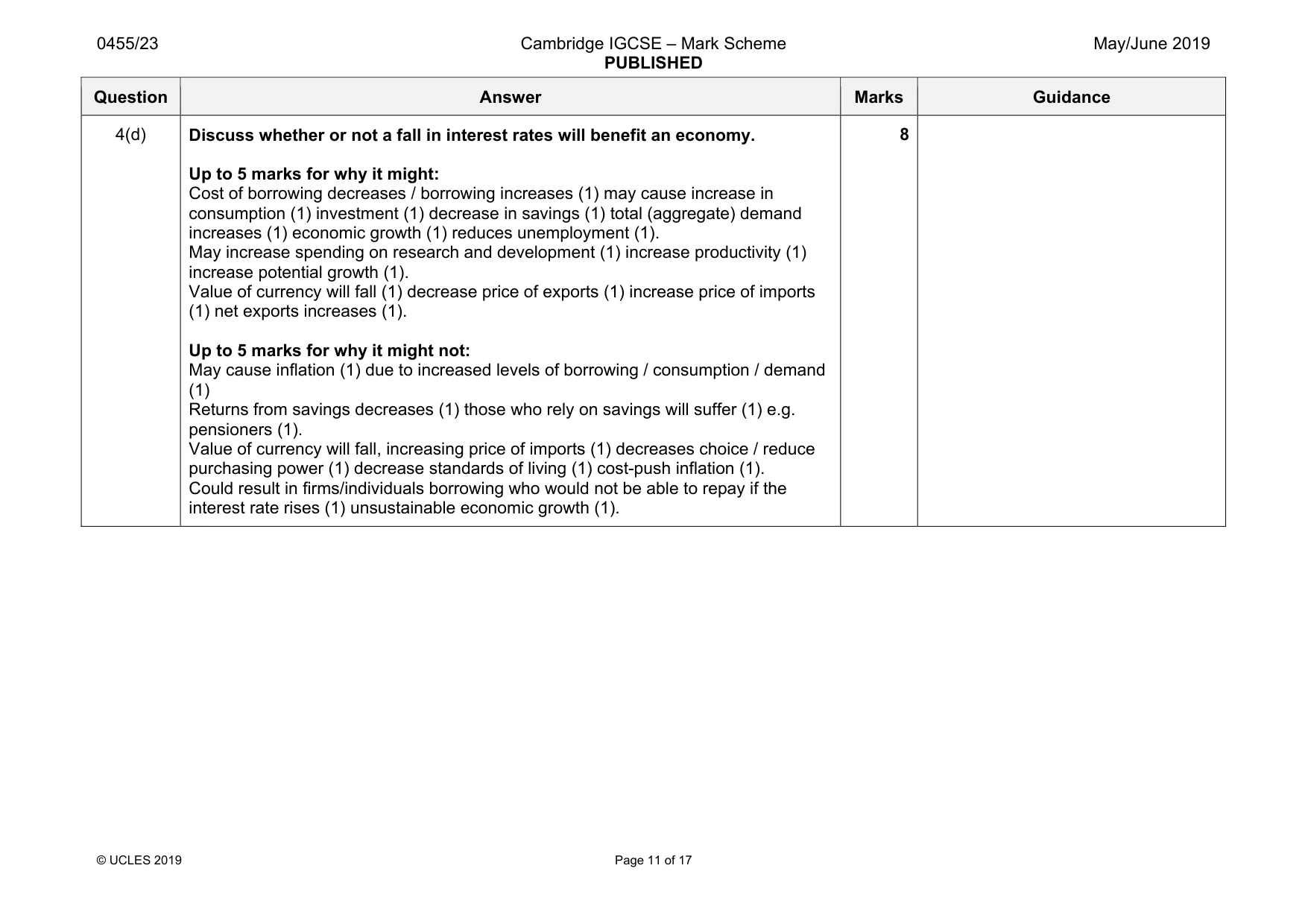
Mark scheme: 4(a) Identify two motives for consumer spending. • to satisfy needs e.g food, shelter • to satisfy wants e.g. luxury goods • fear of future price rises • to gain satisfaction from that consumption 2 4(b) Explain two benefits a firm can gain by borrowing. • it can pay running costs / unexpected expenses (1) to enable the firm to stay in business (1) • it can invest/purchase capital (1) to lower costs/improve efficiency (1) to increase profits (1) • it can improve products/add new products (1) by spending on R&D (1) • it can spend on advertising (1) to increase demand/market share (1) • in a recession, it can help to cover its costs (1) in order to stay in business, e.g. paying wages, covering debts (1) 4 4(c) Analyse two consequences of a depreciating foreign exchange rate. • price of exports decreases (1) quantity of exports demanded increases (1) value of exports increases (1) net exports increase (1) • price of imports increases (1) quantity demanded for imports decreases (1) value of imports decreases (1) • current account deficit decreases / surplus increases (1) total (aggregate) demand increases (1) inflation increases (1) • price of imported raw materials / semi-finished goods increases (1) cost of production increases (1) price level increases / inflation (1) • discourages savers from overseas (1) who fear losing money (1) 6 Maximum of 4 marks if only one consequence analysed. Question Answer Marks Guidance 4(d) Discuss whether or not a fall in interest rates will benefit an economy. Up to 5 marks for why it might: Cost of borrowing decreases / borrowing increases (1) may cause increase in consumption (1) investment (1) decrease in savings (1) total (aggregate) demand increases (1) economic growth (1) reduces unemployment (1). May increase spending on research and development (1) increase productivity (1) increase potential growth (1). Value of currency will fall (1) decrease price of exports (1) increase price of imports (1) net exports increases (1). Up to 5 marks for why it might not: May cause inflation (1) due to increased levels of borrowing / consumption / demand (1) Returns from savings decreases (1) those who rely on savings will suffer (1) e.g. pensioners (1). Value of currency will fall, increasing price of imports (1) decreases choice / reduce purchasing power (1) decrease standards of living (1) cost-push inflation (1). Could result in firms/individuals borrowing who would not be able to repay if the interest rate rises (1) unsustainable economic growth (1). 8
Q5 · The South Korean economy was dominated by many family-owned firms which have now become…
5 The South Korean economy was dominated by many family-owned firms which have now become large public limited companies. The government provided subsidies and imposed trade protection to help their domestic firms to grow. Since 2010, average earnings have risen in South Korea. (a) Define public limited company. [2] (b) Explain two reasons for growth in average earnings. [4] (c) Analyse, using a demand and supply diagram, how government subsidies help firms grow. [6] (d) Discuss whether or not trade protection supports the growth of domestic firms. [8]
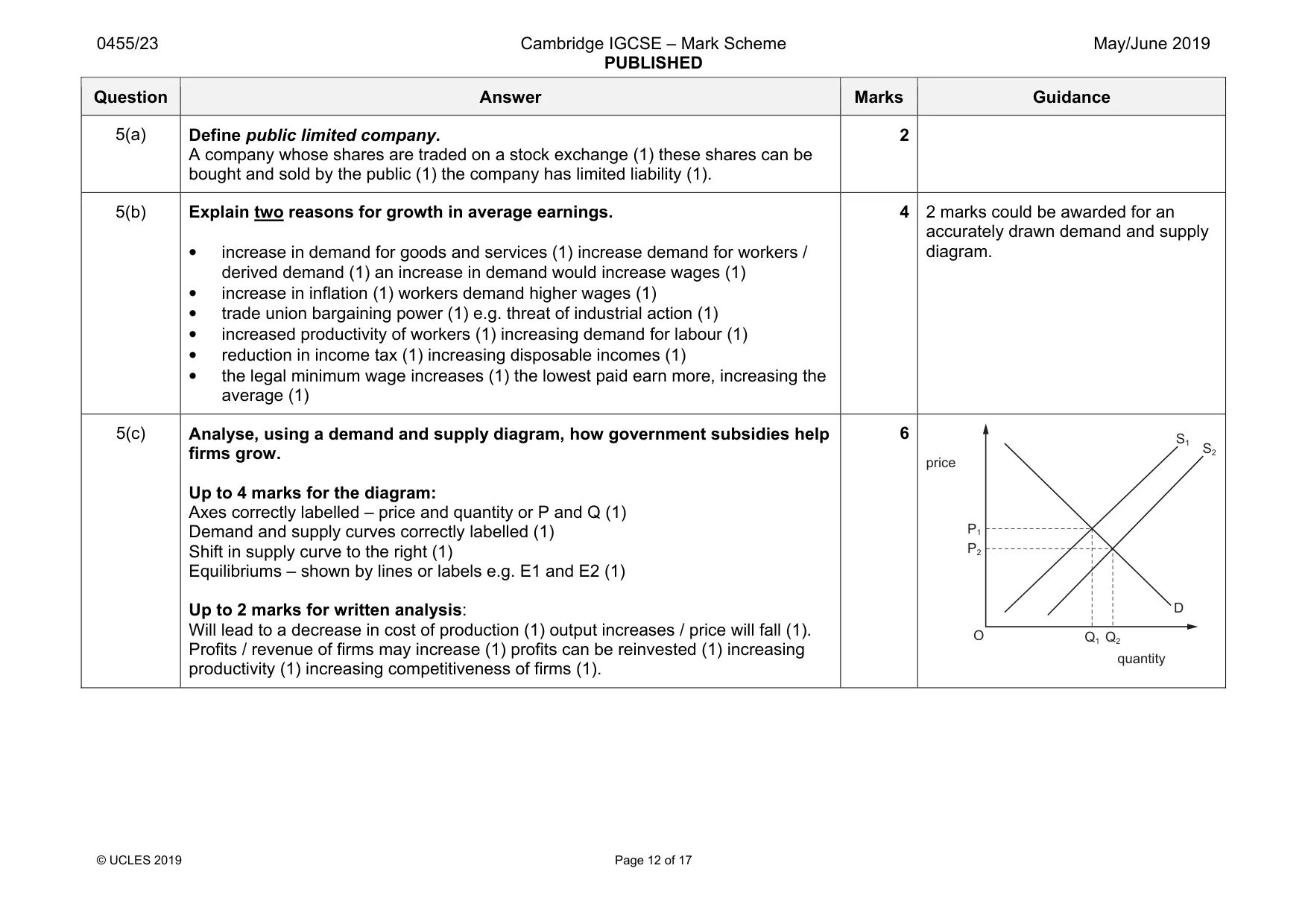
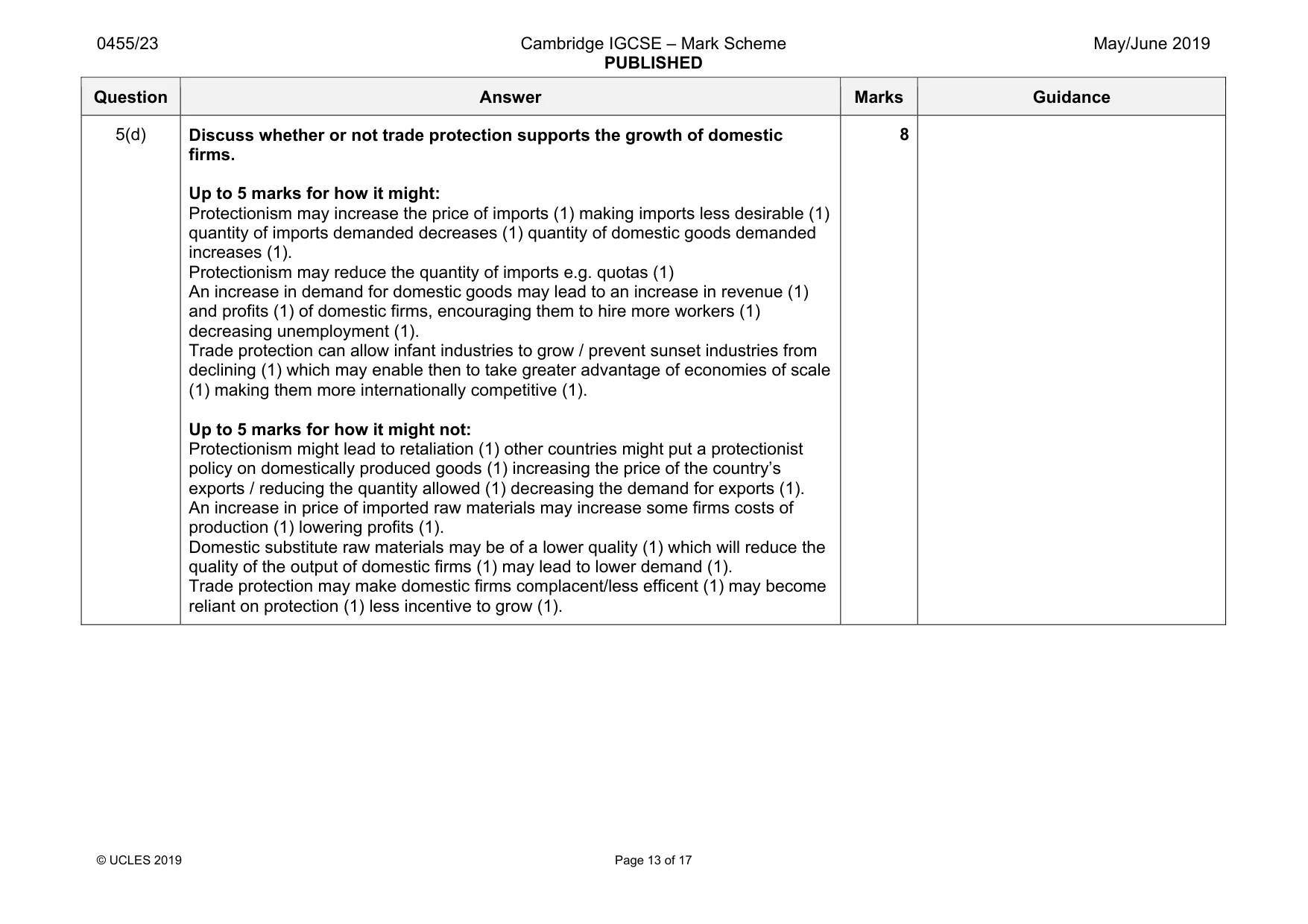
Mark scheme: 5(a) Define public limited company. A company whose shares are traded on a stock exchange (1) these shares can be bought and sold by the public (1) the company has limited liability (1). 2 5(b) Explain two reasons for growth in average earnings. • increase in demand for goods and services (1) increase demand for workers / derived demand (1) an increase in demand would increase wages (1) • increase in inflation (1) workers demand higher wages (1) • trade union bargaining power (1) e.g. threat of industrial action (1) • increased productivity of workers (1) increasing demand for labour (1) • reduction in income tax (1) increasing disposable incomes (1) • the legal minimum wage increases (1) the lowest paid earn more, increasing the average (1) 4 2 marks could be awarded for an accurately drawn demand and supply diagram. 5(c) Analyse, using a demand and supply diagram, how government subsidies help firms grow. Up to 4 marks for the diagram: Axes correctly labelled – price and quantity or P and Q (1) Demand and supply curves correctly labelled (1) Shift in supply curve to the right (1) Equilibriums – shown by lines or labels e.g. E1 and E2 (1) Up to 2 marks for written analysis: Will lead to a decrease in cost of production (1) output increases / price will fall (1). Profits / revenue of firms may increase (1) profits can be reinvested (1) increasing productivity (1) increasing competitiveness of firms (1). 6 S2 S1 Q2 Q1 P1 P2 D O quantity price Question Answer Marks Guidance 5(d) Discuss whether or not trade protection supports the growth of domestic firms. Up to 5 marks for how it might: Protectionism may increase the price of imports (1) making imports less desirable (1) quantity of imports demanded decreases (1) quantity of domestic goods demanded increases (1). Protectionism may reduce the quantity of imports e.g. quotas (1) An increase in demand for domestic goods may lead to an increase in revenue (1) and profits (1) of domestic firms, encouraging them to hire more workers (1) decreasing unemployment (1). Trade protection can allow infant industries to grow / prevent sunset industries from declining (1) which may enable then to take greater advantage of economies of scale (1) making them more internationally competitive (1). Up to 5 marks for how it might not: Protectionism might lead to retaliation (1) other countries might put a protectionist policy on domestically produced goods (1) increasing the price of the country’s exports / reducing the quantity allowed (1) decreasing the demand for exports (1). An increase in price of imported raw materials may increase some firms costs of production (1) lowering profits (1). Domestic substitute raw materials may be of a lower quality (1) which will reduce the quality of the output of domestic firms (1) may lead to lower demand (1). Trade protection may make domestic firms complacent/less efficent (1) may become reliant on protection (1) less incentive to grow (1). 8
Question 6
6 Non-renewable energy (e.g. coal) is thought to cause a higher social cost than renewable energy (e.g. solar or wind power). Excessive demand for non-renewable energy causes a failure of the market economic system. However, producers of renewable energy, some of which specialise in one form of energy, are beginning to produce on a larger scale. (a) Define social cost. [2] (b) Explain two reasons why a firm would want to specialise in producing only one product. [4] (c) Analyse how the ability of firms to produce on a larger scale is beneficial to consumers. [6] (d) Discuss whether or not the operation of a market economic system is harmful to an economy. [8]
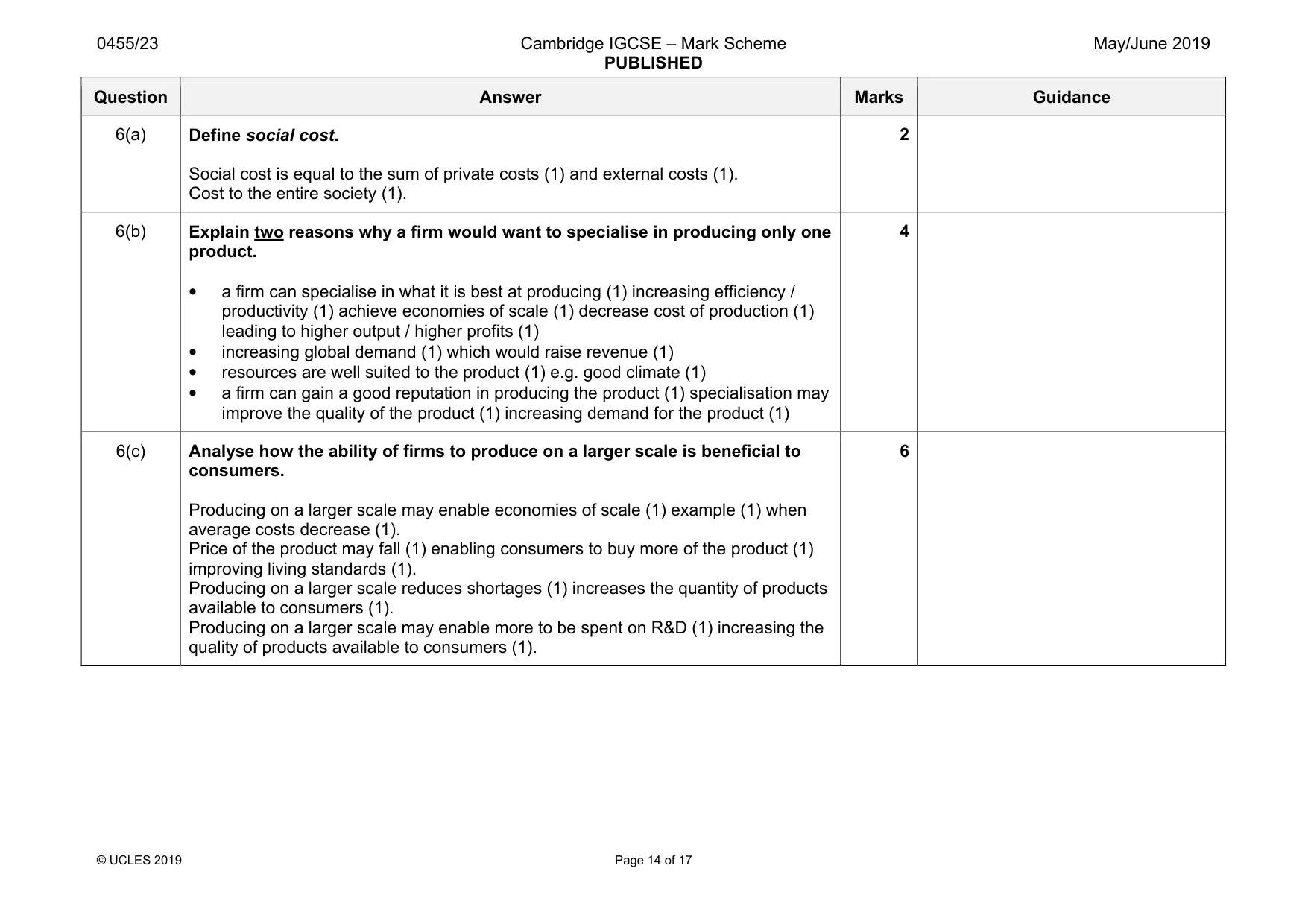
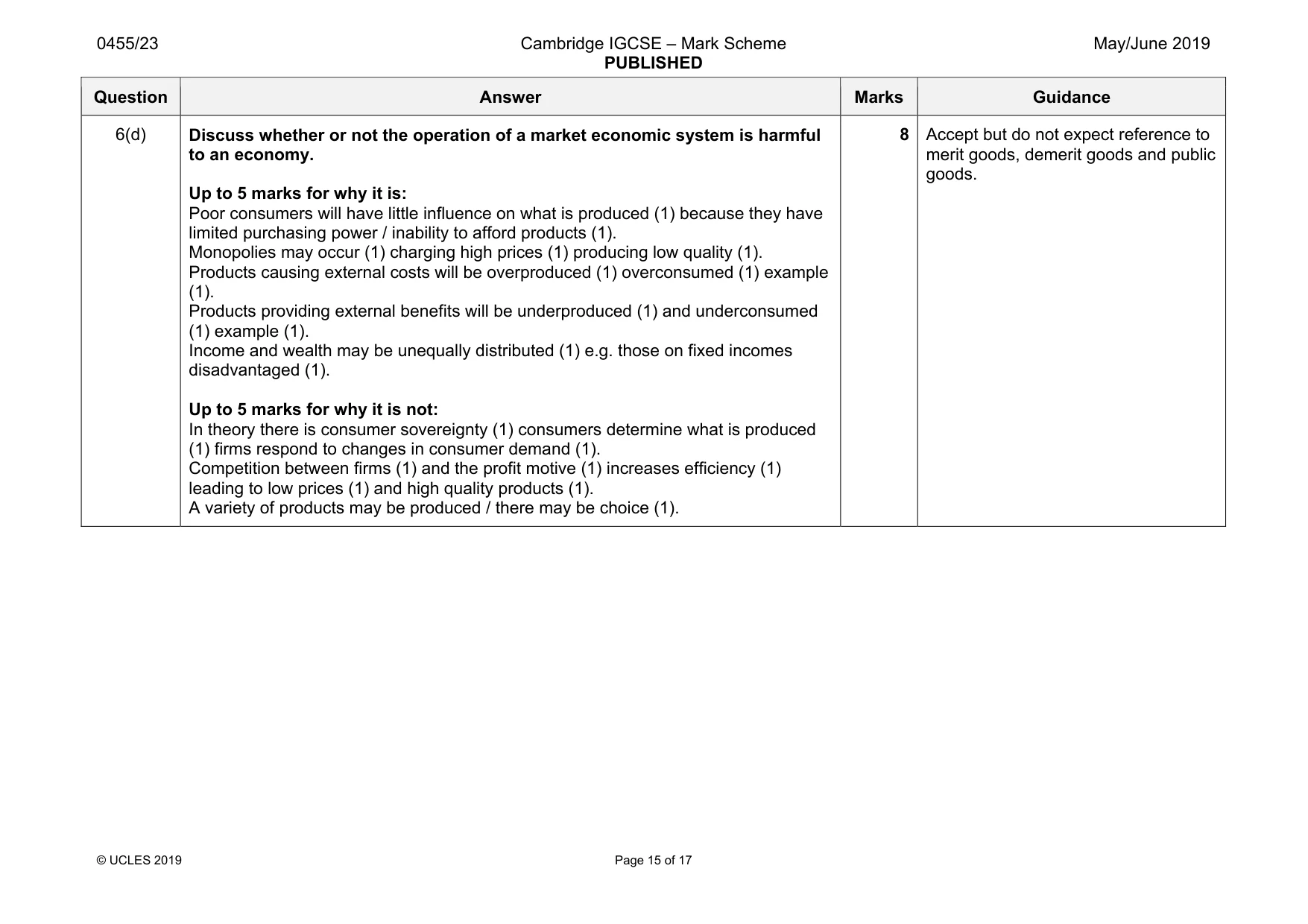
Mark scheme: 6(a) Define social cost. Social cost is equal to the sum of private costs (1) and external costs (1). Cost to the entire society (1). 2 6(b) Explain two reasons why a firm would want to specialise in producing only one product. • a firm can specialise in what it is best at producing (1) increasing efficiency / productivity (1) achieve economies of scale (1) decrease cost of production (1) leading to higher output / higher profits (1) • increasing global demand (1) which would raise revenue (1) • resources are well suited to the product (1) e.g. good climate (1) • a firm can gain a good reputation in producing the product (1) specialisation may improve the quality of the product (1) increasing demand for the product (1) 4 6(c) Analyse how the ability of firms to produce on a larger scale is beneficial to consumers. Producing on a larger scale may enable economies of scale (1) example (1) when average costs decrease (1). Price of the product may fall (1) enabling consumers to buy more of the product (1) improving living standards (1). Producing on a larger scale reduces shortages (1) increases the quantity of products available to consumers (1). Producing on a larger scale may enable more to be spent on R&D (1) increasing the quality of products available to consumers (1). 6 Question Answer Marks Guidance 6(d) Discuss whether or not the operation of a market economic system is harmful to an economy. Up to 5 marks for why it is: Poor consumers will have little influence on what is produced (1) because they have limited purchasing power / inability to afford products (1). Monopolies may occur (1) charging high prices (1) producing low quality (1). Products causing external costs will be overproduced (1) overconsumed (1) example (1). Products providing external benefits will be underproduced (1) and underconsumed (1) example (1). Income and wealth may be unequally distributed (1) e.g. those on fixed incomes disadvantaged (1). Up to 5 marks for why it is not: In theory there is consumer sovereignty (1) consumers determine what is produced (1) firms respond to changes in consumer demand (1). Competition between firms (1) and the profit motive (1) increases efficiency (1) leading to low prices (1) and high quality products (1). A variety of products may be produced / there may be choice (1). 8 Accept but do not expect reference to merit goods, demerit goods and public goods.
Q7 · Some economists have claimed that the 21st century will be the ‘African century’ because…
7 Some economists have claimed that the 21st century will be the ‘African century’ because of the growth in their working-age population. Forecasts show that by 2030, Africa’s contribution to the increase in the global labour force will exceed that from the rest of the world. This will affect incomes, saving, and economic policies in African countries. (a) Define labour. [2] (b) Explain two motives for saving. [4] (c) Analyse the reasons for countries having different population growth rates. [6] (d) Discuss whether or not a rise in the working-age population, as a percentage of the total population, will be beneficial to a country. [8]
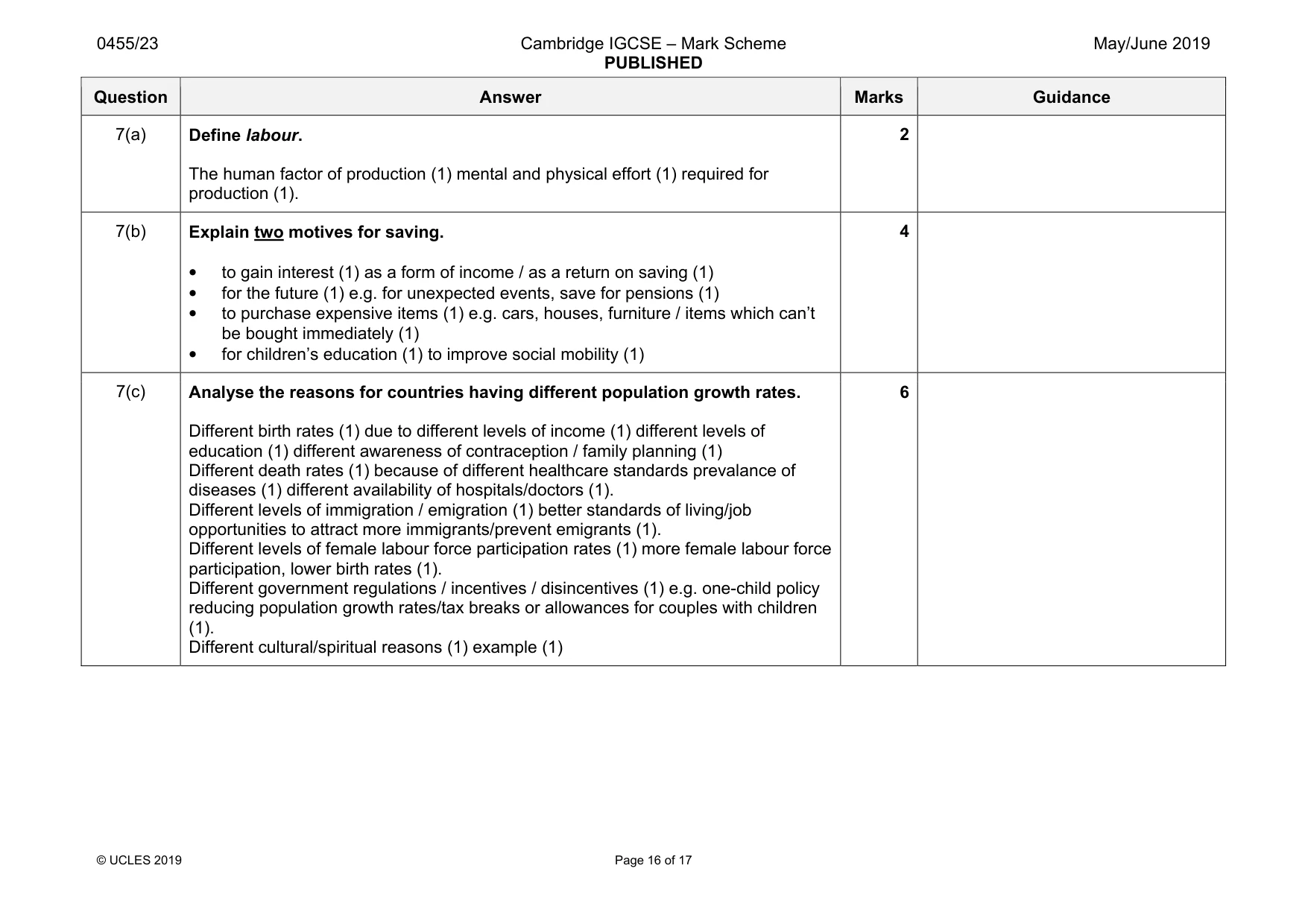
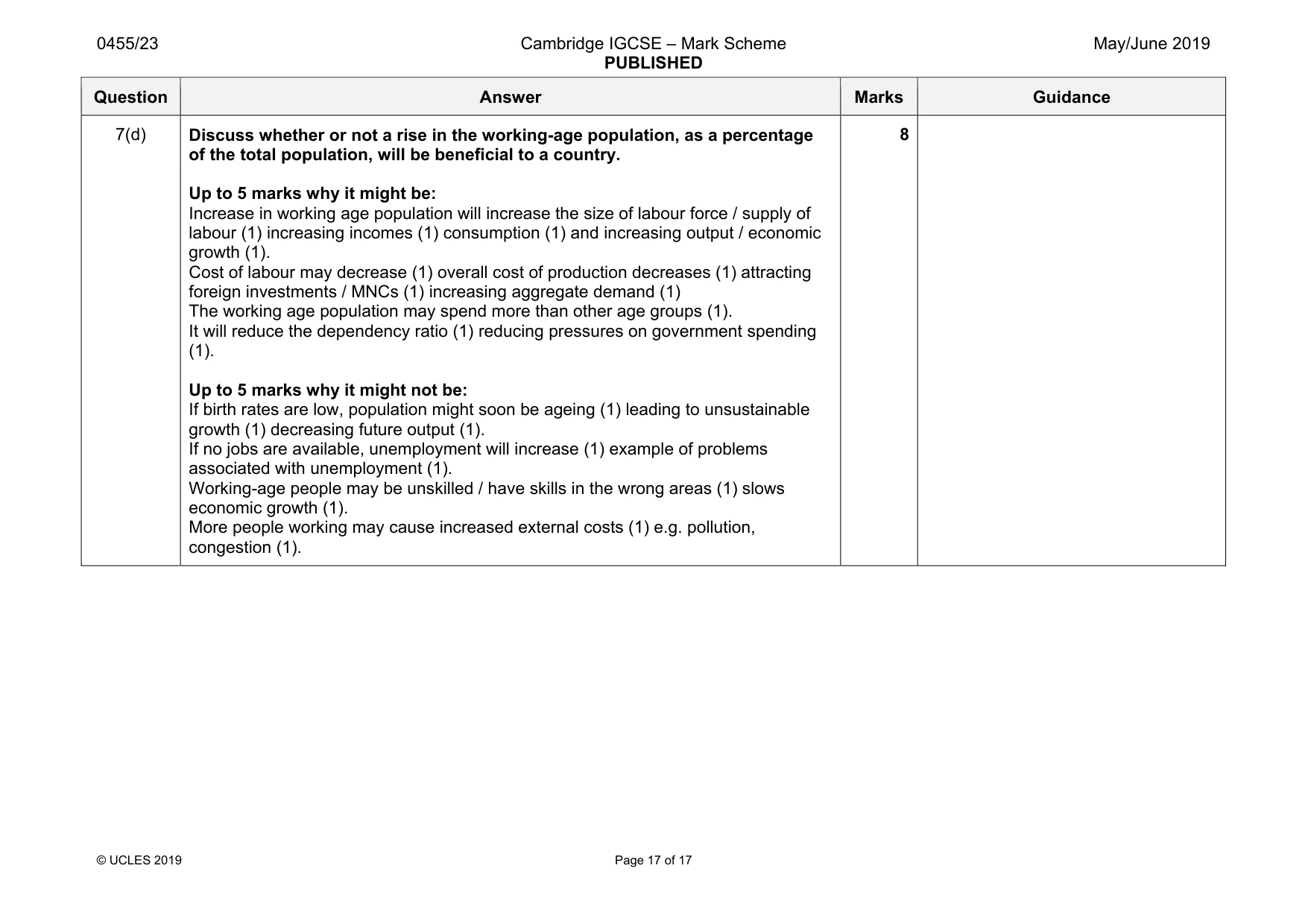
Mark scheme: 7(a) Define labour. The human factor of production (1) mental and physical effort (1) required for production (1). 2 7(b) Explain two motives for saving. • to gain interest (1) as a form of income / as a return on saving (1) • for the future (1) e.g. for unexpected events, save for pensions (1) • to purchase expensive items (1) e.g. cars, houses, furniture / items which can’t be bought immediately (1) • for children’s education (1) to improve social mobility (1) 4 7(c) Analyse the reasons for countries having different population growth rates. Different birth rates (1) due to different levels of income (1) different levels of education (1) different awareness of contraception / family planning (1) Different death rates (1) because of different healthcare standards prevalance of diseases (1) different availability of hospitals/doctors (1). Different levels of immigration / emigration (1) better standards of living/job opportunities to attract more immigrants/prevent emigrants (1). Different levels of female labour force participation rates (1) more female labour force participation, lower birth rates (1). Different government regulations / incentives / disincentives (1) e.g. one-child policy reducing population growth rates/tax breaks or allowances for couples with children (1). Different cultural/spiritual reasons (1) example (1) 6 Question Answer Marks Guidance 7(d) Discuss whether or not a rise in the working-age population, as a percentage of the total population, will be beneficial to a country. Up to 5 marks why it might be: Increase in working age population will increase the size of labour force / supply of labour (1) increasing incomes (1) consumption (1) and increasing output / economic growth (1). Cost of labour may decrease (1) overall cost of production decreases (1) attracting foreign investments / MNCs (1) increasing aggregate demand (1) The working age population may spend more than other age groups (1). It will reduce the dependency ratio (1) reducing pressures on government spending (1). Up to 5 marks why it might not be: If birth rates are low, population might soon be ageing (1) leading to unsustainable growth (1) decreasing future output (1). If no jobs are available, unemployment will increase (1) example of problems associated with unemployment (1). Working-age people may be unskilled / have skills in the wrong areas (1) slows economic growth (1). More people working may cause increased external costs (1) e.g. pollution, congestion (1). 8
What was in this paper
The subtopics covered by these 7 questions, and how many questions each got. Open one in a new tab to see every Cambridge question on it.
What you needed in this session
Cambridge’s own grade thresholds for 2019 May/June, Paper 2 · Variant 3. A higher threshold means an easier paper — the bar moves with how the cohort did.