Questions as text
Q1 · Explain what is meant by opportunity cost 0455/32 May/June 2010
1 (a) (i) Explain what is meant by opportunity cost. … … … … … … … … [2] (ii) Identify, from the extract, one example of opportunity cost. … … [1] (b) Why might the price of rice have increased less in Egypt than in the Philippines in 2008? … … … … … … … … [2] (c) Draw a demand and supply diagram, for each case below, to show the effect on the market for rice of: (i) floods in North Korea [3] (ii) rises in income in China. [3] (d) Does the extract suggest that demand for rice in the Philippines was price elastic or price inelastic in 2008? Explain your answer. … … … … … … … … … … … … [3] (e) Explain why the removal of export restrictions in Vietnam could reduce poverty in the Philippines. … … … … … … … … … … … … [3] (f) Discuss what you would need to know to decide whether Thailand would benefit from specialising even more in rice production. … … … … … … … … … … … … … … … … … … … … … … … … … … … … [7] [Total: 24] The extract ‘A social and economic comparison of selected Indian States 2006’ will be needed for this question.
24 marks
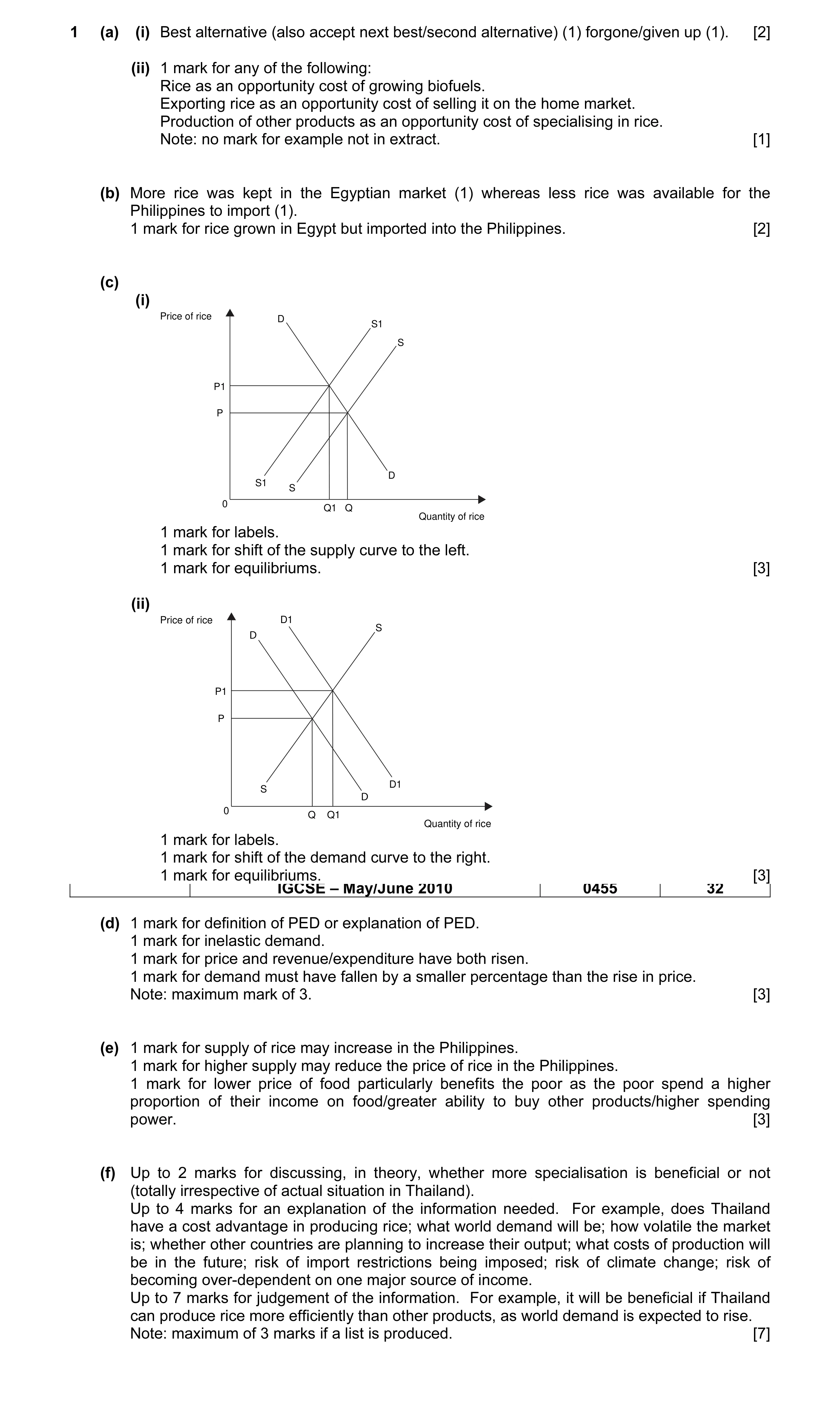
Mark scheme: 1 (a) (i) Best alternative (also accept next best/second alternative) (1) forgone/given up (1). [2] (ii) 1 mark for any of the following: Rice as an opportunity cost of growing biofuels. Exporting rice as an opportunity cost of selling it on the home market. Production of other products as an opportunity cost of specialising in rice. Note: no mark for example not in extract. [1] (b) More rice was kept in the Egyptian market (1) whereas less rice was available for the Philippines to import (1). 1 mark for rice grown in Egypt but imported into the Philippines. [2] (c) (i) Price of rice D S1 S P1 P D S1 S 0 Q1 Q Quantity of rice 1 mark for labels. 1 mark for shift of the supply curve to the left. 1 mark for equilibriums. [3] (ii) Price of rice D1 S D P1 P D1 S D 0 Q Q1 Quantity of rice 1 mark for labels. 1 mark for shift of the demand curve to the right. 1 mark for equilibriums. [3] IGCSE – May/June 2010 0455 32 (d) 1 mark for definition of PED or explanation of PED. 1 mark for inelastic demand. 1 mark for price and revenue/expenditure have both risen. 1 mark for demand must have fallen by a smaller percentage than the rise in price. Note: maximum mark of 3. [3] (e) 1 mark for supply of rice may increase in the Philippines. 1 mark for higher supply may reduce the price of rice in the Philippines. 1 mark for lower price of food particularly benefits the poor as the poor spend a higher proportion of their income on food/greater ability to buy other products/higher spending power. [3] (f) Up to 2 marks for discussing, in theory, whether more specialisation is beneficial or not (totally irrespective of actual situation in Thailand). Up to 4 marks for an explanation of the information needed. For example, does Thailand have a cost advantage in producing rice; what world demand will be; how volatile the market is; whether other countries are planning to increase their output; what costs of production will be in the future; risk of import restrictions being imposed; risk of climate change; risk of becoming over-dependent on one major source of income. Up to 7 marks for judgement of the information. For example, it will be beneficial if Thailand can produce rice more efficiently than other products, as world demand is expected to rise. Note: maximum of 3 marks if a list is produced. [7]
This question in 0455/32 May/June 2010
Q2 · Explain what is meant by opportunity cost 0455/33 May/June 2010
1 (a) (i) Explain what is meant by opportunity cost. … … … … … … … … [2] (ii) Identify, from the extract, one example of opportunity cost. … … [1] (b) Why might the price of rice have increased less in Egypt than in the Philippines in 2008? … … … … … … … … [2] (c) Draw a demand and supply diagram, for each case below, to show the effect on the market for rice of: (i) floods in North Korea [3] (ii) rises in income in China. [3] (d) Does the extract suggest that demand for rice in the Philippines was price elastic or price inelastic in 2008? Explain your answer. … … … … … … … … … … … … [3] (e) Explain why the removal of export restrictions in Vietnam could reduce poverty in the Philippines. … … … … … … … … … … … … [3] (f) Discuss what you would need to know to decide whether Thailand would benefit from specialising even more in rice production. … … … … … … … … … … … … … … … … … … … … … … … … … … … … [7] [Total: 24] The extract ‘A social and economic comparison of selected Indian States 2006’ will be needed for this question.
24 marks
This question in 0455/33 May/June 2010
Q3 · Explain what is meant by primary, secondary and tertiary sectors of production and… 0455/31 Oct/Nov 2010
1 (a) Explain what is meant by primary, secondary and tertiary sectors of production and identify which sectors are referred to in the extract. … … … … … … … … … … … … … … … … … … … … [5] (b) What does the extract mean when it says, ‘a decline in iron ore prices in real terms’? … … … … … … … … … … … … [3] (c) What evidence is there in the extract that the demand for steel from China was a large part of the market? … … … … … … … … [2] (d) Explain, using a demand and supply diagram, the change in the market price for iron ore between 2002 - 2007. … … … … … … [5] (e) Use the information in the extract to suggest what might happen to the price of steel in 2008. … … … … … … … … … … … … … … … … [4] (f) The extract says, ‘successful mining companies used these profits to buy rival competitors in order to cut costs and increase profits even further’. Discuss whether the purchase of another company might lead to lower costs and higher profit. … … … … … … … … … … … … … … … … … … … … … … … … … … … [7] [Total: 26] The extract ‘Reduced furniture prices help bring down inflation’ will be needed for this question.
26 marks
Mark scheme: 1 (a) 1 mark for definition of the primary sector: extraction and collection of raw materials. 1 mark for definition of the secondary sector: the processing of raw materials into semi- finished and finished goods. 1 mark for definition of the tertiary sector: the production of services. 1 mark for identifying the primary sector is referred to (mining). 1 mark for the secondary sector is referred to (manufacturing). [5] (b) 1 mark for stating that prices in real terms have been compared to the rate of inflation. 2 marks for recognising that either inflation was greater than the rise in iron ore prices or iron ore prices fell faster than the price level. [3] (c) 1 mark for the rise in the price of steel was mainly due to higher demand from China. 1 mark for the increase in demand for steel from China was equivalent to either the entire steel output of Germany and/or about half of the output from the United States each year. [2] (d) D1 S D price of P1 iron ore P D1 D S 0 Q Q1 quantity of iron ore 1 mark for labels. 1 mark for shift of demand curve to the right. 1 mark for equilibriums. 1 mark for an increase in demand will raise price. 1 mark for higher price will cause an extension/expansion in supply/increase in quantity supplied. [5] (e) 1 mark for price is expected to fall. 1 mark for the price of iron ore used to make steel is expected to decline/costs of production are expected to fall. 1 mark for price of rival metals is expected to fall. 1 mark for competitive pressure to lower price. 1 mark for recognising the effect is uncertain. 1 mark for large mining companies have market power to set price. 1 mark for demand may continue to rise. Note: maximum mark of 4. [4] IGCSE – October/November 2010 0455 31 (f) Up to 5 marks for considering why such a purchase may lower costs and increase profit: • recognition that whilst total cost may rise, average cost may fall • a larger company may be able to take greater advantage of economies of scale • explanation/examples of economies of scale • buying out a rival company raises market power • higher market power may enable a firm to raise price • lower average cost and higher price will increase profit. Up to 2 marks for why the purchase may not lower average costs and increase profit: • the company purchased may be loss-making • the new company formed may experience diseconomies of scale • examples/explanation of diseconomies of scale. Note: maximum mark of 7. [7]
This question in 0455/31 Oct/Nov 2010
Q4 · What is meant by a finite resource? 0455/31 May/June 2011
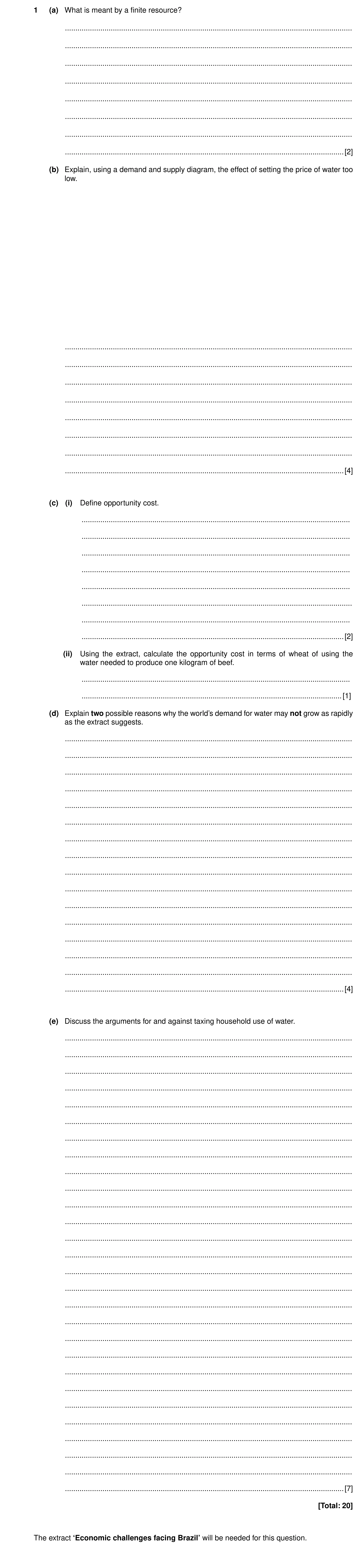
1 (a) What is meant by a finite resource? … … … … … … … … [2] (b) Explain, using a demand and supply diagram, the effect of setting the price of water too low. … … … … … … … … [4] (c) (i) Define opportunity cost. … … … … … … … … [2] (ii) Using the extract, calculate the opportunity cost in terms of wheat of using the water needed to produce one kilogram of beef. … … [1] (d) Explain two possible reasons why the world’s demand for water may not grow as rapidly as the extract suggests. … … … … … … … … … … … … … … … … [4] (e) Discuss the arguments for and against taxing household use of water. … … … … … … … … … … … … … … … … … … … … … … … … … … … … [7] [Total: 20] The extract ‘Economic challenges facing Brazil’ will be needed for this question.
20 marks
Mark scheme: 1 (a) A factor of production/input (1) that is limited in supply/scarce (1). Note: Do not reward examples. [2] (b) D Price S of water P D S 0 QS QD Quantity of water 1 mark for correct labels (D, S, P and Q). 1 mark for price being set below the equilibrium level. 1 mark for stating or showing that demand will exceed supply. 1 mark for supply will fall and demand will rise. 1 mark for explaining that there will be a shortage of water or clearly showing this on the diagram. Note: maximum mark of 4. [4] (c) (i) Best alternative/next best alternative (1) foregone/example bringing out the meaning of foregone (1). [2] (ii) 16 kilograms of wheat. [1] (d) 1 mark for each of two possible reasons identified, such as: • world population may not increase as much as predicted • agriculture/manufacturing may become more efficient • vegetarianism may increase • global warming may not continue • global incomes may fall • tax on water may be introduced by a number of countries • government campaigns to encourage households to save water. 1 mark for each of two possible explanations, such as: • If growth of the world population is less than predicted, the demand for water in general will increase less. • If agriculture becomes more efficient, less water will be needed for each kilogram of food produced. • A rise in vegetarianism will reduce the demand for meat which uses a lot of water to produce it. • If global warming does not continue, there will be fewer droughts and floods. • A fall in global incomes will be likely to reduce the demand for water and the products which use water to produce them. [4] IGCSE – May/June 2011 0455 31 (e) Arguments for taxing household use of water, such as: • may move price to the equilibrium level • would ration a scarce resource • would encourage people not to waste water • would raise revenue. Arguments against taxing household use of water, such as: • difficult to know where to set the tax • the tax will be regressive • the rich may prove unresponsive to the price rise • the tax may cause health problems • agriculture and manufacturing use more water. Up to 5 marks for a one-sided approach. Maximum of 4 marks for a list. [7] $
This question in 0455/31 May/June 2011
Q5 · Calculate the estimated percentage fall in the Japanese population from 2008 to 2050 0455/32 May/June 2011
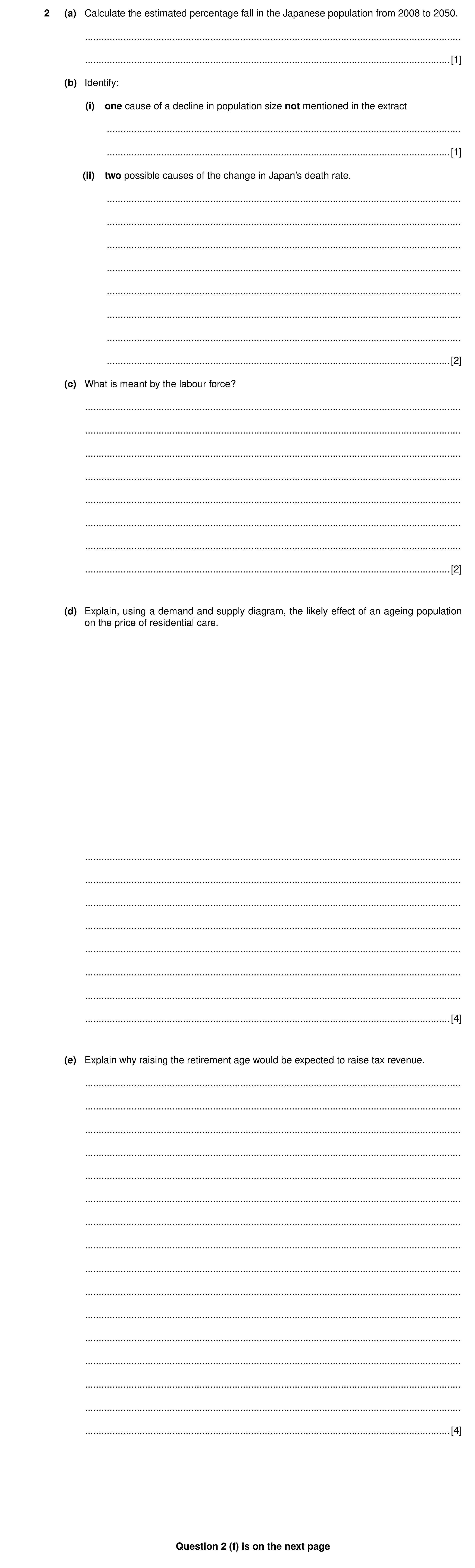
2 (a) Calculate the estimated percentage fall in the Japanese population from 2008 to 2050. … … [1] (b) Identify: (i) one cause of a decline in population size not mentioned in the extract … … [1] (ii) two possible causes of the change in Japan’s death rate. … … … … … … … … [2] (c) What is meant by the labour force? … … … … … … … … [2] (d) Explain, using a demand and supply diagram, the likely effect of an ageing population on the price of residential care. … … … … … … … … [4] (e) Explain why raising the retirement age would be expected to raise tax revenue. … … … … … … … … … … … … … … … … [4] Question 2 (f) is on the next page
14 marks
Mark scheme: 2 (a) 25% [1] (b) (i) 1 mark for either (net) emigration or a rise in the death rate (such as earthquake). Do not accept people marrying later or decline in number of marriages. [1] (ii) 1 mark each for any two valid causes of a falling death rate, e.g. • a healthier lifestyle, e.g. better diet, more exercise • advances in medical care • better housing • improved working conditions • less pollution. [2] (c) 2 marks for those in work and those seeking work, or employed and unemployed, or those who are economically active. 1 mark for those working/workers. [2] (d) 1 mark for correct labels (D, S, P and Q). 1 mark for shift of the demand curve to the right. 1 mark for correct equilibriums (indicated by lines only is sufficient). 1 mark for mentioning that the quantity bought and sold will be likely to rise. 1 mark for mentioning that price will be likely to rise. Note: maximum mark of 4. [4] (e) It would increase those who are working (1). Those affected are likely to receive higher incomes (1) and so pay more income/direct tax (1) and would spend more (1) and so pay more indirect taxes (1). Also reward a business paying more direct tax in the form of corporation tax (1) as a result of increased output/expenditure/profit (1). Note: maximum mark of 4. [4] IGCSE – May/June 2011 0455 32 (f) 1 mark for identification of each piece of information, up to a maximum of three, e.g. • size of population relative to the optimum size (candidates do not need to refer to this term) • current birth rate • current death rate • average age of population • net migration figure • employment level • resources available • short and long term effects. Up to 3 marks for discussing how the information would aid the assessment, e.g. a rise in a country’s birth rate would benefit its economy if: • the population is currently below the optimum level • the country has a labour shortage • the country is well endowed with resources other than labour • the population is ageing and declining • a short term reduction in the size of the labour force is offset by a long term increase in it. Note: up to 3 marks for strong discussion of one piece of information. Note: a maximum of 3 marks for just discussing a rise in the birth rate and ignoring the information needed. [6]
This question in 0455/32 May/June 2011
Q6 · Calculate the estimated percentage fall in the Japanese population from 2008 to 2050 0455/33 May/June 2011
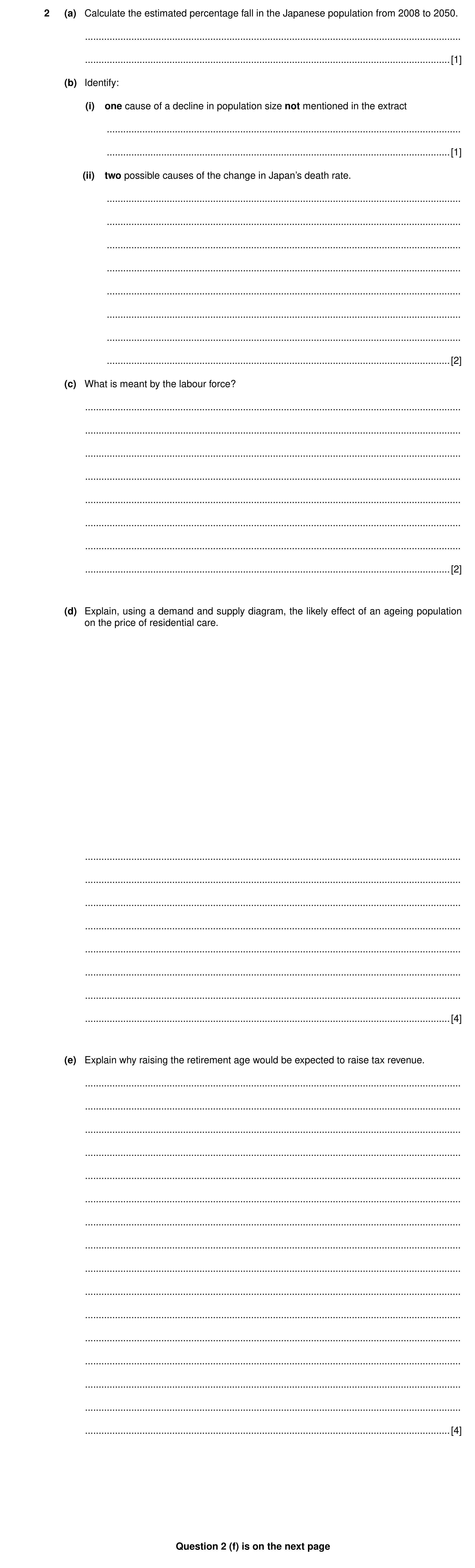
2 (a) Calculate the estimated percentage fall in the Japanese population from 2008 to 2050. … … [1] (b) Identify: (i) one cause of a decline in population size not mentioned in the extract … … [1] (ii) two possible causes of the change in Japan’s death rate. … … … … … … … … [2] (c) What is meant by the labour force? … … … … … … … … [2] (d) Explain, using a demand and supply diagram, the likely effect of an ageing population on the price of residential care. … … … … … … … … [4] (e) Explain why raising the retirement age would be expected to raise tax revenue. … … … … … … … … … … … … … … … … [4] Question 2 (f) is on the next page
14 marks
Mark scheme: 2 (a) 25% [1] (b) (i) 1 mark for either (net) emigration or a rise in the death rate (such as earthquake). Do not accept people marrying later or decline in number of marriages. [1] (ii) 1 mark each for any two valid causes of a falling death rate, e.g. • a healthier lifestyle, e.g. better diet, more exercise • advances in medical care • better housing • improved working conditions • less pollution. [2] (c) 2 marks for those in work and those seeking work, or employed and unemployed, or those who are economically active. 1 mark for those working/workers. [2] (d) 1 mark for correct labels (D, S, P and Q). 1 mark for shift of the demand curve to the right. 1 mark for correct equilibriums (indicated by lines only is sufficient). 1 mark for mentioning that the quantity bought and sold will be likely to rise. 1 mark for mentioning that price will be likely to rise. Note: maximum mark of 4. [4] (e) It would increase those who are working (1). Those affected are likely to receive higher incomes (1) and so pay more income/direct tax (1) and would spend more (1) and so pay more indirect taxes (1). Also reward a business paying more direct tax in the form of corporation tax (1) as a result of increased output/expenditure/profit (1). Note: maximum mark of 4. [4] IGCSE – May/June 2011 0455 33 (f) 1 mark for identification of each piece of information, up to a maximum of three, e.g. • size of population relative to the optimum size (candidates do not need to refer to this term) • current birth rate • current death rate • average age of population • net migration figure • employment level • resources available • short and long term effects. Up to 3 marks for discussing how the information would aid the assessment, e.g. a rise in a country’s birth rate would benefit its economy if: • the population is currently below the optimum level • the country has a labour shortage • the country is well endowed with resources other than labour • the population is ageing and declining • a short term reduction in the size of the labour force is offset by a long term increase in it. Note: up to 3 marks for strong discussion of one piece of information. Note: a maximum of 3 marks for just discussing a rise in the birth rate and ignoring the information needed. [6]
This question in 0455/33 May/June 2011
Q7 · Which two government aims are referred to in the extract? 0455/33 Oct/Nov 2011
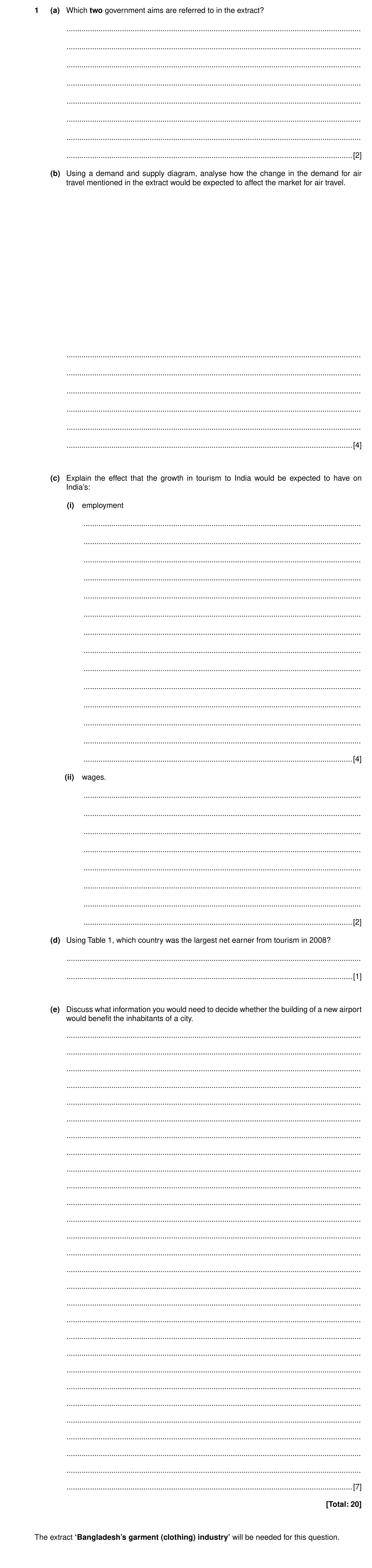
1 (a) Which two government aims are referred to in the extract? … … … … … … … … [2] (b) Using a demand and supply diagram, analyse how the change in the demand for air travel mentioned in the extract would be expected to affect the market for air travel. … … … … … … [4] (c) Explain the effect that the growth in tourism to India would be expected to have on India’s: (i) employment … … … … … … … … … … … … … … [4] (ii) wages. … … … … … … … … [2] (d) Using Table 1, which country was the largest net earner from tourism in 2008? … … [1] (e) Discuss what information you would need to decide whether the building of a new airport would benefit the inhabitants of a city. … … … … … … … … … … … … … … … … … … … … … … … … … … … … [7] [Total: 20] The extract ‘Bangladesh’s garment (clothing) industry’ will be needed for this question.
20 marks
Mark scheme: 1 (a) 1 mark for full employment/lower unemployment. 1 mark for increasing GDP/economic growth. [2] (b) Price of air travel Quantity of air travel 1 mark for labels. 1 mark for shift of the demand curve to the right. 1 mark for correct equilibriums. 1 mark for mentioning that the quantity of air travel bought and sold would increase. 1 mark for mentioning that the increase in demand would tend to increase the price of air travel. Note: maximum mark of 4. [4] IGCSE – October/November 2011 0455 33 (c) (i) Employment: It would be expected to increase employment (1). More jobs will be created in the tourism industry (1) and more employment created in infrastructure (1). Higher employment will lead to more spending, which will generate more jobs (1). Impact on employment will depend on the extent of the rise (1). Some jobs may be filled by people outside the country (1), some jobs may be seasonal (1). Tax revenue may rise (1), which will enable the government to spend more on increasing the skills of the labour force (1). Maximum of 4 marks. [4] (ii) Wages: It would be likely to raise wages (1) as demand for labour would increase/raise ability of firms to pay higher wages (1). Note: accept a diagram which shows demand for labour shifting to the right and wages increasing for 2 marks. [2] (d) Spain. [1] (e) Up to 4 marks for identification of relevant information, for example: • level of capacity at any existing airports • direct and indirect effect on employment • effect on ease of travel to and from the city • where the airport is built • effect on air • noise and visual pollution • private costs • private benefits • external costs • external benefits. Up to 4 marks for commenting on the relevant information, for example: will be more beneficial if any existing airport is working at full capacity, the building of an airport will employ building workers, may increase tourism and may attract new firms into the city but the airport may be built on land of outstanding natural beauty and the pollution resulting from the airport may reduce the quality of people’s lives. A cost-benefit analysis could be conducted to assess whether the building of the airport would be beneficial. Note: a maximum of 3 marks if the answer just discusses whether the building of a new airport would benefit the inhabitants of a city without reference to the information needed. 2 marks if this approach is one-sided. [7] $ $
This question in 0455/33 Oct/Nov 2011
Q8 · Identify, from the extract, two influences on the demand for tea 0455/31 May/June 2012
2 (a) Identify, from the extract, two influences on the demand for tea. … … … … … … … … [2] (b) (i) Explain what is likely to have happened to the price of Kenyan tea in 2009. … … … … … … … … [2] (ii) Explain what is likely to have happened to the price of Kenyan tea in 2010. … … … … … … … … [2] (c) Using information from the extract, explain two reasons why Kenyan tea pickers may want to switch to other jobs. … … … … … … … … … … … … … … … … [4] (d) Why is there a high average cost of producing tea in Kenya? … … … … … … … … … … … … … … … … [4] (e) Discuss whether giving a subsidy to Kenyan tea farmers would be likely to increase sales of Kenyan tea to Pakistan. … … … … … … … … …
14 marks
Mark scheme: 2 (a) 1 mark for each of two influences from price, quality and tastes. [2] (b) (i) 1 mark for price is likely to have increased. 1 mark for because supply decreased/tea became more scarce/idea of lower supply. (Accept a diagrammatic approach.) [2] (ii) 1 mark for price is likely to have fallen. 1 mark for because supply increased/oversupply/idea of higher supply. (Accept a diagrammatic approach.) [2] (c) 1 mark for each of two reasons identified e.g. • risk of unemployment • disruption to income/earnings • low wages/fluctuations in wages • hard physical job/poor working conditions • fear of change due to possible movement towards more capital intensive methods • fear of change due to increasing competition from other tea-producing countries. 1 mark for each of two explanations e.g. • Tea pickers may want greater stability/security of employment or income/suffer from greater fluctuations in employment or income/experience seasonal unemployment. • Tea pickers may be attracted by higher wages in other jobs/explanation of why wages are low in tea picking explanation that low wages result in low living standards. • Tea picking may have to be undertaken in bad weather conditions or with little capital equipment to help/working conditions may be more favourable in other jobs. • Workers may lack the skills to adapt to new methods of production/skills required in other jobs are not changing, or new methods of production may result in unemployment. Note that the explanation marks may be gained either by explaining why the reason identified occurs (e.g. fluctuations in output, increasing competition from tea producers in other countries, falling demand for Kenyan tea) or why other jobs would be more attractive. [4] IGCSE – May/June 2012 0455 31 (d) 1 mark for small scale of production. 1 mark for little use of capital equipment/labour-intensive method of production. 1 mark for inability to spread fixed cost over a high output/high average fixed cost. 1 mark for increasing output may increase efficiency or productivity/low-scale output is inefficient/labour intensive production may be inefficient/capital intensive production may be efficient. 1 mark for inability to take advantage of economies of scale. Up to 2 marks for describing the types of economies of scale that larger tea producers could experience. [4] (e) Why it might increase sales, e.g. it may • increase supply • lower price • or award up to 2 marks for the above points if shown in a relevant diagram • reduce costs of production • make Kenyan tea more price competitive • make Kenyan tea farmers more efficient • allow Kenyan tea farmers to benefit from economies of scale • provide funds for reinvestment • improve quality. Why it might not increase sales, e.g. • price may not fall below rivals • a recession may occur in Pakistan • import restrictions may be imposed by Pakistan • taste/quality may still favour other countries • there is a risk that Kenyan tea farmers will become reliant on the subsidy and so become inefficient • other factors may influence supply e.g. weather conditions may prevent supply increasing • other tea-producing countries may also subsidise tea production. Maximum of 4 marks for a one sided approach. Maximum of 3 for a list or list-like approach. [6]
This question in 0455/31 May/June 2012
Question 9 0455/32 May/June 2013
1 (a) (i) Define external costs. … … … … … … … … [2] (ii) Using information from the extract, explain two external costs which arise from the use of plastic bags. … … … … … … … … … … … … … … … … [4] (b) Using a demand and supply diagram, explain the effect a tax imposed on the sale of plastic bags would have on the market for plastic bags. … … … … … … … … … … … … … … … … [4] (c) Using information from the extract, explain one disadvantage of banning plastic bags. … … … … … … … … [2] (d) Calculate the percentage of the plastic bags used worldwide in 2011 which were consumed in the USA. … … … … … … … … [2] (e) Discuss whether an increase in tourism will always benefit a country. … … … … … … … … … … … … … … … … … … … … … … … … [6] [Total: 20] The extract ‘Will India overtake China?’ will be needed for this question.
20 marks
Mark scheme: 1 (a) (i) Two marks for the idea of harmful effects imposed on third parties/those not involved with producing or consuming the product. Two marks for social costs minus private costs (also accept social costs = private costs plus external costs). One mark for harmful effects (credit an appropriate example such as pollution). Do not credit just repetition of ‘costs’. One mark for identifying those affected i.e. third parties/others/those not involved with producing or consuming the product (credit an appropriate example such as those who experienced floods because plastic bags have blocked drains). Note: no marks for a general comment referring to the impact on people/society /community (confusion with social costs). Note: maximum of 2 marks. [2] (ii) One mark each for each of two relevant costs identified and one mark each for each of two explanations i.e. • bags being dumped at sea (creating environmental damage) (1)/cause wildlife to die or beaches to be polluted/costs fall on those not involved in making or buying plastic bags (1) • floods and or diseases resulting from litter blocking drains and sewers (1) cause health care costs/deaths or damage to buildings/costs fall on those not involved in making or buying plastic bags (1) • landfill sites (1) can cause visual, air and water pollution/use up resources/costs fall on those not involved in making or buying plastic bags (1) • visual pollution/dirty streets/litter (1) can reduce tourism/take some resources to clean up litter could have been used for other purposes/reduction in tourism/costs fall on those not involved in making or buying plastic bags (1). Note: maximum of 4 marks. [4] IGCSE – May/June 2013 0455 32 (b) One mark for correct labels – P, Q, D and S. One mark for shift of supply curve to the left. One mark for original and new equilibriums. One mark for explaining that price would rise. [4] (c) One mark for identifying unemployment. One mark for explanation i.e. production of plastic bags will stop/firms will close down/supply of plastic bags will fall/firms’ revenue or profits will fall. Or: One mark for identifying loss of tax revenue. One mark for some governments currently tax plastic bags. [2] (d) Two marks for 12.5%. One mark for correct working i.e. 100bn/800bn x 100. [2] (e) Up to four marks for discussing the benefits of tourism e.g. • a rise in GDP • higher employment • rise in export revenue. Up to four marks for discussing disadvantages of tourism/qualifications to advantages e.g. • jobs may be low skilled • jobs may be seasonal • external costs • hotels may be owned by multinational companies • inflation may arise if demand increases by more than supply or if pushes up wages/ costs. Up to three marks for a list-like approach. Up to three marks for any one point identified and discussed. Note: no marks for increased use of plastic bags. Note: a maximum mark of 6. [6] IGCSE – May/June 2013 0455 32
This question in 0455/32 May/June 2013
Q10 · Identify two disadvantages of small scale production referred to in the extract 0455/33 May/June 2013
1 (a) Identify two disadvantages of small scale production referred to in the extract. … … … … … … … … [2] (b) Using information from the extract, explain two reasons why the price of rubber increased in 2011. … … … … … … … … … … … … … … … … [4] (c) Explain two functions of money referred to in the extract. … … … … … … … … … … … … … … … … [4] (d) Using information from the extract, explain two reasons why demand for rubber from Thailand may decrease in the future. … … … … … … … … … … … … … … … … [4] (e) Discuss what factors will influence whether people will want to work for a large rubber producing firm. … … … … … … … … … … … … … … … … … … … … … … … … [6] [Total: 20] The extract ‘Cuba moves towards a market economy’ will be needed for this question.
20 marks
Mark scheme: 1 (a) 1 mark for lack of capital. 1 mark for inability to take advantage of economies of scale/high average costs. [2] (b) 1 mark each for each of 2 reasons identified i.e. decrease in supply and increase in demand. 1 mark each for each of 2 explanations i.e. supply decreased due to bad weather, demand increased due to increasing global demand for tyres. [4] (c) 1 mark for identifying a standard for deferred payment with: 1 mark for explaining that is money is being used to borrow and to repay. 1 mark for identifying a store of value with: 1 mark for explaining that people are saving money. 1 mark for identifying unit of account (measure of value)/medium of exchange with: 1 mark for referring to prices/buying or selling. [4] (d) 1 mark for identifying increased competition from larger Chinese plantations. 1 mark for explaining these Chinese plantations may produce rubber more cheaply. 1 mark for identifying the quantity of synthetic rubber may rise. 1 mark for explaining synthetic and natural rubber are substitutes/people may switch from buying natural rubber to buying synthetic rubber. 1 mark for identifying bad weather may continue. 1 mark for explaining lower supply will raise price which will reduce demand. [4] (e) Up to 3 marks for identifying factors e.g. • wage rate • holidays • promotion chances • job security • job satisfaction • location. Up to 4 marks for discussing factors e.g. more people will want to work for a large rubber firm if: • the wage rate is high • there are long holidays • promotion chances are good • there is a high level of job security • a high level of job satisfaction • the firm is close to where people live. Note: up to three marks for any one point identified and discussed. Up to three marks for a list-like approach. Note: a maximum mark of 6. [6] IGCSE – May/June 2013 0455 33
This question in 0455/33 May/June 2013
Question 11 0455/31 Oct/Nov 2013
1 (a) (i) Define equilibrium price. … … … … … … … … [2] (ii) Explain two possible reasons why the price of rice rose in some countries but fell in other countries. … … … … … … … … … … … … … … … … [4] (b) Using a demand and supply diagram, explain the effect of a rise in the price of oil on the market for food. … … … … … … … … … … … … … … … … [4] (c) (i) Calculate the weighting of food in Uganda’s Consumer Prices Index. … … … … … … … … [2] (ii) Why do rising food prices harm the poor more than the rich? … … … … … … … … [2] (d) Discuss what information you would need to assess whether inflation will be harmful to an economy. … … … … … … … … … … … … … … … … … … … … … … … … [6] [Total: 20] The extract ‘Youth unemployment’ will be needed for this question.
20 marks
Mark scheme: 1 Rising food prices (a) (i) Define equilibrium price. [2] 1 mark for the price where demand and supply are equal/where demand and supply curves meet. 1 mark for the price where there are no surpluses or shortages/no upward or downward pressure on price. (ii) Explain two possible reasons why the price of rice rose in some countries but fell in other countries. [4] 1 mark for each of two possible reasons – demand increased in some countries but decreased in others, supply decreased in some but rose in others. 1 mark for each of two possible explanations of why demand and supply may have changed in different directions e.g. differences in income changes, weather conditions, production costs and taxation. (b) Using a demand and supply diagram, explain the effect of a rise in the price of oil on the market for food. [4] S1 Price D of Food S P1 P S1 S D Q1 Q Quantity 0 1 mark for correct labels – P, Q, D and S. 1 mark for shift of the supply curve to the left. 1 mark for original and new equilibriums. 1 mark for explaining that quantity would fall and price would rise or that higher oil prices will increase costs of production. Note: also accept a diagram showing the demand curve shifting to the left on the basis of food and oil being complementary goods. IGCSE – October/November 2013 0455 31 (c) (i) Calculate the weighting of food in Uganda’s Consumer Prices Index. [2] 2 marks for 27%. 1 mark for correct working i.e. US$324/US$1200 × 100. (ii) Why do rising food prices harm the poor more than the rich? [2] 2 marks for the poor spend a higher proportion of their total household spending on food. 1 mark for the idea of the poor having less money available to spend. 1 mark for poor may suffer from malnutrition/risk of starving to death. (d) Discuss what information you would need to assess whether inflation will be harmful to an economy. [6] Up to 3 marks for identifying relevant factors e.g. • rate • rate relative to other countries • stability or otherwise • cause • government policies to tackle inflation • impact on other government aims • whether costs exceed benefits. Up to 4 marks for discussing relevant factors e.g. • hyperinflation can be very harmful as money may cease to be acceptable • creeping inflation may not be as harmful • inflation lower than rival countries may not be harmful to international competitiveness/if trade position is improving, its suggest that inflation is not that harmful • stable inflation is less harmful than accelerating inflation as it makes it easier to plan • government policies to reduce inflation may cause unemployment • inflation may reduce the real burden of debt • cost-push inflation is likely to be more harmful than demand-pull inflation • if economic growth is rising/unemployment is falling, it suggests that inflation is not that harmful. IGCSE – October/November 2013 0455 31
This question in 0455/31 Oct/Nov 2013
Q12 · Using information from the extract, calculate the percentage change in the price of… 0455/32 Oct/Nov 2013
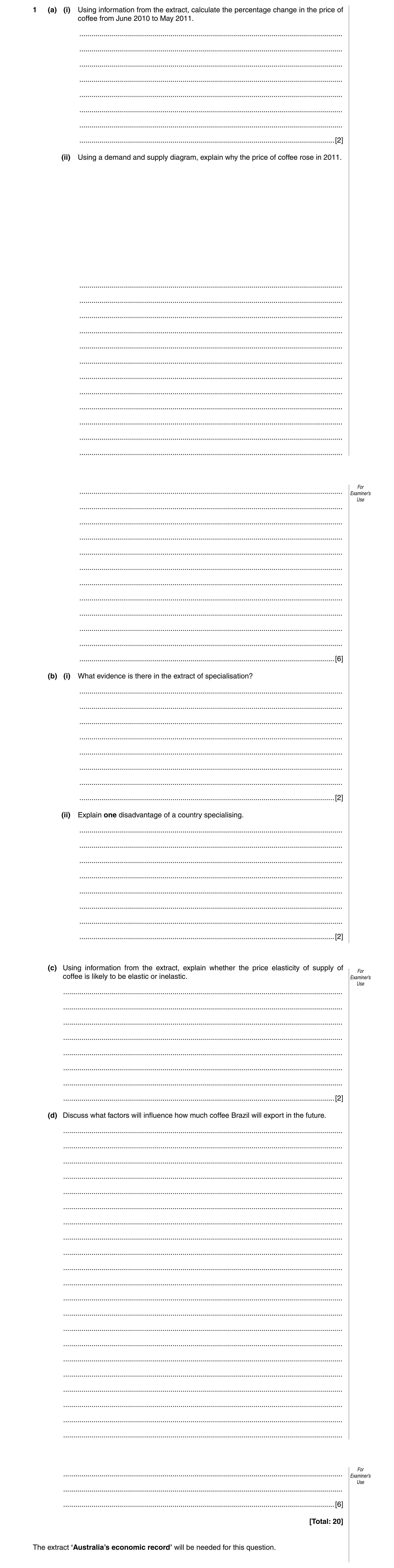
1 (a) (i) Using information from the extract, calculate the percentage change in the price of coffee from June 2010 to May 2011. … … … … … … … … [2] (ii) Using a demand and supply diagram, explain why the price of coffee rose in 2011. … … … … … … … … … … … … … … … … … … … … … … … … [6] (b) (i) What evidence is there in the extract of specialisation? … … … … … … … … [2] (ii) Explain one disadvantage of a country specialising. … … … … … … … … [2] (c) Using information from the extract, explain whether the price elasticity of supply of coffee is likely to be elastic or inelastic. … … … … … … … … [2] (d) Discuss what factors will influence how much coffee Brazil will export in the future. … … … … … … … … … … … … … … … … … … … … … … … … [6] [Total: 20] The extract ‘Australia’s economic record’ will be needed for this question.
20 marks
Mark scheme: 1 The changeable coffee market (a) (i) Using information from the extract, calculate the percentage change in the price of coffee from June 2010 to May 2011. [2] 2 marks for 66.67%/66.7%/67%/66.6%. 1 mark for correct working i.e. $1.20/$1.80 × 100/2/3%/0.67%. (ii) Using a demand and supply diagram, explain why the price of coffee rose in 2011. [6] Price of D1 S1 S Coffee D P1 P S1 D1 S D 0 Q/Q1 Quantity of Coffee 1 mark for correct labels – P, Q, D and S. 1 mark for shift in the supply curve to the left. 1 mark for shift in the demand curve to the right. 1 mark for original and new equilibriums. (Note: the effect on quantity is uncertain. Accept new quantity as unchanged, lower or higher depending on relative shifts.) 1 mark for explaining why demand increased: increased consumption in Brazil, China and India/rise in global demand. 1 mark for explaining why supply decreased: bad weather/natural disasters. IGCSE – October/November 2013 0455 32 (b) (i) What evidence is there in the extract of specialisation? [2] 1 mark for coffee accounting for a high proportion (of Ethiopia’s) export revenue. 1 mark for a relatively high proportion (of Ethiopia’s) labour force employed in growing coffee. (ii) Explain one disadvantage of a country specialising. [2] 1 mark for identifying a disadvantage – risk of demand falling/costs rising/disruption to supplies/increased dependency/depletion of natural resources. 1 mark for explaining either the cause or the consequence of the disadvantage, e.g. tastes changing/rivals increasing or supply difficulties/lower employment/ lower export revenue. Examiner’s note: no marks for a disadvantage of workers specialising, e.g. boredom. (c) Using information from the extract, explain whether the price elasticity of supply of coffee is likely to be elastic or inelastic. [2] 1 mark for stating it is inelastic. 1 mark for explanation i.e. it takes approximately three years to adjust the supply of coffee/long time to produce coffee. (d) Discuss what factors will influence how much coffee Brazil will export in the future. [6] Up to 3 marks for identifying relevant factors, e.g. • level of demand at home and abroad • relative price of Brazilian coffee • weather conditions • import restrictions • quality of Brazilian coffee • exchange rate changes. Up to 4 marks for explanation, e.g. • if incomes abroad rise, demand is likely to increase • higher Brazilian consumption may reduce the amount which can be exported • if Brazilian coffee rises in price by more than rival producers, demand may fall • adverse weather conditions would reduce the ability to export • the imposition of tariffs etc. would reduce Brazil’s ability to export • a rise in the quality of Brazilian coffee is likely to result in higher demand • higher productivity could reduce costs and increase price competitiveness • a rise in Brazil’s exchange rate may make it more difficult to export as export prices would rise. Examiner’s note: 3 × 2. IGCSE – October/November 2013 0455 32
This question in 0455/32 Oct/Nov 2013



 24
24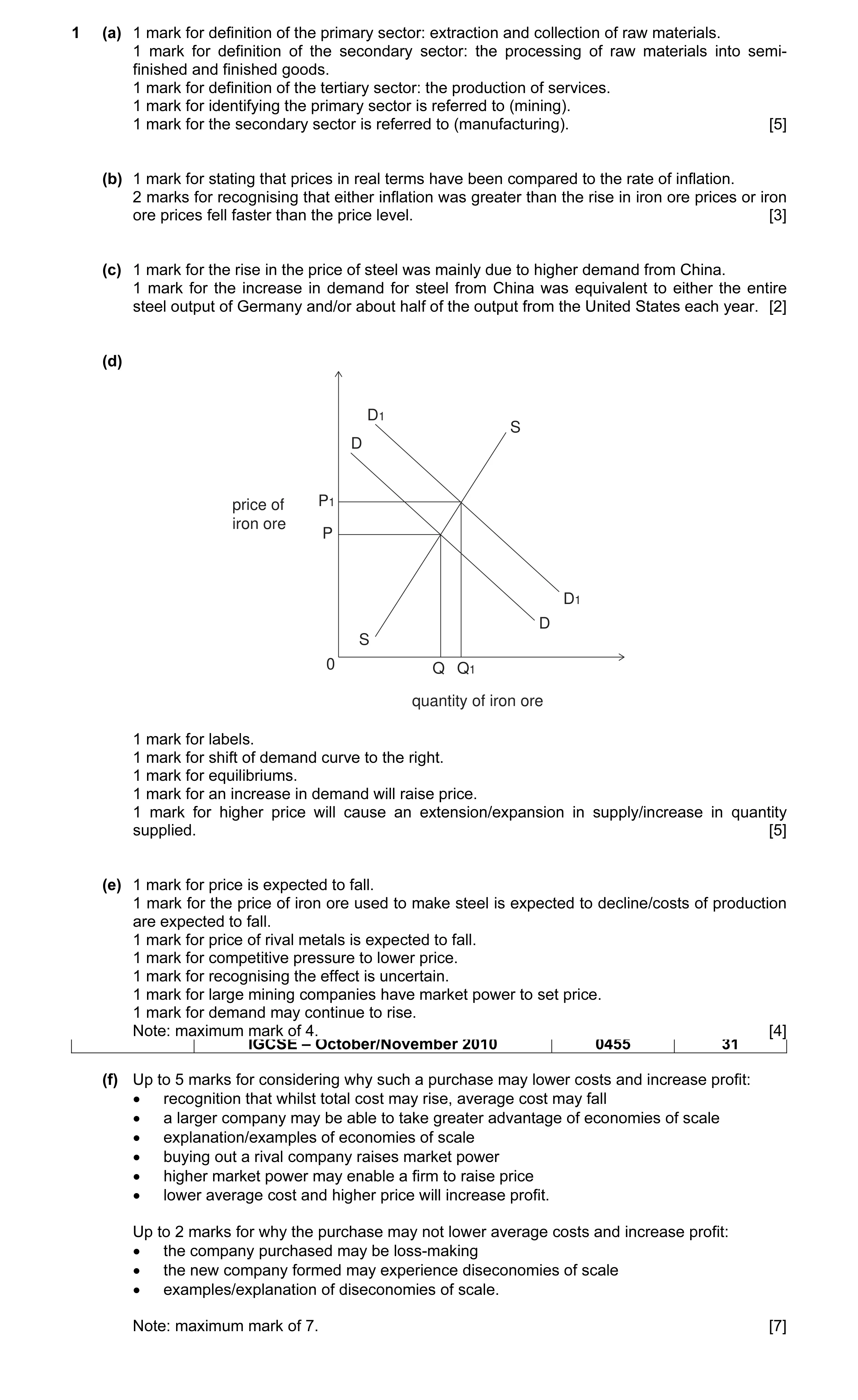 26
26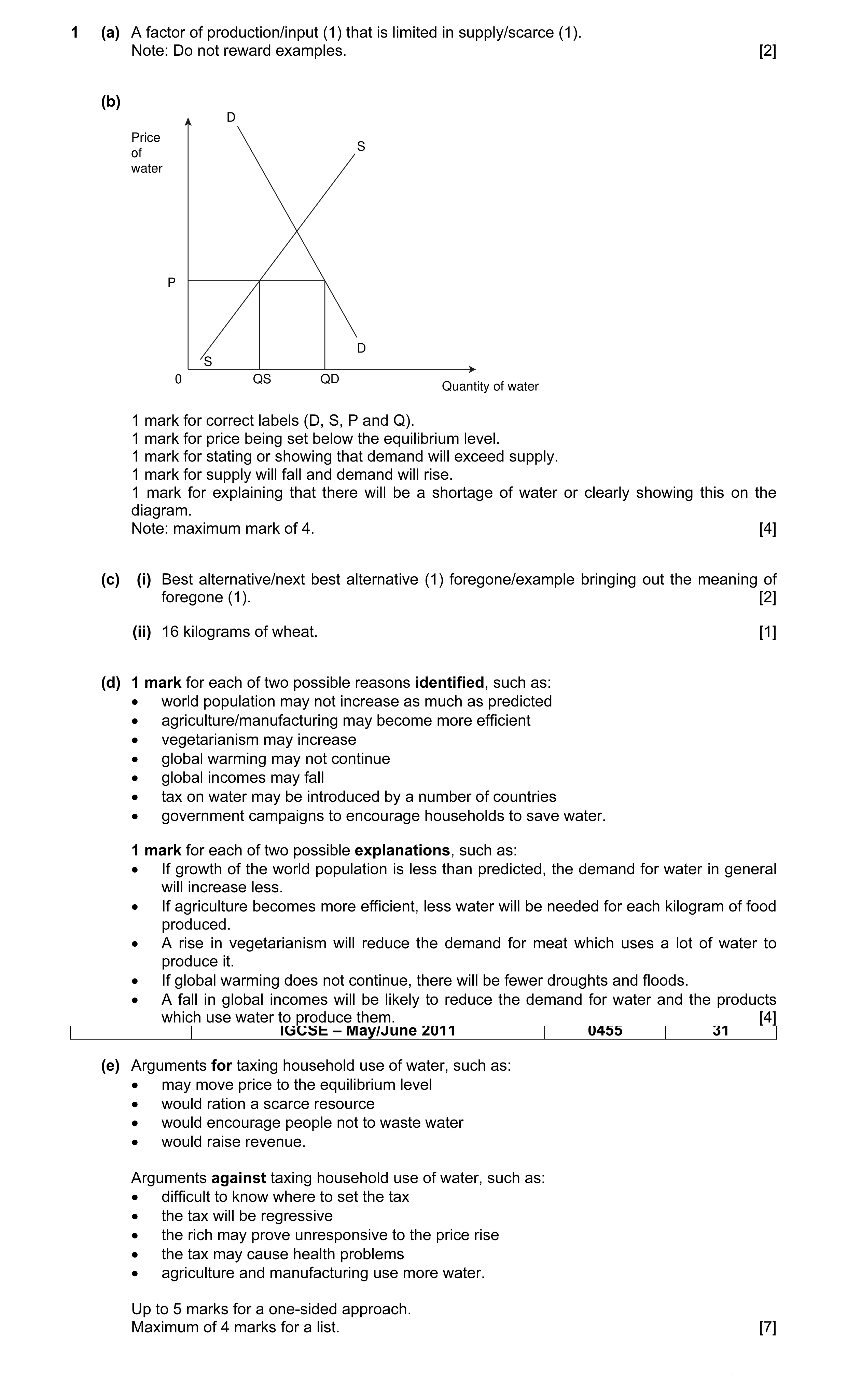 20
20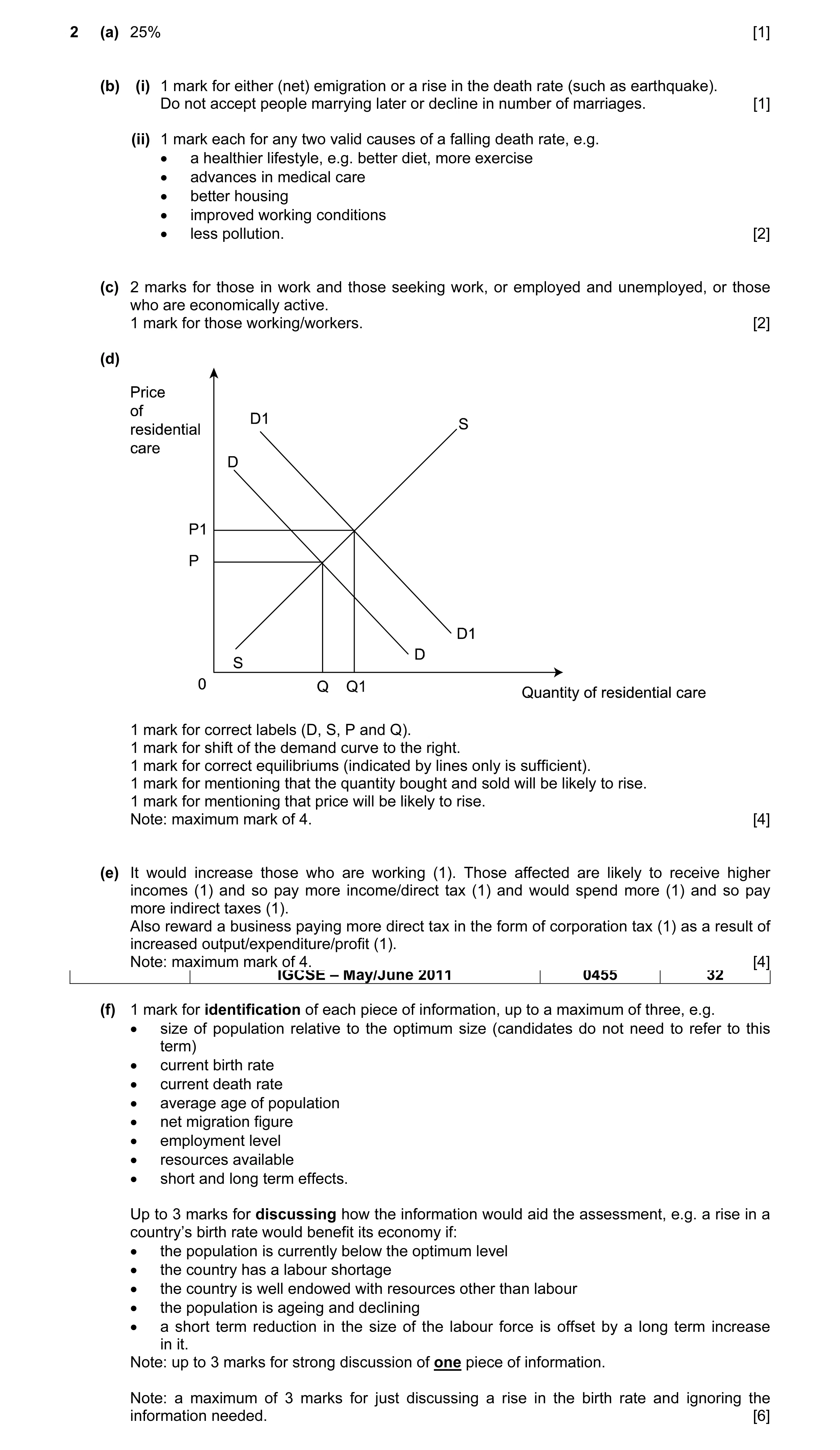 14
14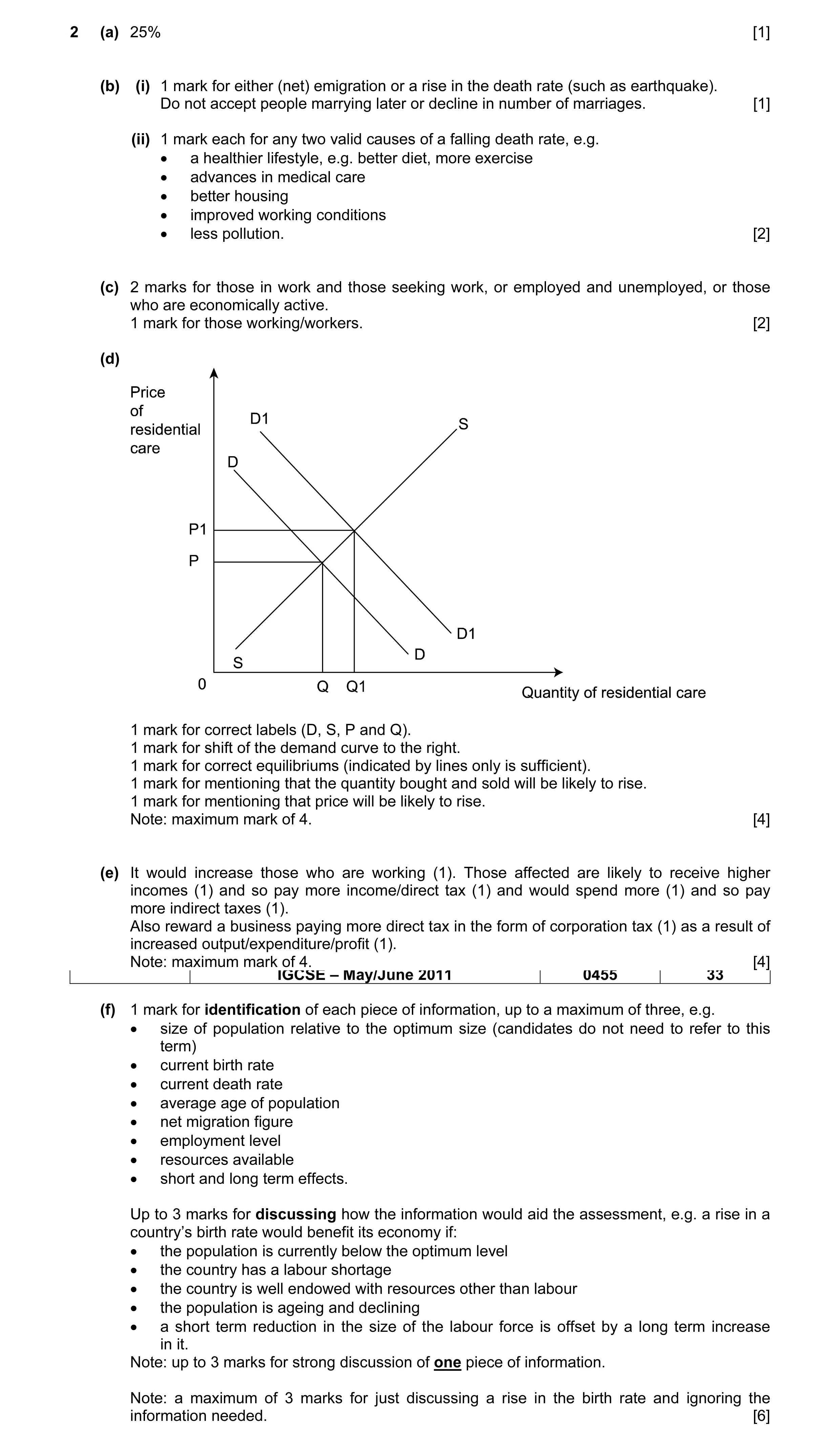 14
14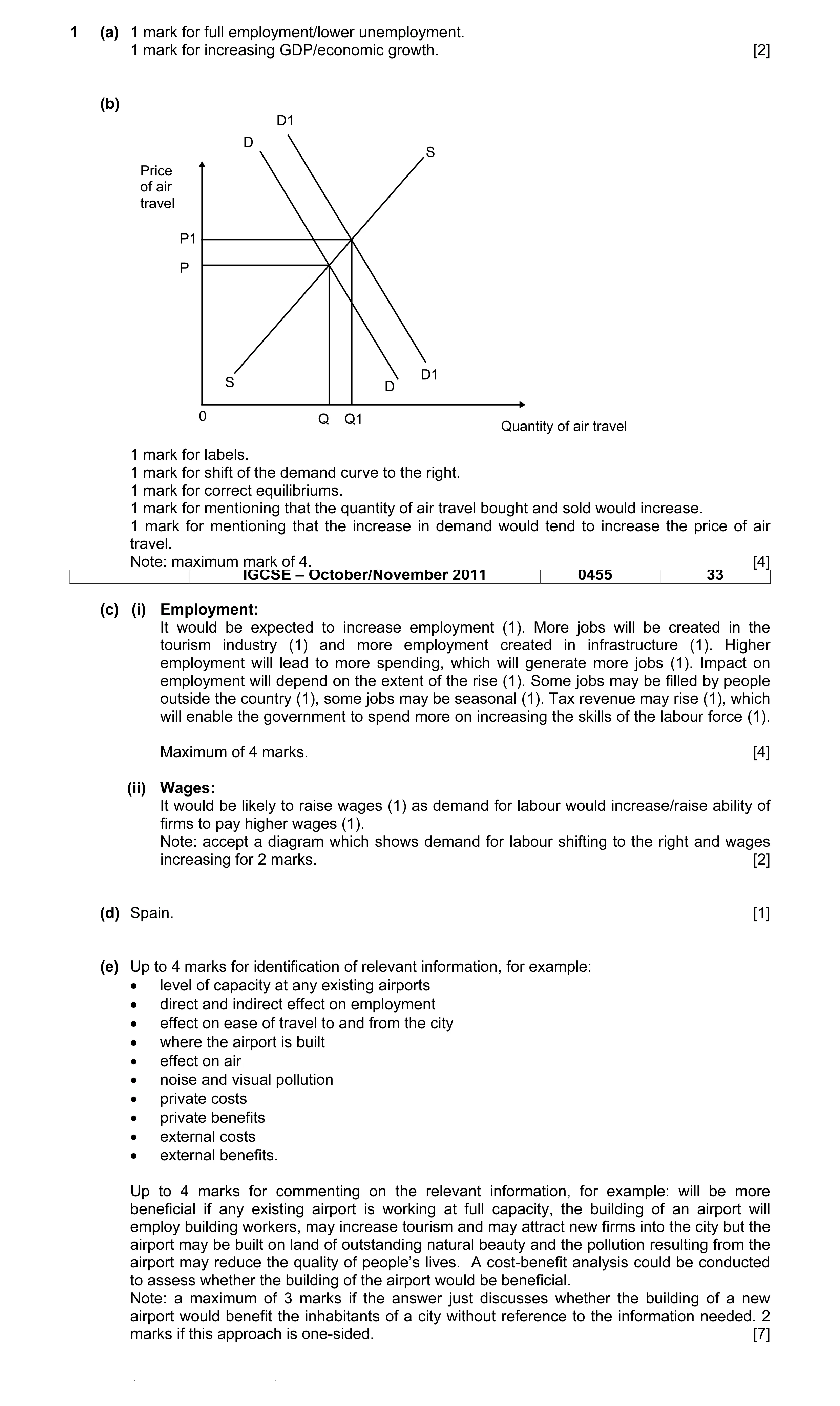 20
20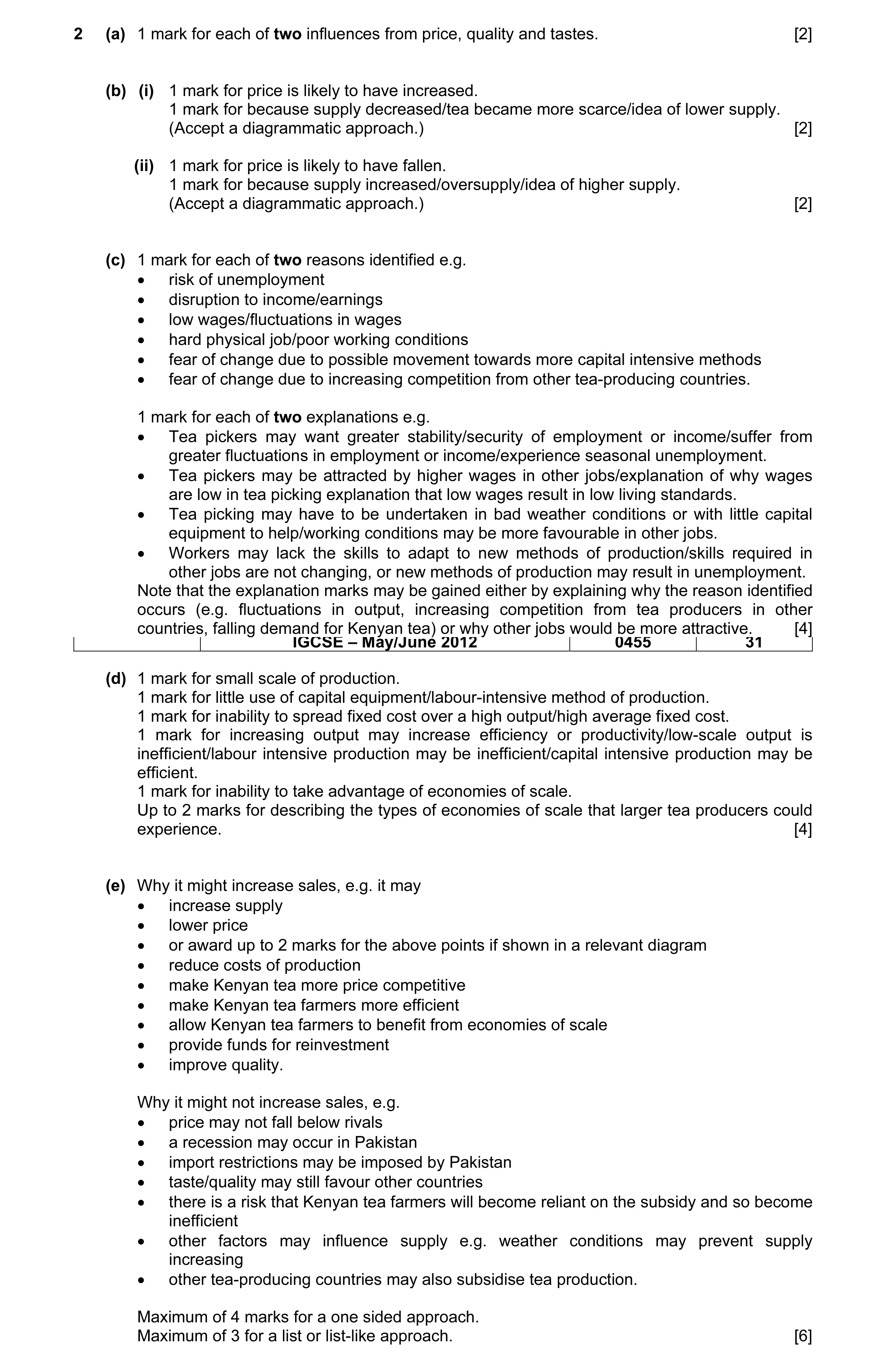 14
14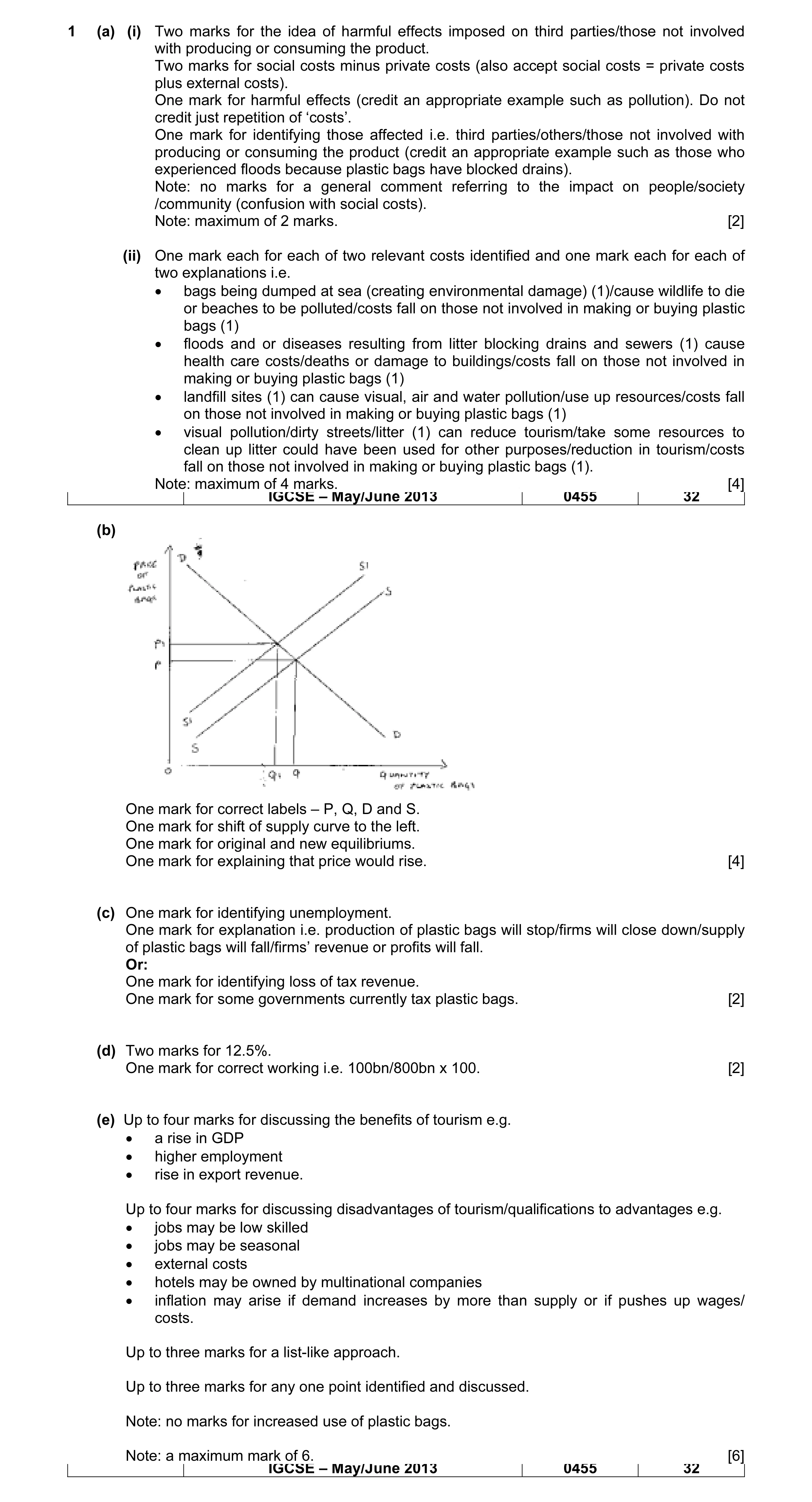 20
20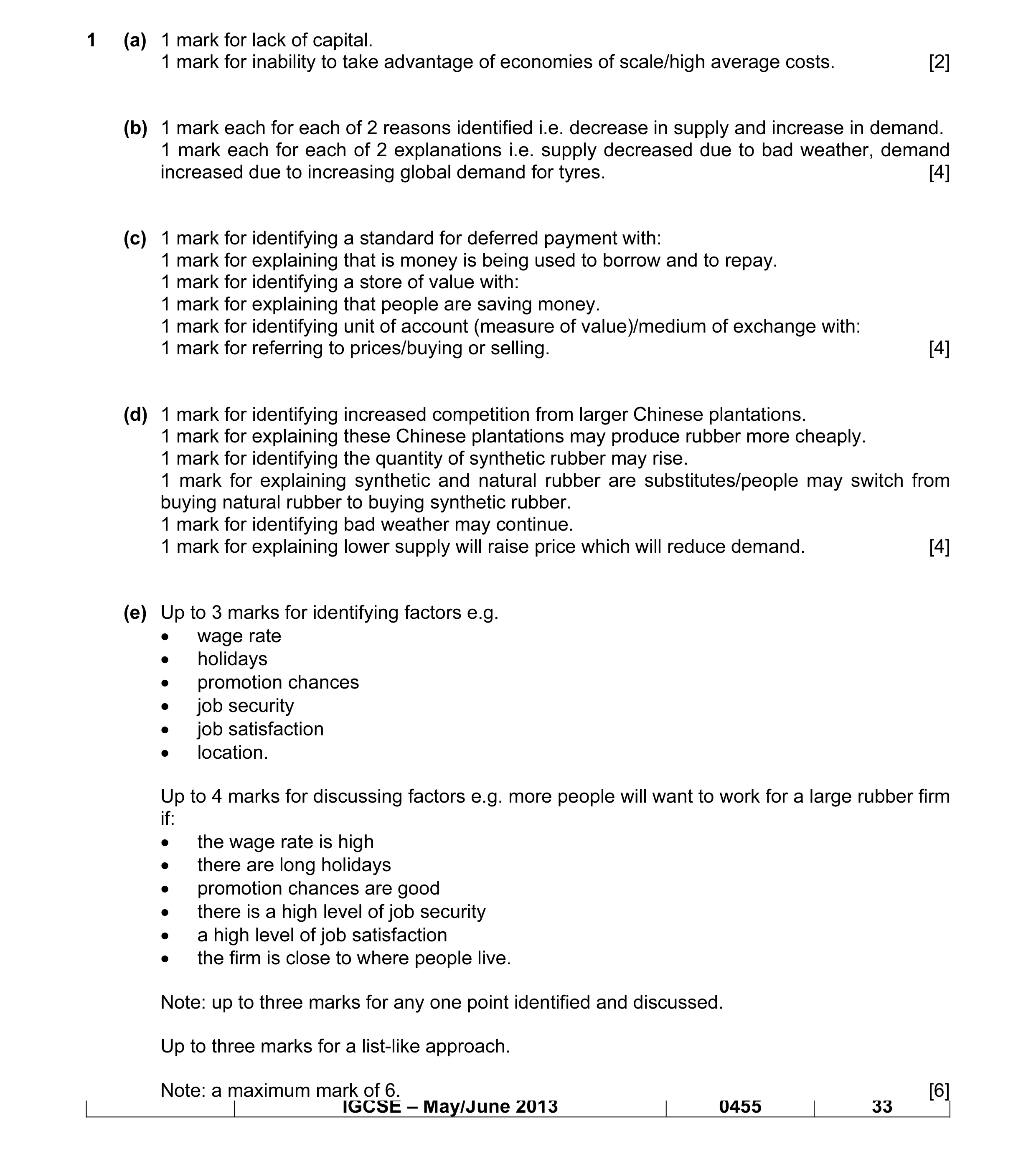 20
20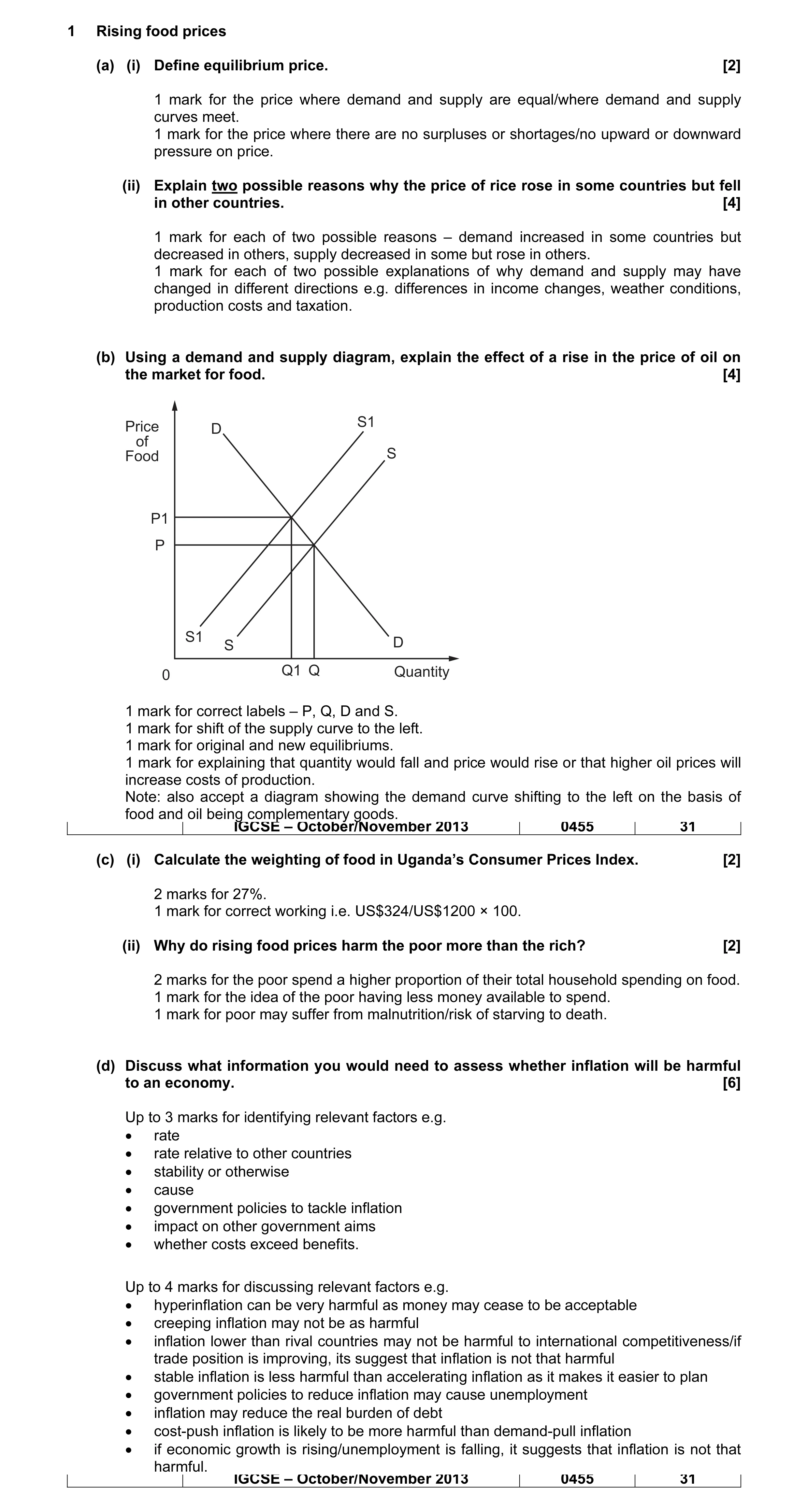 20
20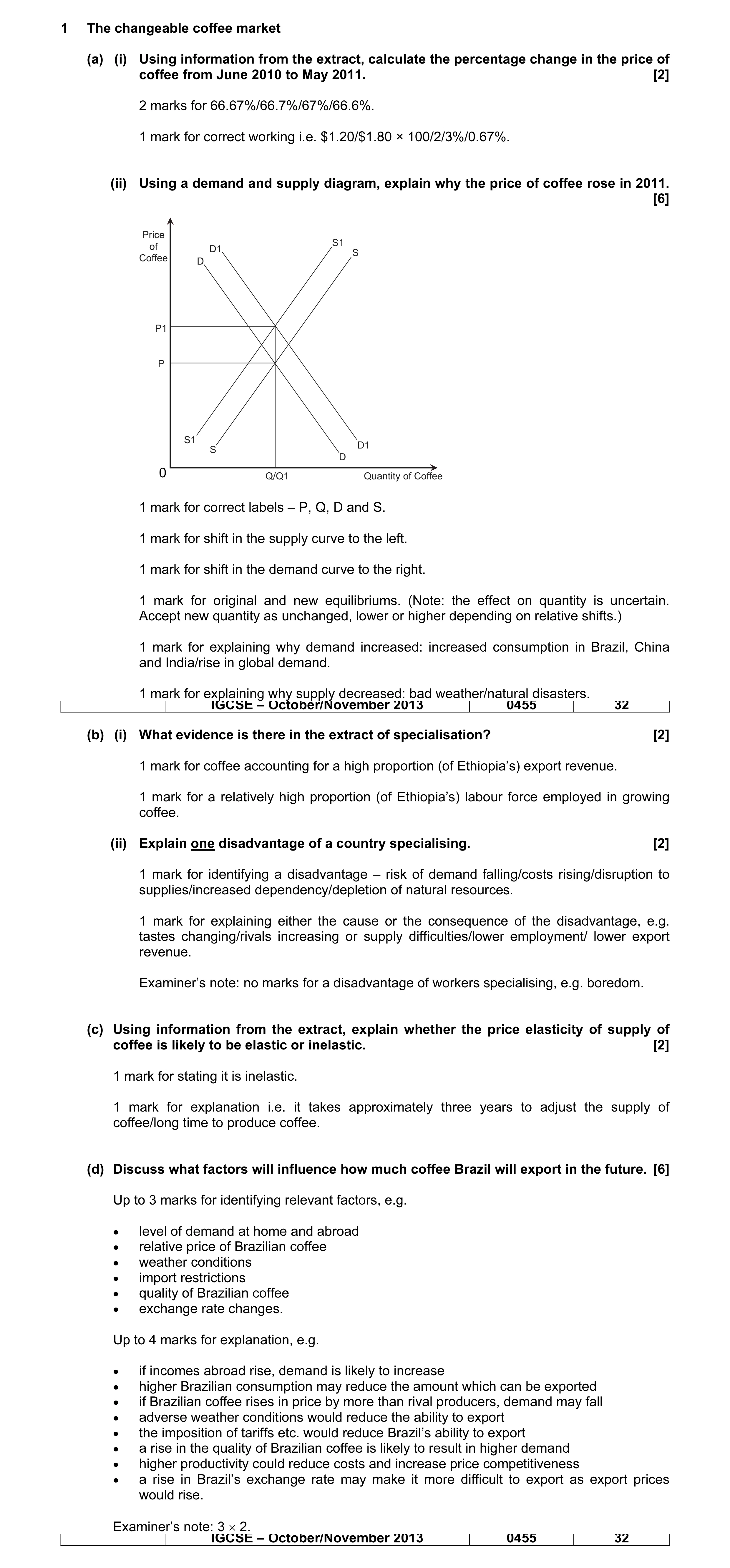 20
20