Cambridge IGCSE Economics 0455 — 2021 Oct/Nov Paper 2 · Variant 3
0455/23/O/N/21 · 5 questions · 90 marks · ≈101 min
The question paper and its mark scheme, free to read here and free to download. This is Cambridge’s own paper, exactly as it was sat.
Question paper8 pages
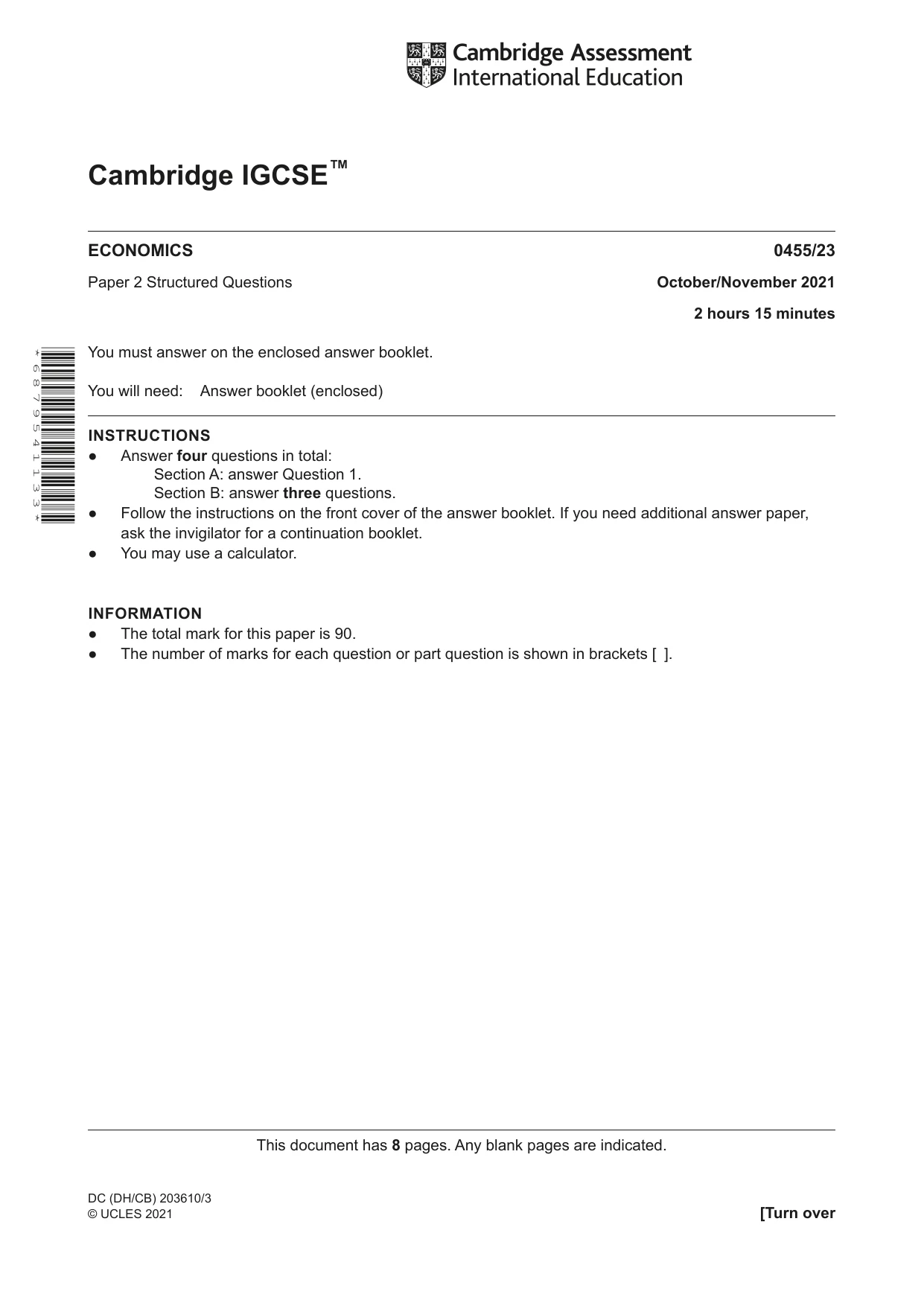
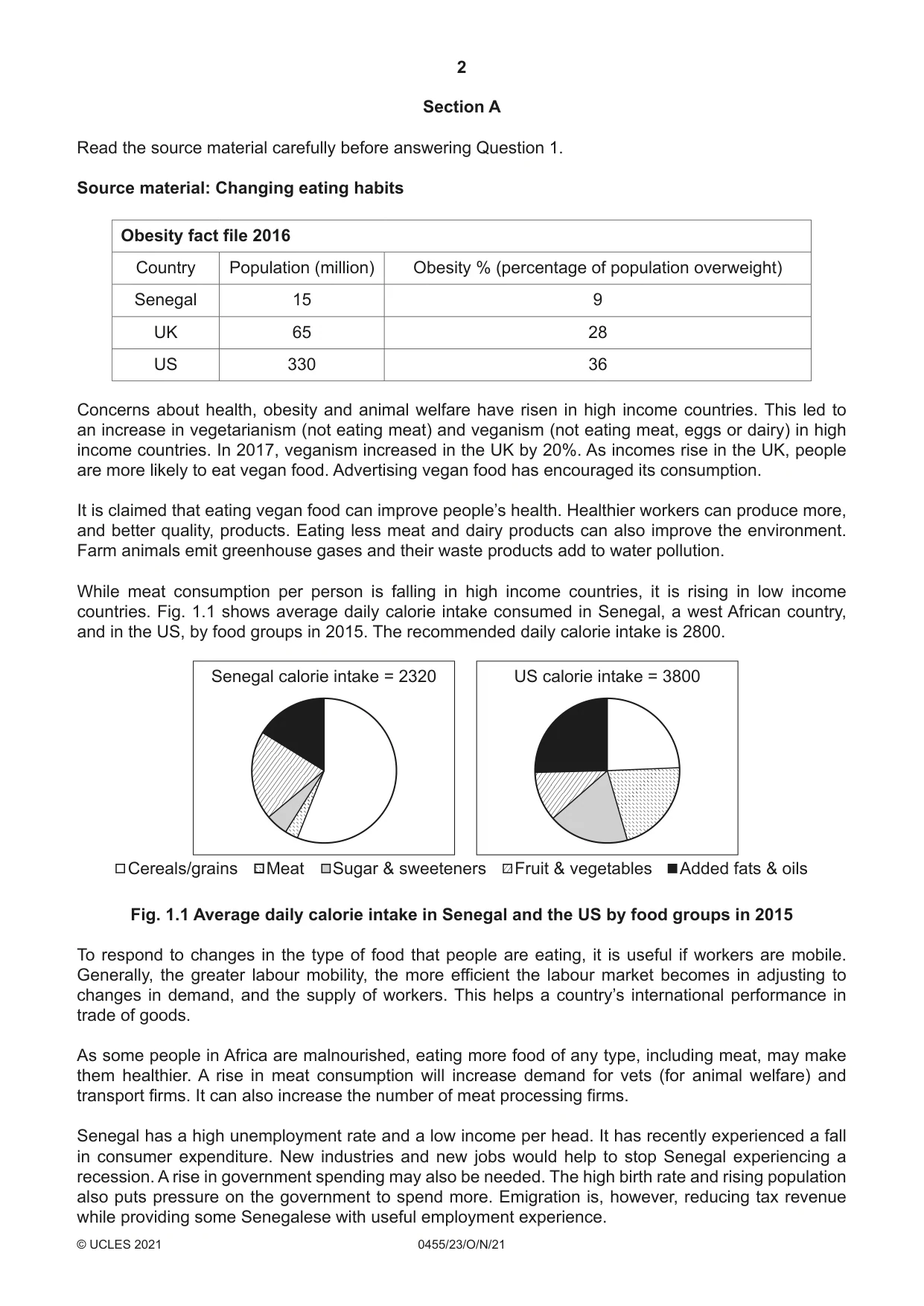
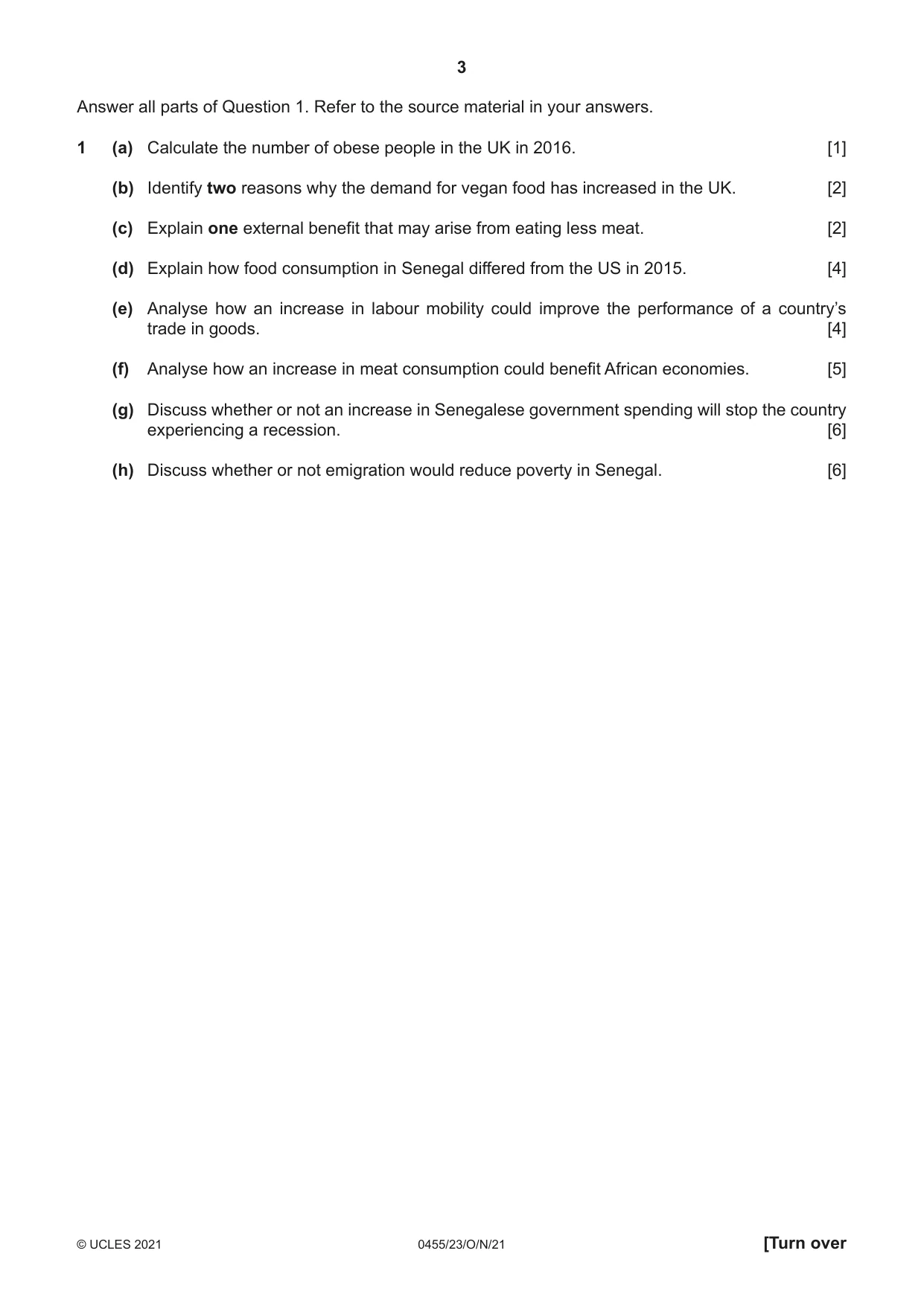
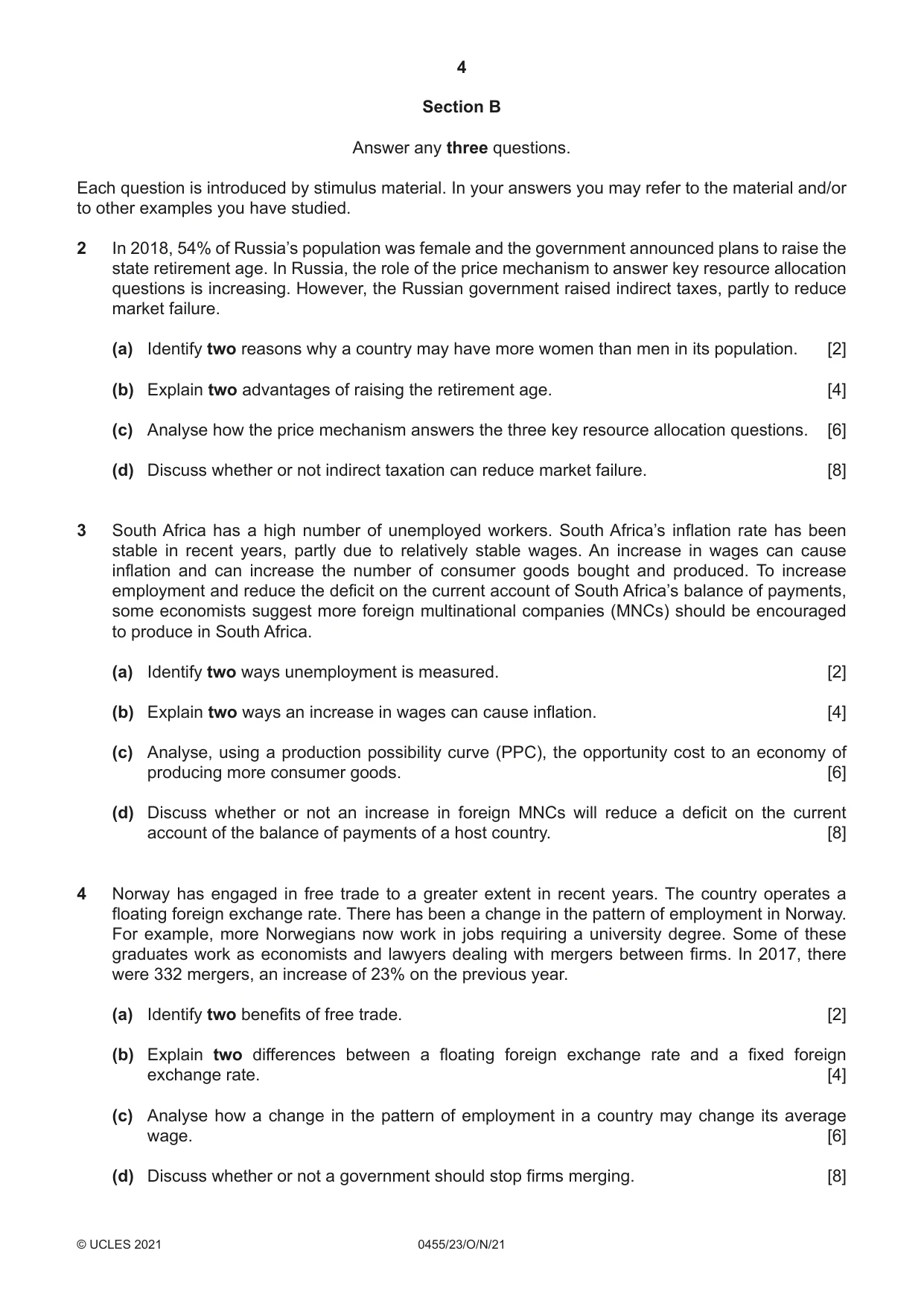



Mark scheme28 pages
Answers below. Sit the paper first if you are practising.
Questions as text
Q1 · Calculate the number of obese people in the UK in 2016
1 (a) Calculate the number of obese people in the UK in 2016. [1] (b) Identify two reasons why the demand for vegan food has increased in the UK. [2] (c) Explain one external benefit that may arise from eating less meat. [2] (d) Explain how food consumption in Senegal differed from the US in 2015. [4] (e) Analyse how an increase in labour mobility could improve the performance of a country’s trade in goods. [4] (f) Analyse how an increase in meat consumption could benefit African economies. [5] (g) Discuss whether or not an increase in Senegalese government spending will stop the country experiencing a recession. [6] (h) Discuss whether or not emigration would reduce poverty in Senegal. [6]
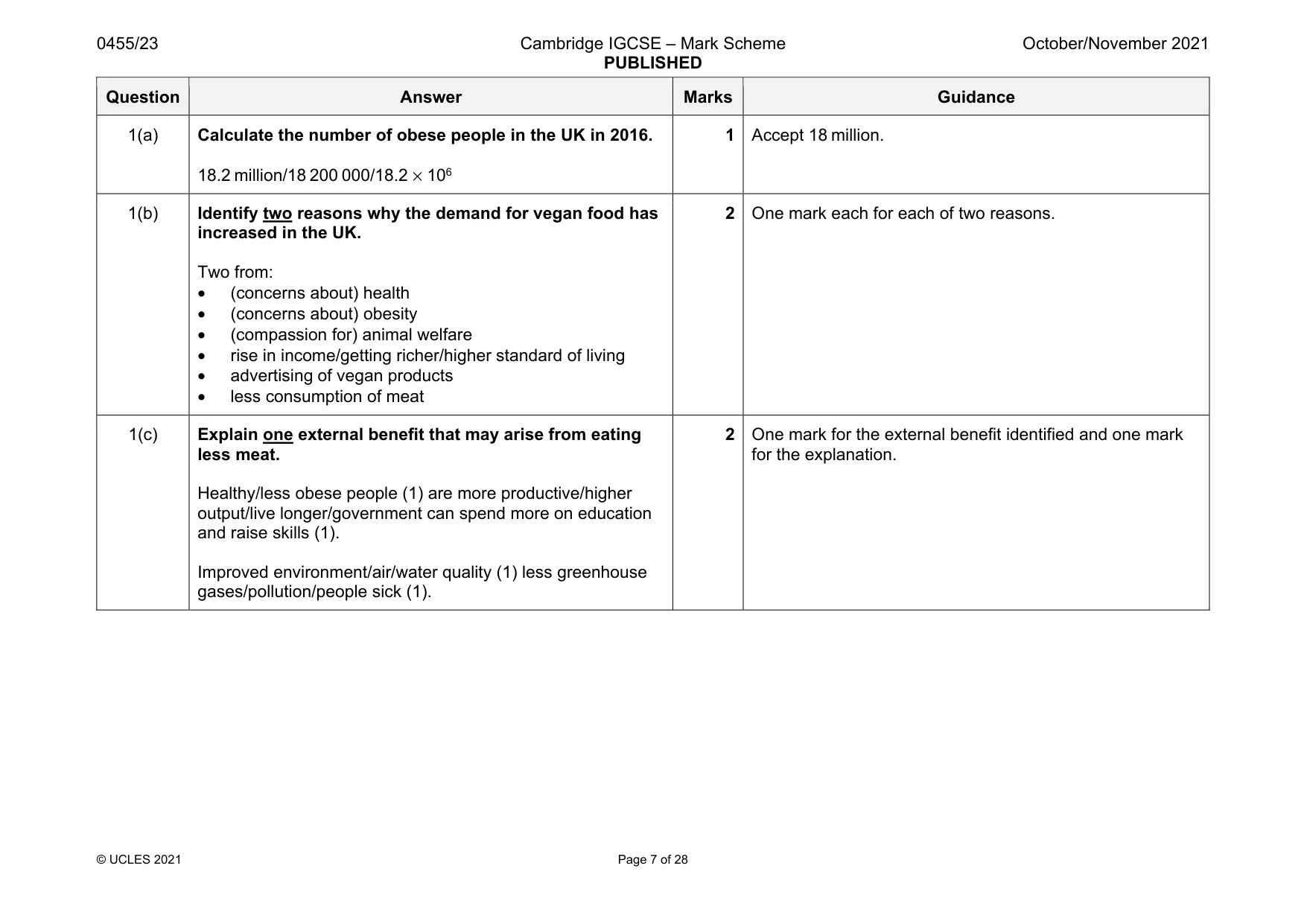
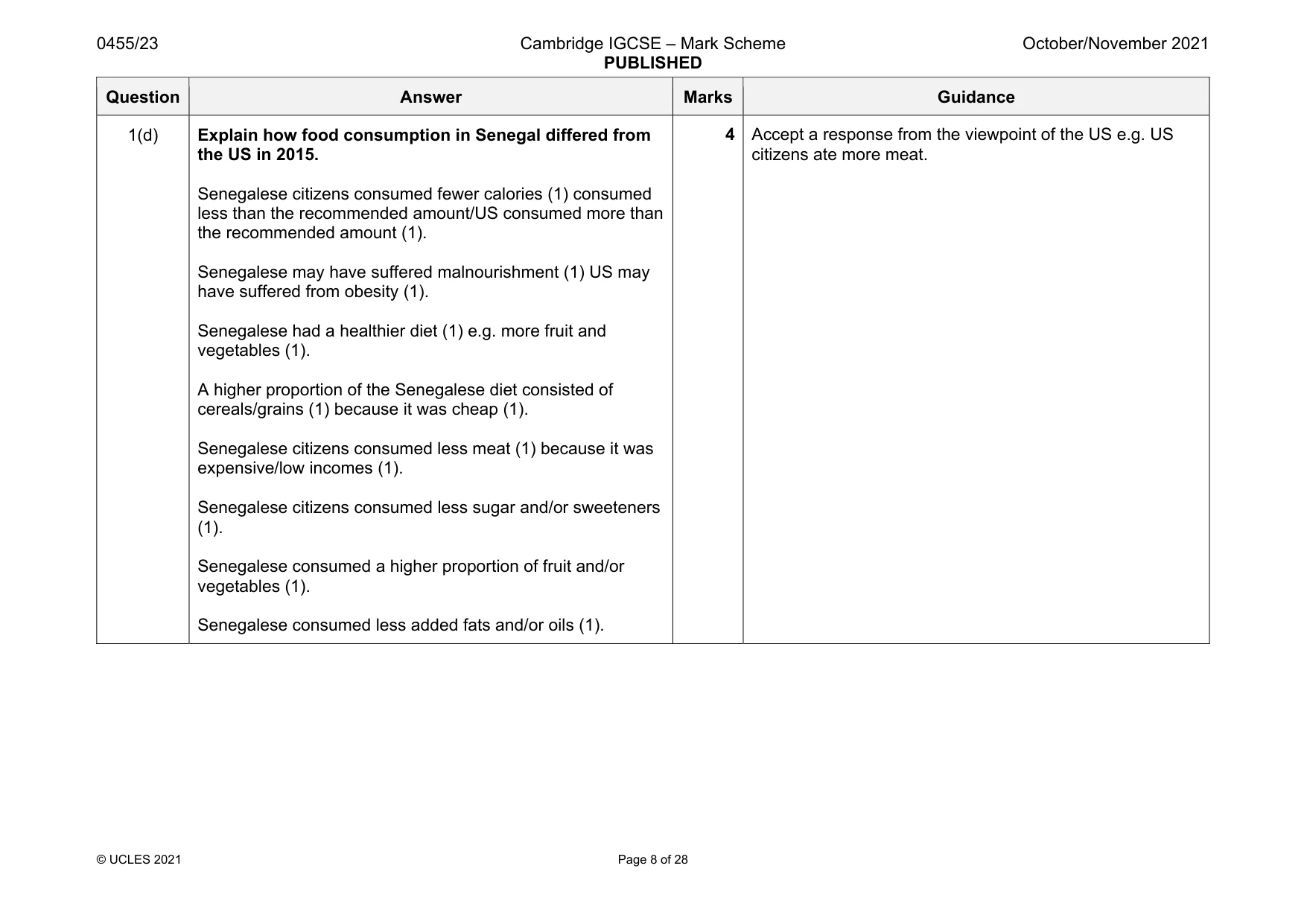
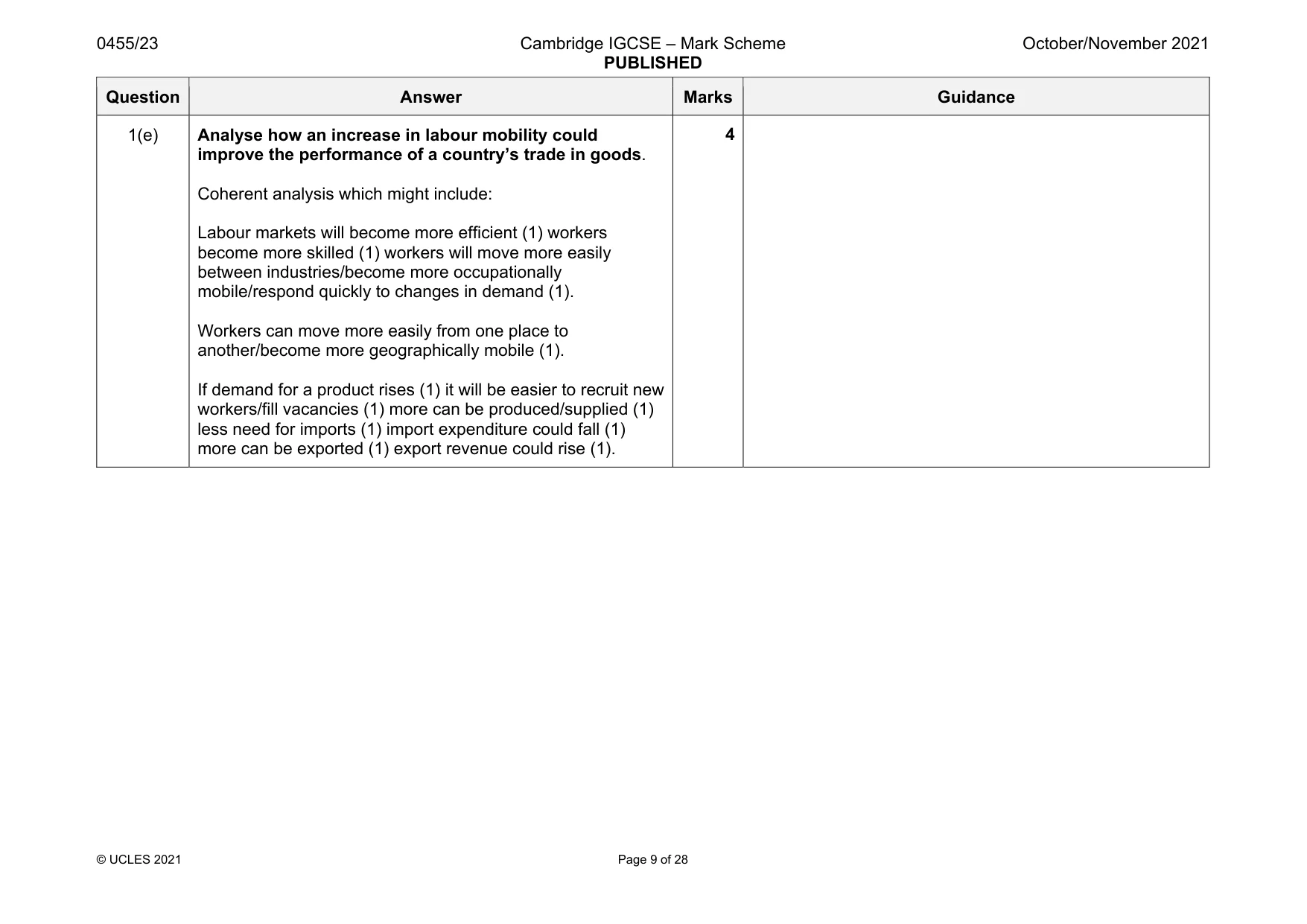
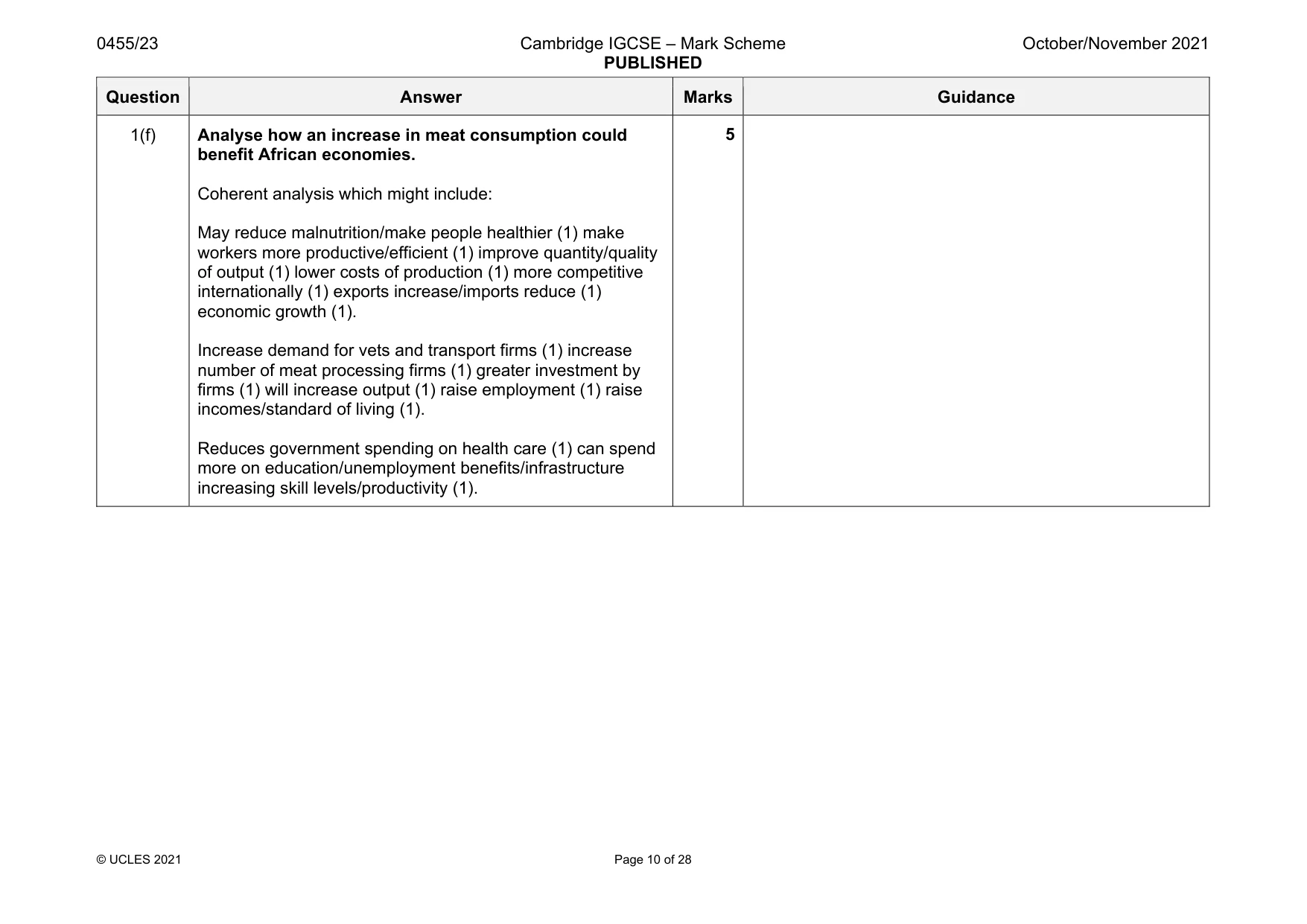
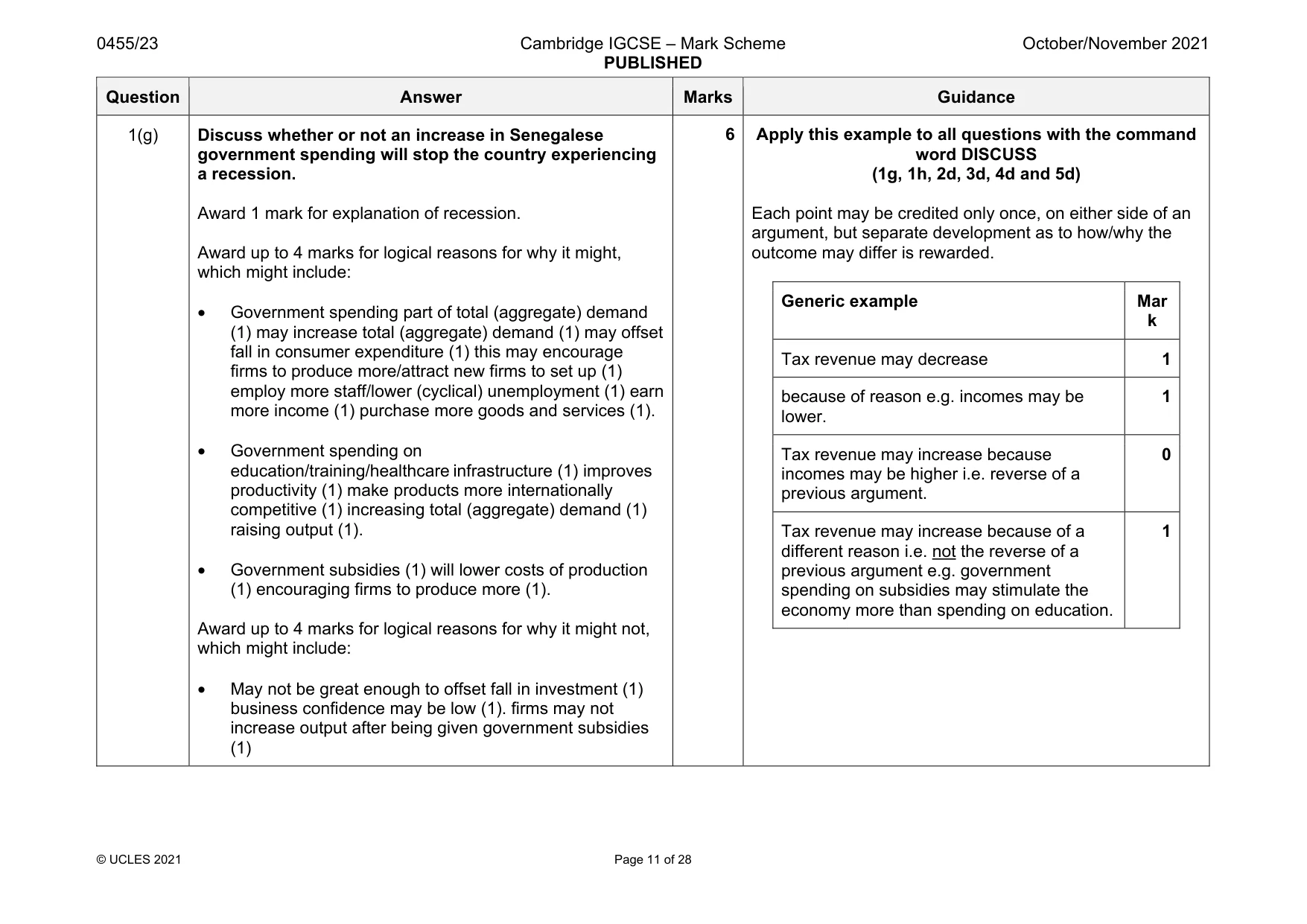
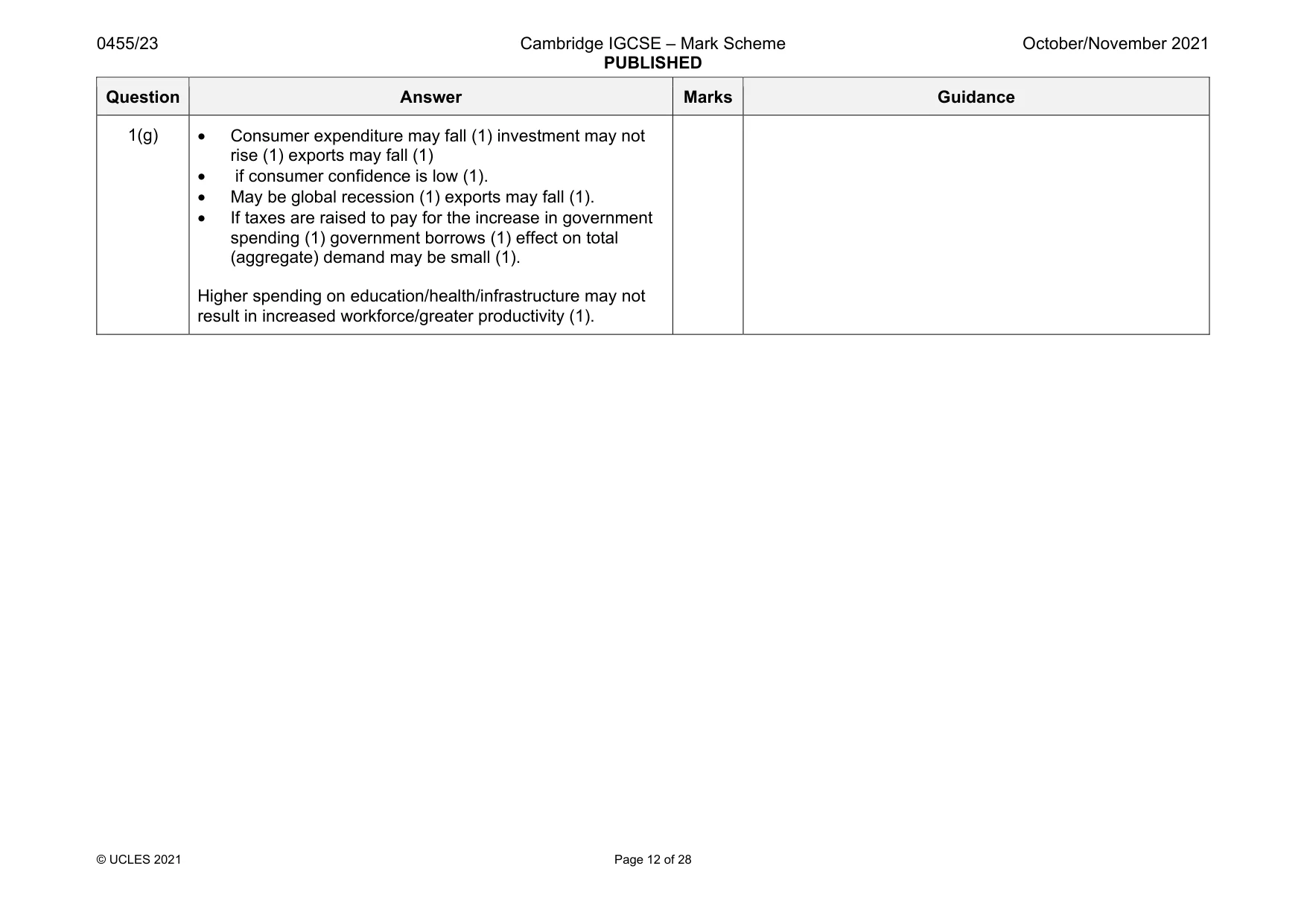
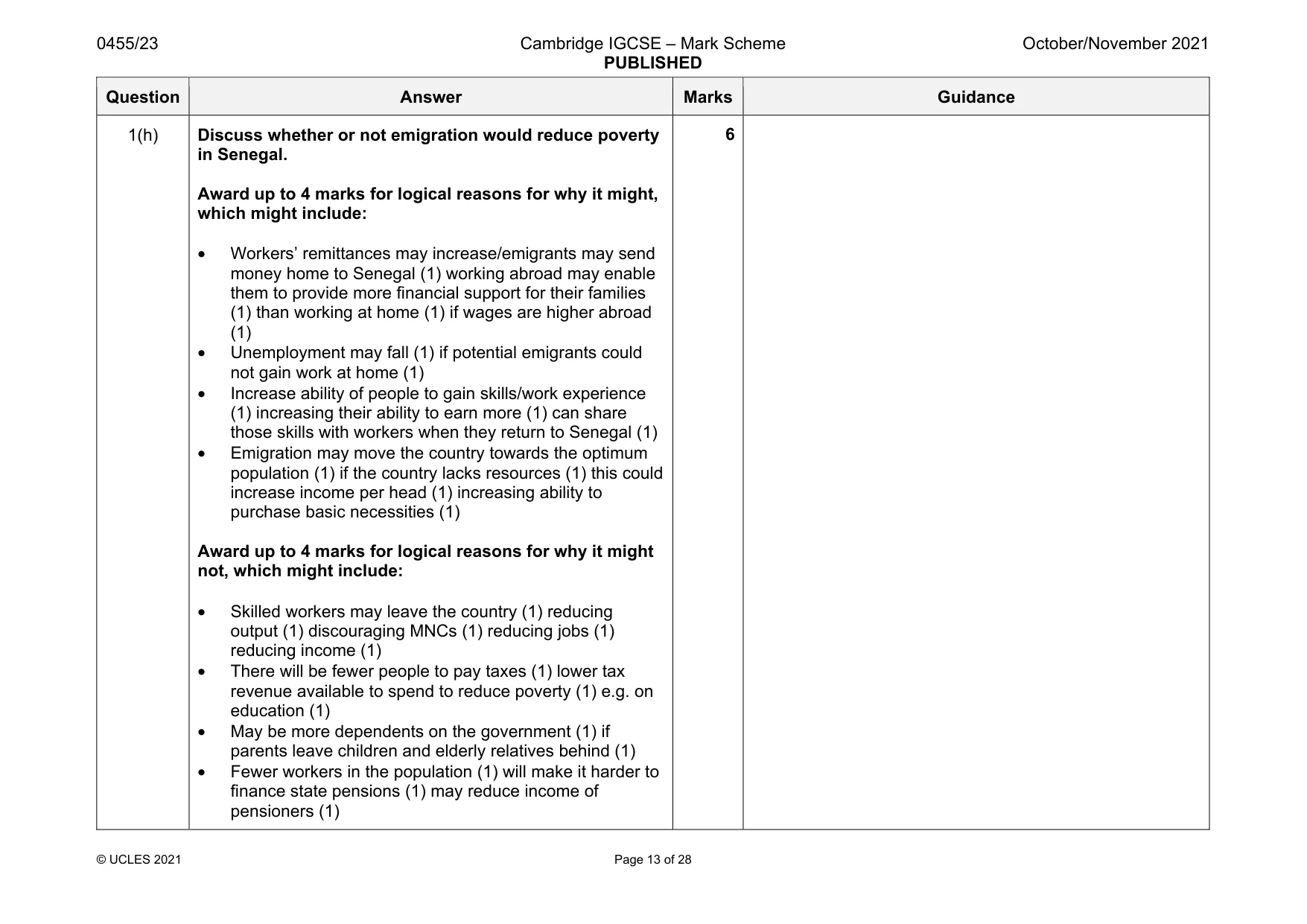
Mark scheme: 1(a) Calculate the number of obese people in the UK in 2016. 18.2 million/18 200 000/18.2 × 106 1 Accept 18 million. 1(b) Identify two reasons why the demand for vegan food has increased in the UK. Two from: • (concerns about) health • (concerns about) obesity • (compassion for) animal welfare • rise in income/getting richer/higher standard of living • advertising of vegan products • less consumption of meat 2 One mark each for each of two reasons. 1(c) Explain one external benefit that may arise from eating less meat. Healthy/less obese people (1) are more productive/higher output/live longer/government can spend more on education and raise skills (1). Improved environment/air/water quality (1) less greenhouse gases/pollution/people sick (1). 2 One mark for the external benefit identified and one mark for the explanation. Question Answer Marks Guidance 1(d) Explain how food consumption in Senegal differed from the US in 2015. Senegalese citizens consumed fewer calories (1) consumed less than the recommended amount/US consumed more than the recommended amount (1). Senegalese may have suffered malnourishment (1) US may have suffered from obesity (1). Senegalese had a healthier diet (1) e.g. more fruit and vegetables (1). A higher proportion of the Senegalese diet consisted of cereals/grains (1) because it was cheap (1). Senegalese citizens consumed less meat (1) because it was expensive/low incomes (1). Senegalese citizens consumed less sugar and/or sweeteners (1). Senegalese consumed a higher proportion of fruit and/or vegetables (1). Senegalese consumed less added fats and/or oils (1). 4 Accept a response from the viewpoint of the US e.g. US citizens ate more meat. Question Answer Marks Guidance 1(e) Analyse how an increase in labour mobility could improve the performance of a country’s trade in goods. Coherent analysis which might include: Labour markets will become more efficient (1) workers become more skilled (1) workers will move more easily between industries/become more occupationally mobile/respond quickly to changes in demand (1). Workers can move more easily from one place to another/become more geographically mobile (1). If demand for a product rises (1) it will be easier to recruit new workers/fill vacancies (1) more can be produced/supplied (1) less need for imports (1) import expenditure could fall (1) more can be exported (1) export revenue could rise (1). 4 Question Answer Marks Guidance 1(f) Analyse how an increase in meat consumption could benefit African economies. Coherent analysis which might include: May reduce malnutrition/make people healthier (1) make workers more productive/efficient (1) improve quantity/quality of output (1) lower costs of production (1) more competitive internationally (1) exports increase/imports reduce (1) economic growth (1). Increase demand for vets and transport firms (1) increase number of meat processing firms (1) greater investment by firms (1) will increase output (1) raise employment (1) raise incomes/standard of living (1). Reduces government spending on health care (1) can spend more on education/unemployment benefits/infrastructure increasing skill levels/productivity (1). 5 Question Answer Marks Guidance 1(g) Discuss whether or not an increase in Senegalese government spending will stop the country experiencing a recession. Award 1 mark for explanation of recession. Award up to 4 marks for logical reasons for why it might, which might include: • Government spending part of total (aggregate) demand (1) may increase total (aggregate) demand (1) may offset fall in consumer expenditure (1) this may encourage firms to produce more/attract new firms to set up (1) employ more staff/lower (cyclical) unemployment (1) earn more income (1) purchase more goods and services (1). • Government spending on education/training/healthcare infrastructure (1) improves productivity (1) make products more internationally competitive (1) increasing total (aggregate) demand (1) raising output (1). • Government subsidies (1) will lower costs of production (1) encouraging firms to produce more (1). Award up to 4 marks for logical reasons for why it might not, which might include: • May not be great enough to offset fall in investment (1) business confidence may be low (1). firms may not increase output after being given government subsidies (1) 6 Apply this example to all questions with the command word DISCUSS (1g, 1h, 2d, 3d, 4d and 5d) Each point may be credited only once, on either side of an argument, but separate development as to how/why the outcome may differ is rewarded. Generic example Mar k Tax revenue may decrease 1 because of reason e.g. incomes may be lower. 1 Tax revenue may increase because incomes may be higher i.e. reverse of a previous argument. 0 Tax revenue may increase because of a different reason i.e. not the reverse of a previous argument e.g. government spending on subsidies may stimulate the economy more than spending on education. 1 Question Answer Marks Guidance 1(g) • Consumer expenditure may fall (1) investment may not rise (1) exports may fall (1) • if consumer confidence is low (1). • May be global recession (1) exports may fall (1). • If taxes are raised to pay for the increase in government spending (1) government borrows (1) effect on total (aggregate) demand may be small (1). Higher spending on education/health/infrastructure may not result in increased workforce/greater productivity (1). Question Answer Marks Guidance 1(h) Discuss whether or not emigration would reduce poverty in Senegal. Award up to 4 marks for logical reasons for why it might, which might include: • Workers’ remittances may increase/emigrants may send money home to Senegal (1) working abroad may enable them to provide more financial support for their families (1) than working at home (1) if wages are higher abroad (1) • Unemployment may fall (1) if potential emigrants could not gain work at home (1) • Increase ability of people to gain skills/work experience (1) increasing their ability to earn more (1) can share those skills with workers when they return to Senegal (1) • Emigration may move the country towards the optimum population (1) if the country lacks resources (1) this could increase income per head (1) increasing ability to purchase basic necessities (1) Award up to 4 marks for logical reasons for why it might not, which might include: • Skilled workers may leave the country (1) reducing output (1) discouraging MNCs (1) reducing jobs (1) reducing income (1) • There will be fewer people to pay taxes (1) lower tax revenue available to spend to reduce poverty (1) e.g. on education (1) • May be more dependents on the government (1) if parents leave children and elderly relatives behind (1) • Fewer workers in the population (1) will make it harder to finance state pensions (1) may reduce income of pensioners (1) 6
Q2 · In 2018, 54% of Russia’s population was female and the government announced plans to…
2 In 2018, 54% of Russia’s population was female and the government announced plans to raise the state retirement age. In Russia, the role of the price mechanism to answer key resource allocation questions is increasing. However, the Russian government raised indirect taxes, partly to reduce market failure. (a) Identify two reasons why a country may have more women than men in its population. [2] (b) Explain two advantages of raising the retirement age. [4] (c) Analyse how the price mechanism answers the three key resource allocation questions. [6] (d) Discuss whether or not indirect taxation can reduce market failure. [8]
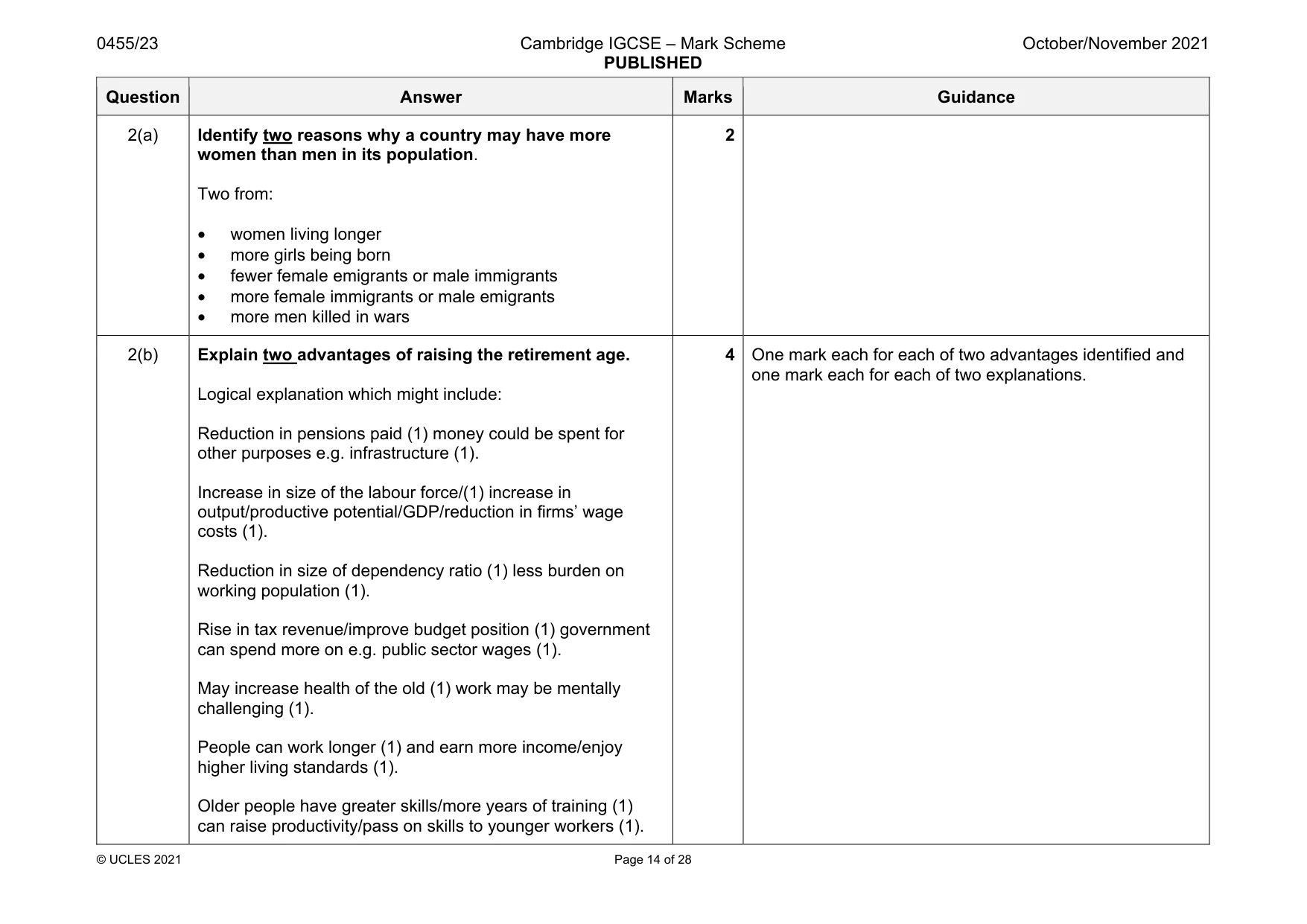
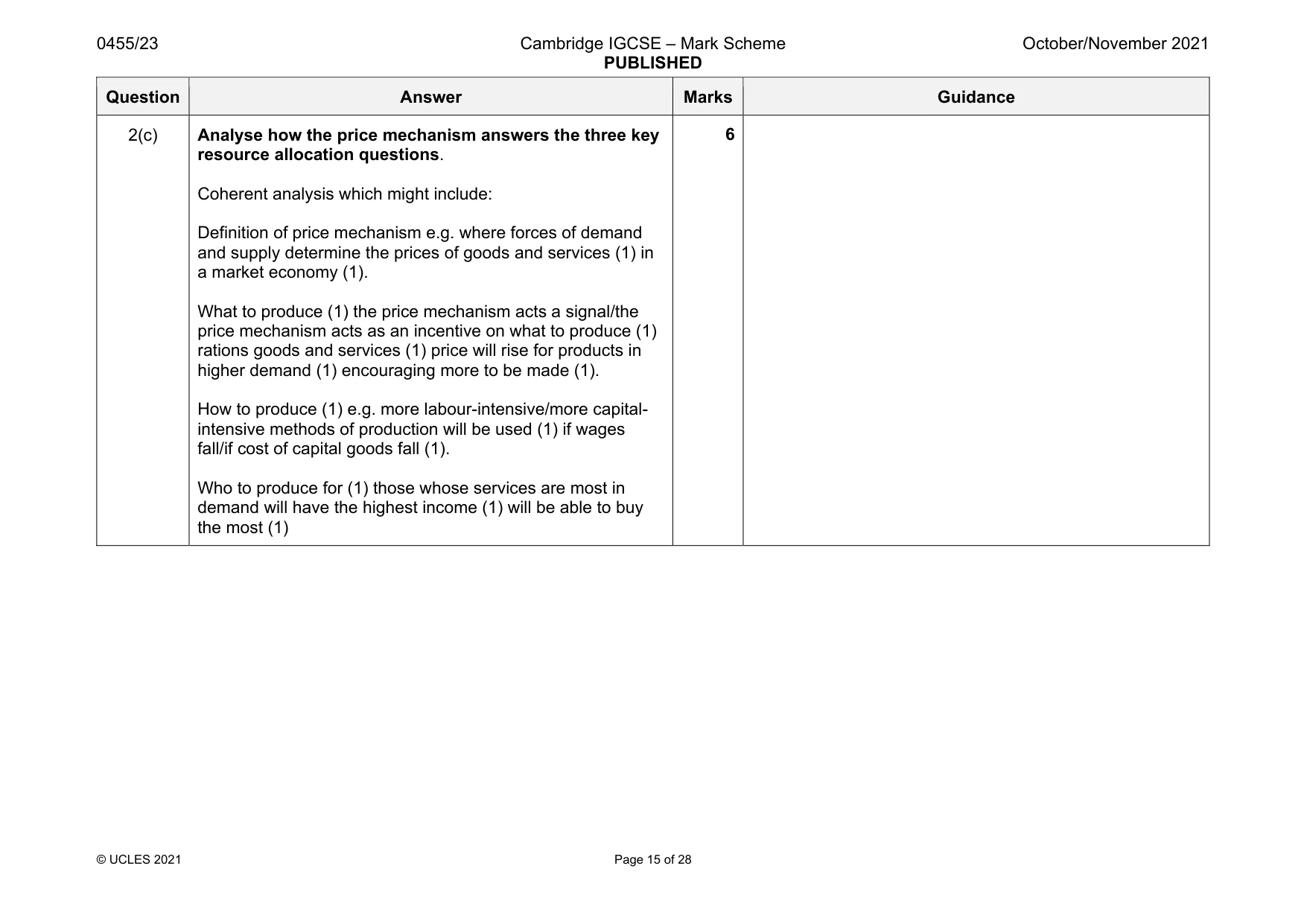
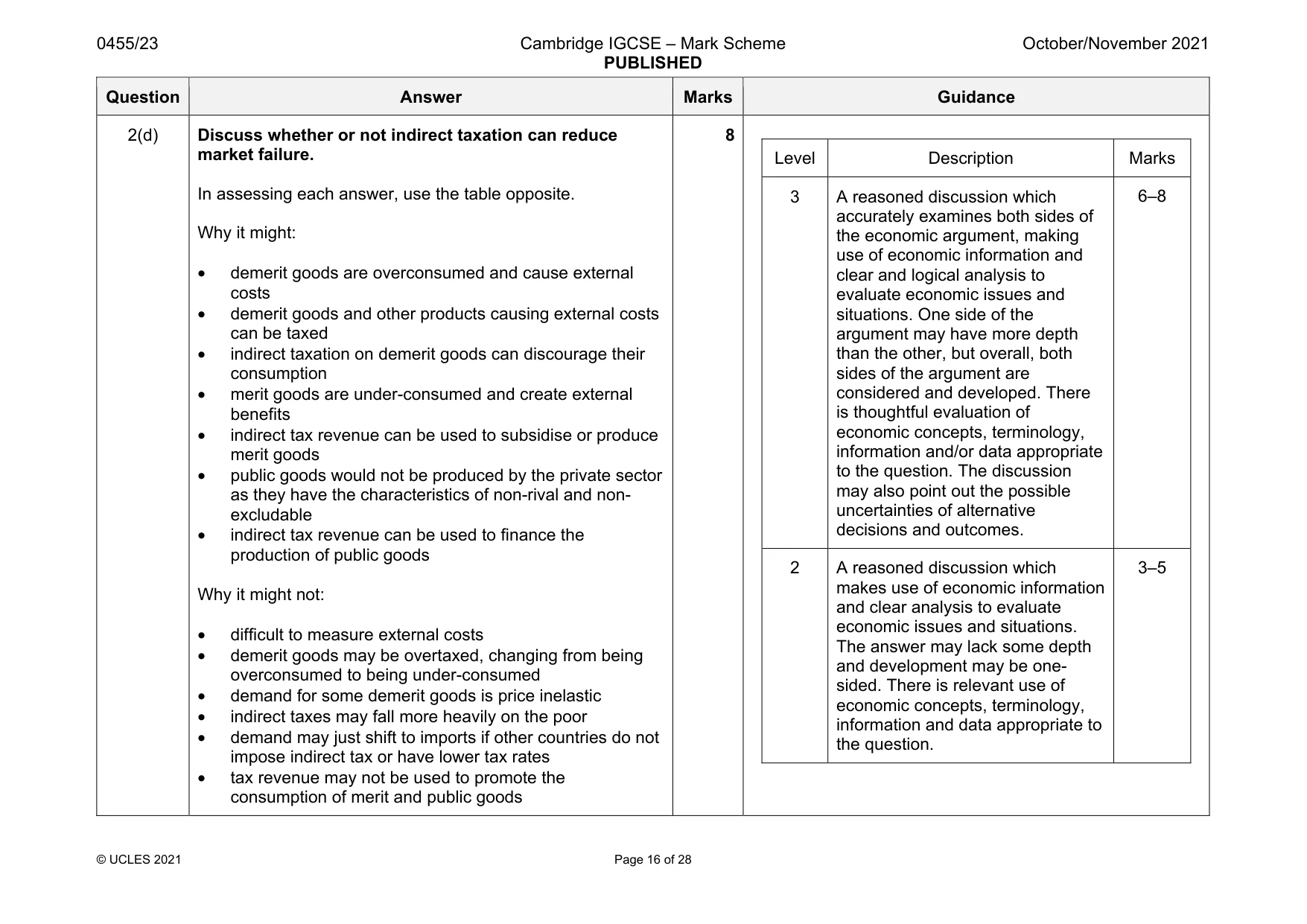
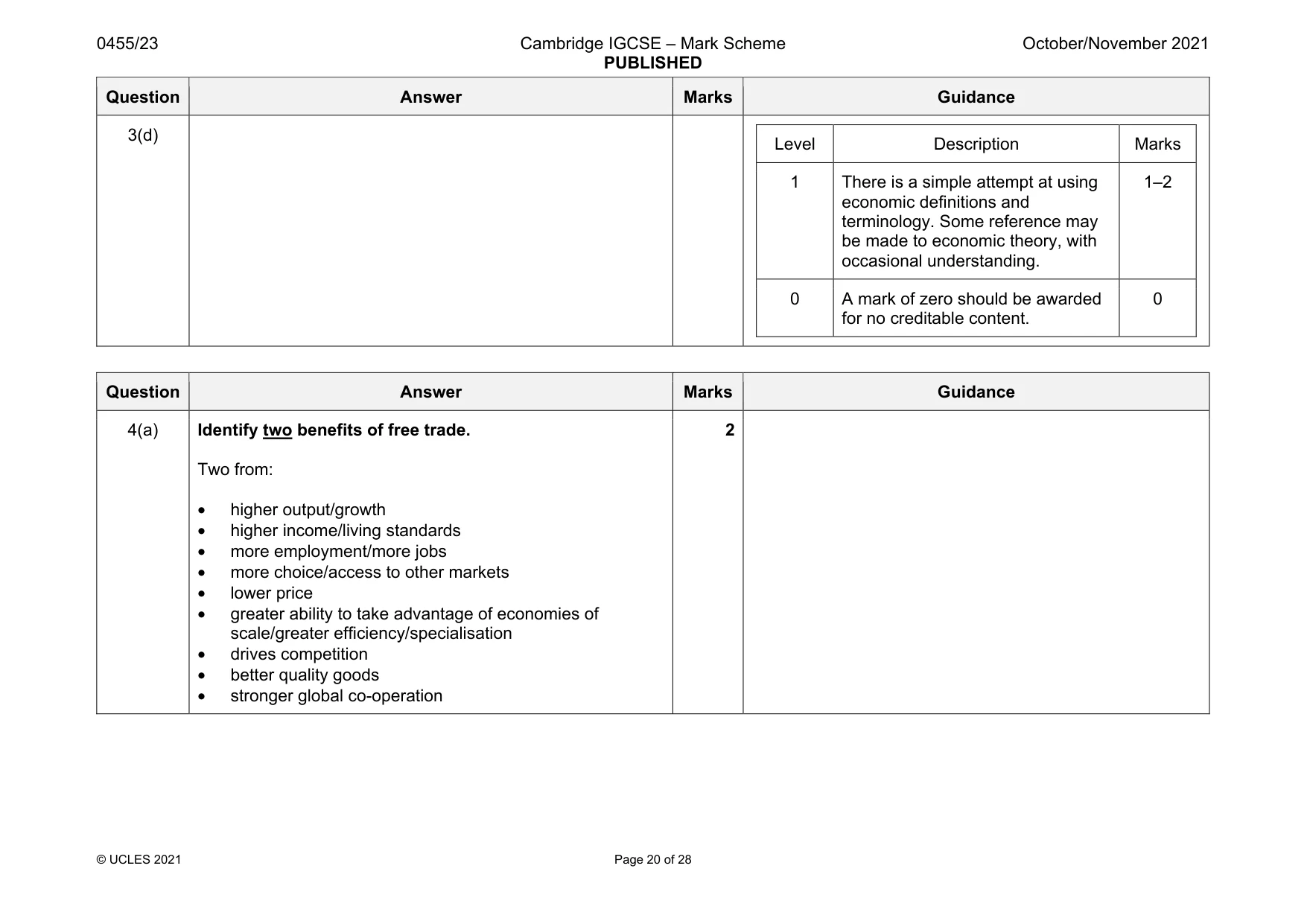
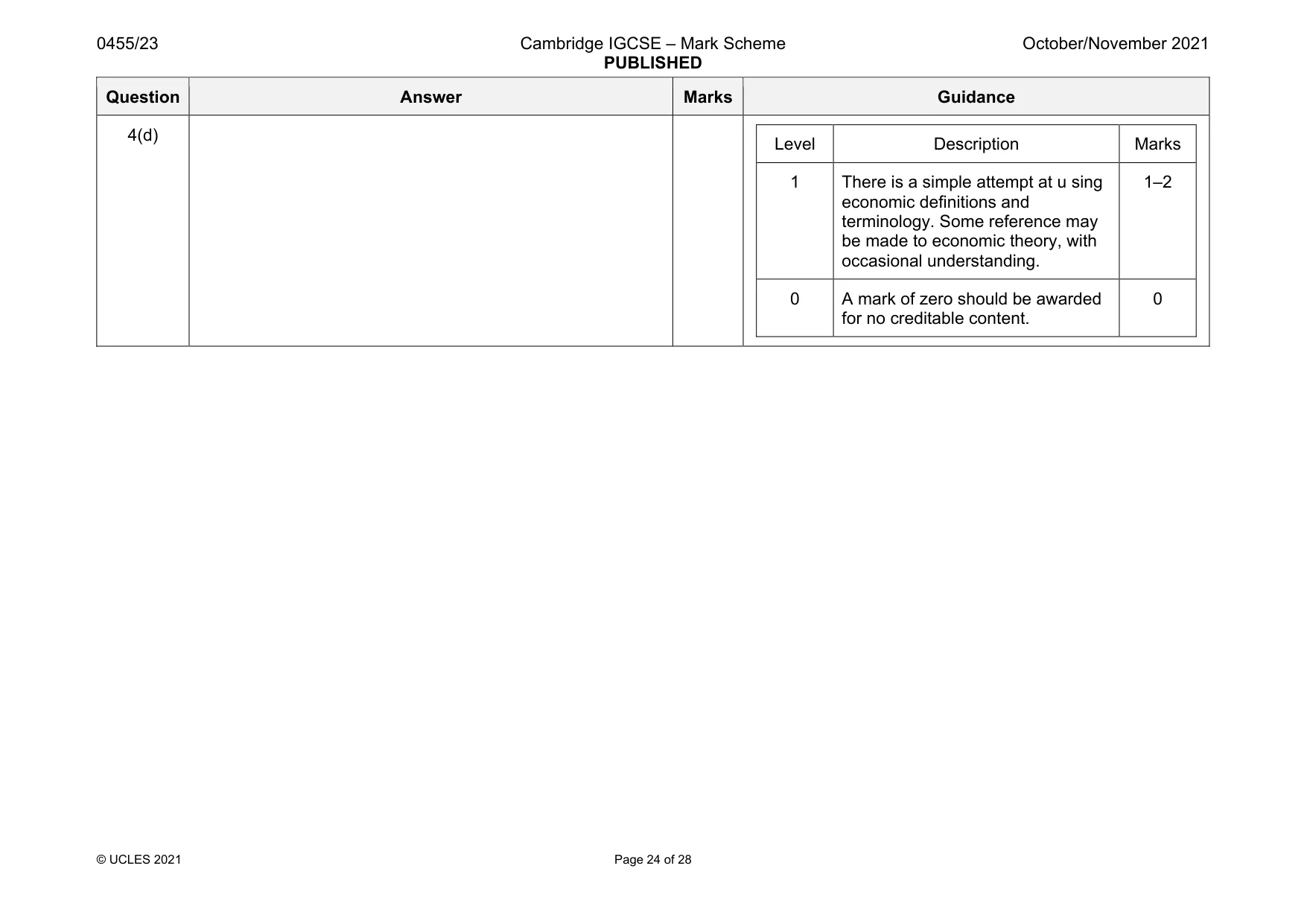
Mark scheme: 2(a) Identify two reasons why a country may have more women than men in its population. Two from: • women living longer • more girls being born • fewer female emigrants or male immigrants • more female immigrants or male emigrants • more men killed in wars 2 2(b) Explain two advantages of raising the retirement age. Logical explanation which might include: Reduction in pensions paid (1) money could be spent for other purposes e.g. infrastructure (1). Increase in size of the labour force/(1) increase in output/productive potential/GDP/reduction in firms’ wage costs (1). Reduction in size of dependency ratio (1) less burden on working population (1). Rise in tax revenue/improve budget position (1) government can spend more on e.g. public sector wages (1). May increase health of the old (1) work may be mentally challenging (1). People can work longer (1) and earn more income/enjoy higher living standards (1). Older people have greater skills/more years of training (1) can raise productivity/pass on skills to younger workers (1). 4 One mark each for each of two advantages identified and one mark each for each of two explanations. Question Answer Marks Guidance 2(c) Analyse how the price mechanism answers the three key resource allocation questions. Coherent analysis which might include: Definition of price mechanism e.g. where forces of demand and supply determine the prices of goods and services (1) in a market economy (1). What to produce (1) the price mechanism acts a signal/the price mechanism acts as an incentive on what to produce (1) rations goods and services (1) price will rise for products in higher demand (1) encouraging more to be made (1). How to produce (1) e.g. more labour-intensive/more capital- intensive methods of production will be used (1) if wages fall/if cost of capital goods fall (1). Who to produce for (1) those whose services are most in demand will have the highest income (1) will be able to buy the most (1) 6 Question Answer Marks Guidance 2(d) Discuss whether or not indirect taxation can reduce market failure. In assessing each answer, use the table opposite. Why it might: • demerit goods are overconsumed and cause external costs • demerit goods and other products causing external costs can be taxed • indirect taxation on demerit goods can discourage their consumption • merit goods are under-consumed and create external benefits • indirect tax revenue can be used to subsidise or produce merit goods • public goods would not be produced by the private sector as they have the characteristics of non-rival and non- excludable • indirect tax revenue can be used to finance the production of public goods Why it might not: • difficult to measure external costs • demerit goods may be overtaxed, changing from being overconsumed to being under-consumed • demand for some demerit goods is price inelastic • indirect taxes may fall more heavily on the poor • demand may just shift to imports if other countries do not impose indirect tax or have lower tax rates • tax revenue may not be used to promote the consumption of merit and public goods 8 Level Description Marks 3 A reasoned discussion which accurately examines both sides of the economic argument, making use of economic information and clear and logical analysis to evaluate economic issues and situations. One side of the argument may have more depth than the other, but overall, both sides of the argument are considered and developed. There is thoughtful evaluation of economic concepts, terminology, information and/or data appropriate to the question. The discussion may also point out the possible uncertainties of alternative decisions and outcomes. 6–8 2 A reasoned discussion which makes use of economic information and clear analysis to evaluate economic issues and situations. The answer may lack some depth and development may be one- sided. There is relevant use of economic concepts, terminology, information and data appropriate to the question. 3–5 Question Answer Marks Guidance 2(d) Level Description Marks 1 There is a simple attempt at u sing economic definitions and terminology. Some reference may be made to economic theory, with occasional understanding. 1–2 0 A mark of zero should be awarded for no creditable content. 0
Q3 · South Africa has a high number of unemployed workers
3 South Africa has a high number of unemployed workers. South Africa’s inflation rate has been stable in recent years, partly due to relatively stable wages. An increase in wages can cause inflation and can increase the number of consumer goods bought and produced. To increase employment and reduce the deficit on the current account of South Africa’s balance of payments, some economists suggest more foreign multinational companies (MNCs) should be encouraged to produce in South Africa. (a) Identify two ways unemployment is measured. [2] (b) Explain two ways an increase in wages can cause inflation. [4] (c) Analyse, using a production possibility curve (PPC), the opportunity cost to an economy of producing more consumer goods. [6] (d) Discuss whether or not an increase in foreign MNCs will reduce a deficit on the current account of the balance of payments of a host country. [8]
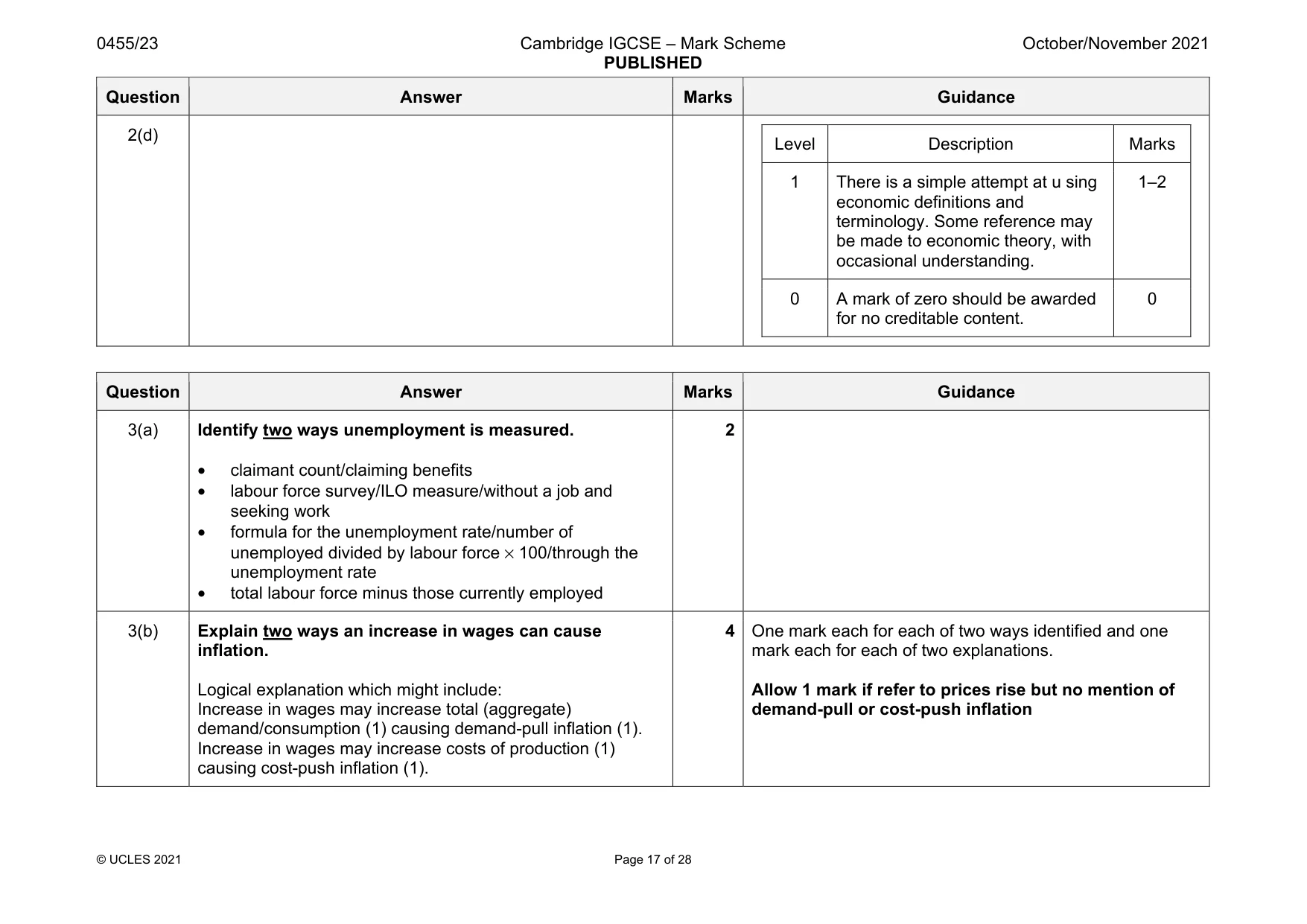
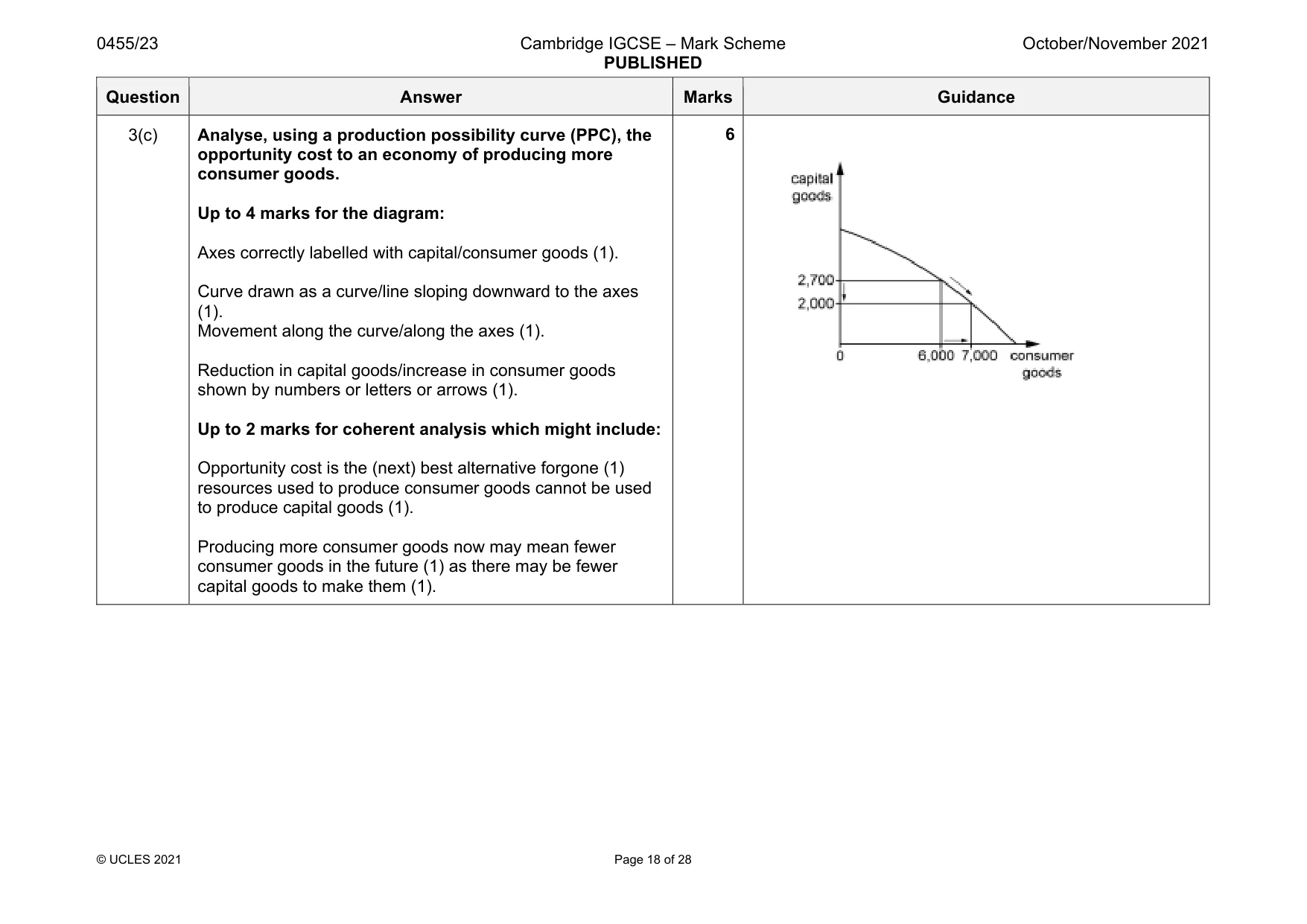
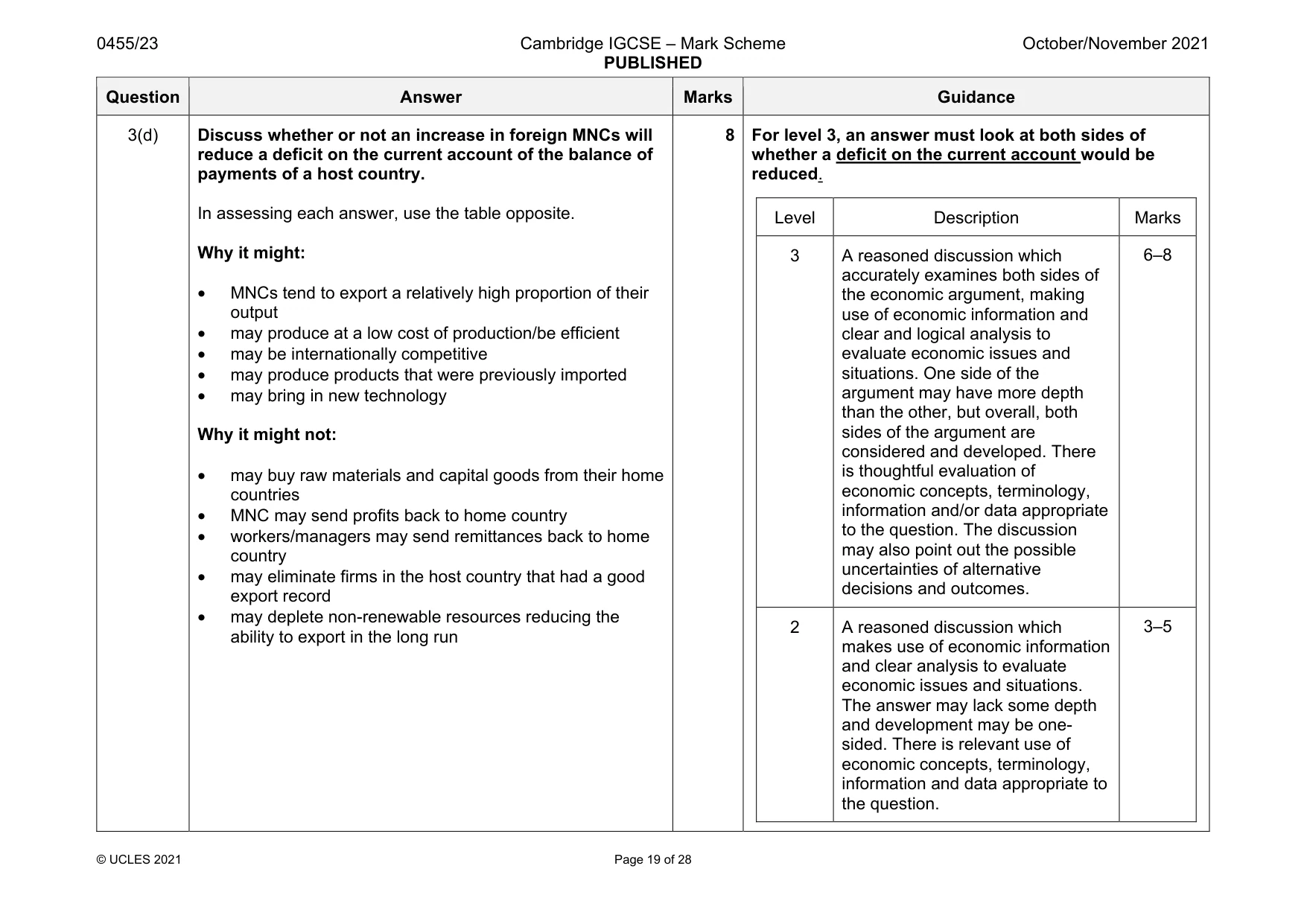
Mark scheme: 3(a) Identify two ways unemployment is measured. • claimant count/claiming benefits • labour force survey/ILO measure/without a job and seeking work • formula for the unemployment rate/number of unemployed divided by labour force × 100/through the unemployment rate • total labour force minus those currently employed 2 3(b) Explain two ways an increase in wages can cause inflation. Logical explanation which might include: Increase in wages may increase total (aggregate) demand/consumption (1) causing demand-pull inflation (1). Increase in wages may increase costs of production (1) causing cost-push inflation (1). 4 One mark each for each of two ways identified and one mark each for each of two explanations. Allow 1 mark if refer to prices rise but no mention of demand-pull or cost-push inflation Question Answer Marks Guidance 3(c) Analyse, using a production possibility curve (PPC), the opportunity cost to an economy of producing more consumer goods. Up to 4 marks for the diagram: Axes correctly labelled with capital/consumer goods (1). Curve drawn as a curve/line sloping downward to the axes (1). Movement along the curve/along the axes (1). Reduction in capital goods/increase in consumer goods shown by numbers or letters or arrows (1). Up to 2 marks for coherent analysis which might include: Opportunity cost is the (next) best alternative forgone (1) resources used to produce consumer goods cannot be used to produce capital goods (1). Producing more consumer goods now may mean fewer consumer goods in the future (1) as there may be fewer capital goods to make them (1). 6 Question Answer Marks Guidance 3(d) Discuss whether or not an increase in foreign MNCs will reduce a deficit on the current account of the balance of payments of a host country. In assessing each answer, use the table opposite. Why it might: • MNCs tend to export a relatively high proportion of their output • may produce at a low cost of production/be efficient • may be internationally competitive • may produce products that were previously imported • may bring in new technology Why it might not: • may buy raw materials and capital goods from their home countries • MNC may send profits back to home country • workers/managers may send remittances back to home country • may eliminate firms in the host country that had a good export record • may deplete non-renewable resources reducing the ability to export in the long run 8 For level 3, an answer must look at both sides of whether a deficit on the current account would be reduced. Level Description Marks 3 A reasoned discussion which accurately examines both sides of the economic argument, making use of economic information and clear and logical analysis to evaluate economic issues and situations. One side of the argument may have more depth than the other, but overall, both sides of the argument are considered and developed. There is thoughtful evaluation of economic concepts, terminology, information and/or data appropriate to the question. The discussion may also point out the possible uncertainties of alternative decisions and outcomes. 6–8 2 A reasoned discussion which makes use of economic information and clear analysis to evaluate economic issues and situations. The answer may lack some depth and development may be one- sided. There is relevant use of economic concepts, terminology, information and data appropriate to the question. 3–5 Question Answer Marks Guidance 3(d) Level Description Marks 1 There is a simple attempt at using economic definitions and terminology. Some reference may be made to economic theory, with occasional understanding. 1–2 0 A mark of zero should be awarded for no creditable content. 0
Q4 · Norway has engaged in free trade to a greater extent in recent years
4 Norway has engaged in free trade to a greater extent in recent years. The country operates a floating foreign exchange rate. There has been a change in the pattern of employment in Norway. For example, more Norwegians now work in jobs requiring a university degree. Some of these graduates work as economists and lawyers dealing with mergers between firms. In 2017, there were 332 mergers, an increase of 23% on the previous year. (a) Identify two benefits of free trade. [2] (b) Explain two differences between a floating foreign exchange rate and a fixed foreign exchange rate. [4] (c) Analyse how a change in the pattern of employment in a country may change its average wage. [6] (d) Discuss whether or not a government should stop firms merging. [8]
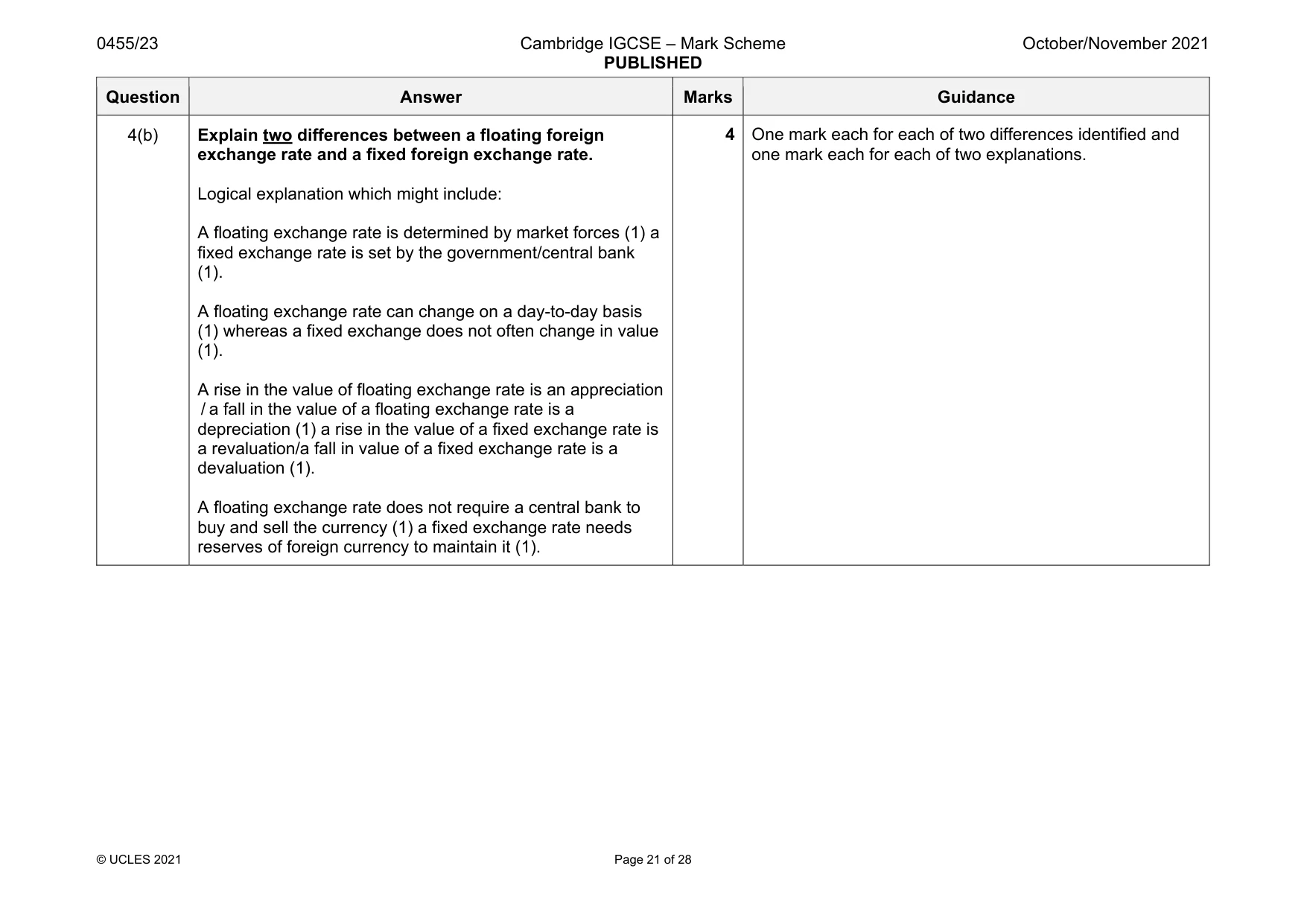
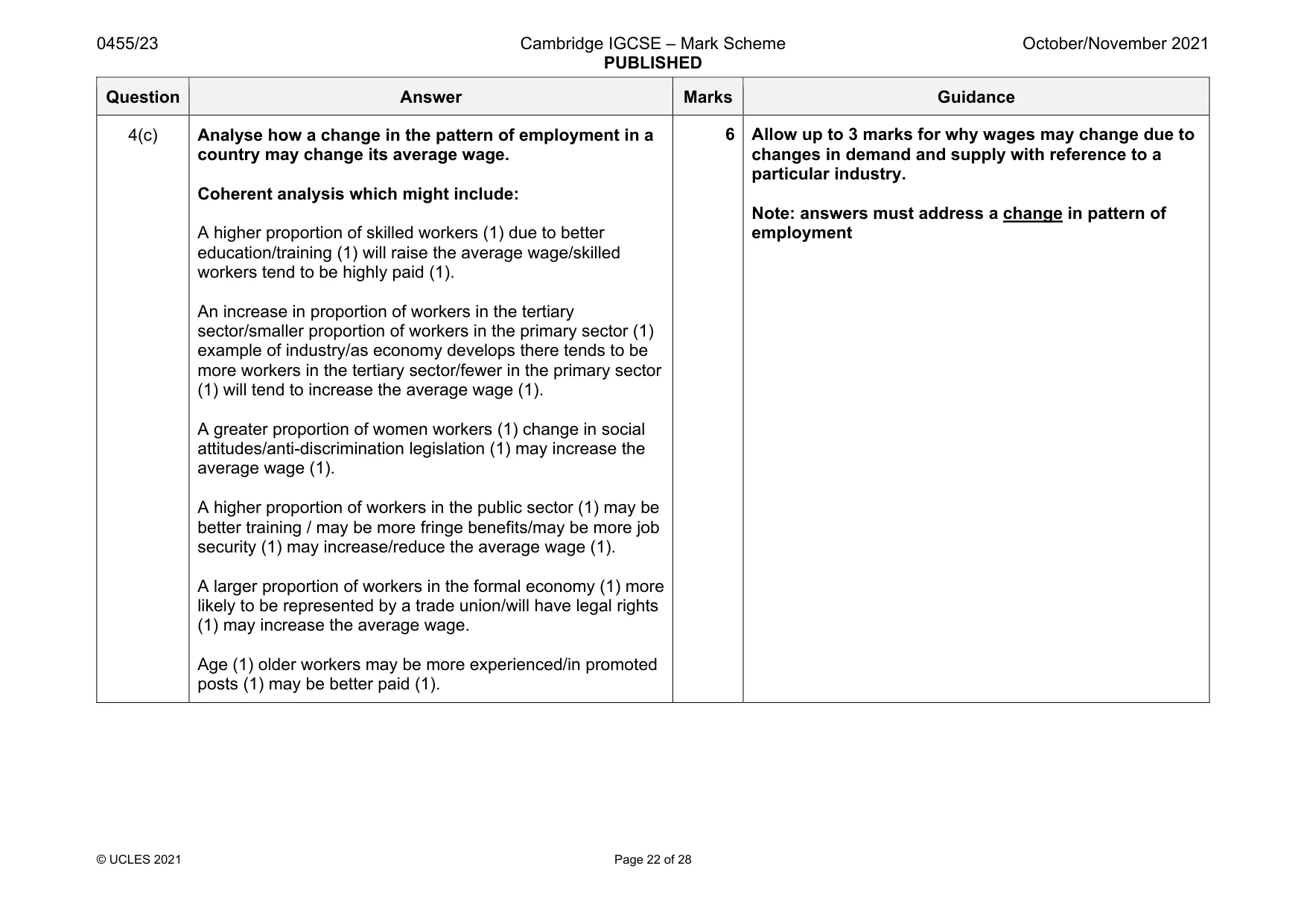
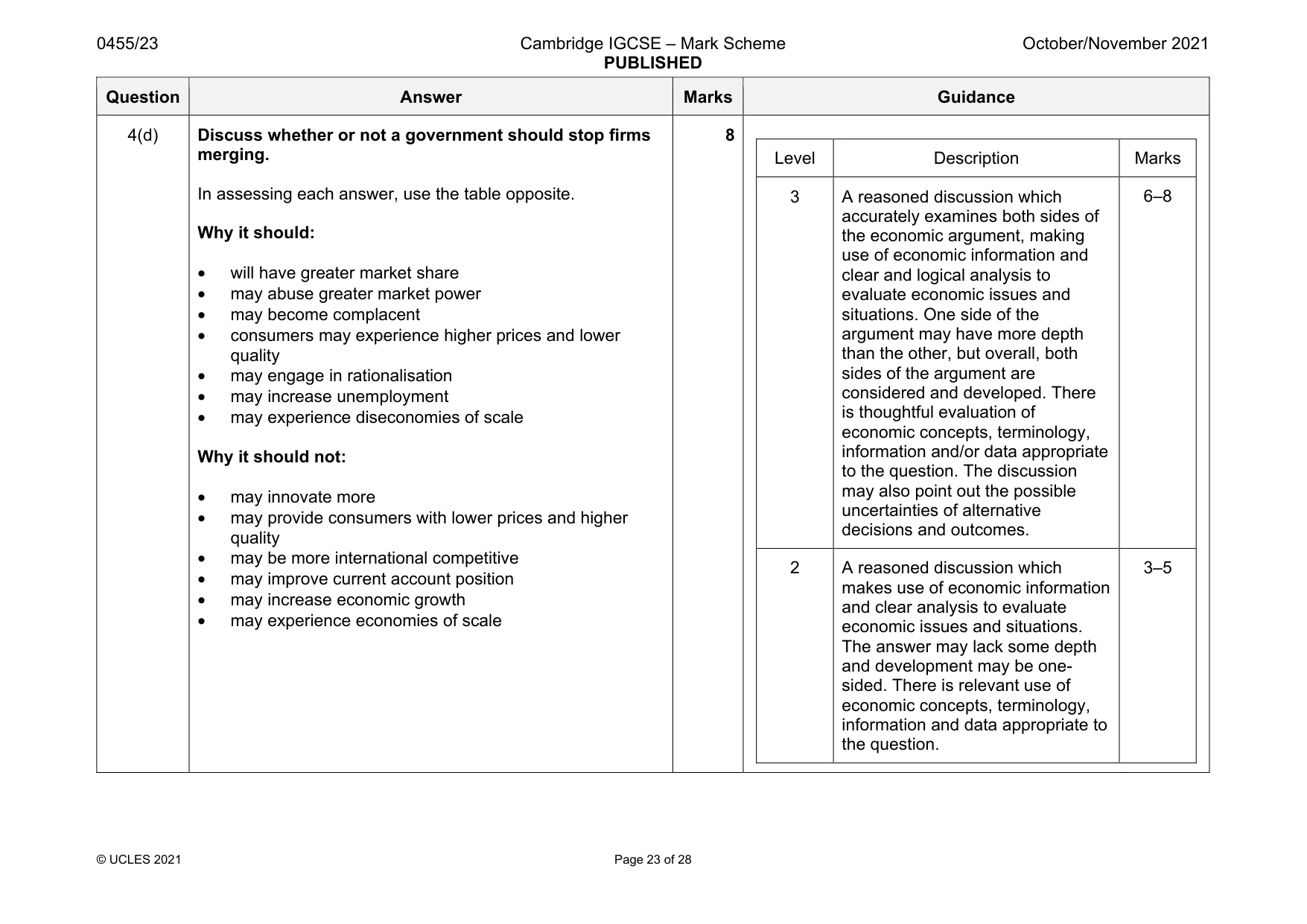
Mark scheme: 4(a) Identify two benefits of free trade. Two from: • higher output/growth • higher income/living standards • more employment/more jobs • more choice/access to other markets • lower price • greater ability to take advantage of economies of scale/greater efficiency/specialisation • drives competition • better quality goods • stronger global co-operation 2 Question Answer Marks Guidance 4(b) Explain two differences between a floating foreign exchange rate and a fixed foreign exchange rate. Logical explanation which might include: A floating exchange rate is determined by market forces (1) a fixed exchange rate is set by the government/central bank (1). A floating exchange rate can change on a day-to-day basis (1) whereas a fixed exchange does not often change in value (1). A rise in the value of floating exchange rate is an appreciation / a fall in the value of a floating exchange rate is a depreciation (1) a rise in the value of a fixed exchange rate is a revaluation/a fall in value of a fixed exchange rate is a devaluation (1). A floating exchange rate does not require a central bank to buy and sell the currency (1) a fixed exchange rate needs reserves of foreign currency to maintain it (1). 4 One mark each for each of two differences identified and one mark each for each of two explanations. Question Answer Marks Guidance 4(c) Analyse how a change in the pattern of employment in a country may change its average wage. Coherent analysis which might include: A higher proportion of skilled workers (1) due to better education/training (1) will raise the average wage/skilled workers tend to be highly paid (1). An increase in proportion of workers in the tertiary sector/smaller proportion of workers in the primary sector (1) example of industry/as economy develops there tends to be more workers in the tertiary sector/fewer in the primary sector (1) will tend to increase the average wage (1). A greater proportion of women workers (1) change in social attitudes/anti-discrimination legislation (1) may increase the average wage (1). A higher proportion of workers in the public sector (1) may be better training / may be more fringe benefits/may be more job security (1) may increase/reduce the average wage (1). A larger proportion of workers in the formal economy (1) more likely to be represented by a trade union/will have legal rights (1) may increase the average wage. Age (1) older workers may be more experienced/in promoted posts (1) may be better paid (1). 6 Allow up to 3 marks for why wages may change due to changes in demand and supply with reference to a particular industry. Note: answers must address a change in pattern of employment Question Answer Marks Guidance 4(d) Discuss whether or not a government should stop firms merging. In assessing each answer, use the table opposite. Why it should: • will have greater market share • may abuse greater market power • may become complacent • consumers may experience higher prices and lower quality • may engage in rationalisation • may increase unemployment • may experience diseconomies of scale Why it should not: • may innovate more • may provide consumers with lower prices and higher quality • may be more international competitive • may improve current account position • may increase economic growth • may experience economies of scale 8 Level Description Marks 3 A reasoned discussion which accurately examines both sides of the economic argument, making use of economic information and clear and logical analysis to evaluate economic issues and situations. One side of the argument may have more depth than the other, but overall, both sides of the argument are considered and developed. There is thoughtful evaluation of economic concepts, terminology, information and/or data appropriate to the question. The discussion may also point out the possible uncertainties of alternative decisions and outcomes. 6–8 2 A reasoned discussion which makes use of economic information and clear analysis to evaluate economic issues and situations. The answer may lack some depth and development may be one- sided. There is relevant use of economic concepts, terminology, information and data appropriate to the question. 3–5 Question Answer Marks Guidance 4(d) Level Description Marks 1 There is a simple attempt at u sing economic definitions and terminology. Some reference may be made to economic theory, with occasional understanding. 1–2 0 A mark of zero should be awarded for no creditable content. 0
Q5 · Industries and markets are changing in Vietnam
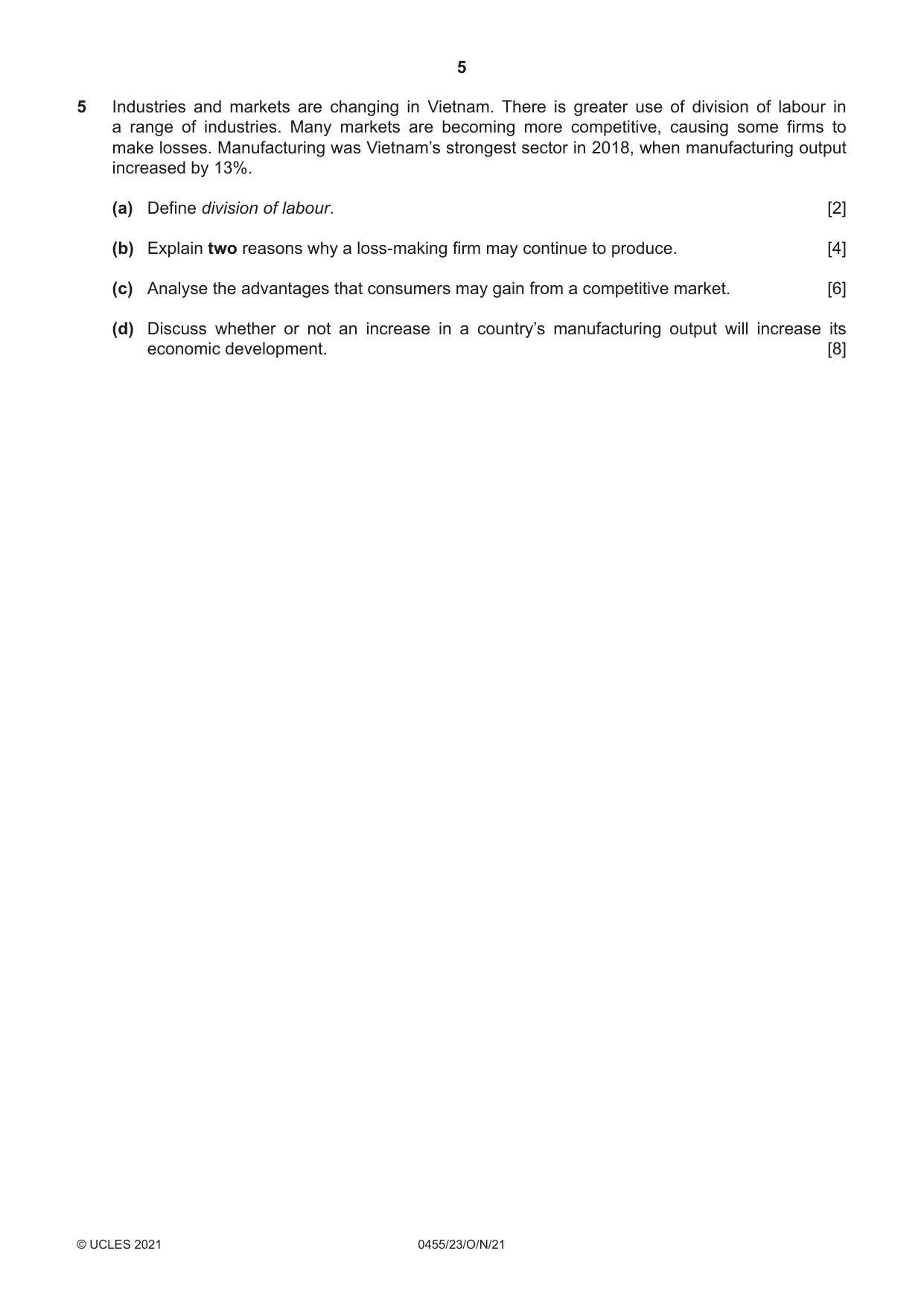
5 Industries and markets are changing in Vietnam. There is greater use of division of labour in a range of industries. Many markets are becoming more competitive, causing some firms to make losses. Manufacturing was Vietnam’s strongest sector in 2018, when manufacturing output increased by 13%. (a) Define division of labour. [2] (b) Explain two reasons why a loss-making firm may continue to produce. [4] (c) Analyse the advantages that consumers may gain from a competitive market. [6] (d) Discuss whether or not an increase in a country’s manufacturing output will increase its economic development. [8]
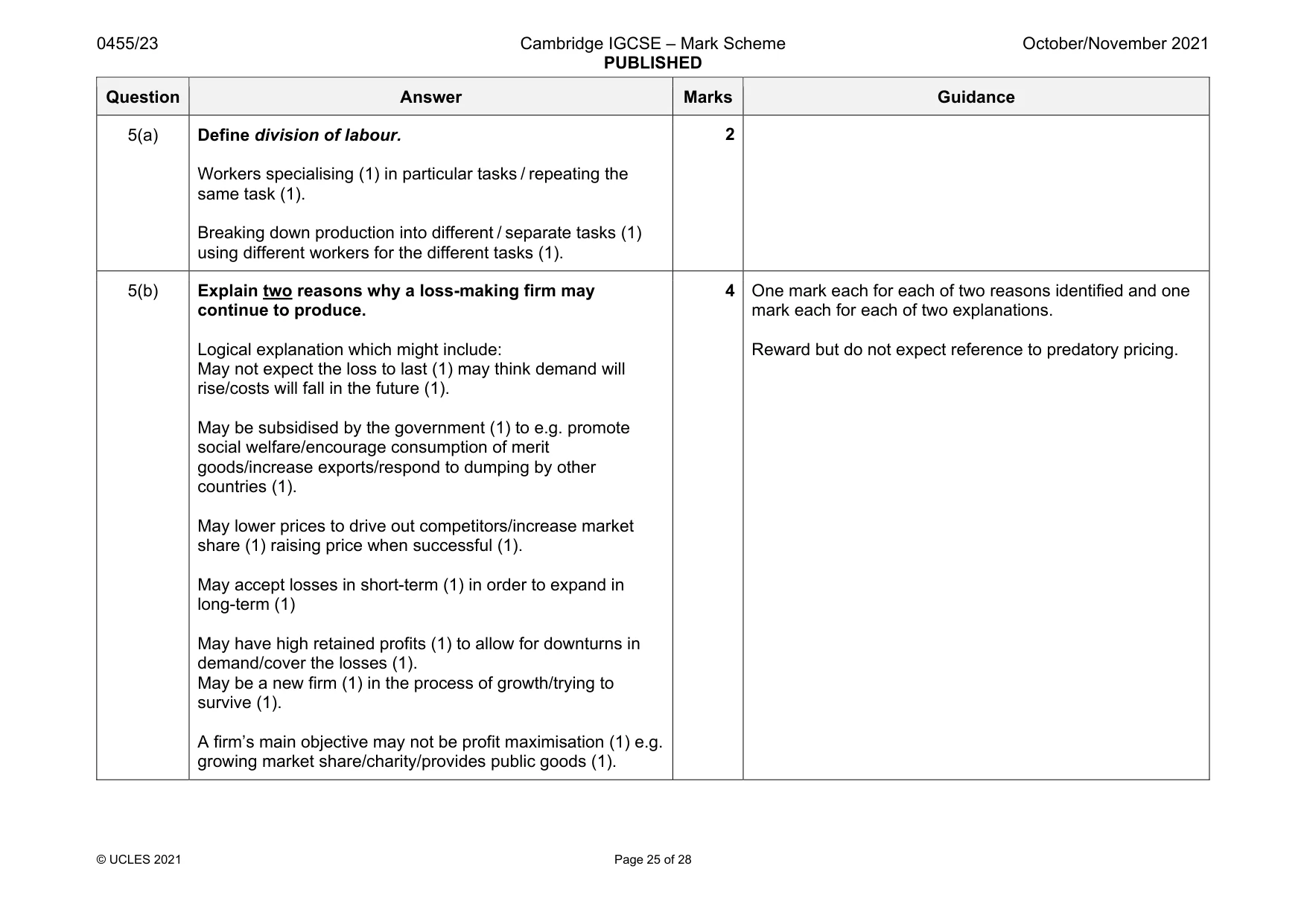
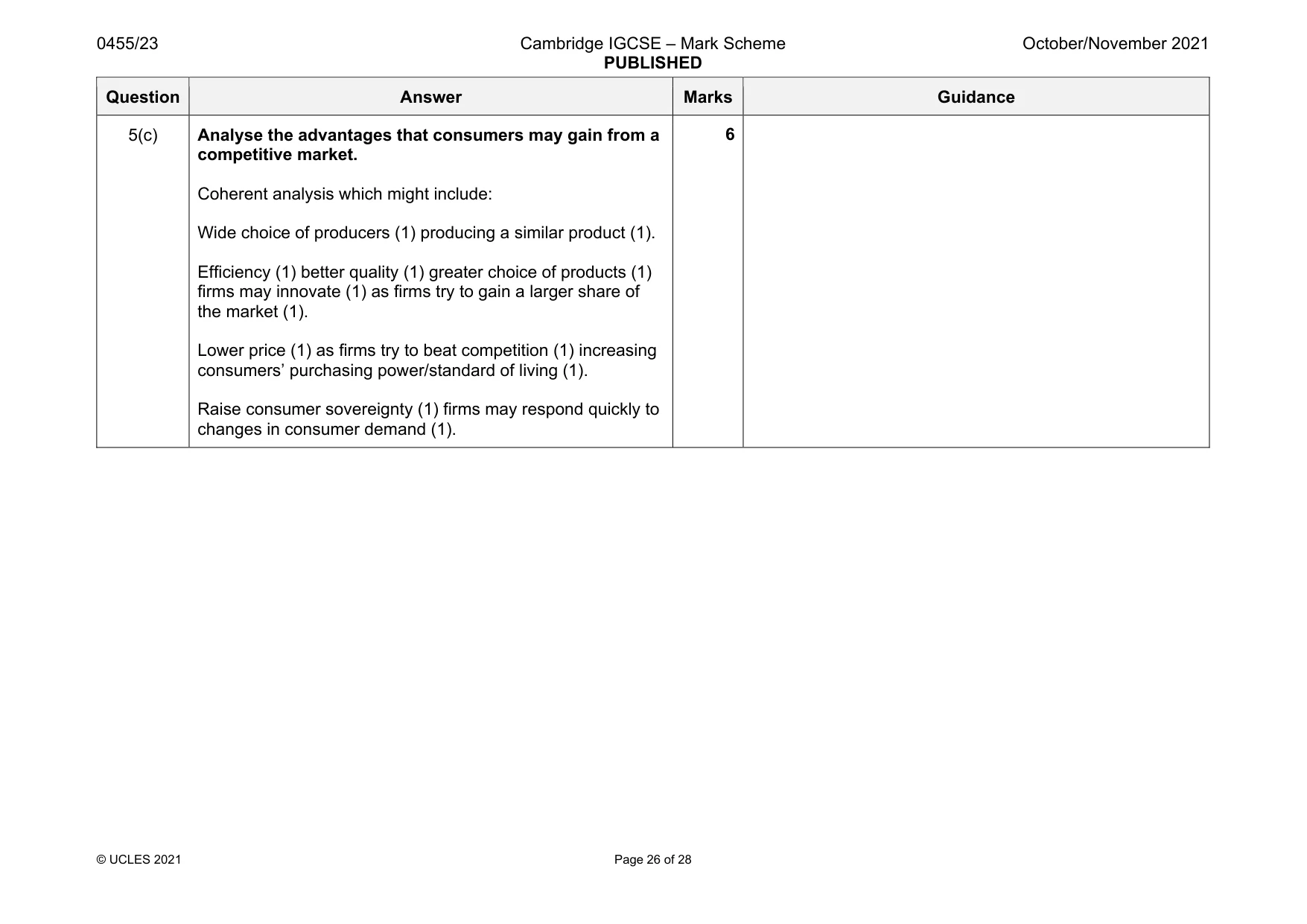
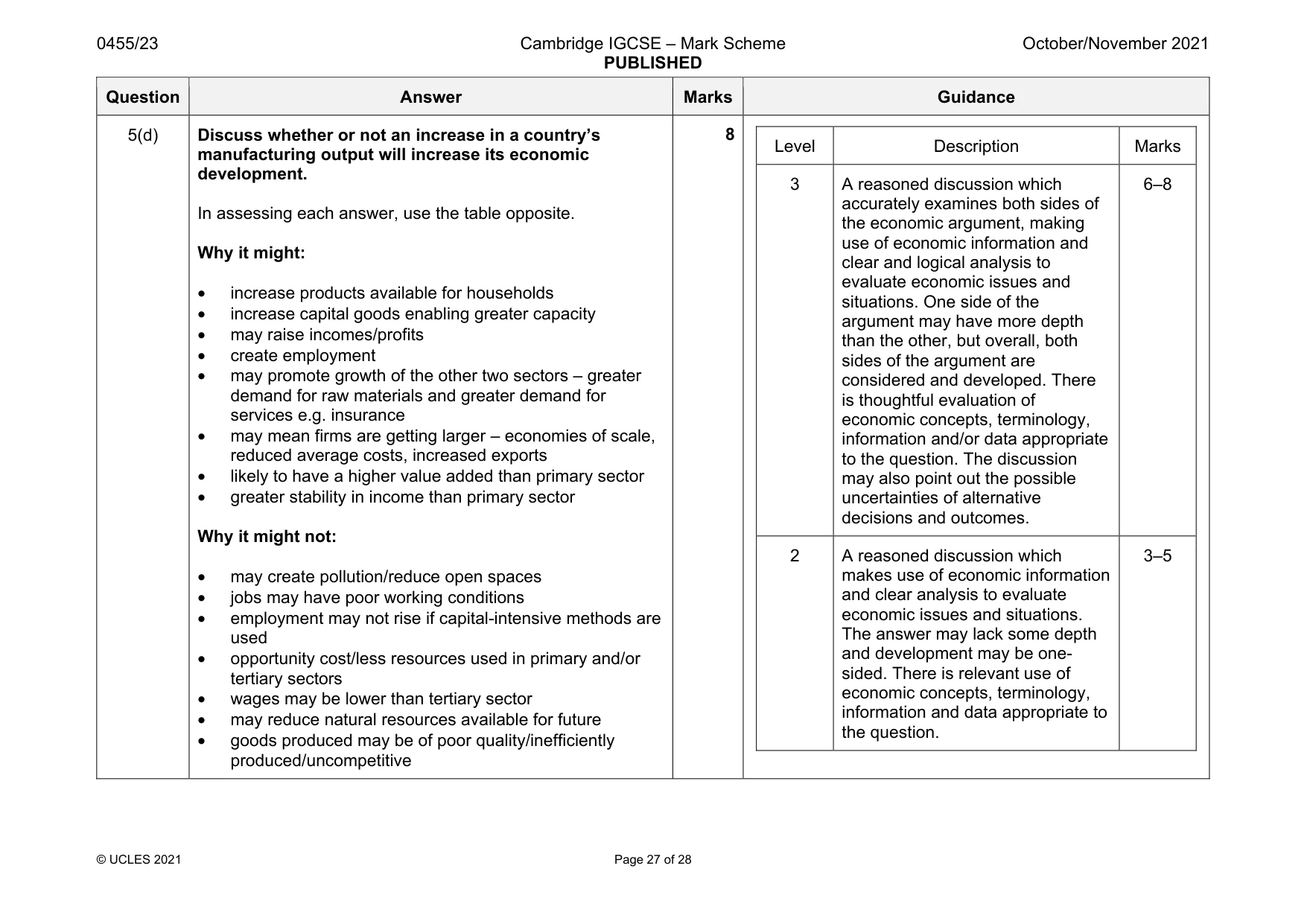
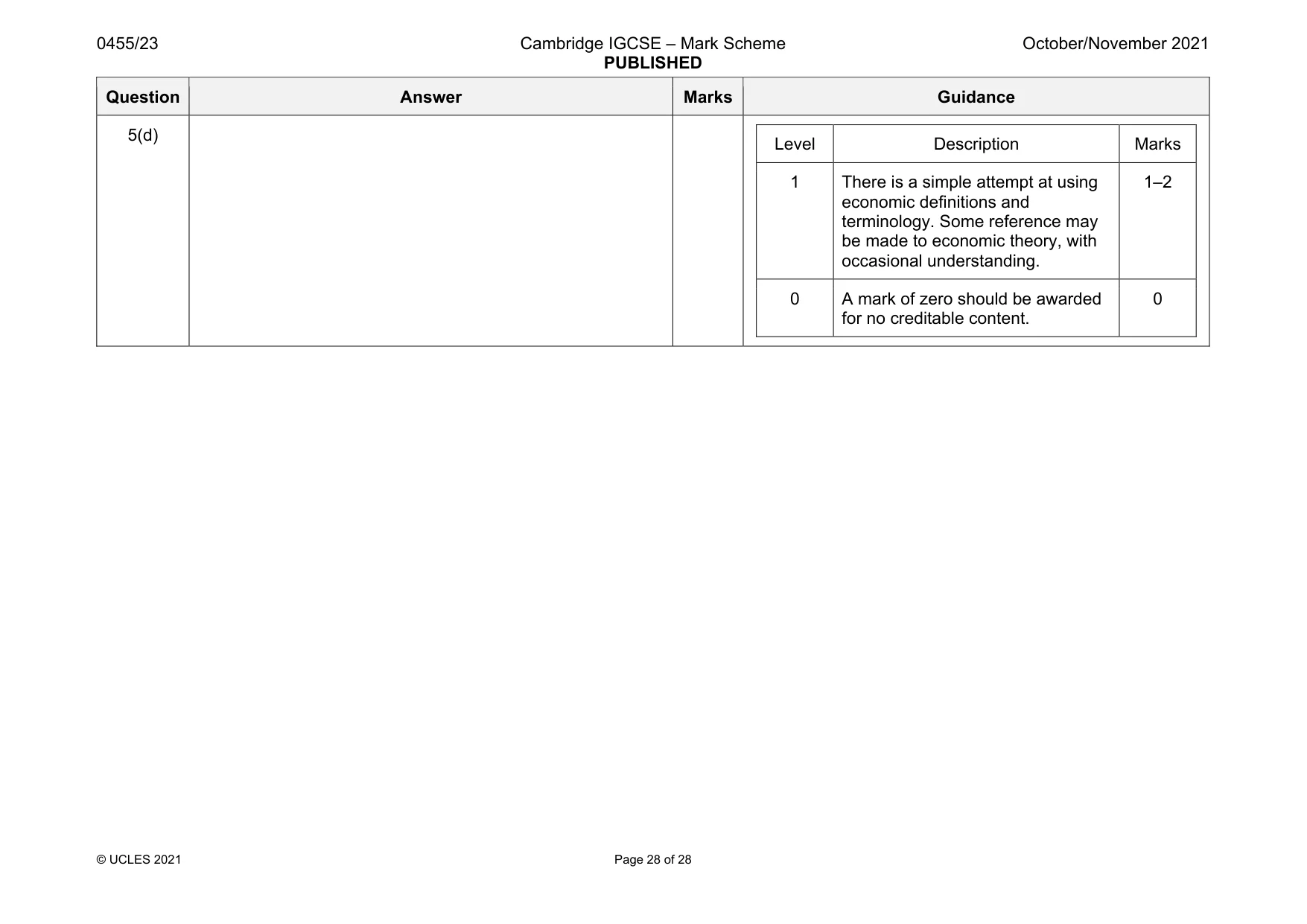
Mark scheme: 5(a) Define division of labour. Workers specialising (1) in particular tasks / repeating the same task (1). Breaking down production into different / separate tasks (1) using different workers for the different tasks (1). 5(b) Explain two reasons why a loss-making firm may continue to produce. Logical explanation which might include: May not expect the loss to last (1) may think demand will rise/costs will fall in the future (1). May be subsidised by the government (1) to e.g. promote social welfare/encourage consumption of merit goods/increase exports/respond to dumping by other countries (1). May lower prices to drive out competitors/increase market share (1) raising price when successful (1). May accept losses in short-term (1) in order to expand in long-term (1) May have high retained profits (1) to allow for downturns in demand/cover the losses (1). May be a new firm (1) in the process of growth/trying to survive (1). A firm’s main objective may not be profit maximisation (1) e.g. growing market share/charity/provides public goods (1). 4 One mark each for each of two reasons identified and one mark each for each of two explanations. Reward but do not expect reference to predatory pricing. Question Answer Marks Guidance 5(c) Analyse the advantages that consumers may gain from a competitive market. Coherent analysis which might include: Wide choice of producers (1) producing a similar product (1). Efficiency (1) better quality (1) greater choice of products (1) firms may innovate (1) as firms try to gain a larger share of the market (1). Lower price (1) as firms try to beat competition (1) increasing consumers’ purchasing power/standard of living (1). Raise consumer sovereignty (1) firms may respond quickly to changes in consumer demand (1). 6 Question Answer Marks Guidance 5(d) Discuss whether or not an increase in a country’s manufacturing output will increase its economic development. In assessing each answer, use the table opposite. Why it might: • increase products available for households • increase capital goods enabling greater capacity • may raise incomes/profits • create employment • may promote growth of the other two sectors – greater demand for raw materials and greater demand for services e.g. insurance • may mean firms are getting larger – economies of scale, reduced average costs, increased exports • likely to have a higher value added than primary sector • greater stability in income than primary sector Why it might not: • may create pollution/reduce open spaces • jobs may have poor working conditions • employment may not rise if capital-intensive methods are used • opportunity cost/less resources used in primary and/or tertiary sectors • wages may be lower than tertiary sector • may reduce natural resources available for future • goods produced may be of poor quality/inefficiently produced/uncompetitive 8 Level Description Marks 3 A reasoned discussion which accurately examines both sides of the economic argument, making use of economic information and clear and logical analysis to evaluate economic issues and situations. One side of the argument may have more depth than the other, but overall, both sides of the argument are considered and developed. There is thoughtful evaluation of economic concepts, terminology, information and/or data appropriate to the question. The discussion may also point out the possible uncertainties of alternative decisions and outcomes. 6–8 2 A reasoned discussion which makes use of economic information and clear analysis to evaluate economic issues and situations. The answer may lack some depth and development may be one- sided. There is relevant use of economic concepts, terminology, information and data appropriate to the question. 3–5 Question Answer Marks Guidance 5(d) Level Description Marks 1 There is a simple attempt at using economic definitions and terminology. Some reference may be made to economic theory, with occasional understanding. 1–2 0 A mark of zero should be awarded for no creditable content. 0
More questions on Differences in economic development between countries
What was in this paper
The subtopics covered by these 5 questions, and how many questions each got. Open one in a new tab to see every Cambridge question on it.
What you needed in this session
Cambridge’s own grade thresholds for 2021 Oct/Nov, Paper 2 · Variant 3. A higher threshold means an easier paper — the bar moves with how the cohort did.