Cambridge IGCSE Design and Technology 0445 — 2015 Oct/Nov Paper 3 · Variant 2
0445/32/O/N/15 · 50 marks · ≈56 min
The question paper and its mark scheme, free to read here and free to download. This is Cambridge’s own paper, exactly as it was sat.
Question paper16 pages
Mark scheme5 pages
Answers below. Sit the paper first if you are practising.
Paper as text
Question paper, page 1
This document consists of 15 printed pages and 1 blank page. DC (NF/CGW) 101543/2 © UCLES 2015 [Turn over Cambridge International Examinations Cambridge International General Certificate of Secondary Education * 0 4 0 4 6 6 6 6 4 2 * DESIGN AND TECHNOLOGY 0445/32 Paper 3 Resistant Materials October/November 2015 1 hour Candidates answer on the Question Paper. No Additional Materials are required. READ THESE INSTRUCTIONS FIRST Write your Centre number, candidate number and name on all the work you hand in. Write in blue or black pen. You may use an HB pencil for any diagrams, graphs or rough working. Do not use staples, paper clips, glue or correction fluid. DO NOT WRITE IN ANY BARCODES. Section A Answer all questions in this section. Section B Answer one question in this section. You may use a calculator. At the end of the examination, fasten all your work securely together. The number of marks is given in brackets [ ] at the end of each question or part question. The total of the marks for this paper is 50.
Question paper, page 2
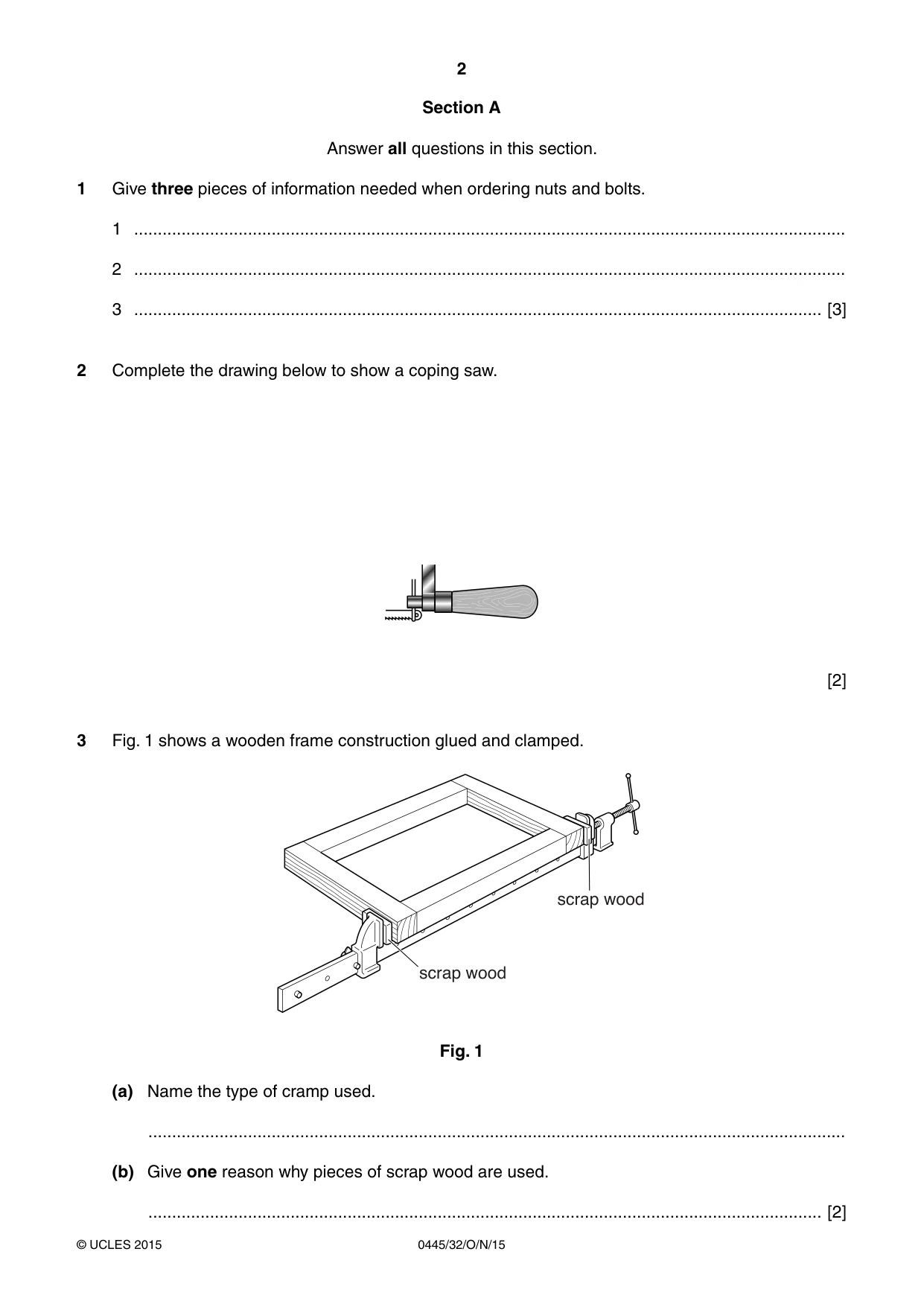
2 0445/32/O/N/15 © UCLES 2015 Section A Answer all questions in this section. 1 Give three pieces of information needed when ordering nuts and bolts. 1 … 2 … 3 … [3] 2 Complete the drawing below to show a coping saw. [2] 3 Fig. 1 shows a wooden frame construction glued and clamped. scrap wood scrap wood Fig. 1 (a) Name the type of cramp used. … (b) Give one reason why pieces of scrap wood are used. … [2]
Question paper, page 3
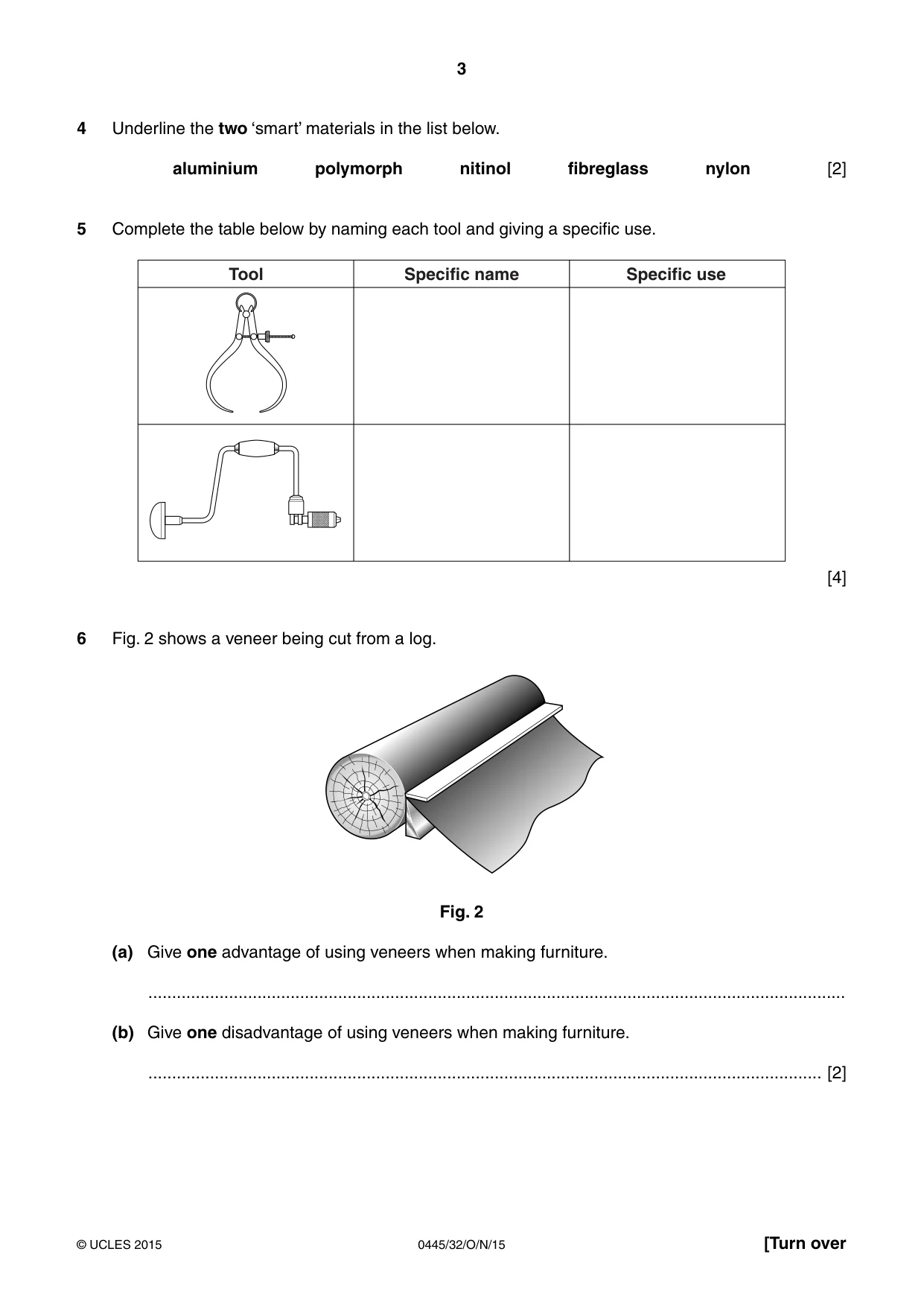
3 0445/32/O/N/15 © UCLES 2015 [Turn over 4 Underline the two ‘smart’ materials in the list below. aluminium polymorph nitinol fibreglass nylon [2] 5 Complete the table below by naming each tool and giving a specific use. Tool Specific name Specific use [4] 6 Fig. 2 shows a veneer being cut from a log. Fig. 2 (a) Give one advantage of using veneers when making furniture. … (b) Give one disadvantage of using veneers when making furniture. … [2]
Question paper, page 4
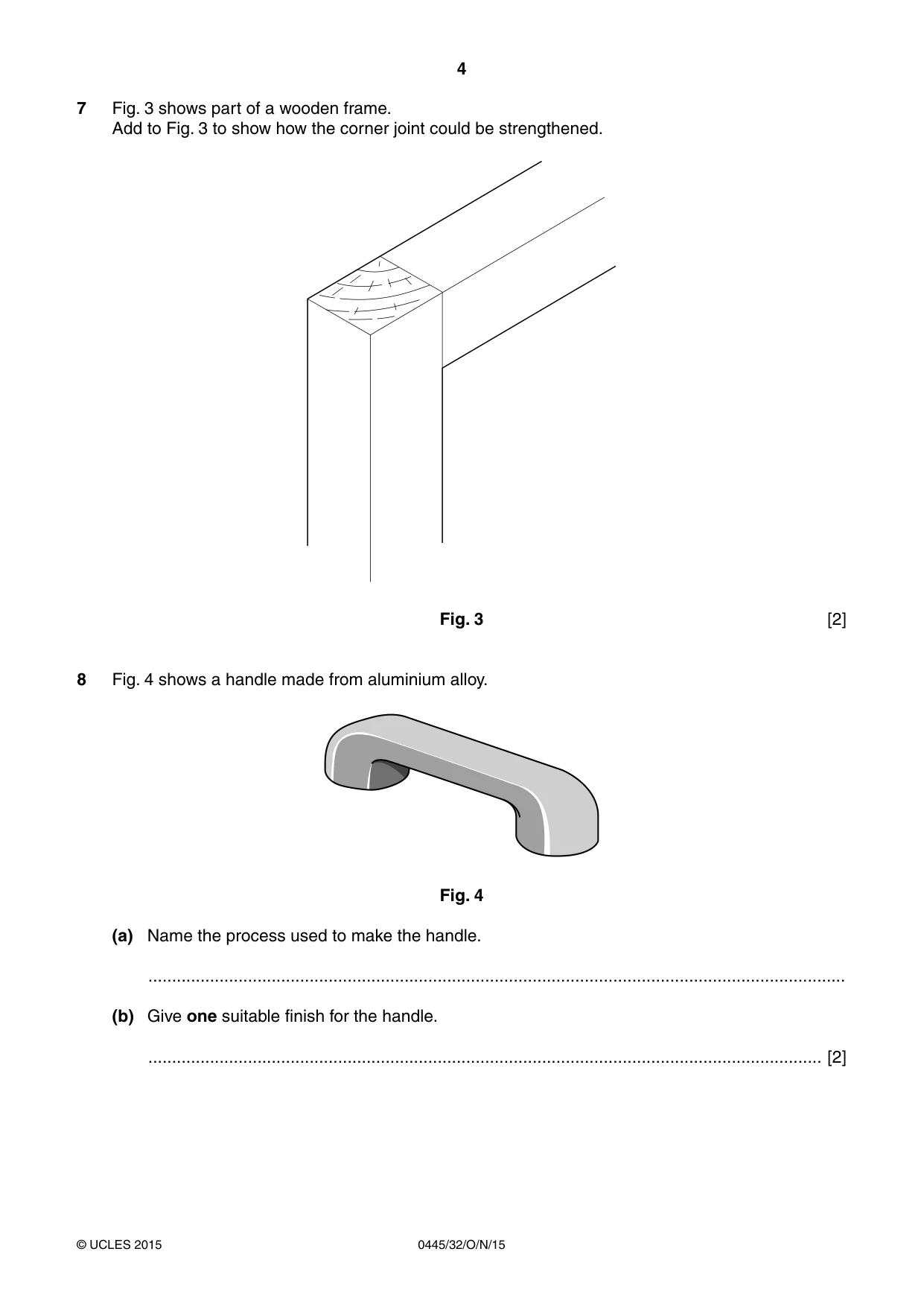
4 0445/32/O/N/15 © UCLES 2015 7 Fig. 3 shows part of a wooden frame. Add to Fig. 3 to show how the corner joint could be strengthened. Fig. 3 [2] 8 Fig. 4 shows a handle made from aluminium alloy. Fig. 4 (a) Name the process used to make the handle. … (b) Give one suitable finish for the handle. … [2]
Question paper, page 5
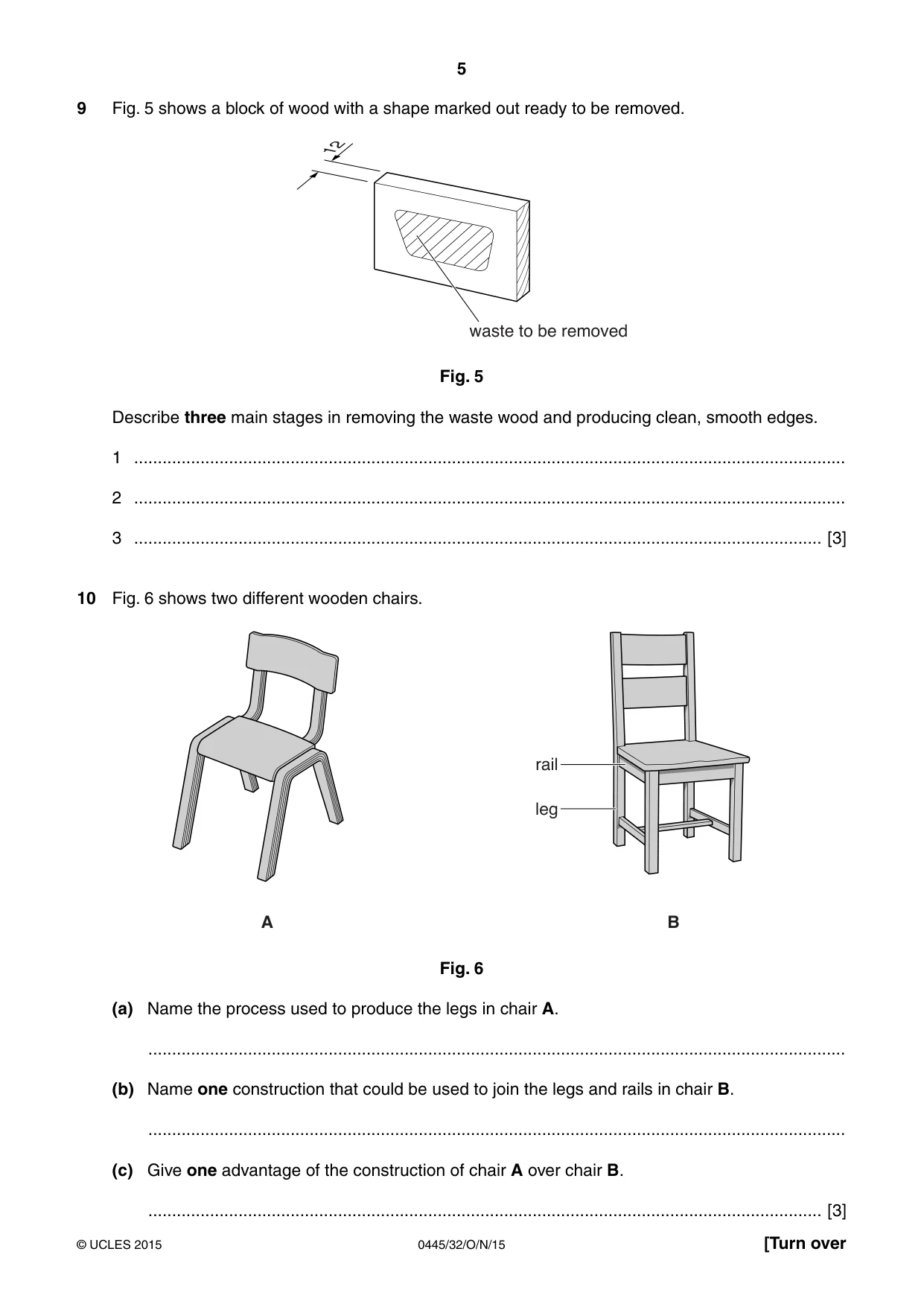
5 0445/32/O/N/15 © UCLES 2015 [Turn over 9 Fig. 5 shows a block of wood with a shape marked out ready to be removed. waste to be removed 12 Fig. 5 Describe three main stages in removing the waste wood and producing clean, smooth edges. 1 … 2 … 3 … [3] 10 Fig. 6 shows two different wooden chairs. A B rail leg Fig. 6 (a) Name the process used to produce the legs in chair A. … (b) Name one construction that could be used to join the legs and rails in chair B. … (c) Give one advantage of the construction of chair A over chair B. … [3]
Question paper, page 6
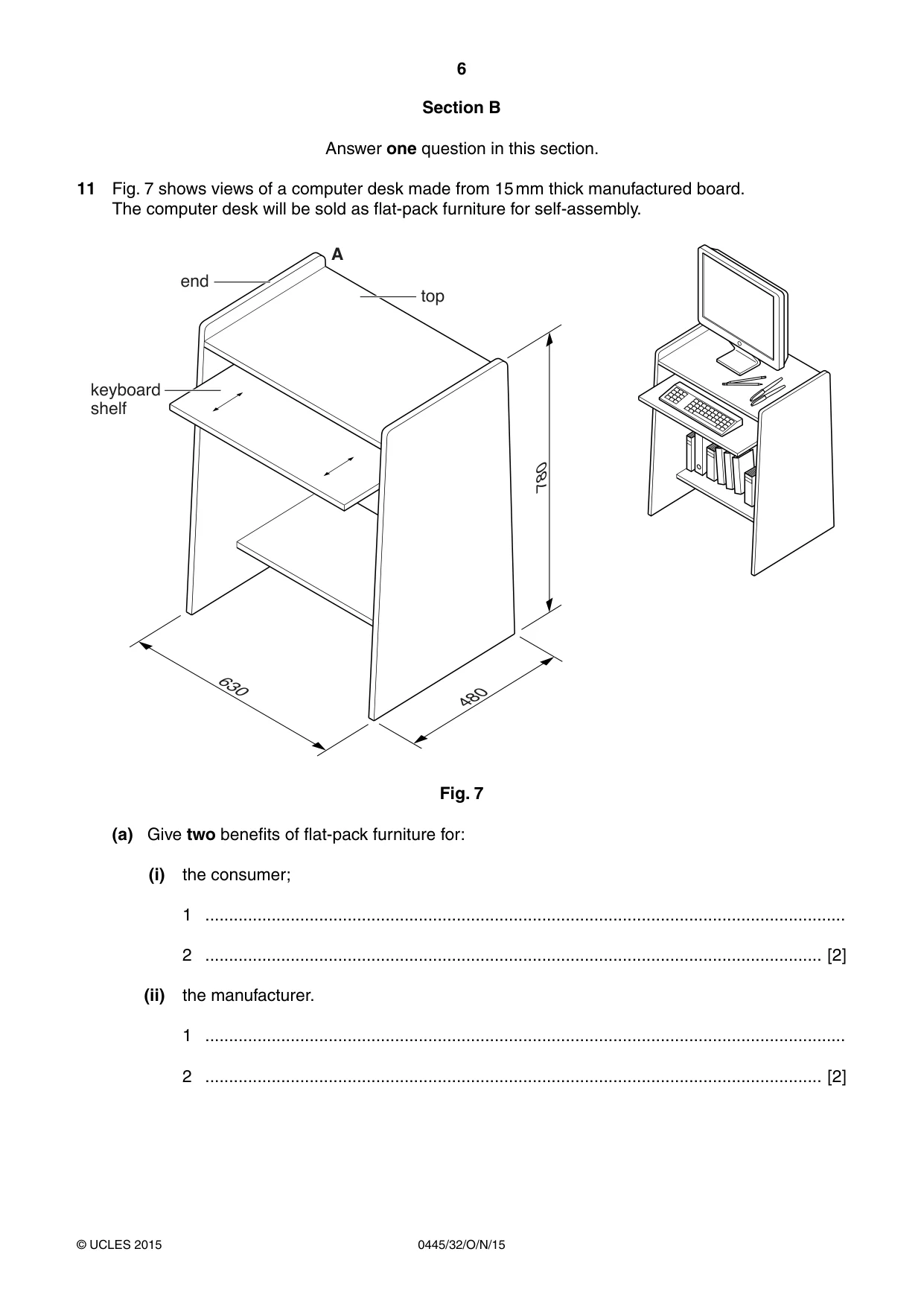
6 0445/32/O/N/15 © UCLES 2015 Section B Answer one question in this section. 11 Fig. 7 shows views of a computer desk made from 15 mm thick manufactured board. The computer desk will be sold as flat-pack furniture for self-assembly. top end keyboard shelf A 780 480 630 Fig. 7 (a) Give two benefits of flat-pack furniture for: (i) the consumer; 1 … 2 … [2] (ii) the manufacturer. 1 … 2 … [2]
Question paper, page 7
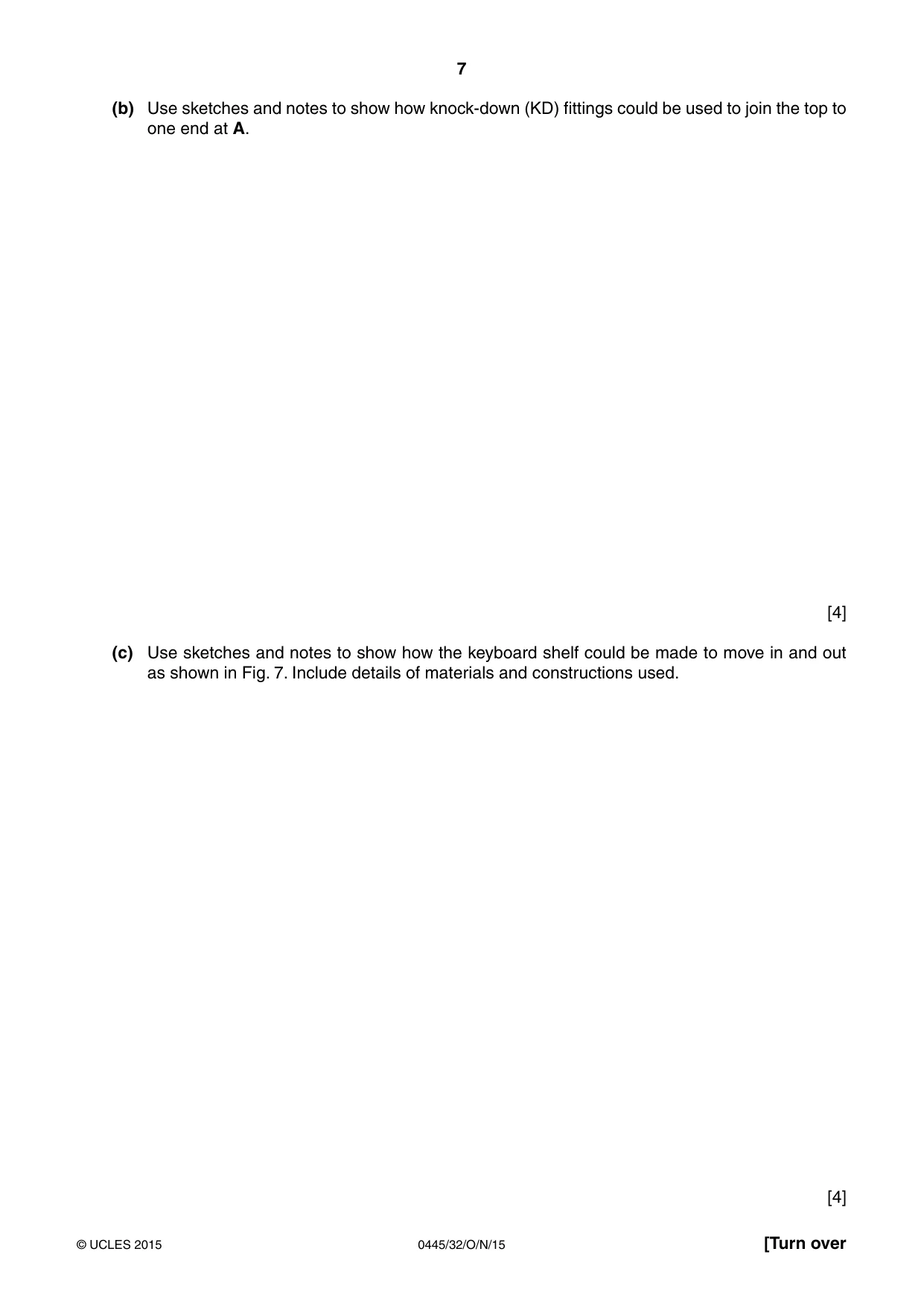
7 0445/32/O/N/15 © UCLES 2015 [Turn over (b) Use sketches and notes to show how knock-down (KD) fittings could be used to join the top to one end at A. [4] (c) Use sketches and notes to show how the keyboard shelf could be made to move in and out as shown in Fig. 7. Include details of materials and constructions used. [4]
Question paper, page 8
8 0445/32/O/N/15 © UCLES 2015 (d) The ends and shelves will be spray painted. (i) Give two advantages of spray painting rather than applying paint with a brush. 1 … 2 … [2] (ii) Describe two safety precautions you would take when spray painting. 1 … 2 … [2] (e) Evaluate the design of the computer desk shown in Fig. 7 in terms of: (i) safety; … … [2] (ii) appearance; … … [2] (iii) costs. … … [2] (f) Explain why the computer desk could be considered to have a limited lifetime. … … … … [3]
Question paper, page 9
9 0445/32/O/N/15 © UCLES 2015 [Turn over BLANK PAGE Question 12 is printed on the next page. Permission to reproduce items where third-party owned material protected by copyright is included has been sought and cleared where possible. Every reasonable effort has been made by the publisher (UCLES) to trace copyright holders, but if any items requiring clearance have unwittingly been included, the publisher will be pleased to make amends at the earliest possible opportunity. To avoid the issue of disclosure of answer-related information to candidates, all copyright acknowledgements are reproduced online in the Cambridge International Examinations Copyright Acknowledgements Booklet. This is produced for each series of examinations and is freely available to download at www.cie.org.uk after the live examination series. Cambridge International Examinations is part of the Cambridge Assessment Group. Cambridge Assessment is the brand name of University of Cambridge Local Examinations Syndicate (UCLES), which is itself a department of the University of Cambridge.
Question paper, page 10
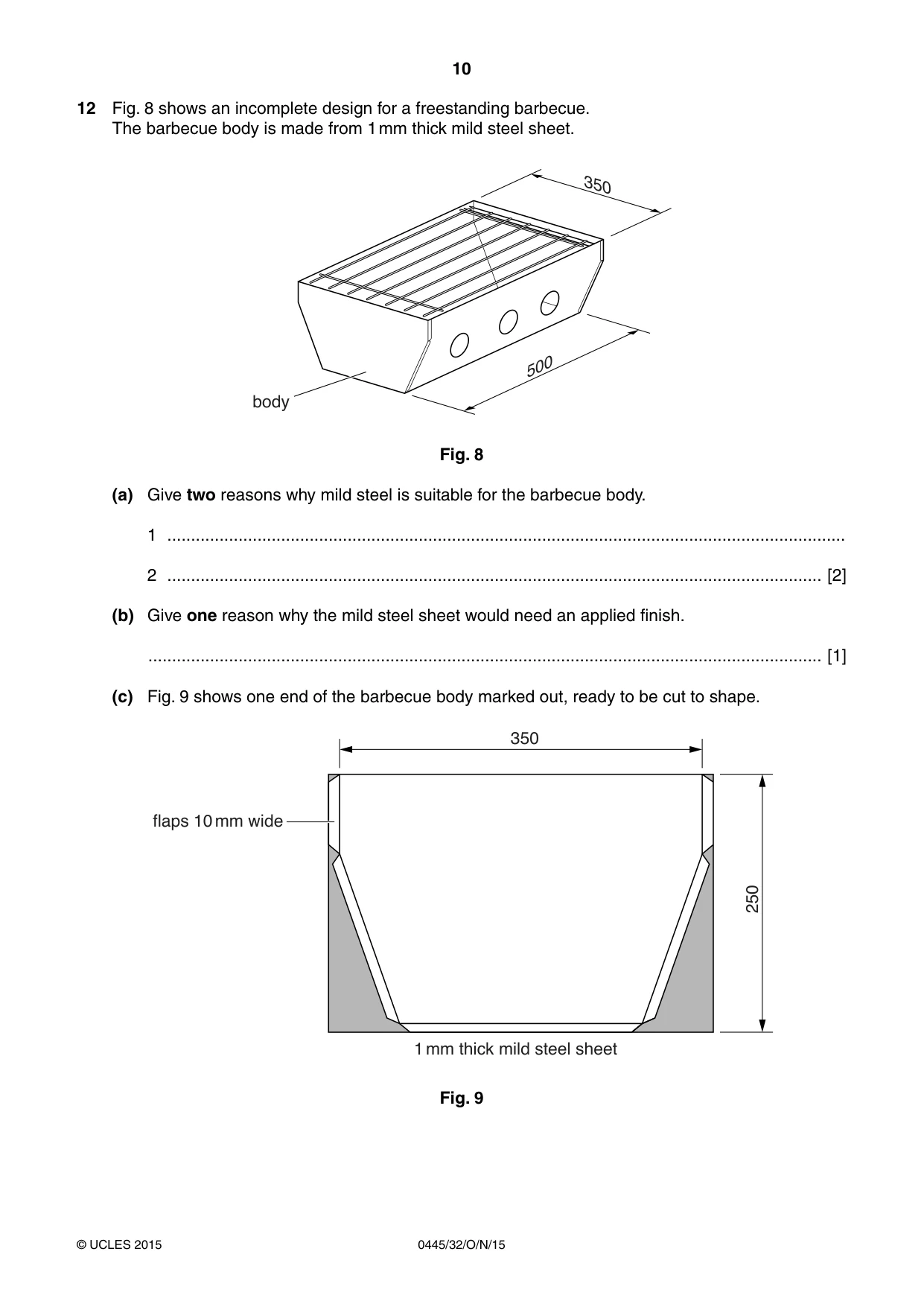
10 0445/32/O/N/15 © UCLES 2015 12 Fig. 8 shows an incomplete design for a freestanding barbecue. The barbecue body is made from 1 mm thick mild steel sheet. body 500 350 Fig. 8 (a) Give two reasons why mild steel is suitable for the barbecue body. 1 … 2 … [2] (b) Give one reason why the mild steel sheet would need an applied finish. … [1] (c) Fig. 9 shows one end of the barbecue body marked out, ready to be cut to shape. flaps 10 mm wide 1 mm thick mild steel sheet 350 250 Fig. 9
Question paper, page 11
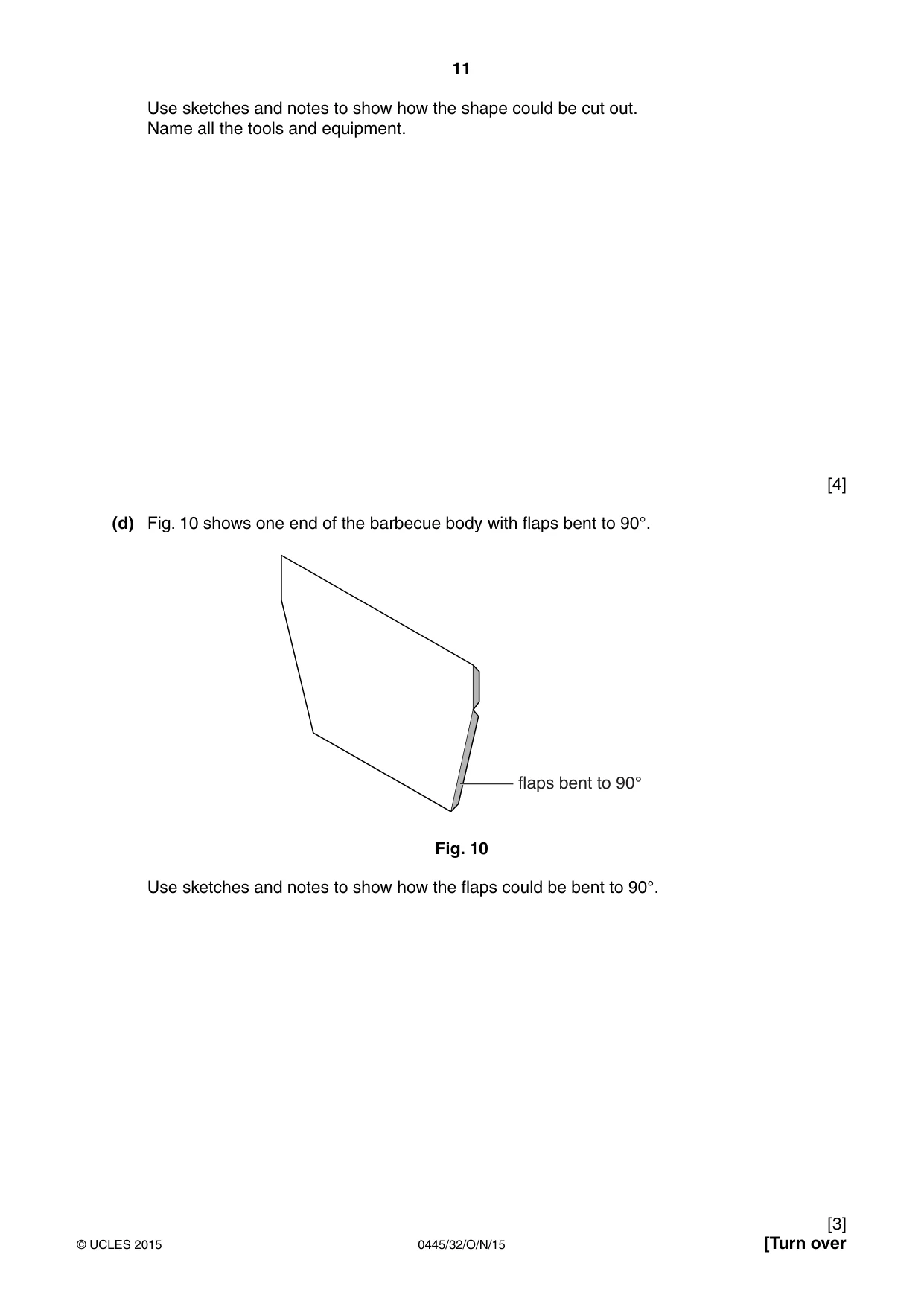
11 0445/32/O/N/15 © UCLES 2015 [Turn over Use sketches and notes to show how the shape could be cut out. Name all the tools and equipment. [4] (d) Fig. 10 shows one end of the barbecue body with flaps bent to 90°. flaps bent to 90° Fig. 10 Use sketches and notes to show how the flaps could be bent to 90°. [3]
Question paper, page 12
12 0445/32/O/N/15 © UCLES 2015 (e) Sketch one permanent method of joining the ends to the sides of the barbecue body. [2] (f) Use sketches and notes to show how the barbecue body could be supported at a height of 500 mm above the ground. Your design must include: • named materials; • two important sizes; • a temporary method of joining the support to the barbecue body. [8]
Question paper, page 13
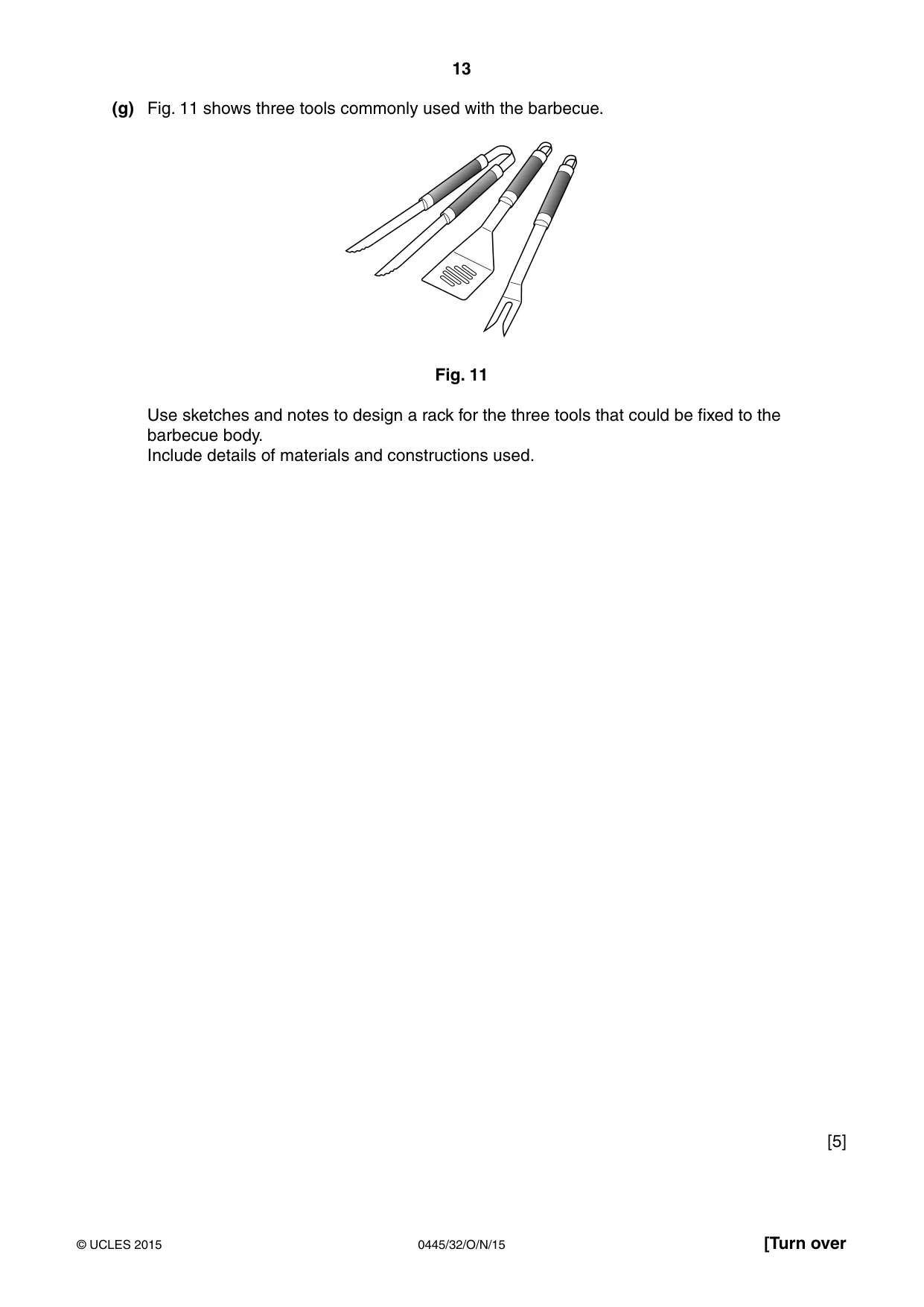
13 0445/32/O/N/15 © UCLES 2015 [Turn over (g) Fig. 11 shows three tools commonly used with the barbecue. Fig. 11 Use sketches and notes to design a rack for the three tools that could be fixed to the barbecue body. Include details of materials and constructions used. [5]
Question paper, page 14
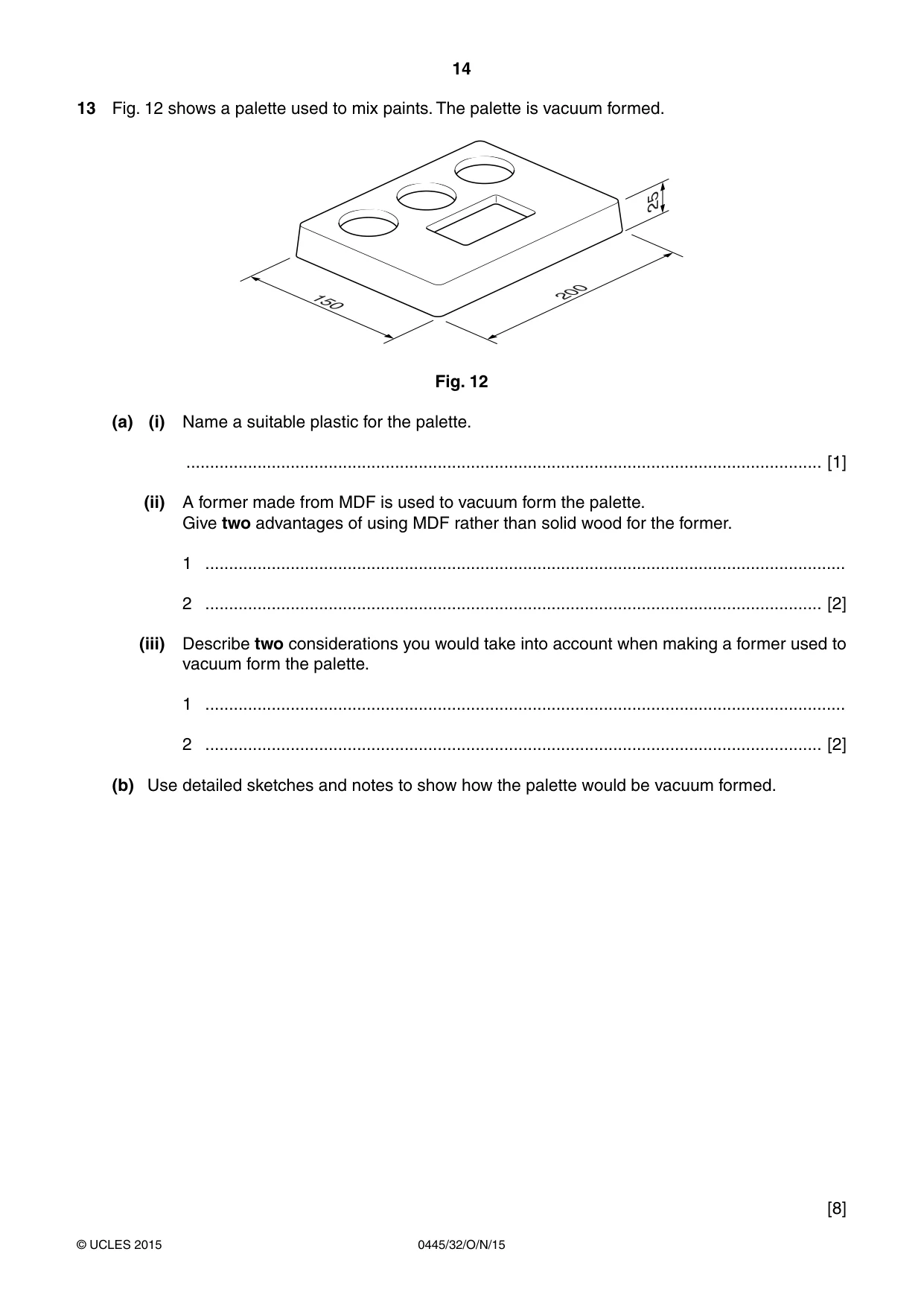
14 0445/32/O/N/15 © UCLES 2015 13 Fig. 12 shows a palette used to mix paints. The palette is vacuum formed. 25 200 150 Fig. 12 (a) (i) Name a suitable plastic for the palette. … [1] (ii) A former made from MDF is used to vacuum form the palette. Give two advantages of using MDF rather than solid wood for the former. 1 … 2 … [2] (iii) Describe two considerations you would take into account when making a former used to vacuum form the palette. 1 … 2 … [2] (b) Use detailed sketches and notes to show how the palette would be vacuum formed. [8]
Question paper, page 15
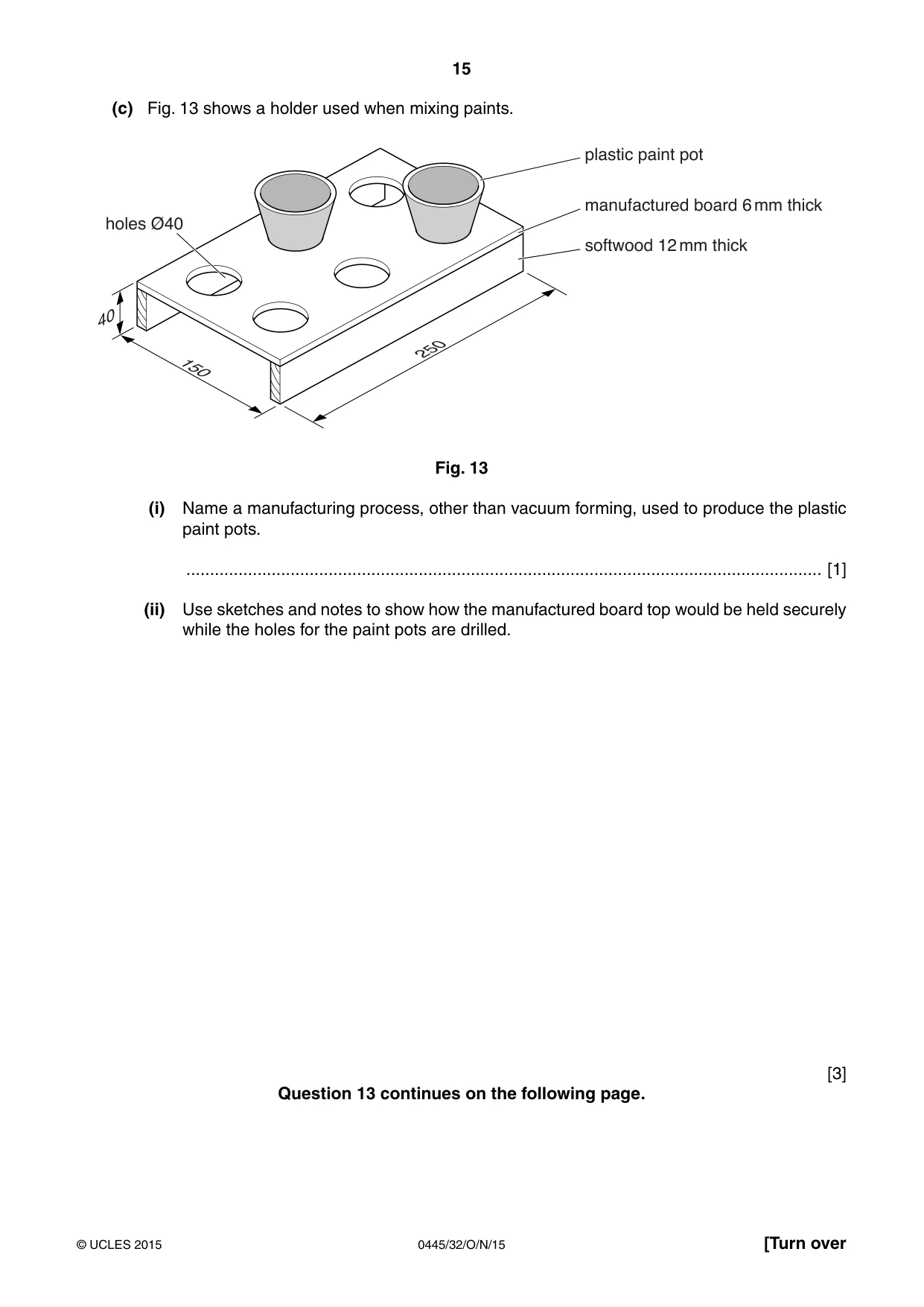
15 0445/32/O/N/15 © UCLES 2015 [Turn over (c) Fig. 13 shows a holder used when mixing paints. holes Ø40 40 plastic paint pot manufactured board 6 mm thick softwood 12 mm thick 250 150 Fig. 13 (i) Name a manufacturing process, other than vacuum forming, used to produce the plastic paint pots. … [1] (ii) Use sketches and notes to show how the manufactured board top would be held securely while the holes for the paint pots are drilled. [3] Question 13 continues on the following page.
Question paper, page 16
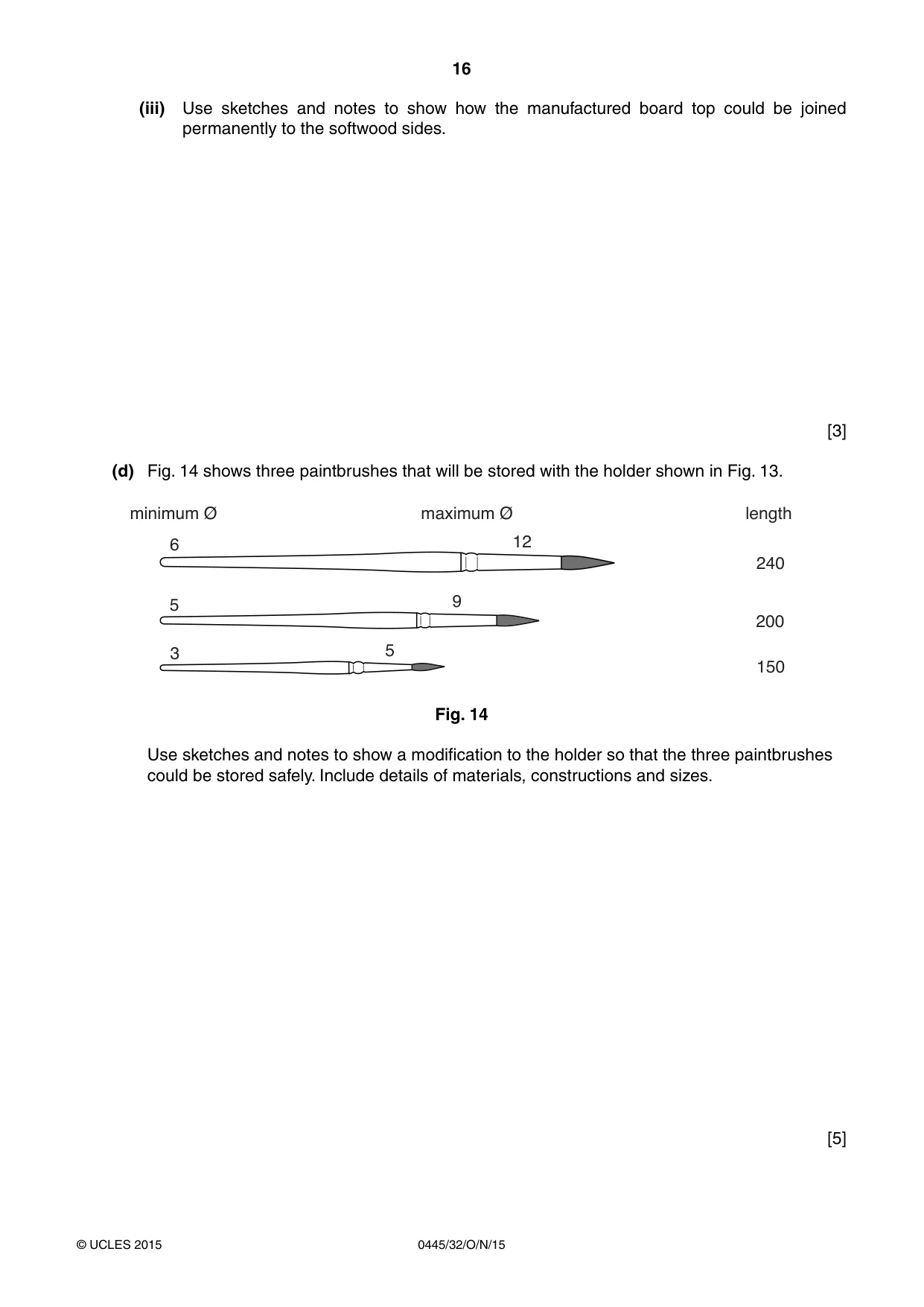
16 0445/32/O/N/15 © UCLES 2015 (iii) Use sketches and notes to show how the manufactured board top could be joined permanently to the softwood sides. [3] (d) Fig. 14 shows three paintbrushes that will be stored with the holder shown in Fig. 13. 12 9 5 minimum Ø maximum Ø length 6 5 3 240 200 150 Fig. 14 Use sketches and notes to show a modification to the holder so that the three paintbrushes could be stored safely. Include details of materials, constructions and sizes. [5]
Mark scheme, page 1
® IGCSE is the registered trademark of Cambridge International Examinations. CAMBRIDGE INTERNATIONAL EXAMINATIONS Cambridge International General Certificate of Secondary Education MARK SCHEME for the October/November 2015 series 0445 DESIGN AND TECHNOLOGY 0445/32 Paper 3 (Resistant Materials), maximum raw mark 50 This mark scheme is published as an aid to teachers and candidates, to indicate the requirements of the examination. It shows the basis on which Examiners were instructed to award marks. It does not indicate the details of the discussions that took place at an Examiners’ meeting before marking began, which would have considered the acceptability of alternative answers. Mark schemes should be read in conjunction with the question paper and the Principal Examiner Report for Teachers. Cambridge will not enter into discussions about these mark schemes. Cambridge is publishing the mark schemes for the October/November 2015 series for most Cambridge IGCSE®, Cambridge International A and AS Level components and some Cambridge O Level components.
Mark scheme, page 2
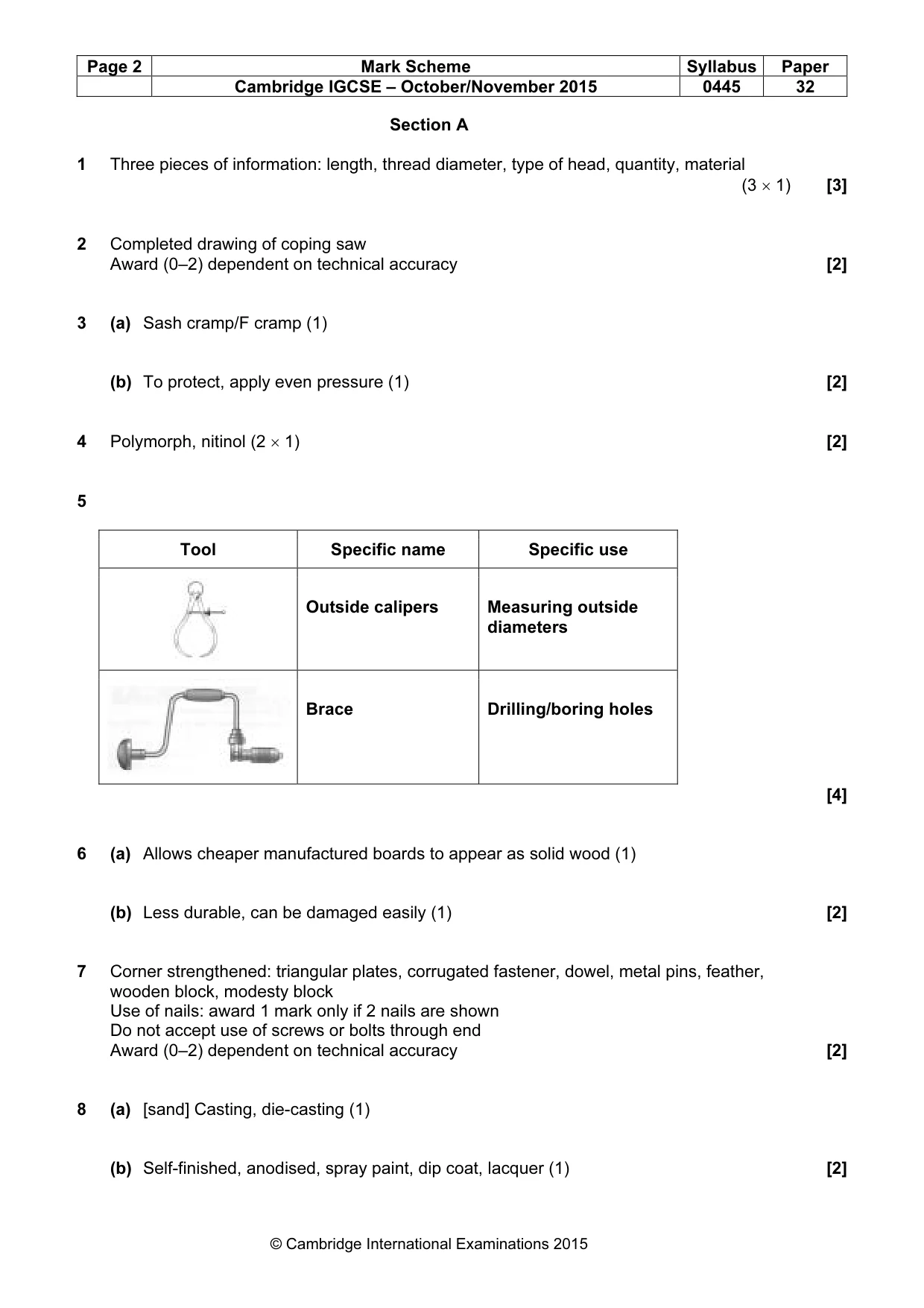
Page 2 Mark Scheme Syllabus Paper Cambridge IGCSE – October/November 2015 0445 32 © Cambridge International Examinations 2015 Section A 1 Three pieces of information: length, thread diameter, type of head, quantity, material (3 × 1) [3] 2 Completed drawing of coping saw Award (0–2) dependent on technical accuracy [2] 3 (a) Sash cramp/F cramp (1) (b) To protect, apply even pressure (1) [2] 4 Polymorph, nitinol (2 × 1) [2] 5 Tool Specific name Specific use Outside calipers Measuring outside diameters Brace Drilling/boring holes [4] 6 (a) Allows cheaper manufactured boards to appear as solid wood (1) (b) Less durable, can be damaged easily (1) [2] 7 Corner strengthened: triangular plates, corrugated fastener, dowel, metal pins, feather, wooden block, modesty block Use of nails: award 1 mark only if 2 nails are shown Do not accept use of screws or bolts through end Award (0–2) dependent on technical accuracy [2] 8 (a) [sand] Casting, die-casting (1) (b) Self-finished, anodised, spray paint, dip coat, lacquer (1) [2]
Mark scheme, page 3
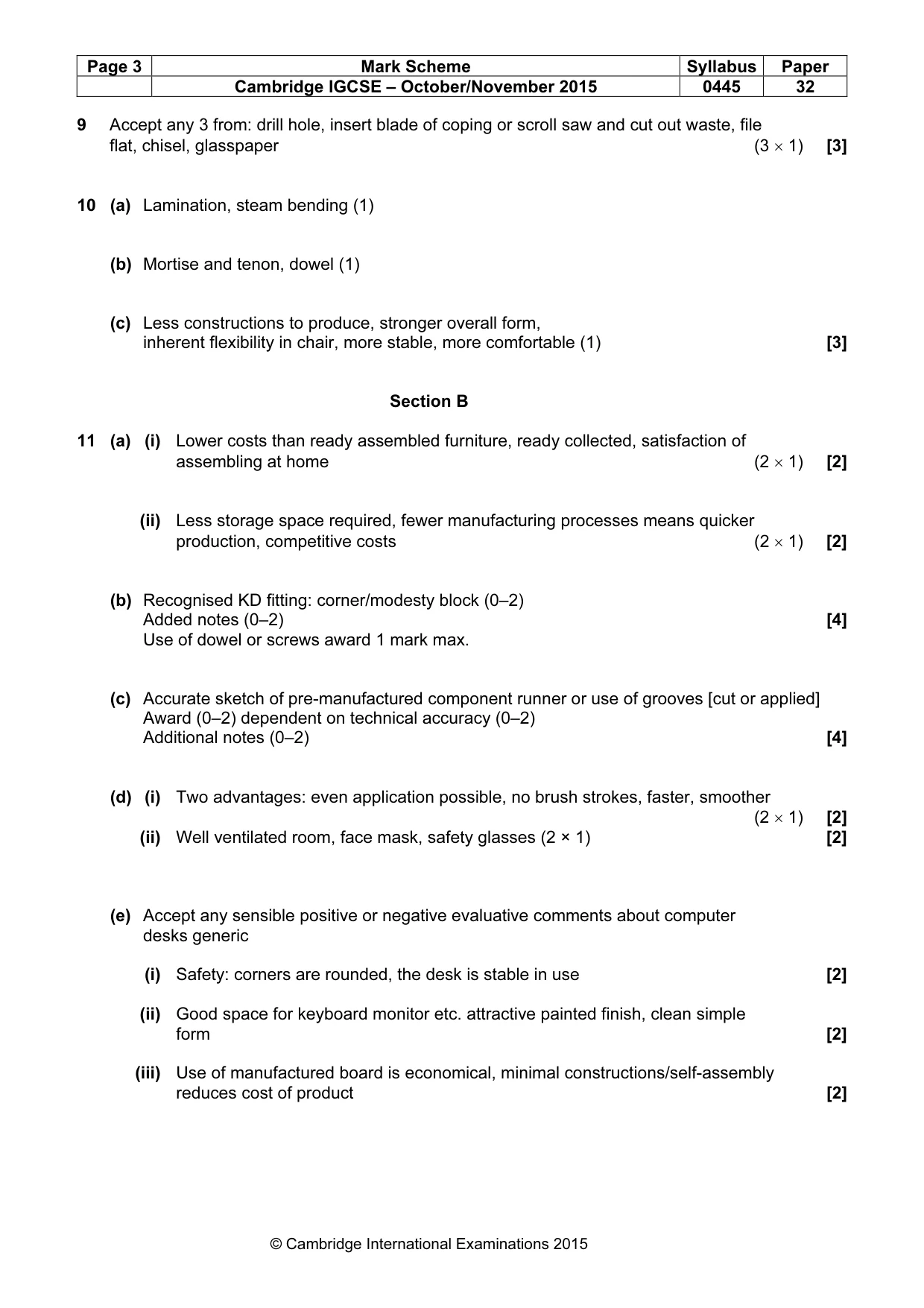
Page 3 Mark Scheme Syllabus Paper Cambridge IGCSE – October/November 2015 0445 32 © Cambridge International Examinations 2015 9 Accept any 3 from: drill hole, insert blade of coping or scroll saw and cut out waste, file flat, chisel, glasspaper (3 × 1) [3] 10 (a) Lamination, steam bending (1) (b) Mortise and tenon, dowel (1) (c) Less constructions to produce, stronger overall form, inherent flexibility in chair, more stable, more comfortable (1) [3] Section B 11 (a) (i) Lower costs than ready assembled furniture, ready collected, satisfaction of assembling at home (2 × 1) [2] (ii) Less storage space required, fewer manufacturing processes means quicker production, competitive costs (2 × 1) [2] (b) Recognised KD fitting: corner/modesty block (0–2) Added notes (0–2) [4] Use of dowel or screws award 1 mark max. (c) Accurate sketch of pre-manufactured component runner or use of grooves [cut or applied] Award (0–2) dependent on technical accuracy (0–2) Additional notes (0–2) [4] (d) (i) Two advantages: even application possible, no brush strokes, faster, smoother (2 × 1) [2] (ii) Well ventilated room, face mask, safety glasses (2 × 1) [2] (e) Accept any sensible positive or negative evaluative comments about computer desks generic (i) Safety: corners are rounded, the desk is stable in use [2] (ii) Good space for keyboard monitor etc. attractive painted finish, clean simple form [2] (iii) Use of manufactured board is economical, minimal constructions/self-assembly reduces cost of product [2]
Mark scheme, page 4
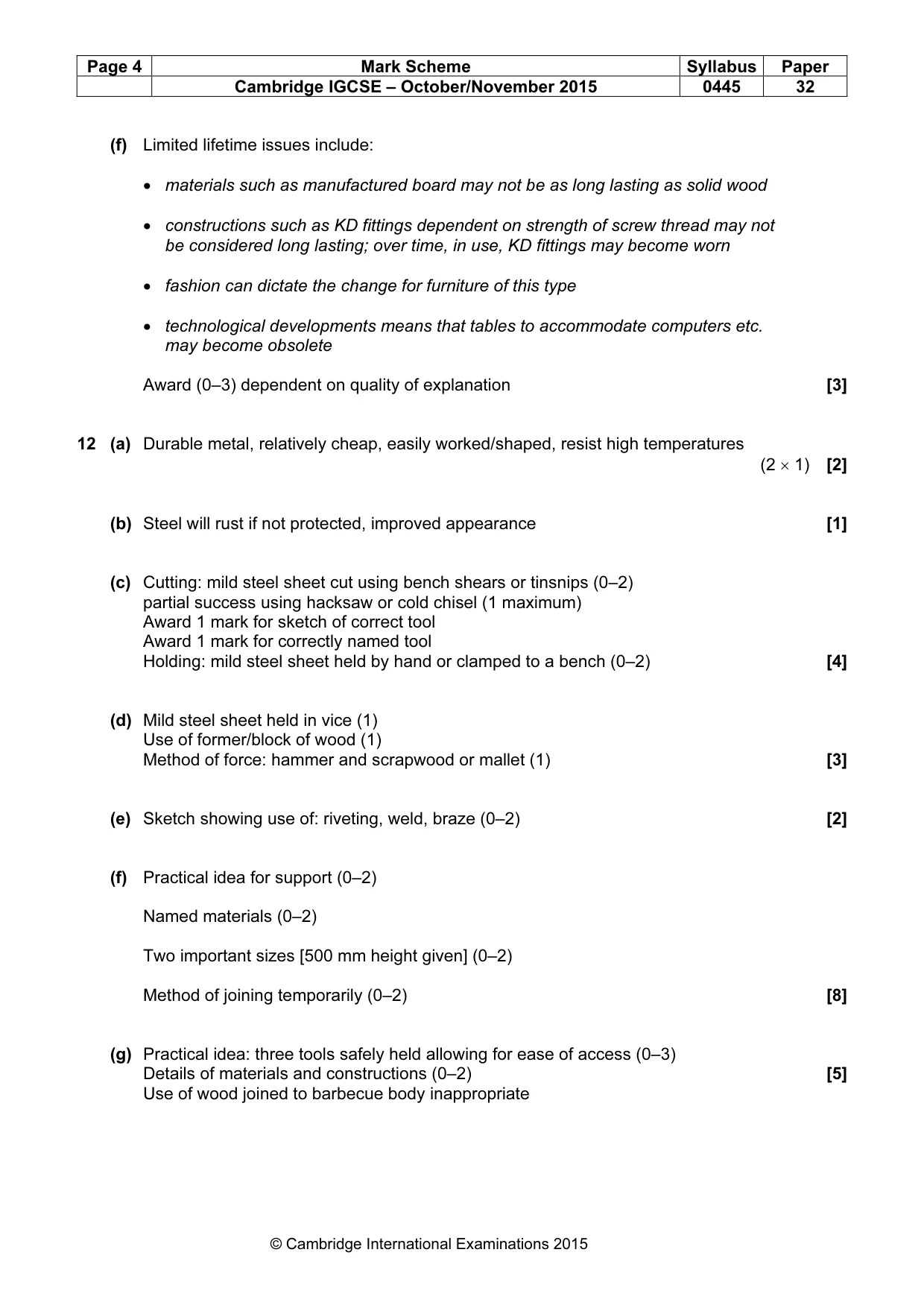
Page 4 Mark Scheme Syllabus Paper Cambridge IGCSE – October/November 2015 0445 32 © Cambridge International Examinations 2015 (f) Limited lifetime issues include: • materials such as manufactured board may not be as long lasting as solid wood • constructions such as KD fittings dependent on strength of screw thread may not be considered long lasting; over time, in use, KD fittings may become worn • fashion can dictate the change for furniture of this type • technological developments means that tables to accommodate computers etc. may become obsolete Award (0–3) dependent on quality of explanation [3] 12 (a) Durable metal, relatively cheap, easily worked/shaped, resist high temperatures (2 × 1) [2] (b) Steel will rust if not protected, improved appearance [1] (c) Cutting: mild steel sheet cut using bench shears or tinsnips (0–2) partial success using hacksaw or cold chisel (1 maximum) Award 1 mark for sketch of correct tool Award 1 mark for correctly named tool Holding: mild steel sheet held by hand or clamped to a bench (0–2) [4] (d) Mild steel sheet held in vice (1) Use of former/block of wood (1) Method of force: hammer and scrapwood or mallet (1) [3] (e) Sketch showing use of: riveting, weld, braze (0–2) [2] (f) Practical idea for support (0–2) Named materials (0–2) Two important sizes [500 mm height given] (0–2) Method of joining temporarily (0–2) [8] (g) Practical idea: three tools safely held allowing for ease of access (0–3) Details of materials and constructions (0–2) [5] Use of wood joined to barbecue body inappropriate
Mark scheme, page 5
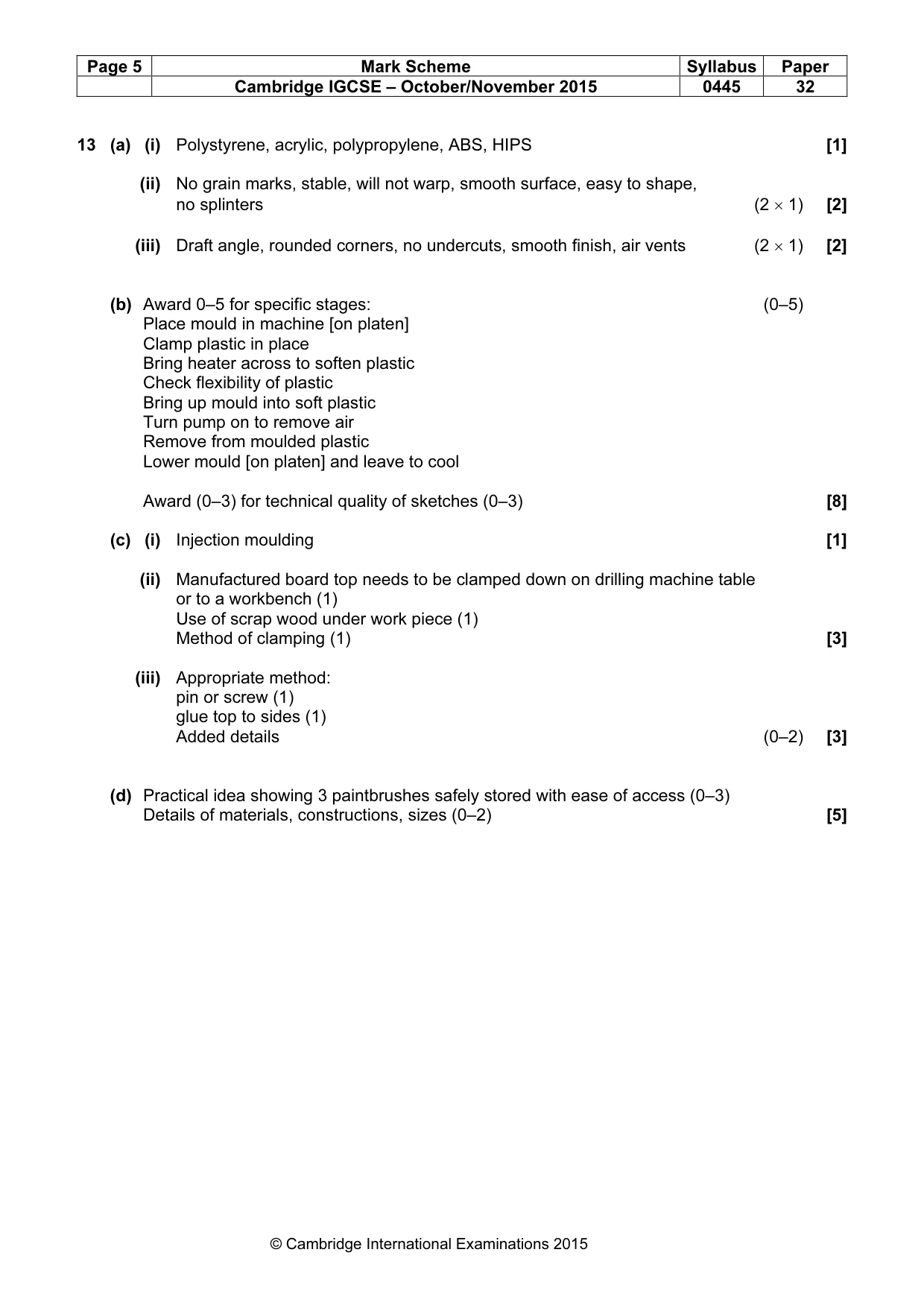
Page 5 Mark Scheme Syllabus Paper Cambridge IGCSE – October/November 2015 0445 32 © Cambridge International Examinations 2015 13 (a) (i) Polystyrene, acrylic, polypropylene, ABS, HIPS [1] (ii) No grain marks, stable, will not warp, smooth surface, easy to shape, no splinters (2 × 1) [2] (iii) Draft angle, rounded corners, no undercuts, smooth finish, air vents (2 × 1) [2] (b) Award 0–5 for specific stages: (0–5) Place mould in machine [on platen] Clamp plastic in place Bring heater across to soften plastic Check flexibility of plastic Bring up mould into soft plastic Turn pump on to remove air Remove from moulded plastic Lower mould [on platen] and leave to cool Award (0–3) for technical quality of sketches (0–3) [8] (c) (i) Injection moulding [1] (ii) Manufactured board top needs to be clamped down on drilling machine table or to a workbench (1) Use of scrap wood under work piece (1) Method of clamping (1) [3] (iii) Appropriate method: pin or screw (1) glue top to sides (1) Added details (0–2) [3] (d) Practical idea showing 3 paintbrushes safely stored with ease of access (0–3) Details of materials, constructions, sizes (0–2) [5]
What you needed in this session
Cambridge’s own grade thresholds for 2015 Oct/Nov, Paper 3 · Variant 2. A higher threshold means an easier paper — the bar moves with how the cohort did.