Cambridge IGCSE Design and Technology 0445 — 2015 Oct/Nov Paper 3 · Variant 1
0445/31/O/N/15 · 50 marks · ≈56 min
The question paper and its mark scheme, free to read here and free to download. This is Cambridge’s own paper, exactly as it was sat.
Question paper16 pages
Mark scheme5 pages
Answers below. Sit the paper first if you are practising.
Paper as text
Question paper, page 1
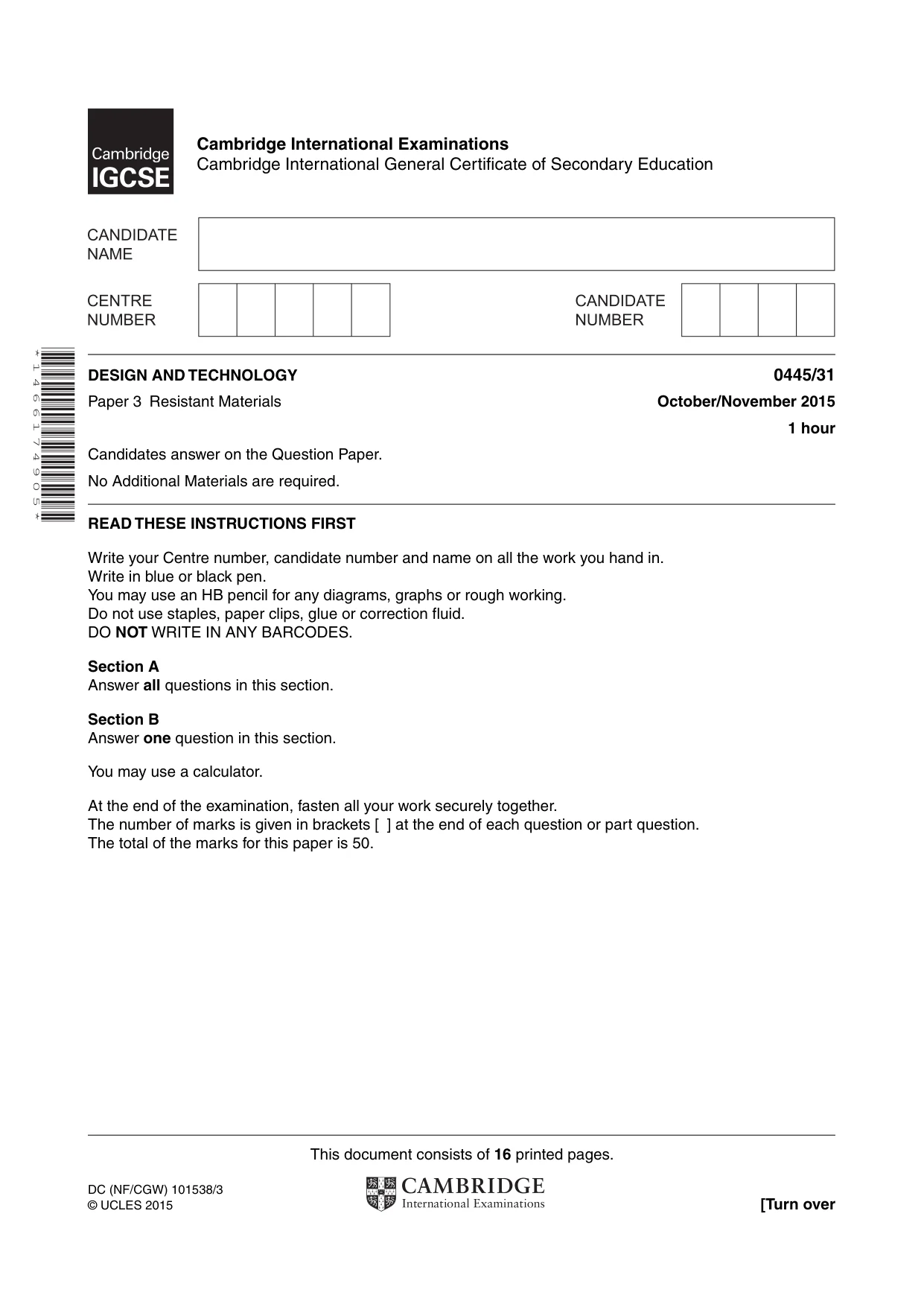
This document consists of 16 printed pages. DC (NF/CGW) 101538/3 © UCLES 2015 [Turn over Cambridge International Examinations Cambridge International General Certificate of Secondary Education * 1 4 6 6 1 7 4 9 0 5 * DESIGN AND TECHNOLOGY 0445/31 Paper 3 Resistant Materials October/November 2015 1 hour Candidates answer on the Question Paper. No Additional Materials are required. READ THESE INSTRUCTIONS FIRST Write your Centre number, candidate number and name on all the work you hand in. Write in blue or black pen. You may use an HB pencil for any diagrams, graphs or rough working. Do not use staples, paper clips, glue or correction fluid. DO NOT WRITE IN ANY BARCODES. Section A Answer all questions in this section. Section B Answer one question in this section. You may use a calculator. At the end of the examination, fasten all your work securely together. The number of marks is given in brackets [ ] at the end of each question or part question. The total of the marks for this paper is 50.
Question paper, page 2
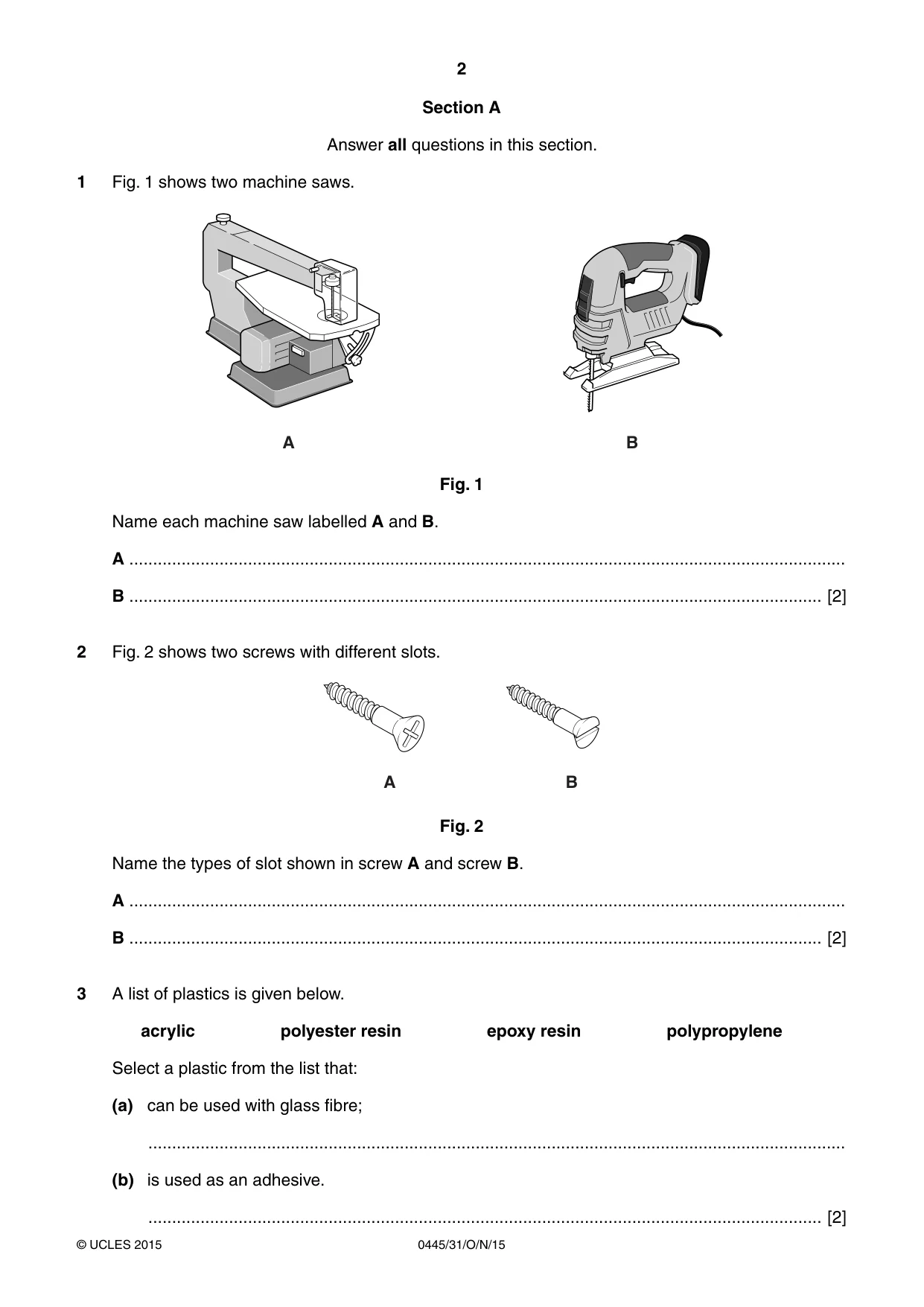
2 0445/31/O/N/15 © UCLES 2015 Section A Answer all questions in this section. 1 Fig. 1 shows two machine saws. A B Fig. 1 Name each machine saw labelled A and B. A … B … [2] 2 Fig. 2 shows two screws with different slots. A B Fig. 2 Name the types of slot shown in screw A and screw B. A … B … [2] 3 A list of plastics is given below. acrylic polyester resin epoxy resin polypropylene Select a plastic from the list that: (a) can be used with glass fibre; … (b) is used as an adhesive. … [2]
Question paper, page 3
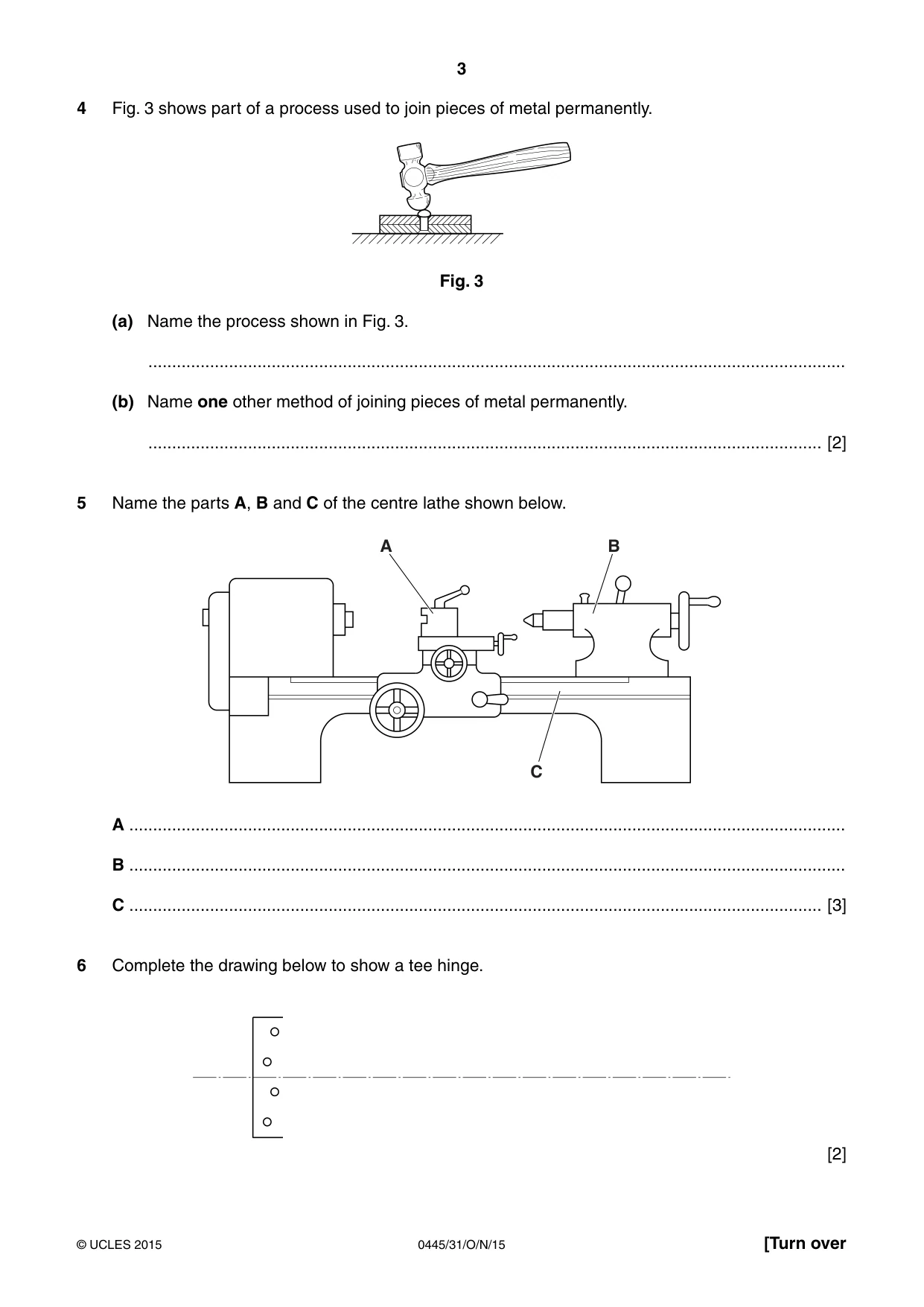
3 0445/31/O/N/15 © UCLES 2015 [Turn over 4 Fig. 3 shows part of a process used to join pieces of metal permanently. Fig. 3 (a) Name the process shown in Fig. 3. … (b) Name one other method of joining pieces of metal permanently. … [2] 5 Name the parts A, B and C of the centre lathe shown below. A B C A … B … C … [3] 6 Complete the drawing below to show a tee hinge. [2]
Question paper, page 4
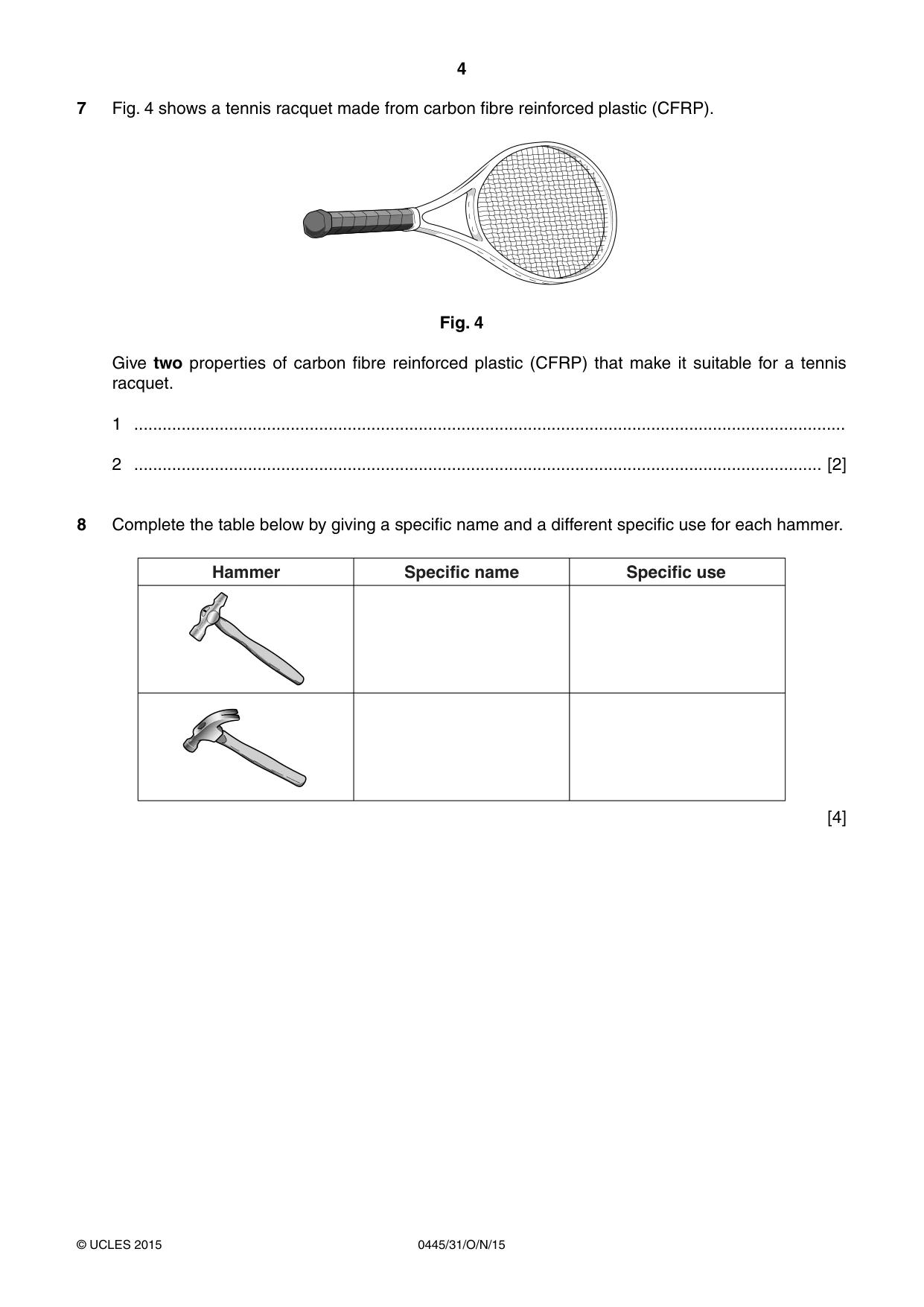
4 0445/31/O/N/15 © UCLES 2015 7 Fig. 4 shows a tennis racquet made from carbon fibre reinforced plastic (CFRP). Fig. 4 Give two properties of carbon fibre reinforced plastic (CFRP) that make it suitable for a tennis racquet. 1 … 2 … [2] 8 Complete the table below by giving a specific name and a different specific use for each hammer. Hammer Specific name Specific use [4]
Question paper, page 5
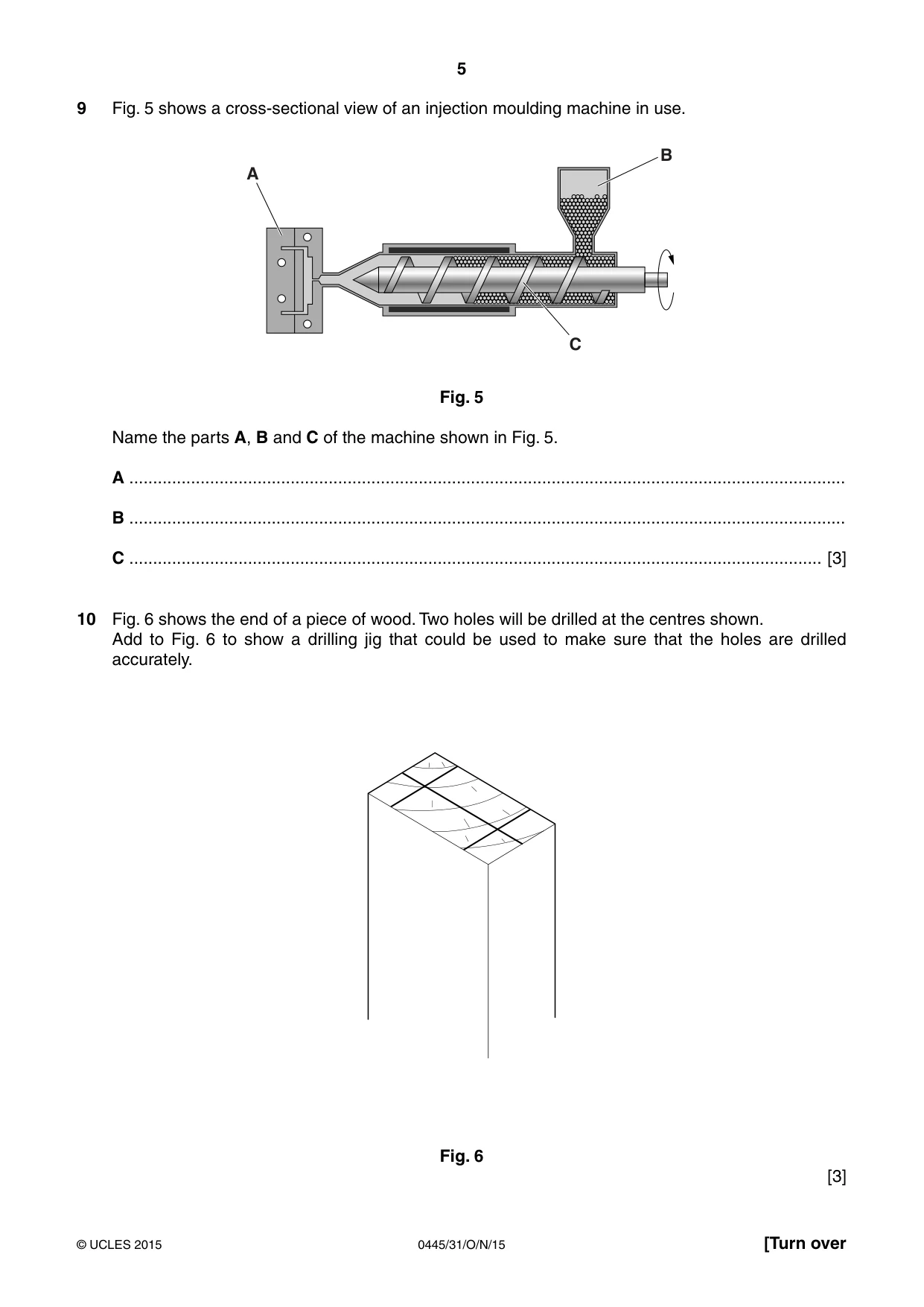
5 0445/31/O/N/15 © UCLES 2015 [Turn over 9 Fig. 5 shows a cross-sectional view of an injection moulding machine in use. A B C Fig. 5 Name the parts A, B and C of the machine shown in Fig. 5. A … B … C … [3] 10 Fig. 6 shows the end of a piece of wood. Two holes will be drilled at the centres shown. Add to Fig. 6 to show a drilling jig that could be used to make sure that the holes are drilled accurately. Fig. 6 [3]
Question paper, page 6
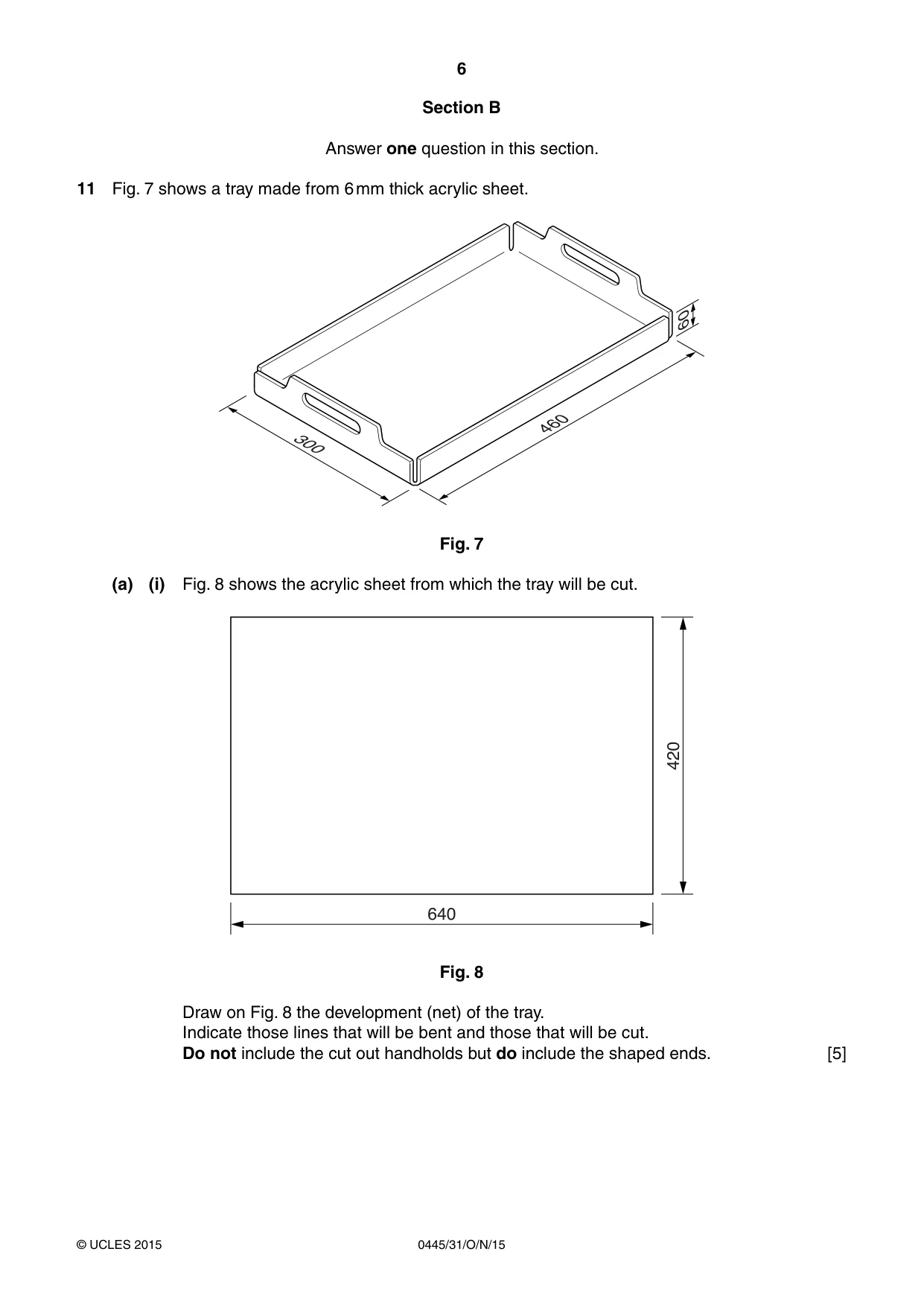
6 0445/31/O/N/15 © UCLES 2015 Section B Answer one question in this section. 11 Fig. 7 shows a tray made from 6 mm thick acrylic sheet. 300 460 60 Fig. 7 (a) (i) Fig. 8 shows the acrylic sheet from which the tray will be cut. 640 420 Fig. 8 Draw on Fig. 8 the development (net) of the tray. Indicate those lines that will be bent and those that will be cut. Do not include the cut out handholds but do include the shaped ends. [5]
Question paper, page 7
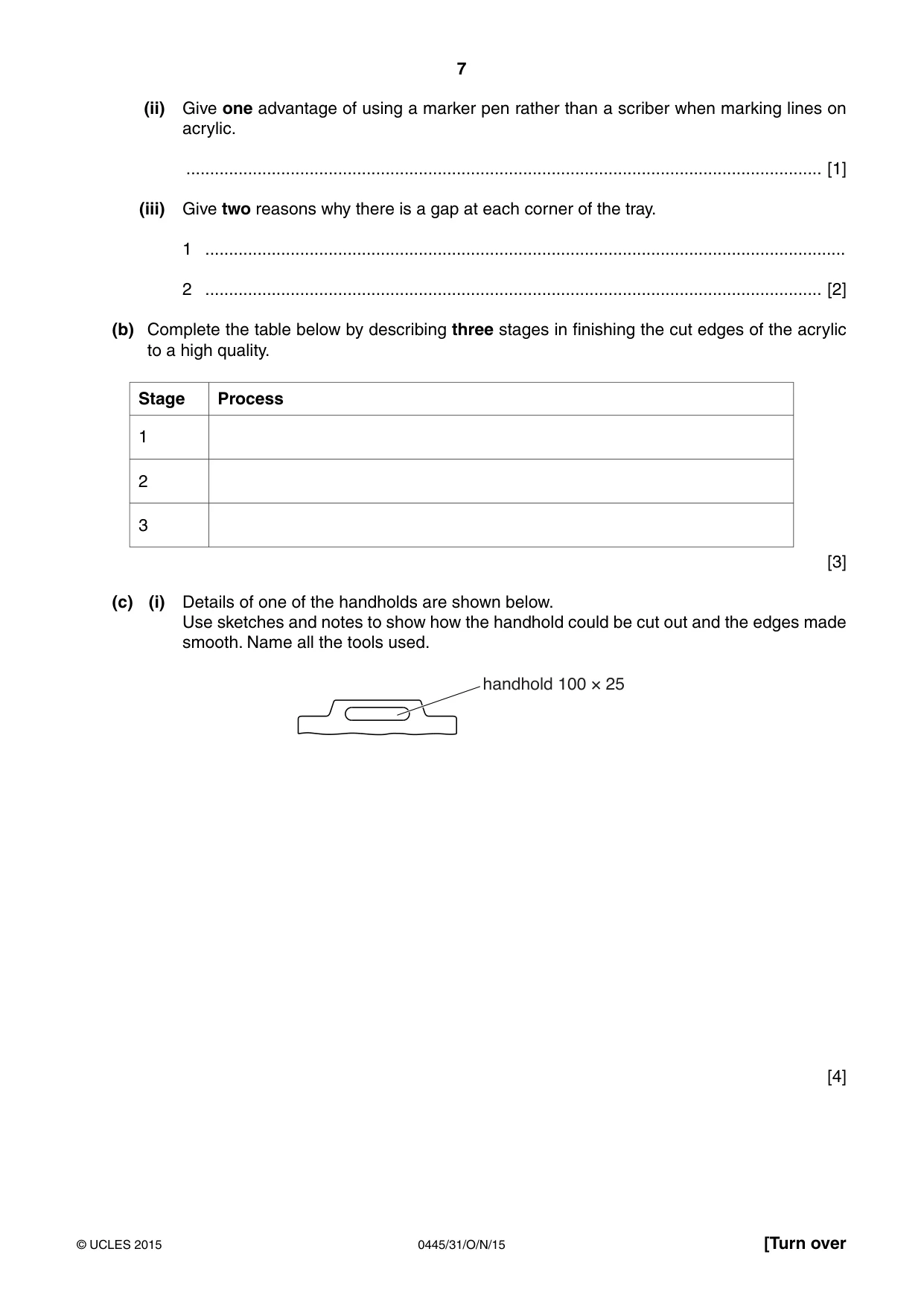
7 0445/31/O/N/15 © UCLES 2015 [Turn over (ii) Give one advantage of using a marker pen rather than a scriber when marking lines on acrylic. … [1] (iii) Give two reasons why there is a gap at each corner of the tray. 1 … 2 … [2] (b) Complete the table below by describing three stages in finishing the cut edges of the acrylic to a high quality. Stage Process 1 2 3 [3] (c) (i) Details of one of the handholds are shown below. Use sketches and notes to show how the handhold could be cut out and the edges made smooth. Name all the tools used. handhold 100 × 25 [4]
Question paper, page 8
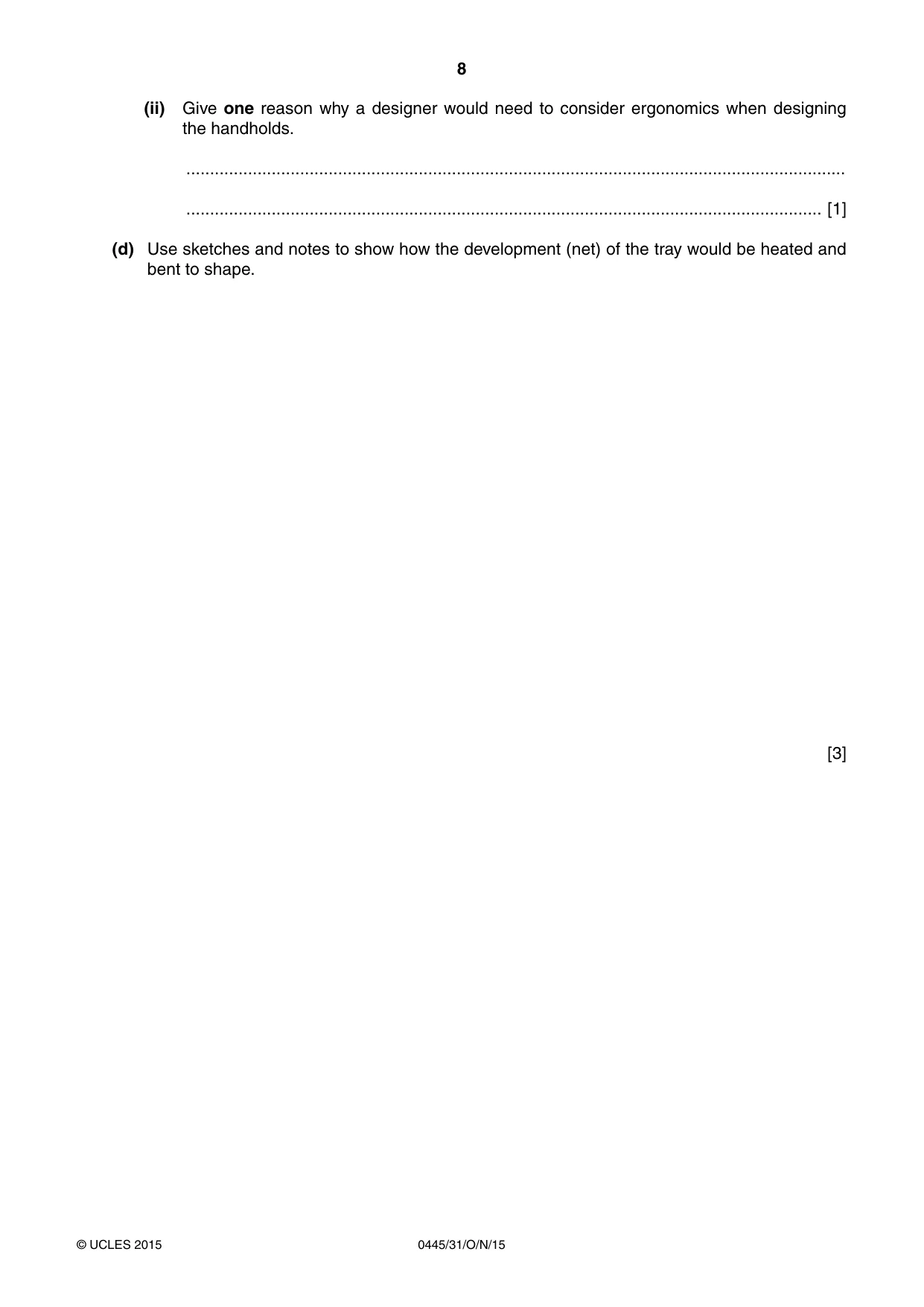
8 0445/31/O/N/15 © UCLES 2015 (ii) Give one reason why a designer would need to consider ergonomics when designing the handholds. … … [1] (d) Use sketches and notes to show how the development (net) of the tray would be heated and bent to shape. [3]
Question paper, page 9
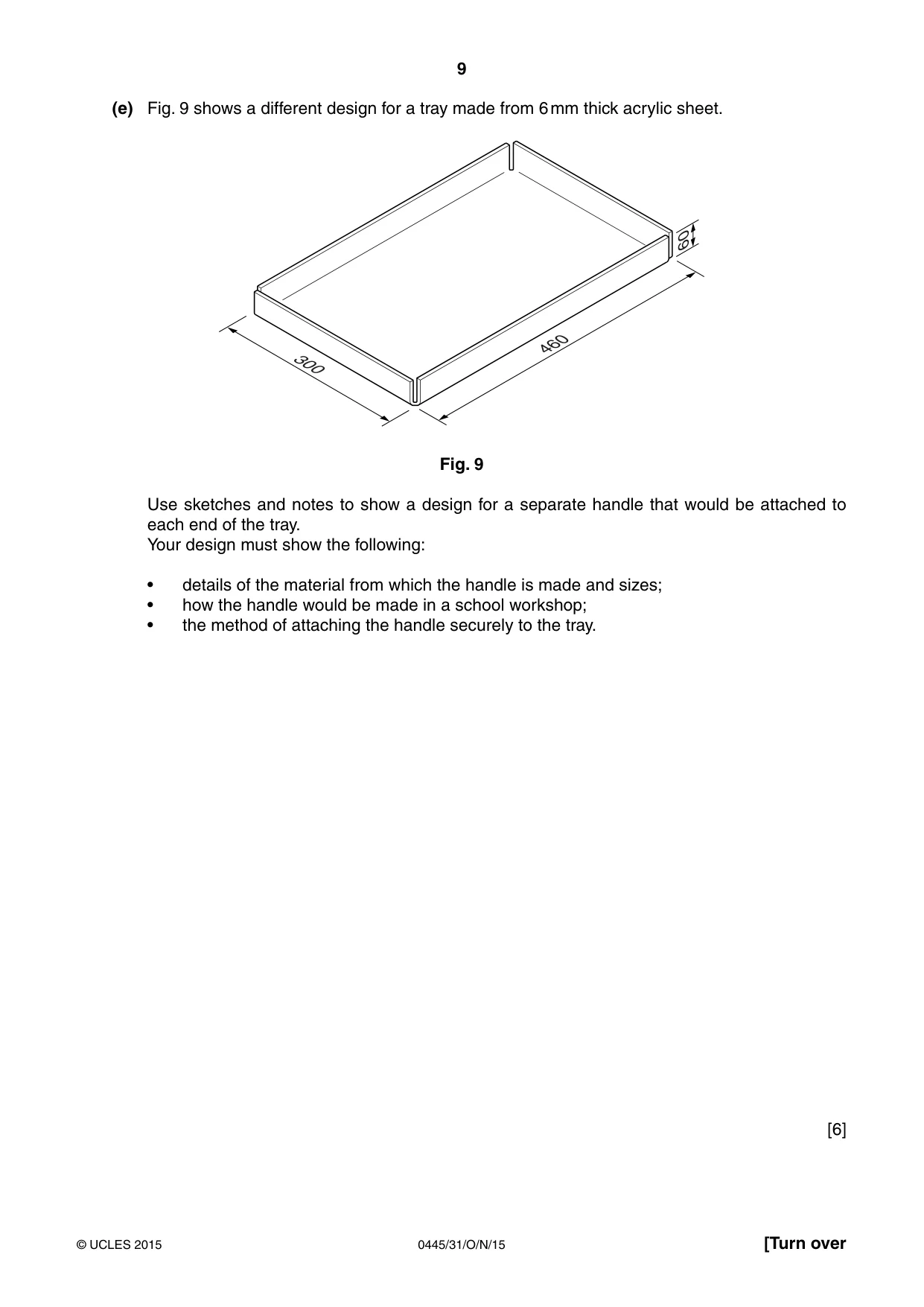
9 0445/31/O/N/15 © UCLES 2015 [Turn over (e) Fig. 9 shows a different design for a tray made from 6 mm thick acrylic sheet. 300 460 60 Fig. 9 Use sketches and notes to show a design for a separate handle that would be attached to each end of the tray. Your design must show the following: • details of the material from which the handle is made and sizes; • how the handle would be made in a school workshop; • the method of attaching the handle securely to the tray. [6]
Question paper, page 10
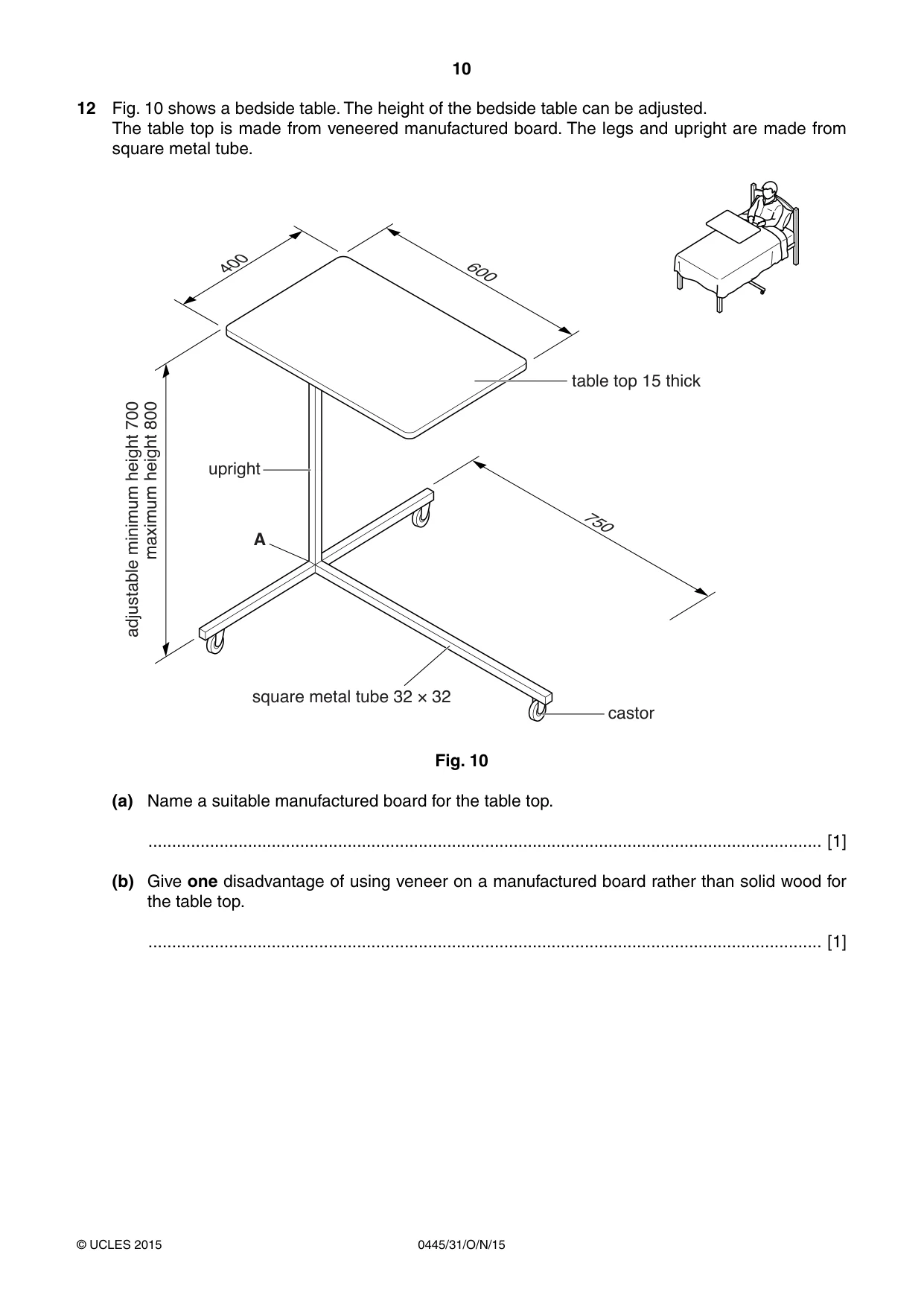
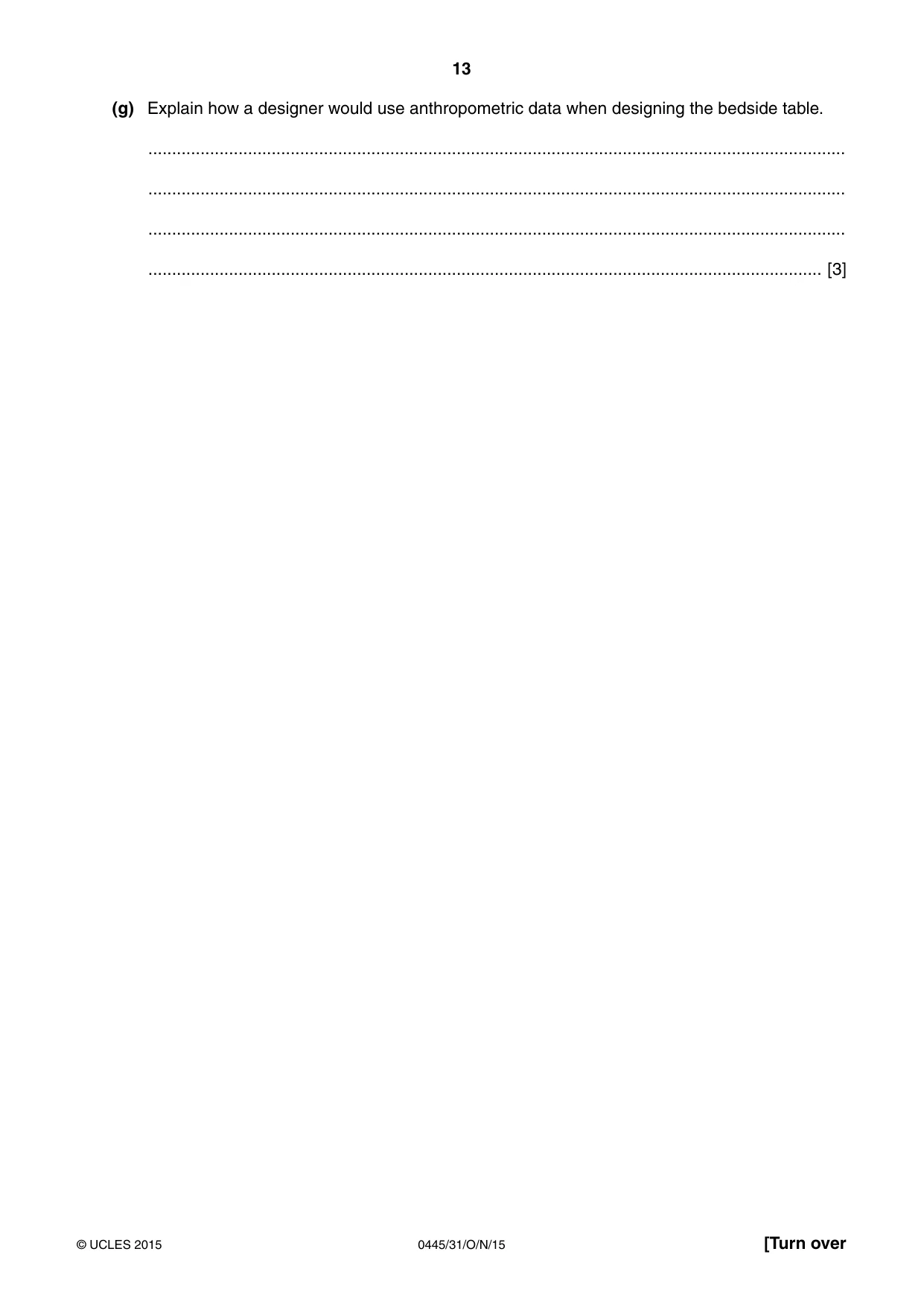
10 0445/31/O/N/15 © UCLES 2015 12 Fig. 10 shows a bedside table. The height of the bedside table can be adjusted. The table top is made from veneered manufactured board. The legs and upright are made from square metal tube. upright adjustable minimum height 700 maximum height 800 400 600 750 table top 15 thick castor square metal tube 32 × 32 A Fig. 10 (a) Name a suitable manufactured board for the table top. … [1] (b) Give one disadvantage of using veneer on a manufactured board rather than solid wood for the table top. … [1]
Question paper, page 11
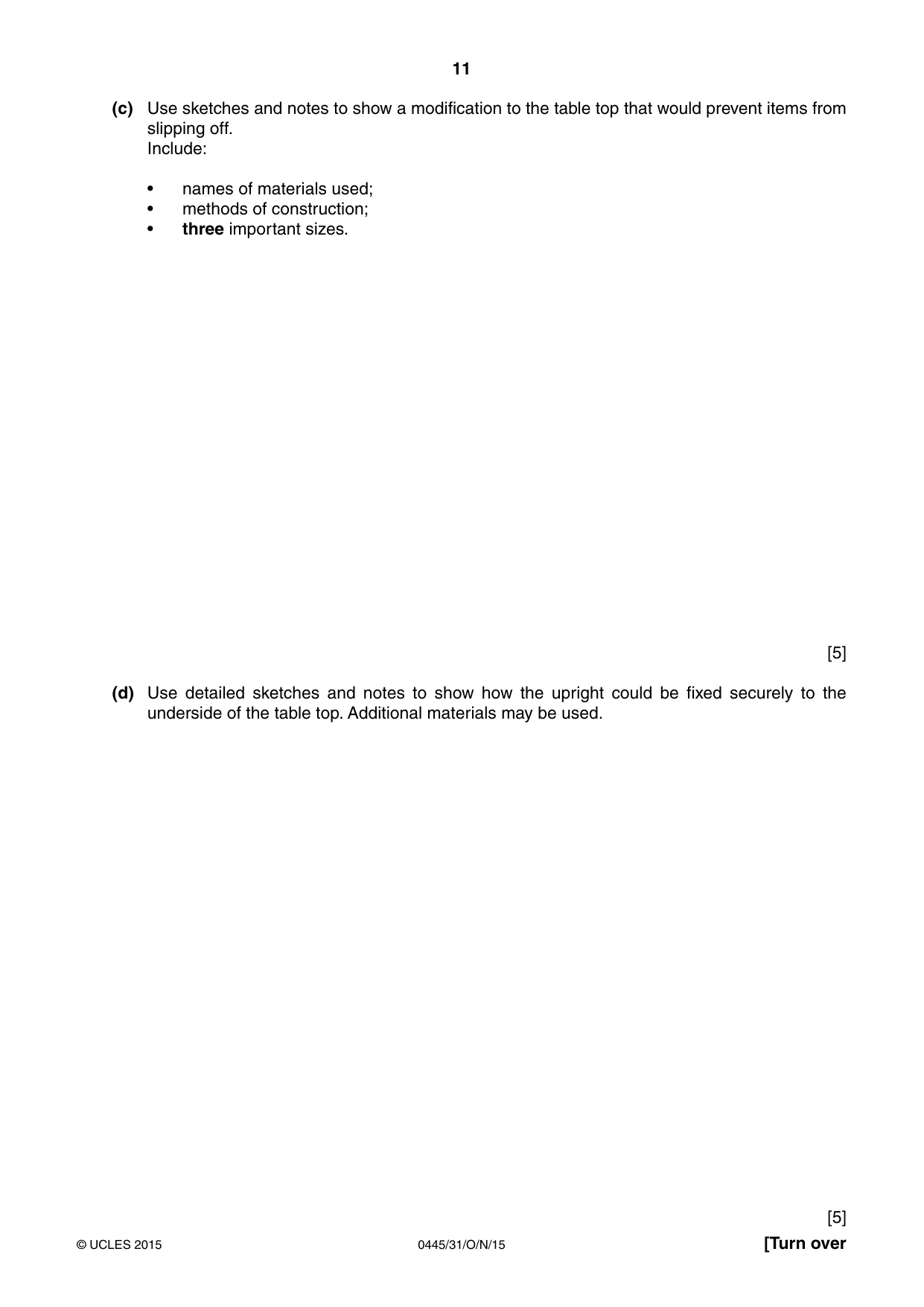
11 0445/31/O/N/15 © UCLES 2015 [Turn over (c) Use sketches and notes to show a modification to the table top that would prevent items from slipping off. Include: • names of materials used; • methods of construction; • three important sizes. [5] (d) Use detailed sketches and notes to show how the upright could be fixed securely to the underside of the table top. Additional materials may be used. [5]
Question paper, page 12
12 0445/31/O/N/15 © UCLES 2015 (e) Use sketches and notes to show how the joint at A could be strengthened. Include details of materials, sizes and constructions used. [4] (f) Use sketches and notes to show how the table top could be adjusted and locked at different heights between 700 mm – 800 mm. Include details of materials, sizes and constructions used. [6]
Question paper, page 13
13 0445/31/O/N/15 © UCLES 2015 [Turn over (g) Explain how a designer would use anthropometric data when designing the bedside table. … … … … [3]
Question paper, page 14
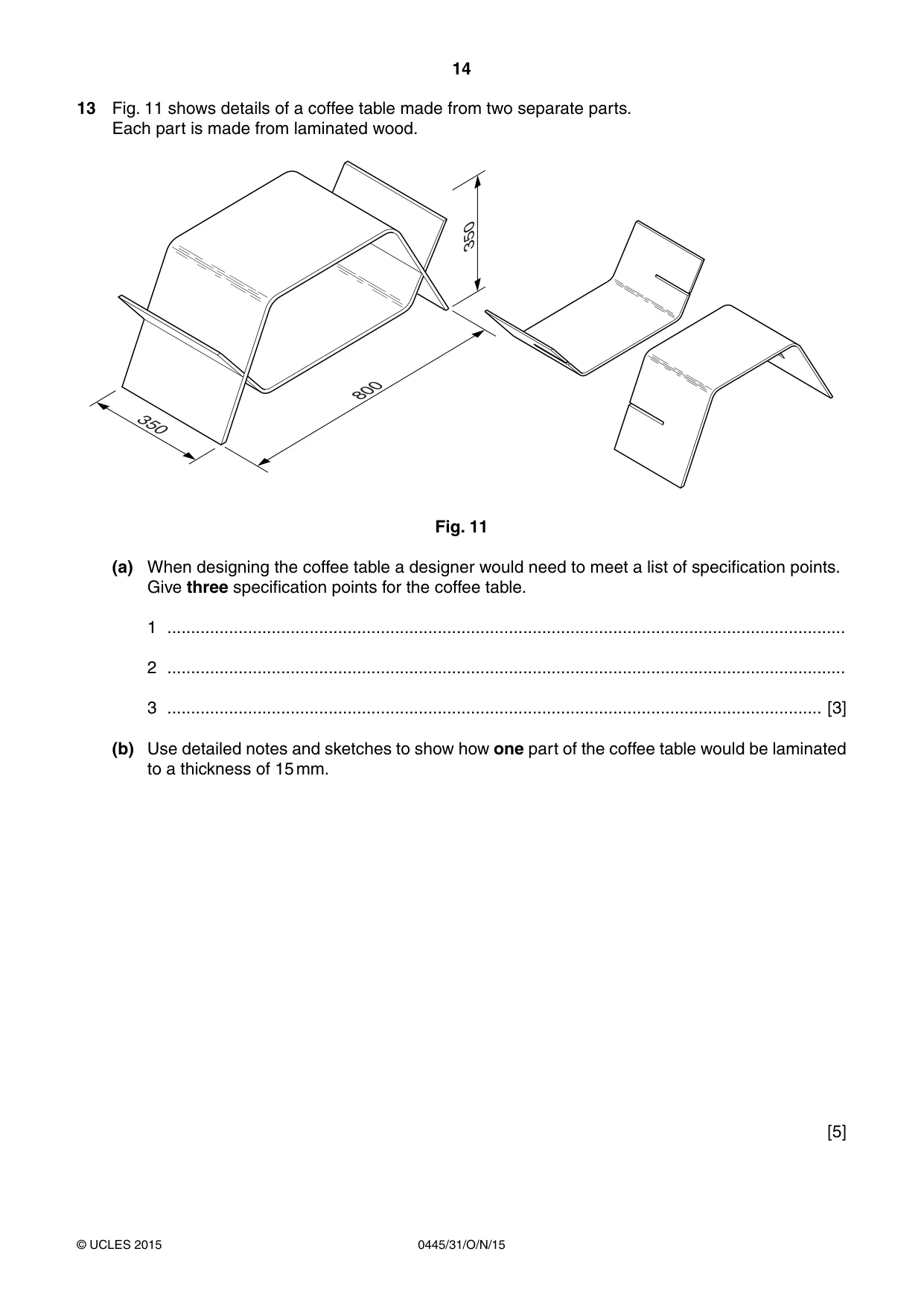
14 0445/31/O/N/15 © UCLES 2015 13 Fig. 11 shows details of a coffee table made from two separate parts. Each part is made from laminated wood. 350 800 350 Fig. 11 (a) When designing the coffee table a designer would need to meet a list of specification points. Give three specification points for the coffee table. 1 … 2 … 3 … [3] (b) Use detailed notes and sketches to show how one part of the coffee table would be laminated to a thickness of 15 mm. [5]
Question paper, page 15
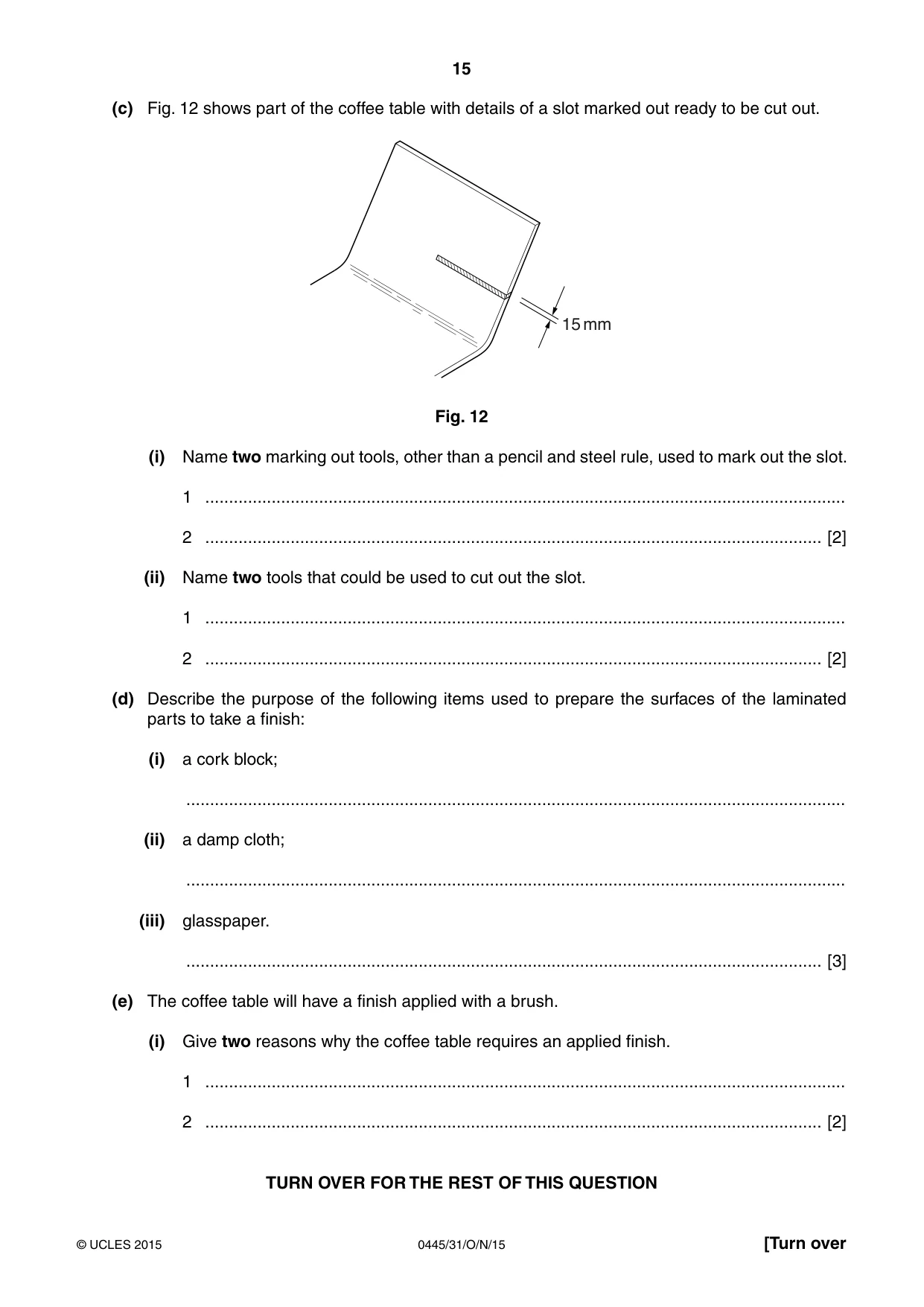
15 0445/31/O/N/15 © UCLES 2015 [Turn over (c) Fig. 12 shows part of the coffee table with details of a slot marked out ready to be cut out. 15 mm Fig. 12 (i) Name two marking out tools, other than a pencil and steel rule, used to mark out the slot. 1 … 2 … [2] (ii) Name two tools that could be used to cut out the slot. 1 … 2 … [2] (d) Describe the purpose of the following items used to prepare the surfaces of the laminated parts to take a finish: (i) a cork block; … (ii) a damp cloth; … (iii) glasspaper. … [3] (e) The coffee table will have a finish applied with a brush. (i) Give two reasons why the coffee table requires an applied finish. 1 … 2 … [2] TURN OVER FOR THE REST OF THIS QUESTION
Question paper, page 16
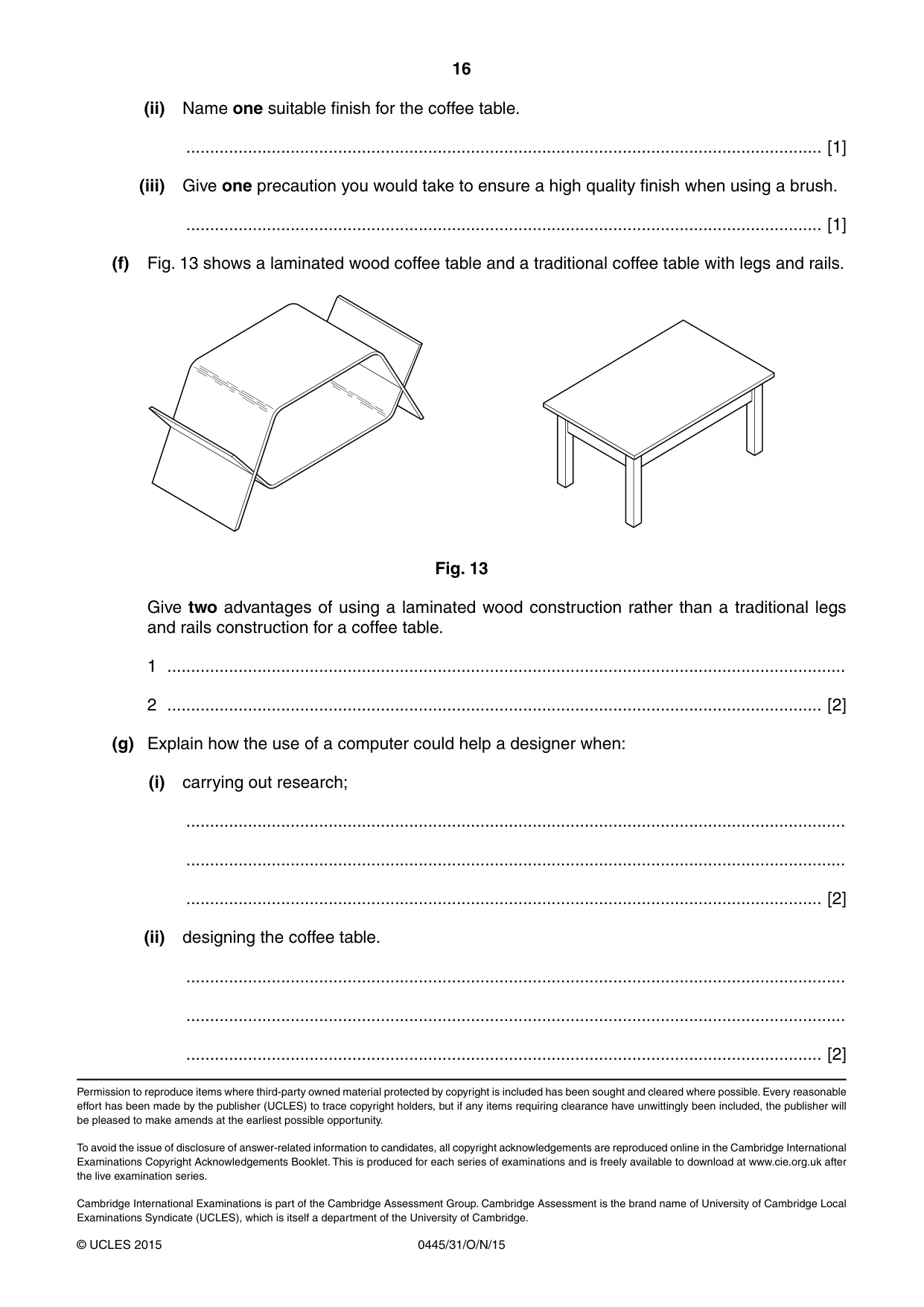
16 0445/31/O/N/15 © UCLES 2015 Permission to reproduce items where third-party owned material protected by copyright is included has been sought and cleared where possible. Every reasonable effort has been made by the publisher (UCLES) to trace copyright holders, but if any items requiring clearance have unwittingly been included, the publisher will be pleased to make amends at the earliest possible opportunity. To avoid the issue of disclosure of answer-related information to candidates, all copyright acknowledgements are reproduced online in the Cambridge International Examinations Copyright Acknowledgements Booklet. This is produced for each series of examinations and is freely available to download at www.cie.org.uk after the live examination series. Cambridge International Examinations is part of the Cambridge Assessment Group. Cambridge Assessment is the brand name of University of Cambridge Local Examinations Syndicate (UCLES), which is itself a department of the University of Cambridge. (ii) Name one suitable finish for the coffee table. … [1] (iii) Give one precaution you would take to ensure a high quality finish when using a brush. … [1] (f) Fig. 13 shows a laminated wood coffee table and a traditional coffee table with legs and rails. Fig. 13 Give two advantages of using a laminated wood construction rather than a traditional legs and rails construction for a coffee table. 1 … 2 … [2] (g) Explain how the use of a computer could help a designer when: (i) carrying out research; … … … [2] (ii) designing the coffee table. … … … [2]
Mark scheme, page 1
® IGCSE is the registered trademark of Cambridge International Examinations. CAMBRIDGE INTERNATIONAL EXAMINATIONS Cambridge International General Certificate of Secondary Education MARK SCHEME for the October/November 2015 series 0445 DESIGN AND TECHNOLOGY 0445/31 Paper 3 (Resistant Materials), maximum raw mark 50 This mark scheme is published as an aid to teachers and candidates, to indicate the requirements of the examination. It shows the basis on which Examiners were instructed to award marks. It does not indicate the details of the discussions that took place at an Examiners’ meeting before marking began, which would have considered the acceptability of alternative answers. Mark schemes should be read in conjunction with the question paper and the Principal Examiner Report for Teachers. Cambridge will not enter into discussions about these mark schemes. Cambridge is publishing the mark schemes for the October/November 2015 series for most Cambridge IGCSE®, Cambridge International A and AS Level components and some Cambridge O Level components.
Mark scheme, page 2
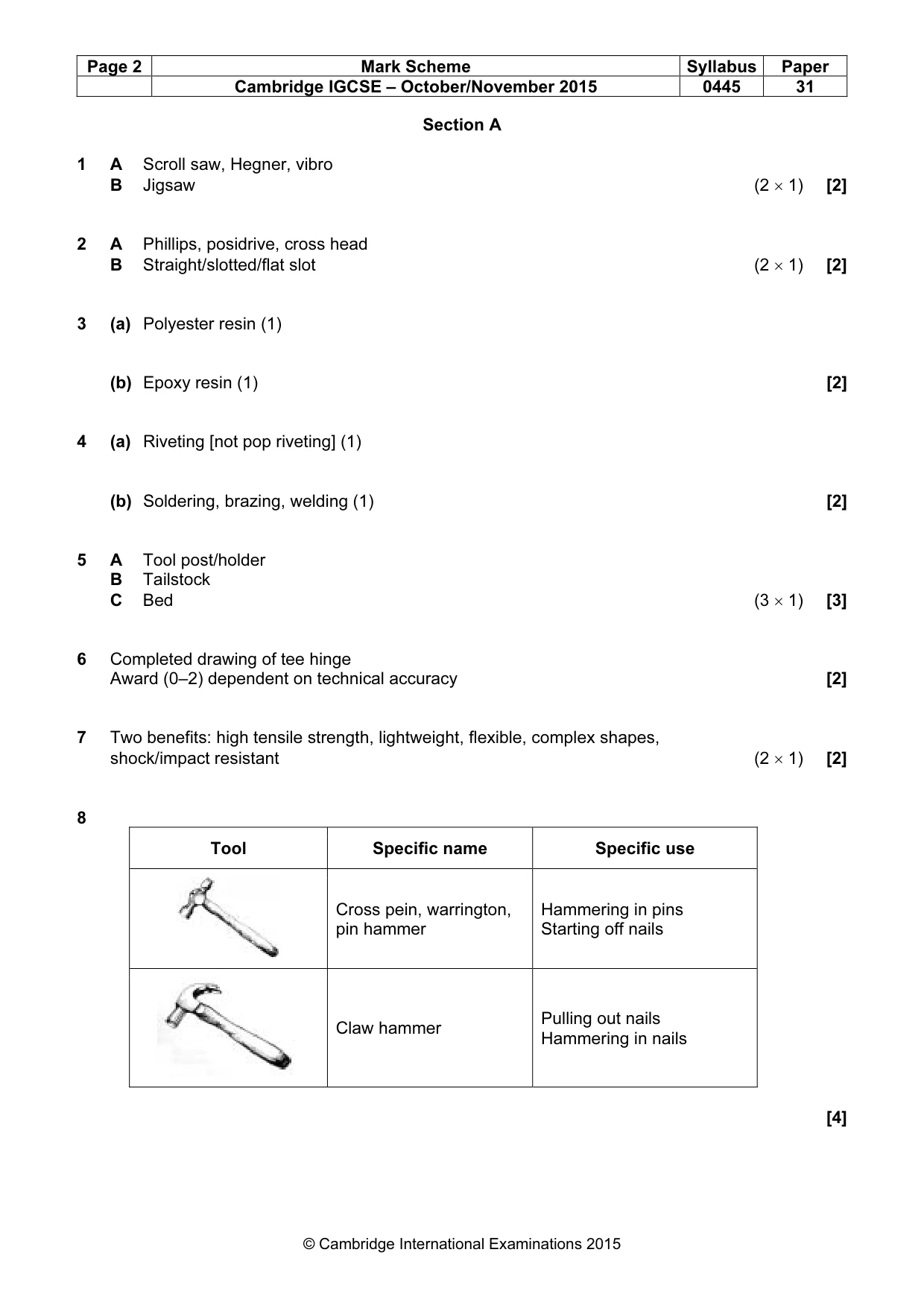
Page 2 Mark Scheme Syllabus Paper Cambridge IGCSE – October/November 2015 0445 31 © Cambridge International Examinations 2015 Section A 1 A Scroll saw, Hegner, vibro B Jigsaw (2 × 1) [2] 2 A Phillips, posidrive, cross head B Straight/slotted/flat slot (2 × 1) [2] 3 (a) Polyester resin (1) (b) Epoxy resin (1) [2] 4 (a) Riveting [not pop riveting] (1) (b) Soldering, brazing, welding (1) [2] 5 A Tool post/holder B Tailstock C Bed (3 × 1) [3] 6 Completed drawing of tee hinge Award (0–2) dependent on technical accuracy [2] 7 Two benefits: high tensile strength, lightweight, flexible, complex shapes, shock/impact resistant (2 × 1) [2] 8 Tool Specific name Specific use Cross pein, warrington, pin hammer Hammering in pins Starting off nails Claw hammer Pulling out nails Hammering in nails [4]
Mark scheme, page 3
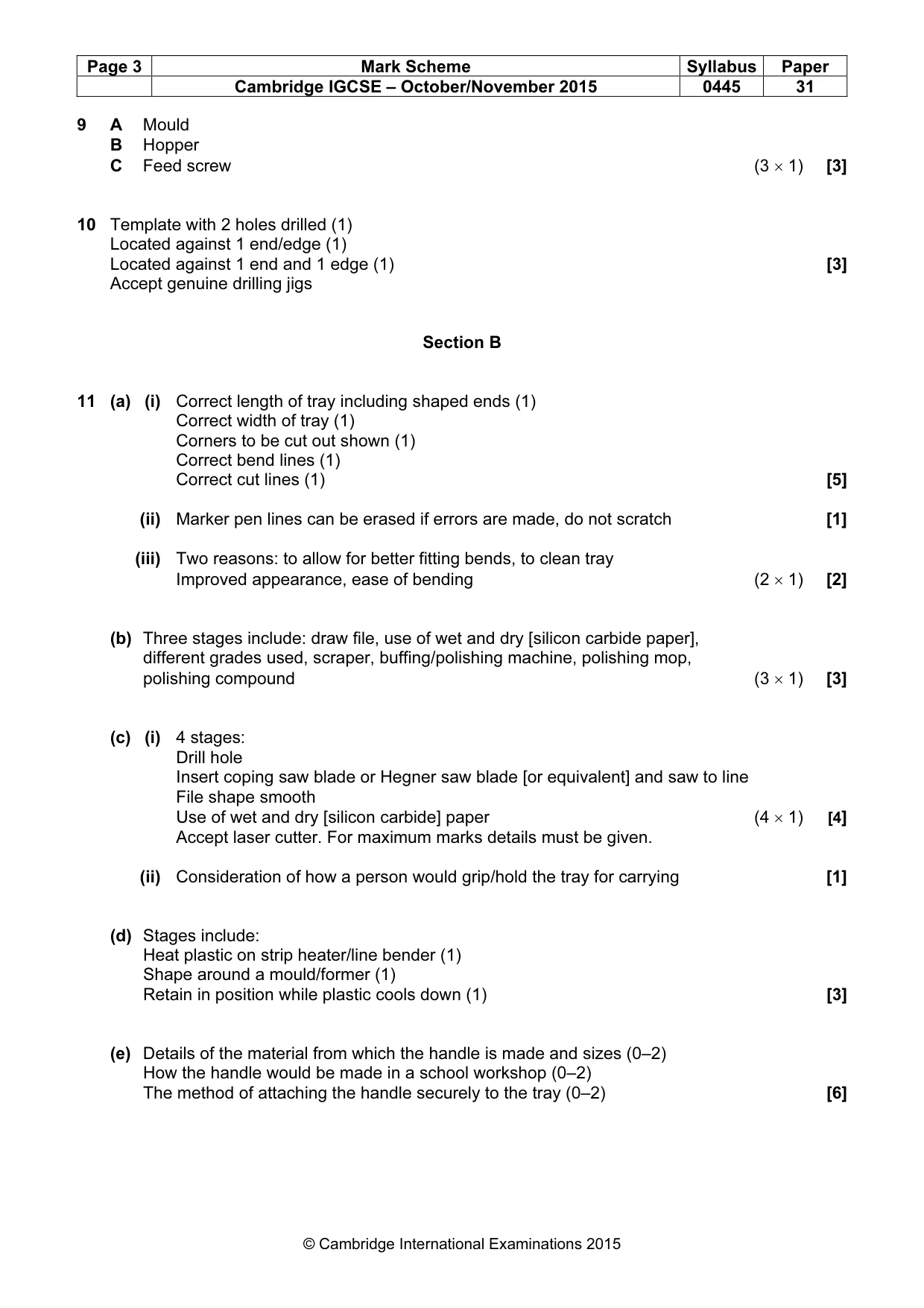
Page 3 Mark Scheme Syllabus Paper Cambridge IGCSE – October/November 2015 0445 31 © Cambridge International Examinations 2015 9 A Mould B Hopper C Feed screw (3 × 1) [3] 10 Template with 2 holes drilled (1) Located against 1 end/edge (1) Located against 1 end and 1 edge (1) [3] Accept genuine drilling jigs Section B 11 (a) (i) Correct length of tray including shaped ends (1) Correct width of tray (1) Corners to be cut out shown (1) Correct bend lines (1) Correct cut lines (1) [5] (ii) Marker pen lines can be erased if errors are made, do not scratch [1] (iii) Two reasons: to allow for better fitting bends, to clean tray Improved appearance, ease of bending (2 × 1) [2] (b) Three stages include: draw file, use of wet and dry [silicon carbide paper], different grades used, scraper, buffing/polishing machine, polishing mop, polishing compound (3 × 1) [3] (c) (i) 4 stages: Drill hole Insert coping saw blade or Hegner saw blade [or equivalent] and saw to line File shape smooth Use of wet and dry [silicon carbide] paper (4 × 1) [4] Accept laser cutter. For maximum marks details must be given. (ii) Consideration of how a person would grip/hold the tray for carrying [1] (d) Stages include: Heat plastic on strip heater/line bender (1) Shape around a mould/former (1) Retain in position while plastic cools down (1) [3] (e) Details of the material from which the handle is made and sizes (0–2) How the handle would be made in a school workshop (0–2) The method of attaching the handle securely to the tray (0–2) [6]
Mark scheme, page 4
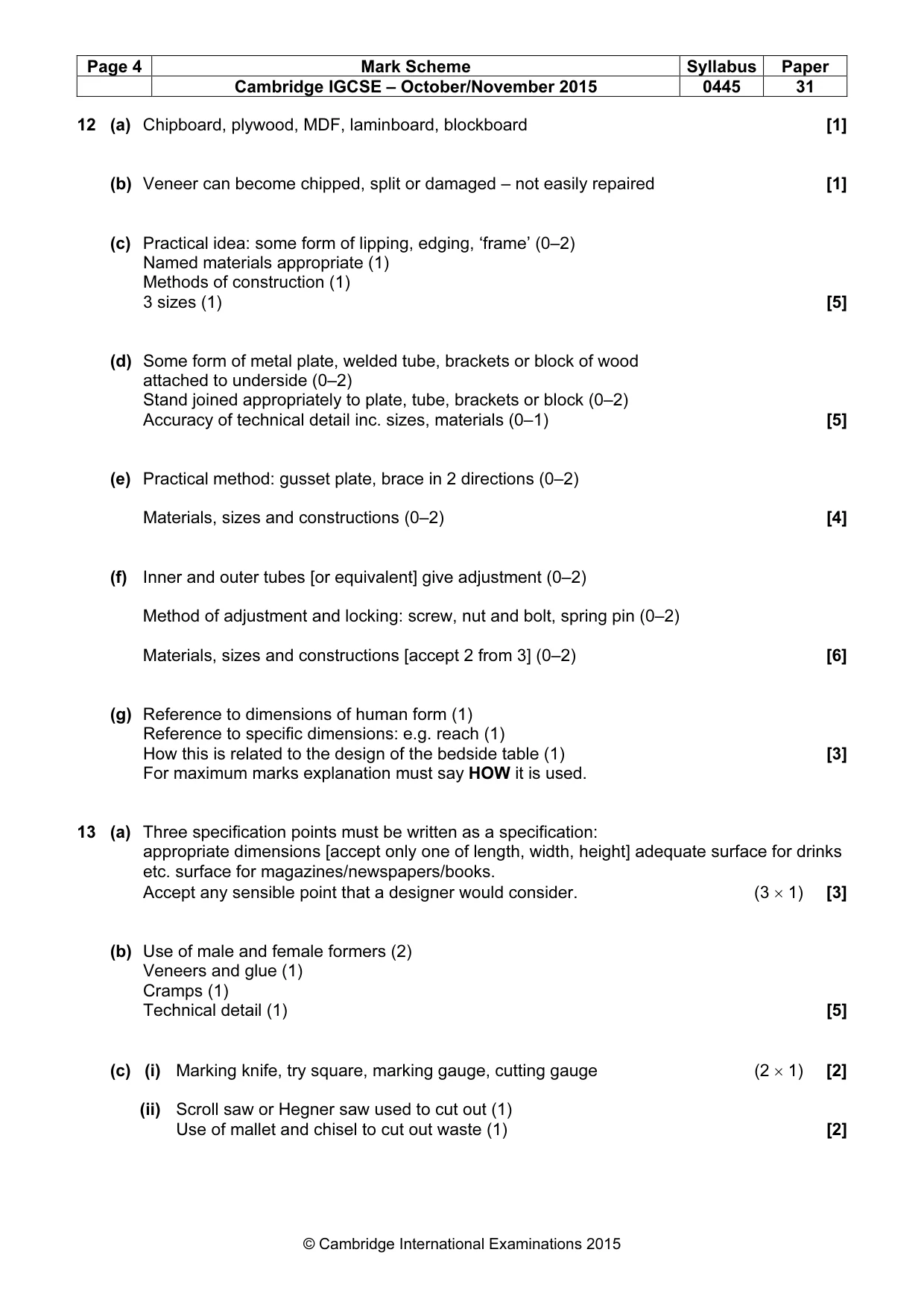
Page 4 Mark Scheme Syllabus Paper Cambridge IGCSE – October/November 2015 0445 31 © Cambridge International Examinations 2015 12 (a) Chipboard, plywood, MDF, laminboard, blockboard [1] (b) Veneer can become chipped, split or damaged – not easily repaired [1] (c) Practical idea: some form of lipping, edging, ‘frame’ (0–2) Named materials appropriate (1) Methods of construction (1) 3 sizes (1) [5] (d) Some form of metal plate, welded tube, brackets or block of wood attached to underside (0–2) Stand joined appropriately to plate, tube, brackets or block (0–2) Accuracy of technical detail inc. sizes, materials (0–1) [5] (e) Practical method: gusset plate, brace in 2 directions (0–2) Materials, sizes and constructions (0–2) [4] (f) Inner and outer tubes [or equivalent] give adjustment (0–2) Method of adjustment and locking: screw, nut and bolt, spring pin (0–2) Materials, sizes and constructions [accept 2 from 3] (0–2) [6] (g) Reference to dimensions of human form (1) Reference to specific dimensions: e.g. reach (1) How this is related to the design of the bedside table (1) [3] For maximum marks explanation must say HOW it is used. 13 (a) Three specification points must be written as a specification: appropriate dimensions [accept only one of length, width, height] adequate surface for drinks etc. surface for magazines/newspapers/books. Accept any sensible point that a designer would consider. (3 × 1) [3] (b) Use of male and female formers (2) Veneers and glue (1) Cramps (1) Technical detail (1) [5] (c) (i) Marking knife, try square, marking gauge, cutting gauge (2 × 1) [2] (ii) Scroll saw or Hegner saw used to cut out (1) Use of mallet and chisel to cut out waste (1) [2]
Mark scheme, page 5
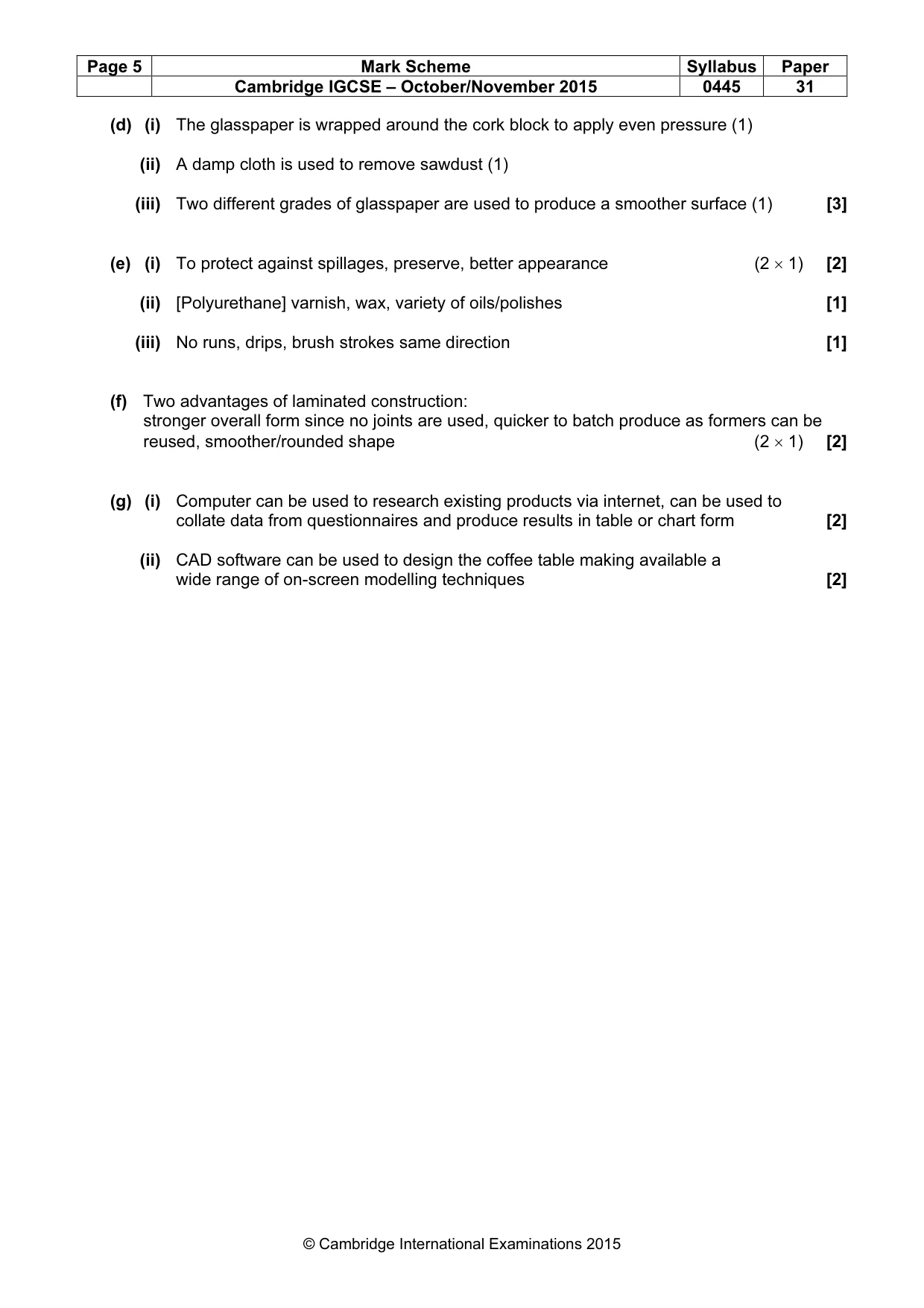
Page 5 Mark Scheme Syllabus Paper Cambridge IGCSE – October/November 2015 0445 31 © Cambridge International Examinations 2015 (d) (i) The glasspaper is wrapped around the cork block to apply even pressure (1) (ii) A damp cloth is used to remove sawdust (1) (iii) Two different grades of glasspaper are used to produce a smoother surface (1) [3] (e) (i) To protect against spillages, preserve, better appearance (2 × 1) [2] (ii) [Polyurethane] varnish, wax, variety of oils/polishes [1] (iii) No runs, drips, brush strokes same direction [1] (f) Two advantages of laminated construction: stronger overall form since no joints are used, quicker to batch produce as formers can be reused, smoother/rounded shape (2 × 1) [2] (g) (i) Computer can be used to research existing products via internet, can be used to collate data from questionnaires and produce results in table or chart form [2] (ii) CAD software can be used to design the coffee table making available a wide range of on-screen modelling techniques [2]
What you needed in this session
Cambridge’s own grade thresholds for 2015 Oct/Nov, Paper 3 · Variant 1. A higher threshold means an easier paper — the bar moves with how the cohort did.