Cambridge IGCSE Design and Technology 0445 — 2015 Oct/Nov Paper 3 · Variant 3
0445/33/O/N/15 · 50 marks · ≈56 min
The question paper and its mark scheme, free to read here and free to download. This is Cambridge’s own paper, exactly as it was sat.
Question paper20 pages
Mark scheme5 pages
Answers below. Sit the paper first if you are practising.
Paper as text
Question paper, page 1
This document consists of 17 printed pages and 3 blank pages. DC (NF/CGW) 101540/4 © UCLES 2015 [Turn over Cambridge International Examinations Cambridge International General Certificate of Secondary Education * 8 6 2 2 4 0 8 0 6 1 * DESIGN AND TECHNOLOGY 0445/33 Paper 3 Resistant Materials October/November 2015 1 hour Candidates answer on the Question Paper. No Additional Materials are required. READ THESE INSTRUCTIONS FIRST Write your Centre number, candidate number and name on all the work you hand in. Write in blue or black pen. You may use an HB pencil for any diagrams, graphs or rough working. Do not use staples, paper clips, glue or correction fluid. DO NOT WRITE IN ANY BARCODES. Section A Answer all questions in this section. Section B Answer one question in this section. You may use a calculator. At the end of the examination, fasten all your work securely together. The number of marks is given in brackets [ ] at the end of each question or part question. The total of the marks for this paper is 50.
Question paper, page 2
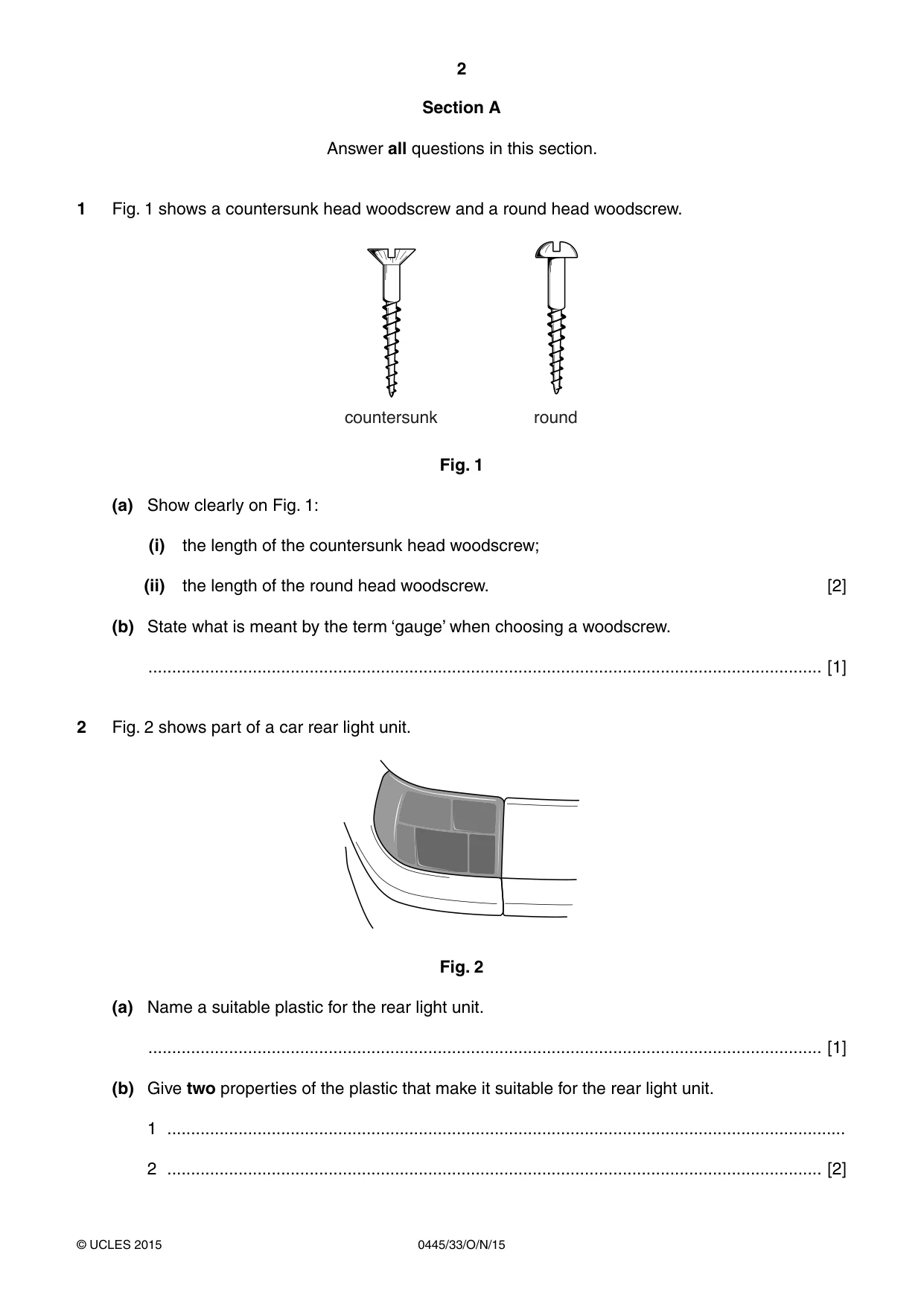
2 0445/33/O/N/15 © UCLES 2015 Section A Answer all questions in this section. 1 Fig. 1 shows a countersunk head woodscrew and a round head woodscrew. countersunk round Fig. 1 (a) Show clearly on Fig. 1: (i) the length of the countersunk head woodscrew; (ii) the length of the round head woodscrew. [2] (b) State what is meant by the term ‘gauge’ when choosing a woodscrew. … [1] 2 Fig. 2 shows part of a car rear light unit. Fig. 2 (a) Name a suitable plastic for the rear light unit. … [1] (b) Give two properties of the plastic that make it suitable for the rear light unit. 1 … 2 … [2]
Question paper, page 3
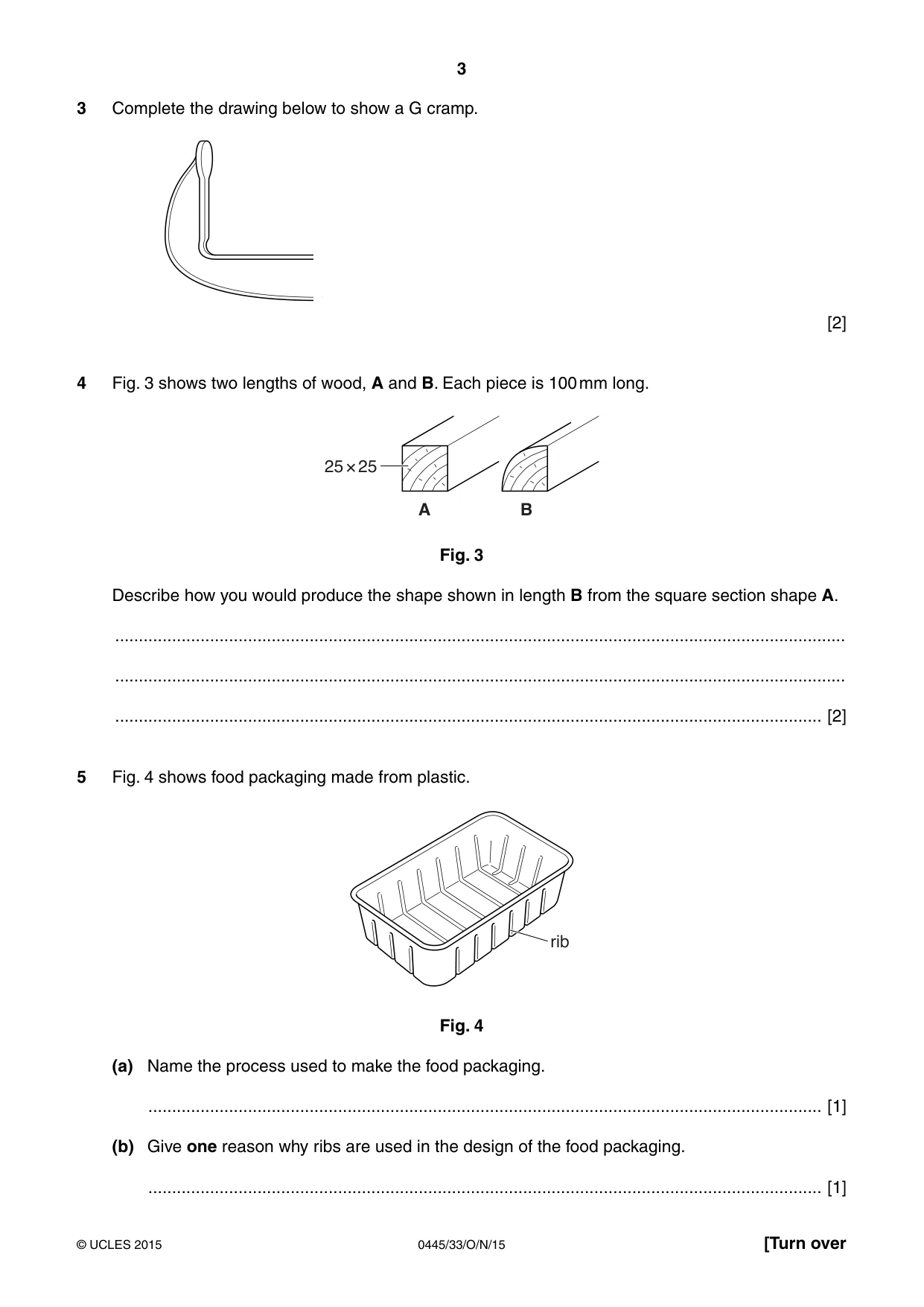
3 0445/33/O/N/15 © UCLES 2015 [Turn over 3 Complete the drawing below to show a G cramp. [2] 4 Fig. 3 shows two lengths of wood, A and B. Each piece is 100 mm long. 25 × 25 A B Fig. 3 Describe how you would produce the shape shown in length B from the square section shape A. … … … [2] 5 Fig. 4 shows food packaging made from plastic. rib Fig. 4 (a) Name the process used to make the food packaging. … [1] (b) Give one reason why ribs are used in the design of the food packaging. … [1]
Question paper, page 4
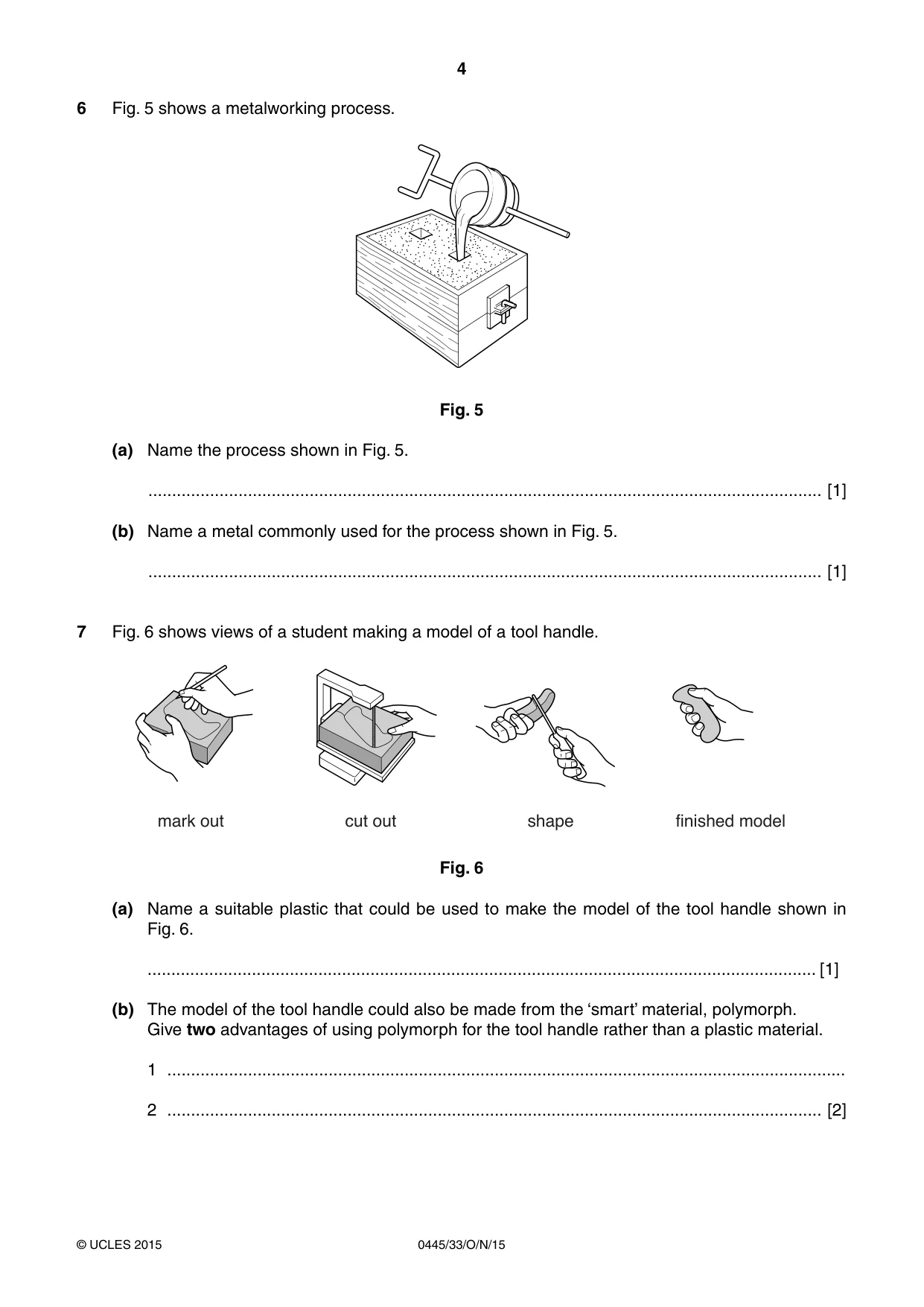
4 0445/33/O/N/15 © UCLES 2015 6 Fig. 5 shows a metalworking process. Fig. 5 (a) Name the process shown in Fig. 5. … [1] (b) Name a metal commonly used for the process shown in Fig. 5. … [1] 7 Fig. 6 shows views of a student making a model of a tool handle. mark out cut out shape finished model Fig. 6 (a) Name a suitable plastic that could be used to make the model of the tool handle shown in Fig. 6. … [1] (b) The model of the tool handle could also be made from the ‘smart’ material, polymorph. Give two advantages of using polymorph for the tool handle rather than a plastic material. 1 … 2 … [2]
Question paper, page 5
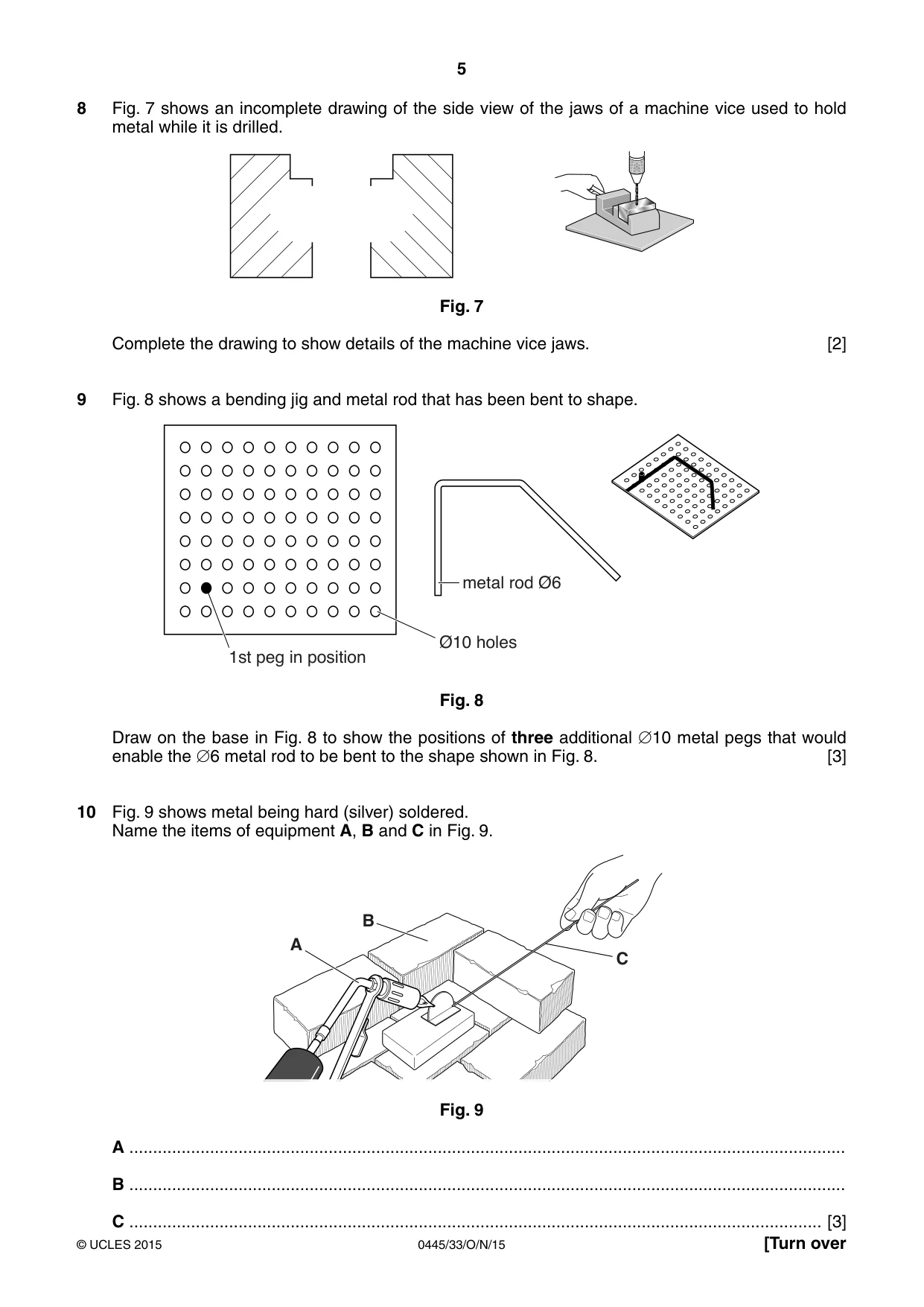
5 0445/33/O/N/15 © UCLES 2015 [Turn over 8 Fig. 7 shows an incomplete drawing of the side view of the jaws of a machine vice used to hold metal while it is drilled. Fig. 7 Complete the drawing to show details of the machine vice jaws. [2] 9 Fig. 8 shows a bending jig and metal rod that has been bent to shape. 1st peg in position Ø10 holes metal rod Ø6 Fig. 8 Draw on the base in Fig. 8 to show the positions of three additional ∅10 metal pegs that would enable the ∅6 metal rod to be bent to the shape shown in Fig. 8. [3] 10 Fig. 9 shows metal being hard (silver) soldered. Name the items of equipment A, B and C in Fig. 9. A B C Fig. 9 A … B … C … [3]
Question paper, page 6
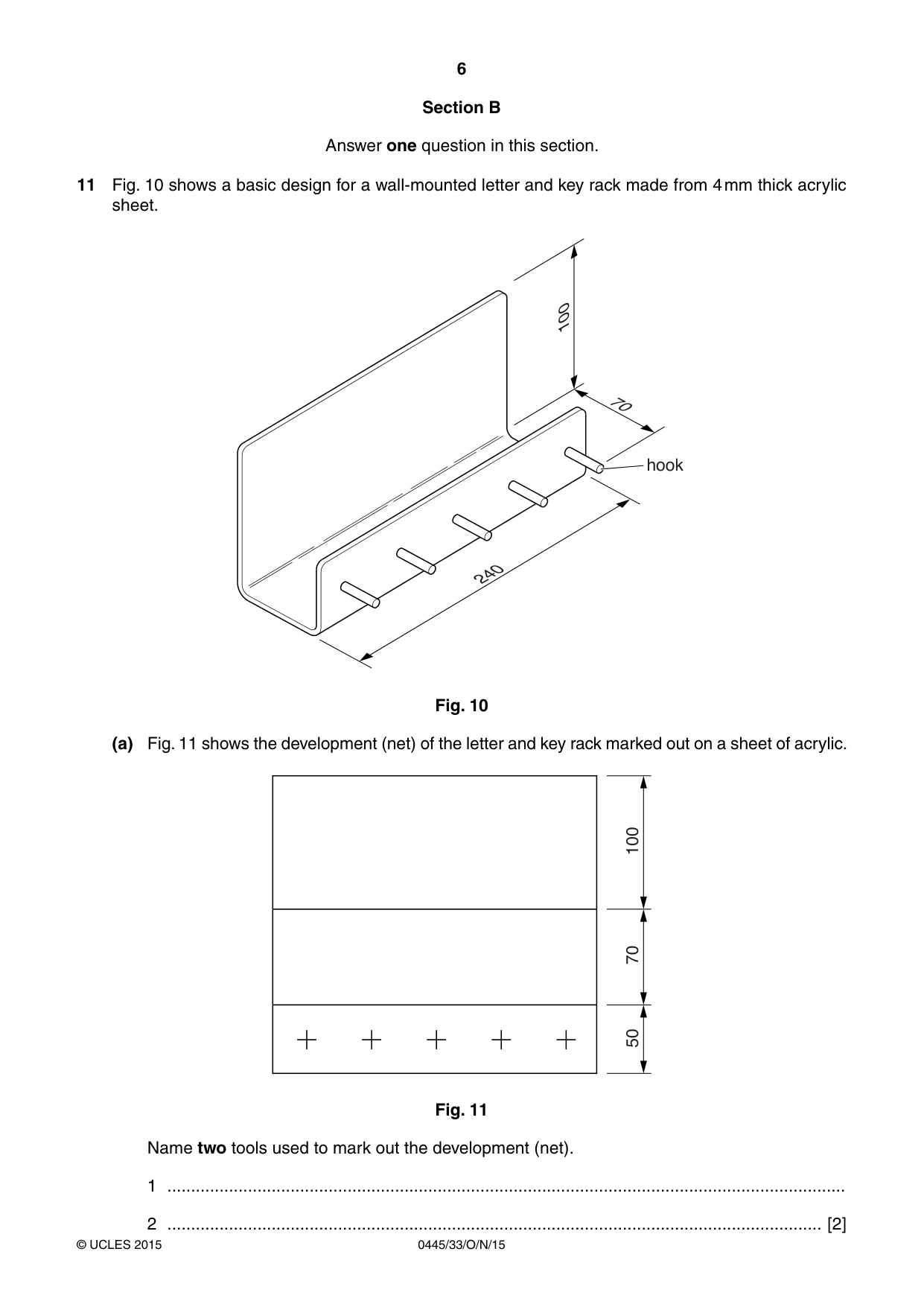
6 0445/33/O/N/15 © UCLES 2015 Section B Answer one question in this section. 11 Fig. 10 shows a basic design for a wall-mounted letter and key rack made from 4 mm thick acrylic sheet. 100 240 70 hook Fig. 10 (a) Fig. 11 shows the development (net) of the letter and key rack marked out on a sheet of acrylic. 100 70 50 Fig. 11 Name two tools used to mark out the development (net). 1 … 2 … [2]
Question paper, page 7
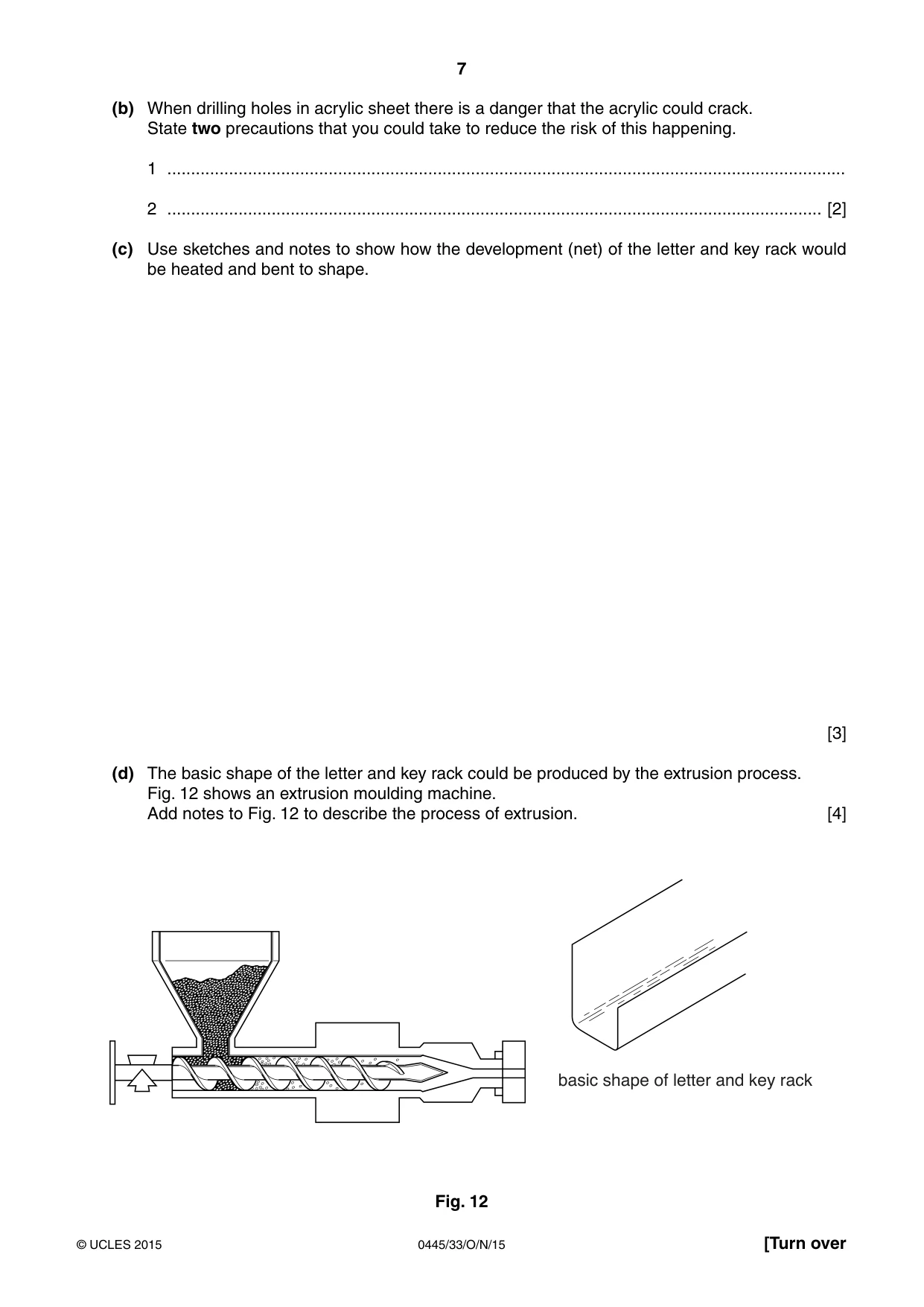
7 0445/33/O/N/15 © UCLES 2015 [Turn over (b) When drilling holes in acrylic sheet there is a danger that the acrylic could crack. State two precautions that you could take to reduce the risk of this happening. 1 … 2 … [2] (c) Use sketches and notes to show how the development (net) of the letter and key rack would be heated and bent to shape. [3] (d) The basic shape of the letter and key rack could be produced by the extrusion process. Fig. 12 shows an extrusion moulding machine. Add notes to Fig. 12 to describe the process of extrusion. [4] basic shape of letter and key rack Fig. 12
Question paper, page 8
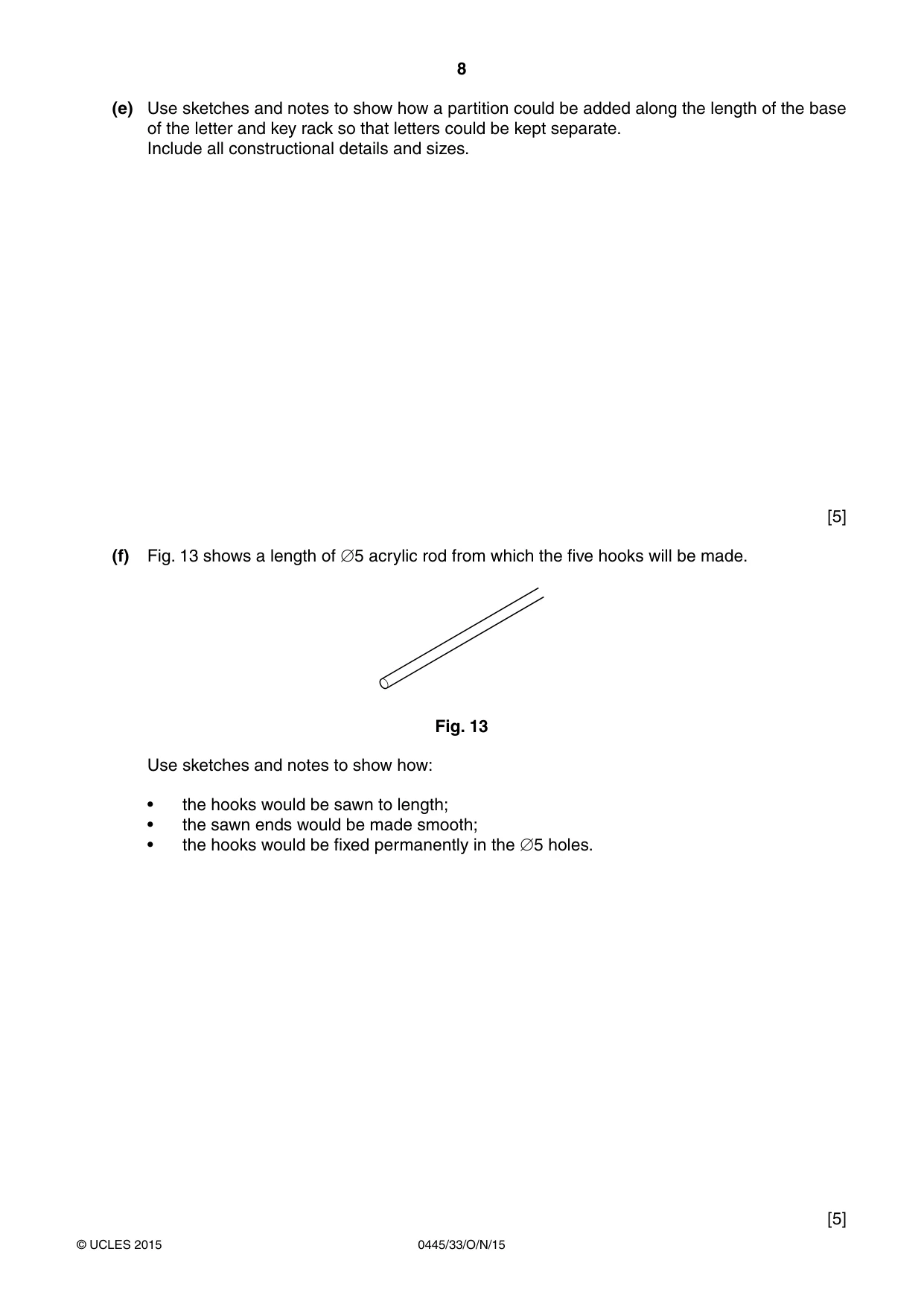
8 0445/33/O/N/15 © UCLES 2015 (e) Use sketches and notes to show how a partition could be added along the length of the base of the letter and key rack so that letters could be kept separate. Include all constructional details and sizes. [5] (f) Fig. 13 shows a length of ∅5 acrylic rod from which the five hooks will be made. Fig. 13 Use sketches and notes to show how: • the hooks would be sawn to length; • the sawn ends would be made smooth; • the hooks would be fixed permanently in the ∅5 holes. [5]
Question paper, page 9
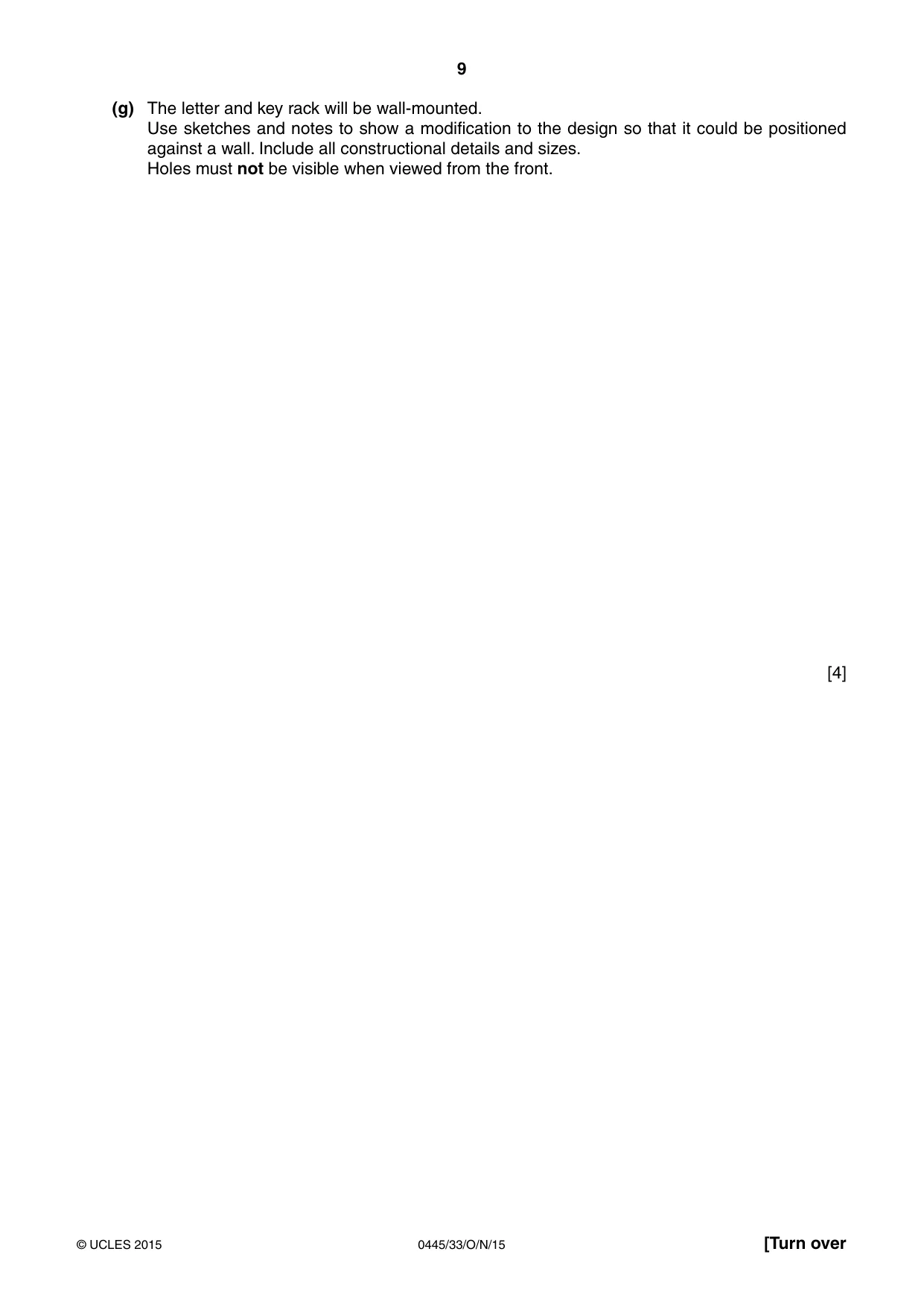
9 0445/33/O/N/15 © UCLES 2015 [Turn over (g) The letter and key rack will be wall-mounted. Use sketches and notes to show a modification to the design so that it could be positioned against a wall. Include all constructional details and sizes. Holes must not be visible when viewed from the front. [4]
Question paper, page 10
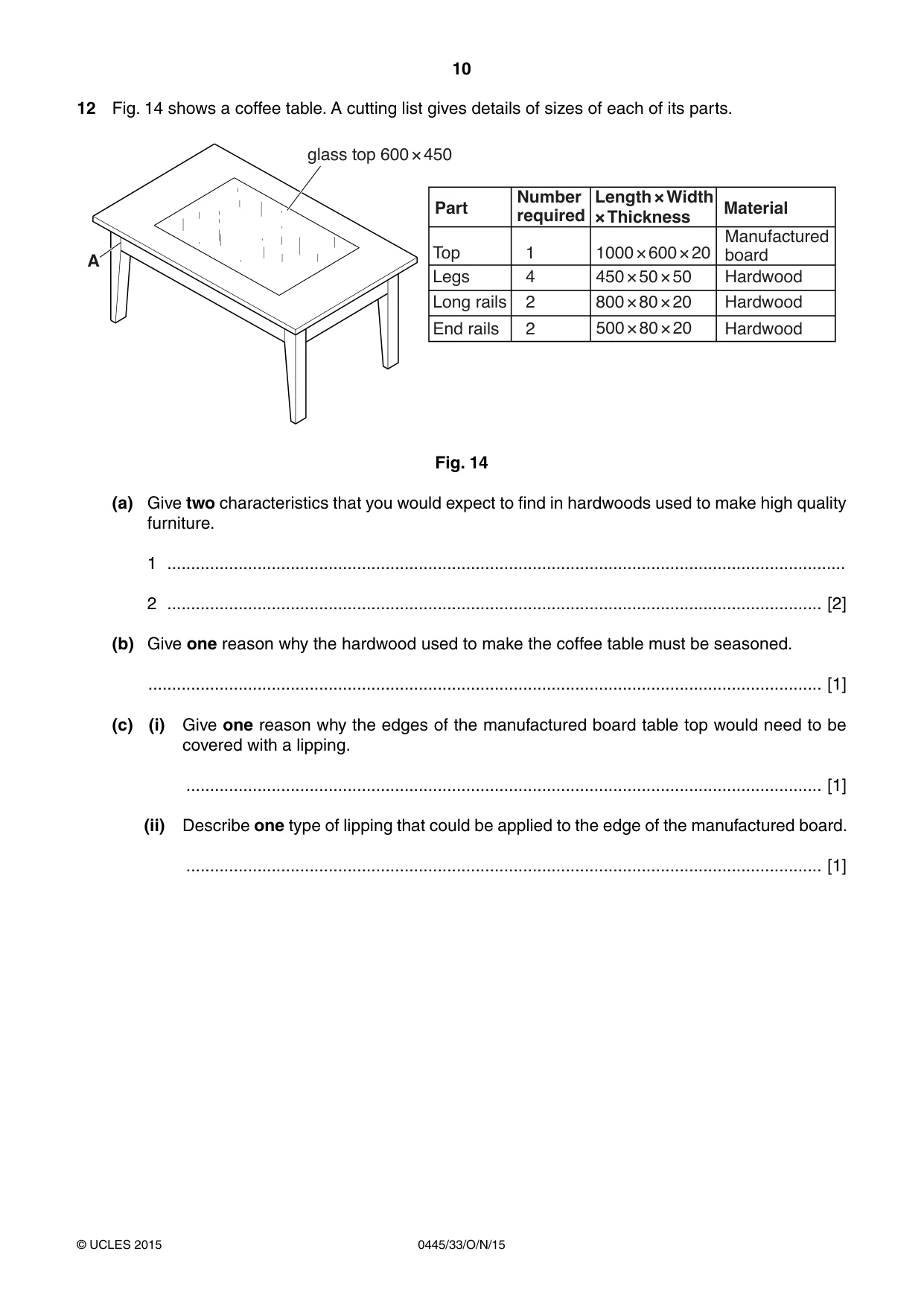
10 0445/33/O/N/15 © UCLES 2015 12 Fig. 14 shows a coffee table. A cutting list gives details of sizes of each of its parts. glass top 600 × 450 A Top Part Material Length × Width × Thickness Number required Legs Long rails End rails Manufactured board Hardwood Hardwood Hardwood 1 4 2 2 1000 × 600 × 20 450 × 50 × 50 800 × 80 × 20 500 × 80 × 20 Fig. 14 (a) Give two characteristics that you would expect to find in hardwoods used to make high quality furniture. 1 … 2 … [2] (b) Give one reason why the hardwood used to make the coffee table must be seasoned. … [1] (c) (i) Give one reason why the edges of the manufactured board table top would need to be covered with a lipping. … [1] (ii) Describe one type of lipping that could be applied to the edge of the manufactured board. … [1]
Question paper, page 11
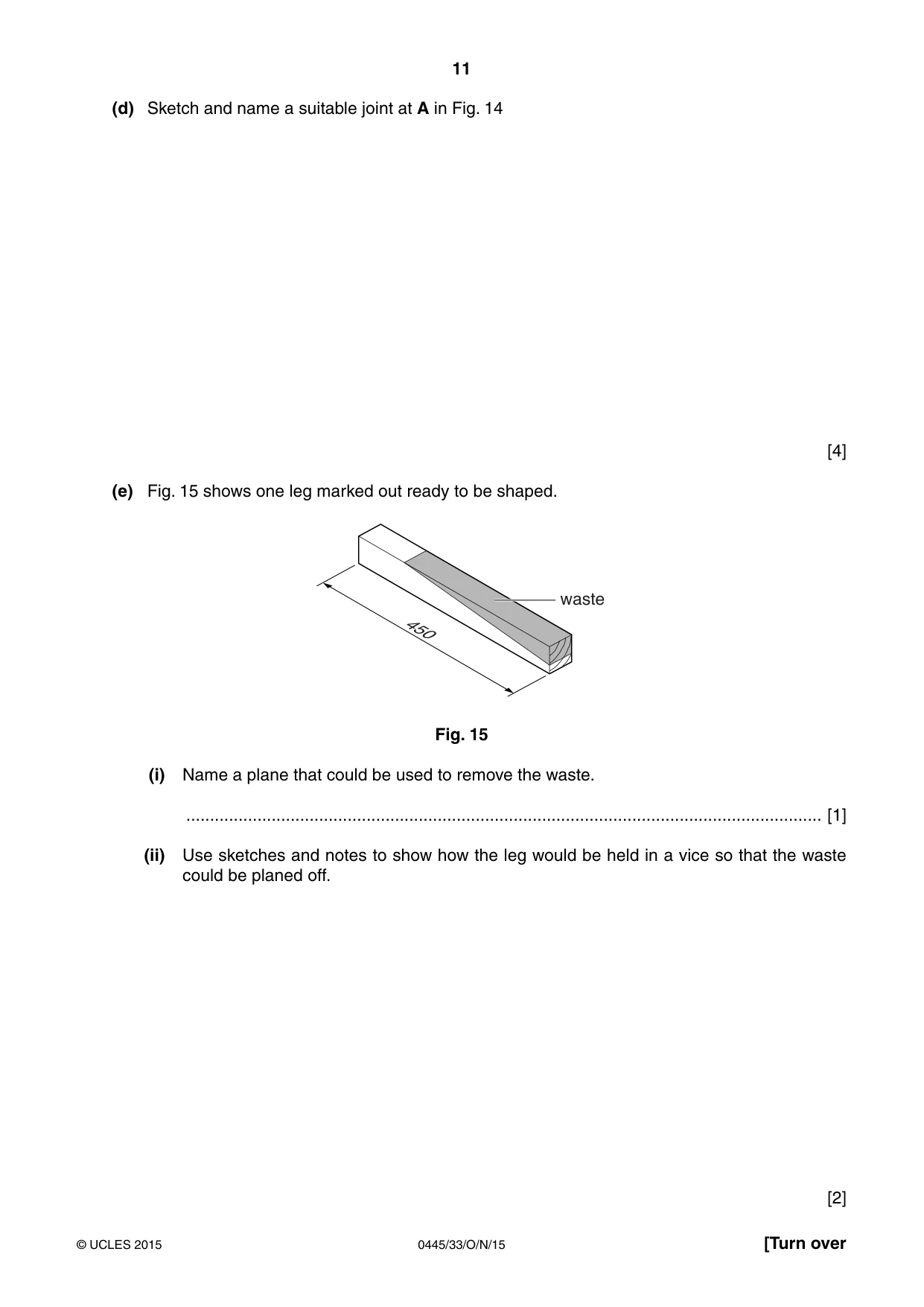
11 0445/33/O/N/15 © UCLES 2015 [Turn over (d) Sketch and name a suitable joint at A in Fig. 14 [4] (e) Fig. 15 shows one leg marked out ready to be shaped. 450 waste Fig. 15 (i) Name a plane that could be used to remove the waste. … [1] (ii) Use sketches and notes to show how the leg would be held in a vice so that the waste could be planed off. [2]
Question paper, page 12
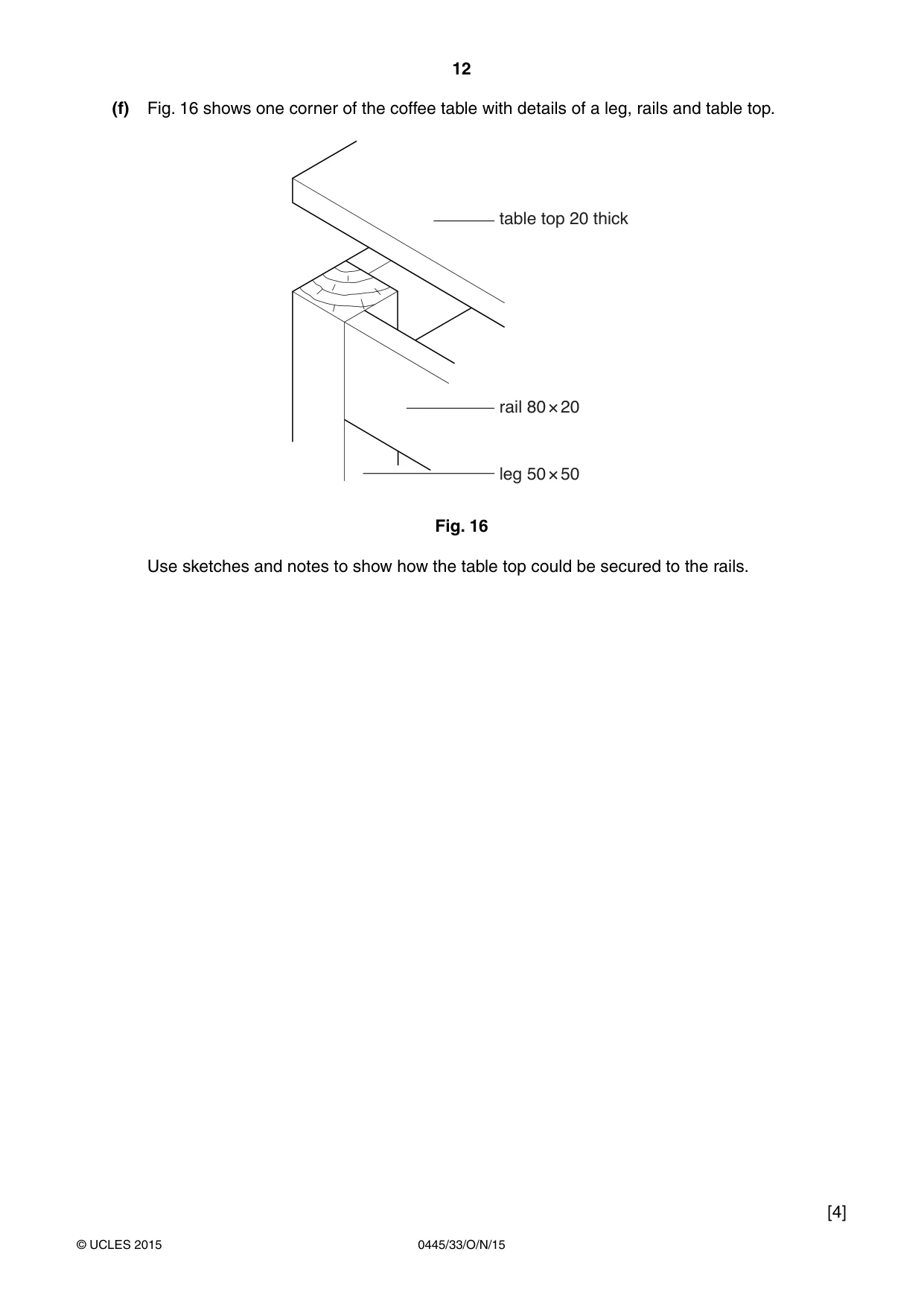
12 0445/33/O/N/15 © UCLES 2015 (f) Fig. 16 shows one corner of the coffee table with details of a leg, rails and table top. table top 20 thick rail 80 × 20 leg 50 × 50 Fig. 16 Use sketches and notes to show how the table top could be secured to the rails. [4]
Question paper, page 13
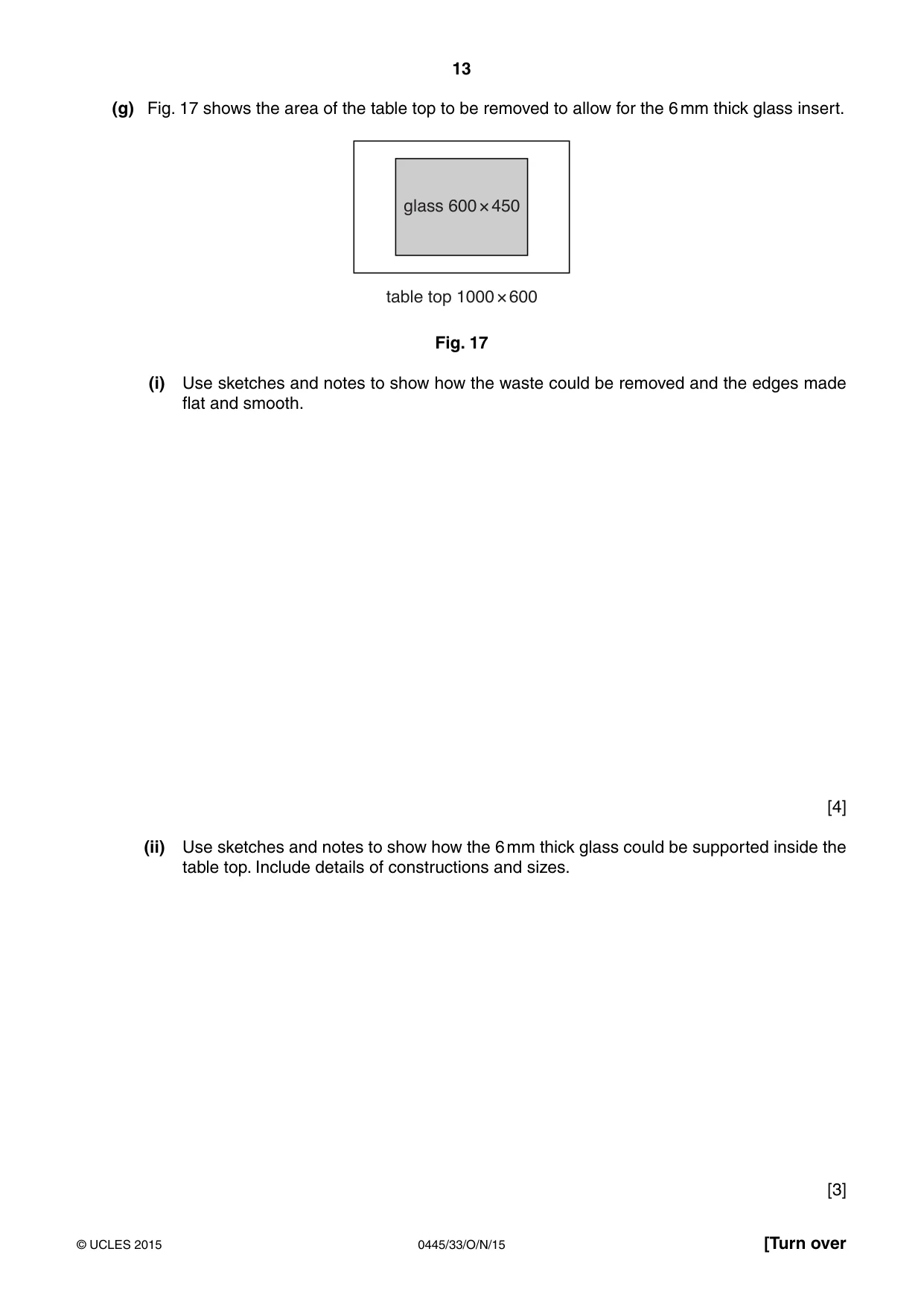
13 0445/33/O/N/15 © UCLES 2015 [Turn over (g) Fig. 17 shows the area of the table top to be removed to allow for the 6 mm thick glass insert. glass 600 × 450 table top 1000 × 600 Fig. 17 (i) Use sketches and notes to show how the waste could be removed and the edges made flat and smooth. [4] (ii) Use sketches and notes to show how the 6 mm thick glass could be supported inside the table top. Include details of constructions and sizes. [3]
Question paper, page 14
14 0445/33/O/N/15 © UCLES 2015 (h) Explain how the coffee table shown in Fig. 14 could be considered to be a product that is environmentally friendly. … … … [2]
Question paper, page 15
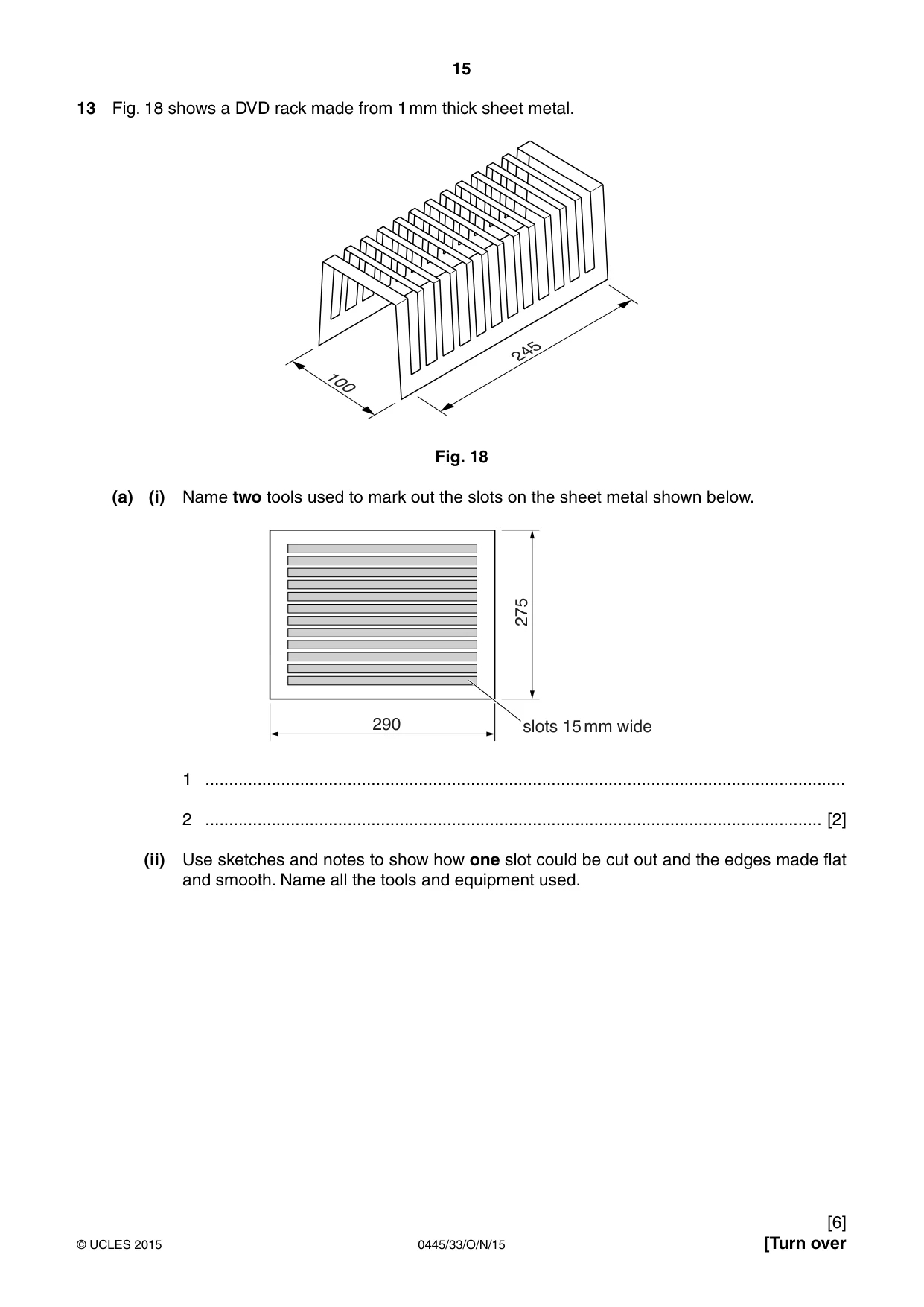
15 0445/33/O/N/15 © UCLES 2015 [Turn over 13 Fig. 18 shows a DVD rack made from 1 mm thick sheet metal. 100 245 Fig. 18 (a) (i) Name two tools used to mark out the slots on the sheet metal shown below. 275 290 slots 15 mm wide 1 … 2 … [2] (ii) Use sketches and notes to show how one slot could be cut out and the edges made flat and smooth. Name all the tools and equipment used. [6]
Question paper, page 16
16 0445/33/O/N/15 © UCLES 2015 (b) The DVD rack could be made from mild steel or aluminium. (i) Name a suitable applied finish for a DVD rack made from mild steel. … [1] (ii) Describe how you could finish the DVD rack when made from aluminium without applying an additional finish. … … … … [3] (c) Use sketches and notes to show how the sheet metal could be bent to shape. Name the tools and equipment used. [4]
Question paper, page 17
17 0445/33/O/N/15 © UCLES 2015 (d) As the user’s collection of DVDs increases an additional DVD rack is needed. Use sketches and notes to show how the DVD rack in Fig. 18 could be modified so that an identical DVD rack could be connected to either end of it quickly and easily. Include details of materials used and sizes. [4] (e) There is a danger that the edges of the DVD rack could cause scratches when placed on a polished surface. Use sketches and notes to show a design modification to the DVD rack to prevent this. Include details of materials and constructions used. [4] (f) Give one reason why the DVD rack could be considered to be a product with a limited lifetime. … … [1]
Question paper, page 18
18 0445/33/O/N/15 © UCLES 2015 BLANK PAGE
Question paper, page 19
19 0445/33/O/N/15 © UCLES 2015 BLANK PAGE
Question paper, page 20
20 0445/33/O/N/15 © UCLES 2015 Permission to reproduce items where third-party owned material protected by copyright is included has been sought and cleared where possible. Every reasonable effort has been made by the publisher (UCLES) to trace copyright holders, but if any items requiring clearance have unwittingly been included, the publisher will be pleased to make amends at the earliest possible opportunity. To avoid the issue of disclosure of answer-related information to candidates, all copyright acknowledgements are reproduced online in the Cambridge International Examinations Copyright Acknowledgements Booklet. This is produced for each series of examinations and is freely available to download at www.cie.org.uk after the live examination series. Cambridge International Examinations is part of the Cambridge Assessment Group. Cambridge Assessment is the brand name of University of Cambridge Local Examinations Syndicate (UCLES), which is itself a department of the University of Cambridge. BLANK PAGE
Mark scheme, page 1
® IGCSE is the registered trademark of Cambridge International Examinations. CAMBRIDGE INTERNATIONAL EXAMINATIONS Cambridge International General Certificate of Secondary Education MARK SCHEME for the October/November 2015 series 0445 DESIGN AND TECHNOLOGY 0445/33 Paper 3 (Resistant Materials), maximum raw mark 50 This mark scheme is published as an aid to teachers and candidates, to indicate the requirements of the examination. It shows the basis on which Examiners were instructed to award marks. It does not indicate the details of the discussions that took place at an Examiners’ meeting before marking began, which would have considered the acceptability of alternative answers. Mark schemes should be read in conjunction with the question paper and the Principal Examiner Report for Teachers. Cambridge will not enter into discussions about these mark schemes. Cambridge is publishing the mark schemes for the October/November 2015 series for most Cambridge IGCSE®, Cambridge International A and AS Level components and some Cambridge O Level components.
Mark scheme, page 2
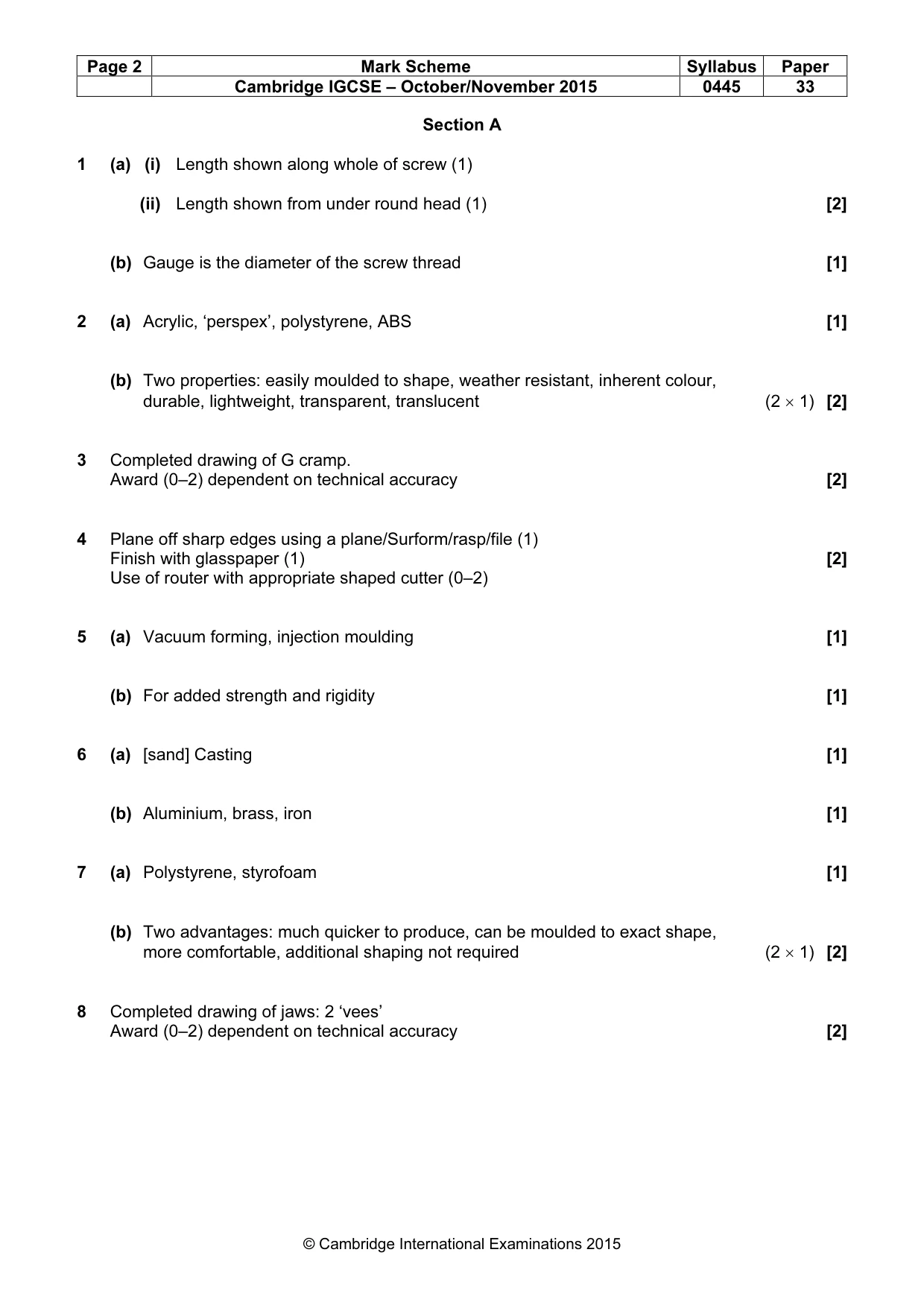
Page 2 Mark Scheme Syllabus Paper Cambridge IGCSE – October/November 2015 0445 33 © Cambridge International Examinations 2015 Section A 1 (a) (i) Length shown along whole of screw (1) (ii) Length shown from under round head (1) [2] (b) Gauge is the diameter of the screw thread [1] 2 (a) Acrylic, ‘perspex’, polystyrene, ABS [1] (b) Two properties: easily moulded to shape, weather resistant, inherent colour, durable, lightweight, transparent, translucent (2 × 1) [2] 3 Completed drawing of G cramp. Award (0–2) dependent on technical accuracy [2] 4 Plane off sharp edges using a plane/Surform/rasp/file (1) Finish with glasspaper (1) [2] Use of router with appropriate shaped cutter (0–2) 5 (a) Vacuum forming, injection moulding [1] (b) For added strength and rigidity [1] 6 (a) [sand] Casting [1] (b) Aluminium, brass, iron [1] 7 (a) Polystyrene, styrofoam [1] (b) Two advantages: much quicker to produce, can be moulded to exact shape, more comfortable, additional shaping not required (2 × 1) [2] 8 Completed drawing of jaws: 2 ‘vees’ Award (0–2) dependent on technical accuracy [2]
Mark scheme, page 3
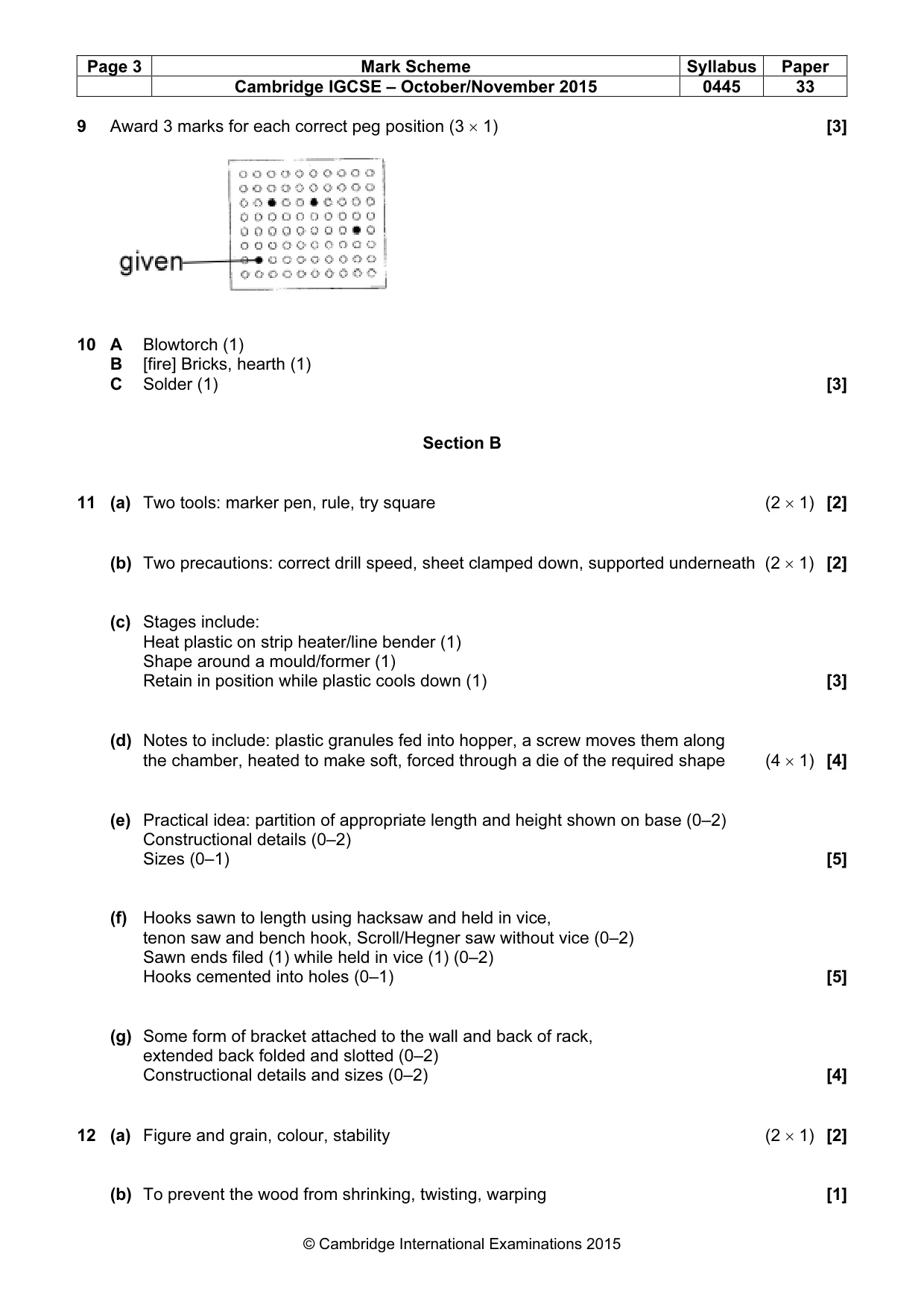
Page 3 Mark Scheme Syllabus Paper Cambridge IGCSE – October/November 2015 0445 33 © Cambridge International Examinations 2015 9 Award 3 marks for each correct peg position (3 × 1) [3] 10 A Blowtorch (1) B [fire] Bricks, hearth (1) C Solder (1) [3] Section B 11 (a) Two tools: marker pen, rule, try square (2 × 1) [2] (b) Two precautions: correct drill speed, sheet clamped down, supported underneath (2 × 1) [2] (c) Stages include: Heat plastic on strip heater/line bender (1) Shape around a mould/former (1) Retain in position while plastic cools down (1) [3] (d) Notes to include: plastic granules fed into hopper, a screw moves them along the chamber, heated to make soft, forced through a die of the required shape (4 × 1) [4] (e) Practical idea: partition of appropriate length and height shown on base (0–2) Constructional details (0–2) Sizes (0–1) [5] (f) Hooks sawn to length using hacksaw and held in vice, tenon saw and bench hook, Scroll/Hegner saw without vice (0–2) Sawn ends filed (1) while held in vice (1) (0–2) Hooks cemented into holes (0–1) [5] (g) Some form of bracket attached to the wall and back of rack, extended back folded and slotted (0–2) Constructional details and sizes (0–2) [4] 12 (a) Figure and grain, colour, stability (2 × 1) [2] (b) To prevent the wood from shrinking, twisting, warping [1]
Mark scheme, page 4
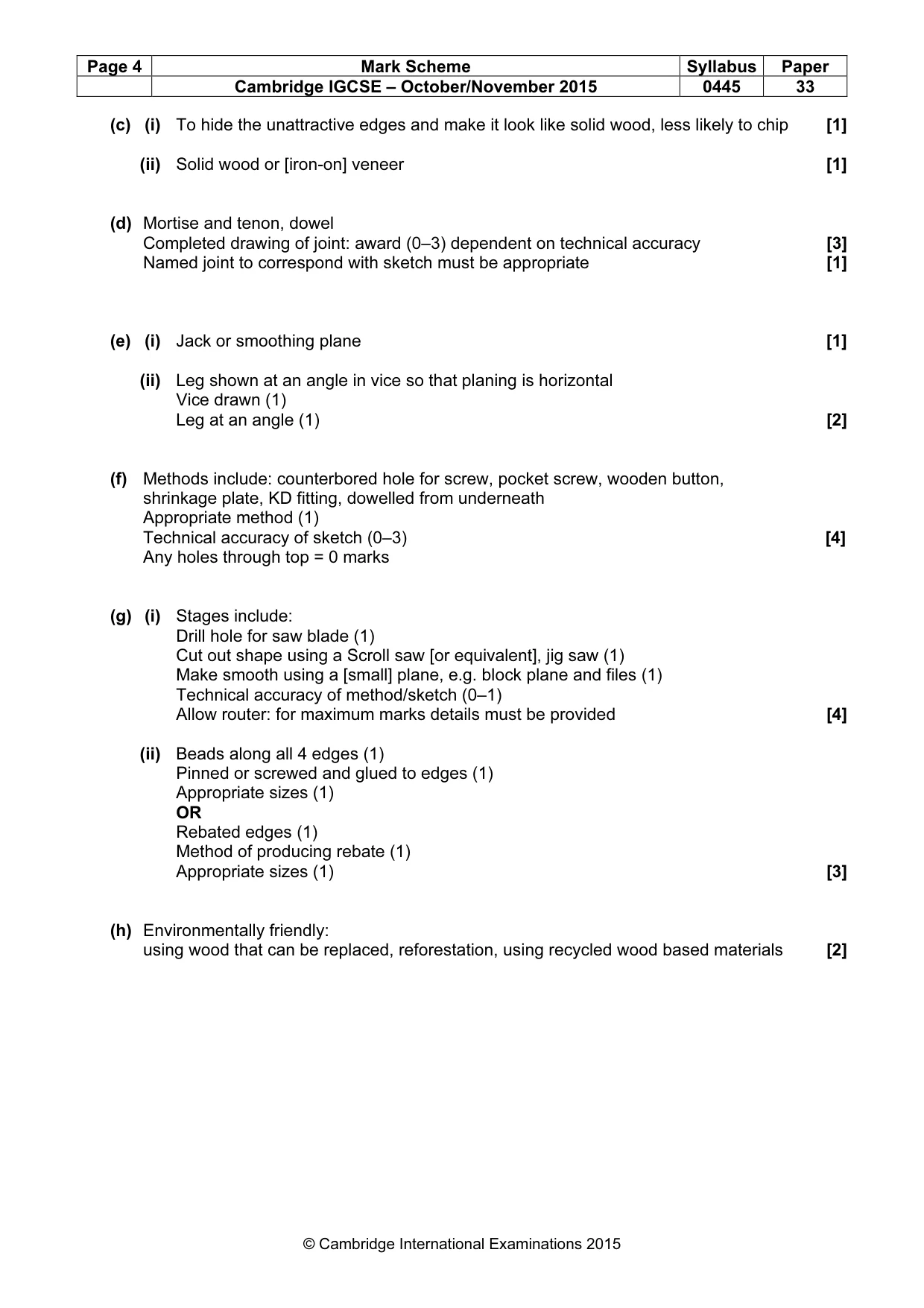
Page 4 Mark Scheme Syllabus Paper Cambridge IGCSE – October/November 2015 0445 33 © Cambridge International Examinations 2015 (c) (i) To hide the unattractive edges and make it look like solid wood, less likely to chip [1] (ii) Solid wood or [iron-on] veneer [1] (d) Mortise and tenon, dowel Completed drawing of joint: award (0–3) dependent on technical accuracy [3] Named joint to correspond with sketch must be appropriate [1] (e) (i) Jack or smoothing plane [1] (ii) Leg shown at an angle in vice so that planing is horizontal Vice drawn (1) Leg at an angle (1) [2] (f) Methods include: counterbored hole for screw, pocket screw, wooden button, shrinkage plate, KD fitting, dowelled from underneath Appropriate method (1) Technical accuracy of sketch (0–3) [4] Any holes through top = 0 marks (g) (i) Stages include: Drill hole for saw blade (1) Cut out shape using a Scroll saw [or equivalent], jig saw (1) Make smooth using a [small] plane, e.g. block plane and files (1) Technical accuracy of method/sketch (0–1) Allow router: for maximum marks details must be provided [4] (ii) Beads along all 4 edges (1) Pinned or screwed and glued to edges (1) Appropriate sizes (1) OR Rebated edges (1) Method of producing rebate (1) Appropriate sizes (1) [3] (h) Environmentally friendly: using wood that can be replaced, reforestation, using recycled wood based materials [2]
Mark scheme, page 5
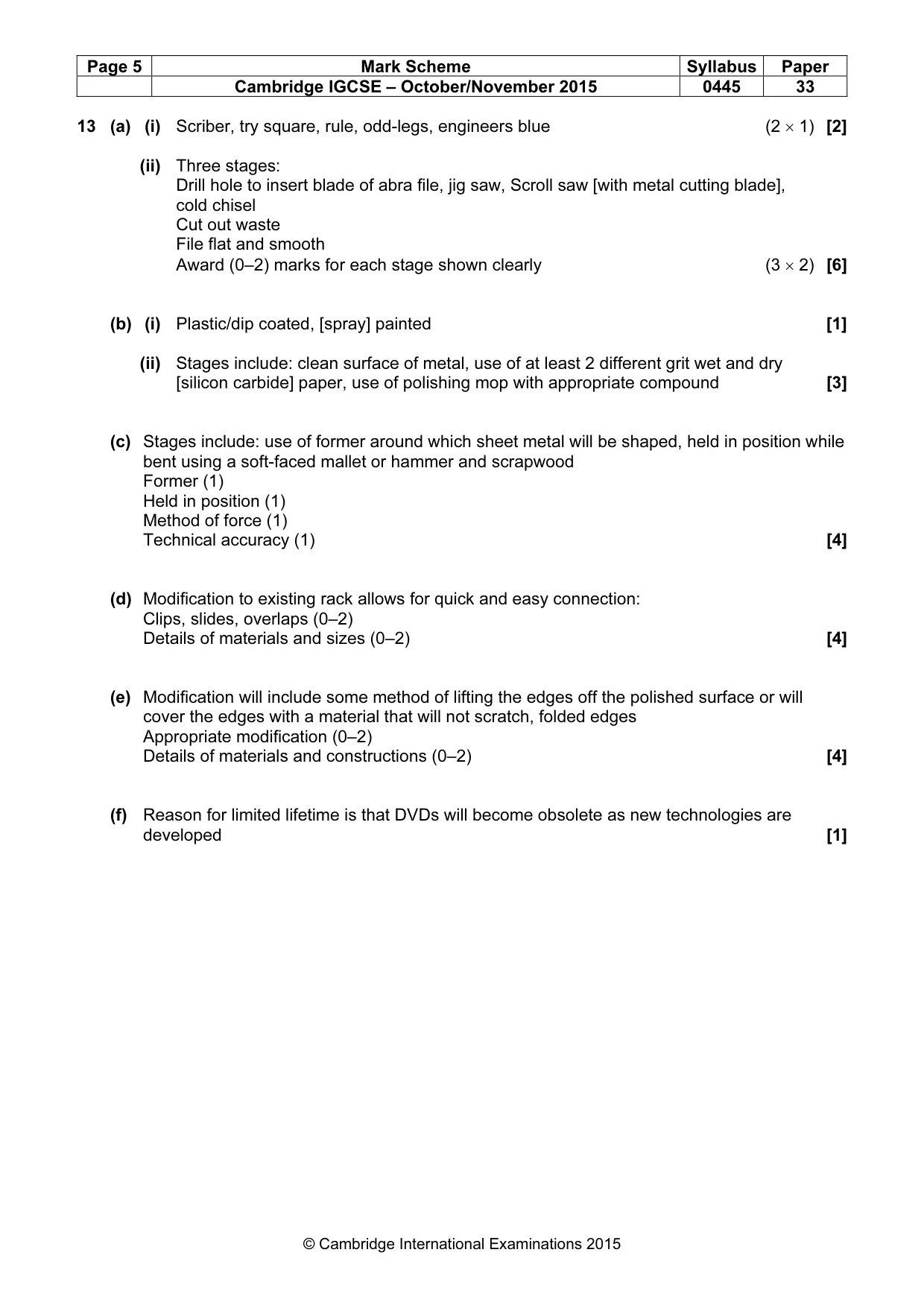
Page 5 Mark Scheme Syllabus Paper Cambridge IGCSE – October/November 2015 0445 33 © Cambridge International Examinations 2015 13 (a) (i) Scriber, try square, rule, odd-legs, engineers blue (2 × 1) [2] (ii) Three stages: Drill hole to insert blade of abra file, jig saw, Scroll saw [with metal cutting blade], cold chisel Cut out waste File flat and smooth Award (0–2) marks for each stage shown clearly (3 × 2) [6] (b) (i) Plastic/dip coated, [spray] painted [1] (ii) Stages include: clean surface of metal, use of at least 2 different grit wet and dry [silicon carbide] paper, use of polishing mop with appropriate compound [3] (c) Stages include: use of former around which sheet metal will be shaped, held in position while bent using a soft-faced mallet or hammer and scrapwood Former (1) Held in position (1) Method of force (1) Technical accuracy (1) [4] (d) Modification to existing rack allows for quick and easy connection: Clips, slides, overlaps (0–2) Details of materials and sizes (0–2) [4] (e) Modification will include some method of lifting the edges off the polished surface or will cover the edges with a material that will not scratch, folded edges Appropriate modification (0–2) Details of materials and constructions (0–2) [4] (f) Reason for limited lifetime is that DVDs will become obsolete as new technologies are developed [1]
What you needed in this session
Cambridge’s own grade thresholds for 2015 Oct/Nov, Paper 3 · Variant 3. A higher threshold means an easier paper — the bar moves with how the cohort did.