Questions as text
Q1 · In a nursery, the children must be properly supervised throughout the day 9694/32 May/June 2017
1 In a nursery, the children must be properly supervised throughout the day. In any room which has children in it there must be 1 adult present for every 4 children, plus 1 additional adult. So 5 children would require 3 adults to be present in the room. Sandra’s nursery has 1 large room and 4 identical small rooms. The large room holds a maximum of 10 children and the small rooms each hold a maximum of 7 children. (a) If the nursery employs 6 adults, what is the largest number of children that could be supervised? [2] There are currently 18 children enrolled at the nursery. (b) What is the smallest number of adults that would be needed to supervise all 18 children? [2] 5 more children join the nursery. (c) What is the smallest number of adults that are needed to supervise all 23 children? [1] Sandra decides to combine some of the rooms, in order to reduce the number of adults she needs to employ. After consultation with the builder, she has three options. Her budget will allow for only one of these to be undertaken: 1) Combine the large room and one of the small rooms to make a room with a capacity of 17 children 2) Combine two of the small rooms to make a room with a capacity of 14 children 3) Combine three of the small rooms to make a room with a capacity of 21 children (d) For each of these options, find the minimum number of adults required to supervise all 23 children. [3] Sandra expects that more children will join the nursery in the future. (e) Explain which of the three options she should choose. [2]
10 marks
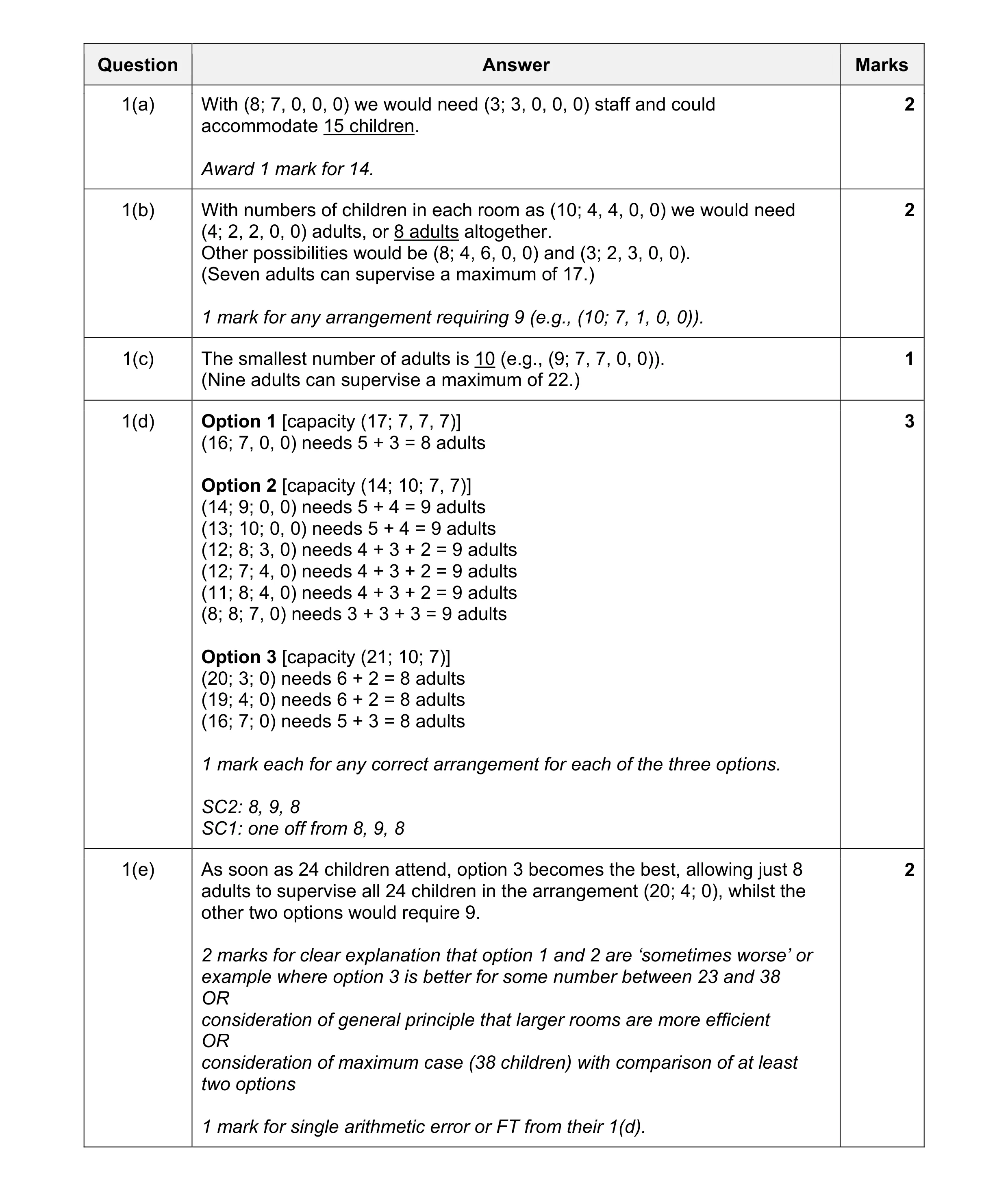
Mark scheme: Question Answer Marks 1(a) With (8; 7, 0, 0, 0) we would need (3; 3, 0, 0, 0) staff and could 2 accommodate 15 children. Award 1 mark for 14. 1(b) With numbers of children in each room as (10; 4, 4, 0, 0) we would need 2 (4; 2, 2, 0, 0) adults, or 8 adults altogether. Other possibilities would be (8; 4, 6, 0, 0) and (3; 2, 3, 0, 0). (Seven adults can supervise a maximum of 17.) 1 mark for any arrangement requiring 9 (e.g., (10; 7, 1, 0, 0)). 1(c) The smallest number of adults is 10 (e.g., (9; 7, 7, 0, 0)). 1 (Nine adults can supervise a maximum of 22.) 1(d) Option 1 [capacity (17; 7, 7, 7)] 3 (16; 7, 0, 0) needs 5 + 3 = 8 adults Option 2 [capacity (14; 10; 7, 7)] (14; 9; 0, 0) needs 5 + 4 = 9 adults (13; 10; 0, 0) needs 5 + 4 = 9 adults (12; 8; 3, 0) needs 4 + 3 + 2 = 9 adults (12; 7; 4, 0) needs 4 + 3 + 2 = 9 adults (11; 8; 4, 0) needs 4 + 3 + 2 = 9 adults (8; 8; 7, 0) needs 3 + 3 + 3 = 9 adults Option 3 [capacity (21; 10; 7)] (20; 3; 0) needs 6 + 2 = 8 adults (19; 4; 0) needs 6 + 2 = 8 adults (16; 7; 0) needs 5 + 3 = 8 adults 1 mark each for any correct arrangement for each of the three options. SC2: 8, 9, 8 SC1: one off from 8, 9, 8 1(e) As soon as 24 children attend, option 3 becomes the best, allowing just 8 2 adults to supervise all 24 children in the arrangement (20; 4; 0), whilst the other two options would require 9. 2 marks for clear explanation that option 1 and 2 are ‘sometimes worse’ or example where option 3 is better for some number between 23 and 38 OR consideration of general principle that larger rooms are more efficient OR consideration of maximum case (38 children) with comparison of at least two options 1 mark for single arithmetic error or FT from their 1(d).
This question in 9694/32 May/June 2017
Q2 · In a nursery, the children must be properly supervised throughout the day 9694/33 May/June 2017
1 In a nursery, the children must be properly supervised throughout the day. In any room which has children in it there must be 1 adult present for every 4 children, plus 1 additional adult. So 5 children would require 3 adults to be present in the room. Sandra’s nursery has 1 large room and 4 identical small rooms. The large room holds a maximum of 10 children and the small rooms each hold a maximum of 7 children. (a) If the nursery employs 6 adults, what is the largest number of children that could be supervised? [2] There are currently 18 children enrolled at the nursery. (b) What is the smallest number of adults that would be needed to supervise all 18 children? [2] 5 more children join the nursery. (c) What is the smallest number of adults that are needed to supervise all 23 children? [1] Sandra decides to combine some of the rooms, in order to reduce the number of adults she needs to employ. After consultation with the builder, she has three options. Her budget will allow for only one of these to be undertaken: 1) Combine the large room and one of the small rooms to make a room with a capacity of 17 children 2) Combine two of the small rooms to make a room with a capacity of 14 children 3) Combine three of the small rooms to make a room with a capacity of 21 children (d) For each of these options, find the minimum number of adults required to supervise all 23 children. [3] Sandra expects that more children will join the nursery in the future. (e) Explain which of the three options she should choose. [2]
10 marks
Mark scheme: Question Answer Marks 1(a) With (8; 7, 0, 0, 0) we would need (3; 3, 0, 0, 0) staff and could 2 accommodate 15 children. Award 1 mark for 14. 1(b) With numbers of children in each room as (10; 4, 4, 0, 0) we would need 2 (4; 2, 2, 0, 0) adults, or 8 adults altogether. Other possibilities would be (8; 4, 6, 0, 0) and (3; 2, 3, 0, 0). (Seven adults can supervise a maximum of 17.) 1 mark for any arrangement requiring 9 (e.g., (10; 7, 1, 0, 0)). 1(c) The smallest number of adults is 10 (e.g., (9; 7, 7, 0, 0)). 1 (Nine adults can supervise a maximum of 22.) 1(d) Option 1 [capacity (17; 7, 7, 7)] 3 (16; 7, 0, 0) needs 5 + 3 = 8 adults Option 2 [capacity (14; 10; 7, 7)] (14; 9; 0, 0) needs 5 + 4 = 9 adults (13; 10; 0, 0) needs 5 + 4 = 9 adults (12; 8; 3, 0) needs 4 + 3 + 2 = 9 adults (12; 7; 4, 0) needs 4 + 3 + 2 = 9 adults (11; 8; 4, 0) needs 4 + 3 + 2 = 9 adults (8; 8; 7, 0) needs 3 + 3 + 3 = 9 adults Option 3 [capacity (21; 10; 7)] (20; 3; 0) needs 6 + 2 = 8 adults (19; 4; 0) needs 6 + 2 = 8 adults (16; 7; 0) needs 5 + 3 = 8 adults 1 mark each for any correct arrangement for each of the three options. SC2: 8, 9, 8 SC1: one off from 8, 9, 8 1(e) As soon as 24 children attend, option 3 becomes the best, allowing just 8 2 adults to supervise all 24 children in the arrangement (20; 4; 0), whilst the other two options would require 9. 2 marks for clear explanation that option 1 and 2 are ‘sometimes worse’ or example where option 3 is better for some number between 23 and 38 OR consideration of general principle that larger rooms are more efficient OR consideration of maximum case (38 children) with comparison of at least two options 1 mark for single arithmetic error or FT from their 1(d).
This question in 9694/33 May/June 2017
Q3 · Moses has a storage room, in the shape of a cuboid, enclosing a space measuring 220 cm… 9694/32 Oct/Nov 2017
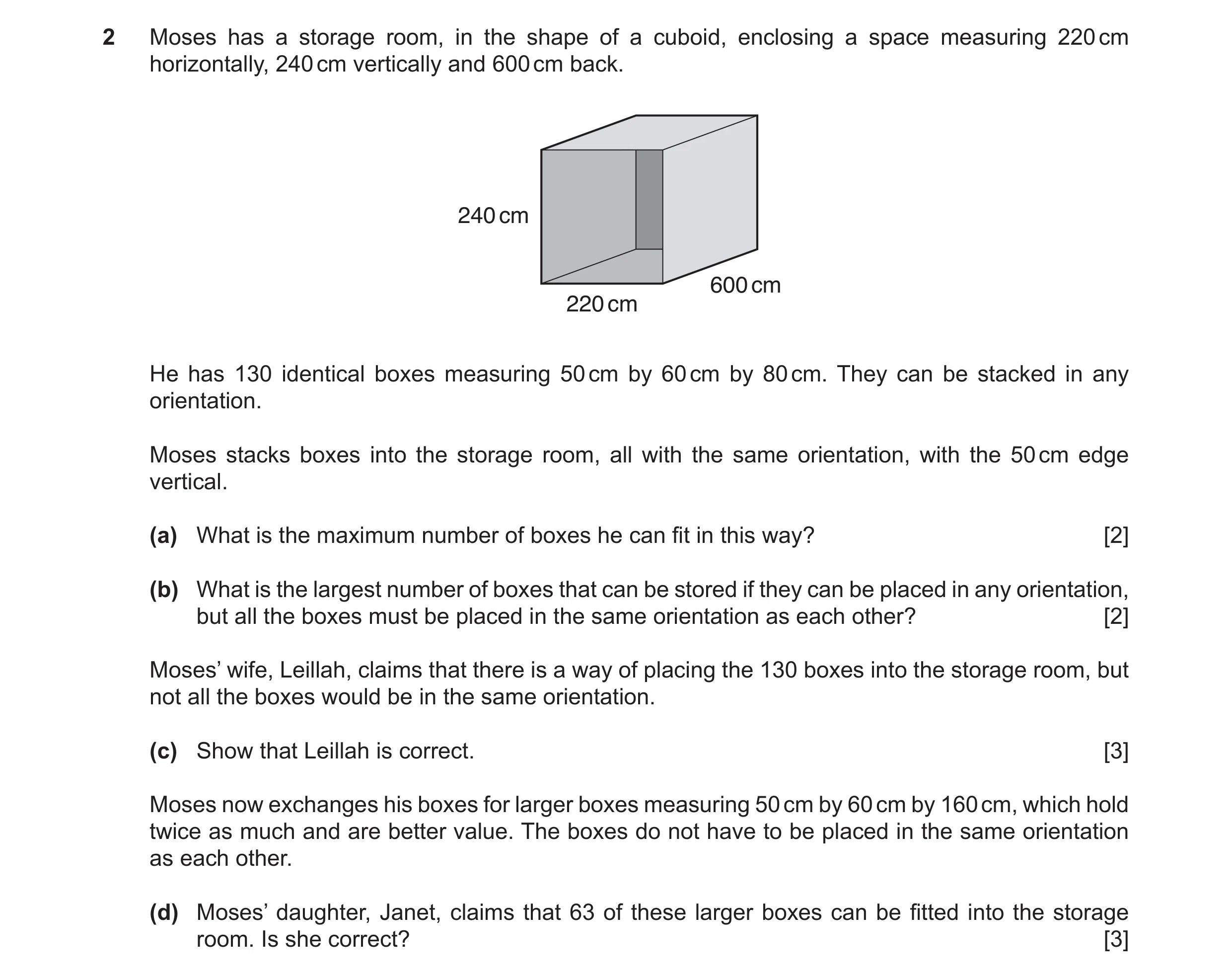
2 Moses has a storage room, in the shape of a cuboid, enclosing a space measuring 220 cm horizontally, 240 cm vertically and 600 cm back. 240 cm 600 cm 220 cm He has 130 identical boxes measuring 50 cm by 60 cm by 80 cm. They can be stacked in any orientation. Moses stacks boxes into the storage room, all with the same orientation, with the 50 cm edge vertical. (a) What is the maximum number of boxes he can fit in this way? [2] (b) What is the largest number of boxes that can be stored if they can be placed in any orientation, but all the boxes must be placed in the same orientation as each other? [2] Moses’ wife, Leillah, claims that there is a way of placing the 130 boxes into the storage room, but not all the boxes would be in the same orientation. (c) Show that Leillah is correct. [3] Moses now exchanges his boxes for larger boxes measuring 50 cm by 60 cm by 160 cm, which hold twice as much and are better value. The boxes do not have to be placed in the same orientation as each other. (d) Moses’ daughter, Janet, claims that 63 of these larger boxes can be fitted into the storage room. Is she correct? [3]
10 marks
Mark scheme: 2(a) He can fit in 2 × 4 × 10 = 80 or 3 × 4 × 7 = 84 boxes. 2 1 mark for either calculation. 2(b) If he places the 50 cm side horizontal and 80 cm side vertical he can fit in 2 4 × 3 × 10 = 120 boxes. 1 mark for 12 × 3 × 3 = 108 boxes OR 7 × 4 × 4 = 112 boxes OR 2 × 12 × 4 = 96 boxes seen. 2(c) For example, 96 boxes can be placed as 2 × 4 × 12, leaving a space 60 × 3 240 × 600, into which a further 36 boxes can be placed, with the 60 cm side horizontal and the 80 cm side vertical. This makes a total of 132 boxes (so 130 is obviously possible). 3 marks for any demonstration of ⩾130 boxes If 3 marks not awarded, award 1 mark each for the following (max 2): • Volume calculation to show sufficient • Splitting the 220 into a combination of 50s, 60s and 80s • Covering a side with 220 end 2(d) For example, with 160 horizontally, he can fit 1 × 4 × 12; this leaves room for 3 1 × 1 × 12 with 60 horizontally. On top of this second set can be fitted another 1 × 1 × 3, making a total of 63. AG 1 mark for filling an entire face OR for room volume = 66 boxes (if not given in (c)) OR 2 marks for obtaining at least 60 (with supporting working) OR 3 marks for (at least) 63 (with supporting working)
This question in 9694/32 Oct/Nov 2017
Q4 · Moses has a storage room, in the shape of a cuboid, enclosing a space measuring 220 cm… 9694/33 Oct/Nov 2017
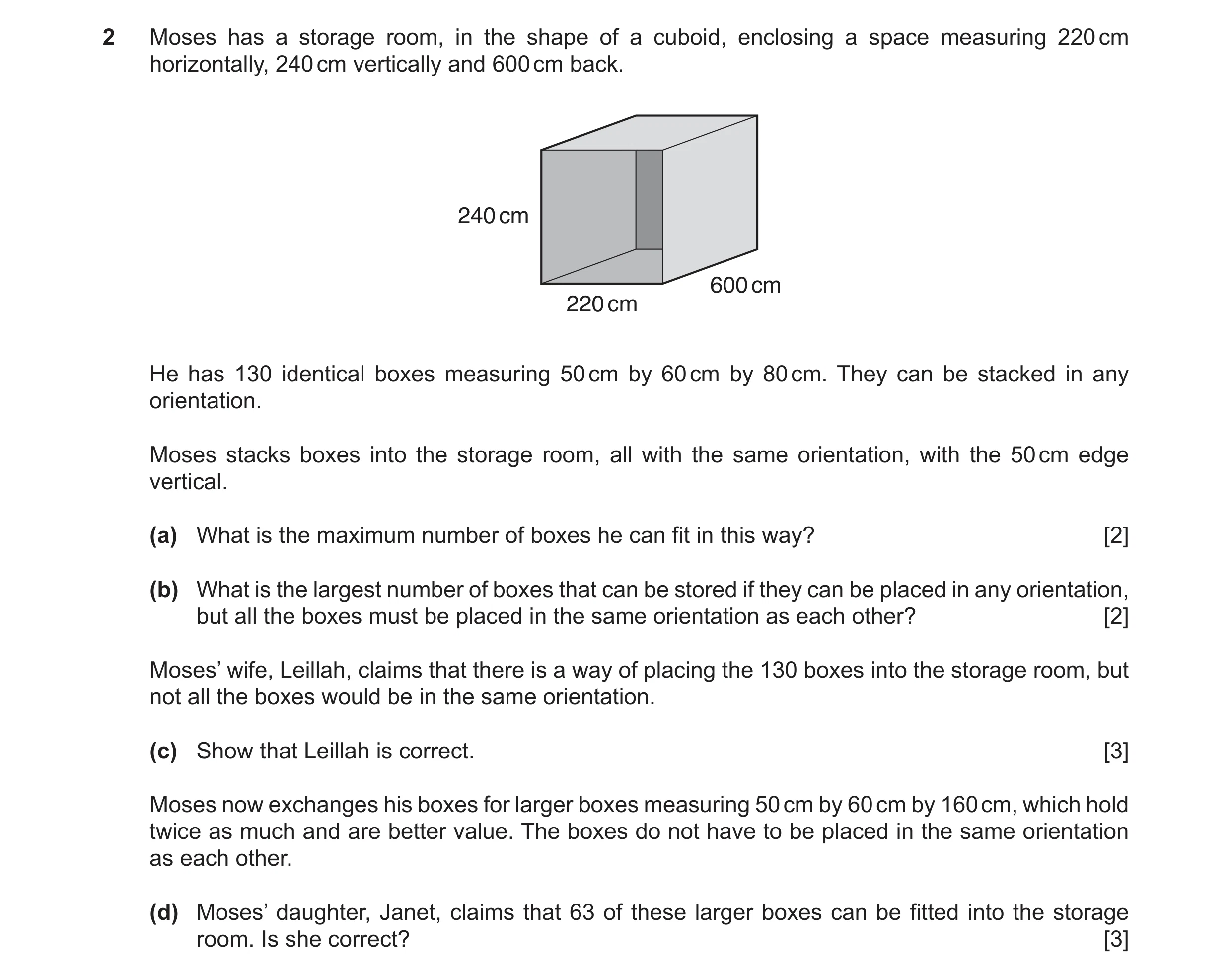
2 Moses has a storage room, in the shape of a cuboid, enclosing a space measuring 220 cm horizontally, 240 cm vertically and 600 cm back. 240 cm 600 cm 220 cm He has 130 identical boxes measuring 50 cm by 60 cm by 80 cm. They can be stacked in any orientation. Moses stacks boxes into the storage room, all with the same orientation, with the 50 cm edge vertical. (a) What is the maximum number of boxes he can fit in this way? [2] (b) What is the largest number of boxes that can be stored if they can be placed in any orientation, but all the boxes must be placed in the same orientation as each other? [2] Moses’ wife, Leillah, claims that there is a way of placing the 130 boxes into the storage room, but not all the boxes would be in the same orientation. (c) Show that Leillah is correct. [3] Moses now exchanges his boxes for larger boxes measuring 50 cm by 60 cm by 160 cm, which hold twice as much and are better value. The boxes do not have to be placed in the same orientation as each other. (d) Moses’ daughter, Janet, claims that 63 of these larger boxes can be fitted into the storage room. Is she correct? [3]
10 marks
Mark scheme: 2(a) He can fit in 2 × 4 × 10 = 80 or 3 × 4 × 7 = 84 boxes. 2 1 mark for either calculation. 2(b) If he places the 50 cm side horizontal and 80 cm side vertical he can fit in 2 4 × 3 × 10 = 120 boxes. 1 mark for 12 × 3 × 3 = 108 boxes OR 7 × 4 × 4 = 112 boxes OR 2 × 12 × 4 = 96 boxes seen. 2(c) For example, 96 boxes can be placed as 2 × 4 × 12, leaving a space 60 × 3 240 × 600, into which a further 36 boxes can be placed, with the 60 cm side horizontal and the 80 cm side vertical. This makes a total of 132 boxes (so 130 is obviously possible). 3 marks for any demonstration of ⩾130 boxes If 3 marks not awarded, award 1 mark each for the following (max 2): • Volume calculation to show sufficient • Splitting the 220 into a combination of 50s, 60s and 80s • Covering a side with 220 end 2(d) For example, with 160 horizontally, he can fit 1 × 4 × 12; this leaves room for 3 1 × 1 × 12 with 60 horizontally. On top of this second set can be fitted another 1 × 1 × 3, making a total of 63. AG 1 mark for filling an entire face OR for room volume = 66 boxes (if not given in (c)) OR 2 marks for obtaining at least 60 (with supporting working) OR 3 marks for (at least) 63 (with supporting working)
This question in 9694/33 Oct/Nov 2017
Q5 · Starting in January, Clarissa took up the offer of a subscription for printer ink 9694/31 May/June 2018
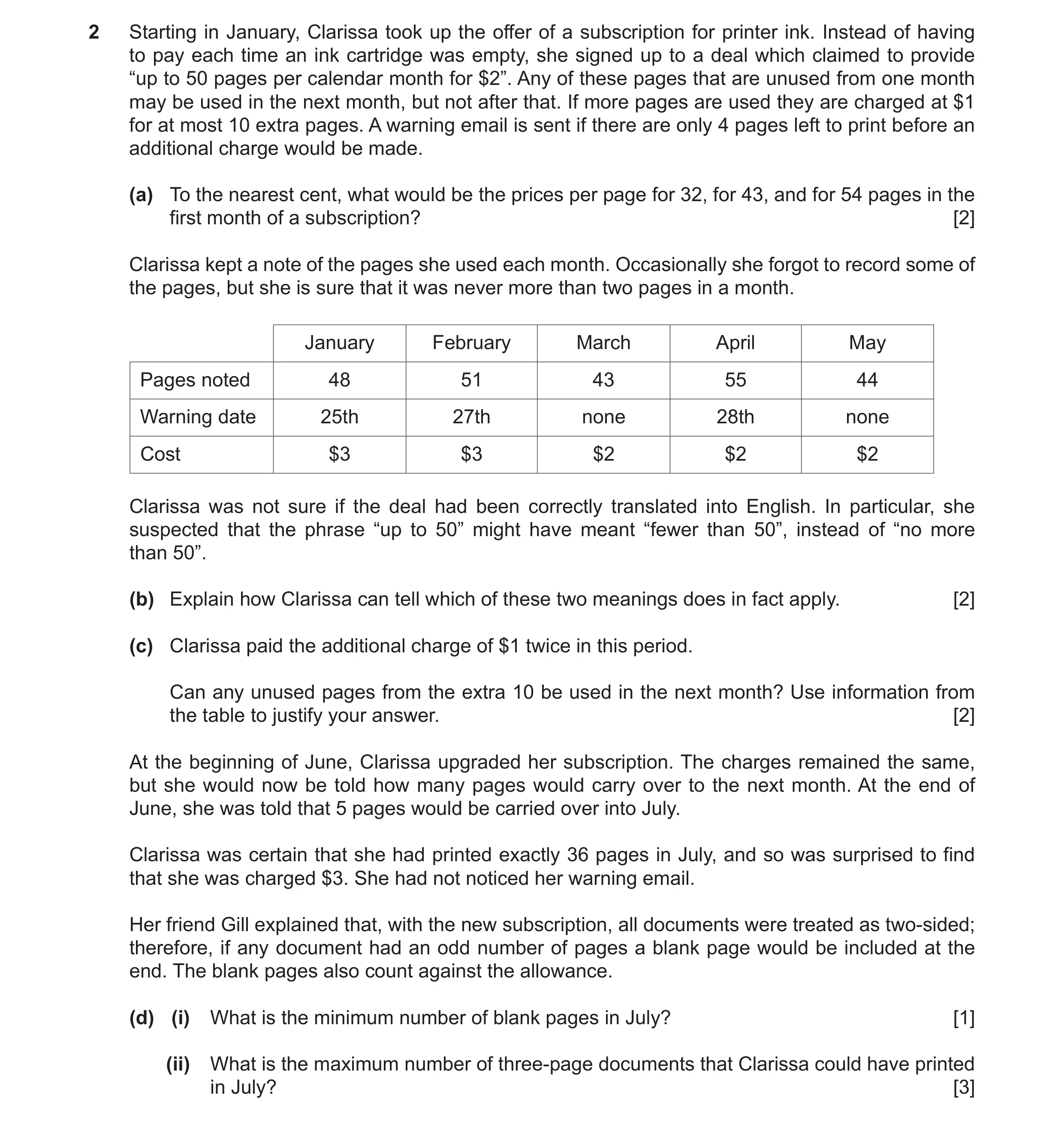
2 Starting in January, Clarissa took up the offer of a subscription for printer ink. Instead of having to pay each time an ink cartridge was empty, she signed up to a deal which claimed to provide “up to 50 pages per calendar month for $2”. Any of these pages that are unused from one month may be used in the next month, but not after that. If more pages are used they are charged at $1 for at most 10 extra pages. A warning email is sent if there are only 4 pages left to print before an additional charge would be made. (a) To the nearest cent, what would be the prices per page for 32, for 43, and for 54 pages in the first month of a subscription? [2] Clarissa kept a note of the pages she used each month. Occasionally she forgot to record some of the pages, but she is sure that it was never more than two pages in a month. January February March April May Pages noted 48 51 43 55 44 Warning date 25th 27th none 28th none Cost $3 $3 $2 $2 $2 Clarissa was not sure if the deal had been correctly translated into English. In particular, she suspected that the phrase “up to 50” might have meant “fewer than 50”, instead of “no more than 50”. (b) Explain how Clarissa can tell which of these two meanings does in fact apply. [2] (c) Clarissa paid the additional charge of $1 twice in this period. Can any unused pages from the extra 10 be used in the next month? Use information from the table to justify your answer. [2] At the beginning of June, Clarissa upgraded her subscription. The charges remained the same, but she would now be told how many pages would carry over to the next month. At the end of June, she was told that 5 pages would be carried over into July. Clarissa was certain that she had printed exactly 36 pages in July, and so was surprised to find that she was charged $3. She had not noticed her warning email. Her friend Gill explained that, with the new subscription, all documents were treated as two-sided; therefore, if any document had an odd number of pages a blank page would be included at the end. The blank pages also count against the allowance. (d) (i) What is the minimum number of blank pages in July? [1] (ii) What is the maximum number of three-page documents that Clarissa could have printed in July? [3]
10 marks
Mark scheme: 2(a) 200/32 = 6.25 = 6 2 200/43 = 4.65 = 5 300/54 = 5.56 = 6 Award 1 mark for any two correct answers, or for three correct numbers but not rounded, as demanded. SC: 1 mark for 6, 4, 5 (all answers truncated) 2(b) She is charged $3 for January, so must have gone over the limit. [1] 2 (The most) she could have in January is 48 + 2 = 50. So it must be “fewer than 50”. [1] 2(c) She had (9) spare from January [1], but was still charged the extra dollar in 2 February (when she could not have used up the extra pages gained from January), so no (the unused pages from the extra 10 cannot be used in the next month.) [1] Correct judgment required for 2 marks. 2(d)(i) At least 49 + 5 + 1 = 55 paid for. Thus at least 55 – 36 = 19 blanks paid for. 1 ft from ‘no more than 50’ in (b): 20 2(d)(ii) If all 36 pages were from 3-page documents, there would be 12 blanks with 3 a total of 48. Changing a 3-page document into three 1-page documents generates (2) further pages, which are blank. 7 more pages are needed to reach 55; this is four 3-page documents being changed into 1-page documents. 12 – 4 = 8 Any recognition that the optimal solution will involve odd pages coming from only 3 page documents and 1 page documents [1]. Feasible number of 3 page documents and 1 page documents from shaded rows of table below [1]. 3 page docs 1 page docs Printed pages Paid for pages Comment 12 0 36 48 <55 so no $3 charge 11 3 36 44+6 <55 so no $3 charge 10 6 36 40+12 <55 so no $3 charge 9 9 36 36+18 <55 so no $3 charge 8 12 36 32+24 56 pages so $3 charge 7 15 36 28+30 58 pages so $3 charge 6 18 36 24+36 60 pages so $3 charge 5 21 36 20+42 62 pages so $3 charge 4 24 36 16+48 64 pages so $3 charge 3 27 36 12+54 >5+49+10 so not possible
This question in 9694/31 May/June 2018
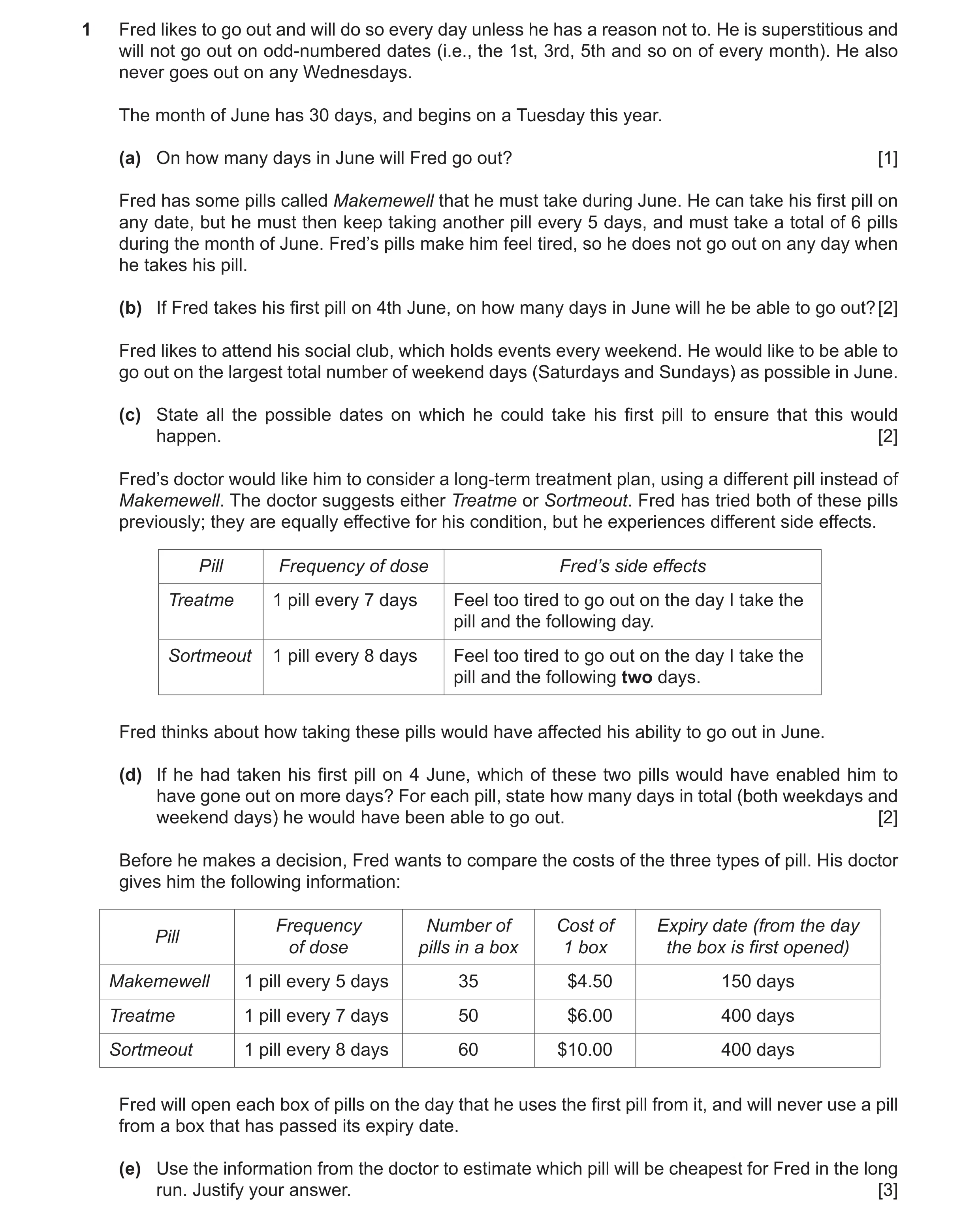
Q6 · Fred likes to go out and will do so every day unless he has a reason not to 9694/31 Oct/Nov 2018
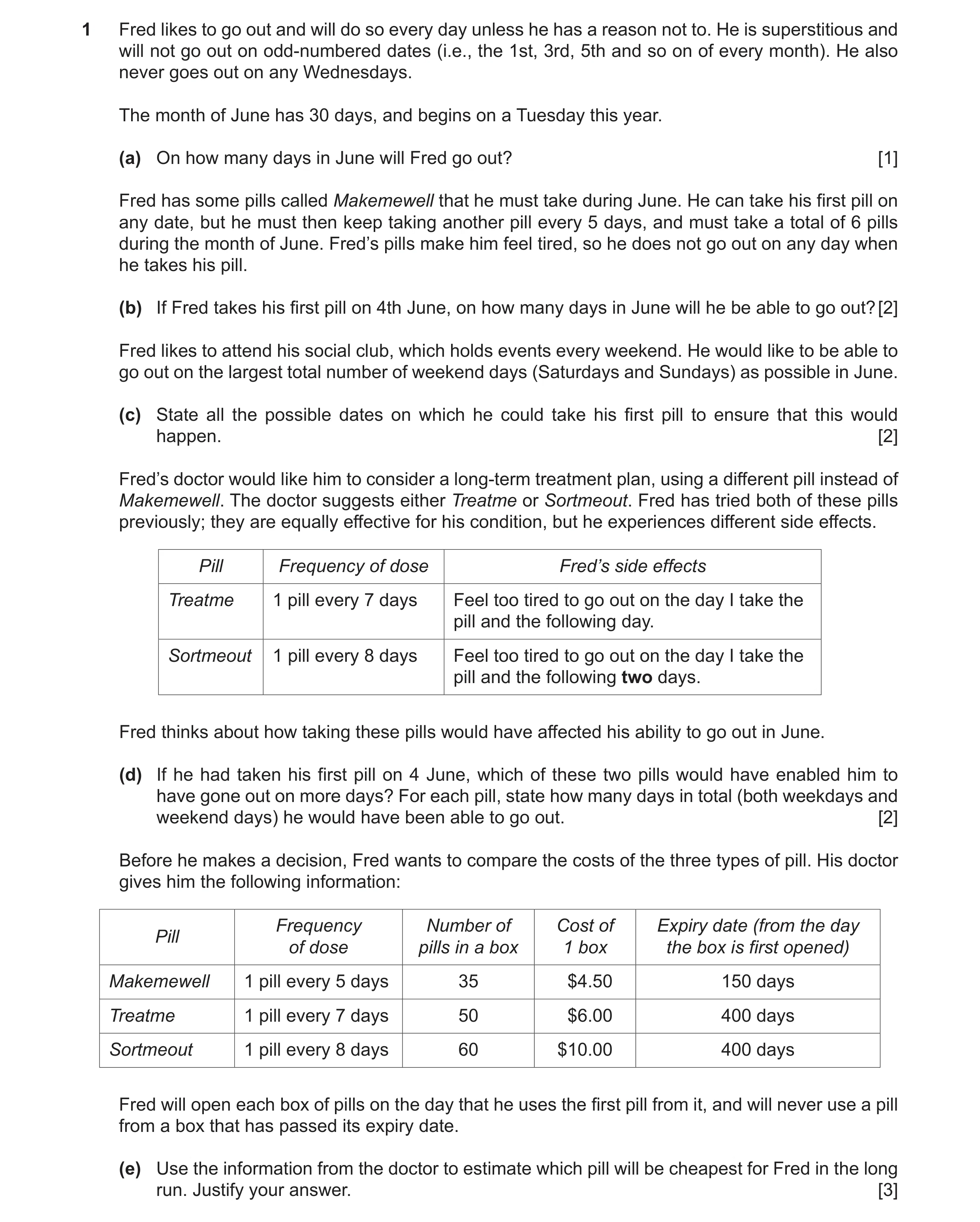
1 Fred likes to go out and will do so every day unless he has a reason not to. He is superstitious and will not go out on odd-numbered dates (i.e., the 1st, 3rd, 5th and so on of every month). He also never goes out on any Wednesdays. The month of June has 30 days, and begins on a Tuesday this year. (a) On how many days in June will Fred go out? [1] Fred has some pills called Makemewell that he must take during June. He can take his first pill on any date, but he must then keep taking another pill every 5 days, and must take a total of 6 pills during the month of June. Fred’s pills make him feel tired, so he does not go out on any day when he takes his pill. (b) If Fred takes his first pill on 4th June, on how many days in June will he be able to go out? [2] Fred likes to attend his social club, which holds events every weekend. He would like to be able to go out on the largest total number of weekend days (Saturdays and Sundays) as possible in June. (c) State all the possible dates on which he could take his first pill to ensure that this would happen. [2] Fred’s doctor would like him to consider a long-term treatment plan, using a different pill instead of Makemewell. The doctor suggests either Treatme or Sortmeout. Fred has tried both of these pills previously; they are equally effective for his condition, but he experiences different side effects. Pill Frequency of dose Fred’s side effects Treatme 1 pill every 7 days Feel too tired to go out on the day I take the pill and the following day. Sortmeout 1 pill every 8 days Feel too tired to go out on the day I take the pill and the following two days. Fred thinks about how taking these pills would have affected his ability to go out in June. (d) If he had taken his first pill on 4 June, which of these two pills would have enabled him to have gone out on more days? For each pill, state how many days in total (both weekdays and weekend days) he would have been able to go out. [2] Before he makes a decision, Fred wants to compare the costs of the three types of pill. His doctor gives him the following information: Frequency Number of Cost of Expiry date (from the day Pill of dose pills in a box 1 box the box is first opened) Makemewell 1 pill every 5 days 35 $4.50 150 days Treatme 1 pill every 7 days 50 $6.00 400 days Sortmeout 1 pill every 8 days 60 $10.00 400 days Fred will open each box of pills on the day that he uses the first pill from it, and will never use a pill from a box that has passed its expiry date. (e) Use the information from the doctor to estimate which pill will be cheapest for Fred in the long run. Justify your answer. [3]
10 marks
Mark scheme: Question Answer Marks 1(a) 12 days (4th, 6th, 8th, 10th, 12th, 14th, 18th, 20th, 22nd, 24th, 26th, 28th) 1 1(b) 9 days (6th, 8th, 10th, 12th, 18th, 20th, 22nd, 26th, 28th) 2 Award 1 mark for 8 or 10 or 3 less than their (a) OR a list of six dates on which Fred takes a pill (4th, 9th, 14th, 19th, 24th, 29th ) OR 21 days (complement of correct answer) 1(c) He should begin taking his pill on either Thursday 3rd June or Friday 4th 2 June, allowing him to go out on 4 weekend days, which is the maximum possible. Award 1 mark for either of these days OR for clear indication that 4 weekend days.(6th, 12th, 20th, 26th ) is the limit 1(d) Treatme: 8 days. 2 Sortmeout: 5 days So Treatme would allow more days. 1 mark for T = 8 OR S = 5. 1(e) He will not finish a box of Makemewell, as this would take him roughly 175 3 days and they expire after 150. He will not finish a box of Sortmeout, as this would take him roughly 480 days and they expire after 400. So these will cost $0.03 per day and $0.025 per day / 33 days per $ and 40 days per $ respectively. For Treatme to be cheaper than Sortmeout, a box must last him at least (approximately) 240 days; which it easily does. (Treatme provides 58 days per dollar / $0.0174« dollars per day, so is easily cheaper than Sortmeout.) So Treatme will be cheapest. 1 mark for correctly dealing with at least two expiry dates, e.g. 30/50/50 pills useable or 150/350/400 days 1 mark for correctly calculating an appropriate rate of cost per day for any pill or reciprocal OR calculating the cost of an arbitrary time period 400days+ [M] 150 days@$4.50 : 0.033$pd : 33dp$ [T] 350 days@$6 : 0.017$pd : 58dp$ [S] 400 days@$10 : 0.025$pd : 40dp$ 1 mark for justification based on relevant rates that T will be cheaper than S.
This question in 9694/31 Oct/Nov 2018
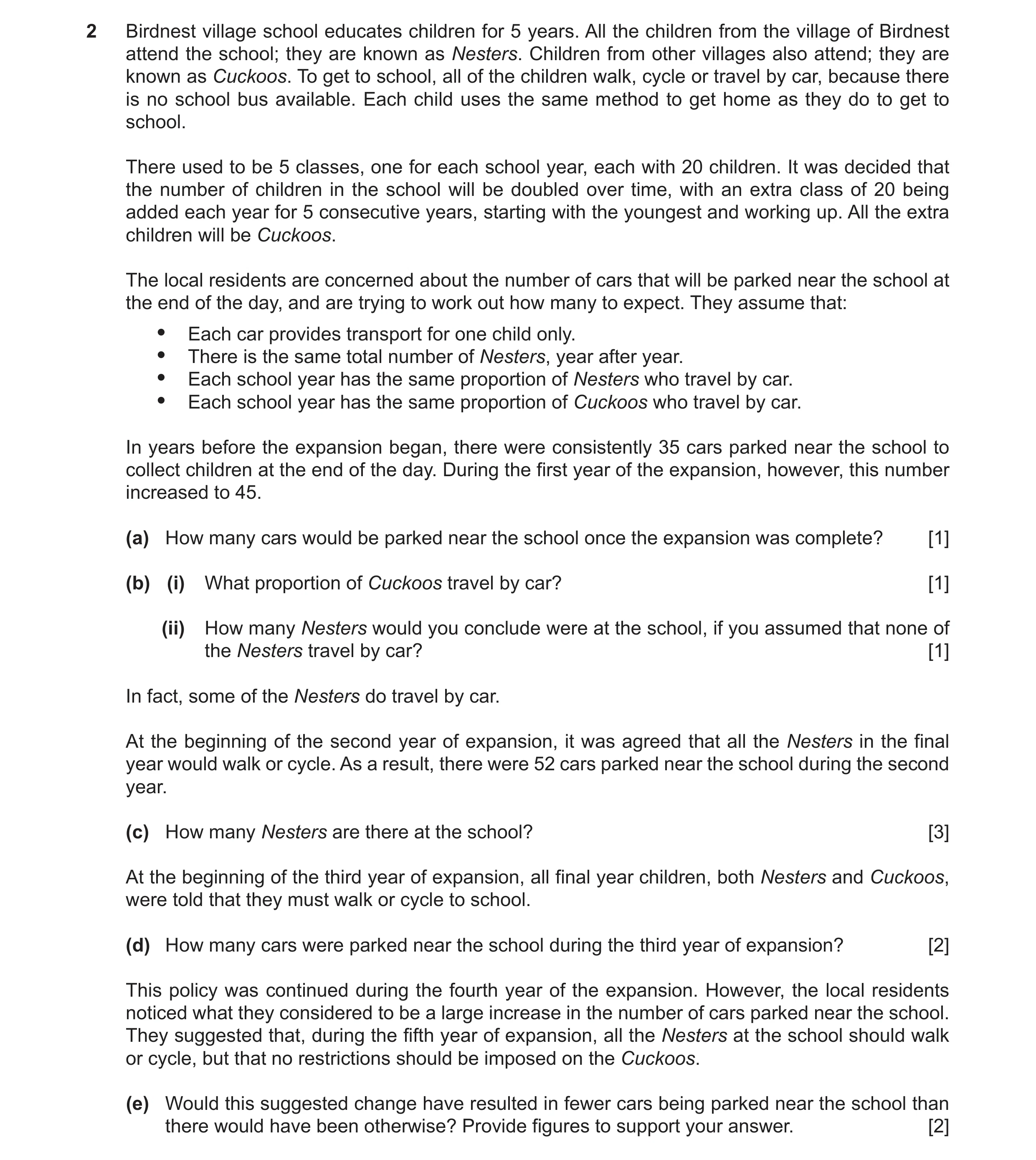
Q7 · Birdnest village school educates children for 5 years 9694/31 Oct/Nov 2018
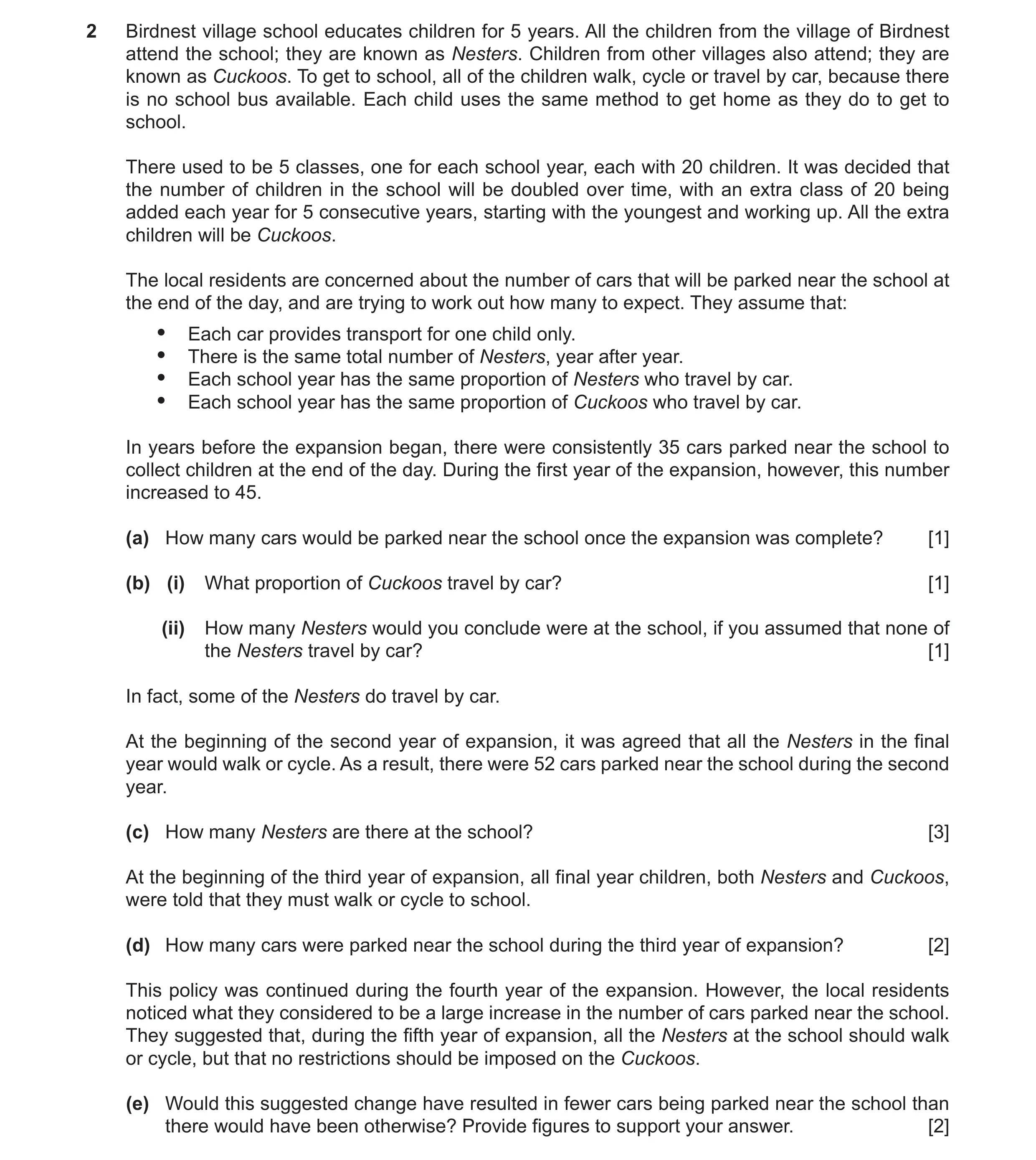
2 Birdnest village school educates children for 5 years. All the children from the village of Birdnest attend the school; they are known as Nesters. Children from other villages also attend; they are known as Cuckoos. To get to school, all of the children walk, cycle or travel by car, because there is no school bus available. Each child uses the same method to get home as they do to get to school. There used to be 5 classes, one for each school year, each with 20 children. It was decided that the number of children in the school will be doubled over time, with an extra class of 20 being added each year for 5 consecutive years, starting with the youngest and working up. All the extra children will be Cuckoos. The local residents are concerned about the number of cars that will be parked near the school at the end of the day, and are trying to work out how many to expect. They assume that: • Each car provides transport for one child only. • There is the same total number of Nesters, year after year. • Each school year has the same proportion of Nesters who travel by car. • Each school year has the same proportion of Cuckoos who travel by car. In years before the expansion began, there were consistently 35 cars parked near the school to collect children at the end of the day. During the first year of the expansion, however, this number increased to 45. (a) How many cars would be parked near the school once the expansion was complete? [1] (b) (i) What proportion of Cuckoos travel by car? [1] (ii) How many Nesters would you conclude were at the school, if you assumed that none of the Nesters travel by car? [1] In fact, some of the Nesters do travel by car. At the beginning of the second year of expansion, it was agreed that all the Nesters in the final year would walk or cycle. As a result, there were 52 cars parked near the school during the second year. (c) How many Nesters are there at the school? [3] At the beginning of the third year of expansion, all final year children, both Nesters and Cuckoos, were told that they must walk or cycle to school. (d) How many cars were parked near the school during the third year of expansion? [2] This policy was continued during the fourth year of the expansion. However, the local residents noticed what they considered to be a large increase in the number of cars parked near the school. They suggested that, during the fifth year of expansion, all the Nesters at the school should walk or cycle, but that no restrictions should be imposed on the Cuckoos. (e) Would this suggested change have resulted in fewer cars being parked near the school than there would have been otherwise? Provide figures to support your answer. [2]
10 marks
Mark scheme: 2(a) An increase of 10 each year would result in a total of 35 + 5 × 10 = 85. 1 2(b)(i) An extra 20 Cuckoos resulted in an extra 10 cars, so 50%. 1 2(b)(ii) If all 35 cars in year zero are from Cuckoos, there are 70 Cuckoos before 1 the expansion. Thus there would be 5 × 20 – 70 = 30. 2(c) Stopping fourth year children resulted in 55 – 52 = 3 fewer cars than with no 3 change, so 3 fifth year Nesters no longer coming by car. [1] This means there were originally 15 Nesters coming by car and 20 outsiders. [1] Hence Cuckoos were 40 of the children. The remaining 60 would be Nesters. [1] 2(d) Half of Cuckoos and quarter of Nesters come by car, but only those not in 2 the last year. The expansion of Cuckoos hasn’t reached the final year yet, so 32 + 60 Cuckoos not in last year. 12 + 46 = 58 1 mark for first step of method: number of Nesters (48) OR Cuckoos (92) not in final year OR 1 mark for method to find number of cars used by those in their final year (N/4 + C/2) SC: 1 mark for 62 (= 12 + 50), ignoring proportion of Cuckoos in last school year Alternatively: There would be 10 extra cars, but 4 final year Cuckoos no longer drive, so 52 + 6 = 58 2(e) There would be 68 cars in both the fourth and fifth year (since the 20 2 Cuckoos from the first year would now reach their last year.) But, if any Cuckoos could come by car, half of the 140, i.e. 70 would, so this is not fewer. 1 mark for 68 or 70 seen. Year of 0 1 2 3 4 5 expansion Nesters 60 60 60 60 60 60 Cuckoos 40 60 80 100 120 140 Cuckoos not in 32 52 72 92 112 112 final year Nesters by car 15 15 12 12 12 12 Cuckoos by 20 30 40 46 56 56 car Total cars 35 45 52 58 68 68
This question in 9694/31 Oct/Nov 2018
Q8 · The Järnvägar Railway Company wants to build a level line between Vänster and Höger 9694/32 Oct/Nov 2018
3 The Järnvägar Railway Company wants to build a level line between Vänster and Höger. In some places the land is higher than the required level and so the rock will have to be cut away to form a ‘cutting’. In other places the land is lower and will need rock to build up an ‘embankment’. The planners intend to use rock from the cuttings to provide the rock for the embankments. Any excess rock that is not needed will be discarded by putting it where there is an embankment, making it wider than necessary; but they will not make the cuttings wider than required. They have produced a model that splits the route into 13 sections of equal length. The amount of rock that needs to be cut or built up in each section is represented by a discrete number of blocks, as shown below. The end sections VU and JH are in the towns; these sections cannot be used for discarding excess rock, but blocks can be stored there temporarily. V U T S R Q P O N M L K J H 0 2 2 –1 –2 –3 2 2 2 –2 1 1 0 4 2 0 –2 –4 (a) How many more blocks than they need are there? [1] The original plan was to build from one end, using the partially-completed railway to move blocks around. For example, if they started at Vänster, they could: • build the railway in VU • move the 2 blocks from UT to VU for temporary storage and build the railway in UT • move the 2 blocks from TS to UT for temporary storage and build the railway in TS • move 1 block from UT to make the embankment for SR and build the railway in SR The planners write these movements using the following notation: V U T S R Q P O N M L K J H 0 2 2 –1 –2 –3 2 2 2 –2 1 1 0 2 0 2 UT → VU 2 0 2 TS → UT 1 0 1 UT → SR (b) (i) Explain why this method would not work from Vänster. [1] (ii) Explain how this method would work from Höger. [2] The planners realise that, if they started from one of the positions U to J, it would be possible to complete the railway without needing to store any blocks temporarily. (c) (i) Which position is it? [1] (ii) Using the planners’ notation, show how it can be done. [3] It costs $1000 to move one block one sector. (d) Find the cost of your method in part (c). [1] The planners have been instructed to move the blocks in the cheapest way, so they decide to use trucks instead of the partially-completed railway: the cost is the same, but the trucks are not constrained to working on level ground where part of the railway has already been built. (e) Find a method that is as cheap as possible. Use the planners’ notation to show your solution. [4] The planners consider selling the excess rock to the construction industry in the two towns. They will move the rock to VU and/or JH where it will be sold for $350 per block. (f) By how much will this reduce the overall cost of building the railway? [2]
15 marks
This question in 9694/32 Oct/Nov 2018
Q9 · Fred likes to go out and will do so every day unless he has a reason not to 9694/33 Oct/Nov 2018
1 Fred likes to go out and will do so every day unless he has a reason not to. He is superstitious and will not go out on odd-numbered dates (i.e., the 1st, 3rd, 5th and so on of every month). He also never goes out on any Wednesdays. The month of June has 30 days, and begins on a Tuesday this year. (a) On how many days in June will Fred go out? [1] Fred has some pills called Makemewell that he must take during June. He can take his first pill on any date, but he must then keep taking another pill every 5 days, and must take a total of 6 pills during the month of June. Fred’s pills make him feel tired, so he does not go out on any day when he takes his pill. (b) If Fred takes his first pill on 4th June, on how many days in June will he be able to go out? [2] Fred likes to attend his social club, which holds events every weekend. He would like to be able to go out on the largest total number of weekend days (Saturdays and Sundays) as possible in June. (c) State all the possible dates on which he could take his first pill to ensure that this would happen. [2] Fred’s doctor would like him to consider a long-term treatment plan, using a different pill instead of Makemewell. The doctor suggests either Treatme or Sortmeout. Fred has tried both of these pills previously; they are equally effective for his condition, but he experiences different side effects. Pill Frequency of dose Fred’s side effects Treatme 1 pill every 7 days Feel too tired to go out on the day I take the pill and the following day. Sortmeout 1 pill every 8 days Feel too tired to go out on the day I take the pill and the following two days. Fred thinks about how taking these pills would have affected his ability to go out in June. (d) If he had taken his first pill on 4 June, which of these two pills would have enabled him to have gone out on more days? For each pill, state how many days in total (both weekdays and weekend days) he would have been able to go out. [2] Before he makes a decision, Fred wants to compare the costs of the three types of pill. His doctor gives him the following information: Frequency Number of Cost of Expiry date (from the day Pill of dose pills in a box 1 box the box is first opened) Makemewell 1 pill every 5 days 35 $4.50 150 days Treatme 1 pill every 7 days 50 $6.00 400 days Sortmeout 1 pill every 8 days 60 $10.00 400 days Fred will open each box of pills on the day that he uses the first pill from it, and will never use a pill from a box that has passed its expiry date. (e) Use the information from the doctor to estimate which pill will be cheapest for Fred in the long run. Justify your answer. [3]
10 marks
Mark scheme: Question Answer Marks 1(a) 12 days (4th, 6th, 8th, 10th, 12th, 14th, 18th, 20th, 22nd, 24th, 26th, 28th) 1 1(b) 9 days (6th, 8th, 10th, 12th, 18th, 20th, 22nd, 26th, 28th) 2 Award 1 mark for 8 or 10 or 3 less than their (a) OR a list of six dates on which Fred takes a pill (4th, 9th, 14th, 19th, 24th, 29th ) OR 21 days (complement of correct answer) 1(c) He should begin taking his pill on either Thursday 3rd June or Friday 4th 2 June, allowing him to go out on 4 weekend days, which is the maximum possible. Award 1 mark for either of these days OR for clear indication that 4 weekend days.(6th, 12th, 20th, 26th ) is the limit 1(d) Treatme: 8 days. 2 Sortmeout: 5 days So Treatme would allow more days. 1 mark for T = 8 OR S = 5. 1(e) He will not finish a box of Makemewell, as this would take him roughly 175 3 days and they expire after 150. He will not finish a box of Sortmeout, as this would take him roughly 480 days and they expire after 400. So these will cost $0.03 per day and $0.025 per day / 33 days per $ and 40 days per $ respectively. For Treatme to be cheaper than Sortmeout, a box must last him at least (approximately) 240 days; which it easily does. (Treatme provides 58 days per dollar / $0.0174« dollars per day, so is easily cheaper than Sortmeout.) So Treatme will be cheapest. 1 mark for correctly dealing with at least two expiry dates, e.g. 30/50/50 pills useable or 150/350/400 days 1 mark for correctly calculating an appropriate rate of cost per day for any pill or reciprocal OR calculating the cost of an arbitrary time period 400days+ [M] 150 days@$4.50 : 0.033$pd : 33dp$ [T] 350 days@$6 : 0.017$pd : 58dp$ [S] 400 days@$10 : 0.025$pd : 40dp$ 1 mark for justification based on relevant rates that T will be cheaper than S.
This question in 9694/33 Oct/Nov 2018
Q10 · Birdnest village school educates children for 5 years 9694/33 Oct/Nov 2018
2 Birdnest village school educates children for 5 years. All the children from the village of Birdnest attend the school; they are known as Nesters. Children from other villages also attend; they are known as Cuckoos. To get to school, all of the children walk, cycle or travel by car, because there is no school bus available. Each child uses the same method to get home as they do to get to school. There used to be 5 classes, one for each school year, each with 20 children. It was decided that the number of children in the school will be doubled over time, with an extra class of 20 being added each year for 5 consecutive years, starting with the youngest and working up. All the extra children will be Cuckoos. The local residents are concerned about the number of cars that will be parked near the school at the end of the day, and are trying to work out how many to expect. They assume that: • Each car provides transport for one child only. • There is the same total number of Nesters, year after year. • Each school year has the same proportion of Nesters who travel by car. • Each school year has the same proportion of Cuckoos who travel by car. In years before the expansion began, there were consistently 35 cars parked near the school to collect children at the end of the day. During the first year of the expansion, however, this number increased to 45. (a) How many cars would be parked near the school once the expansion was complete? [1] (b) (i) What proportion of Cuckoos travel by car? [1] (ii) How many Nesters would you conclude were at the school, if you assumed that none of the Nesters travel by car? [1] In fact, some of the Nesters do travel by car. At the beginning of the second year of expansion, it was agreed that all the Nesters in the final year would walk or cycle. As a result, there were 52 cars parked near the school during the second year. (c) How many Nesters are there at the school? [3] At the beginning of the third year of expansion, all final year children, both Nesters and Cuckoos, were told that they must walk or cycle to school. (d) How many cars were parked near the school during the third year of expansion? [2] This policy was continued during the fourth year of the expansion. However, the local residents noticed what they considered to be a large increase in the number of cars parked near the school. They suggested that, during the fifth year of expansion, all the Nesters at the school should walk or cycle, but that no restrictions should be imposed on the Cuckoos. (e) Would this suggested change have resulted in fewer cars being parked near the school than there would have been otherwise? Provide figures to support your answer. [2]
10 marks
Mark scheme: 2(a) An increase of 10 each year would result in a total of 35 + 5 × 10 = 85. 1 2(b)(i) An extra 20 Cuckoos resulted in an extra 10 cars, so 50%. 1 2(b)(ii) If all 35 cars in year zero are from Cuckoos, there are 70 Cuckoos before 1 the expansion. Thus there would be 5 × 20 – 70 = 30. 2(c) Stopping fourth year children resulted in 55 – 52 = 3 fewer cars than with no 3 change, so 3 fifth year Nesters no longer coming by car. [1] This means there were originally 15 Nesters coming by car and 20 outsiders. [1] Hence Cuckoos were 40 of the children. The remaining 60 would be Nesters. [1] 2(d) Half of Cuckoos and quarter of Nesters come by car, but only those not in 2 the last year. The expansion of Cuckoos hasn’t reached the final year yet, so 32 + 60 Cuckoos not in last year. 12 + 46 = 58 1 mark for first step of method: number of Nesters (48) OR Cuckoos (92) not in final year OR 1 mark for method to find number of cars used by those in their final year (N/4 + C/2) SC: 1 mark for 62 (= 12 + 50), ignoring proportion of Cuckoos in last school year Alternatively: There would be 10 extra cars, but 4 final year Cuckoos no longer drive, so 52 + 6 = 58 2(e) There would be 68 cars in both the fourth and fifth year (since the 20 2 Cuckoos from the first year would now reach their last year.) But, if any Cuckoos could come by car, half of the 140, i.e. 70 would, so this is not fewer. 1 mark for 68 or 70 seen. Year of 0 1 2 3 4 5 expansion Nesters 60 60 60 60 60 60 Cuckoos 40 60 80 100 120 140 Cuckoos not in 32 52 72 92 112 112 final year Nesters by car 15 15 12 12 12 12 Cuckoos by 20 30 40 46 56 56 car Total cars 35 45 52 58 68 68
This question in 9694/33 Oct/Nov 2018
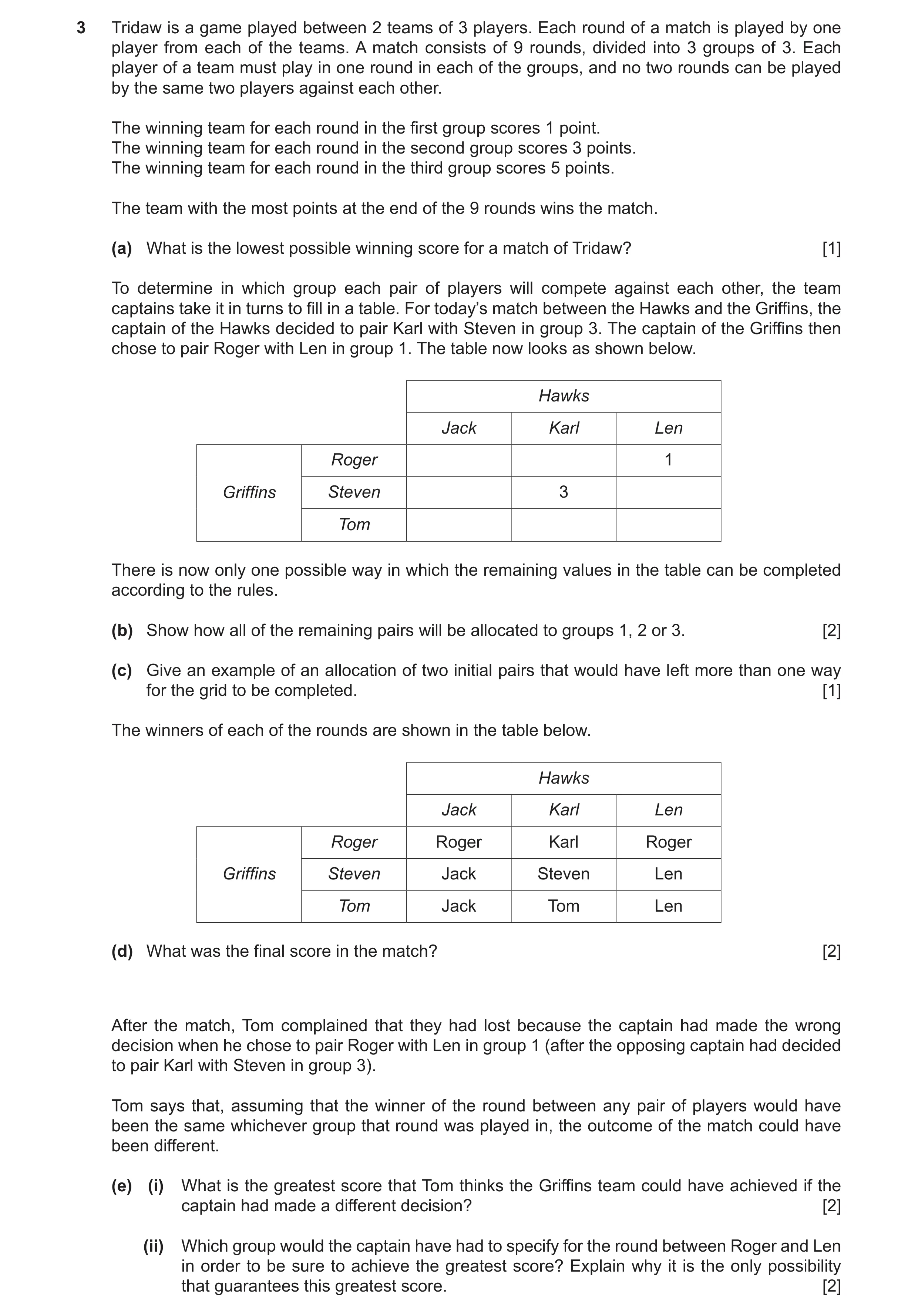
Q11 · Tridaw is a game played between 2 teams of 3 players 9694/32 May/June 2020
3 Tridaw is a game played between 2 teams of 3 players. Each round of a match is played by one player from each of the teams. A match consists of 9 rounds, divided into 3 groups of 3. Each player of a team must play in one round in each of the groups, and no two rounds can be played by the same two players against each other. The winning team for each round in the first group scores 1 point. The winning team for each round in the second group scores 3 points. The winning team for each round in the third group scores 5 points. The team with the most points at the end of the 9 rounds wins the match. (a) What is the lowest possible winning score for a match of Tridaw? [1] To determine in which group each pair of players will compete against each other, the team captains take it in turns to fill in a table. For today’s match between the Hawks and the Griffins, the captain of the Hawks decided to pair Karl with Steven in group 3. The captain of the Griffins then chose to pair Roger with Len in group 1. The table now looks as shown below. Hawks Jack Karl Len Roger 1 Griffins Steven 3 Tom There is now only one possible way in which the remaining values in the table can be completed according to the rules. (b) Show how all of the remaining pairs will be allocated to groups 1, 2 or 3. [2] (c) Give an example of an allocation of two initial pairs that would have left more than one way for the grid to be completed. [1] The winners of each of the rounds are shown in the table below. Hawks Jack Karl Len Roger Roger Karl Roger Griffins Steven Jack Steven Len Tom Jack Tom Len (d) What was the final score in the match? [2] After the match, Tom complained that they had lost because the captain had made the wrong decision when he chose to pair Roger with Len in group 1 (after the opposing captain had decided to pair Karl with Steven in group 3). Tom says that, assuming that the winner of the round between any pair of players would have been the same whichever group that round was played in, the outcome of the match could have been different. (e) (i) What is the greatest score that Tom thinks the Griffins team could have achieved if the captain had made a different decision? [2] (ii) Which group would the captain have had to specify for the round between Roger and Len in order to be sure to achieve the greatest score? Explain why it is the only possibility that guarantees this greatest score. [2]
10 marks
Mark scheme: 3(a) There is a total of 3 × 1 + 3 × 3 + 3 × 5 = 27 points available, so the winning 1 team must score at least 14. 3(b) 3 2 1 2 1 3 2 2 1 3 1 mark for a completed grid in which there are no repetitions in any row OR no repetitions in any column. 3(c) Any example that is either two allocations to the same group or two 1 allocations in the same row or column. 3(d) Griffins: 2×1 + 2×5 = 12 points. [1] 2 Hawks: 1×1 + 3×3 + 1×5 = 15 points. [1] SC: 1 mark for 12 and 15 with no indication of teams. 3(e)(i) 16 2 1 mark for evidence of different decision leading to Roger scoring 8 points instead of 6 OR Tom scoring 3 points instead of 1. 3(e)(ii) Specifying group 2 would force all the remaining rounds to be as required / If 2 the captain of the Griffins had specified group 3 for this round then the remaining rounds would not have been determined [1] and so the other captain’s selection might have put the other Griffin wins into group 1 rather than group 2 (giving the Griffins a score of 12). [1]
This question in 9694/32 May/June 2020
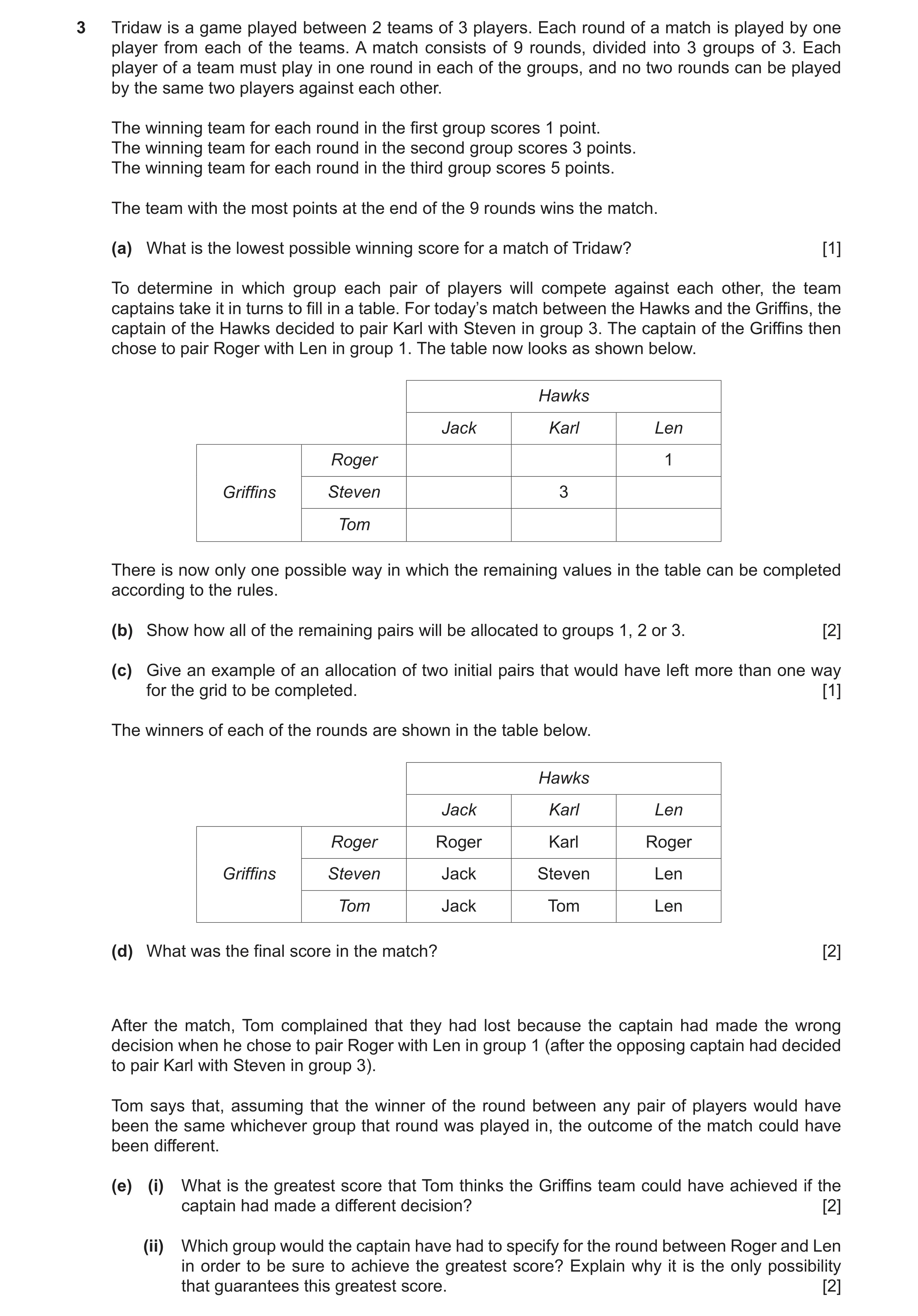
Q12 · Tridaw is a game played between 2 teams of 3 players 9694/33 May/June 2020
3 Tridaw is a game played between 2 teams of 3 players. Each round of a match is played by one player from each of the teams. A match consists of 9 rounds, divided into 3 groups of 3. Each player of a team must play in one round in each of the groups, and no two rounds can be played by the same two players against each other. The winning team for each round in the first group scores 1 point. The winning team for each round in the second group scores 3 points. The winning team for each round in the third group scores 5 points. The team with the most points at the end of the 9 rounds wins the match. (a) What is the lowest possible winning score for a match of Tridaw? [1] To determine in which group each pair of players will compete against each other, the team captains take it in turns to fill in a table. For today’s match between the Hawks and the Griffins, the captain of the Hawks decided to pair Karl with Steven in group 3. The captain of the Griffins then chose to pair Roger with Len in group 1. The table now looks as shown below. Hawks Jack Karl Len Roger 1 Griffins Steven 3 Tom There is now only one possible way in which the remaining values in the table can be completed according to the rules. (b) Show how all of the remaining pairs will be allocated to groups 1, 2 or 3. [2] (c) Give an example of an allocation of two initial pairs that would have left more than one way for the grid to be completed. [1] The winners of each of the rounds are shown in the table below. Hawks Jack Karl Len Roger Roger Karl Roger Griffins Steven Jack Steven Len Tom Jack Tom Len (d) What was the final score in the match? [2] After the match, Tom complained that they had lost because the captain had made the wrong decision when he chose to pair Roger with Len in group 1 (after the opposing captain had decided to pair Karl with Steven in group 3). Tom says that, assuming that the winner of the round between any pair of players would have been the same whichever group that round was played in, the outcome of the match could have been different. (e) (i) What is the greatest score that Tom thinks the Griffins team could have achieved if the captain had made a different decision? [2] (ii) Which group would the captain have had to specify for the round between Roger and Len in order to be sure to achieve the greatest score? Explain why it is the only possibility that guarantees this greatest score. [2]
10 marks
Mark scheme: 3(a) There is a total of 3 × 1 + 3 × 3 + 3 × 5 = 27 points available, so the winning 1 team must score at least 14. 3(b) 3 2 1 2 1 3 2 2 1 3 1 mark for a completed grid in which there are no repetitions in any row OR no repetitions in any column. 3(c) Any example that is either two allocations to the same group or two 1 allocations in the same row or column. 3(d) Griffins: 2×1 + 2×5 = 12 points. [1] 2 Hawks: 1×1 + 3×3 + 1×5 = 15 points. [1] SC: 1 mark for 12 and 15 with no indication of teams. 3(e)(i) 16 2 1 mark for evidence of different decision leading to Roger scoring 8 points instead of 6 OR Tom scoring 3 points instead of 1. 3(e)(ii) Specifying group 2 would force all the remaining rounds to be as required / If 2 the captain of the Griffins had specified group 3 for this round then the remaining rounds would not have been determined [1] and so the other captain’s selection might have put the other Griffin wins into group 1 rather than group 2 (giving the Griffins a score of 12). [1]
This question in 9694/33 May/June 2020
Q13 · OrienT-8 is a single-player game, played on a 10 × 10 grid displayed on the touch screen… 9694/31 May/June 2023
1 OrienT-8 is a single-player game, played on a 10 × 10 grid displayed on the touch screen of an electronic device. The game consists of five rounds. In each round the grid contains eight T-shapes, each occupying four squares. • In round one, four are revealed at the start and the player has to find the other four. • In round two, three are revealed at the start and the player has to find the other five. • In round three, two are revealed at the start and the player has to find the other six. • In round four, one is revealed at the start and the player has to find the other seven. • In round five, none are revealed at the start and the player has to find all eight. At no time do two T-shapes ever touch, either edge to edge or corner to corner. In every round: • When a square is touched, either a tick (ü) appears in the square, indicating that part of a T-shape occupies the square, or a cross (X) appears. Each tick scores 2 points, whereas each cross deducts 1 point from the player’s score. • Immediately after a tick appears that completes a T-shape, all four squares turn black and a bonus of 2 points is added to the score. • The round ends when all eight T-shapes have been revealed or when twelve crosses have appeared, whichever occurs first. No points are scored for T-shapes already displayed at the start of any round. Tom is playing a game of OrienT-8. This is the current situation part way through round three. 91 92 93 94 95 96 97 98 X 81 82 84 85 86 X X 71 75 76 ü 78 79 61 X 63 64 65 66 ü 68 69 70 X 52 53 54 55 56 57 58 59 60 41 42 43 44 45 X 47 32 33 34 35 37 38 40 23 24 28 29 30 12 13 14 15 X 17 18 19 20 1 2 3 4 5 6 7 8 9 10 The squares have been numbered to help identify positions on the grid. For instance the T-shape in the top right corner can be described as 80-89-90-100. Tom has completed both of the first two rounds without any crosses appearing at all. He knows that he can complete this round without any further crosses and he is hopeful that he can beat his previous best total score of 273. (a) How many squares has Tom touched so far this round? [2] (b) What is Tom’s total score at present? [2] (c) What evidence is there that 11-21-22-31 and 39-48-49-50 are the two T-shapes that were revealed at the start of round three? [1] (d) Give the numbers of the ten squares that Tom will touch to complete the last three T-shapes in this round. [3] (e) In order to register a new personal best score, what is the maximum number of crosses that can be revealed altogether in the last two rounds? [2]
10 marks
Mark scheme: Question Answer Marks 1(a) 21 2 1 mark for sight of 12 (black squares not already revealed at the start of the round) or 9 (crosses + ticks) SC 1 mark for answer of 57 1(b) 117 2 1 mark for sight of 90 (score at the end of round two) OR 27 (score so far in this round) OR 93 seen (forgets bonus points) 1(c) There are no crosses in squares next to either of these two T-shapes 1 / there are crosses in squares next to each of the other (three) T-shapes. 1(d) 66 and 68 [1] 3 8, 9, 10 and 19 [1] 43, 52, 53 and 54 [1] 1(e) 117 points so far and will score a further 26 in round three = 143 points [1] 2 so 131 needed . ft their 117 + 26 for 143 There are a total of 70 + 80 = 150 points available for the last two rounds so he can afford 19 crosses maximum. Alternatively Tom’s maximum possible game score is 293 ft their 117 + 176 A maximum of 26 crosses allows a score of 274 1 mark for either He has already revealed 7 so can afford 19 more. SC 1 mark for answer of 20
This question in 9694/31 May/June 2023
Q14 · A ‘three-legged race’ is a running event in which pairs of participants compete with the… 9694/31 May/June 2023
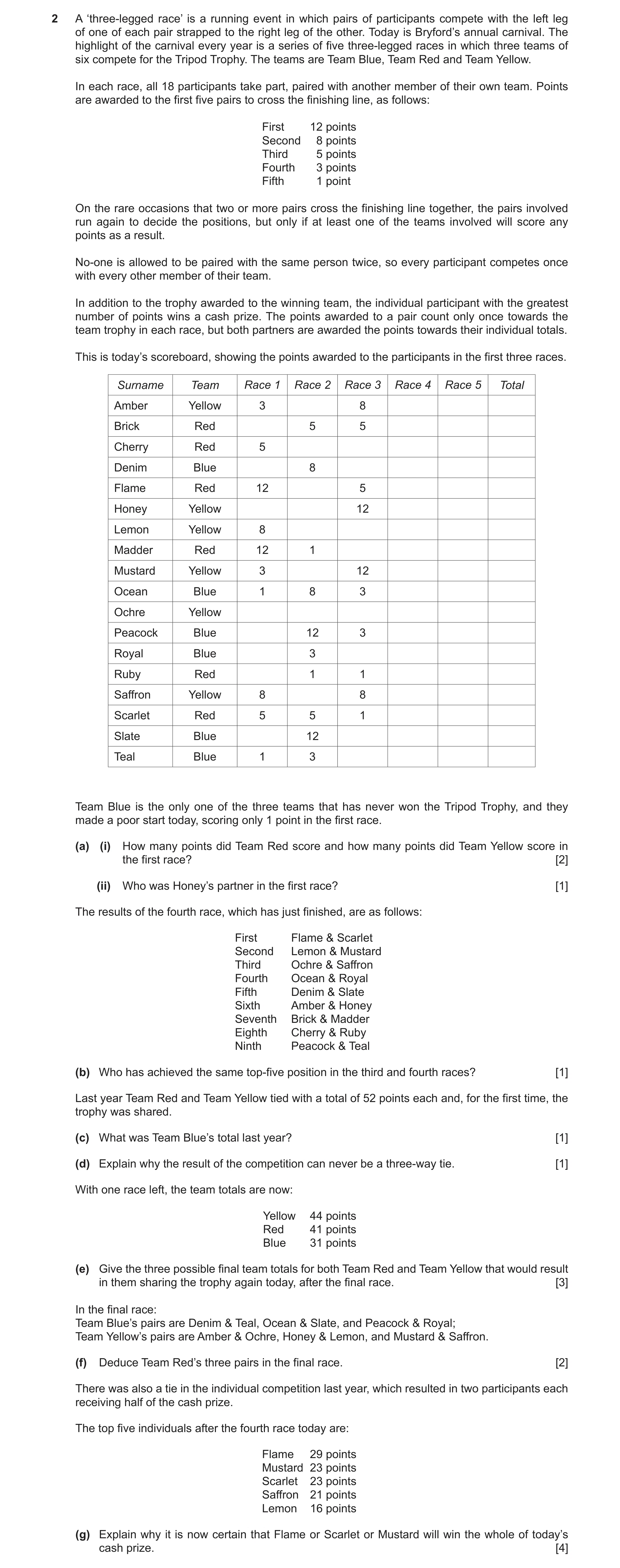
2 A ‘three-legged race’ is a running event in which pairs of participants compete with the left leg of one of each pair strapped to the right leg of the other. Today is Bryford’s annual carnival. The highlight of the carnival every year is a series of five three-legged races in which three teams of six compete for the Tripod Trophy. The teams are Team Blue, Team Red and Team Yellow. In each race, all 18 participants take part, paired with another member of their own team. Points are awarded to the first five pairs to cross the finishing line, as follows: First 12 points Second 8 points Third 5 points Fourth 3 points Fifth 1 point On the rare occasions that two or more pairs cross the finishing line together, the pairs involved run again to decide the positions, but only if at least one of the teams involved will score any points as a result. No-one is allowed to be paired with the same person twice, so every participant competes once with every other member of their team. In addition to the trophy awarded to the winning team, the individual participant with the greatest number of points wins a cash prize. The points awarded to a pair count only once towards the team trophy in each race, but both partners are awarded the points towards their individual totals. This is today’s scoreboard, showing the points awarded to the participants in the first three races. Surname Team Race 1 Race 2 Race 3 Race 4 Race 5 Total Amber Yellow 3 8 Brick Red 5 5 Cherry Red 5 Denim Blue 8 Flame Red 12 5 Honey Yellow 12 Lemon Yellow 8 Madder Red 12 1 Mustard Yellow 3 12 Ocean Blue 1 8 3 Ochre Yellow Peacock Blue 12 3 Royal Blue 3 Ruby Red 1 1 Saffron Yellow 8 8 Scarlet Red 5 5 1 Slate Blue 12 Teal Blue 1 3 Team Blue is the only one of the three teams that has never won the Tripod Trophy, and they made a poor start today, scoring only 1 point in the first race. (a) (i) How many points did Team Red score and how many points did Team Yellow score in the first race? [2] (ii) Who was Honey’s partner in the first race? [1] The results of the fourth race, which has just finished, are as follows: First Flame & Scarlet Second Lemon & Mustard Third Ochre & Saffron Fourth Ocean & Royal Fifth Denim & Slate Sixth Amber & Honey Seventh Brick & Madder Eighth Cherry & Ruby Ninth Peacock & Teal (b) Who has achieved the same top-five position in the third and fourth races? [1] Last year Team Red and Team Yellow tied with a total of 52 points each and, for the first time, the trophy was shared. (c) What was Team Blue’s total last year? [1] (d) Explain why the result of the competition can never be a three-way tie. [1] With one race left, the team totals are now: Yellow 44 points Red 41 points Blue 31 points (e) Give the three possible final team totals for both Team Red and Team Yellow that would result in them sharing the trophy again today, after the final race. [3] In the final race: Team Blue’s pairs are Denim & Teal, Ocean & Slate, and Peacock & Royal; Team Yellow’s pairs are Amber & Ochre, Honey & Lemon, and Mustard & Saffron. (f) Deduce Team Red’s three pairs in the final race. [2] There was also a tie in the individual competition last year, which resulted in two participants each receiving half of the cash prize. The top five individuals after the fourth race today are: Flame 29 points Mustard 23 points Scarlet 23 points Saffron 21 points Lemon 16 points (g) Explain why it is now certain that Flame or Scarlet or Mustard will win the whole of today’s cash prize. [4]
15 marks
Mark scheme: 2(a)(i) Red: 17 (points) [1] 2 Yellow: 11 (points) [1] 1 mark for either of the following: (Red) 34 AND (Yellow) 22 11,17 without teams being identified 2(a)(ii) Ochre 1 2(b) Ocean 1 2(c) 41 (points) 1 2(d) The total number of (team) points (145) is not divisible by 3. 1 2(e) 49, 53 and 57 (points) 3 Award one mark for each correct total, max 2 if any incorrect. Award up to 2 marks for correct descriptions without totals calculated. Max 1 if 5 answers, 0 if more than 5. If 0 scored, award 1 mark for answer of just 47. 2(f) Brick & Cherry 2 Flame & Ruby Madder & Scarlet 1 mark for one or two correct pairs with no more than 3 pairs given. 1 mark for fully correct answer with another set of 3 given. 2(g) Only Flame, Scarlet and Mustard can achieve a winning score: 4 Lemon (and no-one below Lemon) can match (or surpass) Flame’s current score (of 29) [1] Mustard and Saffron are paired together, so Mustard will finish (2 points) ahead of Saffron [1] There will not be a tie for first place: There is no way for two peoples’ scores to differ by 6 points (so Flame cannot be tied with Mustard or Scarlett) [1] Mustard and Scarlett are not paired, so must score different numbers of points (unless they both score 0, in which case Flame will have a higher score. [1] Award 1 mark for an answer which notes both features of the explanation, but does not score either mark for one of the parts.
This question in 9694/31 May/June 2023
Q15 · A rural hospital is planning the staff and beds it will need during the forthcoming months 9694/31 Oct/Nov 2024
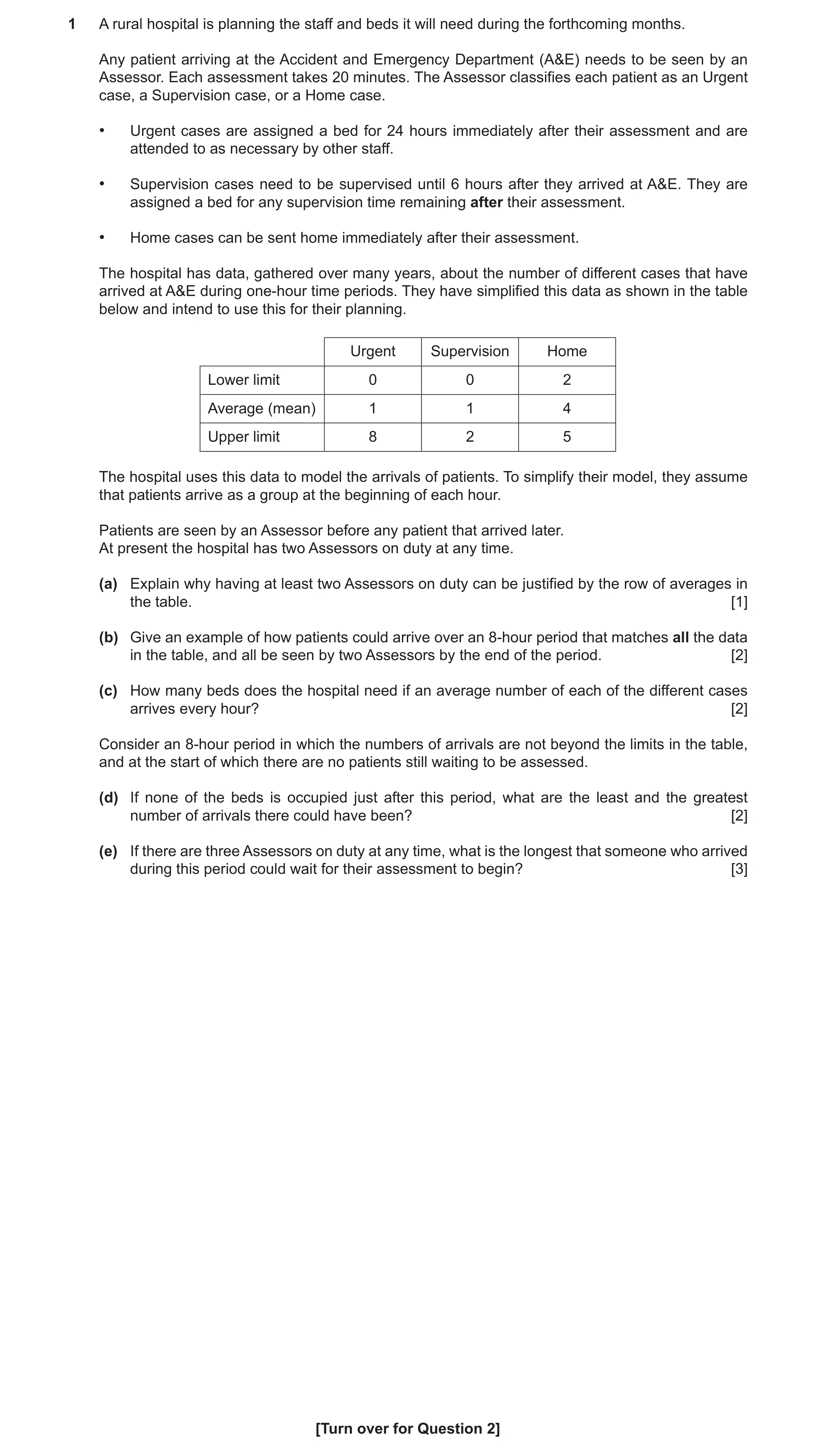
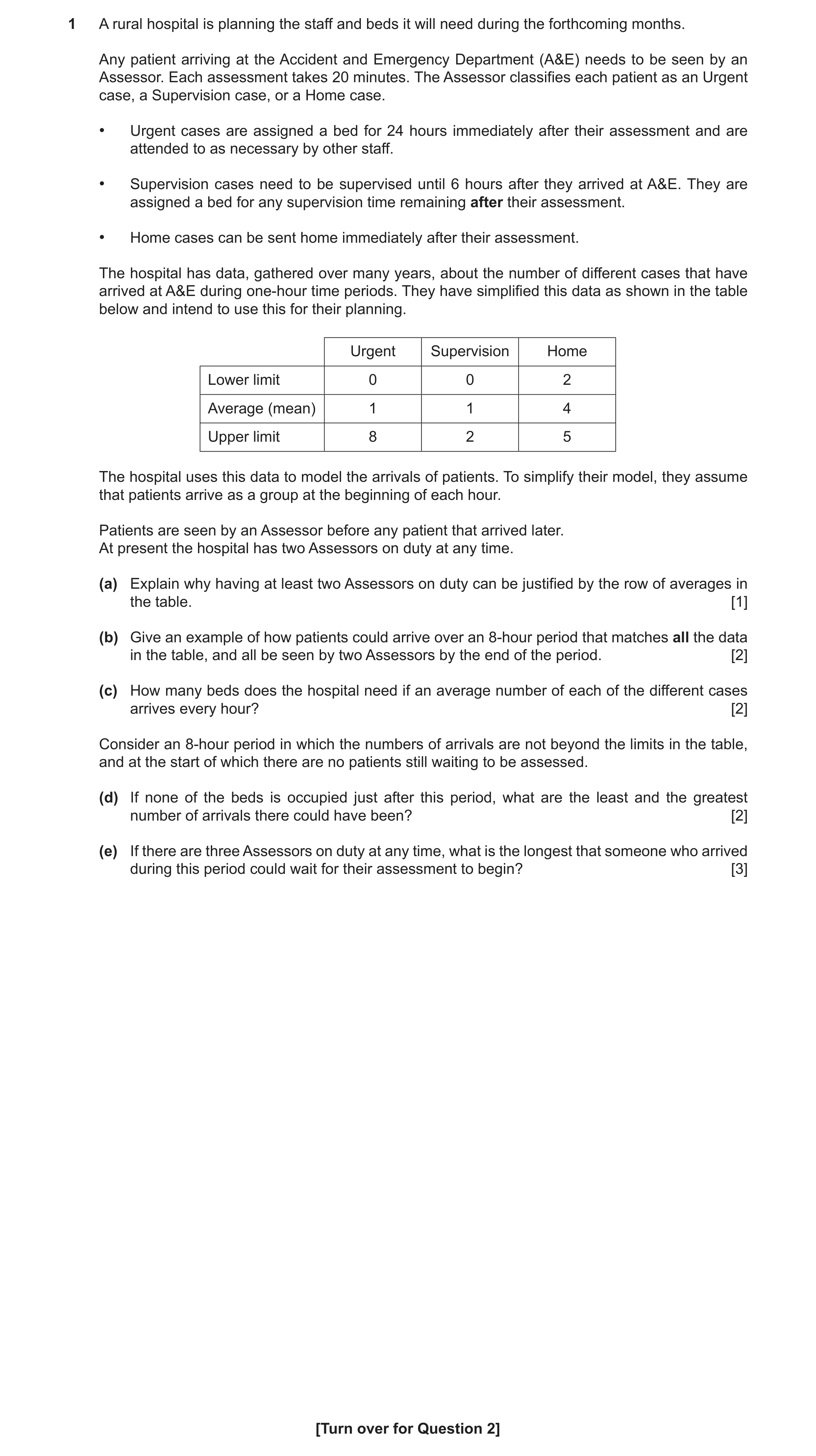
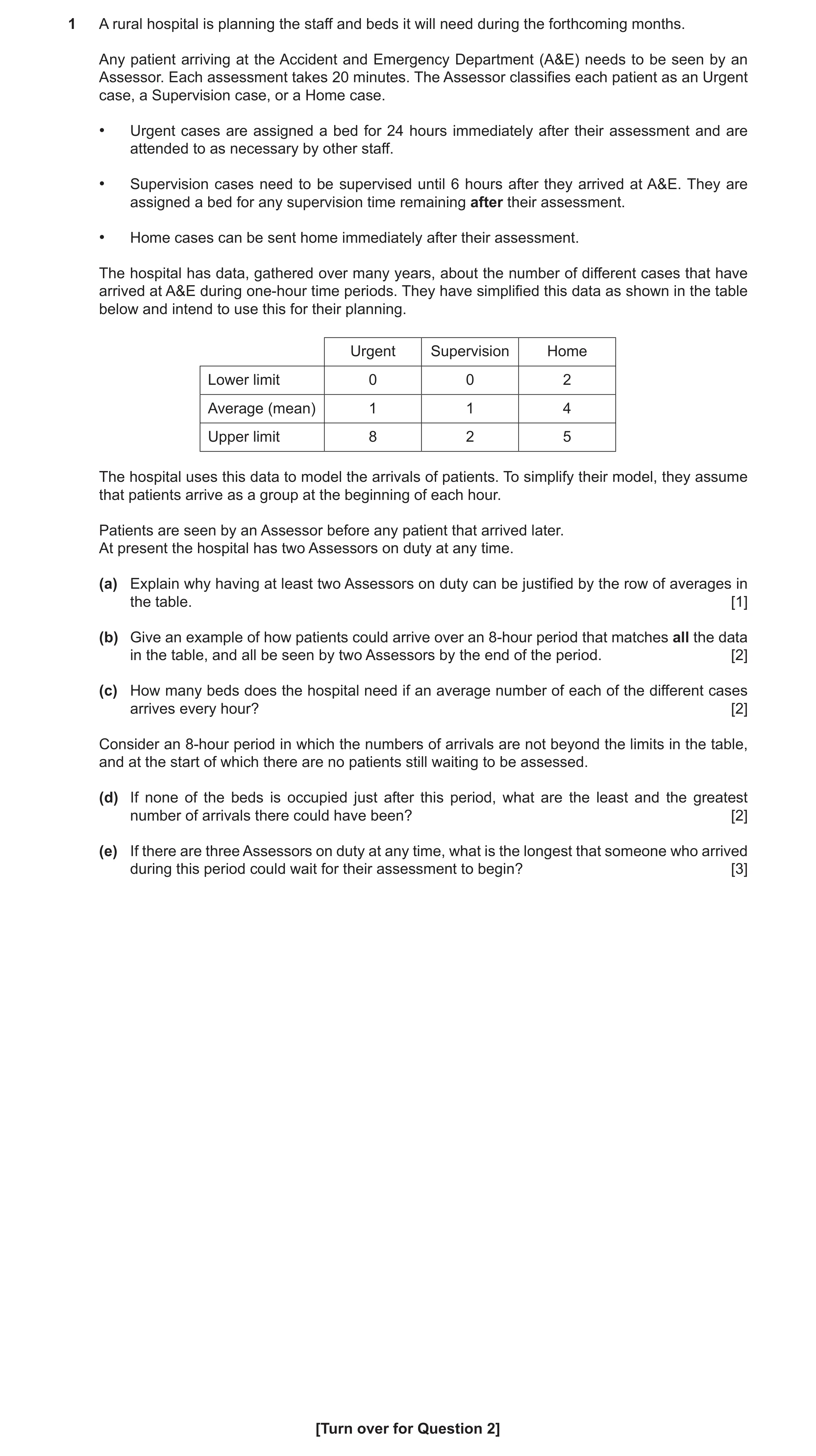
1 A rural hospital is planning the staff and beds it will need during the forthcoming months. Any patient arriving at the Accident and Emergency Department (A&E) needs to be seen by an Assessor. Each assessment takes 20 minutes. The Assessor classifies each patient as an Urgent case, a Supervision case, or a Home case. • Urgent cases are assigned a bed for 24 hours immediately after their assessment and are attended to as necessary by other staff. • Supervision cases need to be supervised until 6 hours after they arrived at A&E. They are assigned a bed for any supervision time remaining after their assessment. • Home cases can be sent home immediately after their assessment. The hospital has data, gathered over many years, about the number of different cases that have arrived at A&E during one-hour time periods. They have simplified this data as shown in the table below and intend to use this for their planning. Urgent Supervision Home Lower limit 0 0 2 Average (mean) 1 1 4 Upper limit 8 2 5 The hospital uses this data to model the arrivals of patients. To simplify their model, they assume that patients arrive as a group at the beginning of each hour. Patients are seen by an Assessor before any patient that arrived later. At present the hospital has two Assessors on duty at any time. (a) Explain why having at least two Assessors on duty can be justified by the row of averages in the table. [1] (b) Give an example of how patients could arrive over an 8-hour period that matches all the data in the table, and all be seen by two Assessors by the end of the period. [2] (c) How many beds does the hospital need if an average number of each of the different cases arrives every hour? [2] Consider an 8-hour period in which the numbers of arrivals are not beyond the limits in the table, and at the start of which there are no patients still waiting to be assessed. (d) If none of the beds is occupied just after this period, what are the least and the greatest number of arrivals there could have been? [2] (e) If there are three Assessors on duty at any time, what is the longest that someone who arrived during this period could wait for their assessment to begin? [3] [Turn over for Question 2]
10 marks
Mark scheme: Question Answer Marks 1(a) On average 6 arrivals. 1 assessment per 20 minutes = 3 per Assessor per 1 hour. 6 ÷ 3 = 2 Assessors needed. 1(b) 2 marks for any example with the correct totals AND values within the limits 2 AND must be at least cumulative 6,12,18….. 1 mark for any example with two of these features 1 mark for an example in which any one type of appointment has the correct total and values within the limits 1 2 3 4 5 6 7 8 total U 8 0 0 0 0 0 0 0 8 S 0 0 1 1 1 1 2 2 8 H 2 2 5 5 5 5 5 3 32 1(c) Supervision: 1 an hour for 24 hours, but they start leaving (one in one out) 2 after 6: 6 beds needed [1] Urgents: 1 an hour for 24 hours = 24 beds needed If (at any point in time) the Urgent case classified 24 hours ago was not assessed immediately upon arrival, then 1 more bed is needed Total = 31 SC: 2 marks for final answer 30 1(d) min = 8 2 homes = 16 arrivals [1] 2 max = (8 5 homes) + (2 3 supervision) = 46 arrivals [1] SC: If 0 scored, award 1 mark for max = 44. (from 2 2 supervision) 1(e) If all 15 (max of each) came at the same time then they would take 5 3 Assessor–hours to be seen If this happened every hour for 8 hours, 40 Assessor–hours needed [1] If there were only 3 Assessors, this would take 13 h 20 m to complete [1] Someone arriving at the beginning of the 8th hour could have to wait (13 h 20 m – 7 h – 20 m =) 6 hours [1] oe OR Only 9 patients can be assessed within an hour, so if 15 arrive there will be an overflow of 6 At the start of the 8th hour there could be 7 6 = 42 patients [1] from earlier hours still waiting, plus 15 arrivals for the 8th hour The total number of patients waiting to be seen at the start of the 8th hour could be 57 57 assessments takes 19 hours [1], so with 3 assessors 6 hours 20 minutes are required The assessment takes 20 minutes, so the longest wait would be 6 hours 20 minutes – 20 minutes = 6 hours [1]
This question in 9694/31 Oct/Nov 2024
Q16 · A rural hospital is planning the staff and beds it will need during the forthcoming months 9694/32 Oct/Nov 2024
1 A rural hospital is planning the staff and beds it will need during the forthcoming months. Any patient arriving at the Accident and Emergency Department (A&E) needs to be seen by an Assessor. Each assessment takes 20 minutes. The Assessor classifies each patient as an Urgent case, a Supervision case, or a Home case. • Urgent cases are assigned a bed for 24 hours immediately after their assessment and are attended to as necessary by other staff. • Supervision cases need to be supervised until 6 hours after they arrived at A&E. They are assigned a bed for any supervision time remaining after their assessment. • Home cases can be sent home immediately after their assessment. The hospital has data, gathered over many years, about the number of different cases that have arrived at A&E during one-hour time periods. They have simplified this data as shown in the table below and intend to use this for their planning. Urgent Supervision Home Lower limit 0 0 2 Average (mean) 1 1 4 Upper limit 8 2 5 The hospital uses this data to model the arrivals of patients. To simplify their model, they assume that patients arrive as a group at the beginning of each hour. Patients are seen by an Assessor before any patient that arrived later. At present the hospital has two Assessors on duty at any time. (a) Explain why having at least two Assessors on duty can be justified by the row of averages in the table. [1] (b) Give an example of how patients could arrive over an 8-hour period that matches all the data in the table, and all be seen by two Assessors by the end of the period. [2] (c) How many beds does the hospital need if an average number of each of the different cases arrives every hour? [2] Consider an 8-hour period in which the numbers of arrivals are not beyond the limits in the table, and at the start of which there are no patients still waiting to be assessed. (d) If none of the beds is occupied just after this period, what are the least and the greatest number of arrivals there could have been? [2] (e) If there are three Assessors on duty at any time, what is the longest that someone who arrived during this period could wait for their assessment to begin? [3] [Turn over for Question 2]
10 marks
Mark scheme: Question Answer Marks 1(a) On average 6 arrivals. 1 assessment per 20 minutes = 3 per Assessor per 1 hour. 6 ÷ 3 = 2 Assessors needed. 1(b) 2 marks for any example with the correct totals AND values within the limits 2 AND must be at least cumulative 6,12,18….. 1 mark for any example with two of these features 1 mark for an example in which any one type of appointment has the correct total and values within the limits 1 2 3 4 5 6 7 8 total U 8 0 0 0 0 0 0 0 8 S 0 0 1 1 1 1 2 2 8 H 2 2 5 5 5 5 5 3 32 1(c) Supervision: 1 an hour for 24 hours, but they start leaving (one in one out) 2 after 6: 6 beds needed [1] Urgents: 1 an hour for 24 hours = 24 beds needed If (at any point in time) the Urgent case classified 24 hours ago was not assessed immediately upon arrival, then 1 more bed is needed Total = 31 SC: 2 marks for final answer 30 1(d) min = 8 2 homes = 16 arrivals [1] 2 max = (8 5 homes) + (2 3 supervision) = 46 arrivals [1] SC: If 0 scored, award 1 mark for max = 44. (from 2 2 supervision) 1(e) If all 15 (max of each) came at the same time then they would take 5 3 Assessor–hours to be seen If this happened every hour for 8 hours, 40 Assessor–hours needed [1] If there were only 3 Assessors, this would take 13 h 20 m to complete [1] Someone arriving at the beginning of the 8th hour could have to wait (13 h 20 m – 7 h – 20 m =) 6 hours [1] oe OR Only 9 patients can be assessed within an hour, so if 15 arrive there will be an overflow of 6 At the start of the 8th hour there could be 7 6 = 42 patients [1] from earlier hours still waiting, plus 15 arrivals for the 8th hour The total number of patients waiting to be seen at the start of the 8th hour could be 57 57 assessments takes 19 hours [1], so with 3 assessors 6 hours 20 minutes are required The assessment takes 20 minutes, so the longest wait would be 6 hours 20 minutes – 20 minutes = 6 hours [1]
This question in 9694/32 Oct/Nov 2024
Q17 · A rural hospital is planning the staff and beds it will need during the forthcoming months 9694/33 Oct/Nov 2024
1 A rural hospital is planning the staff and beds it will need during the forthcoming months. Any patient arriving at the Accident and Emergency Department (A&E) needs to be seen by an Assessor. Each assessment takes 20 minutes. The Assessor classifies each patient as an Urgent case, a Supervision case, or a Home case. • Urgent cases are assigned a bed for 24 hours immediately after their assessment and are attended to as necessary by other staff. • Supervision cases need to be supervised until 6 hours after they arrived at A&E. They are assigned a bed for any supervision time remaining after their assessment. • Home cases can be sent home immediately after their assessment. The hospital has data, gathered over many years, about the number of different cases that have arrived at A&E during one-hour time periods. They have simplified this data as shown in the table below and intend to use this for their planning. Urgent Supervision Home Lower limit 0 0 2 Average (mean) 1 1 4 Upper limit 8 2 5 The hospital uses this data to model the arrivals of patients. To simplify their model, they assume that patients arrive as a group at the beginning of each hour. Patients are seen by an Assessor before any patient that arrived later. At present the hospital has two Assessors on duty at any time. (a) Explain why having at least two Assessors on duty can be justified by the row of averages in the table. [1] (b) Give an example of how patients could arrive over an 8-hour period that matches all the data in the table, and all be seen by two Assessors by the end of the period. [2] (c) How many beds does the hospital need if an average number of each of the different cases arrives every hour? [2] Consider an 8-hour period in which the numbers of arrivals are not beyond the limits in the table, and at the start of which there are no patients still waiting to be assessed. (d) If none of the beds is occupied just after this period, what are the least and the greatest number of arrivals there could have been? [2] (e) If there are three Assessors on duty at any time, what is the longest that someone who arrived during this period could wait for their assessment to begin? [3] [Turn over for Question 2]
10 marks
Mark scheme: Question Answer Marks 1(a) On average 6 arrivals. 1 assessment per 20 minutes = 3 per Assessor per 1 hour. 6 ÷ 3 = 2 Assessors needed. 1(b) 2 marks for any example with the correct totals AND values within the limits 2 AND must be at least cumulative 6,12,18….. 1 mark for any example with two of these features 1 mark for an example in which any one type of appointment has the correct total and values within the limits 1 2 3 4 5 6 7 8 total U 8 0 0 0 0 0 0 0 8 S 0 0 1 1 1 1 2 2 8 H 2 2 5 5 5 5 5 3 32 1(c) Supervision: 1 an hour for 24 hours, but they start leaving (one in one out) 2 after 6: 6 beds needed [1] Urgents: 1 an hour for 24 hours = 24 beds needed If (at any point in time) the Urgent case classified 24 hours ago was not assessed immediately upon arrival, then 1 more bed is needed Total = 31 SC: 2 marks for final answer 30 1(d) min = 8 2 homes = 16 arrivals [1] 2 max = (8 5 homes) + (2 3 supervision) = 46 arrivals [1] SC: If 0 scored, award 1 mark for max = 44. (from 2 2 supervision) 1(e) If all 15 (max of each) came at the same time then they would take 5 3 Assessor–hours to be seen If this happened every hour for 8 hours, 40 Assessor–hours needed [1] If there were only 3 Assessors, this would take 13 h 20 m to complete [1] Someone arriving at the beginning of the 8th hour could have to wait (13 h 20 m – 7 h – 20 m =) 6 hours [1] oe OR Only 9 patients can be assessed within an hour, so if 15 arrive there will be an overflow of 6 At the start of the 8th hour there could be 7 6 = 42 patients [1] from earlier hours still waiting, plus 15 arrivals for the 8th hour The total number of patients waiting to be seen at the start of the 8th hour could be 57 57 assessments takes 19 hours [1], so with 3 assessors 6 hours 20 minutes are required The assessment takes 20 minutes, so the longest wait would be 6 hours 20 minutes – 20 minutes = 6 hours [1]
This question in 9694/33 Oct/Nov 2024
Q18 · In the Double Triple Quiz there are 4 rounds of questions 9694/32 Oct/Nov 2025
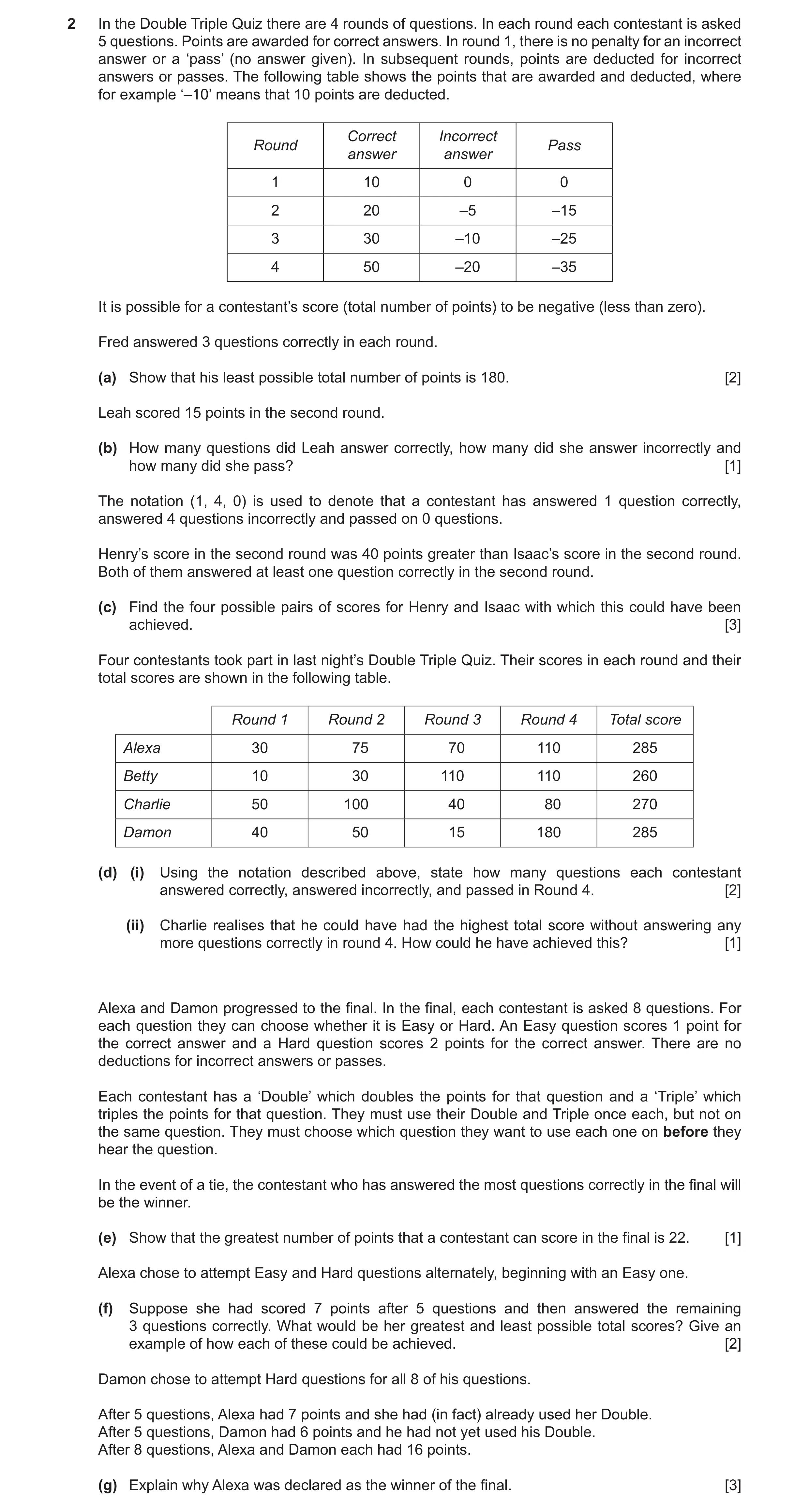
2 In the Double Triple Quiz there are 4 rounds of questions. In each round each contestant is asked 5 questions. Points are awarded for correct answers. In round 1, there is no penalty for an incorrect answer or a ‘pass’ (no answer given). In subsequent rounds, points are deducted for incorrect answers or passes. The following table shows the points that are awarded and deducted, where for example ‘–10’ means that 10 points are deducted. Correct Incorrect Round Pass answer answer 1 10 0 0 2 20 –5 –15 3 30 –10 –25 4 50 –20 –35 It is possible for a contestant’s score (total number of points) to be negative (less than zero). Fred answered 3 questions correctly in each round. (a) Show that his least possible total number of points is 180. [2] Leah scored 15 points in the second round. (b) How many questions did Leah answer correctly, how many did she answer incorrectly and how many did she pass? [1] The notation (1, 4, 0) is used to denote that a contestant has answered 1 question correctly, answered 4 questions incorrectly and passed on 0 questions. Henry’s score in the second round was 40 points greater than Isaac’s score in the second round. Both of them answered at least one question correctly in the second round. (c) Find the four possible pairs of scores for Henry and Isaac with which this could have been achieved. [3] Four contestants took part in last night’s Double Triple Quiz. Their scores in each round and their total scores are shown in the following table. Round 1 Round 2 Round 3 Round 4 Total score Alexa 30 75 70 110 285 Betty 10 30 110 110 260 Charlie 50 100 40 80 270 Damon 40 50 15 180 285 (d) (i) Using the notation described above, state how many questions each contestant answered correctly, answered incorrectly, and passed in Round 4. [2] (ii) Charlie realises that he could have had the highest total score without answering any more questions correctly in round 4. How could he have achieved this? [1] Alexa and Damon progressed to the final. In the final, each contestant is asked 8 questions. For each question they can choose whether it is Easy or Hard. An Easy question scores 1 point for the correct answer and a Hard question scores 2 points for the correct answer. There are no deductions for incorrect answers or passes. Each contestant has a ‘Double’ which doubles the points for that question and a ‘Triple’ which triples the points for that question. They must use their Double and Triple once each, but not on the same question. They must choose which question they want to use each one on before they hear the question. In the event of a tie, the contestant who has answered the most questions correctly in the final will be the winner. (e) Show that the greatest number of points that a contestant can score in the final is 22. [1] Alexa chose to attempt Easy and Hard questions alternately, beginning with an Easy one. (f) Suppose she had scored 7 points after 5 questions and then answered the remaining 3 questions correctly. What would be her greatest and least possible total scores? Give an example of how each of these could be achieved. [2] Damon chose to attempt Hard questions for all 8 of his questions. After 5 questions, Alexa had 7 points and she had (in fact) already used her Double. After 5 questions, Damon had 6 points and he had not yet used his Double. After 8 questions, Alexa and Damon each had 16 points. (g) Explain why Alexa was declared as the winner of the final. [3]
15 marks
Mark scheme: 2(a) Points awarded are 3 (10 + 20 + 30 + 50) = 330 2 Biggest deduction for 2 questions is 0 – 30 – 50 – 70 = (−)150 [1] So least possible total is 330 – 150 = 180 [1] AG 2(b) 2 correct, 2 incorrect and 1 pass 1 2(c) 65, 25 from (4, 0, 1) and (2, 3, 0) 3 40, 0 from (3, 1, 1) and (1, 4, 0) 30, –10 from (3, 0, 2) and (1, 3, 1) 0, –40 from (1, 4, 0) and (1, 0, 4) 2 marks for 3 correct with at most one incorrect OR 2 marks for a list of 4 containing only correct pairs of scores or pairs of scores in which one player answered no questions correctly: 15, –25 from (2,2,1) and (0,5,0), 5, –35 from (2,1,2) and (0,4,1), –5, –45 from (2, 0, 3) and (0, 3, 2), –25, –65 from (0,5,0) and (0,1,4), –35, –75 from (0,4,1) and (0,0,5) OR 1 mark for 2 correct or finding vectors (-2, +3, –1) or (0, +4, –4) 2(d)(i) Alexa (3, 2, 0) 2 Betty (3, 2, 0) Charlie (3, 0, 2) Damon (4, 1, 0) 1 mark for any pair from AC, AD, BC, BD, CD correct 2(d)(ii) If Charlie had given answers (even if incorrect) to the two questions he 1 passed, then he would have at least 30 points more, so a total of at least 300, which is more than 285 2(e) 8 Hard questions, one with Double and one with Triple, 1 so 6 2 + 4 + 6 = 22 AG 2(f) Highest: scores in first 5 questions 1, 2, 1, 2, 1 (7) then Hard Double (4), Easy 2 (1), Hard Triple (6), total 18 [1] Lowest: Valid example for questions 1-5, e.g. 3, 4, 0, 0, 0 or 3, 2, 2, 0, 0 then Hard (2), Easy (1), Hard (2), total 12 [1] SC: 1 mark for 12 and 18 with no/incorrect example given 2(g) • Alexa must have answered her last three questions correctly to score 16 3 with one of them tripled. • Therefore she answered at most 2 questions incorrectly. • The only possibility is that Damon scores 6, 4 and 0 from his final three questions. • This means that he must have answered 3 questions incorrectly. 3 marks for all four steps in the reasoning given. 2 marks for any two given. 1 mark for any one given
This question in 9694/32 Oct/Nov 2025
 1 / 22
 2 / 22
 3 / 22
 4 / 22
 5 / 22
 6 / 22
 7 / 22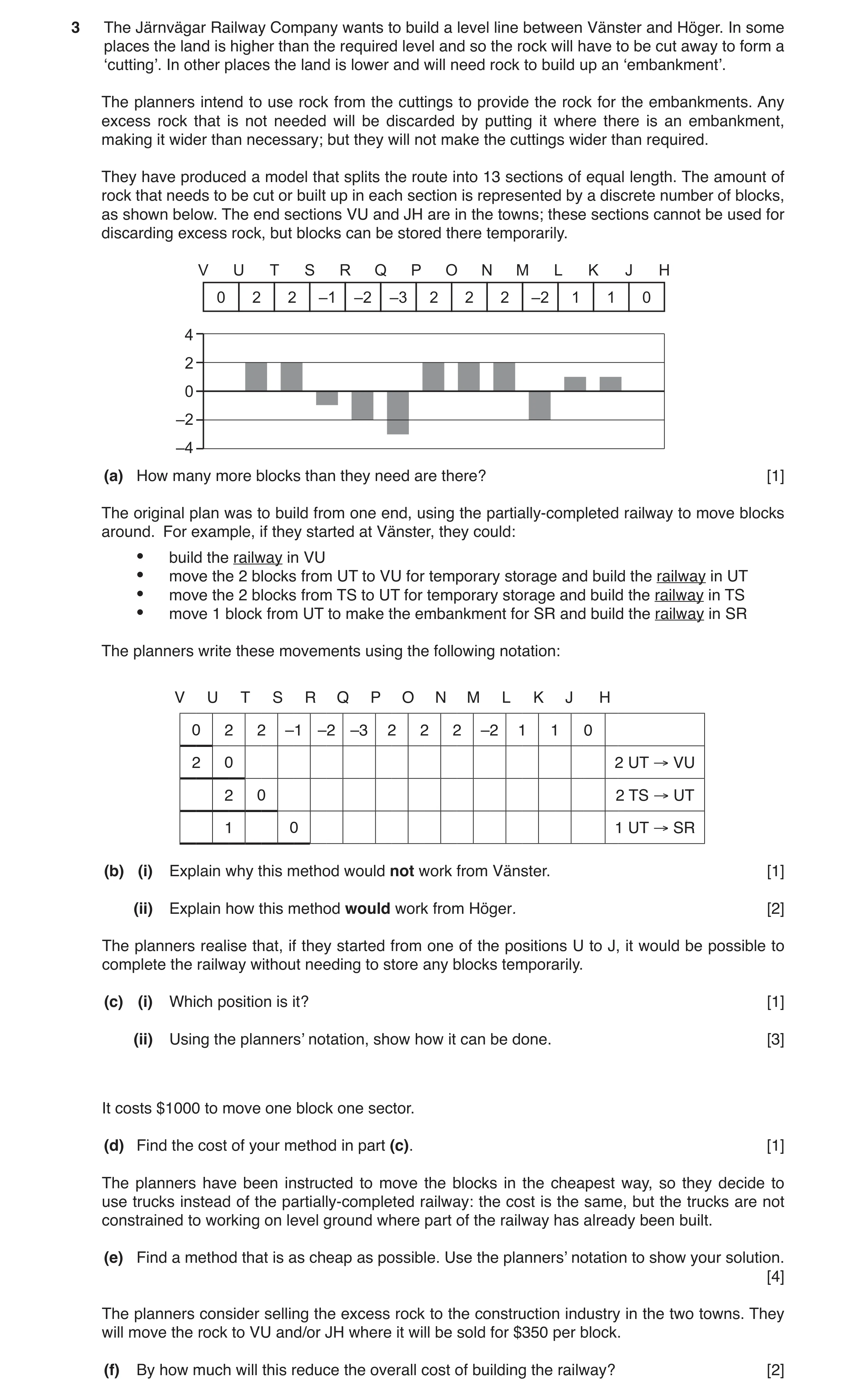
 10 / 22
 11 / 22
 12 / 22
 13 / 22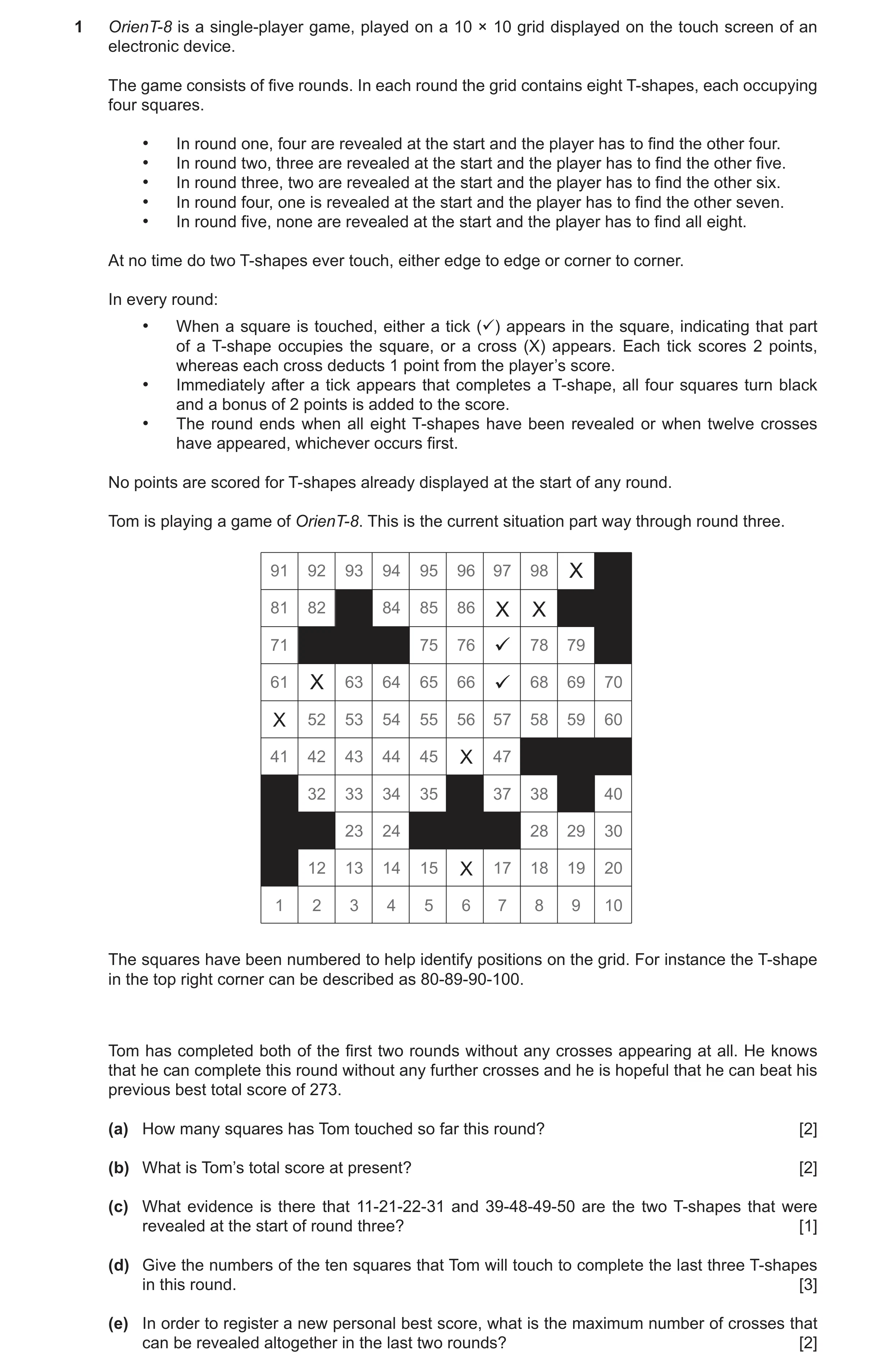
 10
10 10
10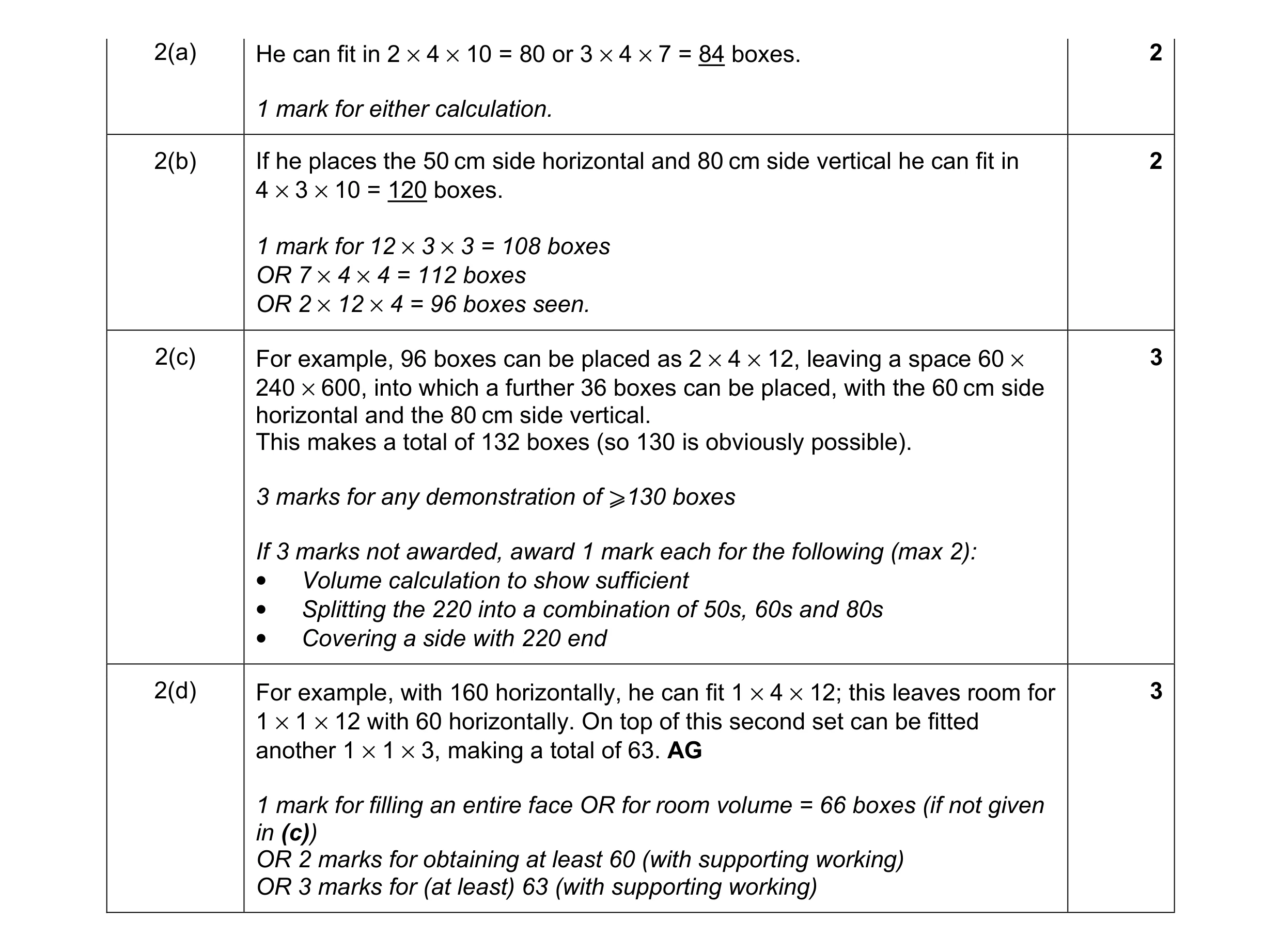 10
10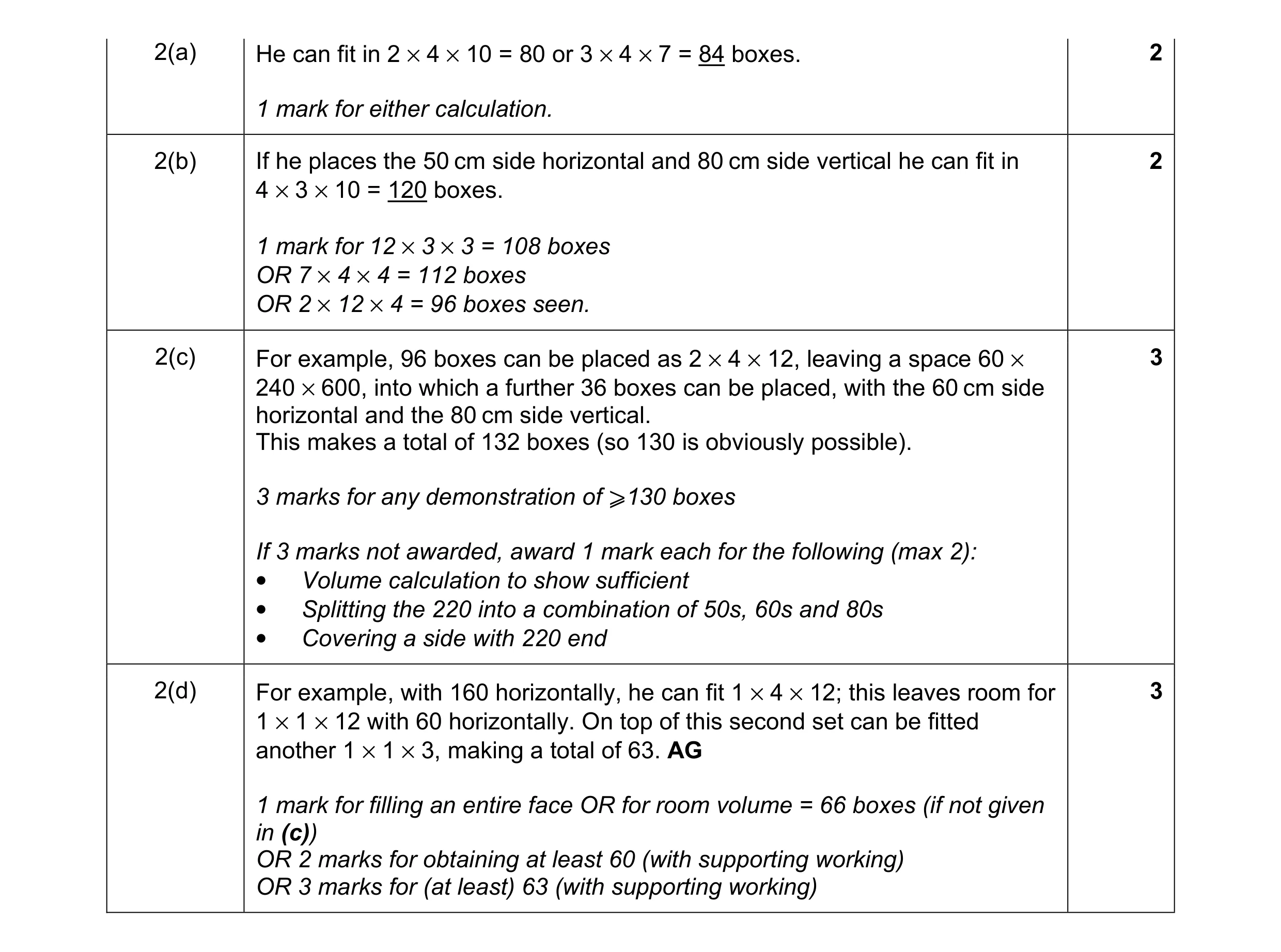 10
10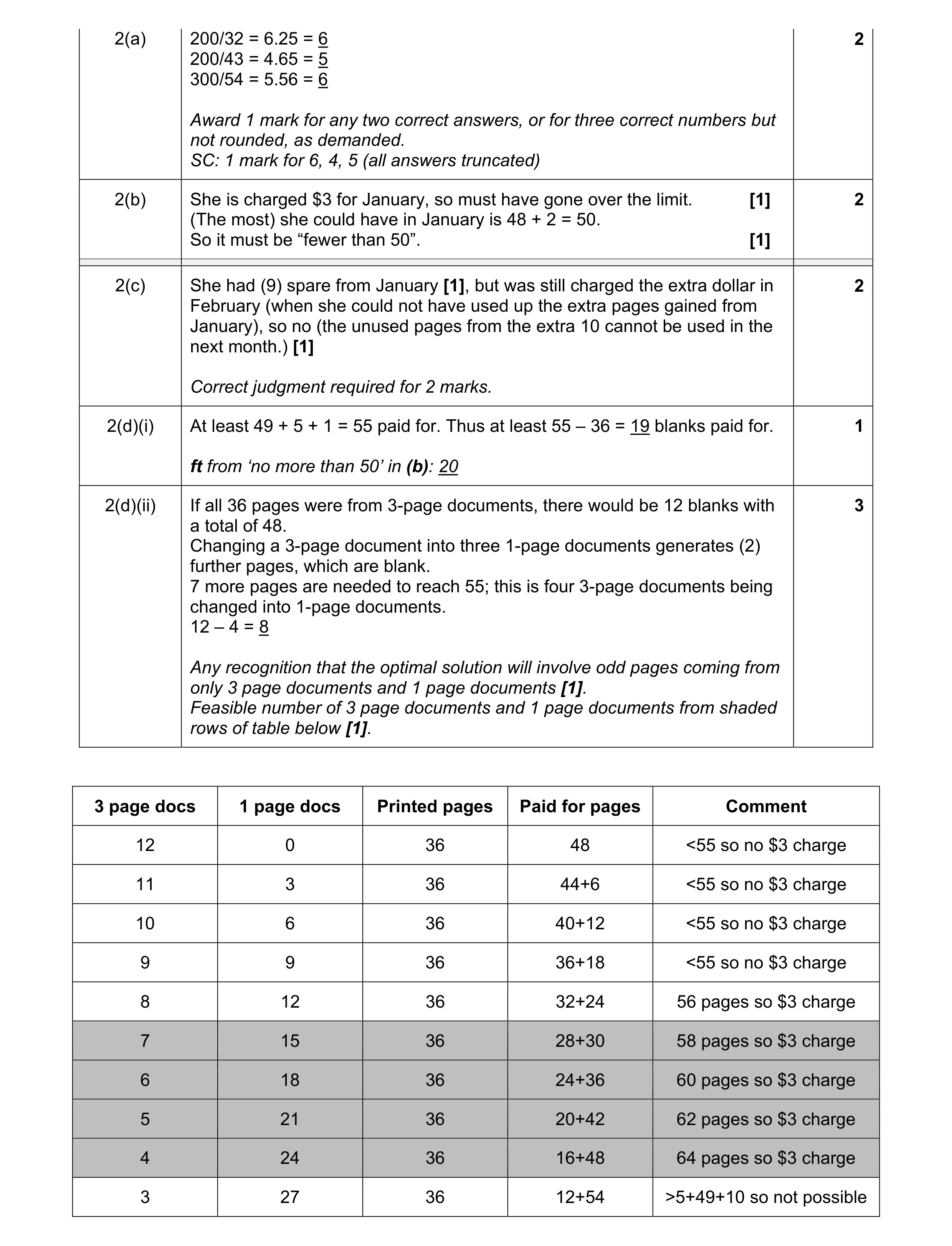 10
10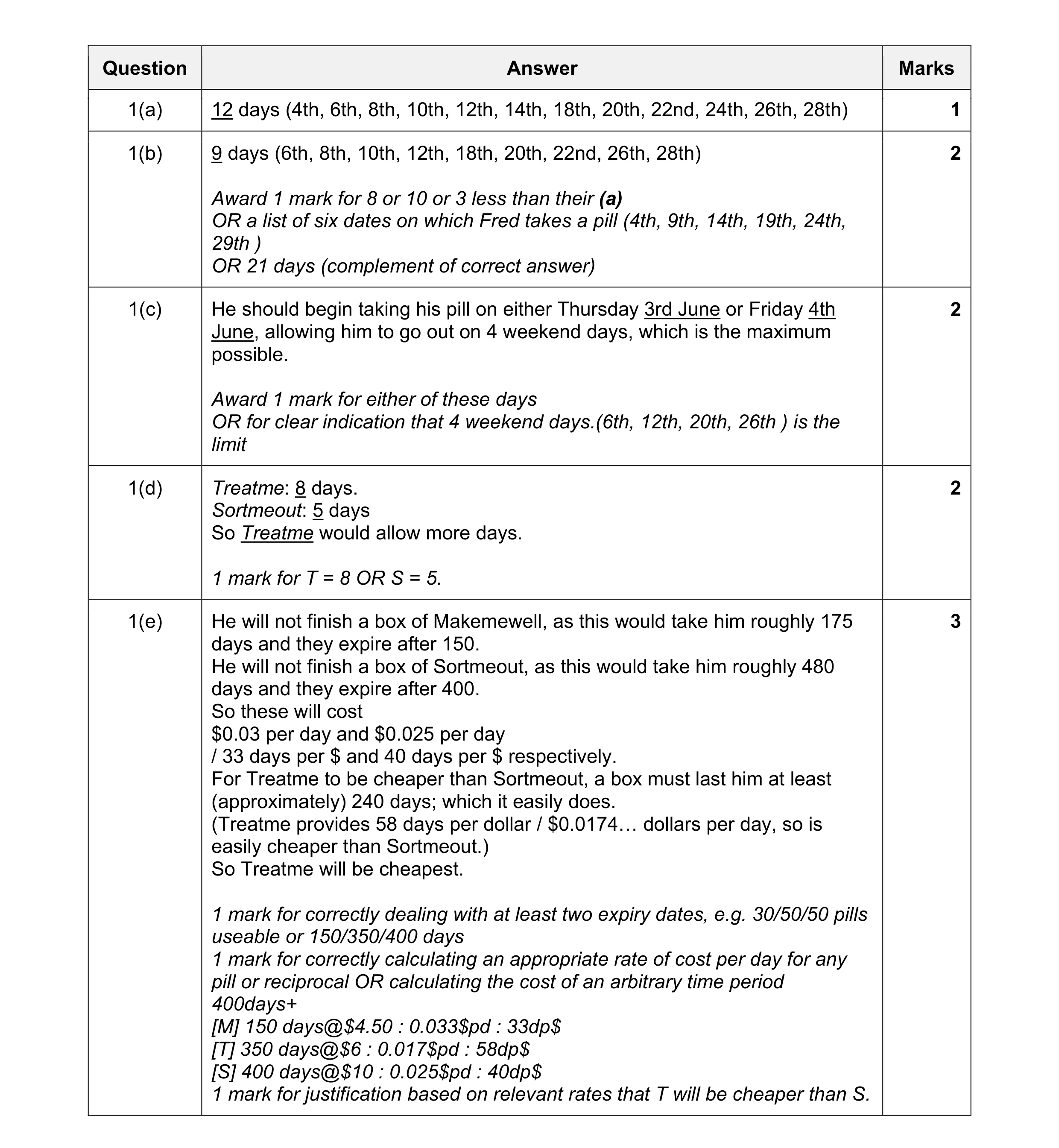 10
10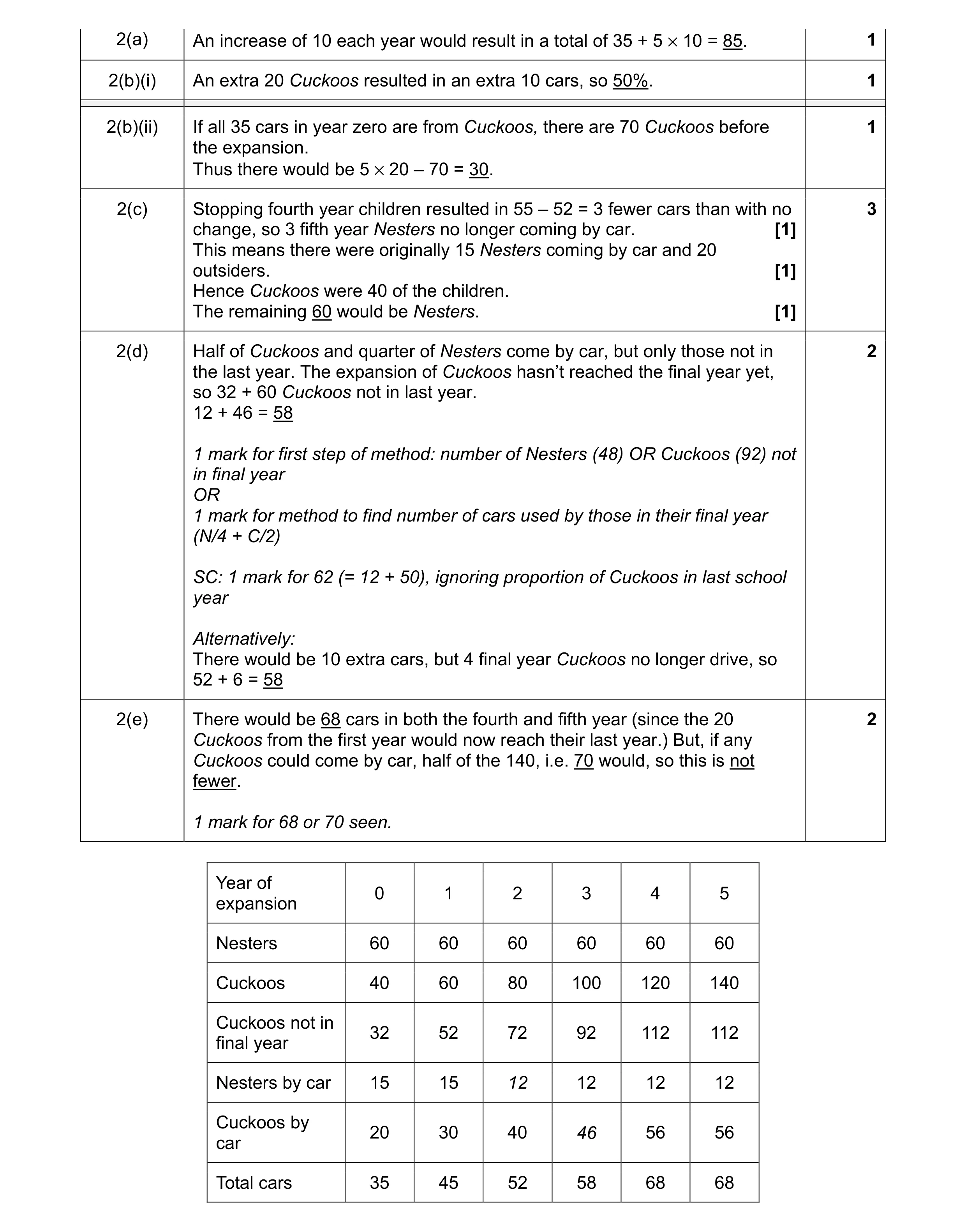 10
10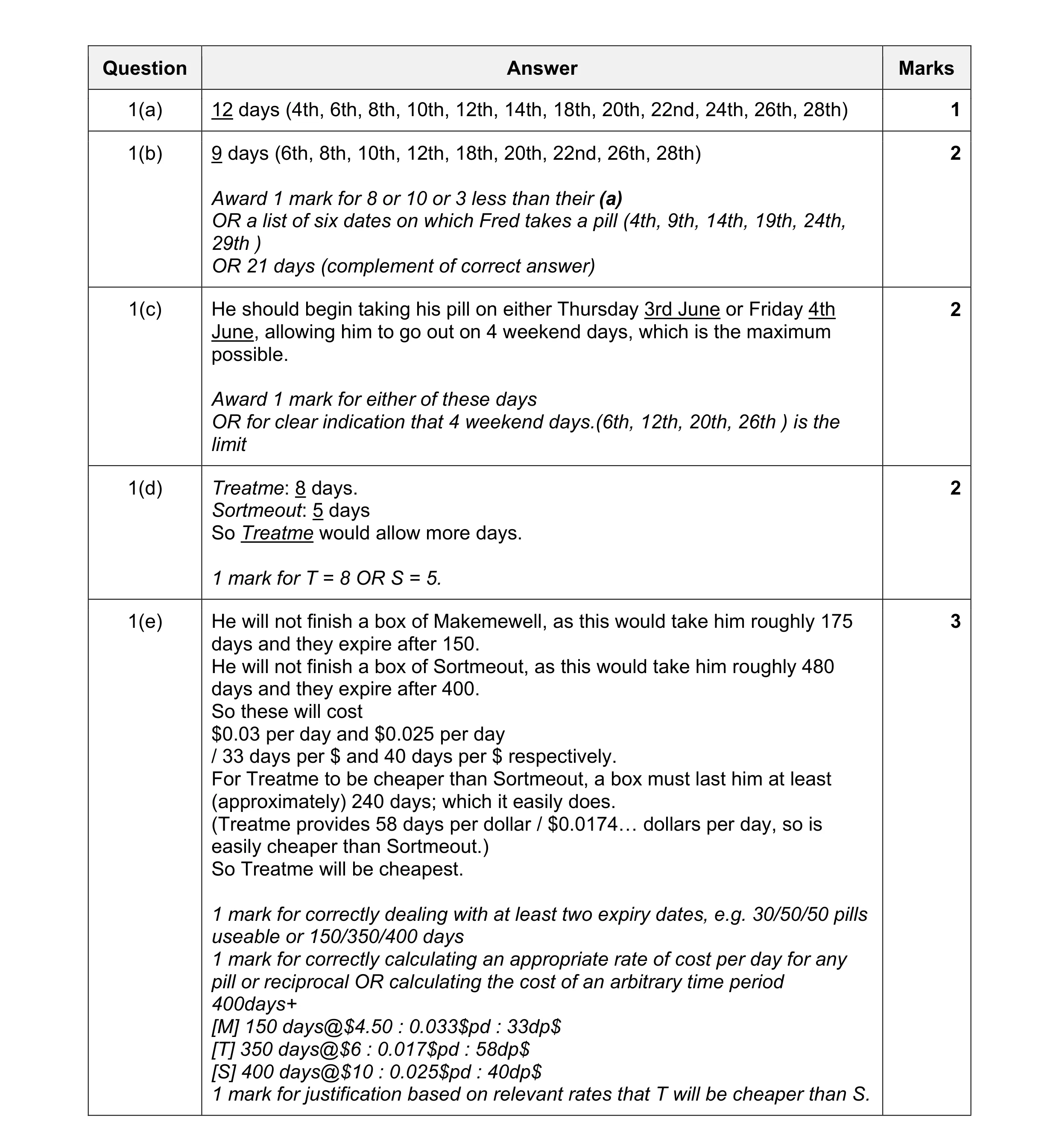 10
10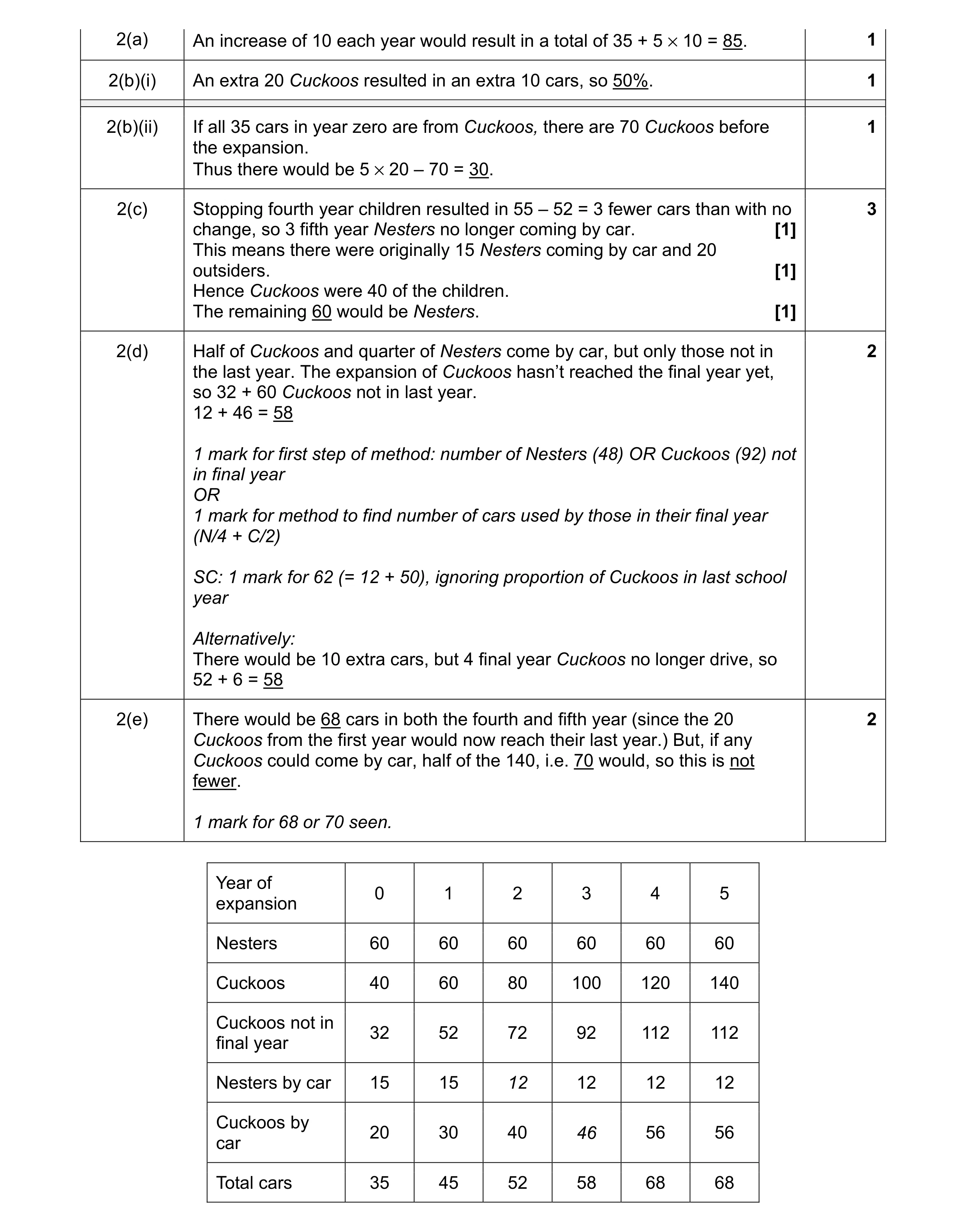 10
10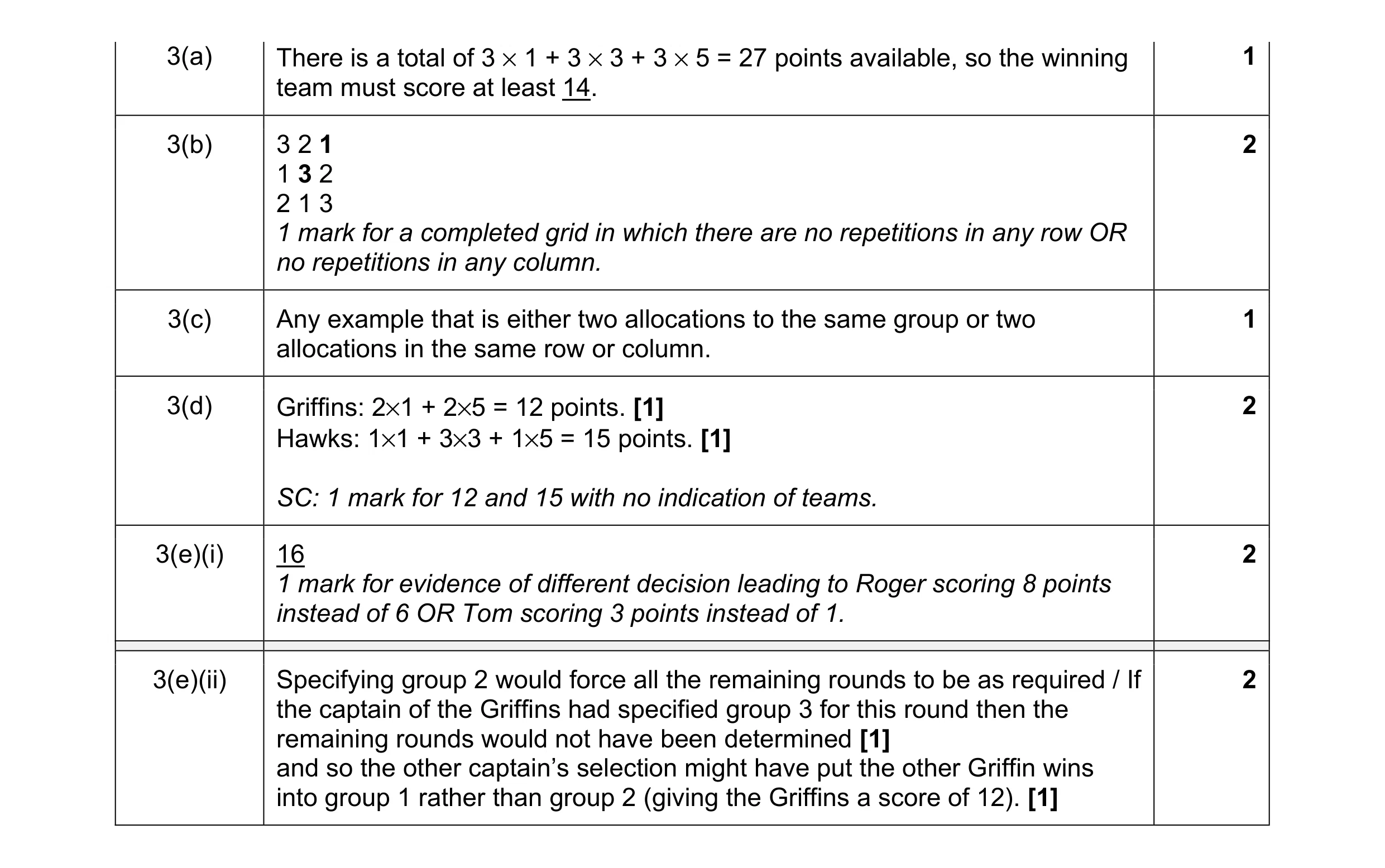 10
10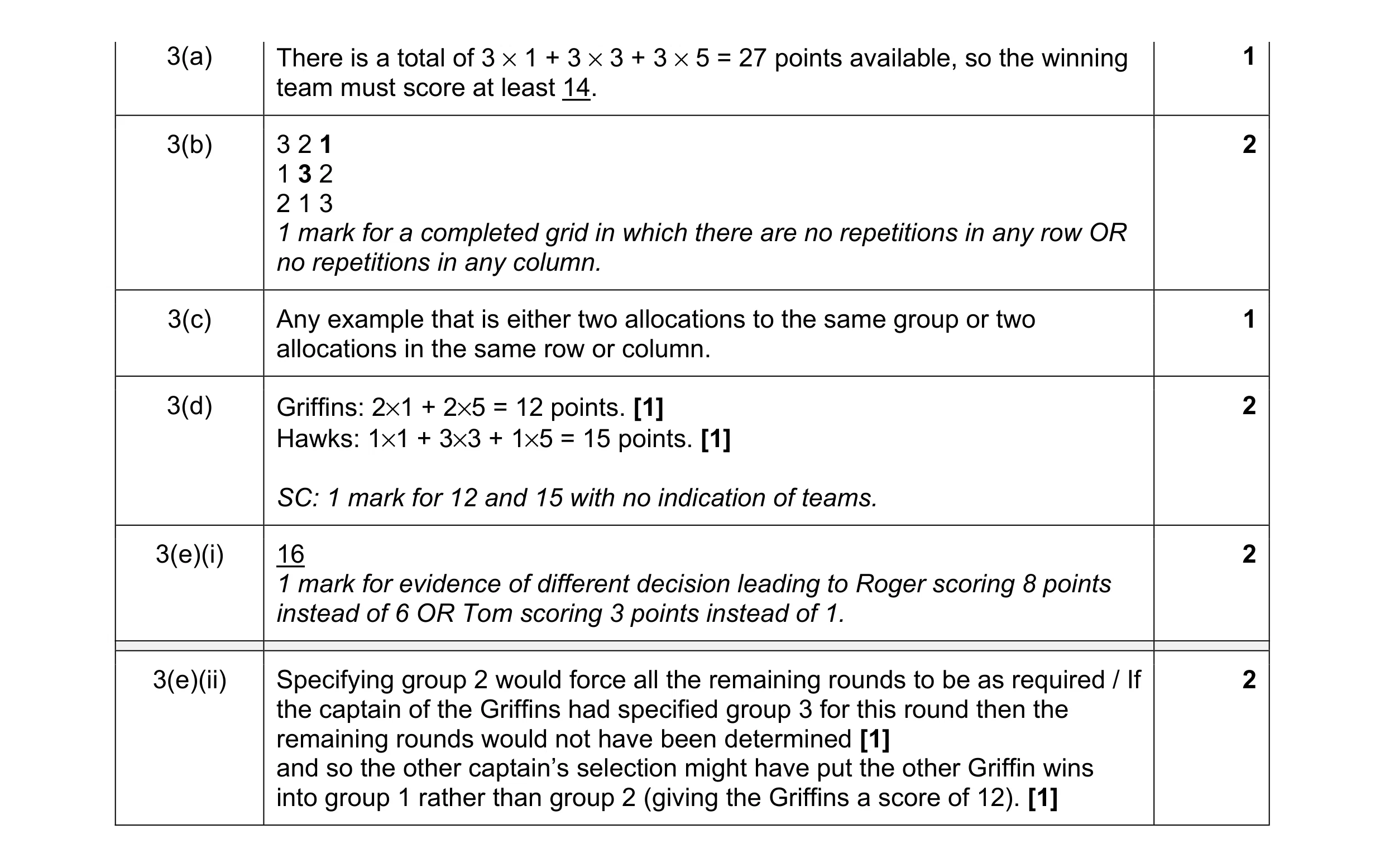 10
10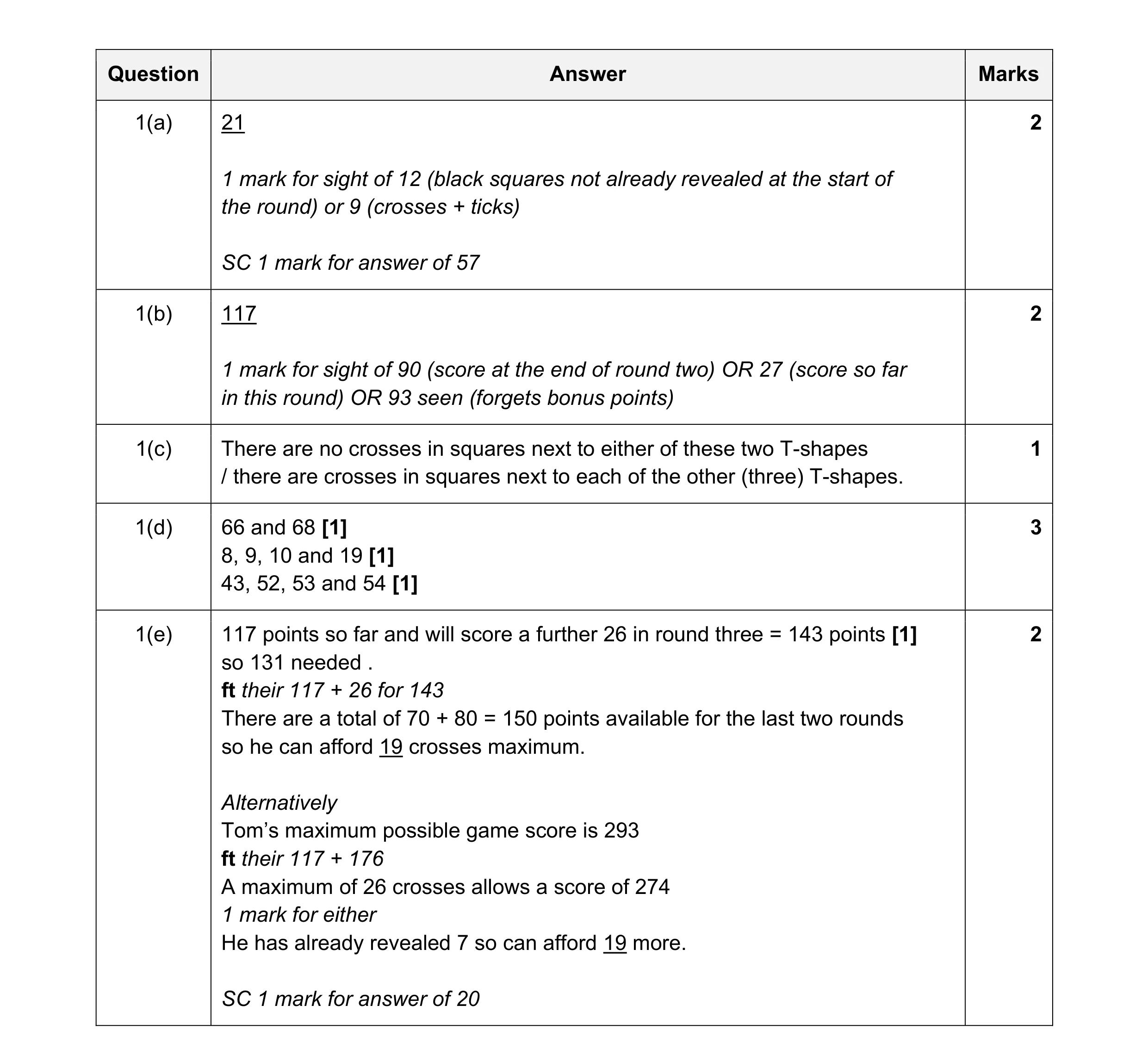 10
10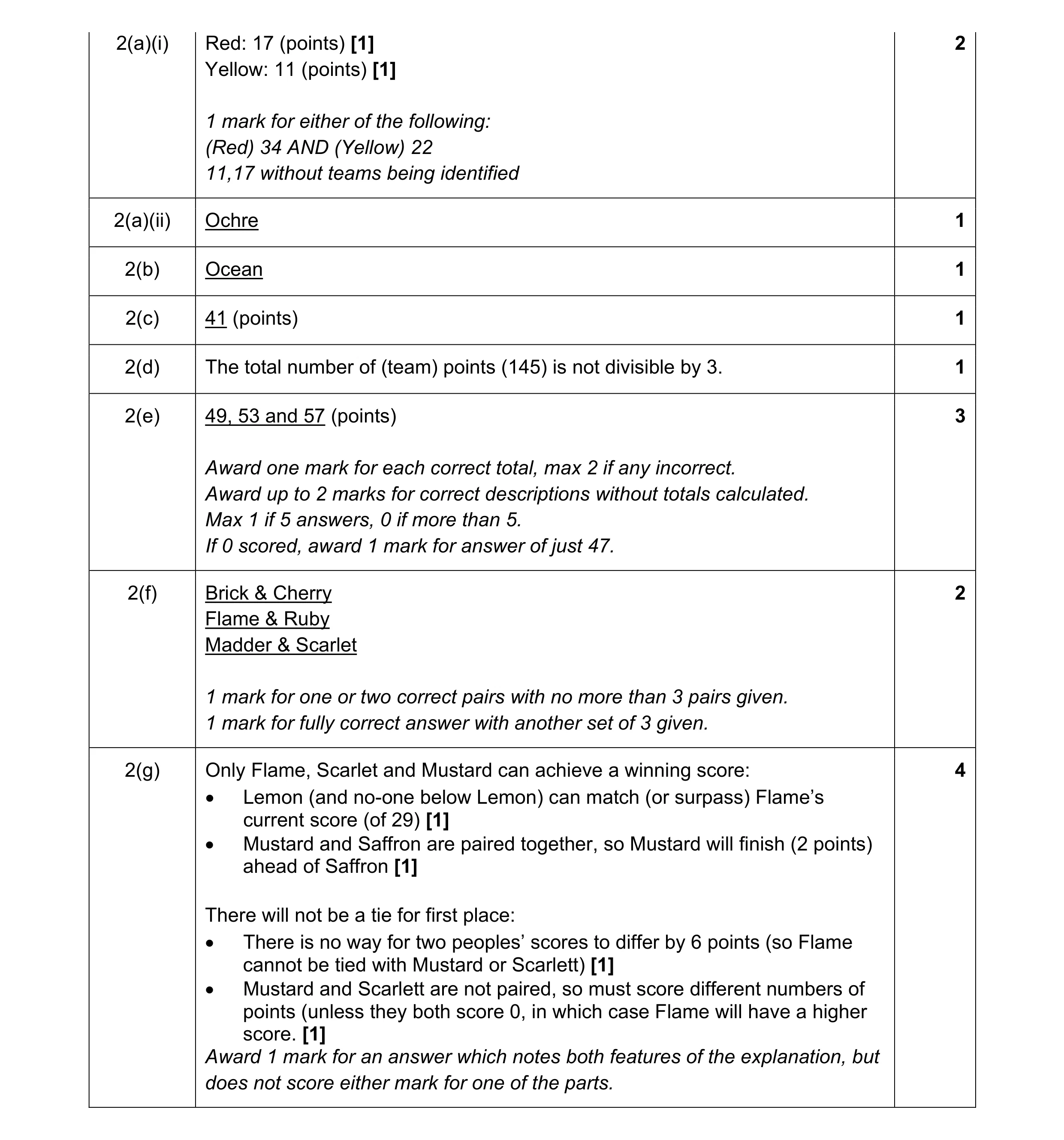 15
15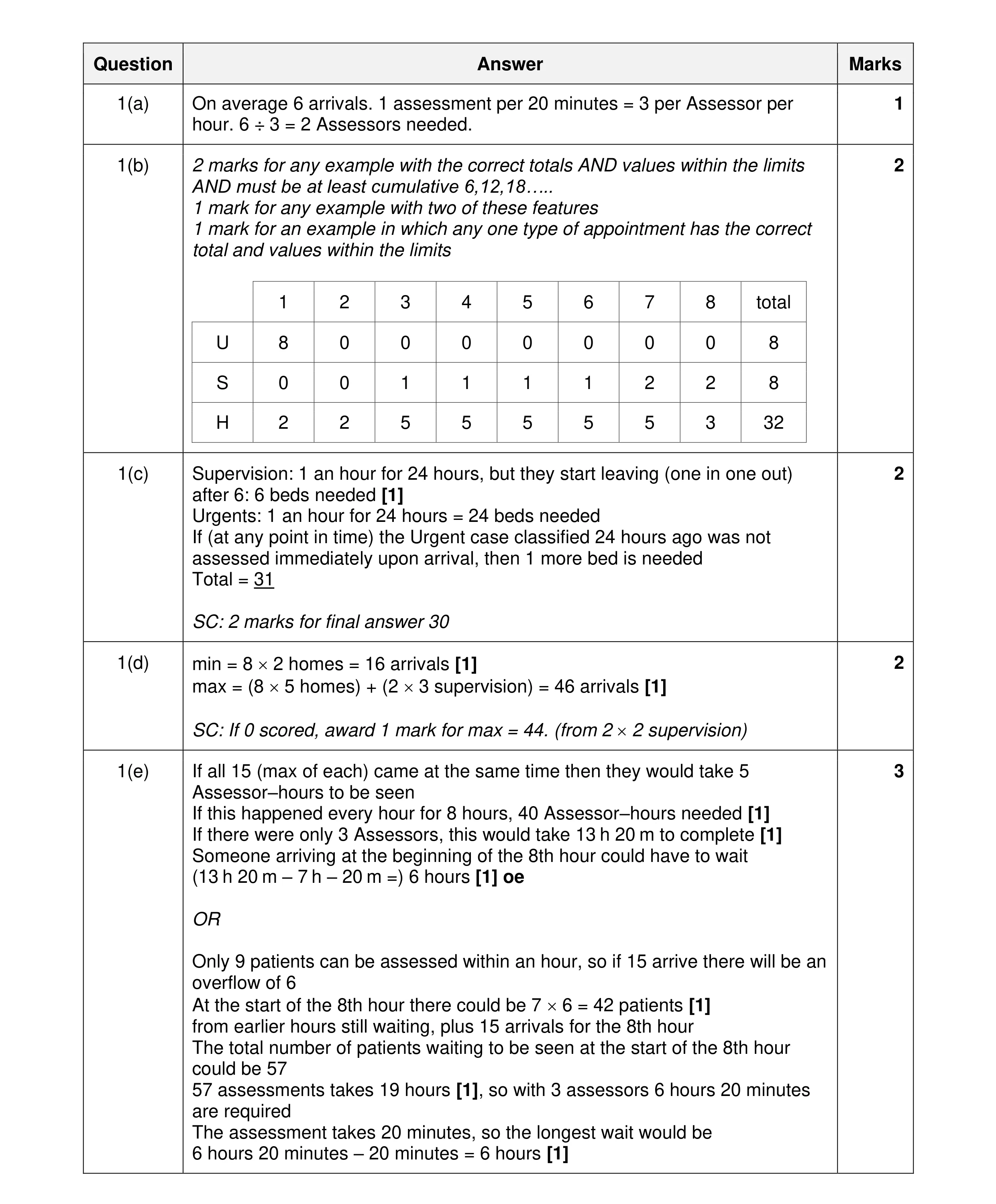 10
10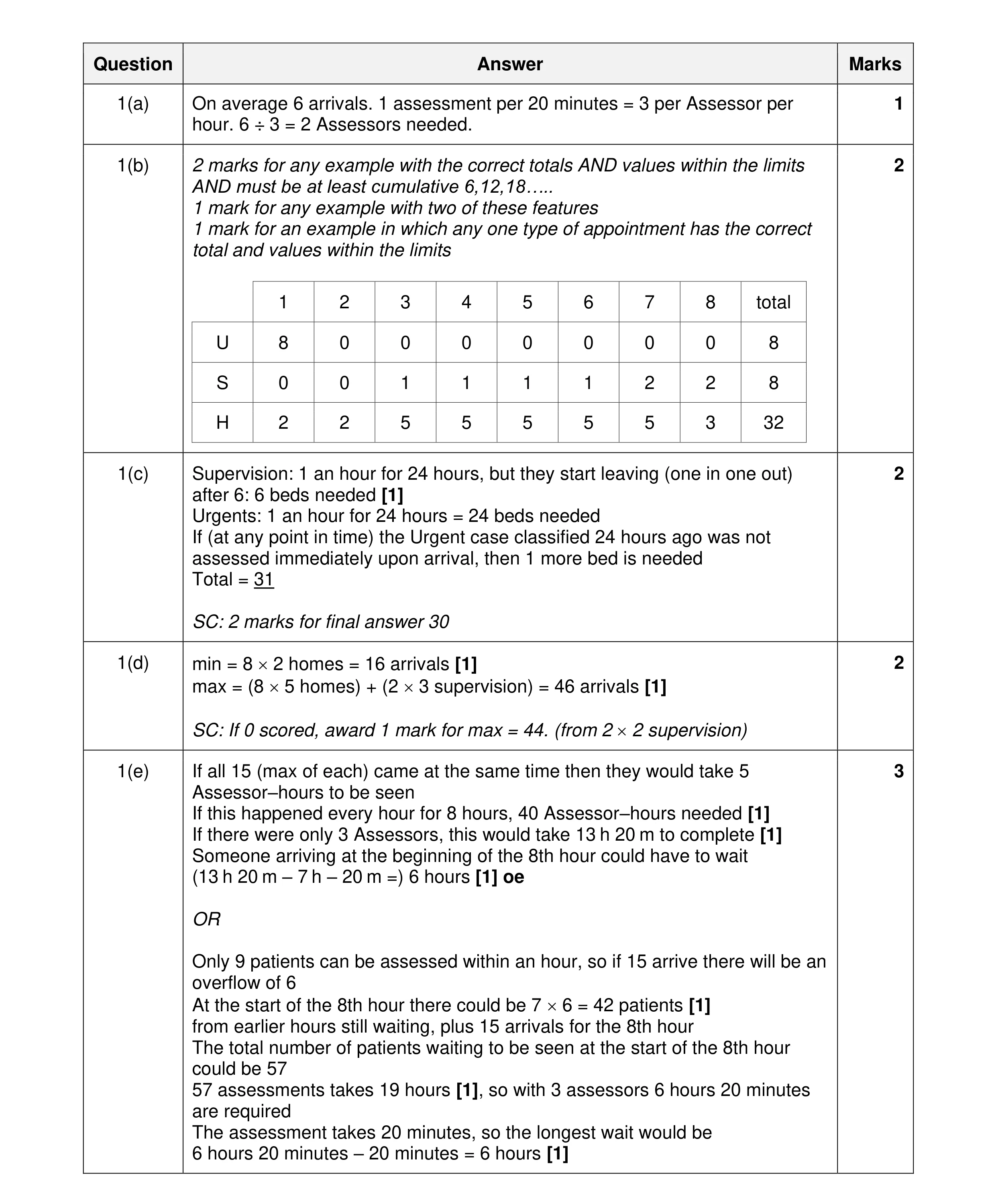 10
10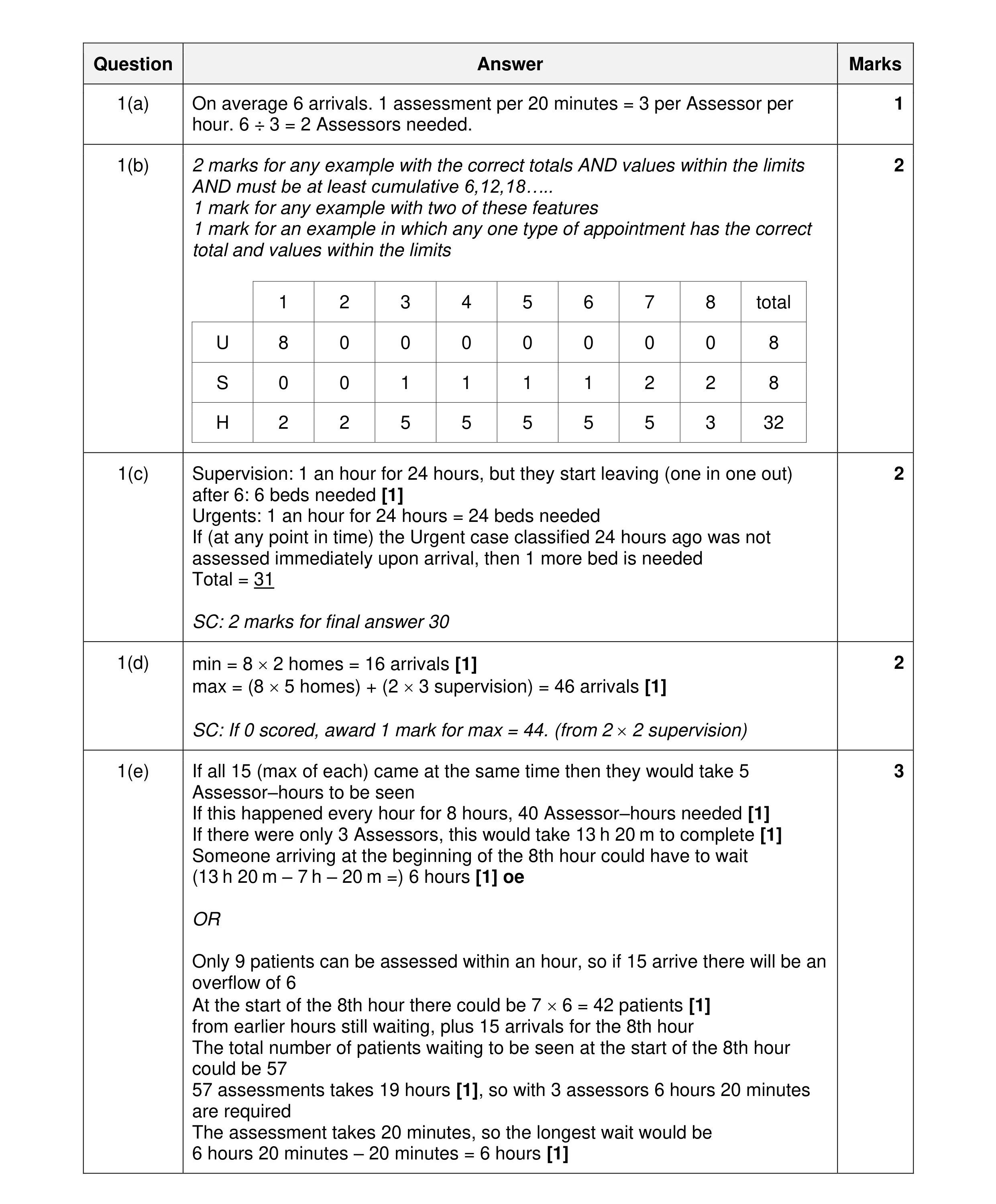 10
10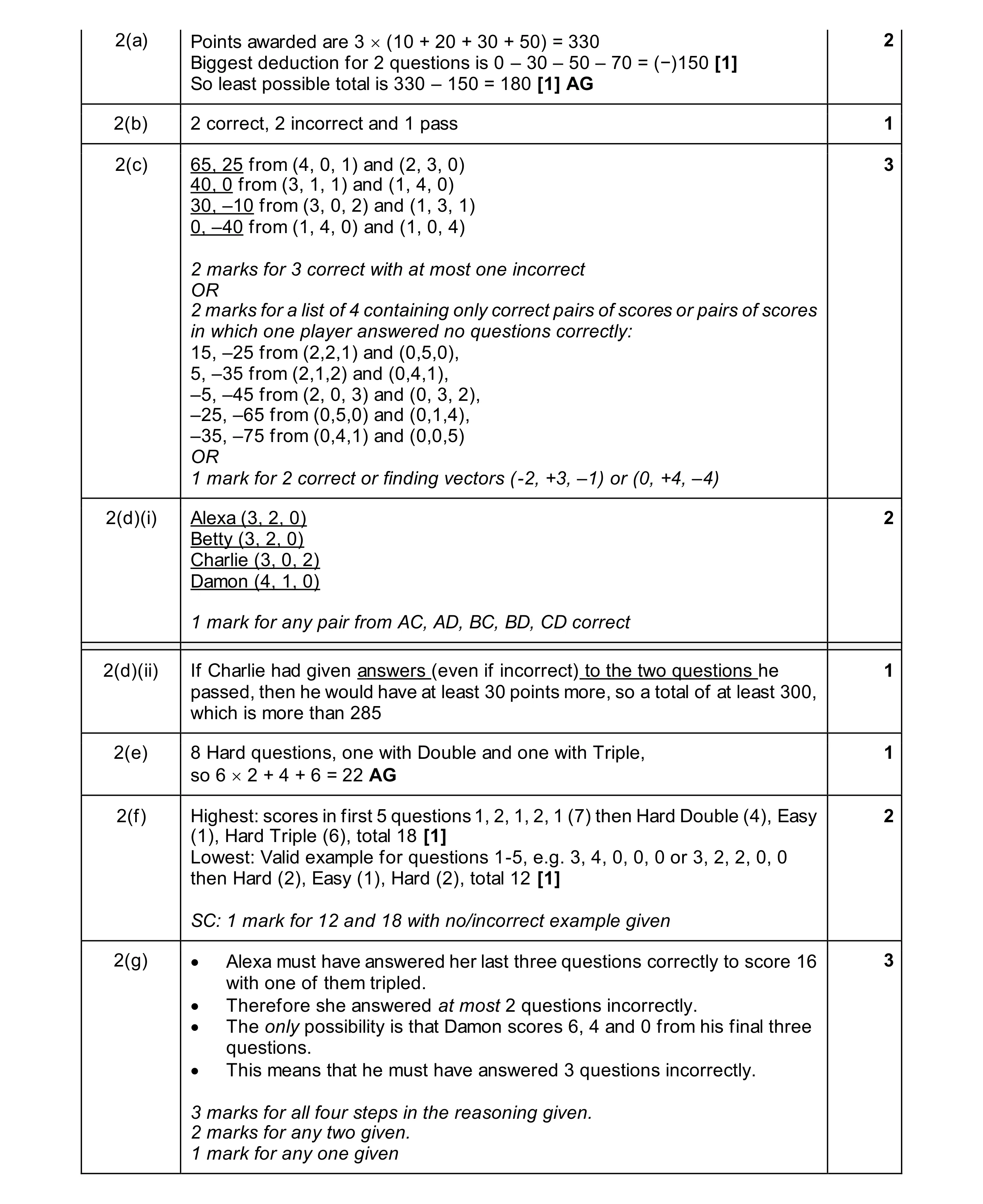 15
15