Cambridge A Level Thinking Skills 9694 — 2020 May/June Paper 3 · Variant 3
9694/33/M/J/20 · 4 questions · 50 marks · ≈56 min
The question paper and its mark scheme, free to read here and free to download. This is Cambridge’s own paper, exactly as it was sat.
Question paper12 pages



Mark scheme8 pages
Answers below. Sit the paper first if you are practising.
Questions as text
Q1 · In Bolandian currency, $1 is worth 100 cents (¢)
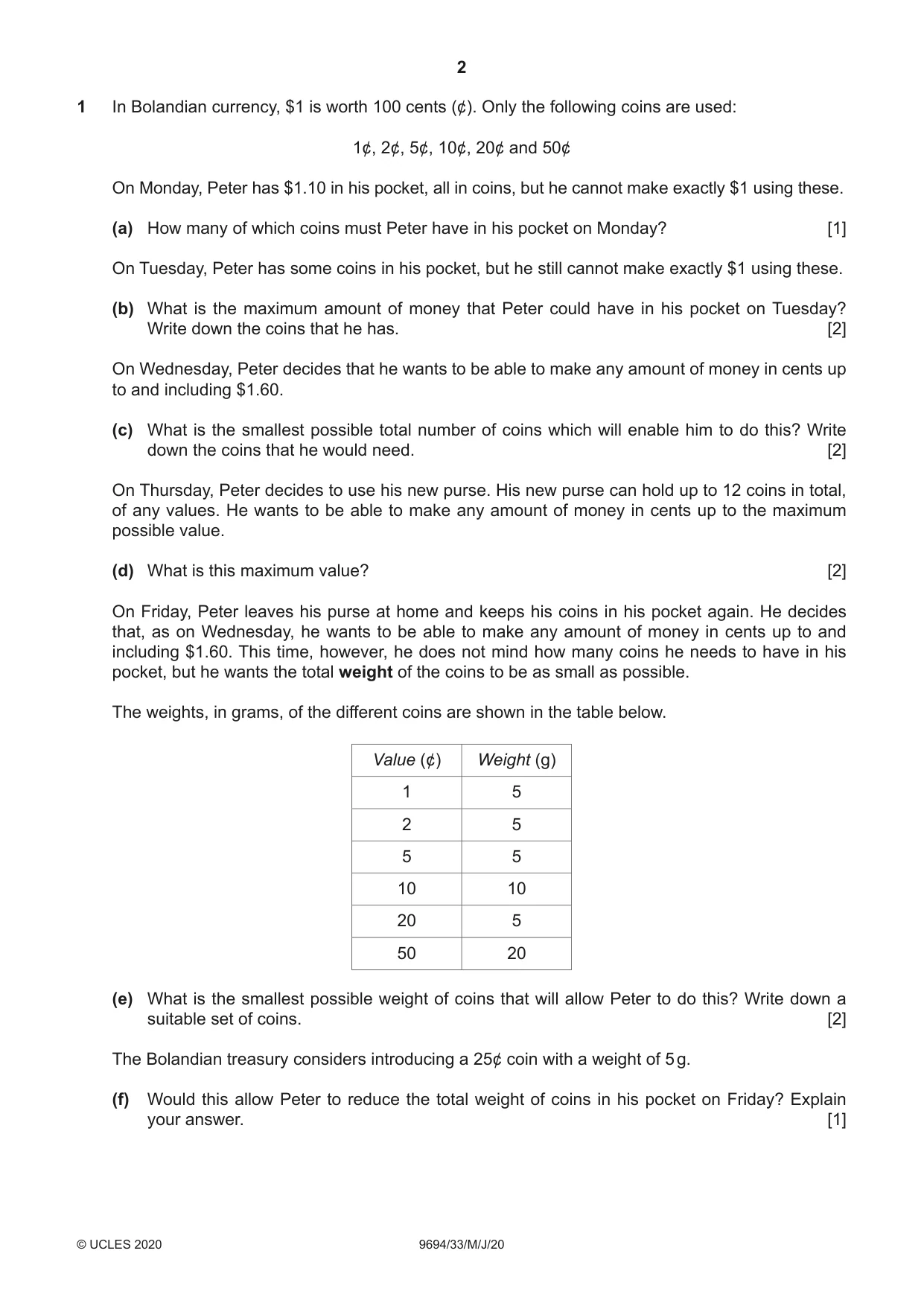
1 In Bolandian currency, $1 is worth 100 cents (¢). Only the following coins are used: 1¢, 2¢, 5¢, 10¢, 20¢ and 50¢ On Monday, Peter has $1.10 in his pocket, all in coins, but he cannot make exactly $1 using these. (a) How many of which coins must Peter have in his pocket on Monday? [1] On Tuesday, Peter has some coins in his pocket, but he still cannot make exactly $1 using these. (b) What is the maximum amount of money that Peter could have in his pocket on Tuesday? Write down the coins that he has. [2] On Wednesday, Peter decides that he wants to be able to make any amount of money in cents up to and including $1.60. (c) What is the smallest possible total number of coins which will enable him to do this? Write down the coins that he would need. [2] On Thursday, Peter decides to use his new purse. His new purse can hold up to 12 coins in total, of any values. He wants to be able to make any amount of money in cents up to the maximum possible value. (d) What is this maximum value? [2] On Friday, Peter leaves his purse at home and keeps his coins in his pocket again. He decides that, as on Wednesday, he wants to be able to make any amount of money in cents up to and including $1.60. This time, however, he does not mind how many coins he needs to have in his pocket, but he wants the total weight of the coins to be as small as possible. The weights, in grams, of the different coins are shown in the table below. Value (¢) Weight (g) 1 5 2 5 5 5 10 10 20 5 50 20 (e) What is the smallest possible weight of coins that will allow Peter to do this? Write down a suitable set of coins. [2] The Bolandian treasury considers introducing a 25¢ coin with a weight of 5 g. (f) Would this allow Peter to reduce the total weight of coins in his pocket on Friday? Explain your answer. [1] [Question 2 begins on the next page]
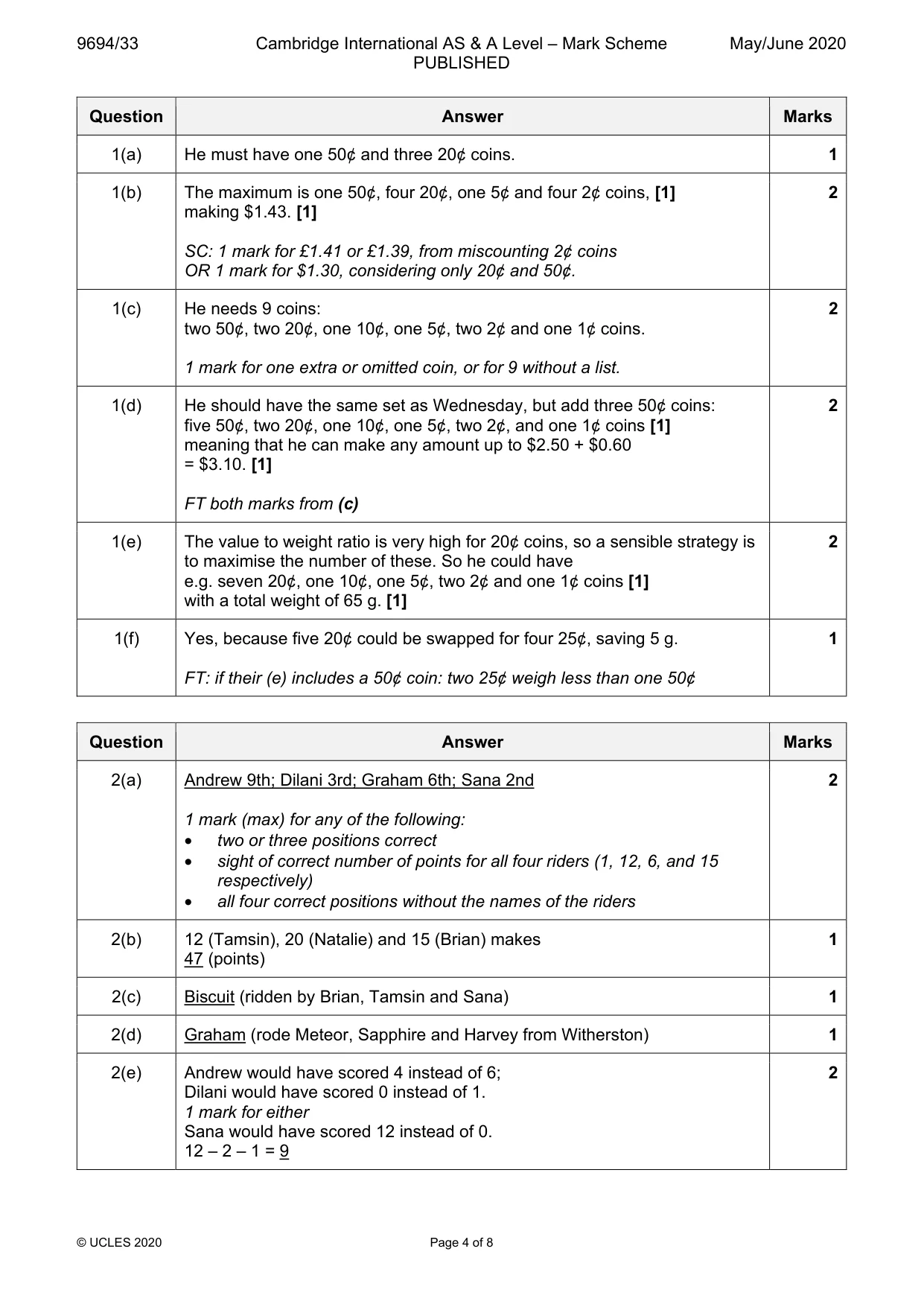
Mark scheme: Question Answer Marks 1(a) He must have one 50¢ and three 20¢ coins. 1 1(b) The maximum is one 50¢, four 20¢, one 5¢ and four 2¢ coins, [1] 2 making $1.43. [1] SC: 1 mark for £1.41 or £1.39, from miscounting 2¢ coins OR 1 mark for $1.30, considering only 20¢ and 50¢. 1(c) He needs 9 coins: 2 two 50¢, two 20¢, one 10¢, one 5¢, two 2¢ and one 1¢ coins. 1 mark for one extra or omitted coin, or for 9 without a list. 1(d) He should have the same set as Wednesday, but add three 50¢ coins: 2 five 50¢, two 20¢, one 10¢, one 5¢, two 2¢, and one 1¢ coins [1] meaning that he can make any amount up to $2.50 + $0.60 = $3.10. [1] FT both marks from (c) 1(e) The value to weight ratio is very high for 20¢ coins, so a sensible strategy is 2 to maximise the number of these. So he could have e.g. seven 20¢, one 10¢, one 5¢, two 2¢ and one 1¢ coins [1] with a total weight of 65 g. [1] 1(f) Yes, because five 20¢ could be swapped for four 25¢, saving 5 g. 1 FT: if their (e) includes a 50¢ coin: two 25¢ weigh less than one 50¢
More questions on Perform appropriate operations with information
Q2 · Every year at the two-day Chevalier Horse Show teams of four riders from Frogford…
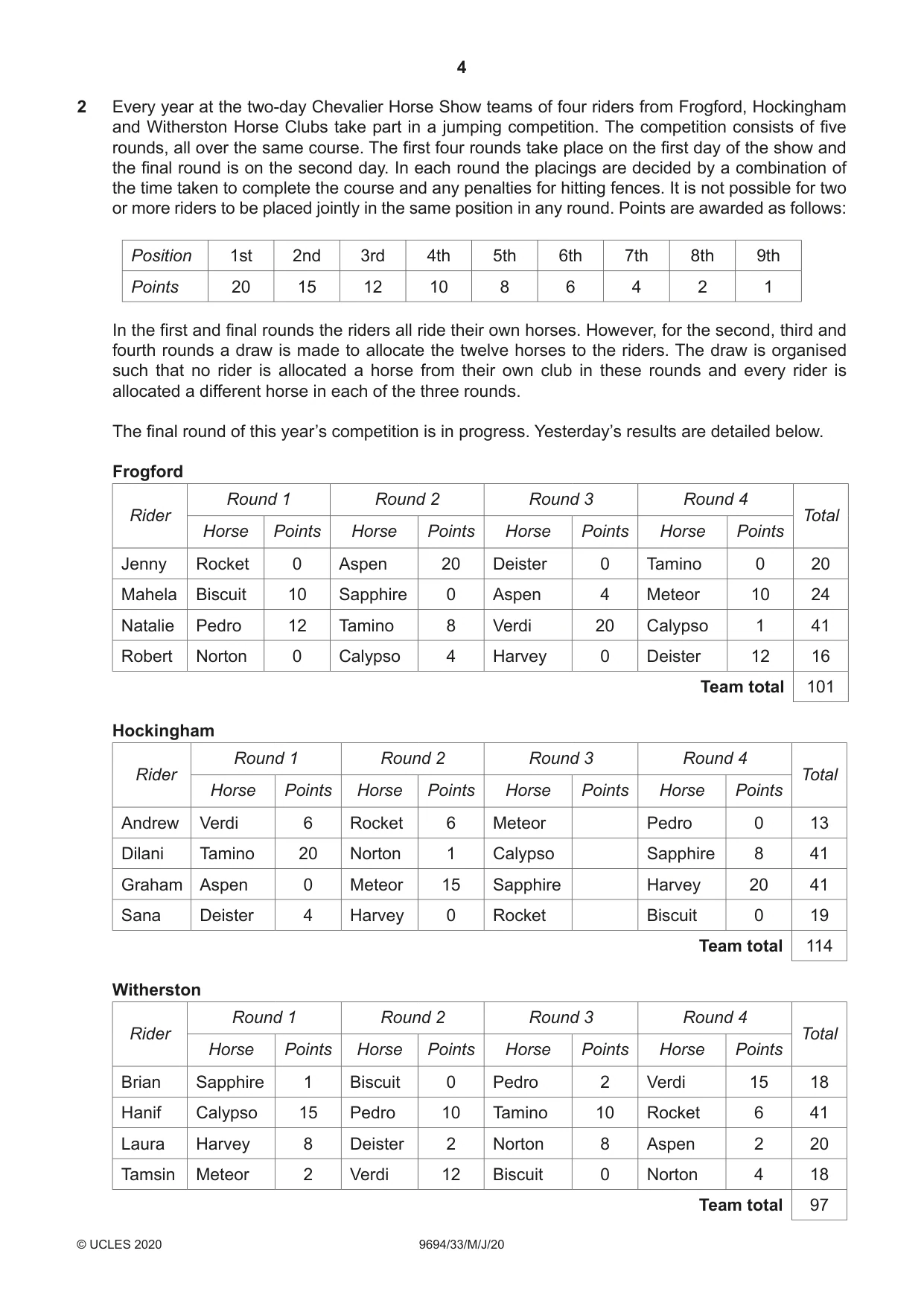
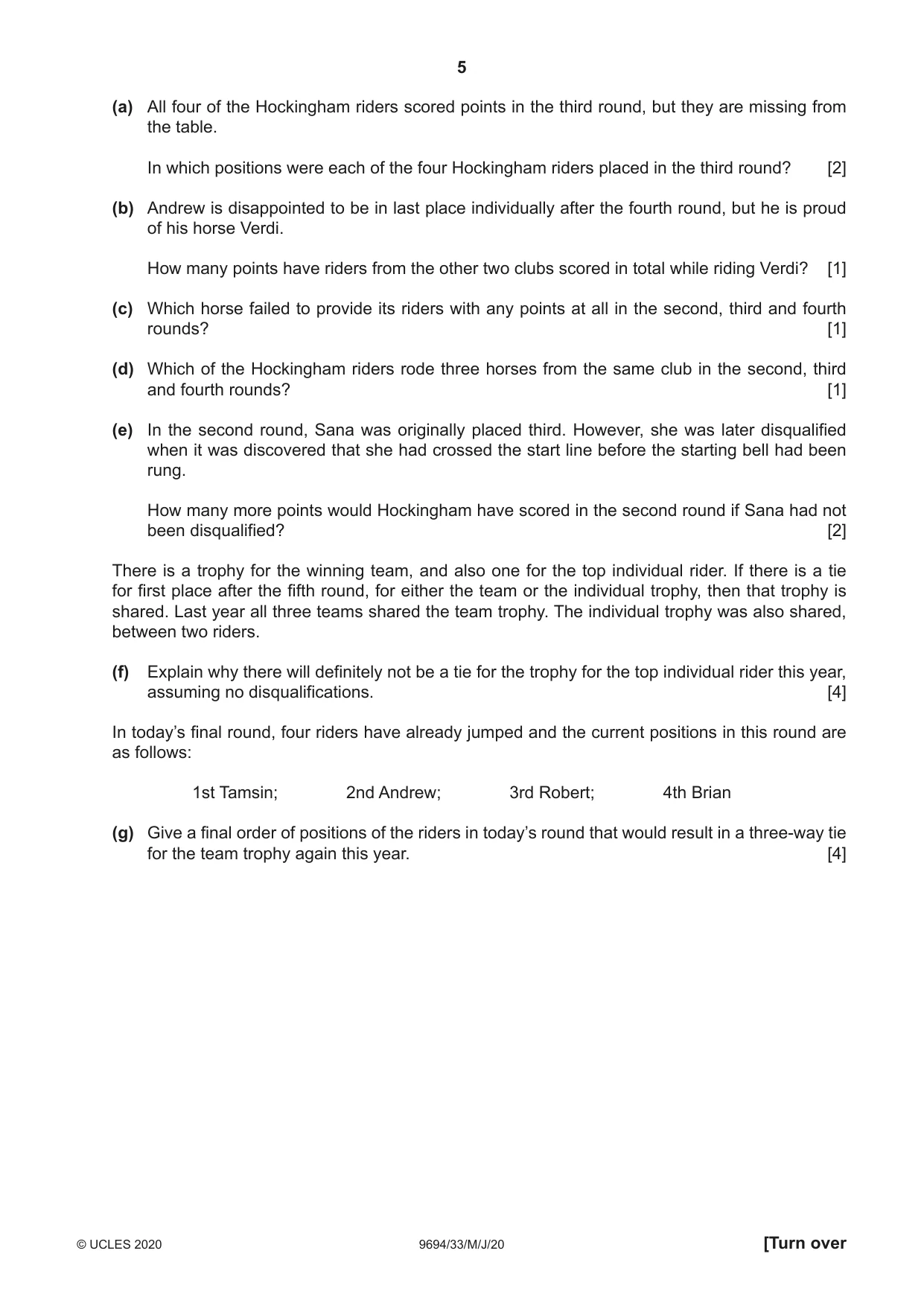
2 Every year at the two-day Chevalier Horse Show teams of four riders from Frogford, Hockingham and Witherston Horse Clubs take part in a jumping competition. The competition consists of five rounds, all over the same course. The first four rounds take place on the first day of the show and the final round is on the second day. In each round the placings are decided by a combination of the time taken to complete the course and any penalties for hitting fences. It is not possible for two or more riders to be placed jointly in the same position in any round. Points are awarded as follows: Position 1st 2nd 3rd 4th 5th 6th 7th 8th 9th Points 20 15 12 10 8 6 4 2 1 In the first and final rounds the riders all ride their own horses. However, for the second, third and fourth rounds a draw is made to allocate the twelve horses to the riders. The draw is organised such that no rider is allocated a horse from their own club in these rounds and every rider is allocated a different horse in each of the three rounds. The final round of this year’s competition is in progress. Yesterday’s results are detailed below. Frogford Round 1 Round 2 Round 3 Round 4 Rider Total Horse Points Horse Points Horse Points Horse Points Jenny Rocket 0 Aspen 20 Deister 0 Tamino 0 20 Mahela Biscuit 10 Sapphire 0 Aspen 4 Meteor 10 24 Natalie Pedro 12 Tamino 8 Verdi 20 Calypso 1 41 Robert Norton 0 Calypso 4 Harvey 0 Deister 12 16 Team total 101 Hockingham Round 1 Round 2 Round 3 Round 4 Rider Total Horse Points Horse Points Horse Points Horse Points Andrew Verdi 6 Rocket 6 Meteor Pedro 0 13 Dilani Tamino 20 Norton 1 Calypso Sapphire 8 41 Graham Aspen 0 Meteor 15 Sapphire Harvey 20 41 Sana Deister 4 Harvey 0 Rocket Biscuit 0 19 Team total 114 Witherston Round 1 Round 2 Round 3 Round 4 Rider Total Horse Points Horse Points Horse Points Horse Points Brian Sapphire 1 Biscuit 0 Pedro 2 Verdi 15 18 Hanif Calypso 15 Pedro 10 Tamino 10 Rocket 6 41 Laura Harvey 8 Deister 2 Norton 8 Aspen 2 20 Tamsin Meteor 2 Verdi 12 Biscuit 0 Norton 4 18 Team total 97 (a) All four of the Hockingham riders scored points in the third round, but they are missing from the table. In which positions were each of the four Hockingham riders placed in the third round? [2] (b) Andrew is disappointed to be in last place individually after the fourth round, but he is proud of his horse Verdi. How many points have riders from the other two clubs scored in total while riding Verdi? [1] (c) Which horse failed to provide its riders with any points at all in the second, third and fourth rounds? [1] (d) Which of the Hockingham riders rode three horses from the same club in the second, third and fourth rounds? [1] (e) In the second round, Sana was originally placed third. However, she was later disqualified when it was discovered that she had crossed the start line before the starting bell had been rung. How many more points would Hockingham have scored in the second round if Sana had not been disqualified? [2] There is a trophy for the winning team, and also one for the top individual rider. If there is a tie for first place after the fifth round, for either the team or the individual trophy, then that trophy is shared. Last year all three teams shared the team trophy. The individual trophy was also shared, between two riders. (f) Explain why there will definitely not be a tie for the trophy for the top individual rider this year, assuming no disqualifications. [4] In today’s final round, four riders have already jumped and the current positions in this round are as follows: 1st Tamsin; 2nd Andrew; 3rd Robert; 4th Brian (g) Give a final order of positions of the riders in today’s round that would result in a three-way tie for the team trophy again this year. [4]
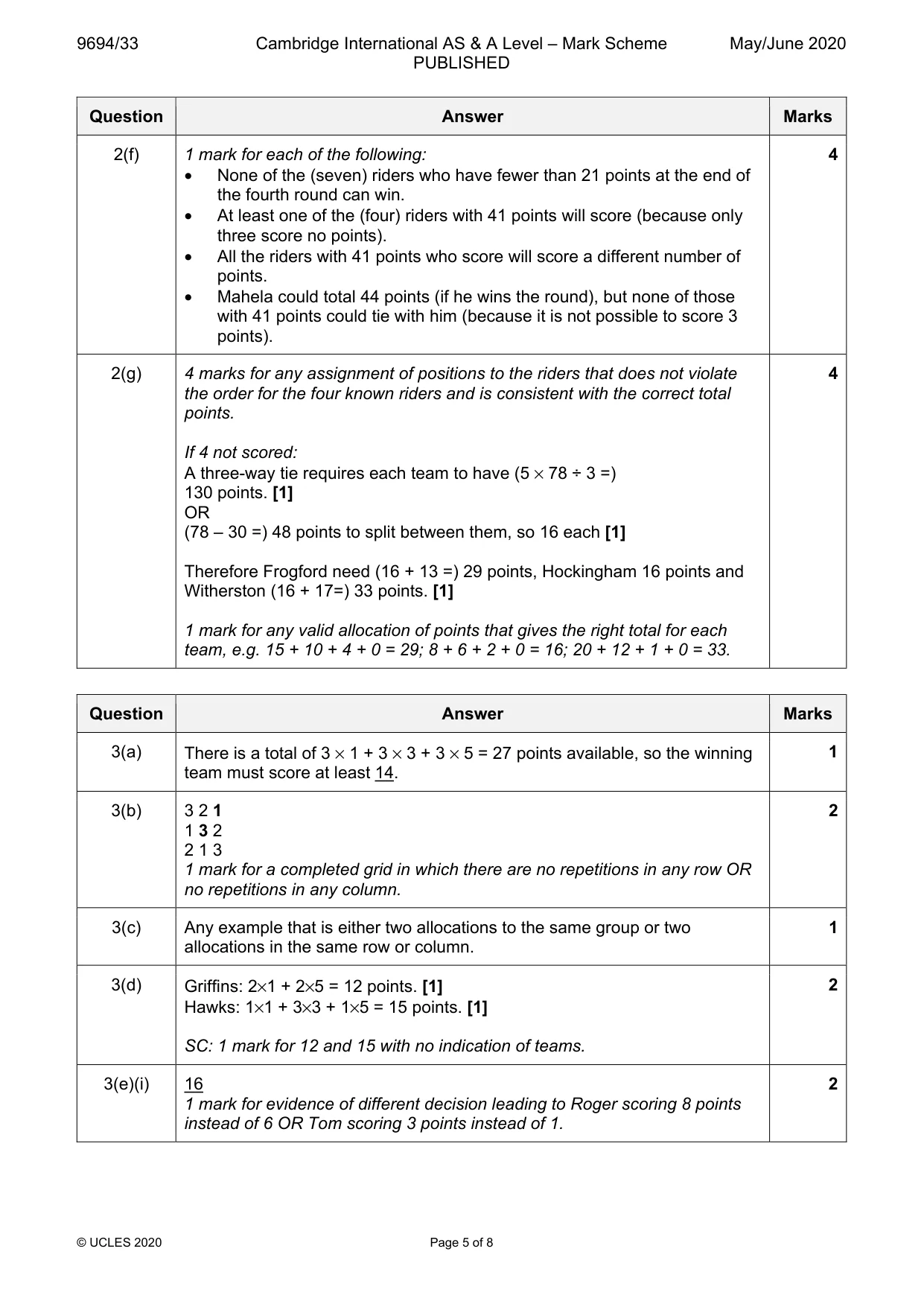
Mark scheme: 2(a) Andrew 9th; Dilani 3rd; Graham 6th; Sana 2nd 2 1 mark (max) for any of the following: • two or three positions correct • sight of correct number of points for all four riders (1, 12, 6, and 15 respectively) • all four correct positions without the names of the riders 2(b) 12 (Tamsin), 20 (Natalie) and 15 (Brian) makes 1 47 (points) 2(c) Biscuit (ridden by Brian, Tamsin and Sana) 1 2(d) Graham (rode Meteor, Sapphire and Harvey from Witherston) 1 2(e) Andrew would have scored 4 instead of 6; 2 Dilani would have scored 0 instead of 1. 1 mark for either Sana would have scored 12 instead of 0. 12 – 2 – 1 = 9 2(f) 1 mark for each of the following: 4 • None of the (seven) riders who have fewer than 21 points at the end of the fourth round can win. • At least one of the (four) riders with 41 points will score (because only three score no points). • All the riders with 41 points who score will score a different number of points. • Mahela could total 44 points (if he wins the round), but none of those with 41 points could tie with him (because it is not possible to score 3 points). 2(g) 4 marks for any assignment of positions to the riders that does not violate 4 the order for the four known riders and is consistent with the correct total points. If 4 not scored: A three-way tie requires each team to have (5 × 78 ÷ 3 =) 130 points. [1] OR (78 – 30 =) 48 points to split between them, so 16 each [1] Therefore Frogford need (16 + 13 =) 29 points, Hockingham 16 points and Witherston (16 + 17=) 33 points. [1] 1 mark for any valid allocation of points that gives the right total for each team, e.g. 15 + 10 + 4 + 0 = 29; 8 + 6 + 2 + 0 = 16; 20 + 12 + 1 + 0 = 33.
Q3 · Tridaw is a game played between 2 teams of 3 players
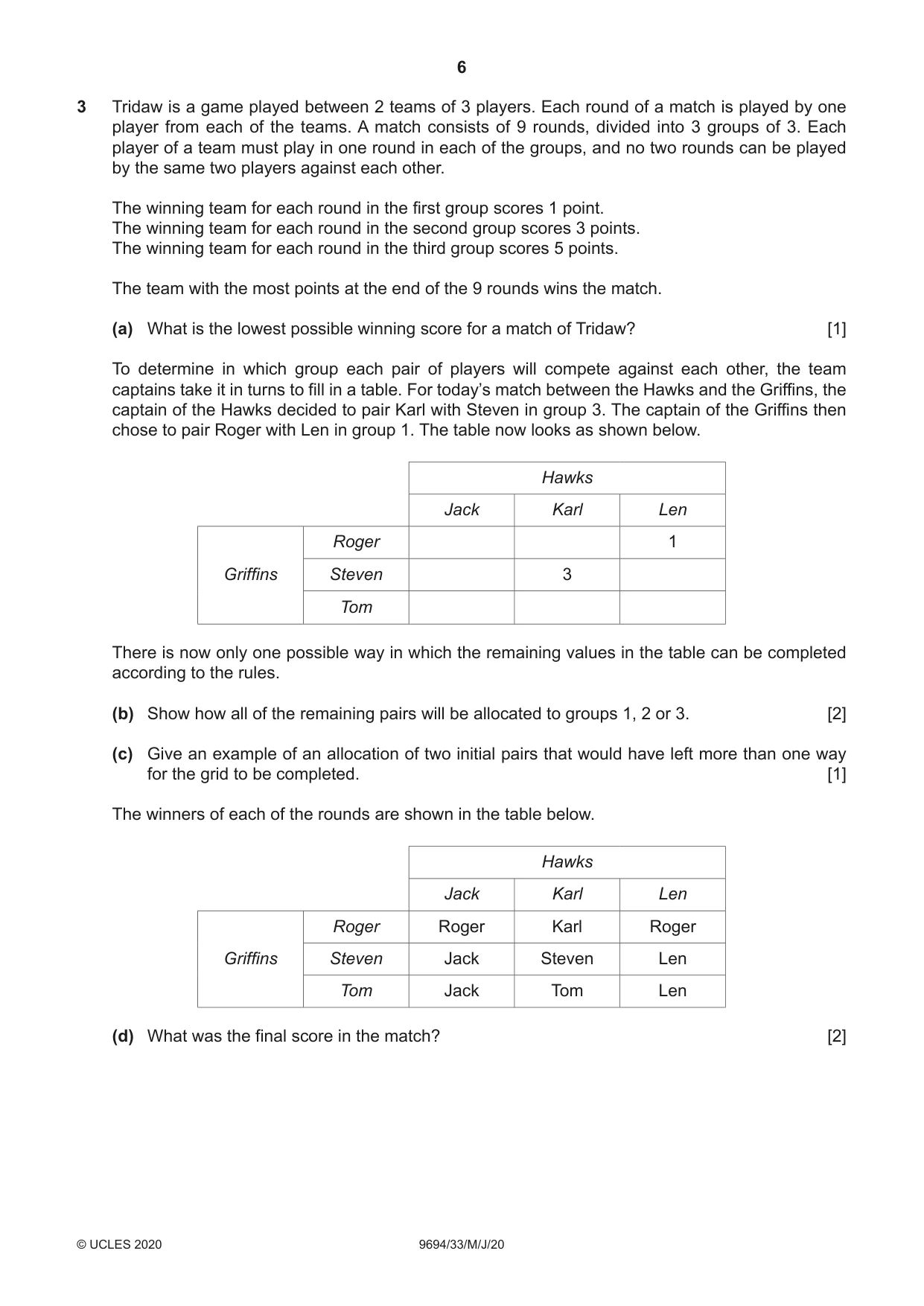
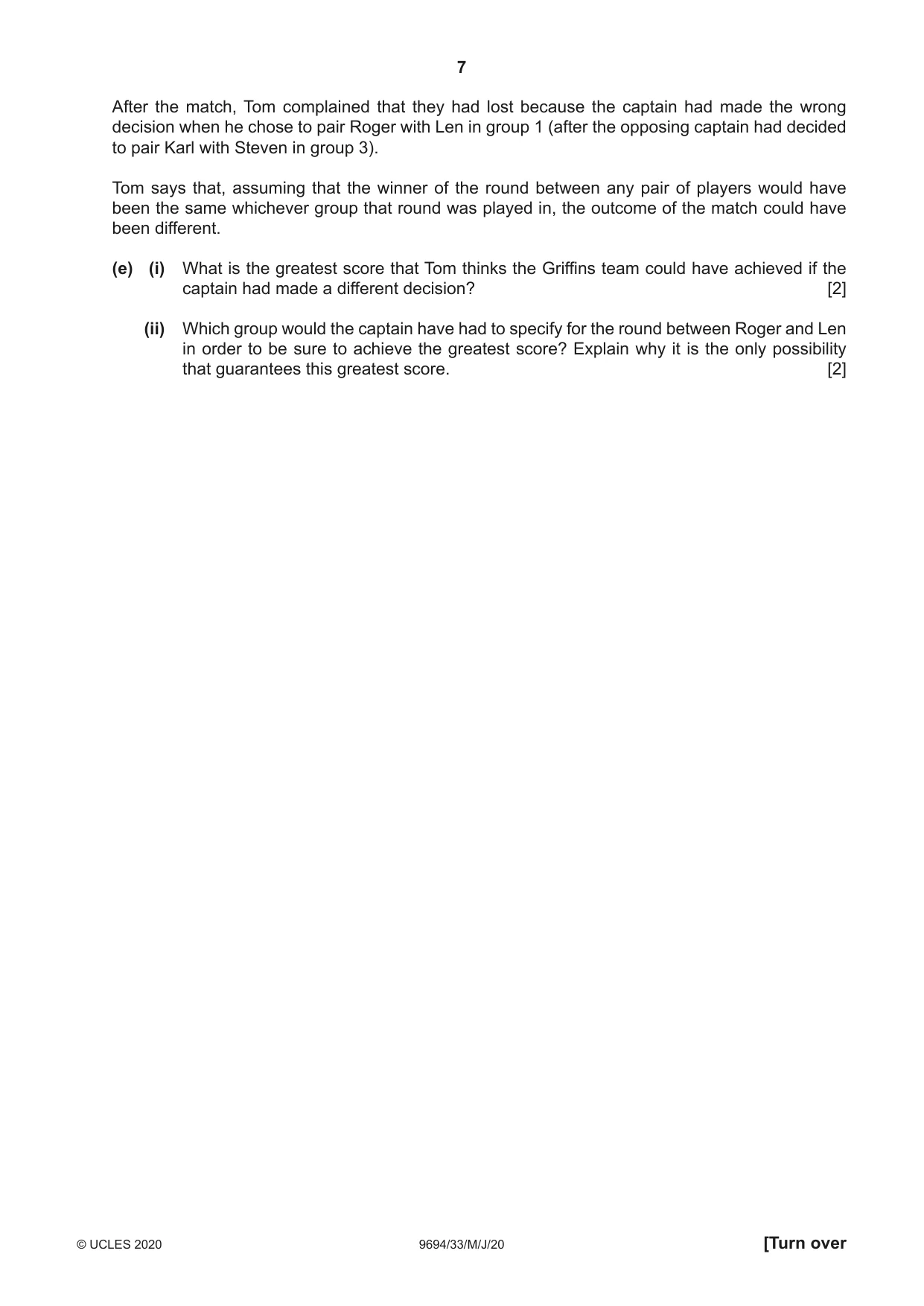
3 Tridaw is a game played between 2 teams of 3 players. Each round of a match is played by one player from each of the teams. A match consists of 9 rounds, divided into 3 groups of 3. Each player of a team must play in one round in each of the groups, and no two rounds can be played by the same two players against each other. The winning team for each round in the first group scores 1 point. The winning team for each round in the second group scores 3 points. The winning team for each round in the third group scores 5 points. The team with the most points at the end of the 9 rounds wins the match. (a) What is the lowest possible winning score for a match of Tridaw? [1] To determine in which group each pair of players will compete against each other, the team captains take it in turns to fill in a table. For today’s match between the Hawks and the Griffins, the captain of the Hawks decided to pair Karl with Steven in group 3. The captain of the Griffins then chose to pair Roger with Len in group 1. The table now looks as shown below. Hawks Jack Karl Len Roger 1 Griffins Steven 3 Tom There is now only one possible way in which the remaining values in the table can be completed according to the rules. (b) Show how all of the remaining pairs will be allocated to groups 1, 2 or 3. [2] (c) Give an example of an allocation of two initial pairs that would have left more than one way for the grid to be completed. [1] The winners of each of the rounds are shown in the table below. Hawks Jack Karl Len Roger Roger Karl Roger Griffins Steven Jack Steven Len Tom Jack Tom Len (d) What was the final score in the match? [2] After the match, Tom complained that they had lost because the captain had made the wrong decision when he chose to pair Roger with Len in group 1 (after the opposing captain had decided to pair Karl with Steven in group 3). Tom says that, assuming that the winner of the round between any pair of players would have been the same whichever group that round was played in, the outcome of the match could have been different. (e) (i) What is the greatest score that Tom thinks the Griffins team could have achieved if the captain had made a different decision? [2] (ii) Which group would the captain have had to specify for the round between Roger and Len in order to be sure to achieve the greatest score? Explain why it is the only possibility that guarantees this greatest score. [2]
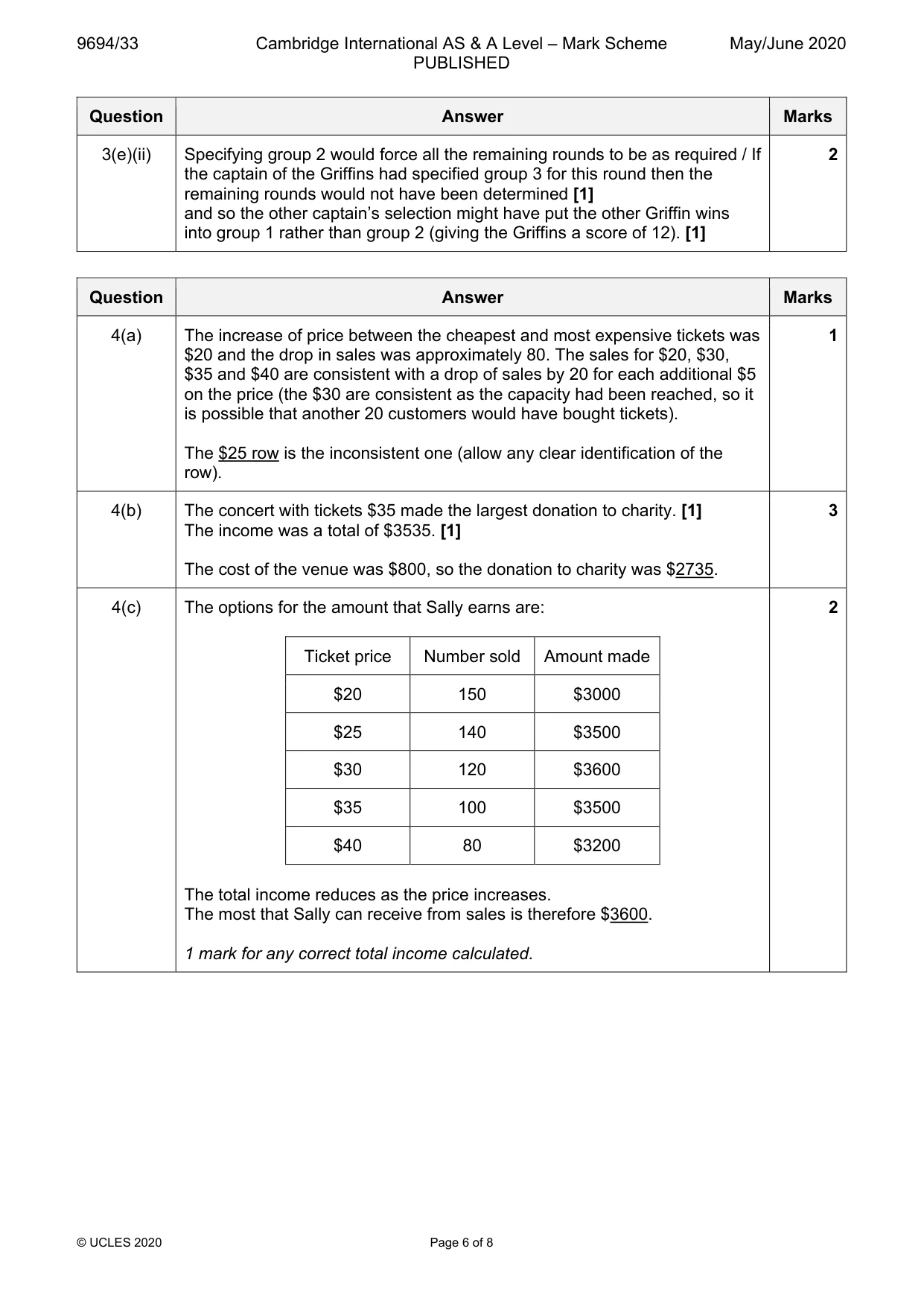
Mark scheme: 3(a) There is a total of 3 × 1 + 3 × 3 + 3 × 5 = 27 points available, so the winning 1 team must score at least 14. 3(b) 3 2 1 2 1 3 2 2 1 3 1 mark for a completed grid in which there are no repetitions in any row OR no repetitions in any column. 3(c) Any example that is either two allocations to the same group or two 1 allocations in the same row or column. 3(d) Griffins: 2×1 + 2×5 = 12 points. [1] 2 Hawks: 1×1 + 3×3 + 1×5 = 15 points. [1] SC: 1 mark for 12 and 15 with no indication of teams. 3(e)(i) 16 2 1 mark for evidence of different decision leading to Roger scoring 8 points instead of 6 OR Tom scoring 3 points instead of 1. 3(e)(ii) Specifying group 2 would force all the remaining rounds to be as required / If 2 the captain of the Griffins had specified group 3 for this round then the remaining rounds would not have been determined [1] and so the other captain’s selection might have put the other Griffin wins into group 1 rather than group 2 (giving the Griffins a score of 12). [1]
Q4 · Sally is organising a charity concert next month
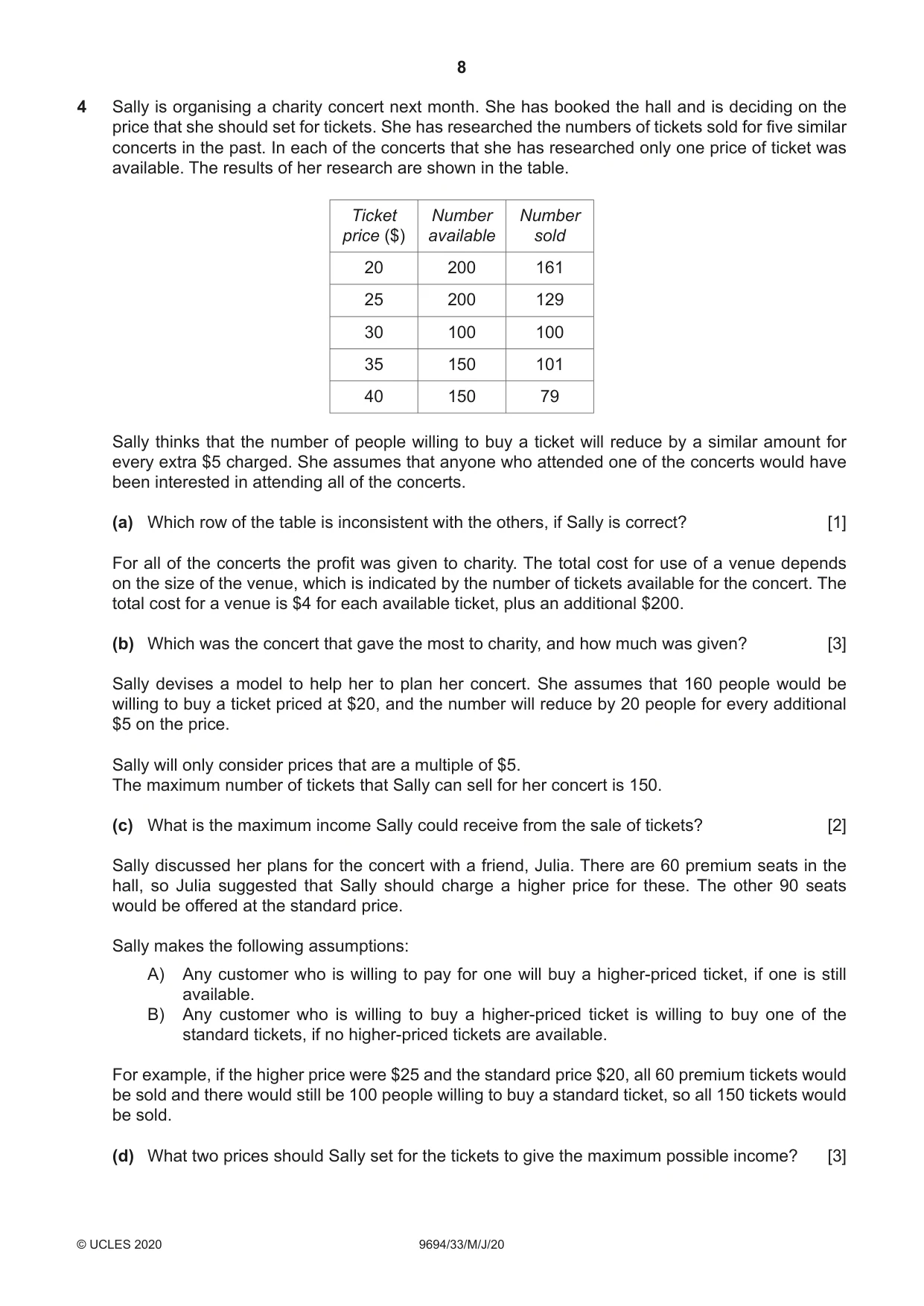
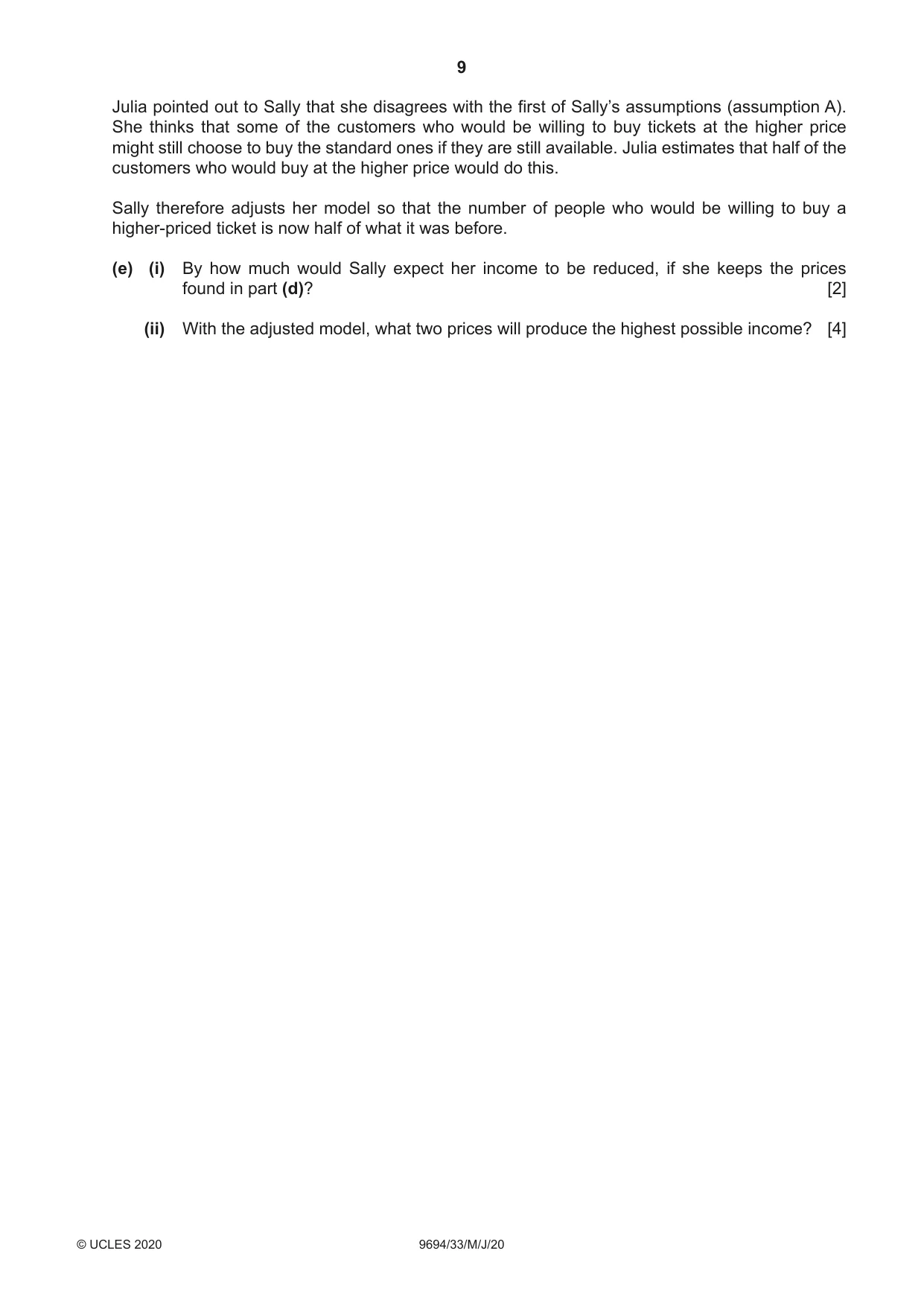
4 Sally is organising a charity concert next month. She has booked the hall and is deciding on the price that she should set for tickets. She has researched the numbers of tickets sold for five similar concerts in the past. In each of the concerts that she has researched only one price of ticket was available. The results of her research are shown in the table. Ticket Number Number price ($) available sold 20 200 161 25 200 129 30 100 100 35 150 101 40 150 79 Sally thinks that the number of people willing to buy a ticket will reduce by a similar amount for every extra $5 charged. She assumes that anyone who attended one of the concerts would have been interested in attending all of the concerts. (a) Which row of the table is inconsistent with the others, if Sally is correct? [1] For all of the concerts the profit was given to charity. The total cost for use of a venue depends on the size of the venue, which is indicated by the number of tickets available for the concert. The total cost for a venue is $4 for each available ticket, plus an additional $200. (b) Which was the concert that gave the most to charity, and how much was given? [3] Sally devises a model to help her to plan her concert. She assumes that 160 people would be willing to buy a ticket priced at $20, and the number will reduce by 20 people for every additional $5 on the price. Sally will only consider prices that are a multiple of $5. The maximum number of tickets that Sally can sell for her concert is 150. (c) What is the maximum income Sally could receive from the sale of tickets? [2] Sally discussed her plans for the concert with a friend, Julia. There are 60 premium seats in the hall, so Julia suggested that Sally should charge a higher price for these. The other 90 seats would be offered at the standard price. Sally makes the following assumptions: A) Any customer who is willing to pay for one will buy a higher-priced ticket, if one is still available. B) Any customer who is willing to buy a higher-priced ticket is willing to buy one of the standard tickets, if no higher-priced tickets are available. For example, if the higher price were $25 and the standard price $20, all 60 premium tickets would be sold and there would still be 100 people willing to buy a standard ticket, so all 150 tickets would be sold. (d) What two prices should Sally set for the tickets to give the maximum possible income? [3] Julia pointed out to Sally that she disagrees with the first of Sally’s assumptions (assumption A). She thinks that some of the customers who would be willing to buy tickets at the higher price might still choose to buy the standard ones if they are still available. Julia estimates that half of the customers who would buy at the higher price would do this. Sally therefore adjusts her model so that the number of people who would be willing to buy a higher-priced ticket is now half of what it was before. (e) (i) By how much would Sally expect her income to be reduced, if she keeps the prices found in part (d)? [2] (ii) With the adjusted model, what two prices will produce the highest possible income? [4]
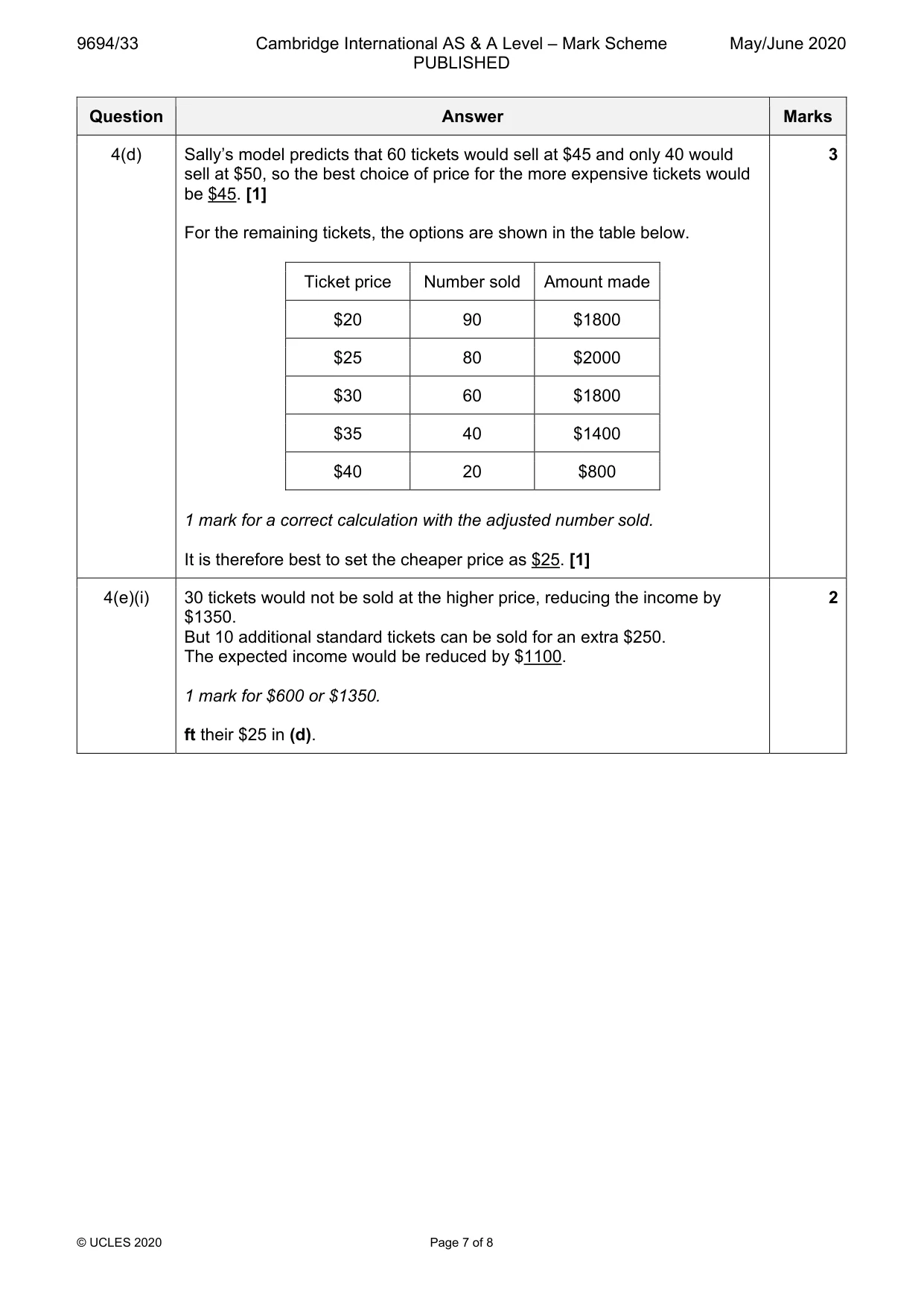
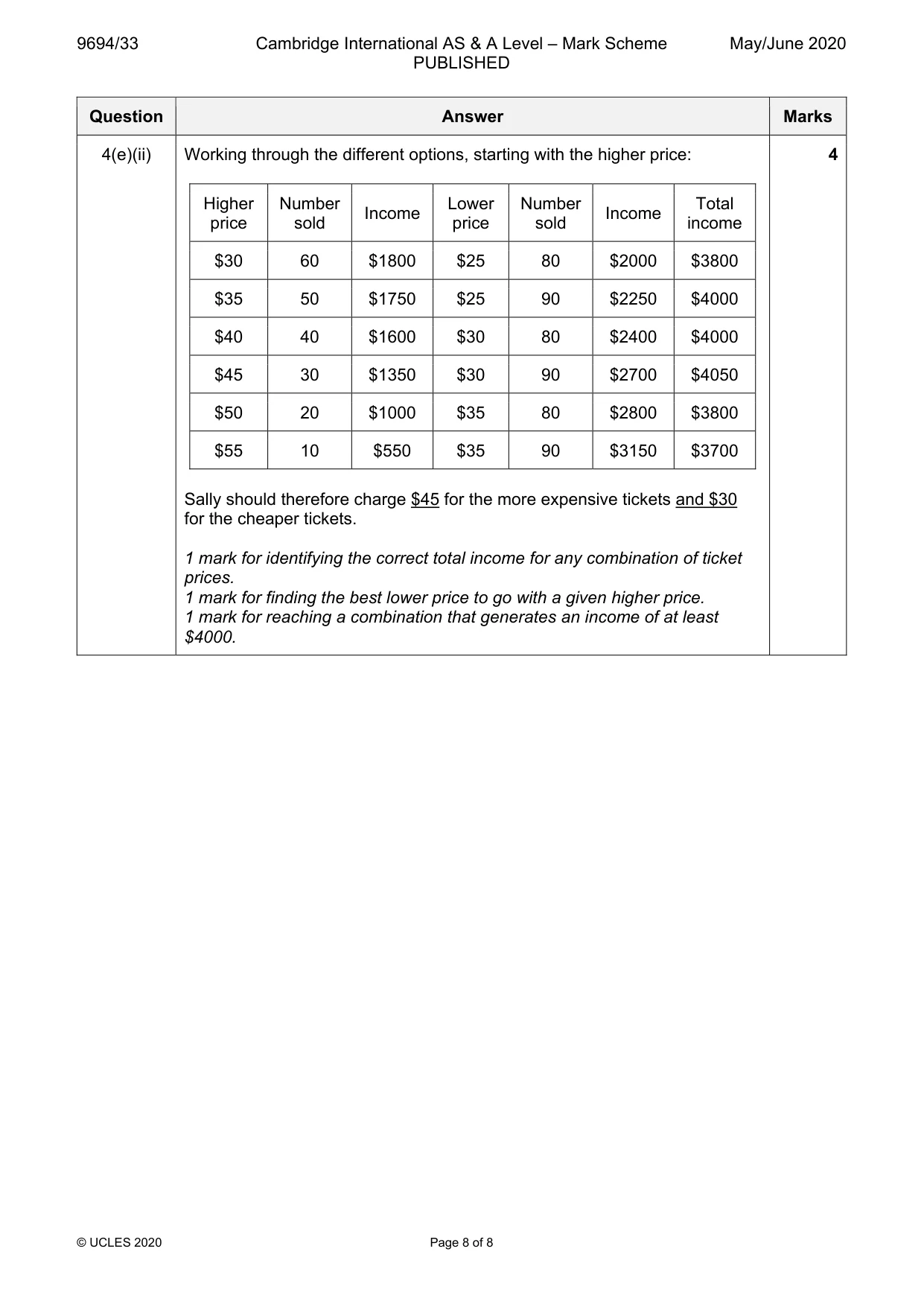
Mark scheme: 4(a) The increase of price between the cheapest and most expensive tickets was 1 $20 and the drop in sales was approximately 80. The sales for $20, $30, $35 and $40 are consistent with a drop of sales by 20 for each additional $5 on the price (the $30 are consistent as the capacity had been reached, so it is possible that another 20 customers would have bought tickets). The $25 row is the inconsistent one (allow any clear identification of the row). 4(b) The concert with tickets $35 made the largest donation to charity. [1] 3 The income was a total of $3535. [1] The cost of the venue was $800, so the donation to charity was $2735. 4(c) The options for the amount that Sally earns are: 2 Ticket price Number sold Amount made $20 150 $3000 $25 140 $3500 $30 120 $3600 $35 100 $3500 $40 80 $3200 The total income reduces as the price increases. The most that Sally can receive from sales is therefore $3600. 1 mark for any correct total income calculated. 4(d) Sally’s model predicts that 60 tickets would sell at $45 and only 40 would 3 sell at $50, so the best choice of price for the more expensive tickets would be $45. [1] For the remaining tickets, the options are shown in the table below. Ticket price Number sold Amount made $20 90 $1800 $25 80 $2000 $30 60 $1800 $35 40 $1400 $40 20 $800 1 mark for a correct calculation with the adjusted number sold. It is therefore best to set the cheaper price as $25. [1] 4(e)(i) 30 tickets would not be sold at the higher price, reducing the income by 2 $1350. But 10 additional standard tickets can be sold for an extra $250. The expected income would be reduced by $1100. 1 mark for $600 or $1350. ft their $25 in (d). 4(e)(ii) Working through the different options, starting with the higher price: 4 Higher Number Lower Number Total Income Income price sold price sold income $30 60 $1800 $25 80 $2000 $3800 $35 50 $1750 $25 90 $2250 $4000 $40 40 $1600 $30 80 $2400 $4000 $45 30 $1350 $30 90 $2700 $4050 $50 20 $1000 $35 80 $2800 $3800 $55 10 $550 $35 90 $3150 $3700 Sally should therefore charge $45 for the more expensive tickets and $30 for the cheaper tickets. 1 mark for identifying the correct total income for any combination of ticket prices. 1 mark for finding the best lower price to go with a given higher price. 1 mark for reaching a combination that generates an income of at least $4000.
More questions on Identify the impact of a change to a problem
What was in this paper
The subtopics covered by these 4 questions, and how many questions each got. Open one in a new tab to see every Cambridge question on it.