Cambridge A Level Thinking Skills 9694 — 2023 May/June Paper 3 · Variant 1
9694/31/M/J/23 · 4 questions · 50 marks · ≈56 min
The question paper and its mark scheme, free to read here and free to download. This is Cambridge’s own paper, exactly as it was sat.
Question paper8 pages

Mark scheme7 pages
Answers below. Sit the paper first if you are practising.
Questions as text
Q1 · OrienT-8 is a single-player game, played on a 10 × 10 grid displayed on the touch screen…
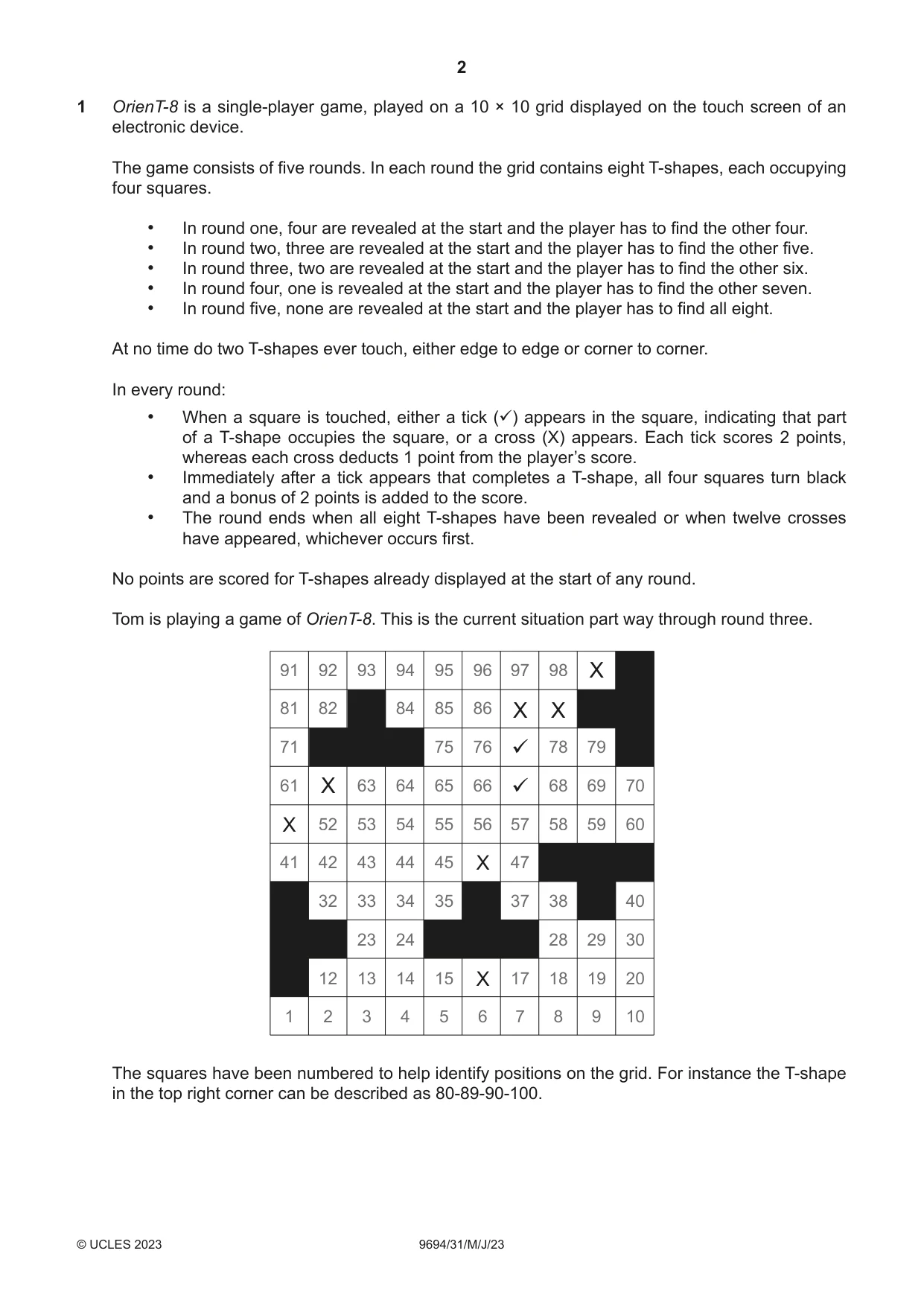
1 OrienT-8 is a single-player game, played on a 10 × 10 grid displayed on the touch screen of an electronic device. The game consists of five rounds. In each round the grid contains eight T-shapes, each occupying four squares. • In round one, four are revealed at the start and the player has to find the other four. • In round two, three are revealed at the start and the player has to find the other five. • In round three, two are revealed at the start and the player has to find the other six. • In round four, one is revealed at the start and the player has to find the other seven. • In round five, none are revealed at the start and the player has to find all eight. At no time do two T-shapes ever touch, either edge to edge or corner to corner. In every round: • When a square is touched, either a tick (ü) appears in the square, indicating that part of a T-shape occupies the square, or a cross (X) appears. Each tick scores 2 points, whereas each cross deducts 1 point from the player’s score. • Immediately after a tick appears that completes a T-shape, all four squares turn black and a bonus of 2 points is added to the score. • The round ends when all eight T-shapes have been revealed or when twelve crosses have appeared, whichever occurs first. No points are scored for T-shapes already displayed at the start of any round. Tom is playing a game of OrienT-8. This is the current situation part way through round three. 91 92 93 94 95 96 97 98 X 81 82 84 85 86 X X 71 75 76 ü 78 79 61 X 63 64 65 66 ü 68 69 70 X 52 53 54 55 56 57 58 59 60 41 42 43 44 45 X 47 32 33 34 35 37 38 40 23 24 28 29 30 12 13 14 15 X 17 18 19 20 1 2 3 4 5 6 7 8 9 10 The squares have been numbered to help identify positions on the grid. For instance the T-shape in the top right corner can be described as 80-89-90-100. Tom has completed both of the first two rounds without any crosses appearing at all. He knows that he can complete this round without any further crosses and he is hopeful that he can beat his previous best total score of 273. (a) How many squares has Tom touched so far this round? [2] (b) What is Tom’s total score at present? [2] (c) What evidence is there that 11-21-22-31 and 39-48-49-50 are the two T-shapes that were revealed at the start of round three? [1] (d) Give the numbers of the ten squares that Tom will touch to complete the last three T-shapes in this round. [3] (e) In order to register a new personal best score, what is the maximum number of crosses that can be revealed altogether in the last two rounds? [2]
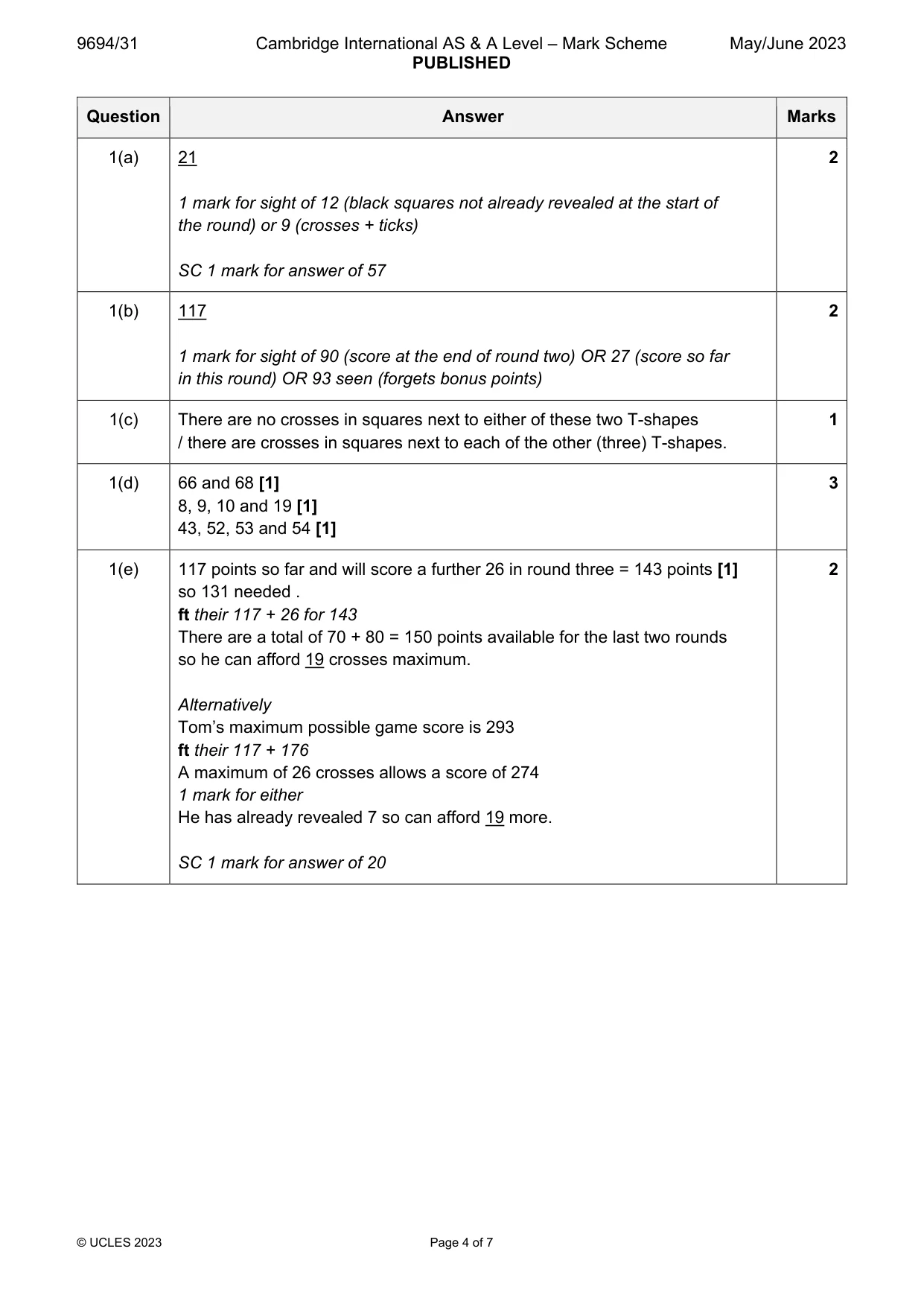
Mark scheme: Question Answer Marks 1(a) 21 2 1 mark for sight of 12 (black squares not already revealed at the start of the round) or 9 (crosses + ticks) SC 1 mark for answer of 57 1(b) 117 2 1 mark for sight of 90 (score at the end of round two) OR 27 (score so far in this round) OR 93 seen (forgets bonus points) 1(c) There are no crosses in squares next to either of these two T-shapes 1 / there are crosses in squares next to each of the other (three) T-shapes. 1(d) 66 and 68 [1] 3 8, 9, 10 and 19 [1] 43, 52, 53 and 54 [1] 1(e) 117 points so far and will score a further 26 in round three = 143 points [1] 2 so 131 needed . ft their 117 + 26 for 143 There are a total of 70 + 80 = 150 points available for the last two rounds so he can afford 19 crosses maximum. Alternatively Tom’s maximum possible game score is 293 ft their 117 + 176 A maximum of 26 crosses allows a score of 274 1 mark for either He has already revealed 7 so can afford 19 more. SC 1 mark for answer of 20
More questions on Perform appropriate operations with information
Q2 · A ‘three-legged race’ is a running event in which pairs of participants compete with the…
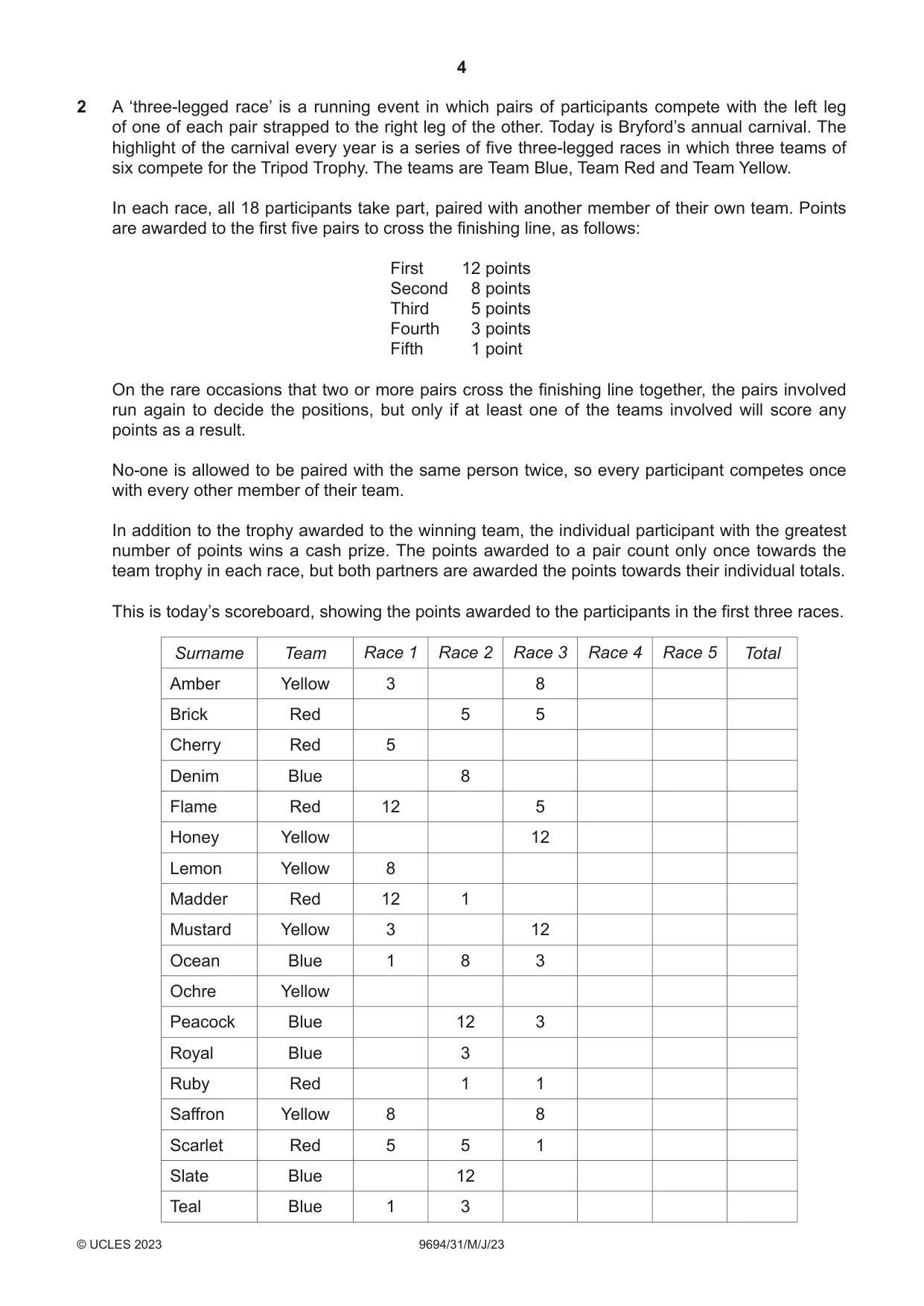
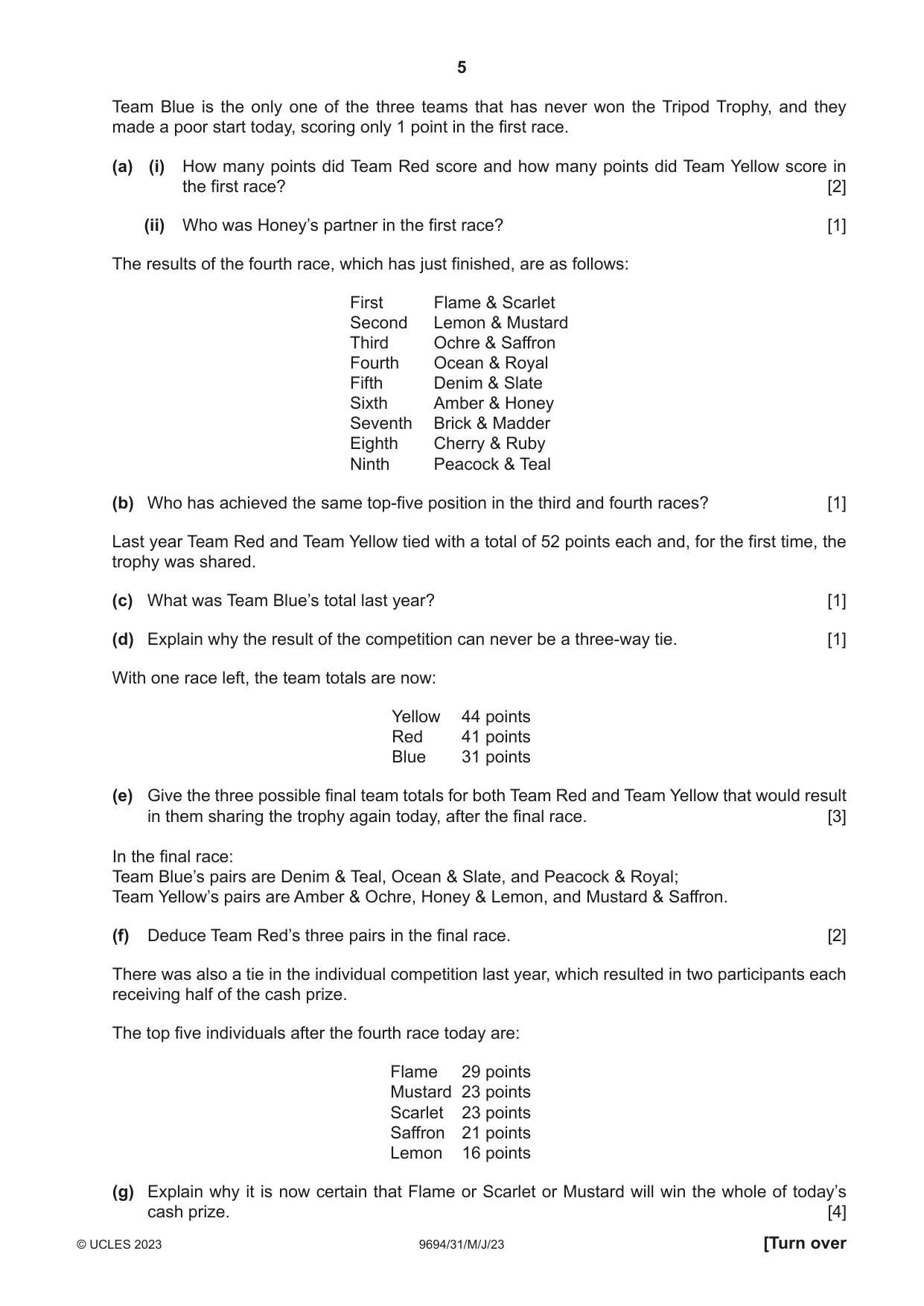
2 A ‘three-legged race’ is a running event in which pairs of participants compete with the left leg of one of each pair strapped to the right leg of the other. Today is Bryford’s annual carnival. The highlight of the carnival every year is a series of five three-legged races in which three teams of six compete for the Tripod Trophy. The teams are Team Blue, Team Red and Team Yellow. In each race, all 18 participants take part, paired with another member of their own team. Points are awarded to the first five pairs to cross the finishing line, as follows: First 12 points Second 8 points Third 5 points Fourth 3 points Fifth 1 point On the rare occasions that two or more pairs cross the finishing line together, the pairs involved run again to decide the positions, but only if at least one of the teams involved will score any points as a result. No-one is allowed to be paired with the same person twice, so every participant competes once with every other member of their team. In addition to the trophy awarded to the winning team, the individual participant with the greatest number of points wins a cash prize. The points awarded to a pair count only once towards the team trophy in each race, but both partners are awarded the points towards their individual totals. This is today’s scoreboard, showing the points awarded to the participants in the first three races. Surname Team Race 1 Race 2 Race 3 Race 4 Race 5 Total Amber Yellow 3 8 Brick Red 5 5 Cherry Red 5 Denim Blue 8 Flame Red 12 5 Honey Yellow 12 Lemon Yellow 8 Madder Red 12 1 Mustard Yellow 3 12 Ocean Blue 1 8 3 Ochre Yellow Peacock Blue 12 3 Royal Blue 3 Ruby Red 1 1 Saffron Yellow 8 8 Scarlet Red 5 5 1 Slate Blue 12 Teal Blue 1 3 Team Blue is the only one of the three teams that has never won the Tripod Trophy, and they made a poor start today, scoring only 1 point in the first race. (a) (i) How many points did Team Red score and how many points did Team Yellow score in the first race? [2] (ii) Who was Honey’s partner in the first race? [1] The results of the fourth race, which has just finished, are as follows: First Flame & Scarlet Second Lemon & Mustard Third Ochre & Saffron Fourth Ocean & Royal Fifth Denim & Slate Sixth Amber & Honey Seventh Brick & Madder Eighth Cherry & Ruby Ninth Peacock & Teal (b) Who has achieved the same top-five position in the third and fourth races? [1] Last year Team Red and Team Yellow tied with a total of 52 points each and, for the first time, the trophy was shared. (c) What was Team Blue’s total last year? [1] (d) Explain why the result of the competition can never be a three-way tie. [1] With one race left, the team totals are now: Yellow 44 points Red 41 points Blue 31 points (e) Give the three possible final team totals for both Team Red and Team Yellow that would result in them sharing the trophy again today, after the final race. [3] In the final race: Team Blue’s pairs are Denim & Teal, Ocean & Slate, and Peacock & Royal; Team Yellow’s pairs are Amber & Ochre, Honey & Lemon, and Mustard & Saffron. (f) Deduce Team Red’s three pairs in the final race. [2] There was also a tie in the individual competition last year, which resulted in two participants each receiving half of the cash prize. The top five individuals after the fourth race today are: Flame 29 points Mustard 23 points Scarlet 23 points Saffron 21 points Lemon 16 points (g) Explain why it is now certain that Flame or Scarlet or Mustard will win the whole of today’s cash prize. [4]
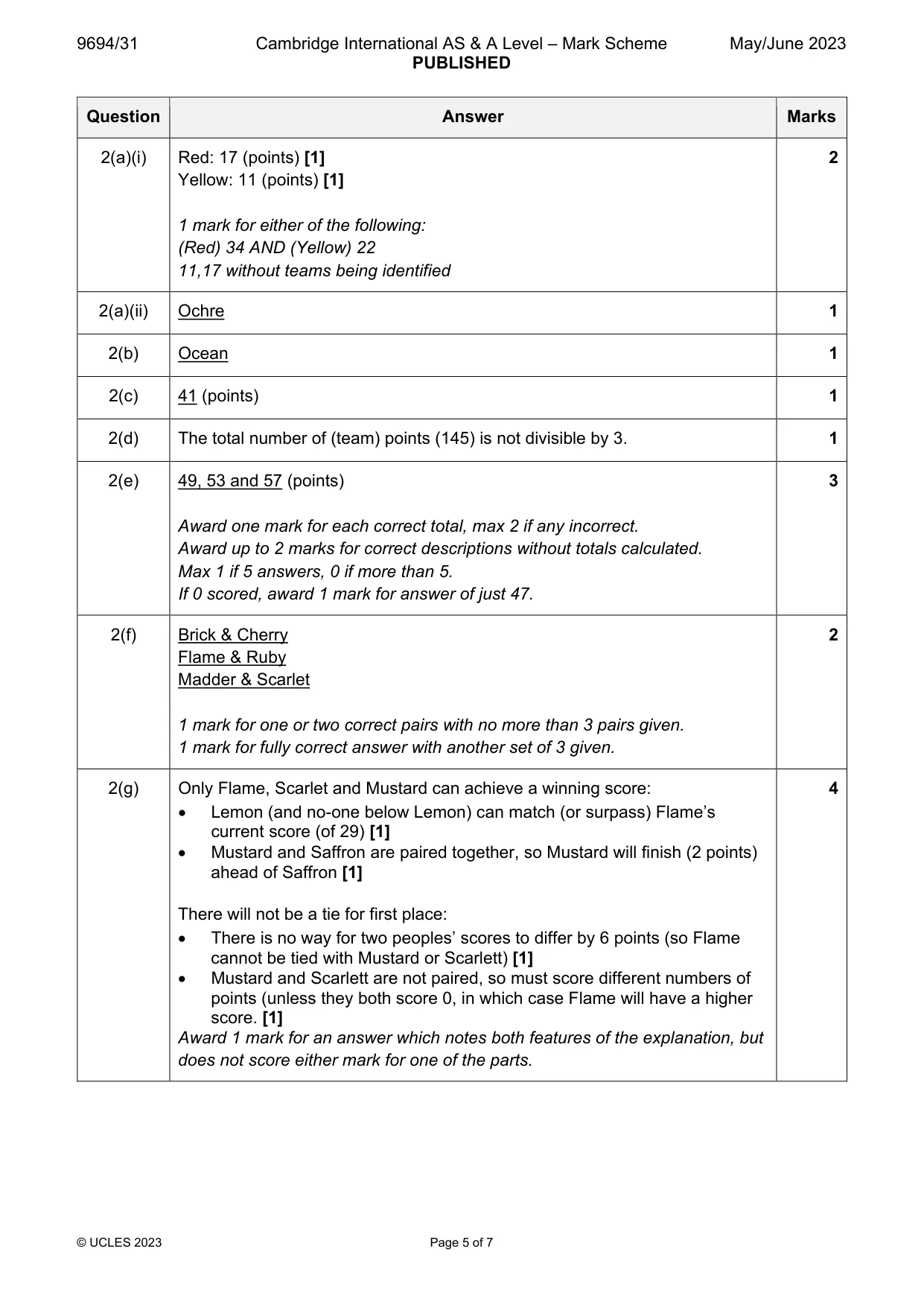
Mark scheme: 2(a)(i) Red: 17 (points) [1] 2 Yellow: 11 (points) [1] 1 mark for either of the following: (Red) 34 AND (Yellow) 22 11,17 without teams being identified 2(a)(ii) Ochre 1 2(b) Ocean 1 2(c) 41 (points) 1 2(d) The total number of (team) points (145) is not divisible by 3. 1 2(e) 49, 53 and 57 (points) 3 Award one mark for each correct total, max 2 if any incorrect. Award up to 2 marks for correct descriptions without totals calculated. Max 1 if 5 answers, 0 if more than 5. If 0 scored, award 1 mark for answer of just 47. 2(f) Brick & Cherry 2 Flame & Ruby Madder & Scarlet 1 mark for one or two correct pairs with no more than 3 pairs given. 1 mark for fully correct answer with another set of 3 given. 2(g) Only Flame, Scarlet and Mustard can achieve a winning score: 4 Lemon (and no-one below Lemon) can match (or surpass) Flame’s current score (of 29) [1] Mustard and Saffron are paired together, so Mustard will finish (2 points) ahead of Saffron [1] There will not be a tie for first place: There is no way for two peoples’ scores to differ by 6 points (so Flame cannot be tied with Mustard or Scarlett) [1] Mustard and Scarlett are not paired, so must score different numbers of points (unless they both score 0, in which case Flame will have a higher score. [1] Award 1 mark for an answer which notes both features of the explanation, but does not score either mark for one of the parts.
More questions on Perform appropriate operations with information
Q3 · In the political Assembly of Bolandia, there are 10 Representatives, one for each of the…
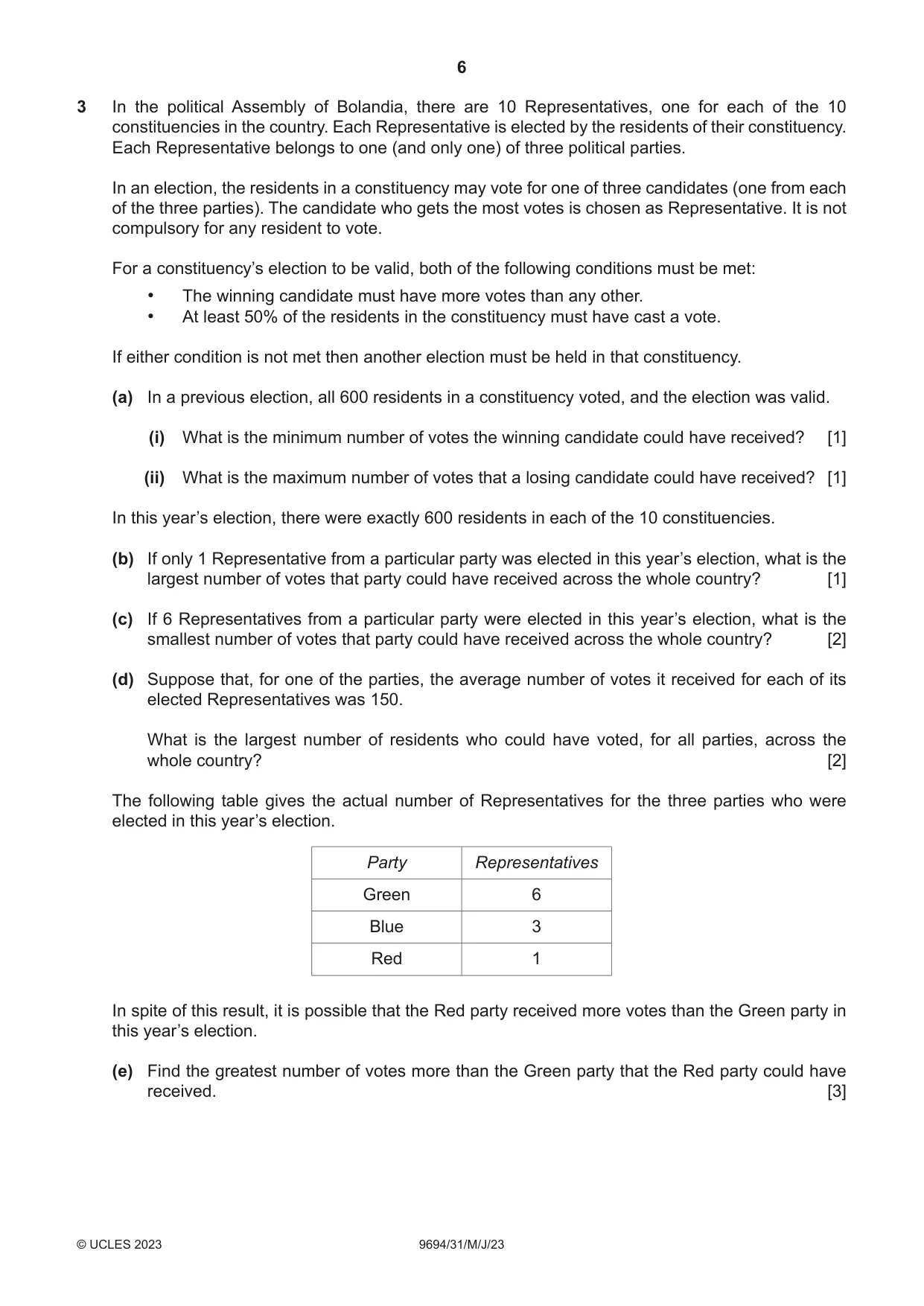
3 In the political Assembly of Bolandia, there are 10 Representatives, one for each of the 10 constituencies in the country. Each Representative is elected by the residents of their constituency. Each Representative belongs to one (and only one) of three political parties. In an election, the residents in a constituency may vote for one of three candidates (one from each of the three parties). The candidate who gets the most votes is chosen as Representative. It is not compulsory for any resident to vote. For a constituency’s election to be valid, both of the following conditions must be met: • The winning candidate must have more votes than any other. • At least 50% of the residents in the constituency must have cast a vote. If either condition is not met then another election must be held in that constituency. (a) In a previous election, all 600 residents in a constituency voted, and the election was valid. (i) What is the minimum number of votes the winning candidate could have received? [1] (ii) What is the maximum number of votes that a losing candidate could have received? [1] In this year’s election, there were exactly 600 residents in each of the 10 constituencies. (b) If only 1 Representative from a particular party was elected in this year’s election, what is the largest number of votes that party could have received across the whole country? [1] (c) If 6 Representatives from a particular party were elected in this year’s election, what is the smallest number of votes that party could have received across the whole country? [2] (d) Suppose that, for one of the parties, the average number of votes it received for each of its elected Representatives was 150. What is the largest number of residents who could have voted, for all parties, across the whole country? [2] The following table gives the actual number of Representatives for the three parties who were elected in this year’s election. Party Representatives Green 6 Blue 3 Red 1 In spite of this result, it is possible that the Red party received more votes than the Green party in this year’s election. (e) Find the greatest number of votes more than the Green party that the Red party could have received. [3]
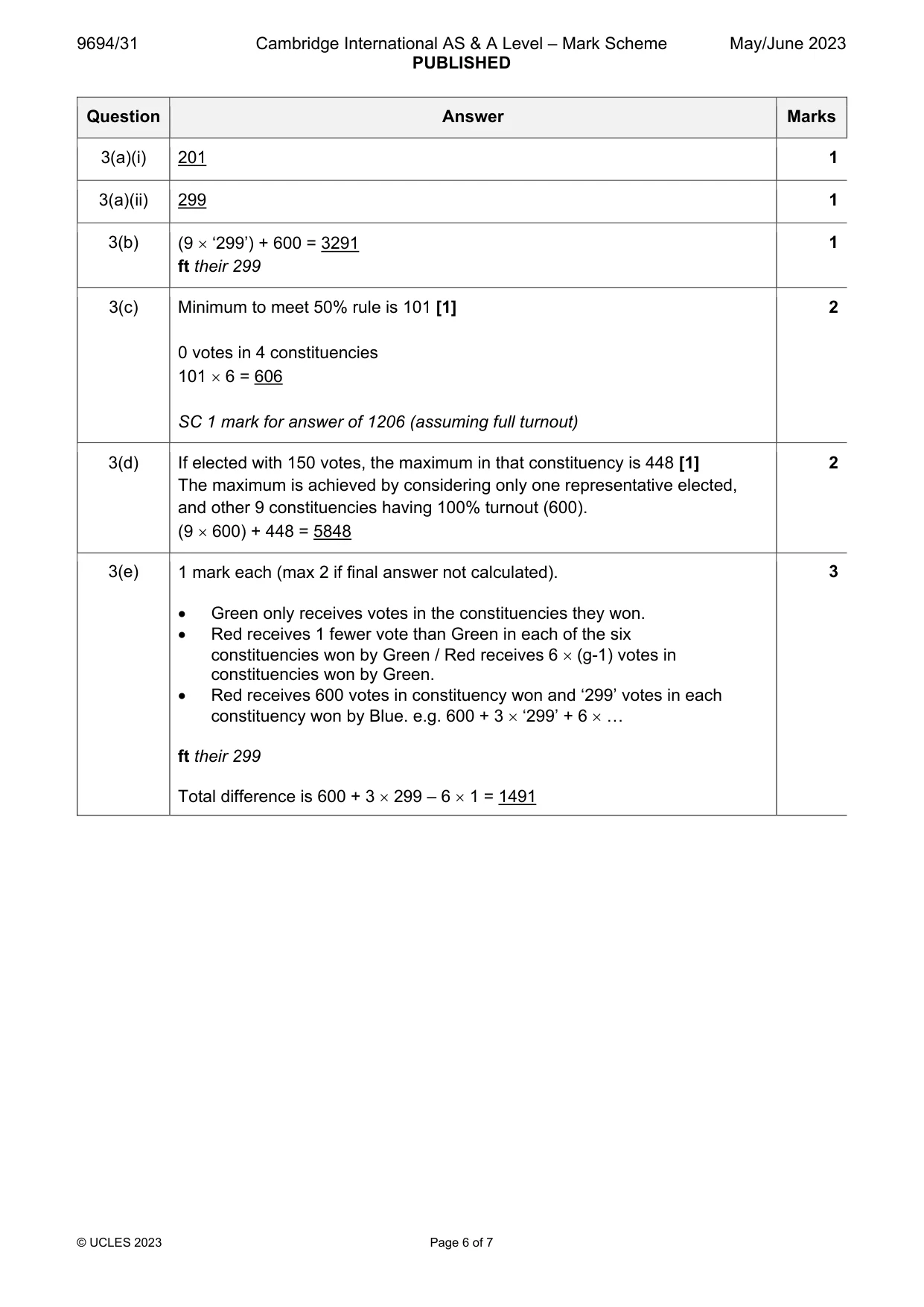
Mark scheme: 3(a)(i) 201 1 3(a)(ii) 299 1 3(b) (9 ‘299’) + 600 = 3291 1 ft their 299 3(c) Minimum to meet 50% rule is 101 [1] 2 0 votes in 4 constituencies 101 6 = 606 SC 1 mark for answer of 1206 (assuming full turnout) 3(d) If elected with 150 votes, the maximum in that constituency is 448 [1] 2 The maximum is achieved by considering only one representative elected, and other 9 constituencies having 100% turnout (600). (9 600) + 448 = 5848 3(e) 1 mark each (max 2 if final answer not calculated). 3 Green only receives votes in the constituencies they won. Red receives 1 fewer vote than Green in each of the six constituencies won by Green / Red receives 6 (g-1) votes in constituencies won by Green. Red receives 600 votes in constituency won and ‘299’ votes in each constituency won by Blue. e.g. 600 + 3 ‘299’ + 6 … ft their 299 Total difference is 600 + 3 299 – 6 1 = 1491
More questions on Perform appropriate operations with information
Q4 · Jane is responsible for ordering and installing 100 computers in an office for a new…
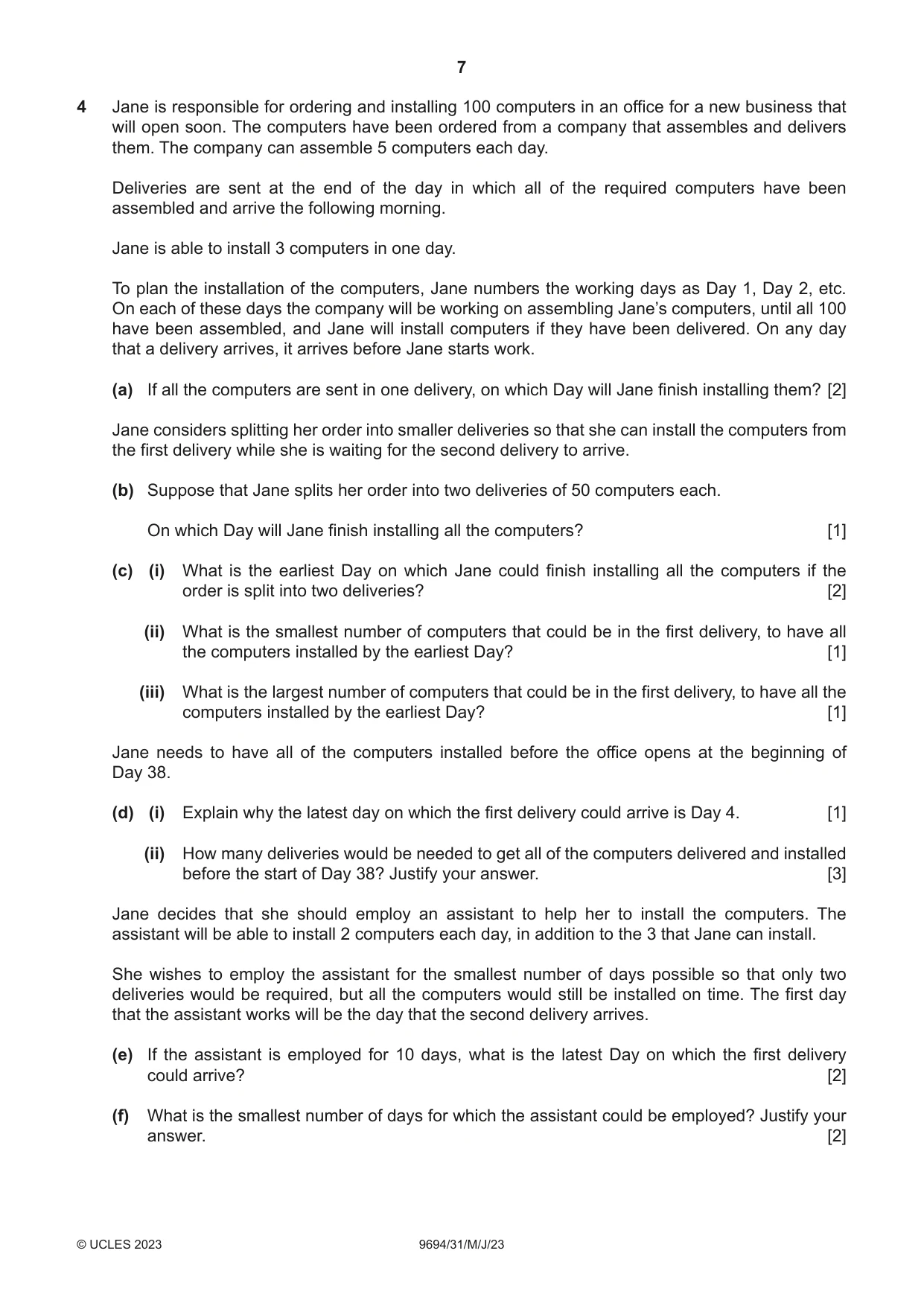
4 Jane is responsible for ordering and installing 100 computers in an office for a new business that will open soon. The computers have been ordered from a company that assembles and delivers them. The company can assemble 5 computers each day. Deliveries are sent at the end of the day in which all of the required computers have been assembled and arrive the following morning. Jane is able to install 3 computers in one day. To plan the installation of the computers, Jane numbers the working days as Day 1, Day 2, etc. On each of these days the company will be working on assembling Jane’s computers, until all 100 have been assembled, and Jane will install computers if they have been delivered. On any day that a delivery arrives, it arrives before Jane starts work. (a) If all the computers are sent in one delivery, on which Day will Jane finish installing them? [2] Jane considers splitting her order into smaller deliveries so that she can install the computers from the first delivery while she is waiting for the second delivery to arrive. (b) Suppose that Jane splits her order into two deliveries of 50 computers each. On which Day will Jane finish installing all the computers? [1] (c) (i) What is the earliest Day on which Jane could finish installing all the computers if the order is split into two deliveries? [2] (ii) What is the smallest number of computers that could be in the first delivery, to have all the computers installed by the earliest Day? [1] (iii) What is the largest number of computers that could be in the first delivery, to have all the computers installed by the earliest Day? [1] Jane needs to have all of the computers installed before the office opens at the beginning of Day 38. (d) (i) Explain why the latest day on which the first delivery could arrive is Day 4. [1] (ii) How many deliveries would be needed to get all of the computers delivered and installed before the start of Day 38? Justify your answer. [3] Jane decides that she should employ an assistant to help her to install the computers. The assistant will be able to install 2 computers each day, in addition to the 3 that Jane can install. She wishes to employ the assistant for the smallest number of days possible so that only two deliveries would be required, but all the computers would still be installed on time. The first day that the assistant works will be the day that the second delivery arrives. (e) If the assistant is employed for 10 days, what is the latest Day on which the first delivery could arrive? [2] (f) What is the smallest number of days for which the assistant could be employed? Justify your answer. [2]
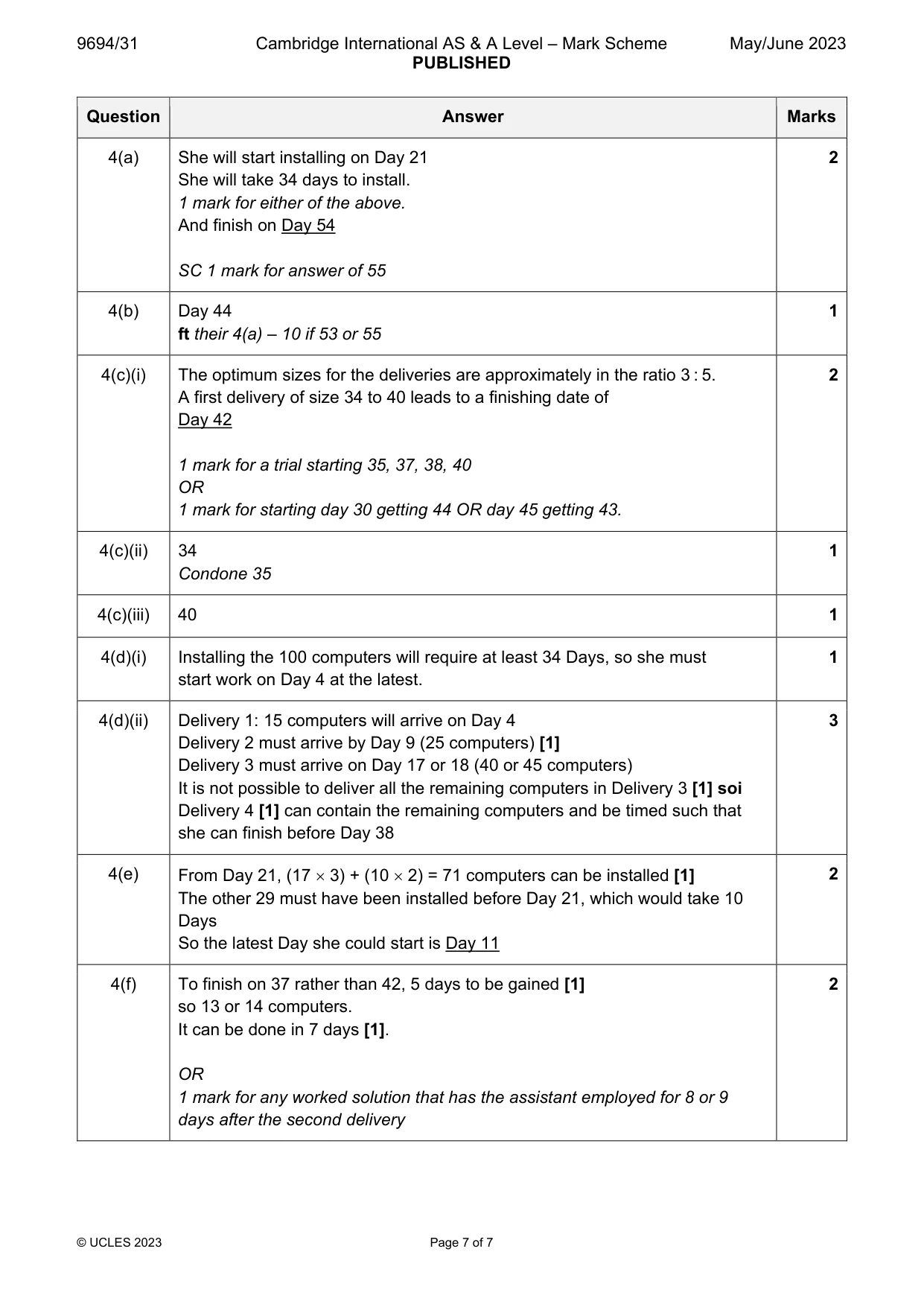
Mark scheme: 4(a) She will start installing on Day 21 2 She will take 34 days to install. 1 mark for either of the above. And finish on Day 54 SC 1 mark for answer of 55 4(b) Day 44 1 ft their 4(a) – 10 if 53 or 55 4(c)(i) The optimum sizes for the deliveries are approximately in the ratio 3 : 5. 2 A first delivery of size 34 to 40 leads to a finishing date of Day 42 1 mark for a trial starting 35, 37, 38, 40 OR 1 mark for starting day 30 getting 44 OR day 45 getting 43. 4(c)(ii) 34 1 Condone 35 4(c)(iii) 40 1 4(d)(i) Installing the 100 computers will require at least 34 Days, so she must 1 start work on Day 4 at the latest. 4(d)(ii) Delivery 1: 15 computers will arrive on Day 4 3 Delivery 2 must arrive by Day 9 (25 computers) [1] Delivery 3 must arrive on Day 17 or 18 (40 or 45 computers) It is not possible to deliver all the remaining computers in Delivery 3 [1] soi Delivery 4 [1] can contain the remaining computers and be timed such that she can finish before Day 38 4(e) From Day 21, (17 3) + (10 2) = 71 computers can be installed [1] 2 The other 29 must have been installed before Day 21, which would take 10 Days So the latest Day she could start is Day 11 4(f) To finish on 37 rather than 42, 5 days to be gained [1] 2 so 13 or 14 computers. It can be done in 7 days [1]. OR 1 mark for any worked solution that has the assistant employed for 8 or 9 days after the second delivery
What was in this paper
The subtopics covered by these 4 questions, and how many questions each got. Open one in a new tab to see every Cambridge question on it.
What you needed in this session
Cambridge’s own grade thresholds for 2023 May/June, Paper 3 · Variant 1. A higher threshold means an easier paper — the bar moves with how the cohort did.