Cambridge A Level Thinking Skills 9694 — 2017 May/June Paper 3 · Variant 2
9694/32/M/J/17 · 4 questions · 50 marks · ≈56 min
The question paper and its mark scheme, free to read here and free to download. This is Cambridge’s own paper, exactly as it was sat.
Question paper8 pages


Mark scheme6 pages
Answers below. Sit the paper first if you are practising.
Questions as text
Q1 · In a nursery, the children must be properly supervised throughout the day
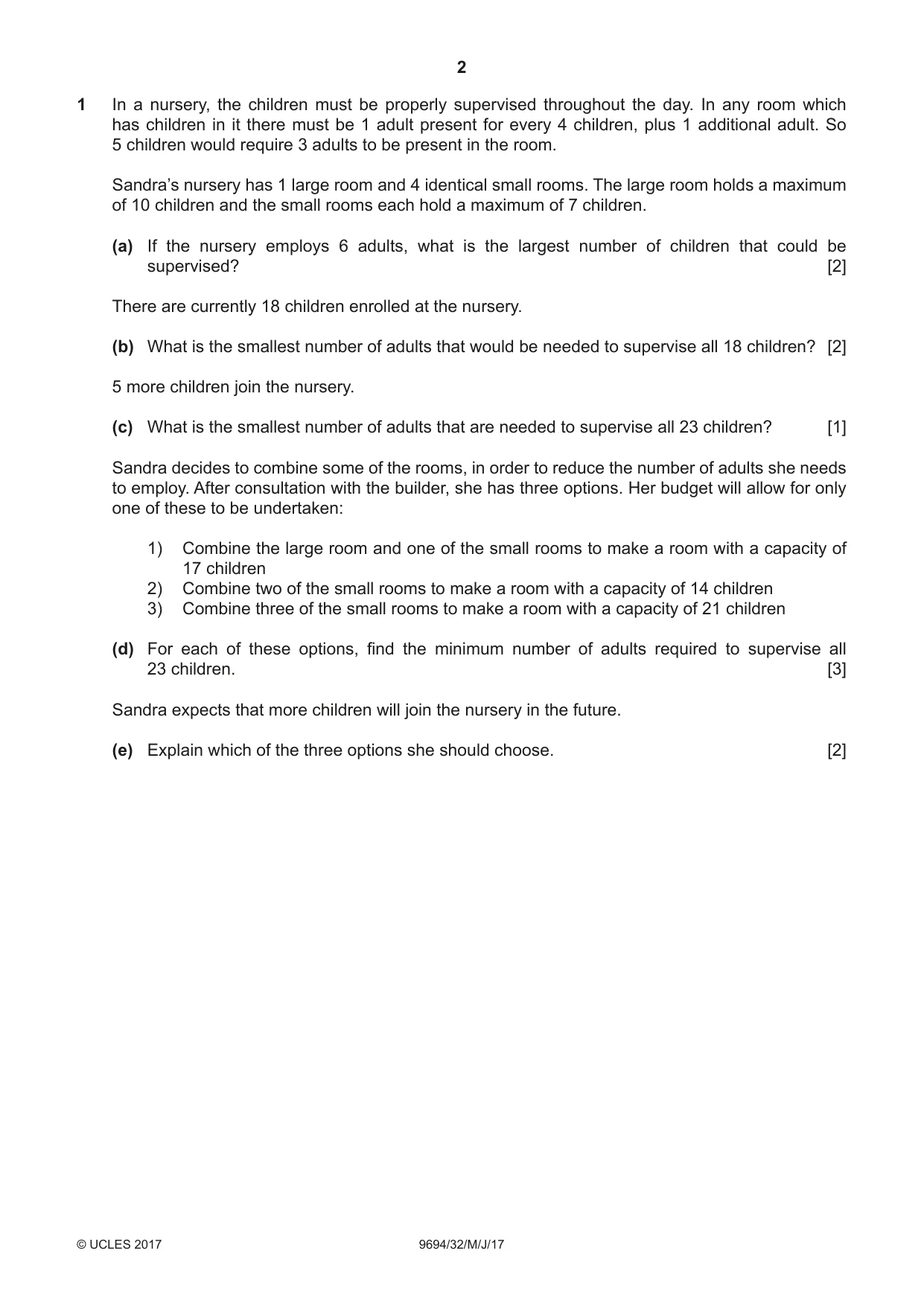
1 In a nursery, the children must be properly supervised throughout the day. In any room which has children in it there must be 1 adult present for every 4 children, plus 1 additional adult. So 5 children would require 3 adults to be present in the room. Sandra’s nursery has 1 large room and 4 identical small rooms. The large room holds a maximum of 10 children and the small rooms each hold a maximum of 7 children. (a) If the nursery employs 6 adults, what is the largest number of children that could be supervised? [2] There are currently 18 children enrolled at the nursery. (b) What is the smallest number of adults that would be needed to supervise all 18 children? [2] 5 more children join the nursery. (c) What is the smallest number of adults that are needed to supervise all 23 children? [1] Sandra decides to combine some of the rooms, in order to reduce the number of adults she needs to employ. After consultation with the builder, she has three options. Her budget will allow for only one of these to be undertaken: 1) Combine the large room and one of the small rooms to make a room with a capacity of 17 children 2) Combine two of the small rooms to make a room with a capacity of 14 children 3) Combine three of the small rooms to make a room with a capacity of 21 children (d) For each of these options, find the minimum number of adults required to supervise all 23 children. [3] Sandra expects that more children will join the nursery in the future. (e) Explain which of the three options she should choose. [2]
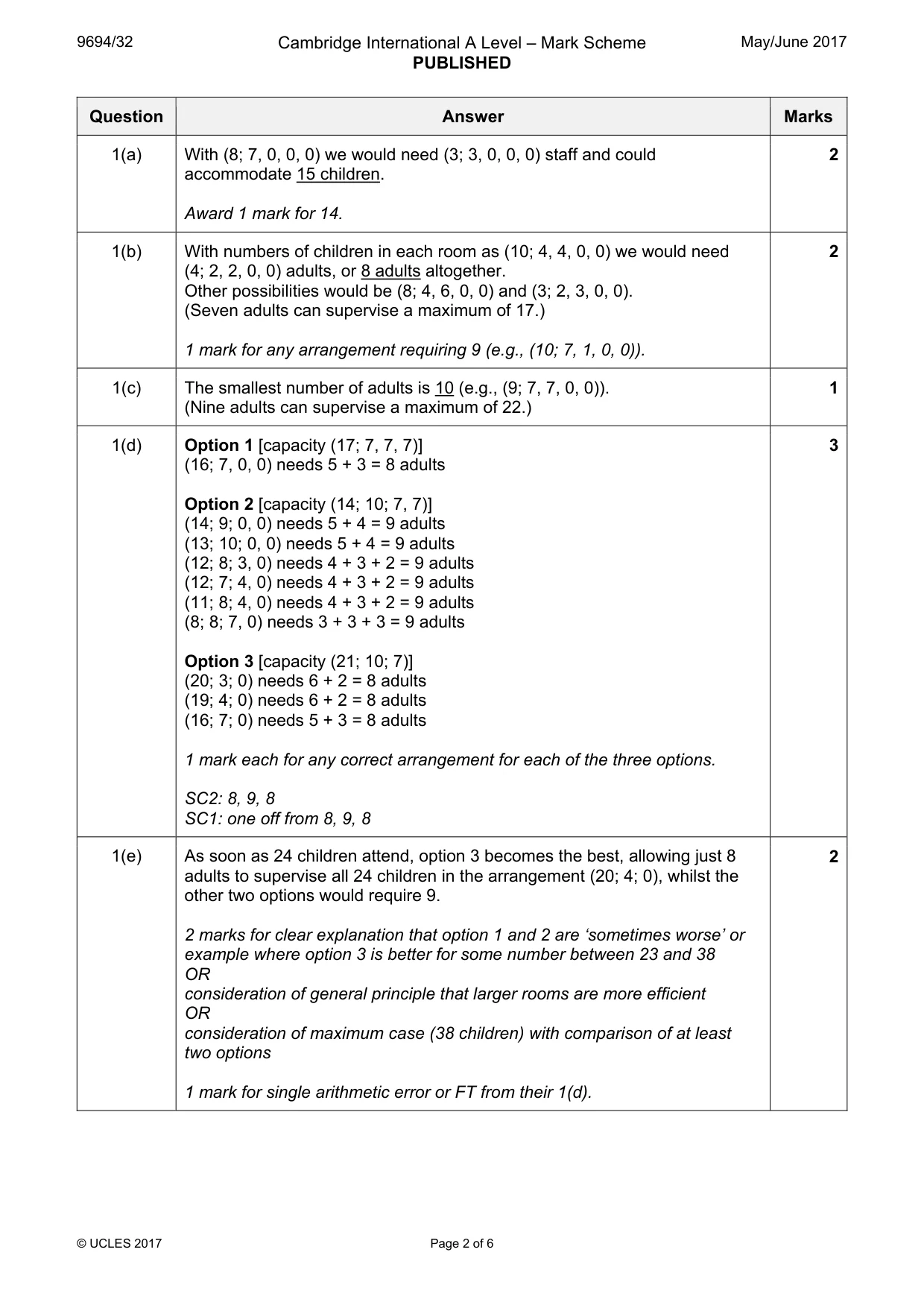
Mark scheme: Question Answer Marks 1(a) With (8; 7, 0, 0, 0) we would need (3; 3, 0, 0, 0) staff and could 2 accommodate 15 children. Award 1 mark for 14. 1(b) With numbers of children in each room as (10; 4, 4, 0, 0) we would need 2 (4; 2, 2, 0, 0) adults, or 8 adults altogether. Other possibilities would be (8; 4, 6, 0, 0) and (3; 2, 3, 0, 0). (Seven adults can supervise a maximum of 17.) 1 mark for any arrangement requiring 9 (e.g., (10; 7, 1, 0, 0)). 1(c) The smallest number of adults is 10 (e.g., (9; 7, 7, 0, 0)). 1 (Nine adults can supervise a maximum of 22.) 1(d) Option 1 [capacity (17; 7, 7, 7)] 3 (16; 7, 0, 0) needs 5 + 3 = 8 adults Option 2 [capacity (14; 10; 7, 7)] (14; 9; 0, 0) needs 5 + 4 = 9 adults (13; 10; 0, 0) needs 5 + 4 = 9 adults (12; 8; 3, 0) needs 4 + 3 + 2 = 9 adults (12; 7; 4, 0) needs 4 + 3 + 2 = 9 adults (11; 8; 4, 0) needs 4 + 3 + 2 = 9 adults (8; 8; 7, 0) needs 3 + 3 + 3 = 9 adults Option 3 [capacity (21; 10; 7)] (20; 3; 0) needs 6 + 2 = 8 adults (19; 4; 0) needs 6 + 2 = 8 adults (16; 7; 0) needs 5 + 3 = 8 adults 1 mark each for any correct arrangement for each of the three options. SC2: 8, 9, 8 SC1: one off from 8, 9, 8 1(e) As soon as 24 children attend, option 3 becomes the best, allowing just 8 2 adults to supervise all 24 children in the arrangement (20; 4; 0), whilst the other two options would require 9. 2 marks for clear explanation that option 1 and 2 are ‘sometimes worse’ or example where option 3 is better for some number between 23 and 38 OR consideration of general principle that larger rooms are more efficient OR consideration of maximum case (38 children) with comparison of at least two options 1 mark for single arithmetic error or FT from their 1(d).
More questions on Perform appropriate operations with information
Q2 · Economists study the inequalities in the distribution of wealth in different countries in…
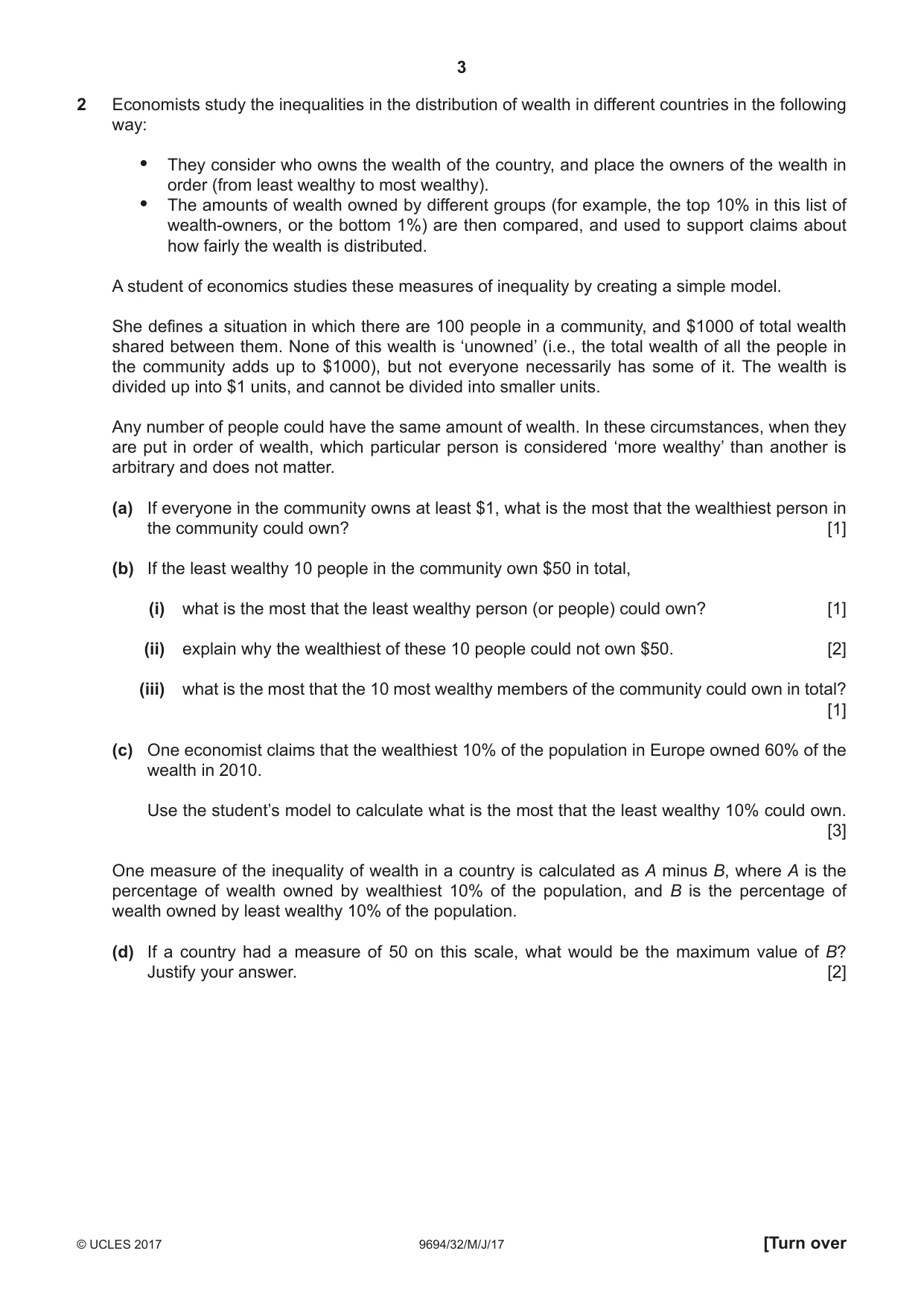
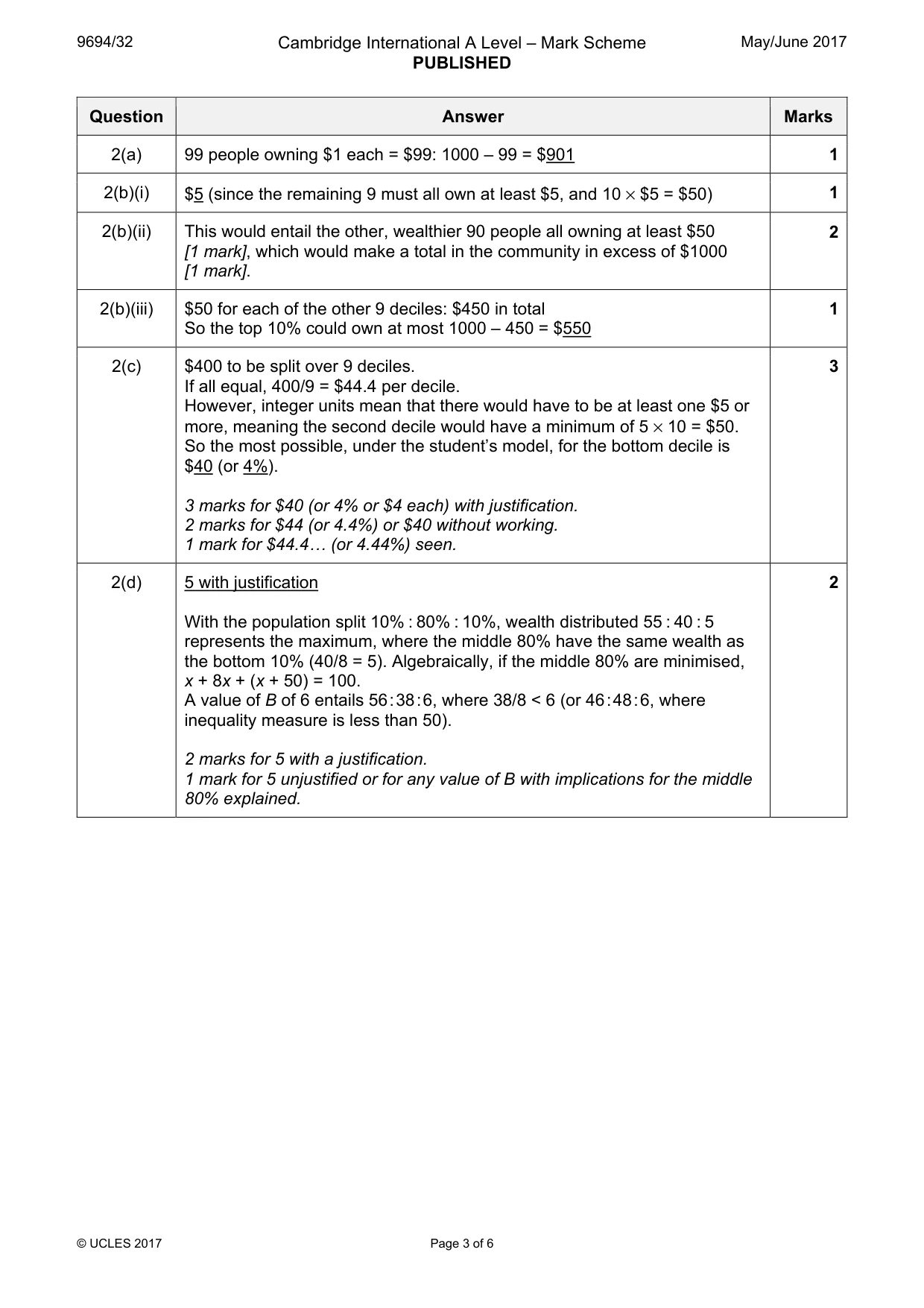
2 Economists study the inequalities in the distribution of wealth in different countries in the following way: • They consider who owns the wealth of the country, and place the owners of the wealth in order (from least wealthy to most wealthy). • The amounts of wealth owned by different groups (for example, the top 10% in this list of wealth-owners, or the bottom 1%) are then compared, and used to support claims about how fairly the wealth is distributed. A student of economics studies these measures of inequality by creating a simple model. She defines a situation in which there are 100 people in a community, and $1000 of total wealth shared between them. None of this wealth is ‘unowned’ (i.e., the total wealth of all the people in the community adds up to $1000), but not everyone necessarily has some of it. The wealth is divided up into $1 units, and cannot be divided into smaller units. Any number of people could have the same amount of wealth. In these circumstances, when they are put in order of wealth, which particular person is considered ‘more wealthy’ than another is arbitrary and does not matter. (a) If everyone in the community owns at least $1, what is the most that the wealthiest person in the community could own? [1] (b) If the least wealthy 10 people in the community own $50 in total, (i) what is the most that the least wealthy person (or people) could own? [1] (ii) explain why the wealthiest of these 10 people could not own $50. [2] (iii) what is the most that the 10 most wealthy members of the community could own in total? [1] (c) One economist claims that the wealthiest 10% of the population in Europe owned 60% of the wealth in 2010. Use the student’s model to calculate what is the most that the least wealthy 10% could own. [3] One measure of the inequality of wealth in a country is calculated as A minus B, where A is the percentage of wealth owned by wealthiest 10% of the population, and B is the percentage of wealth owned by least wealthy 10% of the population. (d) If a country had a measure of 50 on this scale, what would be the maximum value of B? Justify your answer. [2]
Mark scheme: 2(a) 99 people owning $1 each = $99: 1000 – 99 = $901 1 2(b)(i) $5 (since the remaining 9 must all own at least $5, and 10 × $5 = $50) 1 2(b)(ii) This would entail the other, wealthier 90 people all owning at least $50 2 [1 mark], which would make a total in the community in excess of $1000 [1 mark]. 2(b)(iii) $50 for each of the other 9 deciles: $450 in total 1 So the top 10% could own at most 1000 – 450 = $550 2(c) $400 to be split over 9 deciles. 3 If all equal, 400/9 = $44.4 per decile. However, integer units mean that there would have to be at least one $5 or more, meaning the second decile would have a minimum of 5 × 10 = $50. So the most possible, under the student’s model, for the bottom decile is $40 (or 4%). 3 marks for $40 (or 4% or $4 each) with justification. 2 marks for $44 (or 4.4%) or $40 without working. 1 mark for $44.4« (or 4.44%) seen. 2(d) 5 with justification 2 With the population split 10% : 80% : 10%, wealth distributed 55 : 40 : 5 represents the maximum, where the middle 80% have the same wealth as the bottom 10% (40/8 = 5). Algebraically, if the middle 80% are minimised, x + 8x + (x + 50) = 100. A value of B of 6 entails 56 : 38 : 6, where 38/8 < 6 (or 46 : 48 : 6, where inequality measure is less than 50). 2 marks for 5 with a justification. 1 mark for 5 unjustified or for any value of B with implications for the middle 80% explained.
More questions on Identify cases that satisfy given criteria
Q3 · Richard owns a company which produces a range of different chocolates
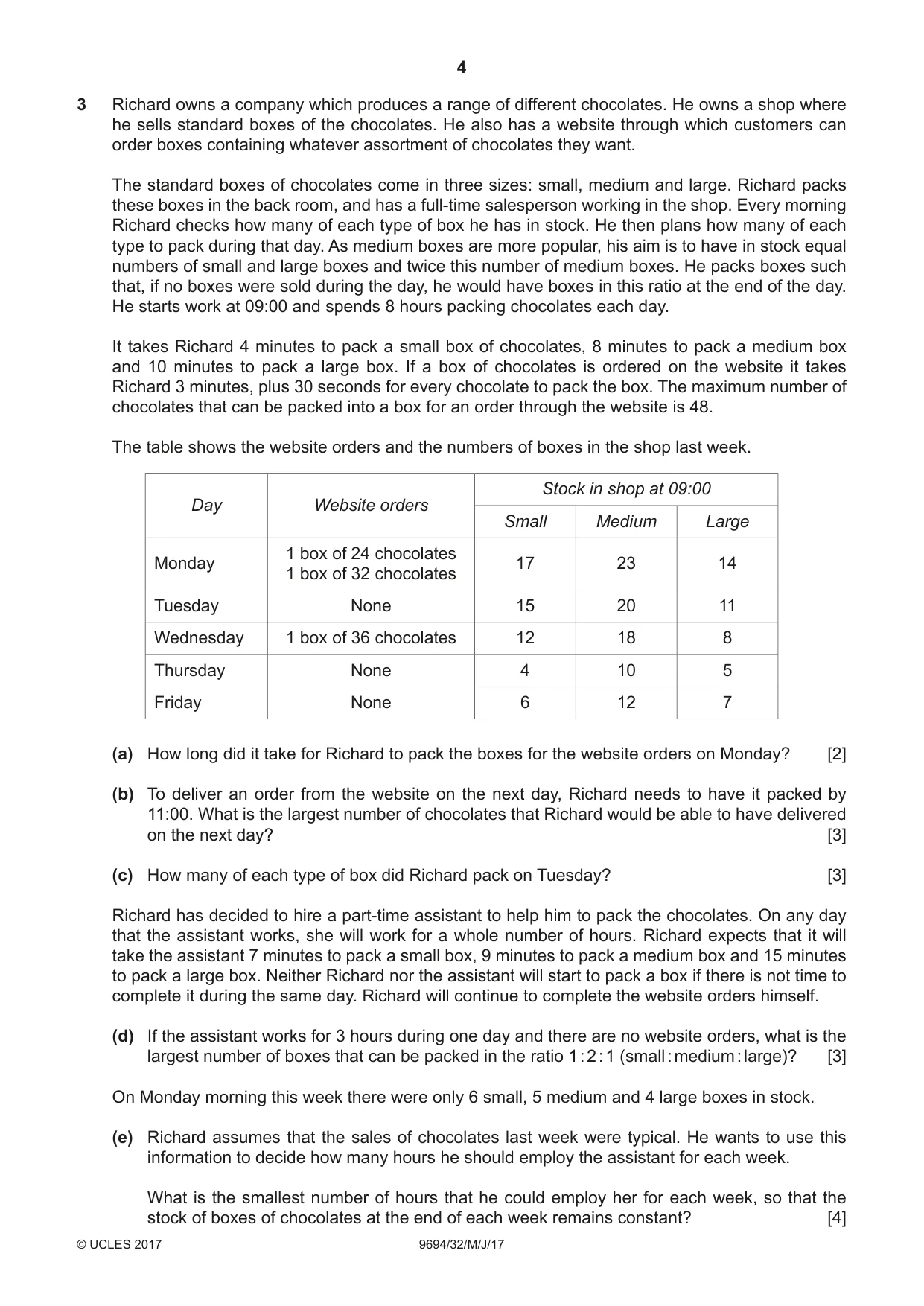
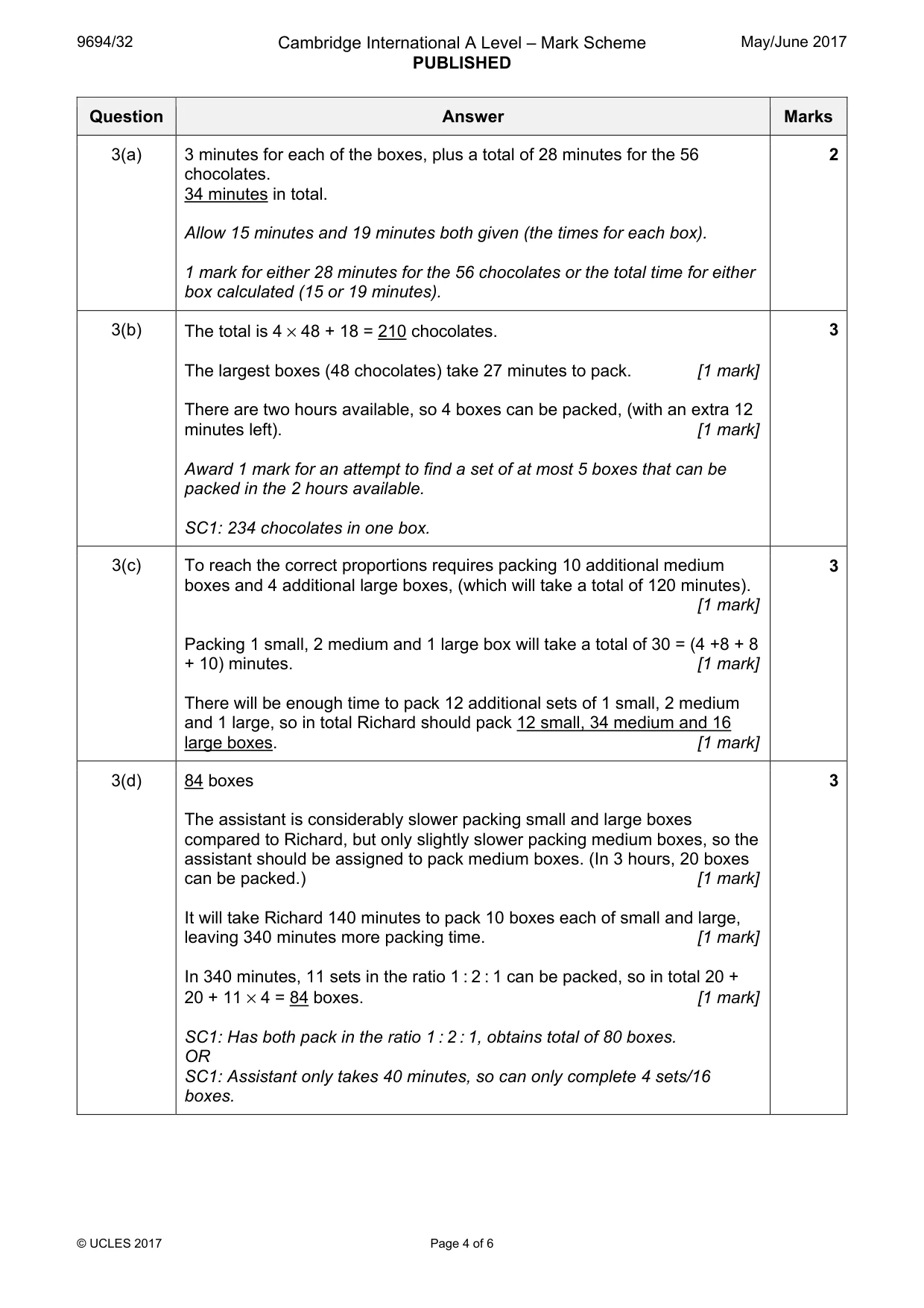
3 Richard owns a company which produces a range of different chocolates. He owns a shop where he sells standard boxes of the chocolates. He also has a website through which customers can order boxes containing whatever assortment of chocolates they want. The standard boxes of chocolates come in three sizes: small, medium and large. Richard packs these boxes in the back room, and has a full-time salesperson working in the shop. Every morning Richard checks how many of each type of box he has in stock. He then plans how many of each type to pack during that day. As medium boxes are more popular, his aim is to have in stock equal numbers of small and large boxes and twice this number of medium boxes. He packs boxes such that, if no boxes were sold during the day, he would have boxes in this ratio at the end of the day. He starts work at 09:00 and spends 8 hours packing chocolates each day. It takes Richard 4 minutes to pack a small box of chocolates, 8 minutes to pack a medium box and 10 minutes to pack a large box. If a box of chocolates is ordered on the website it takes Richard 3 minutes, plus 30 seconds for every chocolate to pack the box. The maximum number of chocolates that can be packed into a box for an order through the website is 48. The table shows the website orders and the numbers of boxes in the shop last week. Stock in shop at 09:00 Day Website orders Small Medium Large 1 box of 24 chocolates Monday 17 23 14 1 box of 32 chocolates Tuesday None 15 20 11 Wednesday 1 box of 36 chocolates 12 18 8 Thursday None 4 10 5 Friday None 6 12 7 (a) How long did it take for Richard to pack the boxes for the website orders on Monday? [2] (b) To deliver an order from the website on the next day, Richard needs to have it packed by 11:00. What is the largest number of chocolates that Richard would be able to have delivered on the next day? [3] (c) How many of each type of box did Richard pack on Tuesday? [3] Richard has decided to hire a part-time assistant to help him to pack the chocolates. On any day that the assistant works, she will work for a whole number of hours. Richard expects that it will take the assistant 7 minutes to pack a small box, 9 minutes to pack a medium box and 15 minutes to pack a large box. Neither Richard nor the assistant will start to pack a box if there is not time to complete it during the same day. Richard will continue to complete the website orders himself. (d) If the assistant works for 3 hours during one day and there are no website orders, what is the largest number of boxes that can be packed in the ratio 1 : 2 : 1 (small : medium : large)? [3] On Monday morning this week there were only 6 small, 5 medium and 4 large boxes in stock. (e) Richard assumes that the sales of chocolates last week were typical. He wants to use this information to decide how many hours he should employ the assistant for each week. What is the smallest number of hours that he could employ her for each week, so that the stock of boxes of chocolates at the end of each week remains constant? [4] [Question 4 begins on the next page]
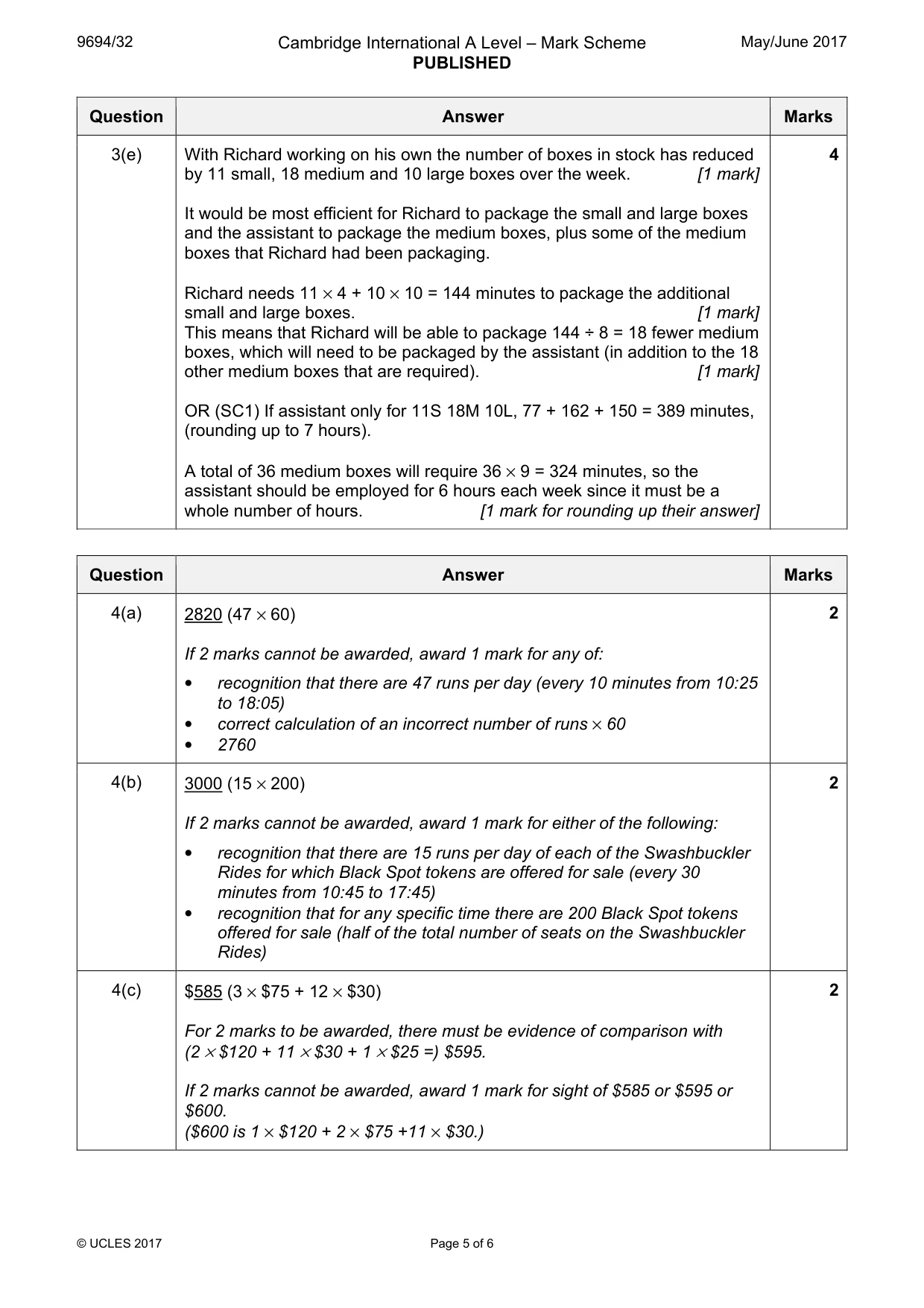
Mark scheme: 3(a) 3 minutes for each of the boxes, plus a total of 28 minutes for the 56 2 chocolates. 34 minutes in total. Allow 15 minutes and 19 minutes both given (the times for each box). 1 mark for either 28 minutes for the 56 chocolates or the total time for either box calculated (15 or 19 minutes). 3(b) The total is 4 × 48 + 18 = 210 chocolates. 3 The largest boxes (48 chocolates) take 27 minutes to pack. [1 mark] There are two hours available, so 4 boxes can be packed, (with an extra 12 minutes left). [1 mark] Award 1 mark for an attempt to find a set of at most 5 boxes that can be packed in the 2 hours available. SC1: 234 chocolates in one box. 3(c) To reach the correct proportions requires packing 10 additional medium 3 boxes and 4 additional large boxes, (which will take a total of 120 minutes). [1 mark] Packing 1 small, 2 medium and 1 large box will take a total of 30 = (4 +8 + 8 + 10) minutes. [1 mark] There will be enough time to pack 12 additional sets of 1 small, 2 medium and 1 large, so in total Richard should pack 12 small, 34 medium and 16 large boxes. [1 mark] 3(d) 84 boxes 3 The assistant is considerably slower packing small and large boxes compared to Richard, but only slightly slower packing medium boxes, so the assistant should be assigned to pack medium boxes. (In 3 hours, 20 boxes can be packed.) [1 mark] It will take Richard 140 minutes to pack 10 boxes each of small and large, leaving 340 minutes more packing time. [1 mark] In 340 minutes, 11 sets in the ratio 1 : 2 : 1 can be packed, so in total 20 + 20 + 11 × 4 = 84 boxes. [1 mark] SC1: Has both pack in the ratio 1 : 2 : 1, obtains total of 80 boxes. OR SC1: Assistant only takes 40 minutes, so can only complete 4 sets/16 boxes. 3(e) With Richard working on his own the number of boxes in stock has reduced 4 by 11 small, 18 medium and 10 large boxes over the week. [1 mark] It would be most efficient for Richard to package the small and large boxes and the assistant to package the medium boxes, plus some of the medium boxes that Richard had been packaging. Richard needs 11 × 4 + 10 × 10 = 144 minutes to package the additional small and large boxes. [1 mark] This means that Richard will be able to package 144 ÷ 8 = 18 fewer medium boxes, which will need to be packaged by the assistant (in addition to the 18 other medium boxes that are required). [1 mark] OR (SC1) If assistant only for 11S 18M 10L, 77 + 162 + 150 = 389 minutes, (rounding up to 7 hours). A total of 36 medium boxes will require 36 × 9 = 324 minutes, so the assistant should be employed for 6 hours each week since it must be a whole number of hours. [1 mark for rounding up their answer]
More questions on Perform appropriate operations with information
Q4 · The theme park Pirate World is open every day from 10:00 to 18:30
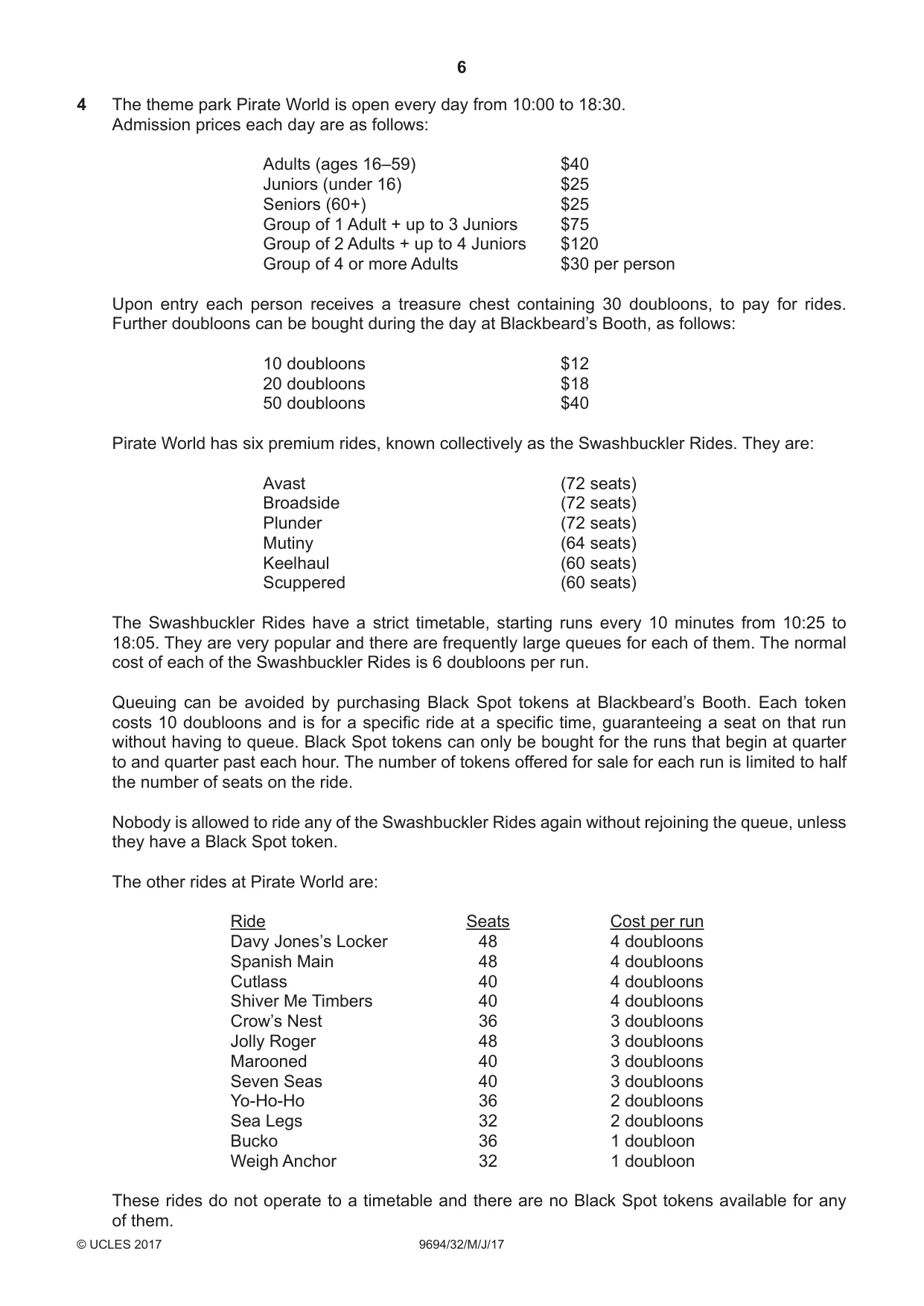
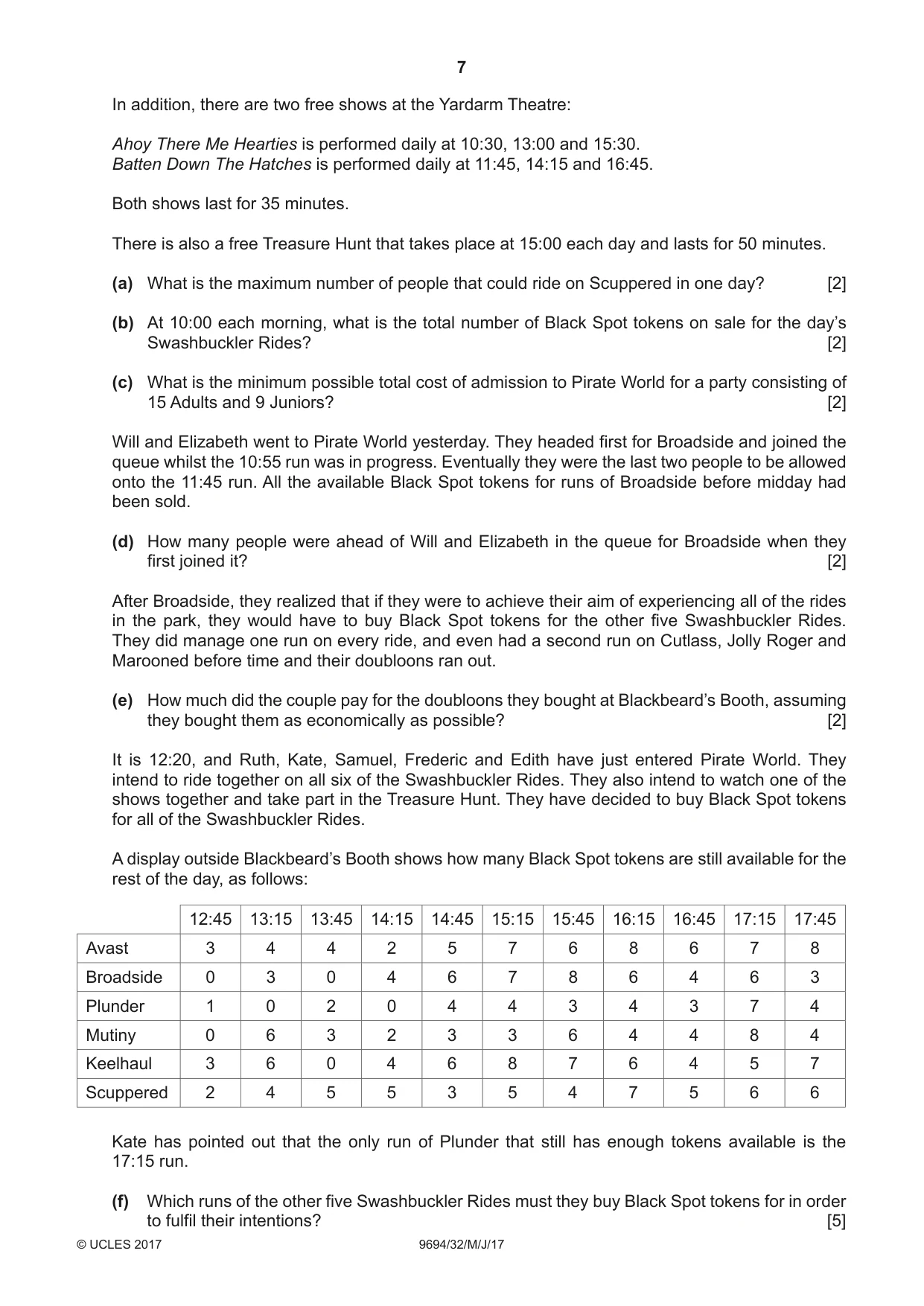
4 The theme park Pirate World is open every day from 10:00 to 18:30. Admission prices each day are as follows: Adults (ages 16–59) $40 Juniors (under 16) $25 Seniors (60+) $25 Group of 1 Adult + up to 3 Juniors $75 Group of 2 Adults + up to 4 Juniors $120 Group of 4 or more Adults $30 per person Upon entry each person receives a treasure chest containing 30 doubloons, to pay for rides. Further doubloons can be bought during the day at Blackbeard’s Booth, as follows: 10 doubloons $12 20 doubloons $18 50 doubloons $40 Pirate World has six premium rides, known collectively as the Swashbuckler Rides. They are: Avast (72 seats) Broadside (72 seats) Plunder (72 seats) Mutiny (64 seats) Keelhaul (60 seats) Scuppered (60 seats) The Swashbuckler Rides have a strict timetable, starting runs every 10 minutes from 10:25 to 18:05. They are very popular and there are frequently large queues for each of them. The normal cost of each of the Swashbuckler Rides is 6 doubloons per run. Queuing can be avoided by purchasing Black Spot tokens at Blackbeard’s Booth. Each token costs 10 doubloons and is for a specific ride at a specific time, guaranteeing a seat on that run without having to queue. Black Spot tokens can only be bought for the runs that begin at quarter to and quarter past each hour. The number of tokens offered for sale for each run is limited to half the number of seats on the ride. Nobody is allowed to ride any of the Swashbuckler Rides again without rejoining the queue, unless they have a Black Spot token. The other rides at Pirate World are: Ride Seats Cost per run Davy Jones’s Locker 48 4 doubloons Spanish Main 48 4 doubloons Cutlass 40 4 doubloons Shiver Me Timbers 40 4 doubloons Crow’s Nest 36 3 doubloons Jolly Roger 48 3 doubloons Marooned 40 3 doubloons Seven Seas 40 3 doubloons Yo-Ho-Ho 36 2 doubloons Sea Legs 32 2 doubloons Bucko 36 1 doubloon Weigh Anchor 32 1 doubloon These rides do not operate to a timetable and there are no Black Spot tokens available for any of them. In addition, there are two free shows at the Yardarm Theatre: Ahoy There Me Hearties is performed daily at 10:30, 13:00 and 15:30. Batten Down The Hatches is performed daily at 11:45, 14:15 and 16:45. Both shows last for 35 minutes. There is also a free Treasure Hunt that takes place at 15:00 each day and lasts for 50 minutes. (a) What is the maximum number of people that could ride on Scuppered in one day? [2] (b) At 10:00 each morning, what is the total number of Black Spot tokens on sale for the day’s Swashbuckler Rides? [2] (c) What is the minimum possible total cost of admission to Pirate World for a party consisting of 15 Adults and 9 Juniors? [2] Will and Elizabeth went to Pirate World yesterday. They headed first for Broadside and joined the queue whilst the 10:55 run was in progress. Eventually they were the last two people to be allowed onto the 11:45 run. All the available Black Spot tokens for runs of Broadside before midday had been sold. (d) How many people were ahead of Will and Elizabeth in the queue for Broadside when they first joined it? [2] After Broadside, they realized that if they were to achieve their aim of experiencing all of the rides in the park, they would have to buy Black Spot tokens for the other five Swashbuckler Rides. They did manage one run on every ride, and even had a second run on Cutlass, Jolly Roger and Marooned before time and their doubloons ran out. (e) How much did the couple pay for the doubloons they bought at Blackbeard’s Booth, assuming they bought them as economically as possible? [2] It is 12:20, and Ruth, Kate, Samuel, Frederic and Edith have just entered Pirate World. They intend to ride together on all six of the Swashbuckler Rides. They also intend to watch one of the shows together and take part in the Treasure Hunt. They have decided to buy Black Spot tokens for all of the Swashbuckler Rides. A display outside Blackbeard’s Booth shows how many Black Spot tokens are still available for the rest of the day, as follows: 12:45 13:15 13:45 14:15 14:45 15:15 15:45 16:15 16:45 17:15 17:45 Avast 3 4 4 2 5 7 6 8 6 7 8 Broadside 0 3 0 4 6 7 8 6 4 6 3 Plunder 1 0 2 0 4 4 3 4 3 7 4 Mutiny 0 6 3 2 3 3 6 4 4 8 4 Keelhaul 3 6 0 4 6 8 7 6 4 5 7 Scuppered 2 4 5 5 3 5 4 7 5 6 6 Kate has pointed out that the only run of Plunder that still has enough tokens available is the 17:15 run. (f) Which runs of the other five Swashbuckler Rides must they buy Black Spot tokens for in order
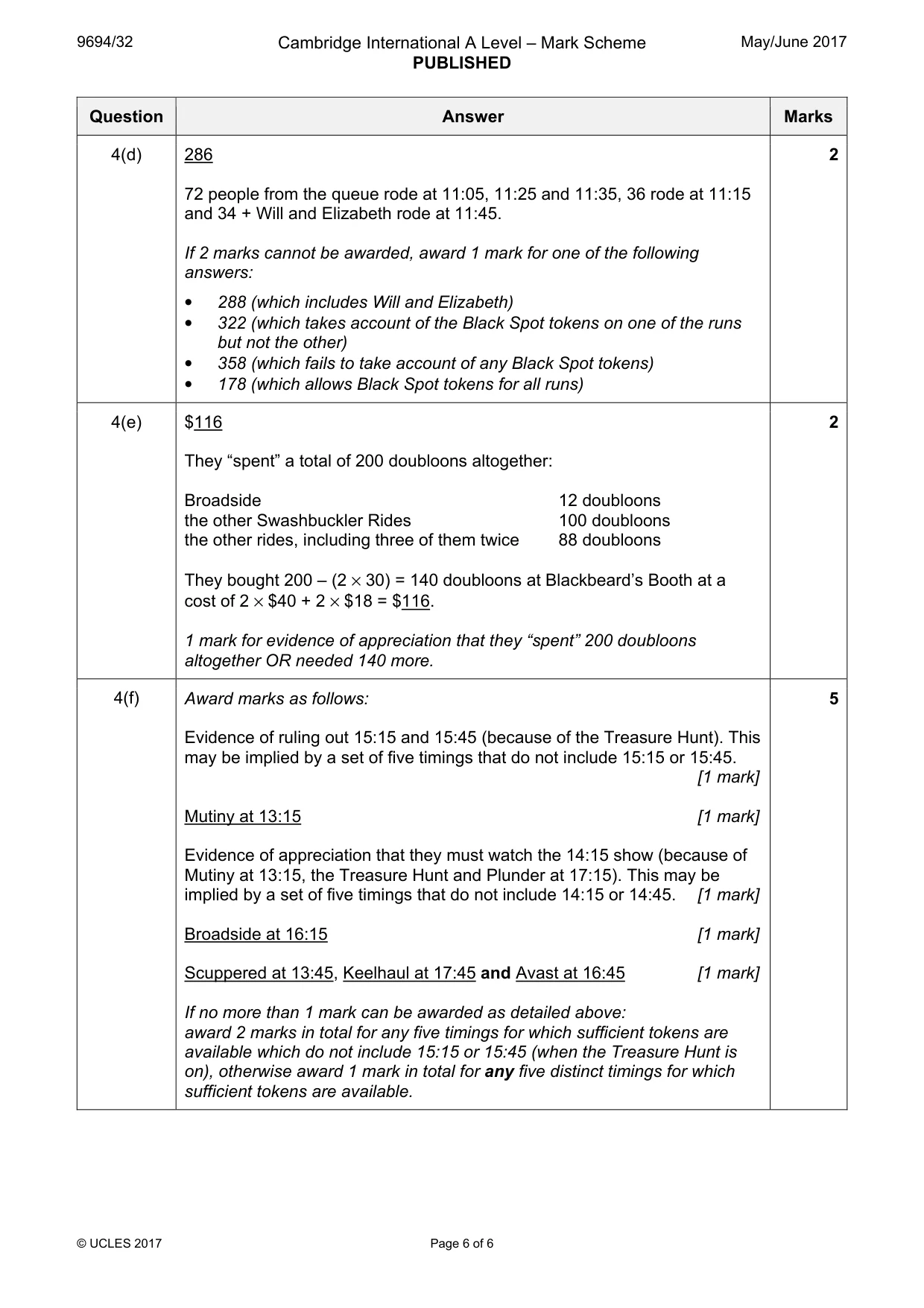
Mark scheme: 4(a) 2820 (47 × 60) 2 If 2 marks cannot be awarded, award 1 mark for any of: • recognition that there are 47 runs per day (every 10 minutes from 10:25 to 18:05) • correct calculation of an incorrect number of runs × 60 • 2760 4(b) 3000 (15 × 200) 2 If 2 marks cannot be awarded, award 1 mark for either of the following: • recognition that there are 15 runs per day of each of the Swashbuckler Rides for which Black Spot tokens are offered for sale (every 30 minutes from 10:45 to 17:45) • recognition that for any specific time there are 200 Black Spot tokens offered for sale (half of the total number of seats on the Swashbuckler Rides) 4(c) $585 (3 × $75 + 12 × $30) 2 For 2 marks to be awarded, there must be evidence of comparison with (2 ×$120 + 11 ×$30 + 1 ×$25 =) $595. If 2 marks cannot be awarded, award 1 mark for sight of $585 or $595 or $600. ($600 is 1 × $120 + 2 × $75 +11 × $30.) 4(d) 286 2 72 people from the queue rode at 11:05, 11:25 and 11:35, 36 rode at 11:15 and 34 + Will and Elizabeth rode at 11:45. If 2 marks cannot be awarded, award 1 mark for one of the following answers: • 288 (which includes Will and Elizabeth) • 322 (which takes account of the Black Spot tokens on one of the runs but not the other) • 358 (which fails to take account of any Black Spot tokens) • 178 (which allows Black Spot tokens for all runs) 4(e) $116 2 They “spent” a total of 200 doubloons altogether: Broadside 12 doubloons the other Swashbuckler Rides 100 doubloons the other rides, including three of them twice 88 doubloons They bought 200 – (2 × 30) = 140 doubloons at Blackbeard’s Booth at a cost of 2 × $40 + 2 × $18 = $116. 1 mark for evidence of appreciation that they “spent” 200 doubloons altogether OR needed 140 more. 4(f) Award marks as follows: 5 Evidence of ruling out 15:15 and 15:45 (because of the Treasure Hunt). This may be implied by a set of five timings that do not include 15:15 or 15:45. [1 mark] Mutiny at 13:15 [1 mark] Evidence of appreciation that they must watch the 14:15 show (because of Mutiny at 13:15, the Treasure Hunt and Plunder at 17:15). This may be implied by a set of five timings that do not include 14:15 or 14:45. [1 mark] Broadside at 16:15 [1 mark] Scuppered at 13:45, Keelhaul at 17:45 and Avast at 16:45 [1 mark] If no more than 1 mark can be awarded as detailed above: award 2 marks in total for any five timings for which sufficient tokens are available which do not include 15:15 or 15:45 (when the Treasure Hunt is on), otherwise award 1 mark in total for any five distinct timings for which sufficient tokens are available.
More questions on Identify cases that satisfy given criteria
What was in this paper
The subtopics covered by these 4 questions, and how many questions each got. Open one in a new tab to see every Cambridge question on it.
What you needed in this session
Cambridge’s own grade thresholds for 2017 May/June, Paper 3 · Variant 2. A higher threshold means an easier paper — the bar moves with how the cohort did.