Cambridge A Level Thinking Skills 9694 — 2018 Oct/Nov Paper 3 · Variant 2
9694/32/O/N/18 · 4 questions · 50 marks · ≈56 min
The question paper and its mark scheme, free to read here and free to download. This is Cambridge’s own paper, exactly as it was sat.
Question paper8 pages

Mark scheme
No mark scheme is in the library for this paper.
Questions as text
Q1 · An innovative school has secured $600 of sponsorship money to spend on improving their…
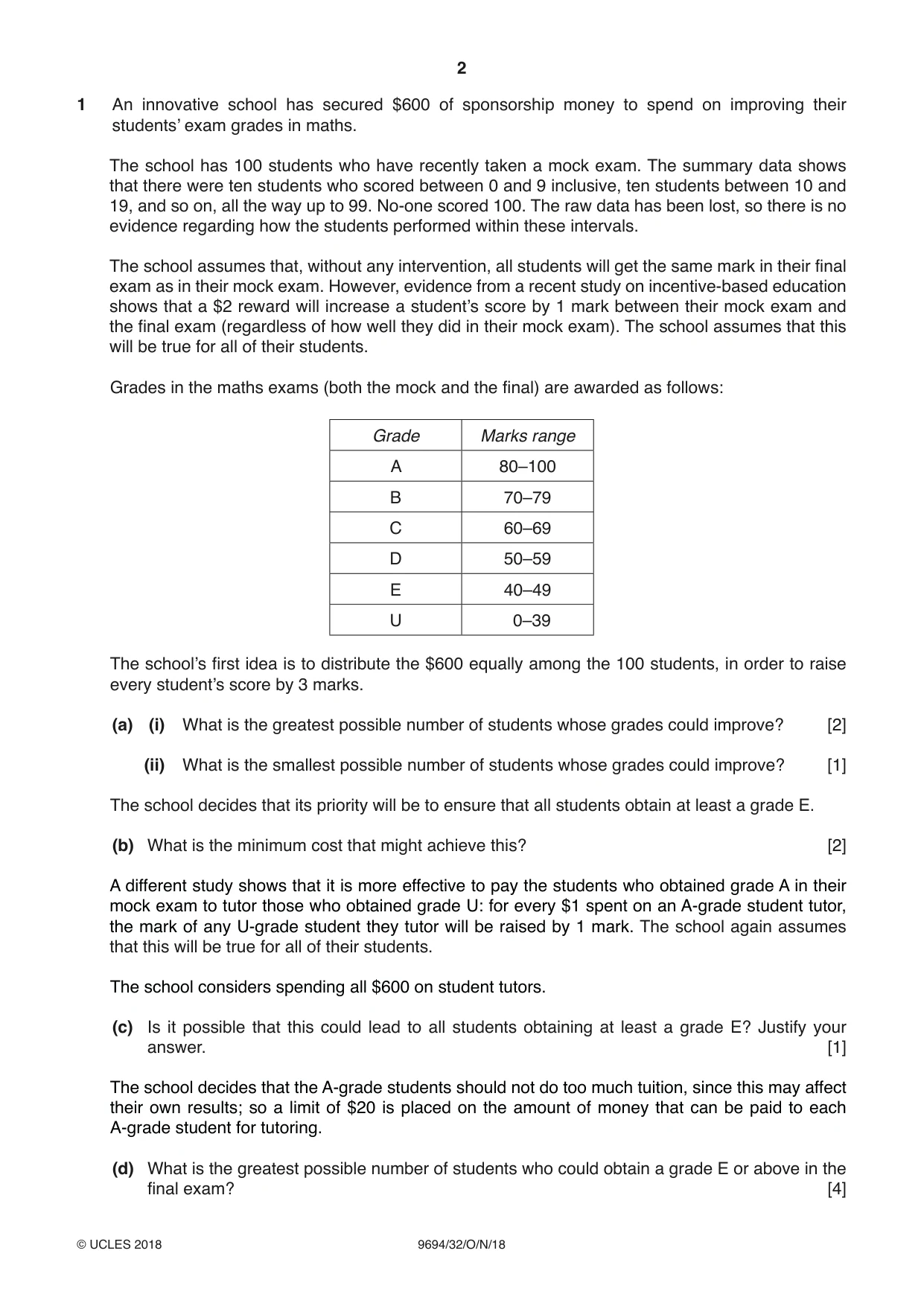
1 An innovative school has secured $600 of sponsorship money to spend on improving their students’ exam grades in maths. The school has 100 students who have recently taken a mock exam. The summary data shows that there were ten students who scored between 0 and 9 inclusive, ten students between 10 and 19, and so on, all the way up to 99. No-one scored 100. The raw data has been lost, so there is no evidence regarding how the students performed within these intervals. The school assumes that, without any intervention, all students will get the same mark in their final exam as in their mock exam. However, evidence from a recent study on incentive-based education shows that a $2 reward will increase a student’s score by 1 mark between their mock exam and the final exam (regardless of how well they did in their mock exam). The school assumes that this will be true for all of their students. Grades in the maths exams (both the mock and the final) are awarded as follows: Grade Marks range A 80–100 B 70–79 C 60–69 D 50–59 E 40–49 U 0–39 The school’s first idea is to distribute the $600 equally among the 100 students, in order to raise every student’s score by 3 marks. (a) (i) What is the greatest possible number of students whose grades could improve? [2] (ii) What is the smallest possible number of students whose grades could improve? [1] The school decides that its priority will be to ensure that all students obtain at least a grade E. (b) What is the minimum cost that might achieve this? [2] A different study shows that it is more effective to pay the students who obtained grade A in their mock exam to tutor those who obtained grade U: for every $1 spent on an A-grade student tutor, the mark of any U-grade student they tutor will be raised by 1 mark. The school again assumes that this will be true for all of their students. The school considers spending all $600 on student tutors. (c) Is it possible that this could lead to all students obtaining at least a grade E? Justify your answer. [1] The school decides that the A-grade students should not do too much tuition, since this may affect their own results; so a limit of $20 is placed on the amount of money that can be paid to each A-grade student for tutoring. (d) What is the greatest possible number of students who could obtain a grade E or above in the final exam? [4]
More questions on Identify cases that satisfy given criteria
Q2 · Graham often has to attend meetings at which he is issued with a visitor badge
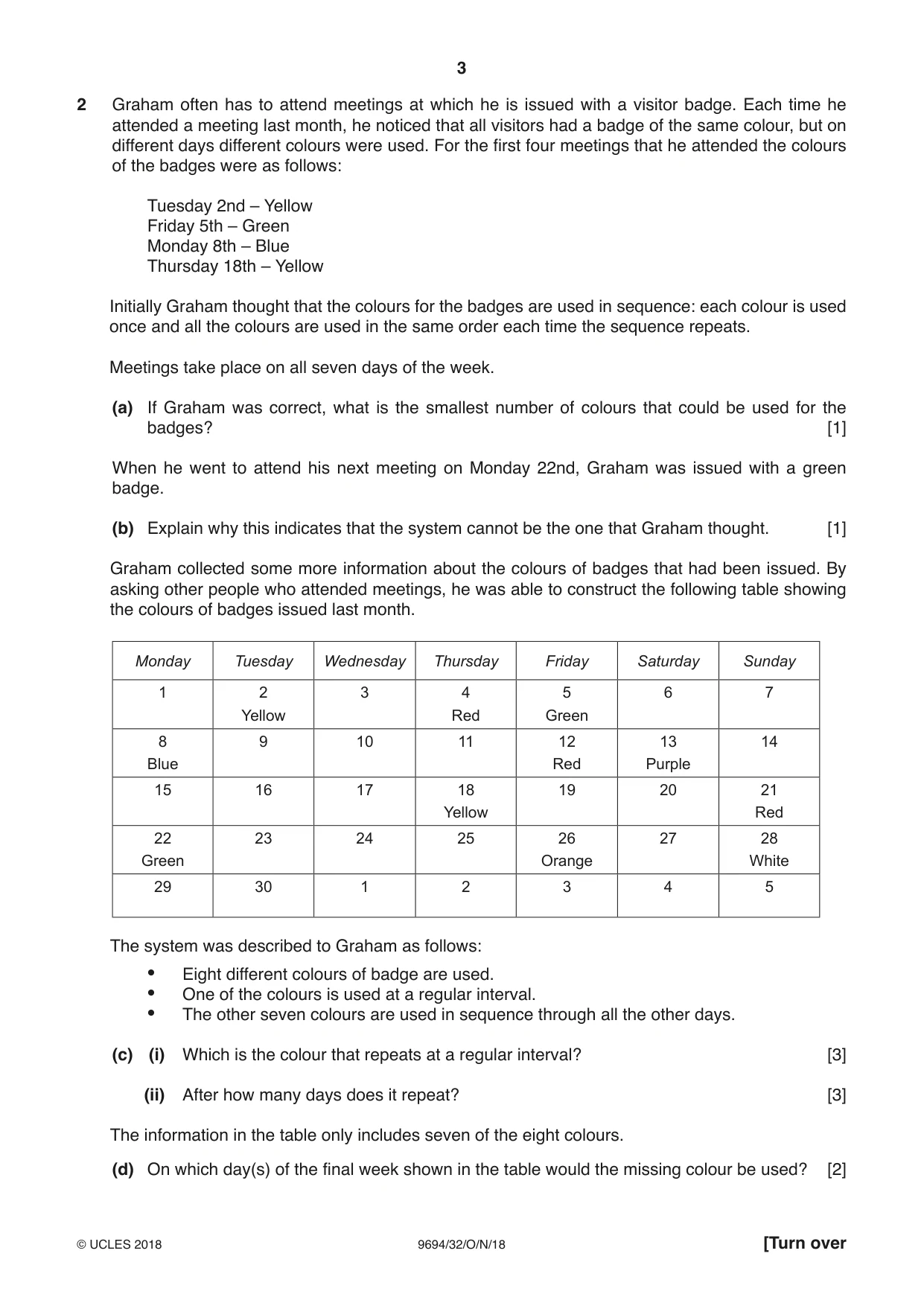
2 Graham often has to attend meetings at which he is issued with a visitor badge. Each time he attended a meeting last month, he noticed that all visitors had a badge of the same colour, but on different days different colours were used. For the first four meetings that he attended the colours of the badges were as follows: Tuesday 2nd – Yellow Friday 5th – Green Monday 8th – Blue Thursday 18th – Yellow Initially Graham thought that the colours for the badges are used in sequence: each colour is used once and all the colours are used in the same order each time the sequence repeats. Meetings take place on all seven days of the week. (a) If Graham was correct, what is the smallest number of colours that could be used for the badges? [1] When he went to attend his next meeting on Monday 22nd, Graham was issued with a green badge. (b) Explain why this indicates that the system cannot be the one that Graham thought. [1] Graham collected some more information about the colours of badges that had been issued. By asking other people who attended meetings, he was able to construct the following table showing the colours of badges issued last month. Monday Tuesday Wednesday Thursday Friday Saturday Sunday 1 2 3 4 5 6 7 Yellow Red Green 8 9 10 11 12 13 14 Blue Red Purple 15 16 17 18 19 20 21 Yellow Red 22 23 24 25 26 27 28 Green Orange White 29 30 1 2 3 4 5 The system was described to Graham as follows: • Eight different colours of badge are used. • One of the colours is used at a regular interval. • The other seven colours are used in sequence through all the other days. (c) (i) Which is the colour that repeats at a regular interval? [3] (ii) After how many days does it repeat? [3] The information in the table only includes seven of the eight colours. (d) On which day(s) of the final week shown in the table would the missing colour be used? [2]
Q3 · The Järnvägar Railway Company wants to build a level line between Vänster and Höger
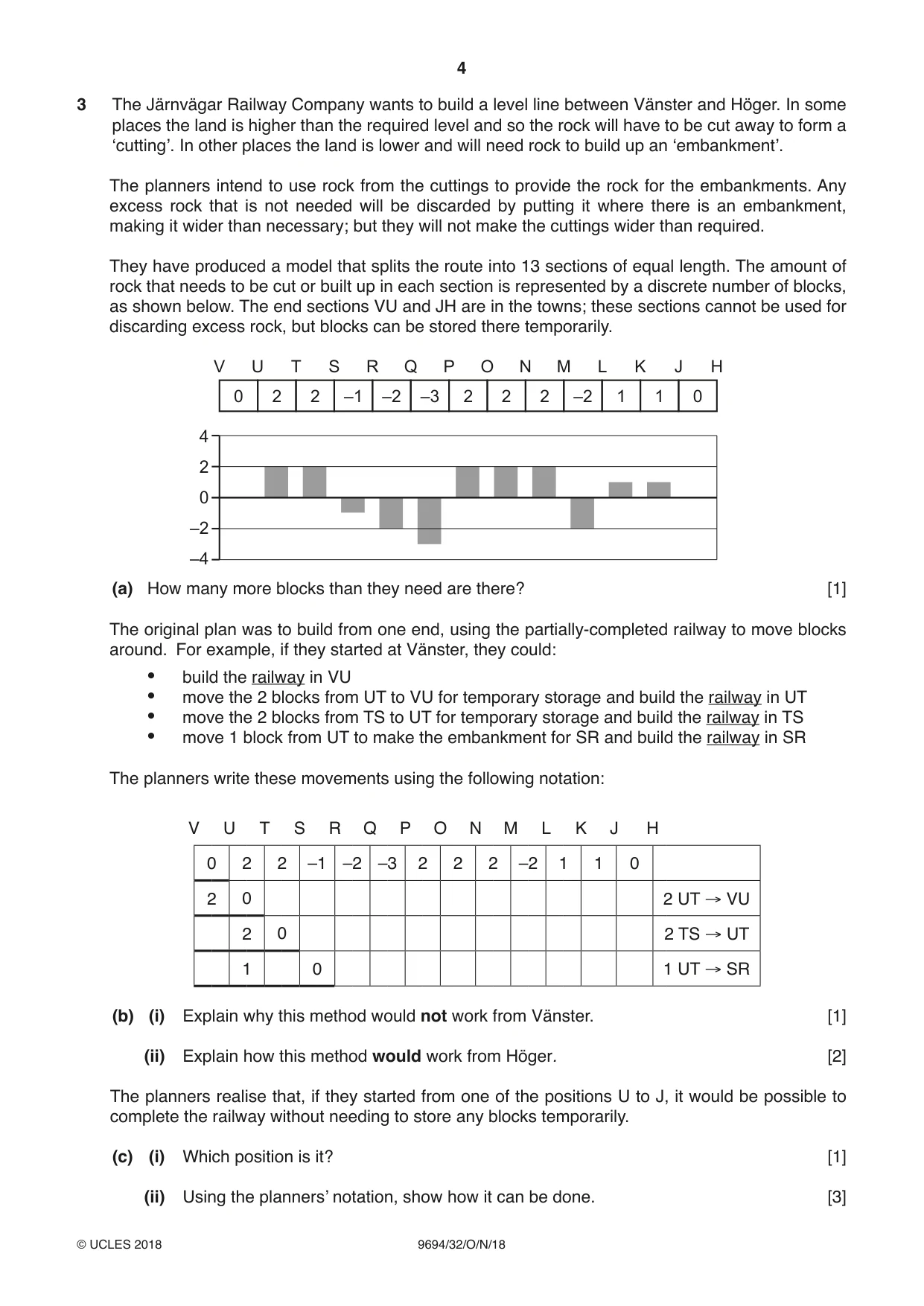
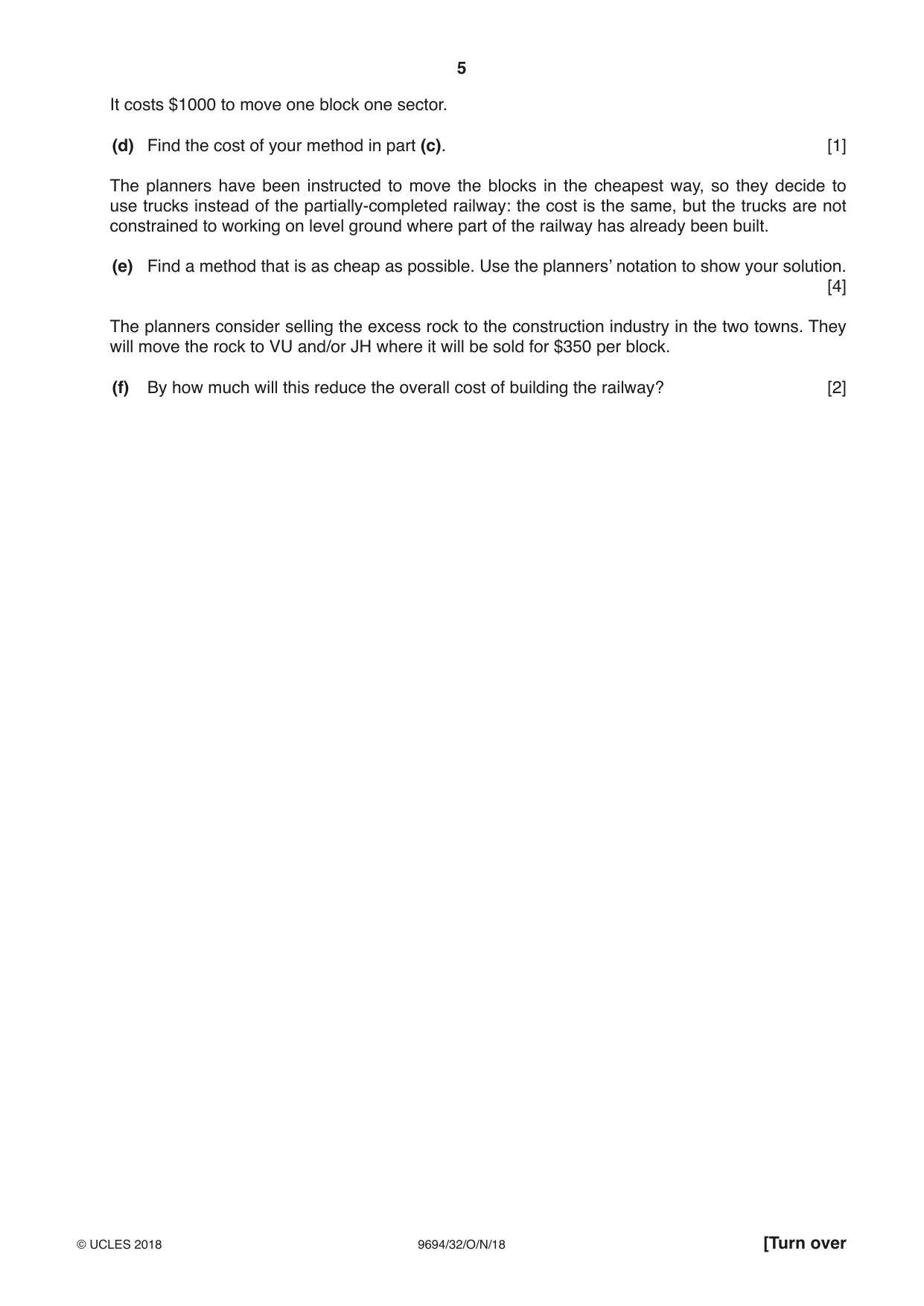
3 The Järnvägar Railway Company wants to build a level line between Vänster and Höger. In some places the land is higher than the required level and so the rock will have to be cut away to form a ‘cutting’. In other places the land is lower and will need rock to build up an ‘embankment’. The planners intend to use rock from the cuttings to provide the rock for the embankments. Any excess rock that is not needed will be discarded by putting it where there is an embankment, making it wider than necessary; but they will not make the cuttings wider than required. They have produced a model that splits the route into 13 sections of equal length. The amount of rock that needs to be cut or built up in each section is represented by a discrete number of blocks, as shown below. The end sections VU and JH are in the towns; these sections cannot be used for discarding excess rock, but blocks can be stored there temporarily. V U T S R Q P O N M L K J H 0 2 2 –1 –2 –3 2 2 2 –2 1 1 0 4 2 0 –2 –4 (a) How many more blocks than they need are there? [1] The original plan was to build from one end, using the partially-completed railway to move blocks around. For example, if they started at Vänster, they could: • build the railway in VU • move the 2 blocks from UT to VU for temporary storage and build the railway in UT • move the 2 blocks from TS to UT for temporary storage and build the railway in TS • move 1 block from UT to make the embankment for SR and build the railway in SR The planners write these movements using the following notation: V U T S R Q P O N M L K J H 0 2 2 –1 –2 –3 2 2 2 –2 1 1 0 2 0 2 UT → VU 2 0 2 TS → UT 1 0 1 UT → SR (b) (i) Explain why this method would not work from Vänster. [1] (ii) Explain how this method would work from Höger. [2] The planners realise that, if they started from one of the positions U to J, it would be possible to complete the railway without needing to store any blocks temporarily. (c) (i) Which position is it? [1] (ii) Using the planners’ notation, show how it can be done. [3] It costs $1000 to move one block one sector. (d) Find the cost of your method in part (c). [1] The planners have been instructed to move the blocks in the cheapest way, so they decide to use trucks instead of the partially-completed railway: the cost is the same, but the trucks are not constrained to working on level ground where part of the railway has already been built. (e) Find a method that is as cheap as possible. Use the planners’ notation to show your solution. [4] The planners consider selling the excess rock to the construction industry in the two towns. They will move the rock to VU and/or JH where it will be sold for $350 per block. (f) By how much will this reduce the overall cost of building the railway? [2]
Q4 · Trigole is a sport in which three teams play against each other on a pitch that is an…
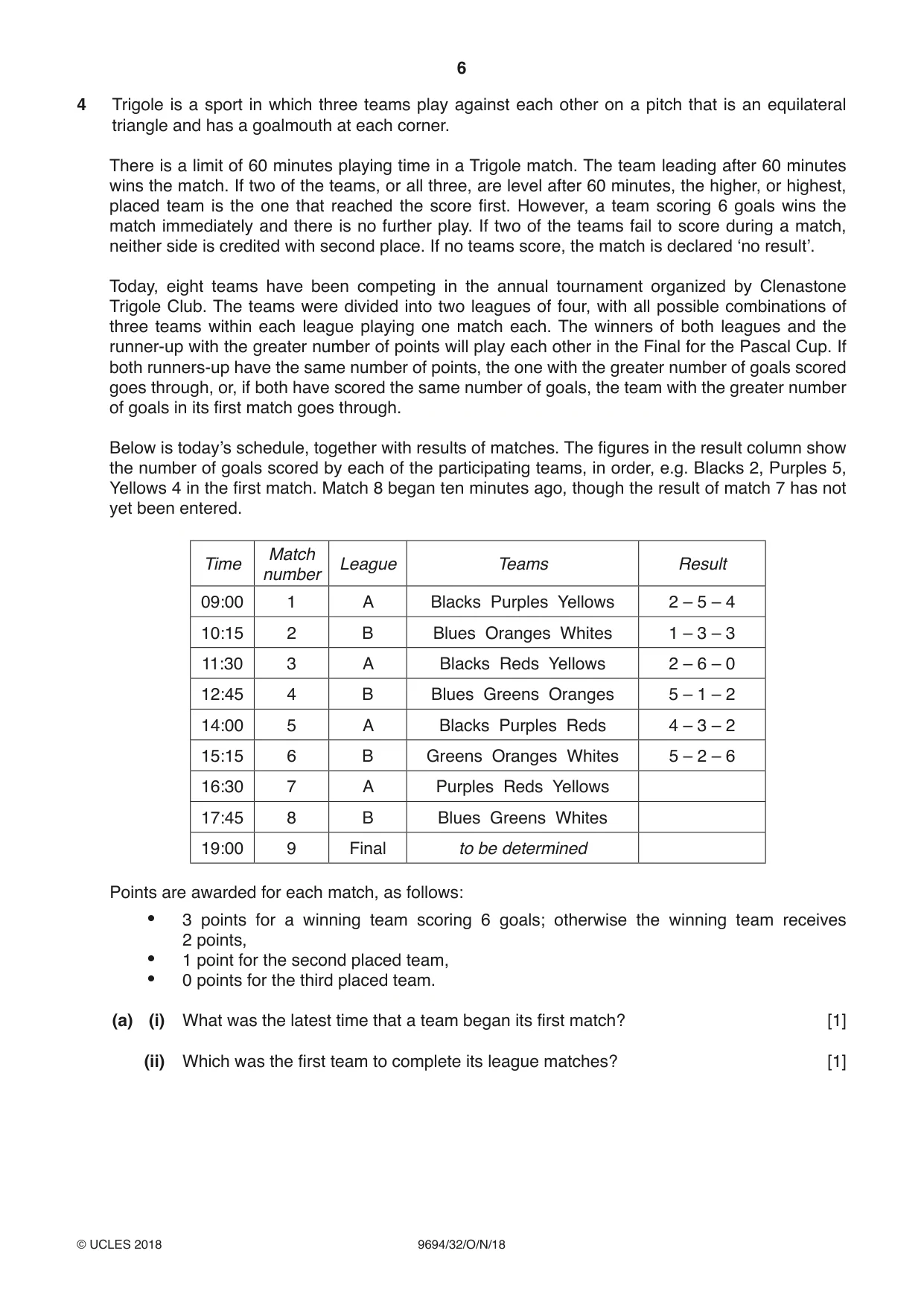
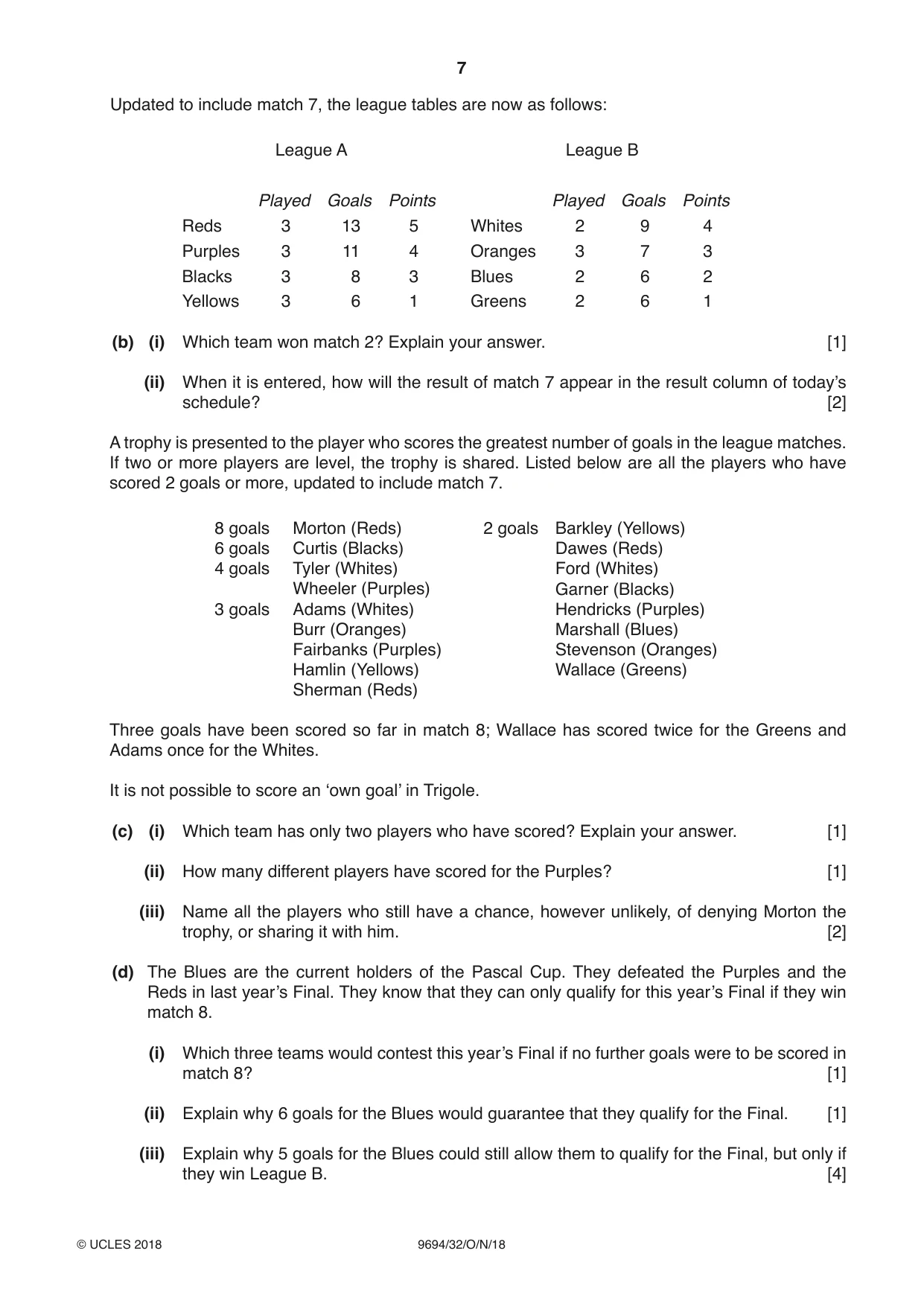
4 Trigole is a sport in which three teams play against each other on a pitch that is an equilateral triangle and has a goalmouth at each corner. There is a limit of 60 minutes playing time in a Trigole match. The team leading after 60 minutes wins the match. If two of the teams, or all three, are level after 60 minutes, the higher, or highest, placed team is the one that reached the score first. However, a team scoring 6 goals wins the match immediately and there is no further play. If two of the teams fail to score during a match, neither side is credited with second place. If no teams score, the match is declared ‘no result’. Today, eight teams have been competing in the annual tournament organized by Clenastone Trigole Club. The teams were divided into two leagues of four, with all possible combinations of three teams within each league playing one match each. The winners of both leagues and the runner-up with the greater number of points will play each other in the Final for the Pascal Cup. If both runners-up have the same number of points, the one with the greater number of goals scored goes through, or, if both have scored the same number of goals, the team with the greater number of goals in its first match goes through. Below is today’s schedule, together with results of matches. The figures in the result column show the number of goals scored by each of the participating teams, in order, e.g. Blacks 2, Purples 5, Yellows 4 in the first match. Match 8 began ten minutes ago, though the result of match 7 has not yet been entered. Match Time League Teams Result number 09:00 1 A Blacks Purples Yellows 2 – 5 – 4 10:15 2 B Blues Oranges Whites 1 – 3 – 3 11:30 3 A Blacks Reds Yellows 2 – 6 – 0 12:45 4 B Blues Greens Oranges 5 – 1 – 2 14:00 5 A Blacks Purples Reds 4 – 3 – 2 15:15 6 B Greens Oranges Whites 5 – 2 – 6 16:30 7 A Purples Reds Yellows 17:45 8 B Blues Greens Whites 19:00 9 Final to be determined Points are awarded for each match, as follows: • 3 points for a winning team scoring 6 goals; otherwise the winning team receives 2 points, • 1 point for the second placed team, • 0 points for the third placed team. (a) (i) What was the latest time that a team began its first match? [1] (ii) Which was the first team to complete its league matches? [1] Updated to include match 7, the league tables are now as follows: League A League B Played Goals Points Played Goals Points Reds 3 13 5 Whites 2 9 4 Purples 3 11 4 Oranges 3 7 3 Blacks 3 8 3 Blues 2 6 2 Yellows 3 6 1 Greens 2 6 1 (b) (i) Which team won match 2? Explain your answer. [1] (ii) When it is entered, how will the result of match 7 appear in the result column of today’s schedule? [2] A trophy is presented to the player who scores the greatest number of goals in the league matches. If two or more players are level, the trophy is shared. Listed below are all the players who have scored 2 goals or more, updated to include match 7. 8 goals Morton (Reds) 2 goals Barkley (Yellows) 6 goals Curtis (Blacks) Dawes (Reds) 4 goals Tyler (Whites) Ford (Whites) Wheeler (Purples) Garner (Blacks) 3 goals Adams (Whites) Hendricks (Purples) Burr (Oranges) Marshall (Blues) Fairbanks (Purples) Stevenson (Oranges) Hamlin (Yellows) Wallace (Greens) Sherman (Reds) Three goals have been scored so far in match 8; Wallace has scored twice for the Greens and Adams once for the Whites. It is not possible to score an ‘own goal’ in Trigole. (c) (i) Which team has only two players who have scored? Explain your answer. [1] (ii) How many different players have scored for the Purples? [1] (iii) Name all the players who still have a chance, however unlikely, of denying Morton the trophy, or sharing it with him. [2] (d) The Blues are the current holders of the Pascal Cup. They defeated the Purples and the Reds in last year’s Final. They know that they can only qualify for this year’s Final if they win match 8. (i) Which three teams would contest this year’s Final if no further goals were to be scored in match 8? [1] (ii) Explain why 6 goals for the Blues would guarantee that they qualify for the Final. [1] (iii) Explain why 5 goals for the Blues could still allow them to qualify for the Final, but only if they win League B. [4]
What was in this paper
The subtopics covered by these 4 questions, and how many questions each got. Open one in a new tab to see every Cambridge question on it.
What you needed in this session
Cambridge’s own grade thresholds for 2018 Oct/Nov, Paper 3 · Variant 2. A higher threshold means an easier paper — the bar moves with how the cohort did.