Cambridge A Level Thinking Skills 9694 — 2018 May/June Paper 3 · Variant 1
9694/31/M/J/18 · 4 questions · 50 marks · ≈56 min
The question paper and its mark scheme, free to read here and free to download. This is Cambridge’s own paper, exactly as it was sat.
Question paper8 pages
Mark scheme8 pages
Answers below. Sit the paper first if you are practising.
Questions as text
Q1 · David is assembling an examination paper which must consist of exactly 10 questions and a…
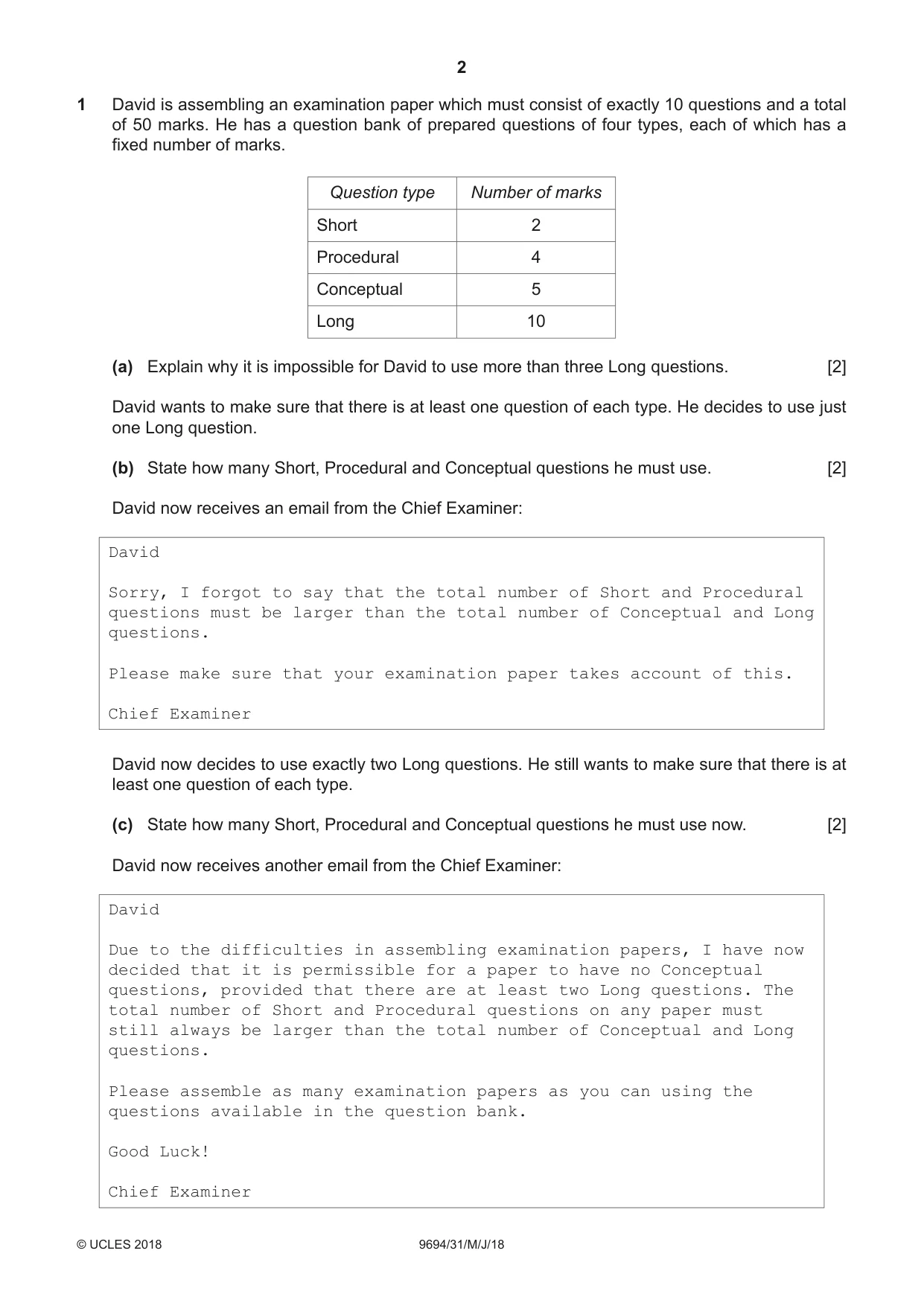
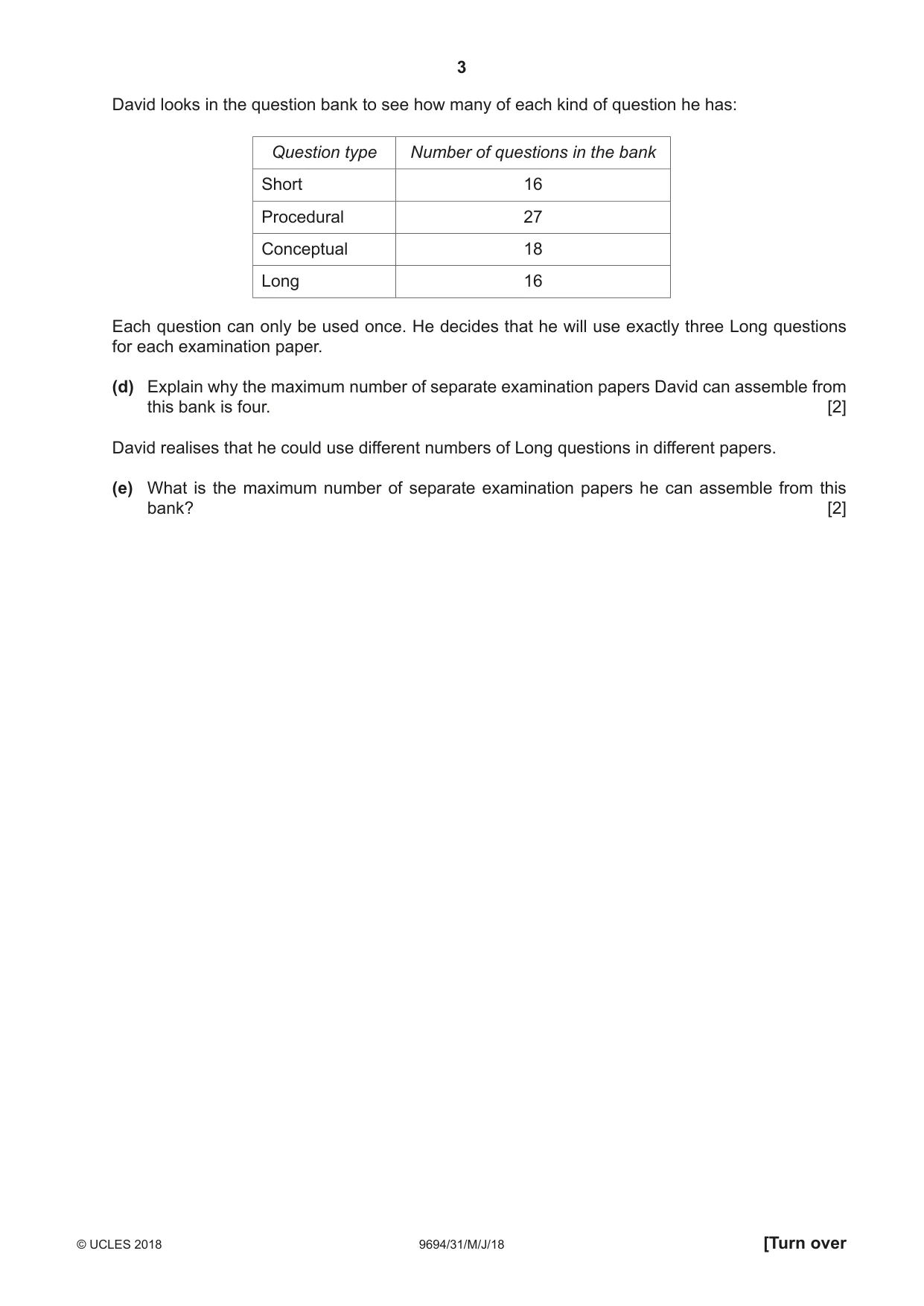
1 David is assembling an examination paper which must consist of exactly 10 questions and a total of 50 marks. He has a question bank of prepared questions of four types, each of which has a fixed number of marks. Question type Number of marks Short 2 Procedural 4 Conceptual 5 Long 10 (a) Explain why it is impossible for David to use more than three Long questions. [2] David wants to make sure that there is at least one question of each type. He decides to use just one Long question. (b) State how many Short, Procedural and Conceptual questions he must use. [2] David now receives an email from the Chief Examiner: David Sorry, I forgot to say that the total number of Short and Procedural questions must be larger than the total number of Conceptual and Long questions. Please make sure that your examination paper takes account of this. Chief Examiner David now decides to use exactly two Long questions. He still wants to make sure that there is at least one question of each type. (c) State how many Short, Procedural and Conceptual questions he must use now. [2] David now receives another email from the Chief Examiner: David Due to the difficulties in assembling examination papers, I have now decided that it is permissible for a paper to have no Conceptual questions, provided that there are at least two Long questions. The total number of Short and Procedural questions on any paper must still always be larger than the total number of Conceptual and Long questions. Please assemble as many examination papers as you can using the questions available in the question bank. Good Luck! Chief Examiner David looks in the question bank to see how many of each kind of question he has: Question type Number of questions in the bank Short 16 Procedural 27 Conceptual 18 Long 16 Each question can only be used once. He decides that he will use exactly three Long questions for each examination paper. (d) Explain why the maximum number of separate examination papers David can assemble from this bank is four. [2] David realises that he could use different numbers of Long questions in different papers. (e) What is the maximum number of separate examination papers he can assemble from this bank? [2]
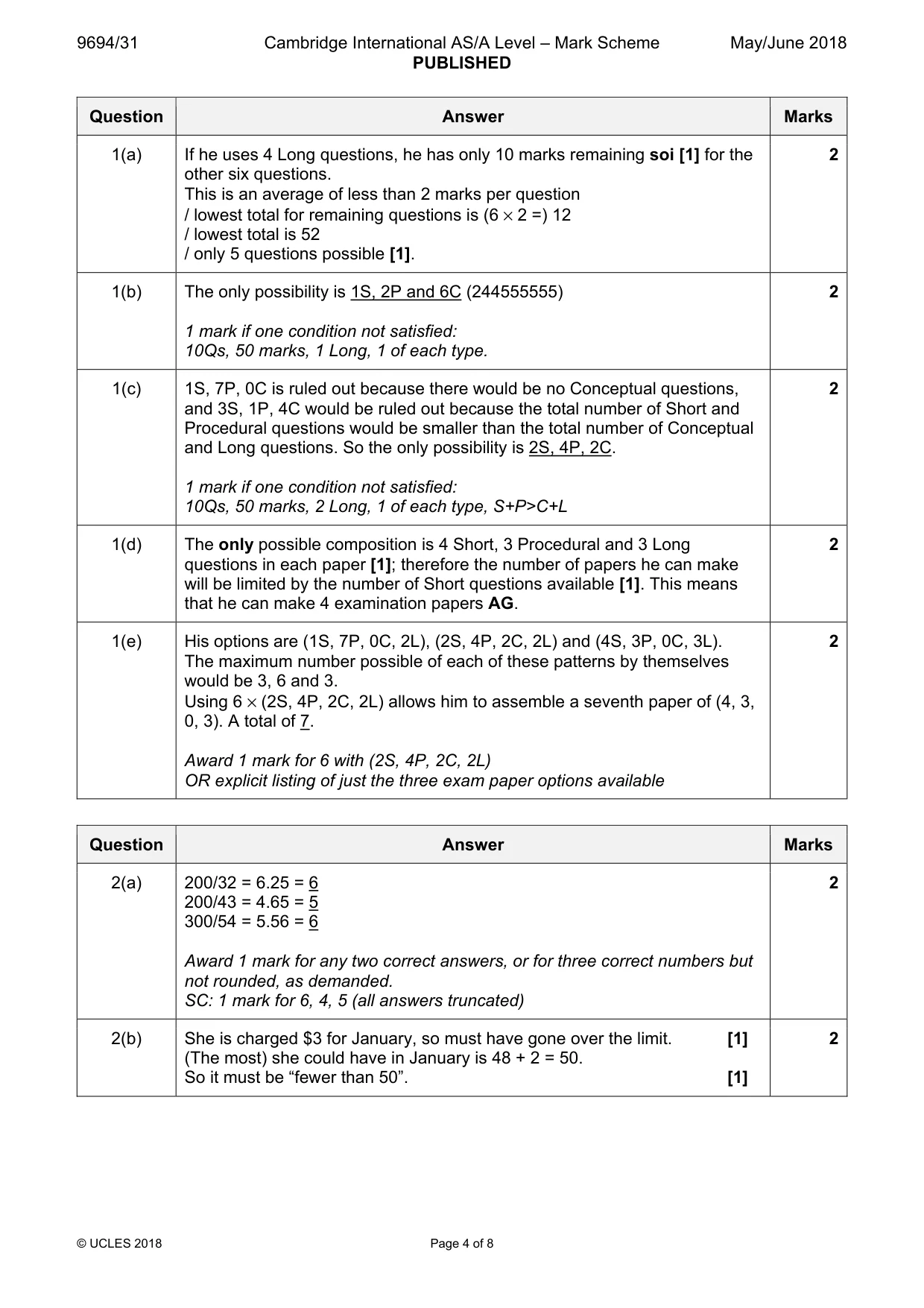
Mark scheme: Question Answer Marks 1(a) If he uses 4 Long questions, he has only 10 marks remaining soi [1] for the 2 other six questions. This is an average of less than 2 marks per question / lowest total for remaining questions is (6 × 2 =) 12 / lowest total is 52 / only 5 questions possible [1]. 1(b) The only possibility is 1S, 2P and 6C (244555555) 2 1 mark if one condition not satisfied: 10Qs, 50 marks, 1 Long, 1 of each type. 1(c) 1S, 7P, 0C is ruled out because there would be no Conceptual questions, 2 and 3S, 1P, 4C would be ruled out because the total number of Short and Procedural questions would be smaller than the total number of Conceptual and Long questions. So the only possibility is 2S, 4P, 2C. 1 mark if one condition not satisfied: 10Qs, 50 marks, 2 Long, 1 of each type, S+P>C+L 1(d) The only possible composition is 4 Short, 3 Procedural and 3 Long 2 questions in each paper [1]; therefore the number of papers he can make will be limited by the number of Short questions available [1]. This means that he can make 4 examination papers AG. 1(e) His options are (1S, 7P, 0C, 2L), (2S, 4P, 2C, 2L) and (4S, 3P, 0C, 3L). 2 The maximum number possible of each of these patterns by themselves would be 3, 6 and 3. Using 6 × (2S, 4P, 2C, 2L) allows him to assemble a seventh paper of (4, 3, 0, 3). A total of 7. Award 1 mark for 6 with (2S, 4P, 2C, 2L) OR explicit listing of just the three exam paper options available
More questions on Identify cases that satisfy given criteria
Q2 · Starting in January, Clarissa took up the offer of a subscription for printer ink
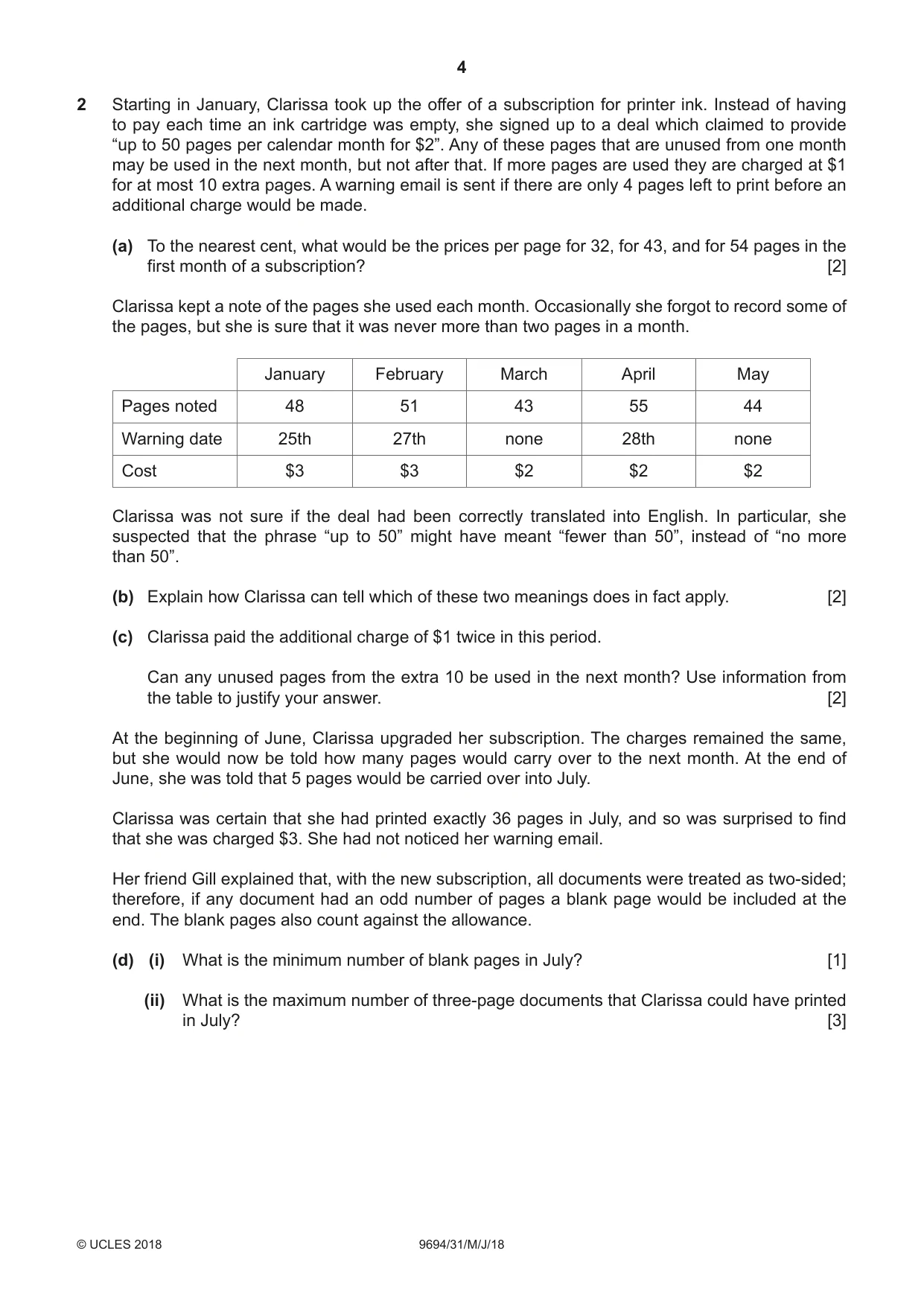
2 Starting in January, Clarissa took up the offer of a subscription for printer ink. Instead of having to pay each time an ink cartridge was empty, she signed up to a deal which claimed to provide “up to 50 pages per calendar month for $2”. Any of these pages that are unused from one month may be used in the next month, but not after that. If more pages are used they are charged at $1 for at most 10 extra pages. A warning email is sent if there are only 4 pages left to print before an additional charge would be made. (a) To the nearest cent, what would be the prices per page for 32, for 43, and for 54 pages in the first month of a subscription? [2] Clarissa kept a note of the pages she used each month. Occasionally she forgot to record some of the pages, but she is sure that it was never more than two pages in a month. January February March April May Pages noted 48 51 43 55 44 Warning date 25th 27th none 28th none Cost $3 $3 $2 $2 $2 Clarissa was not sure if the deal had been correctly translated into English. In particular, she suspected that the phrase “up to 50” might have meant “fewer than 50”, instead of “no more than 50”. (b) Explain how Clarissa can tell which of these two meanings does in fact apply. [2] (c) Clarissa paid the additional charge of $1 twice in this period. Can any unused pages from the extra 10 be used in the next month? Use information from the table to justify your answer. [2] At the beginning of June, Clarissa upgraded her subscription. The charges remained the same, but she would now be told how many pages would carry over to the next month. At the end of June, she was told that 5 pages would be carried over into July. Clarissa was certain that she had printed exactly 36 pages in July, and so was surprised to find that she was charged $3. She had not noticed her warning email. Her friend Gill explained that, with the new subscription, all documents were treated as two-sided; therefore, if any document had an odd number of pages a blank page would be included at the end. The blank pages also count against the allowance. (d) (i) What is the minimum number of blank pages in July? [1] (ii) What is the maximum number of three-page documents that Clarissa could have printed in July? [3]
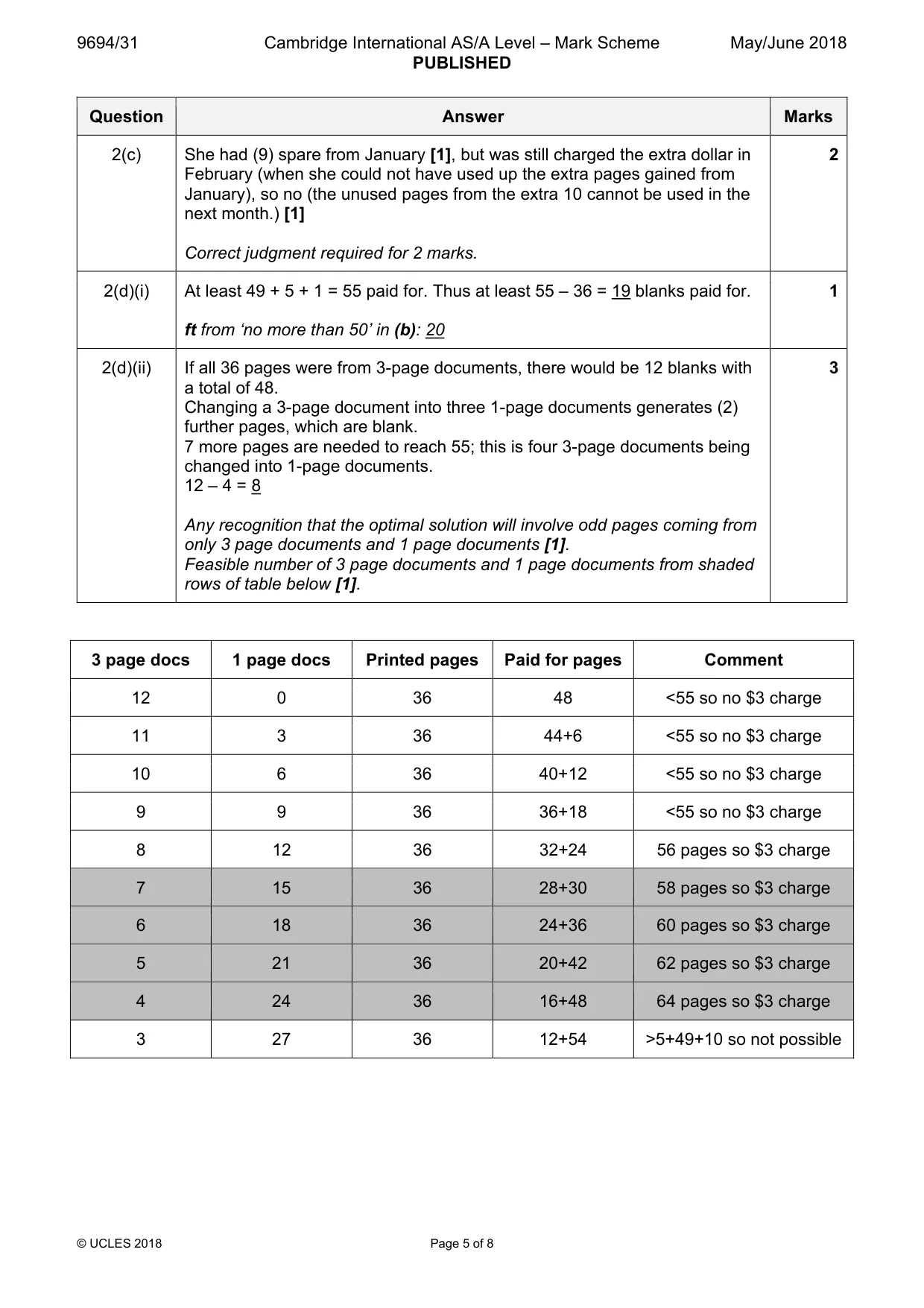
Mark scheme: 2(a) 200/32 = 6.25 = 6 2 200/43 = 4.65 = 5 300/54 = 5.56 = 6 Award 1 mark for any two correct answers, or for three correct numbers but not rounded, as demanded. SC: 1 mark for 6, 4, 5 (all answers truncated) 2(b) She is charged $3 for January, so must have gone over the limit. [1] 2 (The most) she could have in January is 48 + 2 = 50. So it must be “fewer than 50”. [1] 2(c) She had (9) spare from January [1], but was still charged the extra dollar in 2 February (when she could not have used up the extra pages gained from January), so no (the unused pages from the extra 10 cannot be used in the next month.) [1] Correct judgment required for 2 marks. 2(d)(i) At least 49 + 5 + 1 = 55 paid for. Thus at least 55 – 36 = 19 blanks paid for. 1 ft from ‘no more than 50’ in (b): 20 2(d)(ii) If all 36 pages were from 3-page documents, there would be 12 blanks with 3 a total of 48. Changing a 3-page document into three 1-page documents generates (2) further pages, which are blank. 7 more pages are needed to reach 55; this is four 3-page documents being changed into 1-page documents. 12 – 4 = 8 Any recognition that the optimal solution will involve odd pages coming from only 3 page documents and 1 page documents [1]. Feasible number of 3 page documents and 1 page documents from shaded rows of table below [1]. 3 page docs 1 page docs Printed pages Paid for pages Comment 12 0 36 48 <55 so no $3 charge 11 3 36 44+6 <55 so no $3 charge 10 6 36 40+12 <55 so no $3 charge 9 9 36 36+18 <55 so no $3 charge 8 12 36 32+24 56 pages so $3 charge 7 15 36 28+30 58 pages so $3 charge 6 18 36 24+36 60 pages so $3 charge 5 21 36 20+42 62 pages so $3 charge 4 24 36 16+48 64 pages so $3 charge 3 27 36 12+54 >5+49+10 so not possible
Q3 · Leon is an architect and he uses coloured plastic building blocks to help him model new…
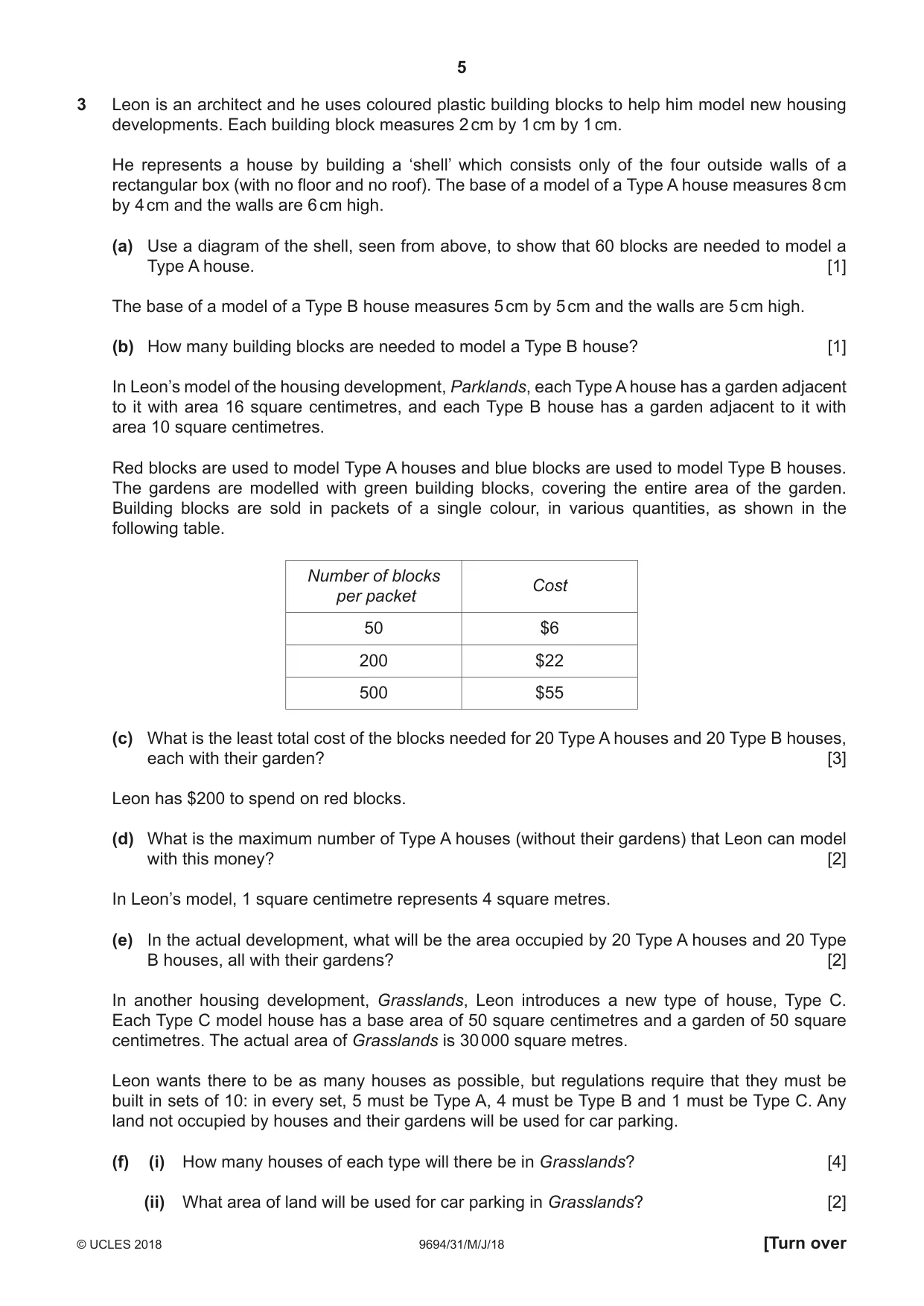
3 Leon is an architect and he uses coloured plastic building blocks to help him model new housing developments. Each building block measures 2 cm by 1 cm by 1 cm. He represents a house by building a ‘shell’ which consists only of the four outside walls of a rectangular box (with no floor and no roof). The base of a model of a Type A house measures 8 cm by 4 cm and the walls are 6 cm high. (a) Use a diagram of the shell, seen from above, to show that 60 blocks are needed to model a Type A house. [1] The base of a model of a Type B house measures 5 cm by 5 cm and the walls are 5 cm high. (b) How many building blocks are needed to model a Type B house? [1] In Leon’s model of the housing development, Parklands, each Type A house has a garden adjacent to it with area 16 square centimetres, and each Type B house has a garden adjacent to it with area 10 square centimetres. Red blocks are used to model Type A houses and blue blocks are used to model Type B houses. The gardens are modelled with green building blocks, covering the entire area of the garden. Building blocks are sold in packets of a single colour, in various quantities, as shown in the following table. Number of blocks Cost per packet 50 $6 200 $22 500 $55 (c) What is the least total cost of the blocks needed for 20 Type A houses and 20 Type B houses, each with their garden? [3] Leon has $200 to spend on red blocks. (d) What is the maximum number of Type A houses (without their gardens) that Leon can model with this money? [2] In Leon’s model, 1 square centimetre represents 4 square metres. (e) In the actual development, what will be the area occupied by 20 Type A houses and 20 Type B houses, all with their gardens? [2] In another housing development, Grasslands, Leon introduces a new type of house, Type C. Each Type C model house has a base area of 50 square centimetres and a garden of 50 square centimetres. The actual area of Grasslands is 30 000 square metres. Leon wants there to be as many houses as possible, but regulations require that they must be built in sets of 10: in every set, 5 must be Type A, 4 must be Type B and 1 must be Type C. Any land not occupied by houses and their gardens will be used for car parking. (f) (i) How many houses of each type will there be in Grasslands? [4] (ii) What area of land will be used for car parking in Grasslands? [2]
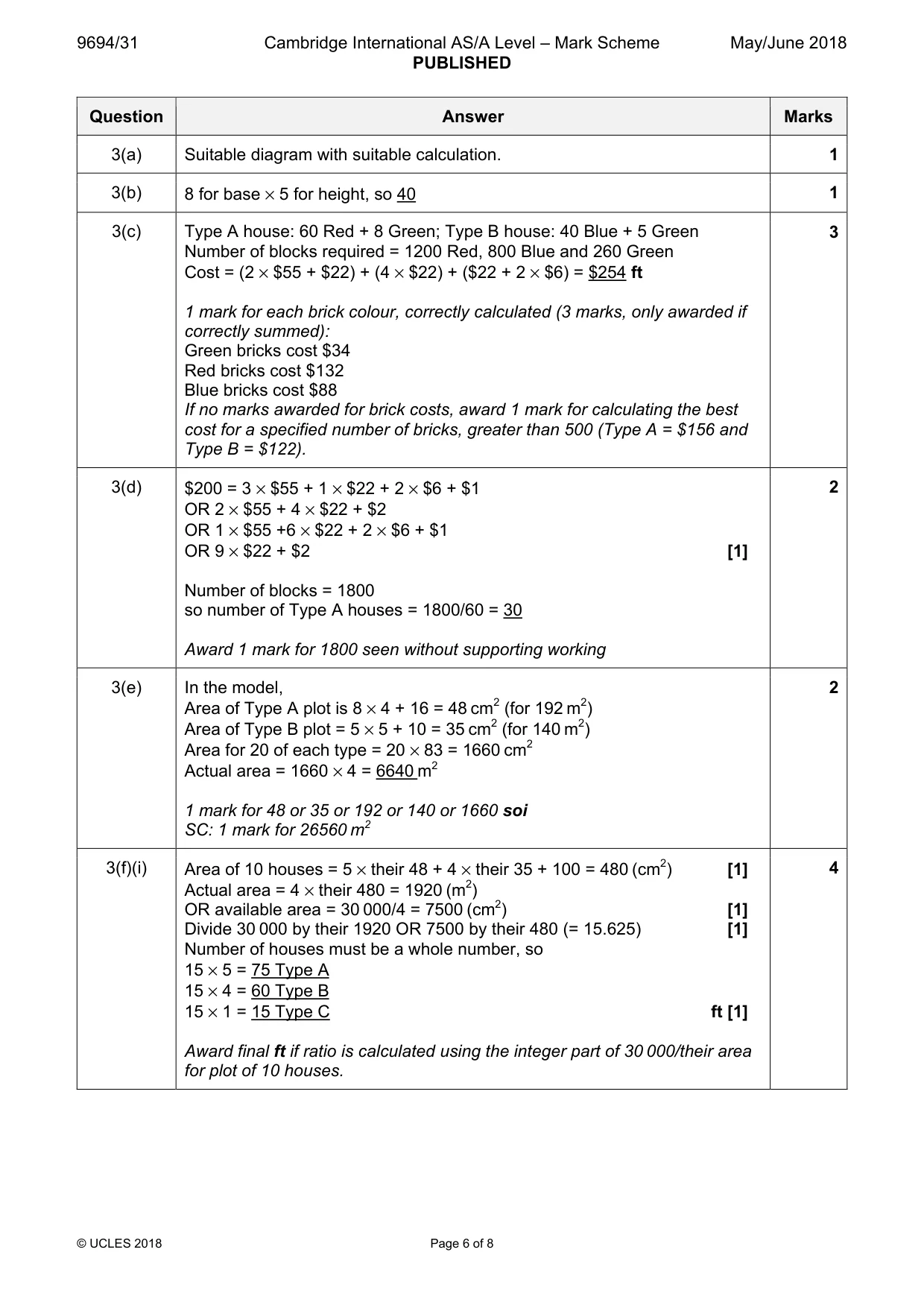
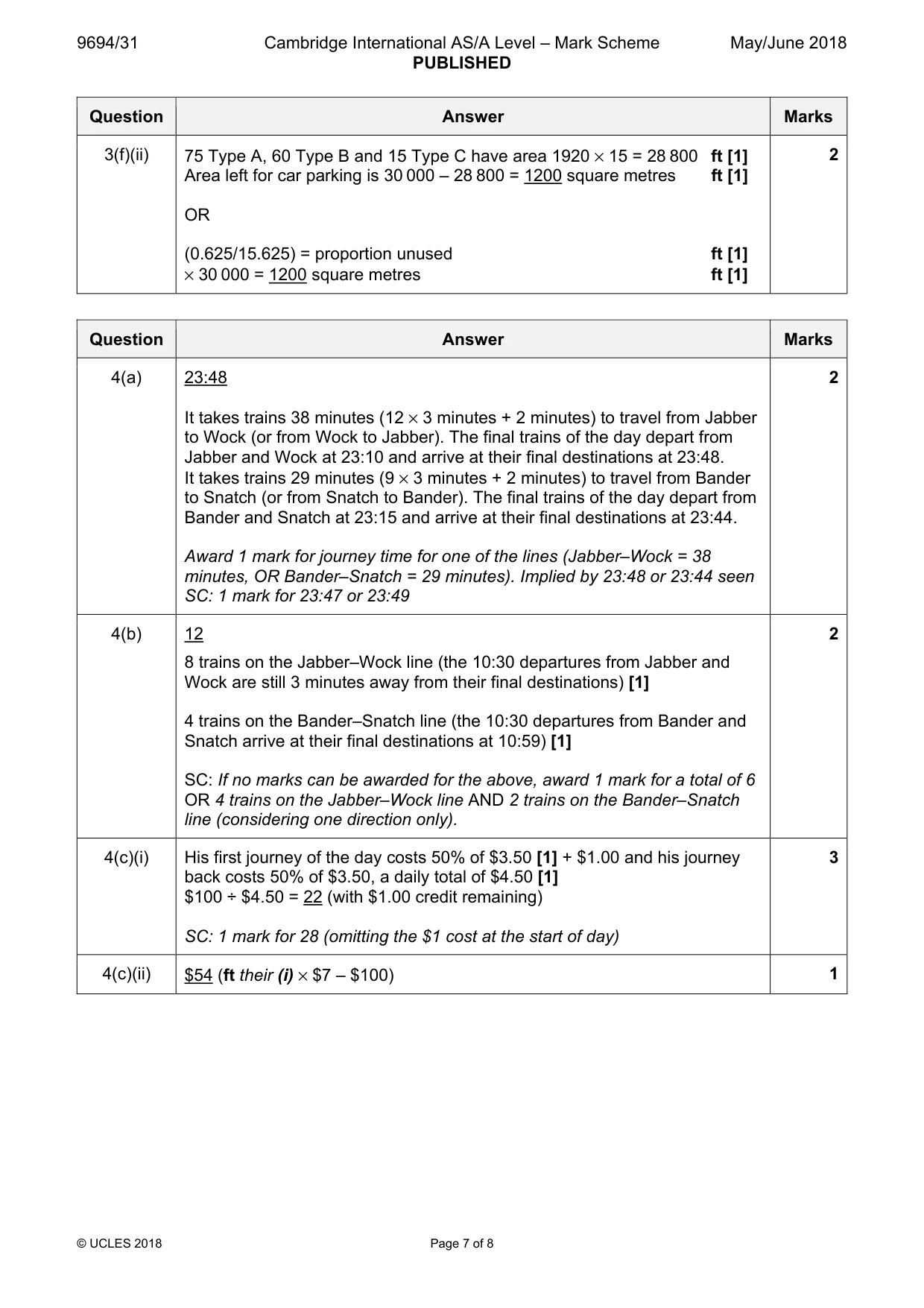
Mark scheme: 3(a) Suitable diagram with suitable calculation. 1 3(b) 8 for base × 5 for height, so 40 1 3(c) Type A house: 60 Red + 8 Green; Type B house: 40 Blue + 5 Green 3 Number of blocks required = 1200 Red, 800 Blue and 260 Green Cost = (2 × $55 + $22) + (4 × $22) + ($22 + 2 × $6) = $254 ft 1 mark for each brick colour, correctly calculated (3 marks, only awarded if correctly summed): Green bricks cost $34 Red bricks cost $132 Blue bricks cost $88 If no marks awarded for brick costs, award 1 mark for calculating the best cost for a specified number of bricks, greater than 500 (Type A = $156 and Type B = $122). 3(d) $200 = 3 × $55 + 1 × $22 + 2 × $6 + $1 2 OR 2 × $55 + 4 × $22 + $2 OR 1 × $55 +6 × $22 + 2 × $6 + $1 OR 9 × $22 + $2 [1] Number of blocks = 1800 so number of Type A houses = 1800/60 = 30 Award 1 mark for 1800 seen without supporting working 3(e) In the model, 2 Area of Type A plot is 8 × 4 + 16 = 48 cm2 (for 192 m2) Area of Type B plot = 5 × 5 + 10 = 35 cm2 (for 140 m2) Area for 20 of each type = 20 × 83 = 1660 cm2 Actual area = 1660 × 4 = 6640 m2 1 mark for 48 or 35 or 192 or 140 or 1660 soi SC: 1 mark for 26560 m2 3(f)(i) Area of 10 houses = 5 × their 48 + 4 × their 35 + 100 = 480 (cm2) [1] 4 Actual area = 4 × their 480 = 1920 (m2) OR available area = 30 000/4 = 7500 (cm2) [1] Divide 30 000 by their 1920 OR 7500 by their 480 (= 15.625) [1] Number of houses must be a whole number, so 15 × 5 = 75 Type A 15 × 4 = 60 Type B 15 × 1 = 15 Type C ft [1] Award final ft if ratio is calculated using the integer part of 30 000/their area for plot of 10 houses. 3(f)(ii) 75 Type A, 60 Type B and 15 Type C have area 1920 × 15 = 28 800 ft [1] 2 Area left for car parking is 30 000 – 28 800 = 1200 square metres ft [1] OR (0.625/15.625) = proportion unused ft [1] × 30 000 = 1200 square metres ft [1]
Q4 · The Quadrille is the underground railway system of the city of Lewcar
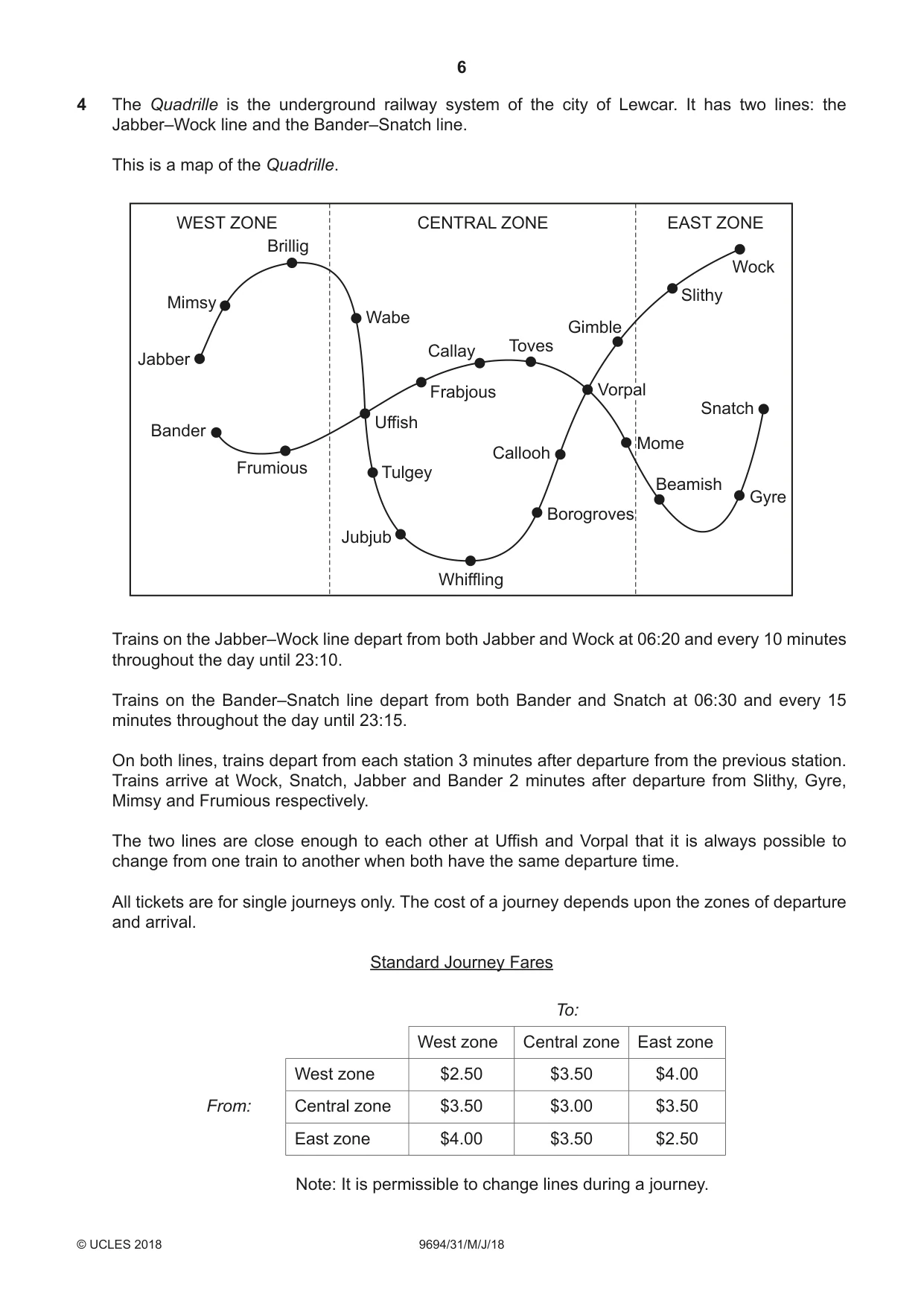
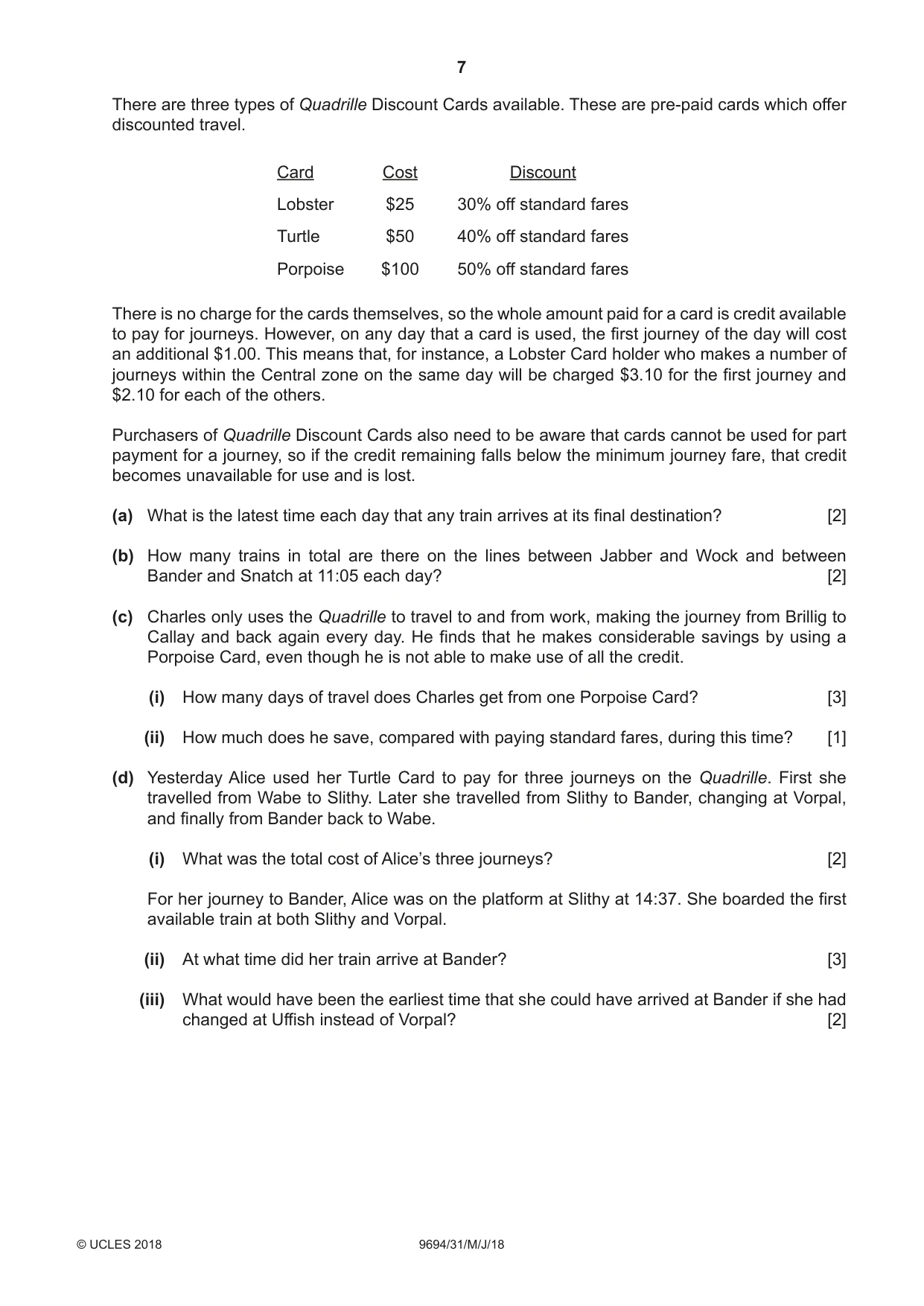
4 The Quadrille is the underground railway system of the city of Lewcar. It has two lines: the Jabber–Wock line and the Bander–Snatch line. This is a map of the Quadrille. WEST ZONE CENTRAL ZONE EAST ZONE Brillig Wock Slithy Mimsy Wabe Gimble Toves Callay Jabber Frabjous Vorpal Snatch Uffish Bander Mome Callooh Frumious Tulgey Beamish Gyre Borogroves Jubjub Whiffling Trains on the Jabber–Wock line depart from both Jabber and Wock at 06:20 and every 10 minutes throughout the day until 23:10. Trains on the Bander–Snatch line depart from both Bander and Snatch at 06:30 and every 15 minutes throughout the day until 23:15. On both lines, trains depart from each station 3 minutes after departure from the previous station. Trains arrive at Wock, Snatch, Jabber and Bander 2 minutes after departure from Slithy, Gyre, Mimsy and Frumious respectively. The two lines are close enough to each other at Uffish and Vorpal that it is always possible to change from one train to another when both have the same departure time. All tickets are for single journeys only. The cost of a journey depends upon the zones of departure and arrival. Standard Journey Fares To: West zone Central zone East zone West zone $2.50 $3.50 $4.00 From: Central zone $3.50 $3.00 $3.50 East zone $4.00 $3.50 $2.50 Note: It is permissible to change lines during a journey. There are three types of Quadrille Discount Cards available. These are pre-paid cards which offer discounted travel. Card Cost Discount Lobster $25 30% off standard fares Turtle $50 40% off standard fares Porpoise $100 50% off standard fares There is no charge for the cards themselves, so the whole amount paid for a card is credit available to pay for journeys. However, on any day that a card is used, the first journey of the day will cost an additional $1.00. This means that, for instance, a Lobster Card holder who makes a number of journeys within the Central zone on the same day will be charged $3.10 for the first journey and $2.10 for each of the others. Purchasers of Quadrille Discount Cards also need to be aware that cards cannot be used for part payment for a journey, so if the credit remaining falls below the minimum journey fare, that credit becomes unavailable for use and is lost. (a) What is the latest time each day that any train arrives at its final destination? [2] (b) How many trains in total are there on the lines between Jabber and Wock and between Bander and Snatch at 11:05 each day? [2] (c) Charles only uses the Quadrille to travel to and from work, making the journey from Brillig to Callay and back again every day. He finds that he makes considerable savings by using a Porpoise Card, even though he is not able to make use of all the credit. (i) How many days of travel does Charles get from one Porpoise Card? [3] (ii) How much does he save, compared with paying standard fares, during this time? [1] (d) Yesterday Alice used her Turtle Card to pay for three journeys on the Quadrille. First she travelled from Wabe to Slithy. Later she travelled from Slithy to Bander, changing at Vorpal, and finally from Bander back to Wabe. (i) What was the total cost of Alice’s three journeys? [2] For her journey to Bander, Alice was on the platform at Slithy at 14:37. She boarded the first available train at both Slithy and Vorpal. (ii) At what time did her train arrive at Bander? [3] (iii) What would have been the earliest time that she could have arrived at Bander if she had changed at Uffish instead of Vorpal? [2]
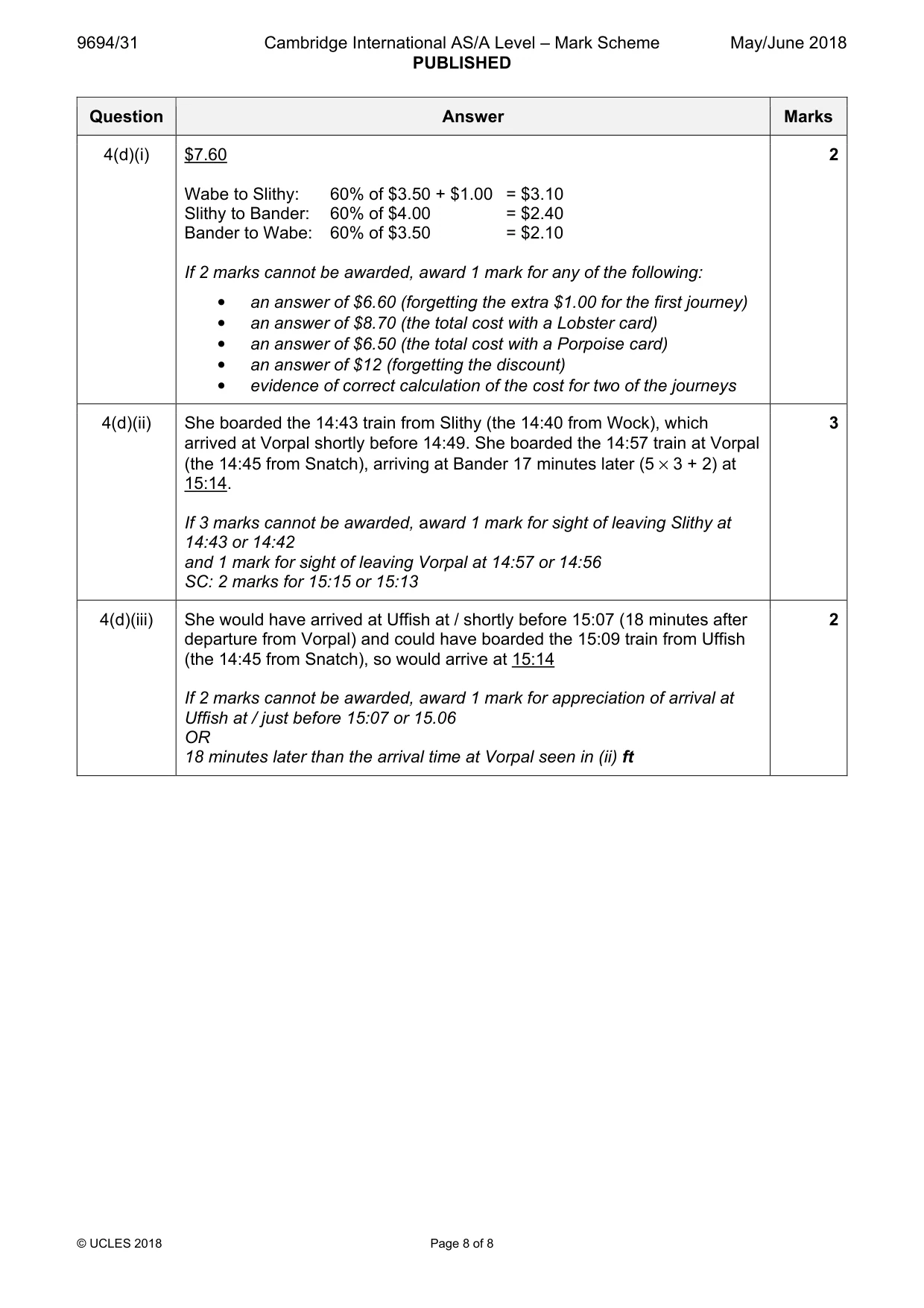
Mark scheme: 4(a) 23:48 2 It takes trains 38 minutes (12 × 3 minutes + 2 minutes) to travel from Jabber to Wock (or from Wock to Jabber). The final trains of the day depart from Jabber and Wock at 23:10 and arrive at their final destinations at 23:48. It takes trains 29 minutes (9 × 3 minutes + 2 minutes) to travel from Bander to Snatch (or from Snatch to Bander). The final trains of the day depart from Bander and Snatch at 23:15 and arrive at their final destinations at 23:44. Award 1 mark for journey time for one of the lines (Jabber–Wock = 38 minutes, OR Bander–Snatch = 29 minutes). Implied by 23:48 or 23:44 seen SC: 1 mark for 23:47 or 23:49 4(b) 12 2 8 trains on the Jabber–Wock line (the 10:30 departures from Jabber and Wock are still 3 minutes away from their final destinations) [1] 4 trains on the Bander–Snatch line (the 10:30 departures from Bander and Snatch arrive at their final destinations at 10:59) [1] SC: If no marks can be awarded for the above, award 1 mark for a total of 6 OR 4 trains on the Jabber–Wock line AND 2 trains on the Bander–Snatch line (considering one direction only). 4(c)(i) His first journey of the day costs 50% of $3.50 [1] + $1.00 and his journey 3 back costs 50% of $3.50, a daily total of $4.50 [1] $100 ÷ $4.50 = 22 (with $1.00 credit remaining) SC: 1 mark for 28 (omitting the $1 cost at the start of day) 4(c)(ii) $54 (ft their (i) × $7 – $100) 1 4(d)(i) $7.60 2 Wabe to Slithy: 60% of $3.50 + $1.00 = $3.10 Slithy to Bander: 60% of $4.00 = $2.40 Bander to Wabe: 60% of $3.50 = $2.10 If 2 marks cannot be awarded, award 1 mark for any of the following: • an answer of $6.60 (forgetting the extra $1.00 for the first journey) • an answer of $8.70 (the total cost with a Lobster card) • an answer of $6.50 (the total cost with a Porpoise card) • an answer of $12 (forgetting the discount) • evidence of correct calculation of the cost for two of the journeys 4(d)(ii) She boarded the 14:43 train from Slithy (the 14:40 from Wock), which 3 arrived at Vorpal shortly before 14:49. She boarded the 14:57 train at Vorpal (the 14:45 from Snatch), arriving at Bander 17 minutes later (5 × 3 + 2) at 15:14. If 3 marks cannot be awarded, award 1 mark for sight of leaving Slithy at 14:43 or 14:42 and 1 mark for sight of leaving Vorpal at 14:57 or 14:56 SC: 2 marks for 15:15 or 15:13 4(d)(iii) She would have arrived at Uffish at / shortly before 15:07 (18 minutes after 2 departure from Vorpal) and could have boarded the 15:09 train from Uffish (the 14:45 from Snatch), so would arrive at 15:14 If 2 marks cannot be awarded, award 1 mark for appreciation of arrival at Uffish at / just before 15:07 or 15.06 OR 18 minutes later than the arrival time at Vorpal seen in (ii) ft
More questions on Perform appropriate operations with information
What was in this paper
The subtopics covered by these 4 questions, and how many questions each got. Open one in a new tab to see every Cambridge question on it.
What you needed in this session
Cambridge’s own grade thresholds for 2018 May/June, Paper 3 · Variant 1. A higher threshold means an easier paper — the bar moves with how the cohort did.