Cambridge A Level Thinking Skills 9694 — 2022 Oct/Nov Paper 2 · Variant 1
9694/21/O/N/22 · 50 marks · ≈56 min
The question paper and its mark scheme, free to read here and free to download. This is Cambridge’s own paper, exactly as it was sat.
Question paper8 pages
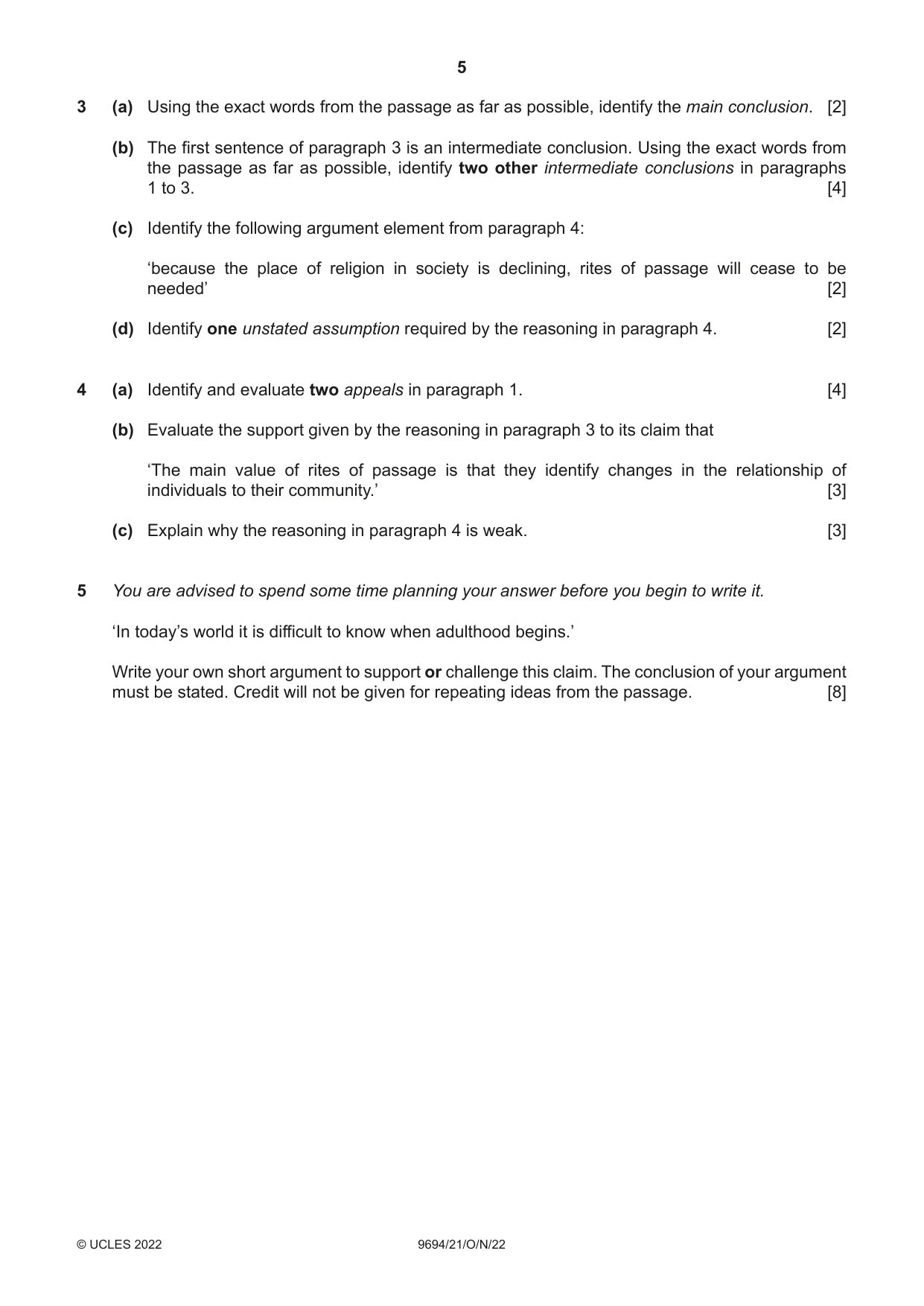


Mark scheme12 pages
Answers below. Sit the paper first if you are practising.
Paper as text
Question paper, page 1
This document has 8 pages. Any blank pages are indicated. [Turn over Cambridge International AS & A Level THINKING SKILLS 9694/21 Paper 2 Critical Thinking October/November 2022 1 hour 45 minutes You must answer on the enclosed answer booklet. You will need: Answer booklet (enclosed) INSTRUCTIONS ● Answer all questions. ● Follow the instructions on the front cover of the answer booklet. If you need additional answer paper, ask the invigilator for a continuation booklet. INFORMATION ● The total mark for this paper is 50. ● The number of marks for each question or part question is shown in brackets [ ]. DC (LK/SG) 213993/1 © UCLES 2022 * 0 6 1 8 1 0 9 7 9 6 *
Question paper, page 2
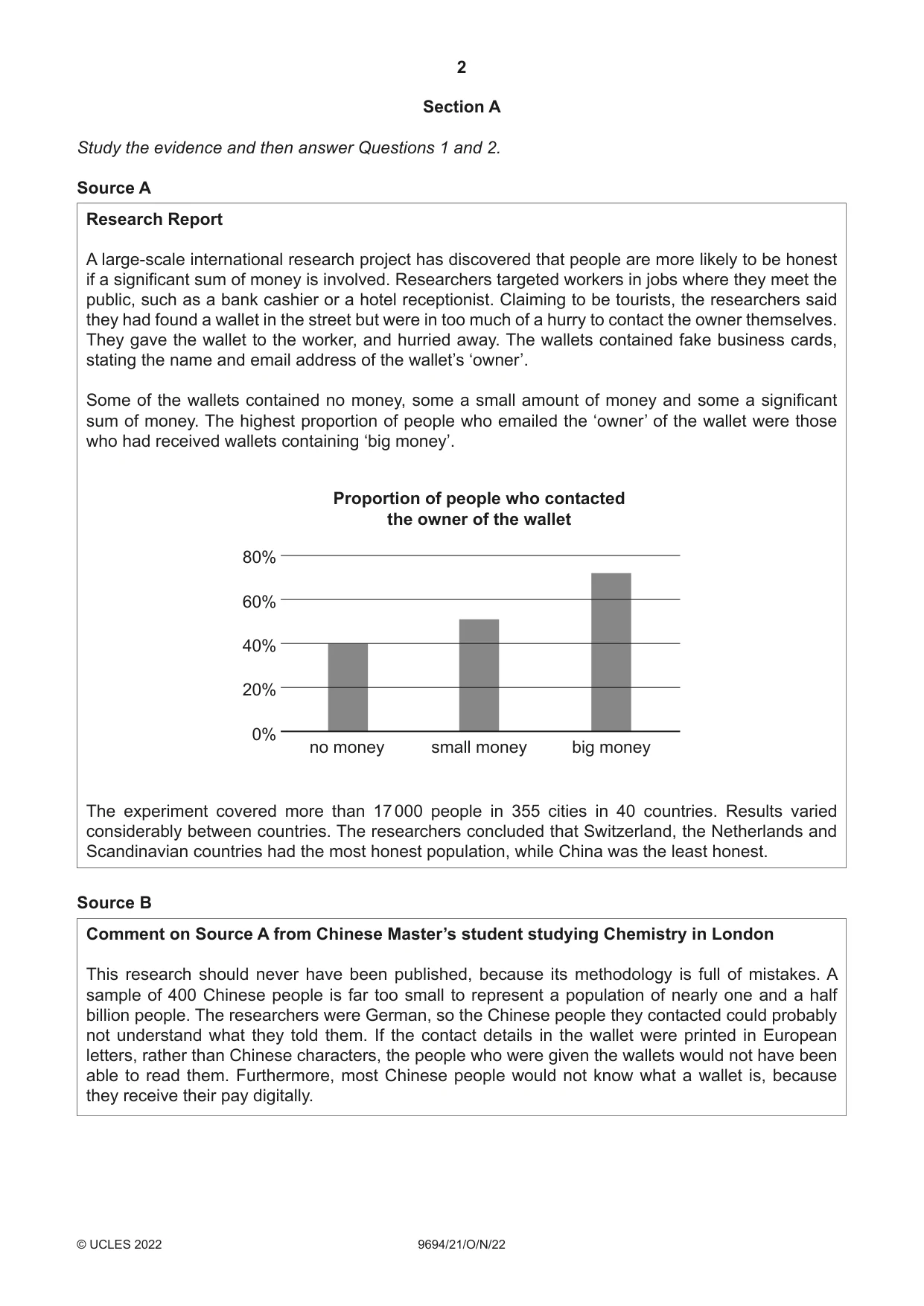
2 9694/21/O/N/22 © UCLES 2022 Section A Study the evidence and then answer Questions 1 and 2. Source A Research Report A large-scale international research project has discovered that people are more likely to be honest if a significant sum of money is involved. Researchers targeted workers in jobs where they meet the public, such as a bank cashier or a hotel receptionist. Claiming to be tourists, the researchers said they had found a wallet in the street but were in too much of a hurry to contact the owner themselves. They gave the wallet to the worker, and hurried away. The wallets contained fake business cards, stating the name and email address of the wallet’s ‘owner’. Some of the wallets contained no money, some a small amount of money and some a significant sum of money. The highest proportion of people who emailed the ‘owner’ of the wallet were those who had received wallets containing ‘big money’. no money small money big money 0% 20% 40% 60% 80% Proportion of people who contacted the owner of the wallet The experiment covered more than 17 000 people in 355 cities in 40 countries. Results varied considerably between countries. The researchers concluded that Switzerland, the Netherlands and Scandinavian countries had the most honest population, while China was the least honest. Source B Comment on Source A from Chinese Master’s student studying Chemistry in London This research should never have been published, because its methodology is full of mistakes. A sample of 400 Chinese people is far too small to represent a population of nearly one and a half billion people. The researchers were German, so the Chinese people they contacted could probably not understand what they told them. If the contact details in the wallet were printed in European letters, rather than Chinese characters, the people who were given the wallets would not have been able to read them. Furthermore, most Chinese people would not know what a wallet is, because they receive their pay digitally.
Question paper, page 3
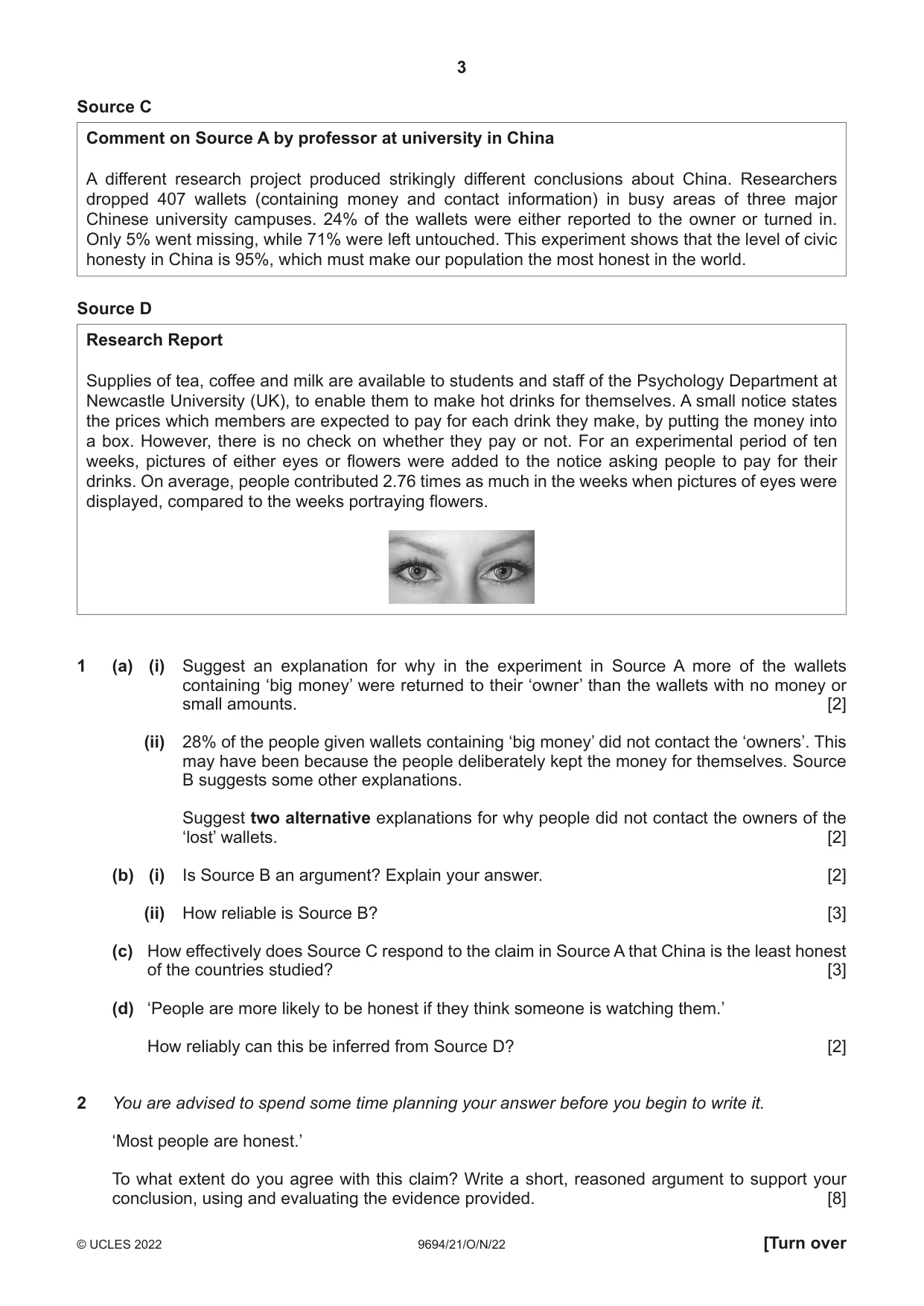
3 9694/21/O/N/22 © UCLES 2022 [Turn over Source C Comment on Source A by professor at university in China A different research project produced strikingly different conclusions about China. Researchers dropped 407 wallets (containing money and contact information) in busy areas of three major Chinese university campuses. 24% of the wallets were either reported to the owner or turned in. Only 5% went missing, while 71% were left untouched. This experiment shows that the level of civic honesty in China is 95%, which must make our population the most honest in the world. Source D Research Report Supplies of tea, coffee and milk are available to students and staff of the Psychology Department at Newcastle University (UK), to enable them to make hot drinks for themselves. A small notice states the prices which members are expected to pay for each drink they make, by putting the money into a box. However, there is no check on whether they pay or not. For an experimental period of ten weeks, pictures of either eyes or flowers were added to the notice asking people to pay for their drinks. On average, people contributed 2.76 times as much in the weeks when pictures of eyes were displayed, compared to the weeks portraying flowers. 1 (a) (i) Suggest an explanation for why in the experiment in Source A more of the wallets containing ‘big money’ were returned to their ‘owner’ than the wallets with no money or small amounts. [2] (ii) 28% of the people given wallets containing ‘big money’ did not contact the ‘owners’. This may have been because the people deliberately kept the money for themselves. Source B suggests some other explanations. Suggest two alternative explanations for why people did not contact the owners of the ‘lost’ wallets. [2] (b) (i) Is Source B an argument? Explain your answer. [2] (ii) How reliable is Source B? [3] (c) How effectively does Source C respond to the claim in Source A that China is the least honest of the countries studied? [3] (d) ‘People are more likely to be honest if they think someone is watching them.’ How reliably can this be inferred from Source D? [2] 2 You are advised to spend some time planning your answer before you begin to write it. ‘Most people are honest.’ To what extent do you agree with this claim? Write a short, reasoned argument to support your conclusion, using and evaluating the evidence provided. [8]
Question paper, page 4
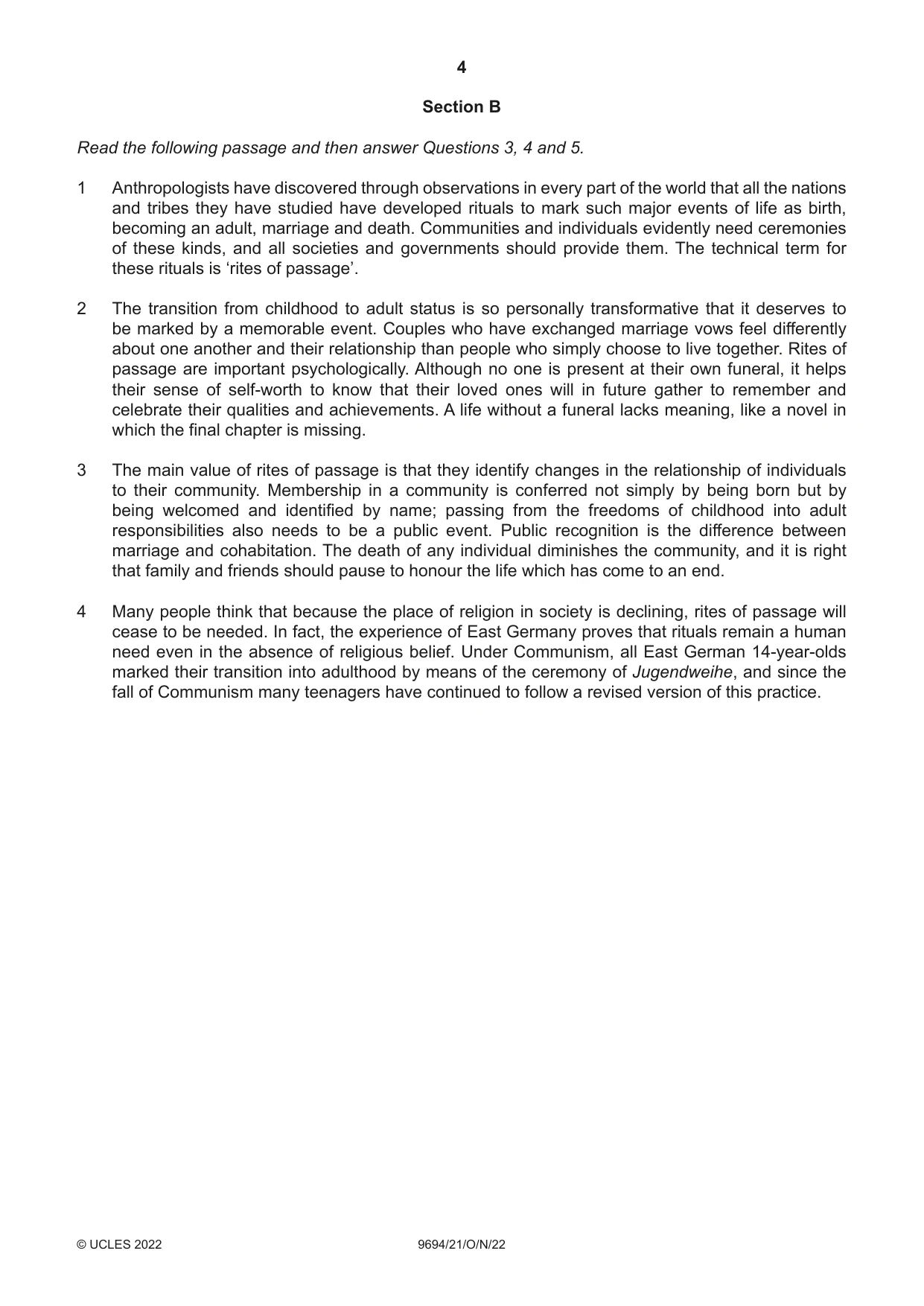
4 9694/21/O/N/22 © UCLES 2022 Section B Read the following passage and then answer Questions 3, 4 and 5. 1 Anthropologists have discovered through observations in every part of the world that all the nations and tribes they have studied have developed rituals to mark such major events of life as birth, becoming an adult, marriage and death. Communities and individuals evidently need ceremonies of these kinds, and all societies and governments should provide them. The technical term for these rituals is ‘rites of passage’. 2 The transition from childhood to adult status is so personally transformative that it deserves to be marked by a memorable event. Couples who have exchanged marriage vows feel differently about one another and their relationship than people who simply choose to live together. Rites of passage are important psychologically. Although no one is present at their own funeral, it helps their sense of self-worth to know that their loved ones will in future gather to remember and celebrate their qualities and achievements. A life without a funeral lacks meaning, like a novel in which the final chapter is missing. 3 The main value of rites of passage is that they identify changes in the relationship of individuals to their community. Membership in a community is conferred not simply by being born but by being welcomed and identified by name; passing from the freedoms of childhood into adult responsibilities also needs to be a public event. Public recognition is the difference between marriage and cohabitation. The death of any individual diminishes the community, and it is right that family and friends should pause to honour the life which has come to an end. 4 Many people think that because the place of religion in society is declining, rites of passage will cease to be needed. In fact, the experience of East Germany proves that rituals remain a human need even in the absence of religious belief. Under Communism, all East German 14-year-olds marked their transition into adulthood by means of the ceremony of Jugendweihe, and since the fall of Communism many teenagers have continued to follow a revised version of this practice.
Question paper, page 5
5 9694/21/O/N/22 © UCLES 2022 3 (a) Using the exact words from the passage as far as possible, identify the main conclusion. [2] (b) The first sentence of paragraph 3 is an intermediate conclusion. Using the exact words from the passage as far as possible, identify two other intermediate conclusions in paragraphs 1 to 3. [4] (c) Identify the following argument element from paragraph 4: ‘because the place of religion in society is declining, rites of passage will cease to be needed’ [2] (d) Identify one unstated assumption required by the reasoning in paragraph 4. [2] 4 (a) Identify and evaluate two appeals in paragraph 1. [4] (b) Evaluate the support given by the reasoning in paragraph 3 to its claim that ‘The main value of rites of passage is that they identify changes in the relationship of individuals to their community.’ [3] (c) Explain why the reasoning in paragraph 4 is weak. [3] 5 You are advised to spend some time planning your answer before you begin to write it. ‘In today’s world it is difficult to know when adulthood begins.’ Write your own short argument to support or challenge this claim. The conclusion of your argument must be stated. Credit will not be given for repeating ideas from the passage. [8]
Question paper, page 6
6 9694/21/O/N/22 © UCLES 2022 BLANK PAGE
Question paper, page 7
7 9694/21/O/N/22 © UCLES 2022 BLANK PAGE
Question paper, page 8
8 9694/21/O/N/22 © UCLES 2022 Permission to reproduce items where third-party owned material protected by copyright is included has been sought and cleared where possible. Every reasonable effort has been made by the publisher (UCLES) to trace copyright holders, but if any items requiring clearance have unwittingly been included, the publisher will be pleased to make amends at the earliest possible opportunity. To avoid the issue of disclosure of answer-related information to candidates, all copyright acknowledgements are reproduced online in the Cambridge Assessment International Education Copyright Acknowledgements Booklet. This is produced for each series of examinations and is freely available to download at www.cambridgeinternational.org after the live examination series. Cambridge Assessment International Education is part of Cambridge Assessment. Cambridge Assessment is the brand name of the University of Cambridge Local Examinations Syndicate (UCLES), which is a department of the University of Cambridge. BLANK PAGE
Mark scheme, page 1
This document consists of 12 printed pages. © UCLES 2022 [Turn over Cambridge International AS & A Level THINKING SKILLS 9694/21 Paper 2 Critical Thinking October/November 2022 MARK SCHEME Maximum Mark: 50 Published This mark scheme is published as an aid to teachers and candidates, to indicate the requirements of the examination. It shows the basis on which Examiners were instructed to award marks. It does not indicate the details of the discussions that took place at an Examiners’ meeting before marking began, which would have considered the acceptability of alternative answers. Mark schemes should be read in conjunction with the question paper and the Principal Examiner Report for Teachers. Cambridge International will not enter into discussions about these mark schemes. Cambridge International is publishing the mark schemes for the October/November 2022 series for most Cambridge IGCSE™, Cambridge International A and AS Level components and some Cambridge O Level components.
Mark scheme, page 2
9694/21 Cambridge International AS & A Level – Mark Scheme PUBLISHED October/November 2022 © UCLES 2022 Page 2 of 12 Generic Marking Principles These general marking principles must be applied by all examiners when marking candidate answers. They should be applied alongside the specific content of the mark scheme or generic level descriptors for a question. Each question paper and mark scheme will also comply with these marking principles. GENERIC MARKING PRINCIPLE 1: Marks must be awarded in line with: • the specific content of the mark scheme or the generic level descriptors for the question • the specific skills defined in the mark scheme or in the generic level descriptors for the question • the standard of response required by a candidate as exemplified by the standardisation scripts. GENERIC MARKING PRINCIPLE 2: Marks awarded are always whole marks (not half marks, or other fractions). GENERIC MARKING PRINCIPLE 3: Marks must be awarded positively: • marks are awarded for correct/valid answers, as defined in the mark scheme. However, credit is given for valid answers which go beyond the scope of the syllabus and mark scheme, referring to your Team Leader as appropriate • marks are awarded when candidates clearly demonstrate what they know and can do • marks are not deducted for errors • marks are not deducted for omissions • answers should only be judged on the quality of spelling, punctuation and grammar when these features are specifically assessed by the question as indicated by the mark scheme. The meaning, however, should be unambiguous. GENERIC MARKING PRINCIPLE 4: Rules must be applied consistently, e.g. in situations where candidates have not followed instructions or in the application of generic level descriptors. GENERIC MARKING PRINCIPLE 5: Marks should be awarded using the full range of marks defined in the mark scheme for the question (however; the use of the full mark range may be limited according to the quality of the candidate responses seen). GENERIC MARKING PRINCIPLE 6: Marks awarded are based solely on the requirements as defined in the mark scheme. Marks should not be awarded with grade thresholds or grade descriptors in mind.
Mark scheme, page 3
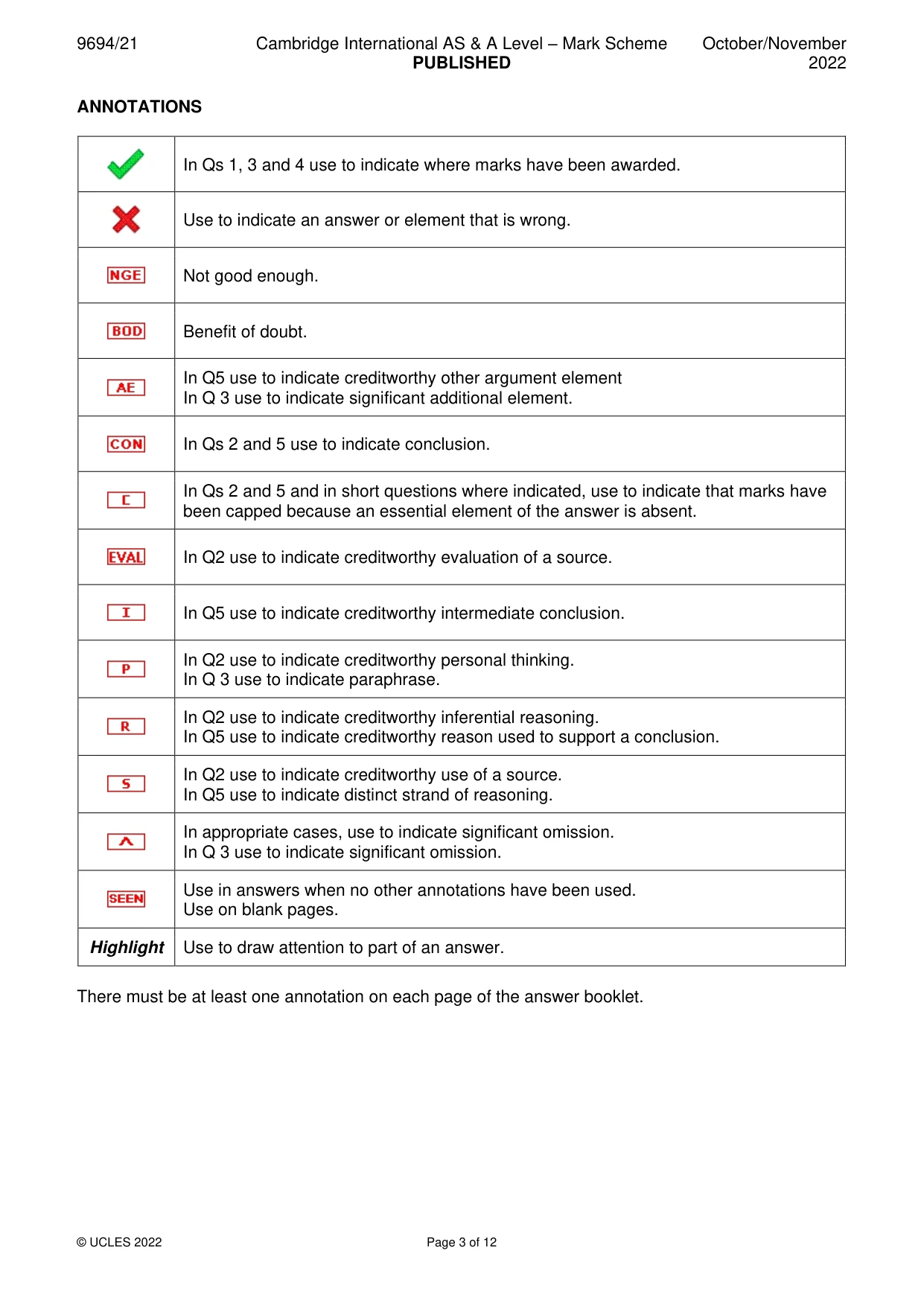
9694/21 Cambridge International AS & A Level – Mark Scheme PUBLISHED October/November 2022 © UCLES 2022 Page 3 of 12 ANNOTATIONS In Qs 1, 3 and 4 use to indicate where marks have been awarded. Use to indicate an answer or element that is wrong. Not good enough. Benefit of doubt. In Q5 use to indicate creditworthy other argument element In Q 3 use to indicate significant additional element. In Qs 2 and 5 use to indicate conclusion. In Qs 2 and 5 and in short questions where indicated, use to indicate that marks have been capped because an essential element of the answer is absent. In Q2 use to indicate creditworthy evaluation of a source. In Q5 use to indicate creditworthy intermediate conclusion. In Q2 use to indicate creditworthy personal thinking. In Q 3 use to indicate paraphrase. In Q2 use to indicate creditworthy inferential reasoning. In Q5 use to indicate creditworthy reason used to support a conclusion. In Q2 use to indicate creditworthy use of a source. In Q5 use to indicate distinct strand of reasoning. In appropriate cases, use to indicate significant omission. In Q 3 use to indicate significant omission. Use in answers when no other annotations have been used. Use on blank pages. Highlight Use to draw attention to part of an answer. There must be at least one annotation on each page of the answer booklet.
Mark scheme, page 4
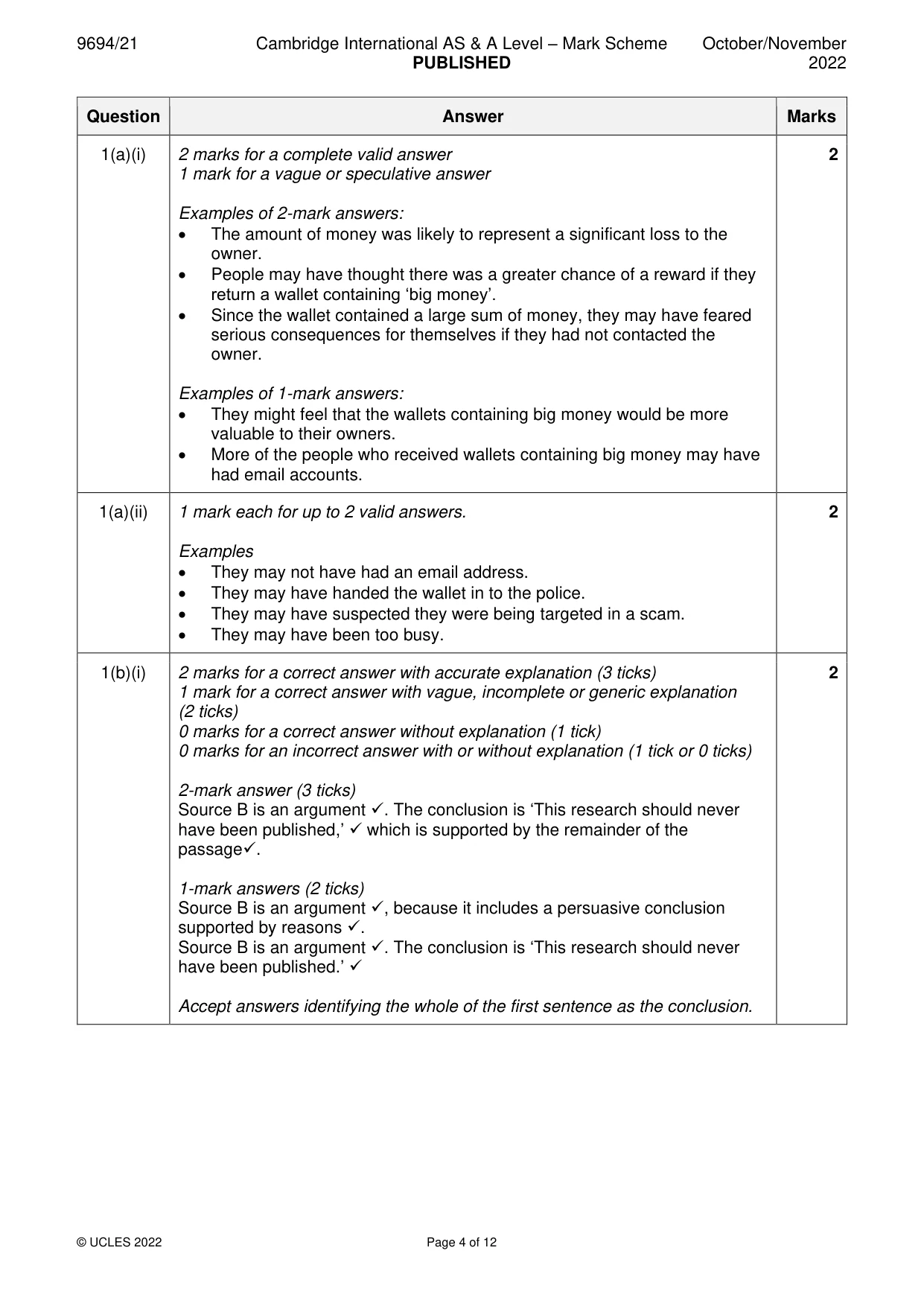
9694/21 Cambridge International AS & A Level – Mark Scheme PUBLISHED October/November 2022 © UCLES 2022 Page 4 of 12 Question Answer Marks 1(a)(i) 2 marks for a complete valid answer 1 mark for a vague or speculative answer Examples of 2-mark answers: • The amount of money was likely to represent a significant loss to the owner. • People may have thought there was a greater chance of a reward if they return a wallet containing ‘big money’. • Since the wallet contained a large sum of money, they may have feared serious consequences for themselves if they had not contacted the owner. Examples of 1-mark answers: • They might feel that the wallets containing big money would be more valuable to their owners. • More of the people who received wallets containing big money may have had email accounts. 2 1(a)(ii) 1 mark each for up to 2 valid answers. Examples • They may not have had an email address. • They may have handed the wallet in to the police. • They may have suspected they were being targeted in a scam. • They may have been too busy. 2 1(b)(i) 2 marks for a correct answer with accurate explanation (3 ticks) 1 mark for a correct answer with vague, incomplete or generic explanation (2 ticks) 0 marks for a correct answer without explanation (1 tick) 0 marks for an incorrect answer with or without explanation (1 tick or 0 ticks) 2-mark answer (3 ticks) Source B is an argument ✓. The conclusion is ‘This research should never have been published,’ ✓ which is supported by the remainder of the passage✓. 1-mark answers (2 ticks) Source B is an argument ✓, because it includes a persuasive conclusion supported by reasons ✓. Source B is an argument ✓. The conclusion is ‘This research should never have been published.’ ✓ Accept answers identifying the whole of the first sentence as the conclusion. 2
Mark scheme, page 5
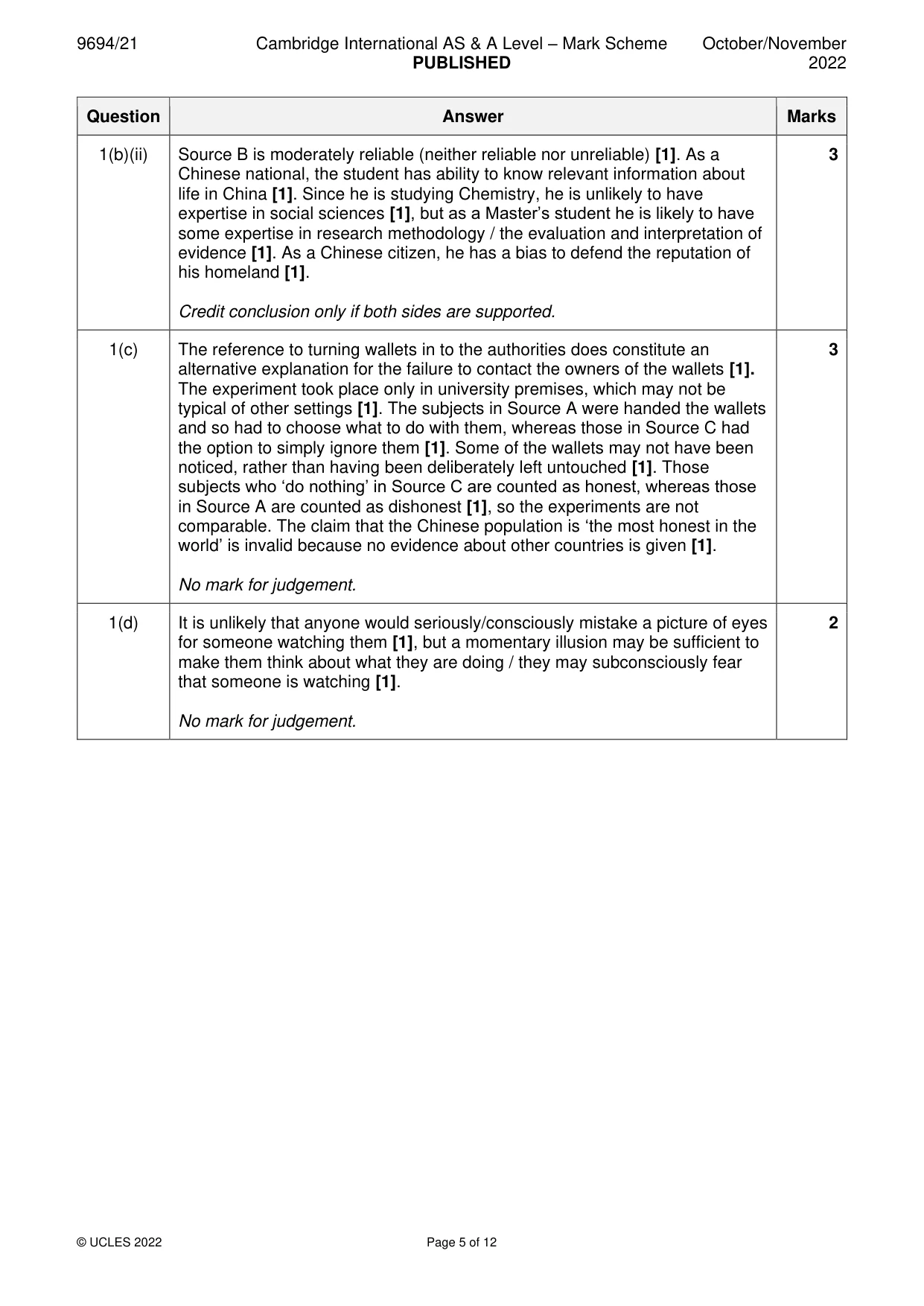
9694/21 Cambridge International AS & A Level – Mark Scheme PUBLISHED October/November 2022 © UCLES 2022 Page 5 of 12 Question Answer Marks 1(b)(ii) Source B is moderately reliable (neither reliable nor unreliable) [1]. As a Chinese national, the student has ability to know relevant information about life in China [1]. Since he is studying Chemistry, he is unlikely to have expertise in social sciences [1], but as a Master’s student he is likely to have some expertise in research methodology / the evaluation and interpretation of evidence [1]. As a Chinese citizen, he has a bias to defend the reputation of his homeland [1]. Credit conclusion only if both sides are supported. 3 1(c) The reference to turning wallets in to the authorities does constitute an alternative explanation for the failure to contact the owners of the wallets [1]. The experiment took place only in university premises, which may not be typical of other settings [1]. The subjects in Source A were handed the wallets and so had to choose what to do with them, whereas those in Source C had the option to simply ignore them [1]. Some of the wallets may not have been noticed, rather than having been deliberately left untouched [1]. Those subjects who ‘do nothing’ in Source C are counted as honest, whereas those in Source A are counted as dishonest [1], so the experiments are not comparable. The claim that the Chinese population is ‘the most honest in the world’ is invalid because no evidence about other countries is given [1]. No mark for judgement. 3 1(d) It is unlikely that anyone would seriously/consciously mistake a picture of eyes for someone watching them [1], but a momentary illusion may be sufficient to make them think about what they are doing / they may subconsciously fear that someone is watching [1]. No mark for judgement. 2
Mark scheme, page 6
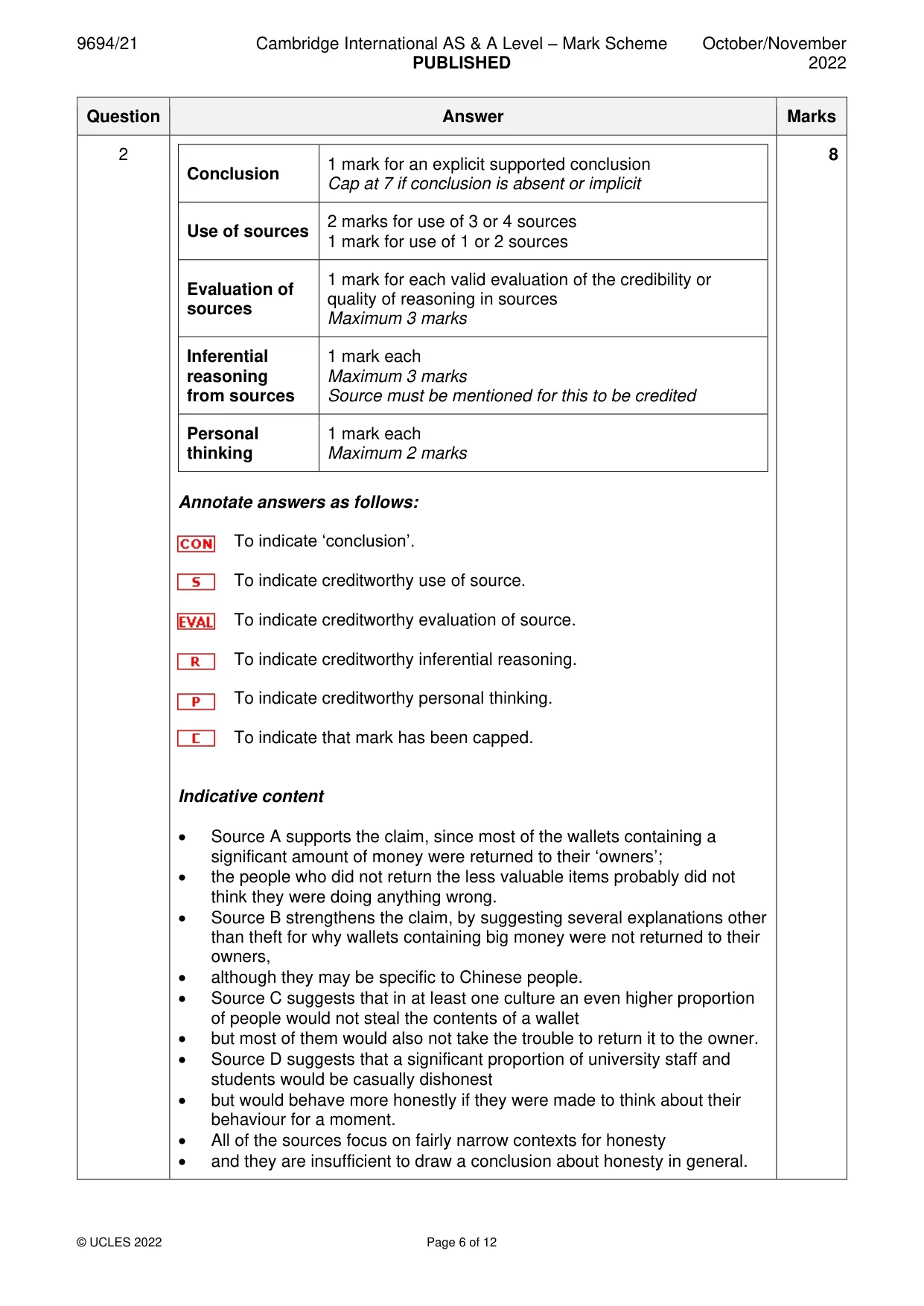
9694/21 Cambridge International AS & A Level – Mark Scheme PUBLISHED October/November 2022 © UCLES 2022 Page 6 of 12 Question Answer Marks 2 Conclusion 1 mark for an explicit supported conclusion Cap at 7 if conclusion is absent or implicit Use of sources 2 marks for use of 3 or 4 sources 1 mark for use of 1 or 2 sources Evaluation of sources 1 mark for each valid evaluation of the credibility or quality of reasoning in sources Maximum 3 marks Inferential reasoning from sources 1 mark each Maximum 3 marks Source must be mentioned for this to be credited Personal thinking 1 mark each Maximum 2 marks Annotate answers as follows: To indicate ‘conclusion’. To indicate creditworthy use of source. To indicate creditworthy evaluation of source. To indicate creditworthy inferential reasoning. To indicate creditworthy personal thinking. To indicate that mark has been capped. Indicative content • Source A supports the claim, since most of the wallets containing a significant amount of money were returned to their ‘owners’; • the people who did not return the less valuable items probably did not think they were doing anything wrong. • Source B strengthens the claim, by suggesting several explanations other than theft for why wallets containing big money were not returned to their owners, • although they may be specific to Chinese people. • Source C suggests that in at least one culture an even higher proportion of people would not steal the contents of a wallet • but most of them would also not take the trouble to return it to the owner. • Source D suggests that a significant proportion of university staff and students would be casually dishonest • but would behave more honestly if they were made to think about their behaviour for a moment. • All of the sources focus on fairly narrow contexts for honesty • and they are insufficient to draw a conclusion about honesty in general. 8
Mark scheme, page 7
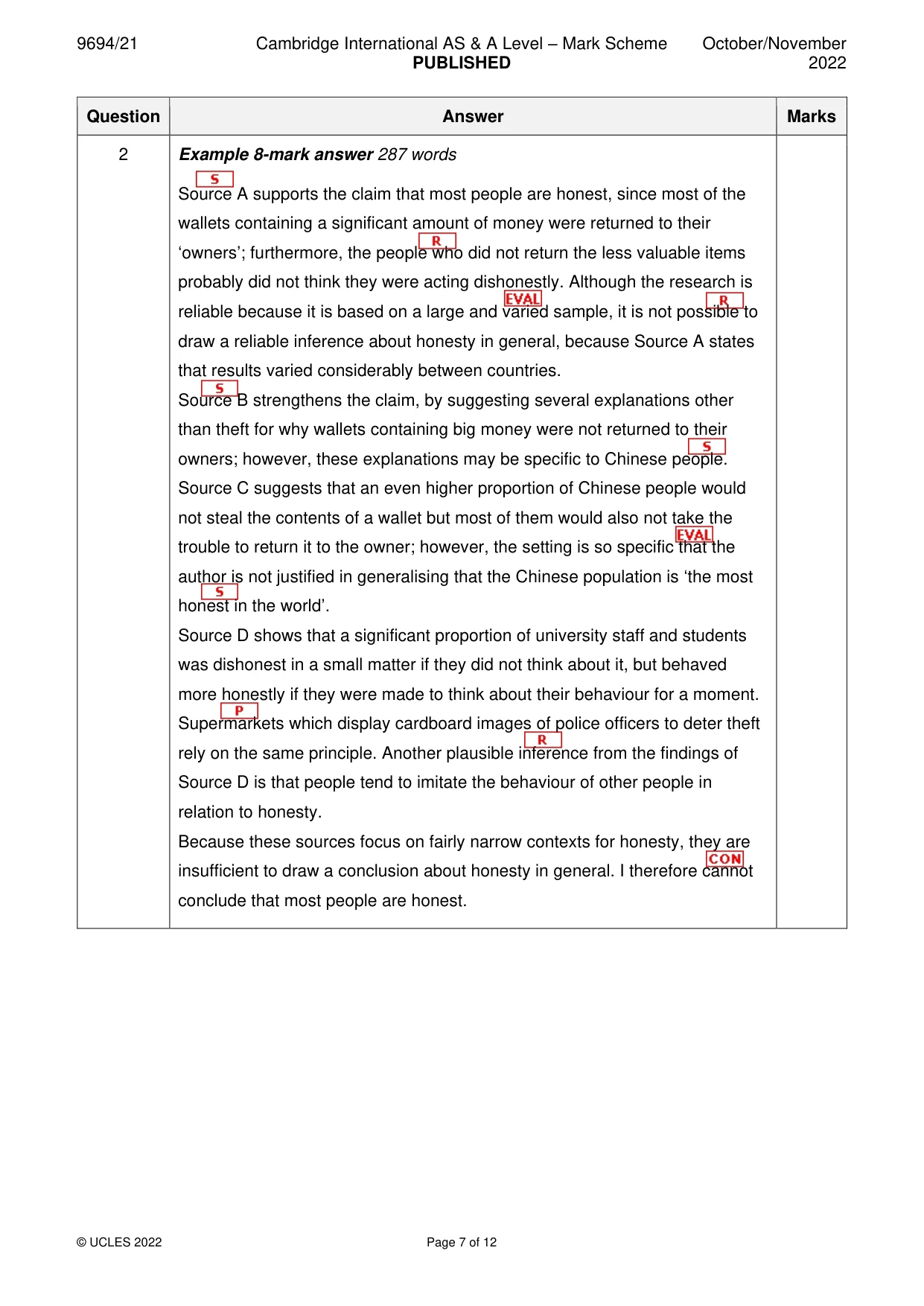
9694/21 Cambridge International AS & A Level – Mark Scheme PUBLISHED October/November 2022 © UCLES 2022 Page 7 of 12 Question Answer Marks 2 Example 8-mark answer 287 words Source A supports the claim that most people are honest, since most of the wallets containing a significant amount of money were returned to their ‘owners’; furthermore, the people who did not return the less valuable items probably did not think they were acting dishonestly. Although the research is reliable because it is based on a large and varied sample, it is not possible to draw a reliable inference about honesty in general, because Source A states that results varied considerably between countries. Source B strengthens the claim, by suggesting several explanations other than theft for why wallets containing big money were not returned to their owners; however, these explanations may be specific to Chinese people. Source C suggests that an even higher proportion of Chinese people would not steal the contents of a wallet but most of them would also not take the trouble to return it to the owner; however, the setting is so specific that the author is not justified in generalising that the Chinese population is ‘the most honest in the world’. Source D shows that a significant proportion of university staff and students was dishonest in a small matter if they did not think about it, but behaved more honestly if they were made to think about their behaviour for a moment. Supermarkets which display cardboard images of police officers to deter theft rely on the same principle. Another plausible inference from the findings of Source D is that people tend to imitate the behaviour of other people in relation to honesty. Because these sources focus on fairly narrow contexts for honesty, they are insufficient to draw a conclusion about honesty in general. I therefore cannot conclude that most people are honest.
Mark scheme, page 8
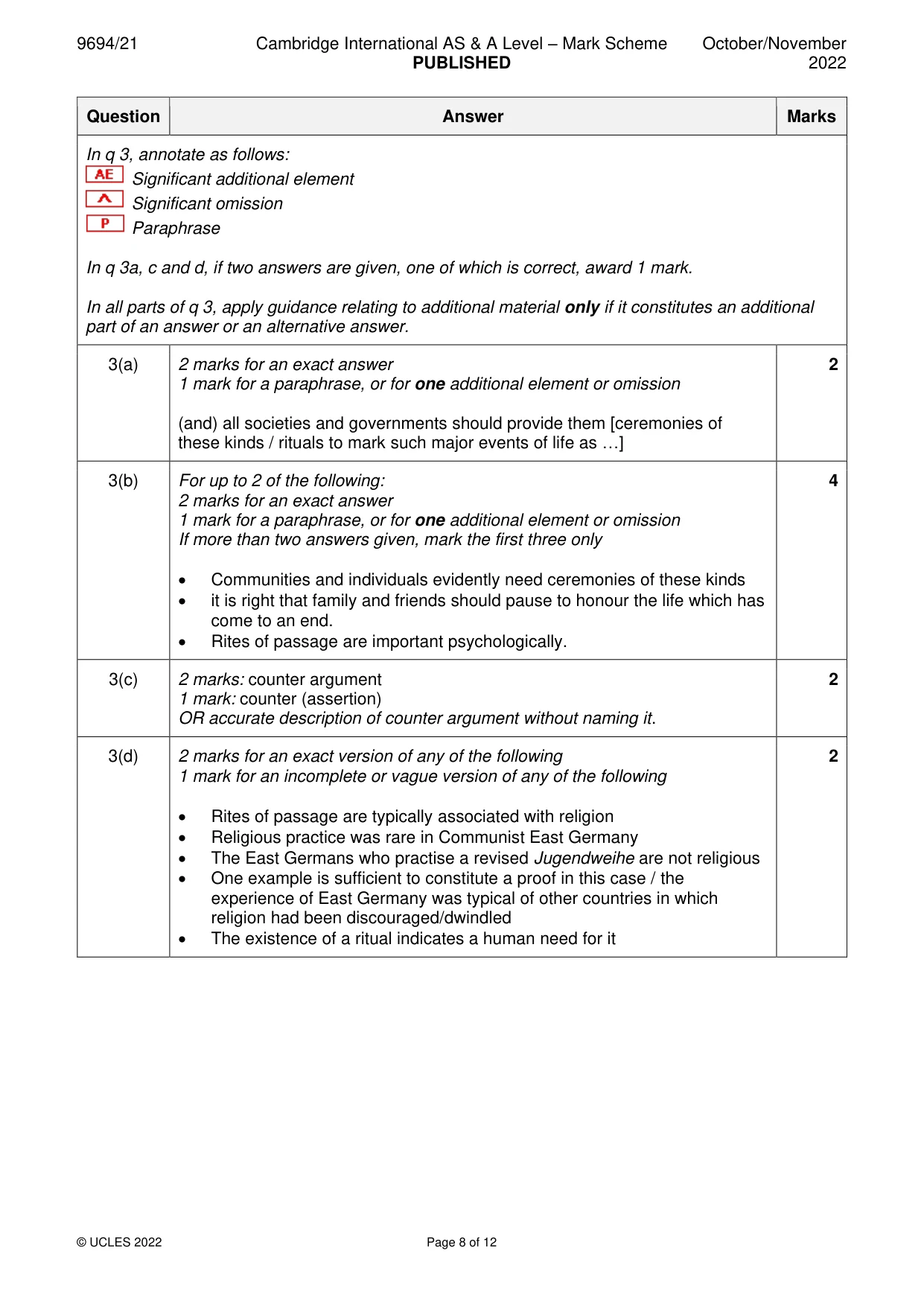
9694/21 Cambridge International AS & A Level – Mark Scheme PUBLISHED October/November 2022 © UCLES 2022 Page 8 of 12 Question Answer Marks In q 3, annotate as follows: Significant additional element Significant omission Paraphrase In q 3a, c and d, if two answers are given, one of which is correct, award 1 mark. In all parts of q 3, apply guidance relating to additional material only if it constitutes an additional part of an answer or an alternative answer. 3(a) 2 marks for an exact answer 1 mark for a paraphrase, or for one additional element or omission (and) all societies and governments should provide them [ceremonies of these kinds / rituals to mark such major events of life as …] 2 3(b) For up to 2 of the following: 2 marks for an exact answer 1 mark for a paraphrase, or for one additional element or omission If more than two answers given, mark the first three only • Communities and individuals evidently need ceremonies of these kinds • it is right that family and friends should pause to honour the life which has come to an end. • Rites of passage are important psychologically. 4 3(c) 2 marks: counter argument 1 mark: counter (assertion) OR accurate description of counter argument without naming it. 2 3(d) 2 marks for an exact version of any of the following 1 mark for an incomplete or vague version of any of the following • Rites of passage are typically associated with religion • Religious practice was rare in Communist East Germany • The East Germans who practise a revised Jugendweihe are not religious • One example is sufficient to constitute a proof in this case / the experience of East Germany was typical of other countries in which religion had been discouraged/dwindled • The existence of a ritual indicates a human need for it 2
Mark scheme, page 9
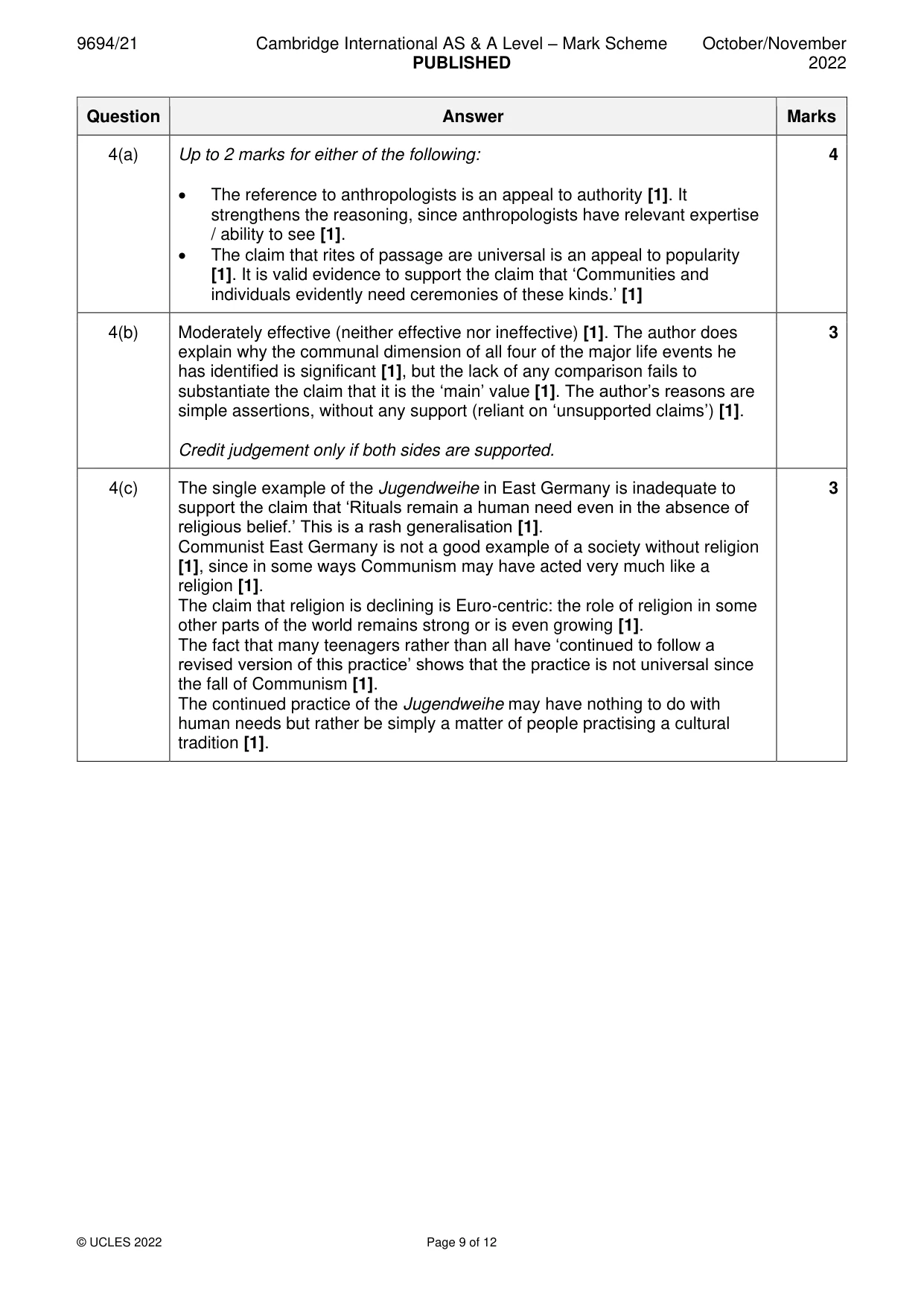
9694/21 Cambridge International AS & A Level – Mark Scheme PUBLISHED October/November 2022 © UCLES 2022 Page 9 of 12 Question Answer Marks 4(a) Up to 2 marks for either of the following: • The reference to anthropologists is an appeal to authority [1]. It strengthens the reasoning, since anthropologists have relevant expertise / ability to see [1]. • The claim that rites of passage are universal is an appeal to popularity [1]. It is valid evidence to support the claim that ‘Communities and individuals evidently need ceremonies of these kinds.’ [1] 4 4(b) Moderately effective (neither effective nor ineffective) [1]. The author does explain why the communal dimension of all four of the major life events he has identified is significant [1], but the lack of any comparison fails to substantiate the claim that it is the ‘main’ value [1]. The author’s reasons are simple assertions, without any support (reliant on ‘unsupported claims’) [1]. Credit judgement only if both sides are supported. 3 4(c) The single example of the Jugendweihe in East Germany is inadequate to support the claim that ‘Rituals remain a human need even in the absence of religious belief.’ This is a rash generalisation [1]. Communist East Germany is not a good example of a society without religion [1], since in some ways Communism may have acted very much like a religion [1]. The claim that religion is declining is Euro-centric: the role of religion in some other parts of the world remains strong or is even growing [1]. The fact that many teenagers rather than all have ‘continued to follow a revised version of this practice’ shows that the practice is not universal since the fall of Communism [1]. The continued practice of the Jugendweihe may have nothing to do with human needs but rather be simply a matter of people practising a cultural tradition [1]. 3
Mark scheme, page 10
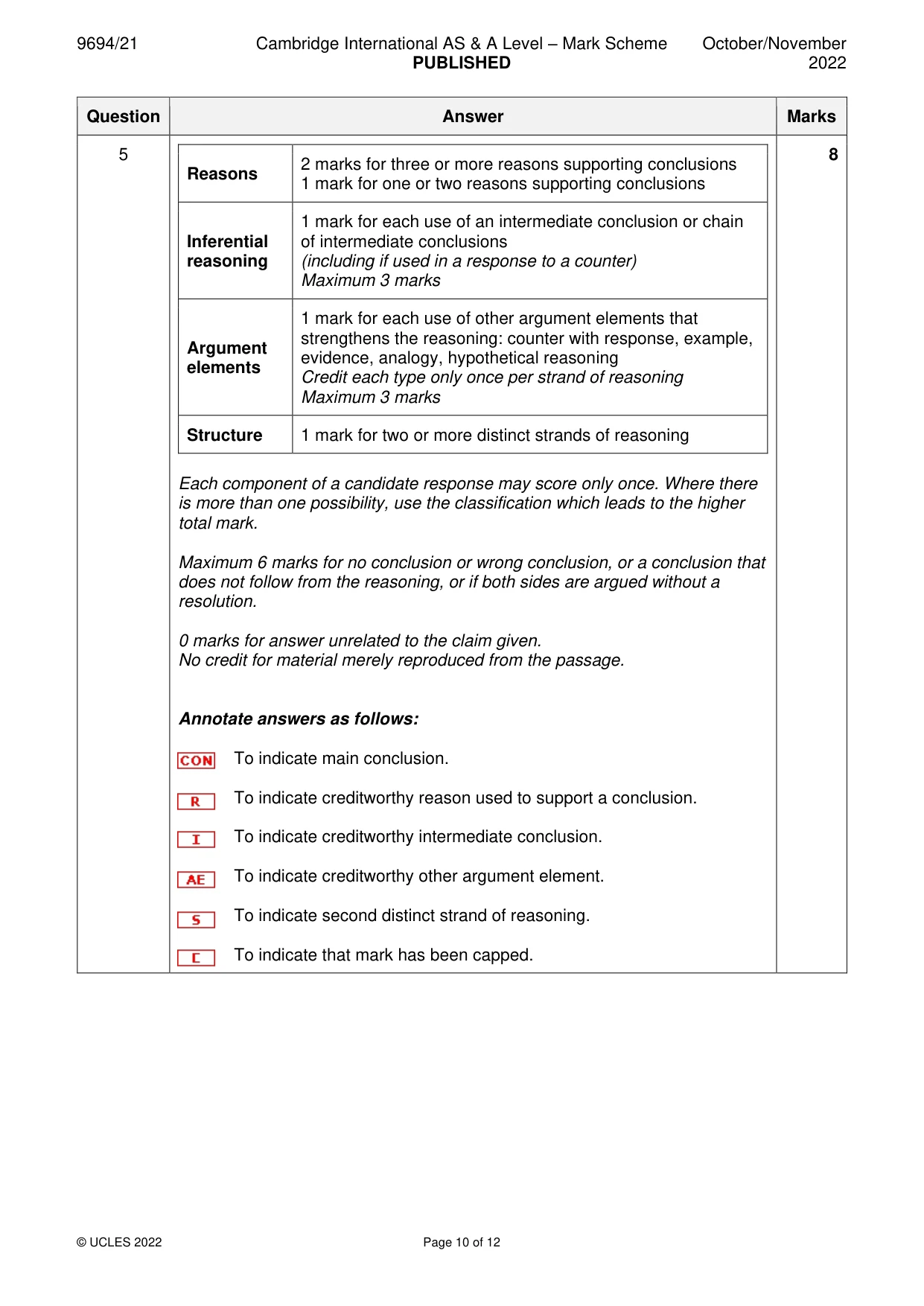
9694/21 Cambridge International AS & A Level – Mark Scheme PUBLISHED October/November 2022 © UCLES 2022 Page 10 of 12 Question Answer Marks 5 Reasons 2 marks for three or more reasons supporting conclusions 1 mark for one or two reasons supporting conclusions Inferential reasoning 1 mark for each use of an intermediate conclusion or chain of intermediate conclusions (including if used in a response to a counter) Maximum 3 marks Argument elements 1 mark for each use of other argument elements that strengthens the reasoning: counter with response, example, evidence, analogy, hypothetical reasoning Credit each type only once per strand of reasoning Maximum 3 marks Structure 1 mark for two or more distinct strands of reasoning Each component of a candidate response may score only once. Where there is more than one possibility, use the classification which leads to the higher total mark. Maximum 6 marks for no conclusion or wrong conclusion, or a conclusion that does not follow from the reasoning, or if both sides are argued without a resolution. 0 marks for answer unrelated to the claim given. No credit for material merely reproduced from the passage. Annotate answers as follows: To indicate main conclusion. To indicate creditworthy reason used to support a conclusion. To indicate creditworthy intermediate conclusion. To indicate creditworthy other argument element. To indicate second distinct strand of reasoning. To indicate that mark has been capped. 8
Mark scheme, page 11
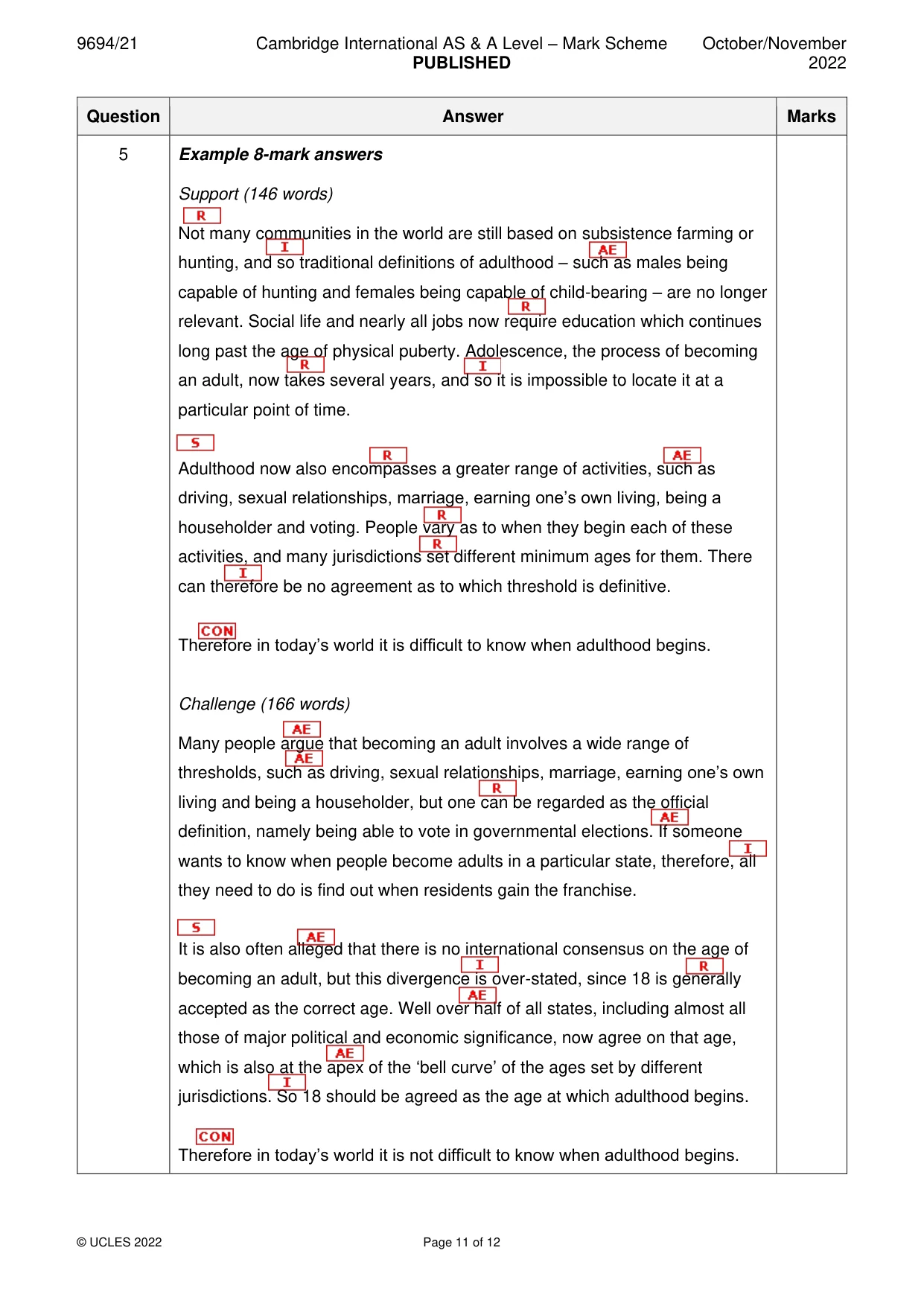
9694/21 Cambridge International AS & A Level – Mark Scheme PUBLISHED October/November 2022 © UCLES 2022 Page 11 of 12 Question Answer Marks 5 Example 8-mark answers Support (146 words) Not many communities in the world are still based on subsistence farming or hunting, and so traditional definitions of adulthood – such as males being capable of hunting and females being capable of child-bearing – are no longer relevant. Social life and nearly all jobs now require education which continues long past the age of physical puberty. Adolescence, the process of becoming an adult, now takes several years, and so it is impossible to locate it at a particular point of time. Adulthood now also encompasses a greater range of activities, such as driving, sexual relationships, marriage, earning one’s own living, being a householder and voting. People vary as to when they begin each of these activities, and many jurisdictions set different minimum ages for them. There can therefore be no agreement as to which threshold is definitive. Therefore in today’s world it is difficult to know when adulthood begins. Challenge (166 words) Many people argue that becoming an adult involves a wide range of thresholds, such as driving, sexual relationships, marriage, earning one’s own living and being a householder, but one can be regarded as the official definition, namely being able to vote in governmental elections. If someone wants to know when people become adults in a particular state, therefore, all they need to do is find out when residents gain the franchise. It is also often alleged that there is no international consensus on the age of becoming an adult, but this divergence is over-stated, since 18 is generally accepted as the correct age. Well over half of all states, including almost all those of major political and economic significance, now agree on that age, which is also at the apex of the ‘bell curve’ of the ages set by different jurisdictions. So 18 should be agreed as the age at which adulthood begins. Therefore in today’s world it is not difficult to know when adulthood begins.
Mark scheme, page 12
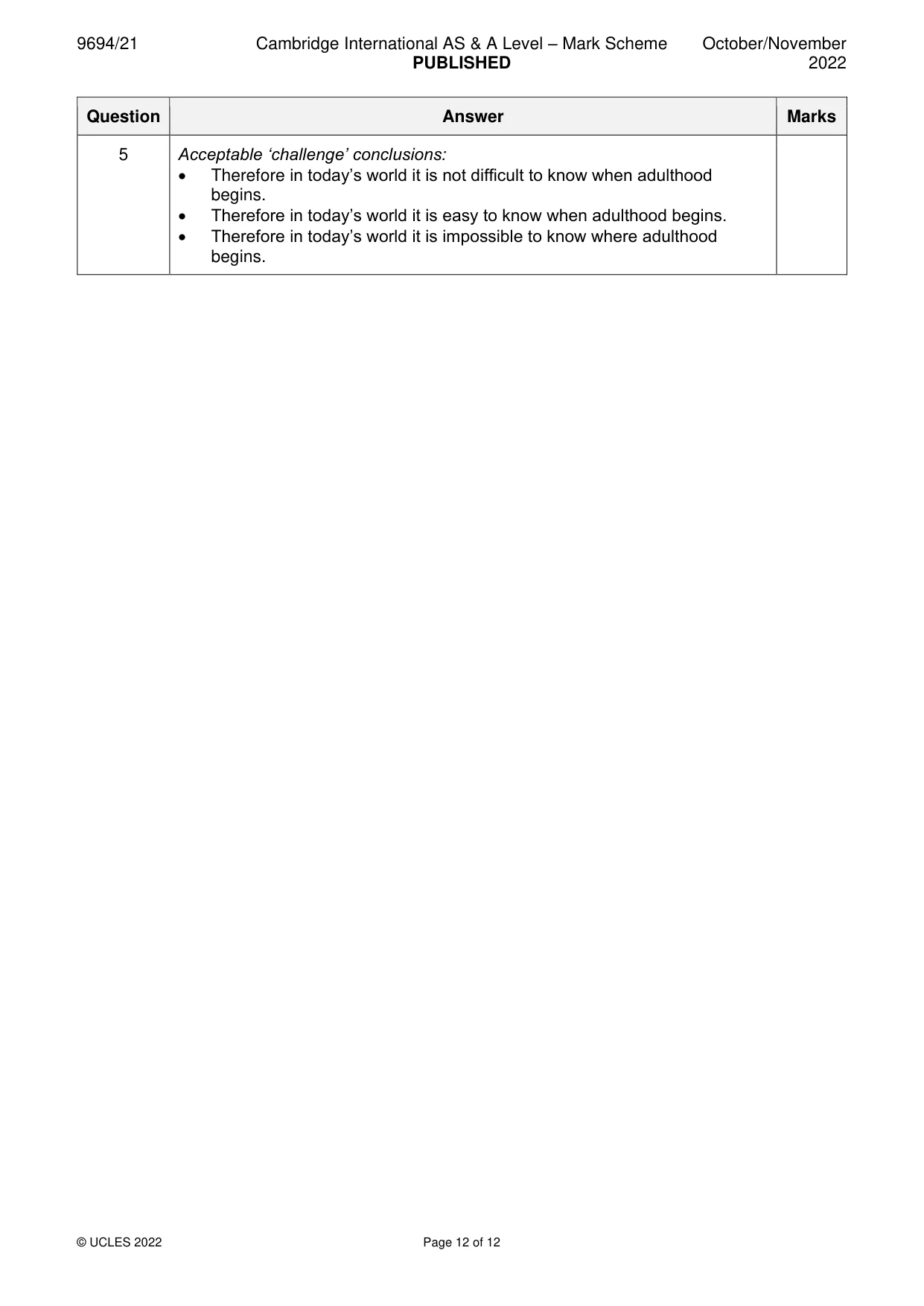
9694/21 Cambridge International AS & A Level – Mark Scheme PUBLISHED October/November 2022 © UCLES 2022 Page 12 of 12 Question Answer Marks 5 Acceptable ‘challenge’ conclusions: • Therefore in today’s world it is not difficult to know when adulthood begins. • Therefore in today’s world it is easy to know when adulthood begins. • Therefore in today’s world it is impossible to know where adulthood begins.
What you needed in this session
Cambridge’s own grade thresholds for 2022 Oct/Nov, Paper 2 · Variant 1. A higher threshold means an easier paper — the bar moves with how the cohort did.