Cambridge A Level Thinking Skills 9694 — 2024 May/June Paper 2 · Variant 1
9694/21/M/J/24 · 50 marks · ≈56 min
The question paper and its mark scheme, free to read here and free to download. This is Cambridge’s own paper, exactly as it was sat.
Question paper8 pages



Mark scheme12 pages
Answers below. Sit the paper first if you are practising.
Paper as text
Question paper, page 1
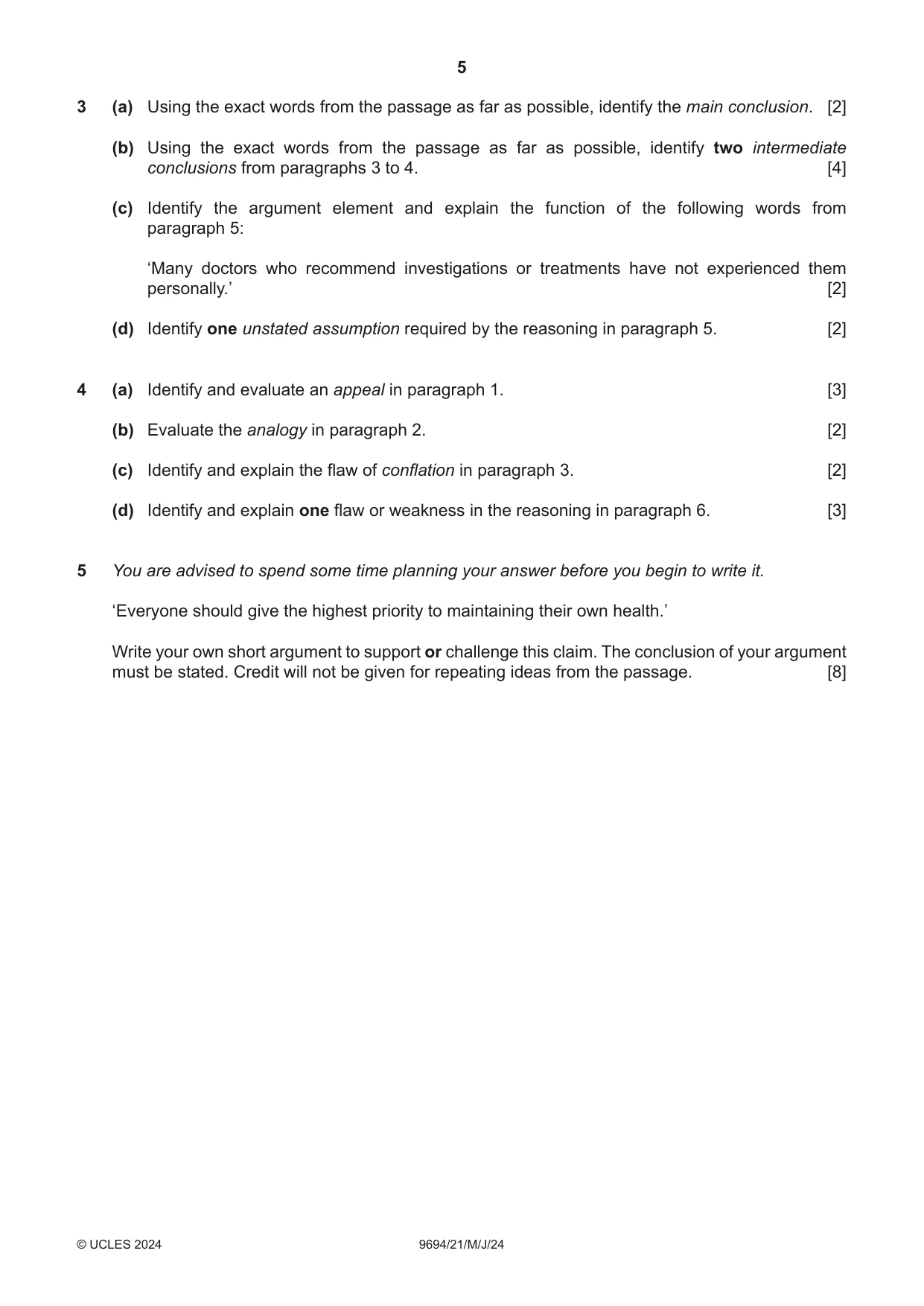
This document has 8 pages. Any blank pages are indicated. [Turn over * 4 4 6 3 5 2 1 9 5 3 * Cambridge International AS & A Level THINKING SKILLS 9694/21 Paper 2 Critical Thinking May/June 2024 1 hour 45 minutes You must answer on the enclosed answer booklet. You will need: Answer booklet (enclosed) INSTRUCTIONS ● Answer all questions. ● Follow the instructions on the front cover of the answer booklet. If you need additional answer paper, ask the invigilator for a continuation booklet. INFORMATION ● The total mark for this paper is 50. ● The number of marks for each question or part question is shown in brackets [ ]. DC (DE/SW) 328333/1 © UCLES 2024
Question paper, page 2
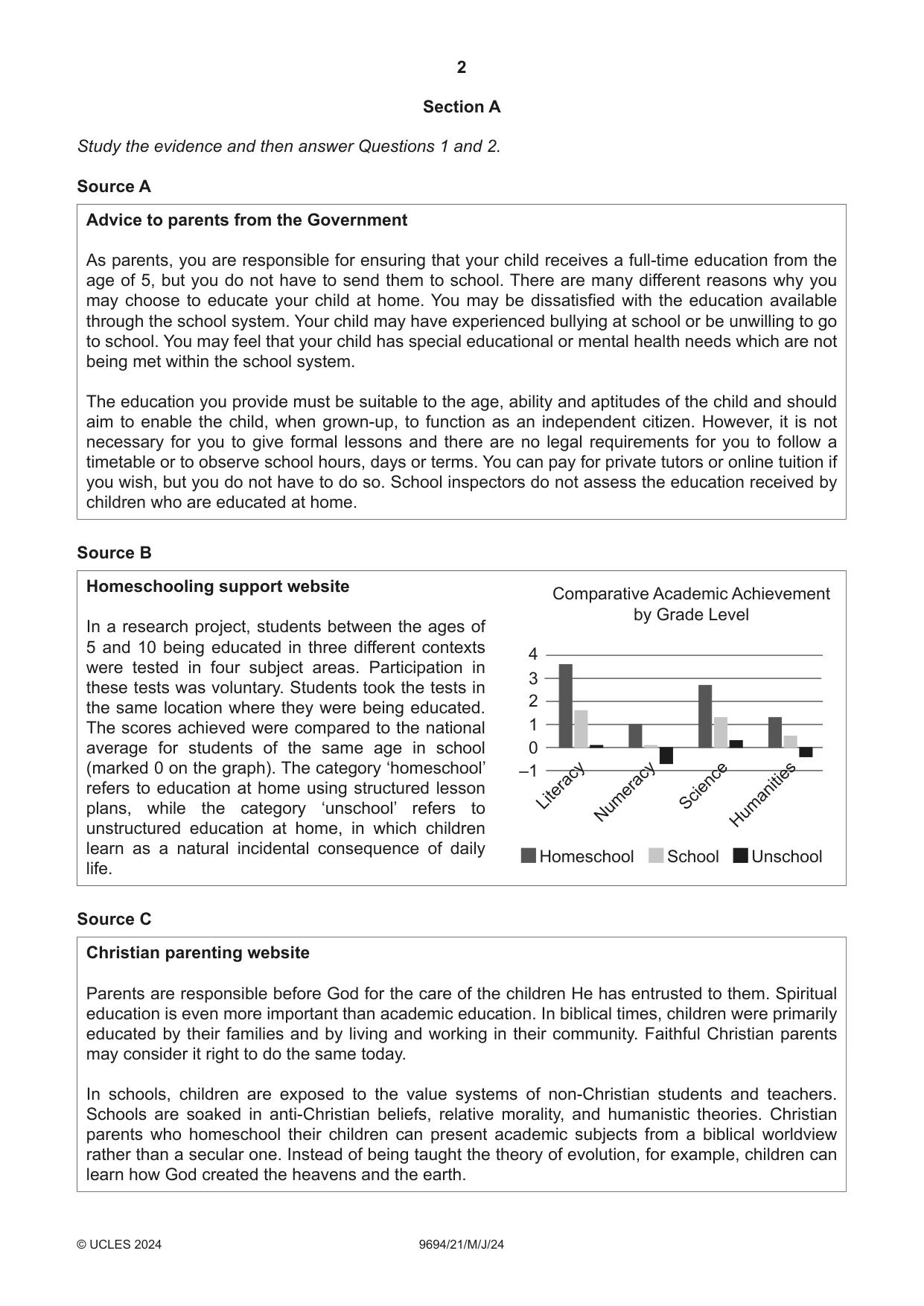
2 9694/21/M/J/24 © UCLES 2024 Section A Study the evidence and then answer Questions 1 and 2. Source A Advice to parents from the Government As parents, you are responsible for ensuring that your child receives a full-time education from the age of 5, but you do not have to send them to school. There are many different reasons why you may choose to educate your child at home. You may be dissatisfied with the education available through the school system. Your child may have experienced bullying at school or be unwilling to go to school. You may feel that your child has special educational or mental health needs which are not being met within the school system. The education you provide must be suitable to the age, ability and aptitudes of the child and should aim to enable the child, when grown-up, to function as an independent citizen. However, it is not necessary for you to give formal lessons and there are no legal requirements for you to follow a timetable or to observe school hours, days or terms. You can pay for private tutors or online tuition if you wish, but you do not have to do so. School inspectors do not assess the education received by children who are educated at home. Source B Homeschooling support website In a research project, students between the ages of 5 and 10 being educated in three different contexts were tested in four subject areas. Participation in these tests was voluntary. Students took the tests in the same location where they were being educated. The scores achieved were compared to the national average for students of the same age in school (marked 0 on the graph). The category ‘homeschool’ refers to education at home using structured lesson plans, while the category ‘unschool’ refers to unstructured education at home, in which children learn as a natural incidental consequence of daily life. 4 3 2 1 0 –1 Literacy Numeracy Science Humanities Homeschool School Unschool Comparative Academic Achievement by Grade Level Source C Christian parenting website Parents are responsible before God for the care of the children He has entrusted to them. Spiritual education is even more important than academic education. In biblical times, children were primarily educated by their families and by living and working in their community. Faithful Christian parents may consider it right to do the same today. In schools, children are exposed to the value systems of non-Christian students and teachers. Schools are soaked in anti-Christian beliefs, relative morality, and humanistic theories. Christian parents who homeschool their children can present academic subjects from a biblical worldview rather than a secular one. Instead of being taught the theory of evolution, for example, children can learn how God created the heavens and the earth.
Question paper, page 3
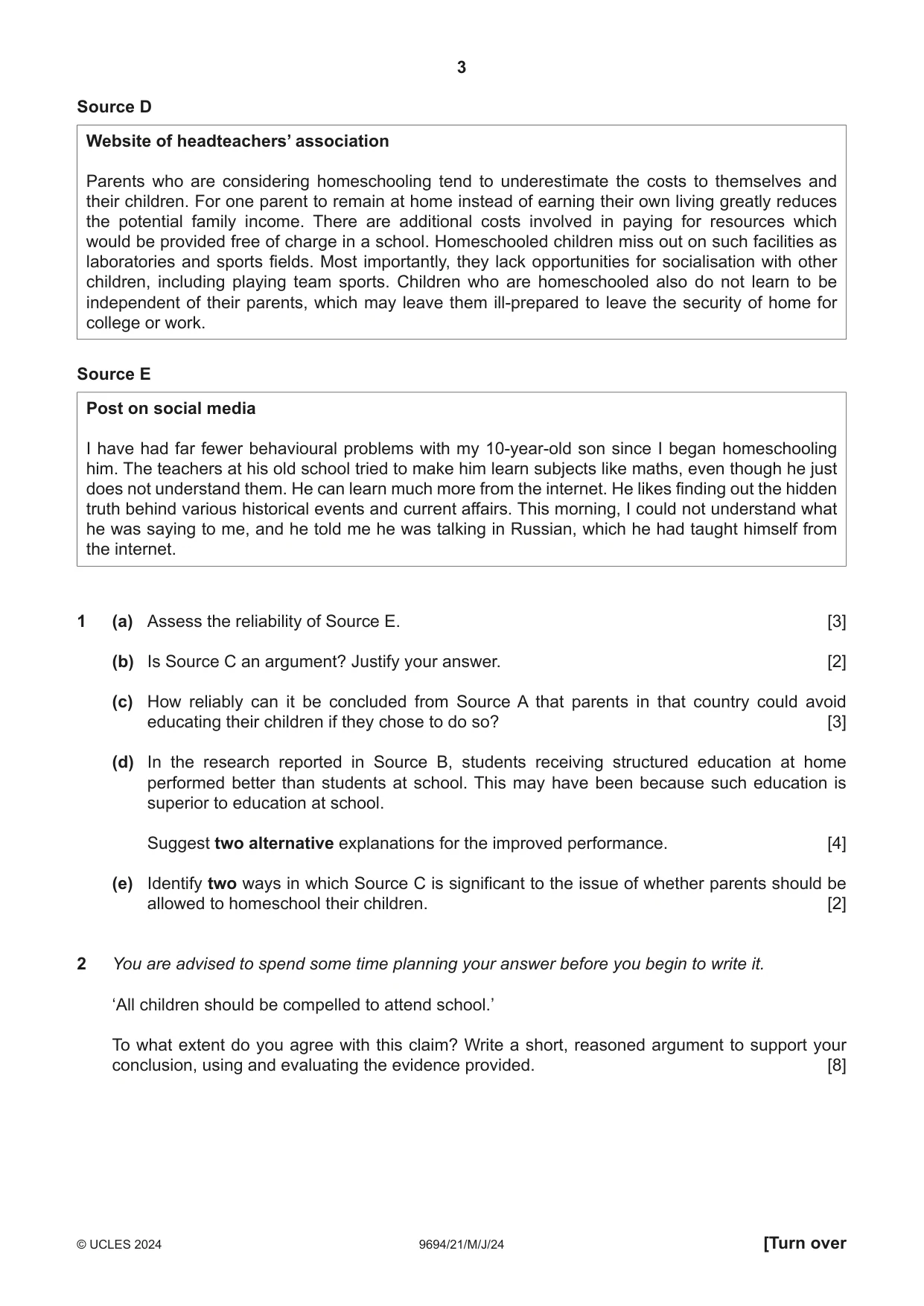
3 9694/21/M/J/24 © UCLES 2024 [Turn over Source D Website of headteachers’ association Parents who are considering homeschooling tend to underestimate the costs to themselves and their children. For one parent to remain at home instead of earning their own living greatly reduces the potential family income. There are additional costs involved in paying for resources which would be provided free of charge in a school. Homeschooled children miss out on such facilities as laboratories and sports fields. Most importantly, they lack opportunities for socialisation with other children, including playing team sports. Children who are homeschooled also do not learn to be independent of their parents, which may leave them ill-prepared to leave the security of home for college or work. Source E Post on social media I have had far fewer behavioural problems with my 10-year-old son since I began homeschooling him. The teachers at his old school tried to make him learn subjects like maths, even though he just does not understand them. He can learn much more from the internet. He likes finding out the hidden truth behind various historical events and current affairs. This morning, I could not understand what he was saying to me, and he told me he was talking in Russian, which he had taught himself from the internet. 1 (a) Assess the reliability of Source E. [3] (b) Is Source C an argument? Justify your answer. [2] (c) How reliably can it be concluded from Source A that parents in that country could avoid educating their children if they chose to do so? [3] (d) In the research reported in Source B, students receiving structured education at home performed better than students at school. This may have been because such education is superior to education at school. Suggest two alternative explanations for the improved performance. [4] (e) Identify two ways in which Source C is significant to the issue of whether parents should be allowed to homeschool their children. [2] 2 You are advised to spend some time planning your answer before you begin to write it. ‘All children should be compelled to attend school.’ To what extent do you agree with this claim? Write a short, reasoned argument to support your conclusion, using and evaluating the evidence provided. [8]
Question paper, page 4
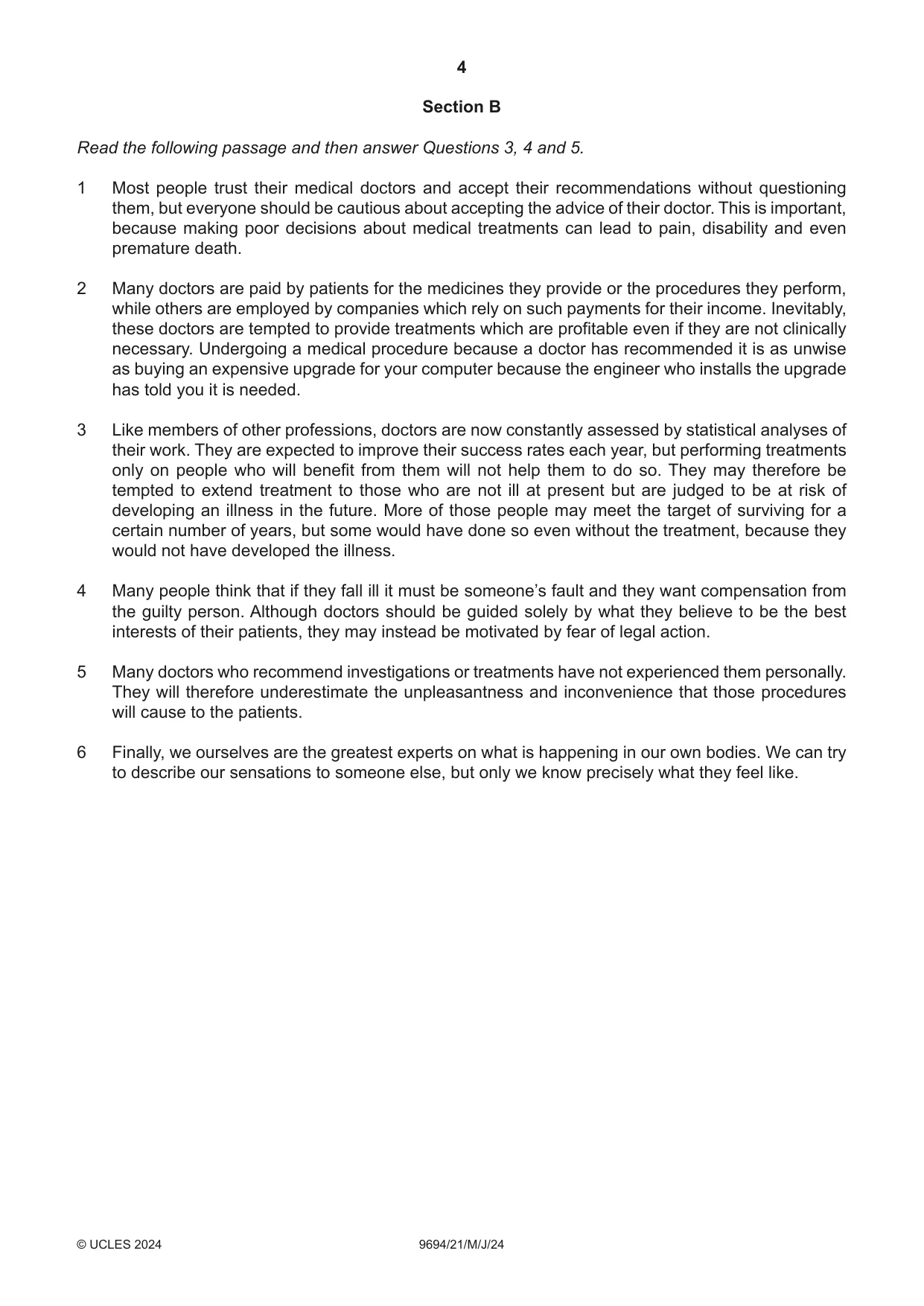
4 9694/21/M/J/24 © UCLES 2024 Section B Read the following passage and then answer Questions 3, 4 and 5. 1 Most people trust their medical doctors and accept their recommendations without questioning them, but everyone should be cautious about accepting the advice of their doctor. This is important, because making poor decisions about medical treatments can lead to pain, disability and even premature death. 2 Many doctors are paid by patients for the medicines they provide or the procedures they perform, while others are employed by companies which rely on such payments for their income. Inevitably, these doctors are tempted to provide treatments which are profitable even if they are not clinically necessary. Undergoing a medical procedure because a doctor has recommended it is as unwise as buying an expensive upgrade for your computer because the engineer who installs the upgrade has told you it is needed. 3 Like members of other professions, doctors are now constantly assessed by statistical analyses of their work. They are expected to improve their success rates each year, but performing treatments only on people who will benefit from them will not help them to do so. They may therefore be tempted to extend treatment to those who are not ill at present but are judged to be at risk of developing an illness in the future. More of those people may meet the target of surviving for a certain number of years, but some would have done so even without the treatment, because they would not have developed the illness. 4 Many people think that if they fall ill it must be someone’s fault and they want compensation from the guilty person. Although doctors should be guided solely by what they believe to be the best interests of their patients, they may instead be motivated by fear of legal action. 5 Many doctors who recommend investigations or treatments have not experienced them personally. They will therefore underestimate the unpleasantness and inconvenience that those procedures will cause to the patients. 6 Finally, we ourselves are the greatest experts on what is happening in our own bodies. We can try to describe our sensations to someone else, but only we know precisely what they feel like.
Question paper, page 5
5 9694/21/M/J/24 © UCLES 2024 3 (a) Using the exact words from the passage as far as possible, identify the main conclusion. [2] (b) Using the exact words from the passage as far as possible, identify two intermediate conclusions from paragraphs 3 to 4. [4] (c) Identify the argument element and explain the function of the following words from paragraph 5: ‘Many doctors who recommend investigations or treatments have not experienced them personally.’ [2] (d) Identify one unstated assumption required by the reasoning in paragraph 5. [2] 4 (a) Identify and evaluate an appeal in paragraph 1. [3] (b) Evaluate the analogy in paragraph 2. [2] (c) Identify and explain the flaw of conflation in paragraph 3. [2] (d) Identify and explain one flaw or weakness in the reasoning in paragraph 6. [3] 5 You are advised to spend some time planning your answer before you begin to write it. ‘Everyone should give the highest priority to maintaining their own health.’ Write your own short argument to support or challenge this claim. The conclusion of your argument must be stated. Credit will not be given for repeating ideas from the passage. [8]
Question paper, page 6
6 9694/21/M/J/24 © UCLES 2024 BLANK PAGE
Question paper, page 7
7 9694/21/M/J/24 © UCLES 2024 BLANK PAGE
Question paper, page 8
8 9694/21/M/J/24 © UCLES 2024 Permission to reproduce items where third-party owned material protected by copyright is included has been sought and cleared where possible. Every reasonable effort has been made by the publisher (UCLES) to trace copyright holders, but if any items requiring clearance have unwittingly been included, the publisher will be pleased to make amends at the earliest possible opportunity. To avoid the issue of disclosure of answer-related information to candidates, all copyright acknowledgements are reproduced online in the Cambridge Assessment International Education Copyright Acknowledgements Booklet. This is produced for each series of examinations and is freely available to download at www.cambridgeinternational.org after the live examination series. Cambridge Assessment International Education is part of Cambridge Assessment. Cambridge Assessment is the brand name of the University of Cambridge Local Examinations Syndicate (UCLES), which is a department of the University of Cambridge. BLANK PAGE
Mark scheme, page 1
This document consists of 12 printed pages. © Cambridge University Press & Assessment 2024 [Turn over Cambridge International AS & A Level THINKING SKILLS 9694/21 Paper 2 Critical Thinking May/June 2024 MARK SCHEME Maximum Mark: 50 Published This mark scheme is published as an aid to teachers and candidates, to indicate the requirements of the examination. It shows the basis on which Examiners were instructed to award marks. It does not indicate the details of the discussions that took place at an Examiners’ meeting before marking began, which would have considered the acceptability of alternative answers. Mark schemes should be read in conjunction with the question paper and the Principal Examiner Report for Teachers. Cambridge International will not enter into discussions about these mark schemes. Cambridge International is publishing the mark schemes for the May/June 2024 series for most Cambridge IGCSE, Cambridge International A and AS Level and Cambridge Pre-U components, and some Cambridge O Level components.
Mark scheme, page 2
9694/21 Cambridge International AS & A Level – Mark Scheme PUBLISHED May/June 2024 © Cambridge University Press & Assessment 2024 Page 2 of 12 Generic Marking Principles These general marking principles must be applied by all examiners when marking candidate answers. They should be applied alongside the specific content of the mark scheme or generic level descriptions for a question. Each question paper and mark scheme will also comply with these marking principles. GENERIC MARKING PRINCIPLE 1: Marks must be awarded in line with: the specific content of the mark scheme or the generic level descriptors for the question the specific skills defined in the mark scheme or in the generic level descriptors for the question the standard of response required by a candidate as exemplified by the standardisation scripts. GENERIC MARKING PRINCIPLE 2: Marks awarded are always whole marks (not half marks, or other fractions). GENERIC MARKING PRINCIPLE 3: Marks must be awarded positively: marks are awarded for correct/valid answers, as defined in the mark scheme. However, credit is given for valid answers which go beyond the scope of the syllabus and mark scheme, referring to your Team Leader as appropriate marks are awarded when candidates clearly demonstrate what they know and can do marks are not deducted for errors marks are not deducted for omissions answers should only be judged on the quality of spelling, punctuation and grammar when these features are specifically assessed by the question as indicated by the mark scheme. The meaning, however, should be unambiguous. GENERIC MARKING PRINCIPLE 4: Rules must be applied consistently, e.g. in situations where candidates have not followed instructions or in the application of generic level descriptors. GENERIC MARKING PRINCIPLE 5: Marks should be awarded using the full range of marks defined in the mark scheme for the question (however; the use of the full mark range may be limited according to the quality of the candidate responses seen). GENERIC MARKING PRINCIPLE 6: Marks awarded are based solely on the requirements as defined in the mark scheme. Marks should not be awarded with grade thresholds or grade descriptors in mind.
Mark scheme, page 3
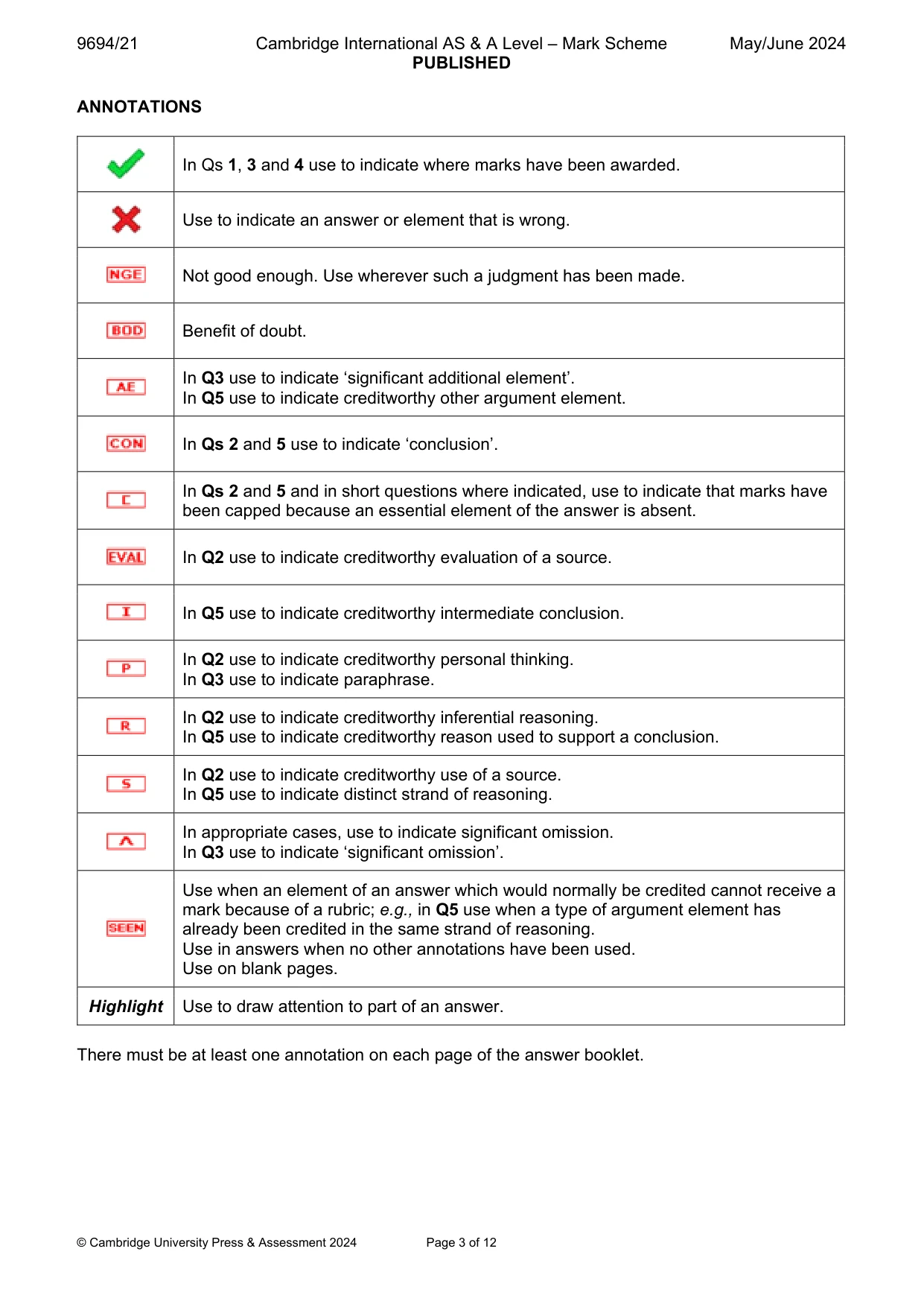
9694/21 Cambridge International AS & A Level – Mark Scheme PUBLISHED May/June 2024 © Cambridge University Press & Assessment 2024 Page 3 of 12 ANNOTATIONS In Qs 1, 3 and 4 use to indicate where marks have been awarded. Use to indicate an answer or element that is wrong. Not good enough. Use wherever such a judgment has been made. Benefit of doubt. In Q3 use to indicate ‘significant additional element’. In Q5 use to indicate creditworthy other argument element. In Qs 2 and 5 use to indicate ‘conclusion’. In Qs 2 and 5 and in short questions where indicated, use to indicate that marks have been capped because an essential element of the answer is absent. In Q2 use to indicate creditworthy evaluation of a source. In Q5 use to indicate creditworthy intermediate conclusion. In Q2 use to indicate creditworthy personal thinking. In Q3 use to indicate paraphrase. In Q2 use to indicate creditworthy inferential reasoning. In Q5 use to indicate creditworthy reason used to support a conclusion. In Q2 use to indicate creditworthy use of a source. In Q5 use to indicate distinct strand of reasoning. In appropriate cases, use to indicate significant omission. In Q3 use to indicate ‘significant omission’. Use when an element of an answer which would normally be credited cannot receive a mark because of a rubric; e.g., in Q5 use when a type of argument element has already been credited in the same strand of reasoning. Use in answers when no other annotations have been used. Use on blank pages. Highlight Use to draw attention to part of an answer. There must be at least one annotation on each page of the answer booklet.
Mark scheme, page 4
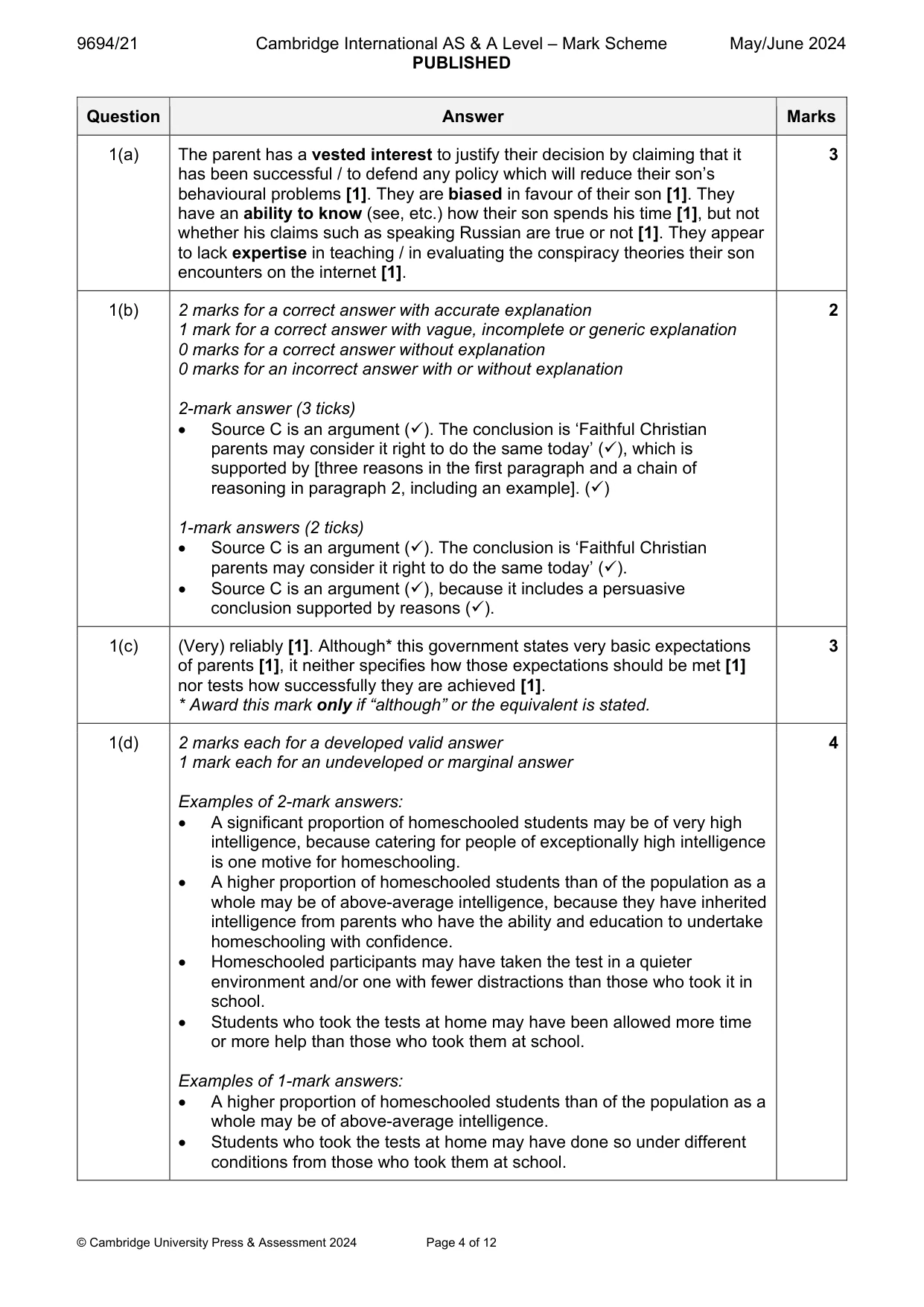
9694/21 Cambridge International AS & A Level – Mark Scheme PUBLISHED May/June 2024 © Cambridge University Press & Assessment 2024 Page 4 of 12 Question Answer Marks 1(a) The parent has a vested interest to justify their decision by claiming that it has been successful / to defend any policy which will reduce their son’s behavioural problems [1]. They are biased in favour of their son [1]. They have an ability to know (see, etc.) how their son spends his time [1], but not whether his claims such as speaking Russian are true or not [1]. They appear to lack expertise in teaching / in evaluating the conspiracy theories their son encounters on the internet [1]. 3 1(b) 2 marks for a correct answer with accurate explanation 1 mark for a correct answer with vague, incomplete or generic explanation 0 marks for a correct answer without explanation 0 marks for an incorrect answer with or without explanation 2-mark answer (3 ticks) Source C is an argument (). The conclusion is ‘Faithful Christian parents may consider it right to do the same today’ (), which is supported by [three reasons in the first paragraph and a chain of reasoning in paragraph 2, including an example]. () 1-mark answers (2 ticks) Source C is an argument (). The conclusion is ‘Faithful Christian parents may consider it right to do the same today’ (). Source C is an argument (), because it includes a persuasive conclusion supported by reasons (). 2 1(c) (Very) reliably [1]. Although* this government states very basic expectations of parents [1], it neither specifies how those expectations should be met [1] nor tests how successfully they are achieved [1]. * Award this mark only if “although” or the equivalent is stated. 3 1(d) 2 marks each for a developed valid answer 1 mark each for an undeveloped or marginal answer Examples of 2-mark answers: A significant proportion of homeschooled students may be of very high intelligence, because catering for people of exceptionally high intelligence is one motive for homeschooling. A higher proportion of homeschooled students than of the population as a whole may be of above-average intelligence, because they have inherited intelligence from parents who have the ability and education to undertake homeschooling with confidence. Homeschooled participants may have taken the test in a quieter environment and/or one with fewer distractions than those who took it in school. Students who took the tests at home may have been allowed more time or more help than those who took them at school. Examples of 1-mark answers: A higher proportion of homeschooled students than of the population as a whole may be of above-average intelligence. Students who took the tests at home may have done so under different conditions from those who took them at school. 4
Mark scheme, page 5
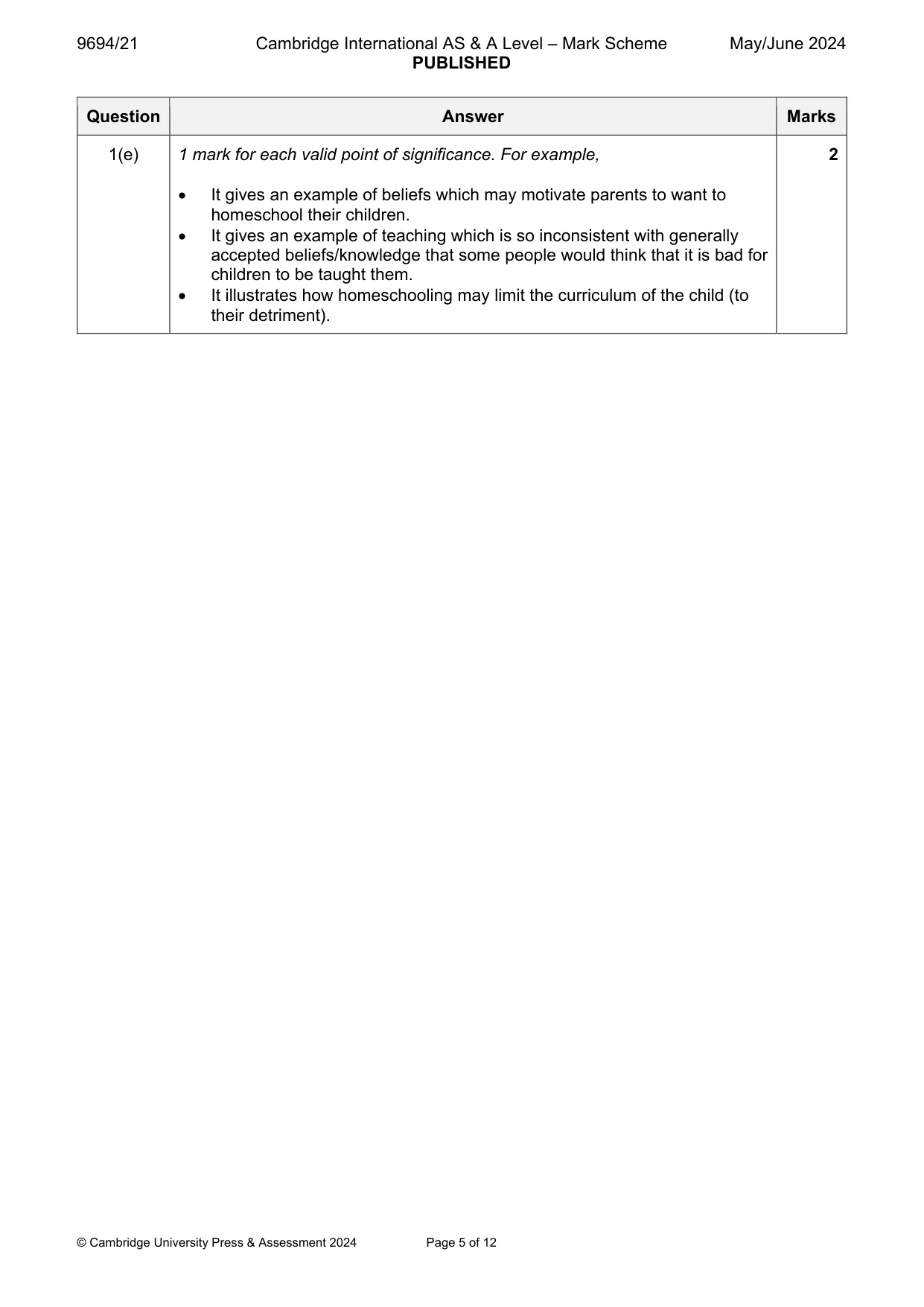
9694/21 Cambridge International AS & A Level – Mark Scheme PUBLISHED May/June 2024 © Cambridge University Press & Assessment 2024 Page 5 of 12 Question Answer Marks 1(e) 1 mark for each valid point of significance. For example, It gives an example of beliefs which may motivate parents to want to homeschool their children. It gives an example of teaching which is so inconsistent with generally accepted beliefs/knowledge that some people would think that it is bad for children to be taught them. It illustrates how homeschooling may limit the curriculum of the child (to their detriment). 2
Mark scheme, page 6
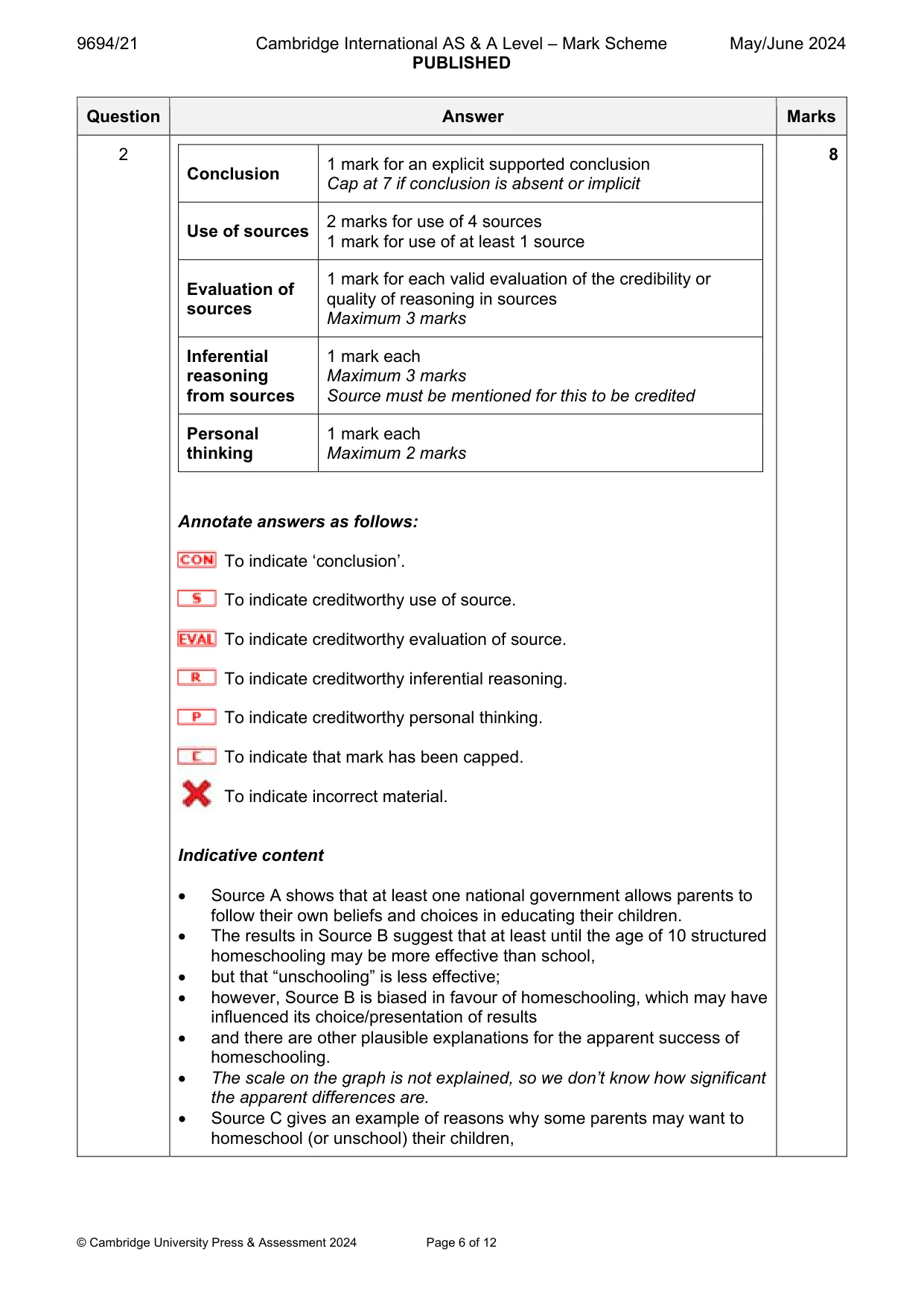
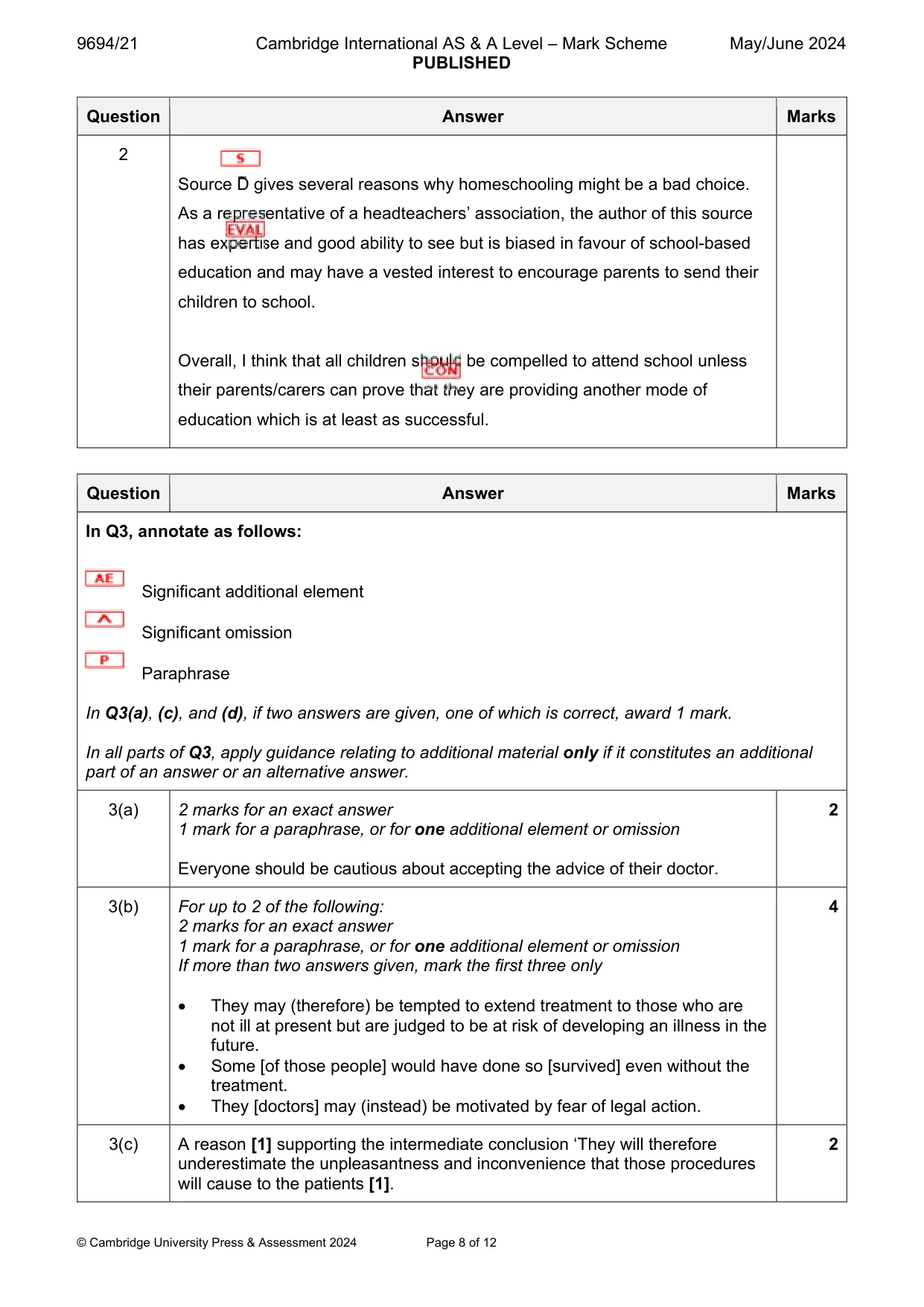
9694/21 Cambridge International AS & A Level – Mark Scheme PUBLISHED May/June 2024 © Cambridge University Press & Assessment 2024 Page 6 of 12 Question Answer Marks 2 Conclusion 1 mark for an explicit supported conclusion Cap at 7 if conclusion is absent or implicit Use of sources 2 marks for use of 4 sources 1 mark for use of at least 1 source Evaluation of sources 1 mark for each valid evaluation of the credibility or quality of reasoning in sources Maximum 3 marks Inferential reasoning from sources 1 mark each Maximum 3 marks Source must be mentioned for this to be credited Personal thinking 1 mark each Maximum 2 marks Annotate answers as follows: To indicate ‘conclusion’. To indicate creditworthy use of source. To indicate creditworthy evaluation of source. To indicate creditworthy inferential reasoning. To indicate creditworthy personal thinking. To indicate that mark has been capped. To indicate incorrect material. Indicative content Source A shows that at least one national government allows parents to follow their own beliefs and choices in educating their children. The results in Source B suggest that at least until the age of 10 structured homeschooling may be more effective than school, but that “unschooling” is less effective; however, Source B is biased in favour of homeschooling, which may have influenced its choice/presentation of results and there are other plausible explanations for the apparent success of homeschooling. The scale on the graph is not explained, so we don’t know how significant the apparent differences are. Source C gives an example of reasons why some parents may want to homeschool (or unschool) their children, 8
Mark scheme, page 7
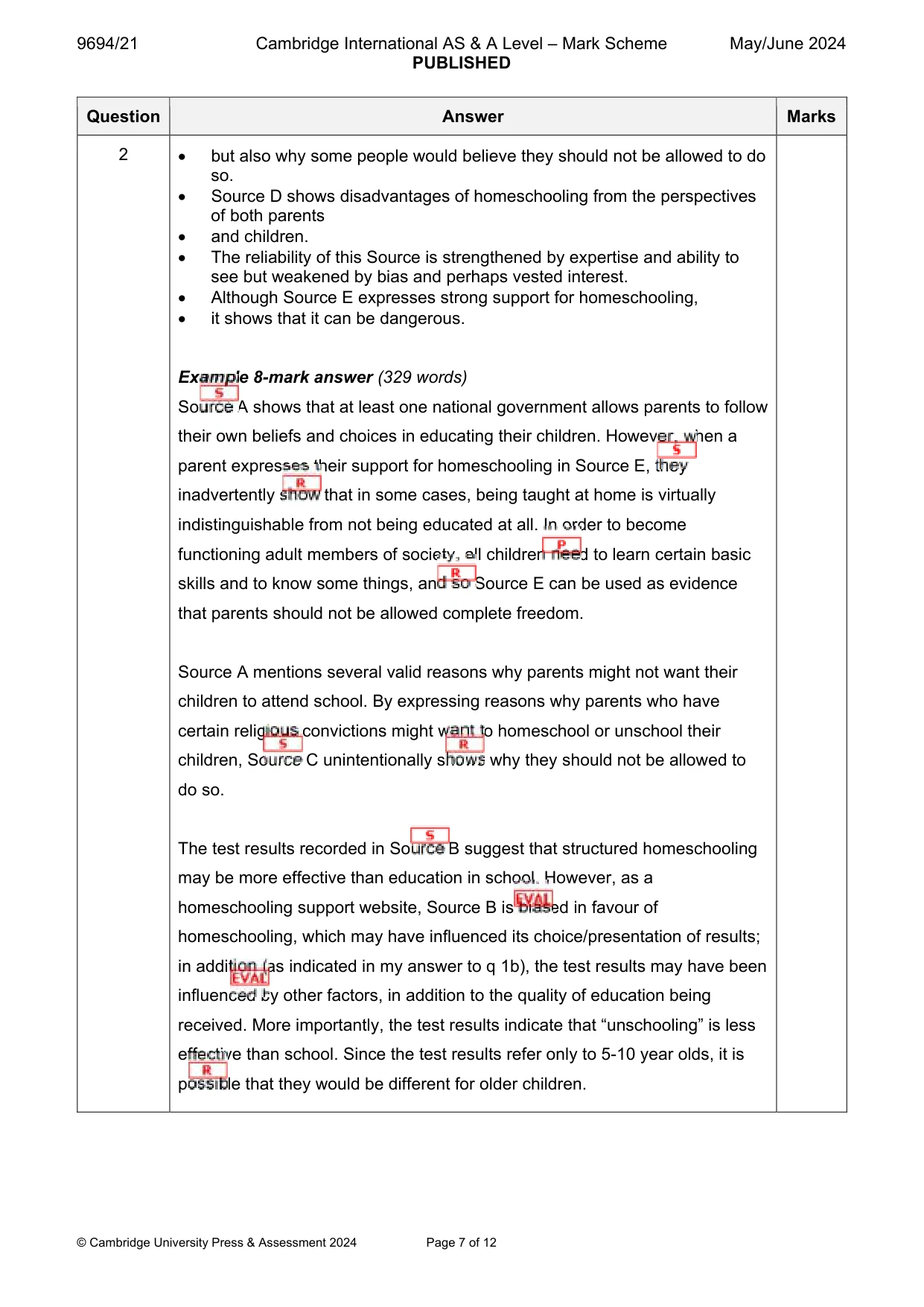
9694/21 Cambridge International AS & A Level – Mark Scheme PUBLISHED May/June 2024 © Cambridge University Press & Assessment 2024 Page 7 of 12 Question Answer Marks 2 but also why some people would believe they should not be allowed to do so. Source D shows disadvantages of homeschooling from the perspectives of both parents and children. The reliability of this Source is strengthened by expertise and ability to see but weakened by bias and perhaps vested interest. Although Source E expresses strong support for homeschooling, it shows that it can be dangerous. Example 8-mark answer (329 words) Source A shows that at least one national government allows parents to follow their own beliefs and choices in educating their children. However, when a parent expresses their support for homeschooling in Source E, they inadvertently show that in some cases, being taught at home is virtually indistinguishable from not being educated at all. In order to become functioning adult members of society, all children need to learn certain basic skills and to know some things, and so Source E can be used as evidence that parents should not be allowed complete freedom. Source A mentions several valid reasons why parents might not want their children to attend school. By expressing reasons why parents who have certain religious convictions might want to homeschool or unschool their children, Source C unintentionally shows why they should not be allowed to do so. The test results recorded in Source B suggest that structured homeschooling may be more effective than education in school. However, as a homeschooling support website, Source B is biased in favour of homeschooling, which may have influenced its choice/presentation of results; in addition (as indicated in my answer to q 1b), the test results may have been influenced by other factors, in addition to the quality of education being received. More importantly, the test results indicate that “unschooling” is less effective than school. Since the test results refer only to 5-10 year olds, it is possible that they would be different for older children.
Mark scheme, page 8
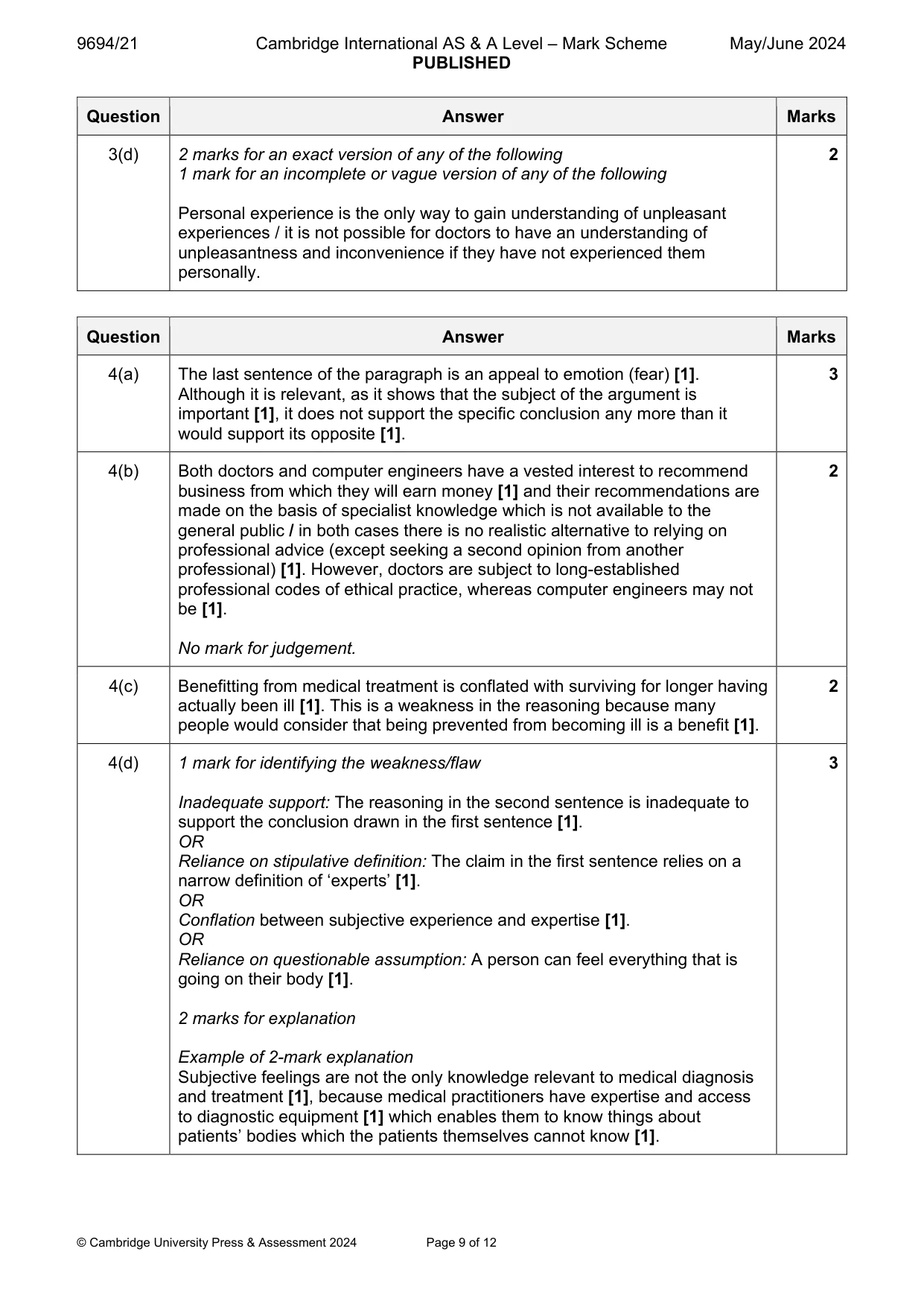
9694/21 Cambridge International AS & A Level – Mark Scheme PUBLISHED May/June 2024 © Cambridge University Press & Assessment 2024 Page 8 of 12 Question Answer Marks 2 Source D gives several reasons why homeschooling might be a bad choice. As a representative of a headteachers’ association, the author of this source has expertise and good ability to see but is biased in favour of school-based education and may have a vested interest to encourage parents to send their children to school. Overall, I think that all children should be compelled to attend school unless their parents/carers can prove that they are providing another mode of education which is at least as successful. Question Answer Marks In Q3, annotate as follows: Significant additional element Significant omission Paraphrase In Q3(a), (c), and (d), if two answers are given, one of which is correct, award 1 mark. In all parts of Q3, apply guidance relating to additional material only if it constitutes an additional part of an answer or an alternative answer. 3(a) 2 marks for an exact answer 1 mark for a paraphrase, or for one additional element or omission Everyone should be cautious about accepting the advice of their doctor. 2 3(b) For up to 2 of the following: 2 marks for an exact answer 1 mark for a paraphrase, or for one additional element or omission If more than two answers given, mark the first three only They may (therefore) be tempted to extend treatment to those who are not ill at present but are judged to be at risk of developing an illness in the future. Some [of those people] would have done so [survived] even without the treatment. They [doctors] may (instead) be motivated by fear of legal action. 4 3(c) A reason [1] supporting the intermediate conclusion ‘They will therefore underestimate the unpleasantness and inconvenience that those procedures will cause to the patients [1]. 2
Mark scheme, page 9
9694/21 Cambridge International AS & A Level – Mark Scheme PUBLISHED May/June 2024 © Cambridge University Press & Assessment 2024 Page 9 of 12 Question Answer Marks 3(d) 2 marks for an exact version of any of the following 1 mark for an incomplete or vague version of any of the following Personal experience is the only way to gain understanding of unpleasant experiences / it is not possible for doctors to have an understanding of unpleasantness and inconvenience if they have not experienced them personally. 2 Question Answer Marks 4(a) The last sentence of the paragraph is an appeal to emotion (fear) [1]. Although it is relevant, as it shows that the subject of the argument is important [1], it does not support the specific conclusion any more than it would support its opposite [1]. 3 4(b) Both doctors and computer engineers have a vested interest to recommend business from which they will earn money [1] and their recommendations are made on the basis of specialist knowledge which is not available to the general public / in both cases there is no realistic alternative to relying on professional advice (except seeking a second opinion from another professional) [1]. However, doctors are subject to long-established professional codes of ethical practice, whereas computer engineers may not be [1]. No mark for judgement. 2 4(c) Benefitting from medical treatment is conflated with surviving for longer having actually been ill [1]. This is a weakness in the reasoning because many people would consider that being prevented from becoming ill is a benefit [1]. 2 4(d) 1 mark for identifying the weakness/flaw Inadequate support: The reasoning in the second sentence is inadequate to support the conclusion drawn in the first sentence [1]. OR Reliance on stipulative definition: The claim in the first sentence relies on a narrow definition of ‘experts’ [1]. OR Conflation between subjective experience and expertise [1]. OR Reliance on questionable assumption: A person can feel everything that is going on their body [1]. 2 marks for explanation Example of 2-mark explanation Subjective feelings are not the only knowledge relevant to medical diagnosis and treatment [1], because medical practitioners have expertise and access to diagnostic equipment [1] which enables them to know things about patients’ bodies which the patients themselves cannot know [1]. 3
Mark scheme, page 10
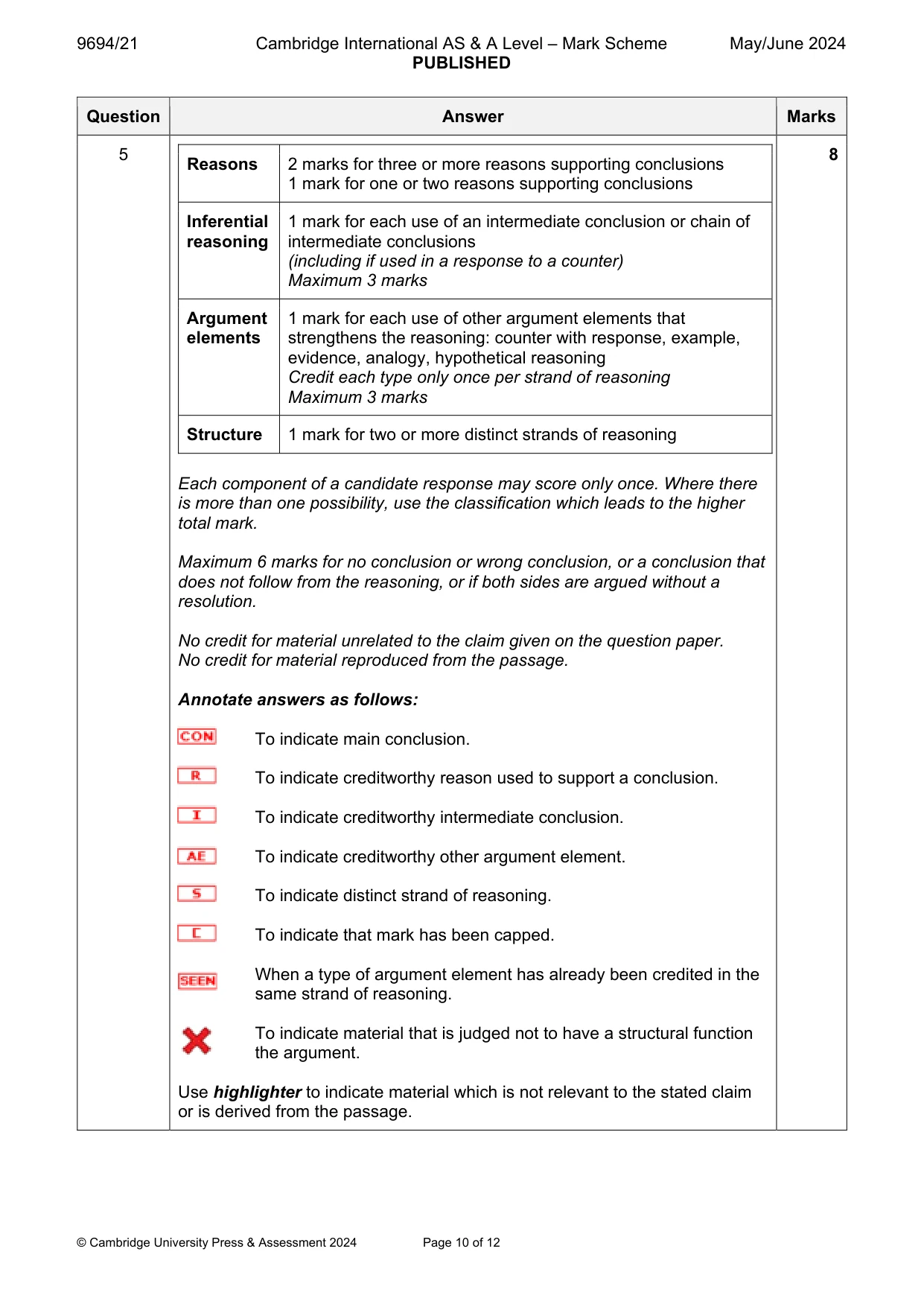
9694/21 Cambridge International AS & A Level – Mark Scheme PUBLISHED May/June 2024 © Cambridge University Press & Assessment 2024 Page 10 of 12 Question Answer Marks 5 Reasons 2 marks for three or more reasons supporting conclusions 1 mark for one or two reasons supporting conclusions Inferential reasoning 1 mark for each use of an intermediate conclusion or chain of intermediate conclusions (including if used in a response to a counter) Maximum 3 marks Argument elements 1 mark for each use of other argument elements that strengthens the reasoning: counter with response, example, evidence, analogy, hypothetical reasoning Credit each type only once per strand of reasoning Maximum 3 marks Structure 1 mark for two or more distinct strands of reasoning Each component of a candidate response may score only once. Where there is more than one possibility, use the classification which leads to the higher total mark. Maximum 6 marks for no conclusion or wrong conclusion, or a conclusion that does not follow from the reasoning, or if both sides are argued without a resolution. No credit for material unrelated to the claim given on the question paper. No credit for material reproduced from the passage. Annotate answers as follows: To indicate main conclusion. To indicate creditworthy reason used to support a conclusion. To indicate creditworthy intermediate conclusion. To indicate creditworthy other argument element. To indicate distinct strand of reasoning. To indicate that mark has been capped. When a type of argument element has already been credited in the same strand of reasoning. To indicate material that is judged not to have a structural function in the argument. Use highlighter to indicate material which is not relevant to the stated claim or is derived from the passage. 8
Mark scheme, page 11
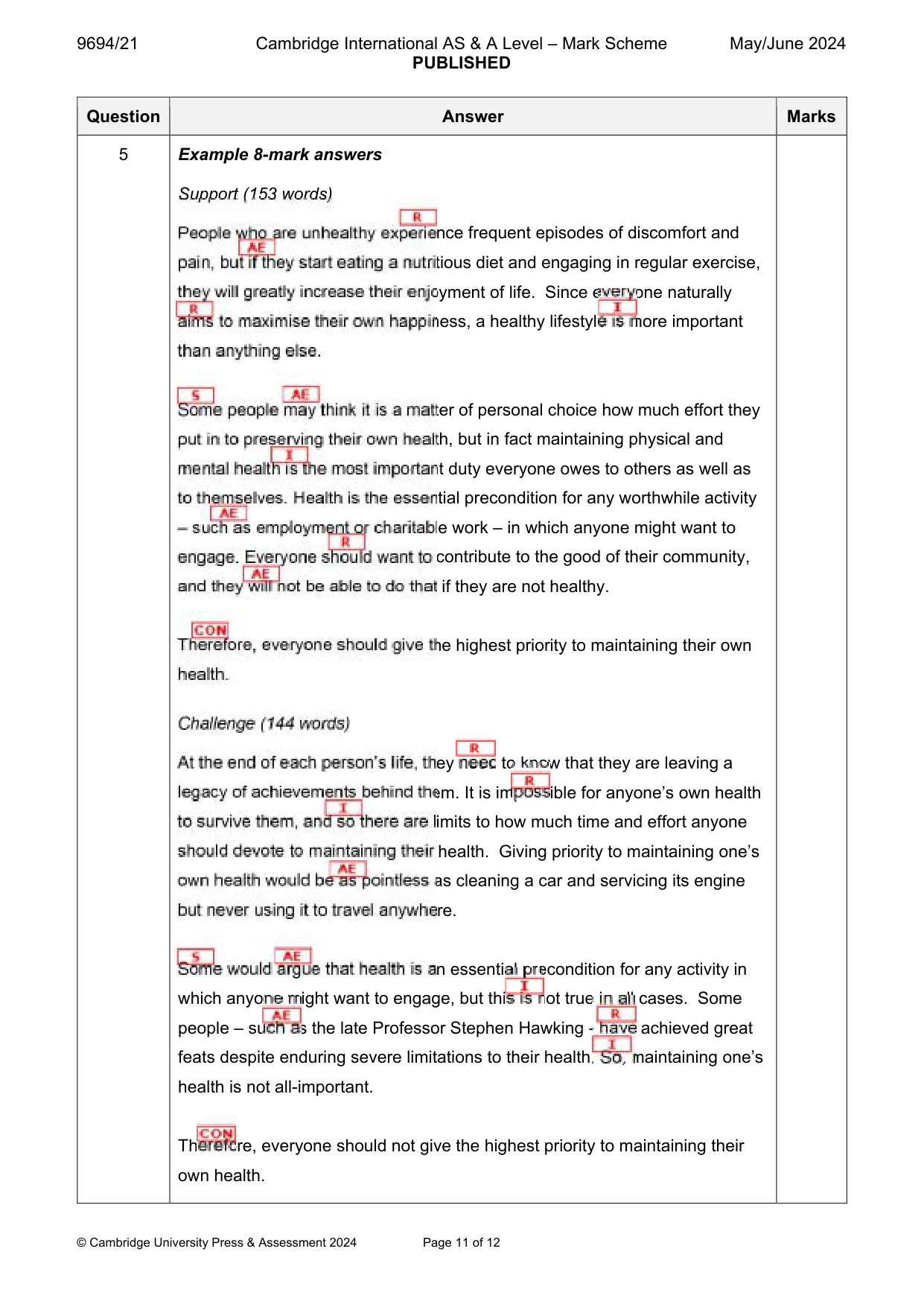
9694/21 Cambridge International AS & A Level – Mark Scheme PUBLISHED May/June 2024 © Cambridge University Press & Assessment 2024 Page 11 of 12 Question Answer Marks 5 Example 8-mark answers Support (153 words) People who are unhealthy experience frequent episodes of discomfort and pain, but if they start eating a nutritious diet and engaging in regular exercise, they will greatly increase their enjoyment of life. Since everyone naturally aims to maximise their own happiness, a healthy lifestyle is more important than anything else. Some people may think it is a matter of personal choice how much effort they put in to preserving their own health, but in fact maintaining physical and mental health is the most important duty everyone owes to others as well as to themselves. Health is the essential precondition for any worthwhile activity – such as employment or charitable work – in which anyone might want to engage. Everyone should want to contribute to the good of their community, and they will not be able to do that if they are not healthy. Therefore, everyone should give the highest priority to maintaining their own health. Challenge (144 words) At the end of each person’s life, they need to know that they are leaving a legacy of achievements behind them. It is impossible for anyone’s own health to survive them, and so there are limits to how much time and effort anyone should devote to maintaining their health. Giving priority to maintaining one’s own health would be as pointless as cleaning a car and servicing its engine but never using it to travel anywhere. Some would argue that health is an essential precondition for any activity in which anyone might want to engage, but this is not true in all cases. Some people – such as the late Professor Stephen Hawking - have achieved great feats despite enduring severe limitations to their health. So, maintaining one’s health is not all-important. Therefore, everyone should not give the highest priority to maintaining their own health.
Mark scheme, page 12
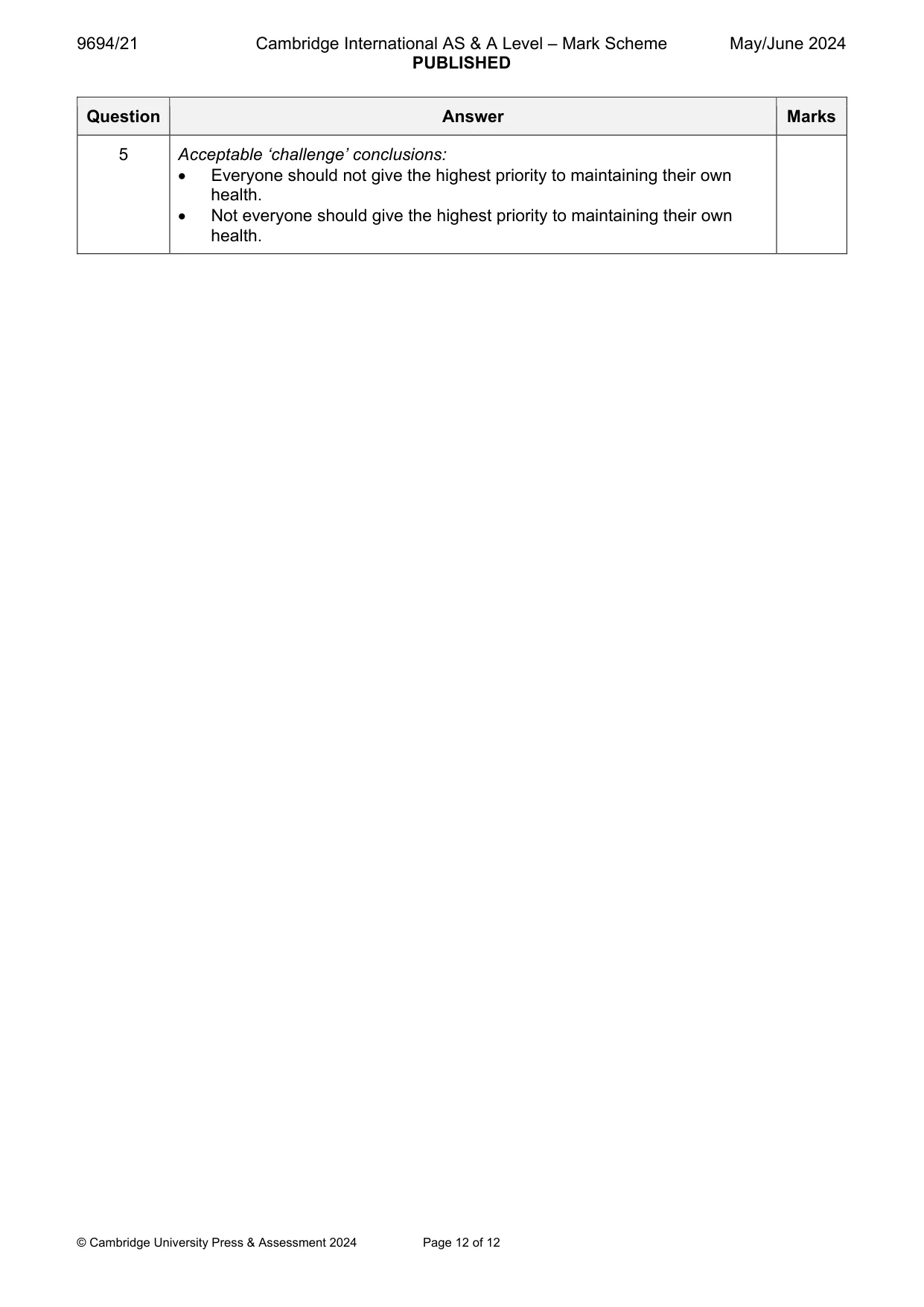
9694/21 Cambridge International AS & A Level – Mark Scheme PUBLISHED May/June 2024 © Cambridge University Press & Assessment 2024 Page 12 of 12 Question Answer Marks 5 Acceptable ‘challenge’ conclusions: Everyone should not give the highest priority to maintaining their own health. Not everyone should give the highest priority to maintaining their own health.
What you needed in this session
Cambridge’s own grade thresholds for 2024 May/June, Paper 2 · Variant 1. A higher threshold means an easier paper — the bar moves with how the cohort did.