Cambridge A Level Thinking Skills 9694 — 2022 Oct/Nov Paper 2 · Variant 3
9694/23/O/N/22 · 50 marks · ≈56 min
The question paper and its mark scheme, free to read here and free to download. This is Cambridge’s own paper, exactly as it was sat.
Question paper8 pages



Mark scheme12 pages
Answers below. Sit the paper first if you are practising.
Paper as text
Question paper, page 1
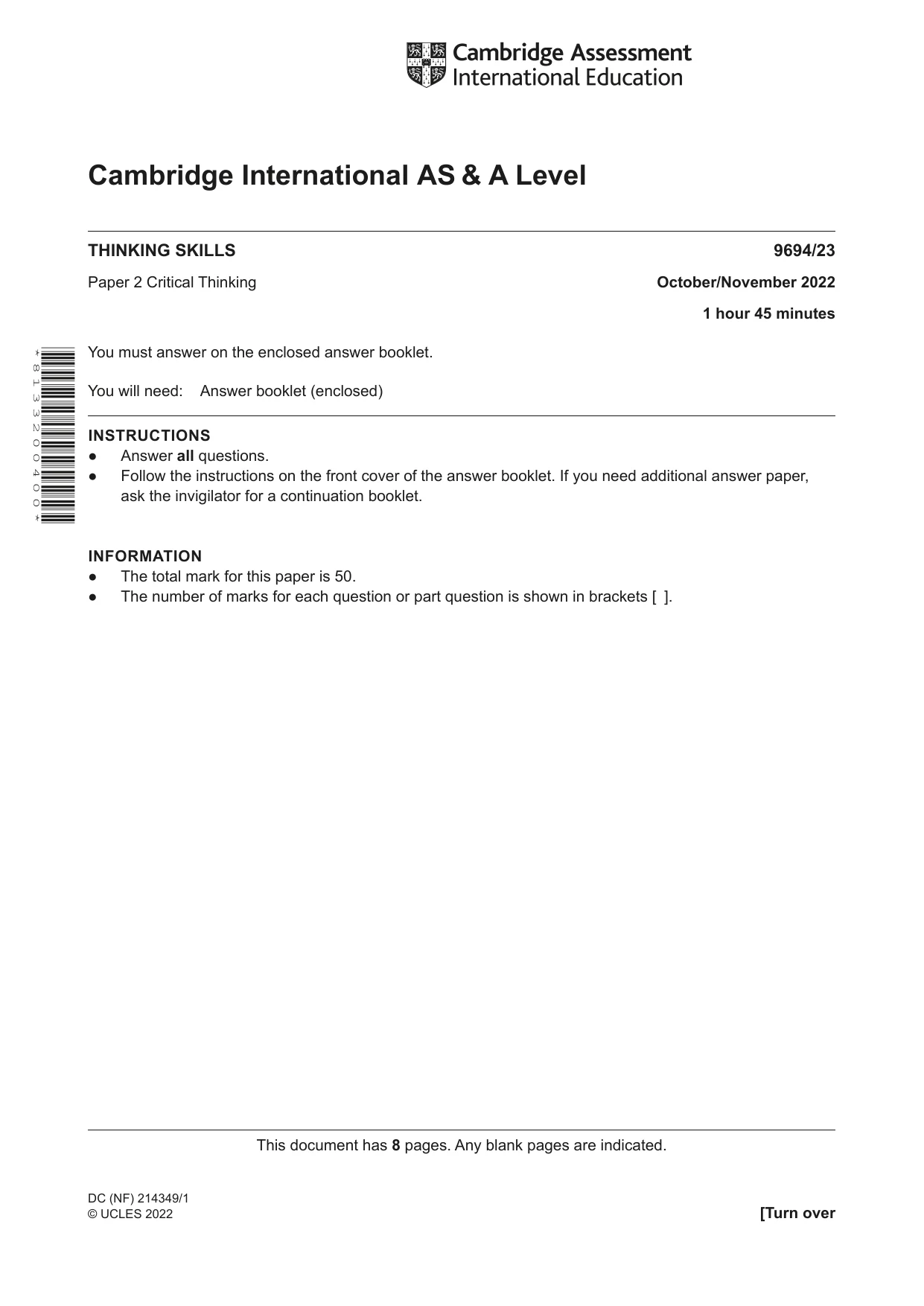
[Turn over DC (NF) 214349/1 © UCLES 2022 This document has 8 pages. Any blank pages are indicated. * 8 1 3 3 2 0 0 4 0 0 * THINKING SKILLS 9694/23 Paper 2 Critical Thinking October/November 2022 1 hour 45 minutes You must answer on the enclosed answer booklet. You will need: Answer booklet (enclosed) INSTRUCTIONS ● Answer all questions. ● Follow the instructions on the front cover of the answer booklet. If you need additional answer paper, ask the invigilator for a continuation booklet. INFORMATION ● The total mark for this paper is 50. ● The number of marks for each question or part question is shown in brackets [ ]. Cambridge International AS & A Level
Question paper, page 2
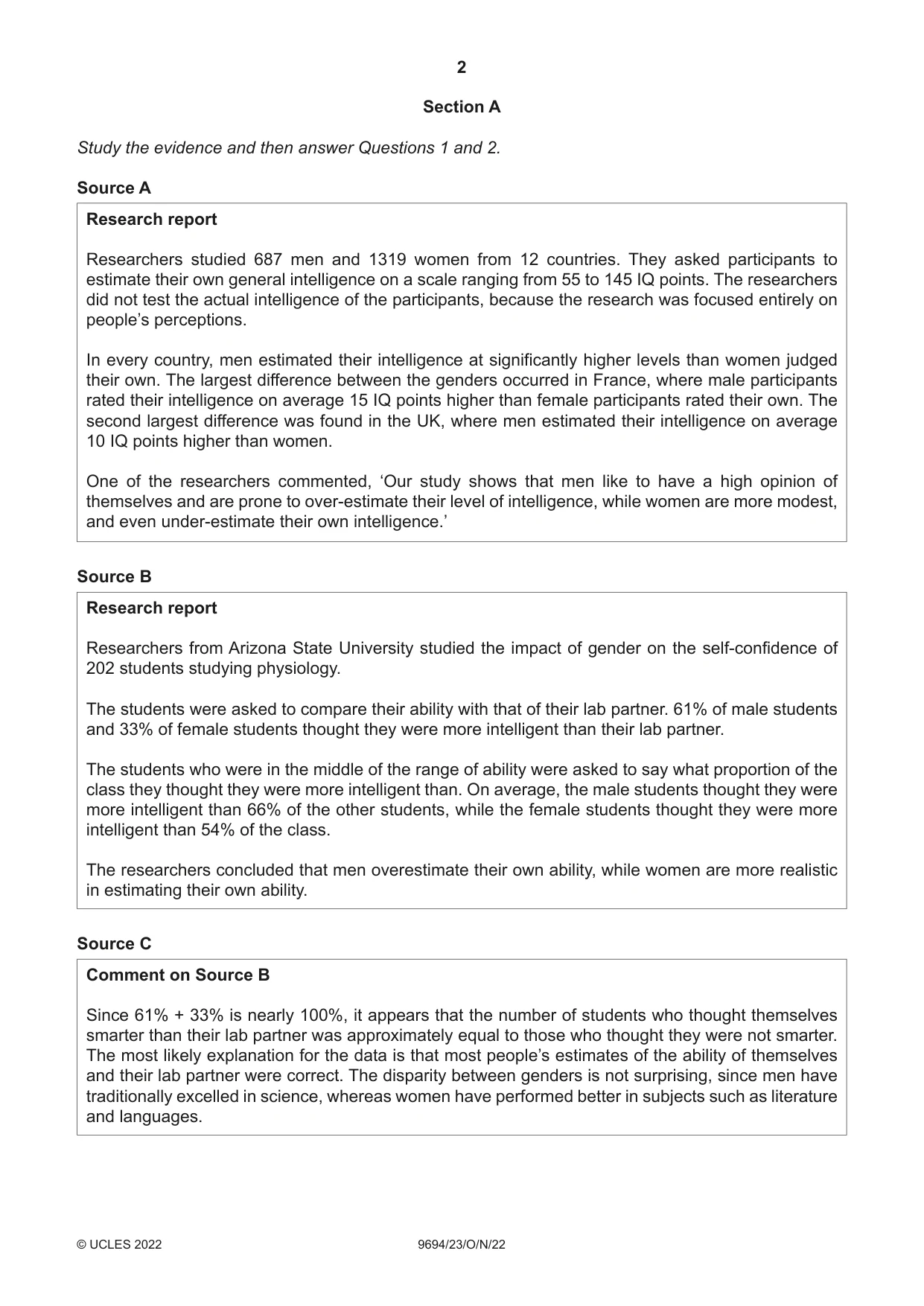
2 9694/23/O/N/22 © UCLES 2022 Section A Study the evidence and then answer Questions 1 and 2. Source A Research report Researchers studied 687 men and 1319 women from 12 countries. They asked participants to estimate their own general intelligence on a scale ranging from 55 to 145 IQ points. The researchers did not test the actual intelligence of the participants, because the research was focused entirely on people’s perceptions. In every country, men estimated their intelligence at significantly higher levels than women judged their own. The largest difference between the genders occurred in France, where male participants rated their intelligence on average 15 IQ points higher than female participants rated their own. The second largest difference was found in the UK, where men estimated their intelligence on average 10 IQ points higher than women. One of the researchers commented, ‘Our study shows that men like to have a high opinion of themselves and are prone to over-estimate their level of intelligence, while women are more modest, and even under-estimate their own intelligence.’ Source B Research report Researchers from Arizona State University studied the impact of gender on the self-confidence of 202 students studying physiology. The students were asked to compare their ability with that of their lab partner. 61% of male students and 33% of female students thought they were more intelligent than their lab partner. The students who were in the middle of the range of ability were asked to say what proportion of the class they thought they were more intelligent than. On average, the male students thought they were more intelligent than 66% of the other students, while the female students thought they were more intelligent than 54% of the class. The researchers concluded that men overestimate their own ability, while women are more realistic in estimating their own ability. Source C Comment on Source B Since 61% + 33% is nearly 100%, it appears that the number of students who thought themselves smarter than their lab partner was approximately equal to those who thought they were not smarter. The most likely explanation for the data is that most people’s estimates of the ability of themselves and their lab partner were correct. The disparity between genders is not surprising, since men have traditionally excelled in science, whereas women have performed better in subjects such as literature and languages.
Question paper, page 3
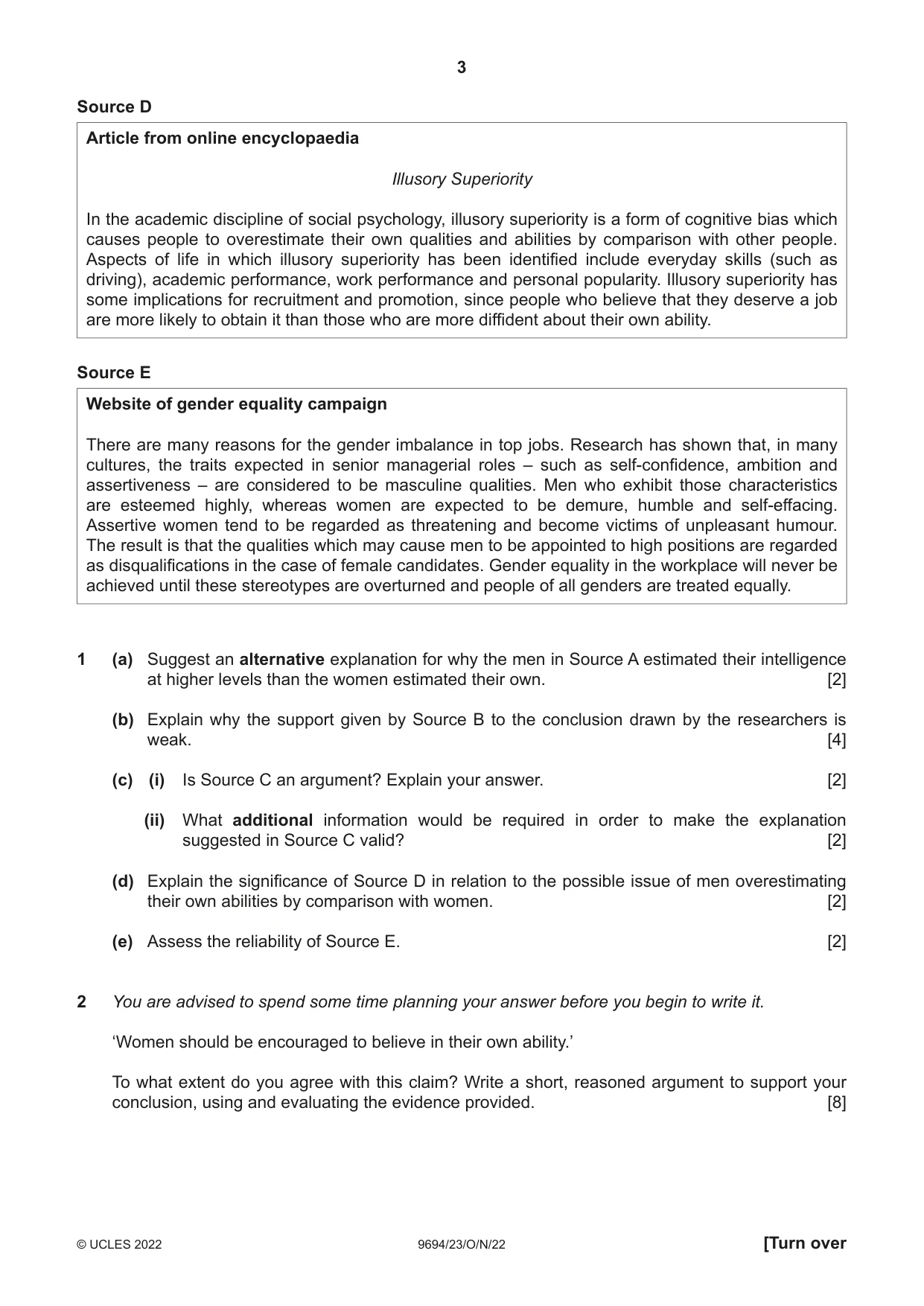
3 9694/23/O/N/22 © UCLES 2022 [Turn over Source D Article from online encyclopaedia Illusory Superiority In the academic discipline of social psychology, illusory superiority is a form of cognitive bias which causes people to overestimate their own qualities and abilities by comparison with other people. Aspects of life in which illusory superiority has been identified include everyday skills (such as driving), academic performance, work performance and personal popularity. Illusory superiority has some implications for recruitment and promotion, since people who believe that they deserve a job are more likely to obtain it than those who are more diffident about their own ability. Source E Website of gender equality campaign There are many reasons for the gender imbalance in top jobs. Research has shown that, in many cultures, the traits expected in senior managerial roles – such as self-confidence, ambition and assertiveness – are considered to be masculine qualities. Men who exhibit those characteristics are esteemed highly, whereas women are expected to be demure, humble and self-effacing. Assertive women tend to be regarded as threatening and become victims of unpleasant humour. The result is that the qualities which may cause men to be appointed to high positions are regarded as disqualifications in the case of female candidates. Gender equality in the workplace will never be achieved until these stereotypes are overturned and people of all genders are treated equally. 1 (a) Suggest an alternative explanation for why the men in Source A estimated their intelligence at higher levels than the women estimated their own. [2] (b) Explain why the support given by Source B to the conclusion drawn by the researchers is weak. [4] (c) (i) Is Source C an argument? Explain your answer. [2] (ii) What additional information would be required in order to make the explanation suggested in Source C valid? [2] (d) Explain the significance of Source D in relation to the possible issue of men overestimating their own abilities by comparison with women. [2] (e) Assess the reliability of Source E. [2] 2 You are advised to spend some time planning your answer before you begin to write it. ‘Women should be encouraged to believe in their own ability.’ To what extent do you agree with this claim? Write a short, reasoned argument to support your conclusion, using and evaluating the evidence provided. [8]
Question paper, page 4
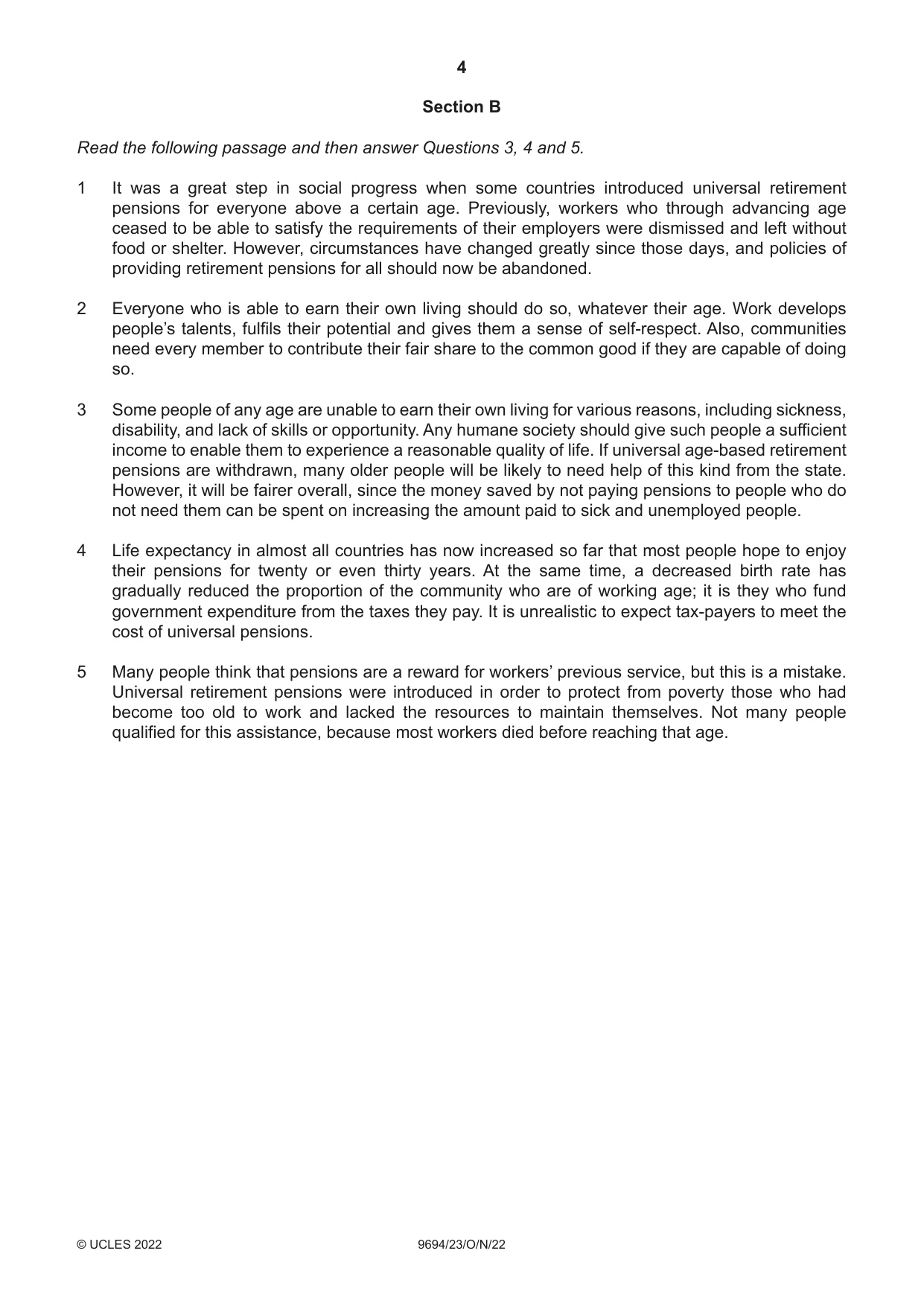
4 9694/23/O/N/22 © UCLES 2022 Section B Read the following passage and then answer Questions 3, 4 and 5. 1 It was a great step in social progress when some countries introduced universal retirement pensions for everyone above a certain age. Previously, workers who through advancing age ceased to be able to satisfy the requirements of their employers were dismissed and left without food or shelter. However, circumstances have changed greatly since those days, and policies of providing retirement pensions for all should now be abandoned. 2 Everyone who is able to earn their own living should do so, whatever their age. Work develops people’s talents, fulfils their potential and gives them a sense of self-respect. Also, communities need every member to contribute their fair share to the common good if they are capable of doing so. 3 Some people of any age are unable to earn their own living for various reasons, including sickness, disability, and lack of skills or opportunity. Any humane society should give such people a sufficient income to enable them to experience a reasonable quality of life. If universal age-based retirement pensions are withdrawn, many older people will be likely to need help of this kind from the state. However, it will be fairer overall, since the money saved by not paying pensions to people who do not need them can be spent on increasing the amount paid to sick and unemployed people. 4 Life expectancy in almost all countries has now increased so far that most people hope to enjoy their pensions for twenty or even thirty years. At the same time, a decreased birth rate has gradually reduced the proportion of the community who are of working age; it is they who fund government expenditure from the taxes they pay. It is unrealistic to expect tax-payers to meet the cost of universal pensions. 5 Many people think that pensions are a reward for workers’ previous service, but this is a mistake. Universal retirement pensions were introduced in order to protect from poverty those who had become too old to work and lacked the resources to maintain themselves. Not many people qualified for this assistance, because most workers died before reaching that age.
Question paper, page 5
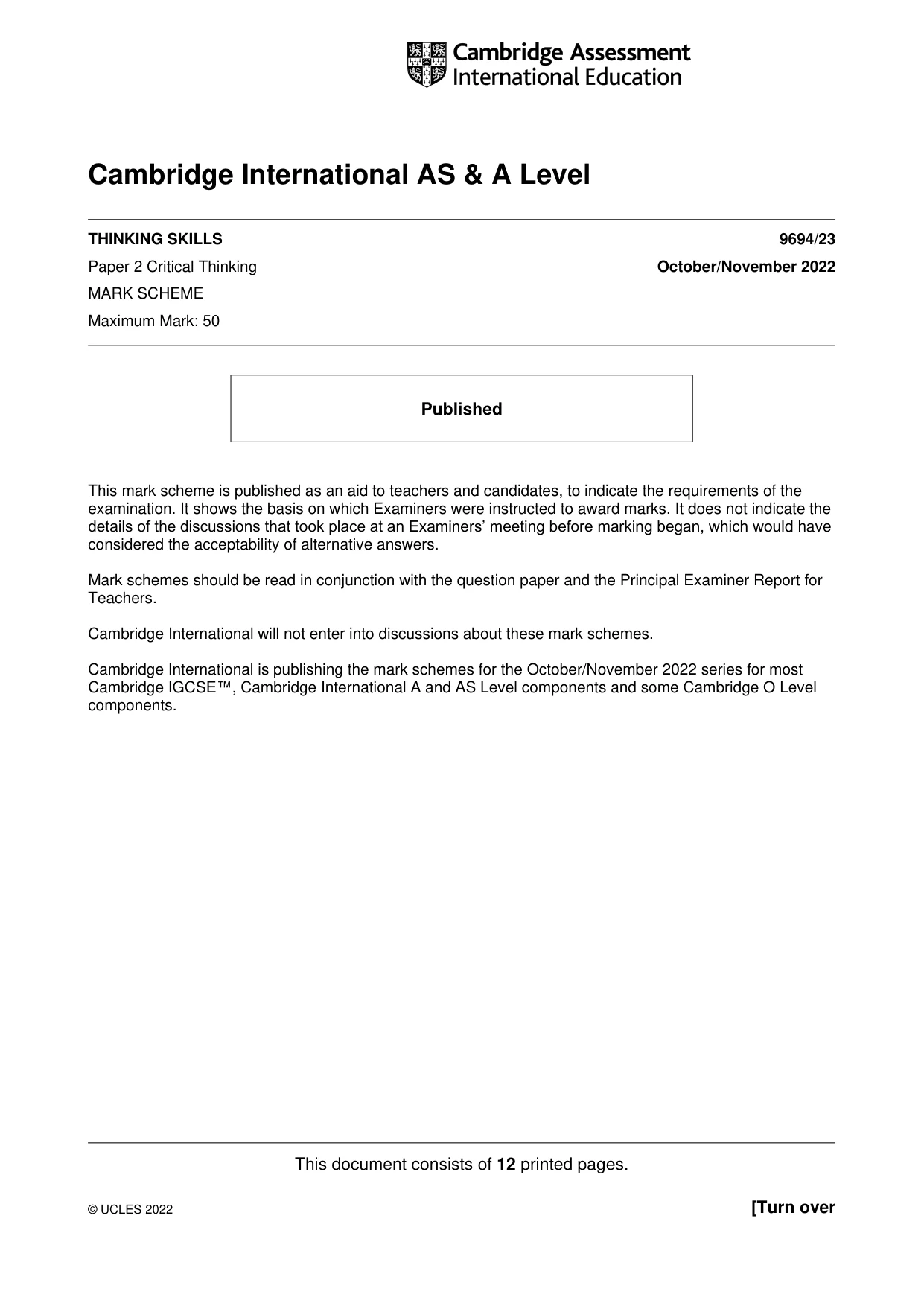
5 9694/23/O/N/22 © UCLES 2022 3 (a) Using the exact words from the passage as far as possible, identify the main conclusion. [2] (b) Using the exact words from the passage as far as possible, identify two intermediate conclusions in paragraphs 2 to 4. [4] (c) Identify the following argument element from paragraph 5: ‘pensions are a reward for workers’ previous service’ [2] (d) Identify two unstated assumptions required by the argument in paragraph 4. [4] 4 (a) Explain how the reasoning in paragraph 2 is weakened by the flaw of conflation. [2] (b) Identify an inconsistency between paragraphs 3 and 4 and explain the impact on the strength of the argument. [4] (c) Identify and evaluate an appeal in paragraph 5. [2] 5 You are advised to spend some time planning your answer before you begin to write it. ‘Most people can expect old age to be the happiest time of their life.’ Write your own short argument to support or challenge this claim. The conclusion of your argument must be stated. Credit will not be given for repeating ideas from the passage. [8]
Question paper, page 6
6 9694/23/O/N/22 © UCLES 2022 BLANK PAGE
Question paper, page 7
7 9694/23/O/N/22 © UCLES 2022 BLANK PAGE
Question paper, page 8
8 9694/23/O/N/22 © UCLES 2022 Permission to reproduce items where third-party owned material protected by copyright is included has been sought and cleared where possible. Every reasonable effort has been made by the publisher (UCLES) to trace copyright holders, but if any items requiring clearance have unwittingly been included, the publisher will be pleased to make amends at the earliest possible opportunity. To avoid the issue of disclosure of answer-related information to candidates, all copyright acknowledgements are reproduced online in the Cambridge Assessment International Education Copyright Acknowledgements Booklet. This is produced for each series of examinations and is freely available to download at www.cambridgeinternational.org after the live examination series. Cambridge Assessment International Education is part of Cambridge Assessment. Cambridge Assessment is the brand name of the University of Cambridge Local Examinations Syndicate (UCLES), which is a department of the University of Cambridge. BLANK PAGE
Mark scheme, page 1
This document consists of 12 printed pages. © UCLES 2022 [Turn over Cambridge International AS & A Level THINKING SKILLS 9694/23 Paper 2 Critical Thinking October/November 2022 MARK SCHEME Maximum Mark: 50 Published This mark scheme is published as an aid to teachers and candidates, to indicate the requirements of the examination. It shows the basis on which Examiners were instructed to award marks. It does not indicate the details of the discussions that took place at an Examiners’ meeting before marking began, which would have considered the acceptability of alternative answers. Mark schemes should be read in conjunction with the question paper and the Principal Examiner Report for Teachers. Cambridge International will not enter into discussions about these mark schemes. Cambridge International is publishing the mark schemes for the October/November 2022 series for most Cambridge IGCSE™, Cambridge International A and AS Level components and some Cambridge O Level components.
Mark scheme, page 2
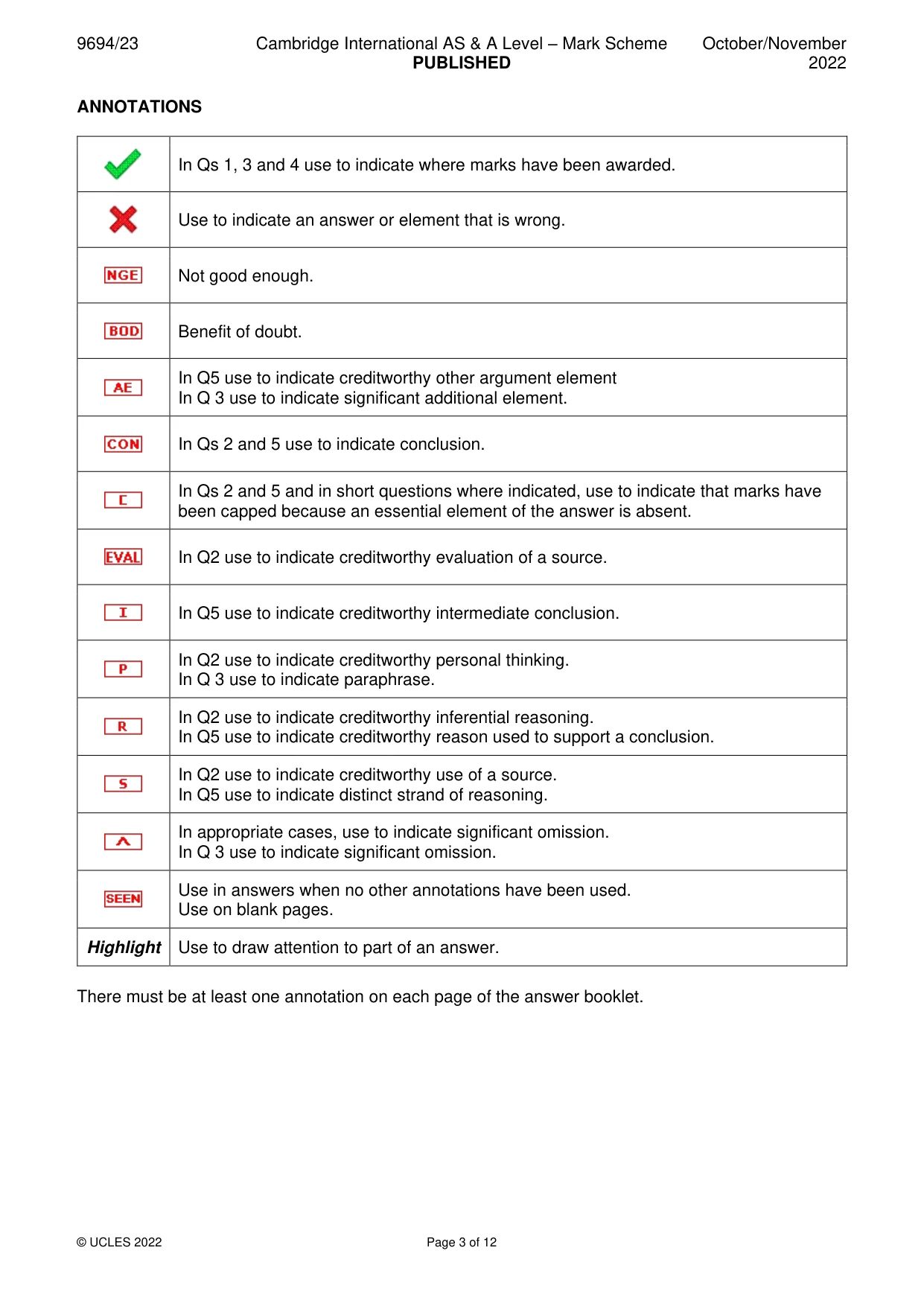
9694/23 Cambridge International AS & A Level – Mark Scheme PUBLISHED October/November 2022 © UCLES 2022 Page 2 of 12 Generic Marking Principles These general marking principles must be applied by all examiners when marking candidate answers. They should be applied alongside the specific content of the mark scheme or generic level descriptors for a question. Each question paper and mark scheme will also comply with these marking principles. GENERIC MARKING PRINCIPLE 1: Marks must be awarded in line with: • the specific content of the mark scheme or the generic level descriptors for the question • the specific skills defined in the mark scheme or in the generic level descriptors for the question • the standard of response required by a candidate as exemplified by the standardisation scripts. GENERIC MARKING PRINCIPLE 2: Marks awarded are always whole marks (not half marks, or other fractions). GENERIC MARKING PRINCIPLE 3: Marks must be awarded positively: • marks are awarded for correct/valid answers, as defined in the mark scheme. However, credit is given for valid answers which go beyond the scope of the syllabus and mark scheme, referring to your Team Leader as appropriate • marks are awarded when candidates clearly demonstrate what they know and can do • marks are not deducted for errors • marks are not deducted for omissions • answers should only be judged on the quality of spelling, punctuation and grammar when these features are specifically assessed by the question as indicated by the mark scheme. The meaning, however, should be unambiguous. GENERIC MARKING PRINCIPLE 4: Rules must be applied consistently, e.g. in situations where candidates have not followed instructions or in the application of generic level descriptors. GENERIC MARKING PRINCIPLE 5: Marks should be awarded using the full range of marks defined in the mark scheme for the question (however; the use of the full mark range may be limited according to the quality of the candidate responses seen). GENERIC MARKING PRINCIPLE 6: Marks awarded are based solely on the requirements as defined in the mark scheme. Marks should not be awarded with grade thresholds or grade descriptors in mind.
Mark scheme, page 3
9694/23 Cambridge International AS & A Level – Mark Scheme PUBLISHED October/November 2022 © UCLES 2022 Page 3 of 12 ANNOTATIONS In Qs 1, 3 and 4 use to indicate where marks have been awarded. Use to indicate an answer or element that is wrong. Not good enough. Benefit of doubt. In Q5 use to indicate creditworthy other argument element In Q 3 use to indicate significant additional element. In Qs 2 and 5 use to indicate conclusion. In Qs 2 and 5 and in short questions where indicated, use to indicate that marks have been capped because an essential element of the answer is absent. In Q2 use to indicate creditworthy evaluation of a source. In Q5 use to indicate creditworthy intermediate conclusion. In Q2 use to indicate creditworthy personal thinking. In Q 3 use to indicate paraphrase. In Q2 use to indicate creditworthy inferential reasoning. In Q5 use to indicate creditworthy reason used to support a conclusion. In Q2 use to indicate creditworthy use of a source. In Q5 use to indicate distinct strand of reasoning. In appropriate cases, use to indicate significant omission. In Q 3 use to indicate significant omission. Use in answers when no other annotations have been used. Use on blank pages. Highlight Use to draw attention to part of an answer. There must be at least one annotation on each page of the answer booklet.
Mark scheme, page 4
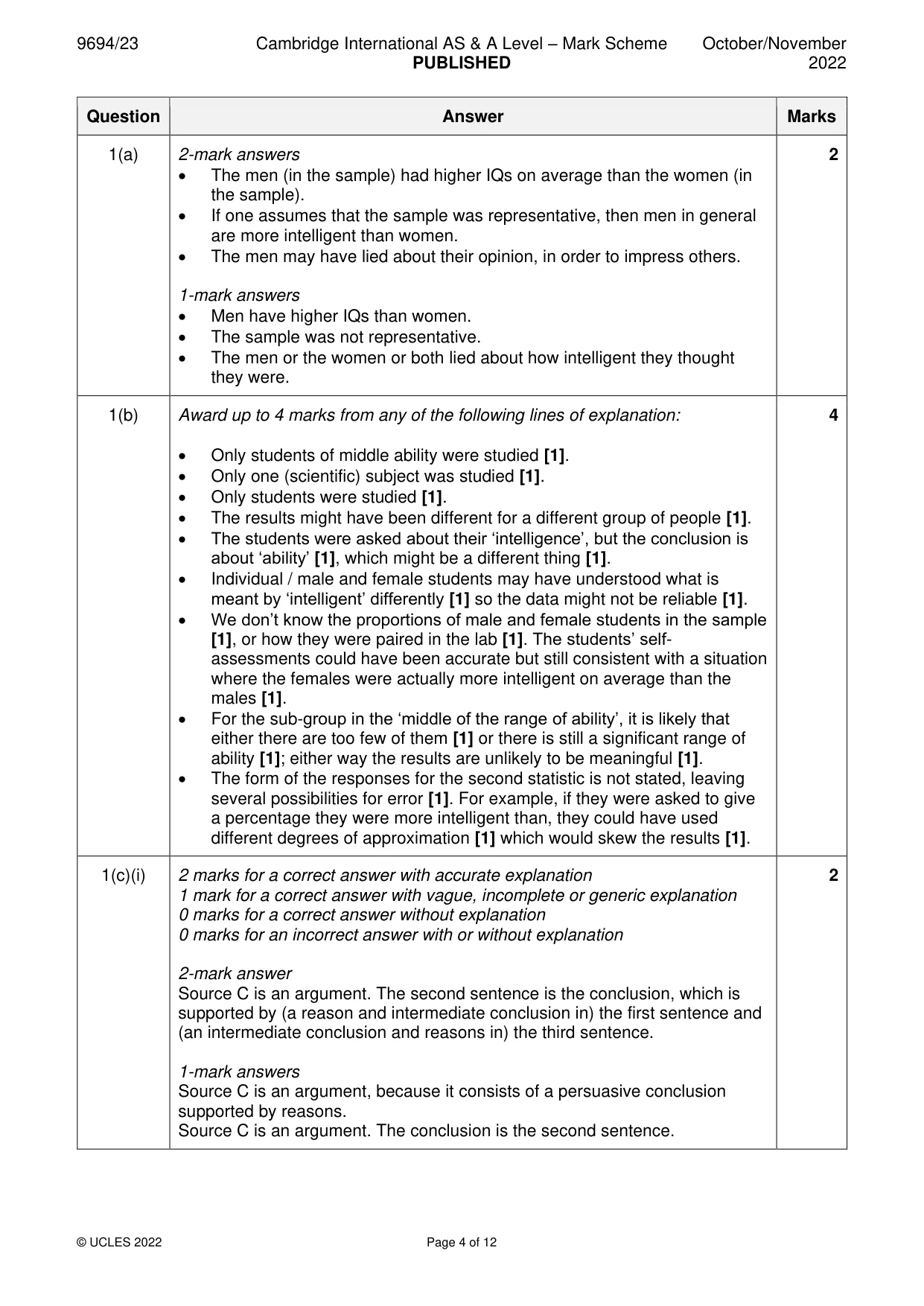
9694/23 Cambridge International AS & A Level – Mark Scheme PUBLISHED October/November 2022 © UCLES 2022 Page 4 of 12 Question Answer Marks 1(a) 2-mark answers • The men (in the sample) had higher IQs on average than the women (in the sample). • If one assumes that the sample was representative, then men in general are more intelligent than women. • The men may have lied about their opinion, in order to impress others. 1-mark answers • Men have higher IQs than women. • The sample was not representative. • The men or the women or both lied about how intelligent they thought they were. 2 1(b) Award up to 4 marks from any of the following lines of explanation: • Only students of middle ability were studied [1]. • Only one (scientific) subject was studied [1]. • Only students were studied [1]. • The results might have been different for a different group of people [1]. • The students were asked about their ‘intelligence’, but the conclusion is about ‘ability’ [1], which might be a different thing [1]. • Individual / male and female students may have understood what is meant by ‘intelligent’ differently [1] so the data might not be reliable [1]. • We don’t know the proportions of male and female students in the sample [1], or how they were paired in the lab [1]. The students’ self- assessments could have been accurate but still consistent with a situation where the females were actually more intelligent on average than the males [1]. • For the sub-group in the ‘middle of the range of ability’, it is likely that either there are too few of them [1] or there is still a significant range of ability [1]; either way the results are unlikely to be meaningful [1]. • The form of the responses for the second statistic is not stated, leaving several possibilities for error [1]. For example, if they were asked to give a percentage they were more intelligent than, they could have used different degrees of approximation [1] which would skew the results [1]. 4 1(c)(i) 2 marks for a correct answer with accurate explanation 1 mark for a correct answer with vague, incomplete or generic explanation 0 marks for a correct answer without explanation 0 marks for an incorrect answer with or without explanation 2-mark answer Source C is an argument. The second sentence is the conclusion, which is supported by (a reason and intermediate conclusion in) the first sentence and (an intermediate conclusion and reasons in) the third sentence. 1-mark answers Source C is an argument, because it consists of a persuasive conclusion supported by reasons. Source C is an argument. The conclusion is the second sentence. 2
Mark scheme, page 5
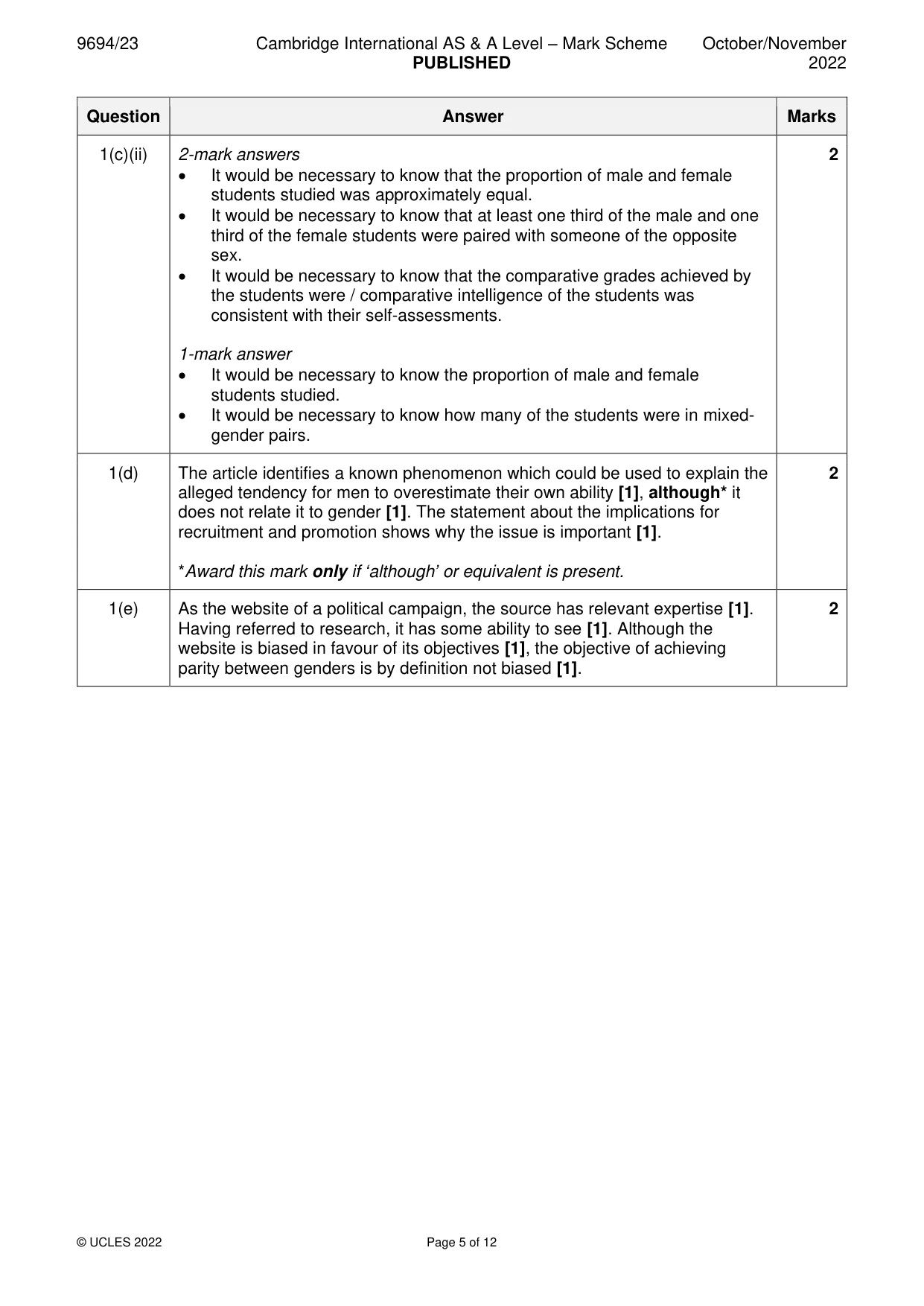
9694/23 Cambridge International AS & A Level – Mark Scheme PUBLISHED October/November 2022 © UCLES 2022 Page 5 of 12 Question Answer Marks 1(c)(ii) 2-mark answers • It would be necessary to know that the proportion of male and female students studied was approximately equal. • It would be necessary to know that at least one third of the male and one third of the female students were paired with someone of the opposite sex. • It would be necessary to know that the comparative grades achieved by the students were / comparative intelligence of the students was consistent with their self-assessments. 1-mark answer • It would be necessary to know the proportion of male and female students studied. • It would be necessary to know how many of the students were in mixed- gender pairs. 2 1(d) The article identifies a known phenomenon which could be used to explain the alleged tendency for men to overestimate their own ability [1], although* it does not relate it to gender [1]. The statement about the implications for recruitment and promotion shows why the issue is important [1]. *Award this mark only if ‘although’ or equivalent is present. 2 1(e) As the website of a political campaign, the source has relevant expertise [1]. Having referred to research, it has some ability to see [1]. Although the website is biased in favour of its objectives [1], the objective of achieving parity between genders is by definition not biased [1]. 2
Mark scheme, page 6
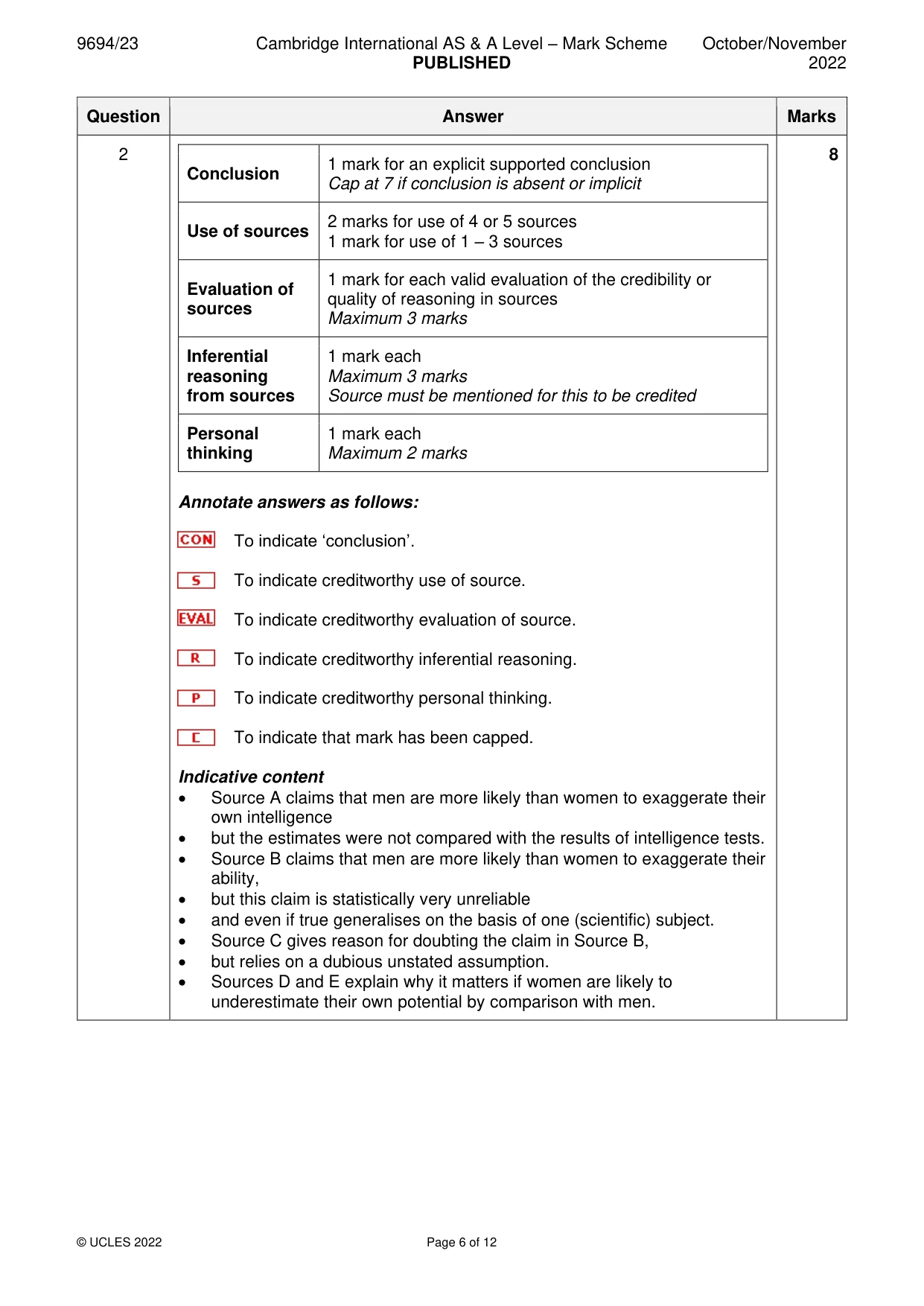
9694/23 Cambridge International AS & A Level – Mark Scheme PUBLISHED October/November 2022 © UCLES 2022 Page 6 of 12 Question Answer Marks 2 Conclusion 1 mark for an explicit supported conclusion Cap at 7 if conclusion is absent or implicit Use of sources 2 marks for use of 4 or 5 sources 1 mark for use of 1 – 3 sources Evaluation of sources 1 mark for each valid evaluation of the credibility or quality of reasoning in sources Maximum 3 marks Inferential reasoning from sources 1 mark each Maximum 3 marks Source must be mentioned for this to be credited Personal thinking 1 mark each Maximum 2 marks Annotate answers as follows: To indicate ‘conclusion’. To indicate creditworthy use of source. To indicate creditworthy evaluation of source. To indicate creditworthy inferential reasoning. To indicate creditworthy personal thinking. To indicate that mark has been capped. Indicative content • Source A claims that men are more likely than women to exaggerate their own intelligence • but the estimates were not compared with the results of intelligence tests. • Source B claims that men are more likely than women to exaggerate their ability, • but this claim is statistically very unreliable • and even if true generalises on the basis of one (scientific) subject. • Source C gives reason for doubting the claim in Source B, • but relies on a dubious unstated assumption. • Sources D and E explain why it matters if women are likely to underestimate their own potential by comparison with men. 8
Mark scheme, page 7
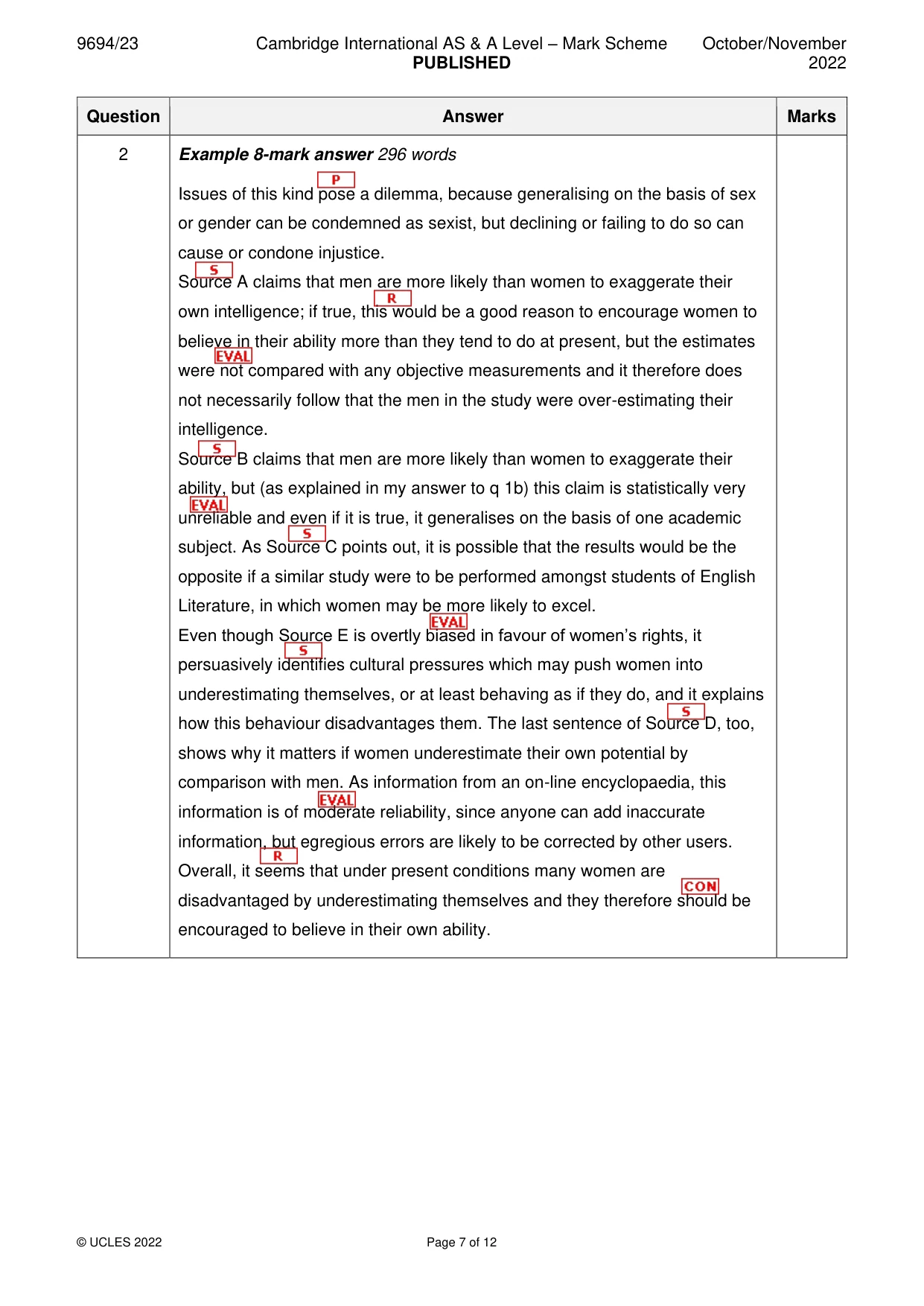
9694/23 Cambridge International AS & A Level – Mark Scheme PUBLISHED October/November 2022 © UCLES 2022 Page 7 of 12 Question Answer Marks 2 Example 8-mark answer 296 words Issues of this kind pose a dilemma, because generalising on the basis of sex or gender can be condemned as sexist, but declining or failing to do so can cause or condone injustice. Source A claims that men are more likely than women to exaggerate their own intelligence; if true, this would be a good reason to encourage women to believe in their ability more than they tend to do at present, but the estimates were not compared with any objective measurements and it therefore does not necessarily follow that the men in the study were over-estimating their intelligence. Source B claims that men are more likely than women to exaggerate their ability, but (as explained in my answer to q 1b) this claim is statistically very unreliable and even if it is true, it generalises on the basis of one academic subject. As Source C points out, it is possible that the results would be the opposite if a similar study were to be performed amongst students of English Literature, in which women may be more likely to excel. Even though Source E is overtly biased in favour of women’s rights, it persuasively identifies cultural pressures which may push women into underestimating themselves, or at least behaving as if they do, and it explains how this behaviour disadvantages them. The last sentence of Source D, too, shows why it matters if women underestimate their own potential by comparison with men. As information from an on-line encyclopaedia, this information is of moderate reliability, since anyone can add inaccurate information, but egregious errors are likely to be corrected by other users. Overall, it seems that under present conditions many women are disadvantaged by underestimating themselves and they therefore should be encouraged to believe in their own ability.
Mark scheme, page 8
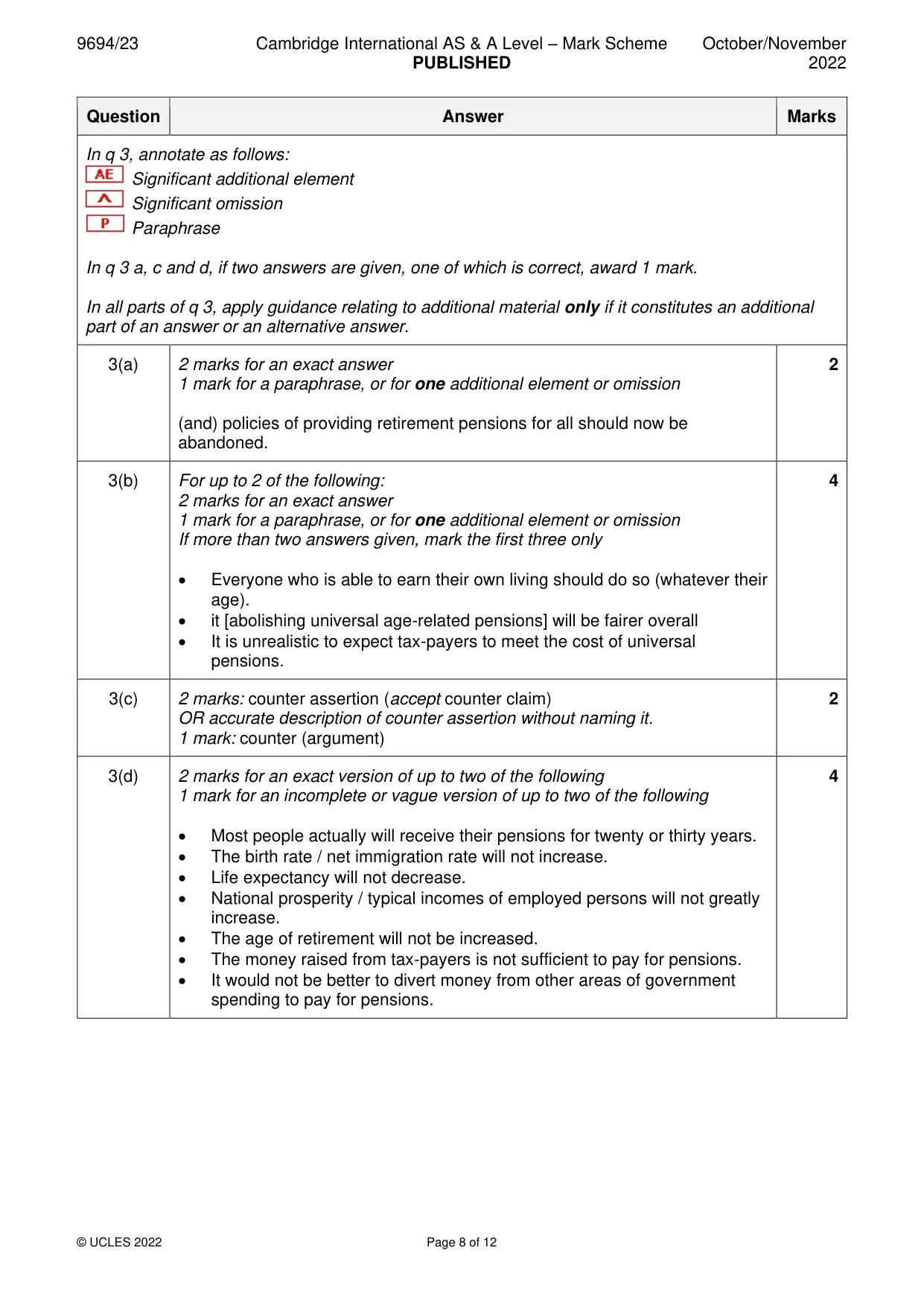
9694/23 Cambridge International AS & A Level – Mark Scheme PUBLISHED October/November 2022 © UCLES 2022 Page 8 of 12 Question Answer Marks In q 3, annotate as follows: Significant additional element Significant omission Paraphrase In q 3 a, c and d, if two answers are given, one of which is correct, award 1 mark. In all parts of q 3, apply guidance relating to additional material only if it constitutes an additional part of an answer or an alternative answer. 3(a) 2 marks for an exact answer 1 mark for a paraphrase, or for one additional element or omission (and) policies of providing retirement pensions for all should now be abandoned. 2 3(b) For up to 2 of the following: 2 marks for an exact answer 1 mark for a paraphrase, or for one additional element or omission If more than two answers given, mark the first three only • Everyone who is able to earn their own living should do so (whatever their age). • it [abolishing universal age-related pensions] will be fairer overall • It is unrealistic to expect tax-payers to meet the cost of universal pensions. 4 3(c) 2 marks: counter assertion (accept counter claim) OR accurate description of counter assertion without naming it. 1 mark: counter (argument) 2 3(d) 2 marks for an exact version of up to two of the following 1 mark for an incomplete or vague version of up to two of the following • Most people actually will receive their pensions for twenty or thirty years. • The birth rate / net immigration rate will not increase. • Life expectancy will not decrease. • National prosperity / typical incomes of employed persons will not greatly increase. • The age of retirement will not be increased. • The money raised from tax-payers is not sufficient to pay for pensions. • It would not be better to divert money from other areas of government spending to pay for pensions. 4
Mark scheme, page 9
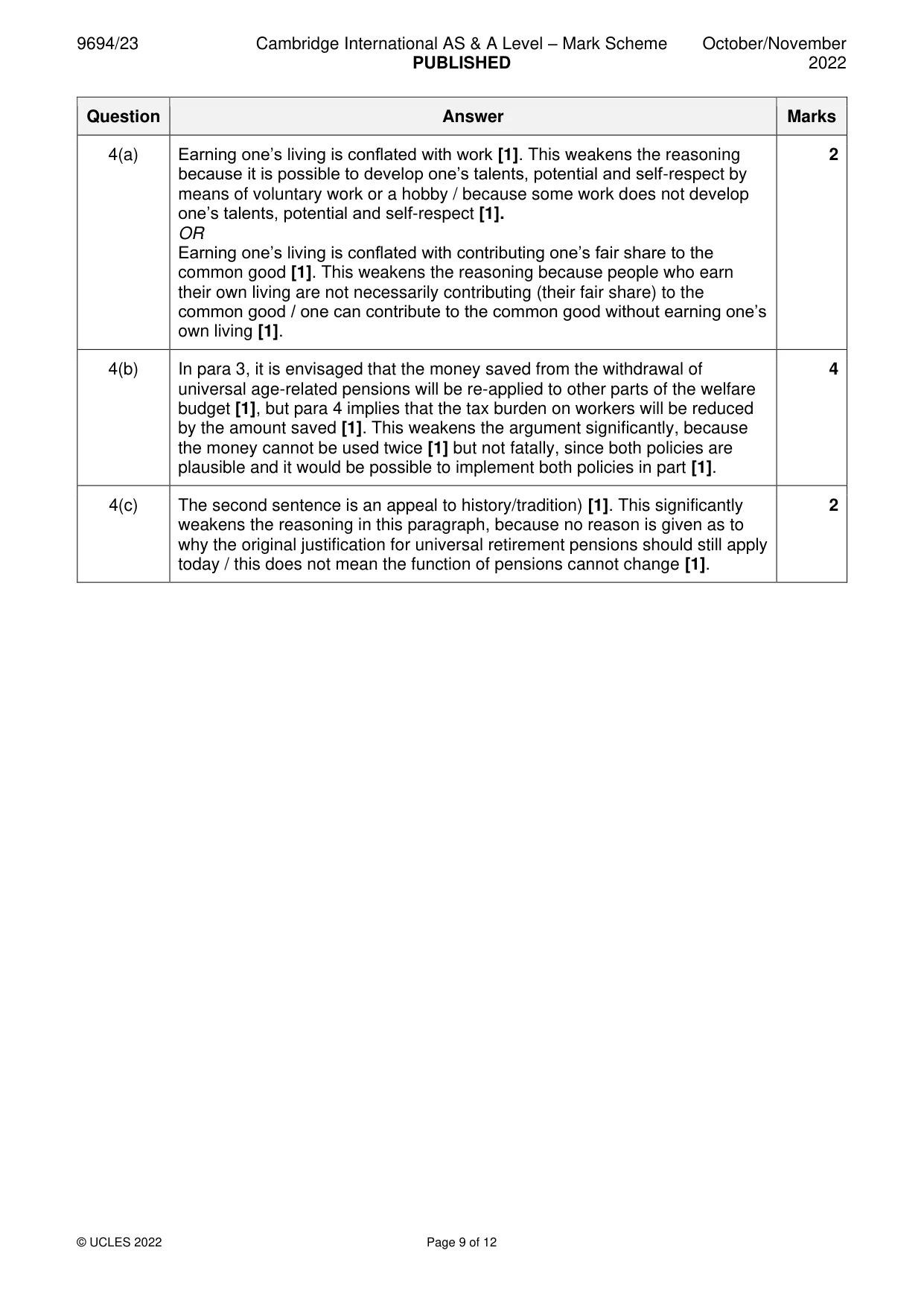
9694/23 Cambridge International AS & A Level – Mark Scheme PUBLISHED October/November 2022 © UCLES 2022 Page 9 of 12 Question Answer Marks 4(a) Earning one’s living is conflated with work [1]. This weakens the reasoning because it is possible to develop one’s talents, potential and self-respect by means of voluntary work or a hobby / because some work does not develop one’s talents, potential and self-respect [1]. OR Earning one’s living is conflated with contributing one’s fair share to the common good [1]. This weakens the reasoning because people who earn their own living are not necessarily contributing (their fair share) to the common good / one can contribute to the common good without earning one’s own living [1]. 2 4(b) In para 3, it is envisaged that the money saved from the withdrawal of universal age-related pensions will be re-applied to other parts of the welfare budget [1], but para 4 implies that the tax burden on workers will be reduced by the amount saved [1]. This weakens the argument significantly, because the money cannot be used twice [1] but not fatally, since both policies are plausible and it would be possible to implement both policies in part [1]. 4 4(c) The second sentence is an appeal to history/tradition) [1]. This significantly weakens the reasoning in this paragraph, because no reason is given as to why the original justification for universal retirement pensions should still apply today / this does not mean the function of pensions cannot change [1]. 2
Mark scheme, page 10
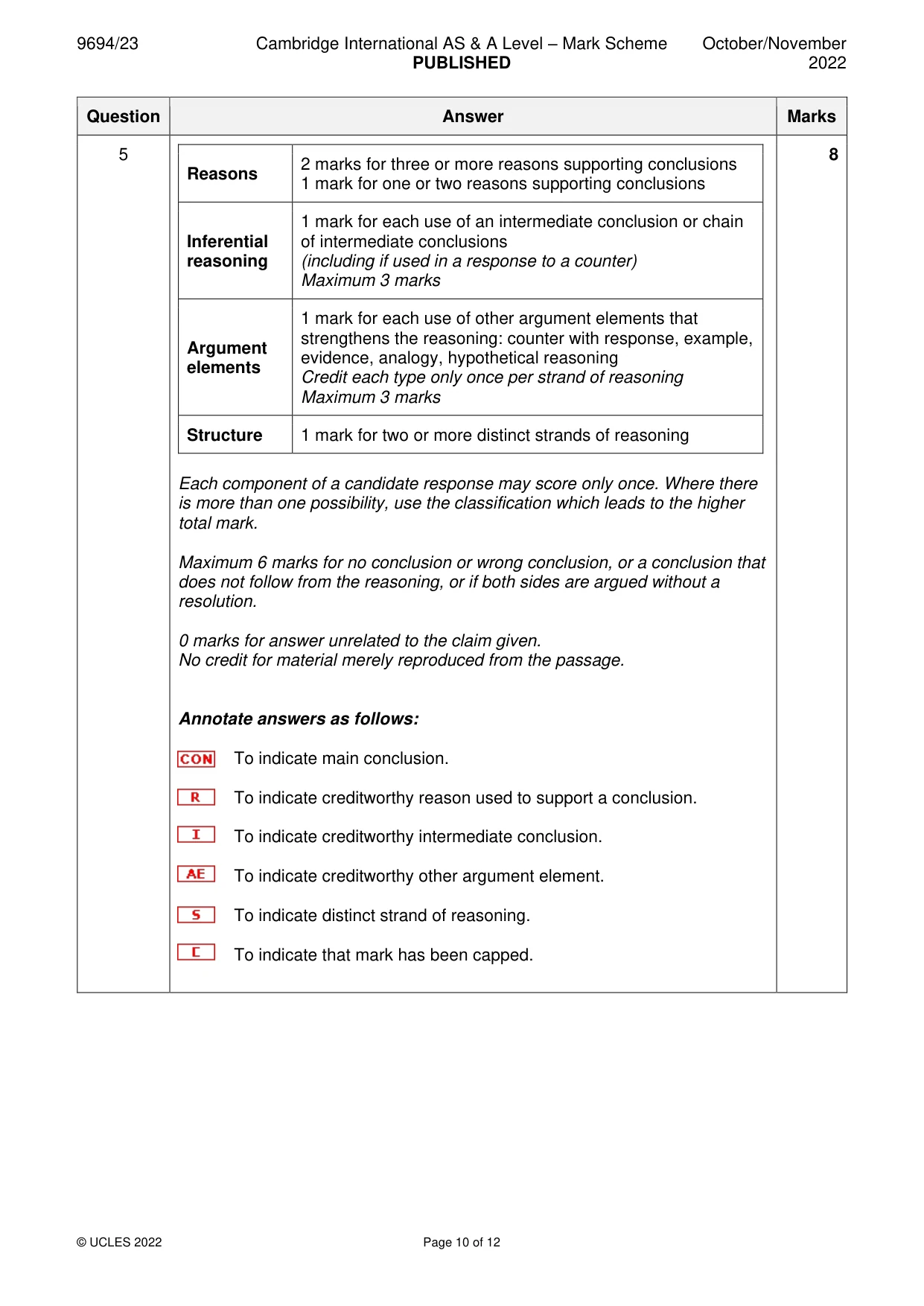
9694/23 Cambridge International AS & A Level – Mark Scheme PUBLISHED October/November 2022 © UCLES 2022 Page 10 of 12 Question Answer Marks 5 Reasons 2 marks for three or more reasons supporting conclusions 1 mark for one or two reasons supporting conclusions Inferential reasoning 1 mark for each use of an intermediate conclusion or chain of intermediate conclusions (including if used in a response to a counter) Maximum 3 marks Argument elements 1 mark for each use of other argument elements that strengthens the reasoning: counter with response, example, evidence, analogy, hypothetical reasoning Credit each type only once per strand of reasoning Maximum 3 marks Structure 1 mark for two or more distinct strands of reasoning Each component of a candidate response may score only once. Where there is more than one possibility, use the classification which leads to the higher total mark. Maximum 6 marks for no conclusion or wrong conclusion, or a conclusion that does not follow from the reasoning, or if both sides are argued without a resolution. 0 marks for answer unrelated to the claim given. No credit for material merely reproduced from the passage. Annotate answers as follows: To indicate main conclusion. To indicate creditworthy reason used to support a conclusion. To indicate creditworthy intermediate conclusion. To indicate creditworthy other argument element. To indicate distinct strand of reasoning. To indicate that mark has been capped. 8
Mark scheme, page 11
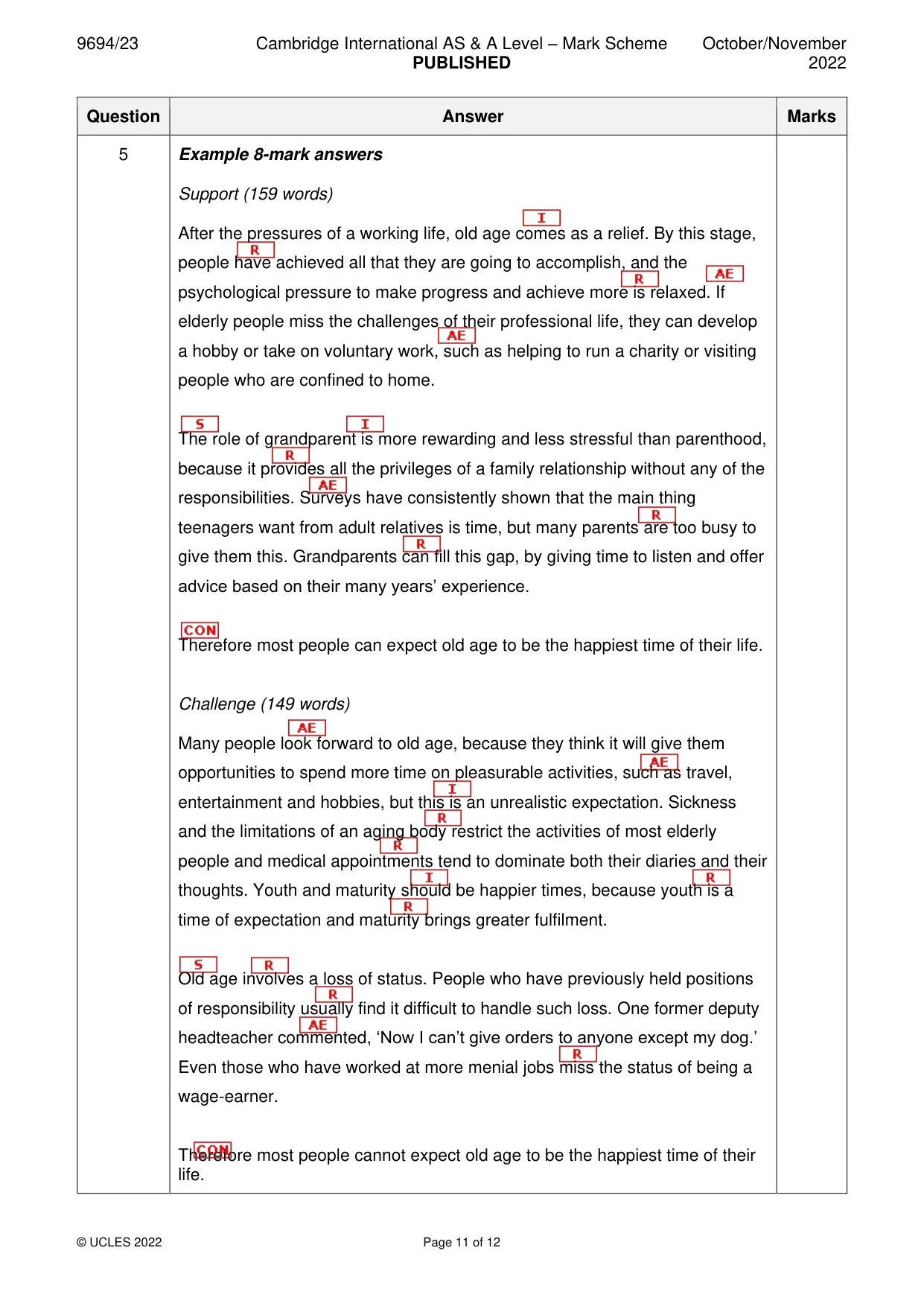
9694/23 Cambridge International AS & A Level – Mark Scheme PUBLISHED October/November 2022 © UCLES 2022 Page 11 of 12 Question Answer Marks 5 Example 8-mark answers Support (159 words) After the pressures of a working life, old age comes as a relief. By this stage, people have achieved all that they are going to accomplish, and the psychological pressure to make progress and achieve more is relaxed. If elderly people miss the challenges of their professional life, they can develop a hobby or take on voluntary work, such as helping to run a charity or visiting people who are confined to home. The role of grandparent is more rewarding and less stressful than parenthood, because it provides all the privileges of a family relationship without any of the responsibilities. Surveys have consistently shown that the main thing teenagers want from adult relatives is time, but many parents are too busy to give them this. Grandparents can fill this gap, by giving time to listen and offer advice based on their many years’ experience. Therefore most people can expect old age to be the happiest time of their life. Challenge (149 words) Many people look forward to old age, because they think it will give them opportunities to spend more time on pleasurable activities, such as travel, entertainment and hobbies, but this is an unrealistic expectation. Sickness and the limitations of an aging body restrict the activities of most elderly people and medical appointments tend to dominate both their diaries and their thoughts. Youth and maturity should be happier times, because youth is a time of expectation and maturity brings greater fulfilment. Old age involves a loss of status. People who have previously held positions of responsibility usually find it difficult to handle such loss. One former deputy headteacher commented, ‘Now I can’t give orders to anyone except my dog.’ Even those who have worked at more menial jobs miss the status of being a wage-earner. Therefore most people cannot expect old age to be the happiest time of their life.
Mark scheme, page 12
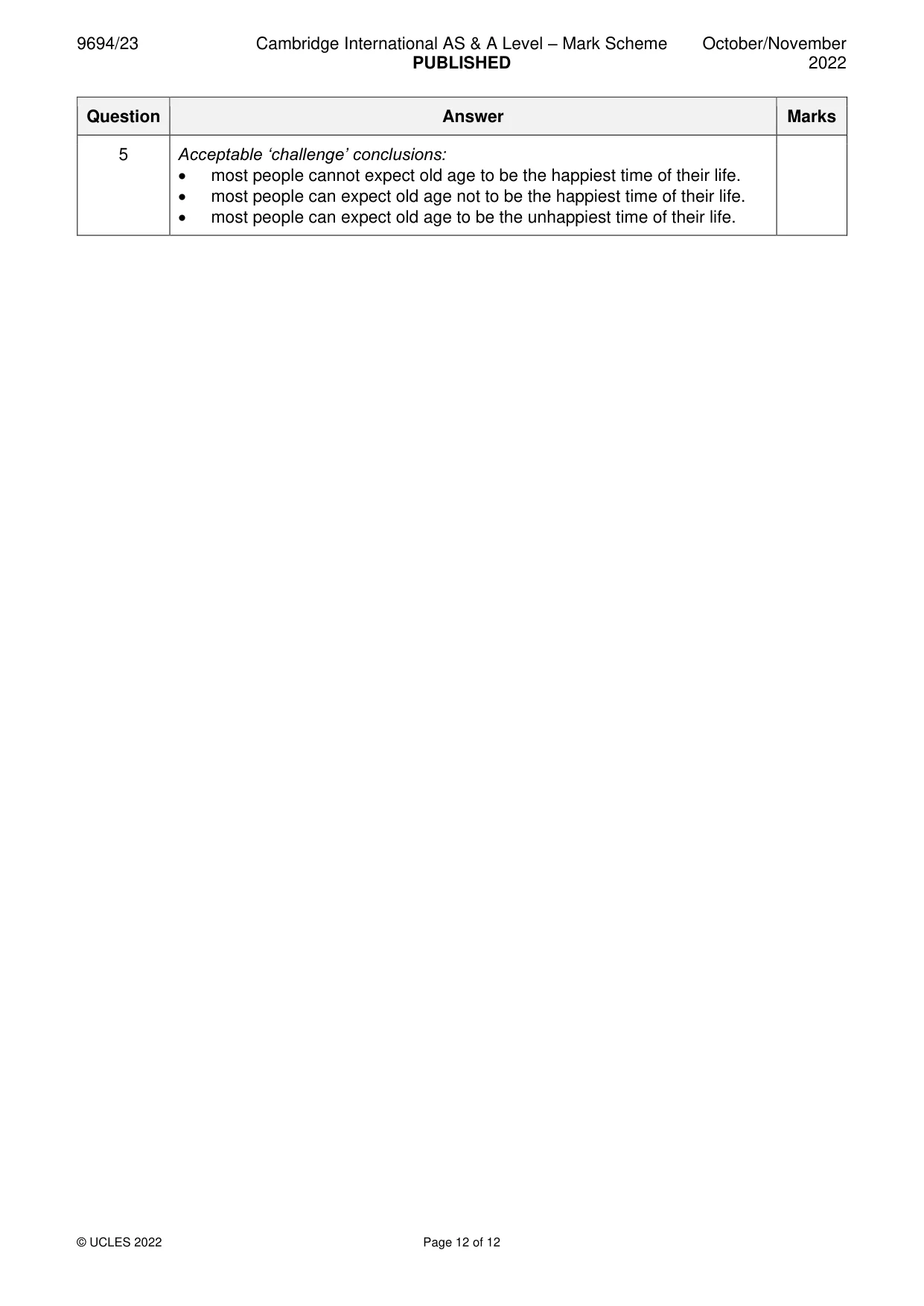
9694/23 Cambridge International AS & A Level – Mark Scheme PUBLISHED October/November 2022 © UCLES 2022 Page 12 of 12 Question Answer Marks 5 Acceptable ‘challenge’ conclusions: • most people cannot expect old age to be the happiest time of their life. • most people can expect old age not to be the happiest time of their life. • most people can expect old age to be the unhappiest time of their life.
What you needed in this session
Cambridge’s own grade thresholds for 2022 Oct/Nov, Paper 2 · Variant 3. A higher threshold means an easier paper — the bar moves with how the cohort did.