Cambridge A Level Thinking Skills 9694 — 2022 Oct/Nov Paper 2 · Variant 2
9694/22/O/N/22 · 50 marks · ≈56 min
The question paper and its mark scheme, free to read here and free to download. This is Cambridge’s own paper, exactly as it was sat.
Question paper8 pages



Mark scheme12 pages
Answers below. Sit the paper first if you are practising.
Paper as text
Question paper, page 1
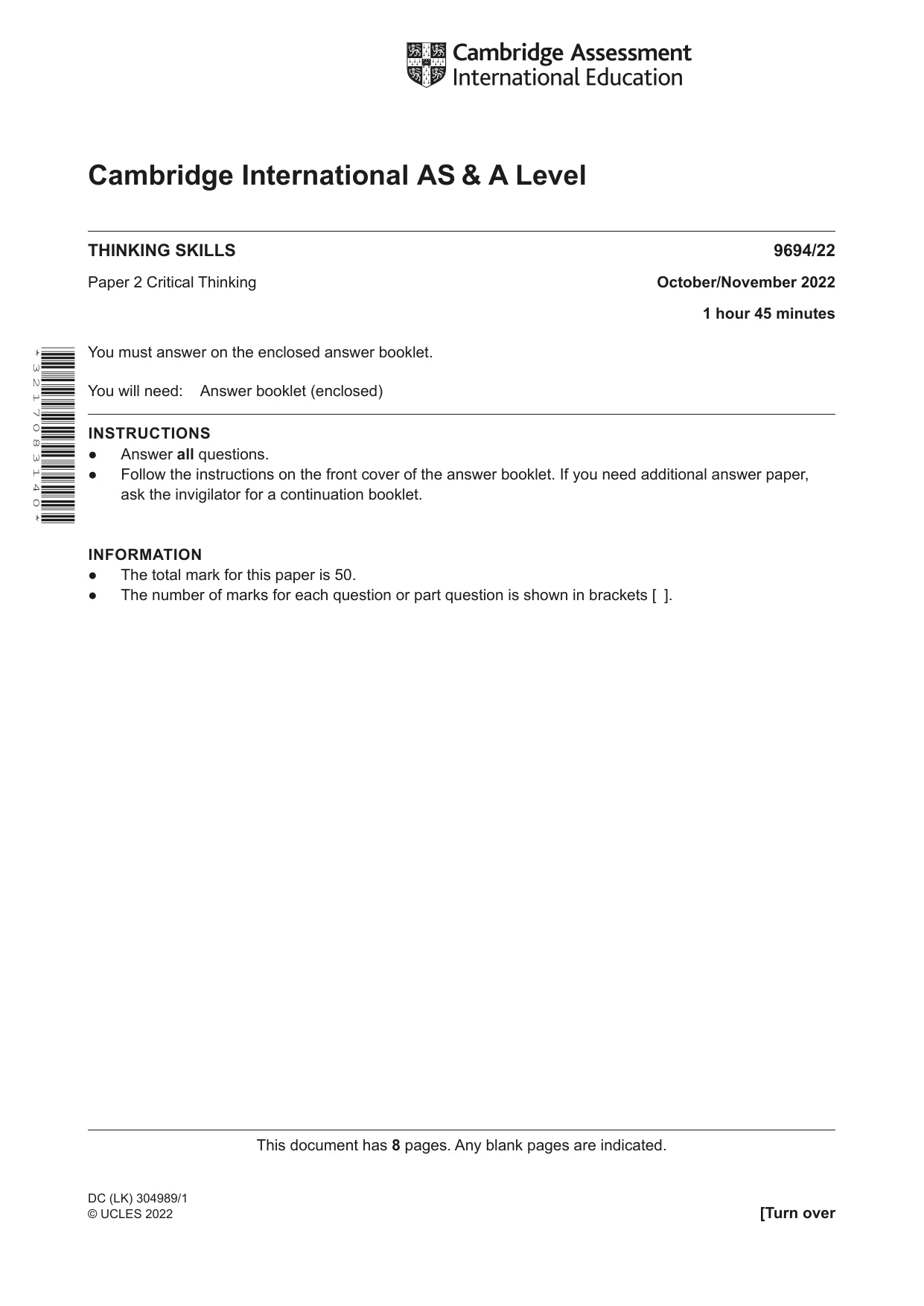
This document has 8 pages. Any blank pages are indicated. [Turn over Cambridge International AS & A Level THINKING SKILLS 9694/22 Paper 2 Critical Thinking October/November 2022 1 hour 45 minutes You must answer on the enclosed answer booklet. You will need: Answer booklet (enclosed) INSTRUCTIONS ● Answer all questions. ● Follow the instructions on the front cover of the answer booklet. If you need additional answer paper, ask the invigilator for a continuation booklet. INFORMATION ● The total mark for this paper is 50. ● The number of marks for each question or part question is shown in brackets [ ]. * 3 2 1 7 0 8 3 1 4 0 * DC (LK) 304989/1 © UCLES 2022
Question paper, page 2
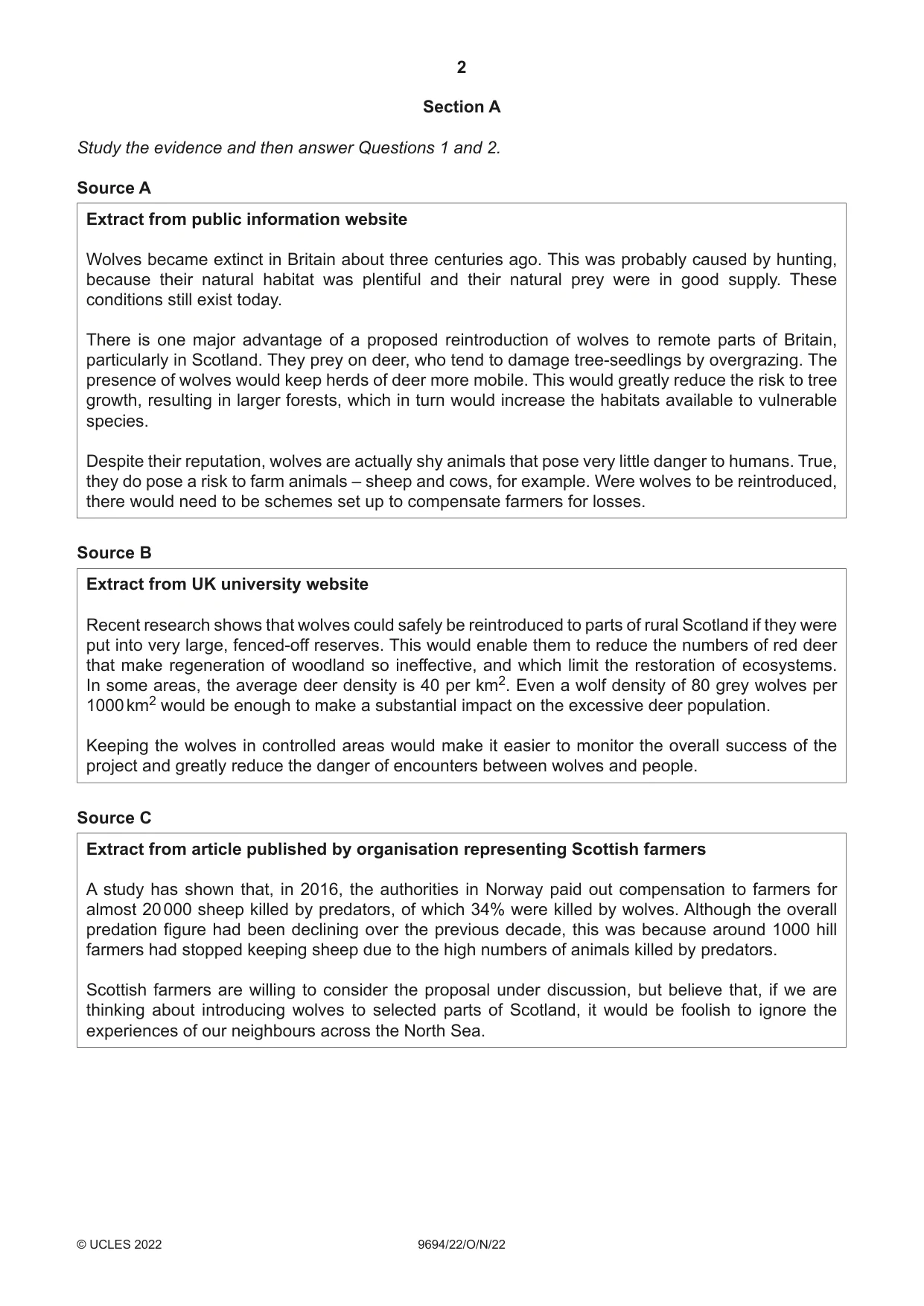
2 9694/22/O/N/22 © UCLES 2022 Section A Study the evidence and then answer Questions 1 and 2. Source A Extract from public information website Wolves became extinct in Britain about three centuries ago. This was probably caused by hunting, because their natural habitat was plentiful and their natural prey were in good supply. These conditions still exist today. There is one major advantage of a proposed reintroduction of wolves to remote parts of Britain, particularly in Scotland. They prey on deer, who tend to damage tree-seedlings by overgrazing. The presence of wolves would keep herds of deer more mobile. This would greatly reduce the risk to tree growth, resulting in larger forests, which in turn would increase the habitats available to vulnerable species. Despite their reputation, wolves are actually shy animals that pose very little danger to humans. True, they do pose a risk to farm animals – sheep and cows, for example. Were wolves to be reintroduced, there would need to be schemes set up to compensate farmers for losses. Source B Extract from UK university website Recent research shows that wolves could safely be reintroduced to parts of rural Scotland if they were put into very large, fenced-off reserves. This would enable them to reduce the numbers of red deer that make regeneration of woodland so ineffective, and which limit the restoration of ecosystems. In some areas, the average deer density is 40 per km2. Even a wolf density of 80 grey wolves per 1000 km2 would be enough to make a substantial impact on the excessive deer population. Keeping the wolves in controlled areas would make it easier to monitor the overall success of the project and greatly reduce the danger of encounters between wolves and people. Source C Extract from article published by organisation representing Scottish farmers A study has shown that, in 2016, the authorities in Norway paid out compensation to farmers for almost 20 000 sheep killed by predators, of which 34% were killed by wolves. Although the overall predation figure had been declining over the previous decade, this was because around 1000 hill farmers had stopped keeping sheep due to the high numbers of animals killed by predators. Scottish farmers are willing to consider the proposal under discussion, but believe that, if we are thinking about introducing wolves to selected parts of Scotland, it would be foolish to ignore the experiences of our neighbours across the North Sea.
Question paper, page 3
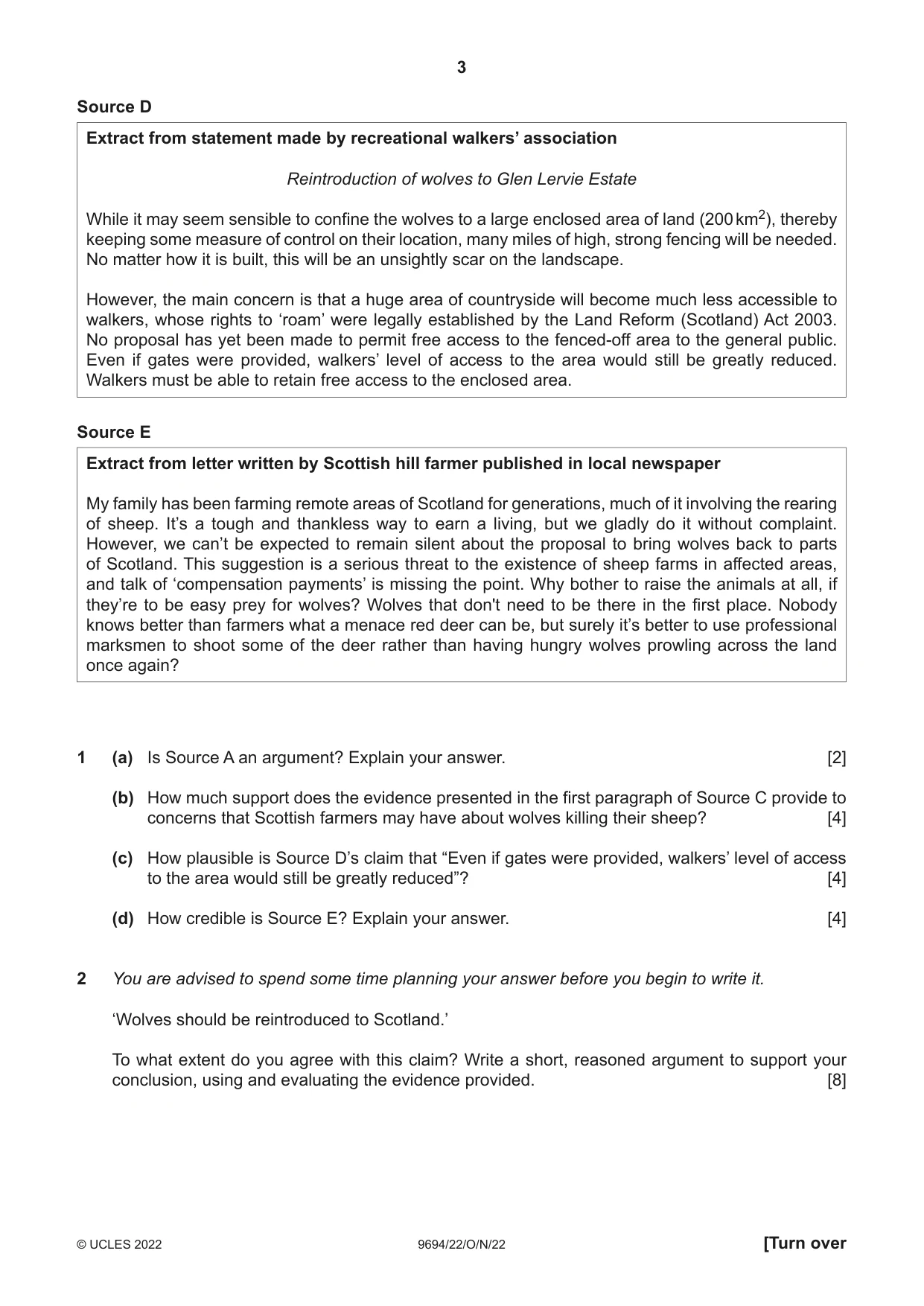
3 9694/22/O/N/22 © UCLES 2022 [Turn over Source D Extract from statement made by recreational walkers’ association Reintroduction of wolves to Glen Lervie Estate While it may seem sensible to confine the wolves to a large enclosed area of land (200 km2), thereby keeping some measure of control on their location, many miles of high, strong fencing will be needed. No matter how it is built, this will be an unsightly scar on the landscape. However, the main concern is that a huge area of countryside will become much less accessible to walkers, whose rights to ‘roam’ were legally established by the Land Reform (Scotland) Act 2003. No proposal has yet been made to permit free access to the fenced-off area to the general public. Even if gates were provided, walkers’ level of access to the area would still be greatly reduced. Walkers must be able to retain free access to the enclosed area. Source E Extract from letter written by Scottish hill farmer published in local newspaper My family has been farming remote areas of Scotland for generations, much of it involving the rearing of sheep. It’s a tough and thankless way to earn a living, but we gladly do it without complaint. However, we can’t be expected to remain silent about the proposal to bring wolves back to parts of Scotland. This suggestion is a serious threat to the existence of sheep farms in affected areas, and talk of ‘compensation payments’ is missing the point. Why bother to raise the animals at all, if they’re to be easy prey for wolves? Wolves that don't need to be there in the first place. Nobody knows better than farmers what a menace red deer can be, but surely it’s better to use professional marksmen to shoot some of the deer rather than having hungry wolves prowling across the land once again? 1 (a) Is Source A an argument? Explain your answer. [2] (b) How much support does the evidence presented in the first paragraph of Source C provide to concerns that Scottish farmers may have about wolves killing their sheep? [4] (c) How plausible is Source D’s claim that “Even if gates were provided, walkers’ level of access to the area would still be greatly reduced”? [4] (d) How credible is Source E? Explain your answer. [4] 2 You are advised to spend some time planning your answer before you begin to write it. ‘Wolves should be reintroduced to Scotland.’ To what extent do you agree with this claim? Write a short, reasoned argument to support your conclusion, using and evaluating the evidence provided. [8]
Question paper, page 4
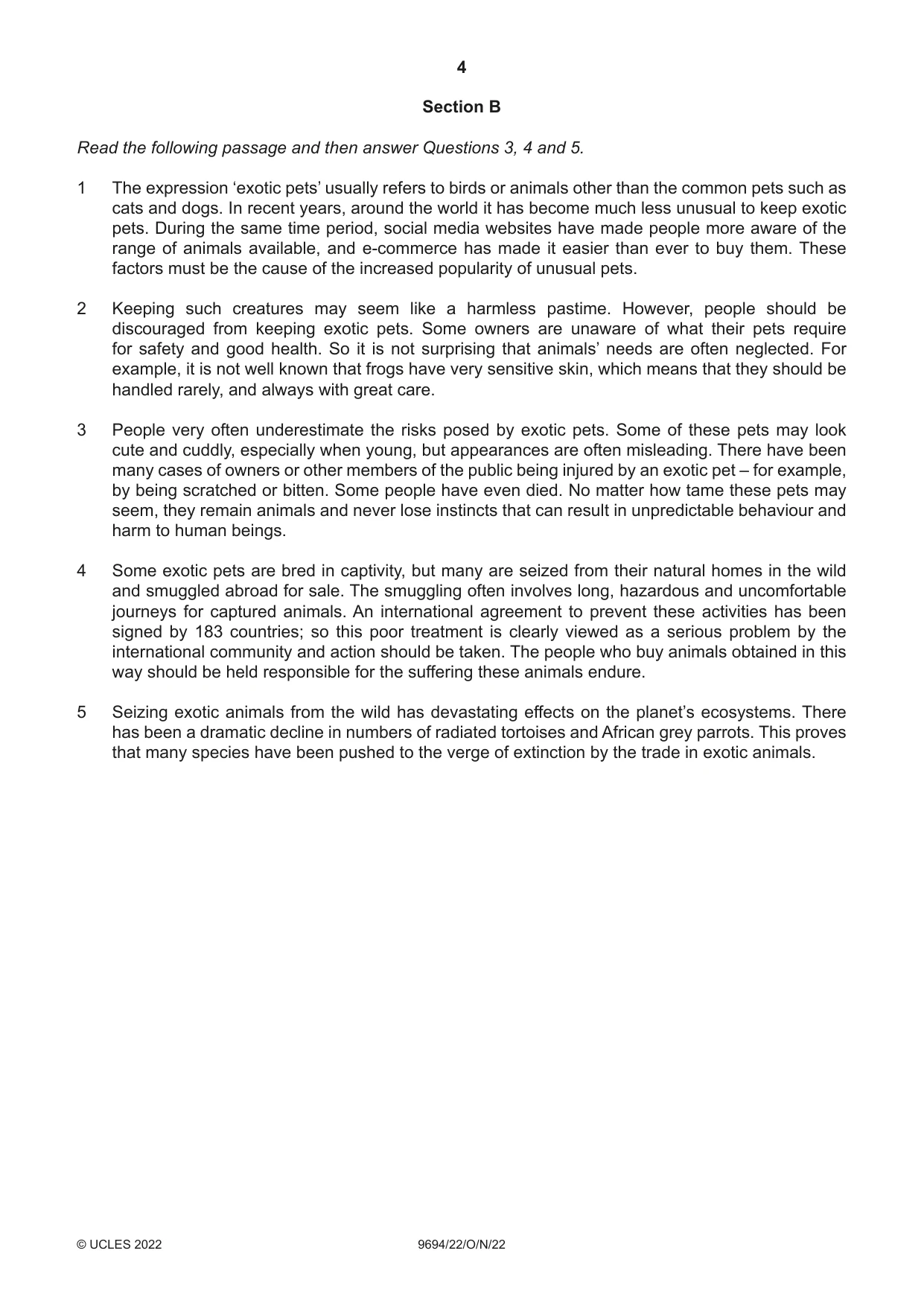
4 9694/22/O/N/22 © UCLES 2022 Section B Read the following passage and then answer Questions 3, 4 and 5. 1 The expression ‘exotic pets’ usually refers to birds or animals other than the common pets such as cats and dogs. In recent years, around the world it has become much less unusual to keep exotic pets. During the same time period, social media websites have made people more aware of the range of animals available, and e-commerce has made it easier than ever to buy them. These factors must be the cause of the increased popularity of unusual pets. 2 Keeping such creatures may seem like a harmless pastime. However, people should be discouraged from keeping exotic pets. Some owners are unaware of what their pets require for safety and good health. So it is not surprising that animals’ needs are often neglected. For example, it is not well known that frogs have very sensitive skin, which means that they should be handled rarely, and always with great care. 3 People very often underestimate the risks posed by exotic pets. Some of these pets may look cute and cuddly, especially when young, but appearances are often misleading. There have been many cases of owners or other members of the public being injured by an exotic pet – for example, by being scratched or bitten. Some people have even died. No matter how tame these pets may seem, they remain animals and never lose instincts that can result in unpredictable behaviour and harm to human beings. 4 Some exotic pets are bred in captivity, but many are seized from their natural homes in the wild and smuggled abroad for sale. The smuggling often involves long, hazardous and uncomfortable journeys for captured animals. An international agreement to prevent these activities has been signed by 183 countries; so this poor treatment is clearly viewed as a serious problem by the international community and action should be taken. The people who buy animals obtained in this way should be held responsible for the suffering these animals endure. 5 Seizing exotic animals from the wild has devastating effects on the planet’s ecosystems. There has been a dramatic decline in numbers of radiated tortoises and African grey parrots. This proves that many species have been pushed to the verge of extinction by the trade in exotic animals.
Question paper, page 5
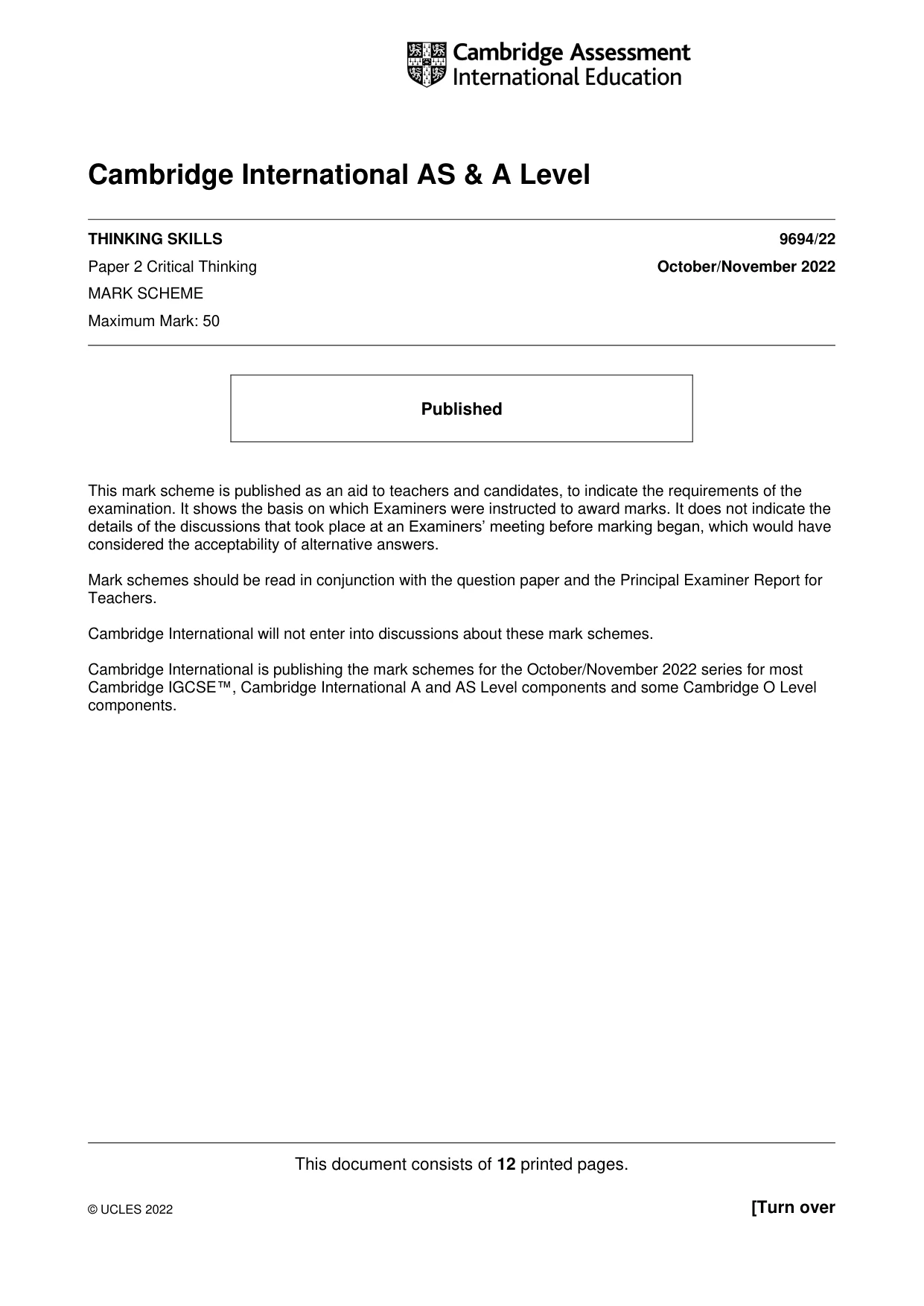
5 9694/22/O/N/22 © UCLES 2022 3 (a) Using the exact words from the passage as far as possible, identify the main conclusion. [2] (b) Using the exact words from the passage as far as possible, identify two intermediate conclusions in paragraphs 3 to 4. [4] (c) Identify the argument element and explain the function of the following words from paragraph 2: ‘Some owners are unaware of what their pets require for safety and good health.’ [2] (d) Identify one unstated assumption required by the reasoning in paragraph 4. [2] 4 (a) Identify and explain one flaw or weakness in the reasoning in paragraph 1. [3] (b) Identify and explain an objection that could be raised against the argument in paragraph 3. [2] (c) Identify and evaluate an appeal in paragraph 4. [2] (d) Evaluate the reasoning in paragraph 5. [3] 5 You are advised to spend some time planning your answer before you begin to write it. ‘Pet owners should be legally responsible for all of the damage or harm caused by their animals.’ Write your own short argument to support or challenge this claim. The conclusion of your argument must be stated. Credit will not be given for repeating ideas from the passage. [8]
Question paper, page 6
6 9694/22/O/N/22 © UCLES 2022 BLANK PAGE
Question paper, page 7
7 9694/22/O/N/22 © UCLES 2022 BLANK PAGE
Question paper, page 8
8 9694/22/O/N/22 © UCLES 2022 Permission to reproduce items where third-party owned material protected by copyright is included has been sought and cleared where possible. Every reasonable effort has been made by the publisher (UCLES) to trace copyright holders, but if any items requiring clearance have unwittingly been included, the publisher will be pleased to make amends at the earliest possible opportunity. To avoid the issue of disclosure of answer-related information to candidates, all copyright acknowledgements are reproduced online in the Cambridge Assessment International Education Copyright Acknowledgements Booklet. This is produced for each series of examinations and is freely available to download at www.cambridgeinternational.org after the live examination series. Cambridge Assessment International Education is part of Cambridge Assessment. Cambridge Assessment is the brand name of the University of Cambridge Local Examinations Syndicate (UCLES), which is a department of the University of Cambridge. BLANK PAGE
Mark scheme, page 1
This document consists of 12 printed pages. © UCLES 2022 [Turn over Cambridge International AS & A Level THINKING SKILLS 9694/22 Paper 2 Critical Thinking October/November 2022 MARK SCHEME Maximum Mark: 50 Published This mark scheme is published as an aid to teachers and candidates, to indicate the requirements of the examination. It shows the basis on which Examiners were instructed to award marks. It does not indicate the details of the discussions that took place at an Examiners’ meeting before marking began, which would have considered the acceptability of alternative answers. Mark schemes should be read in conjunction with the question paper and the Principal Examiner Report for Teachers. Cambridge International will not enter into discussions about these mark schemes. Cambridge International is publishing the mark schemes for the October/November 2022 series for most Cambridge IGCSE™, Cambridge International A and AS Level components and some Cambridge O Level components.
Mark scheme, page 2
9694/22 Cambridge International AS & A Level – Mark Scheme PUBLISHED October/November 2022 © UCLES 2022 Page 2 of 12 Generic Marking Principles These general marking principles must be applied by all examiners when marking candidate answers. They should be applied alongside the specific content of the mark scheme or generic level descriptors for a question. Each question paper and mark scheme will also comply with these marking principles. GENERIC MARKING PRINCIPLE 1: Marks must be awarded in line with: • the specific content of the mark scheme or the generic level descriptors for the question • the specific skills defined in the mark scheme or in the generic level descriptors for the question • the standard of response required by a candidate as exemplified by the standardisation scripts. GENERIC MARKING PRINCIPLE 2: Marks awarded are always whole marks (not half marks, or other fractions). GENERIC MARKING PRINCIPLE 3: Marks must be awarded positively: • marks are awarded for correct/valid answers, as defined in the mark scheme. However, credit is given for valid answers which go beyond the scope of the syllabus and mark scheme, referring to your Team Leader as appropriate • marks are awarded when candidates clearly demonstrate what they know and can do • marks are not deducted for errors • marks are not deducted for omissions • answers should only be judged on the quality of spelling, punctuation and grammar when these features are specifically assessed by the question as indicated by the mark scheme. The meaning, however, should be unambiguous. GENERIC MARKING PRINCIPLE 4: Rules must be applied consistently, e.g. in situations where candidates have not followed instructions or in the application of generic level descriptors. GENERIC MARKING PRINCIPLE 5: Marks should be awarded using the full range of marks defined in the mark scheme for the question (however; the use of the full mark range may be limited according to the quality of the candidate responses seen). GENERIC MARKING PRINCIPLE 6: Marks awarded are based solely on the requirements as defined in the mark scheme. Marks should not be awarded with grade thresholds or grade descriptors in mind.
Mark scheme, page 3
9694/22 Cambridge International AS & A Level – Mark Scheme PUBLISHED October/November 2022 © UCLES 2022 Page 3 of 12 ANNOTATIONS In Qs 1, 3 and 4 use to indicate where marks have been awarded. Use to indicate an answer or element that is wrong. Not good enough. Use wherever such a judgment has been made. Benefit of doubt. In Q5 use to indicate creditworthy other argument element In Q3 use to indicate ‘significant additional element’. In Qs 2 and 5 use to indicate ‘conclusion’. In Qs 2 and 5 and in short questions where indicated, use to indicate that marks have been capped because an essential element of the answer is absent. In Q2 use to indicate creditworthy evaluation of a source. In Q5 use to indicate creditworthy intermediate conclusion. In Q2 use to indicate creditworthy personal thinking. In Q3 use to indicate paraphrase. In Q2 use to indicate creditworthy inferential reasoning. In Q5 use to indicate creditworthy reason used to support a conclusion. In Q2 use to indicate creditworthy use of a source. In Q5 use to indicate distinct strand of reasoning. In appropriate cases, use to indicate significant omission. In Q3 use to indicate ‘significant omission’. Use in answers when no other annotations have been used. Use on blank pages. Highlight Use to draw attention to part of an answer. There must be at least one annotation on each page of the answer booklet.
Mark scheme, page 4
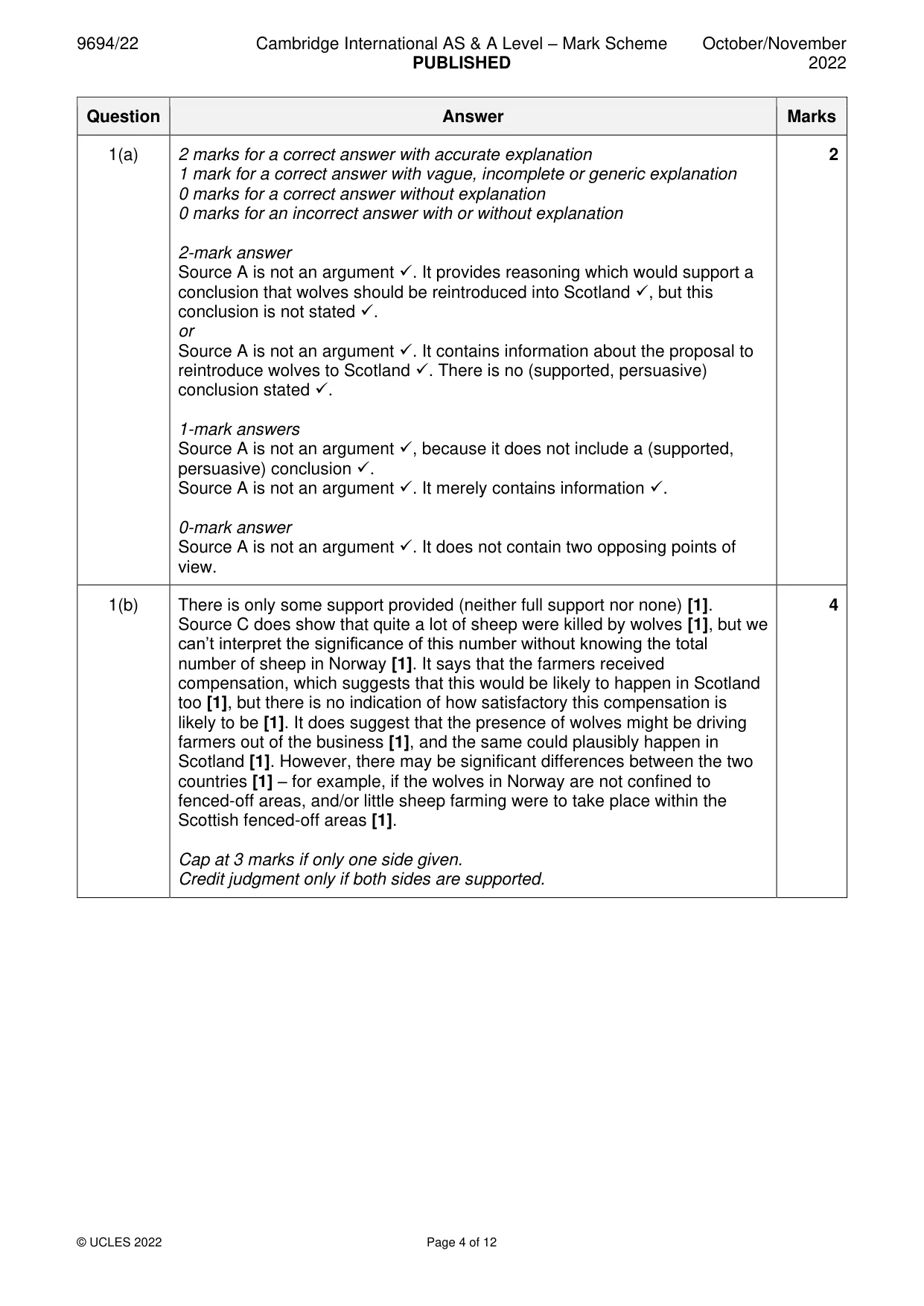
9694/22 Cambridge International AS & A Level – Mark Scheme PUBLISHED October/November 2022 © UCLES 2022 Page 4 of 12 Question Answer Marks 1(a) 2 marks for a correct answer with accurate explanation 1 mark for a correct answer with vague, incomplete or generic explanation 0 marks for a correct answer without explanation 0 marks for an incorrect answer with or without explanation 2-mark answer Source A is not an argument ✓. It provides reasoning which would support a conclusion that wolves should be reintroduced into Scotland ✓, but this conclusion is not stated ✓. or Source A is not an argument ✓. It contains information about the proposal to reintroduce wolves to Scotland ✓. There is no (supported, persuasive) conclusion stated ✓. 1-mark answers Source A is not an argument ✓, because it does not include a (supported, persuasive) conclusion ✓. Source A is not an argument ✓. It merely contains information ✓. 0-mark answer Source A is not an argument ✓. It does not contain two opposing points of view. 2 1(b) There is only some support provided (neither full support nor none) [1]. Source C does show that quite a lot of sheep were killed by wolves [1], but we can’t interpret the significance of this number without knowing the total number of sheep in Norway [1]. It says that the farmers received compensation, which suggests that this would be likely to happen in Scotland too [1], but there is no indication of how satisfactory this compensation is likely to be [1]. It does suggest that the presence of wolves might be driving farmers out of the business [1], and the same could plausibly happen in Scotland [1]. However, there may be significant differences between the two countries [1] – for example, if the wolves in Norway are not confined to fenced-off areas, and/or little sheep farming were to take place within the Scottish fenced-off areas [1]. Cap at 3 marks if only one side given. Credit judgment only if both sides are supported. 4
Mark scheme, page 5
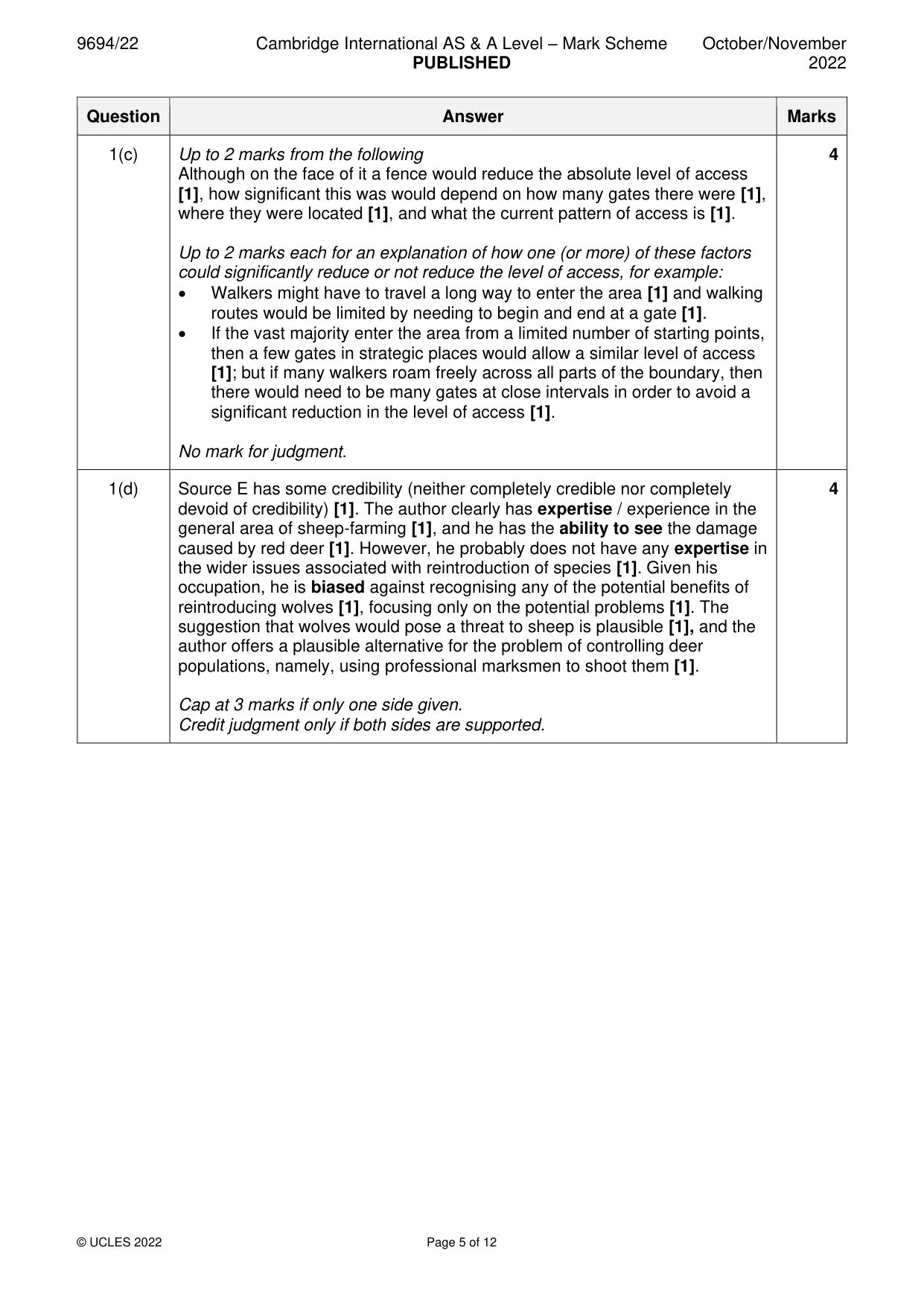
9694/22 Cambridge International AS & A Level – Mark Scheme PUBLISHED October/November 2022 © UCLES 2022 Page 5 of 12 Question Answer Marks 1(c) Up to 2 marks from the following Although on the face of it a fence would reduce the absolute level of access [1], how significant this was would depend on how many gates there were [1], where they were located [1], and what the current pattern of access is [1]. Up to 2 marks each for an explanation of how one (or more) of these factors could significantly reduce or not reduce the level of access, for example: • Walkers might have to travel a long way to enter the area [1] and walking routes would be limited by needing to begin and end at a gate [1]. • If the vast majority enter the area from a limited number of starting points, then a few gates in strategic places would allow a similar level of access [1]; but if many walkers roam freely across all parts of the boundary, then there would need to be many gates at close intervals in order to avoid a significant reduction in the level of access [1]. No mark for judgment. 4 1(d) Source E has some credibility (neither completely credible nor completely devoid of credibility) [1]. The author clearly has expertise / experience in the general area of sheep-farming [1], and he has the ability to see the damage caused by red deer [1]. However, he probably does not have any expertise in the wider issues associated with reintroduction of species [1]. Given his occupation, he is biased against recognising any of the potential benefits of reintroducing wolves [1], focusing only on the potential problems [1]. The suggestion that wolves would pose a threat to sheep is plausible [1], and the author offers a plausible alternative for the problem of controlling deer populations, namely, using professional marksmen to shoot them [1]. Cap at 3 marks if only one side given. Credit judgment only if both sides are supported. 4
Mark scheme, page 6
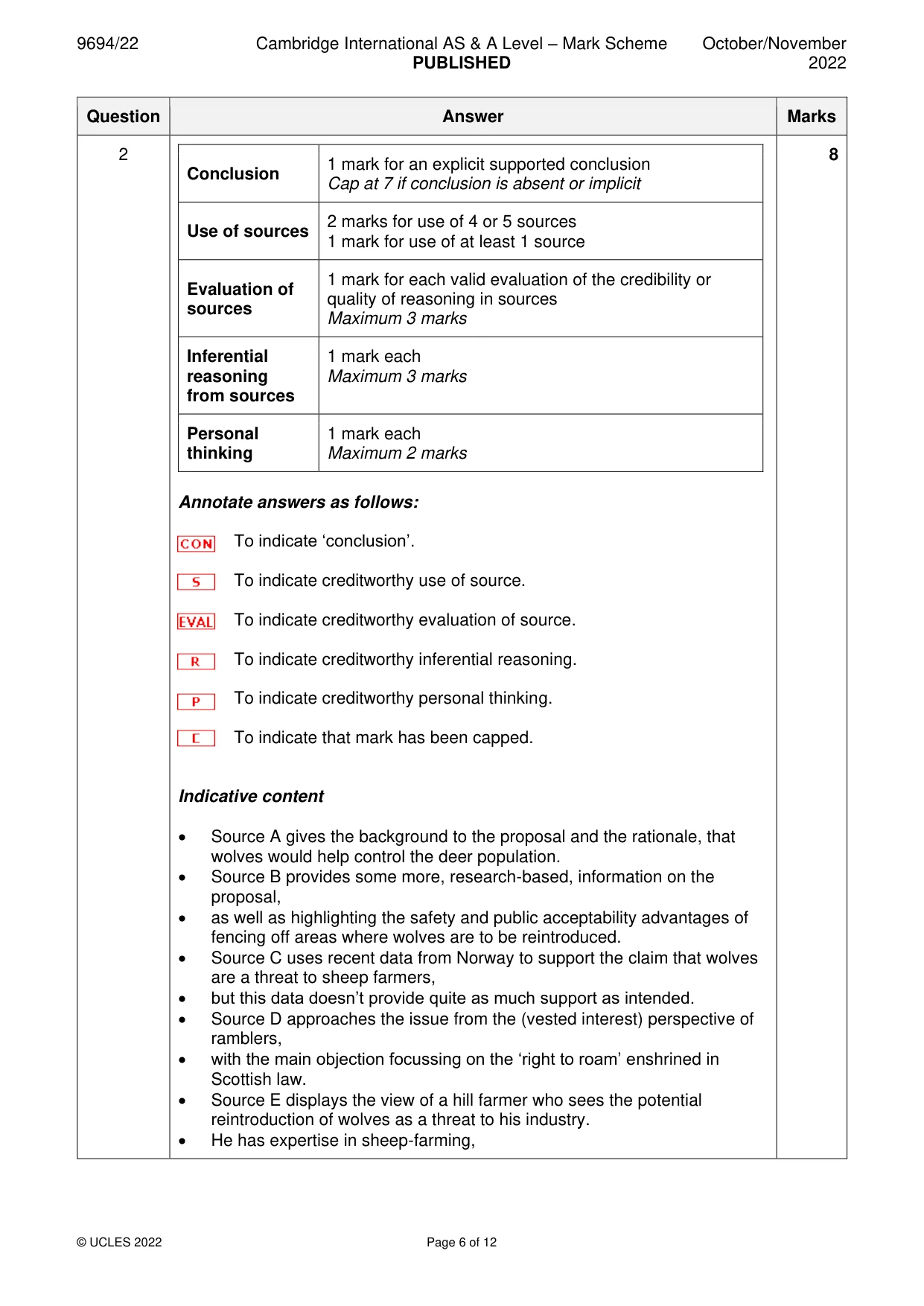
9694/22 Cambridge International AS & A Level – Mark Scheme PUBLISHED October/November 2022 © UCLES 2022 Page 6 of 12 Question Answer Marks 2 Conclusion 1 mark for an explicit supported conclusion Cap at 7 if conclusion is absent or implicit Use of sources 2 marks for use of 4 or 5 sources 1 mark for use of at least 1 source Evaluation of sources 1 mark for each valid evaluation of the credibility or quality of reasoning in sources Maximum 3 marks Inferential reasoning from sources 1 mark each Maximum 3 marks Personal thinking 1 mark each Maximum 2 marks Annotate answers as follows: To indicate ‘conclusion’. To indicate creditworthy use of source. To indicate creditworthy evaluation of source. To indicate creditworthy inferential reasoning. To indicate creditworthy personal thinking. To indicate that mark has been capped. Indicative content • Source A gives the background to the proposal and the rationale, that wolves would help control the deer population. • Source B provides some more, research-based, information on the proposal, • as well as highlighting the safety and public acceptability advantages of fencing off areas where wolves are to be reintroduced. • Source C uses recent data from Norway to support the claim that wolves are a threat to sheep farmers, • but this data doesn’t provide quite as much support as intended. • Source D approaches the issue from the (vested interest) perspective of ramblers, • with the main objection focussing on the ‘right to roam’ enshrined in Scottish law. • Source E displays the view of a hill farmer who sees the potential reintroduction of wolves as a threat to his industry. • He has expertise in sheep-farming, 8
Mark scheme, page 7
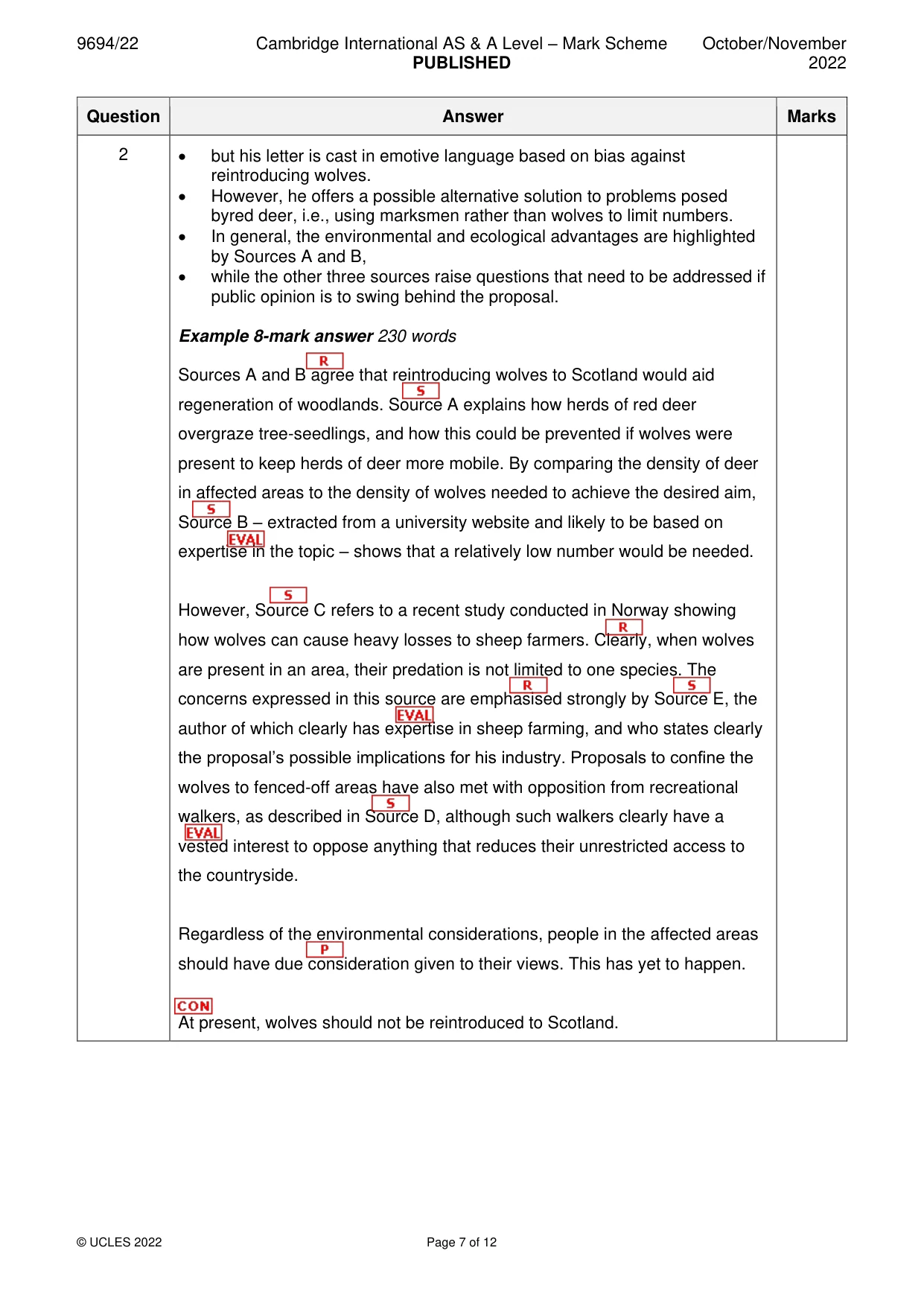
9694/22 Cambridge International AS & A Level – Mark Scheme PUBLISHED October/November 2022 © UCLES 2022 Page 7 of 12 Question Answer Marks 2 • but his letter is cast in emotive language based on bias against reintroducing wolves. • However, he offers a possible alternative solution to problems posed byred deer, i.e., using marksmen rather than wolves to limit numbers. • In general, the environmental and ecological advantages are highlighted by Sources A and B, • while the other three sources raise questions that need to be addressed if public opinion is to swing behind the proposal. Example 8-mark answer 230 words Sources A and B agree that reintroducing wolves to Scotland would aid regeneration of woodlands. Source A explains how herds of red deer overgraze tree-seedlings, and how this could be prevented if wolves were present to keep herds of deer more mobile. By comparing the density of deer in affected areas to the density of wolves needed to achieve the desired aim, Source B – extracted from a university website and likely to be based on expertise in the topic – shows that a relatively low number would be needed. However, Source C refers to a recent study conducted in Norway showing how wolves can cause heavy losses to sheep farmers. Clearly, when wolves are present in an area, their predation is not limited to one species. The concerns expressed in this source are emphasised strongly by Source E, the author of which clearly has expertise in sheep farming, and who states clearly the proposal’s possible implications for his industry. Proposals to confine the wolves to fenced-off areas have also met with opposition from recreational walkers, as described in Source D, although such walkers clearly have a vested interest to oppose anything that reduces their unrestricted access to the countryside. Regardless of the environmental considerations, people in the affected areas should have due consideration given to their views. This has yet to happen. At present, wolves should not be reintroduced to Scotland.
Mark scheme, page 8
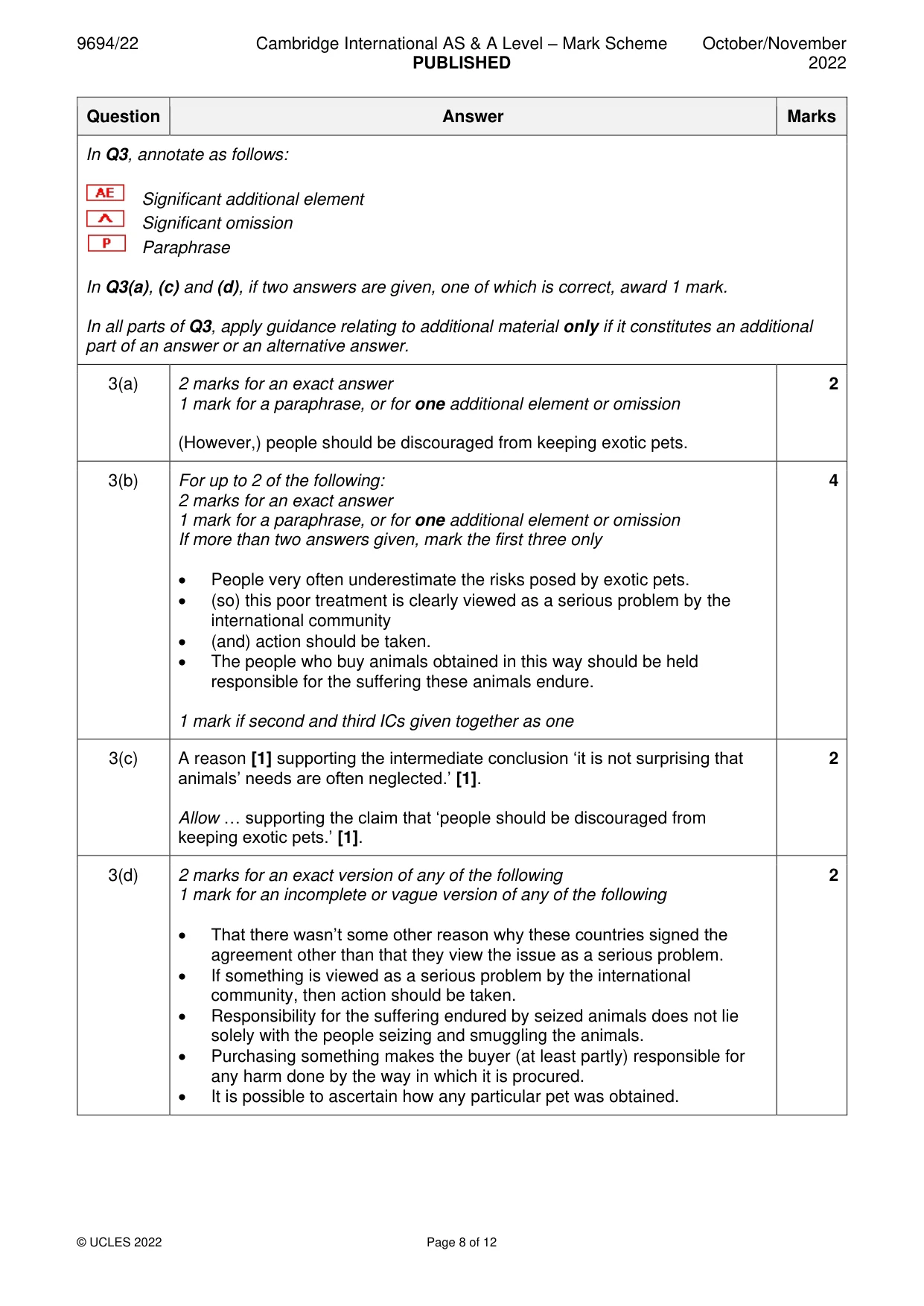
9694/22 Cambridge International AS & A Level – Mark Scheme PUBLISHED October/November 2022 © UCLES 2022 Page 8 of 12 Question Answer Marks In Q3, annotate as follows: Significant additional element Significant omission Paraphrase In Q3(a), (c) and (d), if two answers are given, one of which is correct, award 1 mark. In all parts of Q3, apply guidance relating to additional material only if it constitutes an additional part of an answer or an alternative answer. 3(a) 2 marks for an exact answer 1 mark for a paraphrase, or for one additional element or omission (However,) people should be discouraged from keeping exotic pets. 2 3(b) For up to 2 of the following: 2 marks for an exact answer 1 mark for a paraphrase, or for one additional element or omission If more than two answers given, mark the first three only • People very often underestimate the risks posed by exotic pets. • (so) this poor treatment is clearly viewed as a serious problem by the international community • (and) action should be taken. • The people who buy animals obtained in this way should be held responsible for the suffering these animals endure. 1 mark if second and third ICs given together as one 4 3(c) A reason [1] supporting the intermediate conclusion ‘it is not surprising that animals’ needs are often neglected.’ [1]. Allow … supporting the claim that ‘people should be discouraged from keeping exotic pets.’ [1]. 2 3(d) 2 marks for an exact version of any of the following 1 mark for an incomplete or vague version of any of the following • That there wasn’t some other reason why these countries signed the agreement other than that they view the issue as a serious problem. • If something is viewed as a serious problem by the international community, then action should be taken. • Responsibility for the suffering endured by seized animals does not lie solely with the people seizing and smuggling the animals. • Purchasing something makes the buyer (at least partly) responsible for any harm done by the way in which it is procured. • It is possible to ascertain how any particular pet was obtained. 2
Mark scheme, page 9
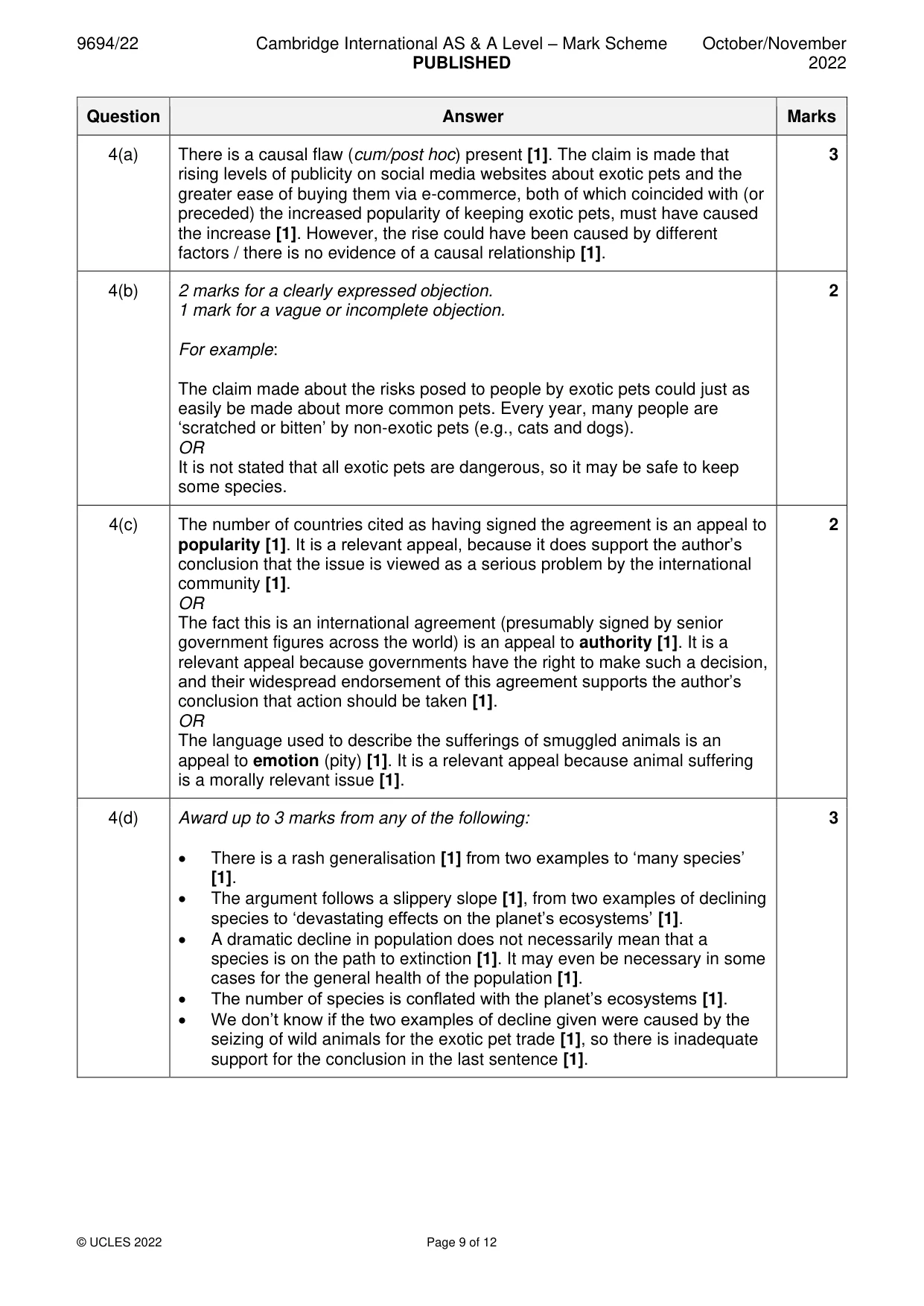
9694/22 Cambridge International AS & A Level – Mark Scheme PUBLISHED October/November 2022 © UCLES 2022 Page 9 of 12 Question Answer Marks 4(a) There is a causal flaw (cum/post hoc) present [1]. The claim is made that rising levels of publicity on social media websites about exotic pets and the greater ease of buying them via e-commerce, both of which coincided with (or preceded) the increased popularity of keeping exotic pets, must have caused the increase [1]. However, the rise could have been caused by different factors / there is no evidence of a causal relationship [1]. 3 4(b) 2 marks for a clearly expressed objection. 1 mark for a vague or incomplete objection. For example: The claim made about the risks posed to people by exotic pets could just as easily be made about more common pets. Every year, many people are ‘scratched or bitten’ by non-exotic pets (e.g., cats and dogs). OR It is not stated that all exotic pets are dangerous, so it may be safe to keep some species. 2 4(c) The number of countries cited as having signed the agreement is an appeal to popularity [1]. It is a relevant appeal, because it does support the author’s conclusion that the issue is viewed as a serious problem by the international community [1]. OR The fact this is an international agreement (presumably signed by senior government figures across the world) is an appeal to authority [1]. It is a relevant appeal because governments have the right to make such a decision, and their widespread endorsement of this agreement supports the author’s conclusion that action should be taken [1]. OR The language used to describe the sufferings of smuggled animals is an appeal to emotion (pity) [1]. It is a relevant appeal because animal suffering is a morally relevant issue [1]. 2 4(d) Award up to 3 marks from any of the following: • There is a rash generalisation [1] from two examples to ‘many species’ [1]. • The argument follows a slippery slope [1], from two examples of declining species to ‘devastating effects on the planet’s ecosystems’ [1]. • A dramatic decline in population does not necessarily mean that a species is on the path to extinction [1]. It may even be necessary in some cases for the general health of the population [1]. • The number of species is conflated with the planet’s ecosystems [1]. • We don’t know if the two examples of decline given were caused by the seizing of wild animals for the exotic pet trade [1], so there is inadequate support for the conclusion in the last sentence [1]. 3
Mark scheme, page 10
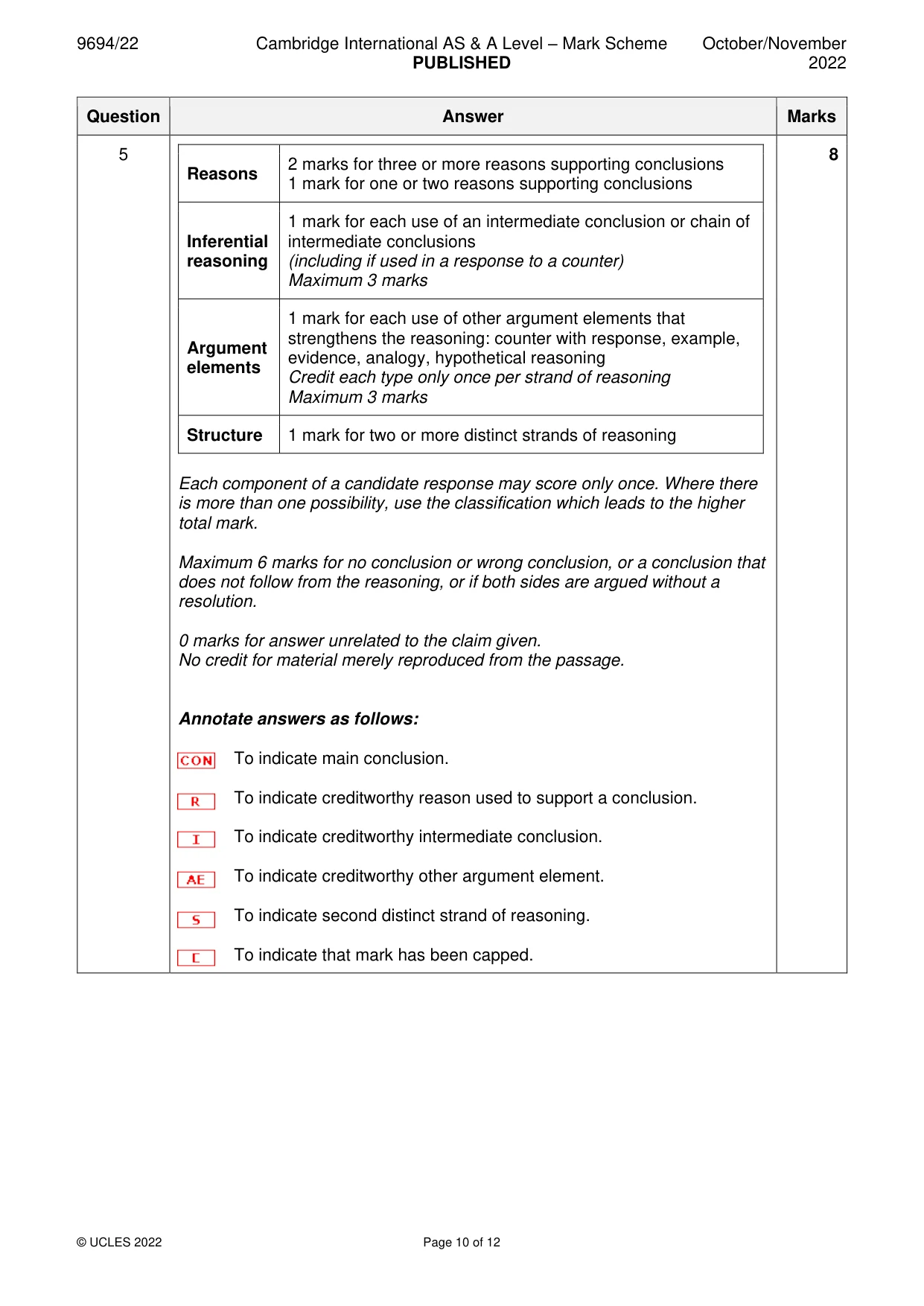
9694/22 Cambridge International AS & A Level – Mark Scheme PUBLISHED October/November 2022 © UCLES 2022 Page 10 of 12 Question Answer Marks 5 Reasons 2 marks for three or more reasons supporting conclusions 1 mark for one or two reasons supporting conclusions Inferential reasoning 1 mark for each use of an intermediate conclusion or chain of intermediate conclusions (including if used in a response to a counter) Maximum 3 marks Argument elements 1 mark for each use of other argument elements that strengthens the reasoning: counter with response, example, evidence, analogy, hypothetical reasoning Credit each type only once per strand of reasoning Maximum 3 marks Structure 1 mark for two or more distinct strands of reasoning Each component of a candidate response may score only once. Where there is more than one possibility, use the classification which leads to the higher total mark. Maximum 6 marks for no conclusion or wrong conclusion, or a conclusion that does not follow from the reasoning, or if both sides are argued without a resolution. 0 marks for answer unrelated to the claim given. No credit for material merely reproduced from the passage. Annotate answers as follows: To indicate main conclusion. To indicate creditworthy reason used to support a conclusion. To indicate creditworthy intermediate conclusion. To indicate creditworthy other argument element. To indicate second distinct strand of reasoning. To indicate that mark has been capped. 8
Mark scheme, page 11
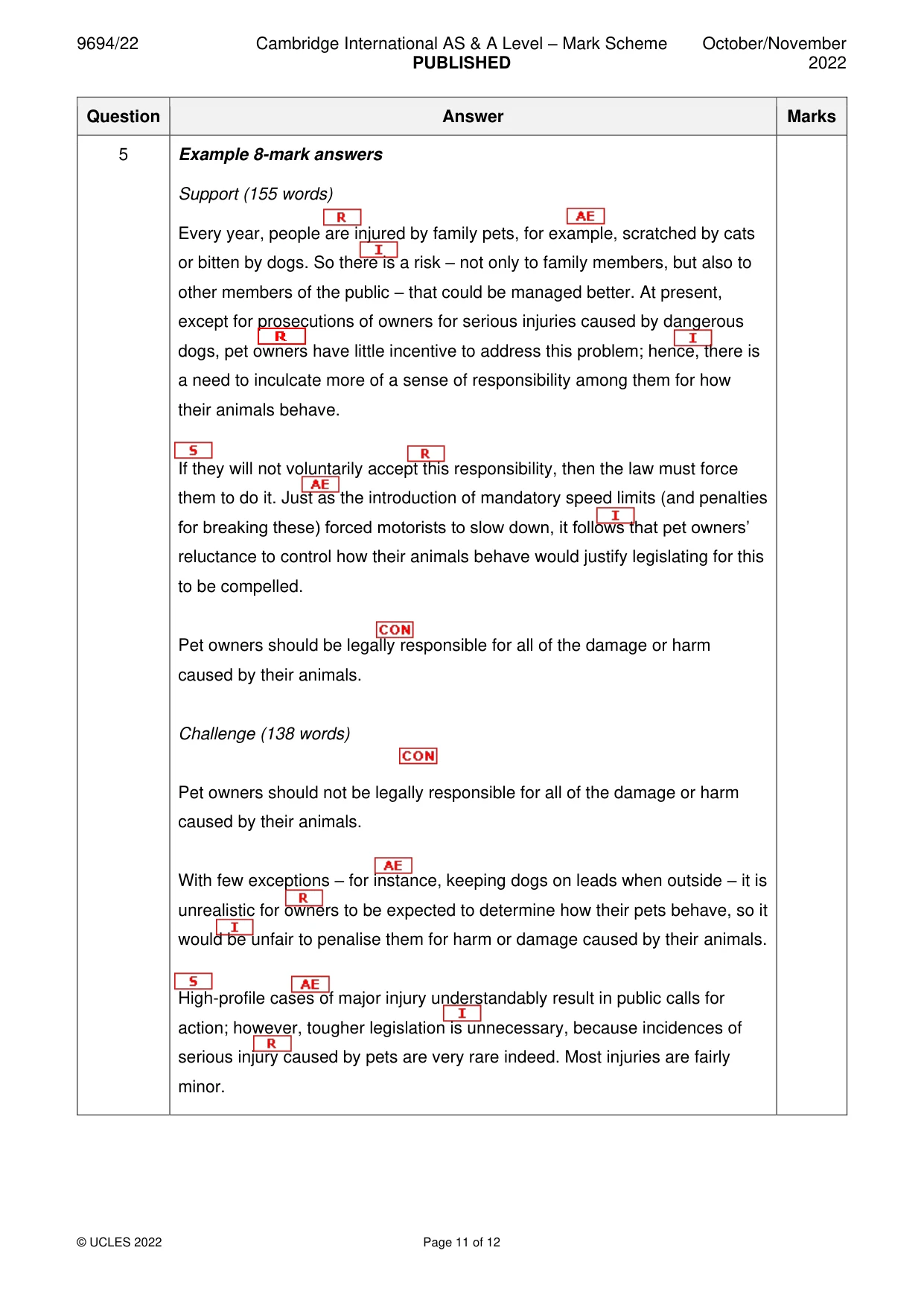
9694/22 Cambridge International AS & A Level – Mark Scheme PUBLISHED October/November 2022 © UCLES 2022 Page 11 of 12 Question Answer Marks 5 Example 8-mark answers Support (155 words) Every year, people are injured by family pets, for example, scratched by cats or bitten by dogs. So there is a risk – not only to family members, but also to other members of the public – that could be managed better. At present, except for prosecutions of owners for serious injuries caused by dangerous dogs, pet owners have little incentive to address this problem; hence, there is a need to inculcate more of a sense of responsibility among them for how their animals behave. If they will not voluntarily accept this responsibility, then the law must force them to do it. Just as the introduction of mandatory speed limits (and penalties for breaking these) forced motorists to slow down, it follows that pet owners’ reluctance to control how their animals behave would justify legislating for this to be compelled. Pet owners should be legally responsible for all of the damage or harm caused by their animals. Challenge (138 words) Pet owners should not be legally responsible for all of the damage or harm caused by their animals. With few exceptions – for instance, keeping dogs on leads when outside – it is unrealistic for owners to be expected to determine how their pets behave, so it would be unfair to penalise them for harm or damage caused by their animals. High-profile cases of major injury understandably result in public calls for action; however, tougher legislation is unnecessary, because incidences of serious injury caused by pets are very rare indeed. Most injuries are fairly minor.
Mark scheme, page 12
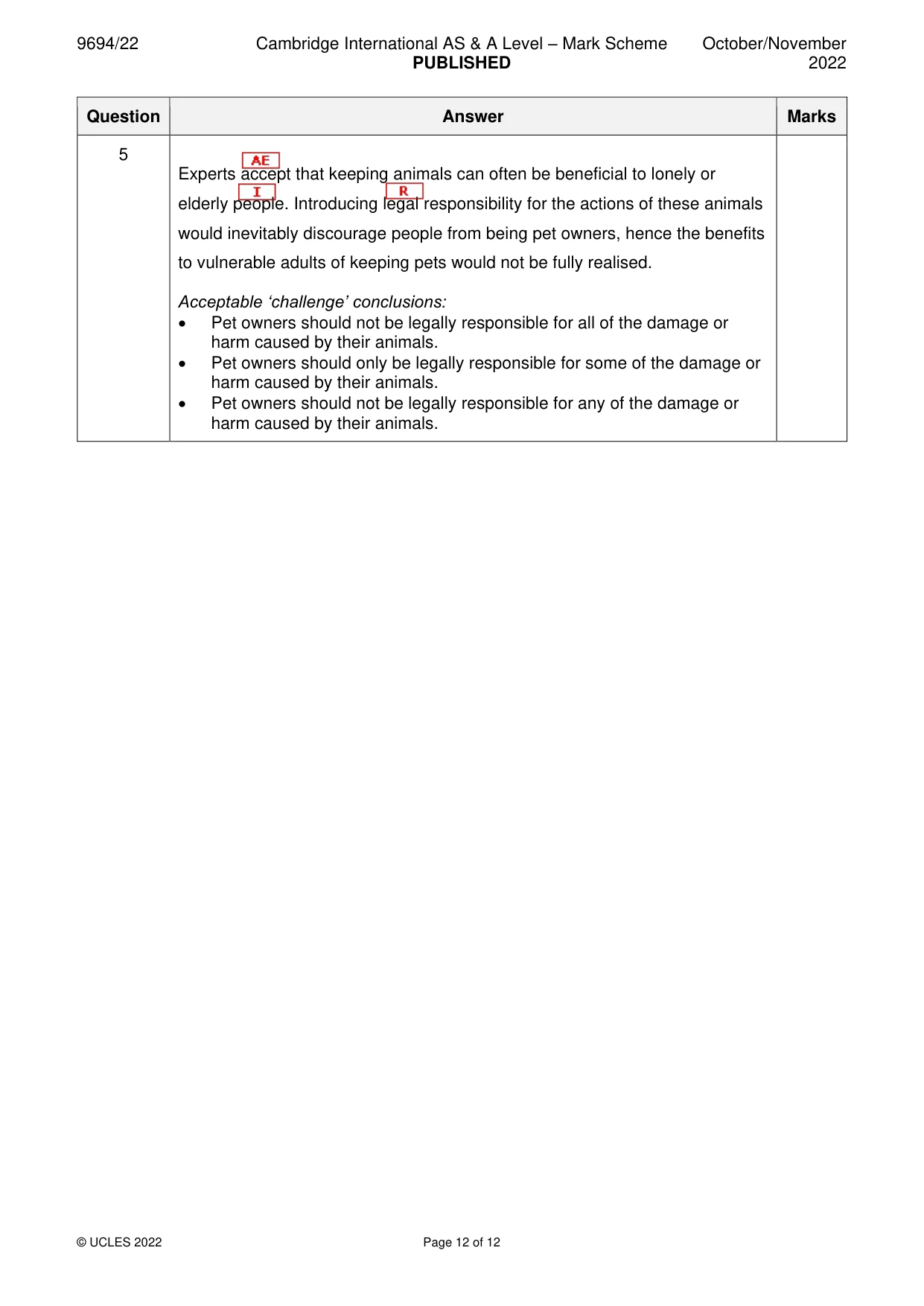
9694/22 Cambridge International AS & A Level – Mark Scheme PUBLISHED October/November 2022 © UCLES 2022 Page 12 of 12 Question Answer Marks 5 Experts accept that keeping animals can often be beneficial to lonely or elderly people. Introducing legal responsibility for the actions of these animals would inevitably discourage people from being pet owners, hence the benefits to vulnerable adults of keeping pets would not be fully realised. Acceptable ‘challenge’ conclusions: • Pet owners should not be legally responsible for all of the damage or harm caused by their animals. • Pet owners should only be legally responsible for some of the damage or harm caused by their animals. • Pet owners should not be legally responsible for any of the damage or harm caused by their animals.
What you needed in this session
Cambridge’s own grade thresholds for 2022 Oct/Nov, Paper 2 · Variant 2. A higher threshold means an easier paper — the bar moves with how the cohort did.