Cambridge A Level Thinking Skills 9694 — 2024 Oct/Nov Paper 2 · Variant 1
9694/21/O/N/24 · 50 marks · ≈56 min
The question paper and its mark scheme, free to read here and free to download. This is Cambridge’s own paper, exactly as it was sat.
Question paper8 pages



Mark scheme12 pages
Answers below. Sit the paper first if you are practising.
Paper as text
Question paper, page 1
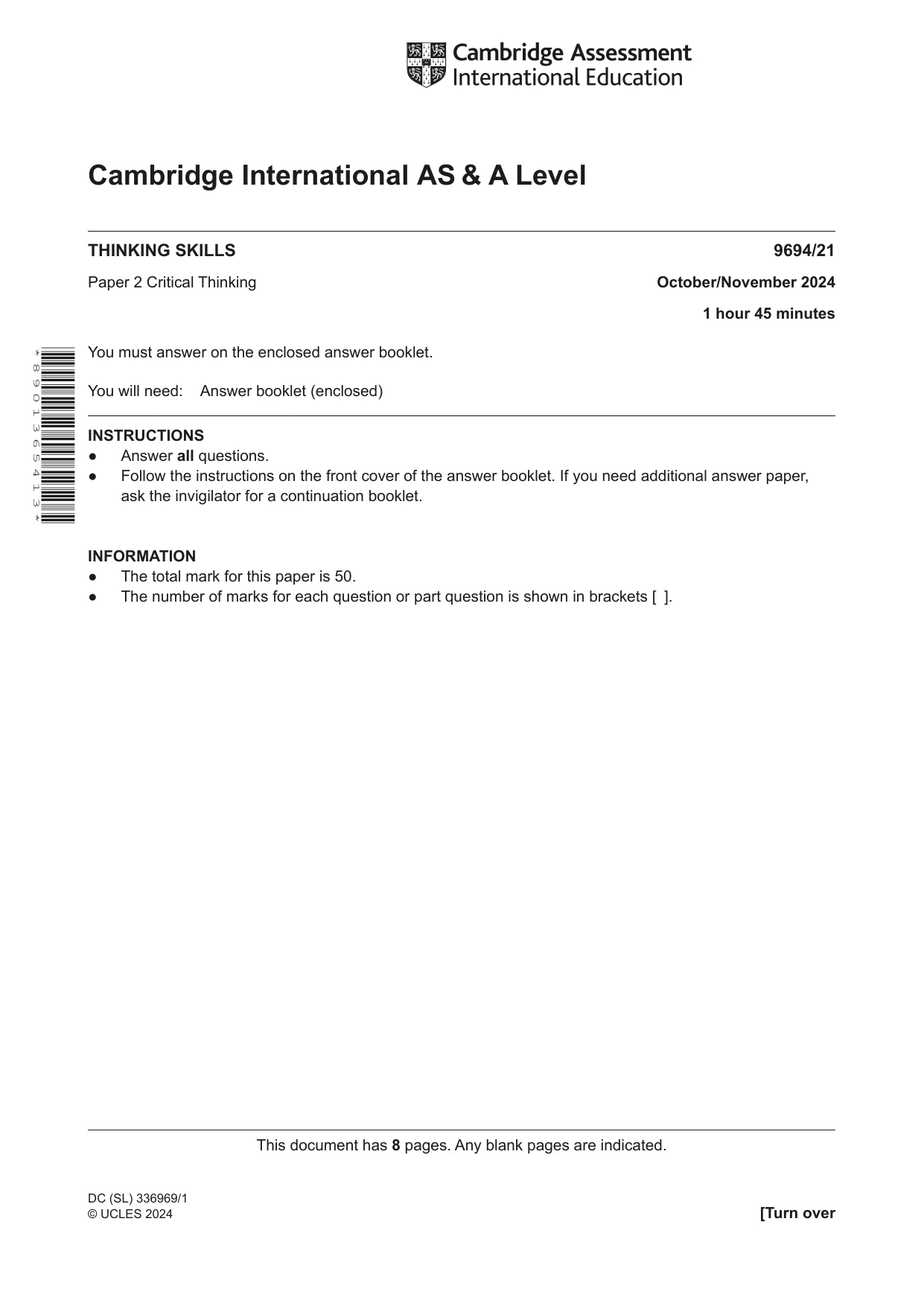
This document has 8 pages. Any blank pages are indicated. [Turn over Cambridge International AS & A Level THINKING SKILLS 9694/21 Paper 2 Critical Thinking October/November 2024 1 hour 45 minutes You must answer on the enclosed answer booklet. You will need: Answer booklet (enclosed) INSTRUCTIONS ● Answer all questions. ● Follow the instructions on the front cover of the answer booklet. If you need additional answer paper, ask the invigilator for a continuation booklet. INFORMATION ● The total mark for this paper is 50. ● The number of marks for each question or part question is shown in brackets [ ]. * 8 9 0 1 3 6 5 4 1 3 * DC (SL) 336969/1 © UCLES 2024
Question paper, page 2
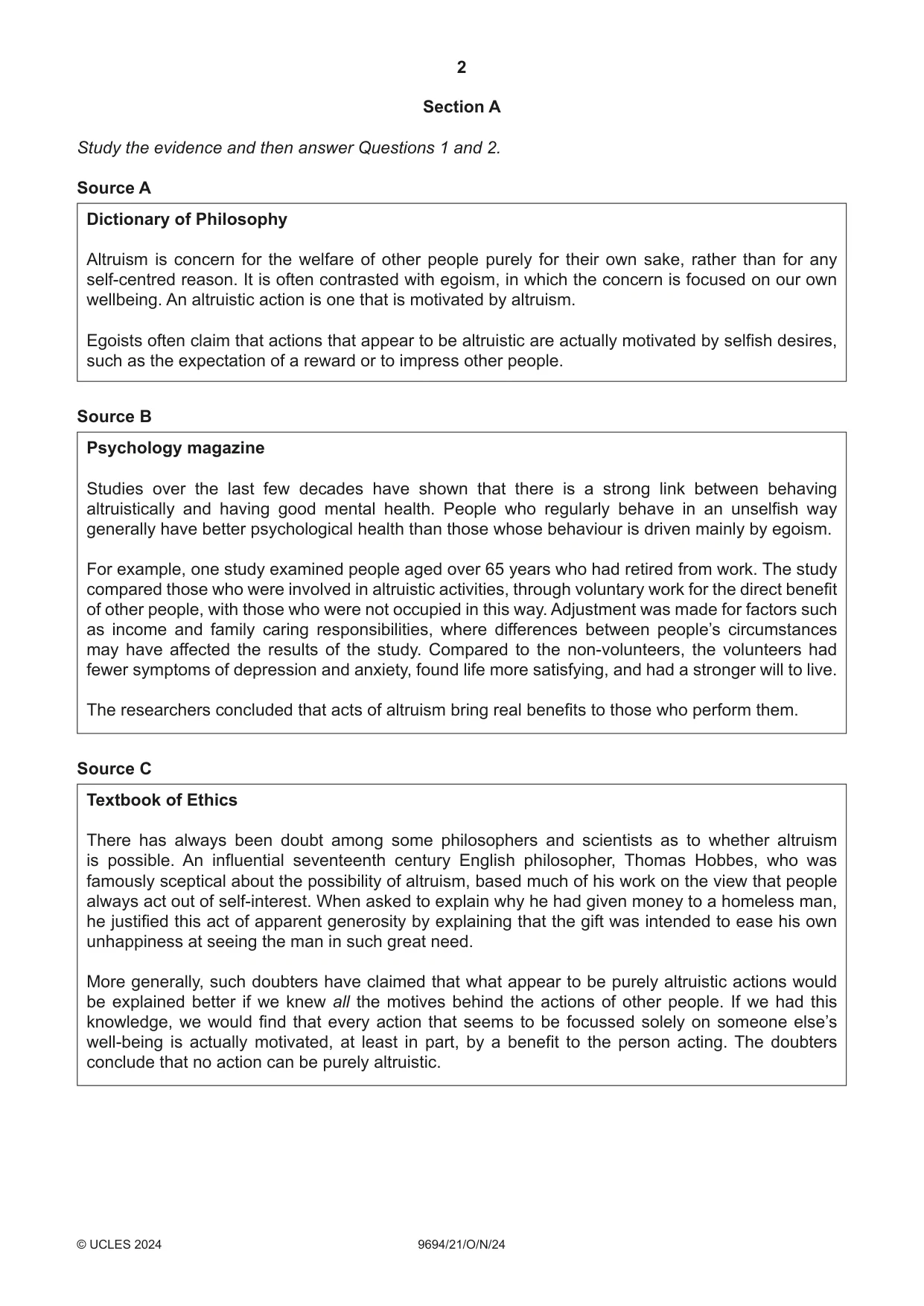
2 9694/21/O/N/24 © UCLES 2024 Section A Study the evidence and then answer Questions 1 and 2. Source A Dictionary of Philosophy Altruism is concern for the welfare of other people purely for their own sake, rather than for any self‑centred reason. It is often contrasted with egoism, in which the concern is focused on our own wellbeing. An altruistic action is one that is motivated by altruism. Egoists often claim that actions that appear to be altruistic are actually motivated by selfish desires, such as the expectation of a reward or to impress other people. Source B Psychology magazine Studies over the last few decades have shown that there is a strong link between behaving altruistically and having good mental health. People who regularly behave in an unselfish way generally have better psychological health than those whose behaviour is driven mainly by egoism. For example, one study examined people aged over 65 years who had retired from work. The study compared those who were involved in altruistic activities, through voluntary work for the direct benefit of other people, with those who were not occupied in this way. Adjustment was made for factors such as income and family caring responsibilities, where differences between people’s circumstances may have affected the results of the study. Compared to the non‑volunteers, the volunteers had fewer symptoms of depression and anxiety, found life more satisfying, and had a stronger will to live. The researchers concluded that acts of altruism bring real benefits to those who perform them. Source C Textbook of Ethics There has always been doubt among some philosophers and scientists as to whether altruism is possible. An influential seventeenth century English philosopher, Thomas Hobbes, who was famously sceptical about the possibility of altruism, based much of his work on the view that people always act out of self‑interest. When asked to explain why he had given money to a homeless man, he justified this act of apparent generosity by explaining that the gift was intended to ease his own unhappiness at seeing the man in such great need. More generally, such doubters have claimed that what appear to be purely altruistic actions would be explained better if we knew all the motives behind the actions of other people. If we had this knowledge, we would find that every action that seems to be focussed solely on someone else’s well‑being is actually motivated, at least in part, by a benefit to the person acting. The doubters conclude that no action can be purely altruistic.
Question paper, page 3
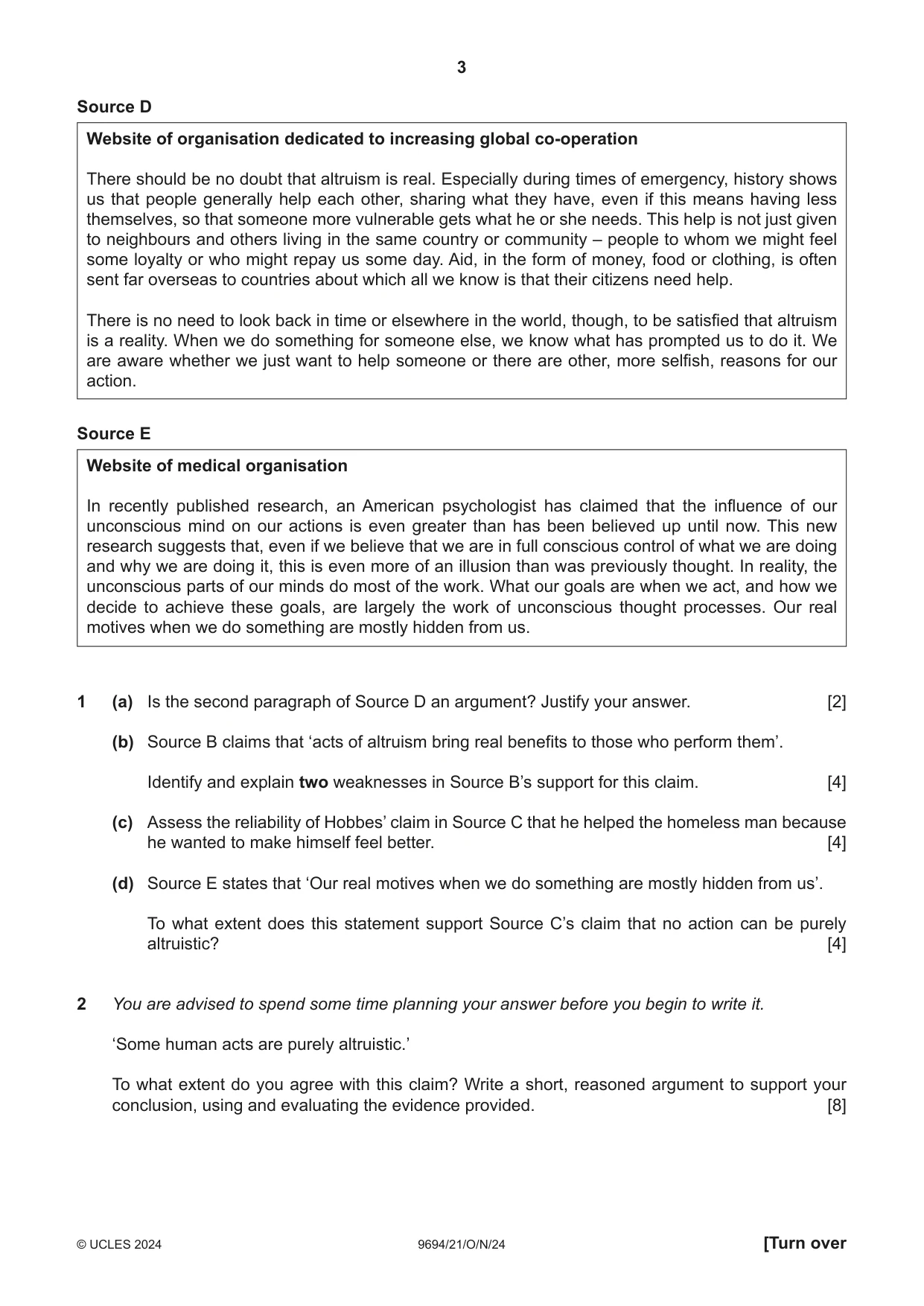
3 9694/21/O/N/24 © UCLES 2024 [Turn over Source D Website of organisation dedicated to increasing global co-operation There should be no doubt that altruism is real. Especially during times of emergency, history shows us that people generally help each other, sharing what they have, even if this means having less themselves, so that someone more vulnerable gets what he or she needs. This help is not just given to neighbours and others living in the same country or community – people to whom we might feel some loyalty or who might repay us some day. Aid, in the form of money, food or clothing, is often sent far overseas to countries about which all we know is that their citizens need help. There is no need to look back in time or elsewhere in the world, though, to be satisfied that altruism is a reality. When we do something for someone else, we know what has prompted us to do it. We are aware whether we just want to help someone or there are other, more selfish, reasons for our action. Source E Website of medical organisation In recently published research, an American psychologist has claimed that the influence of our unconscious mind on our actions is even greater than has been believed up until now. This new research suggests that, even if we believe that we are in full conscious control of what we are doing and why we are doing it, this is even more of an illusion than was previously thought. In reality, the unconscious parts of our minds do most of the work. What our goals are when we act, and how we decide to achieve these goals, are largely the work of unconscious thought processes. Our real motives when we do something are mostly hidden from us. 1 (a) Is the second paragraph of Source D an argument? Justify your answer. [2] (b) Source B claims that ‘acts of altruism bring real benefits to those who perform them’. Identify and explain two weaknesses in Source B’s support for this claim. [4] (c) Assess the reliability of Hobbes’ claim in Source C that he helped the homeless man because he wanted to make himself feel better. [4] (d) Source E states that ‘Our real motives when we do something are mostly hidden from us’. To what extent does this statement support Source C’s claim that no action can be purely altruistic? [4] 2 You are advised to spend some time planning your answer before you begin to write it. ‘Some human acts are purely altruistic.’ To what extent do you agree with this claim? Write a short, reasoned argument to support your conclusion, using and evaluating the evidence provided. [8]
Question paper, page 4
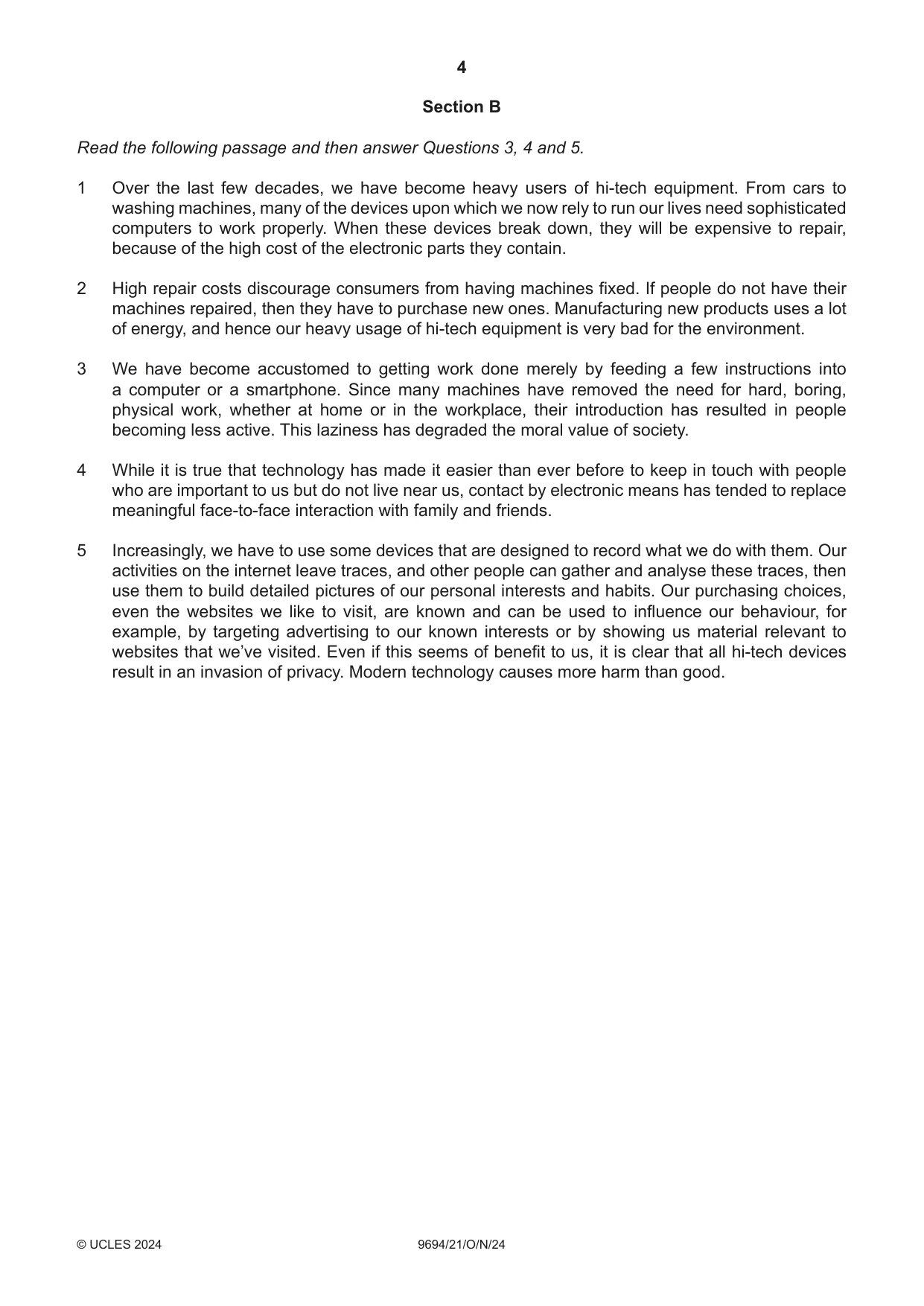
4 9694/21/O/N/24 © UCLES 2024 Section B Read the following passage and then answer Questions 3, 4 and 5. 1 Over the last few decades, we have become heavy users of hi‑tech equipment. From cars to washing machines, many of the devices upon which we now rely to run our lives need sophisticated computers to work properly. When these devices break down, they will be expensive to repair, because of the high cost of the electronic parts they contain. 2 High repair costs discourage consumers from having machines fixed. If people do not have their machines repaired, then they have to purchase new ones. Manufacturing new products uses a lot of energy, and hence our heavy usage of hi‑tech equipment is very bad for the environment. 3 We have become accustomed to getting work done merely by feeding a few instructions into a computer or a smartphone. Since many machines have removed the need for hard, boring, physical work, whether at home or in the workplace, their introduction has resulted in people becoming less active. This laziness has degraded the moral value of society. 4 While it is true that technology has made it easier than ever before to keep in touch with people who are important to us but do not live near us, contact by electronic means has tended to replace meaningful face‑to‑face interaction with family and friends. 5 Increasingly, we have to use some devices that are designed to record what we do with them. Our activities on the internet leave traces, and other people can gather and analyse these traces, then use them to build detailed pictures of our personal interests and habits. Our purchasing choices, even the websites we like to visit, are known and can be used to influence our behaviour, for example, by targeting advertising to our known interests or by showing us material relevant to websites that we’ve visited. Even if this seems of benefit to us, it is clear that all hi‑tech devices result in an invasion of privacy. Modern technology causes more harm than good.
Question paper, page 5
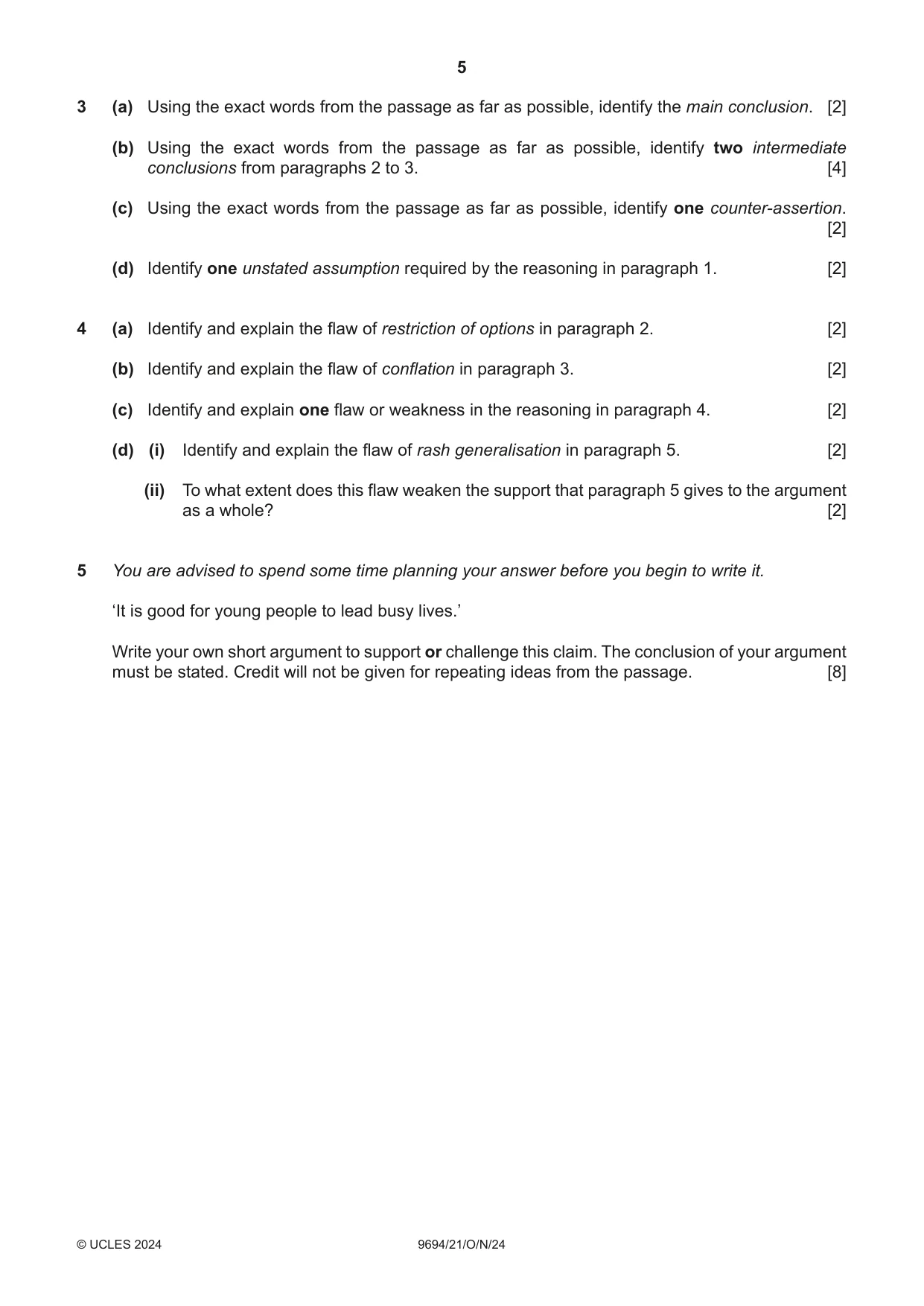
5 9694/21/O/N/24 © UCLES 2024 3 (a) Using the exact words from the passage as far as possible, identify the main conclusion. [2] (b) Using the exact words from the passage as far as possible, identify two intermediate conclusions from paragraphs 2 to 3. [4] (c) Using the exact words from the passage as far as possible, identify one counter-assertion. [2] (d) Identify one unstated assumption required by the reasoning in paragraph 1. [2] 4 (a) Identify and explain the flaw of restriction of options in paragraph 2. [2] (b) Identify and explain the flaw of conflation in paragraph 3. [2] (c) Identify and explain one flaw or weakness in the reasoning in paragraph 4. [2] (d) (i) Identify and explain the flaw of rash generalisation in paragraph 5. [2] (ii) To what extent does this flaw weaken the support that paragraph 5 gives to the argument as a whole? [2] 5 You are advised to spend some time planning your answer before you begin to write it. ‘It is good for young people to lead busy lives.’ Write your own short argument to support or challenge this claim. The conclusion of your argument must be stated. Credit will not be given for repeating ideas from the passage. [8]
Question paper, page 6
6 9694/21/O/N/24 © UCLES 2024 BLANK PAGE
Question paper, page 7
7 9694/21/O/N/24 © UCLES 2024 BLANK PAGE
Question paper, page 8
8 9694/21/O/N/24 © UCLES 2024 Permission to reproduce items where third‑party owned material protected by copyright is included has been sought and cleared where possible. Every reasonable effort has been made by the publisher (UCLES) to trace copyright holders, but if any items requiring clearance have unwittingly been included, the publisher will be pleased to make amends at the earliest possible opportunity. To avoid the issue of disclosure of answer‑related information to candidates, all copyright acknowledgements are reproduced online in the Cambridge Assessment International Education Copyright Acknowledgements Booklet. This is produced for each series of examinations and is freely available to download at www.cambridgeinternational.org after the live examination series. Cambridge Assessment International Education is part of Cambridge Assessment. Cambridge Assessment is the brand name of the University of Cambridge Local Examinations Syndicate (UCLES), which is a department of the University of Cambridge. BLANK PAGE
Mark scheme, page 1
This document consists of 12 printed pages. © Cambridge University Press & Assessment 2024 [Turn over Cambridge International AS & A Level THINKING SKILLS 9694/21 Paper 2 Critical Thinking October/November 2024 MARK SCHEME Maximum Mark: 50 Published This mark scheme is published as an aid to teachers and candidates, to indicate the requirements of the examination. It shows the basis on which Examiners were instructed to award marks. It does not indicate the details of the discussions that took place at an Examiners’ meeting before marking began, which would have considered the acceptability of alternative answers. Mark schemes should be read in conjunction with the question paper and the Principal Examiner Report for Teachers. Cambridge International will not enter into discussions about these mark schemes. Cambridge International is publishing the mark schemes for the October/November 2024 series for most Cambridge IGCSE, Cambridge International A and AS Level components, and some Cambridge O Level components.
Mark scheme, page 2
9694/21 Cambridge International AS & A Level – Mark Scheme PUBLISHED October/November 2024 © Cambridge University Press & Assessment 2024 Page 2 of 12 Generic Marking Principles These general marking principles must be applied by all examiners when marking candidate answers. They should be applied alongside the specific content of the mark scheme or generic level descriptions for a question. Each question paper and mark scheme will also comply with these marking principles. GENERIC MARKING PRINCIPLE 1: Marks must be awarded in line with: • the specific content of the mark scheme or the generic level descriptors for the question • the specific skills defined in the mark scheme or in the generic level descriptors for the question • the standard of response required by a candidate as exemplified by the standardisation scripts. GENERIC MARKING PRINCIPLE 2: Marks awarded are always whole marks (not half marks, or other fractions). GENERIC MARKING PRINCIPLE 3: Marks must be awarded positively: • marks are awarded for correct/valid answers, as defined in the mark scheme. However, credit is given for valid answers which go beyond the scope of the syllabus and mark scheme, referring to your Team Leader as appropriate • marks are awarded when candidates clearly demonstrate what they know and can do • marks are not deducted for errors • marks are not deducted for omissions • answers should only be judged on the quality of spelling, punctuation and grammar when these features are specifically assessed by the question as indicated by the mark scheme. The meaning, however, should be unambiguous. GENERIC MARKING PRINCIPLE 4: Rules must be applied consistently, e.g. in situations where candidates have not followed instructions or in the application of generic level descriptors. GENERIC MARKING PRINCIPLE 5: Marks should be awarded using the full range of marks defined in the mark scheme for the question (however; the use of the full mark range may be limited according to the quality of the candidate responses seen). GENERIC MARKING PRINCIPLE 6: Marks awarded are based solely on the requirements as defined in the mark scheme. Marks should not be awarded with grade thresholds or grade descriptors in mind.
Mark scheme, page 3
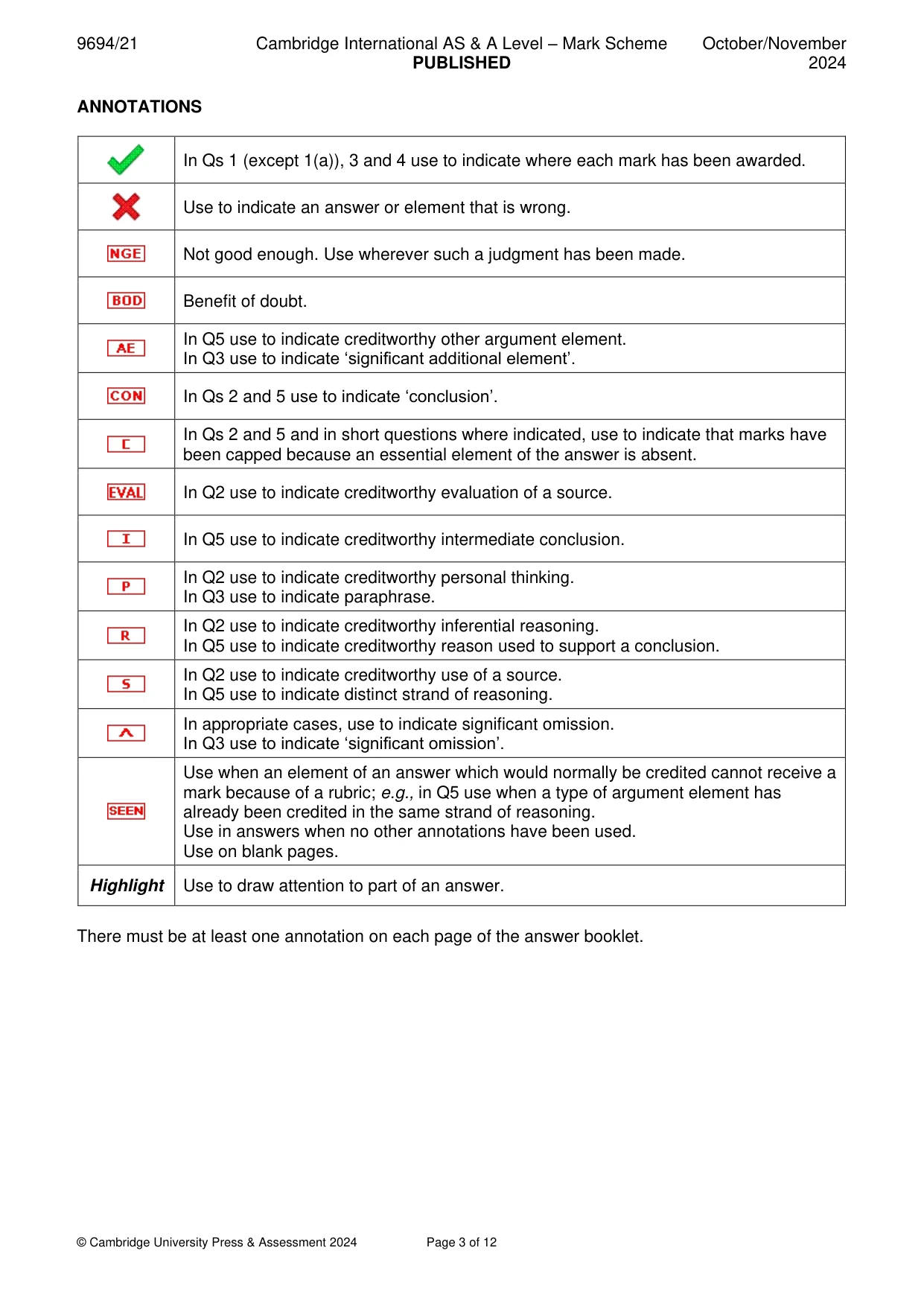
9694/21 Cambridge International AS & A Level – Mark Scheme PUBLISHED October/November 2024 © Cambridge University Press & Assessment 2024 Page 3 of 12 ANNOTATIONS In Qs 1 (except 1(a)), 3 and 4 use to indicate where each mark has been awarded. Use to indicate an answer or element that is wrong. Not good enough. Use wherever such a judgment has been made. Benefit of doubt. In Q5 use to indicate creditworthy other argument element. In Q3 use to indicate ‘significant additional element’. In Qs 2 and 5 use to indicate ‘conclusion’. In Qs 2 and 5 and in short questions where indicated, use to indicate that marks have been capped because an essential element of the answer is absent. In Q2 use to indicate creditworthy evaluation of a source. In Q5 use to indicate creditworthy intermediate conclusion. In Q2 use to indicate creditworthy personal thinking. In Q3 use to indicate paraphrase. In Q2 use to indicate creditworthy inferential reasoning. In Q5 use to indicate creditworthy reason used to support a conclusion. In Q2 use to indicate creditworthy use of a source. In Q5 use to indicate distinct strand of reasoning. In appropriate cases, use to indicate significant omission. In Q3 use to indicate ‘significant omission’. Use when an element of an answer which would normally be credited cannot receive a mark because of a rubric; e.g., in Q5 use when a type of argument element has already been credited in the same strand of reasoning. Use in answers when no other annotations have been used. Use on blank pages. Highlight Use to draw attention to part of an answer. There must be at least one annotation on each page of the answer booklet.
Mark scheme, page 4
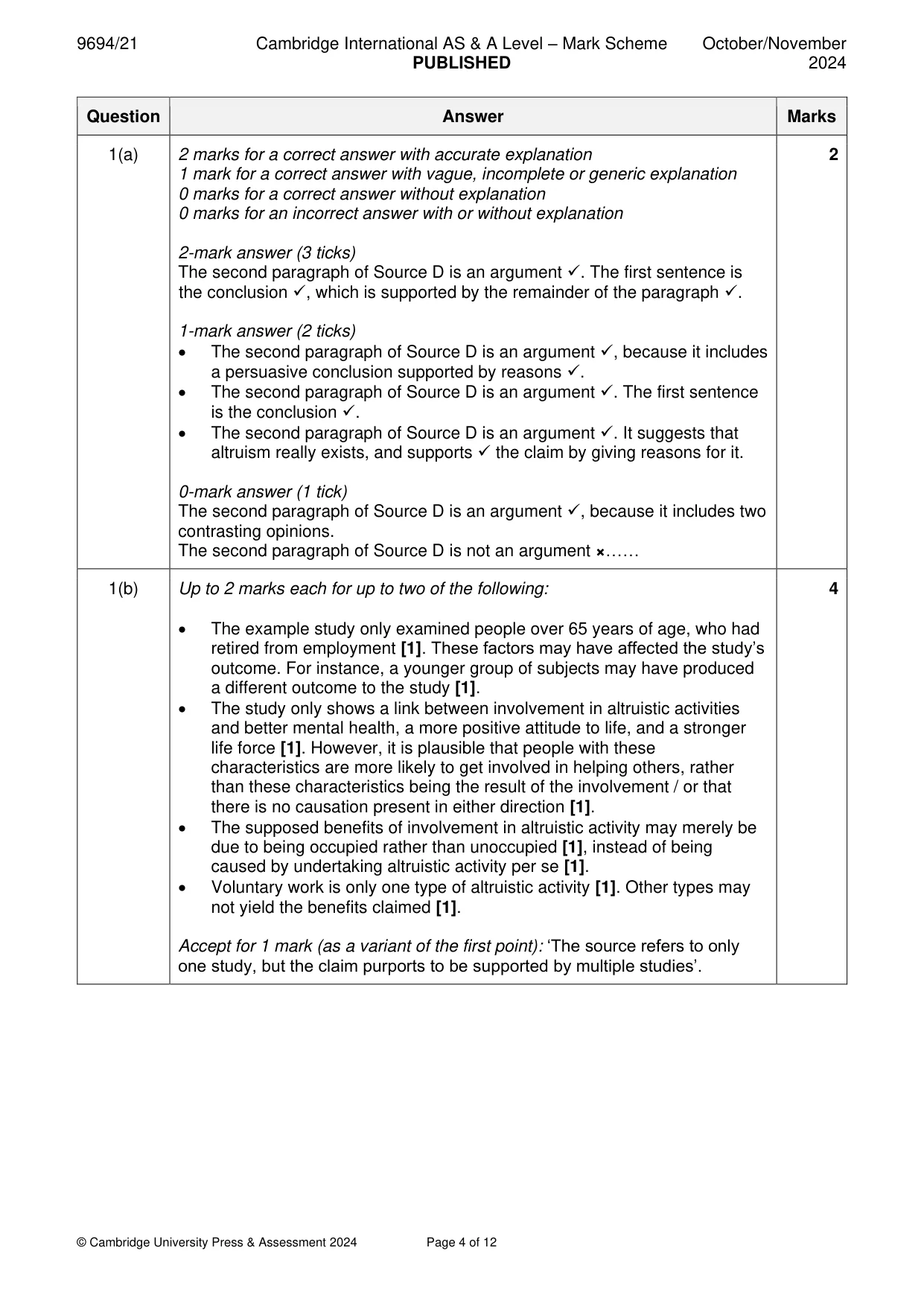
9694/21 Cambridge International AS & A Level – Mark Scheme PUBLISHED October/November 2024 © Cambridge University Press & Assessment 2024 Page 4 of 12 Question Answer Marks 1(a) 2 marks for a correct answer with accurate explanation 1 mark for a correct answer with vague, incomplete or generic explanation 0 marks for a correct answer without explanation 0 marks for an incorrect answer with or without explanation 2-mark answer (3 ticks) The second paragraph of Source D is an argument ✓. The first sentence is the conclusion ✓, which is supported by the remainder of the paragraph ✓. 1-mark answer (2 ticks) • The second paragraph of Source D is an argument ✓, because it includes a persuasive conclusion supported by reasons ✓. • The second paragraph of Source D is an argument ✓. The first sentence is the conclusion ✓. • The second paragraph of Source D is an argument ✓. It suggests that altruism really exists, and supports ✓ the claim by giving reasons for it. 0-mark answer (1 tick) The second paragraph of Source D is an argument ✓, because it includes two contrasting opinions. The second paragraph of Source D is not an argument ×…… 2 1(b) Up to 2 marks each for up to two of the following: • The example study only examined people over 65 years of age, who had retired from employment [1]. These factors may have affected the study’s outcome. For instance, a younger group of subjects may have produced a different outcome to the study [1]. • The study only shows a link between involvement in altruistic activities and better mental health, a more positive attitude to life, and a stronger life force [1]. However, it is plausible that people with these characteristics are more likely to get involved in helping others, rather than these characteristics being the result of the involvement / or that there is no causation present in either direction [1]. • The supposed benefits of involvement in altruistic activity may merely be due to being occupied rather than unoccupied [1], instead of being caused by undertaking altruistic activity per se [1]. • Voluntary work is only one type of altruistic activity [1]. Other types may not yield the benefits claimed [1]. Accept for 1 mark (as a variant of the first point): ‘The source refers to only one study, but the claim purports to be supported by multiple studies’. 4
Mark scheme, page 5
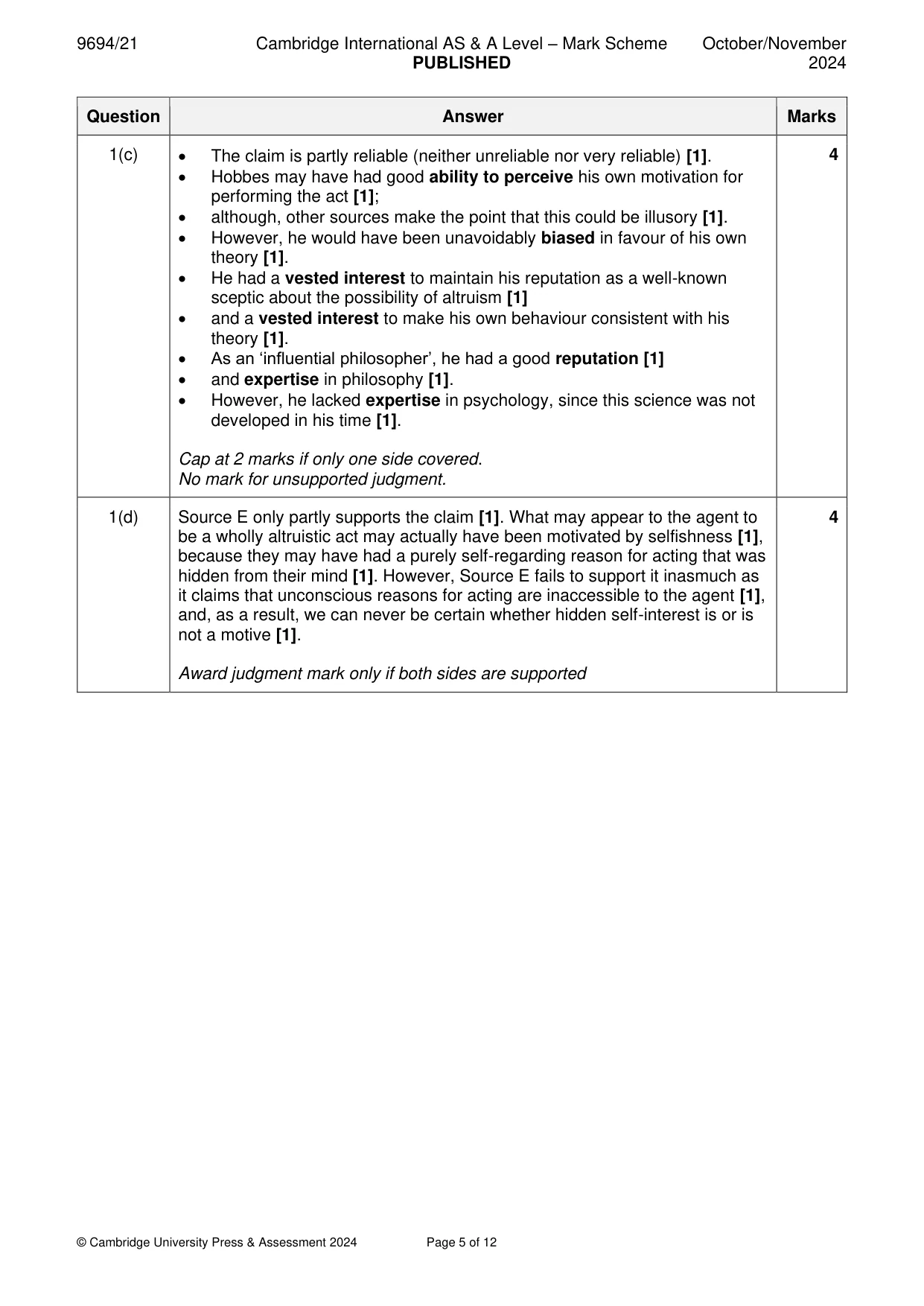
9694/21 Cambridge International AS & A Level – Mark Scheme PUBLISHED October/November 2024 © Cambridge University Press & Assessment 2024 Page 5 of 12 Question Answer Marks 1(c) • The claim is partly reliable (neither unreliable nor very reliable) [1]. • Hobbes may have had good ability to perceive his own motivation for performing the act [1]; • although, other sources make the point that this could be illusory [1]. • However, he would have been unavoidably biased in favour of his own theory [1]. • He had a vested interest to maintain his reputation as a well-known sceptic about the possibility of altruism [1] • and a vested interest to make his own behaviour consistent with his theory [1]. • As an ‘influential philosopher’, he had a good reputation [1] • and expertise in philosophy [1]. • However, he lacked expertise in psychology, since this science was not developed in his time [1]. Cap at 2 marks if only one side covered. No mark for unsupported judgment. 4 1(d) Source E only partly supports the claim [1]. What may appear to the agent to be a wholly altruistic act may actually have been motivated by selfishness [1], because they may have had a purely self-regarding reason for acting that was hidden from their mind [1]. However, Source E fails to support it inasmuch as it claims that unconscious reasons for acting are inaccessible to the agent [1], and, as a result, we can never be certain whether hidden self-interest is or is not a motive [1]. Award judgment mark only if both sides are supported 4
Mark scheme, page 6
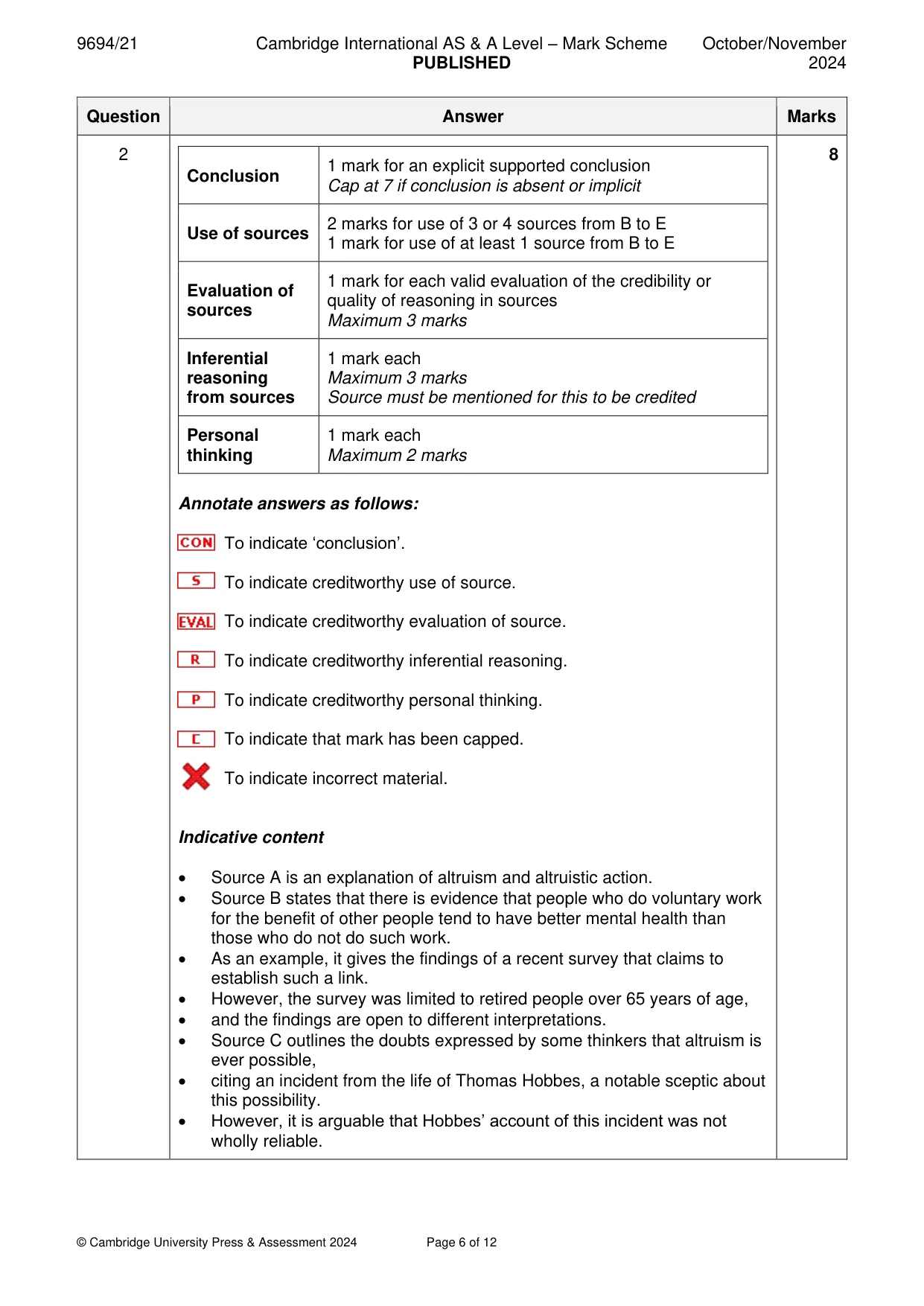
9694/21 Cambridge International AS & A Level – Mark Scheme PUBLISHED October/November 2024 © Cambridge University Press & Assessment 2024 Page 6 of 12 Question Answer Marks 2 Conclusion 1 mark for an explicit supported conclusion Cap at 7 if conclusion is absent or implicit Use of sources 2 marks for use of 3 or 4 sources from B to E 1 mark for use of at least 1 source from B to E Evaluation of sources 1 mark for each valid evaluation of the credibility or quality of reasoning in sources Maximum 3 marks Inferential reasoning from sources 1 mark each Maximum 3 marks Source must be mentioned for this to be credited Personal thinking 1 mark each Maximum 2 marks Annotate answers as follows: To indicate ‘conclusion’. To indicate creditworthy use of source. To indicate creditworthy evaluation of source. To indicate creditworthy inferential reasoning. To indicate creditworthy personal thinking. To indicate that mark has been capped. To indicate incorrect material. Indicative content • Source A is an explanation of altruism and altruistic action. • Source B states that there is evidence that people who do voluntary work for the benefit of other people tend to have better mental health than those who do not do such work. • As an example, it gives the findings of a recent survey that claims to establish such a link. • However, the survey was limited to retired people over 65 years of age, • and the findings are open to different interpretations. • Source C outlines the doubts expressed by some thinkers that altruism is ever possible, • citing an incident from the life of Thomas Hobbes, a notable sceptic about this possibility. • However, it is arguable that Hobbes’ account of this incident was not wholly reliable. 8
Mark scheme, page 7
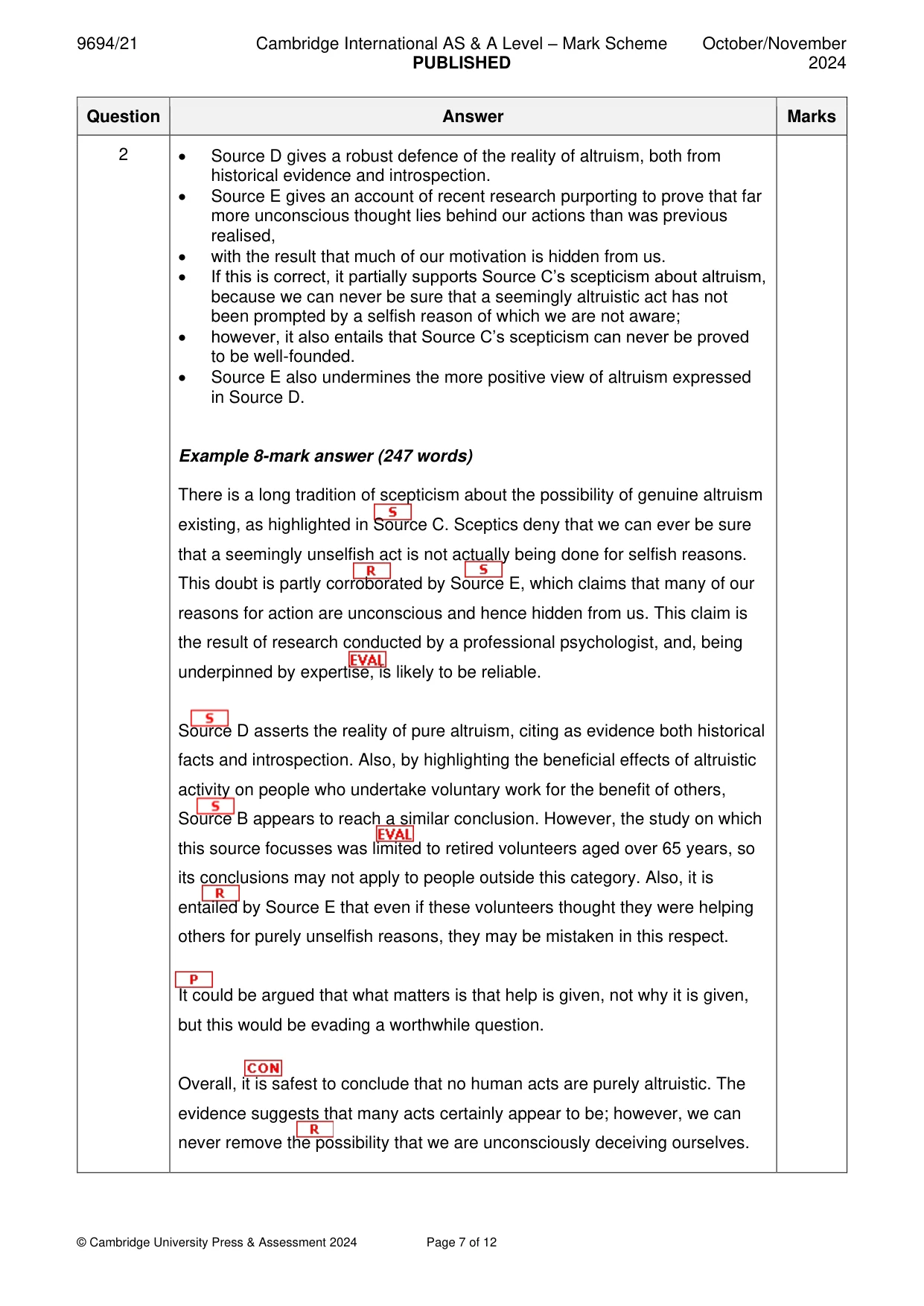
9694/21 Cambridge International AS & A Level – Mark Scheme PUBLISHED October/November 2024 © Cambridge University Press & Assessment 2024 Page 7 of 12 Question Answer Marks 2 • Source D gives a robust defence of the reality of altruism, both from historical evidence and introspection. • Source E gives an account of recent research purporting to prove that far more unconscious thought lies behind our actions than was previous realised, • with the result that much of our motivation is hidden from us. • If this is correct, it partially supports Source C’s scepticism about altruism, because we can never be sure that a seemingly altruistic act has not been prompted by a selfish reason of which we are not aware; • however, it also entails that Source C’s scepticism can never be proved to be well-founded. • Source E also undermines the more positive view of altruism expressed in Source D. Example 8-mark answer (247 words) There is a long tradition of scepticism about the possibility of genuine altruism existing, as highlighted in Source C. Sceptics deny that we can ever be sure that a seemingly unselfish act is not actually being done for selfish reasons. This doubt is partly corroborated by Source E, which claims that many of our reasons for action are unconscious and hence hidden from us. This claim is the result of research conducted by a professional psychologist, and, being underpinned by expertise, is likely to be reliable. Source D asserts the reality of pure altruism, citing as evidence both historical facts and introspection. Also, by highlighting the beneficial effects of altruistic activity on people who undertake voluntary work for the benefit of others, Source B appears to reach a similar conclusion. However, the study on which this source focusses was limited to retired volunteers aged over 65 years, so its conclusions may not apply to people outside this category. Also, it is entailed by Source E that even if these volunteers thought they were helping others for purely unselfish reasons, they may be mistaken in this respect. It could be argued that what matters is that help is given, not why it is given, but this would be evading a worthwhile question. Overall, it is safest to conclude that no human acts are purely altruistic. The evidence suggests that many acts certainly appear to be; however, we can never remove the possibility that we are unconsciously deceiving ourselves.
Mark scheme, page 8
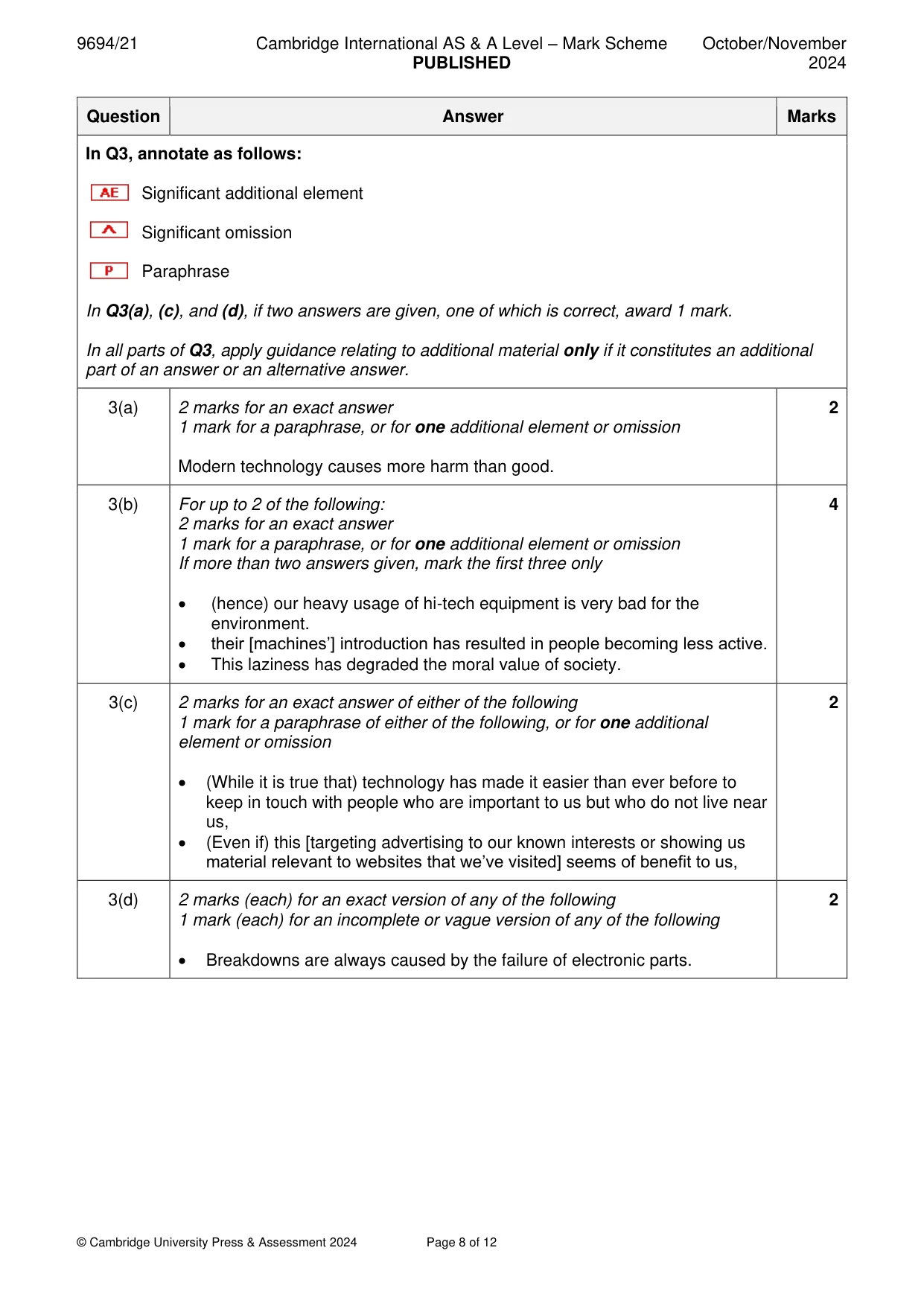
9694/21 Cambridge International AS & A Level – Mark Scheme PUBLISHED October/November 2024 © Cambridge University Press & Assessment 2024 Page 8 of 12 Question Answer Marks In Q3, annotate as follows: Significant additional element Significant omission Paraphrase In Q3(a), (c), and (d), if two answers are given, one of which is correct, award 1 mark. In all parts of Q3, apply guidance relating to additional material only if it constitutes an additional part of an answer or an alternative answer. 3(a) 2 marks for an exact answer 1 mark for a paraphrase, or for one additional element or omission Modern technology causes more harm than good. 2 3(b) For up to 2 of the following: 2 marks for an exact answer 1 mark for a paraphrase, or for one additional element or omission If more than two answers given, mark the first three only • (hence) our heavy usage of hi-tech equipment is very bad for the environment. • their [machines’] introduction has resulted in people becoming less active. • This laziness has degraded the moral value of society. 4 3(c) 2 marks for an exact answer of either of the following 1 mark for a paraphrase of either of the following, or for one additional element or omission • (While it is true that) technology has made it easier than ever before to keep in touch with people who are important to us but who do not live near us, • (Even if) this [targeting advertising to our known interests or showing us material relevant to websites that we’ve visited] seems of benefit to us, 2 3(d) 2 marks (each) for an exact version of any of the following 1 mark (each) for an incomplete or vague version of any of the following • Breakdowns are always caused by the failure of electronic parts. 2
Mark scheme, page 9
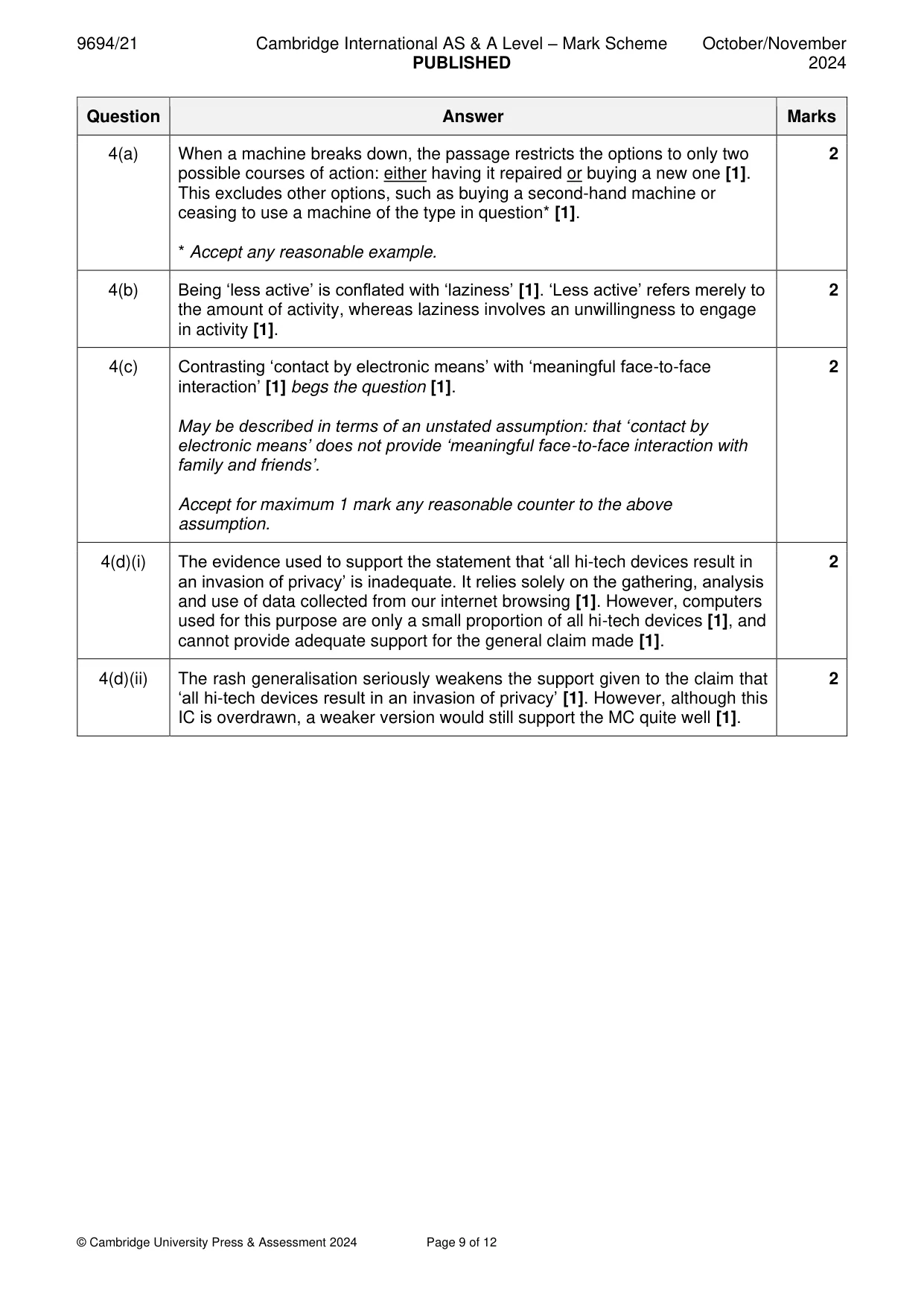
9694/21 Cambridge International AS & A Level – Mark Scheme PUBLISHED October/November 2024 © Cambridge University Press & Assessment 2024 Page 9 of 12 Question Answer Marks 4(a) When a machine breaks down, the passage restricts the options to only two possible courses of action: either having it repaired or buying a new one [1]. This excludes other options, such as buying a second-hand machine or ceasing to use a machine of the type in question* [1]. * Accept any reasonable example. 2 4(b) Being ‘less active’ is conflated with ‘laziness’ [1]. ‘Less active’ refers merely to the amount of activity, whereas laziness involves an unwillingness to engage in activity [1]. 2 4(c) Contrasting ‘contact by electronic means’ with ‘meaningful face-to-face interaction’ [1] begs the question [1]. May be described in terms of an unstated assumption: that ‘contact by electronic means’ does not provide ‘meaningful face-to-face interaction with family and friends’. Accept for maximum 1 mark any reasonable counter to the above assumption. 2 4(d)(i) The evidence used to support the statement that ‘all hi-tech devices result in an invasion of privacy’ is inadequate. It relies solely on the gathering, analysis and use of data collected from our internet browsing [1]. However, computers used for this purpose are only a small proportion of all hi-tech devices [1], and cannot provide adequate support for the general claim made [1]. 2 4(d)(ii) The rash generalisation seriously weakens the support given to the claim that ‘all hi-tech devices result in an invasion of privacy’ [1]. However, although this IC is overdrawn, a weaker version would still support the MC quite well [1]. 2
Mark scheme, page 10
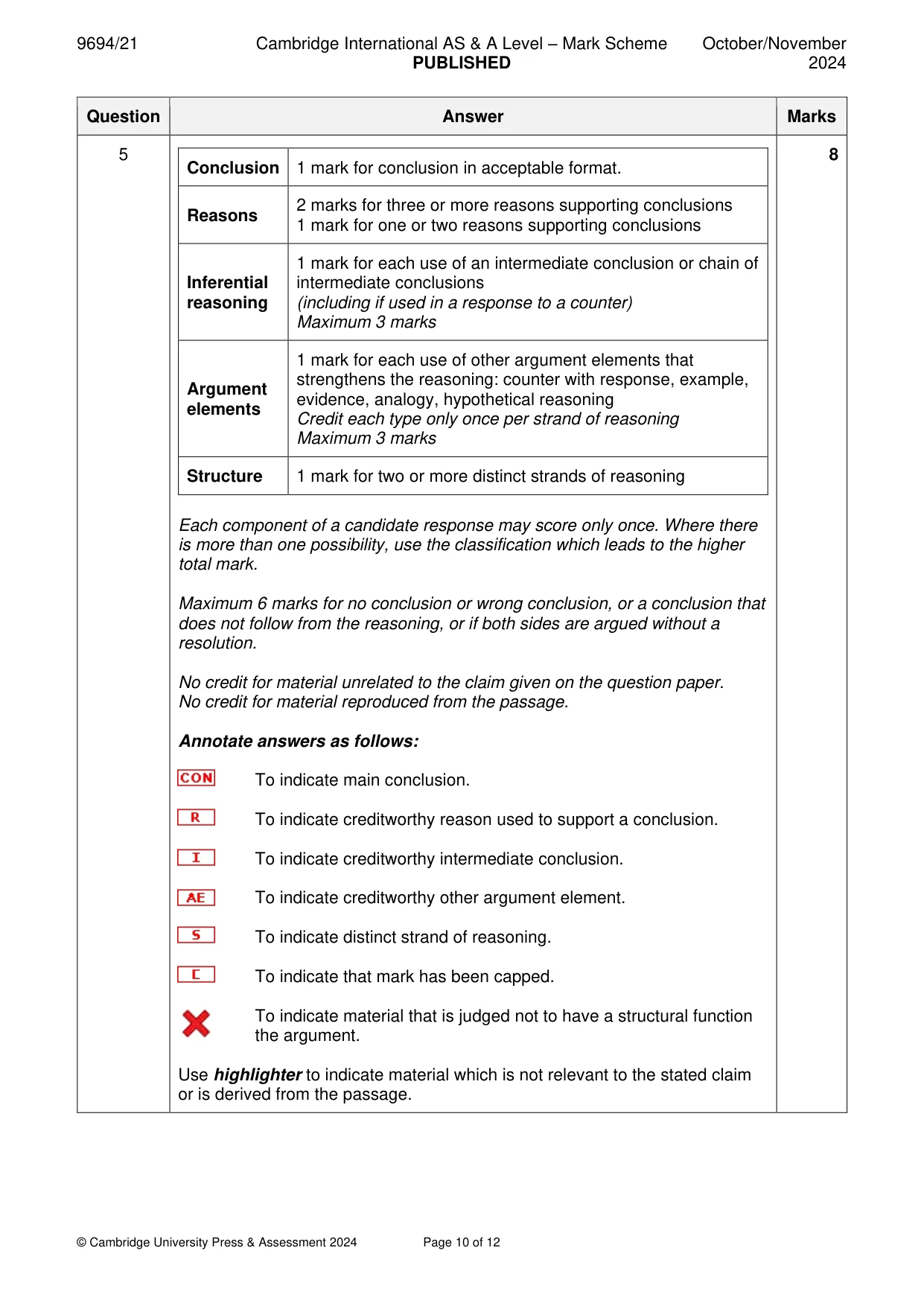
9694/21 Cambridge International AS & A Level – Mark Scheme PUBLISHED October/November 2024 © Cambridge University Press & Assessment 2024 Page 10 of 12 Question Answer Marks 5 Each component of a candidate response may score only once. Where there is more than one possibility, use the classification which leads to the higher total mark. Maximum 6 marks for no conclusion or wrong conclusion, or a conclusion that does not follow from the reasoning, or if both sides are argued without a resolution. No credit for material unrelated to the claim given on the question paper. No credit for material reproduced from the passage. Annotate answers as follows: To indicate main conclusion. To indicate creditworthy reason used to support a conclusion. To indicate creditworthy intermediate conclusion. To indicate creditworthy other argument element. To indicate distinct strand of reasoning. To indicate that mark has been capped. To indicate material that is judged not to have a structural function in the argument. Use highlighter to indicate material which is not relevant to the stated claim or is derived from the passage. Conclusion 1 mark for conclusion in acceptable format. Reasons 2 marks for three or more reasons supporting conclusions 1 mark for one or two reasons supporting conclusions Inferential reasoning 1 mark for each use of an intermediate conclusion or chain of intermediate conclusions (including if used in a response to a counter) Maximum 3 marks Argument elements 1 mark for each use of other argument elements that strengthens the reasoning: counter with response, example, evidence, analogy, hypothetical reasoning Credit each type only once per strand of reasoning Maximum 3 marks Structure 1 mark for two or more distinct strands of reasoning 8
Mark scheme, page 11
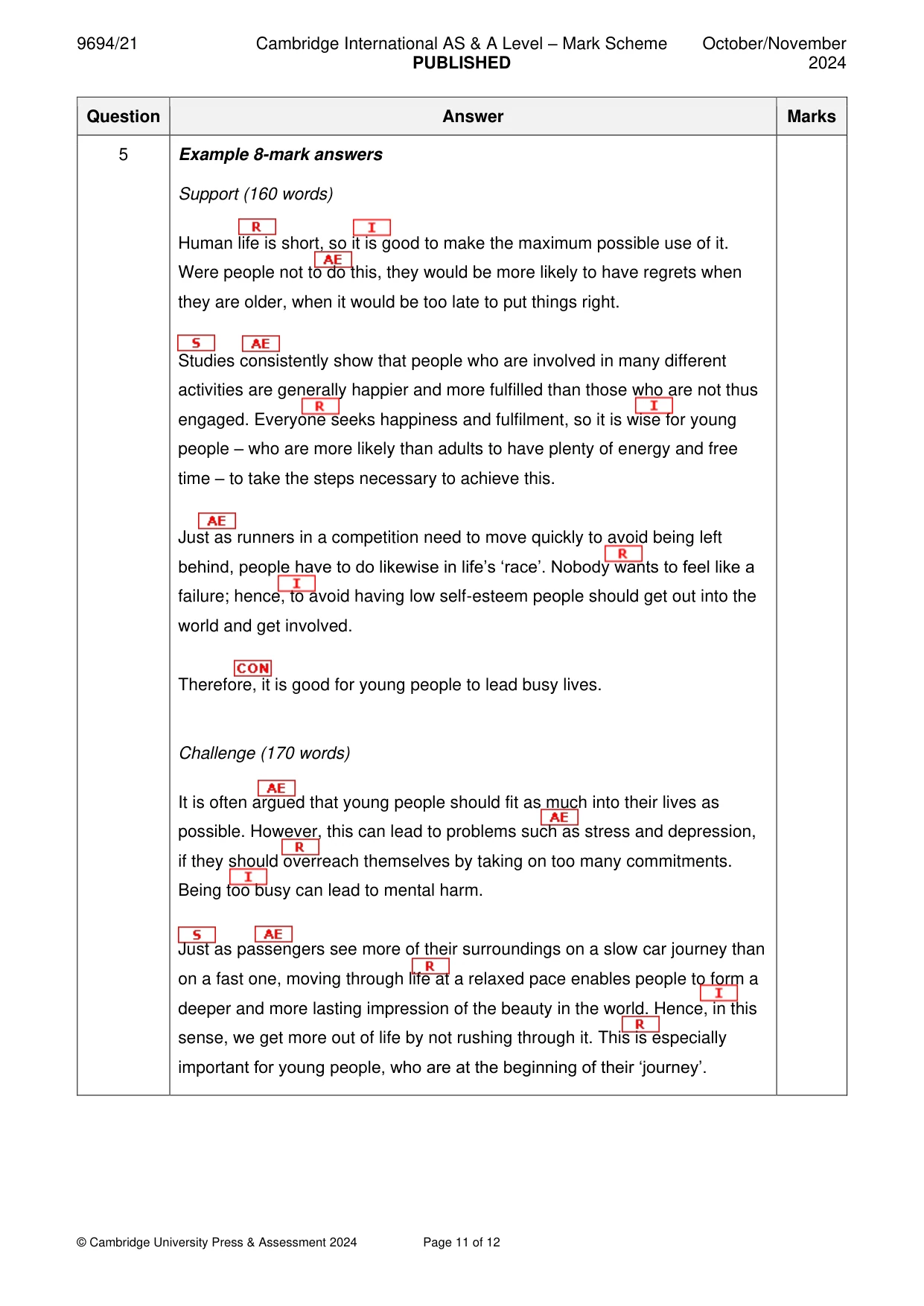
9694/21 Cambridge International AS & A Level – Mark Scheme PUBLISHED October/November 2024 © Cambridge University Press & Assessment 2024 Page 11 of 12 Question Answer Marks 5 Example 8-mark answers Support (160 words) Human life is short, so it is good to make the maximum possible use of it. Were people not to do this, they would be more likely to have regrets when they are older, when it would be too late to put things right. Studies consistently show that people who are involved in many different activities are generally happier and more fulfilled than those who are not thus engaged. Everyone seeks happiness and fulfilment, so it is wise for young people – who are more likely than adults to have plenty of energy and free time – to take the steps necessary to achieve this. Just as runners in a competition need to move quickly to avoid being left behind, people have to do likewise in life’s ‘race’. Nobody wants to feel like a failure; hence, to avoid having low self-esteem people should get out into the world and get involved. Therefore, it is good for young people to lead busy lives. Challenge (170 words) It is often argued that young people should fit as much into their lives as possible. However, this can lead to problems such as stress and depression, if they should overreach themselves by taking on too many commitments. Being too busy can lead to mental harm. Just as passengers see more of their surroundings on a slow car journey than on a fast one, moving through life at a relaxed pace enables people to form a deeper and more lasting impression of the beauty in the world. Hence, in this sense, we get more out of life by not rushing through it. This is especially important for young people, who are at the beginning of their ‘journey’.
Mark scheme, page 12
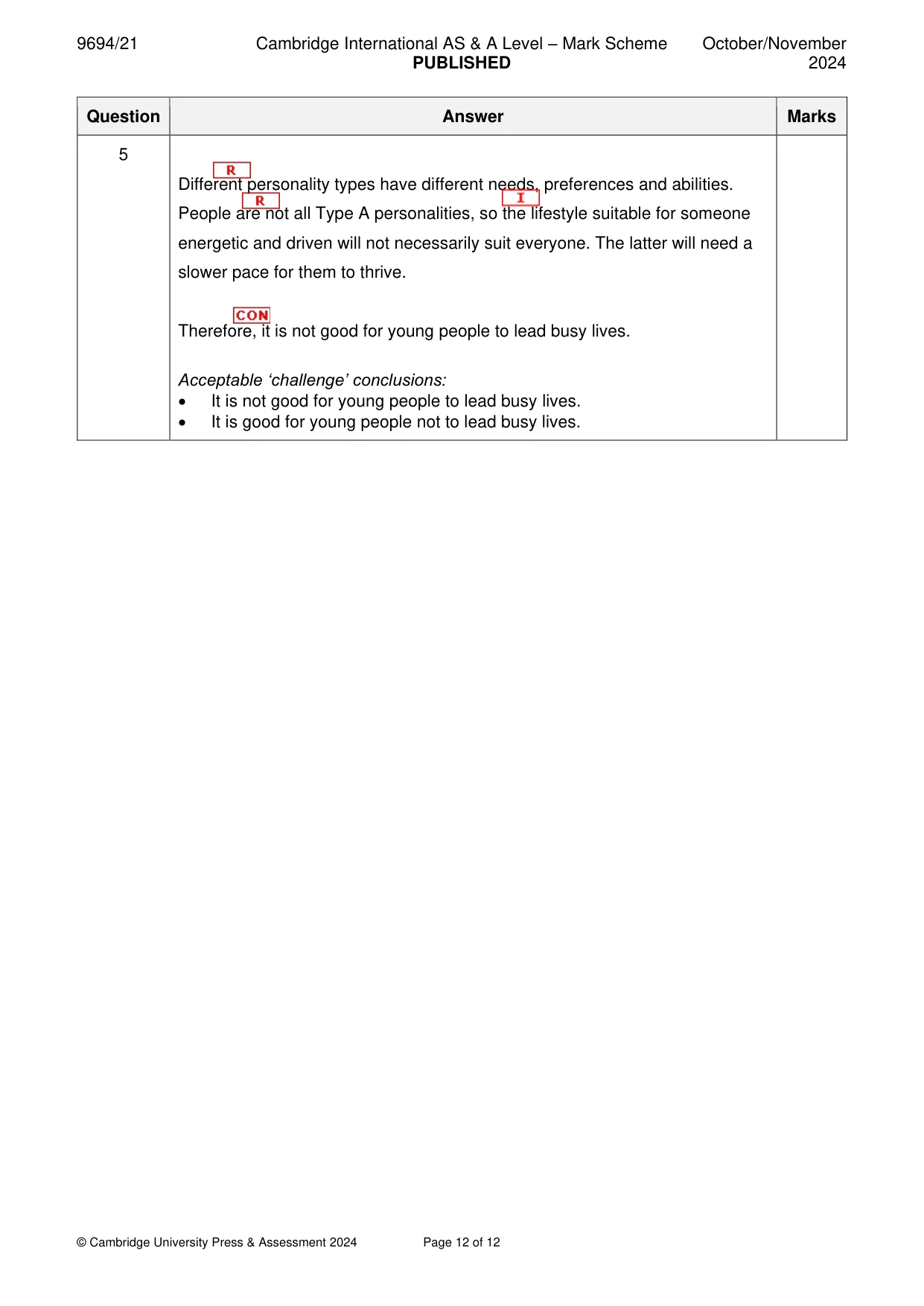
9694/21 Cambridge International AS & A Level – Mark Scheme PUBLISHED October/November 2024 © Cambridge University Press & Assessment 2024 Page 12 of 12 Question Answer Marks 5 Different personality types have different needs, preferences and abilities. People are not all Type A personalities, so the lifestyle suitable for someone energetic and driven will not necessarily suit everyone. The latter will need a slower pace for them to thrive. Therefore, it is not good for young people to lead busy lives. Acceptable ‘challenge’ conclusions: • It is not good for young people to lead busy lives. • It is good for young people not to lead busy lives.
What you needed in this session
Cambridge’s own grade thresholds for 2024 Oct/Nov, Paper 2 · Variant 1. A higher threshold means an easier paper — the bar moves with how the cohort did.