Cambridge A Level Thinking Skills 9694 — 2025 Oct/Nov Paper 2 · Variant 1
9694/21/O/N/25 · 50 marks · ≈56 min
The question paper and its mark scheme, free to read here and free to download. This is Cambridge’s own paper, exactly as it was sat.
Question paper8 pages


Mark scheme14 pages
Answers below. Sit the paper first if you are practising.
Paper as text
Question paper, page 1
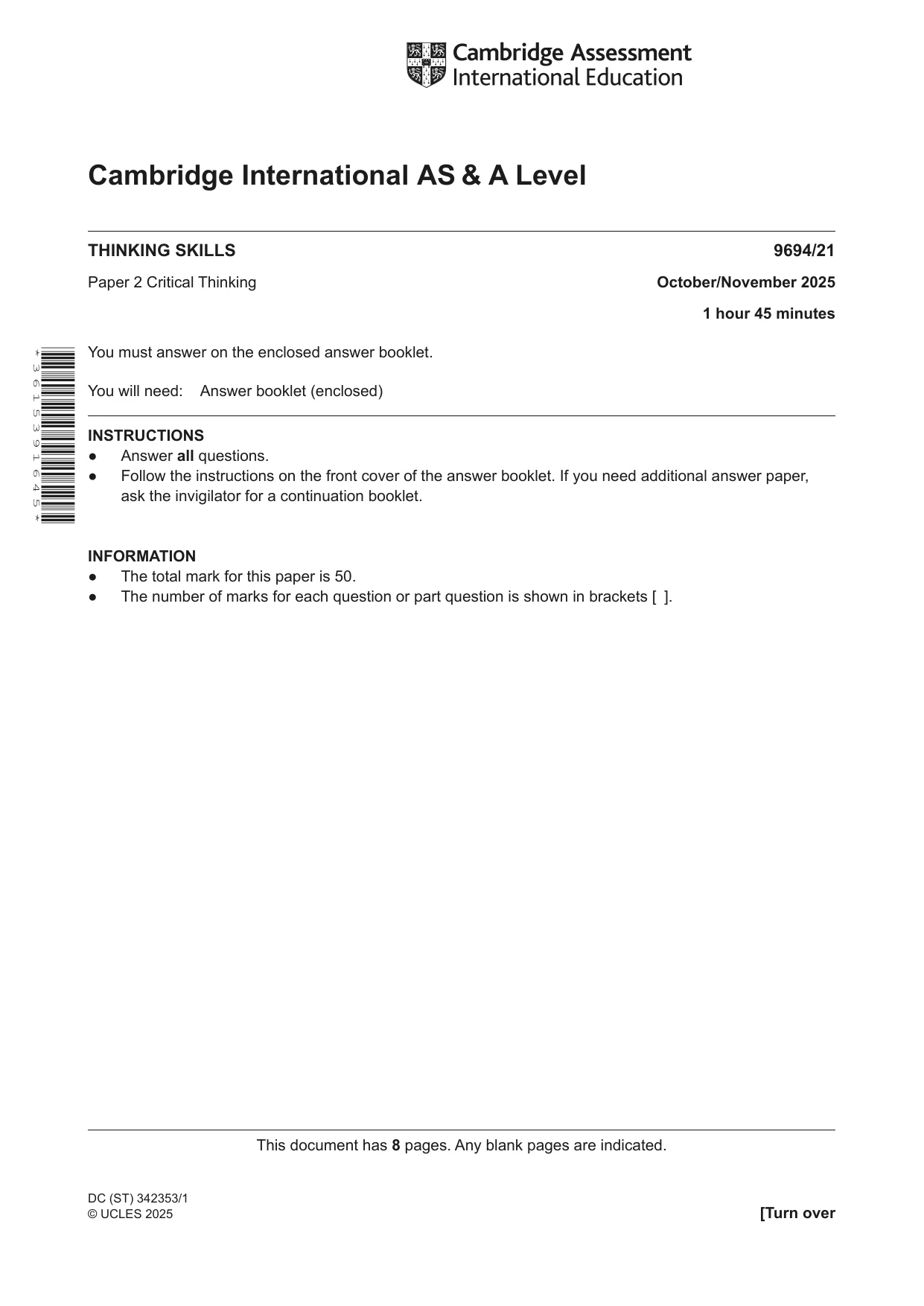
This document has 8 pages. Any blank pages are indicated. [Turn over Cambridge International AS & A Level THINKING SKILLS 9694/21 Paper 2 Critical Thinking October/November 2025 1 hour 45 minutes You must answer on the enclosed answer booklet. You will need: Answer booklet (enclosed) INSTRUCTIONS ● Answer all questions. ● Follow the instructions on the front cover of the answer booklet. If you need additional answer paper, ask the invigilator for a continuation booklet. INFORMATION ● The total mark for this paper is 50. ● The number of marks for each question or part question is shown in brackets [ ]. * 3 6 1 5 3 9 1 6 4 5 * DC (ST) 342353/1 © UCLES 2025
Question paper, page 2
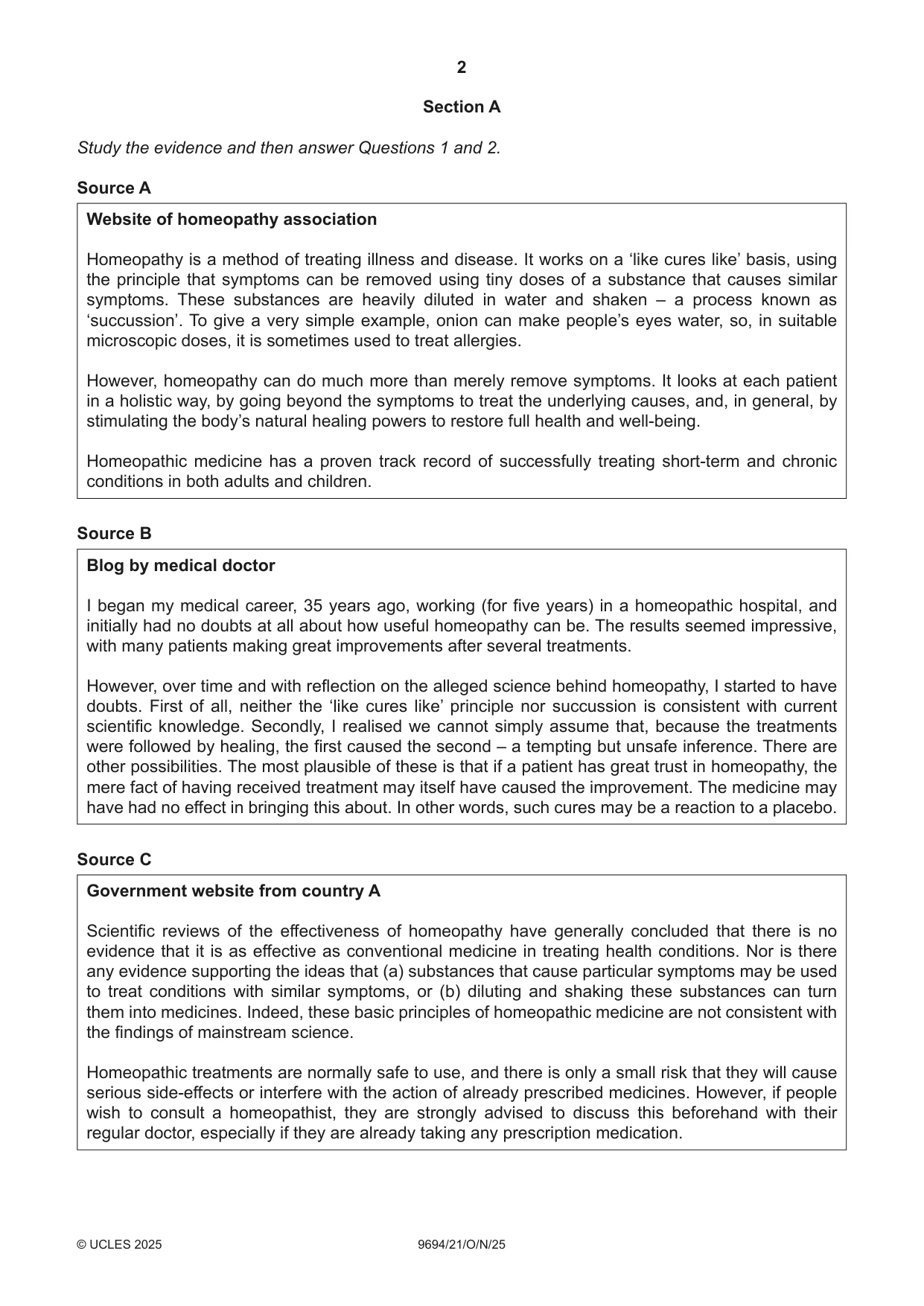
2 9694/21/O/N/25 © UCLES 2025 Section A Study the evidence and then answer Questions 1 and 2. Source A Website of homeopathy association Homeopathy is a method of treating illness and disease. It works on a ‘like cures like’ basis, using the principle that symptoms can be removed using tiny doses of a substance that causes similar symptoms. These substances are heavily diluted in water and shaken – a process known as ‘succussion’. To give a very simple example, onion can make people’s eyes water, so, in suitable microscopic doses, it is sometimes used to treat allergies. However, homeopathy can do much more than merely remove symptoms. It looks at each patient in a holistic way, by going beyond the symptoms to treat the underlying causes, and, in general, by stimulating the body’s natural healing powers to restore full health and well‑being. Homeopathic medicine has a proven track record of successfully treating short‑term and chronic conditions in both adults and children. Source B Blog by medical doctor I began my medical career, 35 years ago, working (for five years) in a homeopathic hospital, and initially had no doubts at all about how useful homeopathy can be. The results seemed impressive, with many patients making great improvements after several treatments. However, over time and with reflection on the alleged science behind homeopathy, I started to have doubts. First of all, neither the ‘like cures like’ principle nor succussion is consistent with current scientific knowledge. Secondly, I realised we cannot simply assume that, because the treatments were followed by healing, the first caused the second – a tempting but unsafe inference. There are other possibilities. The most plausible of these is that if a patient has great trust in homeopathy, the mere fact of having received treatment may itself have caused the improvement. The medicine may have had no effect in bringing this about. In other words, such cures may be a reaction to a placebo. Source C Government website from country A Scientific reviews of the effectiveness of homeopathy have generally concluded that there is no evidence that it is as effective as conventional medicine in treating health conditions. Nor is there any evidence supporting the ideas that (a) substances that cause particular symptoms may be used to treat conditions with similar symptoms, or (b) diluting and shaking these substances can turn them into medicines. Indeed, these basic principles of homeopathic medicine are not consistent with the findings of mainstream science. Homeopathic treatments are normally safe to use, and there is only a small risk that they will cause serious side‑effects or interfere with the action of already prescribed medicines. However, if people wish to consult a homeopathist, they are strongly advised to discuss this beforehand with their regular doctor, especially if they are already taking any prescription medication.
Question paper, page 3
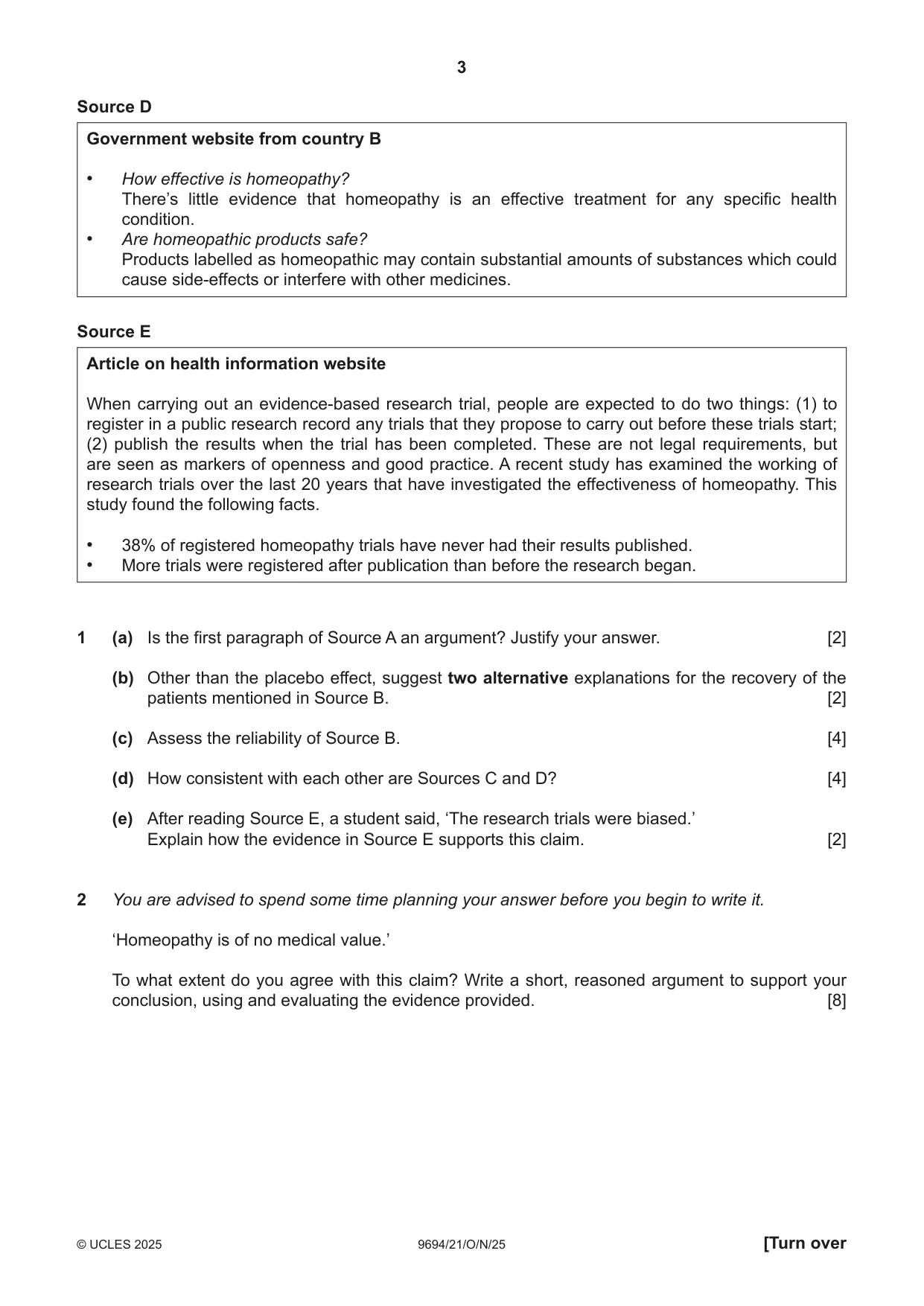
3 9694/21/O/N/25 © UCLES 2025 [Turn over Source D Government website from country B • How effective is homeopathy? There’s little evidence that homeopathy is an effective treatment for any specific health condition. • Are homeopathic products safe? Products labelled as homeopathic may contain substantial amounts of substances which could cause side‑effects or interfere with other medicines. Source E Article on health information website When carrying out an evidence‑based research trial, people are expected to do two things: (1) to register in a public research record any trials that they propose to carry out before these trials start; (2) publish the results when the trial has been completed. These are not legal requirements, but are seen as markers of openness and good practice. A recent study has examined the working of research trials over the last 20 years that have investigated the effectiveness of homeopathy. This study found the following facts. • 38% of registered homeopathy trials have never had their results published. • More trials were registered after publication than before the research began. 1 (a) Is the first paragraph of Source A an argument? Justify your answer. [2] (b) Other than the placebo effect, suggest two alternative explanations for the recovery of the patients mentioned in Source B. [2] (c) Assess the reliability of Source B. [4] (d) How consistent with each other are Sources C and D? [4] (e) After reading Source E, a student said, ‘The research trials were biased.’ Explain how the evidence in Source E supports this claim. [2] 2 You are advised to spend some time planning your answer before you begin to write it. ‘Homeopathy is of no medical value.’ To what extent do you agree with this claim? Write a short, reasoned argument to support your conclusion, using and evaluating the evidence provided. [8]
Question paper, page 4
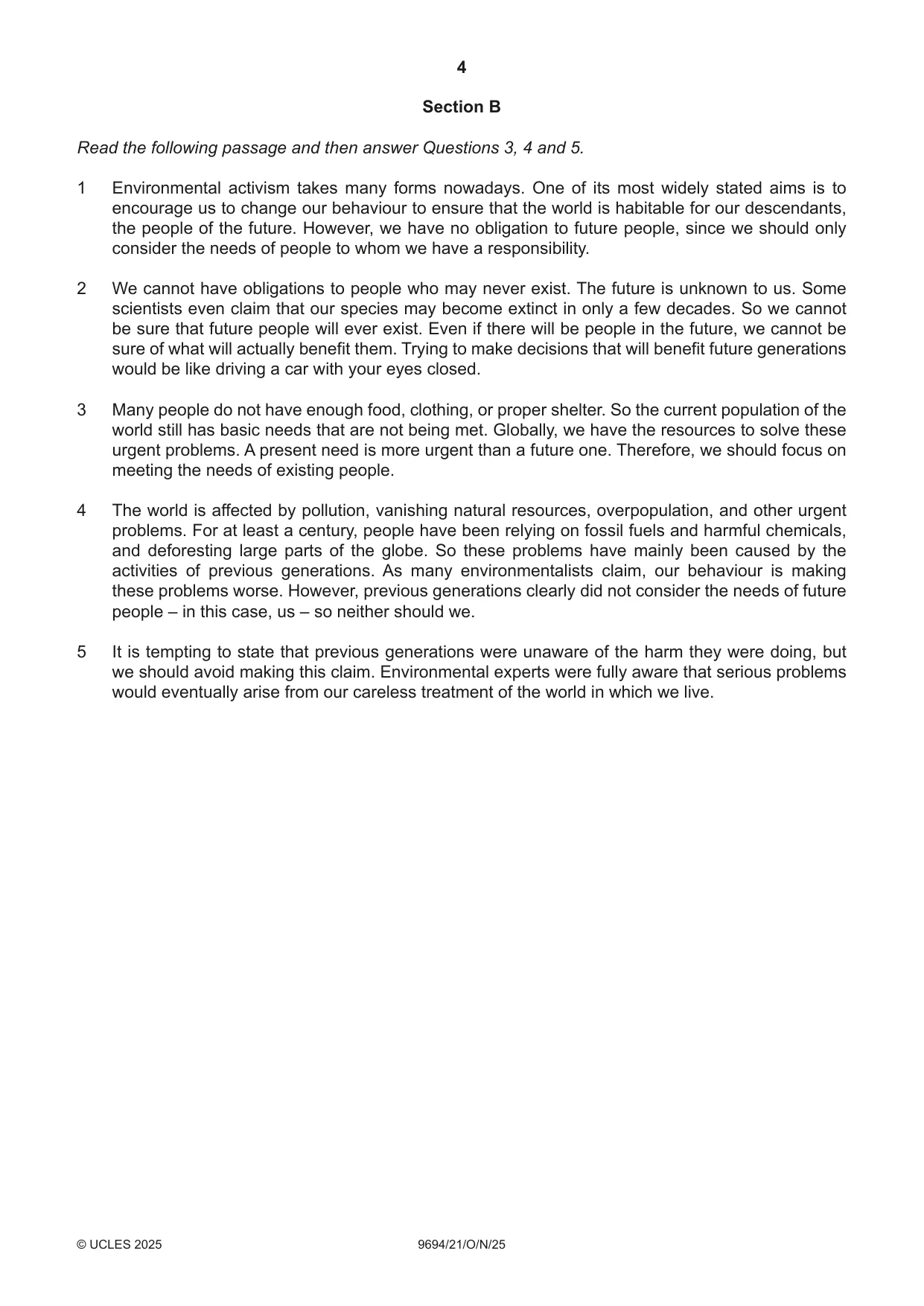
4 9694/21/O/N/25 © UCLES 2025 Section B Read the following passage and then answer Questions 3, 4 and 5. 1 Environmental activism takes many forms nowadays. One of its most widely stated aims is to encourage us to change our behaviour to ensure that the world is habitable for our descendants, the people of the future. However, we have no obligation to future people, since we should only consider the needs of people to whom we have a responsibility. 2 We cannot have obligations to people who may never exist. The future is unknown to us. Some scientists even claim that our species may become extinct in only a few decades. So we cannot be sure that future people will ever exist. Even if there will be people in the future, we cannot be sure of what will actually benefit them. Trying to make decisions that will benefit future generations would be like driving a car with your eyes closed. 3 Many people do not have enough food, clothing, or proper shelter. So the current population of the world still has basic needs that are not being met. Globally, we have the resources to solve these urgent problems. A present need is more urgent than a future one. Therefore, we should focus on meeting the needs of existing people. 4 The world is affected by pollution, vanishing natural resources, overpopulation, and other urgent problems. For at least a century, people have been relying on fossil fuels and harmful chemicals, and deforesting large parts of the globe. So these problems have mainly been caused by the activities of previous generations. As many environmentalists claim, our behaviour is making these problems worse. However, previous generations clearly did not consider the needs of future people – in this case, us – so neither should we. 5 It is tempting to state that previous generations were unaware of the harm they were doing, but we should avoid making this claim. Environmental experts were fully aware that serious problems would eventually arise from our careless treatment of the world in which we live.
Question paper, page 5
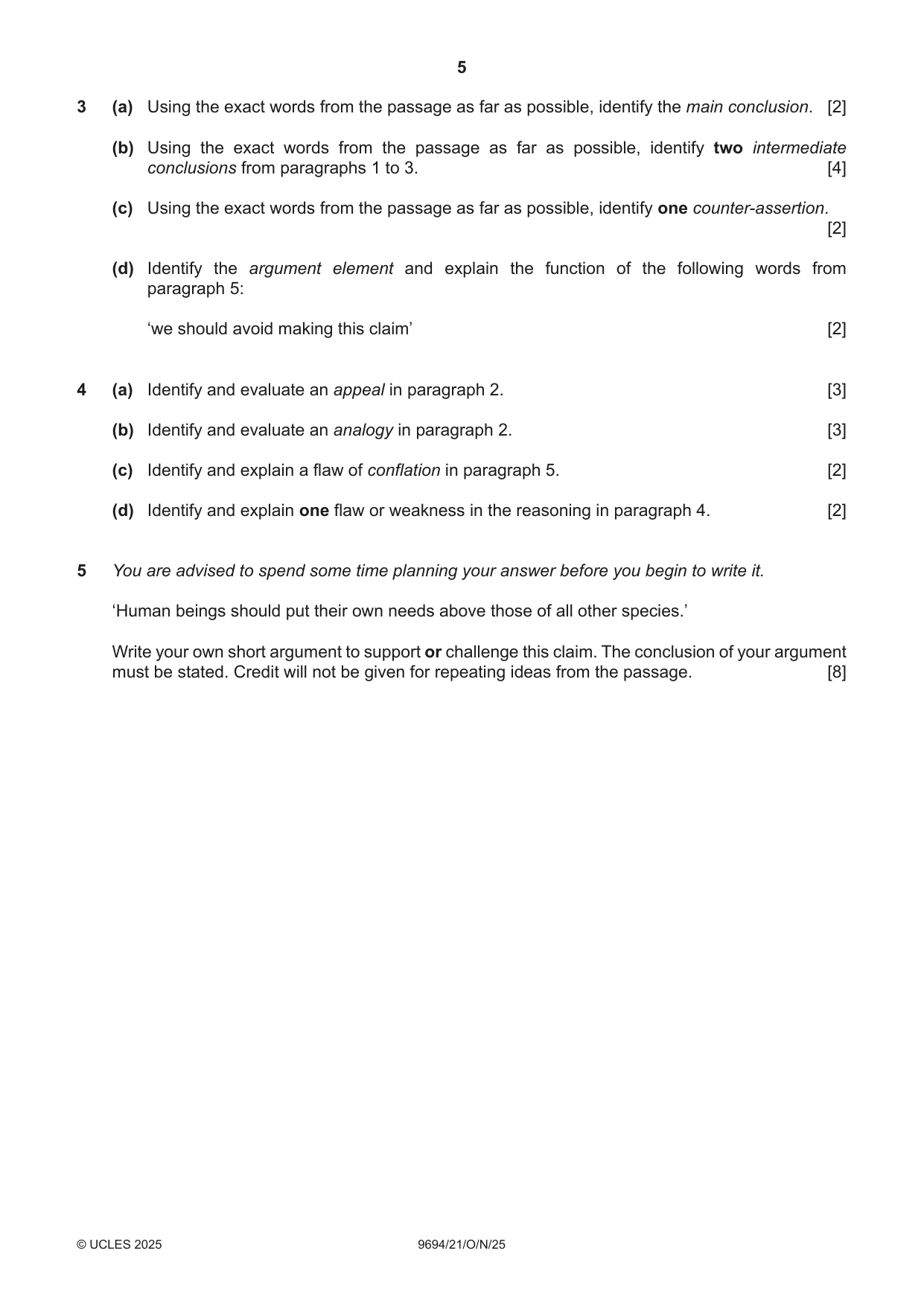
5 9694/21/O/N/25 © UCLES 2025 3 (a) Using the exact words from the passage as far as possible, identify the main conclusion. [2] (b) Using the exact words from the passage as far as possible, identify two intermediate conclusions from paragraphs 1 to 3. [4] (c) Using the exact words from the passage as far as possible, identify one counter‑assertion. [2] (d) Identify the argument element and explain the function of the following words from paragraph 5: ‘we should avoid making this claim’ [2] 4 (a) Identify and evaluate an appeal in paragraph 2. [3] (b) Identify and evaluate an analogy in paragraph 2. [3] (c) Identify and explain a flaw of conflation in paragraph 5. [2] (d) Identify and explain one flaw or weakness in the reasoning in paragraph 4. [2] 5 You are advised to spend some time planning your answer before you begin to write it. ‘Human beings should put their own needs above those of all other species.’ Write your own short argument to support or challenge this claim. The conclusion of your argument must be stated. Credit will not be given for repeating ideas from the passage. [8]
Question paper, page 6
6 9694/21/O/N/25 © UCLES 2025 BLANK PAGE
Question paper, page 7
7 9694/21/O/N/25 © UCLES 2025 BLANK PAGE
Question paper, page 8
8 9694/21/O/N/25 © UCLES 2025 Permission to reproduce items where third‑party owned material protected by copyright is included has been sought and cleared where possible. Every reasonable effort has been made by the publisher (UCLES) to trace copyright holders, but if any items requiring clearance have unwittingly been included, the publisher will be pleased to make amends at the earliest possible opportunity. To avoid the issue of disclosure of answer‑related information to candidates, all copyright acknowledgements are reproduced online in the Cambridge Assessment International Education Copyright Acknowledgements Booklet. This is produced for each series of examinations and is freely available to download at www.cambridgeinternational.org after the live examination series. Cambridge Assessment International Education is part of Cambridge Assessment. Cambridge Assessment is the brand name of the University of Cambridge Local Examinations Syndicate (UCLES), which is a department of the University of Cambridge. BLANK PAGE
Mark scheme, page 1
This document consists of 14 printed pages. © Cambridge University Press & Assessment 2025 [Turn over Cambridge International AS & A Level THINKING SKILLS 9694/21 Paper 2 Critical Thinking October/November 2025 MARK SCHEME Maximum Mark: 50 Published This mark scheme is published as an aid to teachers and candidates, to indicate the requirements of the examination. It shows the basis on which Examiners were instructed to award marks. It does not indicate the details of the discussions that took place at an Examiners’ meeting before marking began, which would have considered the acceptability of alternative answers. Mark schemes should be read in conjunction with the question paper and the Principal Examiner Report for Teachers. Cambridge International will not enter into discussions about these mark schemes. Cambridge International is publishing the mark schemes for the October/November 2025 series for most Cambridge IGCSE, Cambridge International A and AS Level components, and some Cambridge O Level components.
Mark scheme, page 2
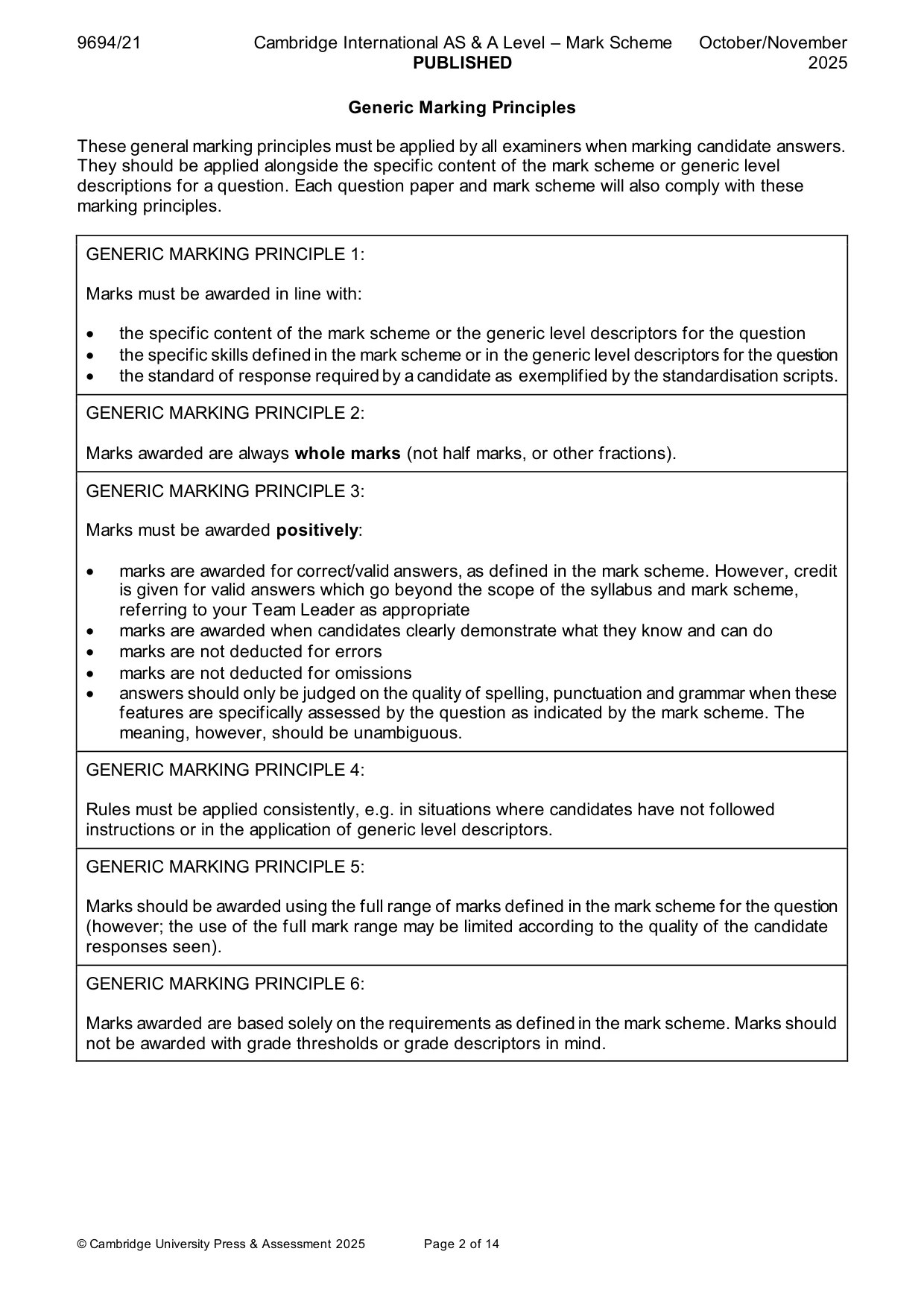
9694/21 Cambridge International AS & A Level – Mark Scheme PUBLISHED October/November 2025 © Cambridge University Press & Assessment 2025 Page 2 of 14 Generic Marking Principles These general marking principles must be applied by all examiners when marking candidate answers. They should be applied alongside the specific content of the mark scheme or generic level descriptions for a question. Each question paper and mark scheme will also comply with these marking principles. GENERIC MARKING PRINCIPLE 1: Marks must be awarded in line with: • the specific content of the mark scheme or the generic level descriptors for the question • the specific skills defined in the mark scheme or in the generic level descriptors for the question • the standard of response required by a candidate as exemplified by the standardisation scripts. GENERIC MARKING PRINCIPLE 2: Marks awarded are always whole marks (not half marks, or other fractions). GENERIC MARKING PRINCIPLE 3: Marks must be awarded positively: • marks are awarded for correct/valid answers, as defined in the mark scheme. However, credit is given for valid answers which go beyond the scope of the syllabus and mark scheme, referring to your Team Leader as appropriate • marks are awarded when candidates clearly demonstrate what they know and can do • marks are not deducted for errors • marks are not deducted for omissions • answers should only be judged on the quality of spelling, punctuation and grammar when these features are specifically assessed by the question as indicated by the mark scheme. The meaning, however, should be unambiguous. GENERIC MARKING PRINCIPLE 4: Rules must be applied consistently, e.g. in situations where candidates have not followed instructions or in the application of generic level descriptors. GENERIC MARKING PRINCIPLE 5: Marks should be awarded using the full range of marks defined in the mark scheme for the question (however; the use of the full mark range may be limited according to the quality of the candidate responses seen). GENERIC MARKING PRINCIPLE 6: Marks awarded are based solely on the requirements as defined in the mark scheme. Marks should not be awarded with grade thresholds or grade descriptors in mind.
Mark scheme, page 3
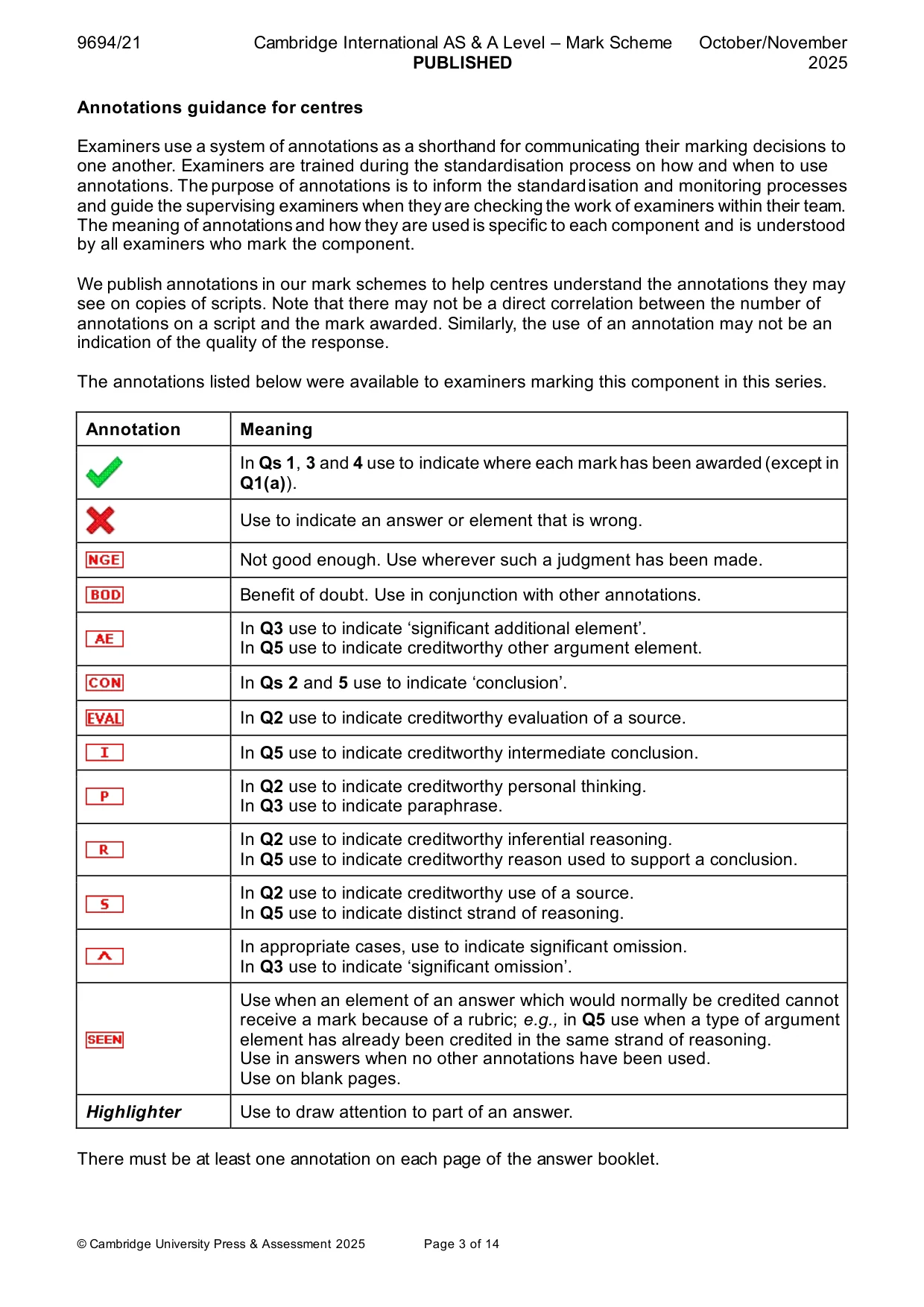
9694/21 Cambridge International AS & A Level – Mark Scheme PUBLISHED October/November 2025 © Cambridge University Press & Assessment 2025 Page 3 of 14 Annotations guidance for centres Examiners use a system of annotations as a shorthand for communicating their marking decisions to one another. Examiners are trained during the standardisation process on how and when to use annotations. The purpose of annotations is to inform the standardisation and monitoring processes and guide the supervising examiners when they are checking the work of examiners within their team. The meaning of annotations and how they are used is specific to each component and is understood by all examiners who mark the component. We publish annotations in our mark schemes to help centres understand the annotations they may see on copies of scripts. Note that there may not be a direct correlation between the number of annotations on a script and the mark awarded. Similarly, the use of an annotation may not be an indication of the quality of the response. The annotations listed below were available to examiners marking this component in this series. Annotation Meaning In Qs 1, 3 and 4 use to indicate where each mark has been awarded (except in Q1(a)). Use to indicate an answer or element that is wrong. Not good enough. Use wherever such a judgment has been made. Benefit of doubt. Use in conjunction with other annotations. In Q3 use to indicate ‘significant additional element’. In Q5 use to indicate creditworthy other argument element. In Qs 2 and 5 use to indicate ‘conclusion’. In Q2 use to indicate creditworthy evaluation of a source. In Q5 use to indicate creditworthy intermediate conclusion. In Q2 use to indicate creditworthy personal thinking. In Q3 use to indicate paraphrase. In Q2 use to indicate creditworthy inferential reasoning. In Q5 use to indicate creditworthy reason used to support a conclusion. In Q2 use to indicate creditworthy use of a source. In Q5 use to indicate distinct strand of reasoning. In appropriate cases, use to indicate significant omission. In Q3 use to indicate ‘significant omission’. Use when an element of an answer which would normally be credited cannot receive a mark because of a rubric; e.g., in Q5 use when a type of argument element has already been credited in the same strand of reasoning. Use in answers when no other annotations have been used. Use on blank pages. Highlighter Use to draw attention to part of an answer. There must be at least one annotation on each page of the answer booklet.
Mark scheme, page 4
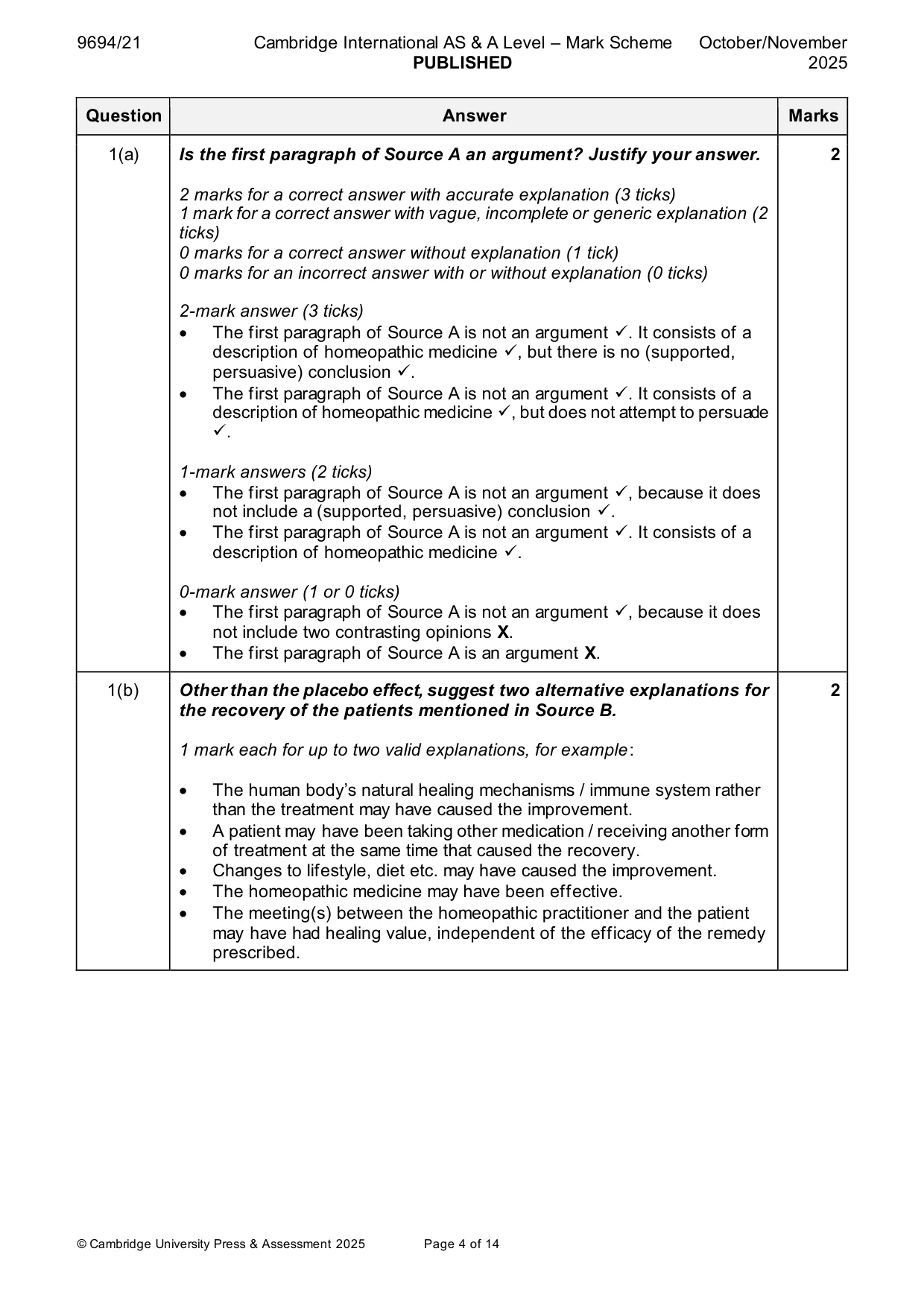
9694/21 Cambridge International AS & A Level – Mark Scheme PUBLISHED October/November 2025 © Cambridge University Press & Assessment 2025 Page 4 of 14 Question Answer Marks 1(a) Is the first paragraph of Source A an argument? Justify your answer. 2 marks for a correct answer with accurate explanation (3 ticks) 1 mark for a correct answer with vague, incomplete or generic explanation (2 ticks) 0 marks for a correct answer without explanation (1 tick) 0 marks for an incorrect answer with or without explanation (0 ticks) 2-mark answer (3 ticks) • The first paragraph of Source A is not an argument ✓. It consists of a description of homeopathic medicine ✓, but there is no (supported, persuasive) conclusion ✓. • The first paragraph of Source A is not an argument ✓. It consists of a description of homeopathic medicine ✓, but does not attempt to persuade ✓. 1-mark answers (2 ticks) • The first paragraph of Source A is not an argument ✓, because it does not include a (supported, persuasive) conclusion ✓. • The first paragraph of Source A is not an argument ✓. It consists of a description of homeopathic medicine ✓. 0-mark answer (1 or 0 ticks) • The first paragraph of Source A is not an argument ✓, because it does not include two contrasting opinions X. • The first paragraph of Source A is an argument X. 2 1(b) Other than the placebo effect, suggest two alternative explanations for the recovery of the patients mentioned in Source B. 1 mark each for up to two valid explanations, for example: • The human body’s natural healing mechanisms / immune system rather than the treatment may have caused the improvement. • A patient may have been taking other medication / receiving another form of treatment at the same time that caused the recovery. • Changes to lifestyle, diet etc. may have caused the improvement. • The homeopathic medicine may have been effective. • The meeting(s) between the homeopathic practitioner and the patient may have had healing value, independent of the efficacy of the remedy prescribed. 2
Mark scheme, page 5
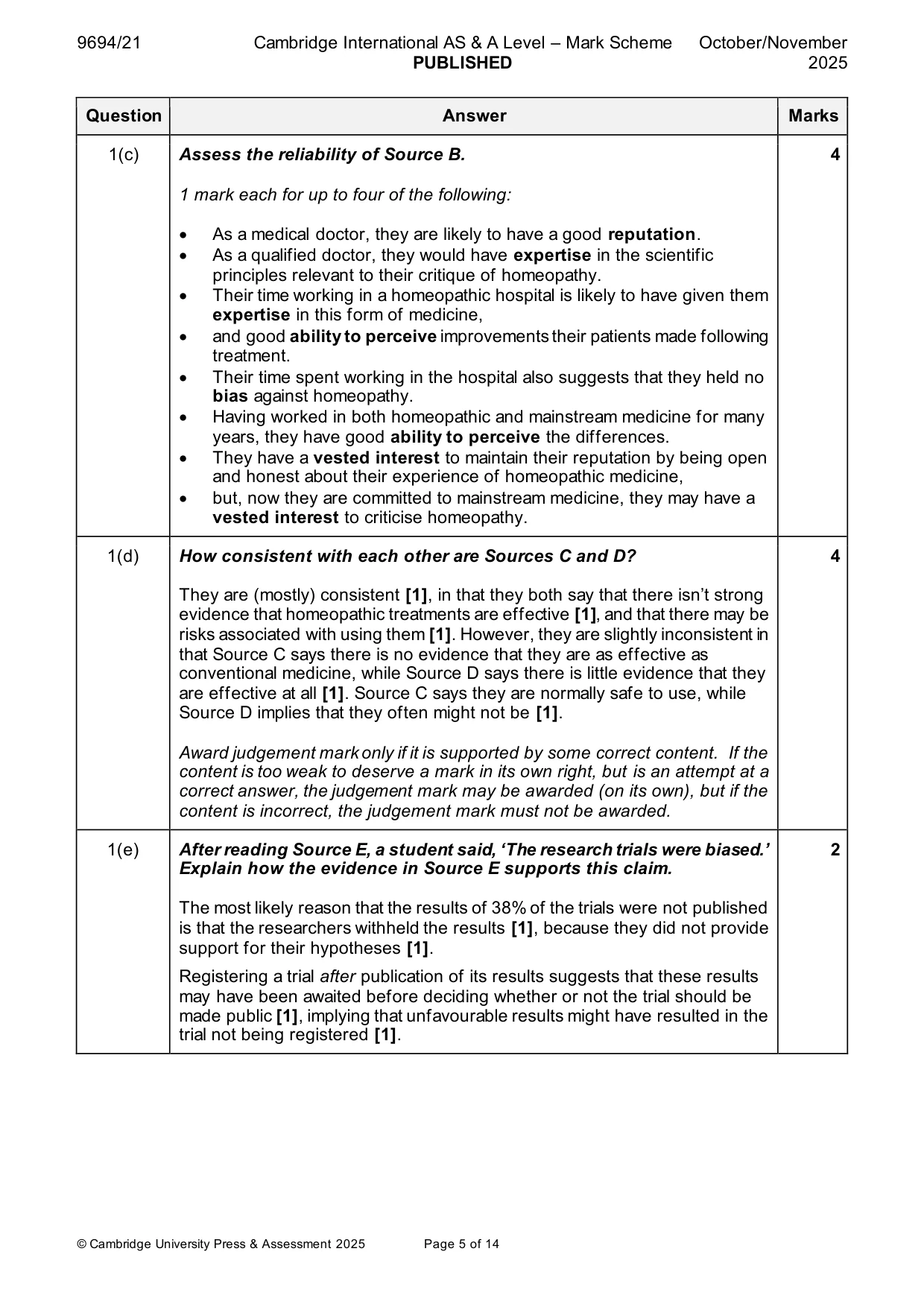
9694/21 Cambridge International AS & A Level – Mark Scheme PUBLISHED October/November 2025 © Cambridge University Press & Assessment 2025 Page 5 of 14 Question Answer Marks 1(c) Assess the reliability of Source B. 1 mark each for up to four of the following: • As a medical doctor, they are likely to have a good reputation. • As a qualified doctor, they would have expertise in the scientific principles relevant to their critique of homeopathy. • Their time working in a homeopathic hospital is likely to have given them expertise in this form of medicine, • and good ability to perceive improvements their patients made following treatment. • Their time spent working in the hospital also suggests that they held no bias against homeopathy. • Having worked in both homeopathic and mainstream medicine for many years, they have good ability to perceive the differences. • They have a vested interest to maintain their reputation by being open and honest about their experience of homeopathic medicine, • but, now they are committed to mainstream medicine, they may have a vested interest to criticise homeopathy. 4 1(d) How consistent with each other are Sources C and D? They are (mostly) consistent [1], in that they both say that there isn’t strong evidence that homeopathic treatments are effective [1], and that there may be risks associated with using them [1]. However, they are slightly inconsistent in that Source C says there is no evidence that they are as effective as conventional medicine, while Source D says there is little evidence that they are effective at all [1]. Source C says they are normally safe to use, while Source D implies that they often might not be [1]. Award judgement mark only if it is supported by some correct content. If the content is too weak to deserve a mark in its own right, but is an attempt at a correct answer, the judgement mark may be awarded (on its own), but if the content is incorrect, the judgement mark must not be awarded. 4 1(e) After reading Source E, a student said, ‘The research trials were biased.’ Explain how the evidence in Source E supports this claim. The most likely reason that the results of 38% of the trials were not published is that the researchers withheld the results [1], because they did not provide support for their hypotheses [1]. Registering a trial after publication of its results suggests that these results may have been awaited before deciding whether or not the trial should be made public [1], implying that unfavourable results might have resulted in the trial not being registered [1]. 2
Mark scheme, page 6
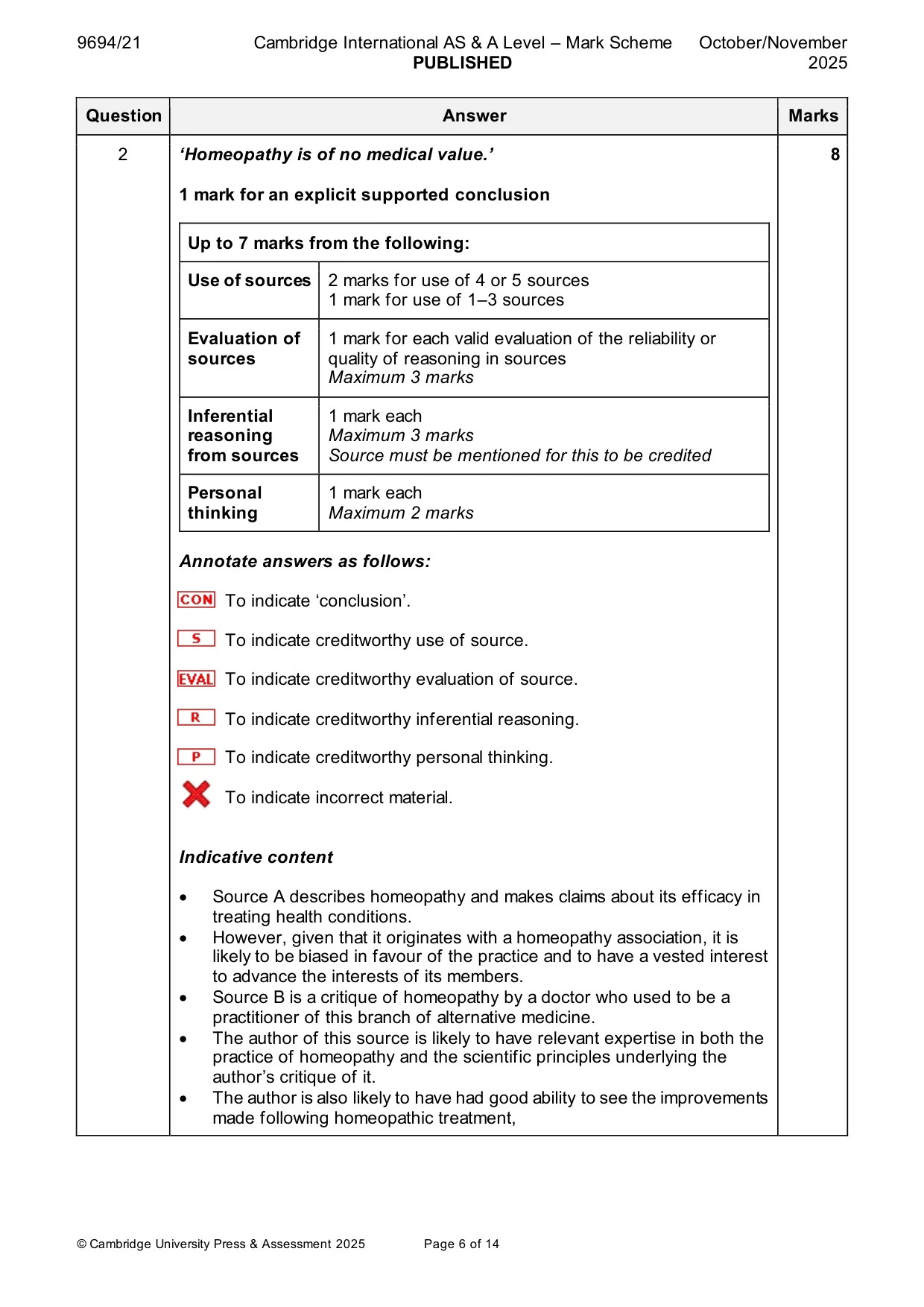
9694/21 Cambridge International AS & A Level – Mark Scheme PUBLISHED October/November 2025 © Cambridge University Press & Assessment 2025 Page 6 of 14 Question Answer Marks 2 ‘Homeopathy is of no medical value.’ 1 mark for an explicit supported conclusion Up to 7 marks from the following: Use of sources 2 marks for use of 4 or 5 sources 1 mark for use of 1–3 sources Evaluation of sources 1 mark for each valid evaluation of the reliability or quality of reasoning in sources Maximum 3 marks Inferential reasoning from sources 1 mark each Maximum 3 marks Source must be mentioned for this to be credited Personal thinking 1 mark each Maximum 2 marks Annotate answers as follows: To indicate ‘conclusion’. To indicate creditworthy use of source. To indicate creditworthy evaluation of source. To indicate creditworthy inferential reasoning. To indicate creditworthy personal thinking. To indicate incorrect material. Indicative content • Source A describes homeopathy and makes claims about its efficacy in treating health conditions. • However, given that it originates with a homeopathy association, it is likely to be biased in favour of the practice and to have a vested interest to advance the interests of its members. • Source B is a critique of homeopathy by a doctor who used to be a practitioner of this branch of alternative medicine. • The author of this source is likely to have relevant expertise in both the practice of homeopathy and the scientific principles underlying the author’s critique of it. • The author is also likely to have had good ability to see the improvements made following homeopathic treatment, 8
Mark scheme, page 7
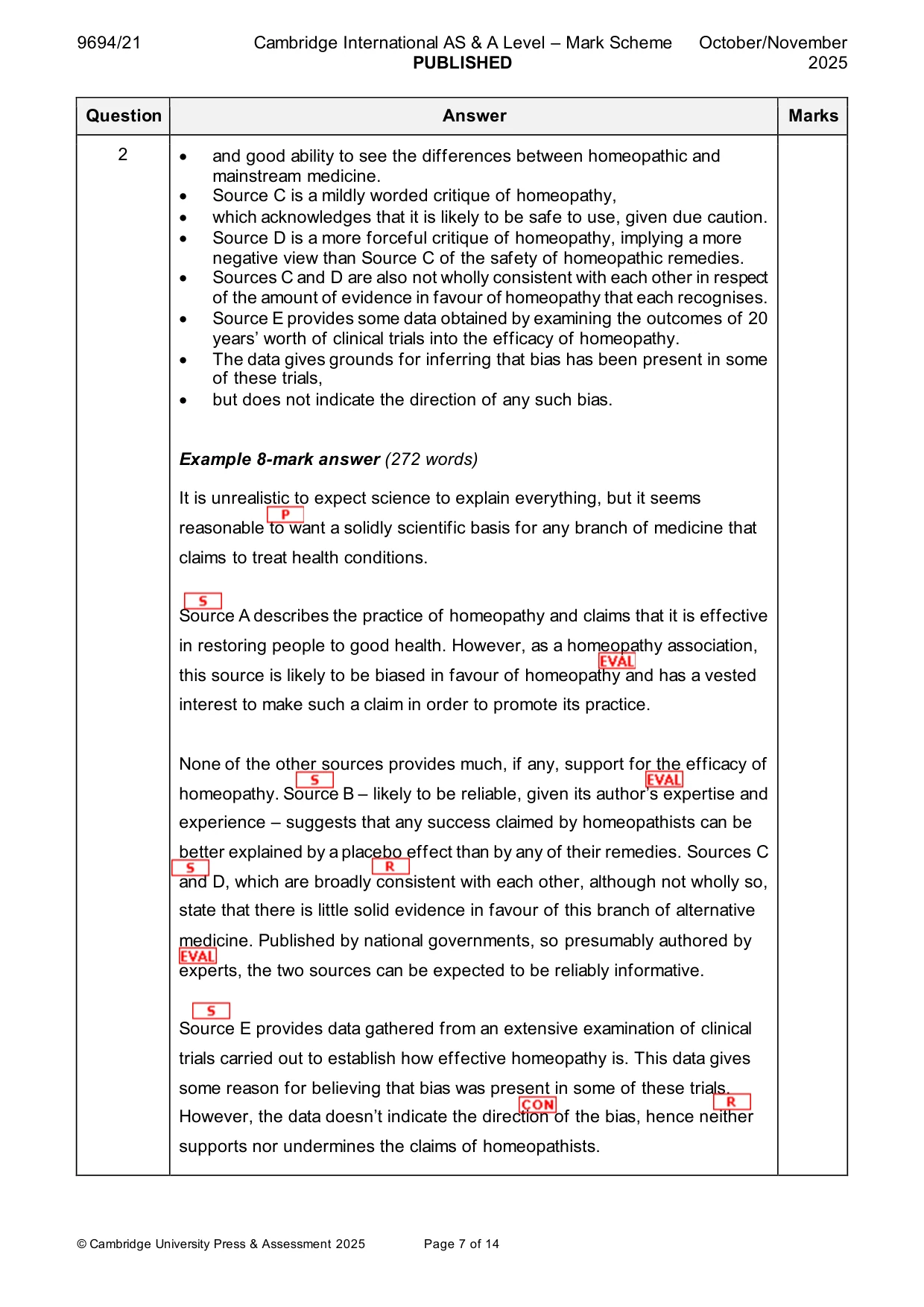
9694/21 Cambridge International AS & A Level – Mark Scheme PUBLISHED October/November 2025 © Cambridge University Press & Assessment 2025 Page 7 of 14 Question Answer Marks 2 • and good ability to see the differences between homeopathic and mainstream medicine. • Source C is a mildly worded critique of homeopathy, • which acknowledges that it is likely to be safe to use, given due caution. • Source D is a more forceful critique of homeopathy, implying a more negative view than Source C of the safety of homeopathic remedies. • Sources C and D are also not wholly consistent with each other in respect of the amount of evidence in favour of homeopathy that each recognises. • Source E provides some data obtained by examining the outcomes of 20 years’ worth of clinical trials into the efficacy of homeopathy. • The data gives grounds for inferring that bias has been present in some of these trials, • but does not indicate the direction of any such bias. Example 8-mark answer (272 words) It is unrealistic to expect science to explain everything, but it seems reasonable to want a solidly scientific basis for any branch of medicine that claims to treat health conditions. Source A describes the practice of homeopathy and claims that it is effective in restoring people to good health. However, as a homeopathy association, this source is likely to be biased in favour of homeopathy and has a vested interest to make such a claim in order to promote its practice. None of the other sources provides much, if any, support for the efficacy of homeopathy. Source B – likely to be reliable, given its author’s expertise and experience – suggests that any success claimed by homeopathists can be better explained by a placebo effect than by any of their remedies. Sources C and D, which are broadly consistent with each other, although not wholly so, state that there is little solid evidence in favour of this branch of alternative medicine. Published by national governments, so presumably authored by experts, the two sources can be expected to be reliably informative. Source E provides data gathered from an extensive examination of clinical trials carried out to establish how effective homeopathy is. This data gives some reason for believing that bias was present in some of these trials. However, the data doesn’t indicate the direction of the bias, hence neither supports nor undermines the claims of homeopathists.
Mark scheme, page 8
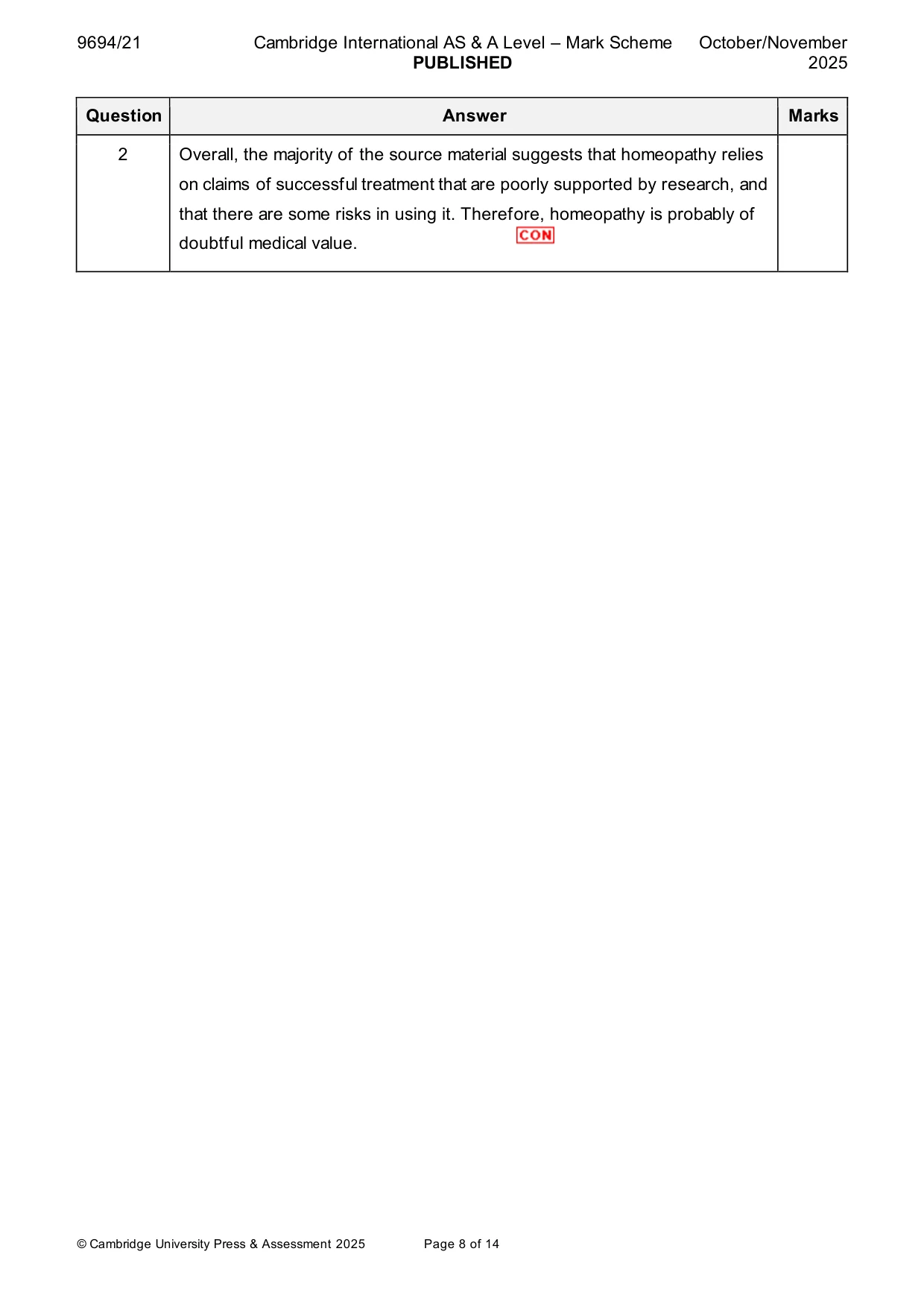
9694/21 Cambridge International AS & A Level – Mark Scheme PUBLISHED October/November 2025 © Cambridge University Press & Assessment 2025 Page 8 of 14 Question Answer Marks 2 Overall, the majority of the source material suggests that homeopathy relies on claims of successful treatment that are poorly supported by research, and that there are some risks in using it. Therefore, homeopathy is probably of doubtful medical value.
Mark scheme, page 9
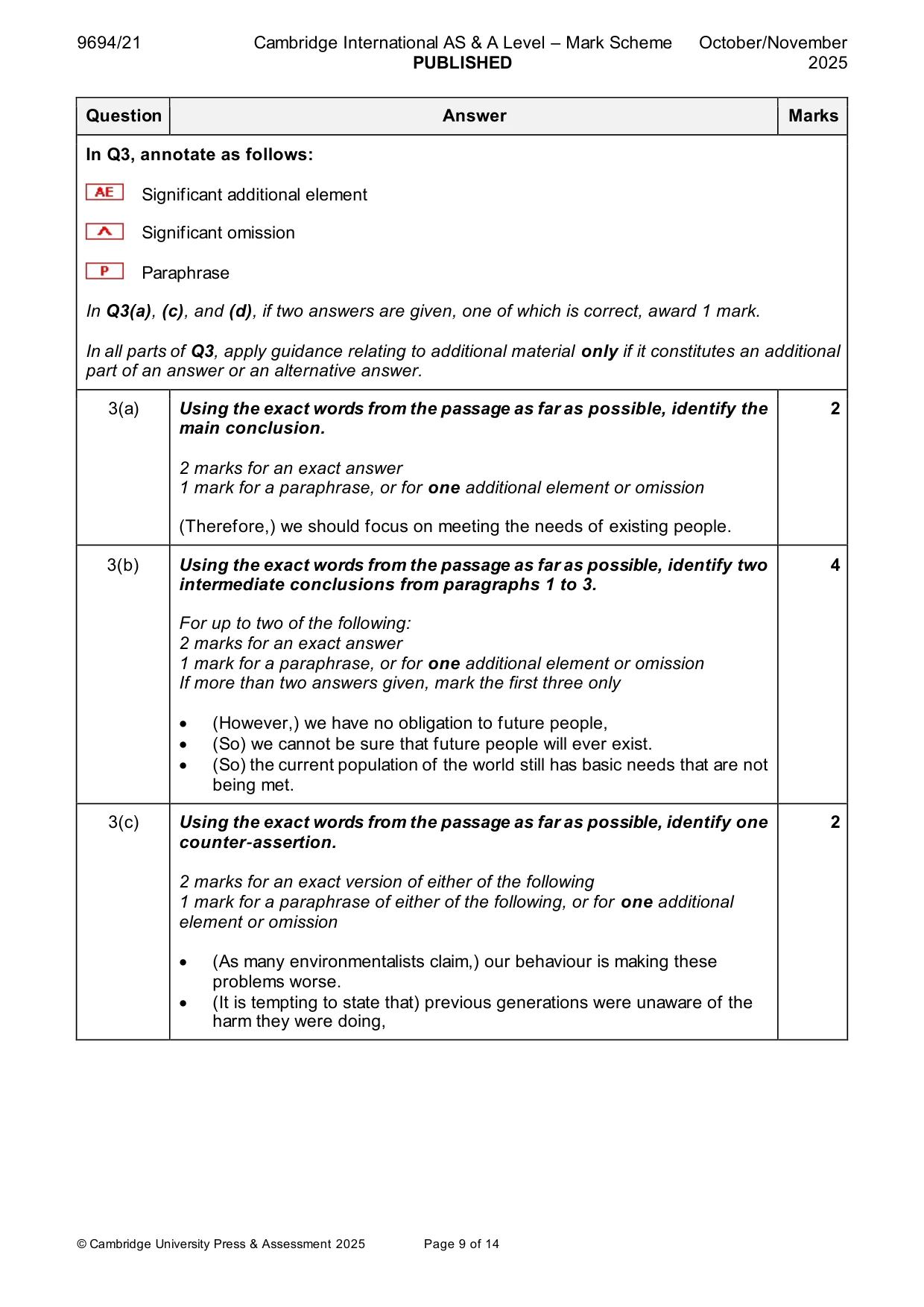
9694/21 Cambridge International AS & A Level – Mark Scheme PUBLISHED October/November 2025 © Cambridge University Press & Assessment 2025 Page 9 of 14 Question Answer Marks In Q3, annotate as follows: Significant additional element Significant omission Paraphrase In Q3(a), (c), and (d), if two answers are given, one of which is correct, award 1 mark. In all parts of Q3, apply guidance relating to additional material only if it constitutes an additional part of an answer or an alternative answer. 3(a) Using the exact words from the passage as far as possible, identify the main conclusion. 2 marks for an exact answer 1 mark for a paraphrase, or for one additional element or omission (Therefore,) we should focus on meeting the needs of existing people. 2 3(b) Using the exact words from the passage as far as possible, identify two intermediate conclusions from paragraphs 1 to 3. For up to two of the following: 2 marks for an exact answer 1 mark for a paraphrase, or for one additional element or omission If more than two answers given, mark the first three only • (However,) we have no obligation to future people, • (So) we cannot be sure that future people will ever exist. • (So) the current population of the world still has basic needs that are not being met. 4 3(c) Using the exact words from the passage as far as possible, identify one counter‑assertion. 2 marks for an exact version of either of the following 1 mark for a paraphrase of either of the following, or for one additional element or omission • (As many environmentalists claim,) our behaviour is making these problems worse. • (It is tempting to state that) previous generations were unaware of the harm they were doing, 2
Mark scheme, page 10
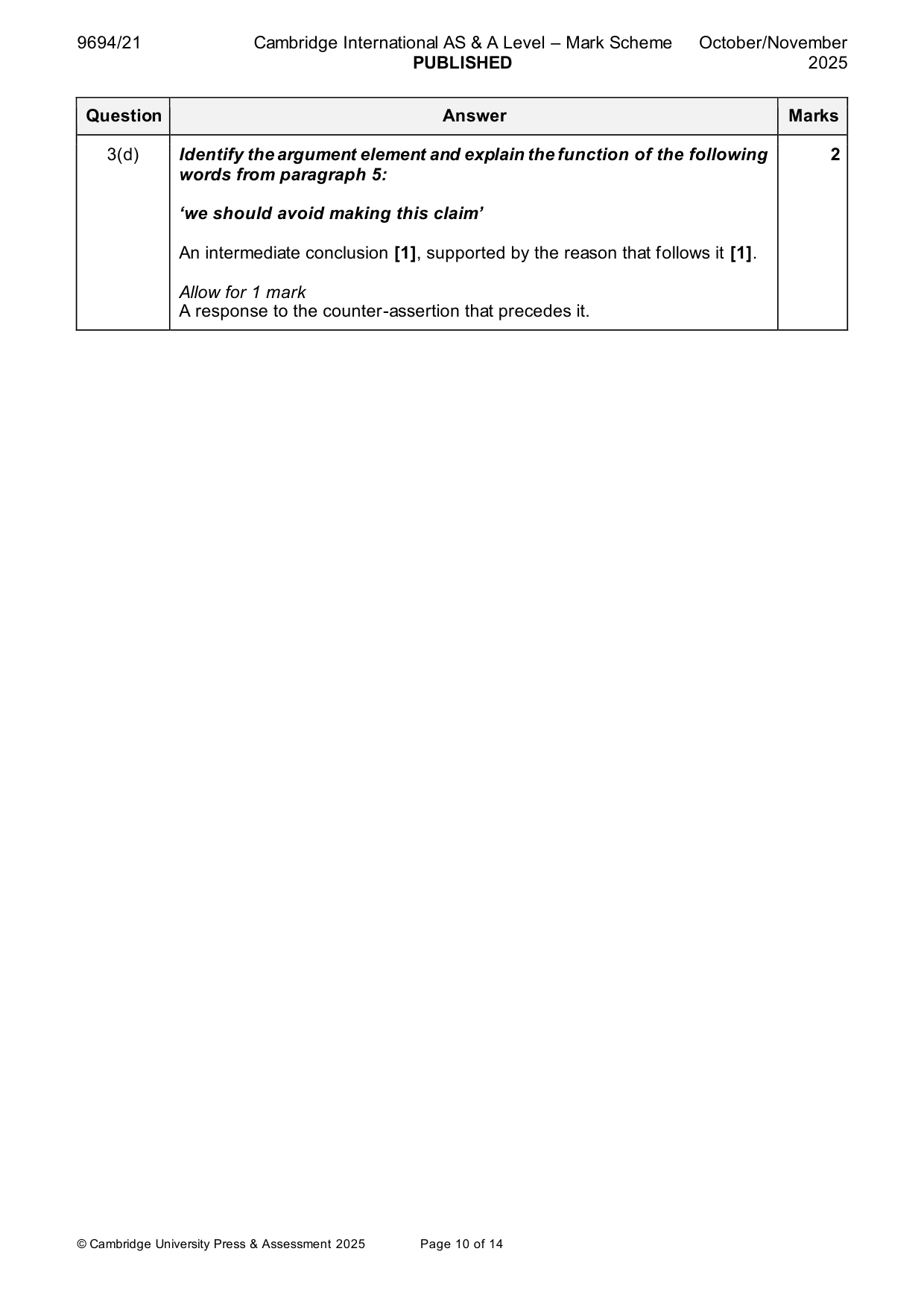
9694/21 Cambridge International AS & A Level – Mark Scheme PUBLISHED October/November 2025 © Cambridge University Press & Assessment 2025 Page 10 of 14 Question Answer Marks 3(d) Identify the argument element and explain the function of the following words from paragraph 5: ‘we should avoid making this claim’ An intermediate conclusion [1], supported by the reason that follows it [1]. Allow for 1 mark A response to the counter-assertion that precedes it. 2
Mark scheme, page 11
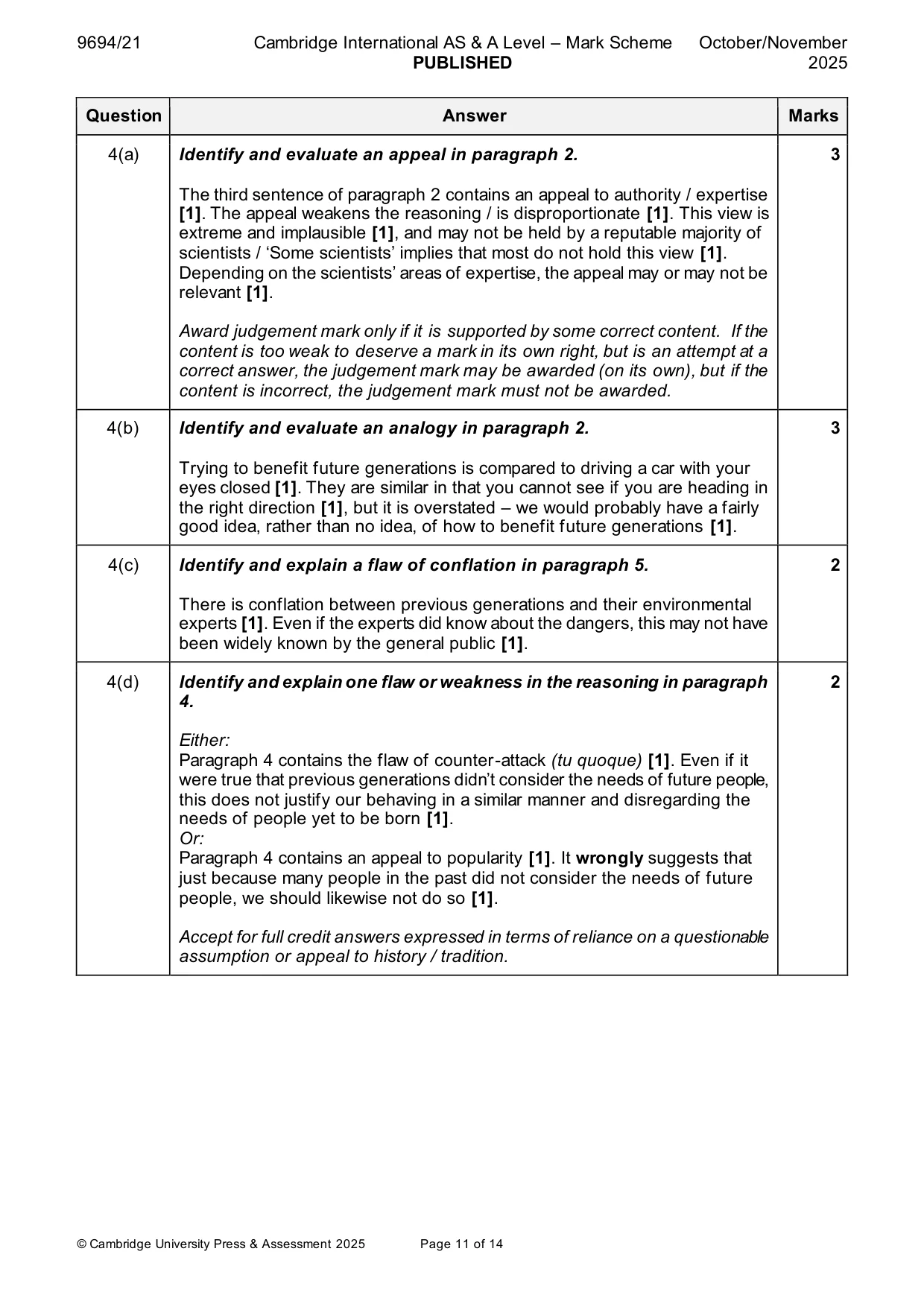
9694/21 Cambridge International AS & A Level – Mark Scheme PUBLISHED October/November 2025 © Cambridge University Press & Assessment 2025 Page 11 of 14 Question Answer Marks 4(a) Identify and evaluate an appeal in paragraph 2. The third sentence of paragraph 2 contains an appeal to authority / expertise [1]. The appeal weakens the reasoning / is disproportionate [1]. This view is extreme and implausible [1], and may not be held by a reputable majority of scientists / ‘Some scientists’ implies that most do not hold this view [1]. Depending on the scientists’ areas of expertise, the appeal may or may not be relevant [1]. Award judgement mark only if it is supported by some correct content. If the content is too weak to deserve a mark in its own right, but is an attempt at a correct answer, the judgement mark may be awarded (on its own), but if the content is incorrect, the judgement mark must not be awarded. 3 4(b) Identify and evaluate an analogy in paragraph 2. Trying to benefit future generations is compared to driving a car with your eyes closed [1]. They are similar in that you cannot see if you are heading in the right direction [1], but it is overstated – we would probably have a fairly good idea, rather than no idea, of how to benefit future generations [1]. 3 4(c) Identify and explain a flaw of conflation in paragraph 5. There is conflation between previous generations and their environmental experts [1]. Even if the experts did know about the dangers, this may not have been widely known by the general public [1]. 2 4(d) Identify and explain one flaw or weakness in the reasoning in paragraph 4. Either: Paragraph 4 contains the flaw of counter-attack (tu quoque) [1]. Even if it were true that previous generations didn’t consider the needs of future people, this does not justify our behaving in a similar manner and disregarding the needs of people yet to be born [1]. Or: Paragraph 4 contains an appeal to popularity [1]. It wrongly suggests that just because many people in the past did not consider the needs of future people, we should likewise not do so [1]. Accept for full credit answers expressed in terms of reliance on a questionable assumption or appeal to history / tradition. 2
Mark scheme, page 12
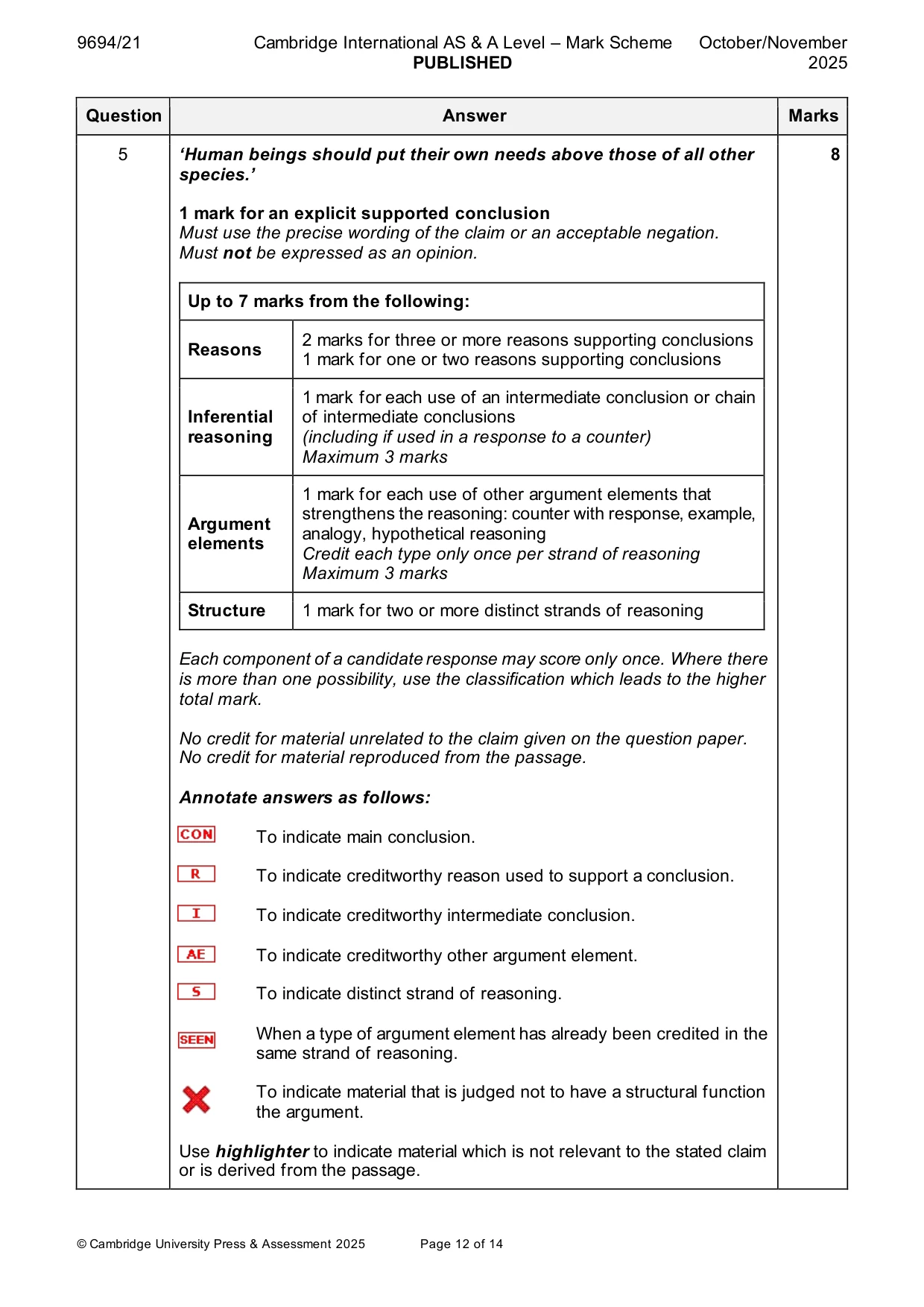
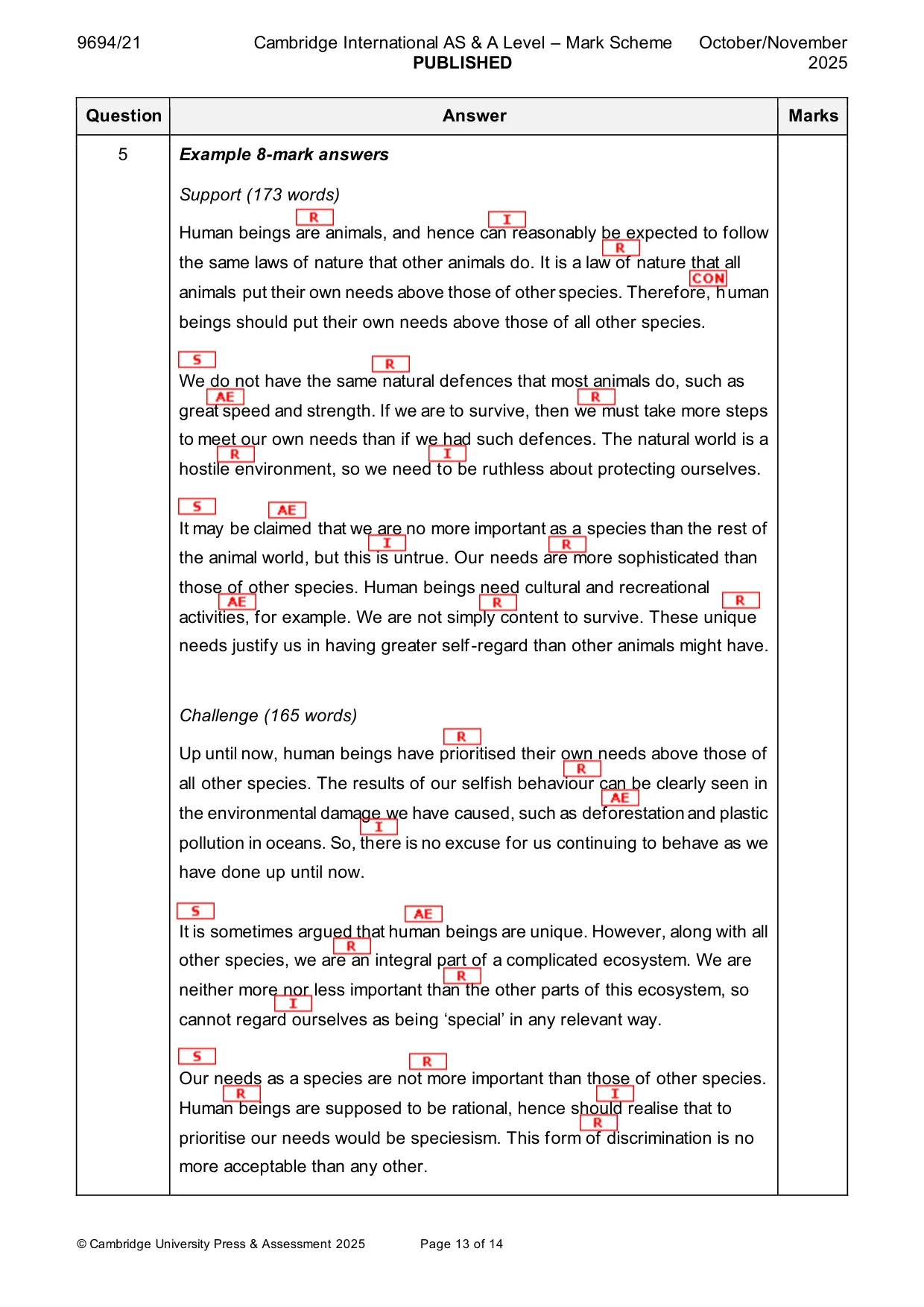
9694/21 Cambridge International AS & A Level – Mark Scheme PUBLISHED October/November 2025 © Cambridge University Press & Assessment 2025 Page 12 of 14 Question Answer Marks 5 ‘Human beings should put their own needs above those of all other species.’ 1 mark for an explicit supported conclusion Must use the precise wording of the claim or an acceptable negation. Must not be expressed as an opinion. Up to 7 marks from the following: Reasons 2 marks for three or more reasons supporting conclusions 1 mark for one or two reasons supporting conclusions Inferential reasoning 1 mark for each use of an intermediate conclusion or chain of intermediate conclusions (including if used in a response to a counter) Maximum 3 marks Argument elements 1 mark for each use of other argument elements that strengthens the reasoning: counter with response, example, analogy, hypothetical reasoning Credit each type only once per strand of reasoning Maximum 3 marks Structure 1 mark for two or more distinct strands of reasoning Each component of a candidate response may score only once. Where there is more than one possibility, use the classification which leads to the higher total mark. No credit for material unrelated to the claim given on the question paper. No credit for material reproduced from the passage. Annotate answers as follows: To indicate main conclusion. To indicate creditworthy reason used to support a conclusion. To indicate creditworthy intermediate conclusion. To indicate creditworthy other argument element. To indicate distinct strand of reasoning. When a type of argument element has already been credited in the same strand of reasoning. To indicate material that is judged not to have a structural function in the argument. Use highlighter to indicate material which is not relevant to the stated claim or is derived from the passage. 8
Mark scheme, page 13
9694/21 Cambridge International AS & A Level – Mark Scheme PUBLISHED October/November 2025 © Cambridge University Press & Assessment 2025 Page 13 of 14 Question Answer Marks 5 Example 8-mark answers Support (173 words) Human beings are animals, and hence can reasonably be expected to follow the same laws of nature that other animals do. It is a law of nature that all animals put their own needs above those of other species. Therefore, human beings should put their own needs above those of all other species. We do not have the same natural defences that most animals do, such as great speed and strength. If we are to survive, then we must take more steps to meet our own needs than if we had such defences. The natural world is a hostile environment, so we need to be ruthless about protecting ourselves. It may be claimed that we are no more important as a species than the rest of the animal world, but this is untrue. Our needs are more sophisticated than those of other species. Human beings need cultural and recreational activities, for example. We are not simply content to survive. These unique needs justify us in having greater self-regard than other animals might have. Challenge (165 words) Up until now, human beings have prioritised their own needs above those of all other species. The results of our selfish behaviour can be clearly seen in the environmental damage we have caused, such as deforestation and plastic pollution in oceans. So, there is no excuse for us continuing to behave as we have done up until now. It is sometimes argued that human beings are unique. However, along with all other species, we are an integral part of a complicated ecosystem. We are neither more nor less important than the other parts of this ecosystem, so cannot regard ourselves as being ‘special’ in any relevant way. Our needs as a species are not more important than those of other species. Human beings are supposed to be rational, hence should realise that to prioritise our needs would be speciesism. This form of discrimination is no more acceptable than any other.
Mark scheme, page 14
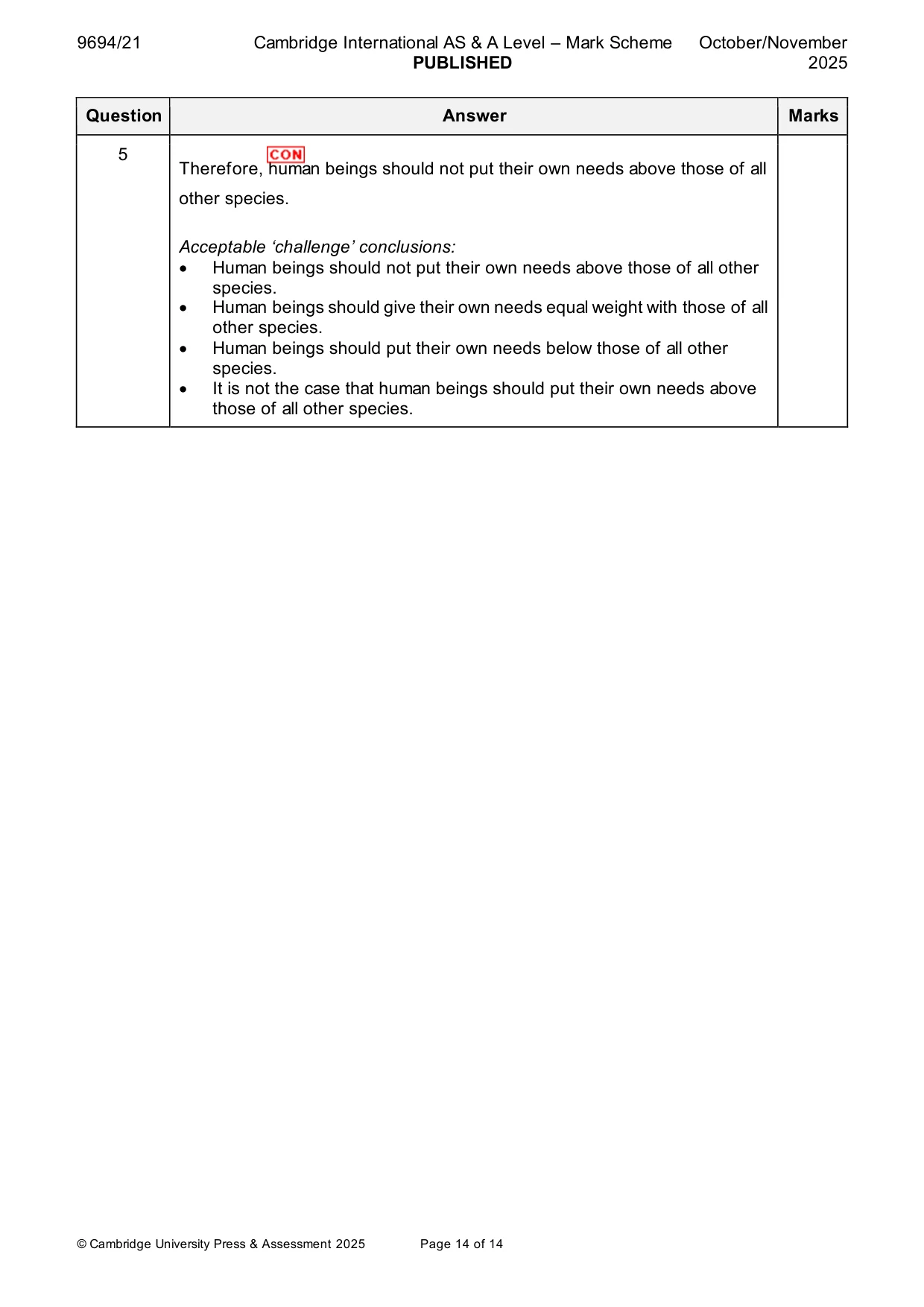
9694/21 Cambridge International AS & A Level – Mark Scheme PUBLISHED October/November 2025 © Cambridge University Press & Assessment 2025 Page 14 of 14 Question Answer Marks 5 Therefore, human beings should not put their own needs above those of all other species. Acceptable ‘challenge’ conclusions: • Human beings should not put their own needs above those of all other species. • Human beings should give their own needs equal weight with those of all other species. • Human beings should put their own needs below those of all other species. • It is not the case that human beings should put their own needs above those of all other species.
What you needed in this session
Cambridge’s own grade thresholds for 2025 Oct/Nov, Paper 2 · Variant 1. A higher threshold means an easier paper — the bar moves with how the cohort did.