Cambridge A Level Thinking Skills 9694 — 2025 May/June Paper 2 · Variant 1
9694/21/M/J/25 · 50 marks · ≈56 min
The question paper and its mark scheme, free to read here and free to download. This is Cambridge’s own paper, exactly as it was sat.
Question paper8 pages



Mark scheme15 pages
Answers below. Sit the paper first if you are practising.
Paper as text
Question paper, page 1
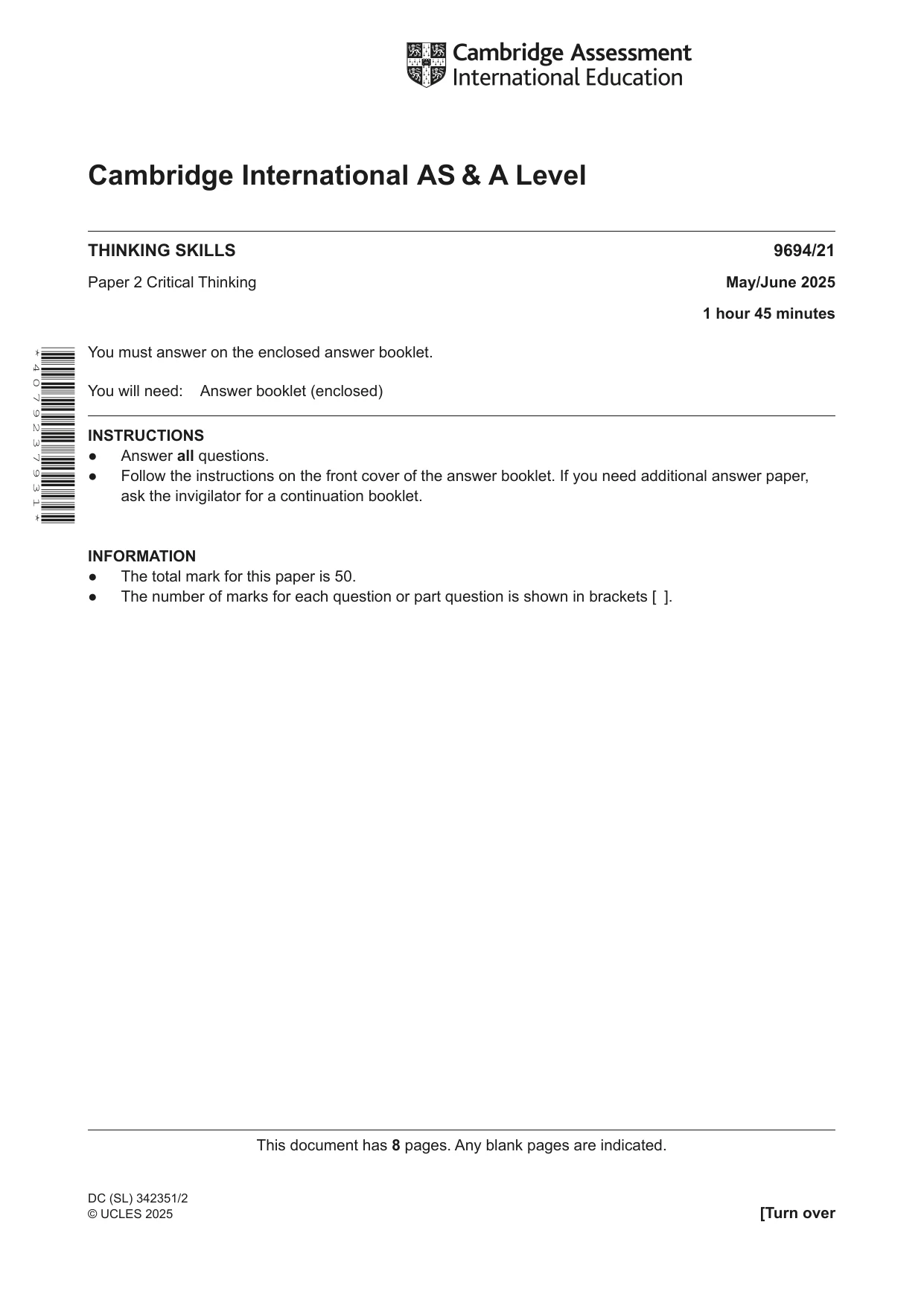
This document has 8 pages. Any blank pages are indicated. [Turn over Cambridge International AS & A Level THINKING SKILLS 9694/21 Paper 2 Critical Thinking May/June 2025 1 hour 45 minutes You must answer on the enclosed answer booklet. You will need: Answer booklet (enclosed) INSTRUCTIONS ● Answer all questions. ● Follow the instructions on the front cover of the answer booklet. If you need additional answer paper, ask the invigilator for a continuation booklet. INFORMATION ● The total mark for this paper is 50. ● The number of marks for each question or part question is shown in brackets [ ]. * 4 0 7 9 2 3 7 9 3 1 * DC (SL) 342351/2 © UCLES 2025
Question paper, page 2
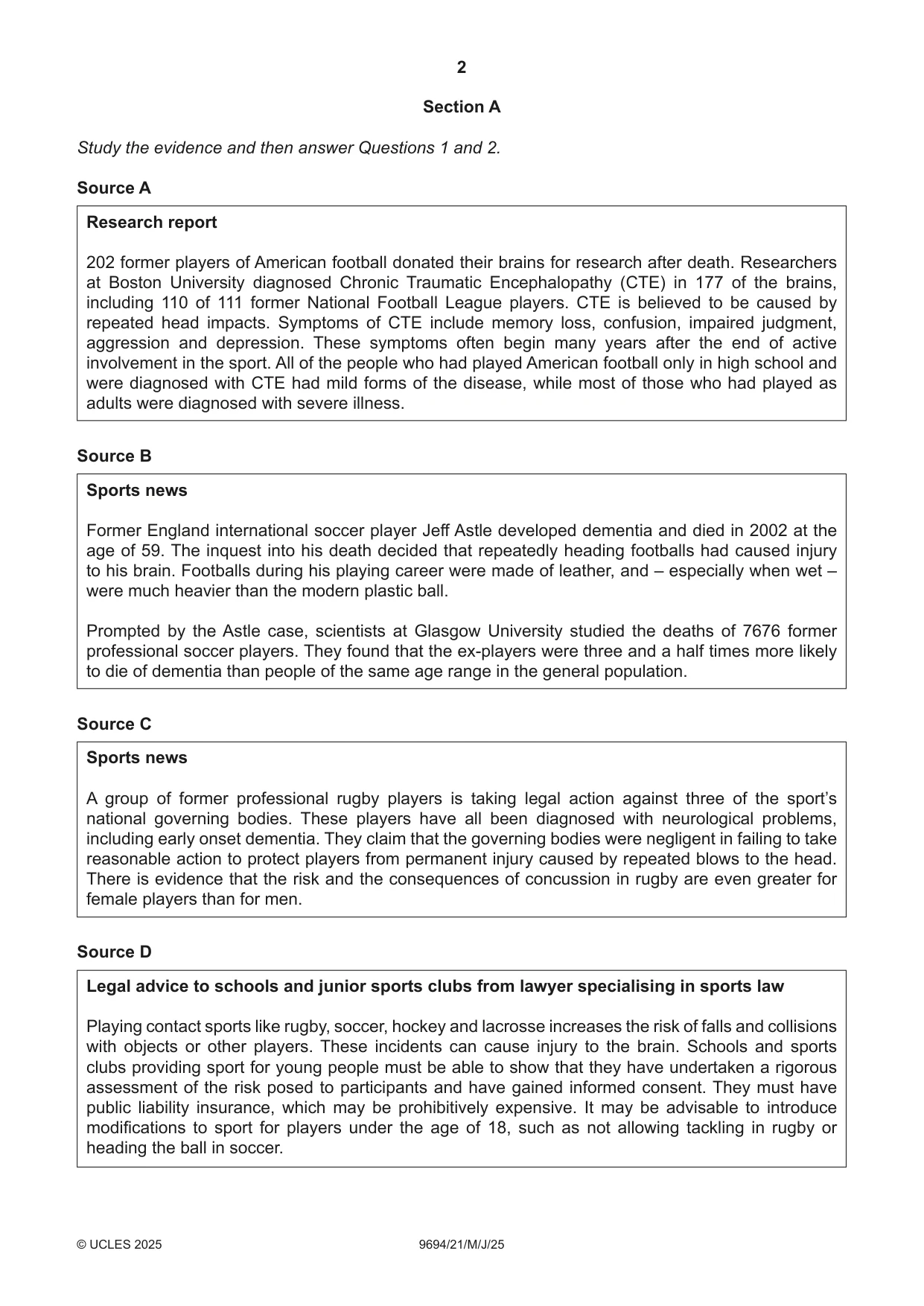
2 9694/21/M/J/25 © UCLES 2025 Section A Study the evidence and then answer Questions 1 and 2. Source A Research report 202 former players of American football donated their brains for research after death. Researchers at Boston University diagnosed Chronic Traumatic Encephalopathy (CTE) in 177 of the brains, including 110 of 111 former National Football League players. CTE is believed to be caused by repeated head impacts. Symptoms of CTE include memory loss, confusion, impaired judgment, aggression and depression. These symptoms often begin many years after the end of active involvement in the sport. All of the people who had played American football only in high school and were diagnosed with CTE had mild forms of the disease, while most of those who had played as adults were diagnosed with severe illness. Source B Sports news Former England international soccer player Jeff Astle developed dementia and died in 2002 at the age of 59. The inquest into his death decided that repeatedly heading footballs had caused injury to his brain. Footballs during his playing career were made of leather, and – especially when wet – were much heavier than the modern plastic ball. Prompted by the Astle case, scientists at Glasgow University studied the deaths of 7676 former professional soccer players. They found that the ex-players were three and a half times more likely to die of dementia than people of the same age range in the general population. Source C Sports news A group of former professional rugby players is taking legal action against three of the sport’s national governing bodies. These players have all been diagnosed with neurological problems, including early onset dementia. They claim that the governing bodies were negligent in failing to take reasonable action to protect players from permanent injury caused by repeated blows to the head. There is evidence that the risk and the consequences of concussion in rugby are even greater for female players than for men. Source D Legal advice to schools and junior sports clubs from lawyer specialising in sports law Playing contact sports like rugby, soccer, hockey and lacrosse increases the risk of falls and collisions with objects or other players. These incidents can cause injury to the brain. Schools and sports clubs providing sport for young people must be able to show that they have undertaken a rigorous assessment of the risk posed to participants and have gained informed consent. They must have public liability insurance, which may be prohibitively expensive. It may be advisable to introduce modifications to sport for players under the age of 18, such as not allowing tackling in rugby or heading the ball in soccer.
Question paper, page 3
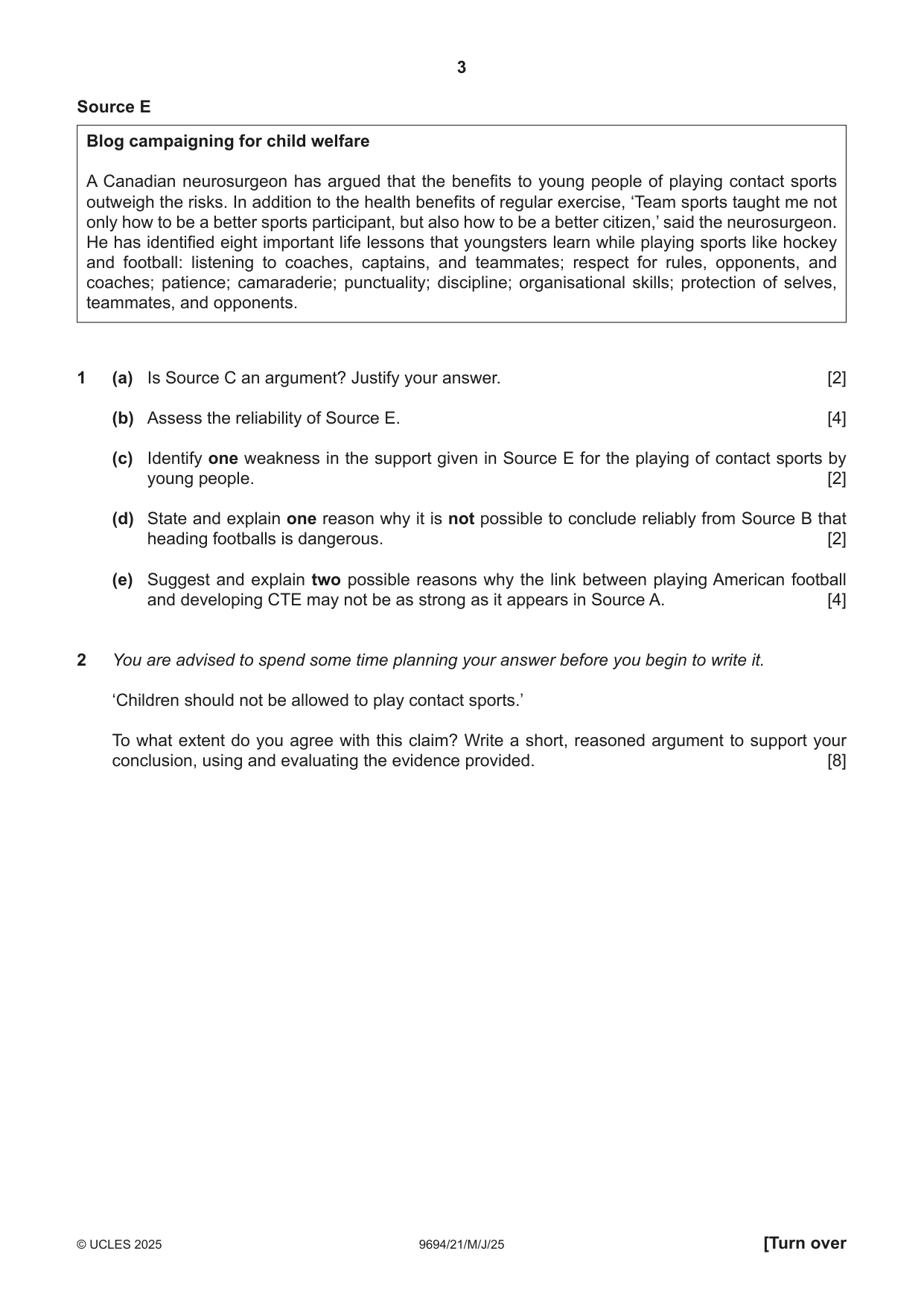
3 9694/21/M/J/25 © UCLES 2025 [Turn over Source E Blog campaigning for child welfare A Canadian neurosurgeon has argued that the benefits to young people of playing contact sports outweigh the risks. In addition to the health benefits of regular exercise, ‘Team sports taught me not only how to be a better sports participant, but also how to be a better citizen,’ said the neurosurgeon. He has identified eight important life lessons that youngsters learn while playing sports like hockey and football: listening to coaches, captains, and teammates; respect for rules, opponents, and coaches; patience; camaraderie; punctuality; discipline; organisational skills; protection of selves, teammates, and opponents. 1 (a) Is Source C an argument? Justify your answer. [2] (b) Assess the reliability of Source E. [4] (c) Identify one weakness in the support given in Source E for the playing of contact sports by young people. [2] (d) State and explain one reason why it is not possible to conclude reliably from Source B that heading footballs is dangerous. [2] (e) Suggest and explain two possible reasons why the link between playing American football and developing CTE may not be as strong as it appears in Source A. [4] 2 You are advised to spend some time planning your answer before you begin to write it. ‘Children should not be allowed to play contact sports.’ To what extent do you agree with this claim? Write a short, reasoned argument to support your conclusion, using and evaluating the evidence provided. [8]
Question paper, page 4
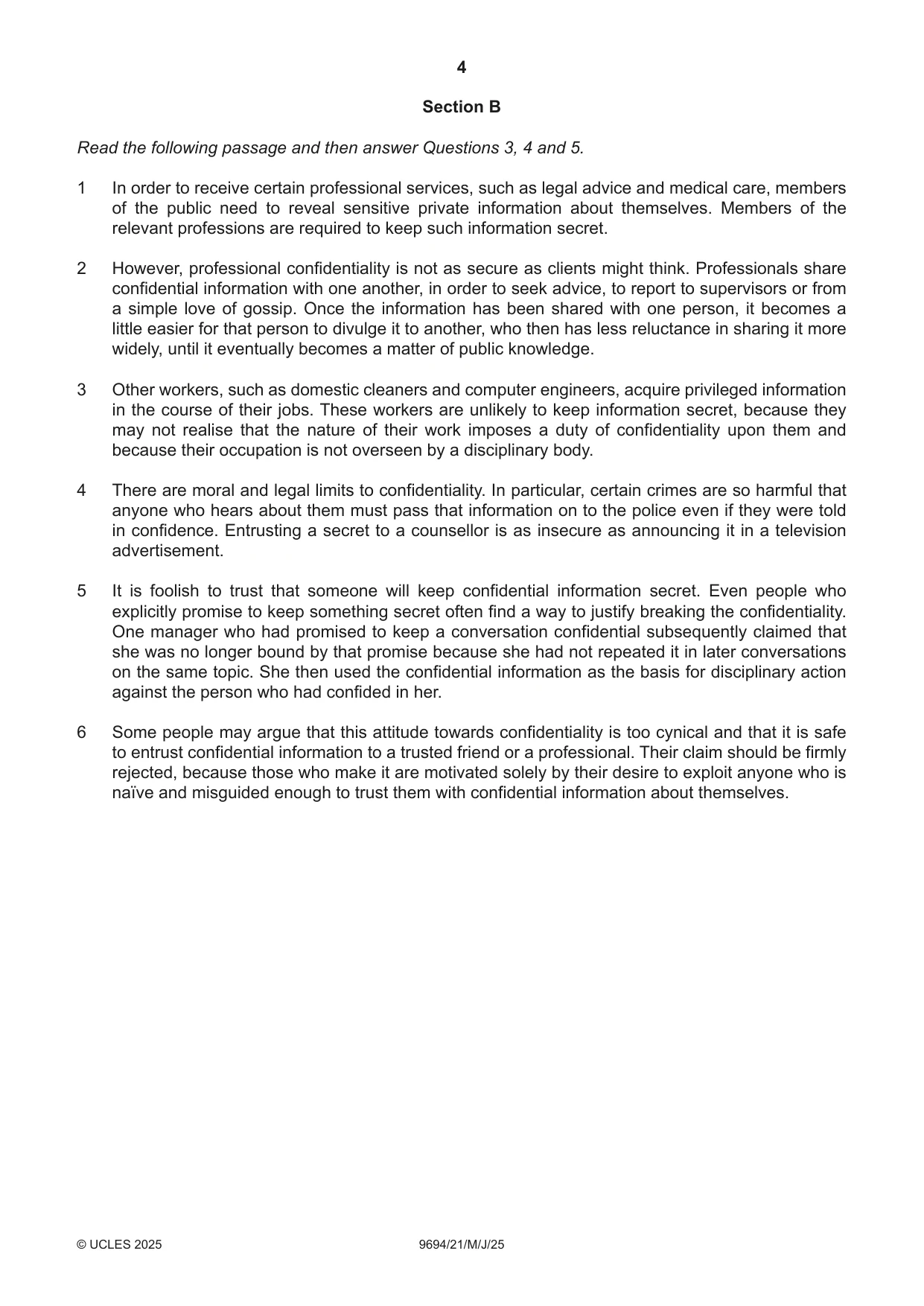
4 9694/21/M/J/25 © UCLES 2025 Section B Read the following passage and then answer Questions 3, 4 and 5. 1 In order to receive certain professional services, such as legal advice and medical care, members of the public need to reveal sensitive private information about themselves. Members of the relevant professions are required to keep such information secret. 2 However, professional confidentiality is not as secure as clients might think. Professionals share confidential information with one another, in order to seek advice, to report to supervisors or from a simple love of gossip. Once the information has been shared with one person, it becomes a little easier for that person to divulge it to another, who then has less reluctance in sharing it more widely, until it eventually becomes a matter of public knowledge. 3 Other workers, such as domestic cleaners and computer engineers, acquire privileged information in the course of their jobs. These workers are unlikely to keep information secret, because they may not realise that the nature of their work imposes a duty of confidentiality upon them and because their occupation is not overseen by a disciplinary body. 4 There are moral and legal limits to confidentiality. In particular, certain crimes are so harmful that anyone who hears about them must pass that information on to the police even if they were told in confidence. Entrusting a secret to a counsellor is as insecure as announcing it in a television advertisement. 5 It is foolish to trust that someone will keep confidential information secret. Even people who explicitly promise to keep something secret often find a way to justify breaking the confidentiality. One manager who had promised to keep a conversation confidential subsequently claimed that she was no longer bound by that promise because she had not repeated it in later conversations on the same topic. She then used the confidential information as the basis for disciplinary action against the person who had confided in her. 6 Some people may argue that this attitude towards confidentiality is too cynical and that it is safe to entrust confidential information to a trusted friend or a professional. Their claim should be firmly rejected, because those who make it are motivated solely by their desire to exploit anyone who is naïve and misguided enough to trust them with confidential information about themselves.
Question paper, page 5
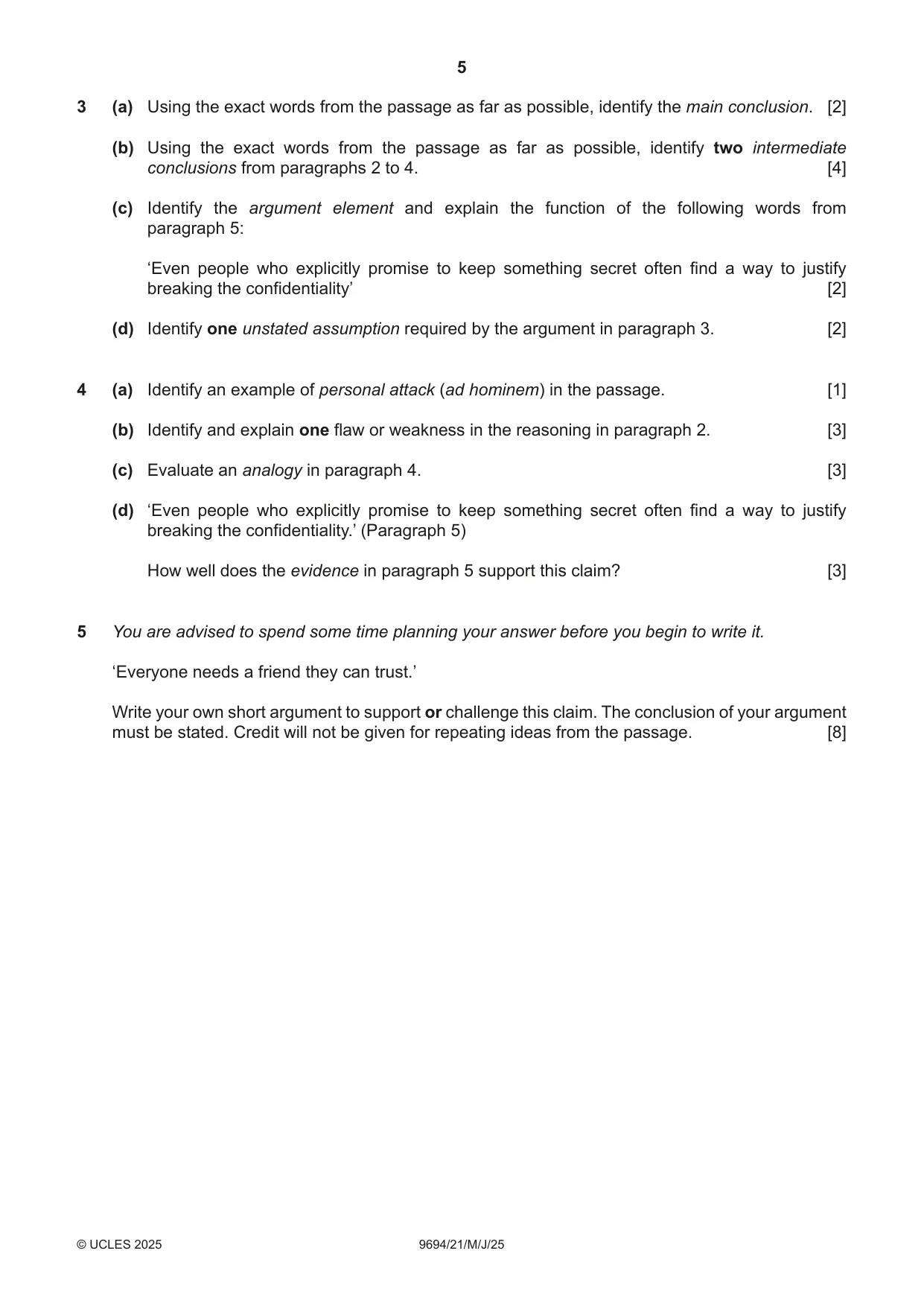
5 9694/21/M/J/25 © UCLES 2025 3 (a) Using the exact words from the passage as far as possible, identify the main conclusion. [2] (b) Using the exact words from the passage as far as possible, identify two intermediate conclusions from paragraphs 2 to 4. [4] (c) Identify the argument element and explain the function of the following words from paragraph 5: ‘Even people who explicitly promise to keep something secret often find a way to justify breaking the confidentiality’ [2] (d) Identify one unstated assumption required by the argument in paragraph 3. [2] 4 (a) Identify an example of personal attack (ad hominem) in the passage. [1] (b) Identify and explain one flaw or weakness in the reasoning in paragraph 2. [3] (c) Evaluate an analogy in paragraph 4. [3] (d) ‘Even people who explicitly promise to keep something secret often find a way to justify breaking the confidentiality.’ (Paragraph 5) How well does the evidence in paragraph 5 support this claim? [3] 5 You are advised to spend some time planning your answer before you begin to write it. ‘Everyone needs a friend they can trust.’ Write your own short argument to support or challenge this claim. The conclusion of your argument must be stated. Credit will not be given for repeating ideas from the passage. [8]
Question paper, page 6
6 9694/21/M/J/25 © UCLES 2025 BLANK PAGE
Question paper, page 7
7 9694/21/M/J/25 © UCLES 2025 BLANK PAGE
Question paper, page 8
8 9694/21/M/J/25 © UCLES 2025 Permission to reproduce items where third-party owned material protected by copyright is included has been sought and cleared where possible. Every reasonable effort has been made by the publisher (UCLES) to trace copyright holders, but if any items requiring clearance have unwittingly been included, the publisher will be pleased to make amends at the earliest possible opportunity. To avoid the issue of disclosure of answer-related information to candidates, all copyright acknowledgements are reproduced online in the Cambridge Assessment International Education Copyright Acknowledgements Booklet. This is produced for each series of examinations and is freely available to download at www.cambridgeinternational.org after the live examination series. Cambridge Assessment International Education is part of Cambridge Assessment. Cambridge Assessment is the brand name of the University of Cambridge Local Examinations Syndicate (UCLES), which is a department of the University of Cambridge. BLANK PAGE
Mark scheme, page 1
This document consists of 15 printed pages. © Cambridge University Press & Assessment 2025 [Turn over Cambridge International AS & A Level THINKING SKILLS 9694/21 Paper 2 Critical Thinking May/June 2025 MARK SCHEME Maximum Mark: 50 Published This mark scheme is published as an aid to teachers and candidates, to indicate the requirements of the examination. It shows the basis on which Examiners were instructed to award marks. It does not indicate the details of the discussions that took place at an Examiners’ meeting before marking began, which would have considered the acceptability of alternative answers. Mark schemes should be read in conjunction with the question paper and the Principal Examiner Report for Teachers. Cambridge International will not enter into discussions about these mark schemes. Cambridge International is publishing the mark schemes for the May/June 2025 series for most Cambridge IGCSE, Cambridge International A and AS Level components, and some Cambridge O Level components.
Mark scheme, page 2
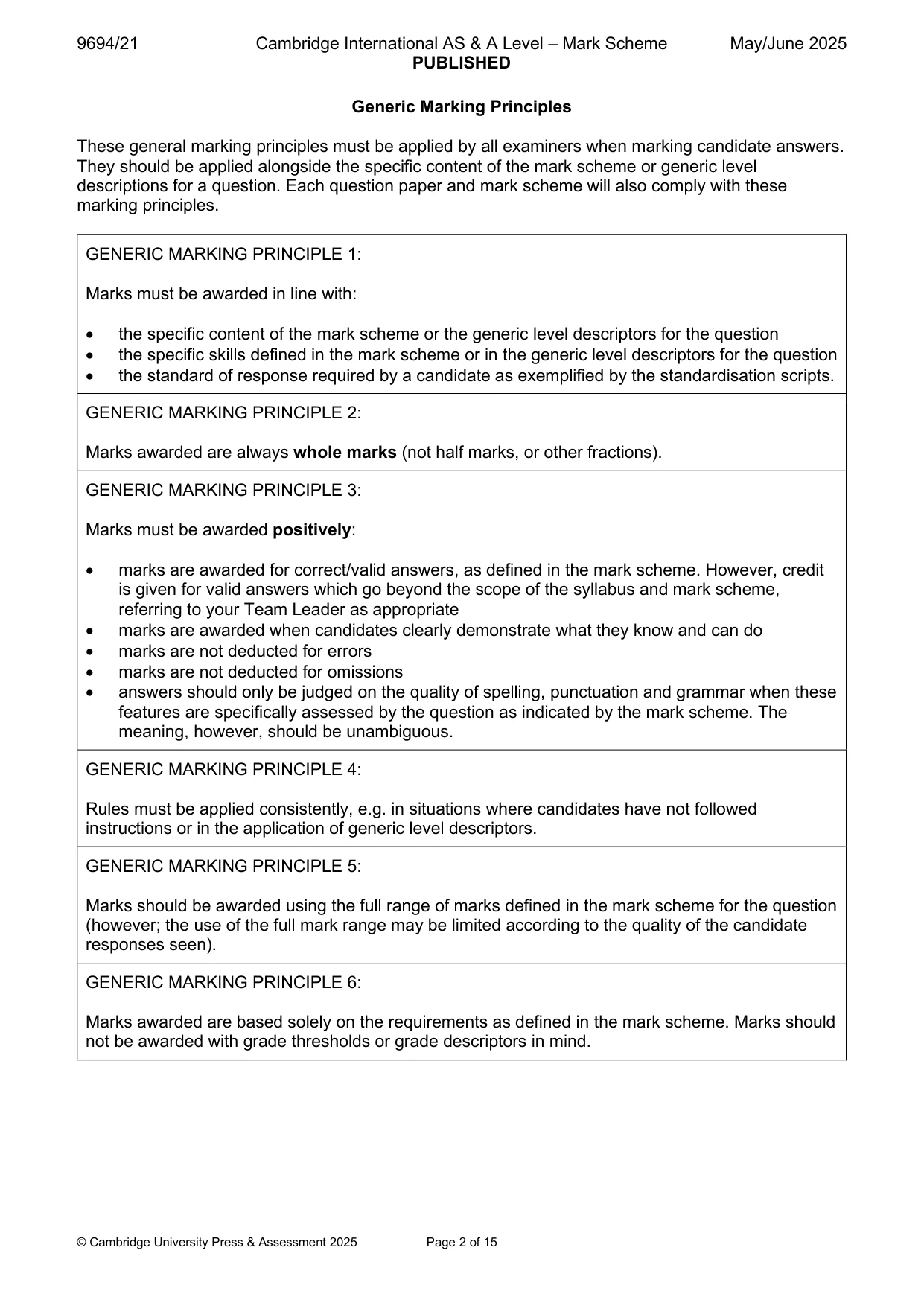
9694/21 Cambridge International AS & A Level – Mark Scheme PUBLISHED May/June 2025 © Cambridge University Press & Assessment 2025 Page 2 of 15 Generic Marking Principles These general marking principles must be applied by all examiners when marking candidate answers. They should be applied alongside the specific content of the mark scheme or generic level descriptions for a question. Each question paper and mark scheme will also comply with these marking principles. GENERIC MARKING PRINCIPLE 1: Marks must be awarded in line with: • the specific content of the mark scheme or the generic level descriptors for the question • the specific skills defined in the mark scheme or in the generic level descriptors for the question • the standard of response required by a candidate as exemplified by the standardisation scripts. GENERIC MARKING PRINCIPLE 2: Marks awarded are always whole marks (not half marks, or other fractions). GENERIC MARKING PRINCIPLE 3: Marks must be awarded positively: • marks are awarded for correct/valid answers, as defined in the mark scheme. However, credit is given for valid answers which go beyond the scope of the syllabus and mark scheme, referring to your Team Leader as appropriate • marks are awarded when candidates clearly demonstrate what they know and can do • marks are not deducted for errors • marks are not deducted for omissions • answers should only be judged on the quality of spelling, punctuation and grammar when these features are specifically assessed by the question as indicated by the mark scheme. The meaning, however, should be unambiguous. GENERIC MARKING PRINCIPLE 4: Rules must be applied consistently, e.g. in situations where candidates have not followed instructions or in the application of generic level descriptors. GENERIC MARKING PRINCIPLE 5: Marks should be awarded using the full range of marks defined in the mark scheme for the question (however; the use of the full mark range may be limited according to the quality of the candidate responses seen). GENERIC MARKING PRINCIPLE 6: Marks awarded are based solely on the requirements as defined in the mark scheme. Marks should not be awarded with grade thresholds or grade descriptors in mind.
Mark scheme, page 3
9694/21 Cambridge International AS & A Level – Mark Scheme PUBLISHED May/June 2025 © Cambridge University Press & Assessment 2025 Page 3 of 15 Annotations guidance for centres Examiners use a system of annotations as a shorthand for communicating their marking decisions to one another. Examiners are trained during the standardisation process on how and when to use annotations. The purpose of annotations is to inform the standardisation and monitoring processes and guide the supervising examiners when they are checking the work of examiners within their team. The meaning of annotations and how they are used is specific to each component and is understood by all examiners who mark the component. We publish annotations in our mark schemes to help centres understand the annotations they may see on copies of scripts. Note that there may not be a direct correlation between the number of annotations on a script and the mark awarded. Similarly, the use of an annotation may not be an indication of the quality of the response. The annotations listed below were available to examiners marking this component in this series.
Mark scheme, page 4
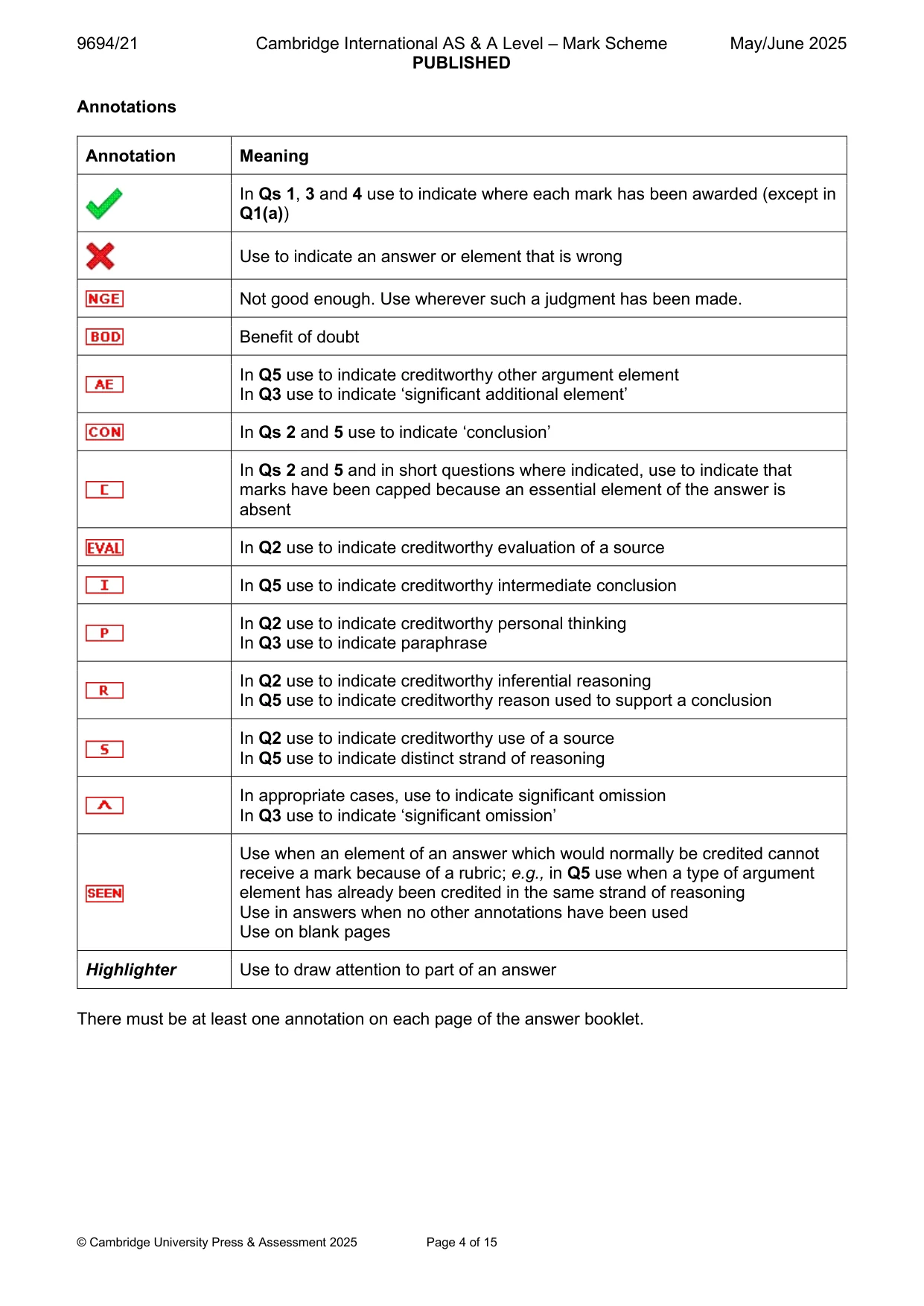
9694/21 Cambridge International AS & A Level – Mark Scheme PUBLISHED May/June 2025 © Cambridge University Press & Assessment 2025 Page 4 of 15 Annotations Annotation Meaning In Qs 1, 3 and 4 use to indicate where each mark has been awarded (except in Q1(a)) Use to indicate an answer or element that is wrong Not good enough. Use wherever such a judgment has been made. Benefit of doubt In Q5 use to indicate creditworthy other argument element In Q3 use to indicate ‘significant additional element’ In Qs 2 and 5 use to indicate ‘conclusion’ In Qs 2 and 5 and in short questions where indicated, use to indicate that marks have been capped because an essential element of the answer is absent In Q2 use to indicate creditworthy evaluation of a source In Q5 use to indicate creditworthy intermediate conclusion In Q2 use to indicate creditworthy personal thinking In Q3 use to indicate paraphrase In Q2 use to indicate creditworthy inferential reasoning In Q5 use to indicate creditworthy reason used to support a conclusion In Q2 use to indicate creditworthy use of a source In Q5 use to indicate distinct strand of reasoning In appropriate cases, use to indicate significant omission In Q3 use to indicate ‘significant omission’ Use when an element of an answer which would normally be credited cannot receive a mark because of a rubric; e.g., in Q5 use when a type of argument element has already been credited in the same strand of reasoning Use in answers when no other annotations have been used Use on blank pages Highlighter Use to draw attention to part of an answer There must be at least one annotation on each page of the answer booklet.
Mark scheme, page 5
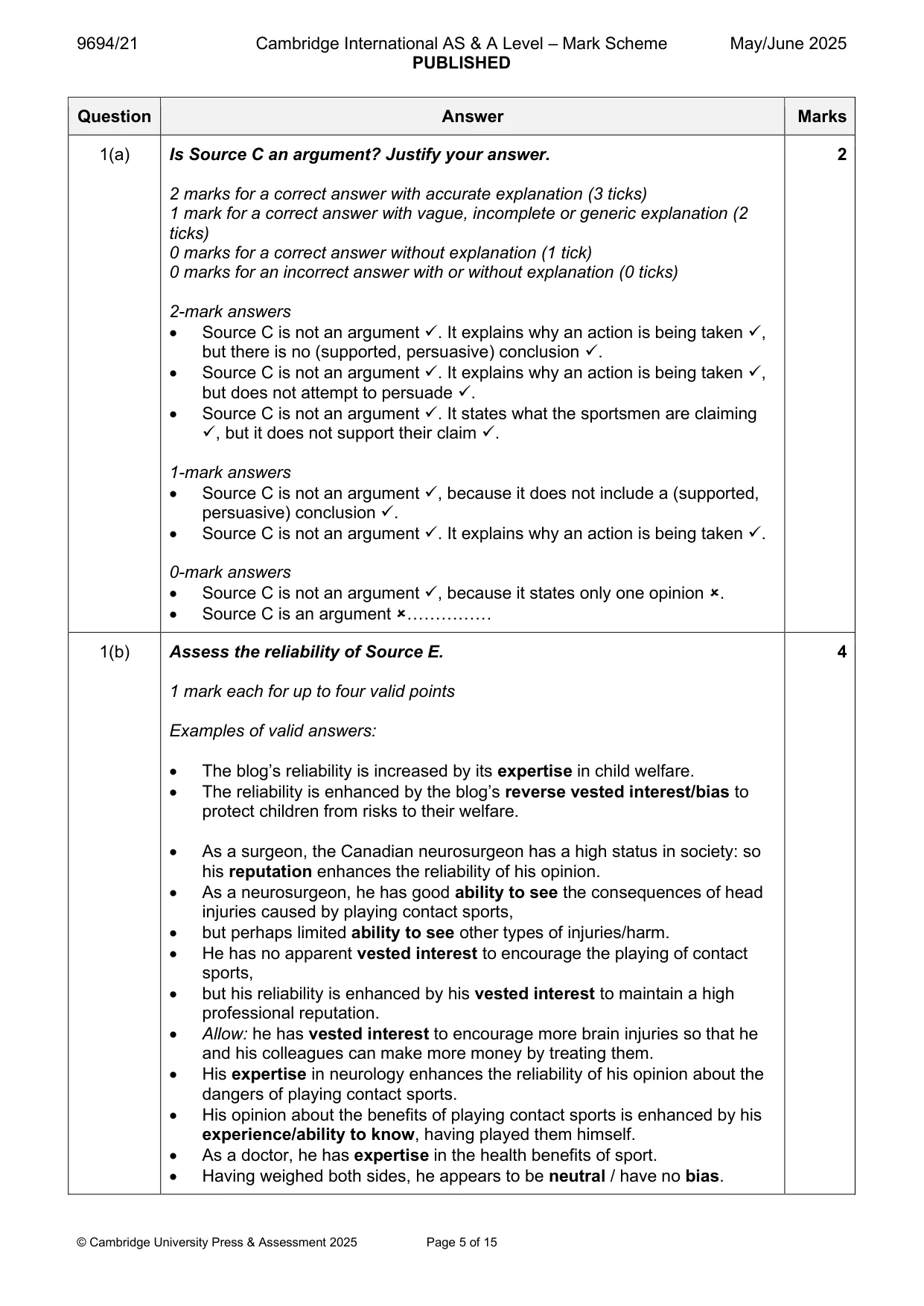
9694/21 Cambridge International AS & A Level – Mark Scheme PUBLISHED May/June 2025 © Cambridge University Press & Assessment 2025 Page 5 of 15 Question Answer Marks 1(a) Is Source C an argument? Justify your answer. 2 marks for a correct answer with accurate explanation (3 ticks) 1 mark for a correct answer with vague, incomplete or generic explanation (2 ticks) 0 marks for a correct answer without explanation (1 tick) 0 marks for an incorrect answer with or without explanation (0 ticks) 2-mark answers • Source C is not an argument ✓. It explains why an action is being taken ✓, but there is no (supported, persuasive) conclusion ✓. • Source C is not an argument ✓. It explains why an action is being taken ✓, but does not attempt to persuade ✓. • Source C is not an argument ✓. It states what the sportsmen are claiming ✓, but it does not support their claim ✓. 1-mark answers • Source C is not an argument ✓, because it does not include a (supported, persuasive) conclusion ✓. • Source C is not an argument ✓. It explains why an action is being taken ✓. 0-mark answers • Source C is not an argument ✓, because it states only one opinion . • Source C is an argument …………… 2 1(b) Assess the reliability of Source E. 1 mark each for up to four valid points Examples of valid answers: • The blog’s reliability is increased by its expertise in child welfare. • The reliability is enhanced by the blog’s reverse vested interest/bias to protect children from risks to their welfare. • As a surgeon, the Canadian neurosurgeon has a high status in society: so his reputation enhances the reliability of his opinion. • As a neurosurgeon, he has good ability to see the consequences of head injuries caused by playing contact sports, • but perhaps limited ability to see other types of injuries/harm. • He has no apparent vested interest to encourage the playing of contact sports, • but his reliability is enhanced by his vested interest to maintain a high professional reputation. • Allow: he has vested interest to encourage more brain injuries so that he and his colleagues can make more money by treating them. • His expertise in neurology enhances the reliability of his opinion about the dangers of playing contact sports. • His opinion about the benefits of playing contact sports is enhanced by his experience/ability to know, having played them himself. • As a doctor, he has expertise in the health benefits of sport. • Having weighed both sides, he appears to be neutral / have no bias. 4
Mark scheme, page 6
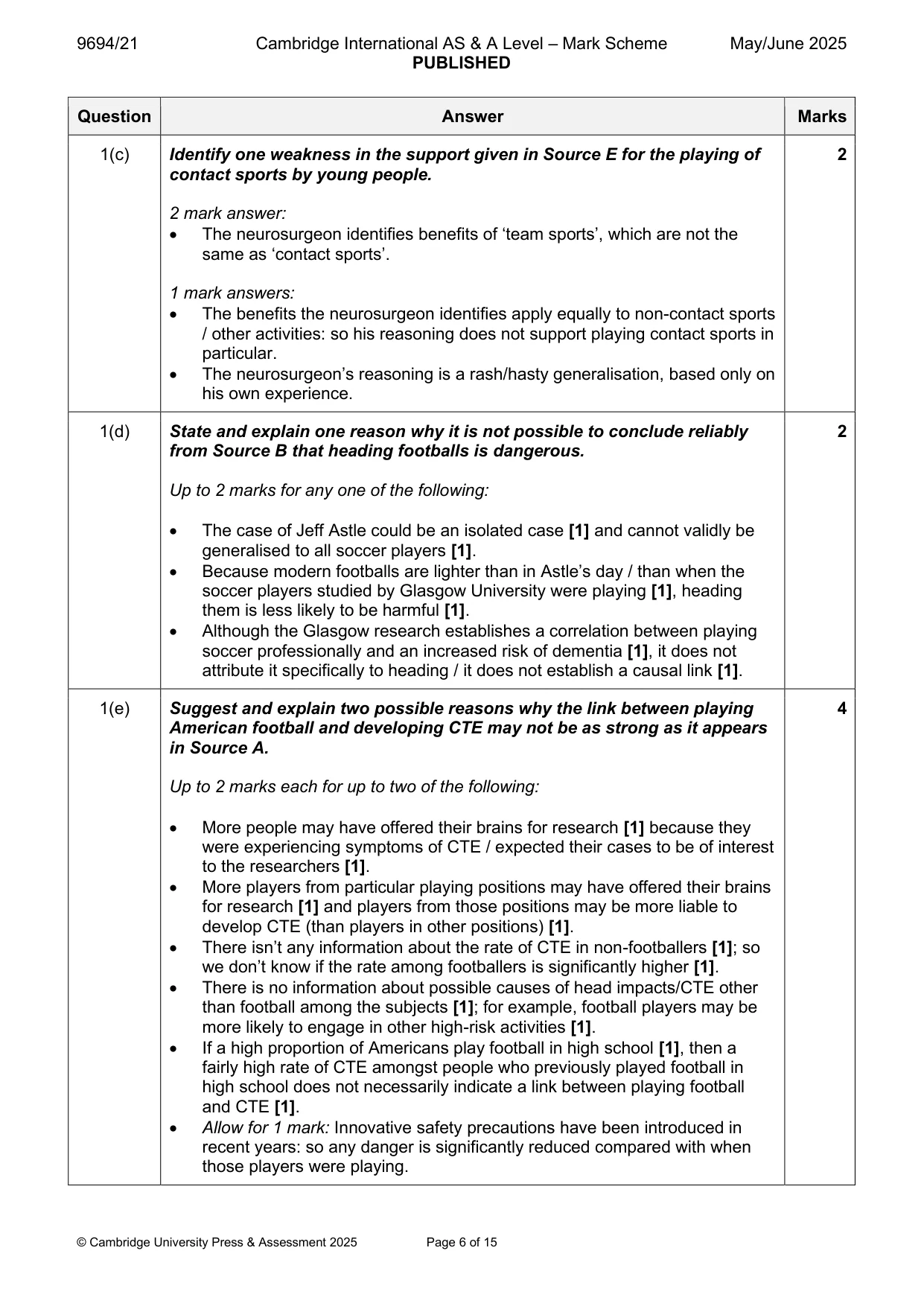
9694/21 Cambridge International AS & A Level – Mark Scheme PUBLISHED May/June 2025 © Cambridge University Press & Assessment 2025 Page 6 of 15 Question Answer Marks 1(c) Identify one weakness in the support given in Source E for the playing of contact sports by young people. 2 mark answer: • The neurosurgeon identifies benefits of ‘team sports’, which are not the same as ‘contact sports’. 1 mark answers: • The benefits the neurosurgeon identifies apply equally to non-contact sports / other activities: so his reasoning does not support playing contact sports in particular. • The neurosurgeon’s reasoning is a rash/hasty generalisation, based only on his own experience. 2 1(d) State and explain one reason why it is not possible to conclude reliably from Source B that heading footballs is dangerous. Up to 2 marks for any one of the following: • The case of Jeff Astle could be an isolated case [1] and cannot validly be generalised to all soccer players [1]. • Because modern footballs are lighter than in Astle’s day / than when the soccer players studied by Glasgow University were playing [1], heading them is less likely to be harmful [1]. • Although the Glasgow research establishes a correlation between playing soccer professionally and an increased risk of dementia [1], it does not attribute it specifically to heading / it does not establish a causal link [1]. 2 1(e) Suggest and explain two possible reasons why the link between playing American football and developing CTE may not be as strong as it appears in Source A. Up to 2 marks each for up to two of the following: • More people may have offered their brains for research [1] because they were experiencing symptoms of CTE / expected their cases to be of interest to the researchers [1]. • More players from particular playing positions may have offered their brains for research [1] and players from those positions may be more liable to develop CTE (than players in other positions) [1]. • There isn’t any information about the rate of CTE in non-footballers [1]; so we don’t know if the rate among footballers is significantly higher [1]. • There is no information about possible causes of head impacts/CTE other than football among the subjects [1]; for example, football players may be more likely to engage in other high-risk activities [1]. • If a high proportion of Americans play football in high school [1], then a fairly high rate of CTE amongst people who previously played football in high school does not necessarily indicate a link between playing football and CTE [1]. • Allow for 1 mark: Innovative safety precautions have been introduced in recent years: so any danger is significantly reduced compared with when those players were playing. 4
Mark scheme, page 7
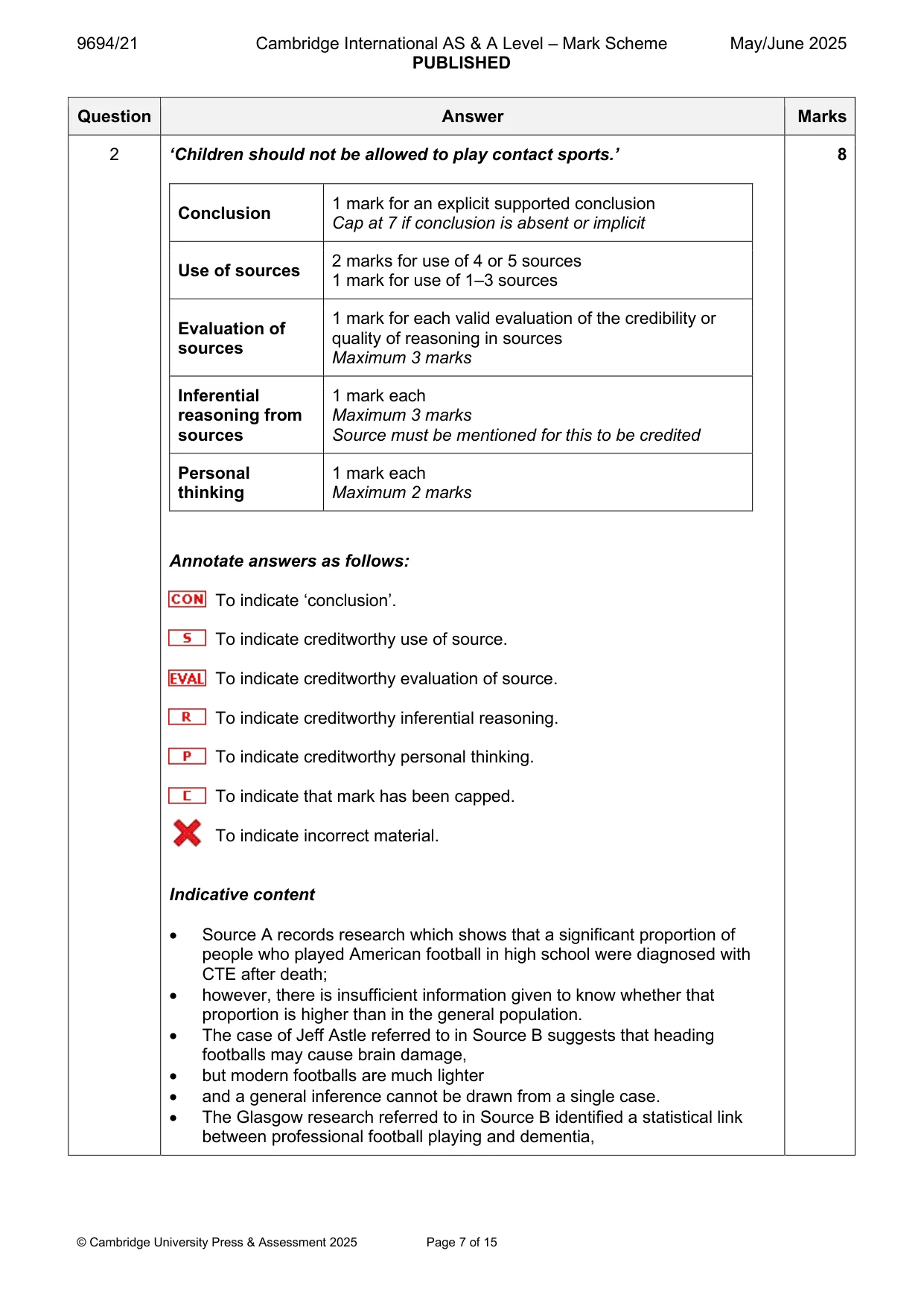
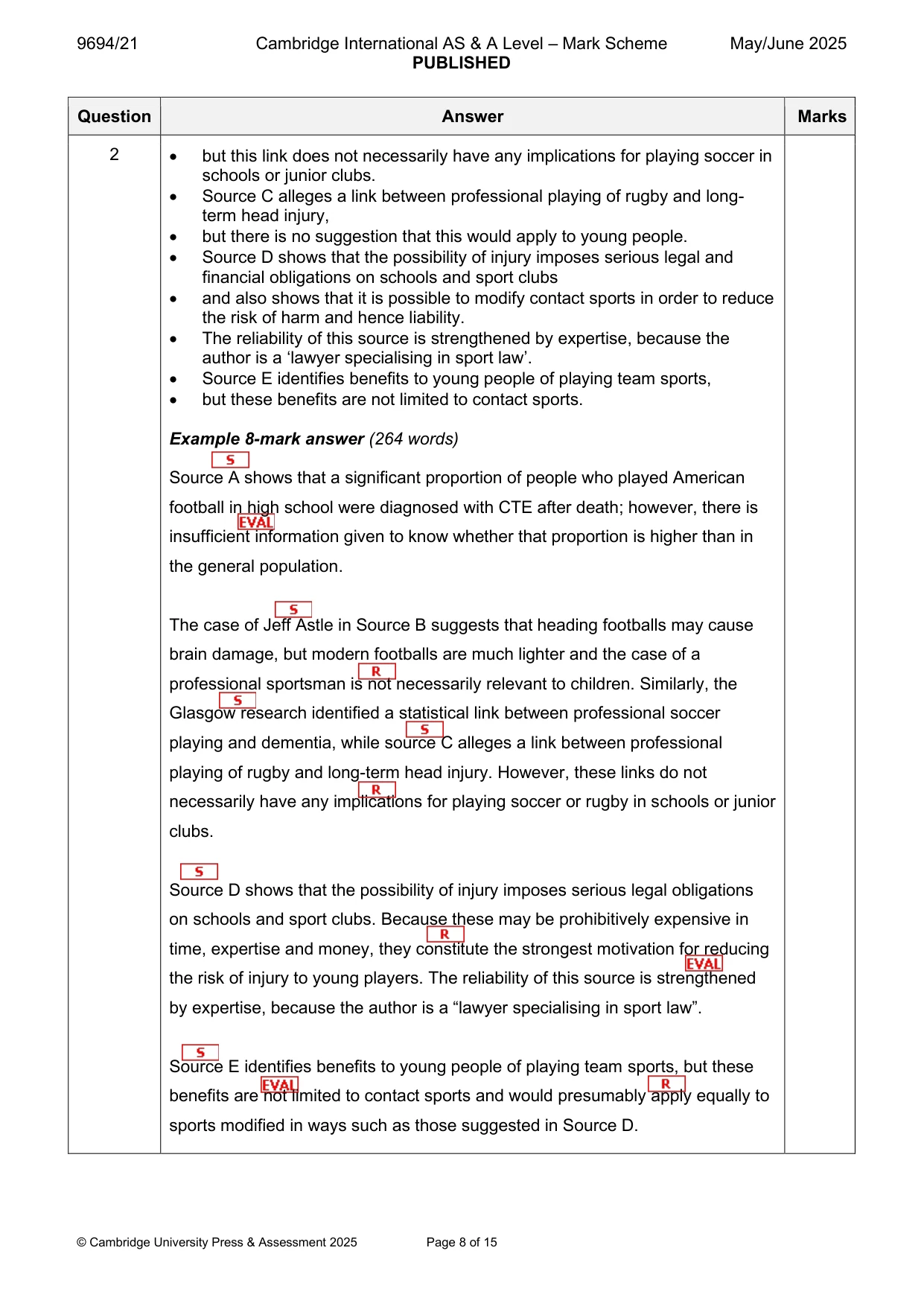
9694/21 Cambridge International AS & A Level – Mark Scheme PUBLISHED May/June 2025 © Cambridge University Press & Assessment 2025 Page 7 of 15 Question Answer Marks 2 ‘Children should not be allowed to play contact sports.’ Conclusion 1 mark for an explicit supported conclusion Cap at 7 if conclusion is absent or implicit Use of sources 2 marks for use of 4 or 5 sources 1 mark for use of 1–3 sources Evaluation of sources 1 mark for each valid evaluation of the credibility or quality of reasoning in sources Maximum 3 marks Inferential reasoning from sources 1 mark each Maximum 3 marks Source must be mentioned for this to be credited Personal thinking 1 mark each Maximum 2 marks Annotate answers as follows: To indicate ‘conclusion’. To indicate creditworthy use of source. To indicate creditworthy evaluation of source. To indicate creditworthy inferential reasoning. To indicate creditworthy personal thinking. To indicate that mark has been capped. To indicate incorrect material. Indicative content • Source A records research which shows that a significant proportion of people who played American football in high school were diagnosed with CTE after death; • however, there is insufficient information given to know whether that proportion is higher than in the general population. • The case of Jeff Astle referred to in Source B suggests that heading footballs may cause brain damage, • but modern footballs are much lighter • and a general inference cannot be drawn from a single case. • The Glasgow research referred to in Source B identified a statistical link between professional football playing and dementia, 8
Mark scheme, page 8
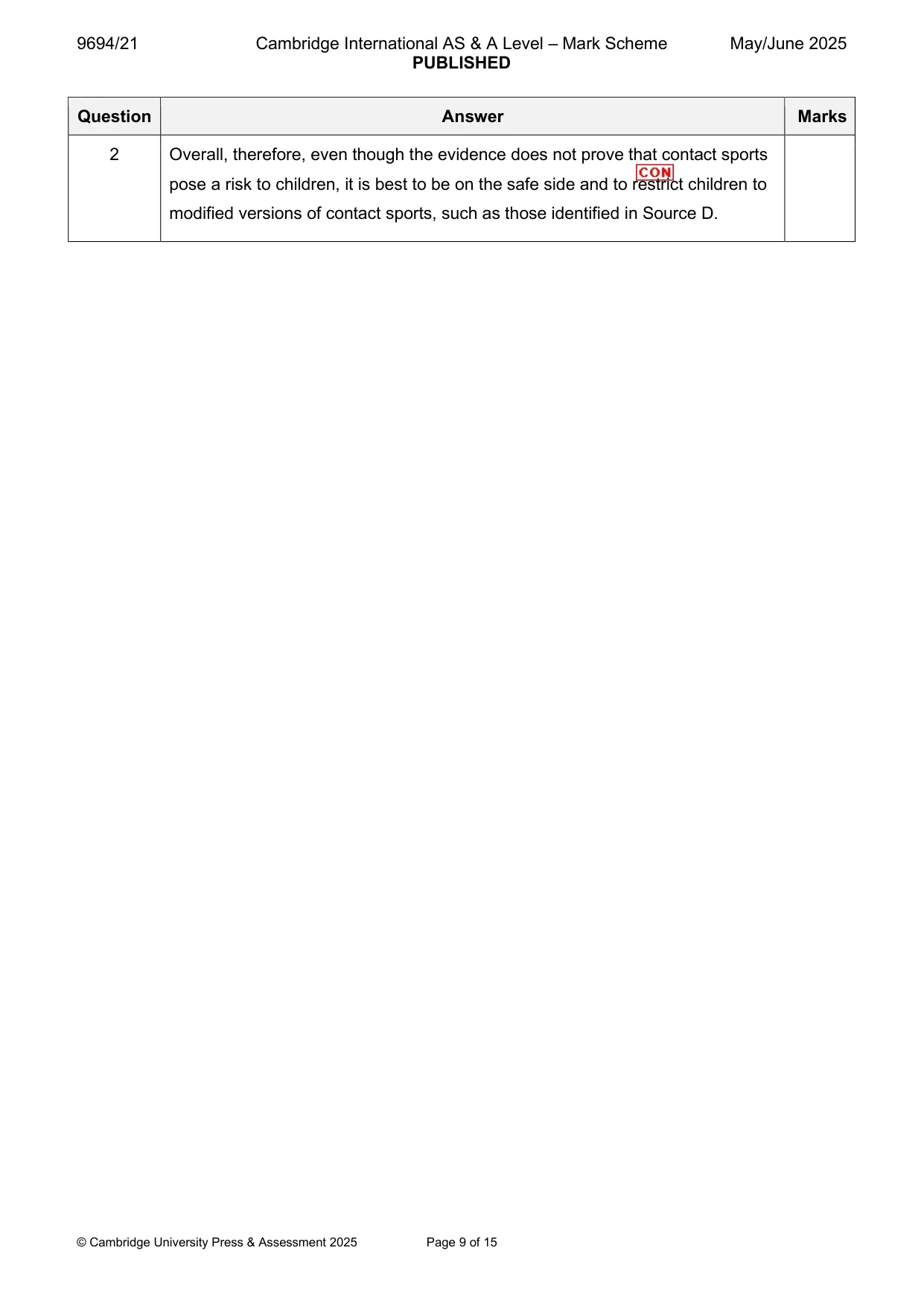
9694/21 Cambridge International AS & A Level – Mark Scheme PUBLISHED May/June 2025 © Cambridge University Press & Assessment 2025 Page 8 of 15 Question Answer Marks 2 • but this link does not necessarily have any implications for playing soccer in schools or junior clubs. • Source C alleges a link between professional playing of rugby and long- term head injury, • but there is no suggestion that this would apply to young people. • Source D shows that the possibility of injury imposes serious legal and financial obligations on schools and sport clubs • and also shows that it is possible to modify contact sports in order to reduce the risk of harm and hence liability. • The reliability of this source is strengthened by expertise, because the author is a ‘lawyer specialising in sport law’. • Source E identifies benefits to young people of playing team sports, • but these benefits are not limited to contact sports. Example 8-mark answer (264 words) Source A shows that a significant proportion of people who played American football in high school were diagnosed with CTE after death; however, there is insufficient information given to know whether that proportion is higher than in the general population. The case of Jeff Astle in Source B suggests that heading footballs may cause brain damage, but modern footballs are much lighter and the case of a professional sportsman is not necessarily relevant to children. Similarly, the Glasgow research identified a statistical link between professional soccer playing and dementia, while source C alleges a link between professional playing of rugby and long-term head injury. However, these links do not necessarily have any implications for playing soccer or rugby in schools or junior clubs. Source D shows that the possibility of injury imposes serious legal obligations on schools and sport clubs. Because these may be prohibitively expensive in time, expertise and money, they constitute the strongest motivation for reducing the risk of injury to young players. The reliability of this source is strengthened by expertise, because the author is a “lawyer specialising in sport law”. Source E identifies benefits to young people of playing team sports, but these benefits are not limited to contact sports and would presumably apply equally to sports modified in ways such as those suggested in Source D.
Mark scheme, page 9
9694/21 Cambridge International AS & A Level – Mark Scheme PUBLISHED May/June 2025 © Cambridge University Press & Assessment 2025 Page 9 of 15 Question Answer Marks 2 Overall, therefore, even though the evidence does not prove that contact sports pose a risk to children, it is best to be on the safe side and to restrict children to modified versions of contact sports, such as those identified in Source D.
Mark scheme, page 10
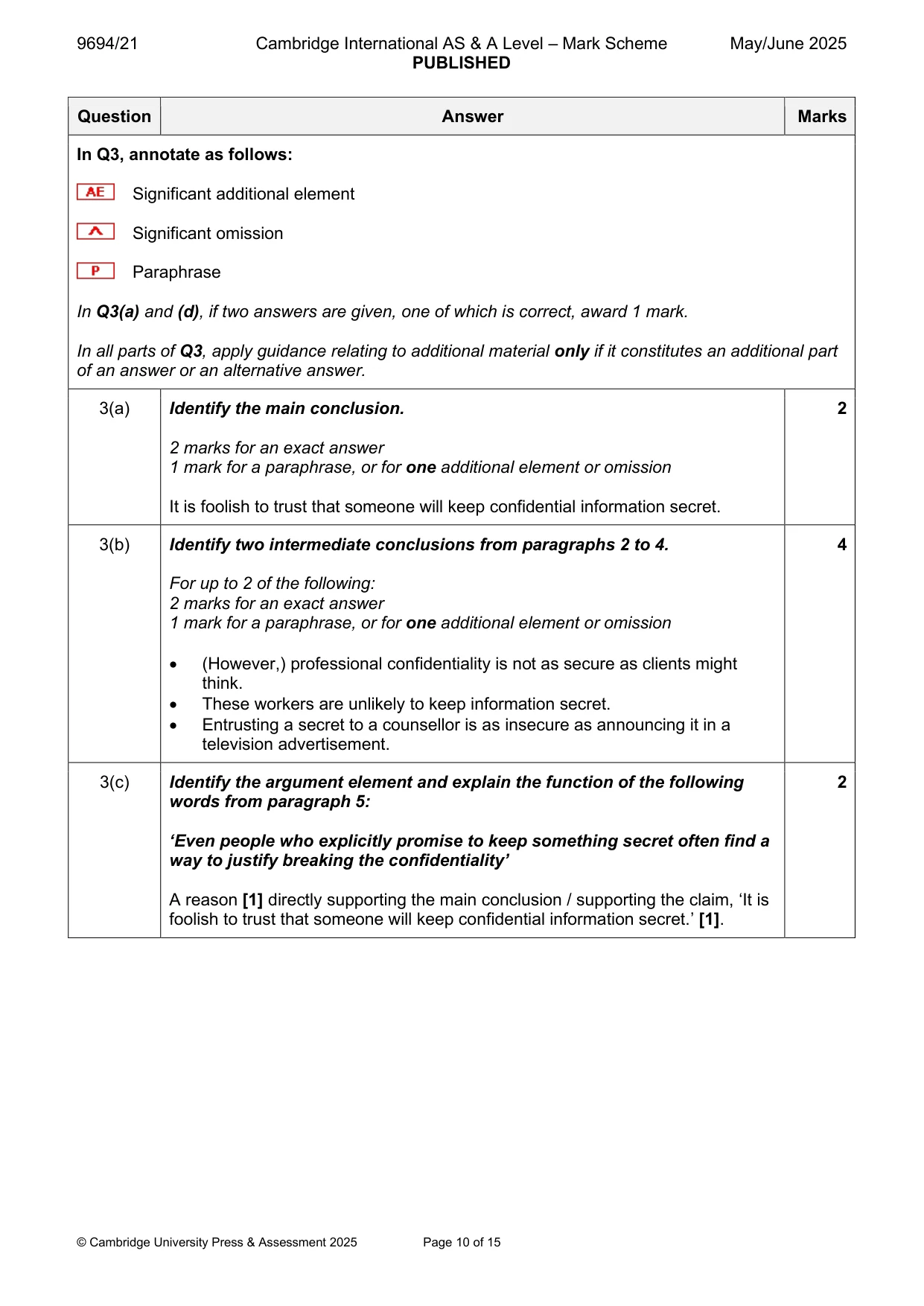
9694/21 Cambridge International AS & A Level – Mark Scheme PUBLISHED May/June 2025 © Cambridge University Press & Assessment 2025 Page 10 of 15 Question Answer Marks In Q3, annotate as follows: Significant additional element Significant omission Paraphrase In Q3(a) and (d), if two answers are given, one of which is correct, award 1 mark. In all parts of Q3, apply guidance relating to additional material only if it constitutes an additional part of an answer or an alternative answer. 3(a) Identify the main conclusion. 2 marks for an exact answer 1 mark for a paraphrase, or for one additional element or omission It is foolish to trust that someone will keep confidential information secret. 2 3(b) Identify two intermediate conclusions from paragraphs 2 to 4. For up to 2 of the following: 2 marks for an exact answer 1 mark for a paraphrase, or for one additional element or omission • (However,) professional confidentiality is not as secure as clients might think. • These workers are unlikely to keep information secret. • Entrusting a secret to a counsellor is as insecure as announcing it in a television advertisement. 4 3(c) Identify the argument element and explain the function of the following words from paragraph 5: ‘Even people who explicitly promise to keep something secret often find a way to justify breaking the confidentiality’ A reason [1] directly supporting the main conclusion / supporting the claim, ‘It is foolish to trust that someone will keep confidential information secret.’ [1]. 2
Mark scheme, page 11
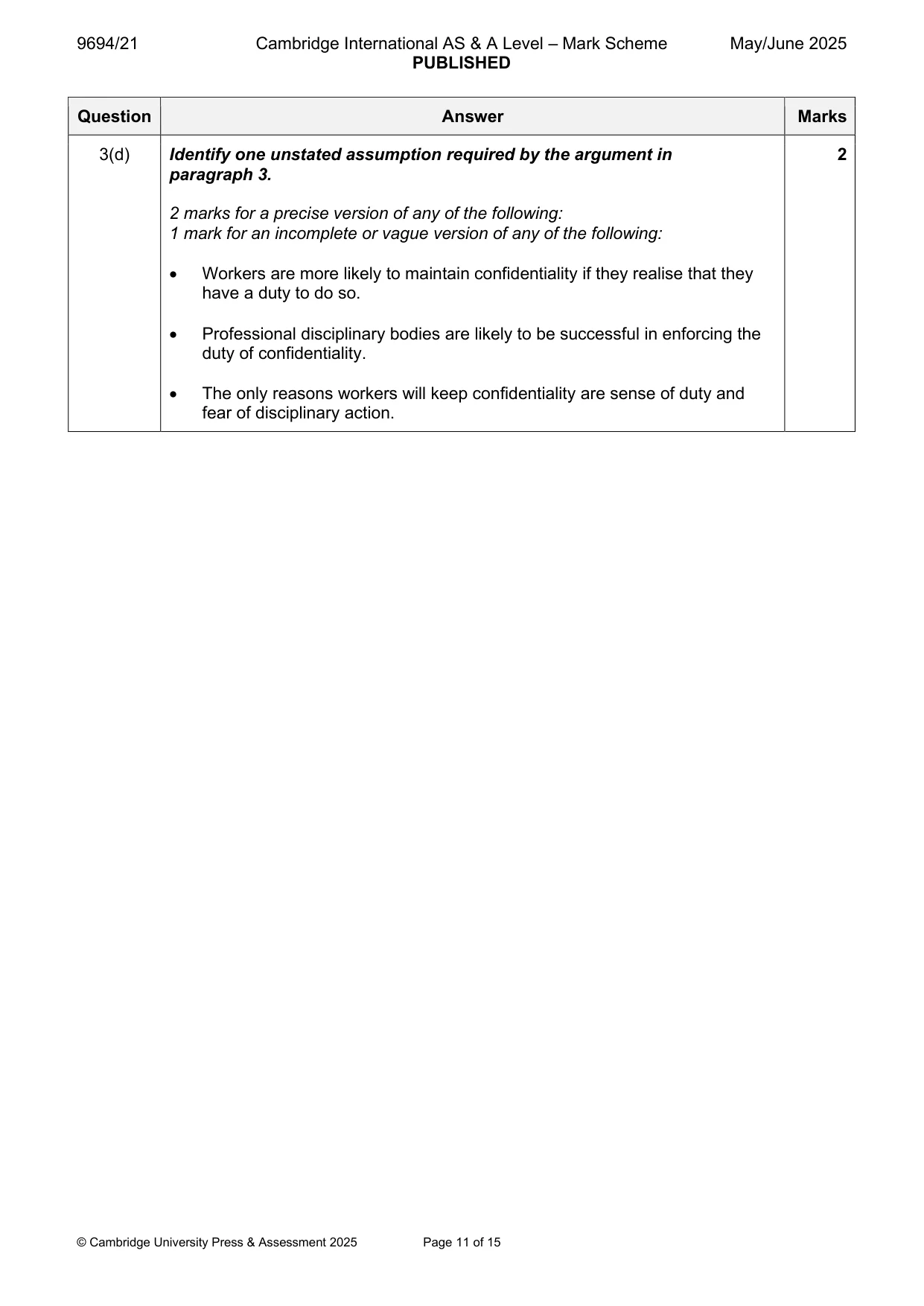
9694/21 Cambridge International AS & A Level – Mark Scheme PUBLISHED May/June 2025 © Cambridge University Press & Assessment 2025 Page 11 of 15 Question Answer Marks 3(d) Identify one unstated assumption required by the argument in paragraph 3. 2 marks for a precise version of any of the following: 1 mark for an incomplete or vague version of any of the following: • Workers are more likely to maintain confidentiality if they realise that they have a duty to do so. • Professional disciplinary bodies are likely to be successful in enforcing the duty of confidentiality. • The only reasons workers will keep confidentiality are sense of duty and fear of disciplinary action. 2
Mark scheme, page 12
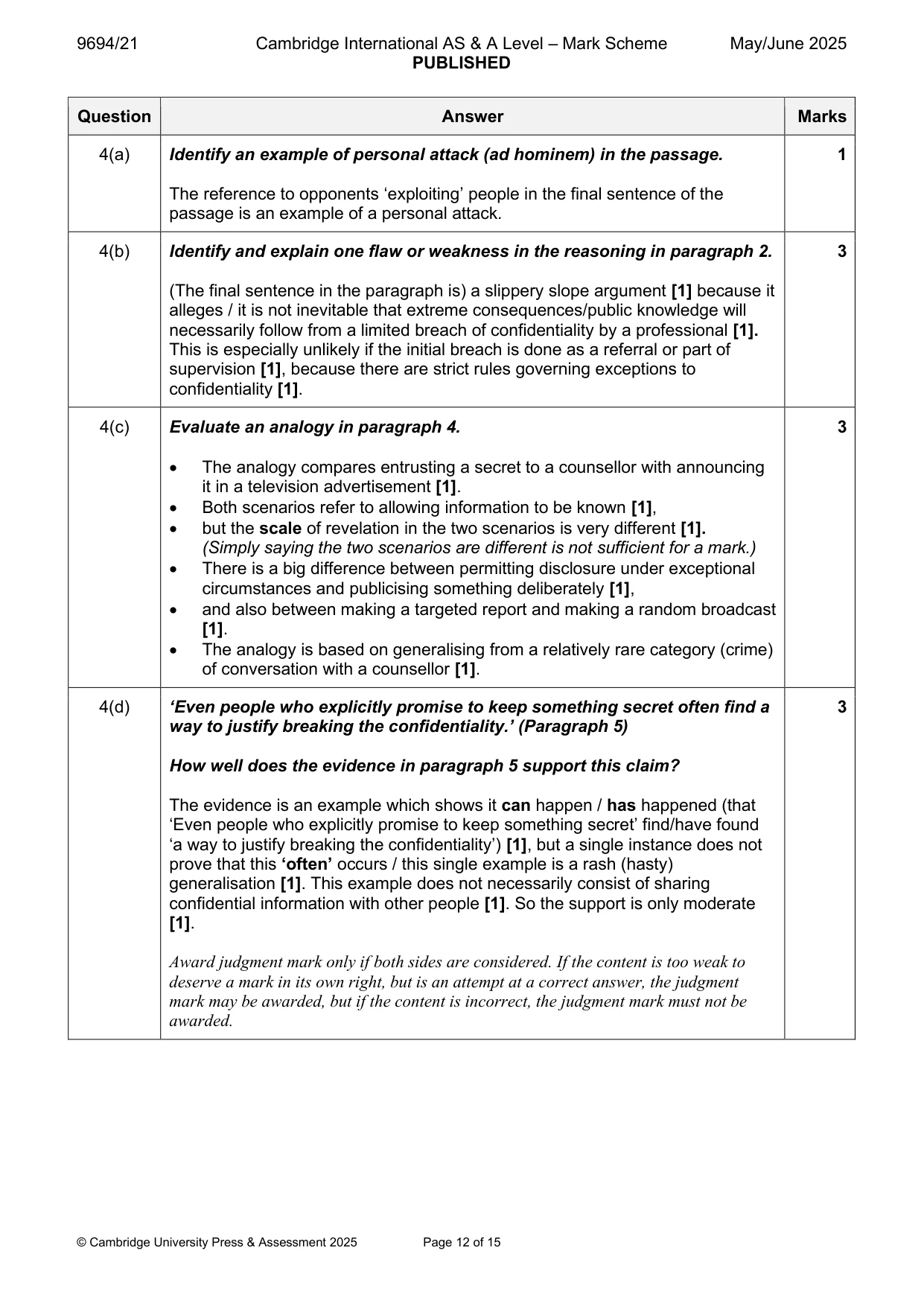
9694/21 Cambridge International AS & A Level – Mark Scheme PUBLISHED May/June 2025 © Cambridge University Press & Assessment 2025 Page 12 of 15 Question Answer Marks 4(a) Identify an example of personal attack (ad hominem) in the passage. The reference to opponents ‘exploiting’ people in the final sentence of the passage is an example of a personal attack. 1 4(b) Identify and explain one flaw or weakness in the reasoning in paragraph 2. (The final sentence in the paragraph is) a slippery slope argument [1] because it alleges / it is not inevitable that extreme consequences/public knowledge will necessarily follow from a limited breach of confidentiality by a professional [1]. This is especially unlikely if the initial breach is done as a referral or part of supervision [1], because there are strict rules governing exceptions to confidentiality [1]. 3 4(c) Evaluate an analogy in paragraph 4. • The analogy compares entrusting a secret to a counsellor with announcing it in a television advertisement [1]. • Both scenarios refer to allowing information to be known [1], • but the scale of revelation in the two scenarios is very different [1]. (Simply saying the two scenarios are different is not sufficient for a mark.) • There is a big difference between permitting disclosure under exceptional circumstances and publicising something deliberately [1], • and also between making a targeted report and making a random broadcast [1]. • The analogy is based on generalising from a relatively rare category (crime) of conversation with a counsellor [1]. 3 4(d) ‘Even people who explicitly promise to keep something secret often find a way to justify breaking the confidentiality.’ (Paragraph 5) How well does the evidence in paragraph 5 support this claim? The evidence is an example which shows it can happen / has happened (that ‘Even people who explicitly promise to keep something secret’ find/have found ‘a way to justify breaking the confidentiality’) [1], but a single instance does not prove that this ‘often’ occurs / this single example is a rash (hasty) generalisation [1]. This example does not necessarily consist of sharing confidential information with other people [1]. So the support is only moderate [1]. Award judgment mark only if both sides are considered. If the content is too weak to deserve a mark in its own right, but is an attempt at a correct answer, the judgment mark may be awarded, but if the content is incorrect, the judgment mark must not be awarded. 3
Mark scheme, page 13
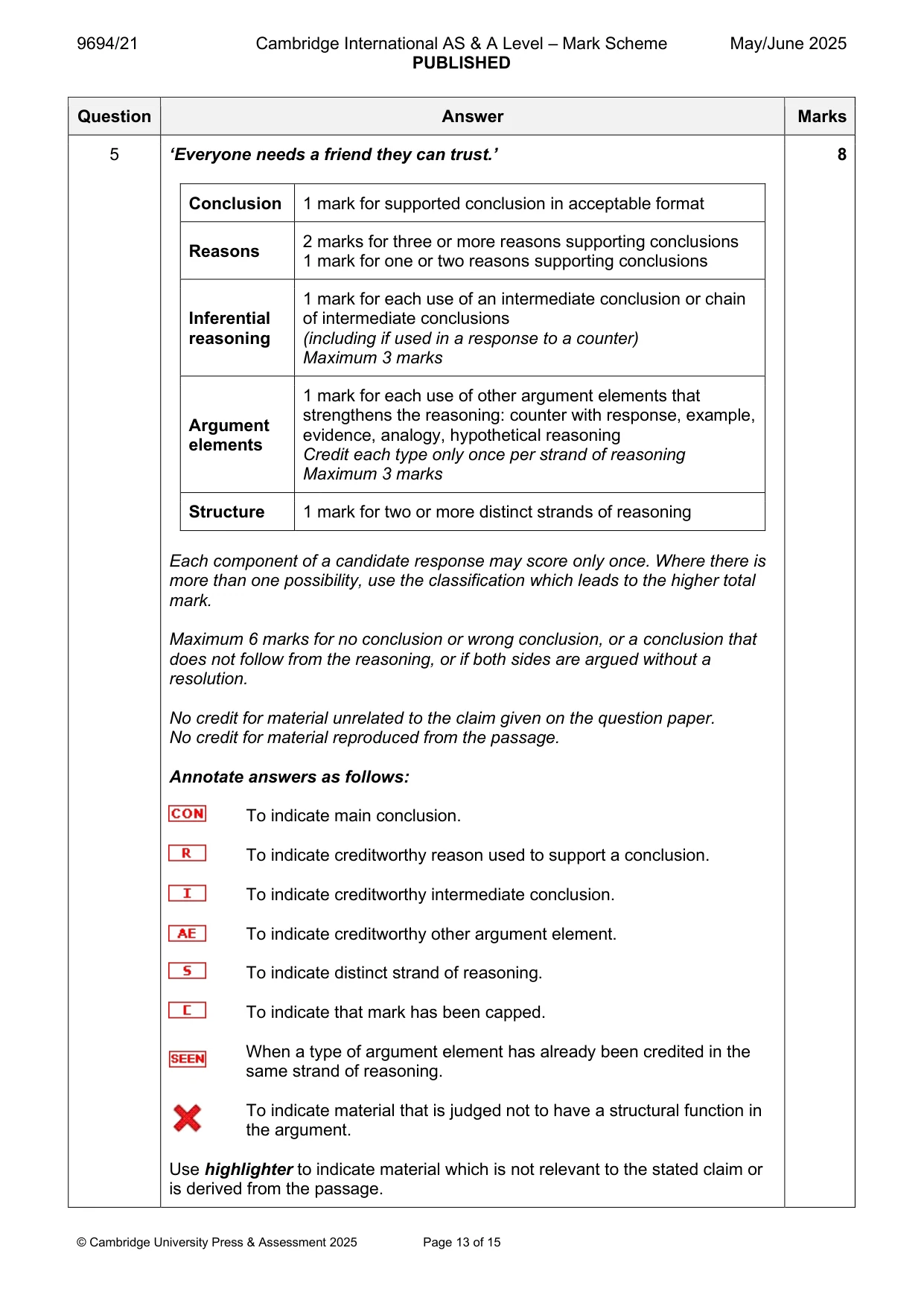
9694/21 Cambridge International AS & A Level – Mark Scheme PUBLISHED May/June 2025 © Cambridge University Press & Assessment 2025 Page 13 of 15 Question Answer Marks 5 ‘Everyone needs a friend they can trust.’ Conclusion 1 mark for supported conclusion in acceptable format Reasons 2 marks for three or more reasons supporting conclusions 1 mark for one or two reasons supporting conclusions Inferential reasoning 1 mark for each use of an intermediate conclusion or chain of intermediate conclusions (including if used in a response to a counter) Maximum 3 marks Argument elements 1 mark for each use of other argument elements that strengthens the reasoning: counter with response, example, evidence, analogy, hypothetical reasoning Credit each type only once per strand of reasoning Maximum 3 marks Structure 1 mark for two or more distinct strands of reasoning Each component of a candidate response may score only once. Where there is more than one possibility, use the classification which leads to the higher total mark. Maximum 6 marks for no conclusion or wrong conclusion, or a conclusion that does not follow from the reasoning, or if both sides are argued without a resolution. No credit for material unrelated to the claim given on the question paper. No credit for material reproduced from the passage. Annotate answers as follows: To indicate main conclusion. To indicate creditworthy reason used to support a conclusion. To indicate creditworthy intermediate conclusion. To indicate creditworthy other argument element. To indicate distinct strand of reasoning. To indicate that mark has been capped. When a type of argument element has already been credited in the same strand of reasoning. To indicate material that is judged not to have a structural function in the argument. Use highlighter to indicate material which is not relevant to the stated claim or is derived from the passage. 8
Mark scheme, page 14
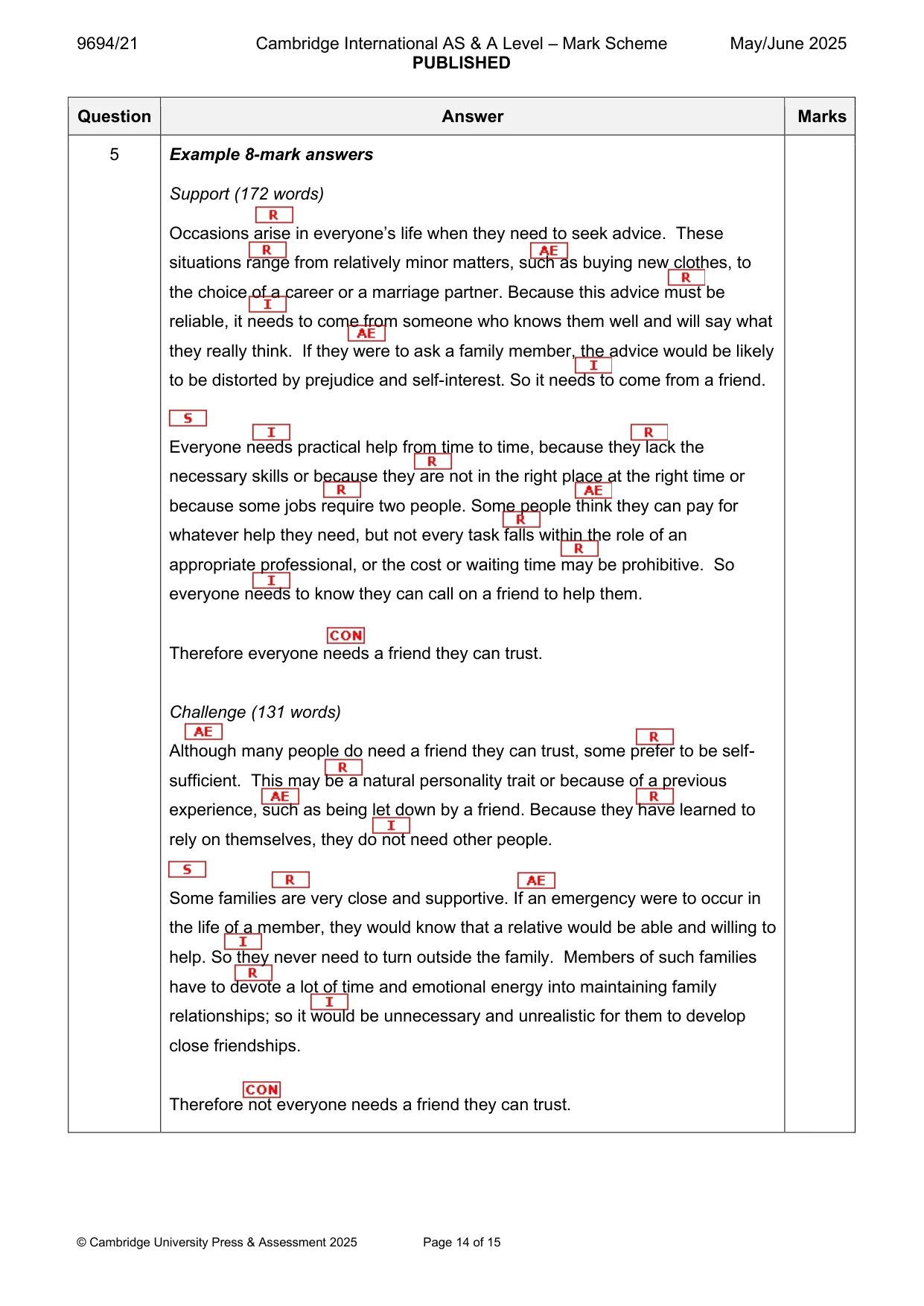
9694/21 Cambridge International AS & A Level – Mark Scheme PUBLISHED May/June 2025 © Cambridge University Press & Assessment 2025 Page 14 of 15 Question Answer Marks 5 Example 8-mark answers Support (172 words) Occasions arise in everyone’s life when they need to seek advice. These situations range from relatively minor matters, such as buying new clothes, to the choice of a career or a marriage partner. Because this advice must be reliable, it needs to come from someone who knows them well and will say what they really think. If they were to ask a family member, the advice would be likely to be distorted by prejudice and self-interest. So it needs to come from a friend. Everyone needs practical help from time to time, because they lack the necessary skills or because they are not in the right place at the right time or because some jobs require two people. Some people think they can pay for whatever help they need, but not every task falls within the role of an appropriate professional, or the cost or waiting time may be prohibitive. So everyone needs to know they can call on a friend to help them. Therefore everyone needs a friend they can trust. Challenge (131 words) Although many people do need a friend they can trust, some prefer to be self- sufficient. This may be a natural personality trait or because of a previous experience, such as being let down by a friend. Because they have learned to rely on themselves, they do not need other people. Some families are very close and supportive. If an emergency were to occur in the life of a member, they would know that a relative would be able and willing to help. So they never need to turn outside the family. Members of such families have to devote a lot of time and emotional energy into maintaining family relationships; so it would be unnecessary and unrealistic for them to develop close friendships. Therefore not everyone needs a friend they can trust.
Mark scheme, page 15
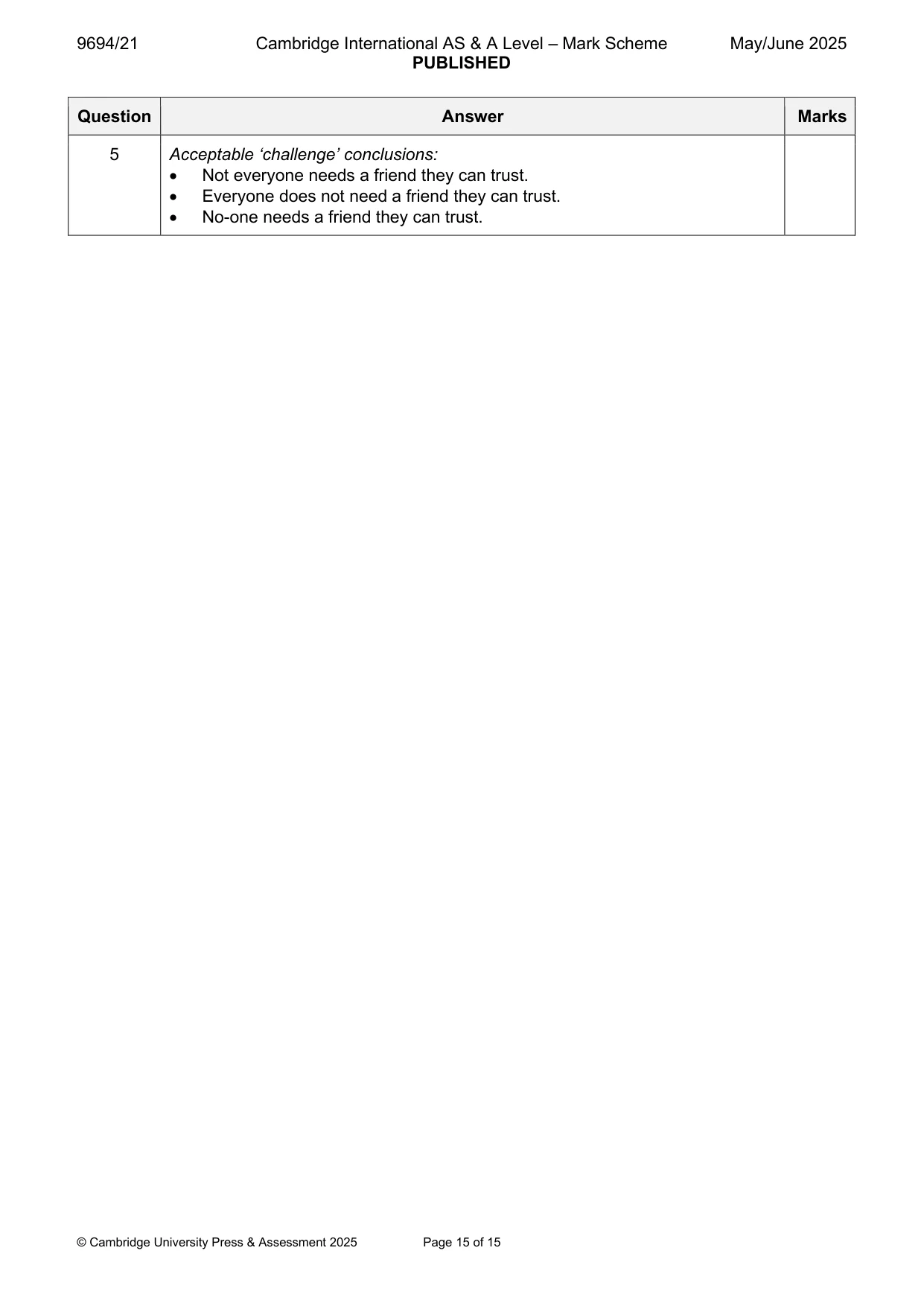
9694/21 Cambridge International AS & A Level – Mark Scheme PUBLISHED May/June 2025 © Cambridge University Press & Assessment 2025 Page 15 of 15 Question Answer Marks 5 Acceptable ‘challenge’ conclusions: • Not everyone needs a friend they can trust. • Everyone does not need a friend they can trust. • No-one needs a friend they can trust.
What you needed in this session
Cambridge’s own grade thresholds for 2025 May/June, Paper 2 · Variant 1. A higher threshold means an easier paper — the bar moves with how the cohort did.