Cambridge A Level Thinking Skills 9694 — 2023 May/June Paper 2 · Variant 1
9694/21/M/J/23 · 50 marks · ≈56 min
The question paper and its mark scheme, free to read here and free to download. This is Cambridge’s own paper, exactly as it was sat.
Question paper8 pages



Mark scheme12 pages
Answers below. Sit the paper first if you are practising.
Paper as text
Question paper, page 1
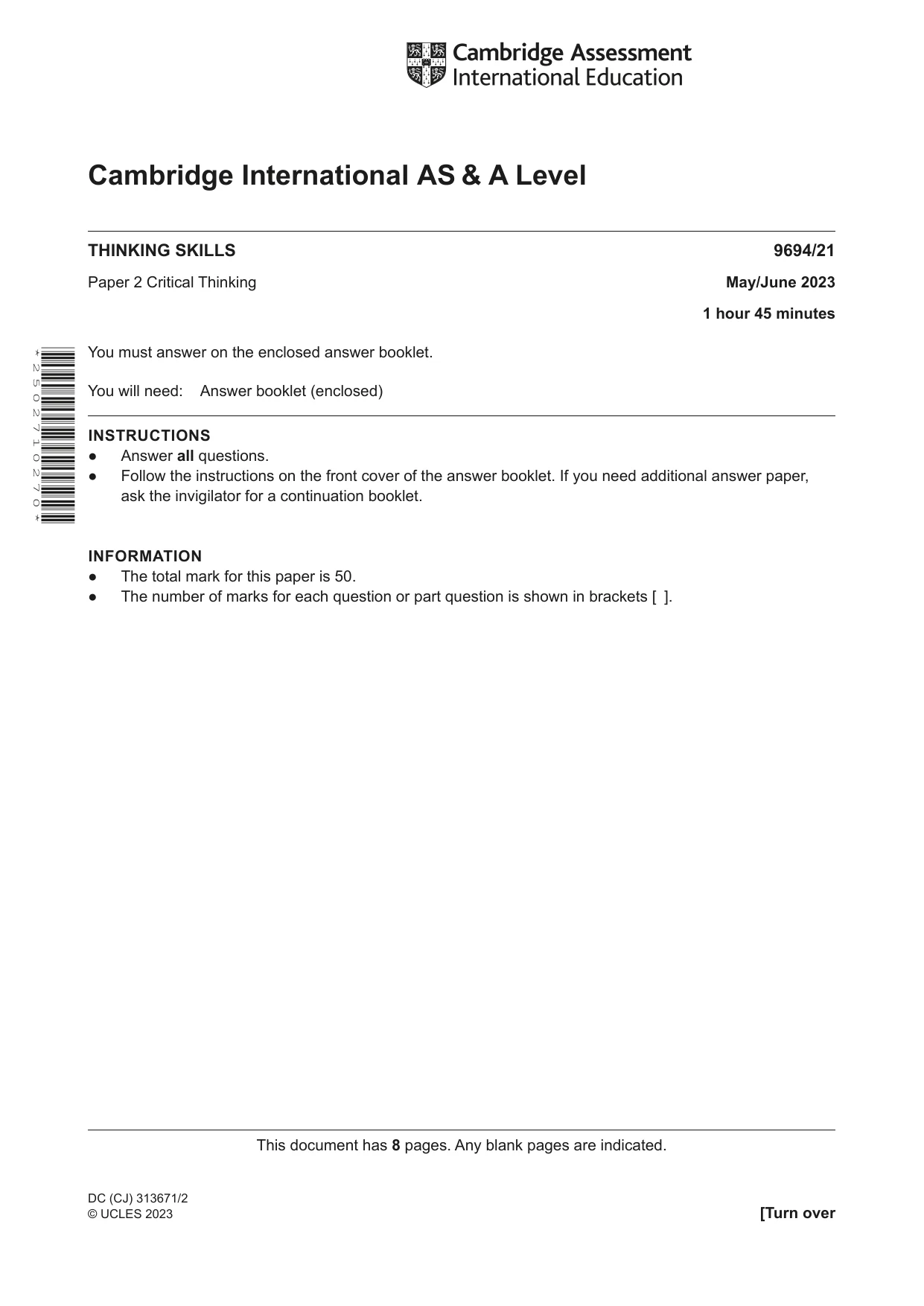
This document has 8 pages. Any blank pages are indicated. [Turn over Cambridge International AS & A Level THINKING SKILLS 9694/21 Paper 2 Critical Thinking May/June 2023 1 hour 45 minutes You must answer on the enclosed answer booklet. You will need: Answer booklet (enclosed) INSTRUCTIONS ● Answer all questions. ● Follow the instructions on the front cover of the answer booklet. If you need additional answer paper, ask the invigilator for a continuation booklet. INFORMATION ● The total mark for this paper is 50. ● The number of marks for each question or part question is shown in brackets [ ]. * 2 5 0 2 7 1 0 2 7 0 * DC (CJ) 313671/2 © UCLES 2023
Question paper, page 2
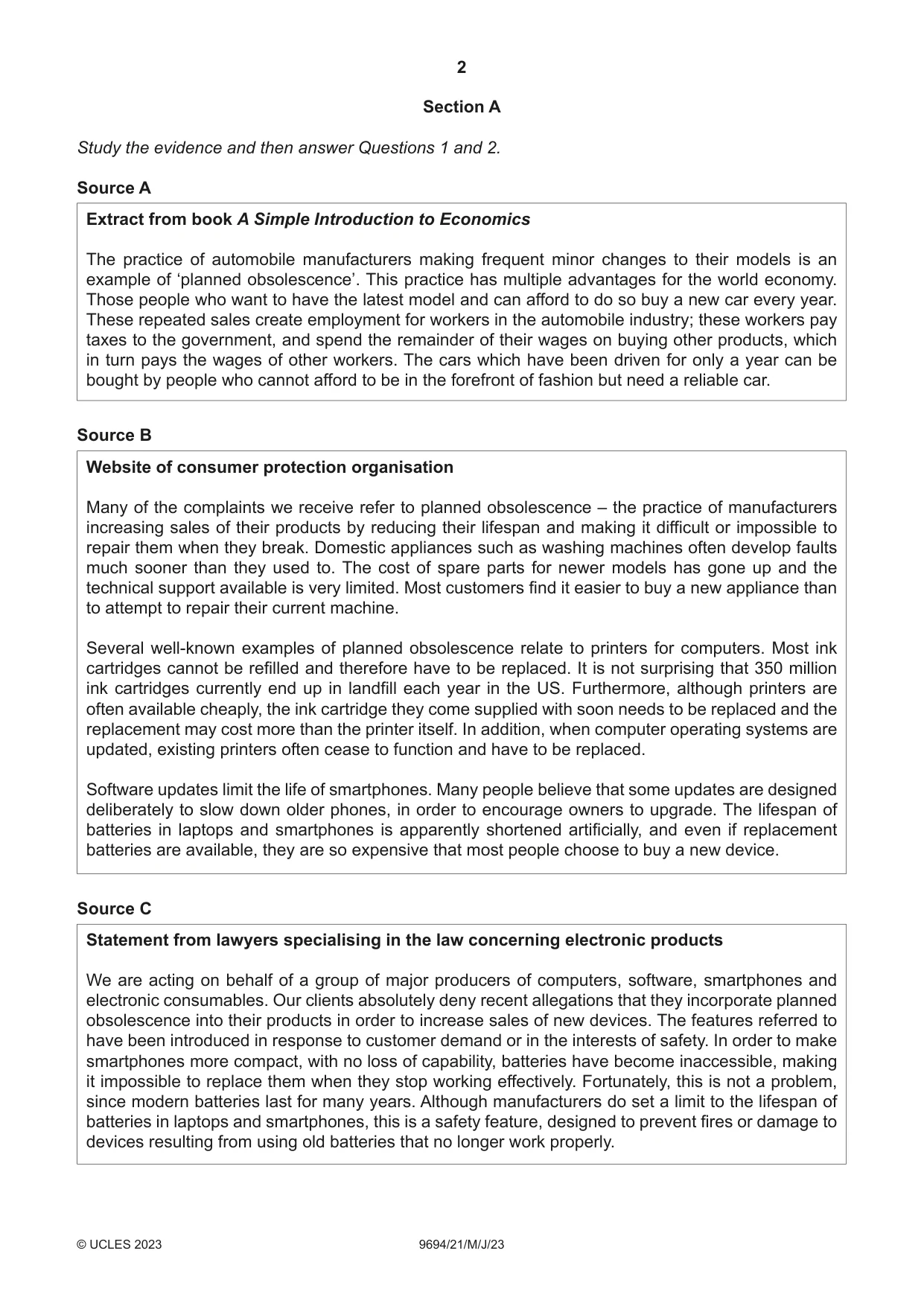
2 9694/21/M/J/23 © UCLES 2023 Section A Study the evidence and then answer Questions 1 and 2. Source A Extract from book A Simple Introduction to Economics The practice of automobile manufacturers making frequent minor changes to their models is an example of ‘planned obsolescence’. This practice has multiple advantages for the world economy. Those people who want to have the latest model and can afford to do so buy a new car every year. These repeated sales create employment for workers in the automobile industry; these workers pay taxes to the government, and spend the remainder of their wages on buying other products, which in turn pays the wages of other workers. The cars which have been driven for only a year can be bought by people who cannot afford to be in the forefront of fashion but need a reliable car. Source B Website of consumer protection organisation Many of the complaints we receive refer to planned obsolescence – the practice of manufacturers increasing sales of their products by reducing their lifespan and making it difficult or impossible to repair them when they break. Domestic appliances such as washing machines often develop faults much sooner than they used to. The cost of spare parts for newer models has gone up and the technical support available is very limited. Most customers find it easier to buy a new appliance than to attempt to repair their current machine. Several well-known examples of planned obsolescence relate to printers for computers. Most ink cartridges cannot be refilled and therefore have to be replaced. It is not surprising that 350 million ink cartridges currently end up in landfill each year in the US. Furthermore, although printers are often available cheaply, the ink cartridge they come supplied with soon needs to be replaced and the replacement may cost more than the printer itself. In addition, when computer operating systems are updated, existing printers often cease to function and have to be replaced. Software updates limit the life of smartphones. Many people believe that some updates are designed deliberately to slow down older phones, in order to encourage owners to upgrade. The lifespan of batteries in laptops and smartphones is apparently shortened artificially, and even if replacement batteries are available, they are so expensive that most people choose to buy a new device. Source C Statement from lawyers specialising in the law concerning electronic products We are acting on behalf of a group of major producers of computers, software, smartphones and electronic consumables. Our clients absolutely deny recent allegations that they incorporate planned obsolescence into their products in order to increase sales of new devices. The features referred to have been introduced in response to customer demand or in the interests of safety. In order to make smartphones more compact, with no loss of capability, batteries have become inaccessible, making it impossible to replace them when they stop working effectively. Fortunately, this is not a problem, since modern batteries last for many years. Although manufacturers do set a limit to the lifespan of batteries in laptops and smartphones, this is a safety feature, designed to prevent fires or damage to devices resulting from using old batteries that no longer work properly.
Question paper, page 3
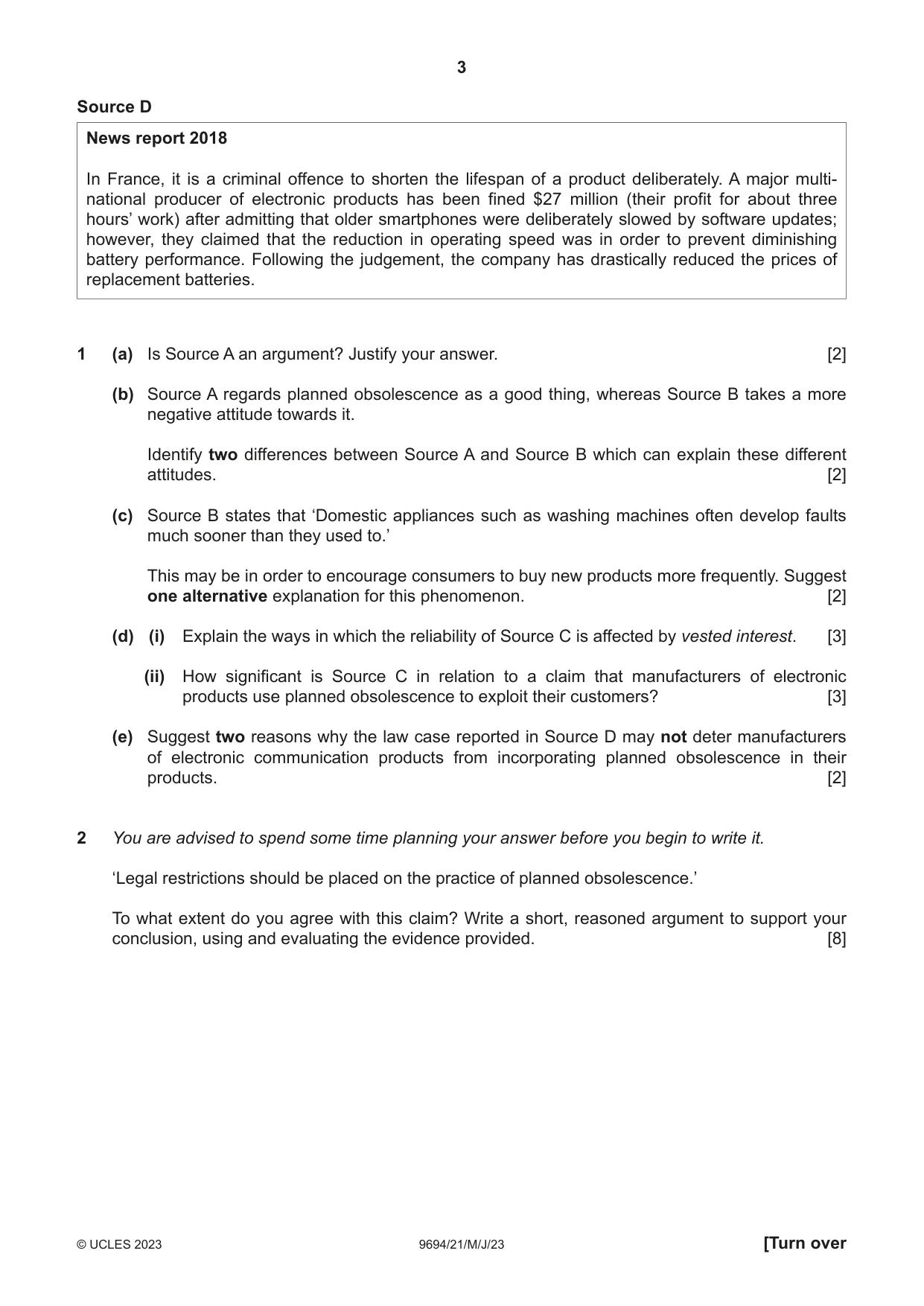
3 9694/21/M/J/23 © UCLES 2023 [Turn over Source D News report 2018 In France, it is a criminal offence to shorten the lifespan of a product deliberately. A major multi- national producer of electronic products has been fined $27 million (their profit for about three hours’ work) after admitting that older smartphones were deliberately slowed by software updates; however, they claimed that the reduction in operating speed was in order to prevent diminishing battery performance. Following the judgement, the company has drastically reduced the prices of replacement batteries. 1 (a) Is Source A an argument? Justify your answer. [2] (b) Source A regards planned obsolescence as a good thing, whereas Source B takes a more negative attitude towards it. Identify two differences between Source A and Source B which can explain these different attitudes. [2] (c) Source B states that ‘Domestic appliances such as washing machines often develop faults much sooner than they used to.’ This may be in order to encourage consumers to buy new products more frequently. Suggest one alternative explanation for this phenomenon. [2] (d) (i) Explain the ways in which the reliability of Source C is affected by vested interest. [3] (ii) How significant is Source C in relation to a claim that manufacturers of electronic products use planned obsolescence to exploit their customers? [3] (e) Suggest two reasons why the law case reported in Source D may not deter manufacturers of electronic communication products from incorporating planned obsolescence in their products. [2] 2 You are advised to spend some time planning your answer before you begin to write it. ‘Legal restrictions should be placed on the practice of planned obsolescence.’ To what extent do you agree with this claim? Write a short, reasoned argument to support your conclusion, using and evaluating the evidence provided. [8]
Question paper, page 4
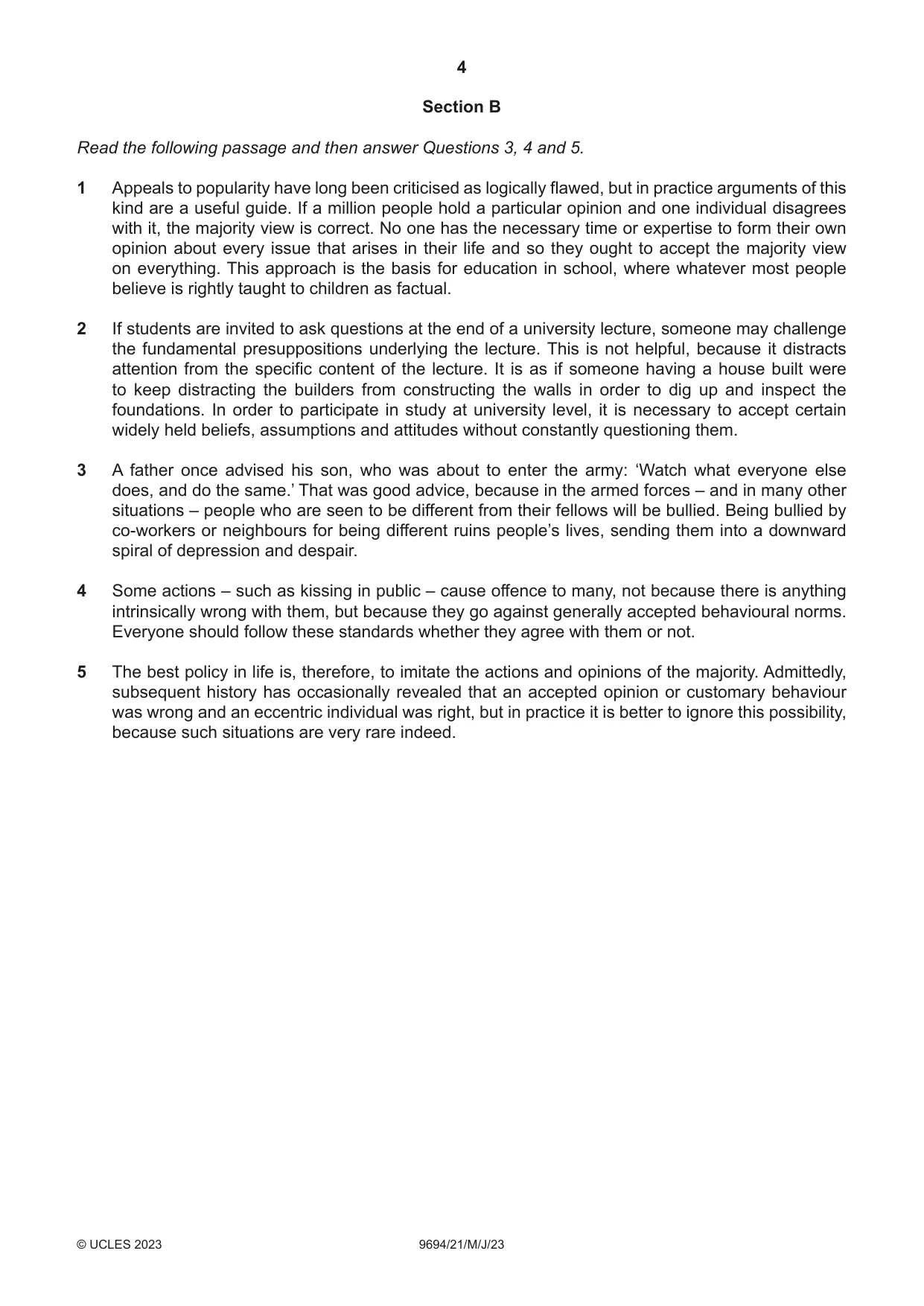
4 9694/21/M/J/23 © UCLES 2023 Section B Read the following passage and then answer Questions 3, 4 and 5. 1 Appeals to popularity have long been criticised as logically flawed, but in practice arguments of this kind are a useful guide. If a million people hold a particular opinion and one individual disagrees with it, the majority view is correct. No one has the necessary time or expertise to form their own opinion about every issue that arises in their life and so they ought to accept the majority view on everything. This approach is the basis for education in school, where whatever most people believe is rightly taught to children as factual. 2 If students are invited to ask questions at the end of a university lecture, someone may challenge the fundamental presuppositions underlying the lecture. This is not helpful, because it distracts attention from the specific content of the lecture. It is as if someone having a house built were to keep distracting the builders from constructing the walls in order to dig up and inspect the foundations. In order to participate in study at university level, it is necessary to accept certain widely held beliefs, assumptions and attitudes without constantly questioning them. 3 A father once advised his son, who was about to enter the army: ‘Watch what everyone else does, and do the same.’ That was good advice, because in the armed forces – and in many other situations – people who are seen to be different from their fellows will be bullied. Being bullied by co-workers or neighbours for being different ruins people’s lives, sending them into a downward spiral of depression and despair. 4 Some actions – such as kissing in public – cause offence to many, not because there is anything intrinsically wrong with them, but because they go against generally accepted behavioural norms. Everyone should follow these standards whether they agree with them or not. 5 The best policy in life is, therefore, to imitate the actions and opinions of the majority. Admittedly, subsequent history has occasionally revealed that an accepted opinion or customary behaviour was wrong and an eccentric individual was right, but in practice it is better to ignore this possibility, because such situations are very rare indeed.
Question paper, page 5
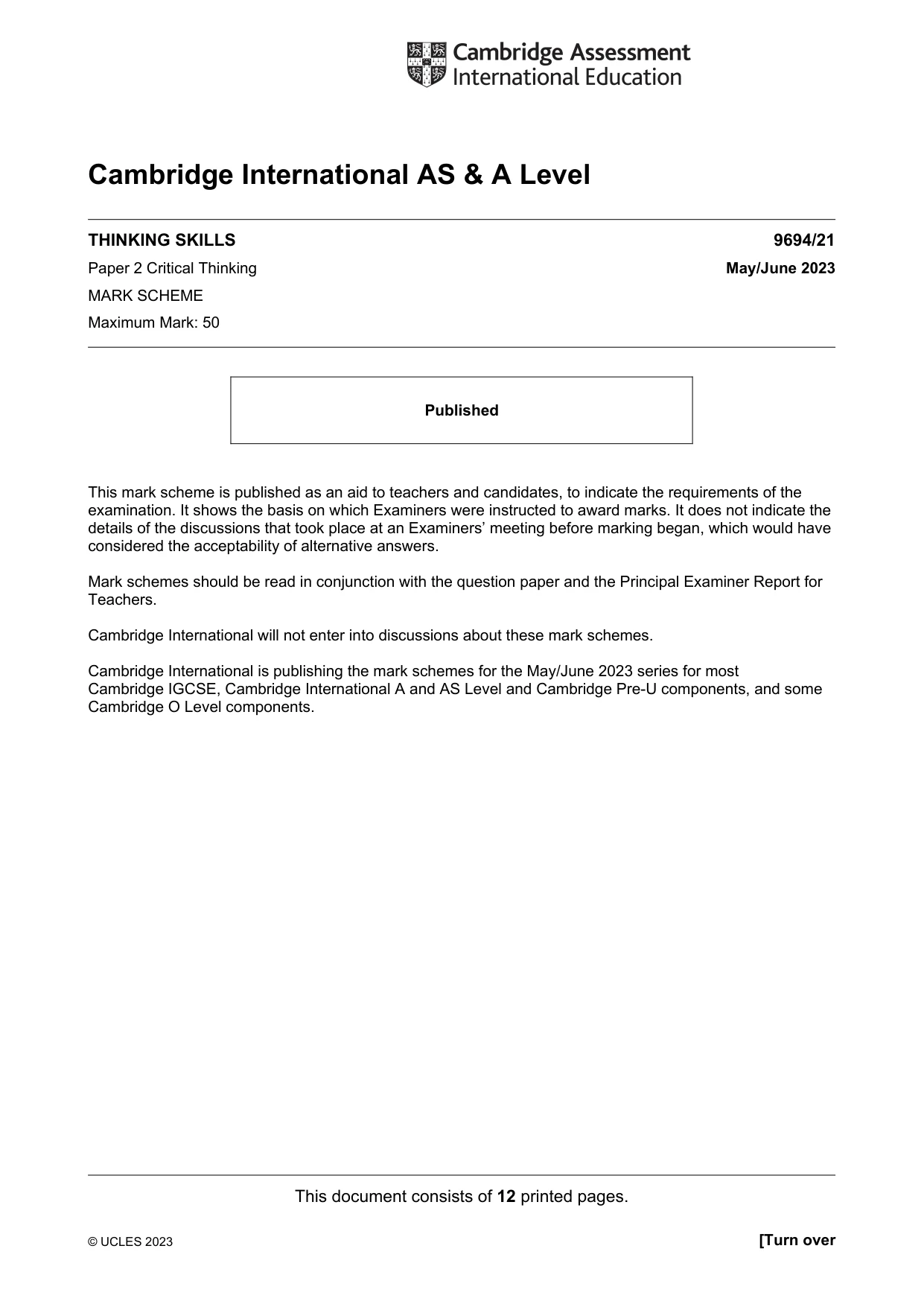
5 9694/21/M/J/23 © UCLES 2023 3 (a) Using the exact words from the passage as far as possible, identify the main conclusion. [2] (b) Using the exact words from the passage as far as possible, identify two intermediate conclusions from paragraphs 3 to 5. [4] (c) Identify the argument element and explain the function of the following words from paragraph 4: ‘kissing in public’ [2] (d) Identify an unstated assumption required by the reasoning in paragraph 4. [2] 4 (a) Identify and explain two flaws or weaknesses in paragraph 1. [4] (b) Evaluate the analogy in paragraph 2. [3] (c) Identify and evaluate an appeal in paragraph 3. [3] 5 You are advised to spend some time planning your answer before you begin to write it. ‘Everyone should use the period of adolescence to develop their own opinions and values.’ Write your own short argument to support or challenge this claim. The conclusion of your argument must be stated. Credit will not be given for repeating ideas from the passage. [8]
Question paper, page 6
6 9694/21/M/J/23 © UCLES 2023 BLANK PAGE
Question paper, page 7
7 9694/21/M/J/23 © UCLES 2023 BLANK PAGE
Question paper, page 8
8 9694/21/M/J/23 © UCLES 2023 Permission to reproduce items where third-party owned material protected by copyright is included has been sought and cleared where possible. Every reasonable effort has been made by the publisher (UCLES) to trace copyright holders, but if any items requiring clearance have unwittingly been included, the publisher will be pleased to make amends at the earliest possible opportunity. To avoid the issue of disclosure of answer-related information to candidates, all copyright acknowledgements are reproduced online in the Cambridge Assessment International Education Copyright Acknowledgements Booklet. This is produced for each series of examinations and is freely available to download at www.cambridgeinternational.org after the live examination series. Cambridge Assessment International Education is part of Cambridge Assessment. Cambridge Assessment is the brand name of the University of Cambridge Local Examinations Syndicate (UCLES), which is a department of the University of Cambridge. BLANK PAGE
Mark scheme, page 1
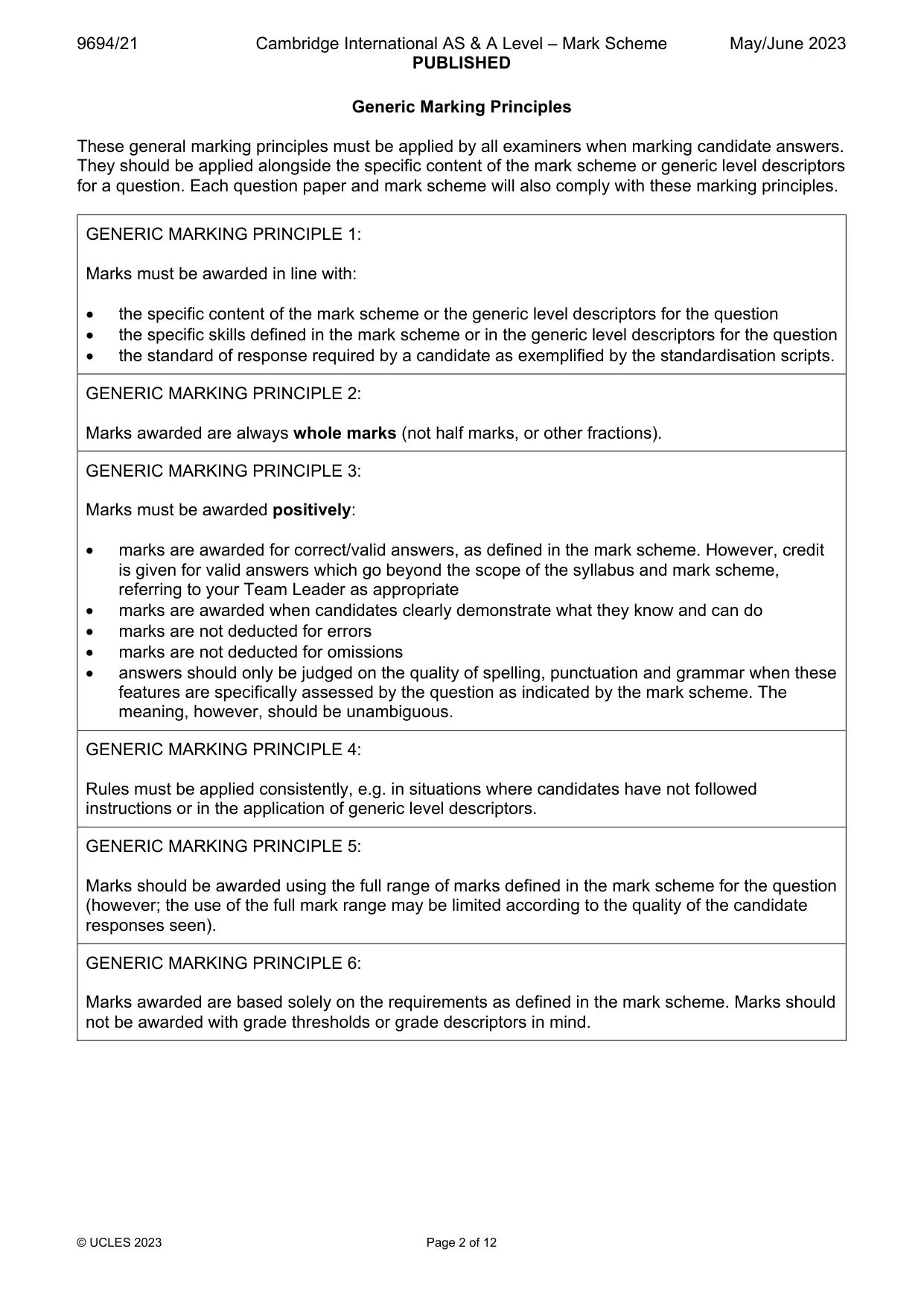
This document consists of 12 printed pages. © UCLES 2023 [Turn over Cambridge International AS & A Level THINKING SKILLS 9694/21 Paper 2 Critical Thinking May/June 2023 MARK SCHEME Maximum Mark: 50 Published This mark scheme is published as an aid to teachers and candidates, to indicate the requirements of the examination. It shows the basis on which Examiners were instructed to award marks. It does not indicate the details of the discussions that took place at an Examiners’ meeting before marking began, which would have considered the acceptability of alternative answers. Mark schemes should be read in conjunction with the question paper and the Principal Examiner Report for Teachers. Cambridge International will not enter into discussions about these mark schemes. Cambridge International is publishing the mark schemes for the May/June 2023 series for most Cambridge IGCSE, Cambridge International A and AS Level and Cambridge Pre-U components, and some Cambridge O Level components.
Mark scheme, page 2
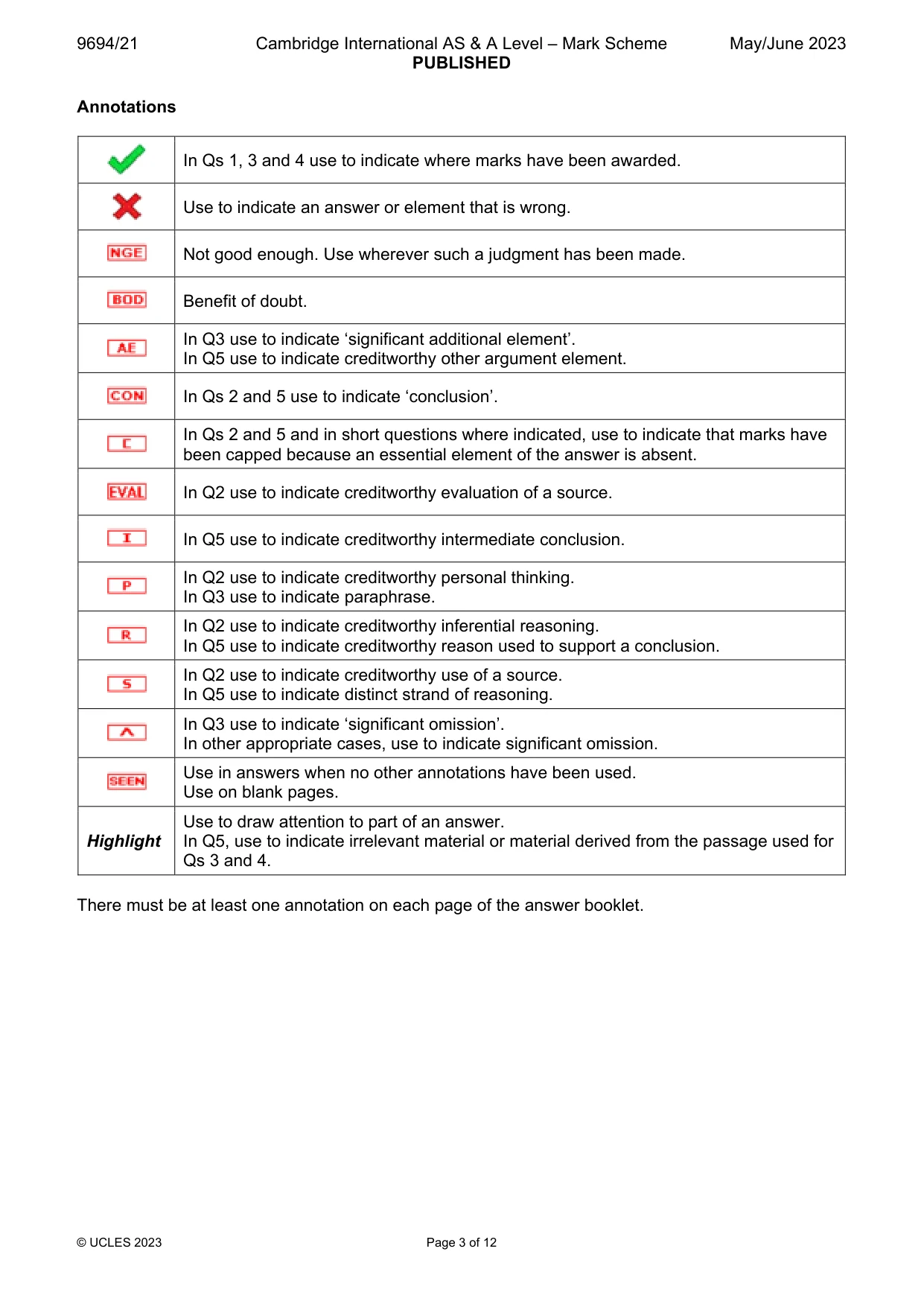
9694/21 Cambridge International AS & A Level – Mark Scheme PUBLISHED May/June 2023 © UCLES 2023 Page 2 of 12 Generic Marking Principles These general marking principles must be applied by all examiners when marking candidate answers. They should be applied alongside the specific content of the mark scheme or generic level descriptors for a question. Each question paper and mark scheme will also comply with these marking principles. GENERIC MARKING PRINCIPLE 1: Marks must be awarded in line with: the specific content of the mark scheme or the generic level descriptors for the question the specific skills defined in the mark scheme or in the generic level descriptors for the question the standard of response required by a candidate as exemplified by the standardisation scripts. GENERIC MARKING PRINCIPLE 2: Marks awarded are always whole marks (not half marks, or other fractions). GENERIC MARKING PRINCIPLE 3: Marks must be awarded positively: marks are awarded for correct/valid answers, as defined in the mark scheme. However, credit is given for valid answers which go beyond the scope of the syllabus and mark scheme, referring to your Team Leader as appropriate marks are awarded when candidates clearly demonstrate what they know and can do marks are not deducted for errors marks are not deducted for omissions answers should only be judged on the quality of spelling, punctuation and grammar when these features are specifically assessed by the question as indicated by the mark scheme. The meaning, however, should be unambiguous. GENERIC MARKING PRINCIPLE 4: Rules must be applied consistently, e.g. in situations where candidates have not followed instructions or in the application of generic level descriptors. GENERIC MARKING PRINCIPLE 5: Marks should be awarded using the full range of marks defined in the mark scheme for the question (however; the use of the full mark range may be limited according to the quality of the candidate responses seen). GENERIC MARKING PRINCIPLE 6: Marks awarded are based solely on the requirements as defined in the mark scheme. Marks should not be awarded with grade thresholds or grade descriptors in mind.
Mark scheme, page 3
9694/21 Cambridge International AS & A Level – Mark Scheme PUBLISHED May/June 2023 © UCLES 2023 Page 3 of 12 Annotations In Qs 1, 3 and 4 use to indicate where marks have been awarded. Use to indicate an answer or element that is wrong. Not good enough. Use wherever such a judgment has been made. Benefit of doubt. In Q3 use to indicate ‘significant additional element’. In Q5 use to indicate creditworthy other argument element. In Qs 2 and 5 use to indicate ‘conclusion’. In Qs 2 and 5 and in short questions where indicated, use to indicate that marks have been capped because an essential element of the answer is absent. In Q2 use to indicate creditworthy evaluation of a source. In Q5 use to indicate creditworthy intermediate conclusion. In Q2 use to indicate creditworthy personal thinking. In Q3 use to indicate paraphrase. In Q2 use to indicate creditworthy inferential reasoning. In Q5 use to indicate creditworthy reason used to support a conclusion. In Q2 use to indicate creditworthy use of a source. In Q5 use to indicate distinct strand of reasoning. In Q3 use to indicate ‘significant omission’. In other appropriate cases, use to indicate significant omission. Use in answers when no other annotations have been used. Use on blank pages. Highlight Use to draw attention to part of an answer. In Q5, use to indicate irrelevant material or material derived from the passage used for Qs 3 and 4. There must be at least one annotation on each page of the answer booklet.
Mark scheme, page 4
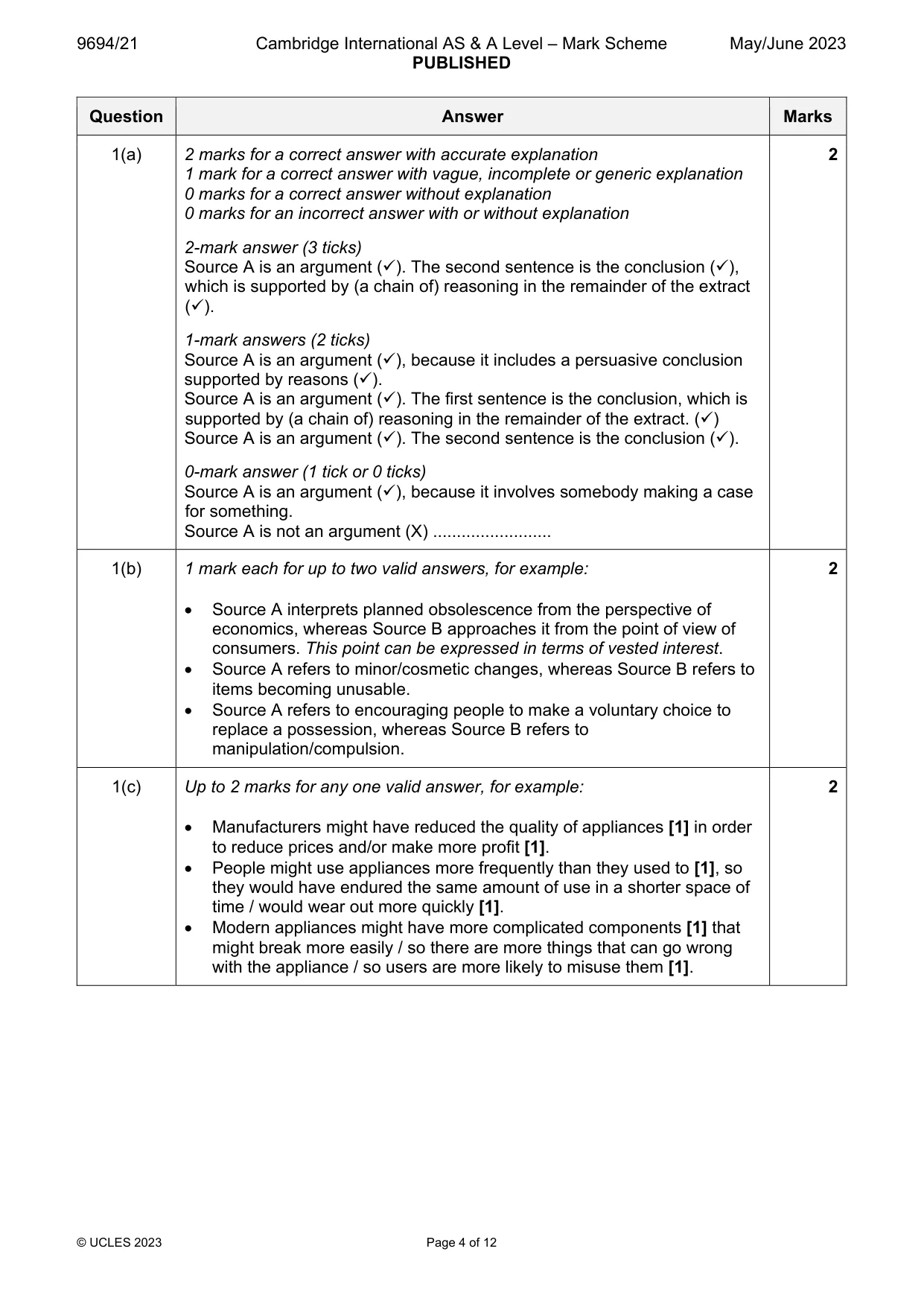
9694/21 Cambridge International AS & A Level – Mark Scheme PUBLISHED May/June 2023 © UCLES 2023 Page 4 of 12 Question Answer Marks 1(a) 2 marks for a correct answer with accurate explanation 1 mark for a correct answer with vague, incomplete or generic explanation 0 marks for a correct answer without explanation 0 marks for an incorrect answer with or without explanation 2-mark answer (3 ticks) Source A is an argument (). The second sentence is the conclusion (), which is supported by (a chain of) reasoning in the remainder of the extract (). 1-mark answers (2 ticks) Source A is an argument (), because it includes a persuasive conclusion supported by reasons (). Source A is an argument (). The first sentence is the conclusion, which is supported by (a chain of) reasoning in the remainder of the extract. () Source A is an argument (). The second sentence is the conclusion (). 0-mark answer (1 tick or 0 ticks) Source A is an argument (), because it involves somebody making a case for something. Source A is not an argument (X) … 2 1(b) 1 mark each for up to two valid answers, for example: Source A interprets planned obsolescence from the perspective of economics, whereas Source B approaches it from the point of view of consumers. This point can be expressed in terms of vested interest. Source A refers to minor/cosmetic changes, whereas Source B refers to items becoming unusable. Source A refers to encouraging people to make a voluntary choice to replace a possession, whereas Source B refers to manipulation/compulsion. 2 1(c) Up to 2 marks for any one valid answer, for example: Manufacturers might have reduced the quality of appliances [1] in order to reduce prices and/or make more profit [1]. People might use appliances more frequently than they used to [1], so they would have endured the same amount of use in a shorter space of time / would wear out more quickly [1]. Modern appliances might have more complicated components [1] that might break more easily / so there are more things that can go wrong with the appliance / so users are more likely to misuse them [1]. 2
Mark scheme, page 5
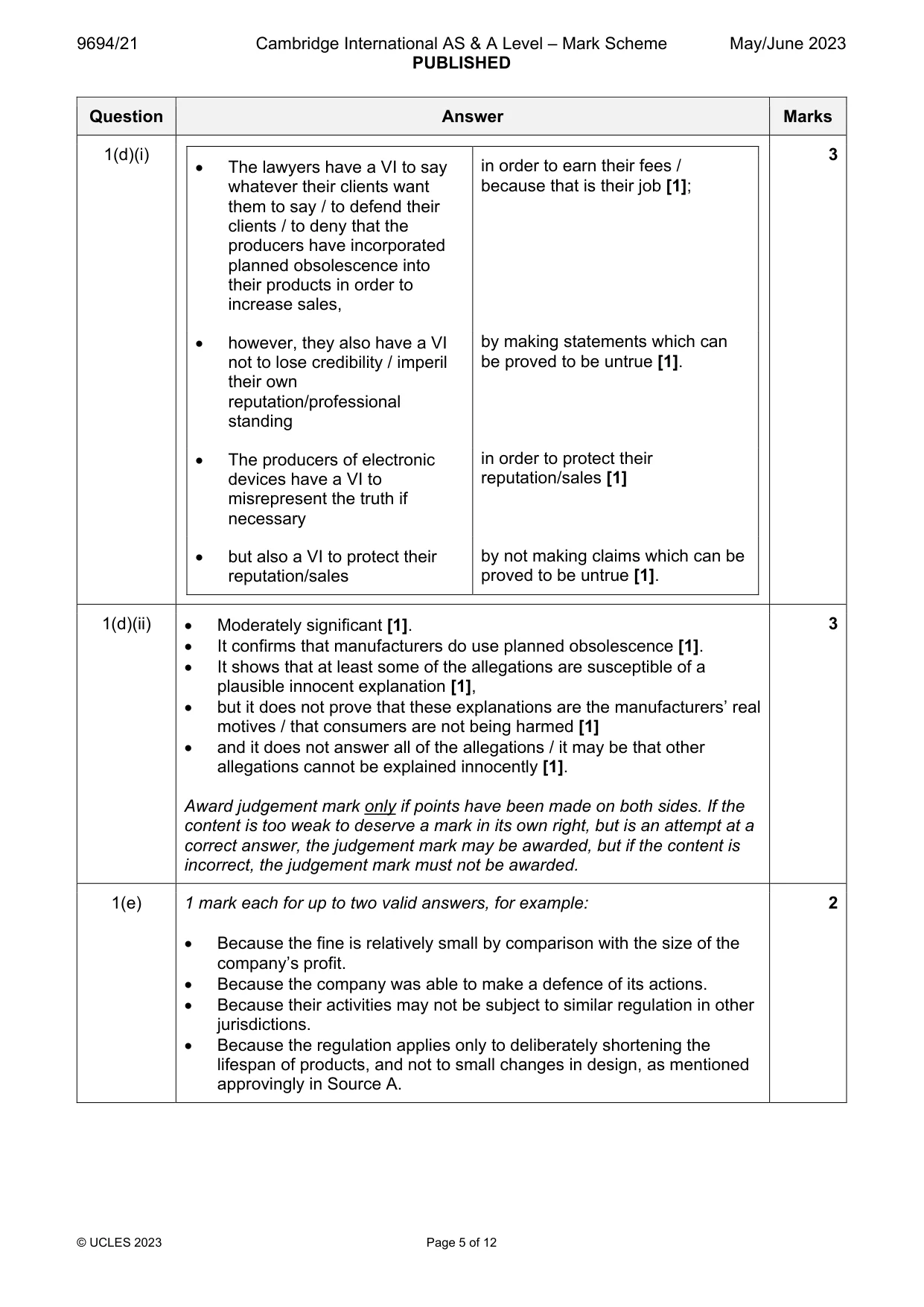
9694/21 Cambridge International AS & A Level – Mark Scheme PUBLISHED May/June 2023 © UCLES 2023 Page 5 of 12 Question Answer Marks 1(d)(i) The lawyers have a VI to say whatever their clients want them to say / to defend their clients / to deny that the producers have incorporated planned obsolescence into their products in order to increase sales, in order to earn their fees / because that is their job [1]; however, they also have a VI not to lose credibility / imperil their own reputation/professional standing by making statements which can be proved to be untrue [1]. The producers of electronic devices have a VI to misrepresent the truth if necessary in order to protect their reputation/sales [1] but also a VI to protect their reputation/sales by not making claims which can be proved to be untrue [1]. 3 1(d)(ii) Moderately significant [1]. It confirms that manufacturers do use planned obsolescence [1]. It shows that at least some of the allegations are susceptible of a plausible innocent explanation [1], but it does not prove that these explanations are the manufacturers’ real motives / that consumers are not being harmed [1] and it does not answer all of the allegations / it may be that other allegations cannot be explained innocently [1]. Award judgement mark only if points have been made on both sides. If the content is too weak to deserve a mark in its own right, but is an attempt at a correct answer, the judgement mark may be awarded, but if the content is incorrect, the judgement mark must not be awarded. 3 1(e) 1 mark each for up to two valid answers, for example: Because the fine is relatively small by comparison with the size of the company’s profit. Because the company was able to make a defence of its actions. Because their activities may not be subject to similar regulation in other jurisdictions. Because the regulation applies only to deliberately shortening the lifespan of products, and not to small changes in design, as mentioned approvingly in Source A. 2
Mark scheme, page 6
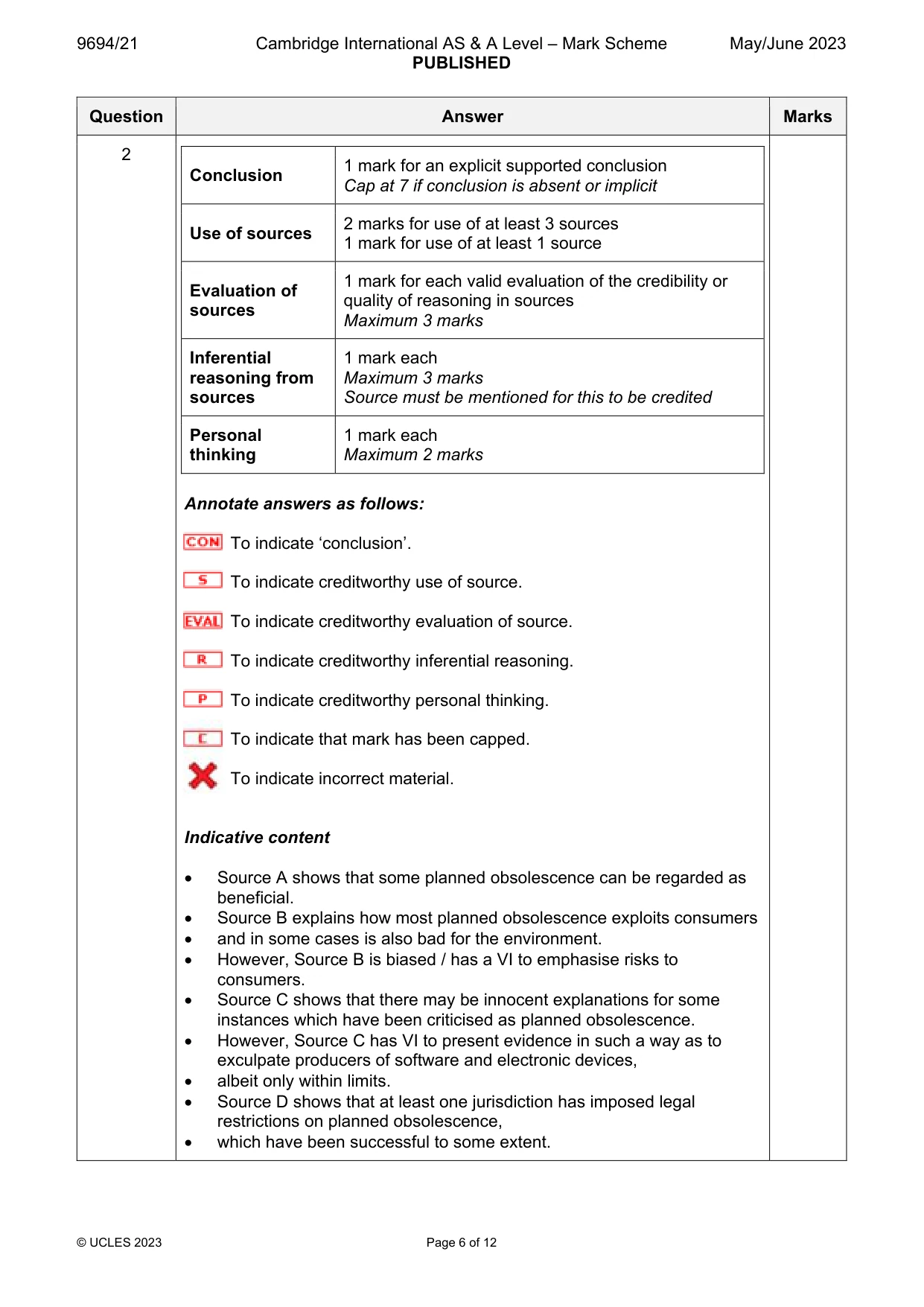
9694/21 Cambridge International AS & A Level – Mark Scheme PUBLISHED May/June 2023 © UCLES 2023 Page 6 of 12 Question Answer Marks 2 Conclusion 1 mark for an explicit supported conclusion Cap at 7 if conclusion is absent or implicit Use of sources 2 marks for use of at least 3 sources 1 mark for use of at least 1 source Evaluation of sources 1 mark for each valid evaluation of the credibility or quality of reasoning in sources Maximum 3 marks Inferential reasoning from sources 1 mark each Maximum 3 marks Source must be mentioned for this to be credited Personal thinking 1 mark each Maximum 2 marks Annotate answers as follows: To indicate ‘conclusion’. To indicate creditworthy use of source. To indicate creditworthy evaluation of source. To indicate creditworthy inferential reasoning. To indicate creditworthy personal thinking. To indicate that mark has been capped. To indicate incorrect material. Indicative content Source A shows that some planned obsolescence can be regarded as beneficial. Source B explains how most planned obsolescence exploits consumers and in some cases is also bad for the environment. However, Source B is biased / has a VI to emphasise risks to consumers. Source C shows that there may be innocent explanations for some instances which have been criticised as planned obsolescence. However, Source C has VI to present evidence in such a way as to exculpate producers of software and electronic devices, albeit only within limits. Source D shows that at least one jurisdiction has imposed legal restrictions on planned obsolescence, which have been successful to some extent.
Mark scheme, page 7
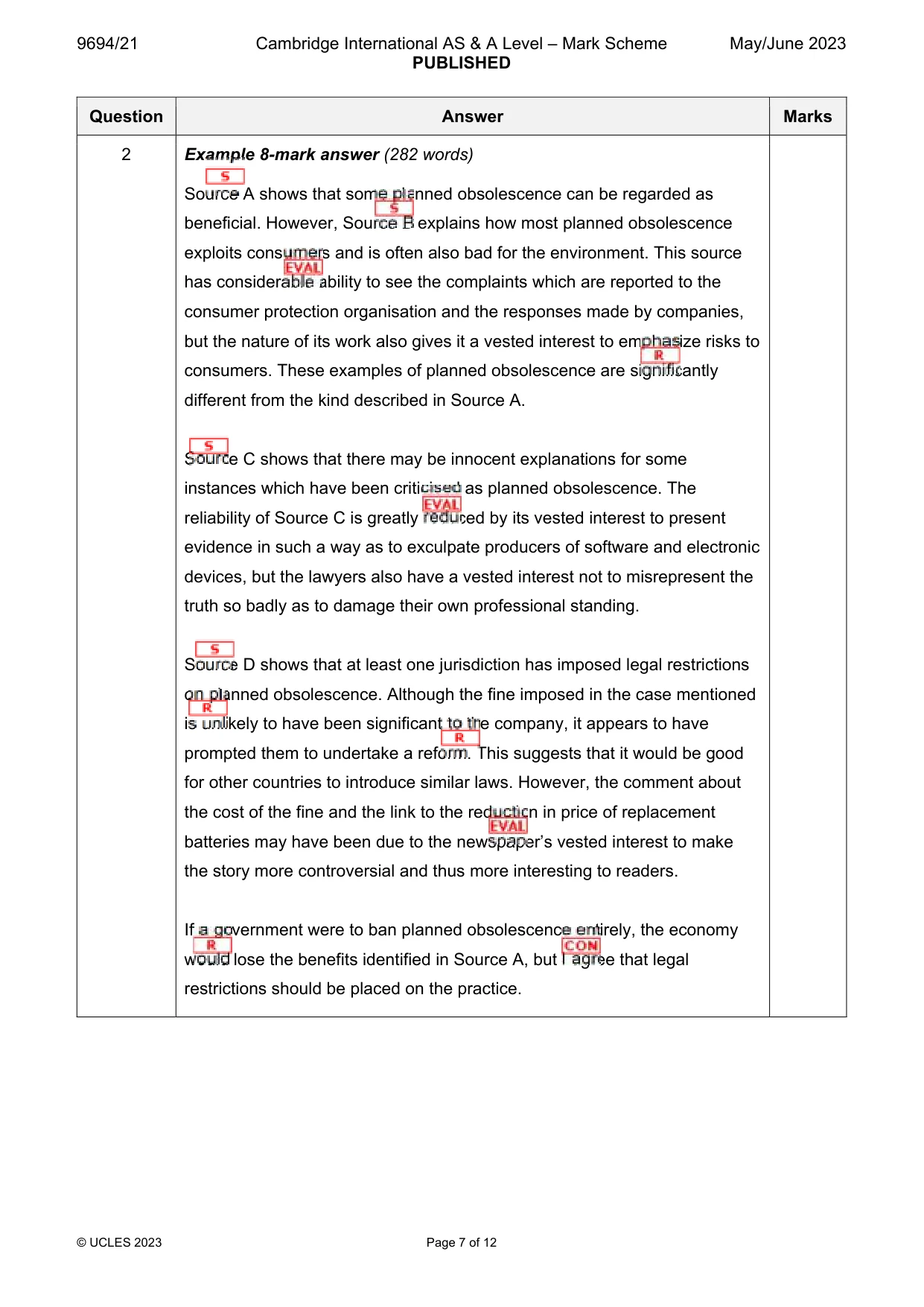
9694/21 Cambridge International AS & A Level – Mark Scheme PUBLISHED May/June 2023 © UCLES 2023 Page 7 of 12 Question Answer Marks 2 Example 8-mark answer (282 words) Source A shows that some planned obsolescence can be regarded as beneficial. However, Source B explains how most planned obsolescence exploits consumers and is often also bad for the environment. This source has considerable ability to see the complaints which are reported to the consumer protection organisation and the responses made by companies, but the nature of its work also gives it a vested interest to emphasize risks to consumers. These examples of planned obsolescence are significantly different from the kind described in Source A. Source C shows that there may be innocent explanations for some instances which have been criticised as planned obsolescence. The reliability of Source C is greatly reduced by its vested interest to present evidence in such a way as to exculpate producers of software and electronic devices, but the lawyers also have a vested interest not to misrepresent the truth so badly as to damage their own professional standing. Source D shows that at least one jurisdiction has imposed legal restrictions on planned obsolescence. Although the fine imposed in the case mentioned is unlikely to have been significant to the company, it appears to have prompted them to undertake a reform. This suggests that it would be good for other countries to introduce similar laws. However, the comment about the cost of the fine and the link to the reduction in price of replacement batteries may have been due to the newspaper’s vested interest to make the story more controversial and thus more interesting to readers. If a government were to ban planned obsolescence entirely, the economy would lose the benefits identified in Source A, but I agree that legal restrictions should be placed on the practice.
Mark scheme, page 8
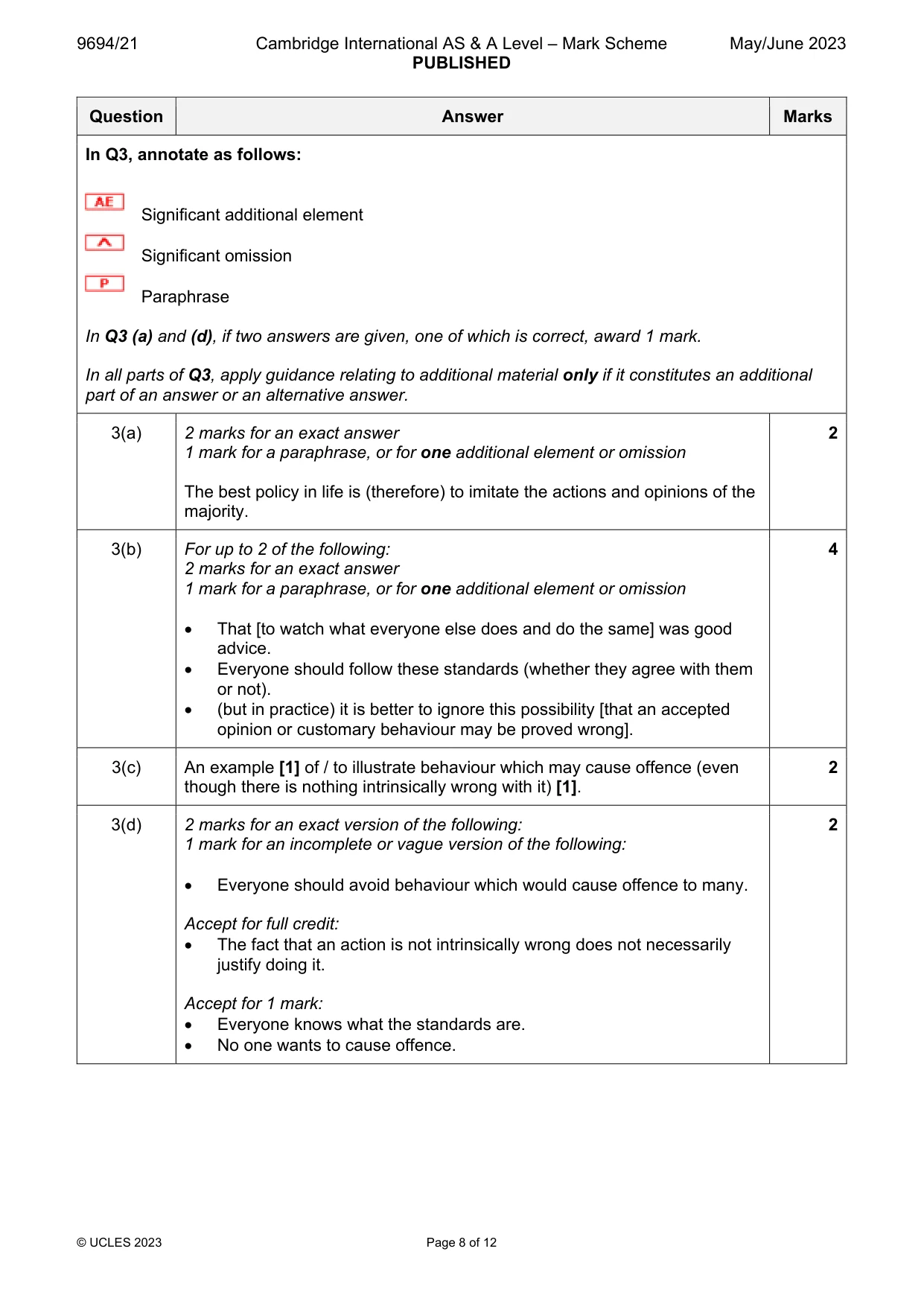
9694/21 Cambridge International AS & A Level – Mark Scheme PUBLISHED May/June 2023 © UCLES 2023 Page 8 of 12 Question Answer Marks In Q3, annotate as follows: Significant additional element Significant omission Paraphrase In Q3 (a) and (d), if two answers are given, one of which is correct, award 1 mark. In all parts of Q3, apply guidance relating to additional material only if it constitutes an additional part of an answer or an alternative answer. 3(a) 2 marks for an exact answer 1 mark for a paraphrase, or for one additional element or omission The best policy in life is (therefore) to imitate the actions and opinions of the majority. 2 3(b) For up to 2 of the following: 2 marks for an exact answer 1 mark for a paraphrase, or for one additional element or omission That [to watch what everyone else does and do the same] was good advice. Everyone should follow these standards (whether they agree with them or not). (but in practice) it is better to ignore this possibility [that an accepted opinion or customary behaviour may be proved wrong]. 4 3(c) An example [1] of / to illustrate behaviour which may cause offence (even though there is nothing intrinsically wrong with it) [1]. 2 3(d) 2 marks for an exact version of the following: 1 mark for an incomplete or vague version of the following: Everyone should avoid behaviour which would cause offence to many. Accept for full credit: The fact that an action is not intrinsically wrong does not necessarily justify doing it. Accept for 1 mark: Everyone knows what the standards are. No one wants to cause offence. 2
Mark scheme, page 9
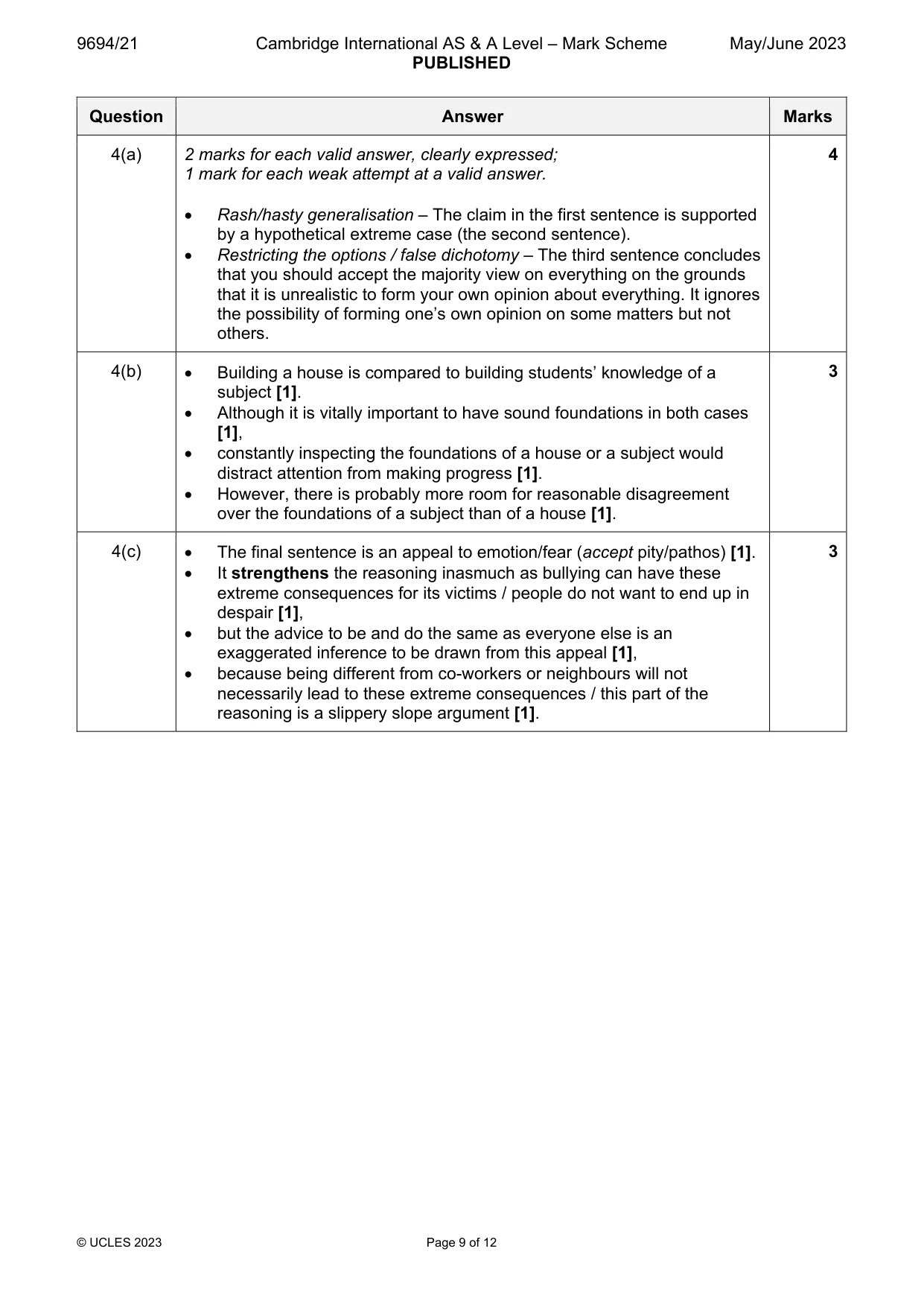
9694/21 Cambridge International AS & A Level – Mark Scheme PUBLISHED May/June 2023 © UCLES 2023 Page 9 of 12 Question Answer Marks 4(a) 2 marks for each valid answer, clearly expressed; 1 mark for each weak attempt at a valid answer. Rash/hasty generalisation – The claim in the first sentence is supported by a hypothetical extreme case (the second sentence). Restricting the options / false dichotomy – The third sentence concludes that you should accept the majority view on everything on the grounds that it is unrealistic to form your own opinion about everything. It ignores the possibility of forming one’s own opinion on some matters but not others. 4 4(b) Building a house is compared to building students’ knowledge of a subject [1]. Although it is vitally important to have sound foundations in both cases [1], constantly inspecting the foundations of a house or a subject would distract attention from making progress [1]. However, there is probably more room for reasonable disagreement over the foundations of a subject than of a house [1]. 3 4(c) The final sentence is an appeal to emotion/fear (accept pity/pathos) [1]. It strengthens the reasoning inasmuch as bullying can have these extreme consequences for its victims / people do not want to end up in despair [1], but the advice to be and do the same as everyone else is an exaggerated inference to be drawn from this appeal [1], because being different from co-workers or neighbours will not necessarily lead to these extreme consequences / this part of the reasoning is a slippery slope argument [1]. 3
Mark scheme, page 10
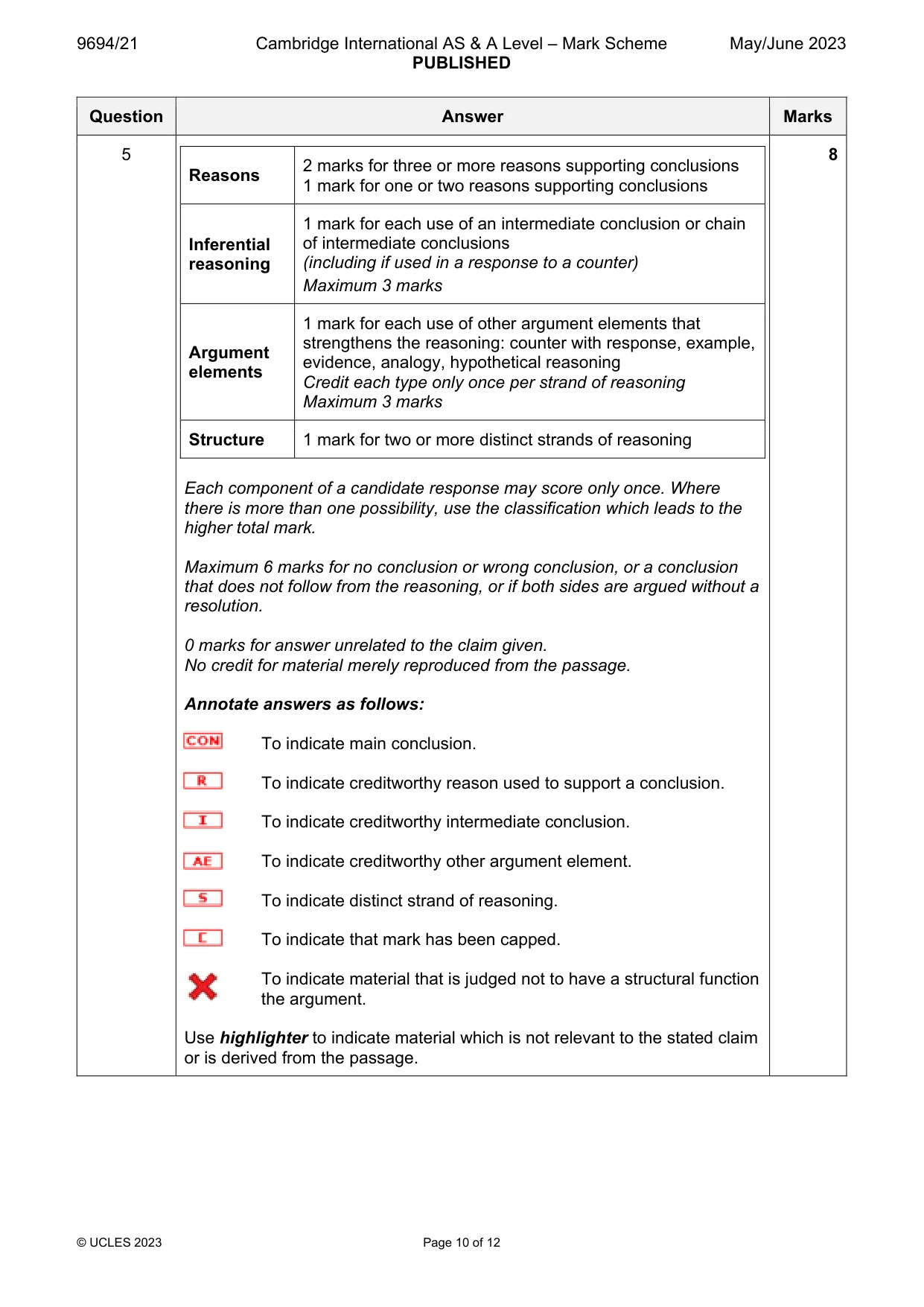
9694/21 Cambridge International AS & A Level – Mark Scheme PUBLISHED May/June 2023 © UCLES 2023 Page 10 of 12 Question Answer Marks 5 Reasons 2 marks for three or more reasons supporting conclusions 1 mark for one or two reasons supporting conclusions Inferential reasoning 1 mark for each use of an intermediate conclusion or chain of intermediate conclusions (including if used in a response to a counter) Maximum 3 marks Argument elements 1 mark for each use of other argument elements that strengthens the reasoning: counter with response, example, evidence, analogy, hypothetical reasoning Credit each type only once per strand of reasoning Maximum 3 marks Structure 1 mark for two or more distinct strands of reasoning Each component of a candidate response may score only once. Where there is more than one possibility, use the classification which leads to the higher total mark. Maximum 6 marks for no conclusion or wrong conclusion, or a conclusion that does not follow from the reasoning, or if both sides are argued without a resolution. 0 marks for answer unrelated to the claim given. No credit for material merely reproduced from the passage. Annotate answers as follows: To indicate main conclusion. To indicate creditworthy reason used to support a conclusion. To indicate creditworthy intermediate conclusion. To indicate creditworthy other argument element. To indicate distinct strand of reasoning. To indicate that mark has been capped. To indicate material that is judged not to have a structural function in the argument. Use highlighter to indicate material which is not relevant to the stated claim or is derived from the passage. 8
Mark scheme, page 11
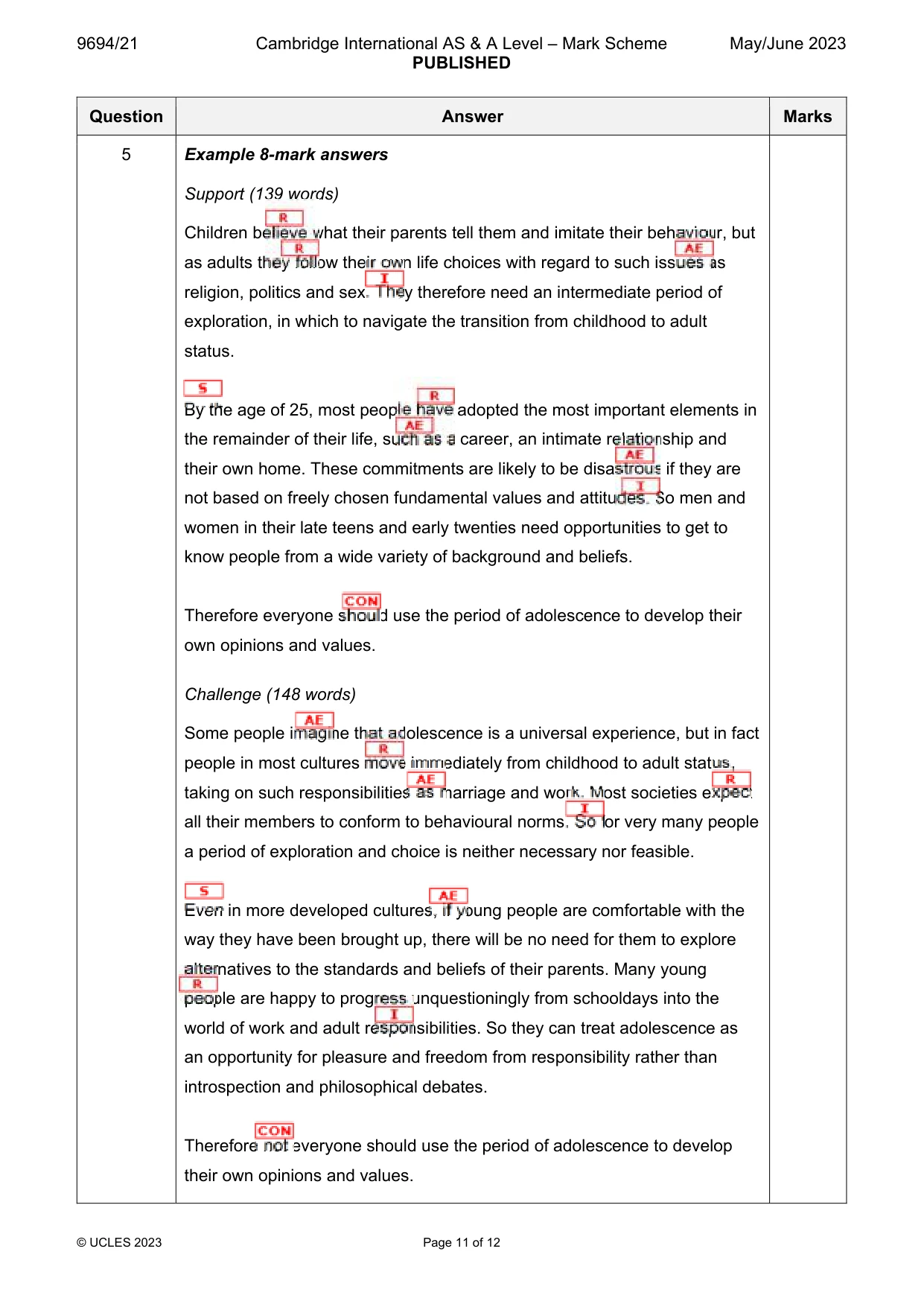
9694/21 Cambridge International AS & A Level – Mark Scheme PUBLISHED May/June 2023 © UCLES 2023 Page 11 of 12 Question Answer Marks 5 Example 8-mark answers Support (139 words) Children believe what their parents tell them and imitate their behaviour, but as adults they follow their own life choices with regard to such issues as religion, politics and sex. They therefore need an intermediate period of exploration, in which to navigate the transition from childhood to adult status. By the age of 25, most people have adopted the most important elements in the remainder of their life, such as a career, an intimate relationship and their own home. These commitments are likely to be disastrous if they are not based on freely chosen fundamental values and attitudes. So men and women in their late teens and early twenties need opportunities to get to know people from a wide variety of background and beliefs. Therefore everyone should use the period of adolescence to develop their own opinions and values. Challenge (148 words) Some people imagine that adolescence is a universal experience, but in fact people in most cultures move immediately from childhood to adult status, taking on such responsibilities as marriage and work. Most societies expect all their members to conform to behavioural norms. So for very many people a period of exploration and choice is neither necessary nor feasible. Even in more developed cultures, if young people are comfortable with the way they have been brought up, there will be no need for them to explore alternatives to the standards and beliefs of their parents. Many young people are happy to progress unquestioningly from schooldays into the world of work and adult responsibilities. So they can treat adolescence as an opportunity for pleasure and freedom from responsibility rather than introspection and philosophical debates. Therefore not everyone should use the period of adolescence to develop their own opinions and values.
Mark scheme, page 12
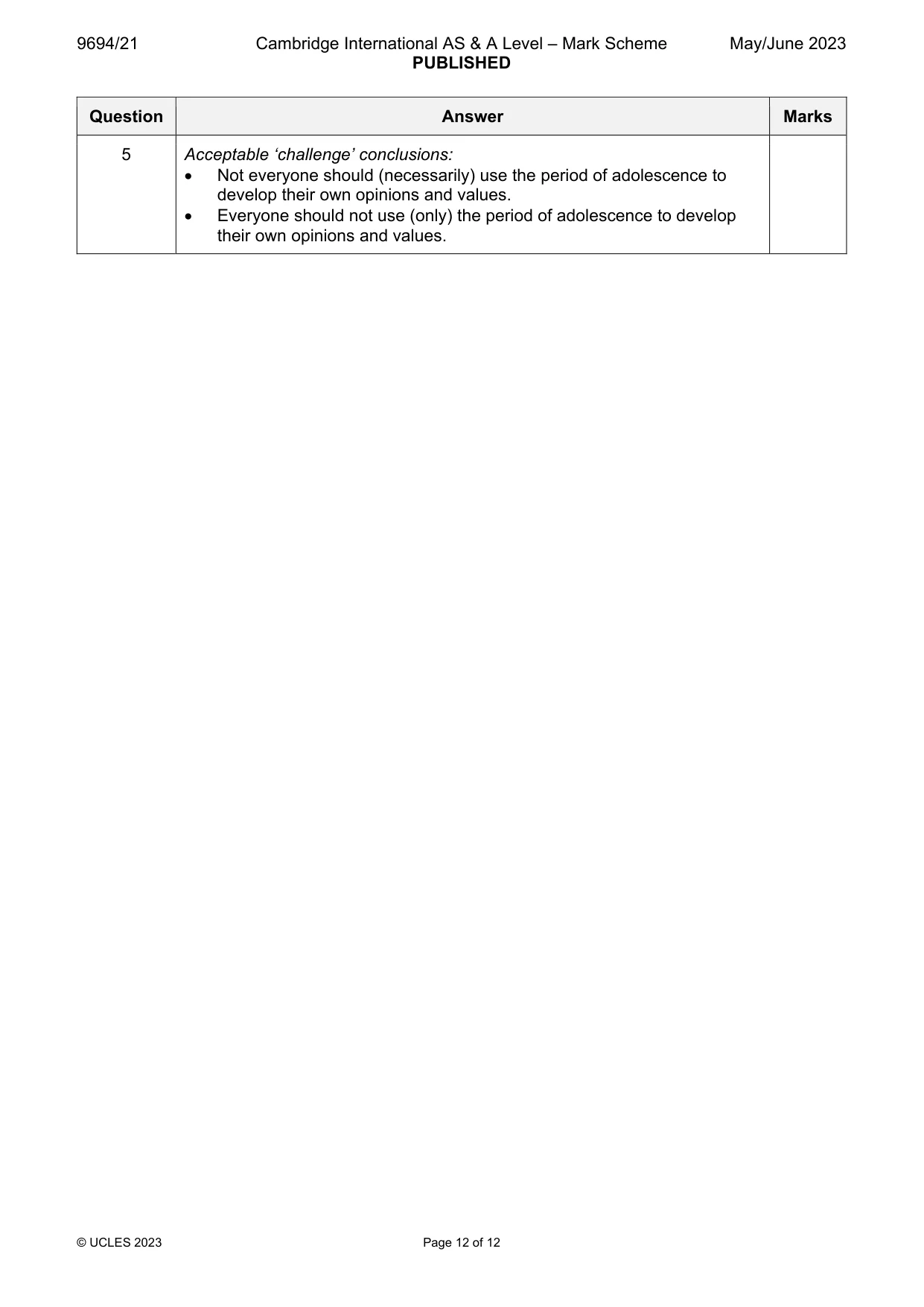
9694/21 Cambridge International AS & A Level – Mark Scheme PUBLISHED May/June 2023 © UCLES 2023 Page 12 of 12 Question Answer Marks 5 Acceptable ‘challenge’ conclusions: Not everyone should (necessarily) use the period of adolescence to develop their own opinions and values. Everyone should not use (only) the period of adolescence to develop their own opinions and values.
What you needed in this session
Cambridge’s own grade thresholds for 2023 May/June, Paper 2 · Variant 1. A higher threshold means an easier paper — the bar moves with how the cohort did.