Cambridge A Level Thinking Skills 9694 — 2023 Oct/Nov Paper 2 · Variant 1
9694/21/O/N/23 · 50 marks · ≈56 min
The question paper and its mark scheme, free to read here and free to download. This is Cambridge’s own paper, exactly as it was sat.
Question paper8 pages



Mark scheme13 pages
Answers below. Sit the paper first if you are practising.
Paper as text
Question paper, page 1
This document has 8 pages. Any blank pages are indicated. [Turn over Cambridge International AS & A Level THINKING SKILLS 9694/21 Paper 2 Critical Thinking October/November 2023 1 hour 45 minutes You must answer on the enclosed answer booklet. You will need: Answer booklet (enclosed) INSTRUCTIONS ● Answer all questions. ● Follow the instructions on the front cover of the answer booklet. If you need additional answer paper, ask the invigilator for a continuation booklet. INFORMATION ● The total mark for this paper is 50. ● The number of marks for each question or part question is shown in brackets [ ]. * 2 2 2 1 2 4 5 9 0 7 * DC (LK) 313668/2 © UCLES 2023
Question paper, page 2
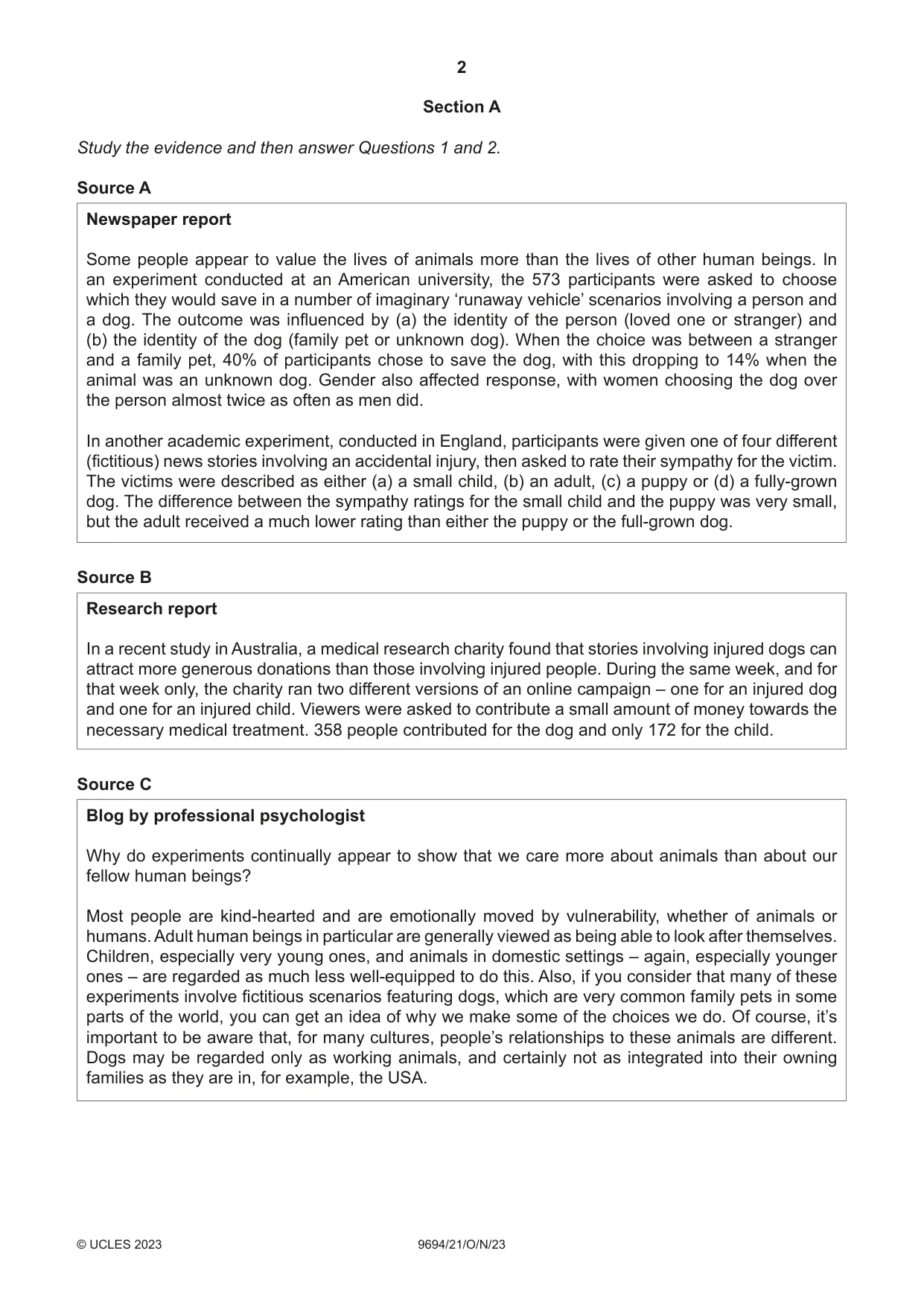
2 9694/21/O/N/23 © UCLES 2023 Section A Study the evidence and then answer Questions 1 and 2. Source A Newspaper report Some people appear to value the lives of animals more than the lives of other human beings. In an experiment conducted at an American university, the 573 participants were asked to choose which they would save in a number of imaginary ‘runaway vehicle’ scenarios involving a person and a dog. The outcome was influenced by (a) the identity of the person (loved one or stranger) and (b) the identity of the dog (family pet or unknown dog). When the choice was between a stranger and a family pet, 40% of participants chose to save the dog, with this dropping to 14% when the animal was an unknown dog. Gender also affected response, with women choosing the dog over the person almost twice as often as men did. In another academic experiment, conducted in England, participants were given one of four different (fictitious) news stories involving an accidental injury, then asked to rate their sympathy for the victim. The victims were described as either (a) a small child, (b) an adult, (c) a puppy or (d) a fully-grown dog. The difference between the sympathy ratings for the small child and the puppy was very small, but the adult received a much lower rating than either the puppy or the full-grown dog. Source B Research report In a recent study in Australia, a medical research charity found that stories involving injured dogs can attract more generous donations than those involving injured people. During the same week, and for that week only, the charity ran two different versions of an online campaign – one for an injured dog and one for an injured child. Viewers were asked to contribute a small amount of money towards the necessary medical treatment. 358 people contributed for the dog and only 172 for the child. Source C Blog by professional psychologist Why do experiments continually appear to show that we care more about animals than about our fellow human beings? Most people are kind-hearted and are emotionally moved by vulnerability, whether of animals or humans. Adult human beings in particular are generally viewed as being able to look after themselves. Children, especially very young ones, and animals in domestic settings – again, especially younger ones – are regarded as much less well-equipped to do this. Also, if you consider that many of these experiments involve fictitious scenarios featuring dogs, which are very common family pets in some parts of the world, you can get an idea of why we make some of the choices we do. Of course, it’s important to be aware that, for many cultures, people’s relationships to these animals are different. Dogs may be regarded only as working animals, and certainly not as integrated into their owning families as they are in, for example, the USA.
Question paper, page 3
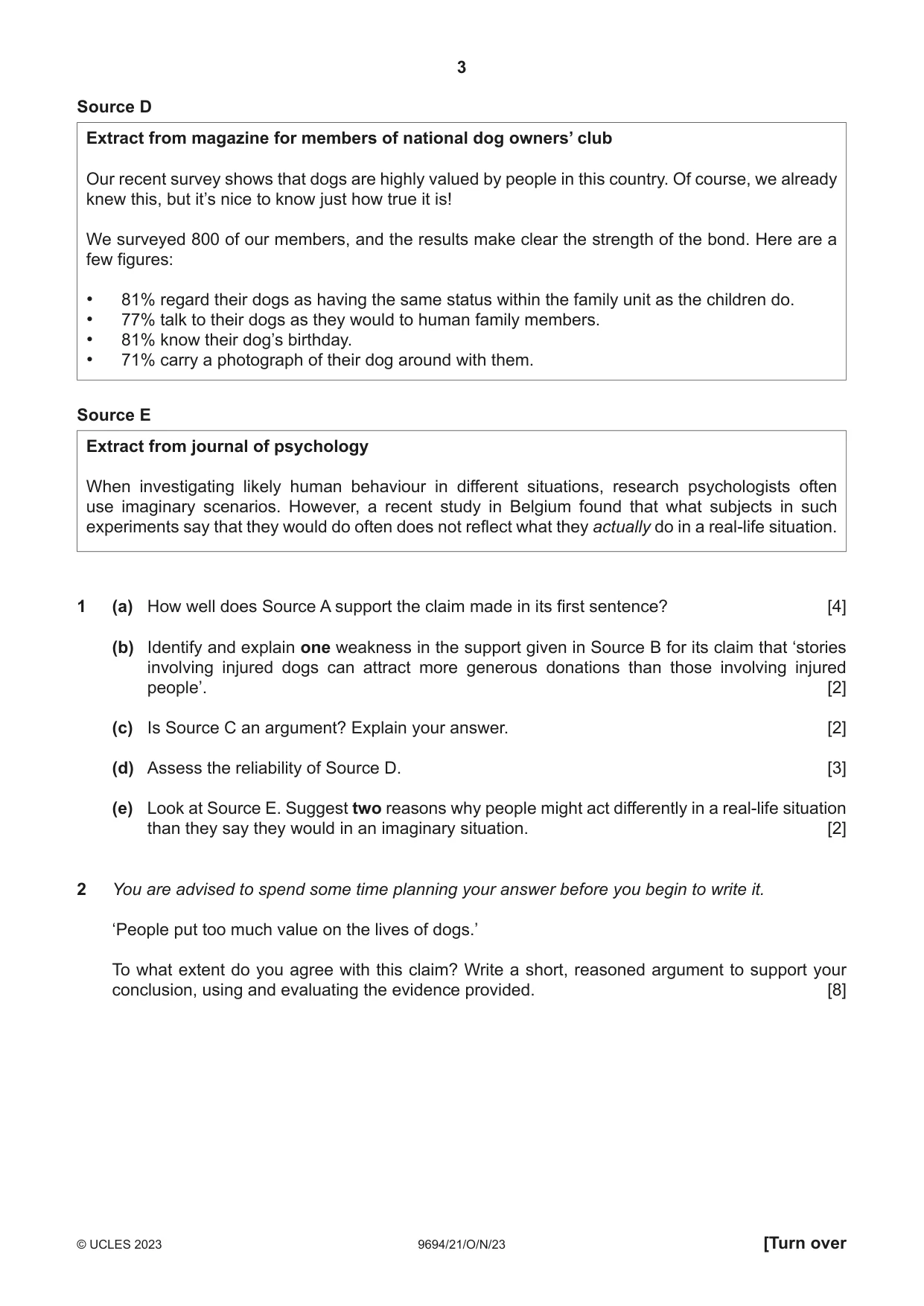
3 9694/21/O/N/23 © UCLES 2023 [Turn over Source D Extract from magazine for members of national dog owners’ club Our recent survey shows that dogs are highly valued by people in this country. Of course, we already knew this, but it’s nice to know just how true it is! We surveyed 800 of our members, and the results make clear the strength of the bond. Here are a few figures: • 81% regard their dogs as having the same status within the family unit as the children do. • 77% talk to their dogs as they would to human family members. • 81% know their dog’s birthday. • 71% carry a photograph of their dog around with them. Source E Extract from journal of psychology When investigating likely human behaviour in different situations, research psychologists often use imaginary scenarios. However, a recent study in Belgium found that what subjects in such experiments say that they would do often does not reflect what they actually do in a real-life situation. 1 (a) How well does Source A support the claim made in its first sentence? [4] (b) Identify and explain one weakness in the support given in Source B for its claim that ‘stories involving injured dogs can attract more generous donations than those involving injured people’. [2] (c) Is Source C an argument? Explain your answer. [2] (d) Assess the reliability of Source D. [3] (e) Look at Source E. Suggest two reasons why people might act differently in a real-life situation than they say they would in an imaginary situation. [2] 2 You are advised to spend some time planning your answer before you begin to write it. ‘People put too much value on the lives of dogs.’ To what extent do you agree with this claim? Write a short, reasoned argument to support your conclusion, using and evaluating the evidence provided. [8]
Question paper, page 4
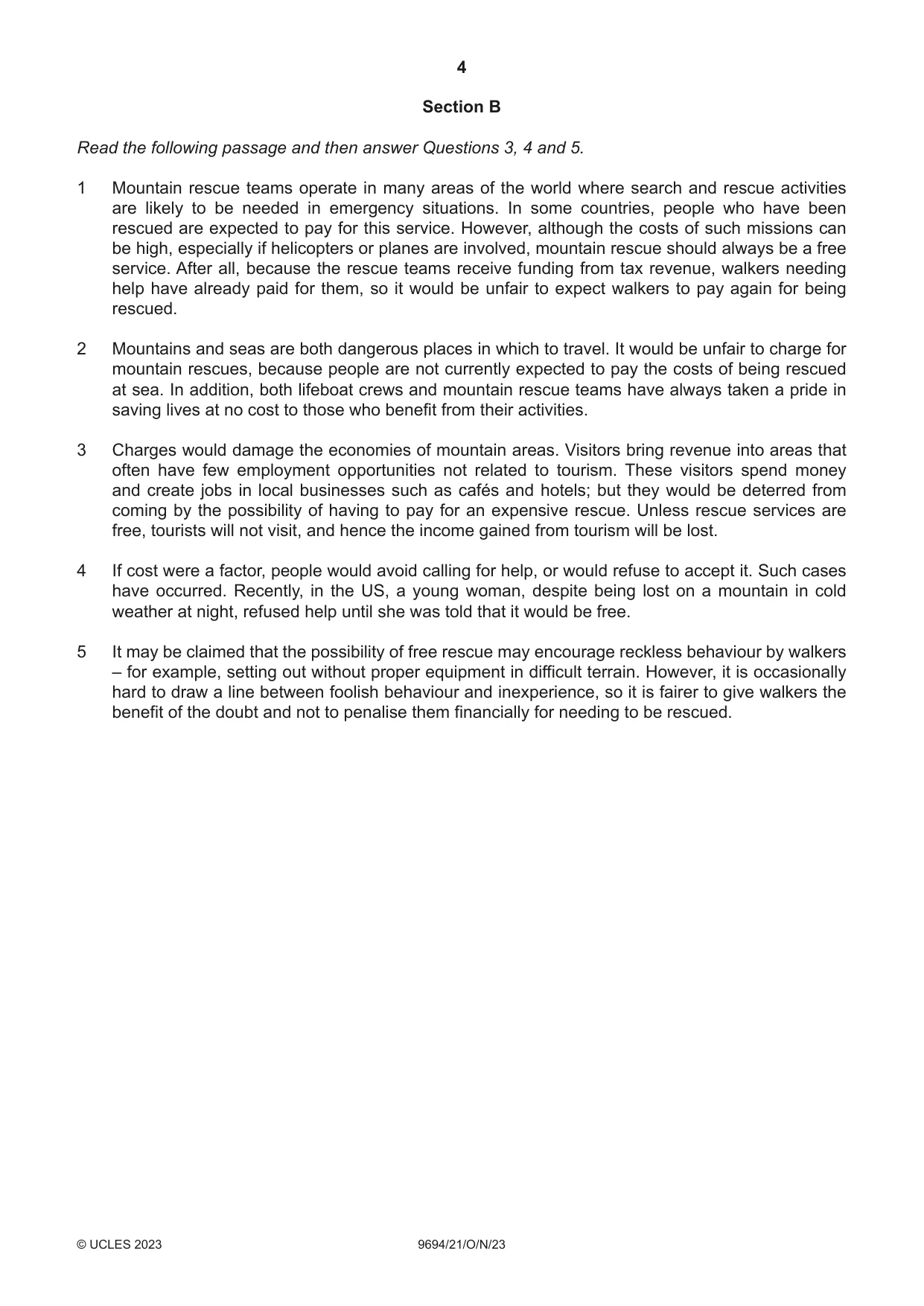
4 9694/21/O/N/23 © UCLES 2023 Section B Read the following passage and then answer Questions 3, 4 and 5. 1 Mountain rescue teams operate in many areas of the world where search and rescue activities are likely to be needed in emergency situations. In some countries, people who have been rescued are expected to pay for this service. However, although the costs of such missions can be high, especially if helicopters or planes are involved, mountain rescue should always be a free service. After all, because the rescue teams receive funding from tax revenue, walkers needing help have already paid for them, so it would be unfair to expect walkers to pay again for being rescued. 2 Mountains and seas are both dangerous places in which to travel. It would be unfair to charge for mountain rescues, because people are not currently expected to pay the costs of being rescued at sea. In addition, both lifeboat crews and mountain rescue teams have always taken a pride in saving lives at no cost to those who benefit from their activities. 3 Charges would damage the economies of mountain areas. Visitors bring revenue into areas that often have few employment opportunities not related to tourism. These visitors spend money and create jobs in local businesses such as cafés and hotels; but they would be deterred from coming by the possibility of having to pay for an expensive rescue. Unless rescue services are free, tourists will not visit, and hence the income gained from tourism will be lost. 4 If cost were a factor, people would avoid calling for help, or would refuse to accept it. Such cases have occurred. Recently, in the US, a young woman, despite being lost on a mountain in cold weather at night, refused help until she was told that it would be free. 5 It may be claimed that the possibility of free rescue may encourage reckless behaviour by walkers – for example, setting out without proper equipment in difficult terrain. However, it is occasionally hard to draw a line between foolish behaviour and inexperience, so it is fairer to give walkers the benefit of the doubt and not to penalise them financially for needing to be rescued.
Question paper, page 5
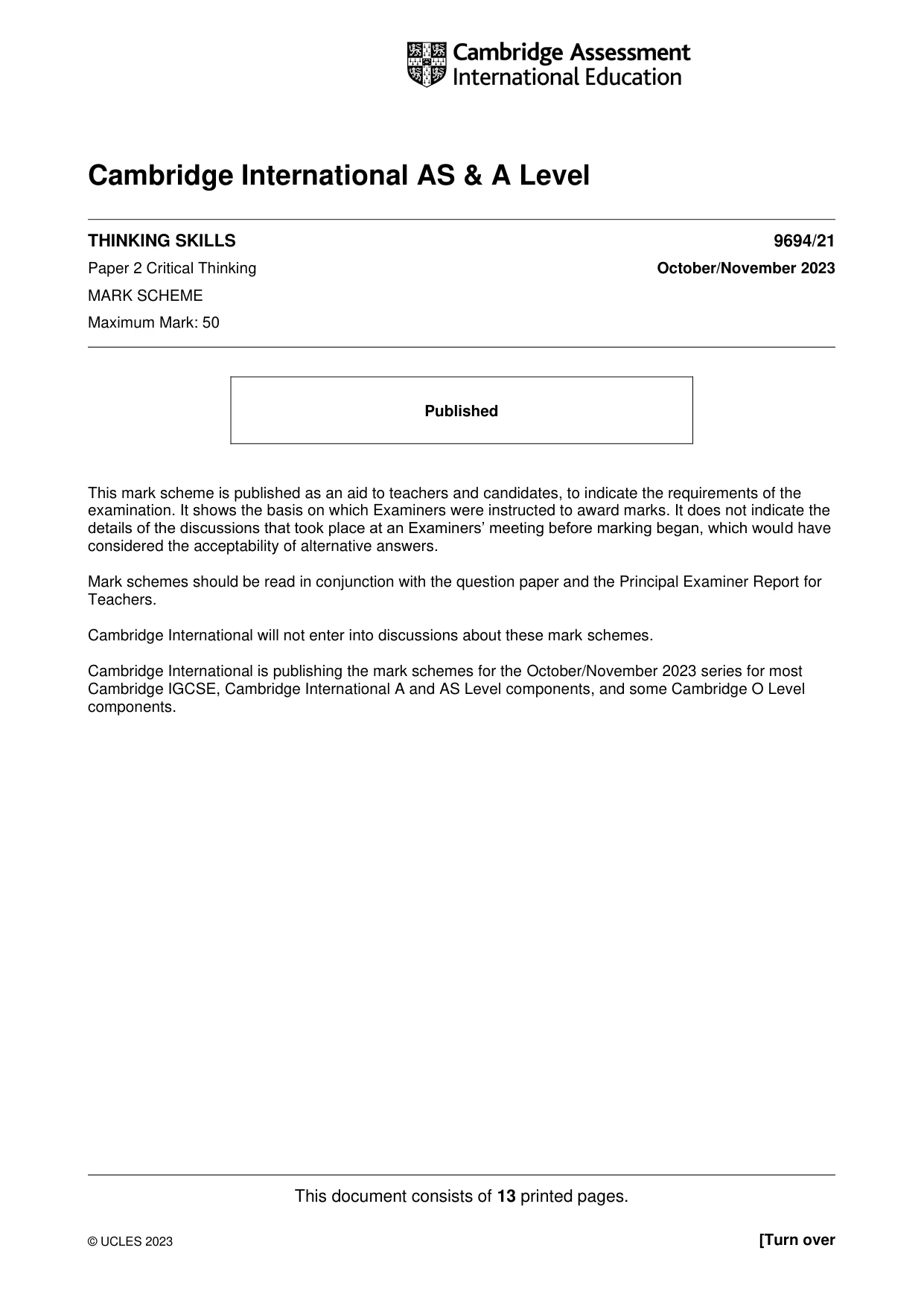
5 9694/21/O/N/23 © UCLES 2023 3 (a) Using the exact words from the passage as far as possible, identify the main conclusion. [2] (b) Using the exact words from the passage as far as possible, identify two intermediate conclusions from paragraphs 2 to 3. [4] (c) Identify the argument element and explain the function of the following words from paragraph 4: ‘Recently, in the US, a young woman, despite being lost on a mountain in cold weather at night, refused help until she was told that it would be free.’ [2] (d) Identify one unstated assumption required by the argument in paragraph 1. [2] 4 (a) Identify an appeal in paragraph 2. [2] (b) (i) Identify the flaw of restricting the options in paragraph 3. [1] (ii) To what extent does this flaw weaken the argument as a whole? [3] (c) Identify and explain one flaw or weakness in the reasoning in paragraph 4. [2] (d) How effective is the response to the counter-assertion in paragraph 5? [3] 5 You are advised to spend some time planning your answer before you begin to write it. ‘Dangerous sports should be banned.’ Write your own short argument to support or challenge this claim. The conclusion of your argument must be stated. Credit will not be given for repeating ideas from the passage. [8]
Question paper, page 6
6 9694/21/O/N/23 © UCLES 2023 BLANK PAGE
Question paper, page 7
7 9694/21/O/N/23 © UCLES 2023 BLANK PAGE
Question paper, page 8
8 9694/21/O/N/23 © UCLES 2023 Permission to reproduce items where third-party owned material protected by copyright is included has been sought and cleared where possible. Every reasonable effort has been made by the publisher (UCLES) to trace copyright holders, but if any items requiring clearance have unwittingly been included, the publisher will be pleased to make amends at the earliest possible opportunity. To avoid the issue of disclosure of answer-related information to candidates, all copyright acknowledgements are reproduced online in the Cambridge Assessment International Education Copyright Acknowledgements Booklet. This is produced for each series of examinations and is freely available to download at www.cambridgeinternational.org after the live examination series. Cambridge Assessment International Education is part of Cambridge Assessment. Cambridge Assessment is the brand name of the University of Cambridge Local Examinations Syndicate (UCLES), which is a department of the University of Cambridge. BLANK PAGE
Mark scheme, page 1
This document consists of 13 printed pages. © UCLES 2023 [Turn over Cambridge International AS & A Level THINKING SKILLS 9694/21 Paper 2 Critical Thinking October/November 2023 MARK SCHEME Maximum Mark: 50 Published This mark scheme is published as an aid to teachers and candidates, to indicate the requirements of the examination. It shows the basis on which Examiners were instructed to award marks. It does not indicate the details of the discussions that took place at an Examiners’ meeting before marking began, which would have considered the acceptability of alternative answers. Mark schemes should be read in conjunction with the question paper and the Principal Examiner Report for Teachers. Cambridge International will not enter into discussions about these mark schemes. Cambridge International is publishing the mark schemes for the October/November 2023 series for most Cambridge IGCSE, Cambridge International A and AS Level components, and some Cambridge O Level components.
Mark scheme, page 2
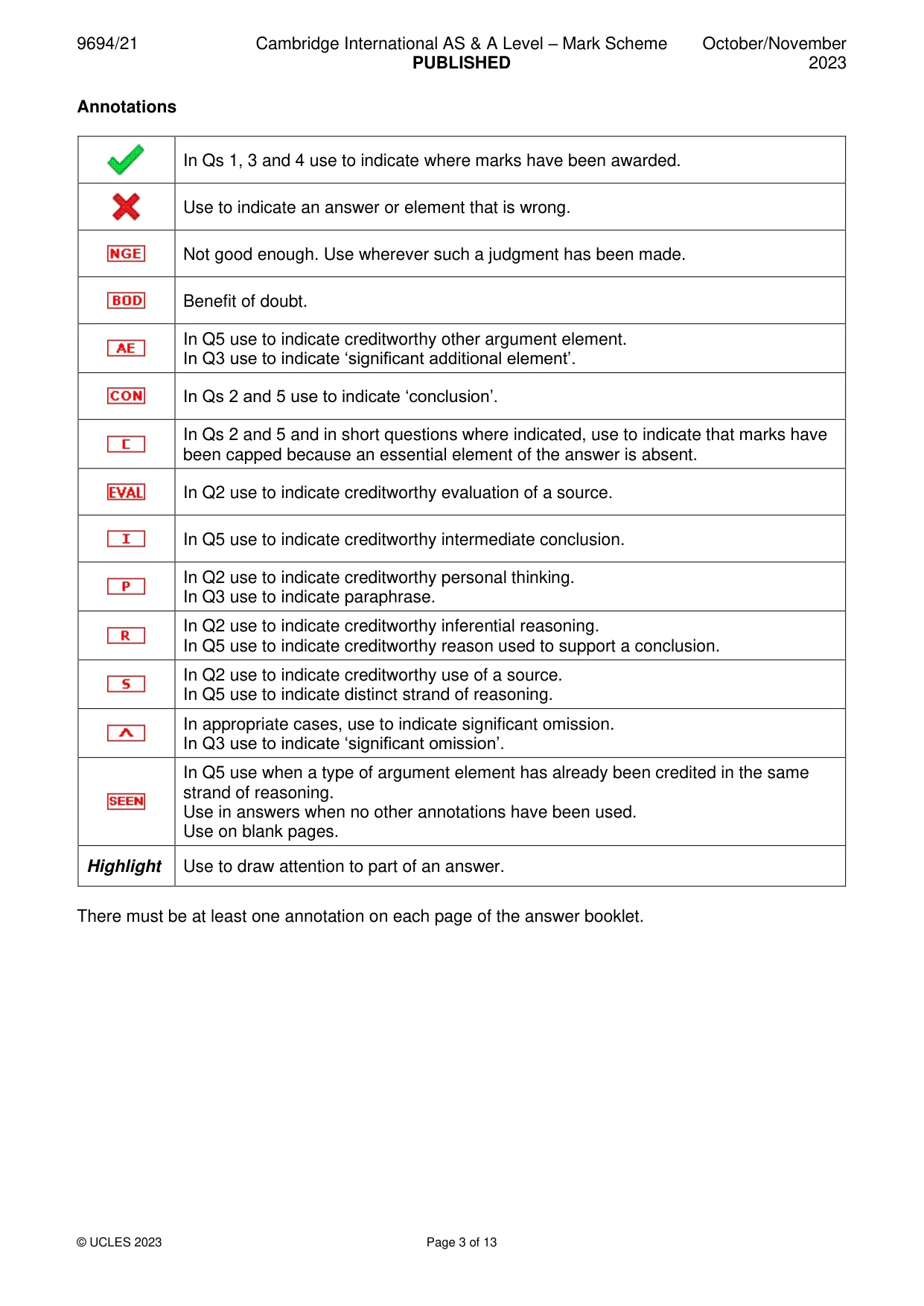
9694/21 Cambridge International AS & A Level – Mark Scheme PUBLISHED October/November 2023 © UCLES 2023 Page 2 of 13 Generic Marking Principles These general marking principles must be applied by all examiners when marking candidate answers. They should be applied alongside the specific content of the mark scheme or generic level descriptors for a question. Each question paper and mark scheme will also comply with these marking principles. GENERIC MARKING PRINCIPLE 1: Marks must be awarded in line with: • the specific content of the mark scheme or the generic level descriptors for the question • the specific skills defined in the mark scheme or in the generic level descriptors for the question • the standard of response required by a candidate as exemplified by the standardisation scripts. GENERIC MARKING PRINCIPLE 2: Marks awarded are always whole marks (not half marks, or other fractions). GENERIC MARKING PRINCIPLE 3: Marks must be awarded positively: • marks are awarded for correct/valid answers, as defined in the mark scheme. However, credit is given for valid answers which go beyond the scope of the syllabus and mark scheme, referring to your Team Leader as appropriate • marks are awarded when candidates clearly demonstrate what they know and can do • marks are not deducted for errors • marks are not deducted for omissions • answers should only be judged on the quality of spelling, punctuation and grammar when these features are specifically assessed by the question as indicated by the mark scheme. The meaning, however, should be unambiguous. GENERIC MARKING PRINCIPLE 4: Rules must be applied consistently, e.g. in situations where candidates have not followed instructions or in the application of generic level descriptors. GENERIC MARKING PRINCIPLE 5: Marks should be awarded using the full range of marks defined in the mark scheme for the question (however; the use of the full mark range may be limited according to the quality of the candidate responses seen). GENERIC MARKING PRINCIPLE 6: Marks awarded are based solely on the requirements as defined in the mark scheme. Marks should not be awarded with grade thresholds or grade descriptors in mind.
Mark scheme, page 3
9694/21 Cambridge International AS & A Level – Mark Scheme PUBLISHED October/November 2023 © UCLES 2023 Page 3 of 13 Annotations In Qs 1, 3 and 4 use to indicate where marks have been awarded. Use to indicate an answer or element that is wrong. Not good enough. Use wherever such a judgment has been made. Benefit of doubt. In Q5 use to indicate creditworthy other argument element. In Q3 use to indicate ‘significant additional element’. In Qs 2 and 5 use to indicate ‘conclusion’. In Qs 2 and 5 and in short questions where indicated, use to indicate that marks have been capped because an essential element of the answer is absent. In Q2 use to indicate creditworthy evaluation of a source. In Q5 use to indicate creditworthy intermediate conclusion. In Q2 use to indicate creditworthy personal thinking. In Q3 use to indicate paraphrase. In Q2 use to indicate creditworthy inferential reasoning. In Q5 use to indicate creditworthy reason used to support a conclusion. In Q2 use to indicate creditworthy use of a source. In Q5 use to indicate distinct strand of reasoning. In appropriate cases, use to indicate significant omission. In Q3 use to indicate ‘significant omission’. In Q5 use when a type of argument element has already been credited in the same strand of reasoning. Use in answers when no other annotations have been used. Use on blank pages. Highlight Use to draw attention to part of an answer. There must be at least one annotation on each page of the answer booklet.
Mark scheme, page 4
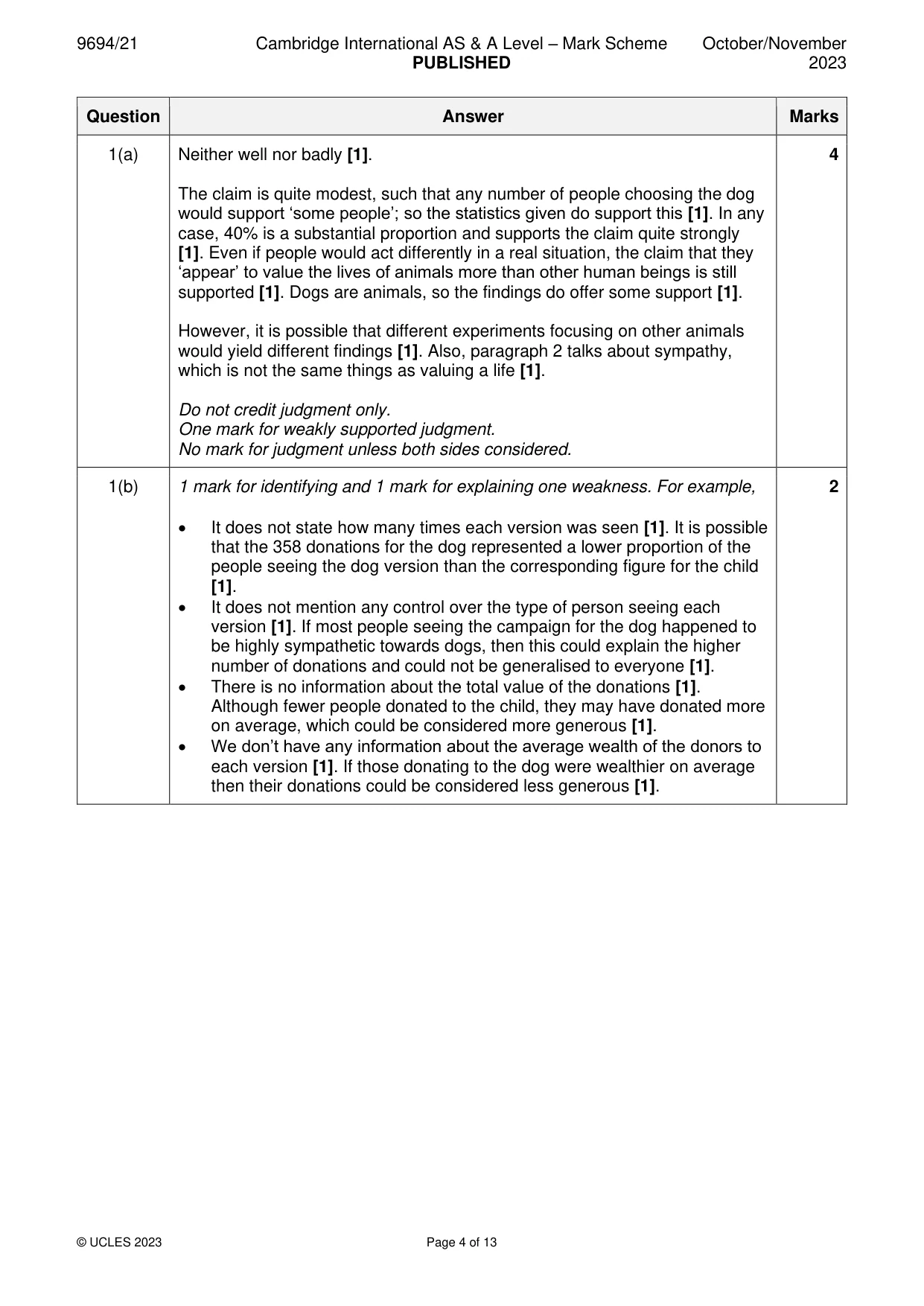
9694/21 Cambridge International AS & A Level – Mark Scheme PUBLISHED October/November 2023 © UCLES 2023 Page 4 of 13 Question Answer Marks 1(a) Neither well nor badly [1]. The claim is quite modest, such that any number of people choosing the dog would support ‘some people’; so the statistics given do support this [1]. In any case, 40% is a substantial proportion and supports the claim quite strongly [1]. Even if people would act differently in a real situation, the claim that they ‘appear’ to value the lives of animals more than other human beings is still supported [1]. Dogs are animals, so the findings do offer some support [1]. However, it is possible that different experiments focusing on other animals would yield different findings [1]. Also, paragraph 2 talks about sympathy, which is not the same things as valuing a life [1]. Do not credit judgment only. One mark for weakly supported judgment. No mark for judgment unless both sides considered. 4 1(b) 1 mark for identifying and 1 mark for explaining one weakness. For example, • It does not state how many times each version was seen [1]. It is possible that the 358 donations for the dog represented a lower proportion of the people seeing the dog version than the corresponding figure for the child [1]. • It does not mention any control over the type of person seeing each version [1]. If most people seeing the campaign for the dog happened to be highly sympathetic towards dogs, then this could explain the higher number of donations and could not be generalised to everyone [1]. • There is no information about the total value of the donations [1]. Although fewer people donated to the child, they may have donated more on average, which could be considered more generous [1]. • We don’t have any information about the average wealth of the donors to each version [1]. If those donating to the dog were wealthier on average then their donations could be considered less generous [1]. 2
Mark scheme, page 5
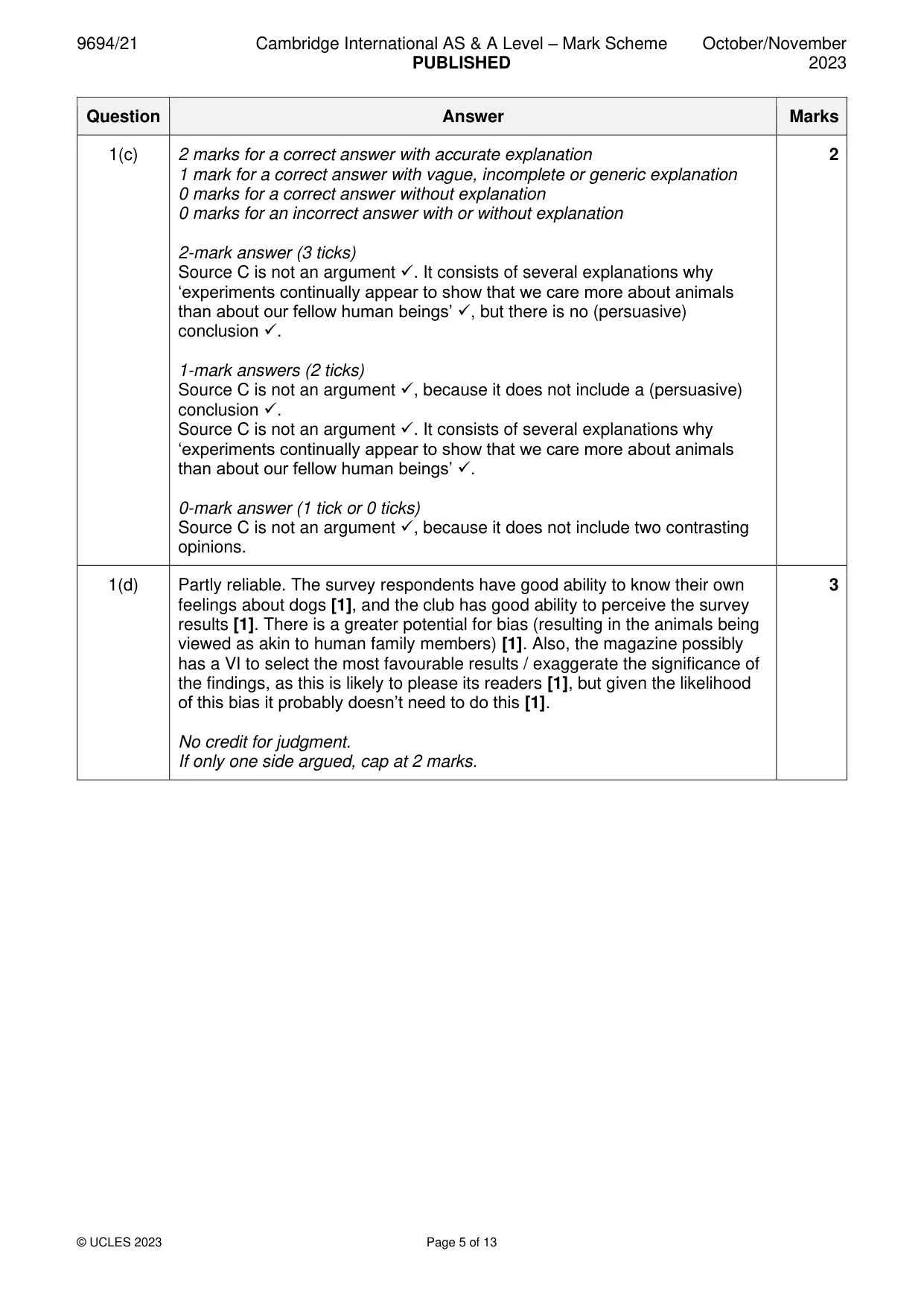
9694/21 Cambridge International AS & A Level – Mark Scheme PUBLISHED October/November 2023 © UCLES 2023 Page 5 of 13 Question Answer Marks 1(c) 2 marks for a correct answer with accurate explanation 1 mark for a correct answer with vague, incomplete or generic explanation 0 marks for a correct answer without explanation 0 marks for an incorrect answer with or without explanation 2-mark answer (3 ticks) Source C is not an argument ✓. It consists of several explanations why ‘experiments continually appear to show that we care more about animals than about our fellow human beings’ ✓, but there is no (persuasive) conclusion ✓. 1-mark answers (2 ticks) Source C is not an argument ✓, because it does not include a (persuasive) conclusion ✓. Source C is not an argument ✓. It consists of several explanations why ‘experiments continually appear to show that we care more about animals than about our fellow human beings’ ✓. 0-mark answer (1 tick or 0 ticks) Source C is not an argument ✓, because it does not include two contrasting opinions. 2 1(d) Partly reliable. The survey respondents have good ability to know their own feelings about dogs [1], and the club has good ability to perceive the survey results [1]. There is a greater potential for bias (resulting in the animals being viewed as akin to human family members) [1]. Also, the magazine possibly has a VI to select the most favourable results / exaggerate the significance of the findings, as this is likely to please its readers [1], but given the likelihood of this bias it probably doesn’t need to do this [1]. No credit for judgment. If only one side argued, cap at 2 marks. 3
Mark scheme, page 6
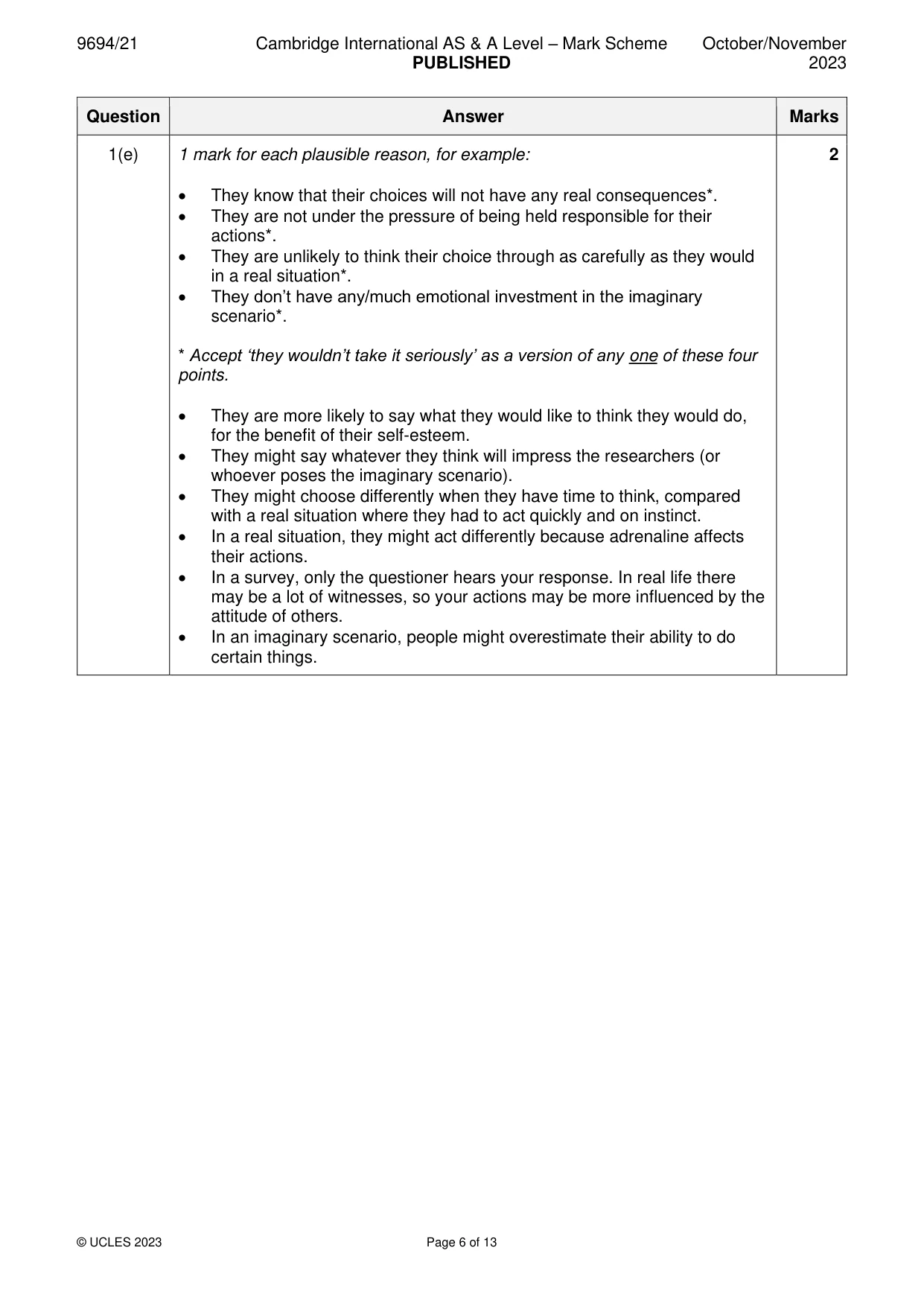
9694/21 Cambridge International AS & A Level – Mark Scheme PUBLISHED October/November 2023 © UCLES 2023 Page 6 of 13 Question Answer Marks 1(e) 1 mark for each plausible reason, for example: • They know that their choices will not have any real consequences*. • They are not under the pressure of being held responsible for their actions*. • They are unlikely to think their choice through as carefully as they would in a real situation*. • They don’t have any/much emotional investment in the imaginary scenario*. * Accept ‘they wouldn’t take it seriously’ as a version of any one of these four points. • They are more likely to say what they would like to think they would do, for the benefit of their self-esteem. • They might say whatever they think will impress the researchers (or whoever poses the imaginary scenario). • They might choose differently when they have time to think, compared with a real situation where they had to act quickly and on instinct. • In a real situation, they might act differently because adrenaline affects their actions. • In a survey, only the questioner hears your response. In real life there may be a lot of witnesses, so your actions may be more influenced by the attitude of others. • In an imaginary scenario, people might overestimate their ability to do certain things. 2
Mark scheme, page 7
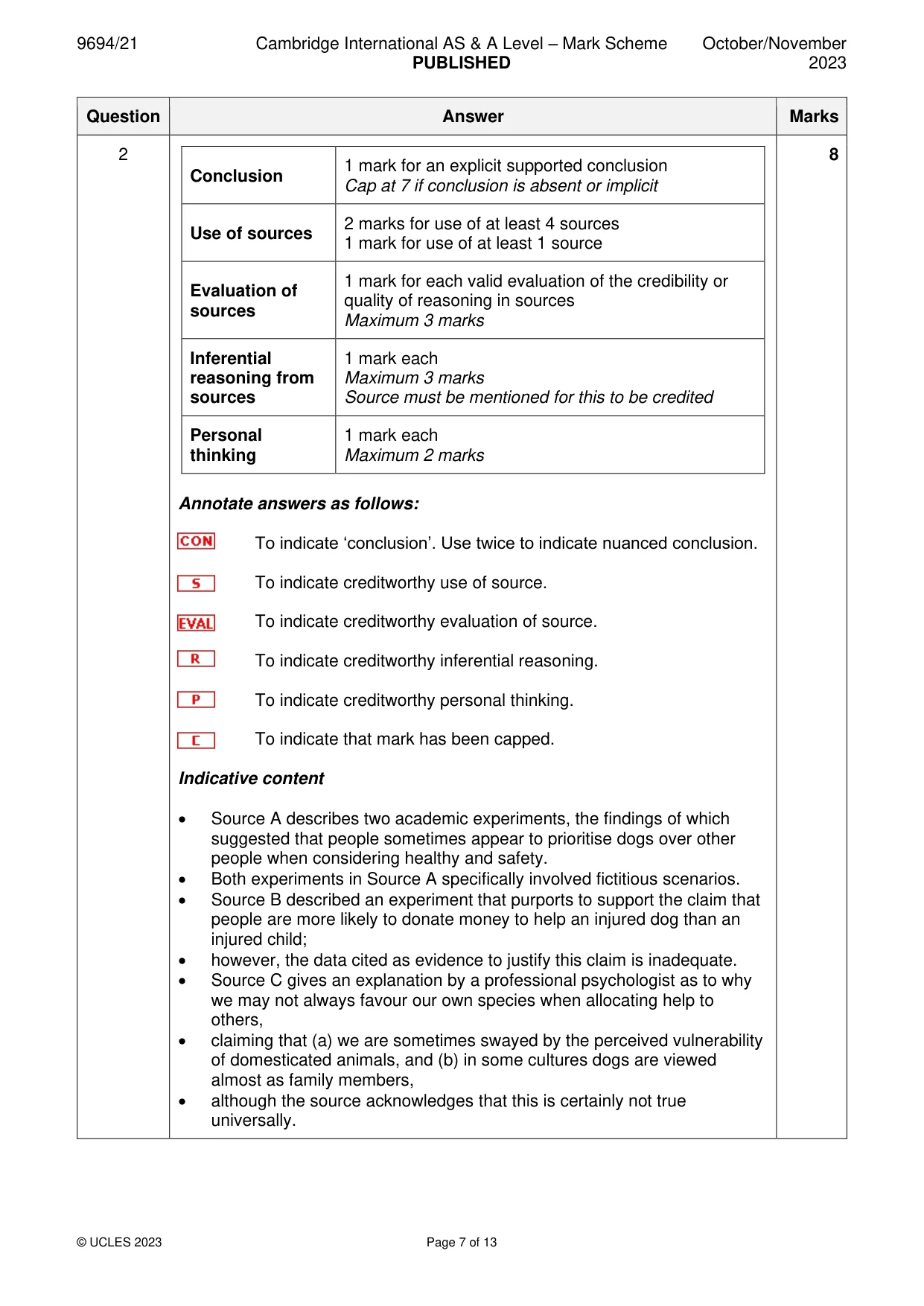
9694/21 Cambridge International AS & A Level – Mark Scheme PUBLISHED October/November 2023 © UCLES 2023 Page 7 of 13 Question Answer Marks 2 Conclusion 1 mark for an explicit supported conclusion Cap at 7 if conclusion is absent or implicit Use of sources 2 marks for use of at least 4 sources 1 mark for use of at least 1 source Evaluation of sources 1 mark for each valid evaluation of the credibility or quality of reasoning in sources Maximum 3 marks Inferential reasoning from sources 1 mark each Maximum 3 marks Source must be mentioned for this to be credited Personal thinking 1 mark each Maximum 2 marks Annotate answers as follows: To indicate ‘conclusion’. Use twice to indicate nuanced conclusion. To indicate creditworthy use of source. To indicate creditworthy evaluation of source. To indicate creditworthy inferential reasoning. To indicate creditworthy personal thinking. To indicate that mark has been capped. Indicative content • Source A describes two academic experiments, the findings of which suggested that people sometimes appear to prioritise dogs over other people when considering healthy and safety. • Both experiments in Source A specifically involved fictitious scenarios. • Source B described an experiment that purports to support the claim that people are more likely to donate money to help an injured dog than an injured child; • however, the data cited as evidence to justify this claim is inadequate. • Source C gives an explanation by a professional psychologist as to why we may not always favour our own species when allocating help to others, • claiming that (a) we are sometimes swayed by the perceived vulnerability of domesticated animals, and (b) in some cultures dogs are viewed almost as family members, • although the source acknowledges that this is certainly not true universally. 8
Mark scheme, page 8
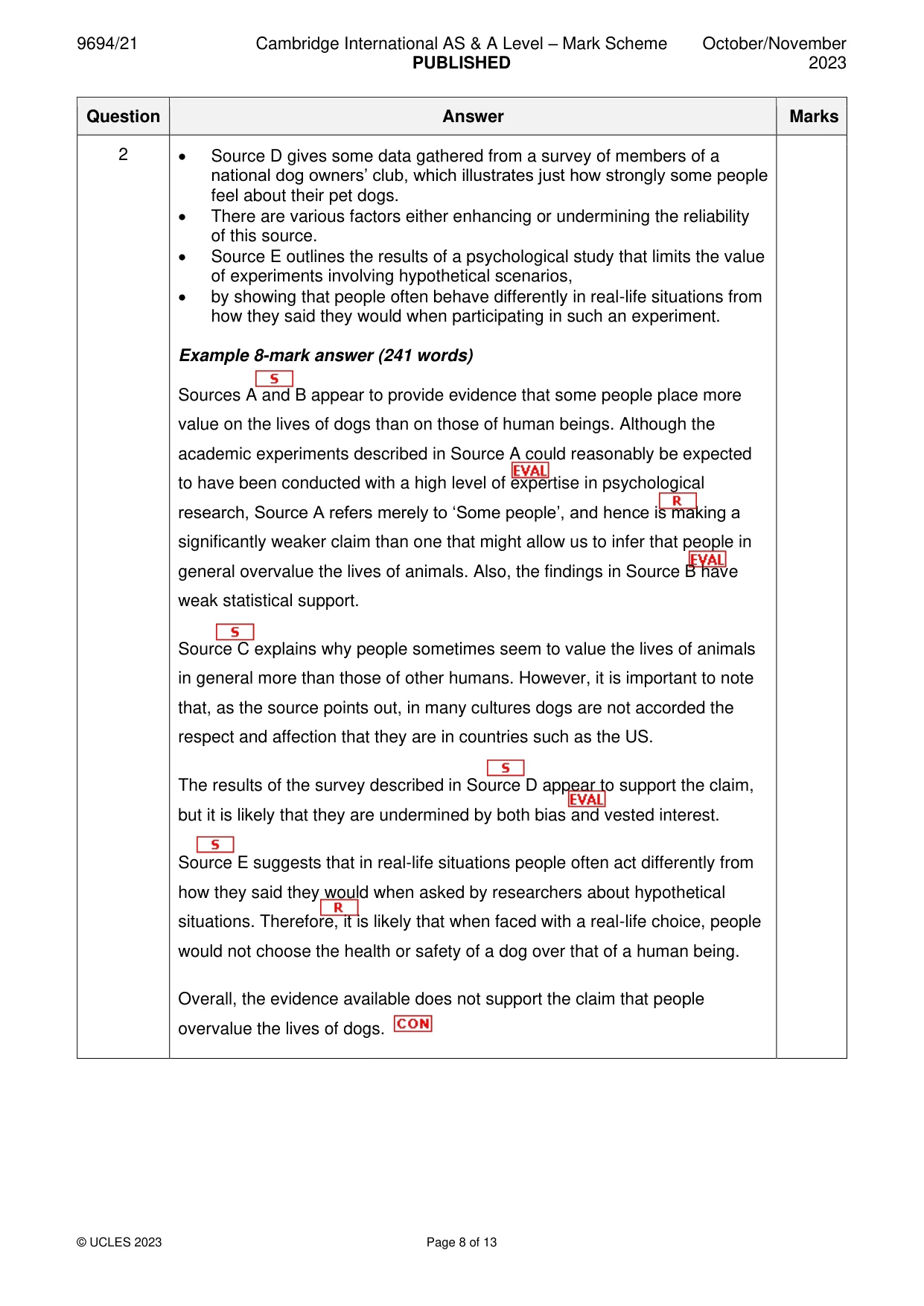
9694/21 Cambridge International AS & A Level – Mark Scheme PUBLISHED October/November 2023 © UCLES 2023 Page 8 of 13 Question Answer Marks 2 • Source D gives some data gathered from a survey of members of a national dog owners’ club, which illustrates just how strongly some people feel about their pet dogs. • There are various factors either enhancing or undermining the reliability of this source. • Source E outlines the results of a psychological study that limits the value of experiments involving hypothetical scenarios, • by showing that people often behave differently in real-life situations from how they said they would when participating in such an experiment. Example 8-mark answer (241 words) Sources A and B appear to provide evidence that some people place more value on the lives of dogs than on those of human beings. Although the academic experiments described in Source A could reasonably be expected to have been conducted with a high level of expertise in psychological research, Source A refers merely to ‘Some people’, and hence is making a significantly weaker claim than one that might allow us to infer that people in general overvalue the lives of animals. Also, the findings in Source B have weak statistical support. Source C explains why people sometimes seem to value the lives of animals in general more than those of other humans. However, it is important to note that, as the source points out, in many cultures dogs are not accorded the respect and affection that they are in countries such as the US. The results of the survey described in Source D appear to support the claim, but it is likely that they are undermined by both bias and vested interest. Source E suggests that in real-life situations people often act differently from how they said they would when asked by researchers about hypothetical situations. Therefore, it is likely that when faced with a real-life choice, people would not choose the health or safety of a dog over that of a human being. Overall, the evidence available does not support the claim that people overvalue the lives of dogs.
Mark scheme, page 9
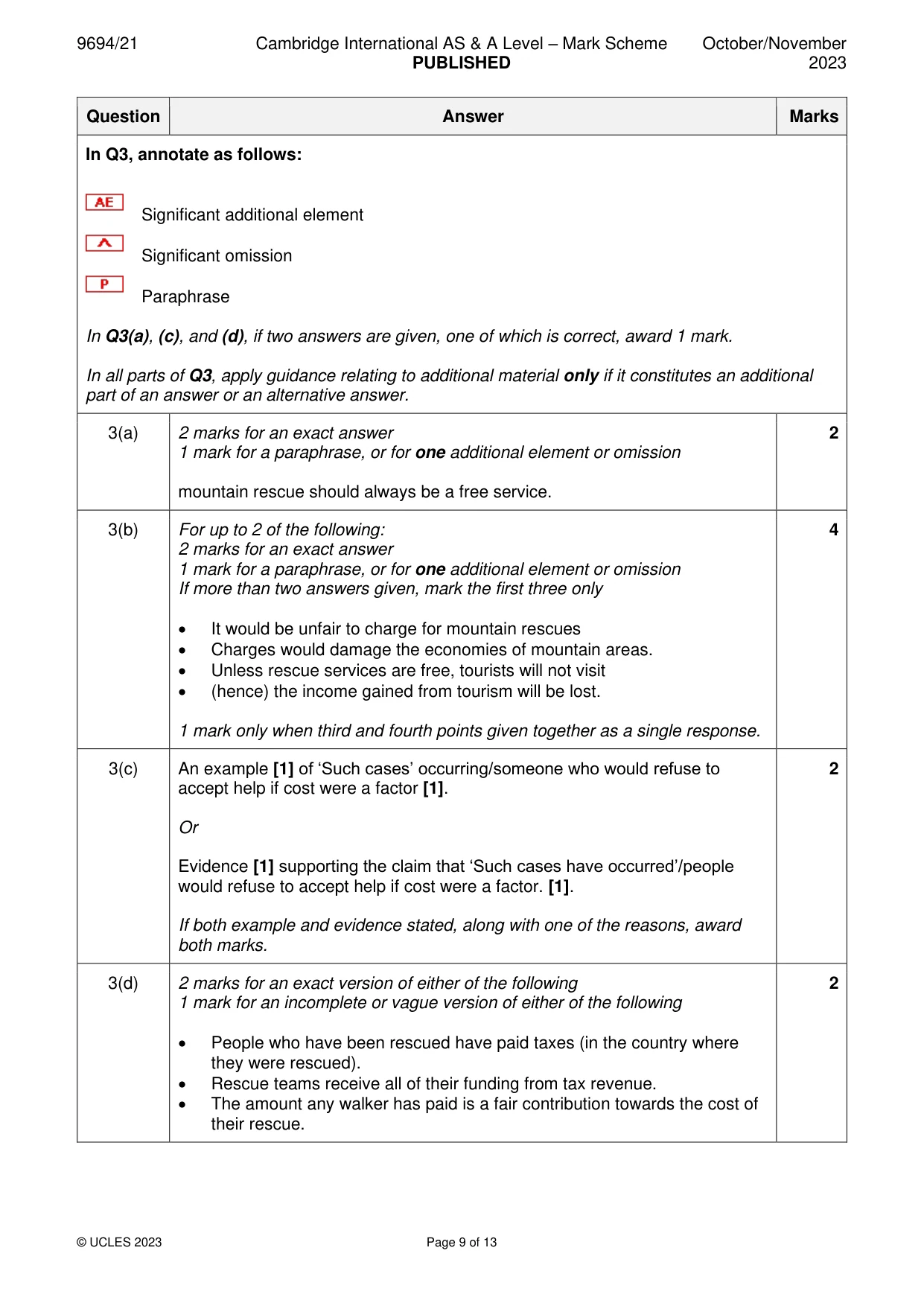
9694/21 Cambridge International AS & A Level – Mark Scheme PUBLISHED October/November 2023 © UCLES 2023 Page 9 of 13 Question Answer Marks In Q3, annotate as follows: Significant additional element Significant omission Paraphrase In Q3(a), (c), and (d), if two answers are given, one of which is correct, award 1 mark. In all parts of Q3, apply guidance relating to additional material only if it constitutes an additional part of an answer or an alternative answer. 3(a) 2 marks for an exact answer 1 mark for a paraphrase, or for one additional element or omission mountain rescue should always be a free service. 2 3(b) For up to 2 of the following: 2 marks for an exact answer 1 mark for a paraphrase, or for one additional element or omission If more than two answers given, mark the first three only • It would be unfair to charge for mountain rescues • Charges would damage the economies of mountain areas. • Unless rescue services are free, tourists will not visit • (hence) the income gained from tourism will be lost. 1 mark only when third and fourth points given together as a single response. 4 3(c) An example [1] of ‘Such cases’ occurring/someone who would refuse to accept help if cost were a factor [1]. Or Evidence [1] supporting the claim that ‘Such cases have occurred’/people would refuse to accept help if cost were a factor. [1]. If both example and evidence stated, along with one of the reasons, award both marks. 2 3(d) 2 marks for an exact version of either of the following 1 mark for an incomplete or vague version of either of the following • People who have been rescued have paid taxes (in the country where they were rescued). • Rescue teams receive all of their funding from tax revenue. • The amount any walker has paid is a fair contribution towards the cost of their rescue. 2
Mark scheme, page 10
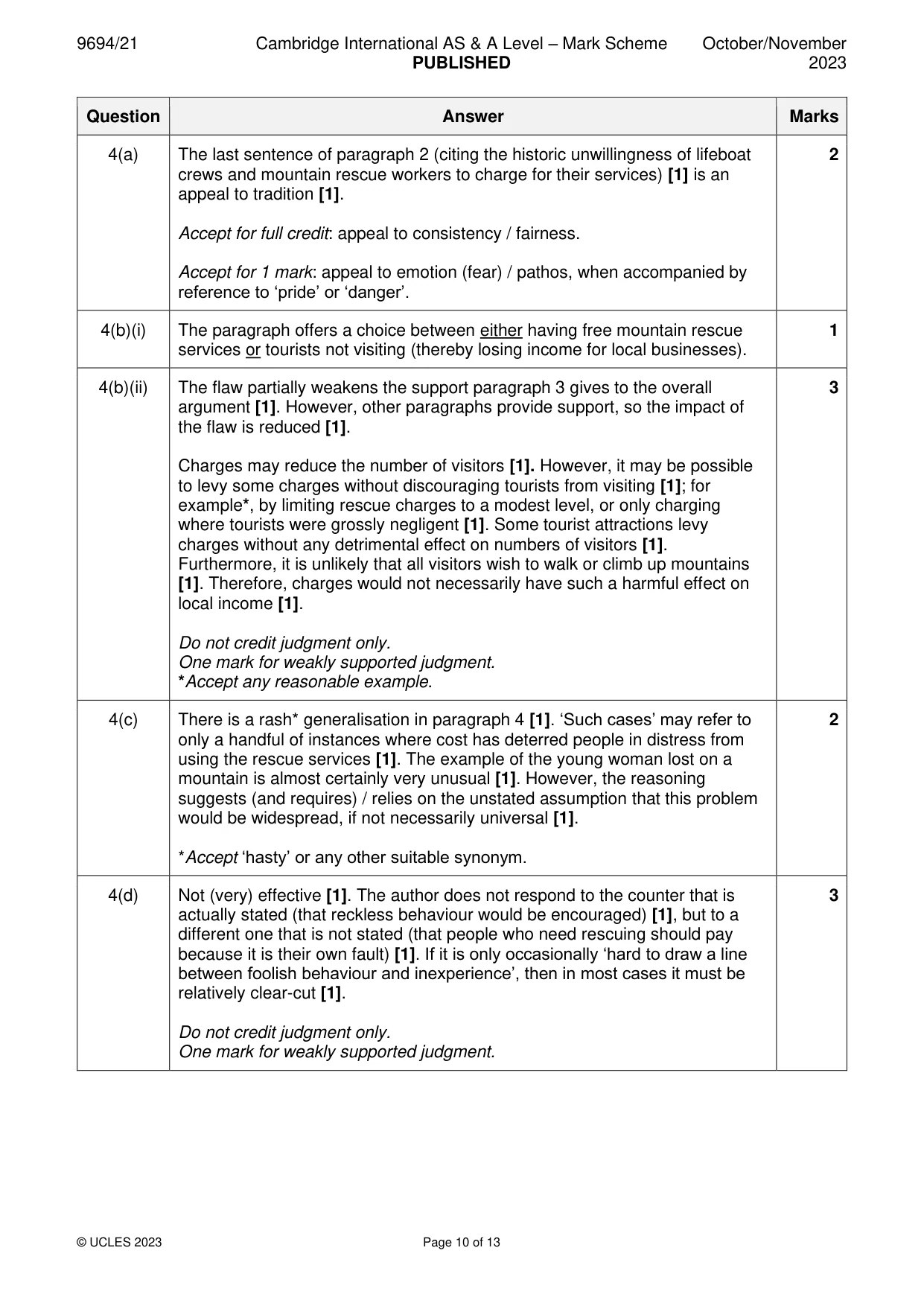
9694/21 Cambridge International AS & A Level – Mark Scheme PUBLISHED October/November 2023 © UCLES 2023 Page 10 of 13 Question Answer Marks 4(a) The last sentence of paragraph 2 (citing the historic unwillingness of lifeboat crews and mountain rescue workers to charge for their services) [1] is an appeal to tradition [1]. Accept for full credit: appeal to consistency / fairness. Accept for 1 mark: appeal to emotion (fear) / pathos, when accompanied by reference to ‘pride’ or ‘danger’. 2 4(b)(i) The paragraph offers a choice between either having free mountain rescue services or tourists not visiting (thereby losing income for local businesses). 1 4(b)(ii) The flaw partially weakens the support paragraph 3 gives to the overall argument [1]. However, other paragraphs provide support, so the impact of the flaw is reduced [1]. Charges may reduce the number of visitors [1]. However, it may be possible to levy some charges without discouraging tourists from visiting [1]; for example*, by limiting rescue charges to a modest level, or only charging where tourists were grossly negligent [1]. Some tourist attractions levy charges without any detrimental effect on numbers of visitors [1]. Furthermore, it is unlikely that all visitors wish to walk or climb up mountains [1]. Therefore, charges would not necessarily have such a harmful effect on local income [1]. Do not credit judgment only. One mark for weakly supported judgment. *Accept any reasonable example. 3 4(c) There is a rash* generalisation in paragraph 4 [1]. ‘Such cases’ may refer to only a handful of instances where cost has deterred people in distress from using the rescue services [1]. The example of the young woman lost on a mountain is almost certainly very unusual [1]. However, the reasoning suggests (and requires) / relies on the unstated assumption that this problem would be widespread, if not necessarily universal [1]. *Accept ‘hasty’ or any other suitable synonym. 2 4(d) Not (very) effective [1]. The author does not respond to the counter that is actually stated (that reckless behaviour would be encouraged) [1], but to a different one that is not stated (that people who need rescuing should pay because it is their own fault) [1]. If it is only occasionally ‘hard to draw a line between foolish behaviour and inexperience’, then in most cases it must be relatively clear-cut [1]. Do not credit judgment only. One mark for weakly supported judgment. 3
Mark scheme, page 11
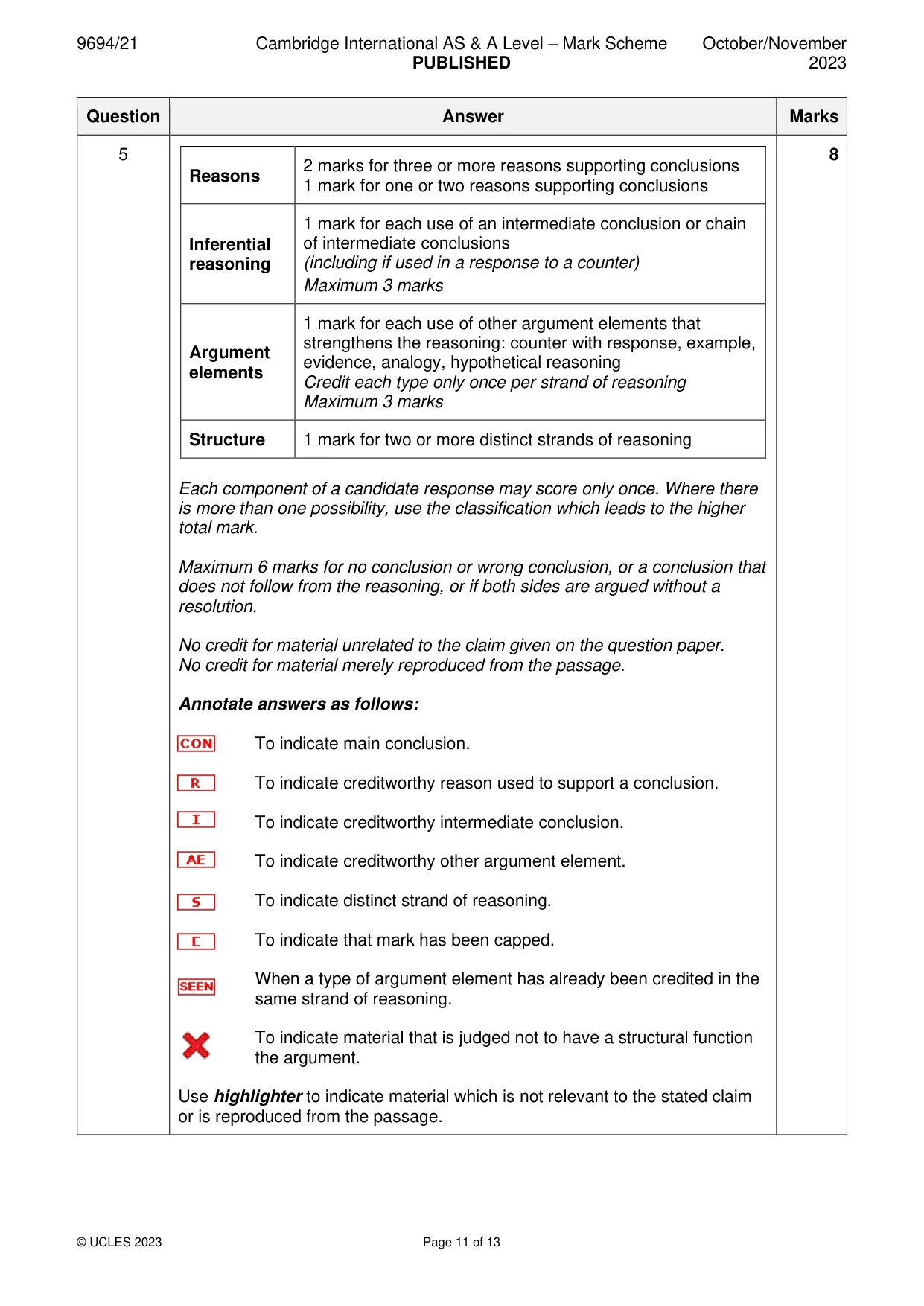
9694/21 Cambridge International AS & A Level – Mark Scheme PUBLISHED October/November 2023 © UCLES 2023 Page 11 of 13 Question Answer Marks 5 Reasons 2 marks for three or more reasons supporting conclusions 1 mark for one or two reasons supporting conclusions Inferential reasoning 1 mark for each use of an intermediate conclusion or chain of intermediate conclusions (including if used in a response to a counter) Maximum 3 marks Argument elements 1 mark for each use of other argument elements that strengthens the reasoning: counter with response, example, evidence, analogy, hypothetical reasoning Credit each type only once per strand of reasoning Maximum 3 marks Structure 1 mark for two or more distinct strands of reasoning Each component of a candidate response may score only once. Where there is more than one possibility, use the classification which leads to the higher total mark. Maximum 6 marks for no conclusion or wrong conclusion, or a conclusion that does not follow from the reasoning, or if both sides are argued without a resolution. No credit for material unrelated to the claim given on the question paper. No credit for material merely reproduced from the passage. Annotate answers as follows: To indicate main conclusion. To indicate creditworthy reason used to support a conclusion. To indicate creditworthy intermediate conclusion. To indicate creditworthy other argument element. To indicate distinct strand of reasoning. To indicate that mark has been capped. When a type of argument element has already been credited in the same strand of reasoning. To indicate material that is judged not to have a structural function in the argument. Use highlighter to indicate material which is not relevant to the stated claim or is reproduced from the passage. 8
Mark scheme, page 12
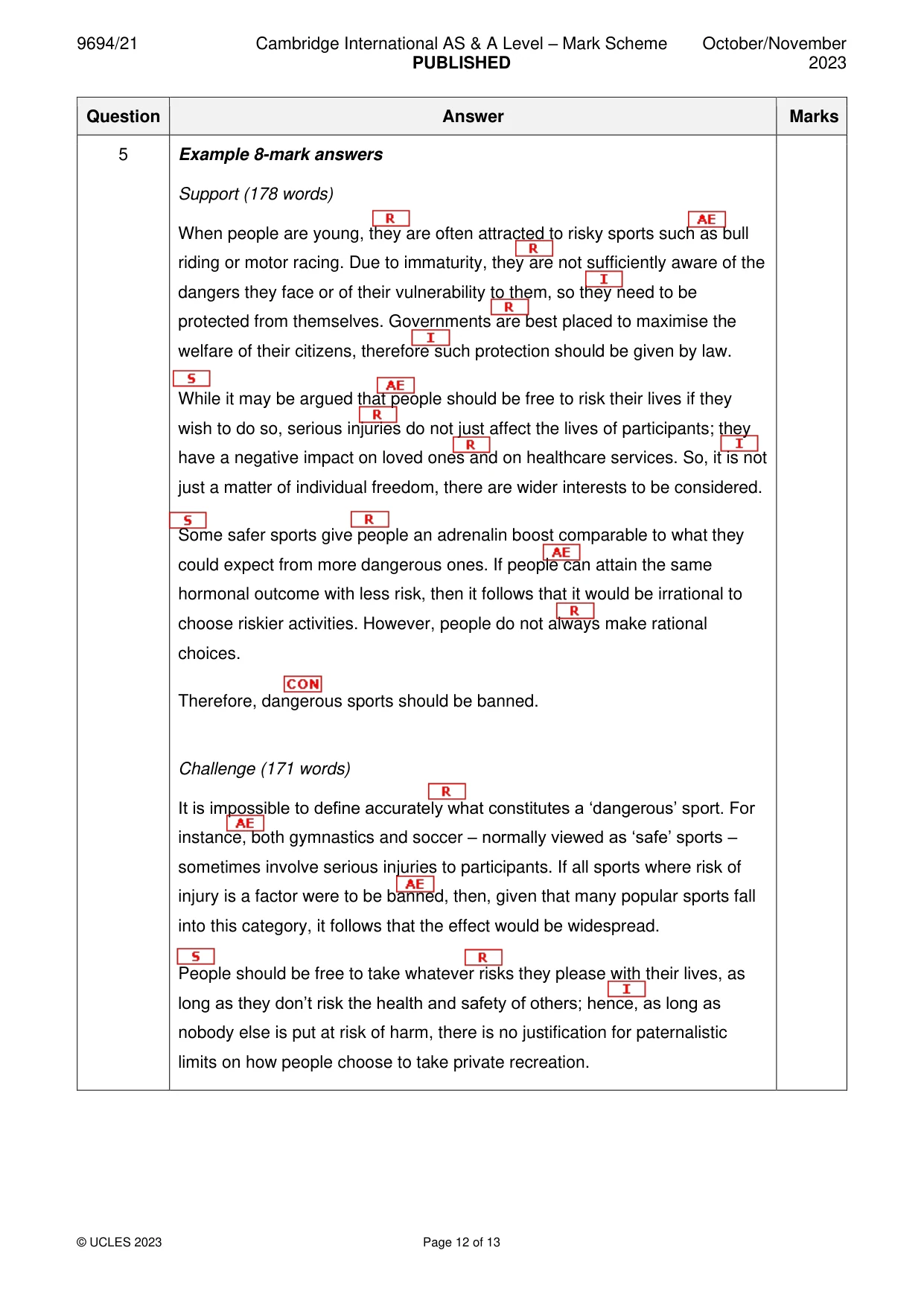
9694/21 Cambridge International AS & A Level – Mark Scheme PUBLISHED October/November 2023 © UCLES 2023 Page 12 of 13 Question Answer Marks 5 Example 8-mark answers Support (178 words) When people are young, they are often attracted to risky sports such as bull riding or motor racing. Due to immaturity, they are not sufficiently aware of the dangers they face or of their vulnerability to them, so they need to be protected from themselves. Governments are best placed to maximise the welfare of their citizens, therefore such protection should be given by law. While it may be argued that people should be free to risk their lives if they wish to do so, serious injuries do not just affect the lives of participants; they have a negative impact on loved ones and on healthcare services. So, it is not just a matter of individual freedom, there are wider interests to be considered. Some safer sports give people an adrenalin boost comparable to what they could expect from more dangerous ones. If people can attain the same hormonal outcome with less risk, then it follows that it would be irrational to choose riskier activities. However, people do not always make rational choices. Therefore, dangerous sports should be banned. Challenge (171 words) It is impossible to define accurately what constitutes a ‘dangerous’ sport. For instance, both gymnastics and soccer – normally viewed as ‘safe’ sports – sometimes involve serious injuries to participants. If all sports where risk of injury is a factor were to be banned, then, given that many popular sports fall into this category, it follows that the effect would be widespread. People should be free to take whatever risks they please with their lives, as long as they don’t risk the health and safety of others; hence, as long as nobody else is put at risk of harm, there is no justification for paternalistic limits on how people choose to take private recreation.
Mark scheme, page 13
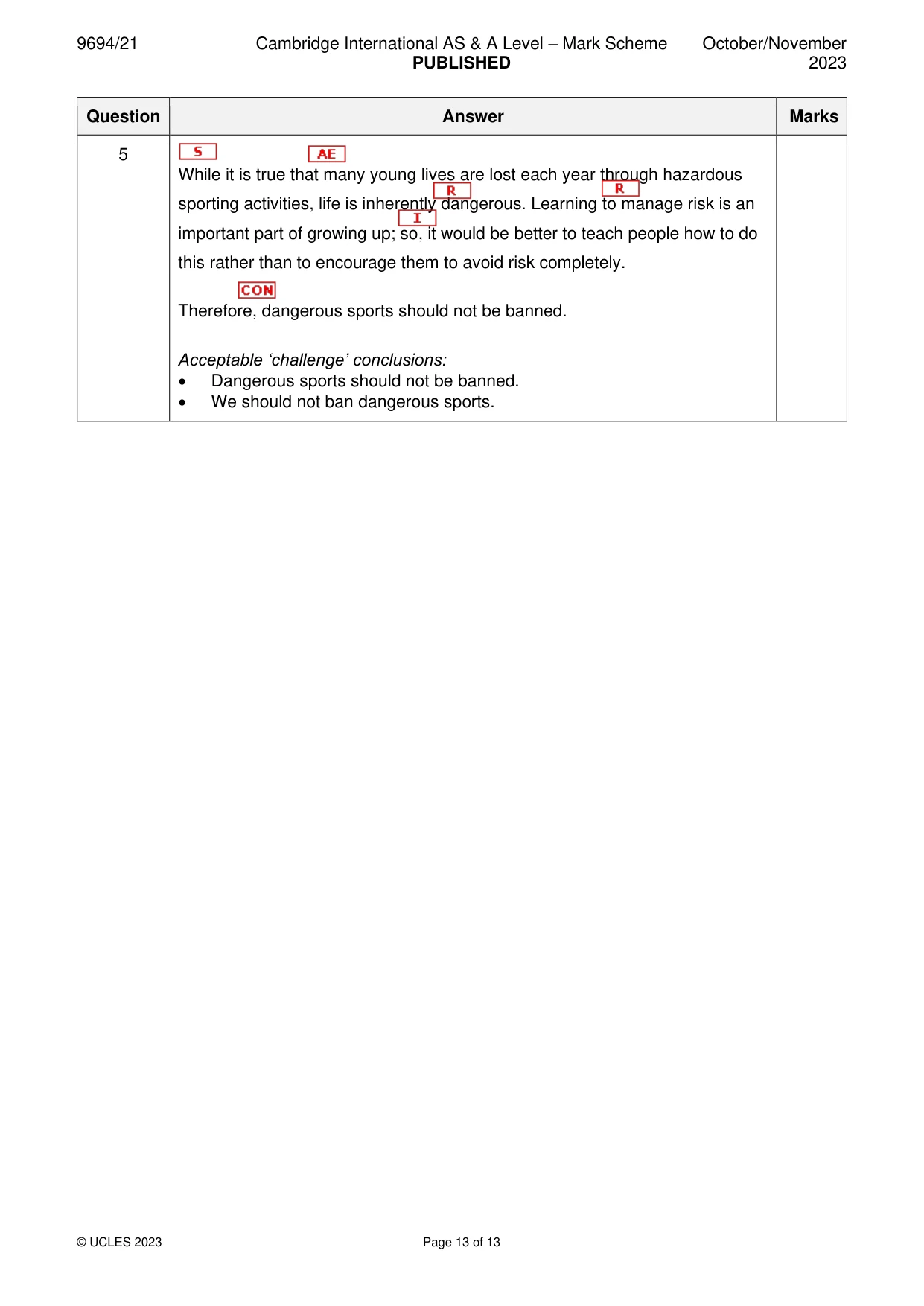
9694/21 Cambridge International AS & A Level – Mark Scheme PUBLISHED October/November 2023 © UCLES 2023 Page 13 of 13 Question Answer Marks 5 While it is true that many young lives are lost each year through hazardous sporting activities, life is inherently dangerous. Learning to manage risk is an important part of growing up; so, it would be better to teach people how to do this rather than to encourage them to avoid risk completely. Therefore, dangerous sports should not be banned. Acceptable ‘challenge’ conclusions: • Dangerous sports should not be banned. • We should not ban dangerous sports.
What you needed in this session
Cambridge’s own grade thresholds for 2023 Oct/Nov, Paper 2 · Variant 1. A higher threshold means an easier paper — the bar moves with how the cohort did.