Cambridge A Level Thinking Skills 9694 — 2021 Oct/Nov Paper 2 · Variant 1
9694/21/O/N/21 · 50 marks · ≈56 min
The question paper and its mark scheme, free to read here and free to download. This is Cambridge’s own paper, exactly as it was sat.
Question paper8 pages


Mark scheme11 pages
Answers below. Sit the paper first if you are practising.
Paper as text
Question paper, page 1
This document has 8 pages. Any blank pages are indicated. Cambridge International AS & A Level * 9 1 3 9 5 2 2 7 3 7 * DC (MB) 201464/1 © UCLES 2021 [Turn over THINKING SKILLS 9694/21 Paper 2 Critical Thinking October/November 2021 1 hour 45 minutes You must answer on the enclosed answer booklet. You will need: Answer booklet (enclosed) INSTRUCTIONS ● Answer all questions. ● Follow the instructions on the front cover of the answer booklet. If you need additional answer paper, ask the invigilator for a continuation booklet. INFORMATION ● The total mark for this paper is 50. ● The number of marks for each question or part question is shown in brackets [ ].
Question paper, page 2
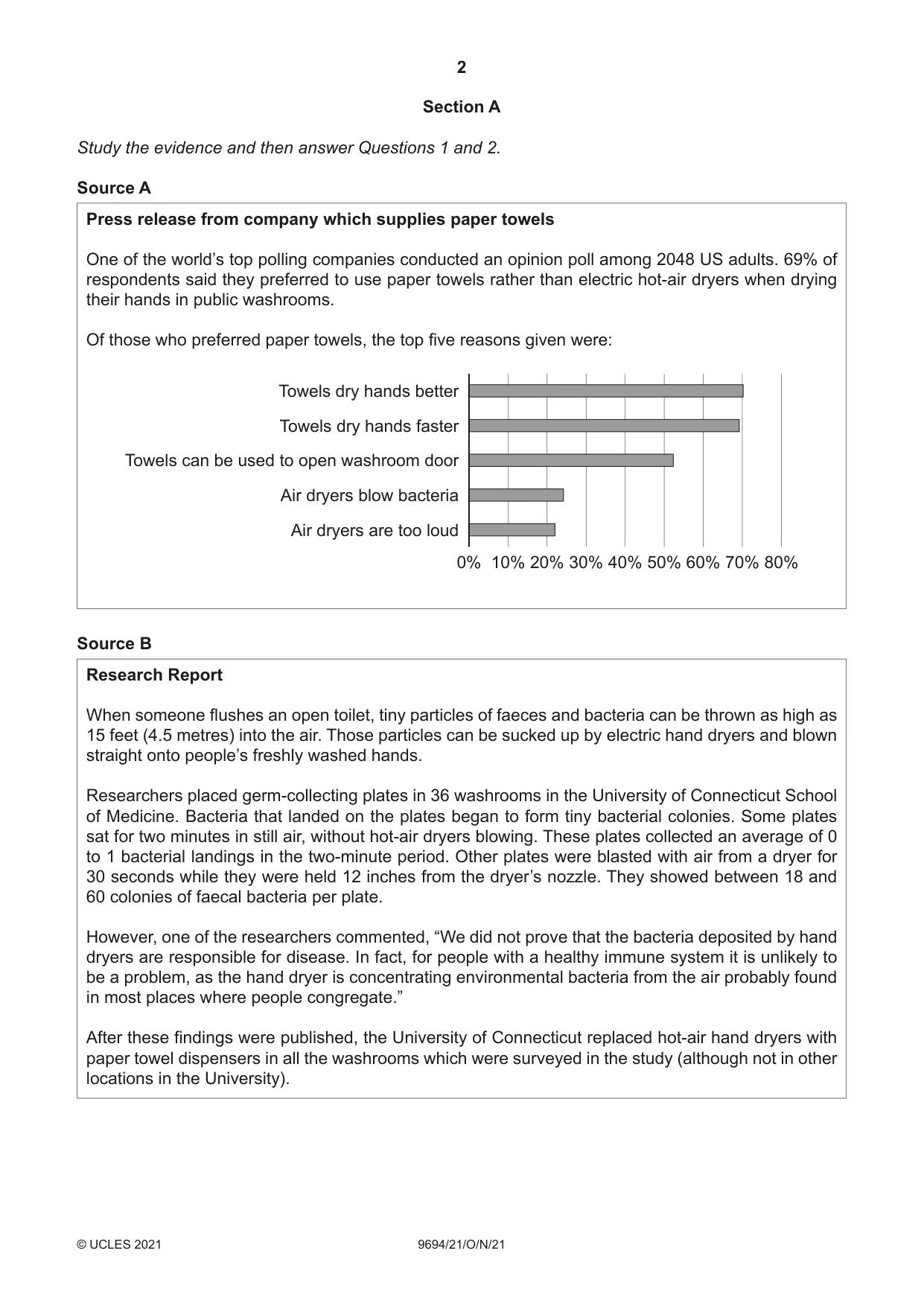
2 9694/21/O/N/21 © UCLES 2021 Section A Study the evidence and then answer Questions 1 and 2. Source A Press release from company which supplies paper towels One of the world’s top polling companies conducted an opinion poll among 2048 US adults. 69% of respondents said they preferred to use paper towels rather than electric hot-air dryers when drying their hands in public washrooms. Of those who preferred paper towels, the top five reasons given were: Towels dry hands better Towels dry hands faster Towels can be used to open washroom door Air dryers blow bacteria Air dryers are too loud 0% 10% 20% 30% 40% 50% 60% 70% 80% Source B Research Report When someone flushes an open toilet, tiny particles of faeces and bacteria can be thrown as high as 15 feet (4.5 metres) into the air. Those particles can be sucked up by electric hand dryers and blown straight onto people’s freshly washed hands. Researchers placed germ-collecting plates in 36 washrooms in the University of Connecticut School of Medicine. Bacteria that landed on the plates began to form tiny bacterial colonies. Some plates sat for two minutes in still air, without hot-air dryers blowing. These plates collected an average of 0 to 1 bacterial landings in the two-minute period. Other plates were blasted with air from a dryer for 30 seconds while they were held 12 inches from the dryer’s nozzle. They showed between 18 and 60 colonies of faecal bacteria per plate. However, one of the researchers commented, “We did not prove that the bacteria deposited by hand dryers are responsible for disease. In fact, for people with a healthy immune system it is unlikely to be a problem, as the hand dryer is concentrating environmental bacteria from the air probably found in most places where people congregate.” After these findings were published, the University of Connecticut replaced hot-air hand dryers with paper towel dispensers in all the washrooms which were surveyed in the study (although not in other locations in the University).
Question paper, page 3
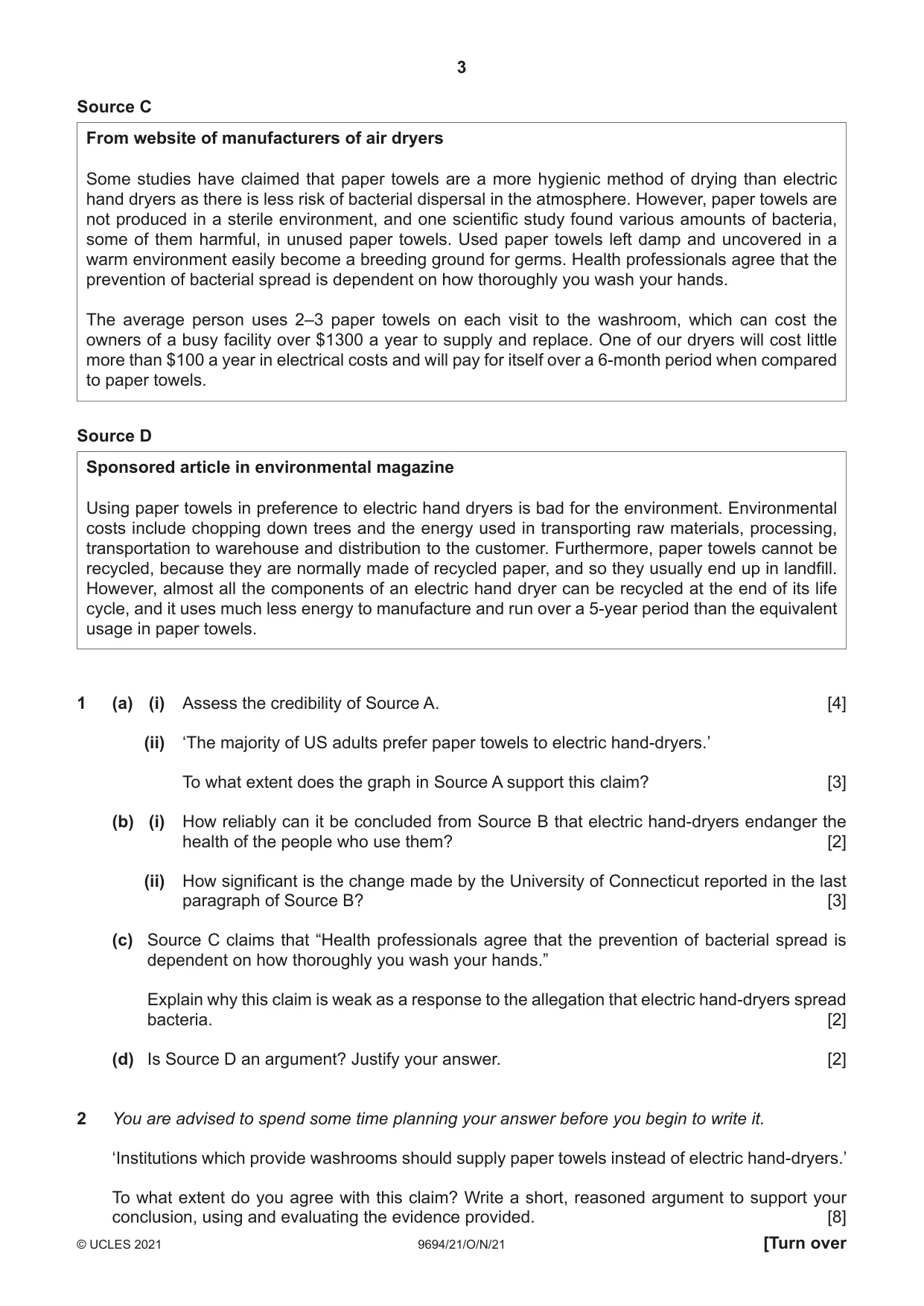
3 9694/21/O/N/21 © UCLES 2021 [Turn over Source C From website of manufacturers of air dryers Some studies have claimed that paper towels are a more hygienic method of drying than electric hand dryers as there is less risk of bacterial dispersal in the atmosphere. However, paper towels are not produced in a sterile environment, and one scientific study found various amounts of bacteria, some of them harmful, in unused paper towels. Used paper towels left damp and uncovered in a warm environment easily become a breeding ground for germs. Health professionals agree that the prevention of bacterial spread is dependent on how thoroughly you wash your hands. The average person uses 2–3 paper towels on each visit to the washroom, which can cost the owners of a busy facility over $1300 a year to supply and replace. One of our dryers will cost little more than $100 a year in electrical costs and will pay for itself over a 6-month period when compared to paper towels. Source D Sponsored article in environmental magazine Using paper towels in preference to electric hand dryers is bad for the environment. Environmental costs include chopping down trees and the energy used in transporting raw materials, processing, transportation to warehouse and distribution to the customer. Furthermore, paper towels cannot be recycled, because they are normally made of recycled paper, and so they usually end up in landfill. However, almost all the components of an electric hand dryer can be recycled at the end of its life cycle, and it uses much less energy to manufacture and run over a 5-year period than the equivalent usage in paper towels. 1 (a) (i) Assess the credibility of Source A. [4] (ii) ‘The majority of US adults prefer paper towels to electric hand-dryers.’ To what extent does the graph in Source A support this claim? [3] (b) (i) How reliably can it be concluded from Source B that electric hand-dryers endanger the health of the people who use them? [2] (ii) How significant is the change made by the University of Connecticut reported in the last paragraph of Source B? [3] (c) Source C claims that “Health professionals agree that the prevention of bacterial spread is dependent on how thoroughly you wash your hands.” Explain why this claim is weak as a response to the allegation that electric hand-dryers spread bacteria. [2] (d) Is Source D an argument? Justify your answer. [2] 2 You are advised to spend some time planning your answer before you begin to write it. ‘Institutions which provide washrooms should supply paper towels instead of electric hand-dryers.’ To what extent do you agree with this claim? Write a short, reasoned argument to support your conclusion, using and evaluating the evidence provided. [8]
Question paper, page 4
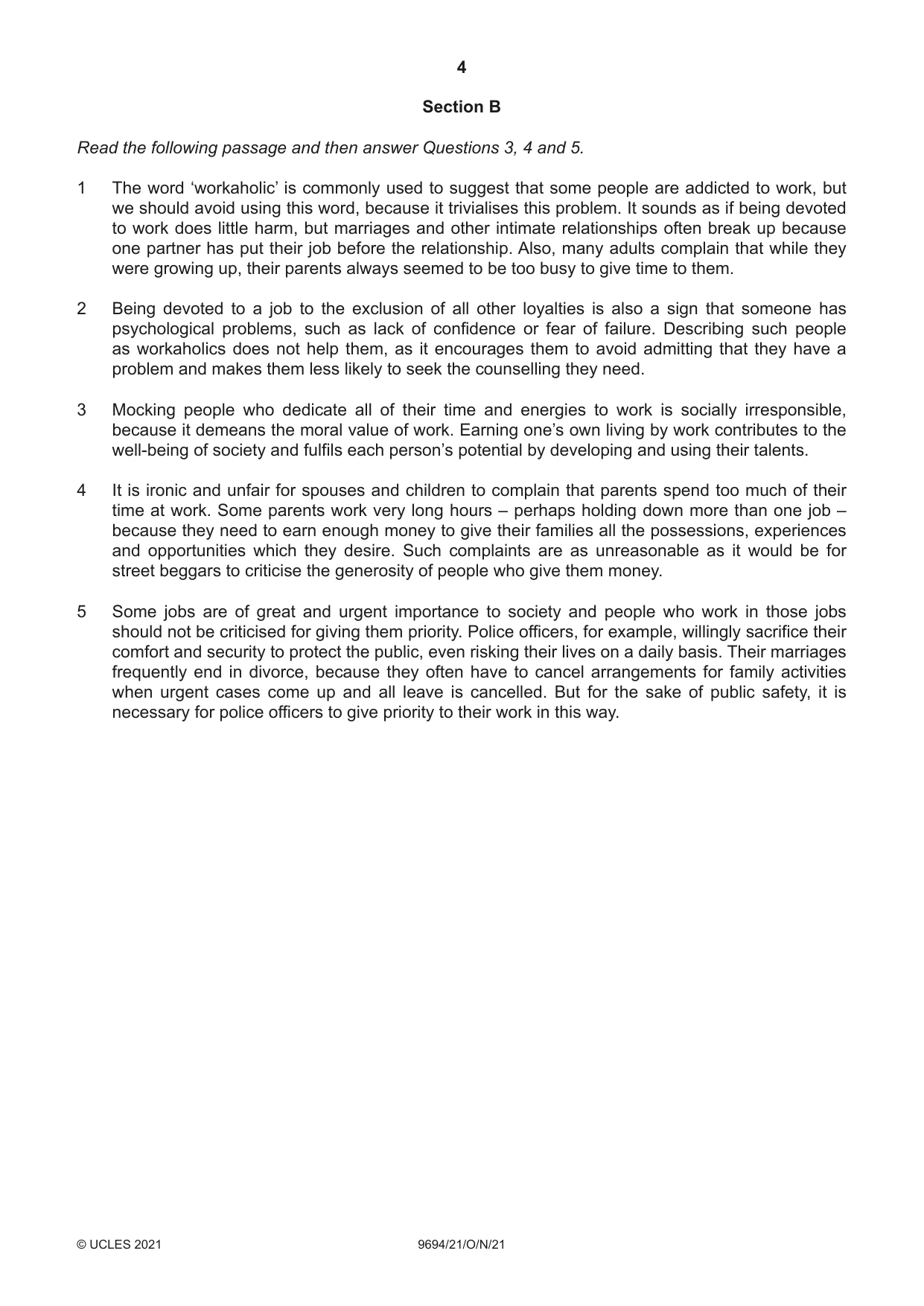
4 9694/21/O/N/21 © UCLES 2021 Section B Read the following passage and then answer Questions 3, 4 and 5. 1 The word ‘workaholic’ is commonly used to suggest that some people are addicted to work, but we should avoid using this word, because it trivialises this problem. It sounds as if being devoted to work does little harm, but marriages and other intimate relationships often break up because one partner has put their job before the relationship. Also, many adults complain that while they were growing up, their parents always seemed to be too busy to give time to them. 2 Being devoted to a job to the exclusion of all other loyalties is also a sign that someone has psychological problems, such as lack of confidence or fear of failure. Describing such people as workaholics does not help them, as it encourages them to avoid admitting that they have a problem and makes them less likely to seek the counselling they need. 3 Mocking people who dedicate all of their time and energies to work is socially irresponsible, because it demeans the moral value of work. Earning one’s own living by work contributes to the well-being of society and fulfils each person’s potential by developing and using their talents. 4 It is ironic and unfair for spouses and children to complain that parents spend too much of their time at work. Some parents work very long hours – perhaps holding down more than one job – because they need to earn enough money to give their families all the possessions, experiences and opportunities which they desire. Such complaints are as unreasonable as it would be for street beggars to criticise the generosity of people who give them money. 5 Some jobs are of great and urgent importance to society and people who work in those jobs should not be criticised for giving them priority. Police officers, for example, willingly sacrifice their comfort and security to protect the public, even risking their lives on a daily basis. Their marriages frequently end in divorce, because they often have to cancel arrangements for family activities when urgent cases come up and all leave is cancelled. But for the sake of public safety, it is necessary for police officers to give priority to their work in this way.
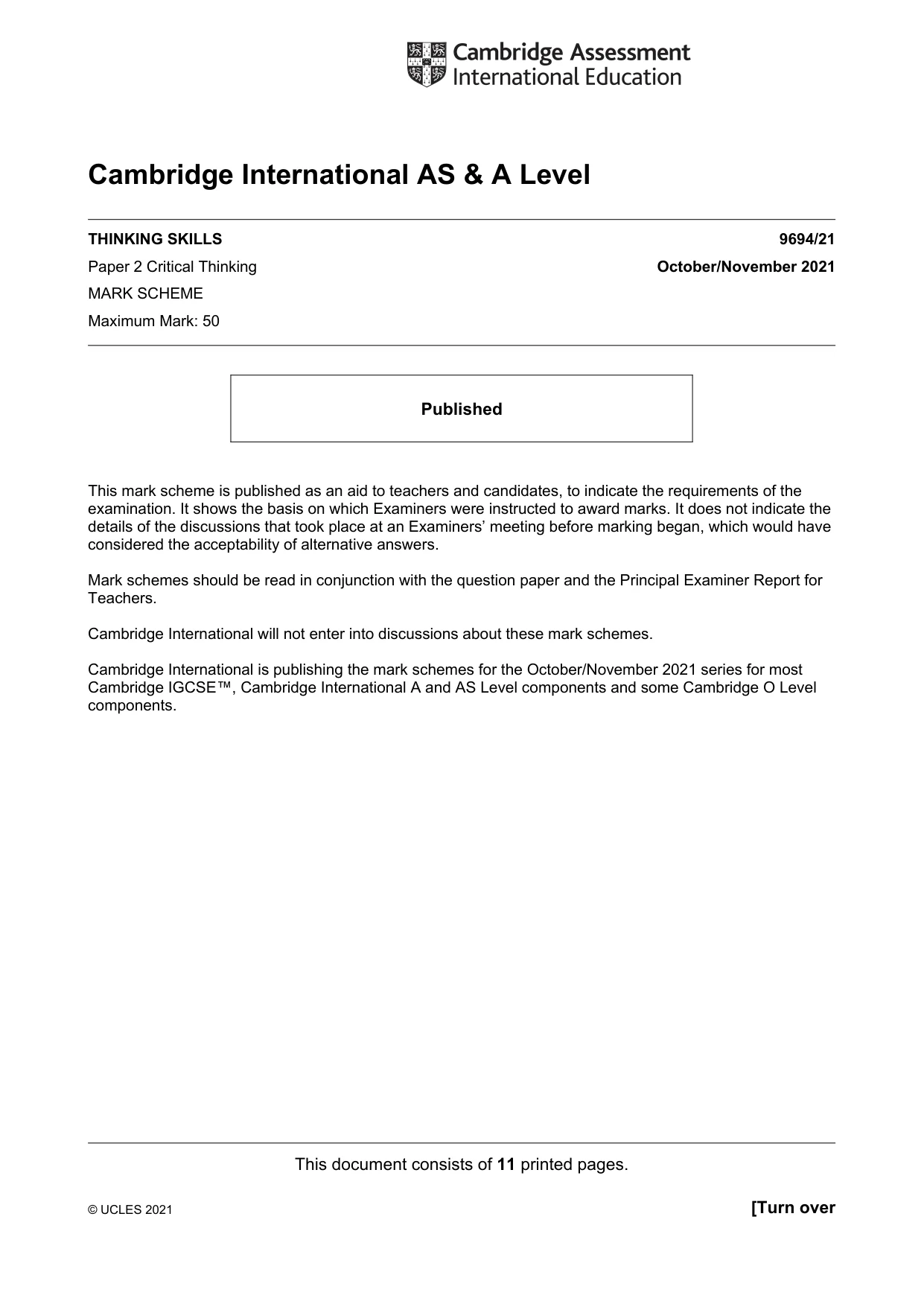
Question paper, page 5
5 9694/21/O/N/21 © UCLES 2021 3 (a) Using the exact words from the passage as far as possible, identify the main conclusion. [2] (b) Using the exact words from the passage as far as possible, identify two intermediate conclusions from paragraphs 1 to 3. [4] (c) Identify the argument element and explain the function of the following words: (i) ‘fear of failure’ (paragraph 2). [2] (ii) ‘Some jobs are of great and urgent importance to society’ (paragraph 5). [2] 4 (a) To what extent is the reasoning in paragraph 3 weakened by the flaw of conflation? [3] (b) (i) Evaluate the analogy in paragraph 4. [3] (ii) Identify one flaw or weakness in paragraph 4 and assess the extent to which it reduces the support given to the main conclusion. [2] 5 You are advised to spend some time planning your answer before you begin to write it. ‘Everyone should make time in their life for leisure.’ Write your own short argument to support or challenge this claim. The conclusion of your argument must be stated. Credit will not be given for repeating ideas from the passage. [8]
Question paper, page 6
6 9694/21/O/N/21 © UCLES 2021 BLANK PAGE
Question paper, page 7
7 9694/21/O/N/21 © UCLES 2021 BLANK PAGE
Question paper, page 8
8 9694/21/O/N/21 © UCLES 2021 Permission to reproduce items where third-party owned material protected by copyright is included has been sought and cleared where possible. Every reasonable effort has been made by the publisher (UCLES) to trace copyright holders, but if any items requiring clearance have unwittingly been included, the publisher will be pleased to make amends at the earliest possible opportunity. To avoid the issue of disclosure of answer-related information to candidates, all copyright acknowledgements are reproduced online in the Cambridge Assessment International Education Copyright Acknowledgements Booklet. This is produced for each series of examinations and is freely available to download at www.cambridgeinternational.org after the live examination series. Cambridge Assessment International Education is part of the Cambridge Assessment Group. Cambridge Assessment is the brand name of the University of Cambridge Local Examinations Syndicate (UCLES), which itself is a department of the University of Cambridge. BLANK PAGE
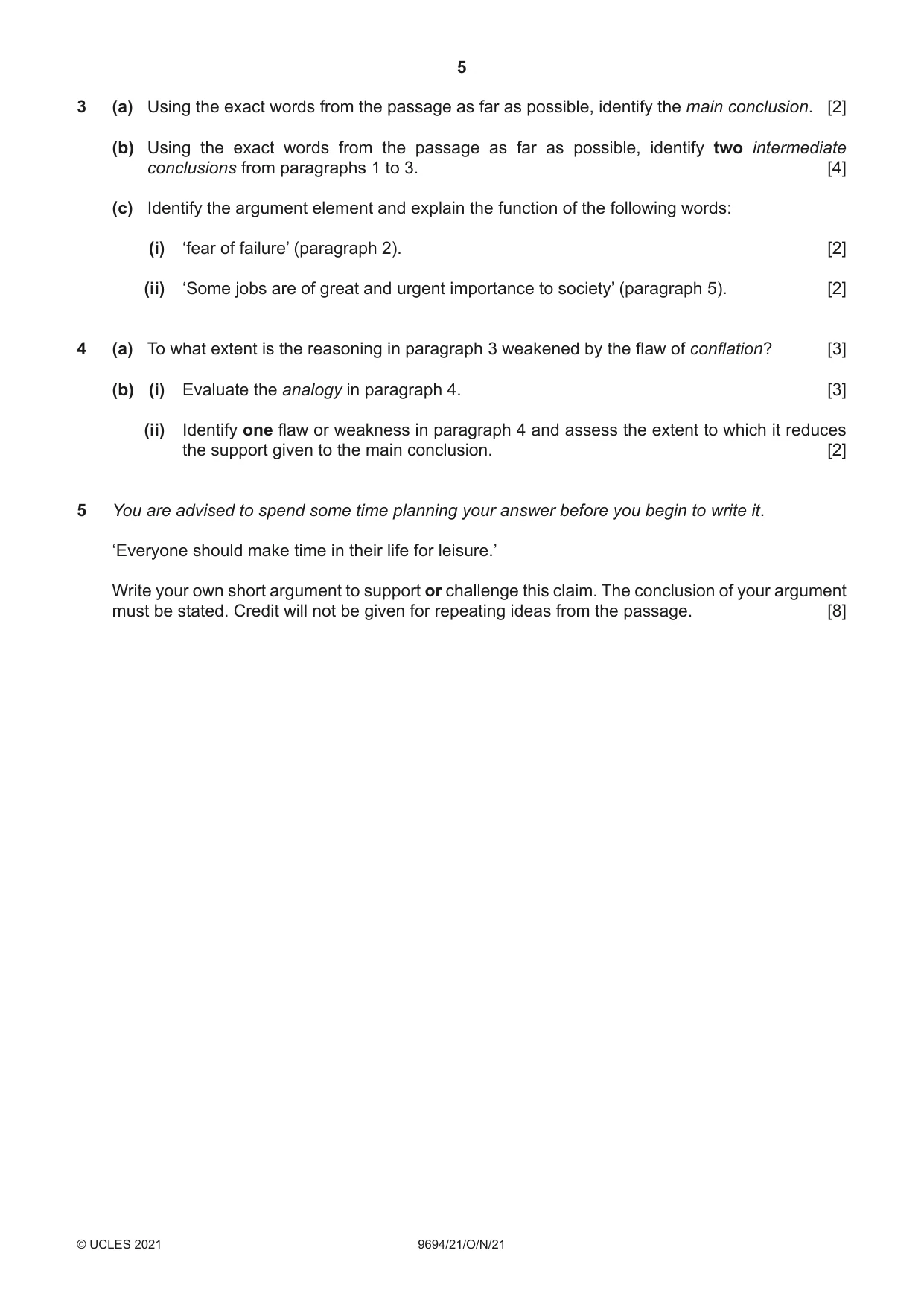
Mark scheme, page 1
This document consists of 11 printed pages. © UCLES 2021 [Turn over Cambridge International AS & A Level THINKING SKILLS 9694/21 Paper 2 Critical Thinking October/November 2021 MARK SCHEME Maximum Mark: 50 Published This mark scheme is published as an aid to teachers and candidates, to indicate the requirements of the examination. It shows the basis on which Examiners were instructed to award marks. It does not indicate the details of the discussions that took place at an Examiners’ meeting before marking began, which would have considered the acceptability of alternative answers. Mark schemes should be read in conjunction with the question paper and the Principal Examiner Report for Teachers. Cambridge International will not enter into discussions about these mark schemes. Cambridge International is publishing the mark schemes for the October/November 2021 series for most Cambridge IGCSE™, Cambridge International A and AS Level components and some Cambridge O Level components.
Mark scheme, page 2
9694/21 Cambridge International AS & A Level – Mark Scheme PUBLISHED October/November 2021 © UCLES 2021 Page 2 of 11 Generic Marking Principles These general marking principles must be applied by all examiners when marking candidate answers. They should be applied alongside the specific content of the mark scheme or generic level descriptors for a question. Each question paper and mark scheme will also comply with these marking principles. GENERIC MARKING PRINCIPLE 1: Marks must be awarded in line with: • the specific content of the mark scheme or the generic level descriptors for the question • the specific skills defined in the mark scheme or in the generic level descriptors for the question • the standard of response required by a candidate as exemplified by the standardisation scripts. GENERIC MARKING PRINCIPLE 2: Marks awarded are always whole marks (not half marks, or other fractions). GENERIC MARKING PRINCIPLE 3: Marks must be awarded positively: • marks are awarded for correct/valid answers, as defined in the mark scheme. However, credit is given for valid answers which go beyond the scope of the syllabus and mark scheme, referring to your Team Leader as appropriate • marks are awarded when candidates clearly demonstrate what they know and can do • marks are not deducted for errors • marks are not deducted for omissions • answers should only be judged on the quality of spelling, punctuation and grammar when these features are specifically assessed by the question as indicated by the mark scheme. The meaning, however, should be unambiguous. GENERIC MARKING PRINCIPLE 4: Rules must be applied consistently, e.g. in situations where candidates have not followed instructions or in the application of generic level descriptors. GENERIC MARKING PRINCIPLE 5: Marks should be awarded using the full range of marks defined in the mark scheme for the question (however; the use of the full mark range may be limited according to the quality of the candidate responses seen). GENERIC MARKING PRINCIPLE 6: Marks awarded are based solely on the requirements as defined in the mark scheme. Marks should not be awarded with grade thresholds or grade descriptors in mind.
Mark scheme, page 3
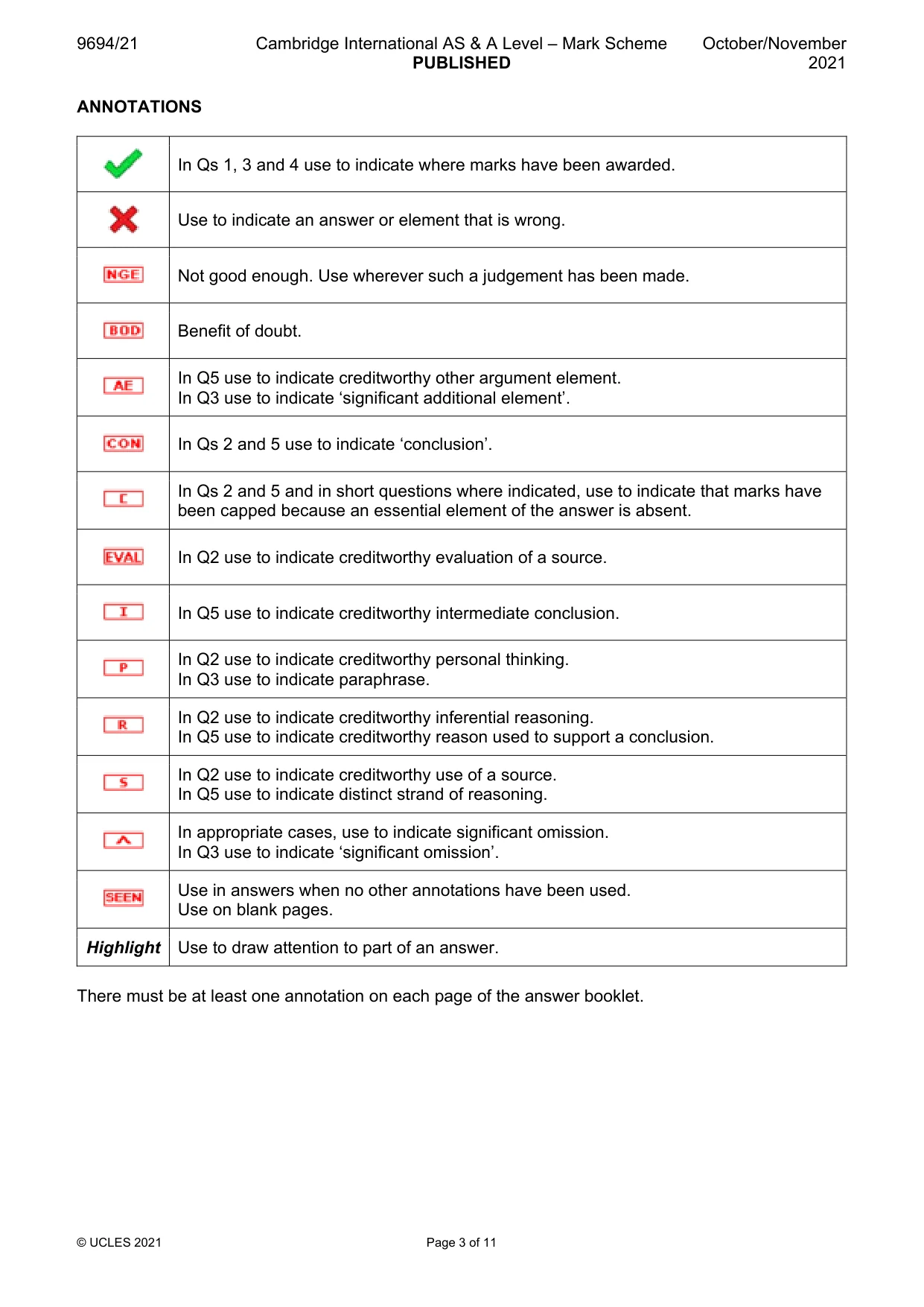
9694/21 Cambridge International AS & A Level – Mark Scheme PUBLISHED October/November 2021 © UCLES 2021 Page 3 of 11 ANNOTATIONS In Qs 1, 3 and 4 use to indicate where marks have been awarded. Use to indicate an answer or element that is wrong. Not good enough. Use wherever such a judgement has been made. Benefit of doubt. In Q5 use to indicate creditworthy other argument element. In Q3 use to indicate ‘significant additional element’. In Qs 2 and 5 use to indicate ‘conclusion’. In Qs 2 and 5 and in short questions where indicated, use to indicate that marks have been capped because an essential element of the answer is absent. In Q2 use to indicate creditworthy evaluation of a source. In Q5 use to indicate creditworthy intermediate conclusion. In Q2 use to indicate creditworthy personal thinking. In Q3 use to indicate paraphrase. In Q2 use to indicate creditworthy inferential reasoning. In Q5 use to indicate creditworthy reason used to support a conclusion. In Q2 use to indicate creditworthy use of a source. In Q5 use to indicate distinct strand of reasoning. In appropriate cases, use to indicate significant omission. In Q3 use to indicate ‘significant omission’. Use in answers when no other annotations have been used. Use on blank pages. Highlight Use to draw attention to part of an answer. There must be at least one annotation on each page of the answer booklet.
Mark scheme, page 4
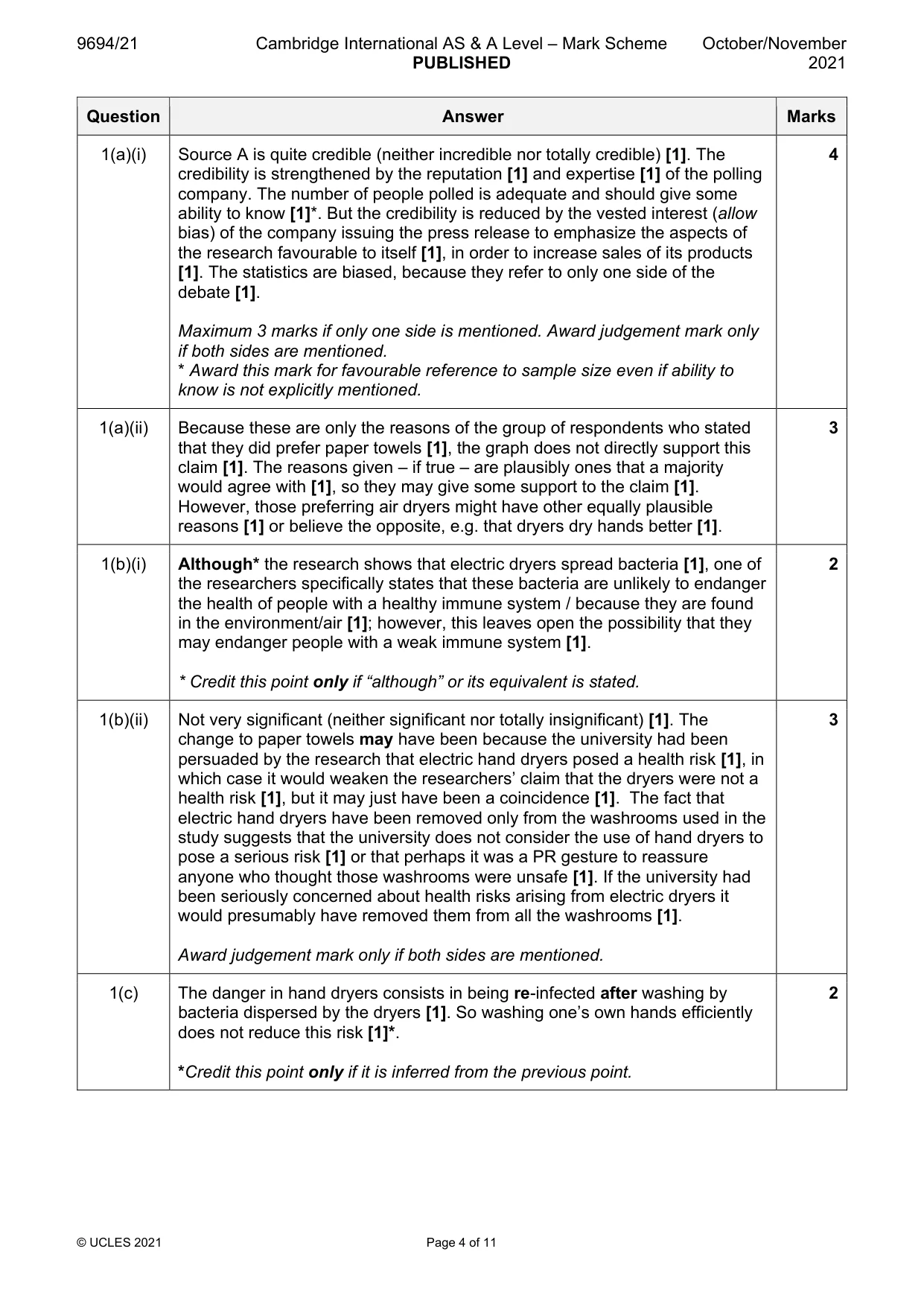
9694/21 Cambridge International AS & A Level – Mark Scheme PUBLISHED October/November 2021 © UCLES 2021 Page 4 of 11 Question Answer Marks 1(a)(i) Source A is quite credible (neither incredible nor totally credible) [1]. The credibility is strengthened by the reputation [1] and expertise [1] of the polling company. The number of people polled is adequate and should give some ability to know [1]*. But the credibility is reduced by the vested interest (allow bias) of the company issuing the press release to emphasize the aspects of the research favourable to itself [1], in order to increase sales of its products [1]. The statistics are biased, because they refer to only one side of the debate [1]. Maximum 3 marks if only one side is mentioned. Award judgement mark only if both sides are mentioned. * Award this mark for favourable reference to sample size even if ability to know is not explicitly mentioned. 4 1(a)(ii) Because these are only the reasons of the group of respondents who stated that they did prefer paper towels [1], the graph does not directly support this claim [1]. The reasons given – if true – are plausibly ones that a majority would agree with [1], so they may give some support to the claim [1]. However, those preferring air dryers might have other equally plausible reasons [1] or believe the opposite, e.g. that dryers dry hands better [1]. 3 1(b)(i) Although* the research shows that electric dryers spread bacteria [1], one of the researchers specifically states that these bacteria are unlikely to endanger the health of people with a healthy immune system / because they are found in the environment/air [1]; however, this leaves open the possibility that they may endanger people with a weak immune system [1]. * Credit this point only if “although” or its equivalent is stated. 2 1(b)(ii) Not very significant (neither significant nor totally insignificant) [1]. The change to paper towels may have been because the university had been persuaded by the research that electric hand dryers posed a health risk [1], in which case it would weaken the researchers’ claim that the dryers were not a health risk [1], but it may just have been a coincidence [1]. The fact that electric hand dryers have been removed only from the washrooms used in the study suggests that the university does not consider the use of hand dryers to pose a serious risk [1] or that perhaps it was a PR gesture to reassure anyone who thought those washrooms were unsafe [1]. If the university had been seriously concerned about health risks arising from electric dryers it would presumably have removed them from all the washrooms [1]. Award judgement mark only if both sides are mentioned. 3 1(c) The danger in hand dryers consists in being re-infected after washing by bacteria dispersed by the dryers [1]. So washing one’s own hands efficiently does not reduce this risk [1]*. *Credit this point only if it is inferred from the previous point. 2
Mark scheme, page 5
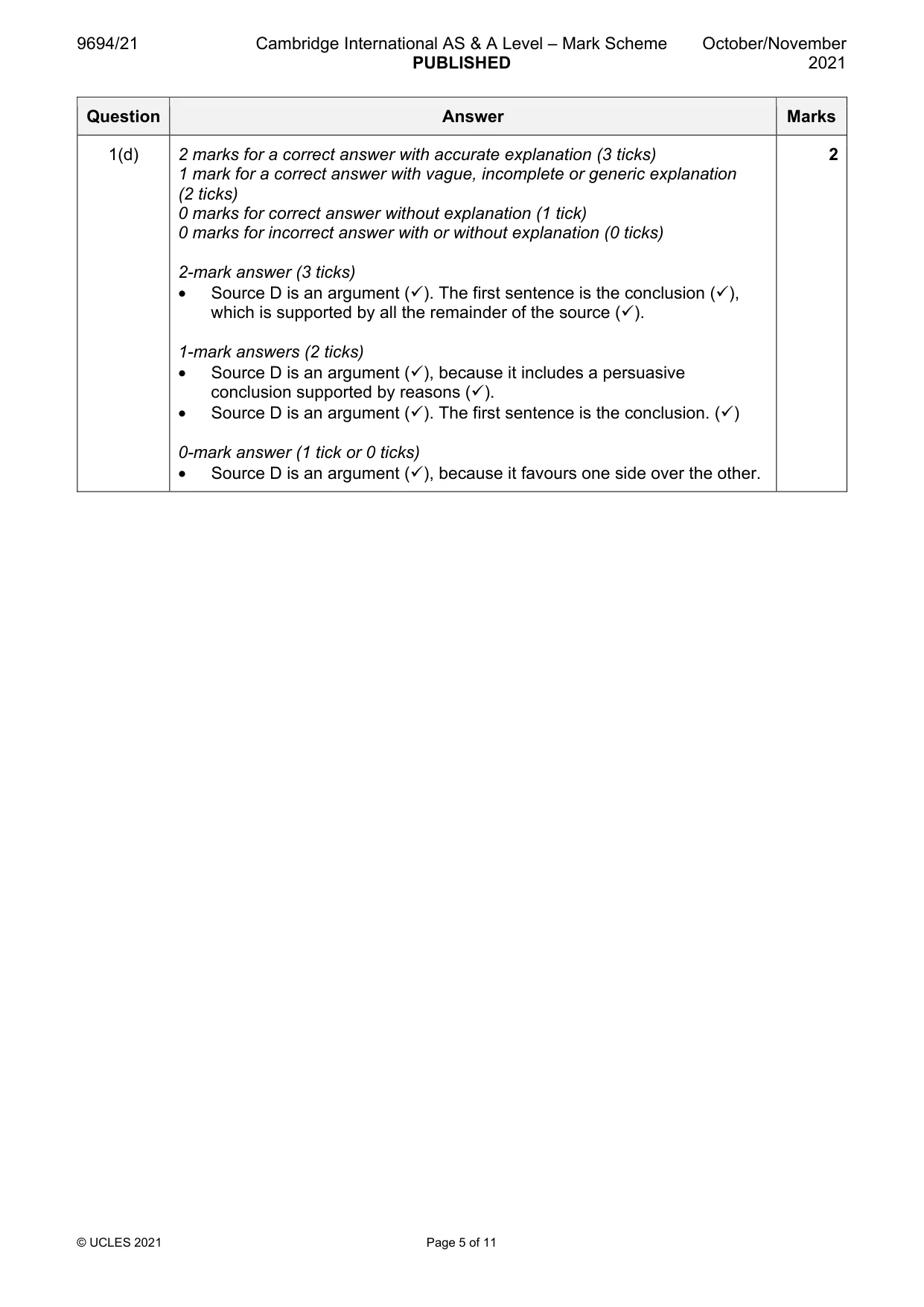
9694/21 Cambridge International AS & A Level – Mark Scheme PUBLISHED October/November 2021 © UCLES 2021 Page 5 of 11 Question Answer Marks 1(d) 2 marks for a correct answer with accurate explanation (3 ticks) 1 mark for a correct answer with vague, incomplete or generic explanation (2 ticks) 0 marks for correct answer without explanation (1 tick) 0 marks for incorrect answer with or without explanation (0 ticks) 2-mark answer (3 ticks) • Source D is an argument (). The first sentence is the conclusion (), which is supported by all the remainder of the source (). 1-mark answers (2 ticks) • Source D is an argument (), because it includes a persuasive conclusion supported by reasons (). • Source D is an argument (). The first sentence is the conclusion. () 0-mark answer (1 tick or 0 ticks) • Source D is an argument (), because it favours one side over the other. 2
Mark scheme, page 6
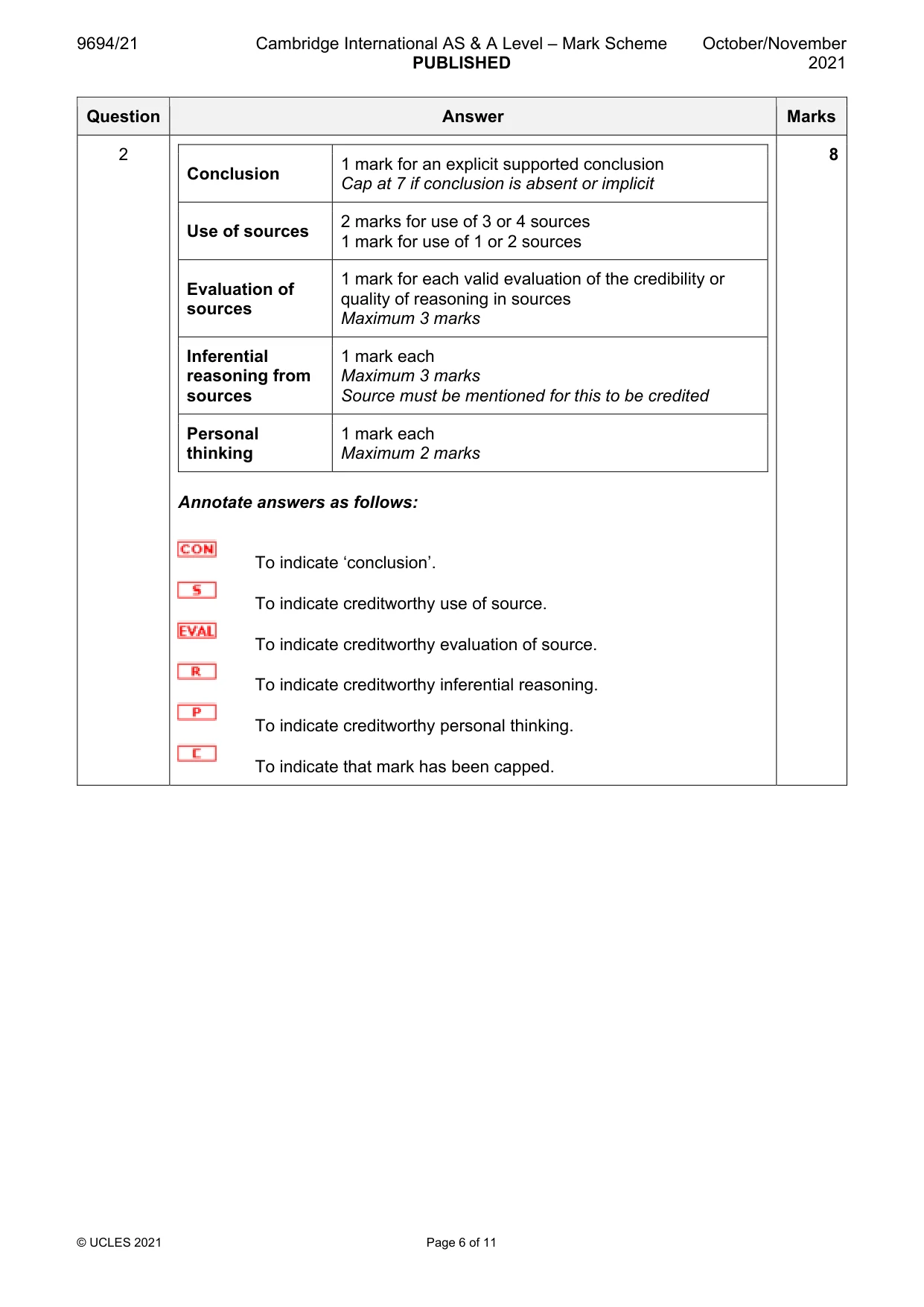
9694/21 Cambridge International AS & A Level – Mark Scheme PUBLISHED October/November 2021 © UCLES 2021 Page 6 of 11 Question Answer Marks 2 Conclusion 1 mark for an explicit supported conclusion Cap at 7 if conclusion is absent or implicit Use of sources 2 marks for use of 3 or 4 sources 1 mark for use of 1 or 2 sources Evaluation of sources 1 mark for each valid evaluation of the credibility or quality of reasoning in sources Maximum 3 marks Inferential reasoning from sources 1 mark each Maximum 3 marks Source must be mentioned for this to be credited Personal thinking 1 mark each Maximum 2 marks Annotate answers as follows: To indicate ‘conclusion’. To indicate creditworthy use of source. To indicate creditworthy evaluation of source. To indicate creditworthy inferential reasoning. To indicate creditworthy personal thinking. To indicate that mark has been capped. 8
Mark scheme, page 7
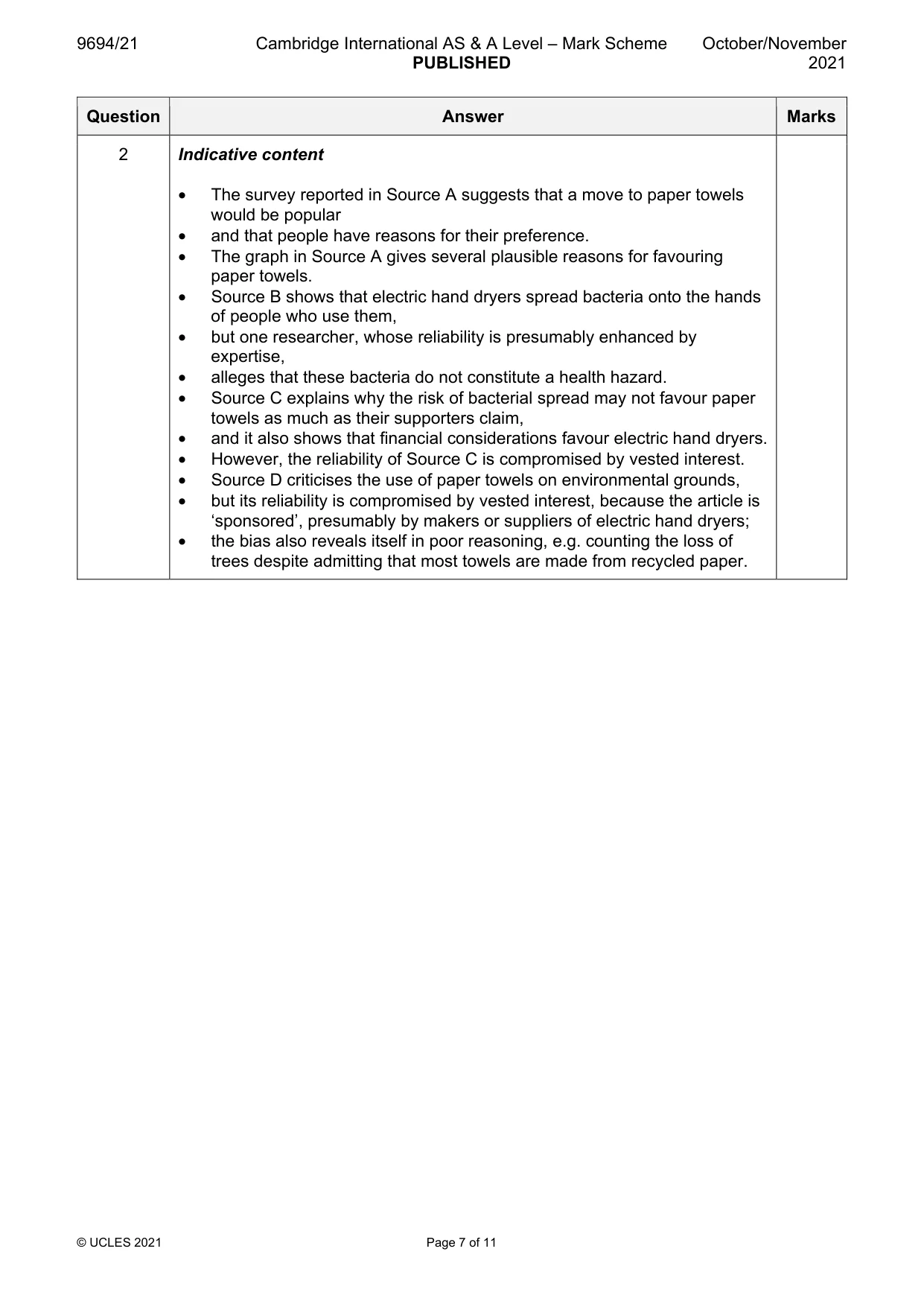
9694/21 Cambridge International AS & A Level – Mark Scheme PUBLISHED October/November 2021 © UCLES 2021 Page 7 of 11 Question Answer Marks 2 Indicative content • The survey reported in Source A suggests that a move to paper towels would be popular • and that people have reasons for their preference. • The graph in Source A gives several plausible reasons for favouring paper towels. • Source B shows that electric hand dryers spread bacteria onto the hands of people who use them, • but one researcher, whose reliability is presumably enhanced by expertise, • alleges that these bacteria do not constitute a health hazard. • Source C explains why the risk of bacterial spread may not favour paper towels as much as their supporters claim, • and it also shows that financial considerations favour electric hand dryers. • However, the reliability of Source C is compromised by vested interest. • Source D criticises the use of paper towels on environmental grounds, • but its reliability is compromised by vested interest, because the article is ‘sponsored’, presumably by makers or suppliers of electric hand dryers; • the bias also reveals itself in poor reasoning, e.g. counting the loss of trees despite admitting that most towels are made from recycled paper.
Mark scheme, page 8
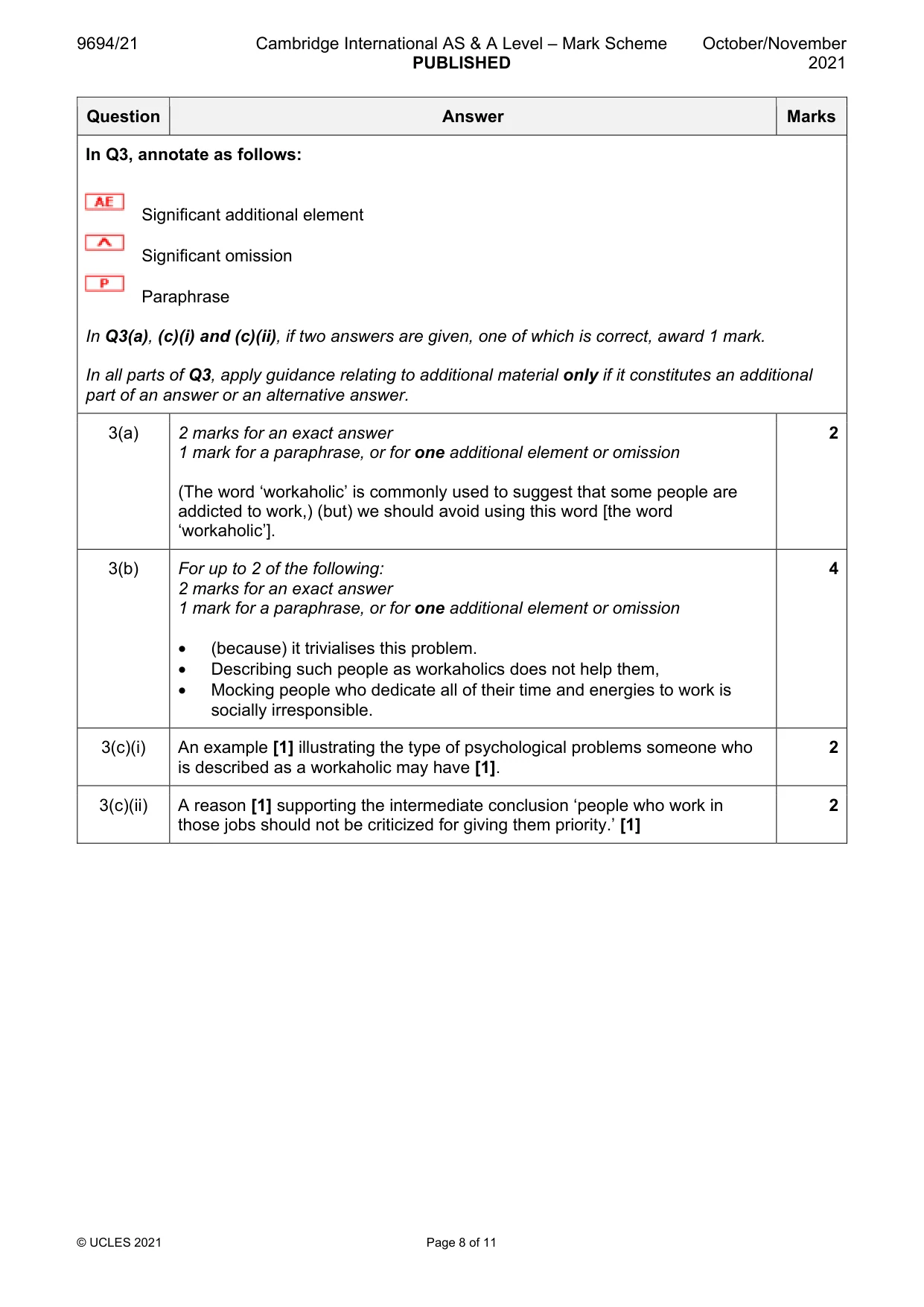
9694/21 Cambridge International AS & A Level – Mark Scheme PUBLISHED October/November 2021 © UCLES 2021 Page 8 of 11 Question Answer Marks In Q3, annotate as follows: Significant additional element Significant omission Paraphrase In Q3(a), (c)(i) and (c)(ii), if two answers are given, one of which is correct, award 1 mark. In all parts of Q3, apply guidance relating to additional material only if it constitutes an additional part of an answer or an alternative answer. 3(a) 2 marks for an exact answer 1 mark for a paraphrase, or for one additional element or omission (The word ‘workaholic’ is commonly used to suggest that some people are addicted to work,) (but) we should avoid using this word [the word ‘workaholic’]. 2 3(b) For up to 2 of the following: 2 marks for an exact answer 1 mark for a paraphrase, or for one additional element or omission • (because) it trivialises this problem. • Describing such people as workaholics does not help them, • Mocking people who dedicate all of their time and energies to work is socially irresponsible. 4 3(c)(i) An example [1] illustrating the type of psychological problems someone who is described as a workaholic may have [1]. 2 3(c)(ii) A reason [1] supporting the intermediate conclusion ‘people who work in those jobs should not be criticized for giving them priority.’ [1] 2
Mark scheme, page 9
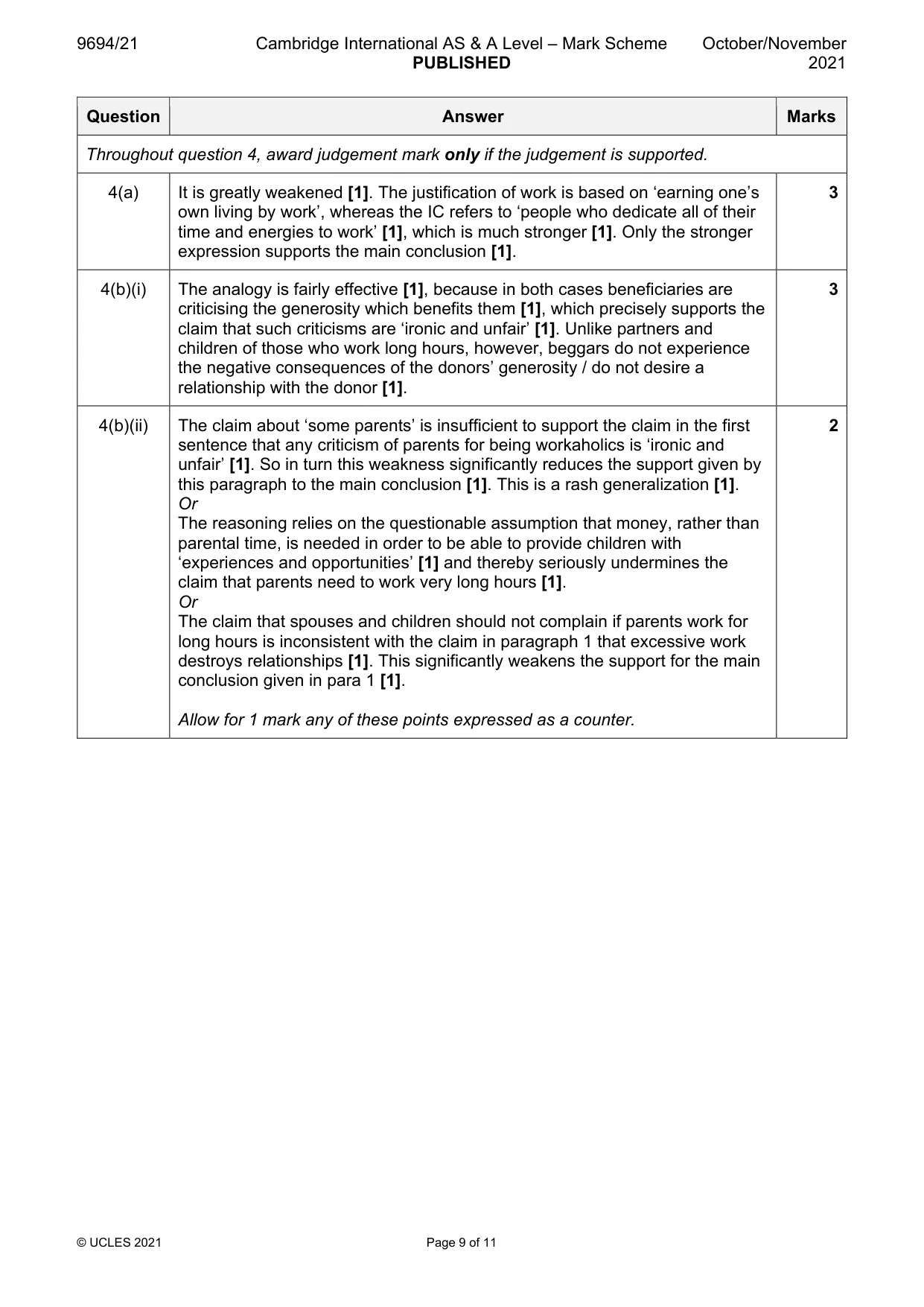
9694/21 Cambridge International AS & A Level – Mark Scheme PUBLISHED October/November 2021 © UCLES 2021 Page 9 of 11 Question Answer Marks Throughout question 4, award judgement mark only if the judgement is supported. 4(a) It is greatly weakened [1]. The justification of work is based on ‘earning one’s own living by work’, whereas the IC refers to ‘people who dedicate all of their time and energies to work’ [1], which is much stronger [1]. Only the stronger expression supports the main conclusion [1]. 3 4(b)(i) The analogy is fairly effective [1], because in both cases beneficiaries are criticising the generosity which benefits them [1], which precisely supports the claim that such criticisms are ‘ironic and unfair’ [1]. Unlike partners and children of those who work long hours, however, beggars do not experience the negative consequences of the donors’ generosity / do not desire a relationship with the donor [1]. 3 4(b)(ii) The claim about ‘some parents’ is insufficient to support the claim in the first sentence that any criticism of parents for being workaholics is ‘ironic and unfair’ [1]. So in turn this weakness significantly reduces the support given by this paragraph to the main conclusion [1]. This is a rash generalization [1]. Or The reasoning relies on the questionable assumption that money, rather than parental time, is needed in order to be able to provide children with ‘experiences and opportunities’ [1] and thereby seriously undermines the claim that parents need to work very long hours [1]. Or The claim that spouses and children should not complain if parents work for long hours is inconsistent with the claim in paragraph 1 that excessive work destroys relationships [1]. This significantly weakens the support for the main conclusion given in para 1 [1]. Allow for 1 mark any of these points expressed as a counter. 2
Mark scheme, page 10
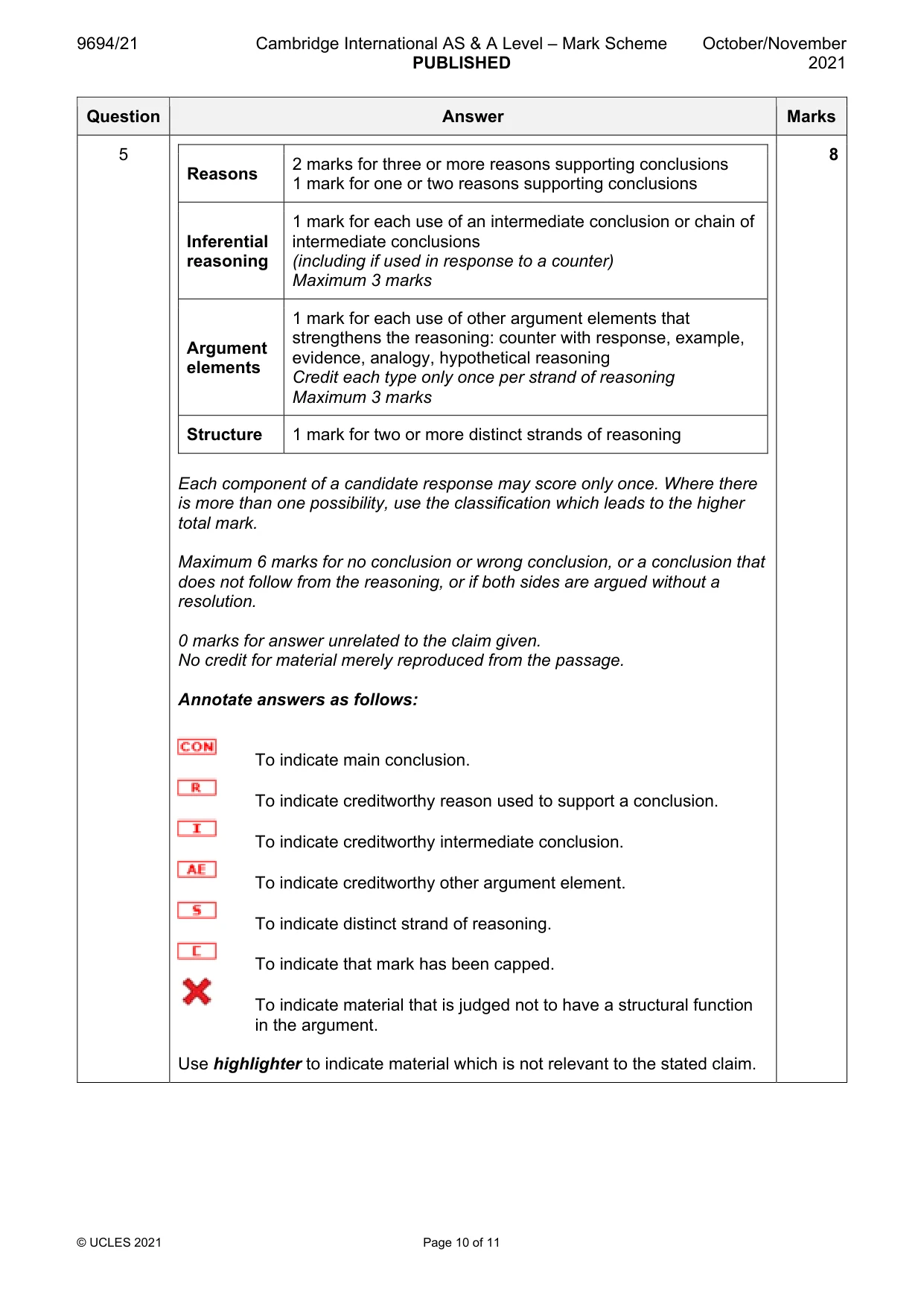
9694/21 Cambridge International AS & A Level – Mark Scheme PUBLISHED October/November 2021 © UCLES 2021 Page 10 of 11 Question Answer Marks 5 Reasons 2 marks for three or more reasons supporting conclusions 1 mark for one or two reasons supporting conclusions Inferential reasoning 1 mark for each use of an intermediate conclusion or chain of intermediate conclusions (including if used in response to a counter) Maximum 3 marks Argument elements 1 mark for each use of other argument elements that strengthens the reasoning: counter with response, example, evidence, analogy, hypothetical reasoning Credit each type only once per strand of reasoning Maximum 3 marks Structure 1 mark for two or more distinct strands of reasoning Each component of a candidate response may score only once. Where there is more than one possibility, use the classification which leads to the higher total mark. Maximum 6 marks for no conclusion or wrong conclusion, or a conclusion that does not follow from the reasoning, or if both sides are argued without a resolution. 0 marks for answer unrelated to the claim given. No credit for material merely reproduced from the passage. Annotate answers as follows: To indicate main conclusion. To indicate creditworthy reason used to support a conclusion. To indicate creditworthy intermediate conclusion. To indicate creditworthy other argument element. To indicate distinct strand of reasoning. To indicate that mark has been capped. To indicate material that is judged not to have a structural function in the argument. Use highlighter to indicate material which is not relevant to the stated claim. 8
Mark scheme, page 11
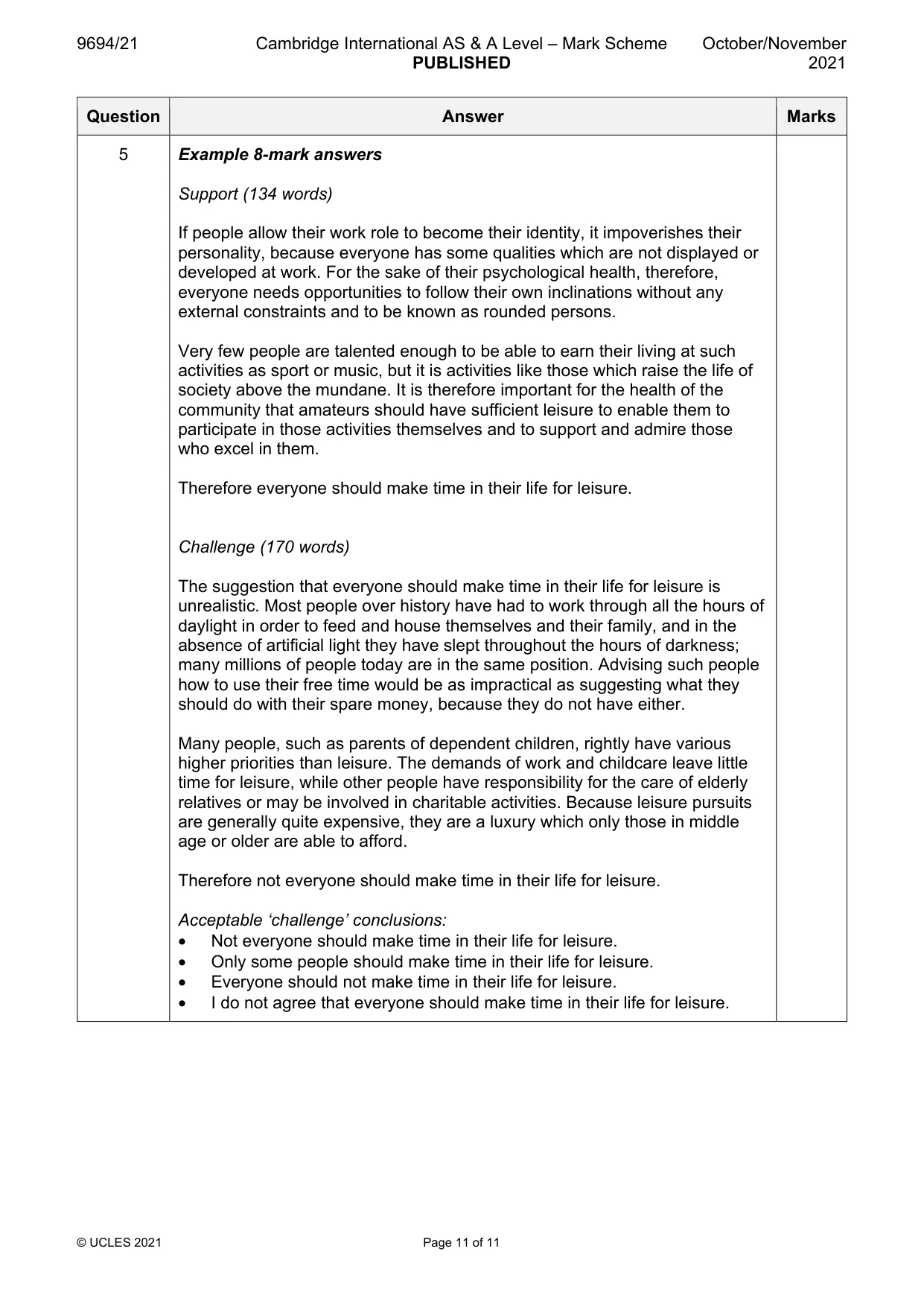
9694/21 Cambridge International AS & A Level – Mark Scheme PUBLISHED October/November 2021 © UCLES 2021 Page 11 of 11 Question Answer Marks 5 Example 8-mark answers Support (134 words) If people allow their work role to become their identity, it impoverishes their personality, because everyone has some qualities which are not displayed or developed at work. For the sake of their psychological health, therefore, everyone needs opportunities to follow their own inclinations without any external constraints and to be known as rounded persons. Very few people are talented enough to be able to earn their living at such activities as sport or music, but it is activities like those which raise the life of society above the mundane. It is therefore important for the health of the community that amateurs should have sufficient leisure to enable them to participate in those activities themselves and to support and admire those who excel in them. Therefore everyone should make time in their life for leisure. Challenge (170 words) The suggestion that everyone should make time in their life for leisure is unrealistic. Most people over history have had to work through all the hours of daylight in order to feed and house themselves and their family, and in the absence of artificial light they have slept throughout the hours of darkness; many millions of people today are in the same position. Advising such people how to use their free time would be as impractical as suggesting what they should do with their spare money, because they do not have either. Many people, such as parents of dependent children, rightly have various higher priorities than leisure. The demands of work and childcare leave little time for leisure, while other people have responsibility for the care of elderly relatives or may be involved in charitable activities. Because leisure pursuits are generally quite expensive, they are a luxury which only those in middle age or older are able to afford. Therefore not everyone should make time in their life for leisure. Acceptable ‘challenge’ conclusions: • Not everyone should make time in their life for leisure. • Only some people should make time in their life for leisure. • Everyone should not make time in their life for leisure. • I do not agree that everyone should make time in their life for leisure.
What you needed in this session
Cambridge’s own grade thresholds for 2021 Oct/Nov, Paper 2 · Variant 1. A higher threshold means an easier paper — the bar moves with how the cohort did.