Cambridge A Level Thinking Skills 9694 — 2021 Oct/Nov Paper 2 · Variant 2
9694/22/O/N/21 · 50 marks · ≈56 min
The question paper and its mark scheme, free to read here and free to download. This is Cambridge’s own paper, exactly as it was sat.
Question paper8 pages



Mark scheme11 pages
Answers below. Sit the paper first if you are practising.
Paper as text
Question paper, page 1
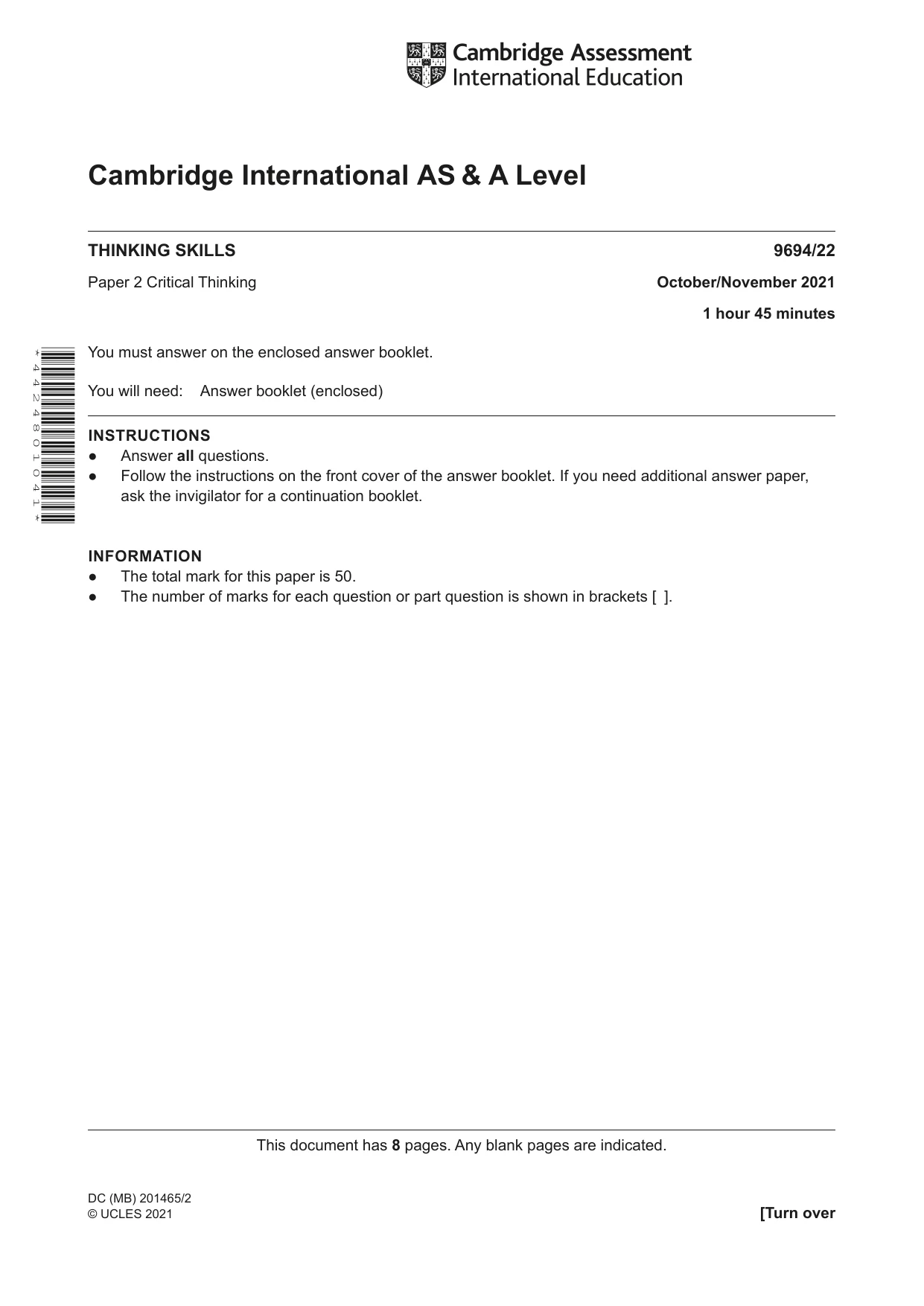
This document has 8 pages. Any blank pages are indicated. Cambridge International AS & A Level DC (MB) 201465/2 © UCLES 2021 [Turn over * 4 4 2 4 8 0 1 0 4 1 * THINKING SKILLS 9694/22 Paper 2 Critical Thinking October/November 2021 1 hour 45 minutes You must answer on the enclosed answer booklet. You will need: Answer booklet (enclosed) INSTRUCTIONS ● Answer all questions. ● Follow the instructions on the front cover of the answer booklet. If you need additional answer paper, ask the invigilator for a continuation booklet. INFORMATION ● The total mark for this paper is 50. ● The number of marks for each question or part question is shown in brackets [ ].
Question paper, page 2
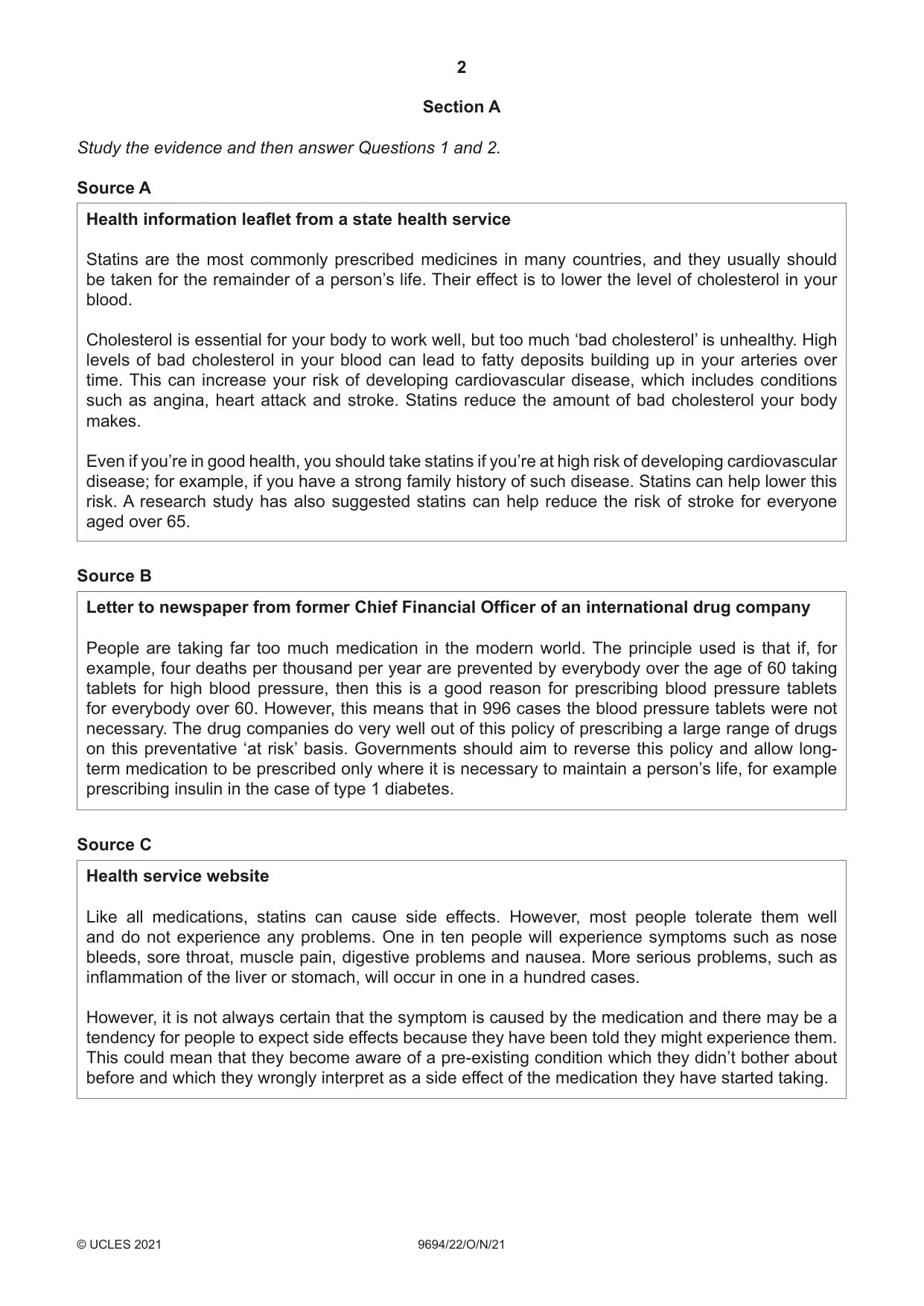
2 9694/22/O/N/21 © UCLES 2021 Section A Study the evidence and then answer Questions 1 and 2. Source A Health information leaflet from a state health service Statins are the most commonly prescribed medicines in many countries, and they usually should be taken for the remainder of a person’s life. Their effect is to lower the level of cholesterol in your blood. Cholesterol is essential for your body to work well, but too much ‘bad cholesterol’ is unhealthy. High levels of bad cholesterol in your blood can lead to fatty deposits building up in your arteries over time. This can increase your risk of developing cardiovascular disease, which includes conditions such as angina, heart attack and stroke. Statins reduce the amount of bad cholesterol your body makes. Even if you’re in good health, you should take statins if you’re at high risk of developing cardiovascular disease; for example, if you have a strong family history of such disease. Statins can help lower this risk. A research study has also suggested statins can help reduce the risk of stroke for everyone aged over 65. Source B Letter to newspaper from former Chief Financial Officer of an international drug company People are taking far too much medication in the modern world. The principle used is that if, for example, four deaths per thousand per year are prevented by everybody over the age of 60 taking tablets for high blood pressure, then this is a good reason for prescribing blood pressure tablets for everybody over 60. However, this means that in 996 cases the blood pressure tablets were not necessary. The drug companies do very well out of this policy of prescribing a large range of drugs on this preventative ‘at risk’ basis. Governments should aim to reverse this policy and allow long- term medication to be prescribed only where it is necessary to maintain a person’s life, for example prescribing insulin in the case of type 1 diabetes. Source C Health service website Like all medications, statins can cause side effects. However, most people tolerate them well and do not experience any problems. One in ten people will experience symptoms such as nose bleeds, sore throat, muscle pain, digestive problems and nausea. More serious problems, such as inflammation of the liver or stomach, will occur in one in a hundred cases. However, it is not always certain that the symptom is caused by the medication and there may be a tendency for people to expect side effects because they have been told they might experience them. This could mean that they become aware of a pre-existing condition which they didn’t bother about before and which they wrongly interpret as a side effect of the medication they have started taking.
Question paper, page 3
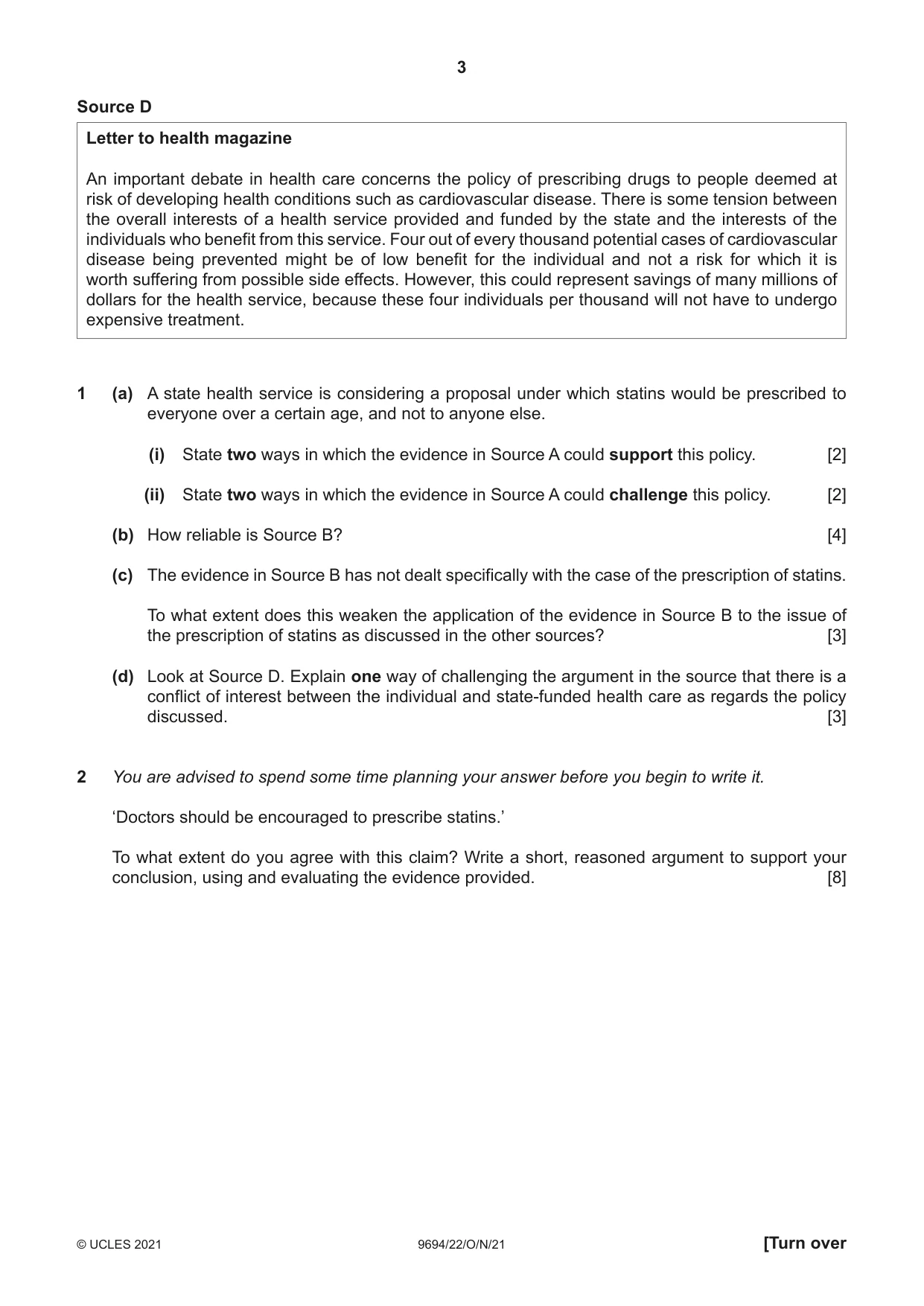
3 9694/22/O/N/21 © UCLES 2021 [Turn over Source D Letter to health magazine An important debate in health care concerns the policy of prescribing drugs to people deemed at risk of developing health conditions such as cardiovascular disease. There is some tension between the overall interests of a health service provided and funded by the state and the interests of the individuals who benefit from this service. Four out of every thousand potential cases of cardiovascular disease being prevented might be of low benefit for the individual and not a risk for which it is worth suffering from possible side effects. However, this could represent savings of many millions of dollars for the health service, because these four individuals per thousand will not have to undergo expensive treatment. 1 (a) A state health service is considering a proposal under which statins would be prescribed to everyone over a certain age, and not to anyone else. (i) State two ways in which the evidence in Source A could support this policy. [2] (ii) State two ways in which the evidence in Source A could challenge this policy. [2] (b) How reliable is Source B? [4] (c) The evidence in Source B has not dealt specifically with the case of the prescription of statins. To what extent does this weaken the application of the evidence in Source B to the issue of the prescription of statins as discussed in the other sources? [3] (d) Look at Source D. Explain one way of challenging the argument in the source that there is a conflict of interest between the individual and state-funded health care as regards the policy discussed. [3] 2 You are advised to spend some time planning your answer before you begin to write it. ‘Doctors should be encouraged to prescribe statins.’ To what extent do you agree with this claim? Write a short, reasoned argument to support your conclusion, using and evaluating the evidence provided. [8]
Question paper, page 4
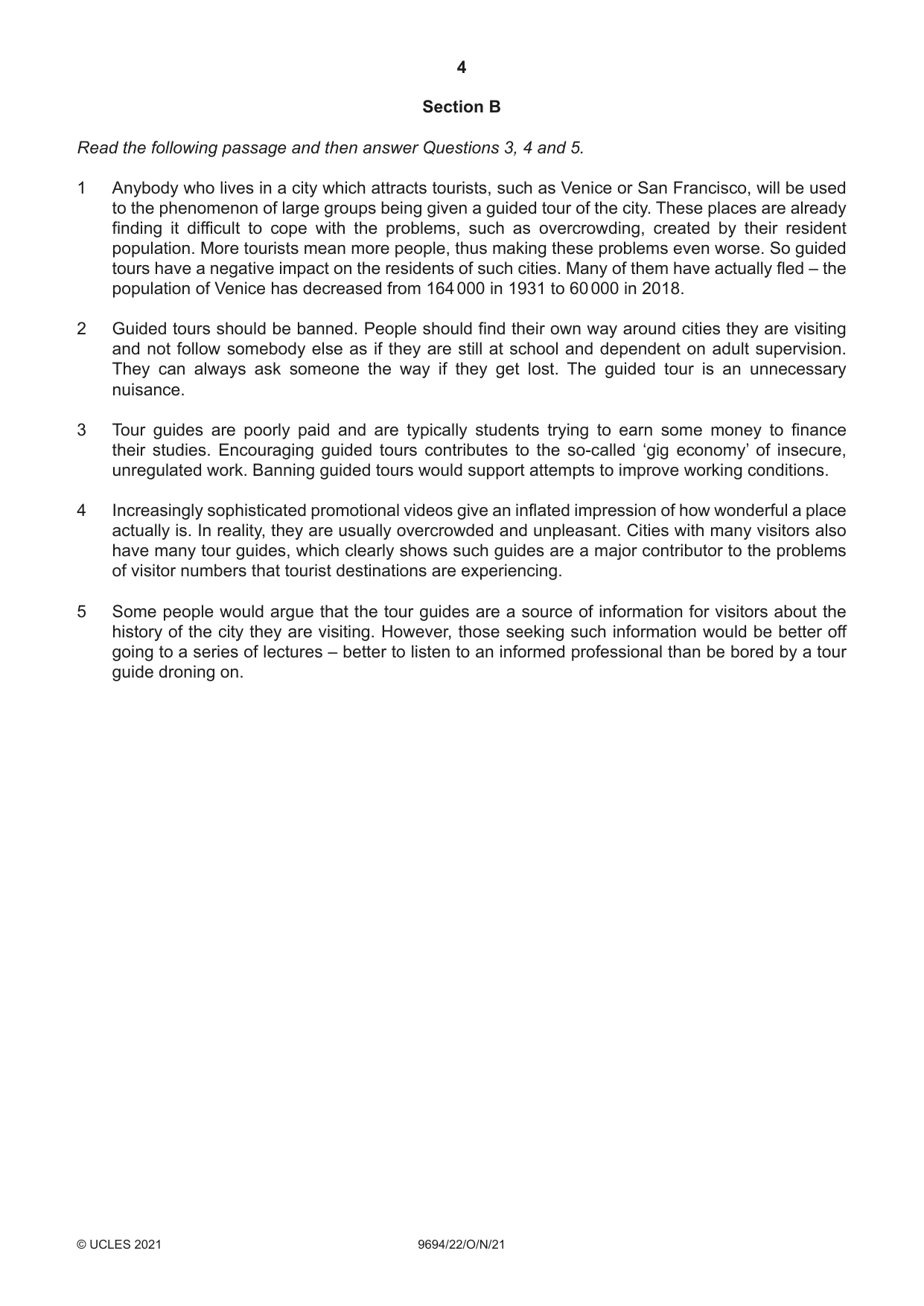
4 9694/22/O/N/21 © UCLES 2021 Section B Read the following passage and then answer Questions 3, 4 and 5. 1 Anybody who lives in a city which attracts tourists, such as Venice or San Francisco, will be used to the phenomenon of large groups being given a guided tour of the city. These places are already finding it difficult to cope with the problems, such as overcrowding, created by their resident population. More tourists mean more people, thus making these problems even worse. So guided tours have a negative impact on the residents of such cities. Many of them have actually fled – the population of Venice has decreased from 164 000 in 1931 to 60 000 in 2018. 2 Guided tours should be banned. People should find their own way around cities they are visiting and not follow somebody else as if they are still at school and dependent on adult supervision. They can always ask someone the way if they get lost. The guided tour is an unnecessary nuisance. 3 Tour guides are poorly paid and are typically students trying to earn some money to finance their studies. Encouraging guided tours contributes to the so-called ‘gig economy’ of insecure, unregulated work. Banning guided tours would support attempts to improve working conditions. 4 Increasingly sophisticated promotional videos give an inflated impression of how wonderful a place actually is. In reality, they are usually overcrowded and unpleasant. Cities with many visitors also have many tour guides, which clearly shows such guides are a major contributor to the problems of visitor numbers that tourist destinations are experiencing. 5 Some people would argue that the tour guides are a source of information for visitors about the history of the city they are visiting. However, those seeking such information would be better off going to a series of lectures – better to listen to an informed professional than be bored by a tour guide droning on.
Question paper, page 5
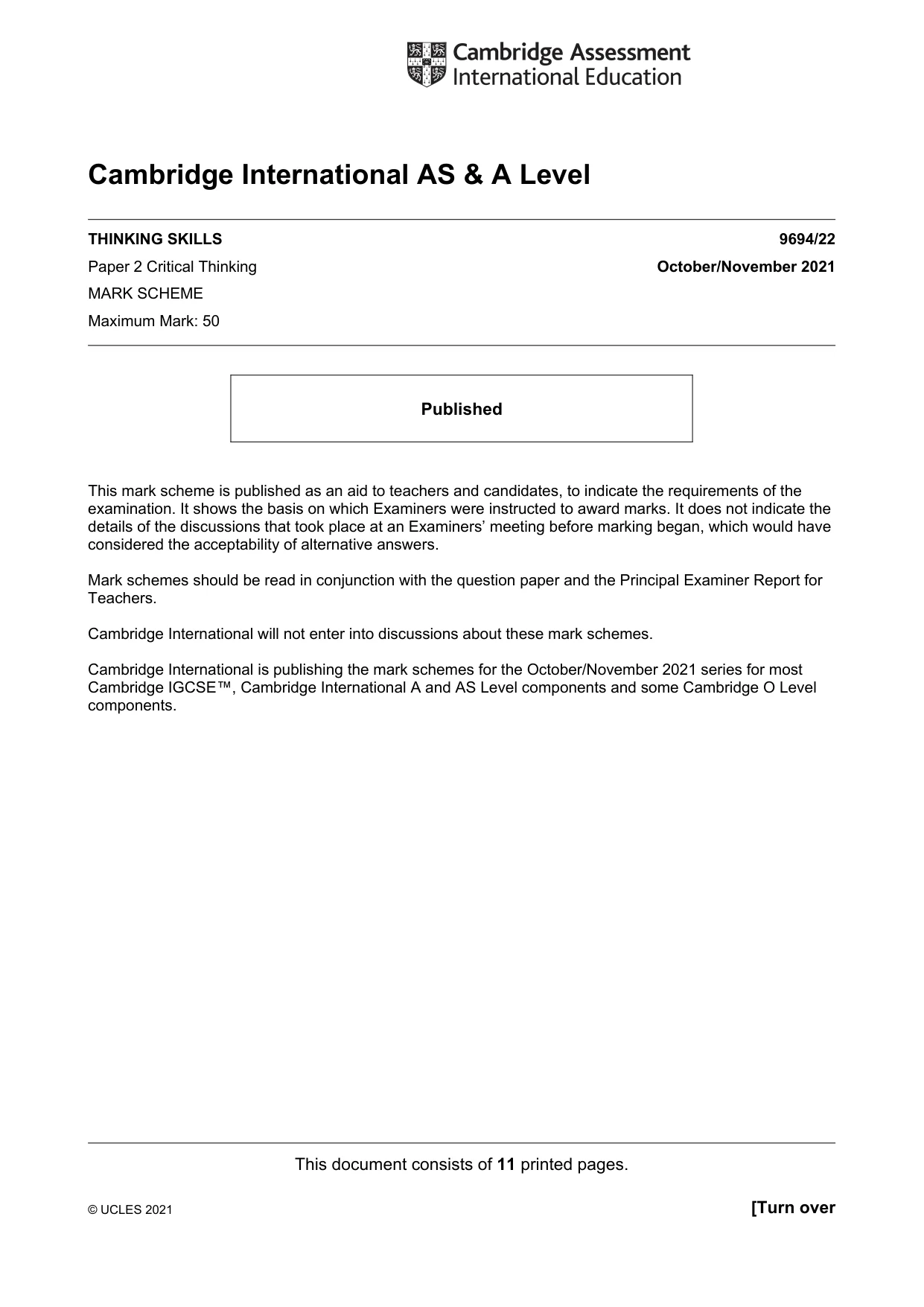
5 9694/22/O/N/21 © UCLES 2021 3 (a) Using the exact words from the passage as far as possible, identify the main conclusion. [2] (b) Using the exact words from the passage as far as possible, identify three intermediate conclusions. [6] (c) Identify two unstated assumptions required by the reasoning in paragraph 5. [4] (d) Identify the argument element and explain the function of the following words from paragraph 1: ‘the population of Venice has decreased from 164 000 in 1931 to 60 000 in 2018’ [2] 4 (a) Identify and explain a causal flaw in paragraph 4. [2] (b) Identify and explain two flaws or weaknesses in the reasoning in paragraphs 1 to 3. [4] 5 You are advised to spend some time planning your answer before you begin to write it. ‘People should be encouraged to visit historic places.’ Write your own short argument to support or challenge this claim. The conclusion of your argument must be stated. Credit will not be given for repeating ideas from the passage. [8]
Question paper, page 6
6 9694/22/O/N/21 © UCLES 2021 BLANK PAGE
Question paper, page 7
7 9694/22/O/N/21 © UCLES 2021 BLANK PAGE
Question paper, page 8
8 9694/22/O/N/21 © UCLES 2021 Permission to reproduce items where third-party owned material protected by copyright is included has been sought and cleared where possible. Every reasonable effort has been made by the publisher (UCLES) to trace copyright holders, but if any items requiring clearance have unwittingly been included, the publisher will be pleased to make amends at the earliest possible opportunity. To avoid the issue of disclosure of answer-related information to candidates, all copyright acknowledgements are reproduced online in the Cambridge Assessment International Education Copyright Acknowledgements Booklet. This is produced for each series of examinations and is freely available to download at www.cambridgeinternational.org after the live examination series. Cambridge Assessment International Education is part of the Cambridge Assessment Group. Cambridge Assessment is the brand name of the University of Cambridge Local Examinations Syndicate (UCLES), which itself is a department of the University of Cambridge. BLANK PAGE
Mark scheme, page 1
This document consists of 11 printed pages. © UCLES 2021 [Turn over Cambridge International AS & A Level THINKING SKILLS 9694/22 Paper 2 Critical Thinking October/November 2021 MARK SCHEME Maximum Mark: 50 Published This mark scheme is published as an aid to teachers and candidates, to indicate the requirements of the examination. It shows the basis on which Examiners were instructed to award marks. It does not indicate the details of the discussions that took place at an Examiners’ meeting before marking began, which would have considered the acceptability of alternative answers. Mark schemes should be read in conjunction with the question paper and the Principal Examiner Report for Teachers. Cambridge International will not enter into discussions about these mark schemes. Cambridge International is publishing the mark schemes for the October/November 2021 series for most Cambridge IGCSE™, Cambridge International A and AS Level components and some Cambridge O Level components.
Mark scheme, page 2
9694/22 Cambridge International AS & A Level – Mark Scheme PUBLISHED October/November 2021 © UCLES 2021 Page 2 of 11 Generic Marking Principles These general marking principles must be applied by all examiners when marking candidate answers. They should be applied alongside the specific content of the mark scheme or generic level descriptors for a question. Each question paper and mark scheme will also comply with these marking principles. GENERIC MARKING PRINCIPLE 1: Marks must be awarded in line with: • the specific content of the mark scheme or the generic level descriptors for the question • the specific skills defined in the mark scheme or in the generic level descriptors for the question • the standard of response required by a candidate as exemplified by the standardisation scripts. GENERIC MARKING PRINCIPLE 2: Marks awarded are always whole marks (not half marks, or other fractions). GENERIC MARKING PRINCIPLE 3: Marks must be awarded positively: • marks are awarded for correct/valid answers, as defined in the mark scheme. However, credit is given for valid answers which go beyond the scope of the syllabus and mark scheme, referring to your Team Leader as appropriate • marks are awarded when candidates clearly demonstrate what they know and can do • marks are not deducted for errors • marks are not deducted for omissions • answers should only be judged on the quality of spelling, punctuation and grammar when these features are specifically assessed by the question as indicated by the mark scheme. The meaning, however, should be unambiguous. GENERIC MARKING PRINCIPLE 4: Rules must be applied consistently, e.g. in situations where candidates have not followed instructions or in the application of generic level descriptors. GENERIC MARKING PRINCIPLE 5: Marks should be awarded using the full range of marks defined in the mark scheme for the question (however; the use of the full mark range may be limited according to the quality of the candidate responses seen). GENERIC MARKING PRINCIPLE 6: Marks awarded are based solely on the requirements as defined in the mark scheme. Marks should not be awarded with grade thresholds or grade descriptors in mind.
Mark scheme, page 3
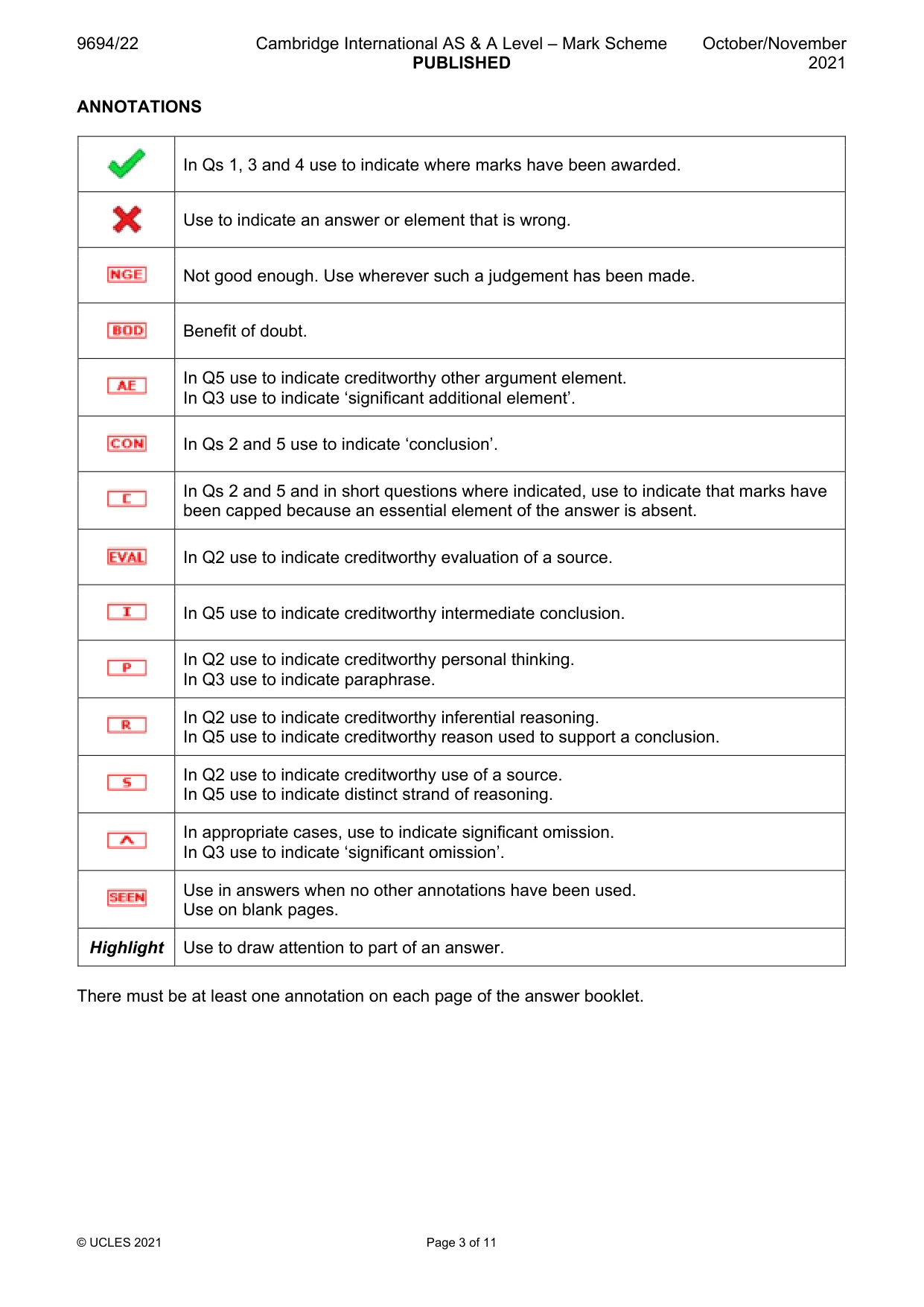
9694/22 Cambridge International AS & A Level – Mark Scheme PUBLISHED October/November 2021 © UCLES 2021 Page 3 of 11 ANNOTATIONS In Qs 1, 3 and 4 use to indicate where marks have been awarded. Use to indicate an answer or element that is wrong. Not good enough. Use wherever such a judgement has been made. Benefit of doubt. In Q5 use to indicate creditworthy other argument element. In Q3 use to indicate ‘significant additional element’. In Qs 2 and 5 use to indicate ‘conclusion’. In Qs 2 and 5 and in short questions where indicated, use to indicate that marks have been capped because an essential element of the answer is absent. In Q2 use to indicate creditworthy evaluation of a source. In Q5 use to indicate creditworthy intermediate conclusion. In Q2 use to indicate creditworthy personal thinking. In Q3 use to indicate paraphrase. In Q2 use to indicate creditworthy inferential reasoning. In Q5 use to indicate creditworthy reason used to support a conclusion. In Q2 use to indicate creditworthy use of a source. In Q5 use to indicate distinct strand of reasoning. In appropriate cases, use to indicate significant omission. In Q3 use to indicate ‘significant omission’. Use in answers when no other annotations have been used. Use on blank pages. Highlight Use to draw attention to part of an answer. There must be at least one annotation on each page of the answer booklet.
Mark scheme, page 4
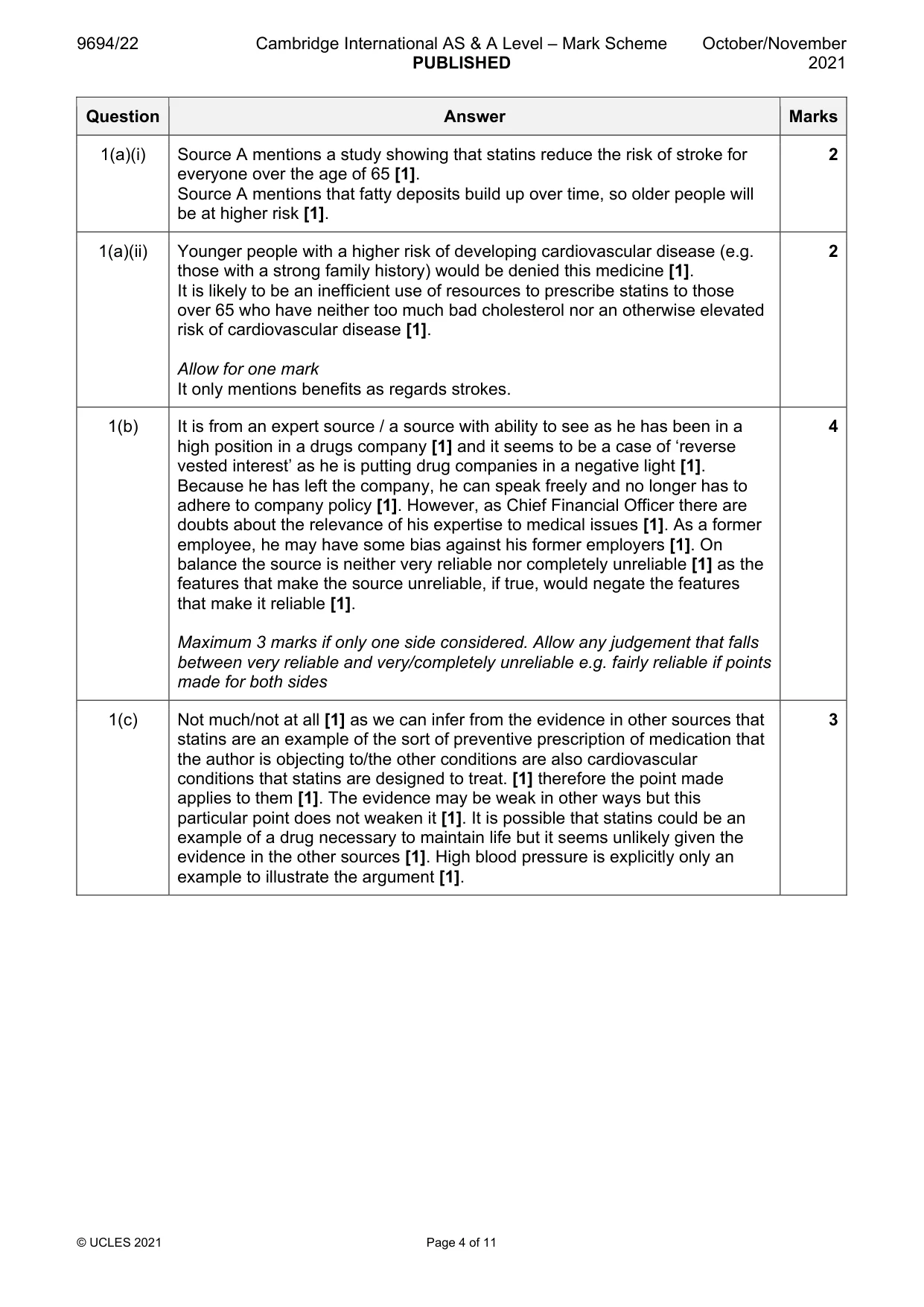
9694/22 Cambridge International AS & A Level – Mark Scheme PUBLISHED October/November 2021 © UCLES 2021 Page 4 of 11 Question Answer Marks 1(a)(i) Source A mentions a study showing that statins reduce the risk of stroke for everyone over the age of 65 [1]. Source A mentions that fatty deposits build up over time, so older people will be at higher risk [1]. 2 1(a)(ii) Younger people with a higher risk of developing cardiovascular disease (e.g. those with a strong family history) would be denied this medicine [1]. It is likely to be an inefficient use of resources to prescribe statins to those over 65 who have neither too much bad cholesterol nor an otherwise elevated risk of cardiovascular disease [1]. Allow for one mark It only mentions benefits as regards strokes. 2 1(b) It is from an expert source / a source with ability to see as he has been in a high position in a drugs company [1] and it seems to be a case of ‘reverse vested interest’ as he is putting drug companies in a negative light [1]. Because he has left the company, he can speak freely and no longer has to adhere to company policy [1]. However, as Chief Financial Officer there are doubts about the relevance of his expertise to medical issues [1]. As a former employee, he may have some bias against his former employers [1]. On balance the source is neither very reliable nor completely unreliable [1] as the features that make the source unreliable, if true, would negate the features that make it reliable [1]. Maximum 3 marks if only one side considered. Allow any judgement that falls between very reliable and very/completely unreliable e.g. fairly reliable if points made for both sides 4 1(c) Not much/not at all [1] as we can infer from the evidence in other sources that statins are an example of the sort of preventive prescription of medication that the author is objecting to/the other conditions are also cardiovascular conditions that statins are designed to treat. [1] therefore the point made applies to them [1]. The evidence may be weak in other ways but this particular point does not weaken it [1]. It is possible that statins could be an example of a drug necessary to maintain life but it seems unlikely given the evidence in the other sources [1]. High blood pressure is explicitly only an example to illustrate the argument [1]. 3
Mark scheme, page 5
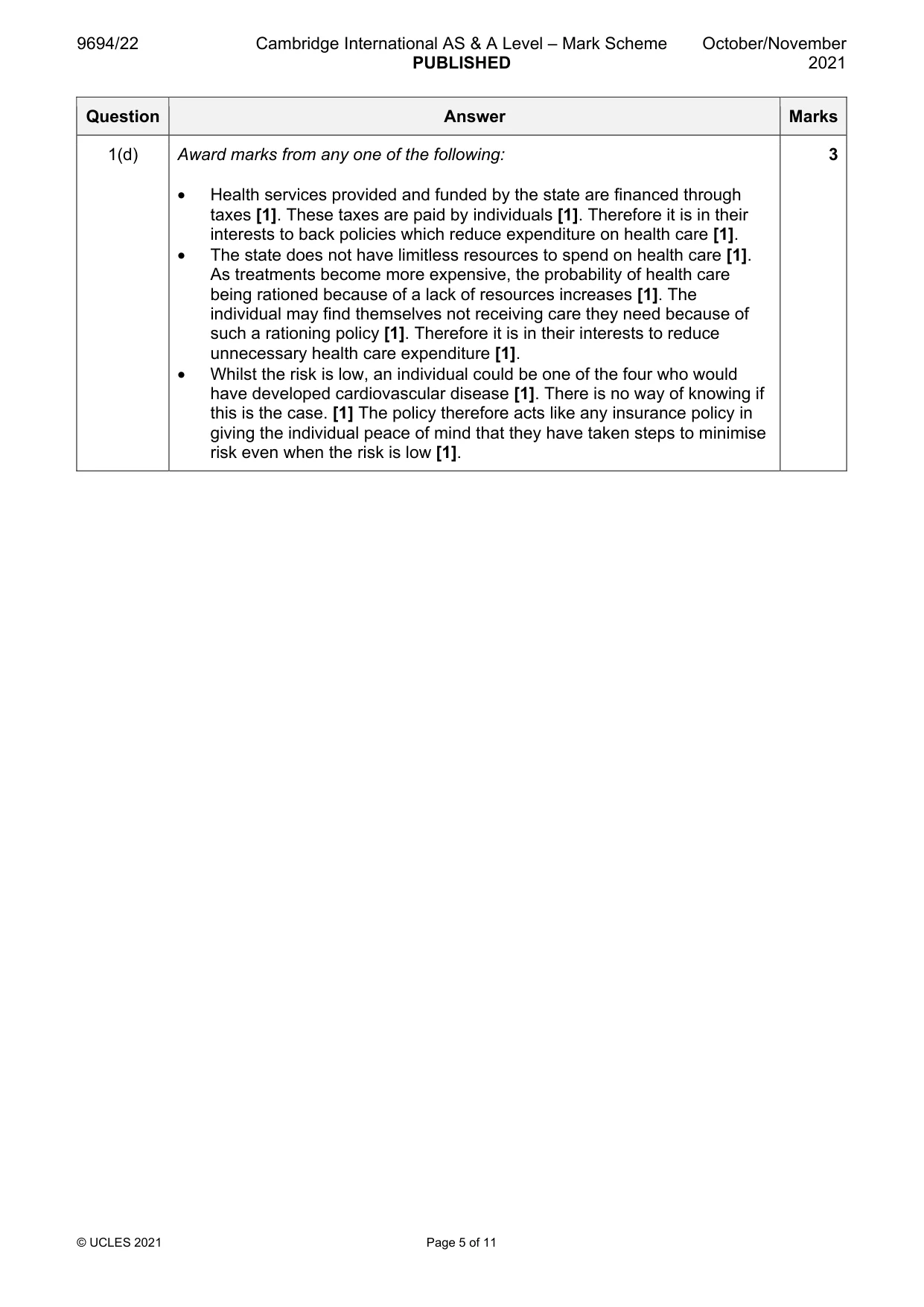
9694/22 Cambridge International AS & A Level – Mark Scheme PUBLISHED October/November 2021 © UCLES 2021 Page 5 of 11 Question Answer Marks 1(d) Award marks from any one of the following: • Health services provided and funded by the state are financed through taxes [1]. These taxes are paid by individuals [1]. Therefore it is in their interests to back policies which reduce expenditure on health care [1]. • The state does not have limitless resources to spend on health care [1]. As treatments become more expensive, the probability of health care being rationed because of a lack of resources increases [1]. The individual may find themselves not receiving care they need because of such a rationing policy [1]. Therefore it is in their interests to reduce unnecessary health care expenditure [1]. • Whilst the risk is low, an individual could be one of the four who would have developed cardiovascular disease [1]. There is no way of knowing if this is the case. [1] The policy therefore acts like any insurance policy in giving the individual peace of mind that they have taken steps to minimise risk even when the risk is low [1]. 3
Mark scheme, page 6
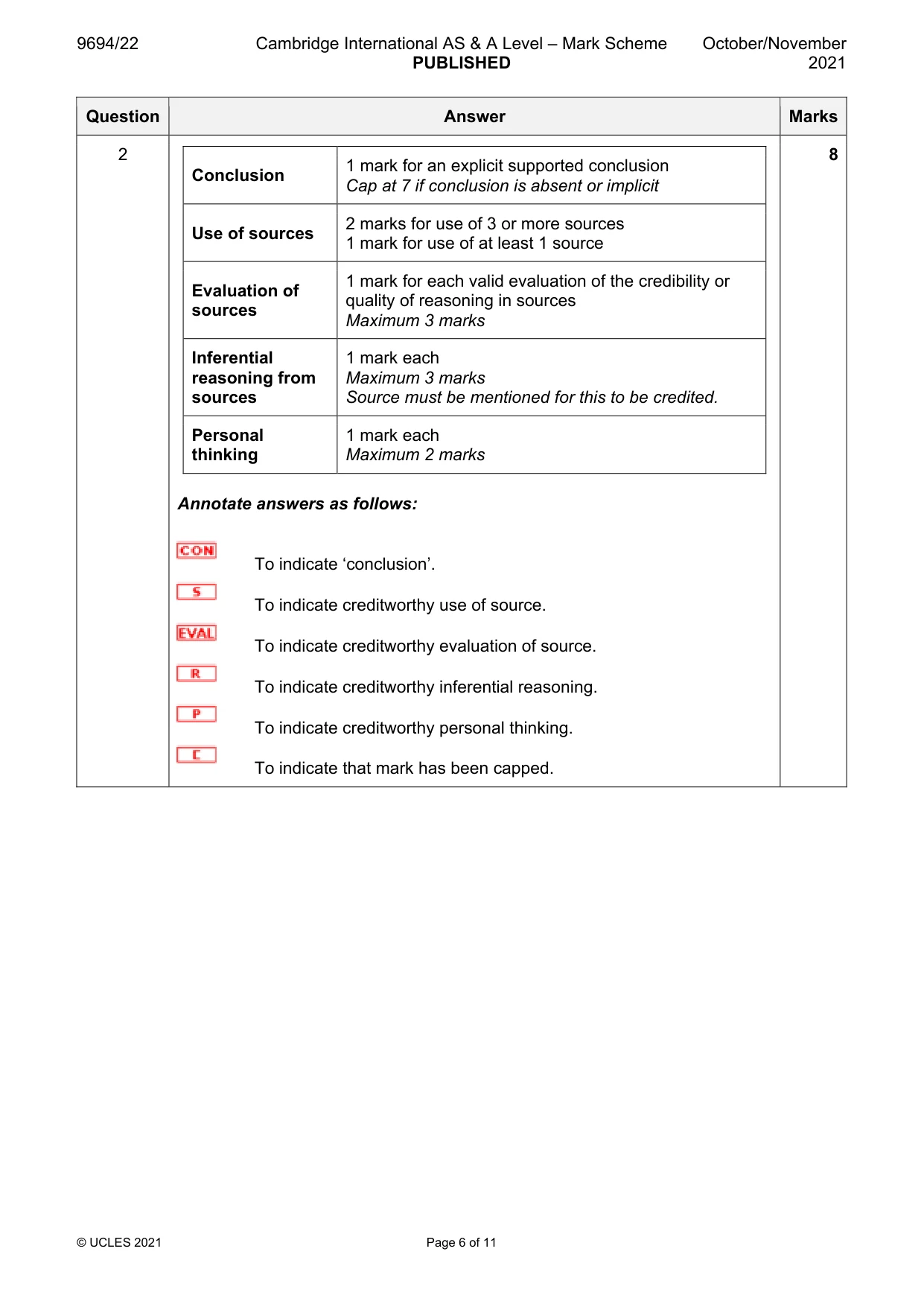
9694/22 Cambridge International AS & A Level – Mark Scheme PUBLISHED October/November 2021 © UCLES 2021 Page 6 of 11 Question Answer Marks 2 Conclusion 1 mark for an explicit supported conclusion Cap at 7 if conclusion is absent or implicit Use of sources 2 marks for use of 3 or more sources 1 mark for use of at least 1 source Evaluation of sources 1 mark for each valid evaluation of the credibility or quality of reasoning in sources Maximum 3 marks Inferential reasoning from sources 1 mark each Maximum 3 marks Source must be mentioned for this to be credited. Personal thinking 1 mark each Maximum 2 marks Annotate answers as follows: To indicate ‘conclusion’. To indicate creditworthy use of source. To indicate creditworthy evaluation of source. To indicate creditworthy inferential reasoning. To indicate creditworthy personal thinking. To indicate that mark has been capped. 8
Mark scheme, page 7
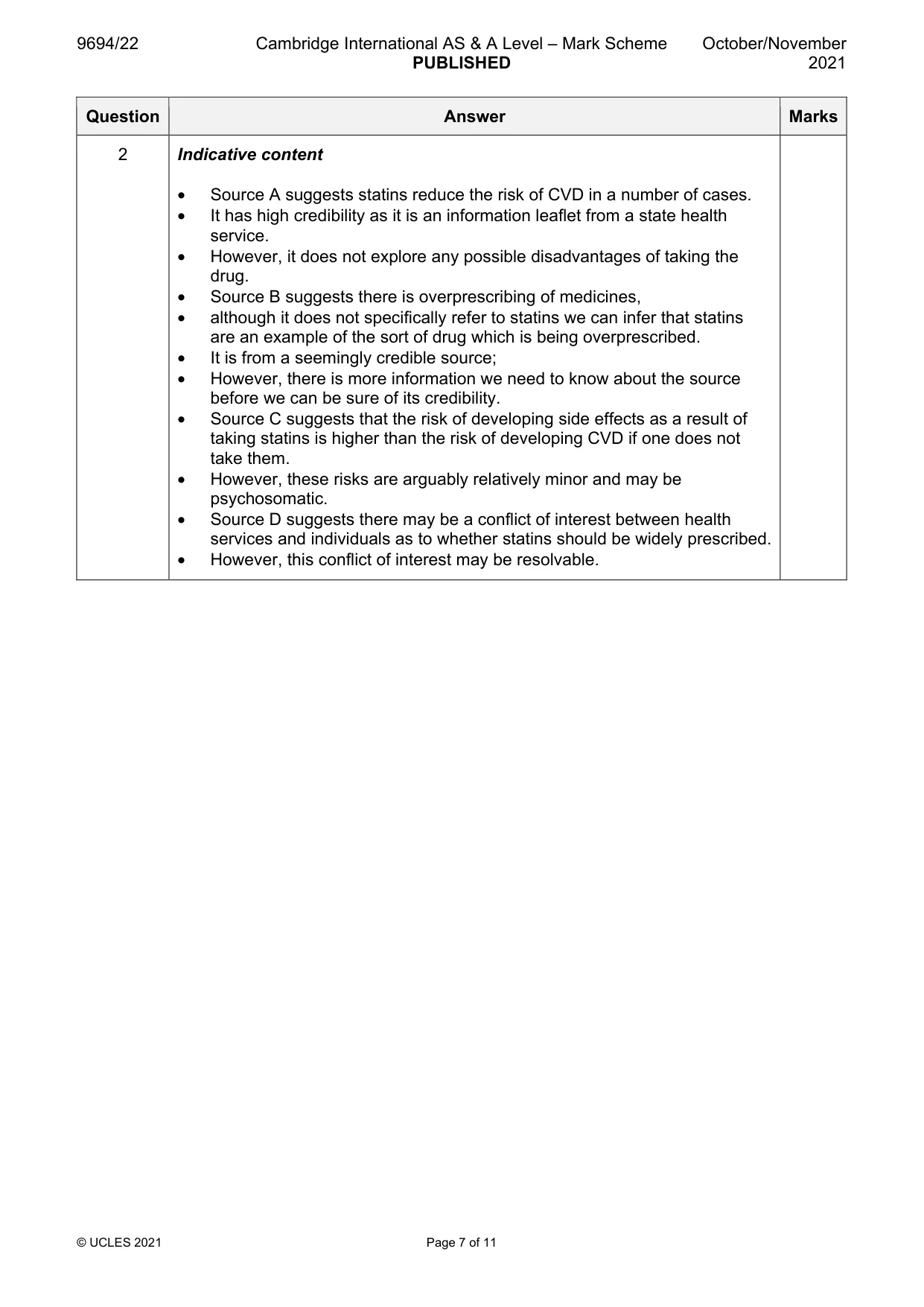
9694/22 Cambridge International AS & A Level – Mark Scheme PUBLISHED October/November 2021 © UCLES 2021 Page 7 of 11 Question Answer Marks 2 Indicative content • Source A suggests statins reduce the risk of CVD in a number of cases. • It has high credibility as it is an information leaflet from a state health service. • However, it does not explore any possible disadvantages of taking the drug. • Source B suggests there is overprescribing of medicines, • although it does not specifically refer to statins we can infer that statins are an example of the sort of drug which is being overprescribed. • It is from a seemingly credible source; • However, there is more information we need to know about the source before we can be sure of its credibility. • Source C suggests that the risk of developing side effects as a result of taking statins is higher than the risk of developing CVD if one does not take them. • However, these risks are arguably relatively minor and may be psychosomatic. • Source D suggests there may be a conflict of interest between health services and individuals as to whether statins should be widely prescribed. • However, this conflict of interest may be resolvable.
Mark scheme, page 8
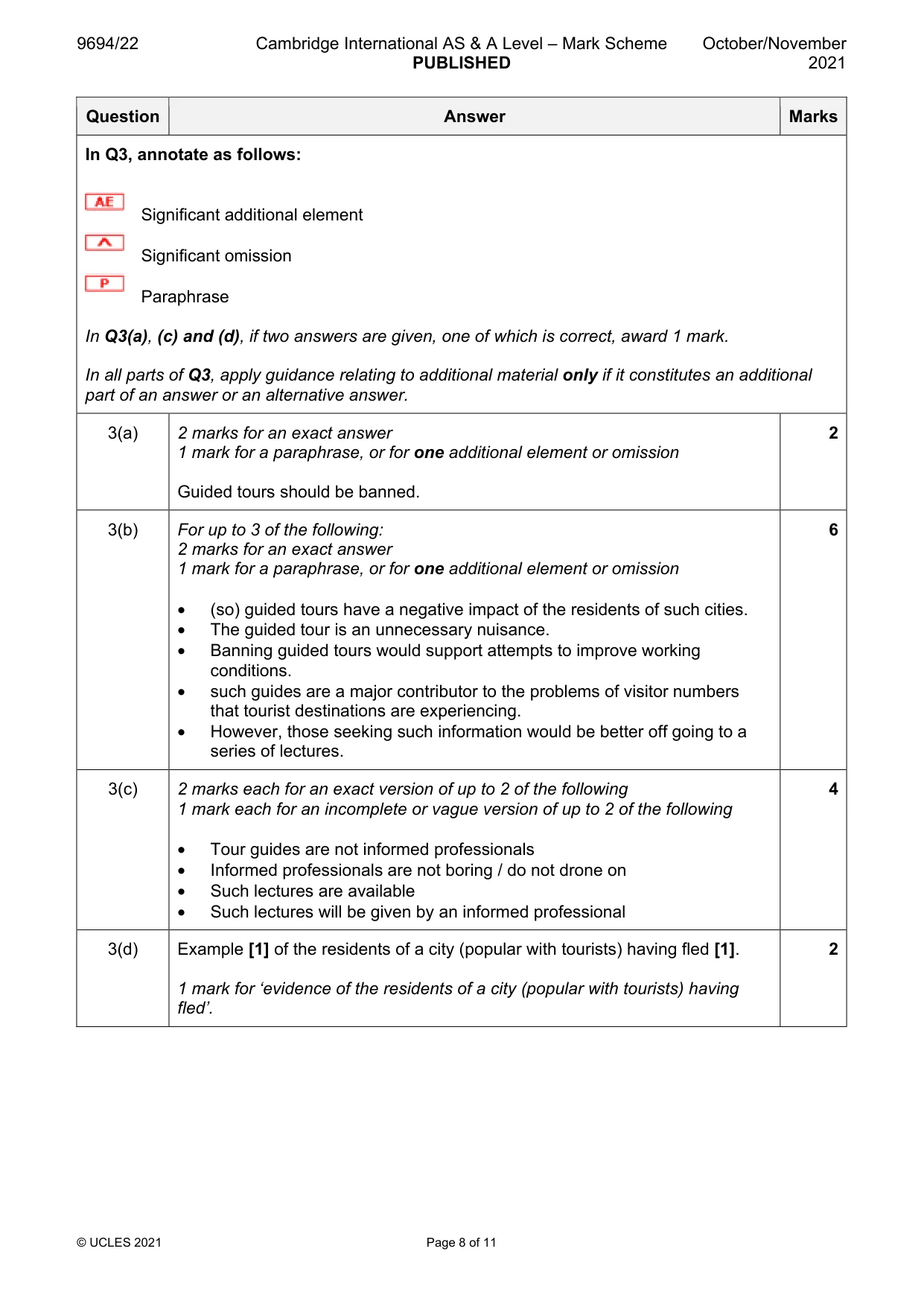
9694/22 Cambridge International AS & A Level – Mark Scheme PUBLISHED October/November 2021 © UCLES 2021 Page 8 of 11 Question Answer Marks In Q3, annotate as follows: Significant additional element Significant omission Paraphrase In Q3(a), (c) and (d), if two answers are given, one of which is correct, award 1 mark. In all parts of Q3, apply guidance relating to additional material only if it constitutes an additional part of an answer or an alternative answer. 3(a) 2 marks for an exact answer 1 mark for a paraphrase, or for one additional element or omission Guided tours should be banned. 2 3(b) For up to 3 of the following: 2 marks for an exact answer 1 mark for a paraphrase, or for one additional element or omission • (so) guided tours have a negative impact of the residents of such cities. • The guided tour is an unnecessary nuisance. • Banning guided tours would support attempts to improve working conditions. • such guides are a major contributor to the problems of visitor numbers that tourist destinations are experiencing. • However, those seeking such information would be better off going to a series of lectures. 6 3(c) 2 marks each for an exact version of up to 2 of the following 1 mark each for an incomplete or vague version of up to 2 of the following • Tour guides are not informed professionals • Informed professionals are not boring / do not drone on • Such lectures are available • Such lectures will be given by an informed professional 4 3(d) Example [1] of the residents of a city (popular with tourists) having fled [1]. 1 mark for ‘evidence of the residents of a city (popular with tourists) having fled’. 2
Mark scheme, page 9
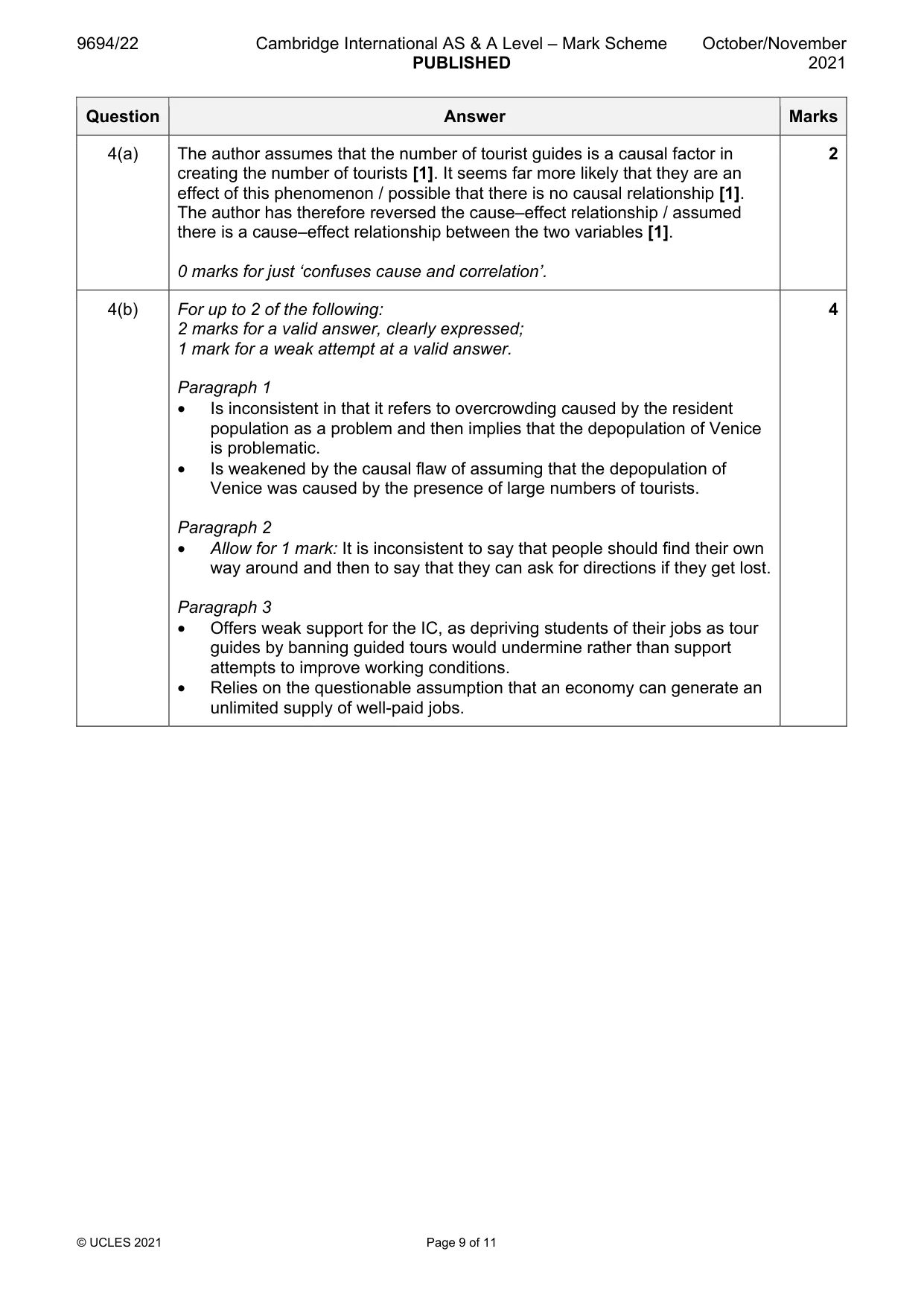
9694/22 Cambridge International AS & A Level – Mark Scheme PUBLISHED October/November 2021 © UCLES 2021 Page 9 of 11 Question Answer Marks 4(a) The author assumes that the number of tourist guides is a causal factor in creating the number of tourists [1]. It seems far more likely that they are an effect of this phenomenon / possible that there is no causal relationship [1]. The author has therefore reversed the cause–effect relationship / assumed there is a cause–effect relationship between the two variables [1]. 0 marks for just ‘confuses cause and correlation’. 2 4(b) For up to 2 of the following: 2 marks for a valid answer, clearly expressed; 1 mark for a weak attempt at a valid answer. Paragraph 1 • Is inconsistent in that it refers to overcrowding caused by the resident population as a problem and then implies that the depopulation of Venice is problematic. • Is weakened by the causal flaw of assuming that the depopulation of Venice was caused by the presence of large numbers of tourists. Paragraph 2 • Allow for 1 mark: It is inconsistent to say that people should find their own way around and then to say that they can ask for directions if they get lost. Paragraph 3 • Offers weak support for the IC, as depriving students of their jobs as tour guides by banning guided tours would undermine rather than support attempts to improve working conditions. • Relies on the questionable assumption that an economy can generate an unlimited supply of well-paid jobs. 4
Mark scheme, page 10
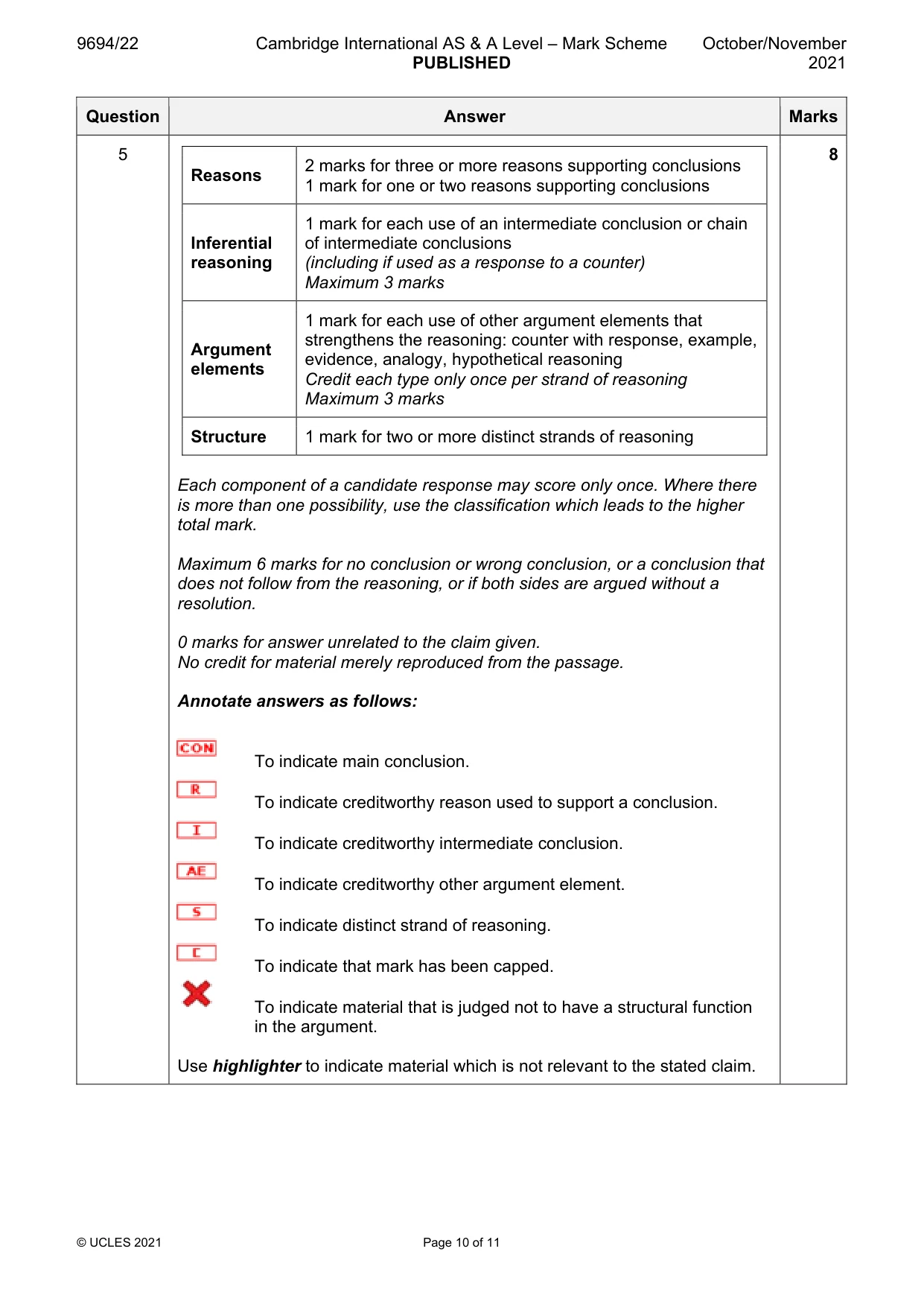
9694/22 Cambridge International AS & A Level – Mark Scheme PUBLISHED October/November 2021 © UCLES 2021 Page 10 of 11 Question Answer Marks 5 Reasons 2 marks for three or more reasons supporting conclusions 1 mark for one or two reasons supporting conclusions Inferential reasoning 1 mark for each use of an intermediate conclusion or chain of intermediate conclusions (including if used as a response to a counter) Maximum 3 marks Argument elements 1 mark for each use of other argument elements that strengthens the reasoning: counter with response, example, evidence, analogy, hypothetical reasoning Credit each type only once per strand of reasoning Maximum 3 marks Structure 1 mark for two or more distinct strands of reasoning Each component of a candidate response may score only once. Where there is more than one possibility, use the classification which leads to the higher total mark. Maximum 6 marks for no conclusion or wrong conclusion, or a conclusion that does not follow from the reasoning, or if both sides are argued without a resolution. 0 marks for answer unrelated to the claim given. No credit for material merely reproduced from the passage. Annotate answers as follows: To indicate main conclusion. To indicate creditworthy reason used to support a conclusion. To indicate creditworthy intermediate conclusion. To indicate creditworthy other argument element. To indicate distinct strand of reasoning. To indicate that mark has been capped. To indicate material that is judged not to have a structural function in the argument. Use highlighter to indicate material which is not relevant to the stated claim. 8
Mark scheme, page 11
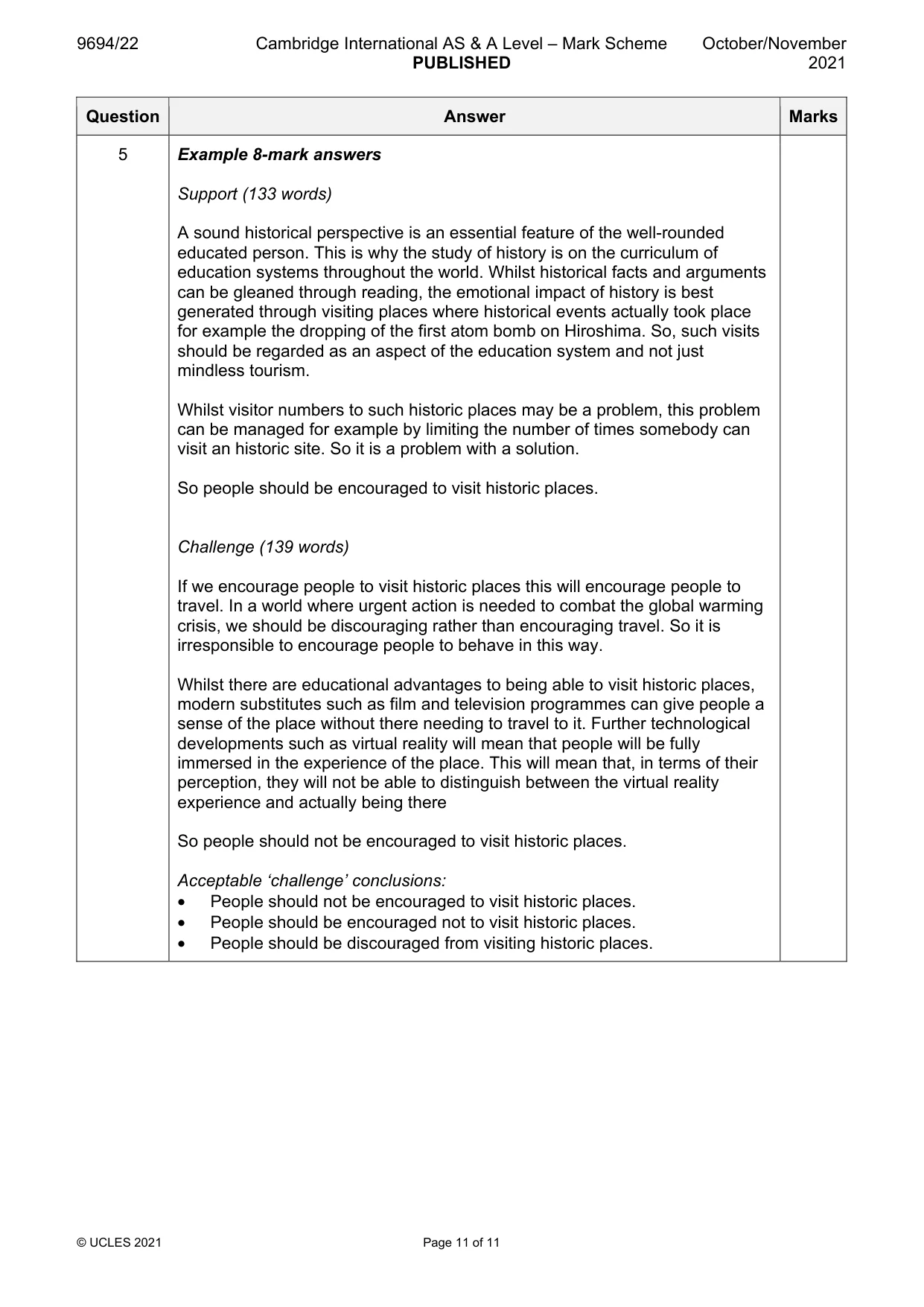
9694/22 Cambridge International AS & A Level – Mark Scheme PUBLISHED October/November 2021 © UCLES 2021 Page 11 of 11 Question Answer Marks 5 Example 8-mark answers Support (133 words) A sound historical perspective is an essential feature of the well-rounded educated person. This is why the study of history is on the curriculum of education systems throughout the world. Whilst historical facts and arguments can be gleaned through reading, the emotional impact of history is best generated through visiting places where historical events actually took place for example the dropping of the first atom bomb on Hiroshima. So, such visits should be regarded as an aspect of the education system and not just mindless tourism. Whilst visitor numbers to such historic places may be a problem, this problem can be managed for example by limiting the number of times somebody can visit an historic site. So it is a problem with a solution. So people should be encouraged to visit historic places. Challenge (139 words) If we encourage people to visit historic places this will encourage people to travel. In a world where urgent action is needed to combat the global warming crisis, we should be discouraging rather than encouraging travel. So it is irresponsible to encourage people to behave in this way. Whilst there are educational advantages to being able to visit historic places, modern substitutes such as film and television programmes can give people a sense of the place without there needing to travel to it. Further technological developments such as virtual reality will mean that people will be fully immersed in the experience of the place. This will mean that, in terms of their perception, they will not be able to distinguish between the virtual reality experience and actually being there So people should not be encouraged to visit historic places. Acceptable ‘challenge’ conclusions: • People should not be encouraged to visit historic places. • People should be encouraged not to visit historic places. • People should be discouraged from visiting historic places.
What you needed in this session
Cambridge’s own grade thresholds for 2021 Oct/Nov, Paper 2 · Variant 2. A higher threshold means an easier paper — the bar moves with how the cohort did.