Cambridge A Level Thinking Skills 9694 — 2021 Oct/Nov Paper 2 · Variant 3
9694/23/O/N/21 · 50 marks · ≈56 min
The question paper and its mark scheme, free to read here and free to download. This is Cambridge’s own paper, exactly as it was sat.
Question paper8 pages



Mark scheme10 pages
Answers below. Sit the paper first if you are practising.
Paper as text
Question paper, page 1
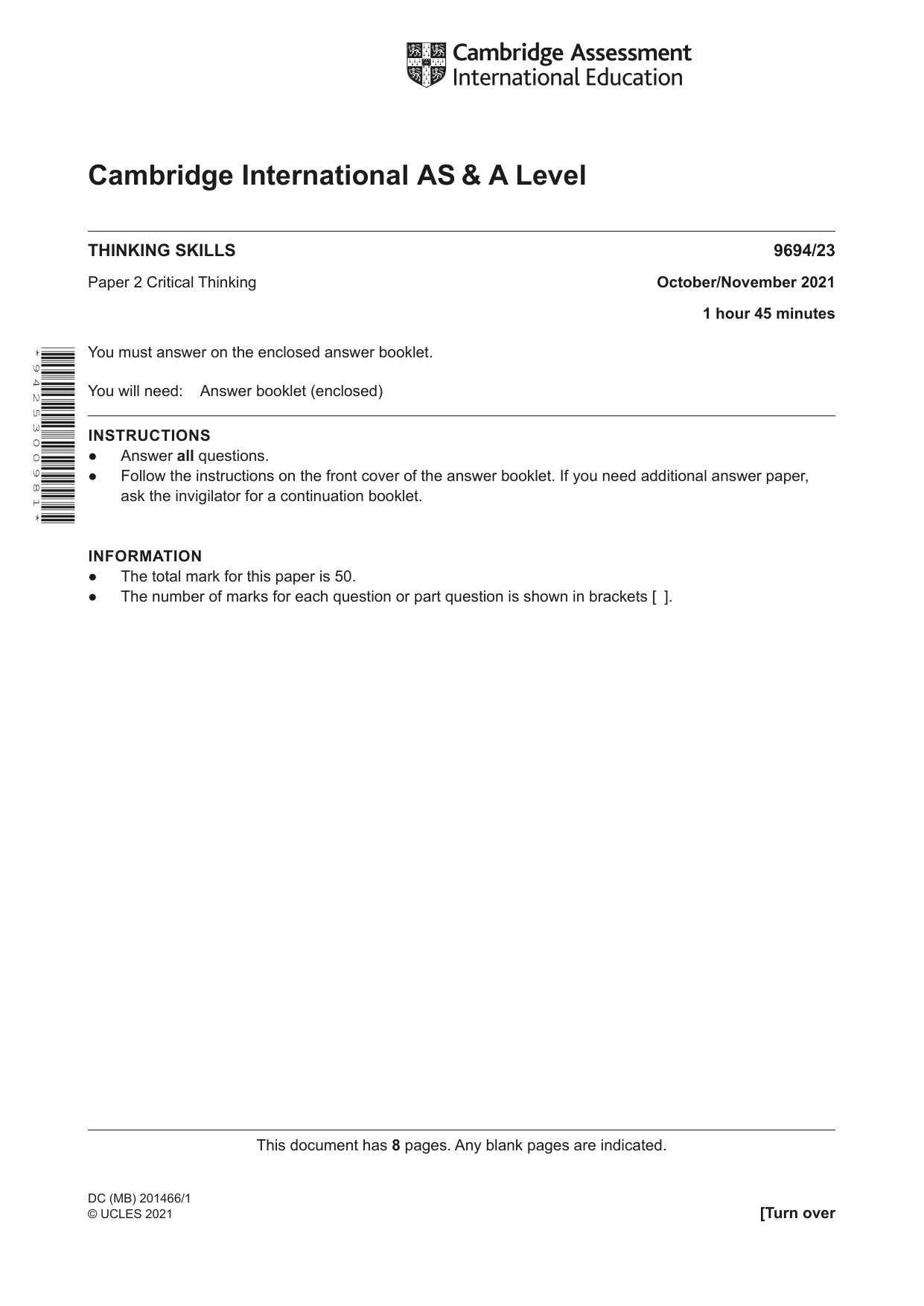
This document has 8 pages. Any blank pages are indicated. Cambridge International AS & A Level DC (MB) 201466/1 © UCLES 2021 [Turn over * 9 4 2 5 3 0 0 9 8 1 * THINKING SKILLS 9694/23 Paper 2 Critical Thinking October/November 2021 1 hour 45 minutes You must answer on the enclosed answer booklet. You will need: Answer booklet (enclosed) INSTRUCTIONS ● Answer all questions. ● Follow the instructions on the front cover of the answer booklet. If you need additional answer paper, ask the invigilator for a continuation booklet. INFORMATION ● The total mark for this paper is 50. ● The number of marks for each question or part question is shown in brackets [ ].
Question paper, page 2
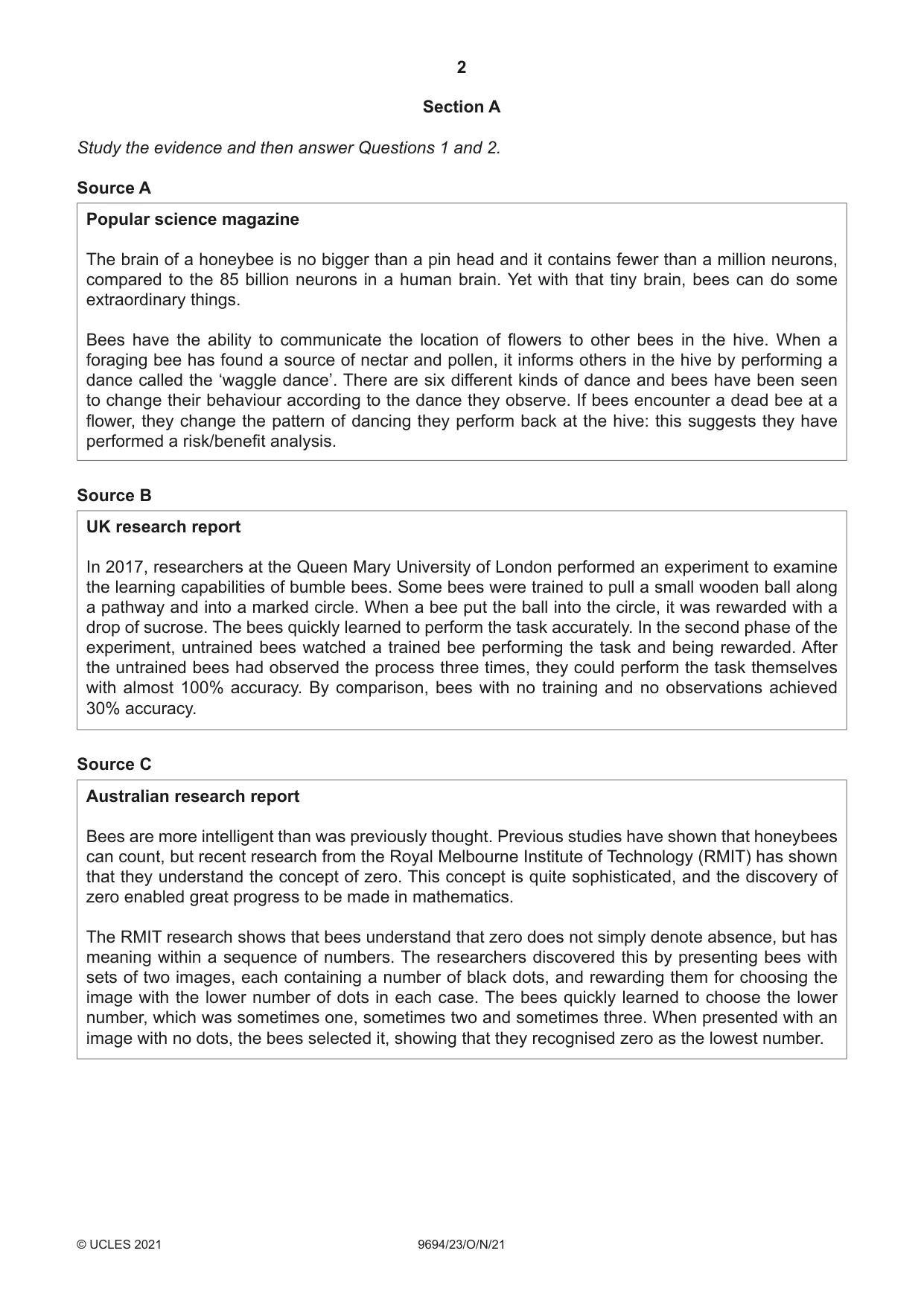
2 9694/23/O/N/21 © UCLES 2021 Section A Study the evidence and then answer Questions 1 and 2. Source A Popular science magazine The brain of a honeybee is no bigger than a pin head and it contains fewer than a million neurons, compared to the 85 billion neurons in a human brain. Yet with that tiny brain, bees can do some extraordinary things. Bees have the ability to communicate the location of flowers to other bees in the hive. When a foraging bee has found a source of nectar and pollen, it informs others in the hive by performing a dance called the ‘waggle dance’. There are six different kinds of dance and bees have been seen to change their behaviour according to the dance they observe. If bees encounter a dead bee at a flower, they change the pattern of dancing they perform back at the hive: this suggests they have performed a risk/benefit analysis. Source B UK research report In 2017, researchers at the Queen Mary University of London performed an experiment to examine the learning capabilities of bumble bees. Some bees were trained to pull a small wooden ball along a pathway and into a marked circle. When a bee put the ball into the circle, it was rewarded with a drop of sucrose. The bees quickly learned to perform the task accurately. In the second phase of the experiment, untrained bees watched a trained bee performing the task and being rewarded. After the untrained bees had observed the process three times, they could perform the task themselves with almost 100% accuracy. By comparison, bees with no training and no observations achieved 30% accuracy. Source C Australian research report Bees are more intelligent than was previously thought. Previous studies have shown that honeybees can count, but recent research from the Royal Melbourne Institute of Technology (RMIT) has shown that they understand the concept of zero. This concept is quite sophisticated, and the discovery of zero enabled great progress to be made in mathematics. The RMIT research shows that bees understand that zero does not simply denote absence, but has meaning within a sequence of numbers. The researchers discovered this by presenting bees with sets of two images, each containing a number of black dots, and rewarding them for choosing the image with the lower number of dots in each case. The bees quickly learned to choose the lower number, which was sometimes one, sometimes two and sometimes three. When presented with an image with no dots, the bees selected it, showing that they recognised zero as the lowest number.
Question paper, page 3
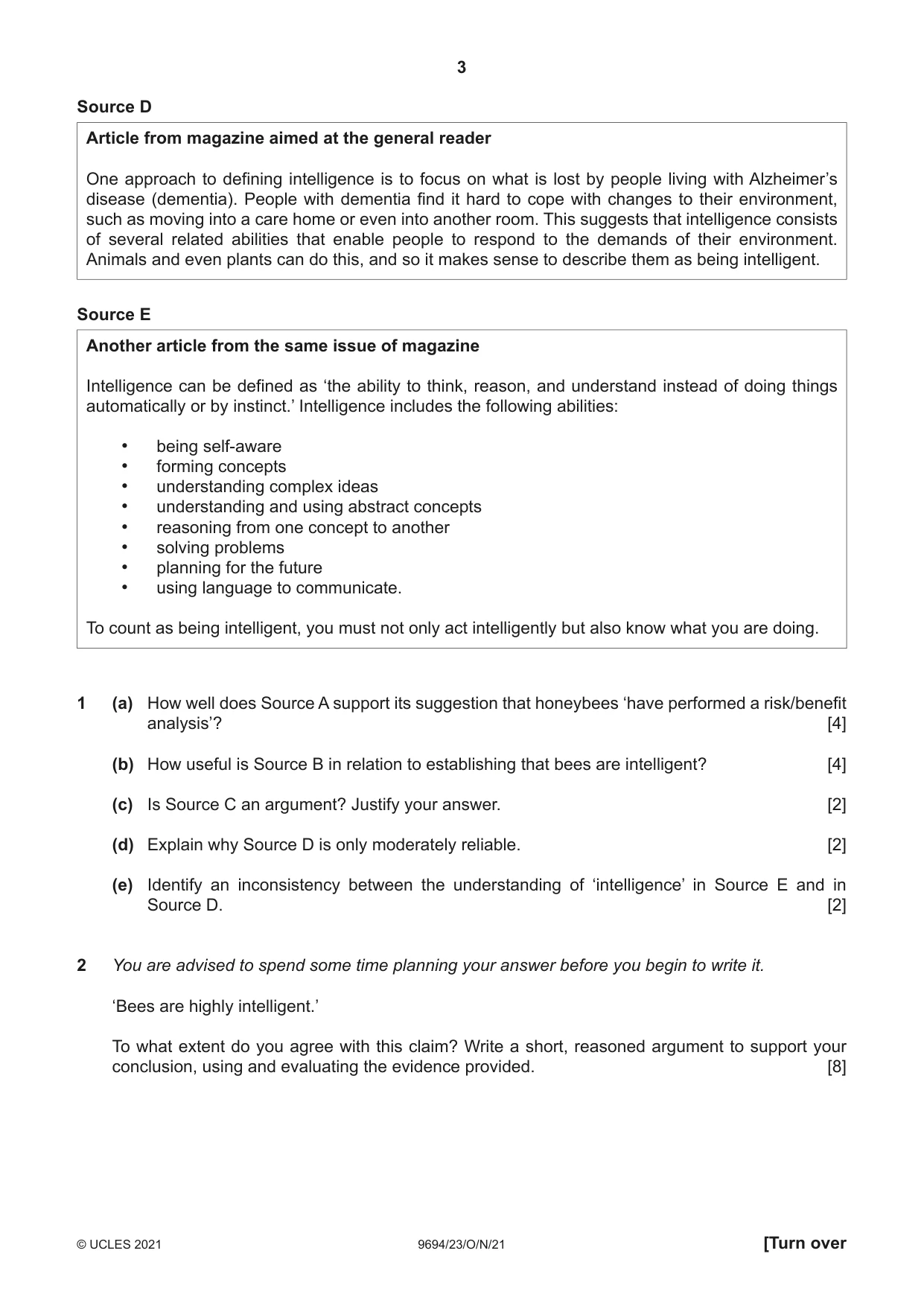
3 9694/23/O/N/21 © UCLES 2021 [Turn over Source D Article from magazine aimed at the general reader One approach to defining intelligence is to focus on what is lost by people living with Alzheimer’s disease (dementia). People with dementia find it hard to cope with changes to their environment, such as moving into a care home or even into another room. This suggests that intelligence consists of several related abilities that enable people to respond to the demands of their environment. Animals and even plants can do this, and so it makes sense to describe them as being intelligent. Source E Another article from the same issue of magazine Intelligence can be defined as ‘the ability to think, reason, and understand instead of doing things automatically or by instinct.’ Intelligence includes the following abilities: • being self-aware • forming concepts • understanding complex ideas • understanding and using abstract concepts • reasoning from one concept to another • solving problems • planning for the future • using language to communicate. To count as being intelligent, you must not only act intelligently but also know what you are doing. 1 (a) How well does Source A support its suggestion that honeybees ‘have performed a risk/benefit analysis’? [4] (b) How useful is Source B in relation to establishing that bees are intelligent? [4] (c) Is Source C an argument? Justify your answer. [2] (d) Explain why Source D is only moderately reliable. [2] (e) Identify an inconsistency between the understanding of ‘intelligence’ in Source E and in Source D. [2] 2 You are advised to spend some time planning your answer before you begin to write it. ‘Bees are highly intelligent.’ To what extent do you agree with this claim? Write a short, reasoned argument to support your conclusion, using and evaluating the evidence provided. [8]
Question paper, page 4
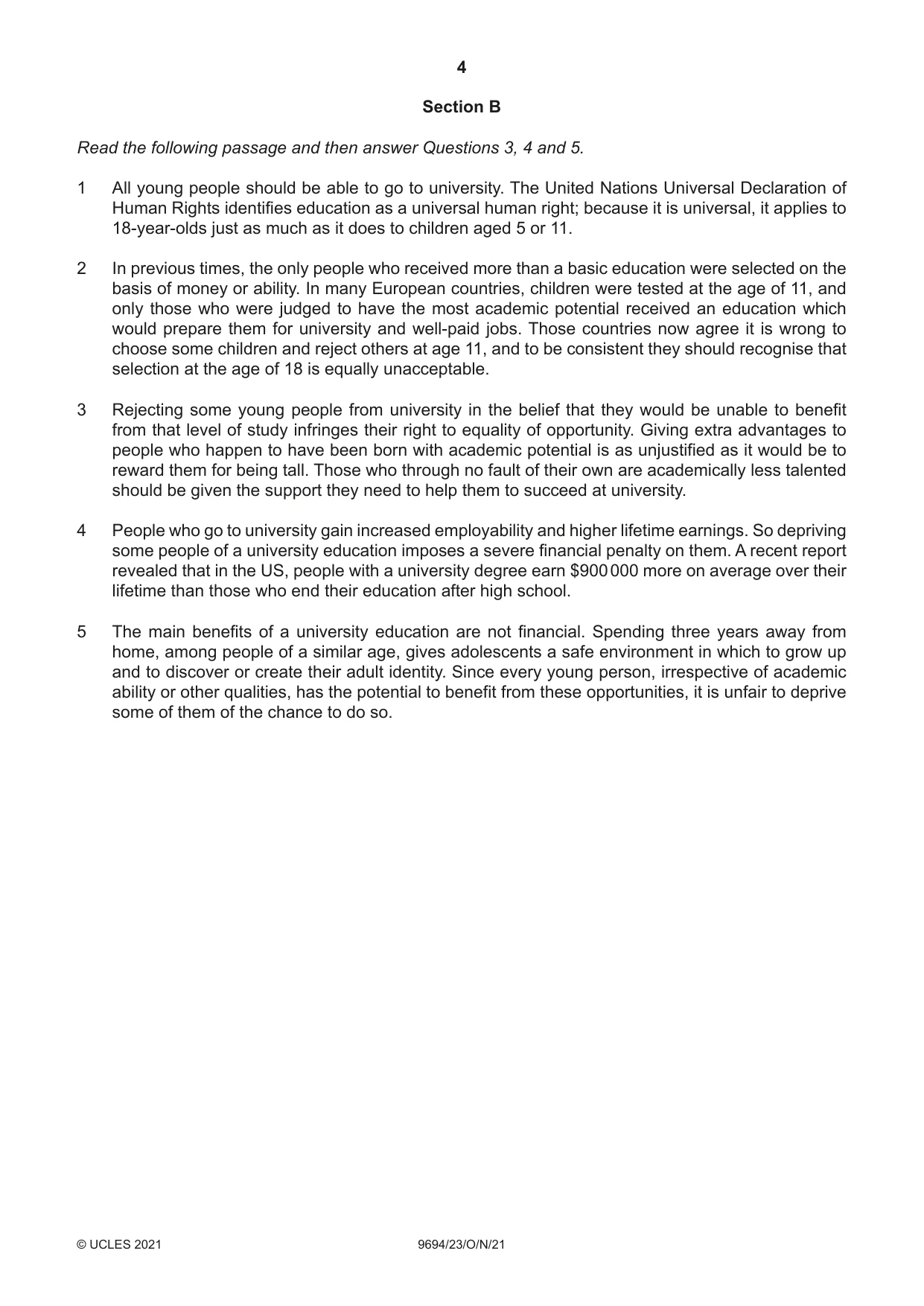
4 9694/23/O/N/21 © UCLES 2021 Section B Read the following passage and then answer Questions 3, 4 and 5. 1 All young people should be able to go to university. The United Nations Universal Declaration of Human Rights identifies education as a universal human right; because it is universal, it applies to 18-year-olds just as much as it does to children aged 5 or 11. 2 In previous times, the only people who received more than a basic education were selected on the basis of money or ability. In many European countries, children were tested at the age of 11, and only those who were judged to have the most academic potential received an education which would prepare them for university and well-paid jobs. Those countries now agree it is wrong to choose some children and reject others at age 11, and to be consistent they should recognise that selection at the age of 18 is equally unacceptable. 3 Rejecting some young people from university in the belief that they would be unable to benefit from that level of study infringes their right to equality of opportunity. Giving extra advantages to people who happen to have been born with academic potential is as unjustified as it would be to reward them for being tall. Those who through no fault of their own are academically less talented should be given the support they need to help them to succeed at university. 4 People who go to university gain increased employability and higher lifetime earnings. So depriving some people of a university education imposes a severe financial penalty on them. A recent report revealed that in the US, people with a university degree earn $900 000 more on average over their lifetime than those who end their education after high school. 5 The main benefits of a university education are not financial. Spending three years away from home, among people of a similar age, gives adolescents a safe environment in which to grow up and to discover or create their adult identity. Since every young person, irrespective of academic ability or other qualities, has the potential to benefit from these opportunities, it is unfair to deprive some of them of the chance to do so.
Question paper, page 5
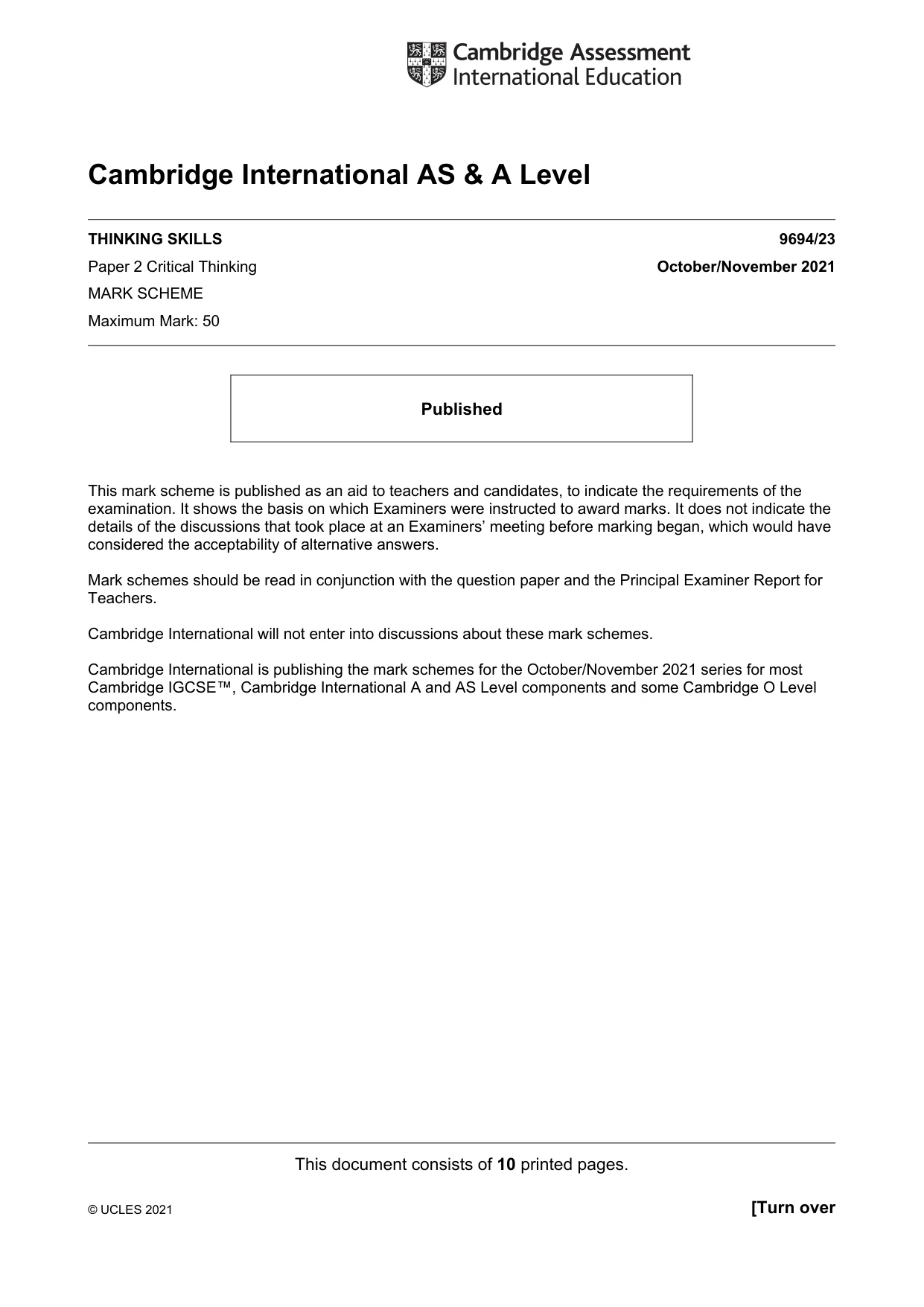
5 9694/23/O/N/21 © UCLES 2021 3 (a) Using the exact words from the passage as far as possible, identify the main conclusion. [2] (b) Using the exact words from the passage as far as possible, identify three intermediate conclusions. [6] (c) Identify the argument element and explain the function of the following words from paragraph 4: ‘in the US, people with a university degree earn $900 000 more on average over their lifetime than those who end their education after high school’ [2] (d) Identify an unstated assumption required by the reasoning in paragraph 2. [2] 4 (a) Identify and evaluate an appeal in paragraph 1. [2] (b) To what extent is the reasoning in paragraph 1 weakened by a flaw of equivocation? [2] (c) Evaluate the analogy in paragraph 3. [2] (d) Identify one flaw or weakness in paragraph 4 and assess the extent to which it reduces the support given to the main conclusion. [2] 5 You are advised to spend some time planning your answer before you begin to write it. ‘People who are rich should be able to buy advantages for their children.’ Write your own short argument to support or challenge this claim. The conclusion of your argument must be stated. Credit will not be given for repeating ideas from the passage. [8]
Question paper, page 6
6 9694/23/O/N/21 © UCLES 2021 BLANK PAGE
Question paper, page 7
7 9694/23/O/N/21 © UCLES 2021 BLANK PAGE
Question paper, page 8
8 9694/23/O/N/21 © UCLES 2021 Permission to reproduce items where third-party owned material protected by copyright is included has been sought and cleared where possible. Every reasonable effort has been made by the publisher (UCLES) to trace copyright holders, but if any items requiring clearance have unwittingly been included, the publisher will be pleased to make amends at the earliest possible opportunity. To avoid the issue of disclosure of answer-related information to candidates, all copyright acknowledgements are reproduced online in the Cambridge Assessment International Education Copyright Acknowledgements Booklet. This is produced for each series of examinations and is freely available to download at www.cambridgeinternational.org after the live examination series. Cambridge Assessment International Education is part of the Cambridge Assessment Group. Cambridge Assessment is the brand name of the University of Cambridge Local Examinations Syndicate (UCLES), which itself is a department of the University of Cambridge. BLANK PAGE
Mark scheme, page 1
This document consists of 10 printed pages. © UCLES 2021 [Turn over Cambridge International AS & A Level THINKING SKILLS 9694/23 Paper 2 Critical Thinking October/November 2021 MARK SCHEME Maximum Mark: 50 Published This mark scheme is published as an aid to teachers and candidates, to indicate the requirements of the examination. It shows the basis on which Examiners were instructed to award marks. It does not indicate the details of the discussions that took place at an Examiners’ meeting before marking began, which would have considered the acceptability of alternative answers. Mark schemes should be read in conjunction with the question paper and the Principal Examiner Report for Teachers. Cambridge International will not enter into discussions about these mark schemes. Cambridge International is publishing the mark schemes for the October/November 2021 series for most Cambridge IGCSE™, Cambridge International A and AS Level components and some Cambridge O Level components.
Mark scheme, page 2
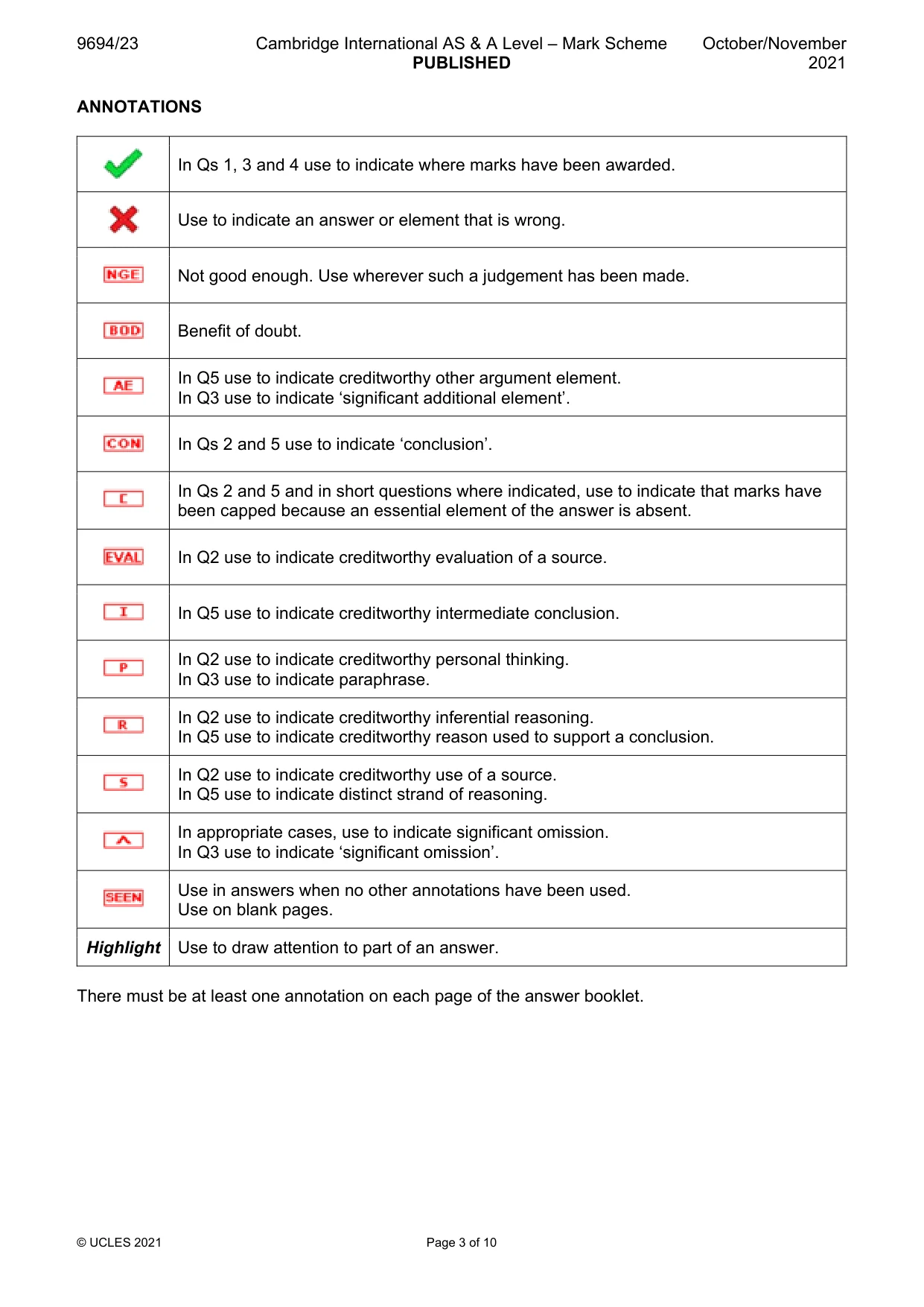
9694/23 Cambridge International AS & A Level – Mark Scheme PUBLISHED October/November 2021 © UCLES 2021 Page 2 of 10 Generic Marking Principles These general marking principles must be applied by all examiners when marking candidate answers. They should be applied alongside the specific content of the mark scheme or generic level descriptors for a question. Each question paper and mark scheme will also comply with these marking principles. GENERIC MARKING PRINCIPLE 1: Marks must be awarded in line with: • the specific content of the mark scheme or the generic level descriptors for the question • the specific skills defined in the mark scheme or in the generic level descriptors for the question • the standard of response required by a candidate as exemplified by the standardisation scripts. GENERIC MARKING PRINCIPLE 2: Marks awarded are always whole marks (not half marks, or other fractions). GENERIC MARKING PRINCIPLE 3: Marks must be awarded positively: • marks are awarded for correct/valid answers, as defined in the mark scheme. However, credit is given for valid answers which go beyond the scope of the syllabus and mark scheme, referring to your Team Leader as appropriate • marks are awarded when candidates clearly demonstrate what they know and can do • marks are not deducted for errors • marks are not deducted for omissions • answers should only be judged on the quality of spelling, punctuation and grammar when these features are specifically assessed by the question as indicated by the mark scheme. The meaning, however, should be unambiguous. GENERIC MARKING PRINCIPLE 4: Rules must be applied consistently, e.g. in situations where candidates have not followed instructions or in the application of generic level descriptors. GENERIC MARKING PRINCIPLE 5: Marks should be awarded using the full range of marks defined in the mark scheme for the question (however; the use of the full mark range may be limited according to the quality of the candidate responses seen). GENERIC MARKING PRINCIPLE 6: Marks awarded are based solely on the requirements as defined in the mark scheme. Marks should not be awarded with grade thresholds or grade descriptors in mind.
Mark scheme, page 3
9694/23 Cambridge International AS & A Level – Mark Scheme PUBLISHED October/November 2021 © UCLES 2021 Page 3 of 10 ANNOTATIONS In Qs 1, 3 and 4 use to indicate where marks have been awarded. Use to indicate an answer or element that is wrong. Not good enough. Use wherever such a judgement has been made. Benefit of doubt. In Q5 use to indicate creditworthy other argument element. In Q3 use to indicate ‘significant additional element’. In Qs 2 and 5 use to indicate ‘conclusion’. In Qs 2 and 5 and in short questions where indicated, use to indicate that marks have been capped because an essential element of the answer is absent. In Q2 use to indicate creditworthy evaluation of a source. In Q5 use to indicate creditworthy intermediate conclusion. In Q2 use to indicate creditworthy personal thinking. In Q3 use to indicate paraphrase. In Q2 use to indicate creditworthy inferential reasoning. In Q5 use to indicate creditworthy reason used to support a conclusion. In Q2 use to indicate creditworthy use of a source. In Q5 use to indicate distinct strand of reasoning. In appropriate cases, use to indicate significant omission. In Q3 use to indicate ‘significant omission’. Use in answers when no other annotations have been used. Use on blank pages. Highlight Use to draw attention to part of an answer. There must be at least one annotation on each page of the answer booklet.
Mark scheme, page 4
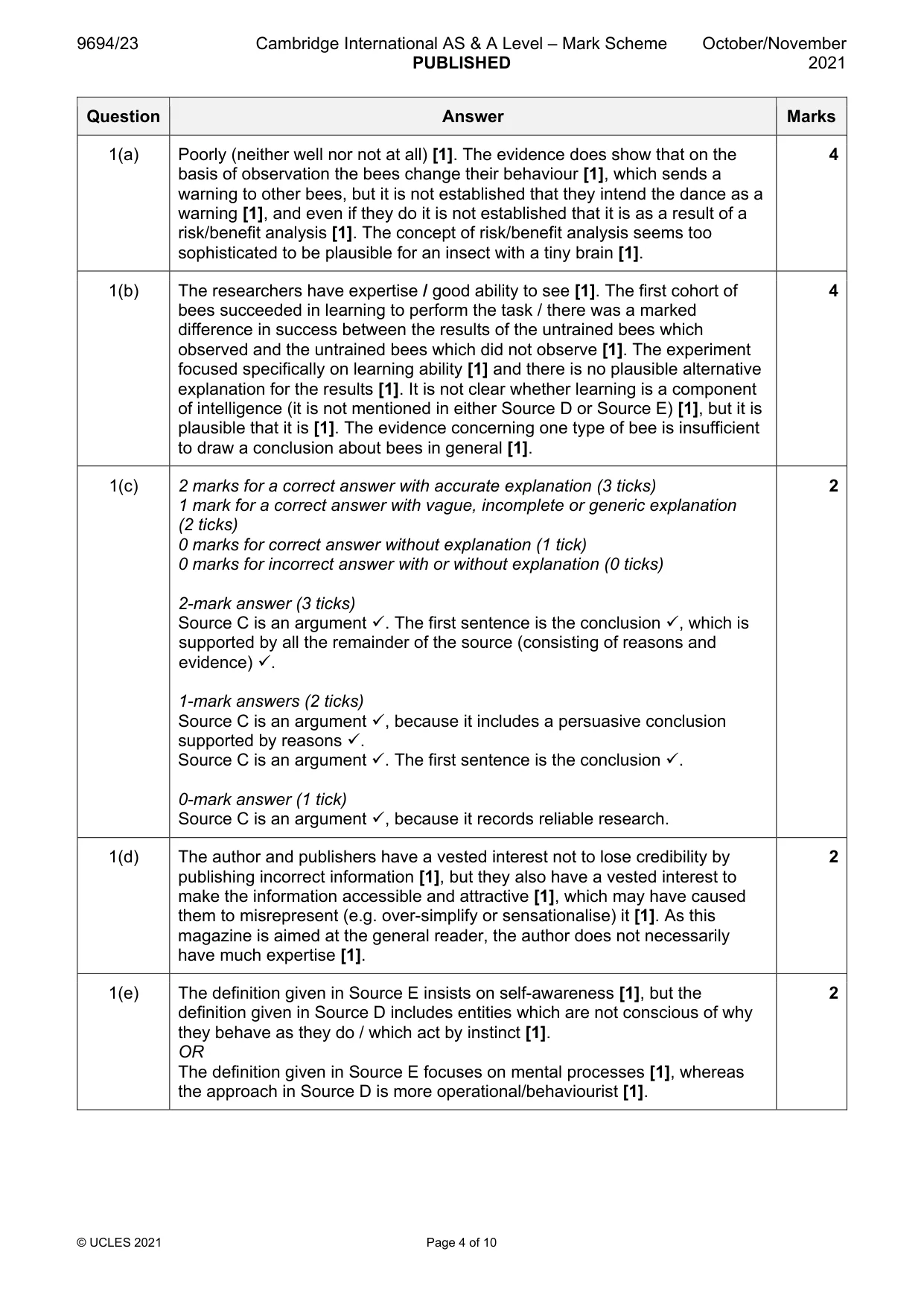
9694/23 Cambridge International AS & A Level – Mark Scheme PUBLISHED October/November 2021 © UCLES 2021 Page 4 of 10 Question Answer Marks 1(a) Poorly (neither well nor not at all) [1]. The evidence does show that on the basis of observation the bees change their behaviour [1], which sends a warning to other bees, but it is not established that they intend the dance as a warning [1], and even if they do it is not established that it is as a result of a risk/benefit analysis [1]. The concept of risk/benefit analysis seems too sophisticated to be plausible for an insect with a tiny brain [1]. 4 1(b) The researchers have expertise / good ability to see [1]. The first cohort of bees succeeded in learning to perform the task / there was a marked difference in success between the results of the untrained bees which observed and the untrained bees which did not observe [1]. The experiment focused specifically on learning ability [1] and there is no plausible alternative explanation for the results [1]. It is not clear whether learning is a component of intelligence (it is not mentioned in either Source D or Source E) [1], but it is plausible that it is [1]. The evidence concerning one type of bee is insufficient to draw a conclusion about bees in general [1]. 4 1(c) 2 marks for a correct answer with accurate explanation (3 ticks) 1 mark for a correct answer with vague, incomplete or generic explanation (2 ticks) 0 marks for correct answer without explanation (1 tick) 0 marks for incorrect answer with or without explanation (0 ticks) 2-mark answer (3 ticks) Source C is an argument . The first sentence is the conclusion , which is supported by all the remainder of the source (consisting of reasons and evidence) . 1-mark answers (2 ticks) Source C is an argument , because it includes a persuasive conclusion supported by reasons . Source C is an argument . The first sentence is the conclusion . 0-mark answer (1 tick) Source C is an argument , because it records reliable research. 2 1(d) The author and publishers have a vested interest not to lose credibility by publishing incorrect information [1], but they also have a vested interest to make the information accessible and attractive [1], which may have caused them to misrepresent (e.g. over-simplify or sensationalise) it [1]. As this magazine is aimed at the general reader, the author does not necessarily have much expertise [1]. 2 1(e) The definition given in Source E insists on self-awareness [1], but the definition given in Source D includes entities which are not conscious of why they behave as they do / which act by instinct [1]. OR The definition given in Source E focuses on mental processes [1], whereas the approach in Source D is more operational/behaviourist [1]. 2
Mark scheme, page 5
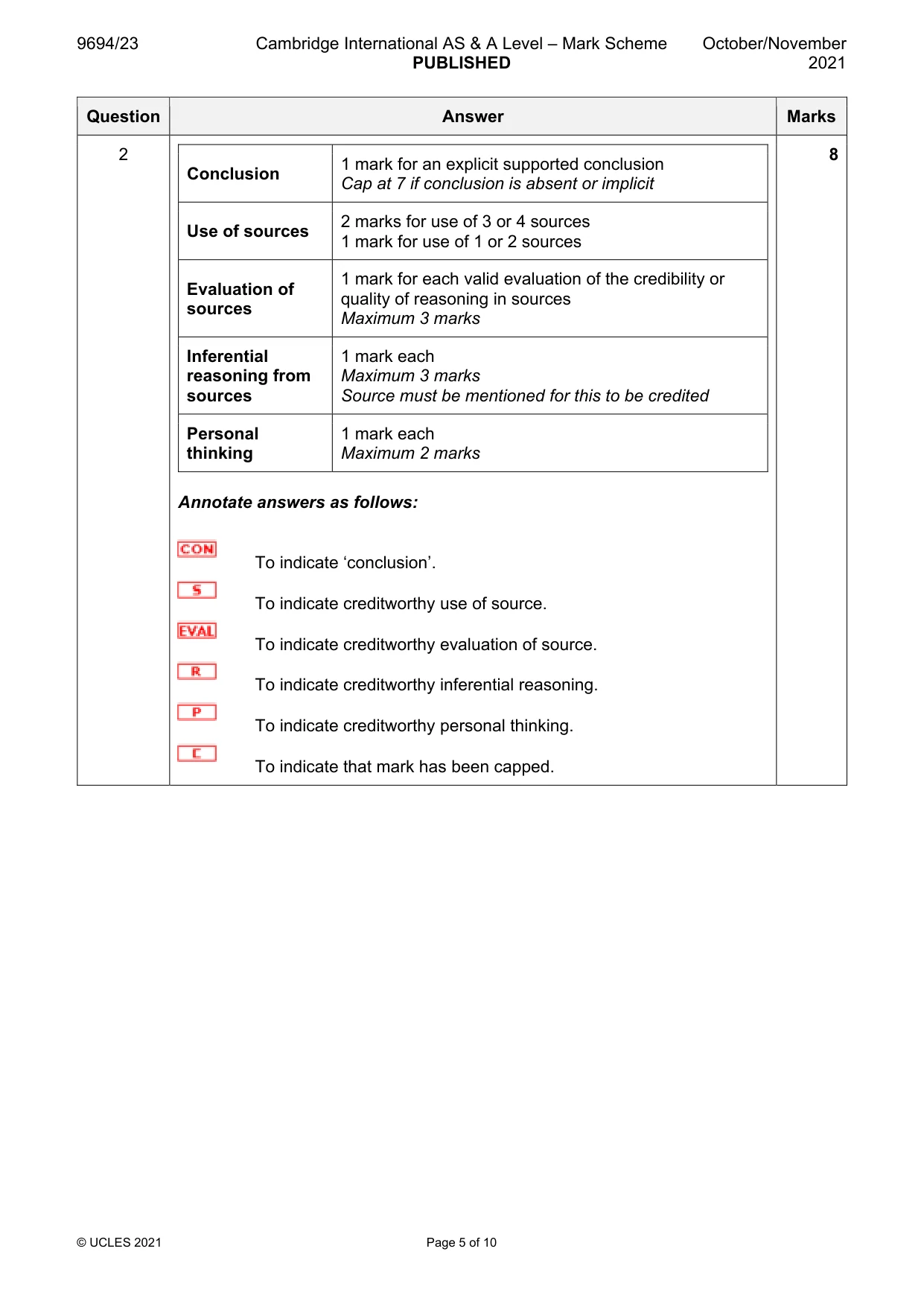
9694/23 Cambridge International AS & A Level – Mark Scheme PUBLISHED October/November 2021 © UCLES 2021 Page 5 of 10 Question Answer Marks 2 Conclusion 1 mark for an explicit supported conclusion Cap at 7 if conclusion is absent or implicit Use of sources 2 marks for use of 3 or 4 sources 1 mark for use of 1 or 2 sources Evaluation of sources 1 mark for each valid evaluation of the credibility or quality of reasoning in sources Maximum 3 marks Inferential reasoning from sources 1 mark each Maximum 3 marks Source must be mentioned for this to be credited Personal thinking 1 mark each Maximum 2 marks Annotate answers as follows: To indicate ‘conclusion’. To indicate creditworthy use of source. To indicate creditworthy evaluation of source. To indicate creditworthy inferential reasoning. To indicate creditworthy personal thinking. To indicate that mark has been capped. 8
Mark scheme, page 6
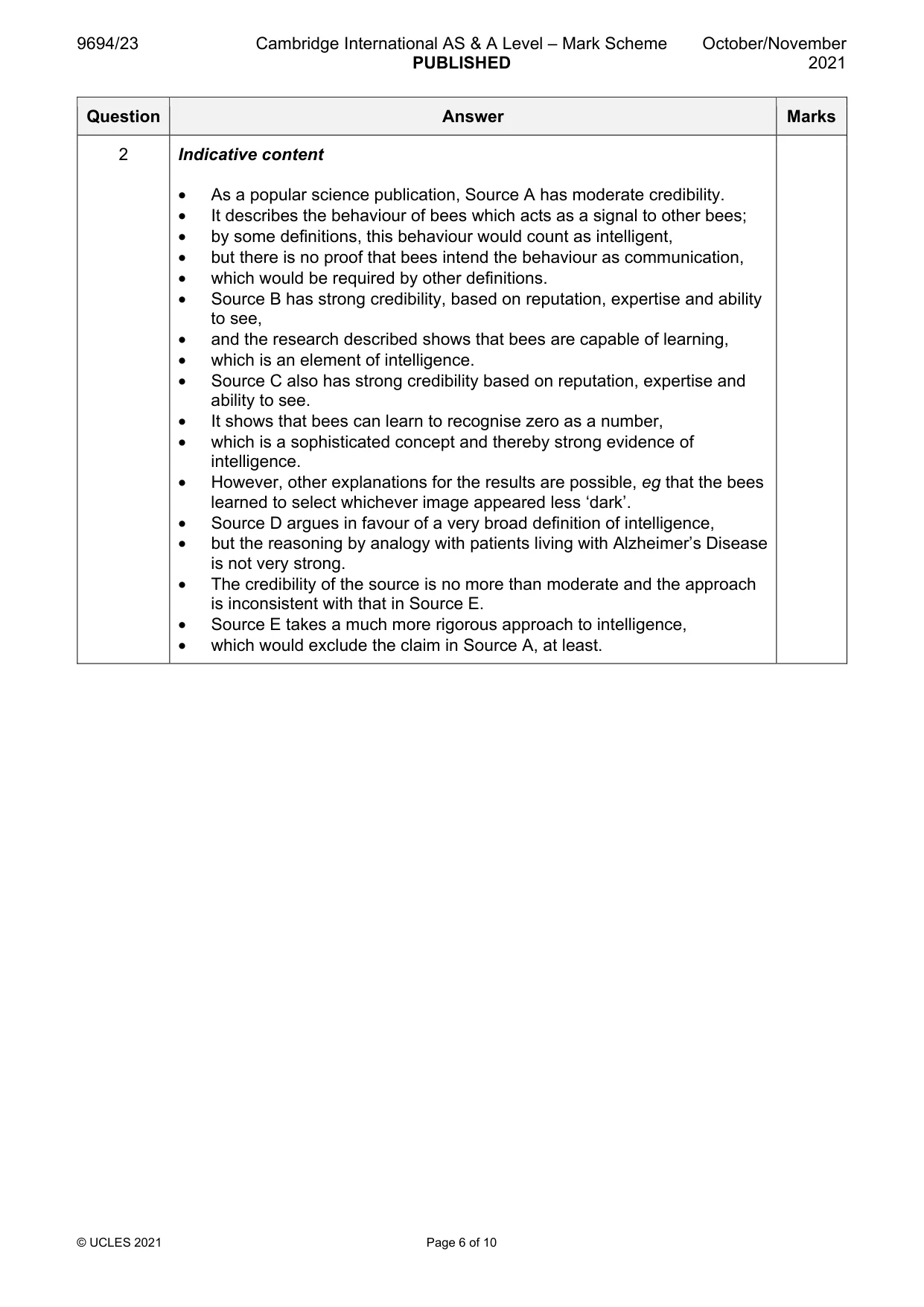
9694/23 Cambridge International AS & A Level – Mark Scheme PUBLISHED October/November 2021 © UCLES 2021 Page 6 of 10 Question Answer Marks 2 Indicative content • As a popular science publication, Source A has moderate credibility. • It describes the behaviour of bees which acts as a signal to other bees; • by some definitions, this behaviour would count as intelligent, • but there is no proof that bees intend the behaviour as communication, • which would be required by other definitions. • Source B has strong credibility, based on reputation, expertise and ability to see, • and the research described shows that bees are capable of learning, • which is an element of intelligence. • Source C also has strong credibility based on reputation, expertise and ability to see. • It shows that bees can learn to recognise zero as a number, • which is a sophisticated concept and thereby strong evidence of intelligence. • However, other explanations for the results are possible, eg that the bees learned to select whichever image appeared less ‘dark’. • Source D argues in favour of a very broad definition of intelligence, • but the reasoning by analogy with patients living with Alzheimer’s Disease is not very strong. • The credibility of the source is no more than moderate and the approach is inconsistent with that in Source E. • Source E takes a much more rigorous approach to intelligence, • which would exclude the claim in Source A, at least.
Mark scheme, page 7
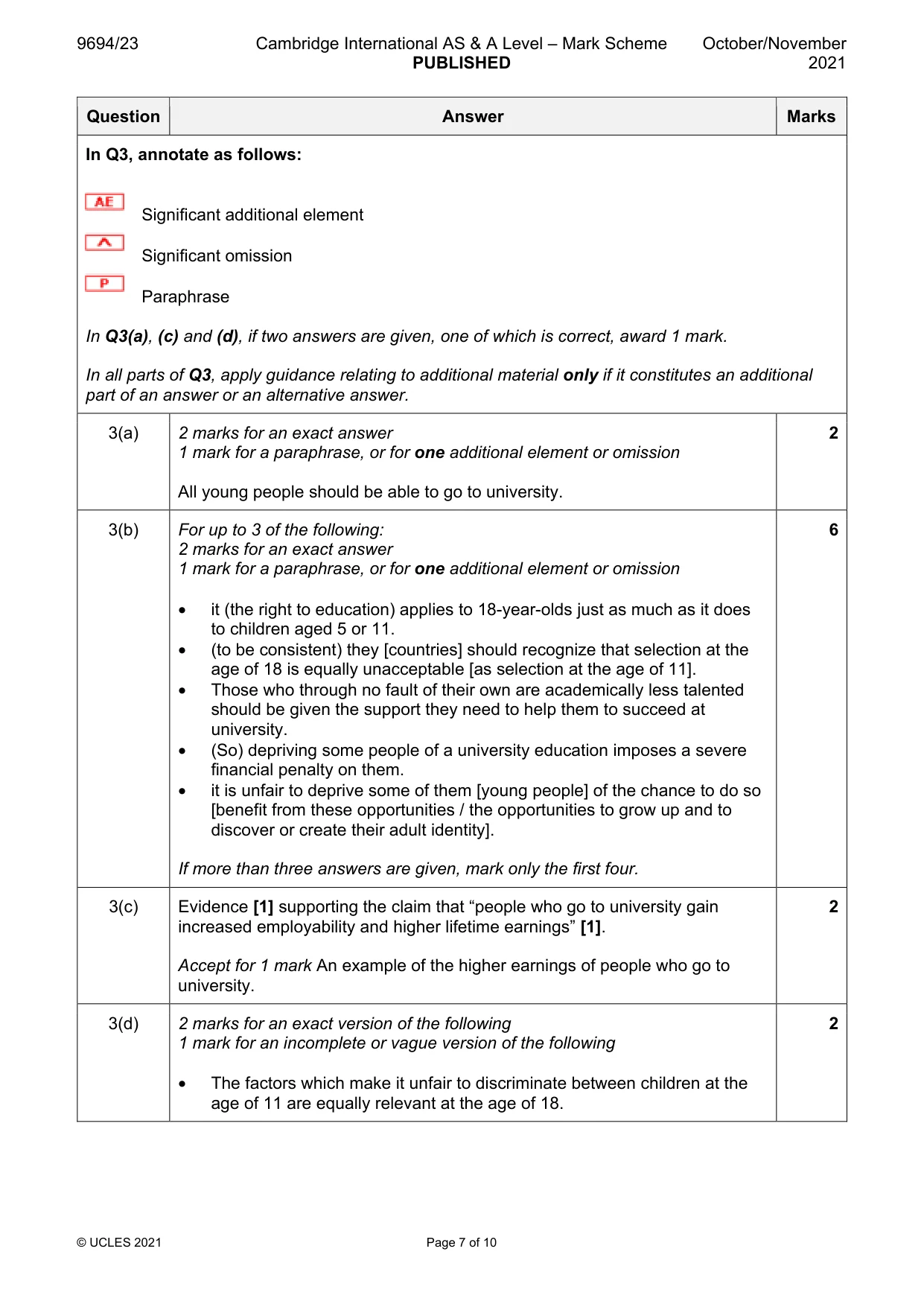
9694/23 Cambridge International AS & A Level – Mark Scheme PUBLISHED October/November 2021 © UCLES 2021 Page 7 of 10 Question Answer Marks In Q3, annotate as follows: Significant additional element Significant omission Paraphrase In Q3(a), (c) and (d), if two answers are given, one of which is correct, award 1 mark. In all parts of Q3, apply guidance relating to additional material only if it constitutes an additional part of an answer or an alternative answer. 3(a) 2 marks for an exact answer 1 mark for a paraphrase, or for one additional element or omission All young people should be able to go to university. 2 3(b) For up to 3 of the following: 2 marks for an exact answer 1 mark for a paraphrase, or for one additional element or omission • it (the right to education) applies to 18-year-olds just as much as it does to children aged 5 or 11. • (to be consistent) they [countries] should recognize that selection at the age of 18 is equally unacceptable [as selection at the age of 11]. • Those who through no fault of their own are academically less talented should be given the support they need to help them to succeed at university. • (So) depriving some people of a university education imposes a severe financial penalty on them. • it is unfair to deprive some of them [young people] of the chance to do so [benefit from these opportunities / the opportunities to grow up and to discover or create their adult identity]. If more than three answers are given, mark only the first four. 6 3(c) Evidence [1] supporting the claim that “people who go to university gain increased employability and higher lifetime earnings” [1]. Accept for 1 mark An example of the higher earnings of people who go to university. 2 3(d) 2 marks for an exact version of the following 1 mark for an incomplete or vague version of the following • The factors which make it unfair to discriminate between children at the age of 11 are equally relevant at the age of 18. 2
Mark scheme, page 8
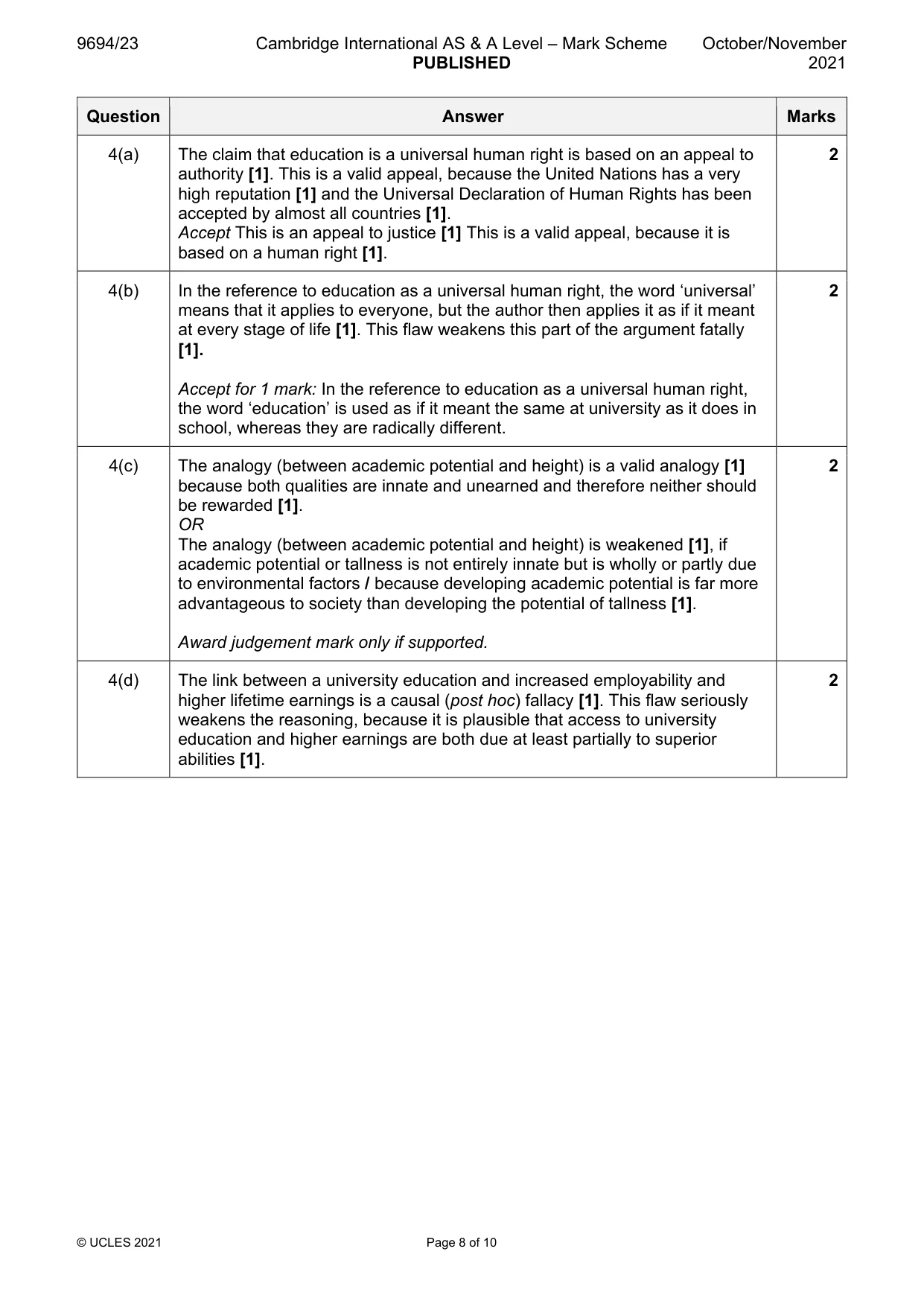
9694/23 Cambridge International AS & A Level – Mark Scheme PUBLISHED October/November 2021 © UCLES 2021 Page 8 of 10 Question Answer Marks 4(a) The claim that education is a universal human right is based on an appeal to authority [1]. This is a valid appeal, because the United Nations has a very high reputation [1] and the Universal Declaration of Human Rights has been accepted by almost all countries [1]. Accept This is an appeal to justice [1] This is a valid appeal, because it is based on a human right [1]. 2 4(b) In the reference to education as a universal human right, the word ‘universal’ means that it applies to everyone, but the author then applies it as if it meant at every stage of life [1]. This flaw weakens this part of the argument fatally [1]. Accept for 1 mark: In the reference to education as a universal human right, the word ‘education’ is used as if it meant the same at university as it does in school, whereas they are radically different. 2 4(c) The analogy (between academic potential and height) is a valid analogy [1] because both qualities are innate and unearned and therefore neither should be rewarded [1]. OR The analogy (between academic potential and height) is weakened [1], if academic potential or tallness is not entirely innate but is wholly or partly due to environmental factors / because developing academic potential is far more advantageous to society than developing the potential of tallness [1]. Award judgement mark only if supported. 2 4(d) The link between a university education and increased employability and higher lifetime earnings is a causal (post hoc) fallacy [1]. This flaw seriously weakens the reasoning, because it is plausible that access to university education and higher earnings are both due at least partially to superior abilities [1]. 2
Mark scheme, page 9
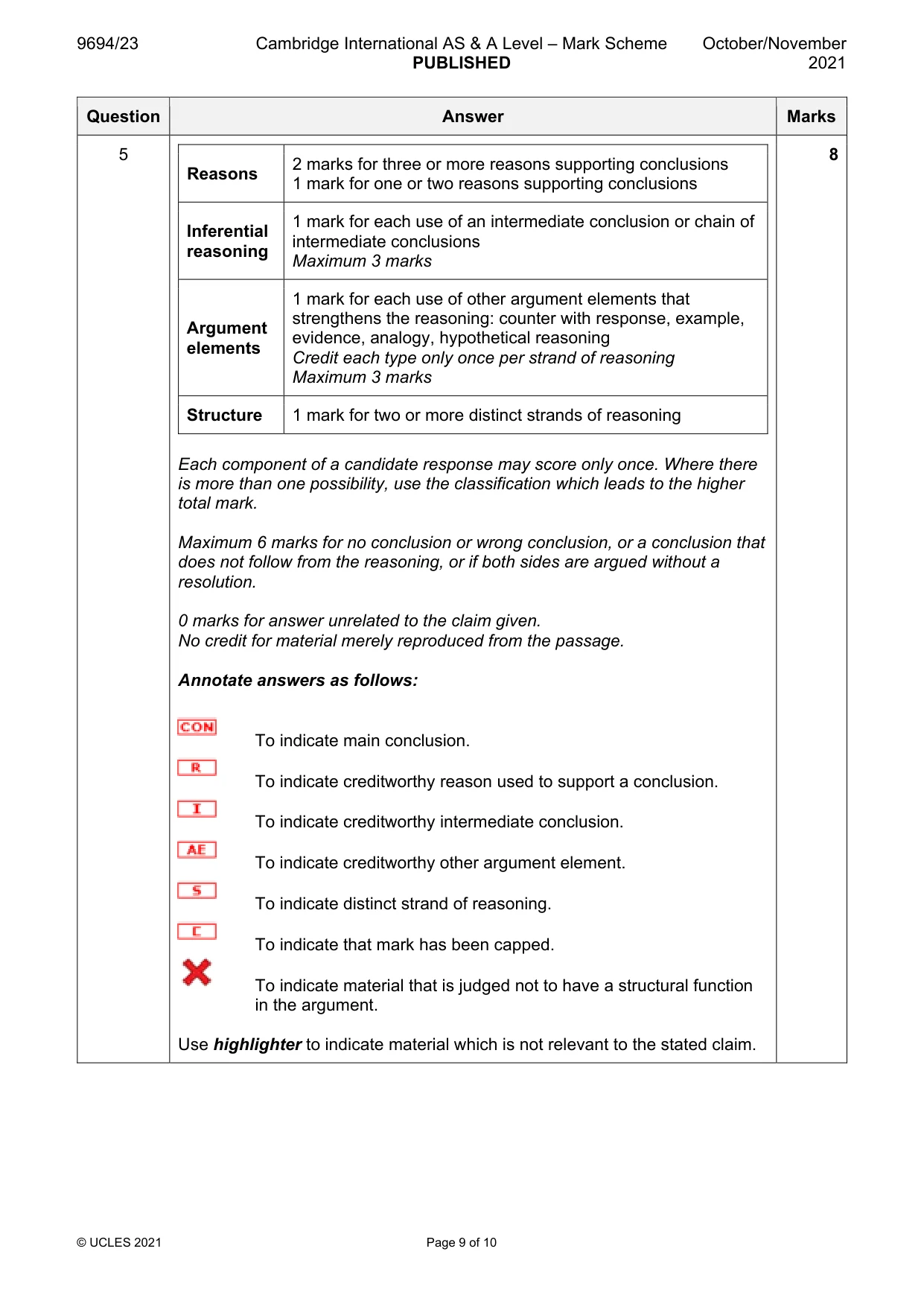
9694/23 Cambridge International AS & A Level – Mark Scheme PUBLISHED October/November 2021 © UCLES 2021 Page 9 of 10 Question Answer Marks 5 Reasons 2 marks for three or more reasons supporting conclusions 1 mark for one or two reasons supporting conclusions Inferential reasoning 1 mark for each use of an intermediate conclusion or chain of intermediate conclusions Maximum 3 marks Argument elements 1 mark for each use of other argument elements that strengthens the reasoning: counter with response, example, evidence, analogy, hypothetical reasoning Credit each type only once per strand of reasoning Maximum 3 marks Structure 1 mark for two or more distinct strands of reasoning Each component of a candidate response may score only once. Where there is more than one possibility, use the classification which leads to the higher total mark. Maximum 6 marks for no conclusion or wrong conclusion, or a conclusion that does not follow from the reasoning, or if both sides are argued without a resolution. 0 marks for answer unrelated to the claim given. No credit for material merely reproduced from the passage. Annotate answers as follows: To indicate main conclusion. To indicate creditworthy reason used to support a conclusion. To indicate creditworthy intermediate conclusion. To indicate creditworthy other argument element. To indicate distinct strand of reasoning. To indicate that mark has been capped. To indicate material that is judged not to have a structural function in the argument. Use highlighter to indicate material which is not relevant to the stated claim. 8
Mark scheme, page 10
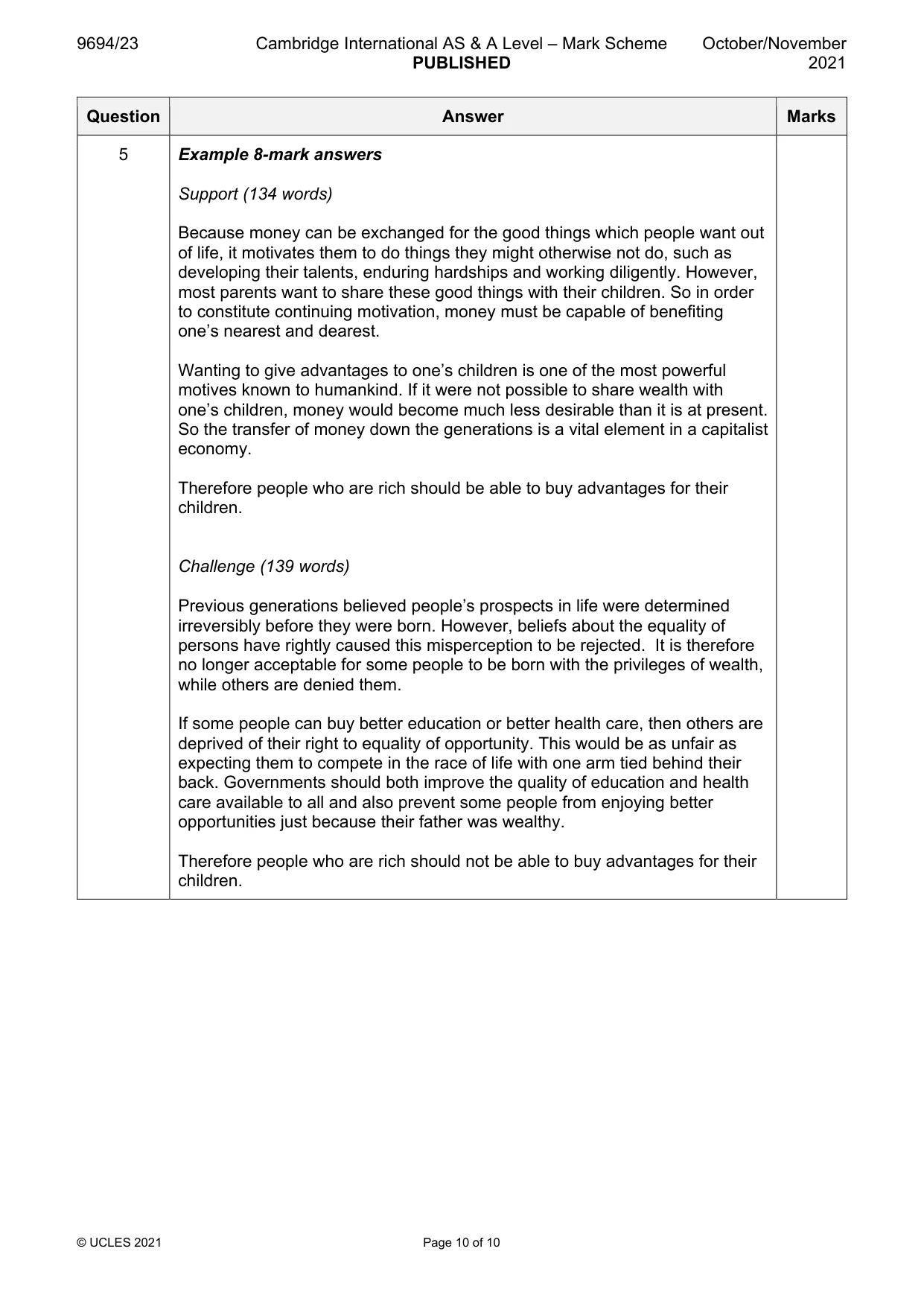
9694/23 Cambridge International AS & A Level – Mark Scheme PUBLISHED October/November 2021 © UCLES 2021 Page 10 of 10 Question Answer Marks 5 Example 8-mark answers Support (134 words) Because money can be exchanged for the good things which people want out of life, it motivates them to do things they might otherwise not do, such as developing their talents, enduring hardships and working diligently. However, most parents want to share these good things with their children. So in order to constitute continuing motivation, money must be capable of benefiting one’s nearest and dearest. Wanting to give advantages to one’s children is one of the most powerful motives known to humankind. If it were not possible to share wealth with one’s children, money would become much less desirable than it is at present. So the transfer of money down the generations is a vital element in a capitalist economy. Therefore people who are rich should be able to buy advantages for their children. Challenge (139 words) Previous generations believed people’s prospects in life were determined irreversibly before they were born. However, beliefs about the equality of persons have rightly caused this misperception to be rejected. It is therefore no longer acceptable for some people to be born with the privileges of wealth, while others are denied them. If some people can buy better education or better health care, then others are deprived of their right to equality of opportunity. This would be as unfair as expecting them to compete in the race of life with one arm tied behind their back. Governments should both improve the quality of education and health care available to all and also prevent some people from enjoying better opportunities just because their father was wealthy. Therefore people who are rich should not be able to buy advantages for their children.
What you needed in this session
Cambridge’s own grade thresholds for 2021 Oct/Nov, Paper 2 · Variant 3. A higher threshold means an easier paper — the bar moves with how the cohort did.