Cambridge A Level Thinking Skills 9694 — 2020 Oct/Nov Paper 2 · Variant 1
9694/21/O/N/20 · 50 marks · ≈56 min
The question paper and its mark scheme, free to read here and free to download. This is Cambridge’s own paper, exactly as it was sat.
Question paper8 pages
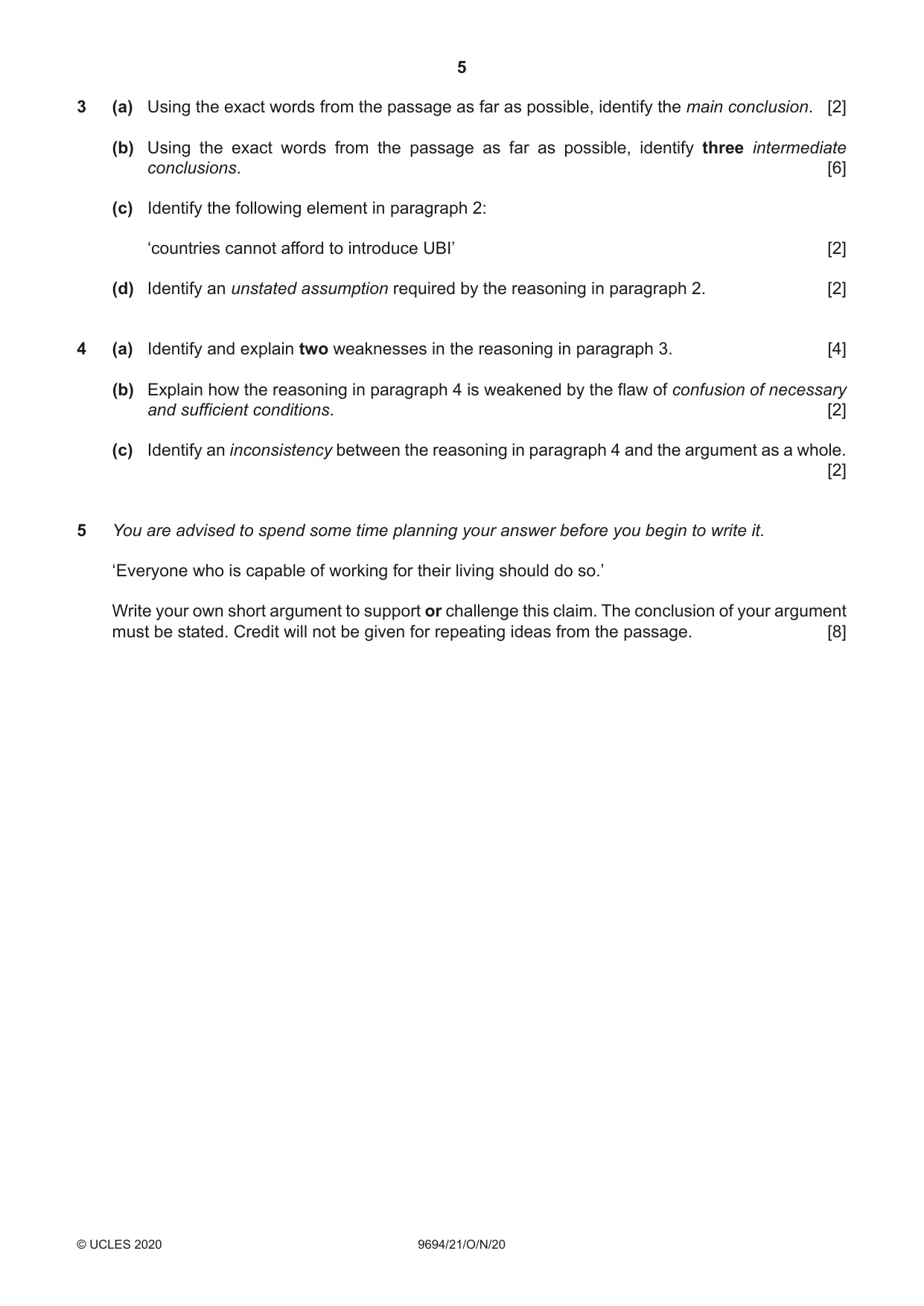


Mark scheme9 pages
Answers below. Sit the paper first if you are practising.
Paper as text
Question paper, page 1
Cambridge International AS & A Level THINKING SKILLS 9694/21 Paper 2 Critical Thinking October/November 2020 1 hour 45 minutes You must answer on the enclosed answer booklet. You will need: Answer booklet (enclosed) INSTRUCTIONS ● Answer all questions. ● Follow the instructions on the front cover of the answer booklet. If you need additional answer paper, ask the invigilator for a continuation booklet. INFORMATION ● The total mark for this paper is 50. ● The number of marks for each question or part question is shown in brackets [ ]. * 0 6 1 6 6 8 4 7 1 4 * DC (LK) 185796/1 © UCLES 2020 [Turn over This document has 8 pages. Blank pages are indicated.
Question paper, page 2
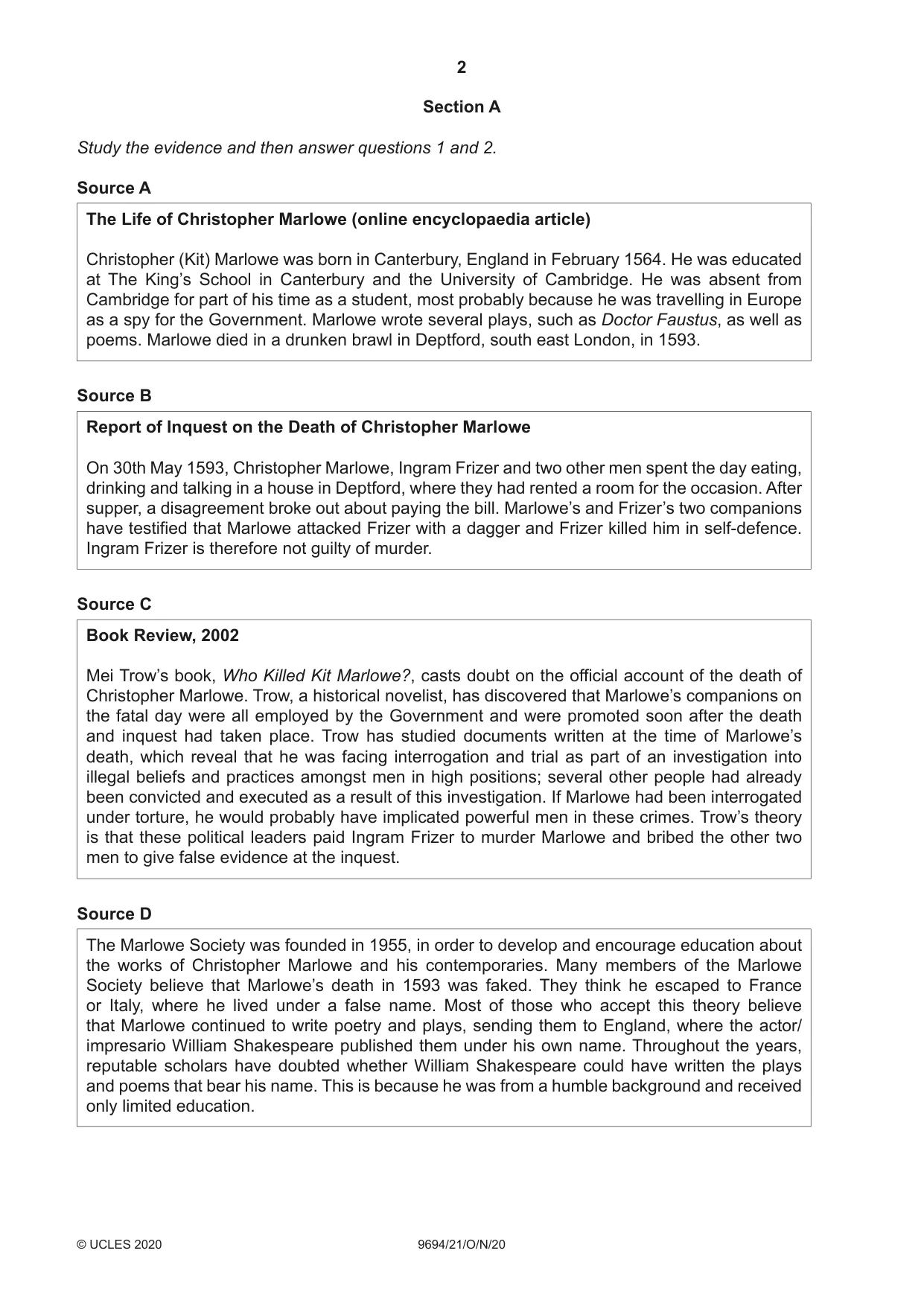
2 9694/21/O/N/20 © UCLES 2020 Section A Study the evidence and then answer questions 1 and 2. Source A The Life of Christopher Marlowe (online encyclopaedia article) Christopher (Kit) Marlowe was born in Canterbury, England in February 1564. He was educated at The King’s School in Canterbury and the University of Cambridge. He was absent from Cambridge for part of his time as a student, most probably because he was travelling in Europe as a spy for the Government. Marlowe wrote several plays, such as Doctor Faustus, as well as poems. Marlowe died in a drunken brawl in Deptford, south east London, in 1593. Source B Report of Inquest on the Death of Christopher Marlowe On 30th May 1593, Christopher Marlowe, Ingram Frizer and two other men spent the day eating, drinking and talking in a house in Deptford, where they had rented a room for the occasion. After supper, a disagreement broke out about paying the bill. Marlowe’s and Frizer’s two companions have testified that Marlowe attacked Frizer with a dagger and Frizer killed him in self-defence. Ingram Frizer is therefore not guilty of murder. Source C Book Review, 2002 Mei Trow’s book, Who Killed Kit Marlowe?, casts doubt on the official account of the death of Christopher Marlowe. Trow, a historical novelist, has discovered that Marlowe’s companions on the fatal day were all employed by the Government and were promoted soon after the death and inquest had taken place. Trow has studied documents written at the time of Marlowe’s death, which reveal that he was facing interrogation and trial as part of an investigation into illegal beliefs and practices amongst men in high positions; several other people had already been convicted and executed as a result of this investigation. If Marlowe had been interrogated under torture, he would probably have implicated powerful men in these crimes. Trow’s theory is that these political leaders paid Ingram Frizer to murder Marlowe and bribed the other two men to give false evidence at the inquest. Source D The Marlowe Society was founded in 1955, in order to develop and encourage education about the works of Christopher Marlowe and his contemporaries. Many members of the Marlowe Society believe that Marlowe’s death in 1593 was faked. They think he escaped to France or Italy, where he lived under a false name. Most of those who accept this theory believe that Marlowe continued to write poetry and plays, sending them to England, where the actor/ impresario William Shakespeare published them under his own name. Throughout the years, reputable scholars have doubted whether William Shakespeare could have written the plays and poems that bear his name. This is because he was from a humble background and received only limited education.
Question paper, page 3
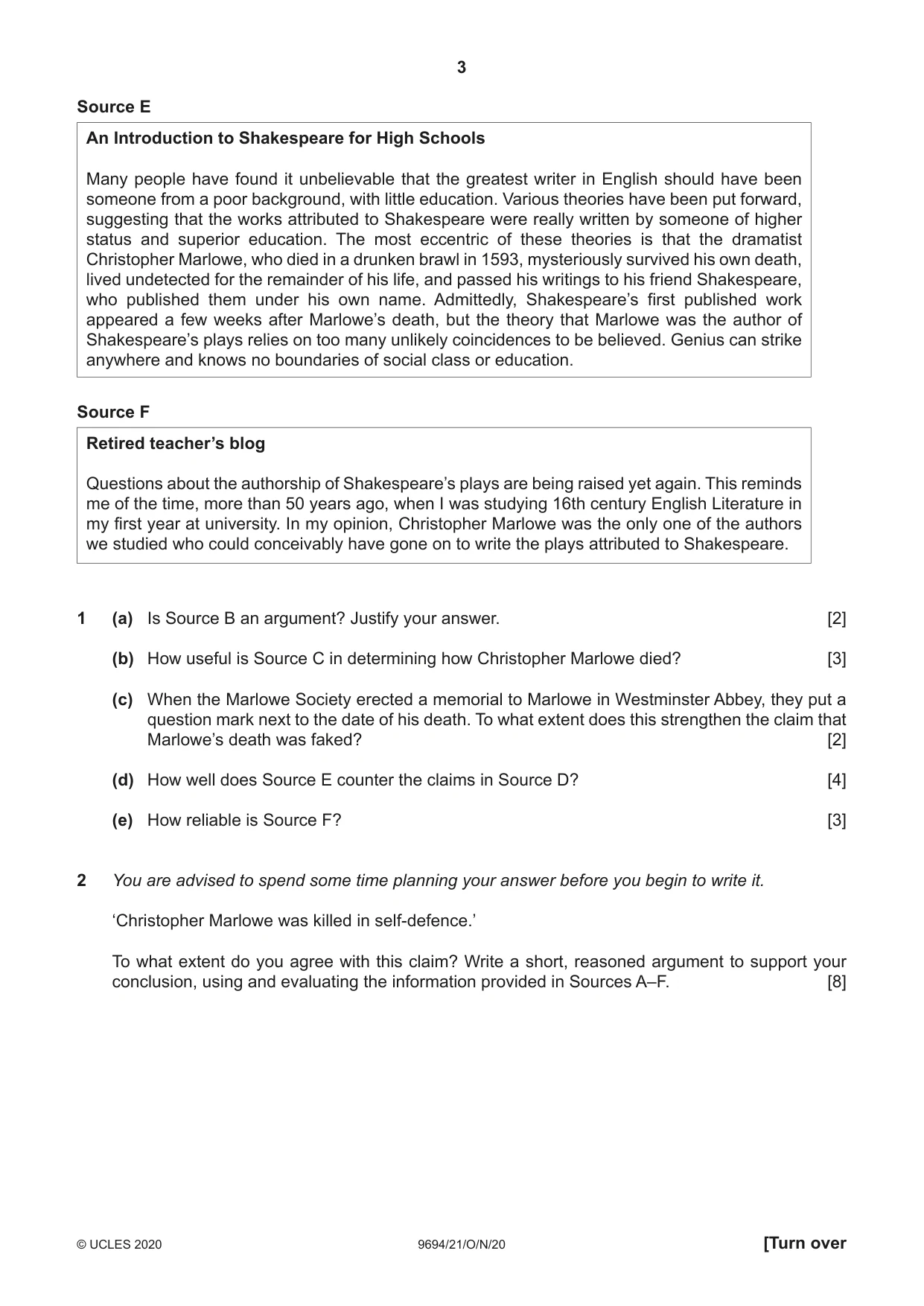
3 9694/21/O/N/20 © UCLES 2020 [Turn over Source E An Introduction to Shakespeare for High Schools Many people have found it unbelievable that the greatest writer in English should have been someone from a poor background, with little education. Various theories have been put forward, suggesting that the works attributed to Shakespeare were really written by someone of higher status and superior education. The most eccentric of these theories is that the dramatist Christopher Marlowe, who died in a drunken brawl in 1593, mysteriously survived his own death, lived undetected for the remainder of his life, and passed his writings to his friend Shakespeare, who published them under his own name. Admittedly, Shakespeare’s first published work appeared a few weeks after Marlowe’s death, but the theory that Marlowe was the author of Shakespeare’s plays relies on too many unlikely coincidences to be believed. Genius can strike anywhere and knows no boundaries of social class or education. Source F Retired teacher’s blog Questions about the authorship of Shakespeare’s plays are being raised yet again. This reminds me of the time, more than 50 years ago, when I was studying 16th century English Literature in my first year at university. In my opinion, Christopher Marlowe was the only one of the authors we studied who could conceivably have gone on to write the plays attributed to Shakespeare. 1 (a) Is Source B an argument? Justify your answer. [2] (b) How useful is Source C in determining how Christopher Marlowe died? [3] (c) When the Marlowe Society erected a memorial to Marlowe in Westminster Abbey, they put a question mark next to the date of his death. To what extent does this strengthen the claim that Marlowe’s death was faked? [2] (d) How well does Source E counter the claims in Source D? [4] (e) How reliable is Source F? [3] 2 You are advised to spend some time planning your answer before you begin to write it. ‘Christopher Marlowe was killed in self-defence.’ To what extent do you agree with this claim? Write a short, reasoned argument to support your conclusion, using and evaluating the information provided in Sources A–F. [8]
Question paper, page 4
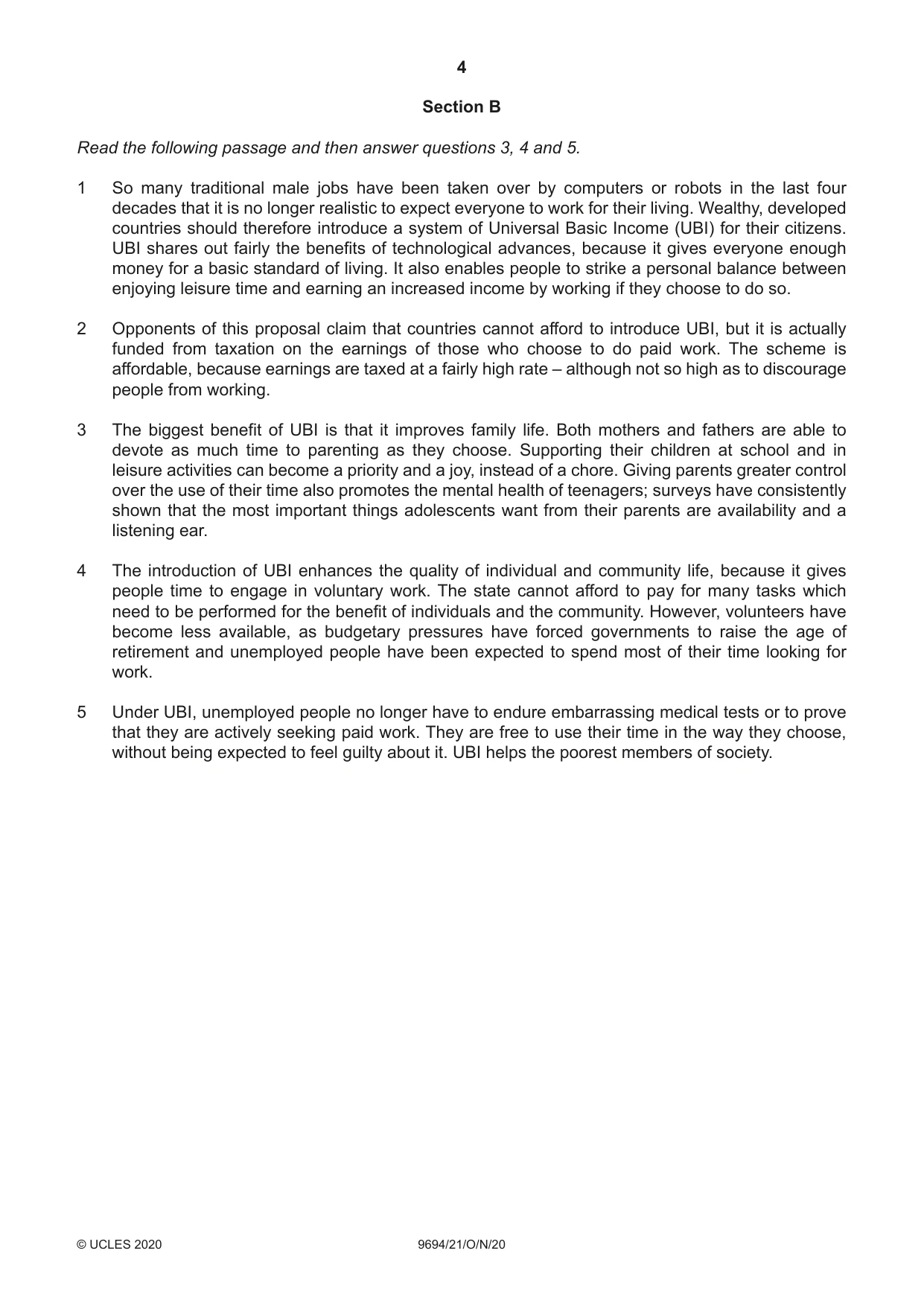
4 9694/21/O/N/20 © UCLES 2020 Section B Read the following passage and then answer questions 3, 4 and 5. 1 So many traditional male jobs have been taken over by computers or robots in the last four decades that it is no longer realistic to expect everyone to work for their living. Wealthy, developed countries should therefore introduce a system of Universal Basic Income (UBI) for their citizens. UBI shares out fairly the benefits of technological advances, because it gives everyone enough money for a basic standard of living. It also enables people to strike a personal balance between enjoying leisure time and earning an increased income by working if they choose to do so. 2 Opponents of this proposal claim that countries cannot afford to introduce UBI, but it is actually funded from taxation on the earnings of those who choose to do paid work. The scheme is affordable, because earnings are taxed at a fairly high rate – although not so high as to discourage people from working. 3 The biggest benefit of UBI is that it improves family life. Both mothers and fathers are able to devote as much time to parenting as they choose. Supporting their children at school and in leisure activities can become a priority and a joy, instead of a chore. Giving parents greater control over the use of their time also promotes the mental health of teenagers; surveys have consistently shown that the most important things adolescents want from their parents are availability and a listening ear. 4 The introduction of UBI enhances the quality of individual and community life, because it gives people time to engage in voluntary work. The state cannot afford to pay for many tasks which need to be performed for the benefit of individuals and the community. However, volunteers have become less available, as budgetary pressures have forced governments to raise the age of retirement and unemployed people have been expected to spend most of their time looking for work. 5 Under UBI, unemployed people no longer have to endure embarrassing medical tests or to prove that they are actively seeking paid work. They are free to use their time in the way they choose, without being expected to feel guilty about it. UBI helps the poorest members of society.
Question paper, page 5
5 9694/21/O/N/20 © UCLES 2020 3 (a) Using the exact words from the passage as far as possible, identify the main conclusion. [2] (b) Using the exact words from the passage as far as possible, identify three intermediate conclusions. [6] (c) Identify the following element in paragraph 2: ‘countries cannot afford to introduce UBI’ [2] (d) Identify an unstated assumption required by the reasoning in paragraph 2. [2] 4 (a) Identify and explain two weaknesses in the reasoning in paragraph 3. [4] (b) Explain how the reasoning in paragraph 4 is weakened by the flaw of confusion of necessary and sufficient conditions. [2] (c) Identify an inconsistency between the reasoning in paragraph 4 and the argument as a whole. [2] 5 You are advised to spend some time planning your answer before you begin to write it. ‘Everyone who is capable of working for their living should do so.’ Write your own short argument to support or challenge this claim. The conclusion of your argument must be stated. Credit will not be given for repeating ideas from the passage. [8]
Question paper, page 6
6 9694/21/O/N/20 © UCLES 2020 BLANK PAGE
Question paper, page 7
7 9694/21/O/N/20 © UCLES 2020 BLANK PAGE
Question paper, page 8
8 9694/21/O/N/20 © UCLES 2020 Permission to reproduce items where third-party owned material protected by copyright is included has been sought and cleared where possible. Every reasonable effort has been made by the publisher (UCLES) to trace copyright holders, but if any items requiring clearance have unwittingly been included, the publisher will be pleased to make amends at the earliest possible opportunity. To avoid the issue of disclosure of answer-related information to candidates, all copyright acknowledgements are reproduced online in the Cambridge Assessment International Education Copyright Acknowledgements Booklet. This is produced for each series of examinations and is freely available to download at www.cambridgeinternational.org after the live examination series. Cambridge Assessment International Education is part of the Cambridge Assessment Group. Cambridge Assessment is the brand name of the University of Cambridge Local Examinations Syndicate (UCLES), which itself is a department of the University of Cambridge. BLANK PAGE
Mark scheme, page 1
This document consists of 9 printed pages. © UCLES 2020 [Turn over Cambridge International AS & A Level THINKING SKILLS 9694/21 Paper 2 Critical Thinking October/November 2020 MARK SCHEME Maximum Mark: 50 Published This mark scheme is published as an aid to teachers and candidates, to indicate the requirements of the examination. It shows the basis on which Examiners were instructed to award marks. It does not indicate the details of the discussions that took place at an Examiners’ meeting before marking began, which would have considered the acceptability of alternative answers. Mark schemes should be read in conjunction with the question paper and the Principal Examiner Report for Teachers. Cambridge International will not enter into discussions about these mark schemes. Cambridge International is publishing the mark schemes for the October/November 2020 series for most Cambridge IGCSE™, Cambridge International A and AS Level and Cambridge Pre-U components, and some Cambridge O Level components.
Mark scheme, page 2
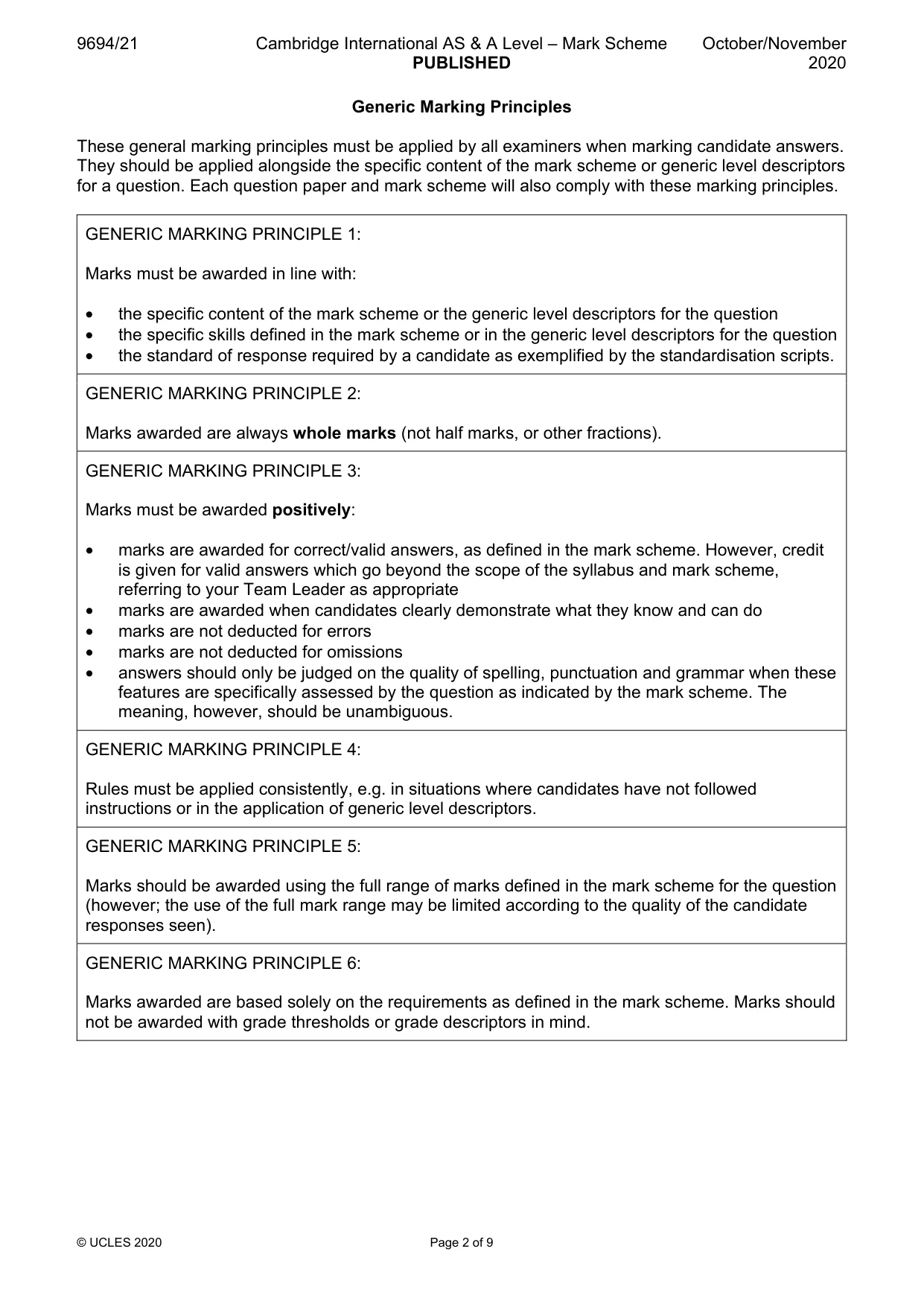
9694/21 Cambridge International AS & A Level – Mark Scheme PUBLISHED October/November 2020 © UCLES 2020 Page 2 of 9 Generic Marking Principles These general marking principles must be applied by all examiners when marking candidate answers. They should be applied alongside the specific content of the mark scheme or generic level descriptors for a question. Each question paper and mark scheme will also comply with these marking principles. GENERIC MARKING PRINCIPLE 1: Marks must be awarded in line with: • the specific content of the mark scheme or the generic level descriptors for the question • the specific skills defined in the mark scheme or in the generic level descriptors for the question • the standard of response required by a candidate as exemplified by the standardisation scripts. GENERIC MARKING PRINCIPLE 2: Marks awarded are always whole marks (not half marks, or other fractions). GENERIC MARKING PRINCIPLE 3: Marks must be awarded positively: • marks are awarded for correct/valid answers, as defined in the mark scheme. However, credit is given for valid answers which go beyond the scope of the syllabus and mark scheme, referring to your Team Leader as appropriate • marks are awarded when candidates clearly demonstrate what they know and can do • marks are not deducted for errors • marks are not deducted for omissions • answers should only be judged on the quality of spelling, punctuation and grammar when these features are specifically assessed by the question as indicated by the mark scheme. The meaning, however, should be unambiguous. GENERIC MARKING PRINCIPLE 4: Rules must be applied consistently, e.g. in situations where candidates have not followed instructions or in the application of generic level descriptors. GENERIC MARKING PRINCIPLE 5: Marks should be awarded using the full range of marks defined in the mark scheme for the question (however; the use of the full mark range may be limited according to the quality of the candidate responses seen). GENERIC MARKING PRINCIPLE 6: Marks awarded are based solely on the requirements as defined in the mark scheme. Marks should not be awarded with grade thresholds or grade descriptors in mind.
Mark scheme, page 3
9694/21 Cambridge International AS & A Level – Mark Scheme PUBLISHED October/November 2020 © UCLES 2020 Page 3 of 9 Annotations In Questions 1, 3 and 4 use to indicate where marks have been awarded. In questions where responses are undeveloped or developed (as defined within the scheme), use 1 tick for undeveloped and 2 ticks for developed. Use to indicate an element of an answer that looks as though it should be credited but is in fact wrong. In Questions 2 and 5 use to indicate ‘conclusion’. Use twice to indicate nuanced conclusion in Question 2. In Questions 2 and 5 use to indicate creditworthy intermediate conclusion. In Questions 2 and 5 use to indicate creditworthy appropriate argument element. In Question 2 use to indicate creditworthy inferential reasoning. In Question 5 use to indicate creditworthy reason used to support a conclusion. In Question 2 use to indicate creditworthy use of source. In Question 2 use to indicate creditworthy evaluation of source. In Question 2 use to indicate creditworthy personal thinking. In appropriate cases, use to indicate significant omission. Not good enough. Benefit of doubt. Use in answers when no other annotations have been used. Use on blank pages. In appropriate cases, use to indicate answers which appear as if they might deserve credit but are incorrect or irrelevant. Highlight Use to indicate answers which are not being considered. Where helpful, use to identify the part of the answer to which another stamp pertains.
Mark scheme, page 4
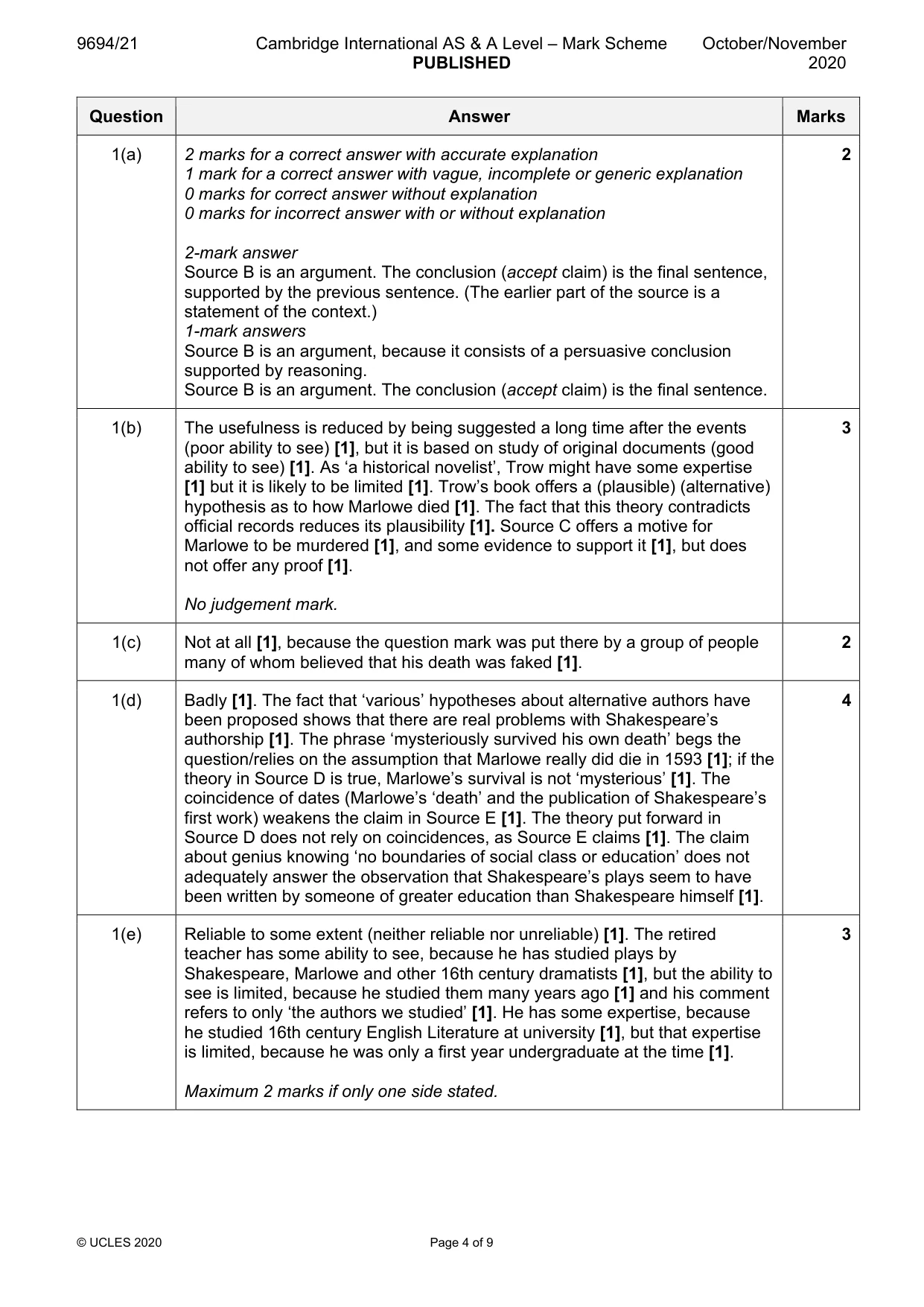
9694/21 Cambridge International AS & A Level – Mark Scheme PUBLISHED October/November 2020 © UCLES 2020 Page 4 of 9 Question Answer Marks 1(a) 2 marks for a correct answer with accurate explanation 1 mark for a correct answer with vague, incomplete or generic explanation 0 marks for correct answer without explanation 0 marks for incorrect answer with or without explanation 2-mark answer Source B is an argument. The conclusion (accept claim) is the final sentence, supported by the previous sentence. (The earlier part of the source is a statement of the context.) 1-mark answers Source B is an argument, because it consists of a persuasive conclusion supported by reasoning. Source B is an argument. The conclusion (accept claim) is the final sentence. 2 1(b) The usefulness is reduced by being suggested a long time after the events (poor ability to see) [1], but it is based on study of original documents (good ability to see) [1]. As ‘a historical novelist’, Trow might have some expertise [1] but it is likely to be limited [1]. Trow’s book offers a (plausible) (alternative) hypothesis as to how Marlowe died [1]. The fact that this theory contradicts official records reduces its plausibility [1]. Source C offers a motive for Marlowe to be murdered [1], and some evidence to support it [1], but does not offer any proof [1]. No judgement mark. 3 1(c) Not at all [1], because the question mark was put there by a group of people many of whom believed that his death was faked [1]. 2 1(d) Badly [1]. The fact that ‘various’ hypotheses about alternative authors have been proposed shows that there are real problems with Shakespeare’s authorship [1]. The phrase ‘mysteriously survived his own death’ begs the question/relies on the assumption that Marlowe really did die in 1593 [1]; if the theory in Source D is true, Marlowe’s survival is not ‘mysterious’ [1]. The coincidence of dates (Marlowe’s ‘death’ and the publication of Shakespeare’s first work) weakens the claim in Source E [1]. The theory put forward in Source D does not rely on coincidences, as Source E claims [1]. The claim about genius knowing ‘no boundaries of social class or education’ does not adequately answer the observation that Shakespeare’s plays seem to have been written by someone of greater education than Shakespeare himself [1]. 4 1(e) Reliable to some extent (neither reliable nor unreliable) [1]. The retired teacher has some ability to see, because he has studied plays by Shakespeare, Marlowe and other 16th century dramatists [1], but the ability to see is limited, because he studied them many years ago [1] and his comment refers to only ‘the authors we studied’ [1]. He has some expertise, because he studied 16th century English Literature at university [1], but that expertise is limited, because he was only a first year undergraduate at the time [1]. Maximum 2 marks if only one side stated. 3
Mark scheme, page 5
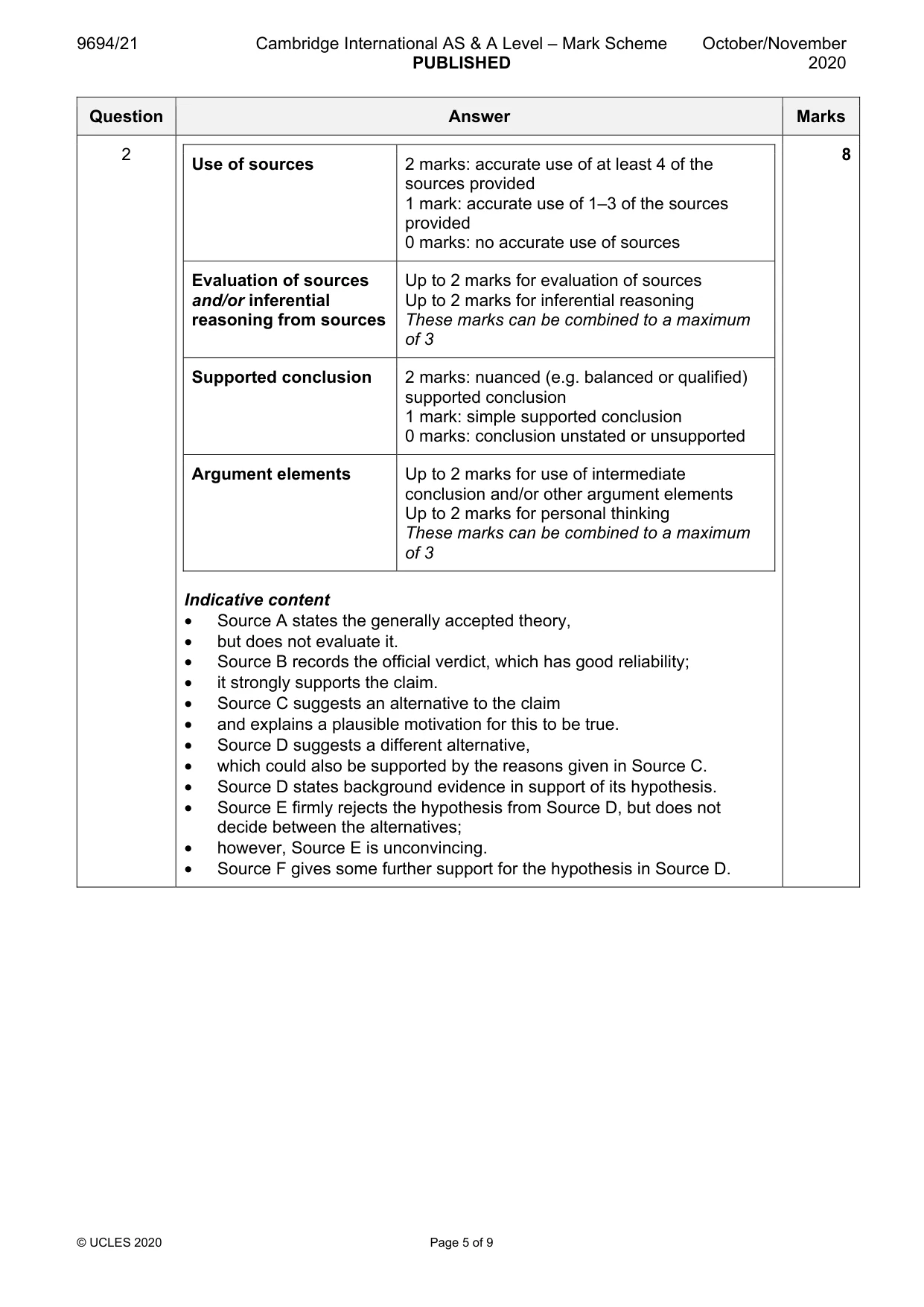
9694/21 Cambridge International AS & A Level – Mark Scheme PUBLISHED October/November 2020 © UCLES 2020 Page 5 of 9 Question Answer Marks 2 Use of sources 2 marks: accurate use of at least 4 of the sources provided 1 mark: accurate use of 1–3 of the sources provided 0 marks: no accurate use of sources Evaluation of sources and/or inferential reasoning from sources Up to 2 marks for evaluation of sources Up to 2 marks for inferential reasoning These marks can be combined to a maximum of 3 Supported conclusion 2 marks: nuanced (e.g. balanced or qualified) supported conclusion 1 mark: simple supported conclusion 0 marks: conclusion unstated or unsupported Argument elements Up to 2 marks for use of intermediate conclusion and/or other argument elements Up to 2 marks for personal thinking These marks can be combined to a maximum of 3 Indicative content • Source A states the generally accepted theory, • but does not evaluate it. • Source B records the official verdict, which has good reliability; • it strongly supports the claim. • Source C suggests an alternative to the claim • and explains a plausible motivation for this to be true. • Source D suggests a different alternative, • which could also be supported by the reasons given in Source C. • Source D states background evidence in support of its hypothesis. • Source E firmly rejects the hypothesis from Source D, but does not decide between the alternatives; • however, Source E is unconvincing. • Source F gives some further support for the hypothesis in Source D. 8
Mark scheme, page 6
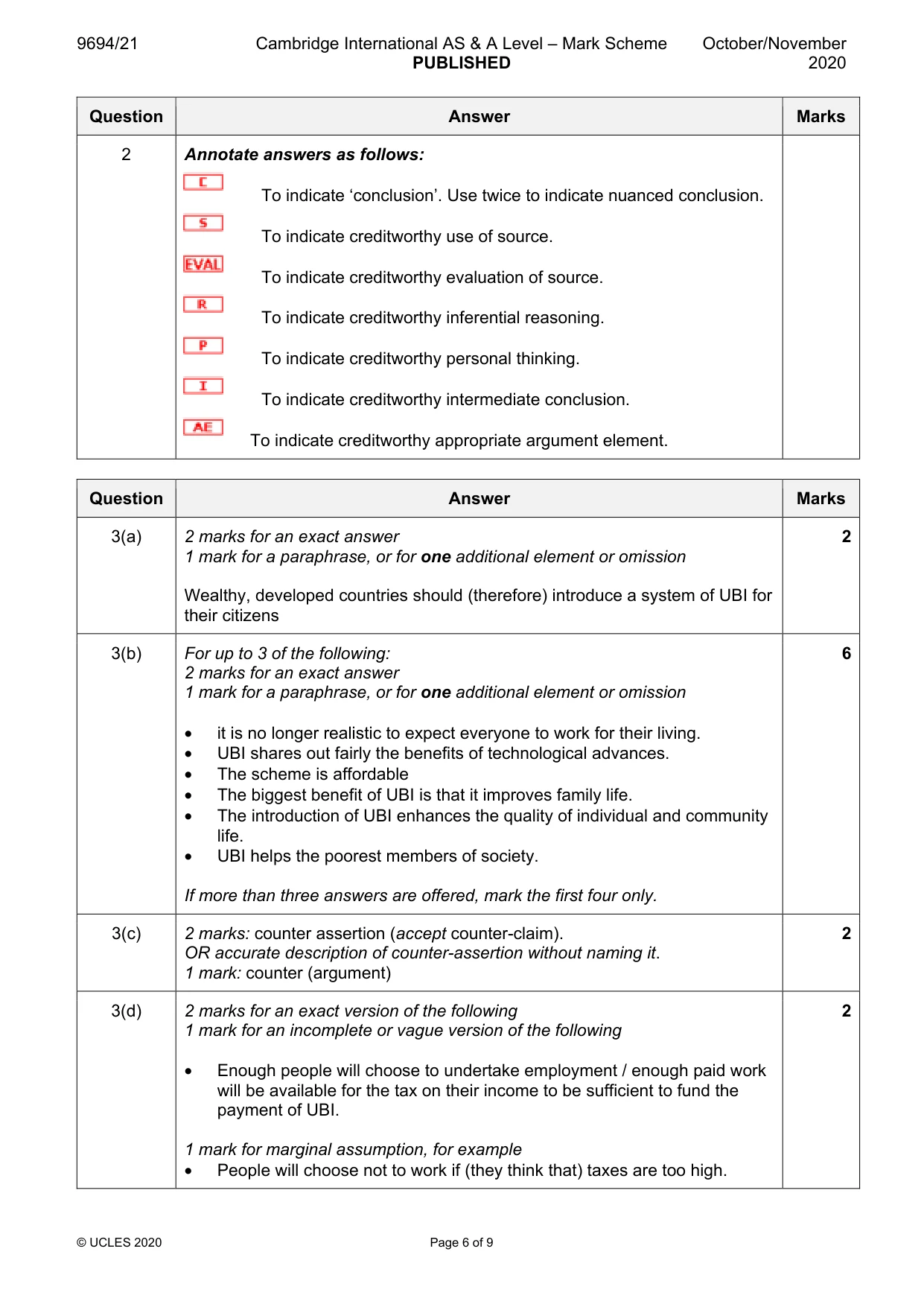
9694/21 Cambridge International AS & A Level – Mark Scheme PUBLISHED October/November 2020 © UCLES 2020 Page 6 of 9 Question Answer Marks 2 Annotate answers as follows: To indicate ‘conclusion’. Use twice to indicate nuanced conclusion. To indicate creditworthy use of source. To indicate creditworthy evaluation of source. To indicate creditworthy inferential reasoning. To indicate creditworthy personal thinking. To indicate creditworthy intermediate conclusion. To indicate creditworthy appropriate argument element. Question Answer Marks 3(a) 2 marks for an exact answer 1 mark for a paraphrase, or for one additional element or omission Wealthy, developed countries should (therefore) introduce a system of UBI for their citizens 2 3(b) For up to 3 of the following: 2 marks for an exact answer 1 mark for a paraphrase, or for one additional element or omission • it is no longer realistic to expect everyone to work for their living. • UBI shares out fairly the benefits of technological advances. • The scheme is affordable • The biggest benefit of UBI is that it improves family life. • The introduction of UBI enhances the quality of individual and community life. • UBI helps the poorest members of society. If more than three answers are offered, mark the first four only. 6 3(c) 2 marks: counter assertion (accept counter-claim). OR accurate description of counter-assertion without naming it. 1 mark: counter (argument) 2 3(d) 2 marks for an exact version of the following 1 mark for an incomplete or vague version of the following • Enough people will choose to undertake employment / enough paid work will be available for the tax on their income to be sufficient to fund the payment of UBI. 1 mark for marginal assumption, for example • People will choose not to work if (they think that) taxes are too high. 2
Mark scheme, page 7
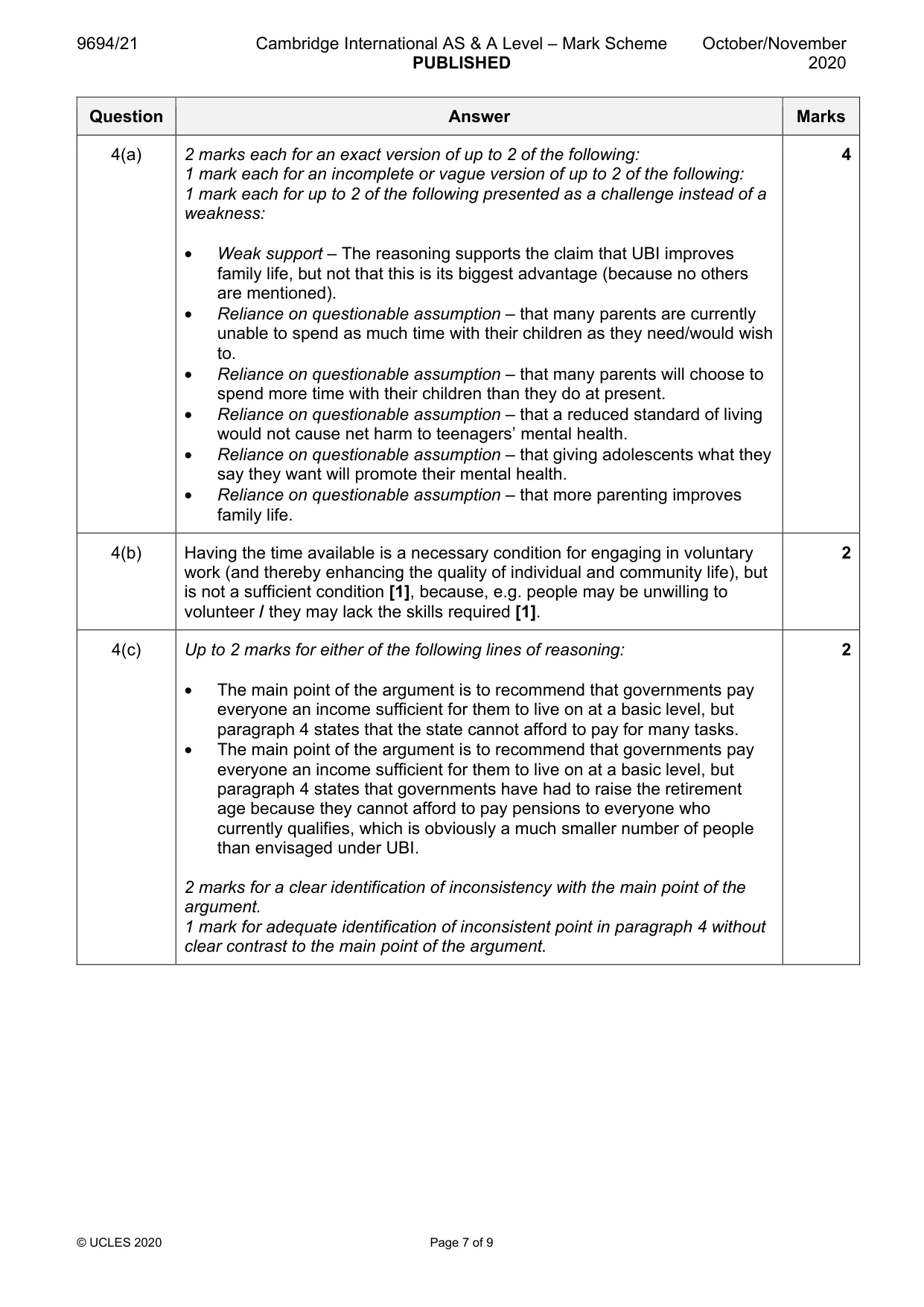
9694/21 Cambridge International AS & A Level – Mark Scheme PUBLISHED October/November 2020 © UCLES 2020 Page 7 of 9 Question Answer Marks 4(a) 2 marks each for an exact version of up to 2 of the following: 1 mark each for an incomplete or vague version of up to 2 of the following: 1 mark each for up to 2 of the following presented as a challenge instead of a weakness: • Weak support – The reasoning supports the claim that UBI improves family life, but not that this is its biggest advantage (because no others are mentioned). • Reliance on questionable assumption – that many parents are currently unable to spend as much time with their children as they need/would wish to. • Reliance on questionable assumption – that many parents will choose to spend more time with their children than they do at present. • Reliance on questionable assumption – that a reduced standard of living would not cause net harm to teenagers’ mental health. • Reliance on questionable assumption – that giving adolescents what they say they want will promote their mental health. • Reliance on questionable assumption – that more parenting improves family life. 4 4(b) Having the time available is a necessary condition for engaging in voluntary work (and thereby enhancing the quality of individual and community life), but is not a sufficient condition [1], because, e.g. people may be unwilling to volunteer / they may lack the skills required [1]. 2 4(c) Up to 2 marks for either of the following lines of reasoning: • The main point of the argument is to recommend that governments pay everyone an income sufficient for them to live on at a basic level, but paragraph 4 states that the state cannot afford to pay for many tasks. • The main point of the argument is to recommend that governments pay everyone an income sufficient for them to live on at a basic level, but paragraph 4 states that governments have had to raise the retirement age because they cannot afford to pay pensions to everyone who currently qualifies, which is obviously a much smaller number of people than envisaged under UBI. 2 marks for a clear identification of inconsistency with the main point of the argument. 1 mark for adequate identification of inconsistent point in paragraph 4 without clear contrast to the main point of the argument. 2
Mark scheme, page 8
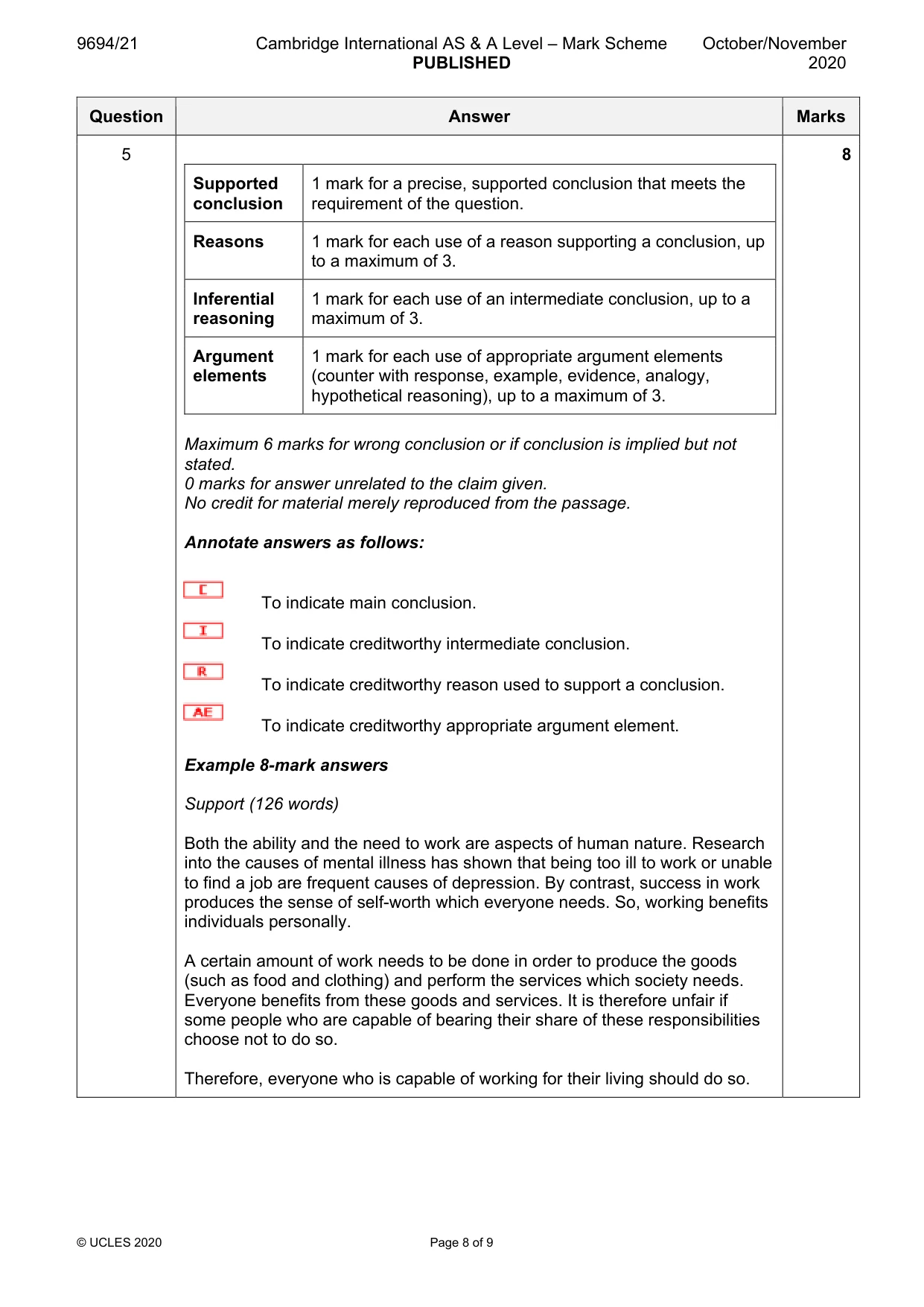
9694/21 Cambridge International AS & A Level – Mark Scheme PUBLISHED October/November 2020 © UCLES 2020 Page 8 of 9 Question Answer Marks 5 Supported conclusion 1 mark for a precise, supported conclusion that meets the requirement of the question. Reasons 1 mark for each use of a reason supporting a conclusion, up to a maximum of 3. Inferential reasoning 1 mark for each use of an intermediate conclusion, up to a maximum of 3. Argument elements 1 mark for each use of appropriate argument elements (counter with response, example, evidence, analogy, hypothetical reasoning), up to a maximum of 3. Maximum 6 marks for wrong conclusion or if conclusion is implied but not stated. 0 marks for answer unrelated to the claim given. No credit for material merely reproduced from the passage. Annotate answers as follows: To indicate main conclusion. To indicate creditworthy intermediate conclusion. To indicate creditworthy reason used to support a conclusion. To indicate creditworthy appropriate argument element. Example 8-mark answers Support (126 words) Both the ability and the need to work are aspects of human nature. Research into the causes of mental illness has shown that being too ill to work or unable to find a job are frequent causes of depression. By contrast, success in work produces the sense of self-worth which everyone needs. So, working benefits individuals personally. A certain amount of work needs to be done in order to produce the goods (such as food and clothing) and perform the services which society needs. Everyone benefits from these goods and services. It is therefore unfair if some people who are capable of bearing their share of these responsibilities choose not to do so. Therefore, everyone who is capable of working for their living should do so. 8
Mark scheme, page 9
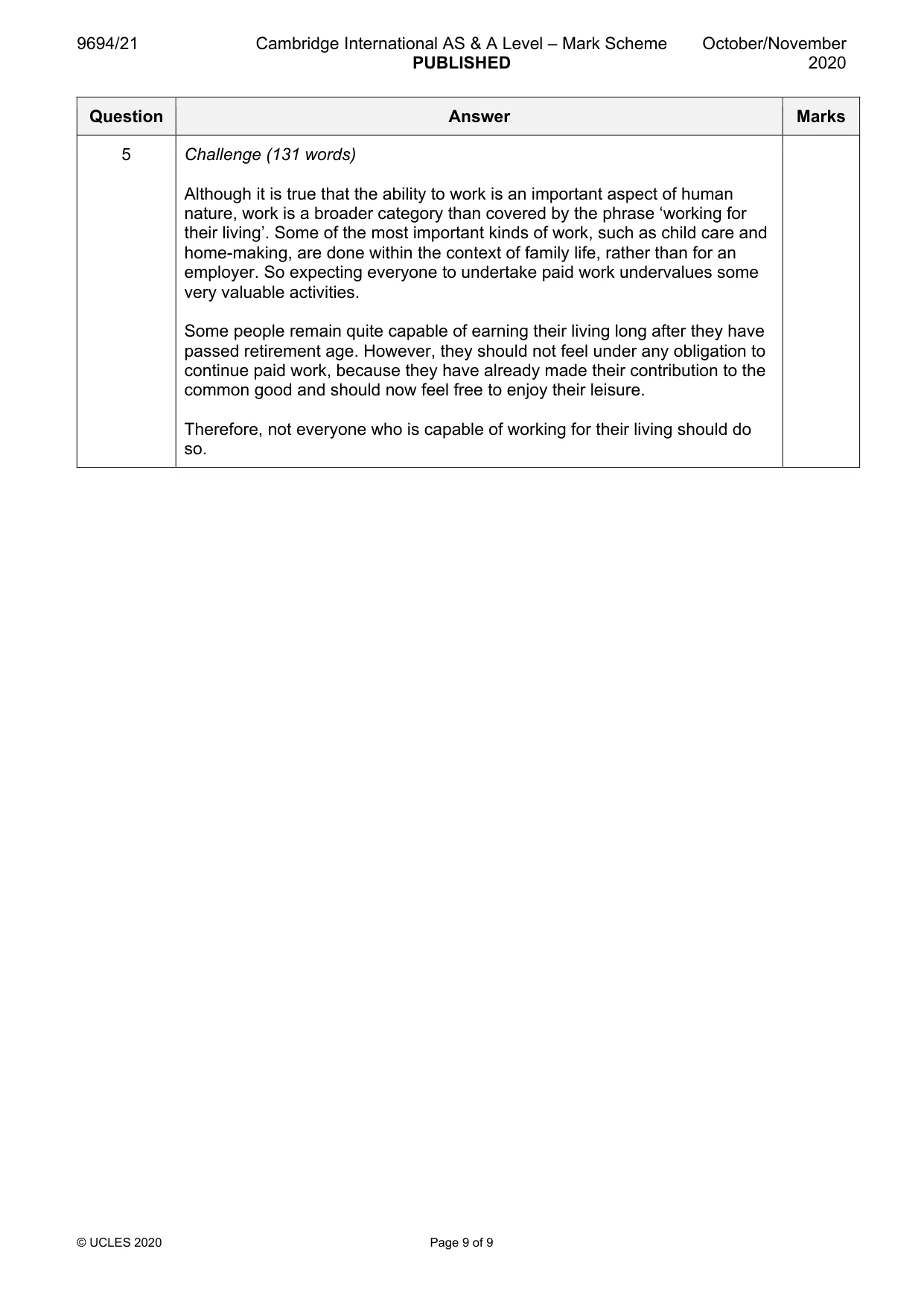
9694/21 Cambridge International AS & A Level – Mark Scheme PUBLISHED October/November 2020 © UCLES 2020 Page 9 of 9 Question Answer Marks 5 Challenge (131 words) Although it is true that the ability to work is an important aspect of human nature, work is a broader category than covered by the phrase ‘working for their living’. Some of the most important kinds of work, such as child care and home-making, are done within the context of family life, rather than for an employer. So expecting everyone to undertake paid work undervalues some very valuable activities. Some people remain quite capable of earning their living long after they have passed retirement age. However, they should not feel under any obligation to continue paid work, because they have already made their contribution to the common good and should now feel free to enjoy their leisure. Therefore, not everyone who is capable of working for their living should do so.
What you needed in this session
Cambridge’s own grade thresholds for 2020 Oct/Nov, Paper 2 · Variant 1. A higher threshold means an easier paper — the bar moves with how the cohort did.